AMC Gremlin buyer's guide
AMC Gremlin -- the model's own buyer's guide: variants, values and what to check.
Years listed: 1971-1976 · Series: Compact
Overview and history
The AMC Gremlin is the car American Motors drew on a sick bag, chopped behind the doors, and then had the nerve to sell for eight years — and the joke, half a century later, is that the basic idea was right. A short-wheelbase, hatch-backed, six-cylinder economy car with a big glass tailgate, cheap mechanical parts shared with a larger family saloon, and enough torque to feel adult in traffic: read that specification without the name attached and it describes the formula that would dominate family motoring for the next forty years. The Gremlin got there first, got there crudely, and got laughed at for it. Buying one now means understanding which parts of that laughter were deserved, which were snobbery, and which were simply the sound of 1970s America adjusting to the end of cheap fuel.
American Motors in 1970 was the smallest of the American manufacturers and the only one that had built its survival on economy cars. The Rambler name had made and then embarrassed the company — by the late 1960s AMC wanted performance credibility, hence the Javelin, the AMX, the Rebel Machine and the SC/Rambler — but its bread and butter remained the Hornet, the compact saloon launched for 1970 to replace the Rambler American. The Hornet was a sound, conventional car: unit construction, a 108-inch wheelbase, coil-sprung independent front suspension, a live rear axle on leaf springs, and AMC's own straight sixes. It was also, crucially, a platform AMC could afford to cut up.
The famous story, retold by designer Richard A. Teague himself, is that the Gremlin's shape began as a sketch on a Northwest Orient air-sickness bag during a flight in 1966, passed to stylist Bob Nixon, who worked out how to shorten a Hornet. The production car did exactly that. The wheelbase came down twelve inches to 96 inches, the body was cut off almost immediately behind the rear wheels in a near-vertical Kamm tail, and the entire front clip, doors, windscreen, dashboard, drivetrain and suspension remained Hornet. What changed was proportion: a long bonnet, a cabin set well back, and then — nothing. No boot, no taper, no apology. Volkswagen's Beetle had proved Americans would buy a car with an odd silhouette if the price and the running costs were right; AMC bet that a chopped Hornet with a hatch would do the same work at a domestic price with domestic parts availability.
The car was launched on 1 April 1970 — April Fool's Day, a choice AMC leaned into rather than hid — initially in two forms. The two-passenger version deleted the rear seat entirely and sold as the cheapest American-built car of its moment, a bare utility hatch with a fixed rear window. The four-passenger version added a folding rear seat and an opening rear window panel that lifted on hinges, because the full lifting tailgate did not arrive until later in the run. Both were novelties in a market where the imported Beetle, and soon the Toyota Corolla and Datsun 510, were teaching buyers that small did not have to mean miserable, and where Ford and General Motors were still a model year away from the Pinto and the Vega. The Gremlin beat both domestic rivals to market by months, and that timing matters to its history: it was not a copy of the subcompact response, it was the opening move.
For 1977 the Gremlin received its only real facelift: a lowered, reshaped nose with a new grille and headlamp treatment, revised tail, larger glass area in the hatch, and — significantly — a genuine four-cylinder option at last, the 2.0-litre Audi-designed engine AMC built under licence, fitted because the sixes could not match the economy figures the imports were advertising. A four-speed manual became more widely available in the later years, and for 1978, the final year, AMC added the Gremlin GT, a flared-arch, spoilered, stripe-heavy attempt to chase the sporty-hatch market the car had helped invent. After 1978 the Gremlin name died, but the car did not: the AMC Spirit, launched for 1979, carried the same basic body forward as the Spirit liftback, with the Gremlin's Kamm tail softened into a longer, more conventional hatch profile. A 1980-dated car offered to you as a Gremlin is therefore a car to identify carefully — by then the showroom successor was the Spirit, and movie-replica and mislabelled listings blur the Pacer, Spirit and Gremlin into one another constantly. Check the VIN plate, the body tag and the title before you check anything else.
That afterlife is the second half of the Gremlin's story. Through the 1980s and 1990s it was a punchline — a byword for 1970s bad taste, bought cheap, run hard and scrapped without sentiment. Exactly because nobody preserved them, a straight, unmolested, rust-light Gremlin is now harder to find than production numbers suggest, and the car's image has completed the familiar arc from joke to period artefact. It appears in films, in advertising, in the background of every visual shorthand for the American 1970s, and values — discussed qualitatively in the Values section below, with the current market figures carried in the block the build appends beneath this guide — have followed that recognition. On this site the current pool is small, eleven cars in total at the time of writing, six listed for sale and five recorded sold, spread across the 1971–76 core years with single later entries, so treat any pool-derived impression as a snapshot of a thin market rather than a census. What the pool does show, consistently with the wider market, is that survivors cluster in the X-packaged, six-cylinder, automatic middle of the range, and that is where a first-time buyer should start looking.
Buy a Gremlin for what it is: the most characterful expression of AMC's parts-bin engineering, mechanically simple to a degree no modern car approaches, and honest about its compromises. Do not buy one expecting a European hot hatch, a muscle car, or an investment-grade rarity. Expect a short, wide, torquey American compact that can be maintained with a basic tool kit, a parts catalogue and patience — provided the shell is sound. Everything in this guide follows from that last clause.
The models
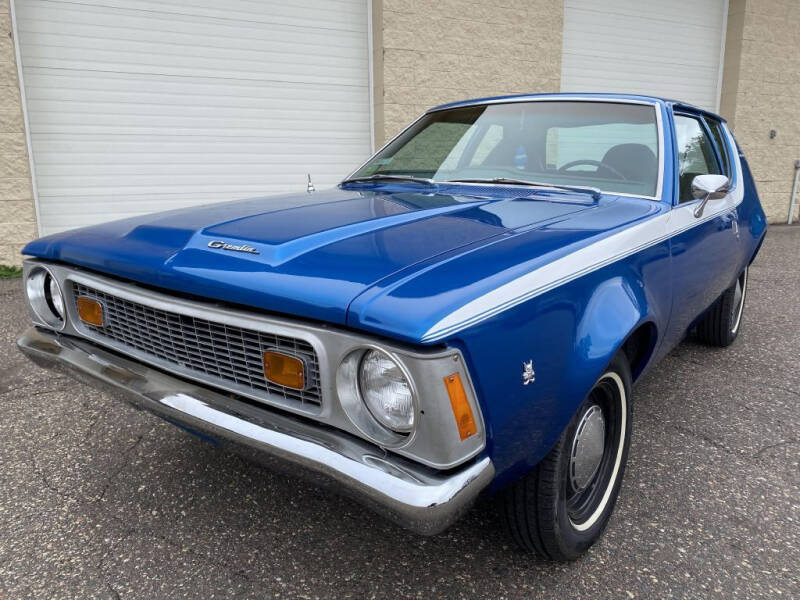
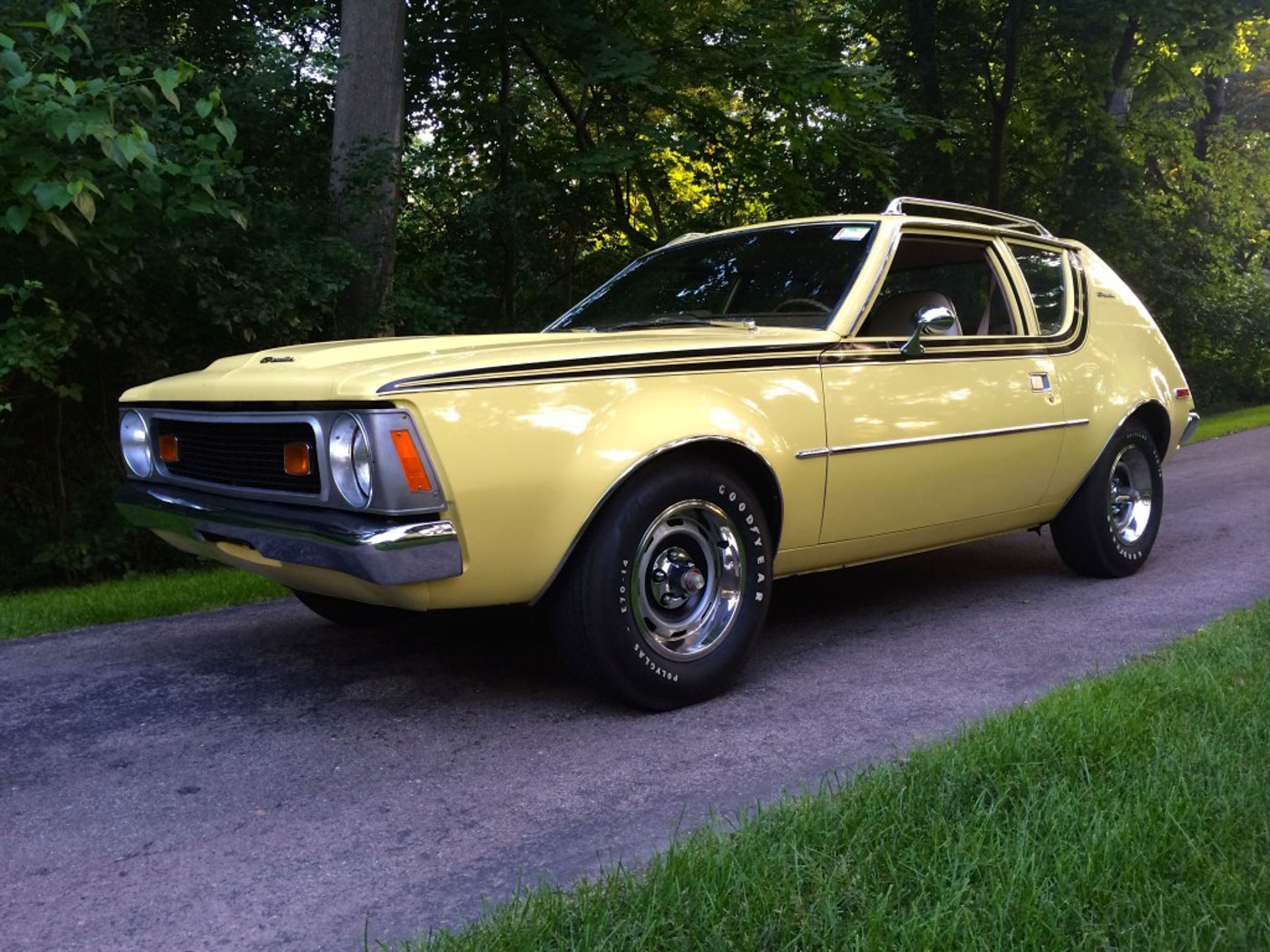
The Gremlin X, offered from 1971 to the end of production, is the package that defines the model's image. It was an appearance and equipment group, not an engine: body side stripes sweeping up over the rear quarter in the famous hockey-stick shape, a blacked-out grille treatment in most years, slot-mag style road wheels, wider tyres, bucket seats, a sports steering wheel and, in many years, a floor-shift and upgraded interior trim. Any engine could sit under an X bonnet, from the 232 six to the 304 V8, so "Gremlin X" in an advertisement tells you about stripes and seats and nothing about performance — ask for the engine code and the VIN. The X is the easiest Gremlin to sell on, the easiest to find parts and reproduction stripes for, and the version the modern market prices most readily. That cuts both ways: it is also the version most often faked from a base car, so compare the stripe style to the model year, check the wheel type, and look for evidence of the original interior.
The Levi's Gremlin, sold from 1973 through 1978, took the X-era formula into the interior. The seats and door panels were trimmed in a blue denim-effect material — in the early cars genuinely associated with Levi Strauss supply, later a denim-look synthetic that wears and fades differently, a distinction a Levi's specialist will make much of and a general buyer can treat as a condition question — with orange stitching, copper-coloured rivet buttons and Levi's tags. Mechanically a Levi's car is whatever engine and gearbox it was ordered with. Its value today is entirely in the survival of that interior: a Levi's car with a torn, faded or replaced cabin is a base Gremlin with a story, while an original, intact denim interior is genuinely difficult to replace like-for-like and is the single strongest originality premium inside the range after the V8.
The V8 cars require a paragraph of their own because they are models in effect if not in name. From 1972 to 1976 the 304 cubic inch AMC V8 was a factory option in any Gremlin, most often ordered in X trim. In net-rated form it made modest headline power by later standards, but in a car of this weight it transformed the performance and the character: strong low-speed torque, a proper V8 exhaust note, and a front end carrying noticeably more weight over the front wheels, with predictable effects on steering effort, front tyre wear and understeer. Factory V8 cars carried the supporting hardware — check for the correct engine bay fittings, the V8's Motorcraft two-barrel carburettor, heavier-duty cooling and the appropriate axle ratio — and a six-cylinder car with a later V8 swap is not the same thing, however well done. AMC engines swap readily within the family, so swaps are common; a swap is not a reason to walk away, but it is a reason to pay swap money, not factory-V8 money, and to inspect the cooling system, front springs and brakes as if they were a conversion, because they are.
| Model | Years | Engine | Output | Built | Character |
|---|---|---|---|---|---|
| Gremlin two-passenger | 1970–1971 | 199 / 232 cu in six | 128 / 145 hp (gross) | Small minority of early production | Cheapest car in America at launch; no rear seat, fixed rear glass; a curiosity now |
| Gremlin four-passenger (base / Custom) | 1970–1978 | 199, 232, 258 cu in six; 2.0-litre four (1977–78) | 128–145 hp (gross, early); about 90–110 hp (net, later) | The bulk of about 671,000 total Gremlins | The honest Gremlin; trim and condition matter more than specification |
| Gremlin X | 1971–1978 | 232, 258 six; 304 V8 (1972–76) | As base car; V8 about 150 hp (net) | Common; the most-sold package | Stripes, slots, buckets; appearance package over any engine — verify, do not assume |
| Levi's Gremlin | 1973–1978 | 232, 258 six; 304 V8 (to 1976) | As base / X | A minority, declining by year | Denim interior is the whole point; value lives or dies with its survival |
| Gremlin V8 (any trim) | 1972–1976 | 304 cu in V8 | About 150 hp (net) | A small minority of production | The quick one; nose-heavy, thirsty, most sought-after — and most often faked by swaps |
| Gremlin GT | 1978 | 258 cu in six (2.0 four also listed) | About 110 hp (net) | One year only, low volume | Flares, spoilers and stripes over standard mechanicals; rarity over performance |

Engines and gearboxes
The AMC straight sixes — 199, 232 and 258
The 199 cubic inch (3.3-litre), 232 cubic inch (3.8-litre) and 258 cubic inch (4.2-litre) sixes are one engine family: AMC's modern straight six, introduced in the mid-1960s with seven main bearings, a cast-iron block and head, hydraulic lifters in most applications, and a reputation for durability that carried the basic architecture, heavily revised, into the Jeep 4.0-litre of the 1990s. In the Gremlin the 199 was the launch economy engine and disappeared early; the 232 was the standard engine for most of the run; the 258, a longer-stroke development, became the increasingly common and ultimately the preferred fitment, standard in the later cars and the GT. All three use a single-barrel Carter carburettor in most Gremlin applications — the Carter YF and its emissions-era derivatives, with the Carter RBS also found — and a single exhaust manifold on the same side of the head as the intake, a siamesed arrangement that defines both the engine's simplicity and its characteristic faults.
Service reality is good. Oil and filter changes are simple, valve clearances are not a routine concern with hydraulic lifters, the distributor is accessible, and the engine bay of a six-cylinder Gremlin is roomy because the shell was designed around it. Plugs, points on early cars, and the carburettor are all reachable without removing anything significant. A straightforward six rebuild by a general machine shop — rebore or hone as required, bearings, timing chain and sprockets, oil pump attention, head skim and valve work — typically falls in the $3,000–5,500 range depending on region and how much ancillary work is included, while a carburettor rebuild with a quality kit and a day's labour sits around $250–500. Budget separately for the exhaust manifold if it is cracked: a good used manifold plus gaskets and studs is a $200–450 job in parts terms before labour, and broken manifold studs can double the time. None of this is cheap in absolute terms, but all of it is ordinary machine-shop work with no marque-specialist premium, which is the Gremlin's central ownership advantage.
The 304 V8
The 304 cubic inch (5.0-litre) AMC V8, offered from 1972 to 1976, belongs to AMC's second-generation V8 family, sharing its architecture with the 290, 343, 360, 390 and 401. It is a cast-iron, pushrod, hydraulic-lifter engine with a Motorcraft 2100 two-barrel carburettor in Gremlin tune, making about 150 hp net and roughly 245 lb-ft of torque — figures that sound mild until you divide them by the Gremlin's weight, at which point the car becomes the quickest thing AMC sold by feel, if not by stopwatch. The V8's character is torque and noise rather than revs; it redlines low, pulls hard from 1,500 rpm, and overwhelms the standard chassis tuning in a way many owners find charming and some find tiresome. Expect heavier steering, more front-end dive and push in corners, and fuel consumption that makes a mockery of the Gremlin's economy-car brief.
Mechanically the 304 is robust and its faults are the family's faults: oil leaks from rocker covers and the rear main seal, timing-chain stretch on high-mileage engines showing as retarded, wandering ignition timing and a slapping noise from the front cover at idle, exhaust manifold gasket leaks at the rear cylinders, and overheating when the larger engine's heat meets a radiator, fan shroud or water pump that has not been maintained — V8 Gremlins need their full shroud and correct fan, and a car missing its shroud will overheat in traffic however clean the core. The 2100 carburettor is one of the best simple two-barrels ever made, rebuildable for roughly $300–550 including a kit and labour, and its characteristic fault is a failed power valve causing rich running and black smoke under load, not the complicated failure sellers sometimes describe. A full 304 rebuild parallels the six at $3,500–6,000, with the premium coming from two heads' worth of valve work and V8 ancillaries rather than any exotic machining. Identity is the V8's biggest buying issue, covered in The models: confirm the engine is a 304 and the car a factory V8 car before paying for either, because 360 and 401 swaps also exist, drive differently, stress the shell and driveline differently, and must be bought knowingly.
The 2.0-litre four
For 1977 AMC, having no competitive small four of its own, built the Audi-designed 2.0-litre overhead-cam engine under licence — the unit known in Europe in Audi and Volkswagen applications and in America also in the Porsche 924 — and fitted it to the Gremlin and other AMC compacts as the economy option. It makes roughly 80–90 hp in Gremlin tune, revs more freely than the sixes, uses a two-barrel carburettor, and returns the best fuel economy of any Gremlin by a clear margin. It is also the engine a generalist buyer should approach most carefully, not because it is fragile but because it is the odd one out: a timing belt where every other Gremlin has a chain, overhead-cam valve gear, different service procedures, and parts supply that runs through both AMC and VW/Audi/Porsche channels depending on the component. A belt of unknown age is a replace-on-purchase item — budget $350–700 for belt, tensioner attention and labour — and an engine that has suffered a belt failure needs its valve and piston contact damage assessed before any other money is spent. Oil leaks from cam and crank seals and a worn distributor drive are the usual age faults. A well-kept 2.0 is a pleasant, light, economical Gremlin; a neglected one can cost more to sort than a six, and there are far fewer of them, so buy on documented condition, not on the economy promise.
Gearboxes
Three gearboxes cover the range, and the choice between them shapes the car as much as the engine does. The standard manual was a Borg-Warner three-speed, fully synchronised on later production, column-shifted on early base cars and floor-shifted on most X and later cars, with ratios chosen for the six's torque rather than for enthusiasm. It is strong, simple and unhurried; its wear shows as jumping out of gear under load, tired synchromesh on second, and sloppy linkage movement that is usually worn bushes and rods rather than internal damage — a linkage overhaul is a $150–400 parts-and-labour job, while an internal rebuild runs roughly $900–1,600. A four-speed manual, from AMC's Borg-Warner T-4 family in the later years and earlier four-speed options in limited applications, became more available from 1976 and is the gearbox enthusiasts seek: it transforms motorway cruising less than you would hope, because top remains direct, but it makes the car markedly more engaging on ordinary roads. Check any four-speed for the correct shifter, for reverse selection, and for the same synchro wear, and budget $1,100–1,900 for a proper rebuild if it crunches into second and third when warm. An overdrive unit, the Laycock-type overdrive offered behind the three-speed manual in the mid-1970s, is a rare and genuinely useful option where it survives and works; where it does not work, you have a three-speed car and an electrical or hydraulic fault to price, not a disaster.
The automatic, and the majority fitment in the surviving pool — in this site's small Gremlin pool, automatic cars outnumber the single listed manual clearly — was sold as Torque-Command. Early cars used a Borg-Warner-sourced unit; from 1972 AMC adopted Chrysler's TorqueFlite architecture, built as the 904 and the heavier 998, and this is the automatic in most Gremlins you will inspect. It is one of the best three-speed automatics of its era: smooth, durable, tolerant, and cheap to service by automatic standards. Its faults are age faults — hardened seals causing delayed engagement from cold, especially into reverse; fluid that has never been changed; a slipping second-gear band needing adjustment or a rebuild; and vacuum modulator and kickdown linkage faults causing wrong or harsh shifts that are adjustment problems, not gearbox failures. A fluid and filter service with band adjustment runs about $180–350; a full TorqueFlite rebuild by a general transmission shop is roughly $1,400–2,400, still without any classic-car premium. Test it as described in How to inspect one: cold engagement, hot shifts, kickdown, and no flare between gears. A good Torque-Command car is the easiest Gremlin to live with; do not let manual-gearbox snobbery push you past a sound automatic toward a tired manual.

Problem areas
Rust: the map
The Gremlin is a unit-construction car with no separate chassis, so rust is structural in a way it is not on a body-on-frame classic, and the Hornet-derived shell has known water paths. Start at the rear, because the Kamm tail creates the car's signature rot. The hatch aperture collects water: check the lower edge of the tailgate itself, the sill panel beneath it, the seal channel all the way around, and the rear valance below the bumper. A bubbling lower hatch edge or a seal channel with filler in it means water has been sitting in the seam, and the same water runs down into the rear quarter panels and the spare-wheel and rear floor area. Lift whatever covers the rear load floor — remembering the two-passenger car has no seat to hide behind — and press the floor around the wheel tubs and at its lowest points. Rear floor and hatch-sill repair, cut out and welded properly, typically runs $800–2,000 depending on how far the seam rot has travelled; a tailgate skin or a sound used tailgate plus paint is a further $400–900, and good used tailgates are not plentiful.
The sills and floors are the second station. The outer rocker panels rot from the inside where mud and water sit behind the front wheels and ahead of the rear wheels, and the floor pans rot above the exhaust run and at the front footwells where windscreen and cowl leaks drip unnoticed for years. Do the test properly: look along the sill from a distance for a wavy line, press firmly along its length, jack the car at the factory jacking points and watch whether the point moves into the sill rather than lifting the car — the sill-jack test referred to again in How to inspect one — and get underneath, or get the car on a lift, to see the floor edges, the subframe rails that carry the front suspension and engine, and the torque-box areas where the rear leaf springs mount. Front subframe and spring-mount rust is the Gremlin's one truly terminal common fault, because repair means jig work, section fabrication and alignment afterwards: $2,000–4,500 for a properly engineered repair is realistic, at which point most Gremlins cease to be economic unless the rest of the car is exceptional. Walk away from spring-hanger rot on a car priced as a driver. By contrast, a single floor pan or an outer sill is ordinary work — $600–1,400 a side welded and painted to a driver standard, more for show finish — and is a negotiating point, not a rejection, if the structure around it is sound.
Work forward. The front wings rot at their rear lower edge, behind the wheel where road dirt packs against the A-post, and at the top around the headlamp and along the wing-to-inner-wing seam. Inner front wings and the cowl plenum area matter more than the shiny outer skin: a leaking cowl floods the footwells, rots the floors from above and soaks the fuse area, and cowl repair is awkward, screen-out work at $1,000–2,500. Check the bottoms of the doors — the Gremlin's doors are long, heavy and shared in spirit with the Hornet, and a door rotted along its lower seam will also have tired hinges and dropped alignment, showing as a door that lifts as it closes. Door skin or lower repair is $500–1,200 a side painted. Check around the windscreen and rear side windows for bubbling under the seals, in the drip rails, and at the base of the A-posts. Finally, check the battery tray and the inner wing beneath it, where acid and water combine, and the front valance and radiator support, which take stone damage and then rust quietly behind the grille.
Engines: wear, leaks and the emissions tangle
The sixes and the 304 wear as described in Engines and gearboxes; the buying task is distinguishing the specific faults. Oil leaks are universal — rocker cover gaskets, the six's side cover, front and rear crank seals, the oil filter and sender — and a light weep on a fifty-year-old AMC engine is normal, while a car leaving a spreading puddle after a test drive has a rear main or a sump problem priced at $450–900 in labour terms because the gearbox or the engine must move to reach it. Blue smoke on start-up that clears is valve-stem seals, a $400–800 job done in place by a shop that knows the trick with compressed air; blue smoke under load that does not clear is rings and bores, and that is the rebuild figure from the engines section. A rhythmic ticking that follows engine speed and is loudest at the exhaust side is most often the exhaust manifold gasket or a cracked manifold, not lifters: feel, carefully and briefly, for chuffing air at the manifold joints on a cold start before the metal gets hot, and shine a torch along the manifold for the hairline crack between the centre ports that sixes are known for. Lifter tick is lighter, comes from under the rocker cover, and often quiets as oil pressure and temperature rise.
The emissions equipment is where Gremlin drivability is won and lost. From the early 1970s onward the cars accumulated EGR valves, air-injection pumps on many applications, evaporative charcoal canisters, heated-air intake systems, vacuum-operated choke pull-offs, dashpots, delay valves and, from 1975, a catalytic converter and unleaded-fuel requirements. None of this is complicated, and all of it is now old rubber, perished diaphragms and seized valves. The classic Gremlin complaint — a flat spot pulling away, a stall at junctions when hot, an idle that hunts — is more often a split vacuum hose, a failed EGR valve stuck open, a choke pull-off diaphragm that will not hold vacuum, or a heat-riser fault than a carburettor body fault. The distinguishing test is a hand vacuum pump: the choke pull-off and the distributor vacuum advance must each hold vacuum applied to them; a diaphragm that leaks down is the fault, whatever the seller says about a recent carburettor rebuild. A full vacuum-hose replacement with correct routing from the under-bonnet diagram, plus an EGR valve, is a $200–500 parts-and-labour exercise that transforms many cars, and it should be your first spend on any rough-running emissions-era Gremlin. A failed catalytic converter on a 1975-on car shows as a sulphurous smell, a rattling substrate and a car that will not pull at higher revs; replacement with a modern universal converter welded in runs about $350–750. Where local rules permit and require nothing, owners sometimes simplify systems, but buy the car as if you must make the fitted system work, because inspection regimes change and originality is easier kept than restored.
Front suspension, steering and the rear axle
The Hornet front suspension — unequal-length wishbones, coil springs, an anti-roll bar on most versions, and drum or optional disc brakes — is conventional, strong and entirely rebuildable, and its condition tells you how the car has been kept. Wear concentrates in the upper and lower ball joints, the wishbone bushes, the anti-roll bar links and bushes, the idler and steering linkage joints on the recirculating-ball steering system, and the wheel bearings. The test is physical: with the front jacked and supported, rock each wheel at top and bottom for ball-joint and bearing play, and at the sides for steering linkage play while an assistant watches which joint moves. Clunks over bumps are usually bushes or anti-roll bar links — a full front bush and ball-joint refresh with quality parts is $700–1,400 in parts and labour before alignment — while a car that wanders and will not hold a straight line after the joints are proven tight has a steering box with wear in it, adjustable to a point and rebuildable at $500–1,000 exchanged or rebuilt. Power steering, where fitted, leaks from the pump, the hoses and the box seals; a pump is a $200–400 item fitted, hoses $100–250 the set, and groaning at full lock with a low reservoir is a leak to find, not a fluid top-up to repeat.
Brakes divide the range. Base cars carried four-wheel drums, self-adjusting in later years, with discs optional at the front on many years and increasingly common, and standard on some later and V8 applications. Drums in good order stop a Gremlin adequately; drums with ovality, leaking wheel cylinders and perished flexible hoses do not, and the system is old enough that any car without documented recent brake work needs a full inspection before it needs anything else. A complete drum-system overhaul — shoes, cylinders, hardware, hoses, master cylinder as required — runs $600–1,100; a front disc service with discs, pads, calipers and hoses is $500–1,000, and a seized caliper or a corroded steel line discovered mid-job is the usual reason the bill grows. The single most dangerous Gremlin fault is a perished flexible brake hose that looks fine outside and is collapsing inside, acting as a one-way valve: the symptom is a brake that drags or a pedal that firms oddly, and the cure is all three hoses, not the one that failed. Handbrakes seize from disuse at the rear cables; cables and freeing work are $150–350.
Interior, hatch and trim
The cabin's fashionable parts are its fragile parts. The padded Hornet dashboard cracks across its top in sun-state cars — cosmetic, and a $150 cover or an $800–1,500 restoration decision, so do not let it distract from the seats. Standard vinyl splits at its seams and the driver's bolster; cloth perishes and fades; and the Levi's denim fades unevenly and wears through at the driver's outer bolster and its rivet stress points. Re-trimming a standard interior in vinyl to a good driver standard runs $1,500–3,000 for seats and door cards; reproducing a Levi's interior faithfully costs more and satisfies less, which is why original Levi's survival carries its premium. Seat frames and foams are shared with other AMC compacts and repairable — a collapsed driver's seat is usually foam and a broken spring, a $250–600 repair inside a retrim.
The hatch is the car's party piece and its main weather path. Gas struts on later full-hatch cars weaken and let the heavy glass hatch fall — $60–140 the pair, ten minutes to fit, and no excuse for a car still propped with wood. Hatch seals perish and are the direct cause of the rear floor rust described above; a seal is cheap if you can find the correct profile, and a car with a new seal and a dry boot floor has been kept by someone who understood the car. Early cars with the lifting rear glass have hinge, latch and seal problems of their own, plus a glass that is far harder to replace than the later hatch glass. Side glass, windscreens and window regulators are generally obtainable through AMC and Hornet channels; the rear side windows and their seals on early cars are the awkward items. Exterior trim — the X stripes are reproduced, badges and grille parts are swap-meet and specialist items, and the big federal bumpers and their rubber strips are heavy, often dented and increasingly hard to replace well. A car missing small trim is not a bargain unless you have already located the trim, because the search, not the price tag, is the cost. Budget trim hunting in months, not dollars.
Electrics and instruments
Gremlin electrics are a simple 12-volt, negative-earth system with an alternator, a fuse box that lives in the footwell's damp on cars with cowl leaks, and age faults rather than design faults. Early cars used points ignition; later cars moved through AMC's electronic systems of the period, ending with more modern solid-state ignition by the final years, and many survivors have been converted one way or another. The buying tests are basic and decisive: the car should charge at about 14 volts at a fast idle with lights on, crank strongly hot and cold, and show no flickering charge light, which on these systems usually means alternator brushes or a failing regulator rather than a battery. A replacement alternator fitted is $220–420; a starter motor $200–380; and a battery is a battery. Non-working gauges are most often sender or earth faults — the fuel sender in the tank is the classic, giving a gauge that reads empty or wanders, and sender replacement means tank access at $250–500 in labour terms. Heater fans, wiper motors and their switches fail with age and are all ordinary AMC parts; a heater matrix leak, announced by a sweet smell and misting screen, is a dashboard-out job at $600–1,100 and is worth testing for on any car by running the heater hot on the test drive. Headlamp and indicator faults on a car that has sat are earth faults at the lamp bodies until proved otherwise. None of this should stop a purchase; all of it should be priced, because electrical niggles on a simple car are a reliable proxy for how long it has been neglected overall.
How to inspect one
- Identity before enthusiasm. Read the VIN plate and the title and compare them digit for digit. Confirm the year from the VIN, not the advertisement — remember that the Gremlin ended in 1978 and its Spirit successor and the Pacer are routinely mislabelled as Gremlins, and that a claimed factory V8, X or Levi's car must be supported by the car itself. Note the engine actually fitted, by its carburettor, manifold arrangement and bay fittings as described in Engines and gearboxes, and record whether it matches the claim.
- Cold start, bonnet up. Insist the engine is stone cold. A healthy six or V8 starts on the choke, fast-idles evenly and settles as it warms. Listen for the exhaust manifold chuff described in Problem areas, watch for blue smoke and note whether it clears, and check the heat-riser movement and the choke operation as the car warms. Refuse a pre-warmed car a second visit only if everything else is perfect — a warm engine hides cold-start, choke and smoke faults.
- The rust walk, rear to front. Follow the rust map in Problem areas in order: hatch edge, seal channel and rear valance; rear load floor lifted and pressed; rear quarters and wheel tubs; then sills, floors and spring mounts underneath. Do the sill-jack test — jack at each factory point and watch that the car lifts rather than the point disappearing into soft sill. Any softness at a rear spring hanger or front subframe rail ends the inspection at driver money, whatever the paint looks like.
- Doors, glass and hatch. Open and close both doors from outside and inside; a door that must be lifted to latch has hinge wear, door-bottom weight from filler or rust, or both. Operate the hatch or the early lifting glass, test the struts by letting the hatch rest unsupported, run a hose or a bucket of water around the hatch seal if the seller permits, and check the rear floor again afterwards. Work every window.
- Underneath. On a lift if possible, on stands or a ramp if not. Read the floors, subframe rails, brake and fuel lines, leaf springs leaf by leaf, spring bushes and shackles, axle leaks, propshaft joints, exhaust condition and the catalytic converter on 1975-on cars. Pull and push each rear wheel for bearing play. This is also where you judge past repairs: neat welded sections with seams sealed are a credit; pop-riveted plates and underseal over rust are a warning about every other repair on the car.
- Front suspension and steering, hands on. Jack the front, support it properly, and rock each wheel top-and-bottom and side-to-side as described in Problem areas, while your friend identifies which joint moves. Turn the steering lock to lock and feel for tight and loose patches that indicate steering-box wear. Check tyre wear patterns — feathered front edges confirm the play you just felt.
- Engine health checks. With the engine warm, remove the oil filler cap and look for emulsion; watch the radiator neck or header for bubbles at idle; check that the cooling system does not pressurise instantly from cold on a restart. Test the choke pull-off and vacuum advance with the hand vacuum pump — both must hold vacuum, the distinguishing test from the emissions section of Problem areas. Note oil leaks after the run, not before it.
- Gearbox, from cold. On an automatic, engage drive and reverse from cold and time the engagement: a long delay, especially into reverse, is the hardened-seal fault described in Engines and gearboxes. On a manual, select every gear at rest, feel the linkage slop, and note whether the seller's claimed four-speed or overdrive is actually present and actually selects. Check the fluid colour and smell on an automatic's dipstick; dark, burnt-smelling fluid on a car with no service history prices a rebuild into your offer.
- The test drive, deliberately routed. Drive at least twenty minutes: cold running and choke behaviour first, then town traffic for the cooling system and the hot idle, then a faster road for steering wander, axle whine, propshaft vibration and brake pull. Brake firmly from speed several times — the car should stop straight, without the dragging or odd pedal feel that betrays a collapsing flexible hose. Test the automatic's kickdown and every manual gear under load, listening for a manual box jumping out of gear on the overrun.
- Heat, electrics and instruments under load. Run the heater fully hot and smell for the sweet coolant odour of a matrix leak. Switch on lights, wipers, fan and indicators together and watch the charge behaviour; check every gauge against reality, especially fuel and temperature. Test the handbrake on a slope.
- Interior and package verification. Sit in the back as well as the front. On a Levi's car, examine the denim at the driver's bolster, seams and rivets in daylight and decide honestly whether it is original and saveable, because that decision is most of the car's value. On an X, cross-check stripes, wheels, seats and steering wheel against the year. Check seat frames by rocking them, and the headlining, dash top and door cards in that order.
- Paperwork and the second look. Service history on a Gremlin is usually a folder of parts receipts rather than stamps; read it for pattern — regular oil, brake and cooling work matters more than a single large bill. Confirm the title is clean and in the seller's name, that the numbers match step 1, and then walk around the car once more in different light before you talk money. The cars that survive this checklist with only ordinary faults are the cars to buy; the checklist's purpose is to make sure the faults are ordinary.

Values
The build appends the current market block beneath this guide — the listed-now summary and the recorded-sales evidence — and that block, refreshed at every build, is where the figures live. This section teaches you how to read it, because with a Gremlin the spread inside any headline figure is wider than the figure itself, and the reasons for the spread are stable even when the numbers move.
The first driver is the shell, and it is not close. A Gremlin's mechanical parts are cheap and its trim is findable, but structural welding is priced by the hour like any other car's, and the car's market ceiling is low enough that a rotten car cannot be made good economically. In the recorded market that produces a condition spread far wider than for most classics: a sound, original, driving car and a shiny car with soft spring mounts are separated not by a percentage but by a category — one is a car, the other is a parts source with good paint. When you compare a car in front of you with the market block, compare it first on the rust map in Problem areas, and only then on specification. A car priced at the top of the range with undocumented floors should be valued as a mid-range car until the underside is proved.
The second driver is specification, in a settled order. Factory V8 cars carry the clearest premium, for performance and rarity together, and the premium is justified only by a verified factory car — the market block cannot tell a factory 304 from a swap, so discount every unverified V8 claim to six-cylinder money in your own arithmetic. The X package carries a smaller, reliable premium because it is the image of the car and because it is what most buyers came looking for. An original Levi's interior carries a premium that is really a condition premium in disguise: it applies in full to an intact cabin and evaporates entirely on a retrimmed or torn one. The GT, one year only, trades on rarity and appearance to a narrow audience of committed AMC buyers — it can take longer to sell than a common X even at a fair price, because the buyer pool is thinner. Early small-bumper cars attract the purist; late facelift cars attract the driver; neither group pays the other's premium, so a seller asking early-car money for a late car, or the reverse, is usually waiting for a specific buyer rather than describing the market.
The third driver is the project-versus-driver gap, which on a Gremlin is unusually honest. Because parts are affordable and the mechanical work is generalist work, a non-running but structurally sound Gremlin is genuinely worth a substantial fraction of a driving one — the cost to recommission it is knowable and bounded, as the job ranges in this guide show. The reverse does not hold for bodywork: a running car with structural rust is worth project money regardless of how sweetly the engine runs, because the welding bill is the one number that can exceed the car's finished value. Read asking prices with that asymmetry in mind. Sellers price the engine they can demonstrate; you should price the shell you have inspected.
Parts and ownership
Service parts are straightforward. Filters, plugs, points and condensers for early cars, caps, rotors, leads, water pumps, thermostats, hoses, belts, brake shoes, pads, cylinders, calipers, shock absorbers, ball joints, bushes and steering joints are all obtainable without drama, most of them through ordinary American parts channels because the Hornet family sold in volume and the Jeep afterlife kept the six in production. A routine service — oil, filter, plugs, points or ignition check, air filter, and a grease and inspection round — is a $180–350 exercise at a general shop, less done at home in an afternoon, which is the way most Gremlins are kept. The Carter and Motorcraft carburettors are supported by kit manufacturers and by rebuilders; the TorqueFlite automatic is supported by every transmission shop in America. There is no Gremlin job a competent general classic shop cannot do, and no reason to pay a marque-specialist labour premium for mechanical work. Save the specialists for knowledge, not labour: for identifying the correct part, the correct stripe, the correct sender, the first time.
Wear and age parts sit in the middle. Alternators, starters, radiators, heater matrices, fuel senders, window regulators and wiper motors are available new, rebuilt or good-used depending on the item, at the prices indicated in Problem areas. Suspension springs, exhaust systems and manifold parts are obtainable, with exhaust manifolds for the six the item most likely to involve a search for a sound used casting. The 2.0-litre four's parts run through two channels — AMC listings for the installation parts, VW/Audi and Porsche 924 channels for many engine internals — and owners of those cars do best to join the specialist knowledge base early rather than discover the cross-references one breakdown at a time. V8 owners have the easiest time of all on engine parts, because the AMC V8 family is well served by the performance aftermarket as well as the restoration trade, though Gremlin-specific V8 installation parts, like the correct shroud and mounts, are car-specific and should be kept, not discarded, during any work.
Body and trim are the constraint. Front wings, doors and bonnet panels are Hornet-shared at the front and findable; the Gremlin-specific rear quarters, tailgate, hatch glass and rear panels are the scarce sheet metal, and rust-free used examples command patience more than money. Reproduction support concentrates where demand is: X stripe kits, weatherstrip in the common profiles, Levi's-adjacent materials, badges and lenses are reproduced or stocked by the AMC specialists, while a perfect dashboard pad, an early lifting rear glass or a specific year's grille can be a season's hunt. The ownership rule follows directly: buy the car with the best shell and the most complete trim you can find, even at the cost of mechanical work, because you can buy an engine rebuild on a date of your choosing and you cannot buy a tailgate on any date at all. Owners who reverse that order spend their ownership searching; owners who follow it spend their ownership driving.

Which one to buy
There is no bad Gremlin specification, only bad Gremlins — rotten shells, faked packages and neglected emissions plumbing wearing any badge in the range. Choose the variant that matches the life you intend for the car, then buy the best example of it your budget reaches, using the inspection order in How to inspect one without shortcuts.
- The all-rounder: a 258 six with the Torque-Command automatic, in X trim, from the middle years. The strongest engine of the sixes, the best automatic of its era, the package the market understands, and parts for everything. This is the Gremlin to recommend to a first-time buyer without qualification.
- The purist's buy: an early 1970–72 small-bumper car, six-cylinder, manual or automatic. The launch shape uncorrupted, the simplest specification, and the car as Teague and Nixon drew it. Accept the early lifting glass, the cruder trim and the gross-era tuning as the price of purity.
- The character buy: a Levi's car with its original denim interior intact. Buy it only after the daylight interior inspection in step 11 — the interior is the car. A Levi's with a replaced cabin is a base Gremlin, and should be priced as one however good the story sounds.
- The performance buy: a verified factory 304 V8 car, 1972–76, ideally in X trim. Verify the factory fitment before paying the premium, budget for cooling-system perfection, and accept the nose-heavy handling and the thirst as part of the package. A documented swap car at swap money can be just as much fun; a swap at factory money is the range's most expensive mistake.
- The value buy: a 1977–78 facelift six, base or X trim. The least fashionable cars in the range and the most usable — best sealing, tidiest electrics, easiest manners — routinely overlooked beside early and V8 cars. If you intend to drive distance, start here.
- The rarity buy: a 1978 Gremlin GT, or a surviving two-passenger car. Buy either for what it is — a one-year trim exercise, or the launch curiosity — with full knowledge that rarity in this range means a thin resale audience as well as a thin supply.
- The economy buy: a 2.0-litre four, 1977–78, with documented belt history. The lightest, most economical Gremlin, bought strictly on paperwork and condition, with a belt change budgeted on purchase if its age is not proven.
The overriding rule: buy the shell, then the package, then the engine — in that order, every time. A sound, dry, honestly repaired Gremlin with the wrong engine is a good car you can improve; a rotten Gremlin with the right engine, the right stripes and the right story is a welding bill wearing a costume. Inspect the rust map first, verify the package second, and let the engine — the cheapest part of a Gremlin to fix — come last in your decision and last in your budget.
See the 6 Gremlin cars currently listed.
What they sell for: Gremlin sale prices.