
AMC Javelin buyer's guide
AMC Javelin -- the model's own buyer's guide: variants, values and what to check.
Years listed: 1968-1973 · Series: AMX/Javelin
Overview and history
The Javelin is the car American Motors built to prove it could do more than sensible. AMC was the smallest of the American makers, a company built on Rambler economy cars, and by the middle of the 1960s that was becoming a problem: the youth market wanted Mustangs, Camaros and Barracudas, and AMC had nothing to sell them. The Javelin, launched for the 1968 model year and sold through 1974, was the answer — a four-seat pony car on a 109-inch wheelbase, styled under Richard A. Teague, and engineered to take every engine AMC made, from a thrifty six to the 390 and later the 401 V8s that powered the company's Trans-Am racers. There are two distinct cars under the one name, and a buyer should never confuse them. The first generation, 1968 to 1970, is the smaller, cleaner car: a long hood, a short deck, a semi-fastback roof and restrained detailing that has aged better than most of its rivals. The second generation, 1971 to 1974, is a bigger, heavier and much more flamboyant machine, famous for the raised humps moulded over its front wheel arches, a longer wheelbase stretched to 110 inches, and a cabin moved towards a Corvette-style twin-cockpit layout. Both are unit-construction cars — AMC had built unibodies for decades and did not make a separate-chassis car — which makes the shell itself the structure, and rust the subject that decides almost every purchase.
The Javelin was never a badge-engineered afterthought. AMC raced it seriously and successfully: under Mark Donohue and Roger Penske, Javelins won the SCCA Trans-Am manufacturers' championship in 1971 and 1972 against factory-backed Mustangs, Camaros and Challengers, and the 1970 Donohue signature edition and the later Go Package cars are direct road-going fallout from that programme. That competition record is why the big-engine Javelins are proper collector cars rather than period curiosities, and it is the first thing to understand about the model's values: a genuine 390 or 401 four-speed car lives in a different market from a six-cylinder automatic wearing the same badges.
At the other end of the range, most Javelins were ordinary family transport. The six-cylinder and small-V8 automatics outsold the performance cars, were used as everyday cars in the salt belt, and were worth very little for a very long time. That defines the market today: the mechanicals are conventional, tough and well understood, parts support is thinner than for a Mustang but far better than most buyers fear, and the spread between a good car and a bad one is almost entirely shell condition, originality and deferred maintenance.
One identity warning belongs at the front of this guide. The AMX of 1968 to 1970 is not a Javelin trim level: it is a separate two-seat car on a shortened 97-inch wheelbase, built by cutting twelve inches out of the Javelin behind the front seats. From 1971 the AMX name became a performance trim package on the Javelin itself. A 1968 to 1970 car described as a Javelin AMX is therefore either an AMX or a Javelin, never both, and the wheelbase settles it in ten seconds with a tape measure.

The models
Every Javelin is a two-door hardtop coupe with four seats; there was no convertible and no fastback-versus-notchback choice of the kind Ford offered. The range divides by generation first, then by trim, then by engine — and for value, the engine matters more than the trim. Trim levels ran from the base Javelin through the better-finished SST on the first-generation cars, and through base, SST and Pierre Cardin editions on the second generation, with the AMX as the performance flagship from 1971. The table below covers the versions a buyer will actually meet. Outputs are period SAE gross figures to 1971 and SAE net figures from 1972, which is why later cars look weaker on paper than they feel on the road — the measuring method changed, not just the engines.
| Model | Years | Engine | Output | Built | Character |
|---|---|---|---|---|---|
| Javelin base / SST, six | 1968–1974 | 232 or 258 six | 145 hp gross (232, early) | The volume of the range | The honest cruiser; value lives in shell condition |
| Javelin 290 / 304 V8 | 1968–1974 | 290, then 304 V8 | 200–210 hp gross | Common | The small-V8 driver; smooth, simple, underrated |
| Javelin 343 V8 | 1968–1969 | 343 V8 | 235–280 hp gross | Two years only | The forgotten middleweight; strong and scarce |
| Javelin 360 V8 | 1970–1974 | 360 V8 | 245–285 hp gross, then net | Common in Gen 2 | The sweet-spot performance car, especially with the Go Package |
| Javelin 390 V8 | 1968–1970 | 390 V8 | 315–325 hp gross | Limited | The first-generation flagship; forged internals, real rarity |
| Javelin AMX 401 | 1971–1974 | 401 V8 | 330 hp gross, then 255 hp net | Flagship only | The second-generation hero car; the Trans-Am connection |
| Javelin SST Donohue | 1970 | 360 or 390 V8 | 285–325 hp gross | About 2,500 | Spoiler, ram-air hood and a signature; verify everything |
| Javelin Pierre Cardin | 1972–1973 | Six, 304 or 360 V8 | As donor car | Limited run | A fashion interior on a standard car; originality is the whole value |
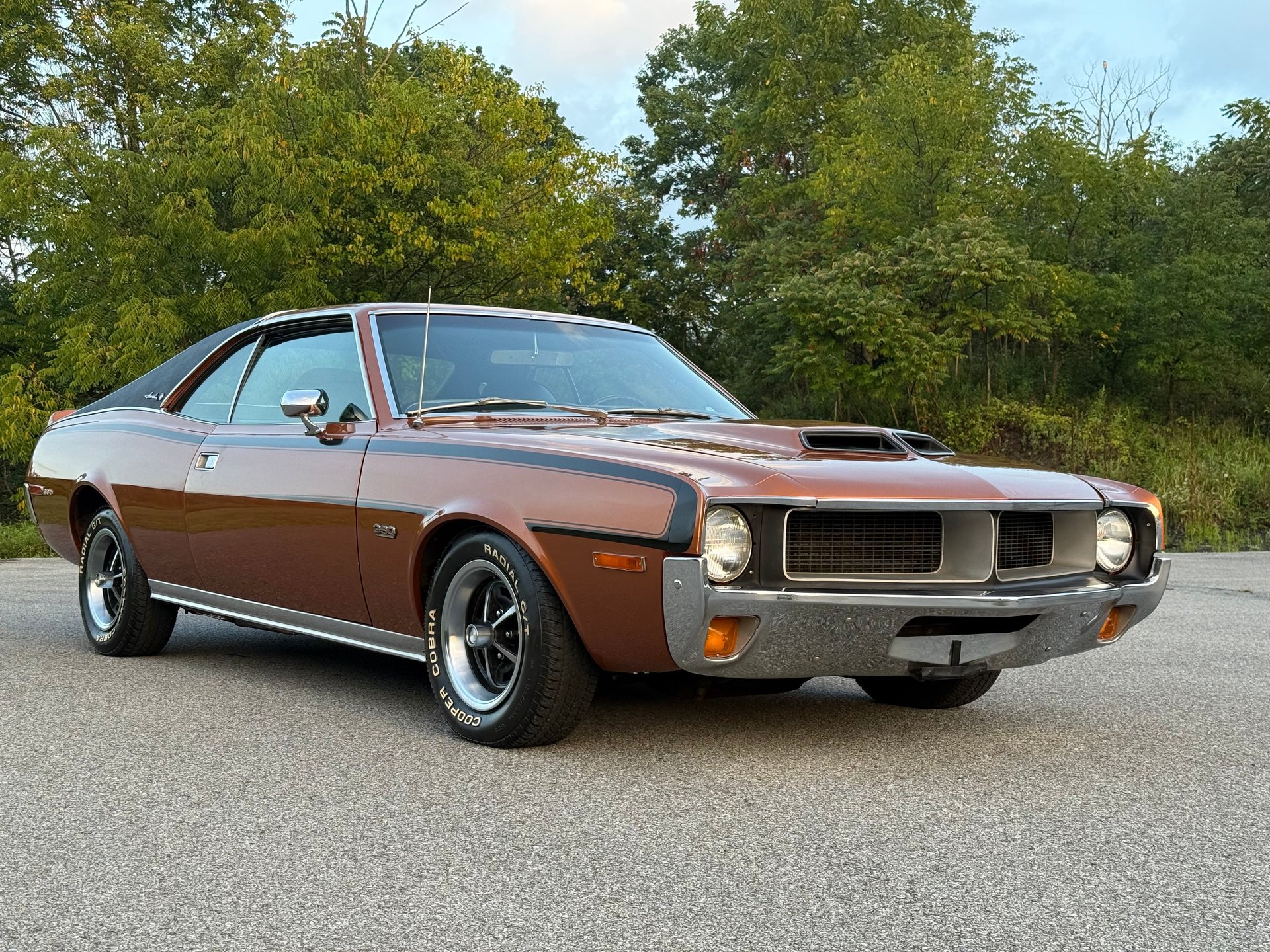
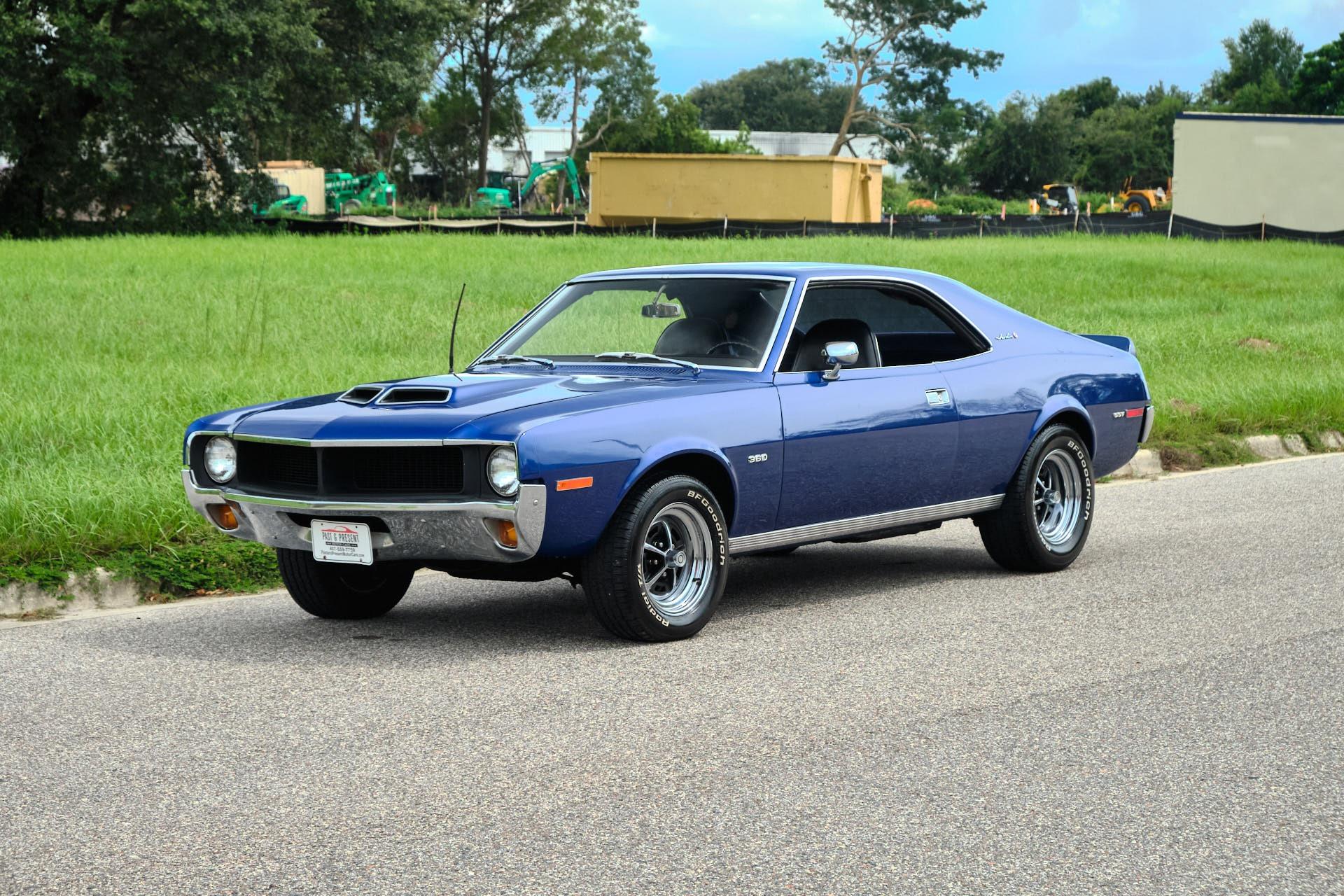
The first generation, 1968 to 1970. The launch cars came as base and SST, the SST adding plusher trim, individual reclining seats and brightwork. Engines ran from the 232 six through the 290 and 343 V8s, with the 390 arriving part-way through 1968 as the top option. The 1969 cars are much the same shell with revised trim and the famous Big Bad colours — Big Bad Blue, Big Bad Green and Big Bad Orange, offered with colour-keyed bumpers on mid-1969 cars and now chased hard by collectors when genuine. The 1970 car is the connoisseur's first-generation Javelin: a one-year-only restyle with a new grille and tail, a revised front suspension, the new-generation V8s (304, 360 and a one-year 390), a functional ram-air hood option, and the Donohue edition. Because 1970 shares so little trim detail with 1968 and 1969, a complete 1970 is worth more than a slightly better but incomplete 1969 to anyone who has priced the missing parts.
The Donohue car, honestly described. The 1970 Mark Donohue Javelin SST was built to homologate the Trans-Am car's rear spoiler, and carries the ducktail spoiler, the ram-air hood and a handling package with either the 360 or the 390. The trap: the spoiler and hood could also be ordered, and have been added to ordinary cars ever since. Pay a Donohue premium only against paperwork — a build record, an original window sticker or a documented chain of history — never against the spoiler alone. The signature on it is a decal, and decals are cheap.
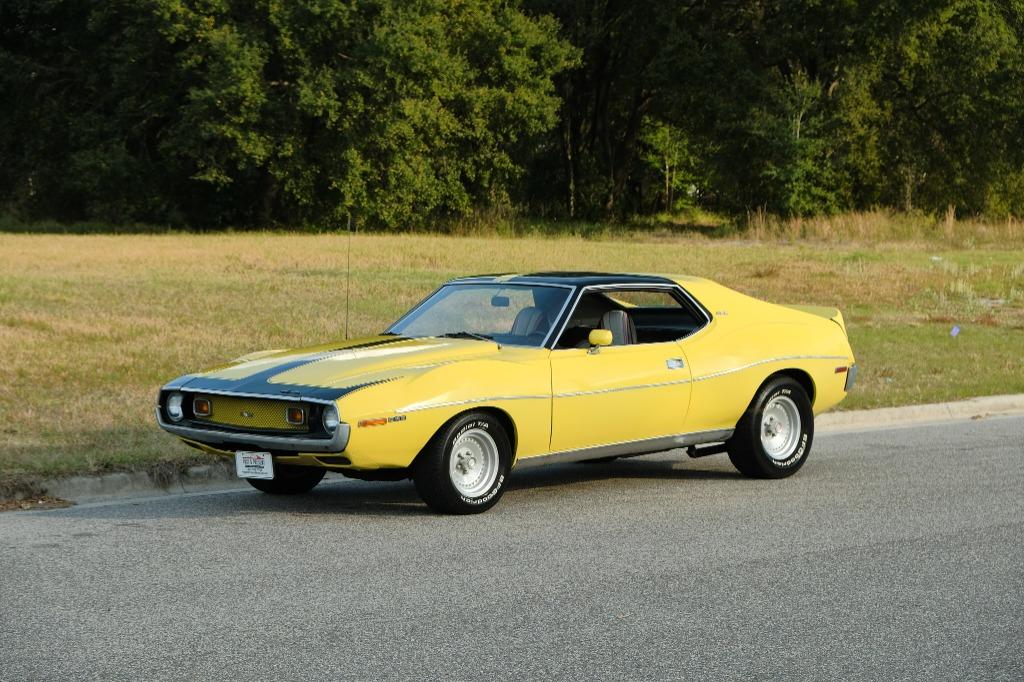
The second generation, 1971 to 1974. The 1971 car was all-new and deliberately dramatic: the fender humps, a roof with an integral spoiler lip, a twin-pod dashboard, and more weight everywhere. The AMX became the top Javelin, with its own grille, slot-style wheels and the 360 or 401 engines. The Go Package — available on SST and AMX cars with the 360 or 401 — bundled heavy-duty handling parts, power disc brakes, a limited-slip Twin-Grip differential, raised-white-letter tyres and, on four-speed cars, the Hurst shifter; it turns a second-generation car from a cruiser into a driver's car. The Pierre Cardin editions of 1972 and 1973 put a striped, multi-colour designer interior into an otherwise standard car; the mechanical specification is whatever the buyer ordered, so a Cardin car is valued on the survival of that fragile interior, not on performance. The 1973 cars gained the mandated energy-absorbing front bumper and a revised grille; 1974, the final year, added the larger rear bumper. There is no 1975 Javelin whatever a seller's paperwork says.

Engines and gearboxes
The sixes: 232 and 258
The Javelin's six is AMC's own overhead-valve straight six, the engine family that powered most of Kenosha's output and one of the toughest American engines of its period. It has seven main bearings, a cast-iron block and head, hydraulic lifters and a single-barrel Carter carburettor in most Javelin installations, with a two-barrel version offered on later and better-trimmed cars. The 232 cubic inch version (3.8 litres) was the standard Javelin engine from 1968; the 258 (4.2 litres) is the same engine with a longer stroke, arriving as an option at the start of the 1970s and prized by owners who actually drive their cars, because its advantage is torque at speeds a Javelin really uses rather than a headline power figure.
A healthy six starts readily, idles with a slight lope that is normal for the type, and pulls without the top-end clatter that means worn lifters or a starved valvetrain. Oil pressure is not shown on most cars — you get a warning light — so on an inspection the six is judged by sound, by smoke and by the state of the oil itself. Blue smoke at start-up that clears is valve stem seals, a known and affordable job. Smoke under load is bore and ring wear, and on a six that usually means the car is a project, because a six-cylinder Javelin rarely justifies a full rebuild commercially even though the parts are cheap.
The six's characteristic faults are ancillary rather than structural. The exhaust manifold cracks and warps with heat cycling, and a ticking that quietens as the engine warms is usually a manifold or its gasket, not a lifter — listen cold, because a lifter tick behaves the opposite way and is worst hot and at idle. The heat-riser valve in the exhaust manifold seizes, which holds the choke on and cooks the carburettor; free it or wire it open as part of any recommissioning. Valve-cover and side-cover gaskets weep as a matter of course. The single-barrel Carter is simple and rebuildable, and most running complaints on a six that has stood are varnish in the carburettor and a perished accelerator-pump cup, not wear. Budget a carburettor rebuild in the region of a few hundred dollars before condemning anything deeper.
One purchase trap: a six-cylinder car has lighter front springs, smaller brakes and different gearing from a V8 car, none of which shows in a photograph. If a car wears V8 badges, look under the hood before discussing price — the six is tall and narrow and fills the bay lengthwise, while every Javelin V8 is visibly wide and short.
The V8s: 290, 343 and 390, then 304, 360 and 401
AMC built its own V8s, and they divide into two generations that a buyer must keep separate because almost nothing that matters is shared in the way the badges suggest. The 1968 and 1969 engines — 290, 343 and 390 — are the second generation of AMC's V8 design: cast-iron, overhead-valve, with the displacement cast into the side of the block, which is the single most useful identity check on any Javelin V8 (see the inspection section). The 290 is a mild, smooth engine for cruising. The 343, offered in two-barrel form and as a four-barrel of genuinely lively performance, is the connoisseur's small engine and only ran for two years. The first 390, standard in the AMX and optional in the Javelin from part-way through 1968, is a serious performance engine with a forged steel crankshaft and connecting rods, large ports and a appetite for fuel that owners forgive because of how it goes.
The 1970 engines are new castings, not bored-out versions of the old ones. The deck height rose, the exhaust ports changed to the free-flowing shape owners call dog-leg ports — the port turns down in a distinctive curve visible when the manifolds are off, and these heads are the ones engine builders want — and the range settled as the 304, the 360 in two- and four-barrel forms, and a 390 that was built for 1970 only. For 1971 the 390 grew into the 401 by way of a longer stroke, again with forged crankshaft and rods, and the 401 carried the flagship role to the end in 1974. A 1970 390 and a 1971-onwards 401 look near-identical from the top of the engine bay, which is exactly why the cast displacement on the block and the engine code matter more than anything a seller tells you. A 360 wearing 401 badges is the oldest trick in this market; a 401 is worth a substantial premium, and premiums attract fiction.
On the road, a sound AMC V8 should start promptly, idle evenly once warm, and pull cleanly without pinking on modern premium fuel if the timing is set for it. These are torquey, understressed engines in standard tune, and their enemies are heat, old oil and the fuel system rather than internal wear. The factory carburettors are Motorcraft units — the 2100 two-barrel and the 4300 four-barrel — and the 4300's flat spots and hesitation are usually a failed accelerator pump, a perished power-valve diaphragm or a vacuum leak at its base, all cheap, rather than the carburettor itself. The 1970 ram-air cars add a vacuum-operated flap in the hood scoop that should open under load; a flap that never moves is a perished vacuum motor or a disconnected hose, and since the ram-air hardware is part of what a 1970 performance car is worth, test it rather than admiring it.
The failure mechanisms that price a V8 are these. The timing chain drives off a cam gear made with a nylon-toothed outer ring for quietness; fifty years on, the nylon hardens, sheds teeth and lets the chain jump, and a car with no record of a timing set is a car whose timing set you will buy — a parts cost in the low hundreds of dollars, and a day of labour, before it strands you. The oil pump lives in the front timing cover, so cover wear is oil-pressure wear: a V8 with low hot idle pressure and a clean bill of health elsewhere needs the pump and cover measured, not a heavier grade of oil poured in as a disguise. Performance builders also know the standard oiling system's weakness at sustained high revs, where the rear main bearing can be starved; the long-standing cure is an external oil-line modification, and its presence tells you a previous owner revved the engine hard and knew what they were doing — read it as history, not as damage. Exhaust manifolds crack, and manifold bolts seize in the heads and snap during removal, turning a cheap gasket into machine-shop money: a straightforward manifold job is a few hundred dollars, and one with snapped studs extracted is several times that. Finally, base cars' cooling was sized for the smallest engine in the range, so a V8 conversion on a standard radiator overheats for a reason that has nothing to do with the engine itself.
From 1972 the published outputs fall sharply because the industry moved from gross to net ratings — measured with full exhaust, air cleaner and accessories fitted — and compression ratios were lowered for unleaded fuel and emissions equipment. A 1973 401 is not the weakling its net figure suggests next to a 1971 car, but it is a softer engine, and the honest comparison is on the road: throttle response, smoke, oil pressure and how hard it pulls, not brochure numbers across the rating change.
Gearboxes, axle and brakes in the drivetrain
Three transmissions cover almost every Javelin you will meet. The standard gearbox on cheaper cars was a three-speed manual, fully synchronised — adequate, unexciting and rarely the reason anyone buys the car. The gearbox enthusiasts want is the Borg-Warner T-10 four-speed manual, close-ratio on performance cars, with a floor shifter that became a Hurst unit on later performance models. A T-10 is judged on second-gear synchromesh, which wears first and baulks or crunches on a fast downchange when cold, and on whether it jumps out of gear under load, which means internal wear rather than linkage. Linkage wear is the cheaper mimic: a sloppy change with good synchromesh is bushes and adjustment, a small-parts job, while a rebuild of the box itself is a four-figure specialist job once removal and refitting are counted. Clutch judder on take-up is usually oil on the plate from a leaking rear main seal or a warped cover, so the rear main seal should be priced into any clutch job.
Most Javelins, though, are automatics, and here the model splits in two at 1972. Cars to 1971 use AMC's Borg-Warner-built three-speed automatic, sold as Shift-Command, a strong unit that shifts firmly and is rebuildable by any shop that knows period Borg-Warner boxes. From 1972 AMC bought its automatics from Chrysler and sold them as Torque-Command: TorqueFlite-pattern gearboxes, the heavy-duty 727 type behind V8s, but built in an AMC-specific case with an AMC bellhousing pattern. That last point is a genuine trap — a Chrysler-case TorqueFlite does not bolt to an AMC engine, and an AMC-case box does not fit a Mopar, however identical the internals are. Any automatic, of either family, should engage drive and reverse promptly from cold, change up cleanly without flaring, and kick down on full throttle; a long delay engaging reverse on a cold morning is the classic first symptom of hardened internal seals and a rebuild in the low-to-mid thousands of dollars at a specialist, so test it cold and price it honestly.
The rear axle on V8 cars is AMC's Model 20, a strong unit with one famous weakness. The axle shafts use a hub retained by a large nut whose correct torque is critical: if that nut has been run loose, the hub can fret and eventually spin on the shaft, and a car with a history of a loose hub needs the shaft and hub examined, not just the nut tightened. The limited-slip option is called Twin-Grip, tested the obvious way — one wheel should not spin freely while the other stays planted under power on a loose surface — because worn clutch plates make a Twin-Grip behave exactly like an open differential while wearing a desirable badge. Gear ratios vary widely by engine and gearbox, economy cars running tall gearing that blunts even a V8, so a car that feels slow may be geared, not tired.
Brakes divide by year and option. Drums all round were standard on cheaper cars for longer than buyers expect, with front discs optional and bundled into performance packages; early disc cars use a four-piston fixed caliper, later cars a simpler single-piston sliding caliper that is cheaper to keep. A disc conversion on a drum car is respectable only as a whole-system conversion — master cylinder, proportioning and hoses included; discs bolted onto a drum master cylinder stop badly for an identifiable reason. Whatever is fitted, judge fifty-year-old hydraulics as a system: perished hoses, a master cylinder weeping into the booster and calipers seized from standing are the standard recommissioning list, and a full hydraulic refresh with labour sits in the high hundreds to low thousands of dollars.
Problem areas
Rust: the map
A Javelin is a unibody, which means the floors, sills, torque boxes and rails you are looking at are not panels hung on a frame — they are the frame. Rust in a fender is a repair; rust in the structure is a different car at a different price, and the whole inspection discipline for this model is keeping those two categories separate. Work through the shell in the order the water does.
Rear quarters, wheel arches and the dogleg. The commonest cosmetic rust on the car and the first place filler accumulates. The lower rear quarter behind the wheel traps road dirt against its inner face, the arch lip rots from inside, and the short section of sill and quarter ahead of the rear wheel — the dogleg — goes early and is awkward to repair invisibly. Run a cloth-wrapped magnet along the arches and lower quarters, and look from inside the trunk at the quarter inners, because an arch that is sound outside and perforated inside has already been repaired once, cosmetically. A quarter repair done properly, with metal cut out and a section welded in and painted, is a job in the low thousands of dollars per side at a body shop; a skim of filler over rust is a few hundred dollars of paint that will bubble within two winters, and the difference between those two repairs is the difference between two price classes of car.
Floors and torque boxes. Lift every carpet you are allowed to lift. Water enters past the windshield seal, the cowl vents and the heater box, runs down the firewall and sits under the carpets and the sound deadening, so Javelin floors characteristically rot from the top down as well as from underneath. The torque boxes — the pressed reinforcement boxes where the front and rear structures tie into the floor and sills — are structural in the truest sense, because the suspension and the shell's torsional stiffness both depend on them. Soft metal, perforation or previous plated repairs at a torque box is the strongest walk-away signal on a cheap Javelin: floor pans can be replaced in sections for a few hundred dollars of panel plus welding labour per side, but torque-box fabrication is skilled work priced per car, and it routinely exceeds what a project Javelin was bought for.
Front rails, spring towers and the engine bay. Under the hood, the rails and the inner fenders carry the front suspension loads. The battery tray rots from acid, from the top down, and hides its damage under the battery — lift the battery or at least rock it and inspect the tray edges and the inner fender beneath with a torch. The front fender tops deserve their own minute on second-generation cars: the famous humps create a shelf and a seam that holds moisture, and bubbling along the hump is a signature 1971 to 1974 fault that is also the hardest panel line on the car to repair invisibly. First-generation front fenders rot at the bottom behind the wheel and along the top edge where the trim sits. All of it is panel work priced by the hour, which is why a car needing every panel is worth so much less than a car needing one.
Trunk floor, drop-offs and the rear window. The rear window seal and the trunk seal leak, and the water collects in the trunk floor's low corners and in the drop-off panels that close the space between the quarter and the floor — areas no listing photograph ever shows. Lift the trunk mat, remove the spare wheel and look at the seams. Staining is a clean, treat and reseal job; perforation of the drop-offs means the quarters are going from inside as well, and a trunk floor replacement with paint is a job approaching the low thousands of dollars done properly. Check the rear window channel itself while you are there: rust under the rear glass on a hardtop means glass out, metal repaired and a new seal, and it leaks directly onto the package shelf and rear seat, so a damp or warped rear shelf trim panel is a clue, not a cosmetic detail.
Doors, cowl and the small traps. Door bottoms fill with water when their drain slots block, and the skin bubbles along its lower edge; feel it with a fingertip rather than looking at it. The cowl sides and lower windshield posts rot where dirt packs in behind the fenders, and this rust is expensive because it is structural, hidden and next to the windshield frame. Headlamp surrounds and valance panels matter less structurally and more as a record of how the car has lived. Add the small traps up honestly: five minor rust areas at a few hundred dollars each of professional attention is a four-figure body budget before you have touched the quarters.
The underseal rule for every unibody of this age applies with force here. Original undercoating after fifty years is patchy, thin at the edges, chipped by stones and dirty in a consistent way. A fresh, uniform coat of black stone-chip blown over floors, rails, torque boxes and seams in the week before a sale is a cover-up until the seller proves otherwise. Prod seams with a screwdriver where the seller permits it, and listen: sound metal rings, rotten metal crunches quietly, and that sound is worth more than any description in an advertisement.
Suspension, steering and the running gear
The front suspension is unequal-length wishbones with coil springs, and the first-generation cars divide at 1970 in a way inspectors must know. The 1968 and 1969 cars use AMC's trunnion-style upper joint arrangement, a period design that is strong but wears in a characteristic way and needs its own parts and knowledge; the 1970-onwards cars use a more conventional ball-joint layout that any alignment shop understands. Neither is a reason to reject a car, but a 1968 car with play in the front end is a specialist conversation, while a 1971 car with the same play is a routine parts order — price them differently. On any Javelin, rock each front wheel top and bottom and side to side, and separate the findings: play top-to-bottom is joints and bearings, play side-to-side is steering linkage, and both together on a high-mileage car is a front-end rebuild in the region of the low thousands of dollars fitted, not a single cheap part.
The steering is a recirculating-ball box, manual on cheap cars and power-assisted on most V8s. A little free play at the wheel centre is period-normal; a lot is a worn box, a worn idler arm or a perished steering coupling, in ascending order of cost, and the way to separate them is to have a helper rock the wheel while you watch each joint in turn from underneath and find where the movement is lost. Power steering pumps whine when low on fluid or worn, and the hoses perish and mist the engine bay with fluid that then gets blamed on the engine. At the rear, leaf springs do the work, and the faults are sagging springs that drop the tail, perished shackle bushes that let the axle wander under power, and tired dampers. A Javelin should sit level and slightly nose-down at rest; a spring set plus bushes is a mid-hundreds-of-dollars parts bill plus labour — predictable money, but money to count before you buy.
Brake condition on a car that has stood is a system verdict, and the standing-car pattern is always the same: a rust band and a lip on every disc, seized rear wheel cylinders on drum cars, a handbrake cable seized in its conduit, and flexible hoses that look acceptable and are internally collapsed, giving a brake that applies and will not release. Pull the car up hard from speed on the test drive: it must stop straight, without judder through the pedal and without a wheel locking early. Judder is warped or unevenly rusted discs; pulling is a seized caliper or a collapsed hose; a pedal that slowly sinks at a standstill is a master cylinder passing internally, and that car is not driven home, it is trailered.
Tyres are evidence. Uneven front wear records alignment and joint wear the seller may not mention, and old, cracked tyres on a supposedly cherished car tell you the maintenance budget ran out some time ago. A tyre over ten years old is a replacement regardless of tread, and a set in the correct size is a real line in the purchase budget.
Interior and trim
The Javelin cabin is where the AMC parts situation bites hardest, because interior and trim parts are model- and year-specific in a way mechanical parts are not, and reproduction coverage is a fraction of what Mustang owners enjoy. Judge the interior as an inventory, item by item, and assume anything missing or broken is a search, not an order.
Seats and soft trim. First-generation cars use vinyl or woven upholstery over foam and spring bases; second-generation cars added the elaborate twin-cockpit dashboard and, on Pierre Cardin cars, a striped woven fabric that is the entire point of the edition and is not reproduced in its original form. A Cardin car whose seats have been retrimmed in plain vinyl has lost the thing it was — value it as a standard car with a story. On any car, sit in the driver's seat: the foam collapses on the entry side first, the vinyl splits along its seams, and once you can feel the seat frame, the job is foam and covers together. A professional retrim of a pair of front seats runs from the high hundreds into the low thousands of dollars, and a full interior retrim is a five-figure conversation on a car whose mechanical parts cost hundreds — which is why a sound original interior is worth a premium out of all proportion to its appearance in photographs.
Glass, seals and brightwork. Windshields and rear glass are available but not everywhere, side glass is car-specific, and window regulators wear so the glass drops or tilts in its channels. Weatherstrips are reproduced for the common applications and are the difference between a dry car and the floor rust described above, so perished seals mean you examine the floors twice. Brightwork pits, dents and goes missing, and because reproduction is patchy, its condition is a real component of value on this model in a way it is not on a Ford. Count the missing pieces out loud during the inspection and price the search.
Electrics and the ancillaries
AMC electrics of this period are conventional American practice — a Motorola alternator with an external regulator on earlier cars, a conventional starter with a fender-mounted solenoid, and wiring that fails, as all wiring of the age fails, at its connections rather than in the middle of its runs. Dim headlights, a wandering fuel gauge and intermittent accessories are earth faults and corroded terminals until proved otherwise: tedious to trace, cheap in parts, and a reliable sign of whether a car has been maintained or merely stored.
Three electrical checks carry real money. The first is charging: a car that shows a discharge at idle with the lights on has an alternator or regulator fault that is affordable in parts but must be diagnosed as a pair, because fitting a regulator to a car whose alternator brushes are finished buys the same fault twice. The second is the starter circuit, where heat-soaked starters on V8 cars crank slowly when hot, and the cause is as often a corroded main cable or a tired solenoid as the starter motor itself, so cables are tested before a motor is bought. The third is evidence of amateur wiring: alarm and stereo installations of the 1980s and 1990s cut into looms and left corroding connectors inside the harness, and a Javelin with a bird's nest under the dashboard will produce a new electrical fault every season until the loom is put back to standard. Budget the hours, not the parts.
Vacuum-operated equipment — the ram-air flap and heater controls on later cars — depends on perished rubber hoses, and a handful of split hoses produces a handful of apparently unrelated faults that all vanish for the price of a length of vacuum pipe. Air conditioning, where fitted, should be valued as decoration until it blows cold in front of you: a system that has stood empty for years is a compressor, drier, hoses and labour, a four-figure recommissioning. Wipers, washers, horn, heater fan on every speed and every lamp are a five-minute test that tells you more about a car's last decade than its paint does.
How to inspect one
Allow at least an hour, bring a torch, a cloth-wrapped magnet, a tape measure and a screwdriver for prodding where the seller permits it. If the car passes your inspection, pay for time on a lift before money changes hands — on a unibody car of this age, the underside is the car.

- Start with identity, before condition. Find the VIN plate and match it to the title. Measure the wheelbase: a 1968 to 1970 car at 109 inches is a Javelin, and at 97 inches it is an AMX, whatever the badges say. On a V8 car, find the displacement cast into the side of the block and read it — 290, 343, 390, 304, 360 or 401 — because that number, not the air-cleaner decal, is the engine you are buying. A claimed 390 or 401 that casts up as a 360 is priced as a 360 from that moment on.
- Cold start, insisted upon. The engine must be cold when you arrive. A six should start and settle with no more than its normal lope; a V8 should fire promptly and idle evenly. Watch the exhaust: blue smoke at start-up is stem seals, smoke that continues under load later in the drive is rings, and white vapour that does not clear is coolant until proved otherwise. Listen for a timing-chain rattle on a V8 and a manifold tick on a six while everything is still cold, because both change character as the car warms.
- The structure, underneath. Torch along both sills, the floor seams, the torque boxes, the front rails and the rear spring hangers, in that order. Perforation in sills, torque boxes or rails is structural and decides whether the inspection continues at all. Read the underseal as you go: patchy, chipped and honestly dirty is factory age; a fresh uniform black coat over everything, including brake pipes and seams, is a question the seller must answer. This is the step the rust section exists to prepare you for — use its map, not your optimism.
- Trunk and the water path. Lift the mat, take the spare wheel out, and inspect the trunk floor corners and drop-offs for staining and perforation. Check the rear window seal and the package shelf for the damp and warping that mean the seal has been leaking. Then look at the windshield base and the cowl: the water that rots the floors enters at the top of the car. Lift all four carpets and prod the pans.
- Body, gaps and the magnet. Run the magnet over the rear arches, the doglegs, the lower quarters, the door bottoms and — on a 1971 to 1974 car — along the front fender humps. Filler announces itself by the magnet falling slack. Check panel gaps for accident history, feel every door bottom edge for bubbling, lift the battery and inspect its tray and the inner fender beneath, and count the pitted, dented or missing brightwork pieces, because on this model trim is a search, not a shopping list.
- Front end and steering. Rock each front wheel top-to-bottom and side-to-side, remembering the split in the problem-areas section: top-to-bottom play is joints and bearings, side-to-side play is steering linkage. Remember too that a 1968 or 1969 car has the trunnion front end and a 1970-onwards car has ball joints, and the same play is priced differently on each. Have a helper rock the steering wheel while you watch the linkage from below and find exactly where the movement is lost.
- The gearbox, cold. On an automatic, engage drive and reverse from cold and count the delay: prompt engagement is health, a long pause into reverse is the hardened-seals warning from the gearbox section, and it is priced as a coming rebuild. On a manual, note the clutch bite point and any judder, and plan to test second-gear synchromesh on the drive, on a downchange, while the oil is still cool.
- The test drive, fifteen minutes minimum. Include a stretch at highway speed. A V8 should pull cleanly and strongly without hesitation — flat spots are the carburettor and vacuum checks from the engine section, not character. A manual car must take a brisk downchange into second without a crunch. An automatic must change firmly without flaring and kick down on full throttle. Brake hard once, safely: straight, no judder, no pull, no sinking pedal. Listen over rough surfaces for the knocks that locate worn bushes and joints better than any static test.
- Heat and the cooling system. Let the car idle hot at the end of the drive. Temperature should stabilise, and there should be no coolant smell in the cabin — that smell, with a misting windshield, is the heater core, and a pair of heater hoses looped together in the bay means someone has already bypassed a leaking one. Check the radiator and hoses for the swelling and perishing that precede a failure on your first long drive home.
- Electrics and ancillaries, everything, once. Headlights bright and even, charging steady, wipers and washers, horn, heater blower on every speed, every gauge, every window up and down, and air conditioning blowing genuinely cold or valued at zero. On a 1970 ram-air car, have a helper watch the hood flap under load as the seller permits, and file a dead flap under vacuum motor and hoses. A car where everything works has been maintained; that is the best single predictor in this entire list.
- Stance and tyres. Stand back and photograph the car from the side and from each corner. It should sit level and fractionally nose-down; a tail-down car is rear springs, and unevenness side to side is a spring, a shackle or structure asking a question. Read the tyres as records: inner-edge front wear is alignment and joints, age codes over ten years are a replacement set in the budget regardless of tread, and mismatched budget tyres on a performance car are a maintenance confession.
- Interior and paperwork, last. Sit in every seat, feel for collapsed foam and the frame beneath it, check the dash pad cracks, and on a claimed Pierre Cardin car examine the striped fabric on seats and door panels as the main event — plain retrimmed seats end the Cardin discussion. Then the history file: invoices for a timing set, an engine rebuild, body metal work and a gearbox rebuild are each worth real money in the negotiation, because each is a bill you will not pay. A thick file on a cosmetically imperfect car beats a shiny car with no past, every time.
Values
The build of this page appends the current market figures — what is listed now and what recorded sales show — beneath this guide, and those numbers are the ones to trade on. This section is about how to read them, because the Javelin market punishes buyers who read a headline figure without understanding the spread underneath it.
The first thing to understand is that there is no single Javelin market; there are at least four, stacked on top of each other. At the top sit the genuine performance flagships — the 1968 to 1970 390 cars, the Donohue edition with paperwork, and the 1971 to 1974 401 AMX and Go Package cars, especially with the four-speed manual — trading among collectors who know the production story and the Trans-Am record. Below them sit the honest V8 drivers, the 343, 360 and small-V8 cars in sound shells, valued the way any good pony car driver is valued: on condition, colour and work demonstrably done. Below those sit the six-cylinder and project cars, where the shell is the entire value. And cutting across all three is the originality market: a Big Bad colour car that genuinely left the factory that colour, a Pierre Cardin car with its fabric intact, a ram-air 1970 with its hardware complete — each carries a premium that evaporates the moment the special feature turns out to be added, worn out or missing. Verify the feature, then pay for the feature; never the other way round.
The condition spread is wider than for a Mustang or a Camaro, and the reason is parts economics. Restoring a Javelin costs Mustang money in labour while yielding an AMC at the end, and the trim and interior parts a Ford buyer orders from a catalogue, a Javelin buyer hunts. That means the gap between a project and a finished car is enormous and honest: a cheap Javelin that needs quarters, floors, a retrim and a brightwork search is not a bargain version of a good car, it is a more expensive route to a worse one. Conversely, a genuinely finished car — sound shell, documented mechanical work, complete trim — is frequently worth more than buyers expect, because the work it embodies cannot be repeated for its asking figure. Read asking prices with that in mind: sellers of finished cars price the work in, sellers of projects price hope in, and achieved prices at auction, where two buyers must agree in public, are the discipline to apply to both.
Asking and achieved figures diverge predictably. Rare-specification cars are often advertised optimistically on the strength of the badge — a 401 claim, a Donohue claim, a Cardin claim — and the achieved figure follows the verification, not the advertisement. Six-cylinder and automatic cars are advertised more modestly and sell closer to their asks, because nobody is pretending they are something else. Geography matters too: sound, dry-state shells command a premium that travels, because shipping a rust-free car costs less than welding a rusty one. Finally, treat any single listing as an anecdote: the sample changing hands in any season is small enough that one exceptional car bends every average it touches, so the recorded-sales block below, read over its longest window, beats any individual asking price.
Parts and ownership
The Javelin is an orphan car from a defunct manufacturer, and ownership is better than that sentence suggests — provided you join the world that supports it. AMC built its cars from a smaller parts bin than the big makers, so a surprising amount of mechanical hardware is shared with the AMX, the Rebel, the Ambassador, the Hornet and the Jeep line that used the same engines, and the specialist trade that grew up around AMC after the company's demise is knowledgeable, clubby and still active.
Easy: service items for both sixes and all the V8s — filters, plugs, points and ignition consumables, belts and hoses — plus brake hydraulics and friction parts, water pumps, engine gaskets and seals, carburettor kits for the Motorcraft and Carter units, timing sets, clutch parts, dampers, springs and the common steering and suspension wear items. The engines' Jeep afterlife is a real advantage: the six and the V8s lived on in Jeeps for years after the Javelin ended, and engine parts support reflects that. Order today, fit this weekend, at prices in line with any American classic.
Harder and dearer: body and trim. Front fenders, quarter repair sections and floor pans exist in reproduction for the more common applications, but coverage is patchy by year — 1970 and the second-generation cars have their own one-year traps — and glass, brightwork, grilles, the AMX grille, dash pads, seat foams and correct upholstery materials range from expensive to search-only. The Pierre Cardin fabric is not reproduced in original form. Correct model-specific items — a ram-air hood assembly, a Donohue spoiler, a Twin-Grip axle in the right ratio, a T-10 in the correct specification — are second-hand market items whose prices follow rarity, and the AMC-specific Torque-Command automatic case means gearbox swaps must start from an AMC box, as the drivetrain section explained. The names to know are the established AMC specialists — firms such as American Parts Depot, Kennedy American, Blaser's Auto and Galvin's Rambler Parts in the United States — together with the American Motors Owners Association and The AMC Forum, whose classifieds and accumulated knowledge are, in practice, part of the parts supply.
Running costs. A sorted Javelin is a realistic regular-use classic. Fuel consumption is period American: gentle in a six, enthusiastic in a 401. Servicing is within the ability of any good independent classic shop — nothing on the car requires a marque main dealer, because there is none — and insurance sits in line with other pony cars of similar value. The budget line that catches new owners is the first year. Catching up deferred maintenance on a running car — hydraulics, hoses, tyres, a timing set on a V8 with no record of one, perished bushes — honestly runs into the low thousands of dollars before anything is improved, and recommissioning a car that has stood for years, with its fuel system cleaned end to end against modern ethanol fuel and every brake component inspected, costs several thousand more at shop rates. Buy a car in regular use over one that has been asleep, even at a higher price.
Which one to buy
- The all-rounder: a 360 V8 car, either generation. The 360 is strong, common enough to buy well, supported by the best parts availability of the performance engines and fast enough to be genuinely enjoyable. A sound 360 with the Go Package, or a 1970 with its one-year style, is the Javelin most buyers should be looking for.
- The value buy: a six-cylinder or 304 car in an excellent shell. The market prices these gently because they are not the poster cars, and a rust-free, original-interior example is a better ownership proposition than a rusty flagship at the same money. Buy it as the cruiser it is and enjoy the cheapest route into the model.
- The first-generation flagship: a 390 car, 1968 to 1970. Forged internals, the clean early styling and genuine rarity. Verify the cast displacement on the block and pay for paperwork, because the premium lives entirely in originality.
- The second-generation hero: a 401 AMX or Go Package car, 1971 to 1974. The Trans-Am connection, the drama of the humped fenders and the strongest engine AMC ever put in the car. The four-speed is the collector's specification; the automatic is the easier car to live with and usually the gentler price.
- The connoisseur's car: a 1970 Donohue or a 343. The Donohue, with documentation, is the most collectable Javelin of all; without documentation it is a 1970 with a spoiler, and should be priced as one. The two-year-only 343 is the thinking buyer's performance car — nearly the pace, a fraction of the attention.
- The character buy: a Pierre Cardin car with its interior intact. You are buying surviving 1970s fashion, not performance, and the fabric is the car. If the stripes live, it is special; if they do not, it is a standard Javelin in fancy dress.
And the rule that overrides all of the above: buy the least rusty, most complete car you can find, in the specification you can live with. Engines can be rebuilt, gearboxes exchanged and brakes renewed at prices you can plan for, but a rotten unibody costs more to put right than the finished car will be worth, and a Javelin missing its year-specific trim may stay missing it for years. On this model, completeness is value.
See the 4 Javelin cars currently listed.
What they sell for: Javelin sale prices.