
Audi Quattro buyer's guide
Audi Quattro -- the model's own buyer's guide: variants, values and what to check.
Years listed: 1983-1986 · Series: Quattro
Overview and history
You are not buying a trim level. You are buying the car that puts the word quattro into the language, and you need to separate it at once from everything else that later wears the same badge.
From the mid-1980s onward Audi sells ordinary saloons, estates, coupés and SUVs with quattro as the name of their all-wheel-drive system. An A4 quattro or a Q5 quattro is a normal production Audi with driven rear wheels. The car in this guide is different in kind, not degree: the original, capital-Q Quattro — enthusiasts call it the ur-quattro, ur being German for original — a specific low-volume coupé on the Type 85 platform, built from 1980 to 1991 with a turbocharged five-cylinder mounted longitudinally ahead of the front axle, a five-speed manual gearbox and permanent four-wheel drive. If a seller shows you a front-wheel-drive Audi Coupé with a quattro badge on the tail, you are not looking at this car at all. That is the identity trap, and it catches more casual buyers than any mechanical fault.
The idea comes from the Volkswagen Iltis, a plain military off-roader Audi engineers test in Scandinavia in the late 1970s. Chassis engineer Jörg Bensinger notices the slow, crude Iltis leaving powerful front-wheel-drive test cars behind on snow — not through power, but through traction everywhere — and proposes a high-performance road car with permanent four-wheel drive. Ferdinand Piëch, Audi's technical director, backs it. Received wisdom says four-wheel drive belongs on tractors, weighs too much and has no place in a fast coupé. The Quattro proves it wrong in public, which is why it matters.
Audi reveals the Quattro at Geneva in March 1980. The shape is a sharp-edged three-door coupé derived from the Audi Coupé (itself from the Audi 80, the B2 family), distinguished instantly by blistered arches, a wider track and a deep front spoiler. Underneath, the engineering is more original than the silhouette: the five-speed gearbox casing also contains the front and centre differentials, a hollow output shaft carries drive forward inside the same housing — an elegant trick that avoids a separate transfer box — and a propeller shaft carries drive rearward. Torque splits 50:50 on early cars, and you can lock the centre and rear differentials manually when the surface turns genuinely loose.
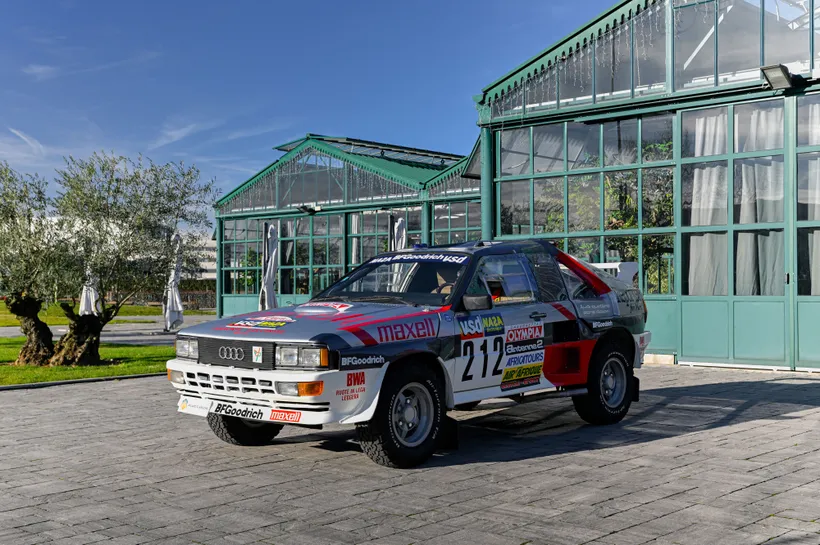
Then rallying makes the car famous, and the fame is earned. Audi enters the World Rally Championship in 1981. Hannu Mikkola wins in Sweden almost immediately. Michèle Mouton wins Sanremo in 1981 — the first woman to win a World Championship rally — and three more events in 1982. Audi takes the manufacturers' title in 1982, Mikkola the drivers' title in 1983, and Audi and Stig Blomqvist both titles in 1984. The short-wheelbase Sport quattro and winged S1 evolution cars that follow are separate, far rarer homologation machines — do not let a seller blur a standard Quattro into a Sport quattro, because the cars and the values live in different worlds — but the road car benefits from the same reputation, honestly earned.
On the road, the achievement is subtler. The Quattro is not the fastest coupé of its era in a straight line, nor the most delicate through a bend. What it gives you is usable performance in weather that stops its rivals: where a turbocharged rear-drive coupé of 1980 asks you to choose between throttle and grip on a wet road, the Quattro lets you use most of its performance most of the time. You feel it today as nose-heavy weight distribution, strong thrust once boost arrives, secure understeer at the limit, and traction that walks the car out of wet junctions and hairpins where its contemporaries are still spinning a wheel.
Production runs from 1980 to 1991 — an unusually long life spanning several distinct technical generations, which is why this guide spends so much time on engine codes and differential types. Total production is 11,452 cars: rare without being unobtainable, and rarer than the number implies, because a large proportion of survivors have been modified, crashed, repaired, stored badly or broken for parts. A straight, documented, unmodified survivor is a much rarer thing than the headline figure suggests.
Geography shapes what you meet. Europe gets the full run, from the earliest WR cars to the final 20-valve RR cars of 1989–91. North America gets the car late and detuned: US cars arrive for 1983, carry the catalysed WX engine, and sell in small numbers through the mid-1980s. This site's pool illustrates the point honestly because it is tiny: five Quattro records in total at the time of writing, three offered for sale and two recorded as sold, every one a 1983 or 1985 car — the early US generation. That sample teaches you what the US market looks like, and nothing about the European MB and RR cars. Treat any five-car pool as a snapshot of one corner of the market, never as the model.
Correct two myths before you look at a single car. First, all Quattros are not the same car with different badges: a WR with manually locked differentials, a US WX with emissions equipment and less power, an MB with a Torsen centre differential, and a 20-valve RR are four distinct propositions sharing a shell. Second, the Quattro is not a crude rally car for the road. It is a well-trimmed grand touring coupé with electric windows, supportive seats and a proper boot, which happens to have a drivetrain from a different future. Buy it as a GT with extraordinary traction and a demanding old-car appetite for maintenance, and your expectations are set correctly.

The models
You meet the Quattro in four main road-car forms, defined by engine code. Learn the codes, because the code — not the year alone, not the seller's description, and not the badge — tells you what engine, what engine management, what centre differential generation and roughly what performance a car should have. The engine code is stamped on the engine and recorded in the car's documentation, and on a car where engines are swapped more often than sellers admit, checking that the fitted engine matches the car's paper identity is a first-order inspection step, not pedantry.
| Model | Years | Engine | Output | Built | Character |
|---|---|---|---|---|---|
| Quattro WR (Europe) | 1980–1987 | 2,144 cc 10-valve turbo, WR, Bosch K-Jetronic | 200 PS (197 hp) | Largest share of 11,452 total | The original: manually locked centre and rear differentials, strongest period character, simplest management |
| Quattro WX (North America) | 1983–1986 | 2,144 cc 10-valve turbo, WX, catalysed K-Jetronic with lambda control | c. 160 hp | Small US import run within 11,452 total | The car most US buyers meet: same shell and drive, less boost, more emissions plumbing, left-hand drive US specification |
| Quattro MB (Europe) | 1987–1989 | 2,226 cc 10-valve turbo, MB, electronic boost and ignition control | 200 PS (197 hp) | Middle share of 11,452 total | The refinement step: Torsen centre differential, stronger low-speed manners, more electronics to age |
| Quattro RR 20v (Europe) | 1989–1991 | 2,226 cc 20-valve turbo, RR, double overhead cams | 220 PS (217 hp) | Final, low-volume run within 11,452 total | The ultimate development: freer-revving, fastest, most complex, and the collector's default choice |
Audi does not publish a clean, universally agreed production split by engine code in the material a buyer can check at the kerb, so this table gives you the verified total and describes each variant's share honestly rather than inventing precise per-code figures. Where a seller quotes you an exact build number for a variant, ask for the source.
The WR cars, 1980–1987
The WR is the Quattro as launched: 2,144 cc, single overhead camshaft, two valves per cylinder, KKK turbocharger, intercooler and Bosch K-Jetronic mechanical injection. Output is 200 PS in a car of roughly 1,300 kg — brisk today, startling in 1980, with 0–62 mph in a little over seven seconds and around 137 mph in period testing. More important is the delivery: boost builds with a pronounced step, and the car feels — and is — a turbocharged machine of its era. You manage lag rather than pretend it does not exist.
Early WR cars have vacuum-operated differential locks controlled from the cabin, a dashboard that evolves over the run (analogue instruments first, then the famous green digital dashboard on facelift cars from the mid-1980s), and running changes to brakes, suspension geometry, wheels and trim that mean no two model years are quite identical. In 1983 the car receives significant chassis revisions, including revised suspension and wider wheels, and the later cars are generally the better resolved. The US WX below is a WR derivative, not a separate design.
The WX cars: North America's Quattro, 1983–1986
If you buy in the United States, the WX is statistically the car in front of you — as this site's five-car pool, all 1983 and 1985 cars, underlines. Audi federalises the Quattro with a catalytic converter, lambda-controlled K-Jetronic, exhaust-gas recirculation and associated emissions hardware, and lower boost pressure. Output falls to roughly 160 hp. The performance gap to a WR is real: a WX feels noticeably softer below and through the boost threshold, and period US tests record acceleration several tenths to a second slower than the European car. Nothing about the shell, the drivetrain layout or the fundamental character changes, and a well-kept WX is a thoroughly satisfying car. But you should price and judge it as what it is. A seller who describes a WX as the full 200-horsepower European specification is either mistaken or hoping you are.
US cars also carry US-specification bumpers, lighting and instrumentation, in a narrow band of model years. The consequence is practical: the American survivor pool is small, heavily concentrated in 1983 cars, and well known to the specialist community, so histories are often traceable. Bad US cars — rusted, modified with period kits of variable quality, or left undriven for a decade — circulate in the same small world wearing the same stories. Documentation matters even more than usual.
The MB cars, 1987–1989
The MB is the thoughtful buyer's car, and the least mythologised. Audi enlarges the five to 2,226 cc, retains the 10-valve head, and adds electronic control of ignition and boost, keeping output at 200 PS with a cleaner, broader delivery than the WR manages. The headline change sits in the middle of the car: the manually locked centre differential gives way to a Torsen unit, which biases torque automatically toward the axle that can use it. The rear differential remains lockable, disengaging automatically as speed rises. An MB feels more modern and less like a machine you operate: the Torsen car flows where the locked-diff car is managed. You lose a little mechanical ceremony and gain a car that is easier to drive quickly in mixed conditions — which is, after all, the point of the design.
The RR 20-valve cars, 1989–1991
The final development fits a 20-valve double-overhead-camshaft head to the 2,226 cc block, with a revised turbocharger and full electronic management. Output rises to 220 PS, the red line rises, and the character changes audibly: an RR revs with a freedom no 10-valve car matches and sounds harder-edged doing it. The Torsen centre differential continues. Audi builds the RR for just two model years, and the market treats it as the definitive ur-quattro — most capable, most developed, most collectible. Whether it is the best to own depends on your appetite for its complexity and premium, a question the final section returns to.
What is not in this table, and why
Three related cars are deliberately excluded. The Sport quattro (1984) is the short-wheelbase homologation special with a substantially different, shorter shell and production in the low hundreds; it is a separate model with separate values, and the S1 and S1 E2 are pure competition cars. The Audi 200 quattro and later S2 and RS2 carry the five-cylinder turbo and quattro drive forward, but they are different models on different platforms. A standard Quattro priced by reference to Sport quattro results is mispriced by an order of magnitude, and the confusion is never accidental when it appears in an advertisement.
Model-year traps deserve a warning of their own. Running changes do not align neatly with calendar years, cars are registered late, imported cars acquire the year of import in careless paperwork, and US model years and European build years diverge. Date a car by its VIN and build records, not by the year on a title alone. Likewise, treat any car described as a 6-speed with suspicion: the ur-quattro leaves the factory with a five-speed manual in every variant, so a claimed six-speed car is either a later conversion — value it as a modification, not an upgrade, unless documented and reversible — or a listing error. Either way, check everything else on that car twice.

Engines and gearboxes
Every ur-quattro uses the same architecture: a cast-iron block, five cylinders in line, mounted longitudinally and canted well ahead of the front axle, with an alloy head, an intercooler and a KKK turbocharger. Audi chooses five cylinders because the block is shorter than a six, fits the bay, and gives the distinctive off-beat exhaust note that becomes part of the car's identity. The bottom end is famously strong and tolerates standard power indefinitely. What fails forty years on is almost never the core rotating assembly — it is the systems bolted to it: injection, turbocharger, exhaust manifold, cooling, vacuum plumbing and management. Budget and inspect accordingly.
The 10-valve engines: WR and WX, 2,144 cc
The WR engine (code WR) displaces 2,144 cc from a bore and stroke Audi derives from its existing five-cylinder family. A single overhead camshaft operates two valves per cylinder through bucket tappets with shim adjustment. A KKK K26 turbocharger blows through an air-to-air intercooler into a Bosch K-Jetronic continuous injection system: a mechanical airflow sensor plate lifts in proportion to incoming air and moves a plunger in the fuel distributor, which meters fuel continuously to five injectors. There is no ECU metering fuel. Ignition is electronic, boost is controlled mechanically and pneumatically, and cold running is managed by a warm-up regulator that enriches the mixture by altering control pressure, assisted by an auxiliary air device and a cold-start injector.
Understand K-Jetronic and you understand most WR and WX running faults. The system depends on three things: correct fuel pressure, correct control pressure, and no unmetered air. A split intake boot, perished injector seal or cracked vacuum hose admits air downstream of the sensor plate, the plate under-reads, and the mixture weakens — felt as hesitation, a flat spot or a refusal to idle, and blamed by sellers on everything from turbo to plugs. The warm-up regulator is the second great culprit: when its bimetallic element drifts, the car starts badly cold, runs rich or lean warm, or hunts. The distinguishing test is a pressure gauge set, not guesswork: system pressure around 5 bar (roughly 70–75 psi), control pressure moving from roughly 1–1.5 bar cold to around 3.4–3.7 bar warm. A specialist with the gauges settles in an hour what a parts-changer chases for a month. A fuel distributor rebuild runs roughly $600–$1,200, a warm-up regulator rebuild $250–$500, injectors $250–$450 plus fitting — cheap by this car's standards, provided the diagnosis is right.
The WX is the same engine wearing federal emissions equipment: a catalytic converter, lambda (oxygen-sensor) closed-loop control grafted onto the K-Jetronic via a frequency valve, exhaust-gas recirculation and lower boost together cost roughly 40 hp. The lambda system adds failure modes — a dead oxygen sensor, failed frequency valve or broken wiring leaves the car on its base mechanical calibration, which you feel as mediocre economy, flat response and an emissions-test failure rather than a breakdown. Many cars have had the system partially removed. A car with catalyst and lambda intact and working is worth more than a de-smogged car in any state with inspection, whatever the seller claims about liberated horsepower: the genuine gain is small, the legal and resale cost is not.
Boost should arrive progressively from roughly 3,000 rpm and pull cleanly to the red line. A car that boosts late, weakly or with a whistle that has changed pitch is telling you about worn bearings, a leaking pressure hose, a tired wastegate diaphragm or a cracked manifold before it tells you about the turbo itself. A turbocharger rebuild or exchange runs roughly $900–$1,600 plus labour, and removal is rarely trivial because forty years of heat cycles seize every fastener the job touches. Turbo life, on all variants, is oil quality and cool-down discipline.
Valve clearances on the 10-valve head are set by shims, at intervals many owners have long since abandoned. A top end that ticks loudly when warm with no record of a shim check deserves one — roughly $300–$600 including shims — before you conclude anything worse. Timing is by toothed belt; belt, tensioner and water pump are a single planned job (treat five years as the outer limit regardless of mileage) at roughly $700–$1,100. A seller who cannot date the belt is selling you that job.
The 10-valve enlarged: MB, 2,226 cc
The MB stretches the five to 2,226 cc, keeps the 10-valve head, and wraps it in a generation-newer control system: ignition and boost come under electronic control from a Hitachi management unit reading speed, load, temperature and knock. The gains are a cleaner idle, better cold behaviour, managed rather than merely limited boost, and detonation protection the mechanical WR lacks. The costs arrive forty years later: the ECU, sensors and wiring are old electronics in a hot bay, and diagnosis needs a specialist — this generation predates standardised diagnostics, so you test components and signals, you do not read codes off a screen.
Mechanically the MB shares the 10-valve family's signature fault: the exhaust manifold. On all 10-valve turbo cars the cast manifold cycles between ambient and very high temperatures while carrying the turbocharger's weight. It cracks, typically between the centre runners, and warps, breaking studs and blowing gaskets. You hear it as ticking or chuffing on a cold start that changes as the metal expands. Replacement manifolds have been scarce for years, good used ones are a lottery, and studs that snap in the head turn a parts problem into a major bill. Budget roughly $800–$1,800 done properly, more if studs must be drilled and inserts fitted — and treat a car that needs it as needing it at that price, not at the price of a gasket.
The 20-valve engine: RR, 2,226 cc
The RR keeps the 2,226 cc iron block and replaces the head with a double-overhead-camshaft, four-valve-per-cylinder design with hydraulic tappets — so the shim-clearance ritual disappears — and a revised KKK turbocharger, electronic engine management controlling fuel and ignition together, and a higher rev ceiling. Output is 220 PS, but the number undersells the change. A 20-valve car pulls harder at the top of the range, revs more eagerly, and responds more crisply at low speed because the management is a generation more sophisticated. It is the engine the five-cylinder was always capable of becoming, and in the later S2 and RS2 it develops much further, which tells you how much headroom the RR leaves in standard tune.
Ownership costs step up with the sophistication. Ignition components, extra sensors, complex breather systems and sheer parts specificity mean diagnosis costs more and parts wait longer; a tired turbocharger runs roughly $1,000–$1,800 for rebuild or exchange plus labour. Against that, hydraulic tappets remove a maintenance task and the management protects the engine better. You do not buy an RR to save money. You buy it because it is the best version, and you budget like an adult for the privilege.
Across all engines, watch three systems. Cooling works hard in a tight, hot bay, and a forty-year-old radiator and hoses may no longer reject the heat: a car that runs hot in the seller's driveway will overheat on your motorway. Oil consumption should be modest — a litre every few hundred miles means turbo seals, valve stem seals or bore wear, in that order of cost. And the exhaust beyond the manifold is a wear item in period steel: budget roughly $600–$1,400 for quality sections, and check a WX car's catalyst is present, not a hollowed shell.
Gearboxes and the quattro drivetrain
Every ur-quattro leaves the factory with a five-speed manual gearbox, type 016 family, in a casing that also houses the front and centre differentials. There is no automatic and no six-speed from the factory. Gear selection on a good car is deliberate and slightly heavy, and synchromesh objects to being rushed, particularly into second when cold — reluctance that improves as the box warms is a characteristic, not automatically a fault. A box that crunches second hot, jumps out of gear or whines with road speed needs a specialist rebuild at roughly $2,500–$4,500 plus removal, because the box comes out with the engine for most major work. A clutch alone runs roughly $1,200–$2,000, dominated by labour.
The centre differential defines the generations. Early cars (WR and WX) use an open centre differential you lock manually: vacuum actuators, switched from the centre console, lock first the centre differential and then, at the second position, the rear as well. The system fails characteristically — perished hoses, seized actuator rods on cars that never use the locks, switchgear faults — cheap in parts, expensive only if neglected until linkages corrode solid. Test the locks on every viewing.
From the MB onward, a Torsen centre differential replaces the lockable unit. Torsen — torque-sensing — is a purely mechanical worm-gear differential that biases torque toward the axle with grip, instantly, without electronics or driver input. It transforms the car's manners on mixed surfaces; the rear differential retains a manual lock that disengages automatically above low speed. The Torsen unit itself is robust. What wears around it — propeller shaft centre bearing, rear diff mounts and seals, CV joints — is conventional hardware: listen for clonks on taking up drive, shunt in traffic, vibration at speed and clicking on lock. CV boots caught early are a $150–$350-per-joint job; worn joints are $400–$700 per corner, and a propeller shaft bearing overhaul roughly $300–$600.
One final drivetrain truth: because the centre differential mechanically links the axles, you must run four tyres of the same make, model, size and similar tread depth. A car on mismatched tyres winds up its own drivetrain, wears the centre differential and CV joints, and handles oddly — and its presence tells you the previous owner either did not know or did not care. Both readings matter.

Problem areas
A Quattro rarely dies of one thing. It declines by accumulation: a rusty sill here, a tired manifold there, a digital dashboard fading, locks seized, a service history that stops a decade ago. Your job is to price the accumulation honestly. The systems below are ordered roughly by how decisively they should affect your decision, and the inspection checklist that follows refers back to them by name.
Rust: the map
The shell is a steel monocoque developed from the Audi 80 and Coupé, and its rust resistance is of its era: early cars predate the comprehensive galvanisation Audi later becomes known for, protection improves over the run, and no ur-quattro is a modern zinc-dipped shell. Rust, not mechanics, writes off more of these cars than everything else combined, because the mechanical parts can be rebuilt while a rotten shell needs fabrication skills and panels that largely do not exist as new stock.
Work the map in this order. The sills carry structural loads and rot from inside, fed by blocked drains and mud trapped behind the front wheels; bubbles at the lower edge mean section loss inside, and a proper sill replacement runs roughly $1,000–$2,500 per side, more if rot reaches the floor edge and jacking points. The flared arches are the signature and the rust trap: rear arches collect moisture between flare and inner arch, and filler over rot is endemic because a correct repair means fabricating the flare profile — budget roughly $800–$2,000 per arch, and press every lip with thumb and magnet. Then check front footwells under the carpets, boot floor and spare wheel well, door bottoms, hatch seams, the windscreen surround (a leaking seal rots the aperture, then the A-pillars and bulkhead), and the front subframe and its mounts. A rotten subframe is replaceable from donor stock at roughly $400–$900 plus a day's labour; rotten mounting points in the shell are fabrication again.
Price three grades differently. Surface corrosion on arms, subframe and underseal edges is normal and treatable. Perforation in cosmetic panels — door bottoms, hatch, arch lips — is a known, budgetable cost. Perforation in sills, floor structure, subframe mounts, windscreen aperture or inner arches is a structural project and, at driver money, a walk-away unless the price fully reflects fabrication. Beware the unofficial fourth grade: fresh underseal and fresh paint in the arches. Insist on seeing the car on a lift, dry, with a torch and a screwdriver used politely but firmly on suspect seams.
Engine, turbocharger and injection faults
The core engine is strong, so concentrate on the systems from the engines section. The manifold crack is the most common significant fault: listen cold, look for soot tracks and broken studs, price it at $800–$1,800. K-Jetronic faults — hot-start problems (classically a failed fuel accumulator or leaking injectors letting residual pressure fall; the accumulator is a $150–$300 part and the test is a residual-pressure check), poor cold running from the warm-up regulator, lean hesitation from unmetered air — are all diagnosable with gauges and a smoke test, and none justifies the engine rebuild a frightened seller may have been quoted. Insist any running fault is either diagnosed to a named component before you complete, or priced as the worst plausible component, not the cheapest.
Oil leaks are a way of life at forty years — cam cover, crank seals, turbo oil lines and cooler connections all weep, and a dry engine is usually a recently cleaned one. Distinguish weeps (monitor them) from leaks reaching the exhaust (fire risk) and from oil in the coolant or coolant in the oil: head gasket failure is uncommon with the iron block, but a car with emulsion under the filler cap and falling coolant needs compression and leak-down tests before money moves. Budget roughly $1,500–$2,800 for a head gasket job done properly.
Turbocharger wear shows as oil consumption, blue smoke on the overrun and after idling, a changed whistle and late boost. Check shaft play at the compressor wheel with the intake hose removed and inspect the tract for oil pooling. Budget $900–$1,800 depending on variant, oil feed line and gaskets included.
Drivetrain: differentials, locks and shafts
On lockable-diff cars, assume the locks do not work until you have seen them work. Hoses perish, actuators seize, and the dashboard tell-tales lie in both directions. The test is physical: on a loose surface at walking pace, engage each stage, feel the transmission bind in a tight turn, and have a helper confirm the actuator rods move. Recommissioning is usually hoses, freed linkages and a diaphragm — roughly $200–$600 — unless corrosion has taken the actuator bodies. On Torsen cars your checks are noise, rear diff seal leaks, perished mounts that thump on power changes, and the rear lock's engagement and automatic release.
Cold second-gear baulkiness that warms away is characteristic. A hot crunch, bearing whine or jumping out of gear is a rebuild at $2,500–$4,500 plus removal. Clutch judder, a high biting point or slip under boost means a clutch at $1,200–$2,000 — and slip shows first in fourth or fifth under full boost, so your test drive must include that pull, which is also your best turbo health check. CV joints and the propeller shaft bearing speak in clonks, shunts and vibration, and none is expensive until neglect makes it so.
Suspension, steering and brakes
The Quattro uses MacPherson struts front and rear on subframes. By now every rubber component is either replaced or due: subframe and wishbone bushes, top mounts, ball joints, track rod ends and anti-roll bar links. A car on original bushes drives with a looseness owners mistake for the design; a rebushed car is transformed. A full refresh — bushes, joints, mounts, dampers where needed and a four-wheel alignment — runs roughly $1,500–$3,000, and it is the best money you can spend on a tired car after making it safe. Check dampers for leaks and for a car that crashes over ridges or floats at speed.
Steering faults centre on the hydraulics. The power steering pump also pressurises the brake servo system via a hydraulic accumulator — the spherical reservoir universally called the bomb. A tired bomb shows as a pedal that goes hard after a few applications with the engine off, or assistance that fades; the test is in the checklist. A new accumulator runs roughly $250–$450 plus fitting, a pump rebuild $300–$600, hoses $150–$400 each. The system uses a specific mineral hydraulic fluid, and years of the wrong fluid damage seals throughout. Ask what fluid is in the car. The answer is diagnostic of the ownership.
Brakes are adequate when new and marginal when tired; early cars have smaller front brakes that hard use overwhelms. At inspection, condition is what matters: disc thickness, pad material, flexible hose age (replace on sight if old or cracked — roughly $150–$300 a set plus labour), caliper sliders and pistons that seize after standing, and handbrake operation on the rear calipers, a classic seizure point. A full overhaul — discs, pads, hoses, caliper rebuilds, fluid — runs roughly $800–$1,600, and on any car that has stood, assume you are buying it.
Electrics and the digital dashboard
Forty-year-old Audi electrics follow a pattern: the core loom is well made, and failures concentrate in earths, connectors, switches and the components that were futuristic in 1983. The digital dashboard on facelift mid-1980s cars is the emblematic case: its LCD displays fade, bleed and lose segments, and its boards suffer dry joints and failing capacitors. Specialist repair runs roughly $400–$900; analogue-dial cars avoid the problem entirely, one reason some buyers prefer them. Do not accept a dark digital dash as charm. It is a bill, and it hides the mileage and warning lights you need.
Elsewhere: electric windows fail via tired motors and regulators (roughly $200–$500 per door); central locking is vacuum-operated and shares the perishing hoses; the fuse and relay box suffers heat and moisture, and intermittent faults that change with a thump on the dashboard usually live there or in the earths behind it. The expensive scenario is not a component but a history: a loom cut for successive alarms, immobilisers, stereos and turbo timers. Lift the carpets, look under the dashboard, count the Scotchlocks. A butchered loom can consume $1,000–$2,500 of auto-electrician time, and it is the strongest argument for the unmodified car.
Interior, trim and body fittings
The cabin is durable in structure and fragile in detail. The driver's outer seat bolster wears first; a quality front-seat retrim runs roughly $600–$1,200, and matching original-pattern material ranges from difficult to impossible, which is why a sound original interior justifies a premium. Dashboard tops crack in sun-baked US cars, headlinings sag, and small trim — grilles, badges, switchgear, diff-lock controls — is where completeness is won or lost, because reproduction is patchy and used parts are priced by people who know you have no alternative. Lamp units, especially uncracked headlamp glass and rear clusters at roughly $200–$600 per unit used, bumpers and correct wheels belong on the same checklist. None of it stops the car driving. All of it decides whether the car ever looks finished — and a car that is 95 percent complete usually stays that way, because the missing 5 percent is missing for a reason.
Water leaks deserve their own sentence because they cause the rust in the first section: sunroof drains block and pour water into the footwells, hatch and door seals perish, the windscreen seal shrinks, and the heater matrix can leak coolant into the passenger footwell (sweet smell, misted windscreen, falling coolant — a dashboard-out job at roughly $800–$1,500). On any car, lift the carpets and feel the underlay. Dry underlay is one of the best signs in the whole inspection.
Standing, storage and recommissioning
Many survivors have stood for years, and standing writes its own fault list on top of everything above. Old fuel varnishes the K-Jetronic metering head and sticks its control plunger, so a car that "ran when parked" often needs the tank drained, the filter changed and the metering head freed or rebuilt before it runs cleanly — budget roughly $400–$1,000 for fuel-system recommissioning before any tuning verdict. Tyres flat-spot and age out regardless of tread, brake discs corrode under the pads, and every seal that was weeping when the car was parked weeps faster once heat cycles return. Price a long-stored car as a recommissioning project, not a driver with a flat battery.

How to inspect one
Inspect in this order, because it saves you money: identity and structure first, because they cannot be fixed at sensible cost; then the cold engine, because a warmed-up car hides its worst behaviour; then the drive, then the systems. Take a torch, a cloth-wrapped magnet, a depth gauge, a friend and — for any car beyond project money — a ramp appointment with a specialist. Refuse, politely, to inspect a car warmed up for you unless the seller agrees to a second, cold viewing.
- Identity before everything. Confirm the car is a ur-quattro and not a badged Coupé: Type 85 identity, flared steel arches, turbocharged five-cylinder, quattro drivetrain with a propeller shaft you can see under the car. Read the VIN plate and the engine code, and check the engine code matches the variant the paperwork claims — WR, WX, MB or RR, as set out in the models section. A mismatched engine is not automatically a bad car, but it is automatically a cheaper car until its history is proven.
- Paperwork and history. Read the history for continuity, not just stamps: belt dates, fluid changes including hydraulic and gearbox oils, and gaps. A decade-long gap is a recommissioning bill — allow roughly $1,500–$3,000 for belts, fluids, hoses, brakes and tyres before anything unexpected. Check title, import paperwork on European cars, and that documented mileage matches wear on pedals, wheel and driver's bolster.
- The cold start. From stone cold, the car should start promptly, settle to a steady idle, and show no manifold ticking or chuffing (the cracked-manifold test from the problem areas), no blue smoke beyond a brief puff, and no top-end rattle that persists. A car that needs throttle to start, hunts, or stalls at the first junction has the K-Jetronic or management faults described in the engines section — diagnosable, but price the diagnosis.
- Rust, on a lift, dry. Work the rust map in order: sills (press the full length), arch lips with thumb and magnet, floor edges, footwells under lifted carpets, boot floor and wheel well, door bottoms, hatch seams, windscreen surround, subframe and mounts. Classify finds as surface, cosmetic or structural, and price structural rust as fabrication, not paint.
- Under the bonnet, engine running. Look for oil leaks reaching hot exhaust parts, coolant staining, perished vacuum and breather hoses (they should flex, not crunch), a bodged intake tract and non-standard wiring. Check coolant cleanliness and the filler cap for emulsion. Note the hydraulic fluid type — the wrong-fluid warning from the problem areas applies.
- Oil, smoke and boost on the road. Drive at least 20 minutes, including a full-boost pull in fourth or fifth gear: the car should pull cleanly without hesitation, smoke, or clutch slip. Watch the mirror on the overrun and after a minute's idling at the end of the drive for the blue smoke that indicts turbo seals. Note where boost arrives and whether the gauge and the seat of your pants agree.
- Gearbox and clutch. From cold, note second-gear engagement; when hot, repeat it. Run through all five gears up and down, check for synchromesh crunch, bearing whine that follows road speed, and jumping out of gear on a trailing throttle. Confirm the car has five gears and a standard gate — the six-speed trap from the models section.
- Differential locks or Torsen behaviour. On a lockable-diff car, on a loose surface at walking pace, engage each stage, confirm the physical binding in a tight turn, then disengage and confirm release. On a Torsen car, listen for rear diff thump on power on-off, check for leaks, and test the rear lock. Seized locks are a recommissioning cost — you want them on the invoice, not in your first winter.
- Brakes and the bomb test. With the engine off, pump the brake pedal: you should have several assisted applications before the pedal goes hard if the hydraulic accumulator — the bomb — holds pressure. A pedal that is hard almost immediately means an accumulator at $250–$450 plus fitting. On the road, brake firmly from speed: the car should pull straight, without judder, fade on a second stop, or a long pedal. Check the handbrake holds on a slope; rear caliper seizure is routine on stored cars.
- Suspension and steering. On broken surfaces at low speed, listen for knocks from ball joints, top mounts and anti-roll bar links. At speed the car should track straight, without vibration or clonks on lock. Check all four tyres match in make, model, size and tread depth — the mismatched-tyre warning from the engines section — and remember a car needing tyres needs them as a set of four.
- Electrics and the dashboard. Operate everything: windows, mirrors, locking, lights, wipers, heater fan, heated rear window, every display. On a digital-dash car, confirm legibility in daylight and that warning lights illuminate at key-on and extinguish after starting — a dark dash is a $400–$900 repair and a hidden-mileage risk. Look under the dashboard for loom butchery.
- Interior, seals and water. Lift the carpets and feel the underlay in both footwells and the boot: dry is a genuinely good sign, damp means find the leak — sunroof drains, hatch or door seals, windscreen seal, or the heater matrix if the damp smells sweet. Check seat bolster wear against the claimed mileage, headlining, dashboard cracks, and the completeness of small trim, badges and lamp units, priced in the problem areas.
- The underside, finally. Back on the lift: subframe, exhaust manifold to tailpipe (including a present, solid catalyst on a WX), fuel and brake lines, CV boots, propeller shaft bearing, and any fresh underseal over structure you could not classify in step 4. Fresh underseal over unexamined structure converts a pass into an unknown, and you price unknowns downward.
- The second viewing. Repeat steps 3, 6 and 9 cold, on a different day if allowed, and have a specialist perform a compression test (expect broadly even figures across all five; one low cylinder means a leak-down test and a negotiation, or a walk) and a fuel-pressure test on K-Jetronic cars. A specialist inspection, typically a few hundred dollars, is the cheapest money in the entire purchase.

Values
This section deliberately contains no prices. The market figures for cars listed and sold through this site appear in the computed market block beneath this guide, refreshed as listings change, and they are the numbers to use. What follows teaches you how to read them, because the Quattro market punishes readers who treat a spread of asking prices as a single number.
Start with the condition spread, which on this model is wider than on almost any contemporary. The gap between best and worst is not polish; it is the difference between a structurally sound, documented, sorted car and a tired car with a cracked manifold, seized locks and a decade of deferred maintenance that merely photographs well. Assume the bottom of the market is priced by its rust and recommissioning bill, and the top by its documentation and originality — and that both can be correct prices. A cheap Quattro is the most expensive way into the model unless you work to a professional standard yourself and price your own labour at nothing.
Variant premiums follow the development story. The RR sits at the top because it is the fastest, the last and the fewest, and collectors buy superlatives. The MB commands a premium over an equivalent WR among buyers who drive in all weathers, because the Torsen car is the better tool — a premium based on use, and therefore durable. Early WR cars carry first-of-the-line appeal, strongest for the most original examples. The US WX sits at a discount to European equivalents, reflecting its lower output; that discount is your opportunity if you want the car without importing one, provided you buy the WX knowingly and not as a misdescribed WR.
Within any variant, originality and documentation move value more than mileage. A higher-mileage car with continuous specialist history, its original engine and a dry, original interior is worth more — and sells faster — than a low-mileage car with a silent history book, an engine swap and a retrim in the wrong material. Modifications divide sharply: reversible, documented work by known specialists is tolerated; period body kits, anonymous turbo conversions, six-speed swaps and cut looms are deductions, and they compound, because each narrows the next buyer's pool to people exactly as tolerant as you.
The project-versus-driver gap defines most real transactions. A project — non-running, stored, structurally suspect or incomplete — is worth its parts and potential minus the full, pessimistic cost of the work in the problem areas; sellers habitually minus only half of it. A driver — sound structure, current maintenance, everything working including locks and dashboard — earns a clear premium because the work is done and evidenced. The trap is the car priced as a driver and delivered as a project, which is why the inspection section is long. Negotiate from evidence: a dated belt receipt, a pressure-test printout, a ramp inspection with sill photographs moves a price; an assurance that these cars are appreciating does not. And remember the sample-size warning: on any single site this market may be a handful of cars. Weight recorded sales over asking prices, and wait for the right car rather than averaging your way into the wrong one.
Parts and ownership
Own a Quattro and you join one of the better-supported small worlds in classic cars, with one caveat: support comes from specialists, clubs and the used-parts market, not from Audi's current parts counters. Audi Tradition, the heritage operation, stocks and reproduces a meaningful range of parts, and specialists in Germany, the UK and North America rebuild the rebuildable — fuel distributors, warm-up regulators, turbochargers, digital dashboards, steering pumps — and fabricate some of what is no longer made. The club and forum knowledge base is deep: most faults you meet have been diagnosed and written up by someone. You are rarely the first.
Service parts are straightforward: filters, plugs, belts, brake consumables, dampers and bushes are available at sensible prices, because the five-cylinder family powered a generation of Audis and much crosses over. Budget roughly $600–$1,200 a year for routine servicing on a car in regular use, more at a specialist — which, for fuel and management systems, is where the car should go. The timing belt at roughly $700–$1,100 and tyres as a matched set of four at roughly $600–$1,200 form the rhythm of ownership. None of it is exotic. All of it is relentless if you buy a car that starts three years behind.
The difficult parts define the ownership risk, and you met most of them in the problem areas: 10-valve exhaust manifolds, body panels and arch sections, lamp units and glass, interior trim and correct seat material, digital dashboard displays, and MB and RR management components. Availability is episodic — a part unobtainable in March appears in September from a car being broken. The strategy this dictates is simple: buy the most complete car you can, because completeness is the one specification you cannot retrofit at sensible price, and buy scarce parts when you see them rather than when you need them.
Daily use is possible — the car was designed for all-weather, all-year service — but salt is the enemy of this shell, and most owners now keep the car for pleasure rather than commuting. Agreed-value classic insurance is straightforward. Expect low-to-mid 20s mpg in gentle use, considerably less on boost, on premium fuel. Storage matters more than mileage: a dry garage and regular use preserve a Quattro better than a heated bubble and total rest, because these cars deteriorate by standing, as every seized lock, caliper and actuator in this guide testifies.
Find your specialist before you find your car. A generalist classic garage can service the car, but the injection, management and drivetrain diagnosis in this guide is specialist work — and specialist rates for correct first-time diagnosis are cheaper than generalist rates for a sequence of plausible guesses.

Which one to buy
Your choice is a choice of generation, because the four variants serve four different owners. Buy on condition within the generation that suits you, not on generation within a condition you cannot accept.
- The originalist: an early WR car. You want the car as launched — manually locked differentials you operate yourself, mechanical injection, the purest period character. Accept the lag, the locks and the oldest shells, and buy the most original, least modified example you can find, because this buyer pool punishes alterations hardest.
- The American all-rounder: a WX car, bought knowingly. You are in North America and you want the genuine car without importing one. A documented, rust-free WX with its emissions equipment intact is the honest way in, and its market discount against European cars is your friend. Never pay WR money for one, and never believe 200-horsepower claims for one.
- The driver: an MB car. You intend to use the car in all weathers, as its makers intended, and you value the Torsen centre differential's automatic torque biasing, the later engine management and the strongest low-speed manners of any 10-valve car. This is the connoisseur's value pick: most of the development, little of the mythology tax.
- The ultimate: an RR 20-valve car. You want the definitive ur-quattro and you accept the premium, the complexity and the parts patience it demands. Buy the best-documented car, not the cheapest entry, because RR-specific faults are the most expensive in this guide to inherit.
- The project buyer: any variant, priced as a project. You fabricate, you spanner, and your labour is genuinely free to you. The rules invert: structure and completeness matter even more, because your labour is only well spent on a shell and a parts inventory that deserve it, and a cheap RR project can consume an MB driver's budget before it turns a wheel.
The overriding rule: buy the structure, the documentation and the original engine, in that order — a rust-free, documented car in the variant you rank second is a better purchase than a rotten, undocumented example of the variant you rank first, every time.
The ur-quattro is not a fragile exotic and not a normal old Audi. It is a landmark — the car that changed what performance cars are — wrapped around demanding but honest mechanical systems that reward knowledge and punish neglect in exact proportion. Go in with the codes learned, the rust map memorised, the locks tested and the evidence read properly, and you buy one of the most significant cars of its century. Go in for the badge alone, and the badge alone is what you will own.
See the 9 Quattro cars currently listed.
For sale now
 $21,250
What they sell for: Quattro sale prices.