
Buick GNX buyer's guide
Buick GNX -- the model's own buyer's guide: variants, values and what to check.
Years listed: 1987-1987 · Series: Grand National
# Buick GNX
Overview and history
You are not looking at a trim level. You are looking at the last, most deliberate statement Buick made before General Motors closed the book on the rear-wheel-drive Regal — and, for a generation, on Buick performance altogether. The GNX exists for one model year, 1987, in one colour, black, in one body style, the two-door Regal coupe, and in a production run so small that the numbered plaque on the dashboard is not decoration. It is the car's identity. Five hundred and forty-seven cars were built. Every claim you will ever hear about a GNX stands or falls on whether that number, that plaque and that paperwork belong to the car in front of you.
Start with the lineage, because a GNX makes no sense without it. Buick had built turbocharged V6 Regals since 1978, and the Grand National name arrived in 1982 as a limited package on the Regal. For 1984 it became all-black and properly quick, with a turbocharged, fuel-injected 3.8-litre V6. For 1986 Buick added an air-to-air intercooler, and the intercooled Grand National became the car magazines could not stop writing about: a formal, upright, body-on-frame G-body coupe that could out-accelerate a Corvette in a straight line while looking like a particularly sinister taxi. For 1987 — the final year of the rear-drive Regal — Buick sent the car out with a flagship built in partnership with ASC/McLaren.
That partnership is the whole point of the car, and the first thing to understand as a buyer. A GNX did not roll down a Buick line as a GNX. Buick built Grand Nationals to a specific specification and shipped them to ASC Incorporated — the American Sunroof Company operation working with McLaren Engines — where each car was converted: a modified turbocharger, a larger and more efficient intercooler, revised engine management, a distinctive rear suspension designed for the car, wider wheels under flared arches, functional fender vents, a full Stewart-Warner instrument cluster and the numbered dash plaque that ties the car to the ASC build records. The conversion was expensive, labour-intensive and deliberately limited. Buick could have sold more. The limit was the programme, not the demand.
The result was a car rated at 276 horsepower and 360 lb-ft of torque — figures everyone in the period understood to be conservative, published partly to keep the peace inside GM, where the Corvette was supposed to be the performance flagship. Period testing put the GNX through the quarter mile in the low-to-mid thirteens, quicker than the Corvette of the same year and quicker than most European exotics you could buy for several times the money. It did this with an automatic gearbox, a live rear axle and the aerodynamics of the building it was parked in front of. That contradiction — formal coupe, devastating straight-line pace — is exactly why the car matters now, and why it has never been cheap since.
Understand, too, what the GNX is not. It is not a handling car in the European sense, and no honest seller should present it as one. The G-body chassis is a separate frame with a live axle, the steering is recirculating-ball, and the car's talent is traction, torque and composure in a straight line, helped — on the GNX specifically — by a rear suspension redesign that controls axle wind-up far better than the standard Grand National arrangement. It is not a rare-colour car, a manual-gearbox car or a convertible: none of those exist. Any GNX offered in another factory colour, with a clutch pedal, or with a sunroof story that cannot be documented, is a car whose story needs rebuilding from the paperwork up.
Finally, frame the market reality. Because only 547 cars exist and the Grand National beneath them is plentiful and visually similar, the GNX is one of the most cloned American cars of its era. Flares, vents, wheels, badges and even dash plaques are all reproducible, and a good conversion can fool a photograph completely. It cannot fool the documentation: the VIN, the ASC records, the plaque matching the car's build sequence, the GNX-specific rear suspension underneath, and the paper trail. On most classics, originality is a preference. On a GNX, authentication is the purchase — everything in this guide flows from that fact.

The models
There is, strictly, one GNX. It was built for 1987 only, in black only, as a coupe only, with one engine, one gearbox and one interior colour scheme. That sounds like it makes this section short. It does not, because you will never shop for a GNX in isolation. Every car you consider sits inside a family of turbo Regals that look alike, share most of their hardware, and differ enormously in value and in what ownership feels like — and the single most expensive mistake in this corner of the market is paying GNX money, or GNX-running-cost expectations, for something that is actually one of its relatives. Learn the family and you learn what the GNX premium is actually buying.
| model | years | engine | output | built | character |
|---|---|---|---|---|---|
| Regal T-Type / Turbo-T | 1983–1987 | 3.8 V6 turbo (LC2 intercooled 1986–87) | 235 hp (1986), 245 hp (1987) intercooled | production in the thousands per year | The sleeper: Grand National mechanicals in colours other than black, chrome available, often the best-driven and best-kept survivors |
| Grand National | 1982; 1984–1987 | 3.8 V6 turbo, intercooled 1986–87 (LC2) | 200 hp (1984–85), 235 hp (1986), 245 hp (1987) | 20,193 in 1987; roughly 27,000 across 1984–87 plus the small 1982 run | The icon: all-black from 1984, the car the GNX is based on, and the raw material for every GNX clone |
| GNX | 1987 | 3.8 V6 turbo, ASC/McLaren modified (ceramic-impeller turbo, larger intercooler) | 276 hp, 360 lb-ft (factory rating, widely regarded as conservative) | 547 | The flagship: numbered, documented, suspension and instrumentation unique to the car, the last and fastest of the line |
The T-Type and its 1987 successor, the Turbo-T, are the cars the textbooks skip and the smart buyers do not. Mechanically, a 1986 or 1987 T-Type carries the same intercooled LC2 engine, the same TH200-4R automatic and the same basic chassis as a Grand National, but it could be ordered in colours — white, silver, rosewood, sage and others — and with chrome trim, bench seats, column shifters and Landau roofs if the first owner wanted them. That breadth cuts both ways for you. A T-Type is far less likely to have been cloned, raced on a GNX's reputation or restored to a false identity, and far more likely to have lived as somebody's fast daily car. It is also the car most likely to be misdescribed upward: a black T-Type with Grand National badges is a Grand National tribute, not a Grand National, and the VIN and option codes settle it in minutes. The WE4 Turbo-T package of 1987 — black, with the Grand National's blackout treatment but lighter aluminium components in places — is the connoisseur's trap and treasure in equal measure; verify the WE4 code on the trunk label before paying its premium.
The Grand National itself divides cleanly into two eras, and you must know which one you are standing in front of even when shopping for a GNX, because clone builders start from both. The 1984–85 cars are "hot-air" cars: turbocharged and fuel-injected, but with no intercooler, the turbo drawing through a different intake arrangement and making 200 horsepower. They are slower, run hotter, and respond differently to modification. The 1986–87 cars are the intercooled LC2 cars: sequential fuel injection, an air-to-air intercooler ahead of the radiator, a revised turbo and 235, then 245 horsepower. Only the 1987 intercooled car is the GNX's donor, and only a 1987 Grand National can even plausibly wear the conversion — a claimed GNX built, as the seller puts it, "from an '85" is not a grey area. It is a no.
Within the 1987 run, options matter to a GNX buyer mainly as context for what ASC received: donor cars were built to a specified pattern — turbo engine, automatic, air conditioning and standard power equipment — then converted. T-tops and Astroroofs belong to the wider Grand National family and carry their own leak and rust penalties; do not let a seller blur family options into GNX specification, and treat roof claims on a purported GNX as a documentary question first.
So what, precisely, does the GNX add over the 1987 Grand National it began as? The list is specific and checkable, and you should be able to recite it at the car. A Garrett turbocharger with a ceramic impeller and a revised housing, chosen for faster spool and better high-boost efficiency. A larger, higher-capacity intercooler. Revised engine calibration and a transmission recalibrated with a different governor and valve-body tuning, plus an auxiliary transmission cooler. A completely different rear suspension: a longitudinal torque arm and Panhard rod locating the live axle, replacing the standard arrangement's reliance on the control arms alone, with revised springs and dampers and a larger rear anti-roll bar. Sixteen-inch cross-lace alloy wheels — black centres, polished rims — wider than the Grand National's fifteens, under flared front and rear arches cut to clear them. Functional vents in the front fenders to extract under-hood heat. A Stewart-Warner instrument cluster with proper analogue gauges, including a boost gauge, in place of the Grand National's notoriously uninformative dash. A numbered plaque on the dashboard, and GNX badging that is, frankly, the least important item on this list because it is the easiest to copy.
That hierarchy — hardware and paperwork first, badges last — is how you weigh any car you inspect. A purported GNX missing its torque-arm rear suspension is not a GNX with a suspension swap until paperwork proves otherwise; it is a Grand National in costume. A car with the hardware, the plaque number matching ASC records for its VIN, and a continuous paper trail is the real thing even if its paint is tired. The GNX's variants are real, converted and fake, and the table above is your map of what the fakes are built from.

Engines and gearboxes
The LC2 3.8 turbo V6: what it is
Every GNX runs the same basic engine as the 1986–87 intercooled Grand National: Buick's 3.8-litre (231 cu in) 90-degree V6, RPO LC2 in its turbocharged form, an iron-block, iron-head pushrod engine with two valves per cylinder, a chain-driven camshaft in the block, hydraulic lifters and a bore and stroke that had been in production, in various forms, since the 1960s. Do not let that humble description mislead you. By 1986 this was one of the most thoroughly developed turbo engines in American production: sequential multi-port fuel injection, a distributorless ignition system using a crankshaft position sensor and a coil pack with three twin-tower coils firing in wasted-spark pairs, an air-to-air intercooler, and electronic engine management that controlled fuelling, spark and boost together. It is an engine of genuine sophistication wrapped around an architecture older than most of its buyers.
The induction path is the one to learn, because half of all GNX driveability faults live somewhere along it. Air enters through a filter in a sealed airbox, passes a mass-airflow (MAF) sensor — a Bosch-style hot-film unit on the intercooled cars that is now one of the most failure-prone and most badly replaced components on the car — and reaches the Garrett turbocharger mounted at the rear of the engine on the passenger side. The turbo compresses the charge and pushes it through the intercooler, a finned aluminium core mounted ahead of the radiator, and from there to the throttle body and a plenum feeding individual intake runners with a fuel injector at each port. Boost is controlled by a wastegate actuator driven by a solenoid under ECM control: the computer can bleed pressure to raise boost, and it listens constantly to a knock sensor screwed into the block. Detect knock — detonation — and the ECM retards spark timing aggressively, in real time, cylinder event by cylinder event. This electronic safety net is why the engine survives its output, and why any GNX running a period "performance chip" that defeats or dulls the knock response is an engine living on borrowed time.
Fuel delivery is by an in-tank electric pump feeding a rail-mounted regulator referenced to manifold pressure, so rail pressure rises with boost. Expect roughly 38–42 psi at the rail at idle on a healthy stock system, rising pound-for-pound with boost. A car that falls lean at the top of second gear is usually a tired pump, clogged filter or perished regulator diaphragm, not a mysterious tuning fault. The injectors are now forty-year-old components with forty-year-old seals; a set sent out for cleaning and flow-testing — a few hundred dollars — is among the cheapest insurance on the whole car.
The bottom end deserves respect rather than fear. The LC2 uses a cast crankshaft in a deep-skirt block with two-bolt main caps, and in stock tune at stock boost it is durable when oiled, cooled and left alone. Failures come from the three classic turbo sins — detonation, overheating, over-boosting — and from one age sin: oil starvation on start-up after long storage, when the turbo bearings spin dry for the first seconds. A GNX that has sat for years should be cranked with the ignition disabled until oil pressure shows, before it is ever fired. Ask the seller how the car is recommissioned after storage; the answer tells you who has been looking after it.
The GNX engine changes: ceramic turbo, bigger intercooler, calibration
ASC/McLaren's engine work was evolutionary, targeted and — this is what made the car — done as a system. The centrepiece is the turbocharger: a Garrett unit with a ceramic turbine impeller, lighter than the standard steel wheel, so it spools faster and responds earlier, in a revised housing with a contoured inlet, matched to a larger wastegate capacity so boost stays controlled at the higher flow. In front of it sits a larger intercooler with greater core volume and improved end-tank flow, reducing both the temperature and the pressure drop of the charge between turbo and throttle body. Cooler, denser air at the same boost pressure is free power and free detonation margin, and the GNX spends that margin on both: more output and a wider safety envelope.
Around those two hardware changes, the calibration was rewritten: revised fuel and spark maps in the ECM, a higher and more sustained boost schedule — period figures put the GNX at roughly 15 psi where a Grand National runs nearer 12–13 — and recalibrated transmission control to match. The factory rating of 276 horsepower at 4,400 rpm and 360 lb-ft at 3,000 rpm was the published peace treaty with the Corvette programme; period dynamometer experience and the car's measured performance both say the real figures are higher, and you should treat any seller's specific "it makes 340 at the wheels" claim as a claim about that car on that dyno, not about GNXs. What you can verify on the road is character: a correct GNX pulls with noticeably less lag than a Grand National from low revs, holds boost cleanly to the shift, and shows no knock-retard sag — that mid-pull hesitation as the ECM pulls timing — on fresh premium fuel. A car that sags, pings or surges is telling you about its MAF sensor, its knock sensor, its fuel delivery or its chip, and each of those is diagnosable, in that order, before you condemn hard parts.
Two GNX-specific identification points live in this engine bay. The turbo's protective heat shield on a GNX carries GNX branding — visible in the engine-bay photograph in this guide — and the intercooler and its ducting differ in detail from Grand National parts. Neither proves a car alone; both belong on your checklist of things that must be present and correct before the paperwork is even asked to agree with them. Conversely, the most common engine-bay lie is subtler: a standard Grand National turbo and intercooler under GNX shields and badges. Learn the shapes from reference photographs before you view, and photograph the bay of any car you are serious about for later comparison.

Gearboxes: the TH200-4R, and only the TH200-4R
There is no manual GNX, no three-speed GNX and no later-overdrive-swap GNX that left ASC. Every car uses General Motors' Turbo-Hydramatic 200-4R: a four-speed automatic with a lock-up torque converter, overdrive top gear, and ratios shared in architecture with the wider GM range but calibrated specifically for the turbo cars. The 200-4R has an unfair reputation, earned in low-power applications where it was tuned for softness and built down to a cost; in the turbo Regals it received the good valve bodies, and in the GNX it received its own calibration again — firmer, later shifts, a specific governor, and an external transmission-fluid cooler in the package. A healthy GNX shifts cleanly and firmly at full throttle, locks its converter at a steady cruise, and does not flare — revs rising between gears — on the 2–3 change, which is the shift this gearbox tires on first.
Living with the 200-4R is about heat and fluid, in that order. Turbo torque plus a heavy car plus a lock-up converter generates heat, and heat is what ages the fluid and then the friction material. The GNX's auxiliary cooler helps; it does not exempt the car from fluid changes, and a car whose fluid is dark and smells burnt is a car negotiating a rebuild — budget $1,800–3,500 for a competent rebuild to turbo-specification, more if hard parts are damaged — whether the seller admits it or not. The throttle-valve (TV) cable adjustment is the gearbox's famous trap: it is not a kickdown cable, it controls line pressure with throttle opening, and a misadjusted or stretched cable makes shifts sloppy first and burns clutches soon after. The test is free — the cable should be taut at wide-open throttle with no slack at idle — and it belongs in every inspection. Modern upgrades exist, up to and including swapping in the stronger TH200-4R builds developed by the Buick specialist community or, more radically, later gearboxes entirely; on a GNX, originality is value, so the correct answer is a properly built 200-4R to GNX specification, kept cool and correctly adjusted, which is entirely adequate for a stock-power car driven as a classic.
A word on the axle the gearbox drives. The GNX uses GM's 8.5-inch 10-bolt rear axle — the stronger corporate axle, not the weaker 7.5-inch unit found in lesser Regals — with a limited-slip differential specified on GNX donor cars and ratios in the 3.42:1 region. The 8.5-inch axle is identifiable by its cover shape and the two prominent lugs at the bottom of the housing, and it is another quiet identity check: a purported GNX sitting on a 7.5-inch open axle has a story problem, not a specification variation. Limited-slip behaviour is checked the simple way: both rear wheels should resist being turned in opposite directions with the axle raised, and the car should leave two even marks — tested discreetly, on the test drive, from a gentle launch — rather than one spinning wheel and a cloud of excuses.
Problem areas
Authentication: the problem area that outranks all others
Begin where the money is. The GNX's problem areas are not headed by rust or by turbos but by identity, because every mechanical fault on a genuine car is fixable at a price, while a fake is a Grand National at a GNX price forever. Understand the anatomy of a clone and you will see why the checks work. A thorough conversion starts from a black 1987 Grand National — the same shell, engine family and interior — and adds the visible GNX catalogue: flares, vents, wheels, badges, the Stewart-Warner cluster, a numbered plaque bought or fabricated, and GNX-branded trim. What it almost never adds, because the work is deep, expensive and invisible in photographs, is the GNX rear suspension: the torque arm, its front mount, the Panhard rod and its brackets, and the revised axle location hardware. What it cannot add is a place in the ASC build sequence. So your authentication ladder, in order, is: paperwork and registry first, underside hardware second, engine-bay specifics third, cosmetics last. Sellers of real cars expect this order and welcome it. Sellers who steer you to the badges and away from a lift are answering your question.
The documentary checks are concrete. The VIN must be a 1987 Regal in the correct sequence for a GNX donor, and the plaque number — 001 to 547 — must correspond to that VIN in GNX registry records and surviving ASC documentation. The Service Parts Identification label in the trunk, listing the car's RPO codes, must be present, legible and consistent with a Grand National donor built for conversion. Paperwork that adds weight, in descending order: ASC conversion documentation and the window sticker showing the GNX option and its substantial charge, the dealer invoice and sales records, the owner's kit materials, and a continuous ownership chain. Photocopies instead of originals, a plaque number you may not photograph, a trunk label "lost in the repaint" — each is a discount at best and a walk-away in combination. A specialist inspection with authentication runs a few hundred dollars, cheap against the cheque you are about to write. In this site's own small pool — two GNX listings, one car photo-examined — that one car's notes record a damage mention and no rust, smoke or leak mentions; a sample of one proves nothing either way, which is precisely the point: on this model, your own inspection carries the whole evidentiary weight.
One myth to kill here, because it costs buyers money in both directions: the idea that a GNX can be authenticated by performance. "It feels too fast to be a Grand National" is not evidence — a modified Grand National will outrun a stock GNX for a fraction of the build cost, and the turbo Regal community has spent forty years making ordinary cars extraordinary. Equally, a genuine GNX that has been de-tuned, fitted with a tired standard turbo during a 1990s repair, or run on a conservative chip will feel ordinary. Feel is the last thing to trust. Hardware and paper are the first.
Rust and structure: the G-body map
The GNX is a body-on-frame car, which changes the rust conversation without ending it. The separate chassis rarely rots to structural failure outside salt-belt neglect, but the body mounted on it has a well-mapped set of appetites, and a repainted black car hides all of them beautifully. Work the map in this order.
The rear frame rails and the body mounts come first, because they are the expensive end. The rails kick up over the rear axle and collect road salt and moisture where the body mount cushions sit; probe around the mount points and along the rails behind the rear wheels, and check that the body sits level — a car sagging at one corner may have a collapsed mount or a rotted perch, not a tired spring. The floor pans rust from the inside out where carpets have held water from leaking window seals and air-conditioning drains; lift the carpets where the seller permits, press hard along the pan seams, and smell the car — a musty interior in a G-body is a water history until proven otherwise. The trunk floor, especially the spare-wheel well and the seams at the rear quarters, traps water from perished trunk seals and rear-window leaks. The lower rear quarters behind the wheels, the dogleg ahead of the rear arch, the bottoms of the doors, and the lower front fenders behind the wheels are the cosmetic-structural borderland: bubbles here are rarely the whole story, because these panels rust from trapped moisture between skins, and what shows is the fraction that has broken through.
The GNX adds its own wrinkles to this map. The flared arches were fitted over cut and modified arch lips during conversion, and the quality of sealing at those lips decides how the metal beneath has aged — get a torch and a mirror behind each flare and look for bubbling, filler and fresh underseal laid over trouble. The fender vents are functional cut-outs with louvers; their apertures and fixings are another moisture path and another place where conversion workmanship shows. T-top and Astroroof cars in the wider family suffer roof-aperture rust and leaks, but remember from the models section: roof options are a Grand National conversation, and their appearance on a supposed GNX is an identity question before it is a rust question.
Paint is its own problem area. Period GM black is known for checking and crazing, and many surviving turbo Regals have been repainted. On a GNX a repaint is not a sin — honest, documented paint on a straight, rust-free shell is fine — but paint is where rust repairs and panel replacement hide. A paint-depth gauge across every panel reads the car's biography: a door reading three times the roof means filler and a story. G-body panel gaps were never German, but they were consistent; wandering gaps usually mean a replaced quarter or front clip. Documented welding repairs on a genuine car are a negotiation point — budget $1,000–2,500 per side for sill-and-quarter-class fabrication, more for frame rails — while the same work discovered undisclosed should reprice or end the deal.
Engine, turbo and management: the failure catalogue
The LC2's faults divide into age faults, which every car now has, and abuse faults, which the good cars have avoided. Learn to separate them at the car, because their prices differ by an order of magnitude.
Age faults first. The MAF sensor is the headline: the original units fail by drift as much as by death, reading airflow inaccurately so the car runs rich or lean, idles unevenly, stumbles on tip-in and loses boost smoothness — symptoms owners routinely blame on the turbo, the injectors and the computer in turn. The distinguishing test is substitution or a scan-tool reading of airflow against expectation; the trap is the replacement market, where cheap pattern sensors misread in their own ways and create new faults. A car running a modern MAF translator with a later sensor is not unoriginal sin — it is a recognised, reversible solution — but it must be disclosed and documented. The coil pack and ignition module heat-cycle for four decades on top of a hot engine and fail as intermittent misfires that vanish when cold; a miss that arrives at operating temperature and disappears overnight is ignition until proven otherwise. The crankshaft position sensor, down in the heat and road dirt at the front of the engine, causes no-starts and stalls when its wiring chafes or its interrupter ring is damaged. Vacuum hoses — and this engine is a plumber's diagram of them, feeding the wastegate solenoid, fuel-pressure regulator, boost gauge, EGR and vapour systems — perish, split and fall off, and a remarkable share of "turbo faults" are a two-dollar hose: a car that will not build boost, builds it slowly, or surges at cruise gets its hoses inspected, in full, before any turbo is condemned. The wastegate actuator diaphragm itself ages and sticks, giving low boost when it leaks and dangerous overboost when the linkage seizes; test it with a hand pressure pump, watching rod movement against pressure, before the road test, not after.
The turbocharger itself is honest but finite. Its bearings are fed with engine oil and cooled by it, and they wear: the roadside tests are shaft play — a small radial movement is normal, axial play or a wheel that can touch its housing is not — oil in the intercooler pipework beyond a light mist, and blue smoke on overrun or after idle, which points to turbo seals but must be distinguished from valve-stem seals, the other classic cause on this engine family, by when it smokes: stem seals smoke on start-up and on the overrun after high vacuum; turbo seals smoke under and after boost. A rebuilt or replacement turbo to correct GNX specification is a $1,000–2,500 event including labour; a standard Grand National turbo substituted during an old repair is cheaper and wrong, and finding one is an originality deduction you should price, not a catastrophe.
Abuse faults are the expensive shelf. Detonation damage — from low-octane fuel, a dead knock sensor, excessive boost on a period chip, or a failed fuel pump leaning the mixture at full load — shows as a car that has had head gaskets, or wants them: pressurised coolant, emulsion under the oil filler, a miss under boost. Head-gasket replacement on this engine is a $1,500–3,000 job done properly with deck and head checks; piston or bearing damage beneath it multiplies the bill and ends the "original engine" story that GNX value leans on. Overheating from a clogged radiator, a failed viscous fan clutch or a collapsed hose cooks the same gaskets from the other direction. The cooling system on a turbo Regal works hard — it also feeds the cabin heater and lives alongside an oil cooler in the radiator — and its service history is a proxy for the whole car's care. Oil leaks, by contrast, are background noise: rear-main and front-cover seepage, rocker-cover leaks onto hot manifolds, and turbo feed-line weeps are common, cheap-ish to fix individually ($300–800 in typical workshop terms) and mainly valuable as evidence of whether the previous owner fixed small things or collected them.
One supporting system deserves its own warning. The Powermaster brake booster — electro-hydraulic, fitted because a turbo engine offers little vacuum — is the car's most safety-critical peculiarity. Its accumulator loses its nitrogen charge with age, the pump runs long and often, the pedal goes hard and the warning light becomes a habit. Treat a tired accumulator as a same-week repair and budget $800–2,000 for pump-and-accumulator work or a properly engineered vacuum conversion, which many owners have done and which must be disclosed. And test charging voltage before condemning any sensor: a tired alternator makes the engine management stupid in ways that mimic sensor faults.
Chassis, suspension, steering and brakes
The GNX's rear suspension is its mechanical signature, and its condition is both a value item and an authentication item. The system locates the live axle with a longitudinal torque arm running forward to a mount near the transmission, controlling axle wind-up under torque, plus a Panhard rod controlling lateral movement, working with coil springs, revised dampers and a substantial rear anti-roll bar. What wears: the torque-arm front bushing and mount, which crack and tear under four decades of 360 lb-ft launches, announcing themselves as a clunk on throttle application and release and as axle tramp — wheel hop — on hard launches that a healthy GNX largely suppresses. The Panhard rod bushings wear and let the axle wander laterally, felt as a vague, shifting rear end over bumps and under power. Dampers tire, springs sag — measure the ride height against reference photographs, as the figures in this guide show the stance to expect — and the front end contributes the usual G-body catalogue: idler arm, centre link and tie-rod wear giving steering slack around centre, ball joints, and recirculating-ball steering box wear that owners mistake for character. A steering box can be adjusted a little and rebuilt properly ($400–900); a car that wanders at cruise usually needs the linkage census done first, joint by joint, on a lift.
Brakes are discs front, drums rear, under Powermaster pressure — adequate when maintained, and the questions are age questions: perished flex hoses, seized rear wheel cylinders, corroded hard lines in salt states, discs scored by standing. Standing is the chassis theme throughout: these cars have spent decades as occasional toys, and rubber perishes on a calendar, not a speedometer — bushings, body mounts, tyres above all. Check tyre date codes and treat anything over seven years old as transport-only, however deep the tread. The 16-inch GNX wheels are themselves a value item — kerbed, corroded or replaced by similar-looking wheels from other GM applications — so verify them like any other GNX-specific hardware.
Interior, electrics and trim
The GNX cabin is black and grey, with Lear Siegler-style bolstered seats in cloth with GNX embroidery, and its centrepiece is the Stewart-Warner cluster: a proper 140-mph speedometer, tachometer, and analogue boost, oil-pressure, water-temperature and fuel gauges. That cluster is simultaneously a delight, an identity item and a fault source — individual gauges fail, printed circuits age, and a dead boost gauge on a test drive robs you of the single most useful instrument for assessing the engine. Check every gauge against reality: oil pressure against a mechanical gauge if the reading looks implausible, boost against the car's pull, temperature against an infrared thermometer on the thermostat housing. The standard Grand National dash, fitted to a purported GNX, is the clone tell everyone knows; the subtler one is a GNX cluster in a car whose paperwork does not match — clusters swap in an afternoon.
Trim condition is a value cliff. Headlinings sag on essentially every G-body eventually — a few hundred dollars and a known job. Seat cloth wears on the driver's bolster, embroidery fades, and the console, dash pad and door cards crack with sun; good used trim commands money because every turbo Regal owner hunts the same parts. Power windows slow as motors tire. Electrics follow the GM pattern of the era: corroded earth straps, ageing fusible links and bulkhead connectors, and 1990s aftermarket alarms and stereos butchering looms and draining batteries. An unmolested harness is worth a real premium: every fault on a modified loom takes three times as long to find.
None of this is exotic, and that is the point. The interior's job in your assessment is corroboration: wear consistent with claimed mileage, trim consistent with the model, a plaque consistent with the paperwork. When the cabin's story disagrees with the underside's and the engine bay's, believe the worst one.

How to inspect one
Inspect a GNX in two passes: authentication first, condition second, because there is no price at which the wrong car becomes the right purchase. Take a torch, a paint-depth gauge, a magnet in a cloth, a hand pressure pump, and a friend to work pedals and lights. Insist on a cold engine, a lift if at all possible, and time. A seller who will not give you those has completed your inspection for you.
- Paperwork before metal. At the desk, not the car: VIN, title, the GNX plaque number, the registry correspondence, the ASC and dealer paperwork, the ownership chain. Photograph everything with permission. If the plaque number and VIN do not correspond in the records you can check, stop here — the condition steps below are for a different car at a different price.
- Identity hardware, front to back. Confirm the GNX engine-bay specifics from the engines section — the branded turbo shield, the larger intercooler and its pipework — then the wheels: genuine 16-inch cross-lace, correct offsets, front and rear widths as they should be. Then get underneath, or commit to a lift visit, for the decisive check: the torque-arm and Panhard-rod rear suspension, the 8.5-inch axle, and the condition of the torque-arm mount and bushings from the problem areas. No torque arm, no GNX money.
- Cold start, standing behind the car. From stone cold, watch the exhaust: a puff of blue that clears suggests valve-stem seals; persistent blue suggests turbo seals or worse; white that smells sweet and does not clear is coolant and ends the day until explained. Listen for start-up rattle that lingers — oil starvation history — and watch oil pressure come up promptly on the Stewart-Warner gauge.
- Engine bay, engine running. Work the induction path from the problem areas in order: airbox and MAF connections, every vacuum hose you can reach, the wastegate actuator — hand-pump it and watch the rod move smoothly — the intercooler pipe joints for oil mist and splits, the coil pack and module connections, coolant level and condition, oil condition on the dipstick and under the filler cap. Note every non-standard part and every piece of non-factory wiring; write them down, price them later.
- The Powermaster brake test. With the engine off, pump the brake pedal to deplete the accumulator, then switch on and time how long the pump runs to restore pressure, and how hard the pedal feels. Pump running excessively, a pedal that stays hard, or a brake warning light that lingers means accumulator or pump work is due — the safety item from the problem areas, priced before you negotiate anything else.
- Body and paint, panel by panel. Paint-gauge every panel and record the readings; walk the rust map from the problem areas — rear frame rails and body mounts, floor edges, trunk floor and well, lower quarters, door bottoms, behind the flares with torch and mirror, the vent apertures. A magnet in cloth finds filler where the gauge raises questions. Check the trunk's Service Parts Identification label is present and consistent while you are in there.
- Underside on the lift. Frame rails, mounts, brake and fuel lines, floor seams, the axle and its GNX locating hardware, the gearbox for leaks and the condition of its fluid on the dipstick — colour and smell, as the gearbox section explains — the TV cable adjustment at the throttle linkage, the exhaust for non-standard parts, and every bushing the chassis section lists. Photograph the underside thoroughly; on this car, those photographs are part of the purchase record.
- Interior corroboration. Stewart-Warner cluster complete and alive, every gauge plausible, seat embroidery and trim correct, headlining, console and dash condition consistent with the claimed mileage, plaque present and matching step 1. Test windows, locks, lights, wipers, air-conditioning and the heater. Disagreement between cabin wear and claimed mileage is a data point, not an insult — record it.
- Road test: boost behaviour. On premium fuel, warm the car fully, then use a safe, open road. A correct GNX spools early, pulls cleanly and holds boost without the mid-pull sag of knock retard, without surge at cruise and without smoke behind you — have your friend watch from behind on a following stretch if you can. Note the boost gauge's peak against the roughly 15 psi a healthy GNX should show, and any pinking, hesitation or flat spot, mapped against the engine fault catalogue.
- Road test: gearbox and chassis. Feel the shifts at light and full throttle: firm, clean, no flare on the 2–3 change, converter lock-up steady at cruise and releasing cleanly under throttle. Listen for the throttle-on/throttle-off clunk of a tired torque-arm bushing, feel for rear-end wander over bumps, steering slack around centre, brake pull or drag, and any wheel-hop on a firm — not violent — launch. Each symptom has a named cause and a price in the problem areas; collect symptoms, do not diagnose on the move.
- Hot restart and idle. Back at base, switch off, wait five minutes, restart hot. Heat-soak faults — ignition module, crank sensor, vapour problems — declare themselves now or not at all. Let it idle and watch temperature stability, fan behaviour, oil pressure hot, and charging voltage. A car that is only healthy while moving is not healthy.
- The second paperwork pass. With the car's condition listed, return to the documents: does the history explain what you found — the repaint the gauge showed, the replacement turbo, the gearbox rebuild the fluid suggested? Genuine cars' paperwork and metal corroborate each other. Then, and only then, talk price, using the values framework below and written estimates for the faults you actually found.
Values
Read the numbers appended to this guide — the live listings and recorded sales the build maintains — with a GNX-specific education, because this market behaves unlike almost any other American classic's. Supply is absolutely fixed at 547 cars, a meaningful number of which are wrecked, exported, modified beyond easy return or locked in collections that do not sell. Demand is international and generational. The result is a market where the spread between the best and worst genuine cars is enormous, and where the asking price of the car in front of you is information about the seller as much as about the car.
The condition spread is driven, in order, by authentication strength, mileage and originality, and only then by cosmetic shine. A documented, registry-corroborated car with its original engine, turbo and suspension hardware, low mileage and a continuous history sits in a different market from a genuine car with a replaced engine, thin paperwork and needs — even if the second car photographs better. Learn to price the paper: on a GNX, a complete ASC and dealer file is not a nice extra, it is a component of the car, and its absence is a defect with a real cost that no detailer's weekend can fix. Mileage works the way it always works on numbered flagships: very low-mileage cars trade as artefacts, bought for collections and rarely driven, while higher-mileage documented cars trade as cars. Decide which market you are buying in before you judge any price as high or low; the artefact buyer and the driver are not bidding on the same object, and confusing their price levels is how drivers overpay and collectors miss cars.
Asking-versus-achieved needs care here. GNXs are often advertised optimistically and sold privately, at auction, or after long exposure, and the record mixes exceptional results for exceptional cars with quiet deals for ordinary ones. Auction headlines for ultra-low-mileage cars are not comparables for an 80,000-mile driver, whatever its seller says. Build your comparable set by matching on documentation, mileage and originality first — year is meaningless in a one-year model — then strike the top and bottom outliers and ask where a car with your target's paperwork quality sits in what remains. That is your negotiation ground.
Variant premiums, in a one-variant model, become specification premiums. There are no colours, gearboxes or engines to rank. What ranks instead: originality of the GNX-specific hardware, especially the ceramic-impeller turbo and the rear suspension; the presence of the owner's materials and documentation supplied with the car; unmodified engine management against period chipped cars; and honest, disclosed, high-quality paint against both tired original paint and glossy mystery paint, which rank closer together than sellers of the glossy kind would like. Project-versus-driver is the final lens. A genuine but needy GNX — rust-free shell, correct hardware, tired cosmetics and deferred mechanical work — can be a rational buy because the expensive things, identity and structure, are sound, and the catalogue of needs is priced and finite. The reverse car, shiny over doubtful identity, is the irrational one at any price. Negotiate from your inspection list with written estimates, keep the authentication conversation separate from the condition conversation, and remember that in a 547-car market, walking away from the wrong car costs you nothing but time, while buying it costs you the difference forever.
Parts and ownership
Owning a GNX divides neatly into three parts worlds, and knowing which world each component lives in tells you both its price and its risk. The first world is the ordinary G-body and GM service catalogue: suspension consumables, brake hydraulics, steering joints, window motors, switches, seals and service items shared with millions of Regals, Monte Carlos and their siblings. This world is cheap, well stocked and increasingly well served by reproduction, because the G-body platform has a large and active following. Nothing in this world should keep a GNX off the road.
The second world is the turbo-Regal specialist ecosystem, and it is one of the great strengths of owning this car. The intercooled Buick community is technically deep, commercially active and unusually willing to document what it knows. MAF solutions, ignition components, fuel-system upgrades that stay invisible, scan tools that read the period ECM's data stream, correctly built TH200-4R gearboxes, Powermaster accumulators and rebuilds, intercoolers, turbo rebuilds to GNX specification, suspension bushings including the GNX torque-arm hardware — all of it exists through specialists who do this work weekly, at prices that are real but sane: a few hundred dollars for sensor and ignition work, low thousands for the big rotating assemblies and gearbox work, as the earlier sections price out. The community's forums and vendors are also your authentication backstop; the registry knowledge of which plaque numbers belong to which cars lives there, maintained by people who have tracked these 547 cars for decades. Join that world before you buy, not after.
The third world is GNX-specific trim and identity parts, and it is the expensive one. Correct wheels, the Stewart-Warner cluster and its gauges, seat cloth and embroidery, flares, vents, badges, the numbered plaque and the owner's materials: original items are scarce, priced like the rare objects they are, and shadowed by reproductions of varying honesty. Buy these parts the way you buy the car — provenance first — and insure the car on an agreed-value basis that reflects what the specific parts would cost to replace, because a standard valuation will not know what a correct cluster is worth. Keep every original part you ever remove, however tired: on a 547-car flagship, the worn original component in a box is worth more to the next buyer than the shiny replacement on the car, and the pair together is worth most of all.
Running a GNX is a discipline of fluids, fuel and sympathy. Premium fuel, always — the knock sensor is a safety net, not a fuelling strategy. Oil and coolant kept fresh, gearbox fluid changed before it darkens, brake fluid flushed on a calendar because the Powermaster depends on clean fluid. Warm the car before using boost; idle it briefly after hard use so the turbo's bearings are fed while they slow. Store it dry, on a maintainer, with the engines section's recommissioning routine — oil pressure before ignition — after any long sleep. Driven that way, a GNX asks less of you than most of the European exotics it outran when new.
Which one to buy
There is one GNX specification, so this section ranks the cars you will actually meet, by the buyer each one suits.
- The collector: a low-mileage, registry-documented car with original engine, ceramic turbo, torque-arm suspension untouched, full ASC and dealer paperwork and its owner's materials — bought as an artefact, insured as one, and driven sparingly with pride.
- The driver: a documented genuine car with honest higher mileage, sound shell and hardware, service needs already done or priced in — the GNX experience at the rational end of the market, and the car most likely to be enjoyed as its makers intended.
- The project buyer: a genuine, rust-free car with correct identity hardware and tired cosmetics or deferred mechanics — only with authentication completed first, because a project GNX is a good buy and a project clone is a Grand National with expensive stickers.
- The family alternative: if the GNX's authentication burden and price of entry do not suit, a good intercooled 1986–87 Grand National or T-Type delivers most of the car for a fraction of the commitment — buy the best documented example instead of a doubtful GNX, every time.
The overriding rule: buy the paperwork and the underside, not the badges — on a GNX, a documented car with needs beats a shiny car with questions, at any price, because identity is the one fault no workshop can repair.
See the 2 GNX cars currently listed.
For sale now
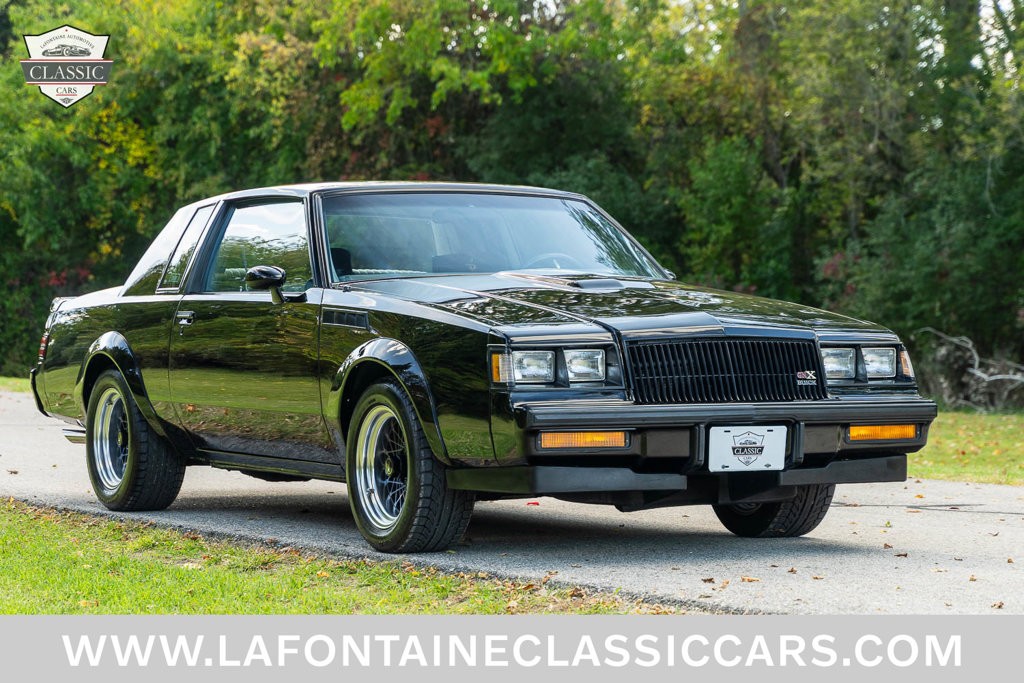 $279,444 · In line with typical
Expand
What they sell for: GNX sale prices.