
Cadillac Calais buyer's guide
Cadillac Calais -- the model's own buyer's guide: variants, values and what to check.
Years listed: 1972-1972 · Series: Full Size
Overview and history
The Calais is the Cadillac for people who wanted the car and not the jewellery. From its launch for the 1965 model year to its quiet deletion after 1976, it sat at the bottom of the Cadillac range — which still meant a full-size, V8-powered, automatic luxury car on the same 129.5-inch (later 130-inch) wheelbase as a DeVille, sharing the DeVille's body shell, its perimeter frame, its engines and its Turbo Hydra-Matic gearbox. What you gave up for the saving was trim: plainer upholstery in cloth and vinyl rather than leather, less brightwork outside, and a shorter standard-equipment list, with things a DeVille buyer took for granted — power windows in the early years, for example — sitting on the option sheet instead. Cadillac named it after the French port city, following the house habit of French names that also gave you the DeVille and the Fleetwood Brougham's formal roofline, and it replaced the Series 62 as the entry point to the marque.
Understand that positioning and the whole car makes sense. The Calais was never a cut-down Cadillac and never a different, lesser machine underneath. A 1972 Calais and a 1972 DeVille are the same engineering wearing different clothes, which is precisely why the Calais is interesting now: the market prices the badge and the trim, so the Calais buys you the big Cadillac driving experience — the silence, the torque, the ride — for DeVille money minus a visible discount, in exchange for a cabin that was plainer when new and is harder to retrim correctly today. The catch, and it runs through this whole guide, is that cheap when new also meant bought cheap and kept cheap. Calais buyers were the value end of the Cadillac clientele, the cars were frequently ordered with fewer options, worked as everyday transport rather than cosseted second cars, and were the first full-size Cadillacs to be let go when money got tight in the 1970s fuel crises. Survival is correspondingly thinner than for DeVille, and condition spread is wider.
The production life divides into three blocks. The 1965–70 cars are the first generation: the clean 1965 restyle with stacked headlamps, the 429 V8 for three years and then the 472 from 1968. The 1971–76 cars are the giants — the biggest Cadillacs ever built, sharing the 1971 GM full-size restyle, gaining 5-mph bumpers, catalytic converters and finally, for 1975–76, the 500-cubic-inch V8. There is no third act: when Cadillac downsized the range for 1977, the Calais name was dropped and the DeVille became the entry car. There was never a Calais convertible, in any year — open Cadillacs were DeVilles and Eldorados — and there was never a manual gearbox. Anyone offering you either is offering you a conversion or a misunderstanding, and you should price and inspect it as such.
Our own listings pool is small and honest about where the surviving market sits: we track three Calais, all currently offered for sale, and they are two 1972 cars and a 1975 — the 1971–76 giant generation, in hardtop form. That matches the wider picture. The 1965–70 cars survive in smaller numbers than their production would suggest, and the Calais you will actually be offered, nine times out of ten, is a 1971–76 coupe or sedan that has outlived two or three owners. Judge the car in front of you against its own brief: a sound body, a healthy big V8, a working climate system and an honest interior. A Calais that delivers those four things is the cheapest honest route into a full-size classic Cadillac that exists.
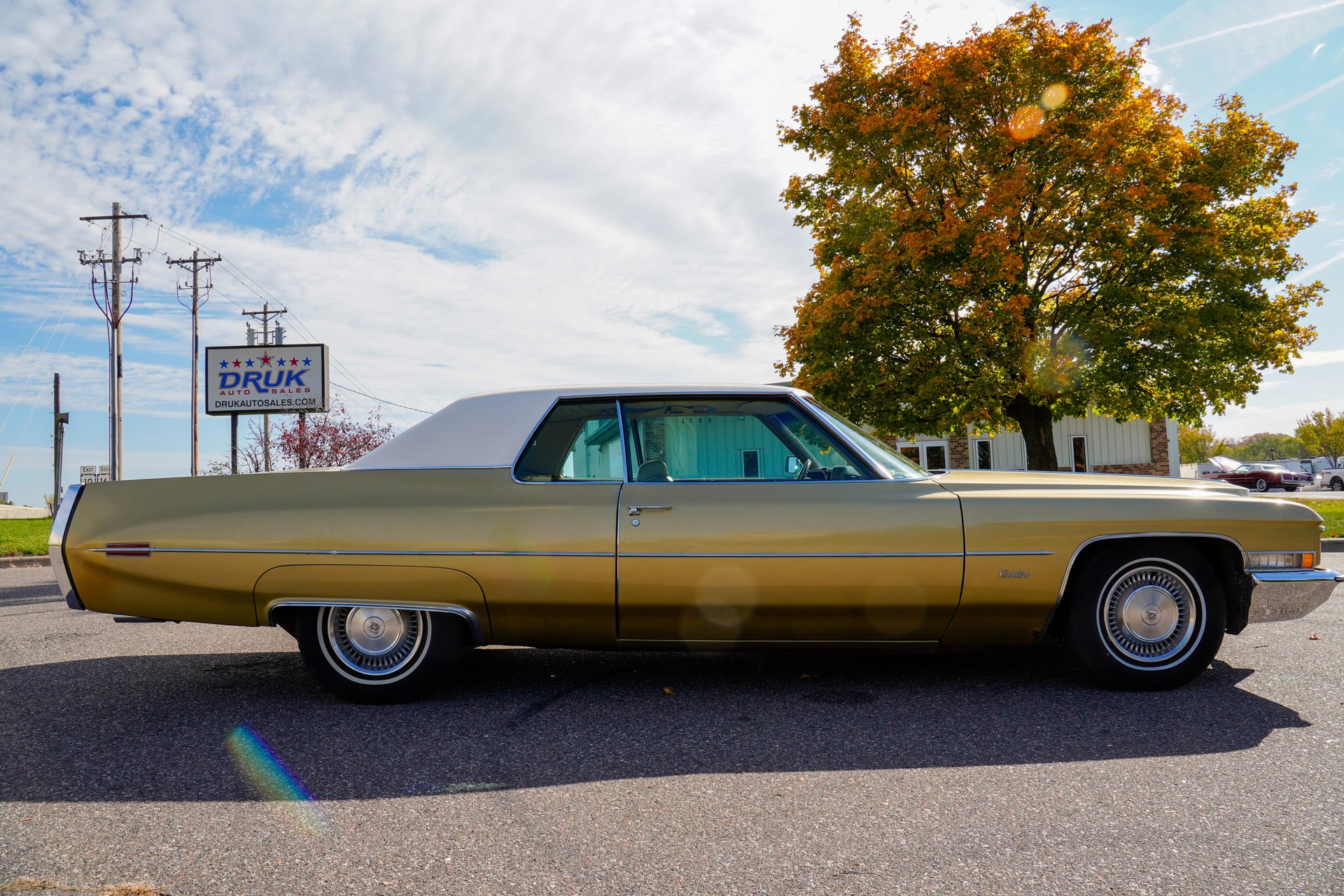
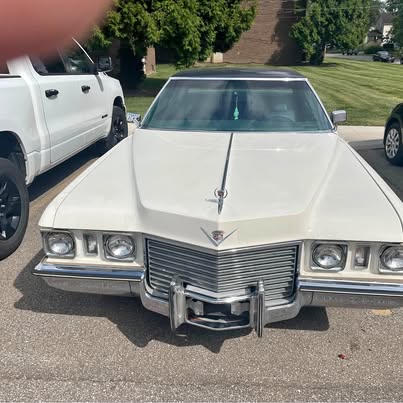
The models
Cadillac kept the Calais range deliberately simple, and that simplicity is a buying aid: in any given year there are only two body styles to understand. The Coupe is a two-door hardtop — pillarless, with a vinyl roof covering on most survivors — and the Sedan is a four-door. For 1965–70 the sedan is a four-door hardtop in the stacked-lamp body; for 1971–76 both bodies sit in the giant shell, the coupe gaining the small rear opera window in its thick C-pillar partway through the run. There is no wagon, no convertible and no long-wheelbase Calais; the long cars were Fleetwood Series 75 territory. Trim is a single level. Where a DeVille buyer chose between standard and d'Elegance packages in the 1970s, the Calais buyer simply ticked individual options: air conditioning (fitted to the great majority of survivors, and close to essential for value), power windows, a power seat, cruise control, a vinyl roof, tilt steering column and, from the mid-1970s, fuel injection on the options list of the biggest engine. Two cars that look identical in photographs can differ by a page of options, so work from the car's own body plate and equipment, never from the model name alone.
| Model | Years | Engine | Output | Built | Character |
|---|---|---|---|---|---|
| Calais Coupe / Sedan | 1965–1967 | 429 V8 | 340 hp (gross) | Not separated in period reporting | The clean first cars; stacked lamps, the sweetest styling |
| Calais Coupe / Sedan | 1968–1970 | 472 V8 | 375 hp (gross) | Not separated in period reporting | Full-fat 472, high compression, pre-emissions character |
| Calais Coupe / Sedan | 1971–1974 | 472 V8 | 220 hp (net) by 1972, 205 hp by 1974 | Not separated in period reporting | The giants arrive; net ratings and emissions tuning change the feel |
| Calais Coupe / Sedan | 1975–1976 | 500 V8 | 190 hp (net) | Not separated in period reporting | The largest production V8; rectangular lamps, catalysts, optional injection |
(Outputs are period SAE gross figures before 1972 and net figures after, so the table appears to show an engine losing half its power across 1971. It did not. The rating method changed, compression fell and emissions equipment arrived, in that order of importance; a 1972 car is a lazier thing than a 1969 car, but by a fraction, not by half. Production was never published as a clean Calais-only split a buyer can rely on year by year, so the table says so rather than inventing one. What is safe to say is that Calais was consistently the smallest-selling series in the full-size range — these were always the minority of production, which is why you see so few next to DeVilles today.)
The 429 cars (1965–67). The connoisseur's Calais, if such a thing exists. The 1965 styling is the cleanest of the whole nameplate's life, the 429 is a strong, simple engine, and the cars predate the emissions era entirely. They are also the rarest survivors and the ones where the Calais's plain trim hurts most at resale: a cloth-trim 1965 coupe is a lovely car that the market will always price behind the equivalent DeVille. Buy one because you want it, not as an investment.
The high-compression 472 cars (1968–70). The 472 arrived for 1968 with 10.5:1 compression in its first years and a gross rating of 375 hp, and these are the fastest-feeling Calais ever built — which is a relative term in a car weighing well over two tons, but the throttle response and mid-range are genuinely different from the later cars. They want premium fuel, they predate hardened-seat concerns being fully settled for unleaded use, and they carry none of the 1970s vacuum plumbing. If you find a sound one, it is the driver's pick of the range.
The early giants (1971–74). The 1971 restyle made the car bigger in every direction, and the Calais became a very large, very plain luxury car — a combination the market has historically undervalued, which is your opportunity. The 1972 cars in our pool are typical: 472 engine, net-rated, with the emissions hardware arriving in stages (EGR from 1973, bigger bumpers from 1973–74). Buy these on body condition above all; the mechanicals are the same honest hardware as the DeVille's and no harder to keep.
The 500 cars (1975–76). The last Calais, with the 500-cubic-inch engine — still the largest-displacement engine fitted to a regular-production American car — rectangular headlamps, a catalytic converter and unleaded fuel. The 1975 car in our pool is the type. A tiny number were ordered with the optional Bendix electronic fuel injection; an injected car is a fascinating survivor and a specialist ownership proposition, covered in the engine section. For most buyers the carburetted 500 is the one: immense, lazy torque and the full 1970s Cadillac experience in its final, largest form.

Engines and gearboxes
Every Calais ever built carries one of three related engines — the 429, the 472 and the 500 — all of them Cadillac's own overhead-valve V8 in the same architectural family, all of them driving through the same three-speed automatic. That is the good news, and it is genuinely good: there is no bad engine in a Calais, no bought-in stopgap, no diesel, no variable-displacement experiment. The differences that matter are compression ratio, emissions equipment and fifty years of maintenance, in ascending order of importance. A neglected 472 is a worse buy than a cherished 500 every time.
The 429 (1965–67)
The 429 was Cadillac's second-generation overhead-valve V8, introduced for 1964 across the range and carried into the Calais at its 1965 launch. It is a 340 hp (gross) engine of conventional layout: cast-iron block and heads, hydraulic lifters, a single Rochester four-barrel carburettor, and breaker-point ignition. It is an understressed, torquey engine in the Cadillac manner — peak effort arrives low in the rev range and the engine is effectively never asked to rev — and its core is durable. What kills 429s now is not design but age and storage: sludge in engines that never got hot, perished seals, and cooling systems that have been topped up with plain water for decades.
Two era-specific points. First, the 429 was designed for leaded premium fuel at 10.5:1 compression; on modern unleaded it will run, but an engine that has never had its valve seats attended to and is worked hard can suffer exhaust-seat recession, and most survivors benefit from a dose of restraint and, at rebuild time, hardened seats. Second, ignition is points through the whole 429 run — a car that starts reluctantly, kicks back or runs flat at speed is very often a $30 set of points and a condenser away from health, and you should always eliminate the cheap ignition causes before letting anyone diagnose the expensive ones.
The 472 (1968–74)
The 472 was a new engine for 1968, designed from the outset with room to grow — the same basic architecture later stretched to 500 cubic inches — and it is one of the great American torque engines: 375 hp gross and a torque figure quoted at 525 lb-ft in its first, high-compression form. In the Calais it runs unchanged in concept through 1974, but the detail evolves constantly. Compression falls from 10.5:1 to 8.5:1 for 1971, which is why the later cars tolerate regular unleaded happily and feel softer. Gross ratings give way to net ratings in 1972 (220 hp net), exhaust-gas recirculation arrives for 1973, and the carburation and vacuum plumbing grow more elaborate every year.
The 472's one famous designed-in weakness is the camshaft timing drive. Cadillac fitted a cam sprocket with nylon-coated teeth to keep the chain quiet, and the nylon embrittles with age and heat cycles until teeth shed — into the sump, and into the oil pickup. The symptoms are a sudden no-start, a jumped-timing misfire that no amount of distributor twisting will cure, or a rattle from the front cover followed by silence. The test is mechanical, not electrical: check for excessive timing-chain slack by rocking the crankshaft pulley against the distributor rotor's movement, and treat any 472 or 500 with no documented timing-set replacement as a car that needs one. A steel timing set fitted as preventive maintenance costs roughly $400–800 in parts and labour at a generalist shop; an engine that has swallowed its own teeth and run bent or starved costs ten times that. Budget for the timing set on any purchase, the way you would budget for tyres.
Fuelling throughout is the Rochester Quadrajet, a spread-bore four-barrel that is excellent when right and blamed for everything when wrong. The classic Quadrajet faults on these cars are specific: the primary throttle shaft wears its bore in the baseplate and leaks vacuum, giving a high, hunting idle that no mixture screw will settle; the choke pull-off diaphragm perishes and causes a cold stumble; and the fuel-well plugs in the float bowl weep internally, so the bowl drains overnight and the car cranks forever on a cold morning before it fires. That last test is free and definitive: a Calais that starts instantly when warm but needs twenty seconds of cranking after standing overnight is telling you its bowl is empty by morning, and the cause is plugs or a draining float, not the starter motor everyone replaces first.
The 500 (1975–76) and the injection option
For 1975 the Calais moved to the 500, the 472's architecture at its full stretch, net-rated at 190 hp and built for torque, smoothness and emissions compliance rather than numbers. It runs at 8.5:1 compression, breathes through a Quadrajet, exhales through a catalytic converter — 1975 is the converter's first year, with unleaded fuel mandatory — and from 1974 the range had already adopted GM's High Energy Ignition, so 500 cars have no points to set and a much stronger spark, at the price of an ignition module and pickup coil that fail with age and heat instead. A 500 that dies hot and restarts cold, repeatedly, is showing you the classic HEI module failure; the module is cheap, lives under the distributor cap, and should be your first suspect before the coil or the carburettor.
The rarity is the optional Bendix electronic fuel injection offered on the 500 in 1975–76: an analogue, speed-density system with an electronic control unit that was remarkable technology for a production car of the period and is a specialist subject now. Injected cars have no carburettor, use an electric fuel pump and a throttle-body-style intake, and when the system works the car starts and idles beautifully. When it does not, the failure is usually in fifty-year-old electronics, sensors or wiring rather than in the iron, and the pool of people who can diagnose it is small and shrinking. Our advice is absolute: buy an injected Calais only as a documented, running curiosity from an owner who understands it, and price a carburetted car as the default. Never pay an injection premium for a car that "just needs the injection sorting" — that sentence conceals the single hardest recommissioning job in the whole Calais range.
Living with these engines today: fuel, oil and tuning
Three modern facts govern a Calais engine's health now, and none of them is the one owners argue about most. The argument is valve seats and unleaded fuel. The honest position: the high-compression 429 and early 472 were built in the leaded era, their exhaust seats are the head material itself, and sustained hard use on unleaded can erode them — but these are low-revving, lightly stressed engines in cars that now do gentle mileage, and the practical evidence across the DeVille and Fleetwood fleet is that seat recession is a slow, rebuild-time consideration, not an emergency. Fit hardened seats when a head is off for other work; do not tear down a healthy engine to fit them, and do not let a seller use "unleaded conversion done" as a premium without paperwork.
The bigger daily issue is ethanol. Modern pump fuel attacks the Quadrajet's older rubber components, swells needle tips, and goes stale in a vented float bowl within weeks, which is why a Calais that sits for a month starts like a car with a fuel fault: it has one, and the fuel is it. Use the freshest fuel you can, drive the car properly at least every few weeks in season, and treat any carburettor rebuild as the moment to fit ethanol-tolerant components. On oil, these are flat-tappet engines designed for the zinc-rich oils of their era; a quality classic-car oil with adequate ZDDP, changed at 3,000 miles or annually, is cheap insurance for the cam and lifters, and oil pressure is your tell-tale — a hot idle that drops the gauge and flickers the light on a high-mileage 472 is bearing wear announcing itself, not a sender fault to be wished away, though you always prove it with a mechanical gauge before believing it.
Tuning is conventional and rewarding. Points cars want dwell set before timing, always, because dwell changes timing and not the reverse; HEI cars want a healthy module, clean grounds and correct plug gaps, which are wider than points gaps and often wrongly set by habit. Timing on the emissions-era cars should be set to the car's own underbonnet label as a starting point, then judged on the road: a 472 or 500 that pings on modern fuel at the book setting is telling you about carbon, a tired advance mechanism or an EGR system that no longer flows, and retarding the timing to silence it is treating the symptom at the cost of economy and exhaust temperature. Vacuum advance units perish and are cheap; a car that cruises flat and thirsty with good compression very often just needs its advance restored.
Gearboxes: the Turbo Hydra-Matic 400
Every Calais uses GM's Turbo Hydra-Matic 400 three-speed automatic, column-shifted, with a torque converter and no overdrive and no lock-up clutch. It is one of the strongest automatic gearboxes ever fitted to a production car, it was the standard choice behind big-block power across GM, and a healthy one in a Calais should be nearly invisible: clean upshifts under light throttle, a firm kickdown when you ask, no flare between ratios and no delay engaging Drive or Reverse from cold. Parts, rebuild knowledge and filters are universally available, and a full professional rebuild typically runs $1,800–3,000 — real money, but a known quantity, and not a reason to reject an otherwise sound car if the price reflects it.
The TH400 faults you will meet are diagnostic gifts, because they have signatures. The vacuum modulator on the side of the case controls shift timing and firmness from manifold vacuum; when its diaphragm ruptures, the engine sucks transmission fluid up the vacuum line and burns it, so the car produces pale smoke under load, shifts late and hard, and loses fluid with no visible leak underneath. If a Calais smokes lightly, uses ATF and has a dry underside, pull the modulator vacuum hose and look for fluid inside it before you condemn the engine's rings — the modulator is an inexpensive external part. A car that will not upshift out of first at all, with correct fluid level, has usually stripped the plastic governor gear, another external-ish repair. Kickdown is by an electric switch at the accelerator pedal rather than a cable, so a car that never kicks down may need a switch or its wiring, not a gearbox. And check the fluid itself: it should be red and sweet-smelling. Dark, burnt fluid in a box that still shifts well is a service overdue; dark fluid in a box that flares on the 2–3 shift is a rebuild negotiation.
Problem areas
A Calais fails in a predictable order, and the order is the opposite of what most buyers fear. The engine and gearbox — the expensive-sounding parts — are the strongest parts of the car. The body, the climate system, the vacuum plumbing and the trim are where Calais money goes, because the car is enormous, every panel is large and hard to ship, and the Calais's plain specification means reproduction trim support is thinner than for the DeVille the market loves more. Work through the systems below in this order: body first, because rust decides whether the car is a car at all; then the running systems, which are almost all fixable at sane money; then the cabin, which decides whether you will enjoy owning it.
Rust: the map
Start underneath, because on a 1971–76 car you are inspecting a perimeter frame and a very large body that traps water in specific, repeatable places. The frame itself is stout and usually survives, but check the rear kick-up over the axle, the body-mount points and the front crossmember area for scaling and thinning, and reject any car whose frame rails are holed — frame repair on a car this size is specialist fabrication, not a weekend weld. The body mounts themselves perish and compress, which is why a sagging, creaking Calais with uneven door gaps is often tired rubber rather than a bent car; mounts are replaceable, but the labour is in the lifting.
The classic rot points, in the order to check them: the trunk floor, especially the well and the areas over the rear frame rails, because the trunk seal leaks and the water sits unseen under the mat; the rear quarters low behind the wheels and under the fender skirts, which trap road dirt against the panel and rot it from inside — always look up behind the skirt from underneath, not at the shiny face; the floor pans under the front carpets, fed by windscreen leaks and by heater-core coolant; the lower front fenders behind the wheels; the door bottoms, where the drain holes block and the hem flange rusts; and the battery tray and inner fender beneath it, acid-eaten on almost every car. On vinyl-roof cars — which is most of them — add the roof itself: the padding under the vinyl holds moisture against the steel, and bubbling at the base of the C-pillars, around the rear window or along the roof's lower edges means the panel underneath is perforating. A roof repair means removing the vinyl, welding, and re-covering, typically $1,500–3,500 done properly, and it is the single most under-declared defect on these cars because fresh vinyl hides it beautifully for about a year.
Our own photo-note evidence is thin and we say so plainly: only one car in our current Calais pool has a full photo-note examination on file, and that one car was noted for both rust and damage. A sample of one proves nothing about the model — but it is exactly the pattern the wider DeVille and Fleetwood market shows, and you should inspect any Calais as if rust is present until you have personally proved each area above is clean. Beware fresh underseal, fresh trunk paint and new carpets fitted over unphotographed floors; on a Calais, cosmetic freshness in exactly the rust zones is a reason to probe harder, with a magnet, a torch and a screwdriver used with the seller's permission. Structural welding on these cars runs roughly $1,000–2,500 per side for sills and floors at a competent shop, and quarter-panel work costs more because the panels are huge and used ones are the usual source.
Engine ancillaries and cooling
The core engines are covered above; what surrounds them is where the running faults live. The cooling system is the first system to interrogate, because a 472 or 500 that has overheated repeatedly is a different engine from one that has not. The radiator is large and, on survivors, often the original core with fifty years of scale in it; a car that runs cool on the road but creeps up at idle usually has a failed fan clutch or a blocked core, and the distinction is easy — the fan clutch should resist and roar when hot, and a radiator that is cold in patches under your palm after a run is blocked in those patches. Water pumps weep from the tell-tale hole before they fail; heater cores leak into the passenger footwell and fog the screen with a sweet smell, and replacing one is a dashboard-out labour bill of $800–1,500 even though the core itself is cheap, which is why so many cars have the heater looped out with a length of hose in the engine bay. A looped heater hose on a viewing is not a detail; it is a declared $1,000 fault, priced as such.
Exhaust manifolds crack, particularly on the higher-mileage cars, and tick when cold in a way that fades as the metal expands — distinguishable from a lifter tick because the manifold tick is sharp, exhaust-paced and gone within minutes. The heat-riser valve in the exhaust manifold seizes and strangles cold running. Under the car, the starter motor lives close to the exhaust and suffers heat soak: a Calais that starts perfectly cold and clicks or cranks slowly after a hot fuel stop is showing you a tired, heat-soaked starter and tired cables, not a failing battery, and the test is simply to let it cool for twenty minutes and try again. Oil leaks are universal — valve covers, the rear main area, the front cover — and the buying distinction is between weepage that marks a driveway and a leak that loses measurable oil between services; the first is a gasket weekend, the second is investigation.
Suspension, steering and brakes
The chassis is conventional and strong: unequal-length front arms with coil springs and ball joints, a live rear axle on coil springs with trailing arms, recirculating-ball power steering by Saginaw, and power brakes — front discs and rear drums on the 1971–76 cars, with disc availability varying on the 1960s cars. Nothing here is exotic and everything here wears by weight. Two-plus tons on fifty-year-old ball joints, idler arms and centre links gives you the classic big-Cadillac wander: the car follows road camber, needs constant small corrections and feels vague around the straight-ahead. The test is to drive it on a straight, flat road at 40 mph and take your hands lightly off the wheel; a sorted car tracks, a worn car hunts. Play at the steering wheel before the road wheels move points to the steering box adjustment, the flexible coupling and the linkage in combination, and a full front-end refresh with quality parts is a $1,000–2,000 job that transforms the car — budget it on any purchase that has not had it documented.
Springs sag, and Calais sit low at the rear with age; measure the car side to side on flat ground, because a one-sided sag is a broken or collapsed spring, not a stance. Some cars were optioned with automatic level control using air-assisted rear dampers and an engine-driven or electric compressor depending on year; where fitted and dead, the rear sits low and the system is usually abandoned rather than repaired, which is acceptable if the car has been converted to standard dampers and springs properly and sits level — unacceptable if it is simply dragging. Brakes: the pedal should be high, firm and straight-line. A pedal that sinks slowly at a stop is a master cylinder passing internally; a pull under braking on the disc/drum cars is usually a seized caliper or a collapsed flexible hose on the opposite side; and the parking brake on these cars is a vacuum-released unit on many years that depends on the same vacuum system as everything else, so test that it holds and releases. Rear wheel cylinders weep inside the drums invisibly until the shoes are contaminated, so a car with a long pedal and a recent "brake service" deserves a drum off, not a receipt waved at you.
Tyres deserve a sentence of their own: these are heavy cars that sit for months, and flat-spotted, aged-out whitewalls are the norm on fresh purchases. Check the date codes, not the tread. A set of correct-size tyres is ordinary money, but driving home on ten-year-old rubber is how a cheap Calais becomes an expensive one.
Climate control, vacuum and electrics
This is the section that decides daily happiness, because a 1970s Cadillac is a vacuum-powered machine wearing an electrical overcoat. The automatic climate system — Comfort Control on the earlier cars, Automatic Climate Control later — runs on engine vacuum through a programmer behind the dash, moving doors and valves to hold a set temperature. When it works it is superb. When it does not, the failure is usually perished vacuum hoses, a failed vacuum actuator diaphragm, or a programmer fault, and the diagnostic order matters: prove engine vacuum and hose integrity first, because half of all "climate control ECUs" condemned on these cars are a split $2 hose at the firewall. Budget $500–1,500 for a specialist to recommission a dead system properly, more if the air-conditioning side needs conversion work; the cars were built for R12 refrigerant, the A6 compressor is robust and rebuildable, and the 1973-onwards valves-in-receiver (VIR) assembly is a known service item. A car advertised with "A/C just needs gas" needs, in reality, a leak found, seals, a drier or VIR service and a recharge — price it as a system recommission, never as a can of refrigerant.
Vacuum also runs the door locks on many cars, the parking-brake release and the cruise control, so a car with a rough idle and three dead convenience systems is telling you one story, not four. Electrically, the pattern faults are power-window motors and, more often, the wiring that flexes in the door jambs until conductors break inside unbroken insulation — a window that works with the door open and not closed has confessed. Power seats use a transmission with plastic gears and cables that seize. The charging system is conventional: externally regulated alternators on the earlier cars, internal-regulator units later, and fusible links that corrode at the starter and cause total, intermittent electrical death that mimics a failed ignition switch. On HEI cars, carry a spare ignition module in the glovebox; on points cars, carry points and a condenser. Both habits are cheaper than one tow.
Fuel, exhaust and emissions hardware
The systems added through the 1970s are now old enough to cause faults that masquerade as engine wear, and the Calais spans the whole transition, so date the car before you diagnose it. Pre-1971 cars have essentially no emissions hardware beyond a PCV valve and a closed crankcase system — keep the PCV valve fresh, because a blocked one pressurises the crankcase and manufactures oil leaks at every seal. From the early 1970s you add an evaporative charcoal canister (a saturated or split canister gives fuel smells in the cabin and boot that owners chase as leaks for months), an air-injection pump whose seized bearings squeal and whose diverter valves fail, and from 1973 exhaust-gas recirculation. The EGR valve is the great impersonator: carboned open, it gives a rough, stumbling idle and a car that stalls at junctions, blamed on the carburettor by everyone who has not put a finger under the valve and felt it held off its seat. The test is to disable the valve's vacuum supply temporarily — if the idle cleans up instantly, you have found the fault and the cure is cleaning or replacing the valve and its passages, not a carburettor rebuild.
On the 1975–76 cars the catalytic converter joins the system, and a converter on a car that has run rich for years — choke faults, the draining float bowl, misfires — eventually overheats and blocks, giving a car that starts and idles well but will not pull, will not rev under load and hisses at the exhaust. The distinguishing test is vacuum: a gauge that reads healthily at idle and falls away as revs are held is showing you a restricted exhaust, and the converter and a collapsed double-wall exhaust pipe are the two suspects. Exhaust systems themselves are long, heavy and prone to rot from the inside on cars used for short trips; budget for sections rather than assuming a full system exists off the shelf, and know that manifold-to-pipe studs on a fifty-year-old 472 will test any mechanic's patience and occasionally the manifold. Fuel tanks rust from inside on stored cars and feed the Quadrajet a diet of rust dust that blocks its small passages no matter how often the filter is changed — if a car has needed three carburettor clean-outs in a year, the tank is the fault and the carburettor is the victim. The sender unit and its earth strap are the usual cause of a dead or lying fuel gauge, and on a car this thirsty a lying gauge is not a trivial fault.
Interior and trim
The Calais cabin is where the model's cheapness when new becomes the buyer's problem now. The upholstery is cloth or vinyl in Calais-specific patterns — the DeVille's leather and brocade support from the retrimmers does not extend to correct Calais cloth, and a torn Calais seat in an unusual pattern can be effectively unmatchable except by a trimmer weaving a close substitute at $1,500–3,000 for a seat set. Inspect accordingly: a clean, original Calais interior is a major asset and worth real money in the price; a split, sun-rotted one is a permanent compromise or a four-figure bill. Dashboard pads crack along the speaker and defroster lines in sun-belt cars; headliners sag; the simulated wood and bright trim are Calais-grade and pit like all period pot metal. Door cards warp at their lower edges from the same water that rusts the door bottoms, so a warped card is a prompt to check the door shell, not just a cosmetic note.
Outside, the brightwork is less extensive than a DeVille's — that is the point of the model — but what exists is model- and year-specific: grilles, lamp bezels, the Calais scripts on the rear fenders of the later coupes, and the big bumpers, whose chrome is expensive to redo at roughly $800–1,500 per bumper for quality plating. Fender skirts go missing; wheel covers are cheap and correct ones are plain. The rule for trim is the rule for the whole car: completeness beats shine. A dull car with every script, skirt and bezel present is a better buy than a gleaming one missing three pieces that each take six months to find.
How to inspect one
Inspect a Calais in a fixed order, cold car first, and do not let the seller warm it up before you arrive — half the diagnoses in this guide are cold diagnoses. Take a torch, a magnet in a cloth, a tyre gauge, a long screwdriver and this list.
- Paperwork and identity first. Match the VIN plate to the title, then read the body plate on the cowl for the style, paint and trim codes. The plate tells you the car's original colour and upholstery; a "rare original colour" that is not on the plate is a repaint, priced as one. Confirm the car is badged and built as a Calais — Calais scripts, plain trim — and that nobody is charging you a DeVille premium for it.
- Cold start. From stone cold, the car should crank briefly and settle to a fast idle that steps down as it warms. Twenty seconds of cranking on a carburetted car points to the Quadrajet's draining float bowl from the engine section; instant warm starting later in the visit confirms it. Blue smoke at the cold start that clears is valve-stem seals; smoke that persists is rings or, if it comes with late shifts and falling fluid level, the gearbox modulator.
- The rust walk. Torch and magnet, in the order of the rust section: trunk floor under the mat, behind the fender skirts from underneath, floor pans under lifted carpet corners, door bottoms, front fender heels, battery tray. Then the vinyl roof — press gently along the C-pillar bases and rear-window edges for the crunch of perforation under padding. Any structural hole moves the car from "driver" to "project" pricing on the spot.
- Frame and mounts. Underneath, check the rear kick-up, body mounts and crossmember. Surface scale is normal; holed rails end the inspection. Compressed, cracked body mounts explain creaks and door gaps and are negotiable; a bent frame is not.
- Fluids before the drive. Engine oil for level, smell and mayonnaise under the filler cap; coolant for colour and oil contamination; brake fluid level; power-steering fluid; and transmission fluid — red and sweet is serviceable, brown and burnt is a negotiation, and the level must be checked hot later as well. A low ATF level with a dry underside sends you straight to the modulator test: pull its vacuum hose and look for fluid inside.
- Cooling system, static. Radiator cap off (cold), look for scale and oil film. Squeeze the top hose for perishing. Check the fan clutch for wobble and resistance, the belts, and the engine bay for the looped heater hose that declares a dead heater core — a four-figure labour fault priced in the problem areas.
- The drive: steering and suspension. On a straight road at 40 mph, relax your grip: the car should track, not hunt. Note play before the wheels respond, knocks over bumps (ball joints, links), and one-sided sag you measured before setting off. A documented front-end refresh is worth money; an undocumented car gets the $1,000–2,000 refresh budgeted against it.
- The drive: engine and gearbox. The TH400 should engage Drive and Reverse promptly from rest, upshift cleanly, and kick down on demand via its pedal switch. Flare on the 2–3 shift, late hard shifts with pale smoke, or no kickdown each have named causes in the gearbox section — use them to price, not just to worry. At a steady cruise the engine should be inaudible effort; a cold tick that fades is a manifold, a hot rattle from the front cover is the timing drive asking for its steel replacement set.
- Brakes, properly. Firm pedal, no slow sink at a held stop (master cylinder), straight stops from 40 mph with hands light (caliper or hose faults pull), and a parking brake that holds on a slope and releases. Remember the rear cylinders hide their leaks inside the drums.
- Climate and vacuum. Set the climate control to full cold and full heat in turn and give it a minute each way; doors should move, air should change temperature and distribution. Then test every vacuum dependent in reach — locks, cruise on the drive, parking-brake release. Three dead systems with a rough idle is one vacuum story, and you are pricing hoses and actuators, not three separate disasters.
- Electrics, all of them. Every window, in both door positions (open and closed — the jamb-wiring test), the seat, lights, wipers, horn, radio and gauges. On an HEI car, note any history of hot cut-outs; on a points car, ask when the points were last set. Dead items are bargaining chips only if you have priced the specific cause.
- Hot restart and final fluids. After the drive, shut it off, wait five minutes and restart: a slow, clicking hot crank is the heat-soaked starter from the problem areas, and twenty minutes' cooling will prove it. Recheck ATF hot, look underneath for fresh drips, and only then talk money — with the timing set, the heater, the climate and the front end each either documented, tested good, or priced into your offer.

Values
Read the Calais market as a condition market, not a model market, because the badge carries a built-in discount and condition overwhelms everything else. The same car — same year, same body — exists at project money with a perforated roof and a dead climate system, and at strong money as a documented, rust-free survivor, and the spread between those two cars is several times the value of the cheaper one. The computed listings and recorded-sales figures appended below this guide show you where today's asks sit; your job is to place the specific car in front of you on the condition ladder before you compare it with any of them. A Calais priced like a DeVille needs a DeVille-beating reason — exceptional originality, a superb colour, documented history — because the market will reimpose the Calais discount the day you come to sell.
Asking prices and achieved prices part company most on the over-presented cars: the freshly detailed, freshly vinyl-roofed 1970s coupe photographed at golden hour, where the ask assumes the roof, floors and climate system you have not yet verified. The inspection sequence above is your negotiating instrument. Each named fault — the steel timing set the engine has never had, the looped heater hose, the dead climate programmer, the front-end refresh — is a real, costed job, and sellers of these cars generally know it; a calm, itemised deduction from the ask lands better than a low offer with no reasoning. Conversely, the honest survivor with original paint, a working everything and a file of receipts is frequently underpriced by sellers who have absorbed the "Calais is the cheap one" story too completely, and those cars sell quickly when they appear.
Variant premiums within the range are modest and logical. The 1968–70 high-compression cars are the enthusiasts' pick and hold a small edge; the 1975–76 500 cars trade on the engine's fame; coupes are generally easier to sell than sedans; and the injected 500 is a curiosity whose premium exists only when the system demonstrably works. What never carries a premium is a project. The gap between a project Calais and a driving one is the cost of bodywork, trim and climate recommissioning at shop rates, which routinely exceeds the finished car's value — so the project is only rational at a price that treats it as a parts-and-shell proposition, or in the hands of an owner who welds. Buy the best body and interior you can find and let the mechanicals, which are this car's strong suit, be the part you fix.
Parts and ownership
Ownership is the Calais's quiet strength. Mechanically the car is a full-size GM product of the most populous kind: the 429, 472 and 500 share their service parts with the DeVille and Fleetwood ranges, the TH400 is supported everywhere automatics are rebuilt, and filters, belts, hoses, brake parts, suspension joints and steering components are ordinary catalogue items at ordinary prices, much of it shared with other full-size GM cars of the period. Engine hard parts, Quadrajet service kits, HEI components and timing sets — buy the steel set, never another nylon-toothed sprocket — are all in current production or healthy reproduction. A competent generalist mechanic who knows carburetted V8s can maintain the whole car; you do not need a marque specialist except for the fuel-injection cars and the climate programmer.
Where support thins is exactly where the problem areas pointed: body and trim. Sheet metal comes from donor cars, and the panels are enormous to store and ship, so a rust-free donor quarter or door is a find, not an order. Calais-specific scripts, bezels and interior cloth are the hardest items on the car, and the sensible owner buys spares opportunistically — at swap meets, from parted cars, whenever they appear — rather than when needed. Glass is shared with the DeVille bodies and is obtainable; vinyl roof material is generic and any good trimmer can fit it once the steel beneath is sound.
Running costs are dominated by fuel, tyres and the car's sheer appetite for space. Expect fuel consumption in the low teens per gallon at best, worse around town; the car is over eighteen feet long in giant form and needs a garage that fits it, which is a real ownership filter — measure before you buy. Insurance on agreed-value classic policies is reasonable, registration is simple in most states for cars of this age, and the maintenance rhythm is undemanding: oil and filter every 3,000 miles or annually, coolant every two years, transmission fluid and filter on a sensible interval, and grease and inspection of the front end annually, because weight is always working on it. Used as a fair-weather car with those basics done, a Calais is one of the least troublesome classics of its size; neglected, it becomes a queue of four-figure systems all asking at once.
Which one to buy
- The all-rounder: a 1971–74 Calais coupe or sedan with the 472 — the giant body, the simplest specification of the big cars, parts support at its best, and the market's Calais discount at its most generous. Buy on body and interior, with the timing set documented or budgeted.
- The driver's pick: a 1968–70 car — high-compression 472, pre-emissions manners, the sharpest responses the nameplate ever offered. Scarcer, and worth paying for in genuinely rust-free form.
- The monument: a 1975–76 car with the carburetted 500 — the largest production V8 and the full final-form 1970s Cadillac experience. Rectangular lamps, catalyst, unleaded fuel, no points. The injected version only as a running, documented curiosity.
- The value buy: a sound 1965–67 429 car in an unfashionable colour with a clean original interior — the market prices the plain trim and the early cars' rarity of survival inconsistently, and a good one is the most charming Calais of all.
- The one to walk away from: any car, any year, with a perforated vinyl roof, holed frame rails or a missing-trim interior — those three faults are the ones money cannot efficiently cure on this model.
The overriding rule: on a Calais, buy the body, the roof and the interior — the engine and gearbox are the strongest part of the car and the cheapest to put right, so never pay a premium for a shiny drivetrain in a rusty shell, and never reject a sound shell over mechanical faults you can price.
See the 1 Calais cars currently listed.
For sale now
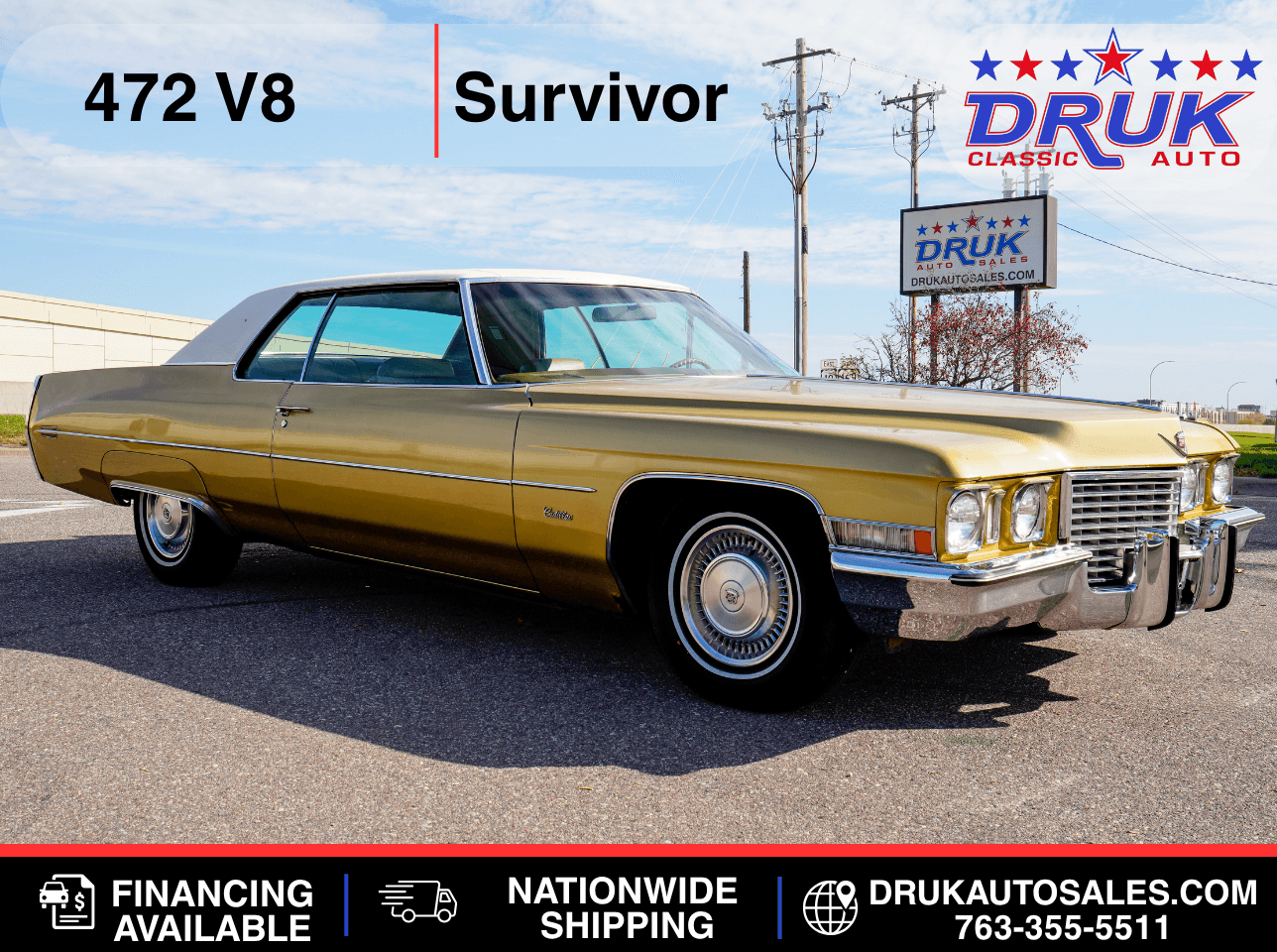 $9,980 · 44% above typical
Expand
What they sell for: Calais sale prices.