
Chevrolet 1967 Chevy C30 Dually w/ Vintage buyer's guide
Chevrolet 1967 Chevy C30 Dually w/ Vintage -- the model's own buyer's guide: variants, values and what to check.
Years listed: 1967-1986 · Series: C/K Trucks
# Chevrolet C30 Buying Guide
Overview and history
The C30 is the one-ton at the top of Chevrolet's classic C/K truck line, and it is the most misunderstood truck in the range — not because it is complicated, but because most buyers shop for it as if it were a big C10. It is not. The half-ton trucks were built to ride like cars and look good doing it. The C30 was built to carry a rated ton of payload — in practice often far more — on a heavier frame, with heavier springs, heavier axles, bigger brakes and gearing chosen for pulling away from a standstill fully loaded. Everything about buying one follows from that: the engines that matter are the torque engines, the condition that matters is the frame and the running gear rather than the paint, and the truck's past life — farm, municipality, contractor, camper hauler — is written into it more honestly than on any lighter truck.
The naming is simple once decoded. In Chevrolet's system, C means two-wheel drive (K is the four-wheel-drive line) and the number is the payload class: 10 for half-ton, 20 for three-quarter-ton, 30 for one-ton. The C30 badge arrived with the C/K range in 1960 and ran, through three distinct generations of truck, until 1986; for 1987 the carried-over design was rebadged R30 in the short-lived R/V series, and from 1988 the GMT400 generation renamed the one-ton C3500. This guide concentrates on the two generations that make up nearly everything you will find for sale: the 1967–72 "Action Line" and the 1973–87 "Rounded Line" square bodies; the 1960–66 first-generation truck shares the philosophy and most of the engines, and its differences are flagged where they matter.
What defines the C30 against its lighter brothers is hardware. The frame is a deeper, heavier-gauge channel section than the C10/C20 frame. The rear axle is a full-floating unit — an Eaton HO72 on earlier trucks, a Dana 70 under most dual-rear-wheel square bodies, GM's own 10.5-inch 14-bolt full-floater under single-rear-wheel square bodies — so the axle shafts carry no weight and a broken shaft does not strand you. Front suspension is independent, on coil springs and ball joints, across the whole run; there is no solid front axle unless someone has swapped one in. Dual rear wheels were a factory option on pickups and near-universal on chassis-cabs, and they transform stability under load while making tyre maintenance, parking and wet-road manners worse.
The other defining fact is that Chevrolet sold the C30 in two fundamentally different forms. As a pickup, with a factory Fleetside or Stepside bed, it is a close cousin of the C10 and C20 and is bought the same way. As a cab-and-chassis, it left the factory with nothing behind the cab but frame rails, and everything aft of the cab — dump body, flatbed, wrecker, utility body, camper, fire-rescue body — was fitted by an outside body builder or a previous owner. That second form dominates the surviving population: every one of the eight C30s listed on this site at the time of writing wears a working body rather than a factory pickup bed. A cab-and-chassis C30 is therefore two vehicles to inspect — a Chevrolet truck, and a body of unknown parentage bolted to it — and this guide treats both halves with equal weight, because the body is often where the money goes.
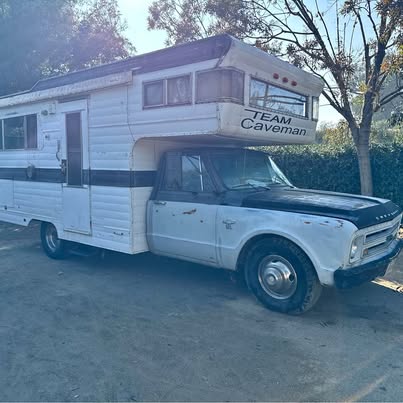
Why buy one at all, when a C20 does most jobs? Three honest reasons. First, capability: nothing else in the classic Chevrolet line will legally and comfortably carry what a dual-wheel C30 carries, and for a slide-in camper, a gooseneck or a working dump body, the one-ton is the correct tool rather than an upgrade. Second, value: because the market prices glamour, and glamour lives in short-bed half-tons, the C30 has historically been the cheapest way into a genuinely heavy classic truck. Third, character: a one-ton drives like nothing else in the range — stiff, deliberate and faintly agricultural unladen; loaded, the most composed ride of any classic Chevrolet truck. Buy it for work, or for the pleasure of a machine built without compromise for work, and you will be happy. Buy it expecting a C10 with more badges and you will not.
The models
The C30 was never a single model but a weight class applied across body styles, wheelbases and trim levels, and the first job with any individual truck is placing it in that matrix. Wheelbases tell you most of it. The factory pickup sat on the shorter chassis (127 inches in the Action Line years, 131.5 inches in the square-body years), while chassis-cabs came in a run of longer wheelbases — roughly 133, 157 and 164 inches across the generations — the length chosen by the body builder's cab-to-axle requirement.
Trim is the second axis. At the bottom sat the unnamed base truck — vinyl bench, painted grille, no brightwork — which is what most working C30s are. Custom and Custom Deluxe added cloth-and-vinyl trim and better instruments. Cheyenne (Action Line) and Cheyenne / Silverado (square body) were the top trims, with carpet, padded door panels, extra sound deadening and, on square bodies, the option of air conditioning, tilt wheel and power windows even on one-tons. Do not let trim drive your decision the way it might on a C10: underneath, the trucks are identical. Identity is settled by the VIN plate and the glovebox SPID label, not by the grille, as the inspection section explains.
The third axis is the one that actually matters: what is behind the cab.
| Model / form | Years | Typical engines | Output (period) | Built | Character |
|---|---|---|---|---|---|
| C30 pickup, Fleetside/Stepside 8 ft bed | 1967–87 | 292 six, 350, 454 V8 | 147–230 hp net (V8) | Not published separately | The one-ton as a truck you can use like a car; SRW or DRW |
| C30 Longhorn pickup (8.5 ft bed) | 1968–72 | 350, 396/402 V8 | 255–300 hp gross | Not published separately | 133 in wheelbase, built for slide-in campers; the connoisseur's Action Line one-ton |
| C30 cab-and-chassis | 1967–87 | 292 six, 350, 454, 6.2 diesel | 130–230 hp net | Not published separately | Bare frame aft of the cab; dump, flatbed, wrecker and utility bodies fitted by others |
| C30 crew cab ("3+3") / Bonus Cab | 1973–87 | 350, 454, 6.2 diesel | 130–230 hp net | Not published separately | Four-door or extended cab on the long chassis; the family-sized work truck |
| C30 Camper Special / camper conversions | 1967–87 | 350, 396/402, 454 | 255–300 hp gross / 175–230 net | Not published separately | Chassis sold for slide-in or coachbuilt campers; check GVW against the camper's real weight |
| C30 municipal / rescue / fire bodies | 1973–87 | 350, 454 | 165–230 hp net | Not published separately | Low miles, high idle hours; superb maintenance records, tired everything else |
Chevrolet did not publish C30-only production figures — output was reported within the wider C/K series totals — so any source quoting an exact build count for a C30 variant is inventing it.
A few variants deserve prose. The Longhorn (1968–72) is the Action Line connoisseur's truck: an 8.5-foot Fleetside bed on the 133-inch chassis, sold at C20 and C30 weights expressly so a slide-in camper would sit fully supported instead of hanging off the back. On a C30 it is genuinely rare and capable, and the extra bed length is the identity check — a standard 8-foot bed on a claimed Longhorn means a swap or a story. The square-body crew cab, badged 3+3 with two bench seats, put four doors on the one-ton chassis from 1973 and is the direct ancestor of every modern crew-cab dually; the two-door Bonus Cab added a small rear seat on the same long wheelbase. Both ride on long frames with two-piece driveshafts, which matters in the driveline checks below.
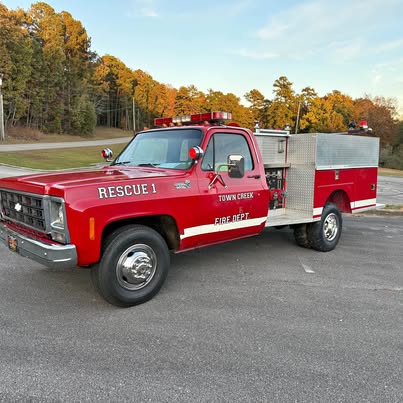
Finally, the municipal truck. Fire-rescue, utility and small dump bodies on C30 chassis were bought by towns, counties and utilities in quantity, particularly in the square-body years. The 1979 rescue truck pictured below is the type exactly: bought new by a small fire department, garaged indoors, maintained on a schedule with public money, and sold with low mileage and a tired interior. These are often the best-maintained C30s in existence — and the ones with the most idle hours, the most holes drilled in the cab for radios and lights, and the most non-standard wiring. The problem-areas section returns to them.
Engines and gearboxes
The C30's engine range is the mainstream Chevrolet truck range of each era, filtered by one principle: at one-ton weights, torque and cooling capacity matter and peak horsepower does not. Every engine below is a known quantity with total parts support; what differs is how hard each has had to work in a truck that was rarely driven empty.
The sixes: 250 and 292
The base engine in early Action Line C30s was the 250 cu in (4.1-litre) third-generation inline-six, and it is marginal in a one-ton — adequate empty, breathless loaded. The six that matters is the 292 (4.8 litres), the tall-deck heavy-duty version of the same family, built expressly for trucks like this. Period ratings run from 165 hp gross in the late 1960s to around 120–147 hp net in the emissions years, and it makes its torque just off idle, with a seven-main-bearing bottom end that tolerates decades of labour. A 292 C30 will not cruise at modern highway speeds with a load, but around a farm, a town or a job site it is arguably the most durable engine ever fitted to this chassis.
Ownership reality: the 292's exhaust manifold cracks, usually at the centre ports, and ticks when cold in a way that closes up as it warms — annoying, rarely fatal, and available new. The heat-riser valve in the manifold arrangement must stay free; a seized one cooks the carburettor and causes the hot-start and flat-spot complaints everyone blames on the carb itself. Side-cover gaskets weep. None of this is expensive. What wears sixes out in one-tons is gearing: trucks ordered with deep axle ratios (4.57:1 was common) have cruised at high rpm for forty years, so judge a six by oil pressure at hot idle and by blow-by at the filler cap, not by mileage claims.
The small-block V8s: 307, 350 and 400
The default C30 engine across both generations is the 350 (5.7 litres), and it is the right default: strong enough for any legal load, cheap to maintain, and supported by the deepest parts network of any engine on earth. In Action Line trucks you will also meet the 307 (1968–73), an emissions-era stopgap that is adequate but unloved, and the earlier 283 and 327. The 400 small-block (1970s, in trucks through about 1980) deserves a specific warning: its siamesed cylinder bores make it the one small-block that genuinely dislikes overheating, and in a one-ton that has worked hot, a 400 should be compression-tested before any money moves. Period outputs for the 350 run from about 255 hp gross (four-barrel, 1970) down to 160–175 hp net in the mid-1970s and back up modestly in the 1980s; the numbers matter less than the specification — four-barrel engines with dual exhausts pull noticeably better than the two-barrel base tune.
In service, the small-block's failure modes are wear modes, not design flaws. The nylon-toothed timing sprocket on emissions-era engines sheds teeth and retards cam timing progressively — a sluggish, hard-to-tune 350 with a known-good carburettor and ignition is telling you to check the timing chain, and a steel double-roller set (roughly $300–600 fitted) transforms the truck. Two-piece rear main seals weep; valve stem seals harden and give the classic puff of blue smoke on start-up after a sit; exhaust manifold bolts snap in the heads, and a ticking that fades as the engine warms is usually a manifold leak, not a lifter. From 1975 most applications breathe through the Rochester Quadrajet, whose real faults are specific: worn throttle-shaft bores in the baseplate leak vacuum and make idle mixture untuneable (the cure is bushing the baseplate, not a new carburettor), the air horn warps if the long centre bolts are overtightened, and secondary air-valve spring tension decides whether the engine bogs when the secondaries open. Budget $400–800 for a proper rebuild and treat a cheap exchange unit with suspicion.
Cooling is the system that decides a small-block C30's life. These trucks were specified with radiators sized for the load, but forty years of scale, solder bloom and bent fins reduce any original core to a fraction of its capacity. A C30 that runs hot only under load, or only on grades, is showing you a marginal radiator, not a head gasket — test the radiator's flow and the fan clutch (step 6 of the inspection) before condemning the engine.
The big-blocks and the diesels: 396/402, 454, 350 diesel, 6.2 diesel
The Action Line big-block option was the 396 — sold from 1970 as the 402 and badged in trucks as a "400" — making up to 300 hp gross in period trim. It is a fine engine and a trap for the unwary in one specific way: a truck badged "400" may carry the 402 big-block or the 400 small-block, two engines with nothing in common, and the seller may not know which. The metal settles it: the big-block is physically much wider, with broad seven-bolt valve covers, and its engine-number pad confirms the application. Pay small-block money until you have proved big-block identity, never the reverse.
The square-body heavy option, and the engine that defines the later C30, is the 454 (7.4 litres), offered from 1973 to the end of the run. Net outputs sit in the 205–240 hp range depending on year, but the figure that matters is torque — around 355–385 lb-ft net, delivered low — which is why the 454 C30 is the only classic Chevrolet one-ton that will tow a loaded gooseneck at highway speed without drama. Its known faults are exhaust manifolds that warp and crack (listen for the cold tick, look for soot tracks at the ports, budget for broken studs), valve-guide wear that shows as oil consumption before it shows as smoke, and a thirst no tuning will cure: expect single-figure to low-teen miles per gallon depending on load and gearing, whatever the seller claims. Heat is the enemy — its cooling system needs the same radiator-and-fan-clutch audit as the small-block, only more so.
Two diesels were offered, and they are not equal. The 5.7-litre (350) Oldsmobile diesel of 1978–81 was a converted petrol engine with a deservedly poor reputation for head-gasket and bottom-end failures under load; in a one-ton, treat it as parts value unless it comes with documented evidence of the later DX-block revisions and a sympathetic life. The 6.2-litre Detroit Diesel (1982 onward) is a different proposition: a purpose-built, mechanically injected economy diesel making 130–148 hp, genuinely frugal and long-lived if maintained. Its systems are the inspection points: the Stanadyne DB2 rotary injection pump wears and causes hard hot starting (the classic test — an engine that starts cold but not hot, cured temporarily by pouring cool water over the pump — indicts the pump's clearances; a rebuild runs roughly $800–1,500); the glow-plug system eats plugs and controllers, and swollen plug tips can break off in the prechamber; the harmonic balancer's rubber ring deteriorates and, ignored, takes the crankshaft with it — inspect it on every 6.2 and replace on age alone for roughly $150–300 in parts. Dual batteries, heavy cables and a strong starter are not optional on this engine; a 6.2 that cranks slowly will not start in winter. Note also that diesel and many heavy C30s use Hydroboost brake assistance (hydraulic pressure from the power-steering pump instead of vacuum), which links the brake and steering systems into one diagnostic path in the problem-areas section.
A note on emissions: most C30s were sold above the 8,500 lb GVWR threshold for "heavy-duty" certification, so many left the factory without catalytic converters and with simpler controls than a same-year C10 — check the under-hood emissions label on the specific truck, and your own state's rules, before assuming anything.
Gearboxes and axles
The standard manual across most of the run is the Muncie SM465 four-speed (1968 onward; the earlier SM420 served in 1967), a truck gearbox in the old sense: a 6.55:1 first gear marked "L" that is a starting gear for loaded pull-aways, then three usable road gears, synchromesh on the upper gears only. It is nearly unbreakable and its faults are honest ones — worn synchro rings make second and third crunch on fast shifts, and the shifter mechanism wears sloppy. On a C30 the SM465 is what you want and what you will usually find. Clutches are 11- or 12-inch units; a slipping clutch in a truck that has hauled will often have scored the flywheel, so budget for machining or replacement (a full clutch job runs roughly $600–1,200 in parts and labour at independent rates).
The automatic story is simpler than on the cars. Light C30s used the Turbo Hydra-Matic 350, but the correct one-ton automatic — standard behind the 454 and the diesel, and the one to prefer behind any engine — is the TH400, a three-speed of legendary strength whose service needs are a vacuum modulator (a failed diaphragm draws transmission fluid into the intake and produces white smoke that mimics engine trouble), fluid and filter changes, and attention to cooler lines. A TH400 that shifts late and hard with a known-good vacuum signal has governor or internal wear; one that slips only when hot is telling you the fluid is cooked and the clutches are following. There is no overdrive automatic in this range — a C30 automatic at highway speed turns the rpm its axle ratio dictates, which is why the ratio matters: expect anything from 3.73:1 to 4.57:1, read it from the SPID label or the axle tag, and understand that a 4.57 truck is a 55 mph truck however strong its engine.
Axles: full-floating in all cases, which makes rear wheel bearings an oil-bath service item — a leaking hub seal oils the brake shoes and announces itself as a grabby, pulling rear brake long before it shows on the driveway. The Eaton HO72 (Action Line) uses a distinctive drop-out third member and is strong but has thinning parts support for its brake drums; the Dana 70 and the 14-bolt (square body) are supported by every truck parts supplier in the country. Limited-slip (Positraction) was available and is worth having on a truck that works on grass and gravel; check for it by the tag or by turning one wheel with both off the ground.
Problem areas
A C30 accumulates damage differently from a lighter truck. The loads are bigger, the bodies behind the cab are heavier and usually homemade in their mounting, the miles are often low while the hours are high, and the previous owners were businesses that fixed what stopped the truck earning and ignored everything else. Work through the truck in the order below: structure first, then the running gear, then the body — because on a one-ton, the body can cost more than the truck.
Rust: the map
Start with the cab, because the cab is the one part every C30 shares and the part that decides whether the truck is a vehicle or a parts source. On the Action Line (1967–72) cab, rust takes the rocker panels first — inner and outer, and the cab floor where it meets them — then the lower cab corners behind the doors, the floor supports that carry the cab mounts, and the front of the cab floor where road spray lives. Front fenders rot along the eyebrow above the wheel arch and at the lower rear corner behind the wheel; doors go along the bottom seam; the hood's front edge traps water against the grille panel. The cowl plenum and windshield frame rust from the inside out where leaves have sat for decades — water stains on the inner kick panels and a wet floor after rain are the telltales. Cab mounts deserve their own sentence: the rubber cushions perish and the steel mount brackets rust, the cab settles, door gaps change and the doors start to strike the latches — a C30 whose doors need a slam and whose cab sits visibly low at one corner is showing you mount failure, which is a cab-off repair if the floor supports have gone with them.
The square body (1973–87) rusts in the same places, faster, and adds its own signatures. Cab corners and rockers are the famous pair, but the structural money is in the floor pans and the cab floor supports under them, and in the front clip: inner fenders dissolve around the battery tray, where decades of acid fumes do the work, and the radiator core support rusts at its mounts and lets the whole nose settle. Bed sides on pickup-bodied trucks arch over the rear wheels; on chassis-cabs there is no bed, which moves the problem to the frame (below) and to whatever the body builder fitted. Distinguish surface rust from structural rust with the probe, panel by panel: paint over perforation is the normal condition of a cheap one-ton, the seller's word "solid" is not evidence, and a cab that needs corners, rockers, floors and supports is a $3,000–6,000 welding bill at shop rates before paint — the single most common way buyers overpay for these trucks.
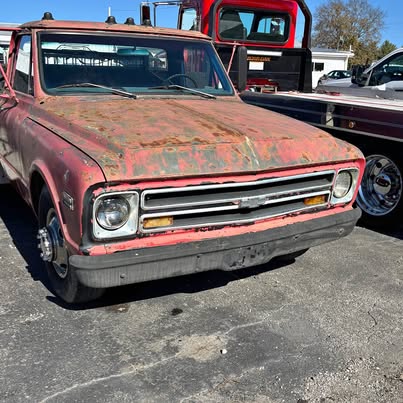
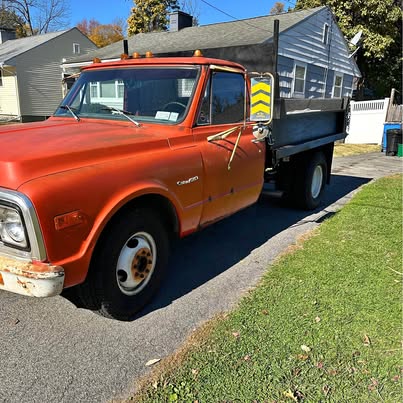
One warning about presentation: the ramp truck pictured below is typical of how Action Line trucks look — heavy surface rust and failed paint over metal that may be sound or perforated, and you cannot tell which from a photograph or from across a yard. The hood and fender tops rust cosmetically; the same truck's cab corners and floor can be perfect or absent. There is no shortcut: get under it.
Frame, suspension, steering and brakes
The frame is the C30's foundation and its most under-inspected part. The rails are a riveted channel section, and rust works in the laminations — between rail and crossmember, around spring hanger rivets, and above all along the top flange where a body or a dump subframe has trapped wet dirt against the steel for forty years. Scale that flakes off in sheets, rails swollen visibly thicker at the seams, and spring hangers loose on their rivets are condemnation points: a one-ton frame is not a component you casually weld-plate back to strength, and frame repair on a truck you intend to load needs a fabricator's opinion, not optimism. Check also for cracks radiating from holes drilled by body builders, a bent or twisted rail from a life of uneven loading (sight along the rails from behind; the truck should look symmetrical), and on square bodies, cracks around the steering-box mounting — the box's leverage works the left rail with every steering input, a known square-body failure that presents first as vague steering and a creak on lock.
Suspension is coil springs in front, leaf springs behind, and both wear by sagging and by losing their hardware rather than by breaking. Front ball joints carry real weight in a one-ton — check them loaded and unloaded as the inspection section describes — and the coil springs settle, giving the nose-down stance of every tired work truck. Idler arms, centre links and tie-rod ends accumulate the play that makes a C30 wander; the steering coupler (rag joint) perishes and adds its own free play; the steering box wears at centre and leaks. Rear leaves crack at the centre bolt and wear their bushings and U-bolts; overload (helper) springs that have been permanently engaged tell you the truck has lived at maximum weight. Shock absorbers on a one-ton are cheap and almost always dead; budget for them and do not read anything into the ride until they are replaced.
Dual rear wheels bring one discipline of their own — the inner dual is the most neglected tyre on any truck, invisible and rarely pressure-checked — and it is covered in full at step 9 of the inspection section.
Brakes divide by era. Front drums served to 1970; front discs became standard on the C30 for 1971 and stayed — a pre-1971 truck is a drum-brake truck and should be priced and judged as one, however well it stops on the test drive. Disc-era trucks suffer seized calipers and collapsed flex hoses that act as one-way valves, applying a brake that will not release. Rear drums are large and dependent on self-adjusters that seize — a rear brake that only works when the parking brake has been recently used is showing you frozen adjusters. Brake pipes rust along the frame rail, and on salt-belt trucks a full re-pipe in copper-nickel is the standard, sensible repair ($400–900 in parts and labour). Where Hydroboost is fitted (diesels and many heavy square bodies), the accumulator stores a few assisted applications after engine failure — test that reserve with the engine off — and a pedal that kicks back, or steering that goes heavy at parking speeds with the brake applied, points to pump or booster wear across the shared hydraulic system.
Engines and drivetrain in service
The engine-specific faults are catalogued in the engines section; in service, the pattern is that a one-ton's engine has lived at high load and low speed, which wears different parts from a car's life. Cooling systems are scaled and marginal (see the radiator test in the inspection section). Oil consumption through valve guides and stem seals is the norm on high-hour engines and is tolerable if compression is even; uneven compression with a miss is not. Exhaust systems rot from the manifolds back and manifold studs snap — listen cold, before the ticking warms away. Engine mounts collapse and let the fan meet the shroud under torque; check for witness marks.
Gearboxes follow the same pattern of honest wear. The SM465 that crunches second on a fast change is a working gearbox with worn synchros and is priced as such; the SM465 that jumps out of gear under load has deeper trouble. The TH400 that has towed will have cooked fluid unless it was serviced — pull the dipstick and smell it; burnt fluid in an automatic that still shifts acceptably is a service and a prayer, in one that slips it is a rebuild quote ($1,800–3,000 fitted). Centre support bearings, U-joints and pinion seals are the small-ticket items every old one-ton needs and no seller has done. Rear axle noise — a whine that changes with throttle — is ring-and-pinion wear, tolerable for years at work-truck duty cycles but expensive to silence properly.
The working bodies: dumps, decks, haulers and campers
Everything aft of the cab on a chassis-cab C30 was fitted by someone else, to standards that vary from coachbuilt to farm-welded, and it must be inspected as a separate machine. Dump bodies are the most mechanical: a power take-off on the gearbox drives a hydraulic pump, which drives a single- or twin-ram hoist under a steel bed pivoted at the rear. The raised-bed photograph below shows exactly what to examine — the hoist rams for scored or pitted chrome (pitting destroys seals and leaks follow), the pivot pins and brackets for wear and cracked welds, the subframe for the rust that lives permanently between subframe and chassis rail, and the bed floor for holes worn through by gravel and salt. A hoist that creeps down overnight has internal seal leakage; a PTO that grinds going in has worn engagement parts; and never work under a raised body that is not propped with its safety prop or a substantial timber, because hoists fail and beds fall.
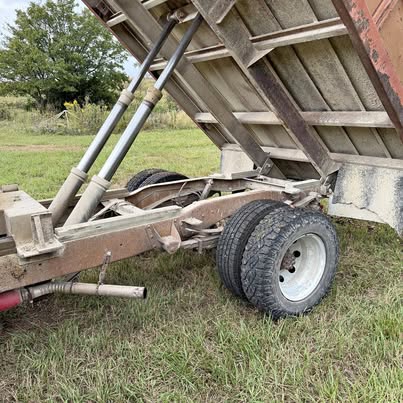
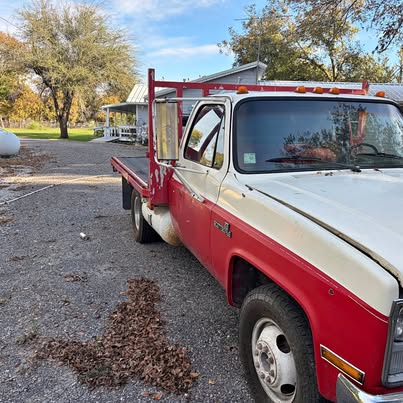
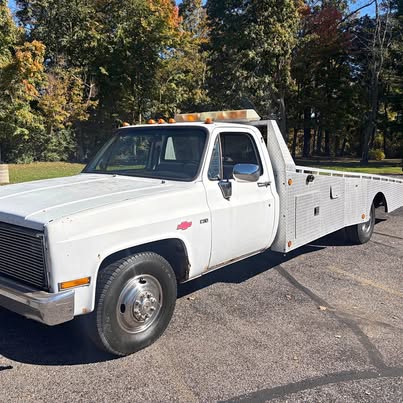
Flatbeds and stake bodies fail by rot and by mounting: wood decks rot from the top and from the trapped underside, steel decks rust at the crossmember contact points, and the U-bolts or shear plates mounting the body loosen and crack. Walk the deck — soft spots underfoot are rot, wherever the surface paint says otherwise. Wrecker and ramp/hauler beds add a winch, hydraulics and a bed that slides or tilts: check the rails the bed travels on, the winch cable for fraying, and the ramps for bent members. The white 1983 hauler in the inspection section is the type: a genuinely useful truck whose value sits half in the Chevrolet and half in the bed gear. Camper bodies, as the overview warned, are buildings: check every roof seam and window for water ingress, press the lower wall corners for softness, and read bent rear springs and permanently engaged overloads as evidence the combination lived overweight. Fire and rescue bodies are usually the best-built of all and the most altered electrically: pumps and auxiliary engines, if fitted, are separate machines with their own hours and their own neglect.
Across all bodies, two universal checks: the mounting (U-bolts torqued, mounts uncracked, no body shifting on the frame — stand behind and have someone rock the truck), and the wiring, because body builders tap into the chassis harness with varying skill, and the corroded connector behind the cab causes half the electrical faults on working trucks.
Interior, electrics and trim
The cab interior of a C30 is a work space and wears like one: bench-seat foam and vinyl split at the driver's bolster, square-body dash pads crack across the top in the sun (reproductions exist; originality here is worth little), and door hinge pins and bushings wear until the doors drop and must be lifted to close — a cheap repair that transforms how the truck feels. Window regulators, vent-window seals and door seals are wear items with full reproduction support. The heater core leaks into the passenger footwell and is a dashboard-out job on square bodies; price it in if the carpet is damp and sweet-smelling.
Electrics are simple and therefore usually fixable, but two items recur. The engine-bay bulkhead connector (square body) and the fusible links at the starter and junction block (both generations) corrode and melt, producing intermittent total failures that mimic ignition-switch faults; a truck that "sometimes won't crank, then is fine" is showing you a link or a connection, not a starter. Check for 13.8–14.4 volts at the battery at fast idle with the lights on. Dash instruments fail by sender more often than by gauge — the oil-pressure sender on a Chevrolet V8 is a cheap part that has frightened many sellers into discounting a healthy engine — and the fuel gauge's earth at the tank is the first suspect when the needle lies. Dual-battery diesel and camper trucks add isolators and solenoids, each a small failure point, and ex-municipal trucks add the archaeology of removed radios and light bars: budget a day with a wiring diagram for any ex-service truck, and treat a cab full of dead switches and cut looms as a priced-in job, not a surprise.
How to inspect one
Inspect a C30 in daylight, on dry ground, cold — and with at least an hour in hand. A one-ton hides its faults at the bottom of a long list, and the seller's hurry is the most expensive item in the transaction. Work in this order:
- Identity first. Read the VIN plate on the driver's door jamb and the glovebox SPID label, and check they agree with the title and with each other. The SPID label is the build sheet: engine, axle ratio, trim, dual-wheel option, GVWR. A truck badged "400" settles big-block-versus-small-block here, and a truck whose SPID says cab-and-chassis but now carries a factory bed is a reconstruction, not a factory pickup. Photograph both labels before you touch anything else.
- The cold start. Insist on starting it cold, with the seller's hand off the key. A hard-starting small-block on a cold morning may be choke adjustment; on a 6.2 diesel it is the glow-plug system, batteries and starter (and, hot, the injection pump). Watch the exhaust for thirty seconds: blue smoke on start that clears is valve seals; continuous blue under load is rings; black smoke under load is over-fuelling or a choked air filter; white smoke on a petrol engine that smells sweet is coolant.
- The sill-jack test from the rust section settles the cab. Jack on the factory jacking point and watch: a sound cab lifts the truck; a rotten one flexes, cracks its paint, or the jack goes through the floor. Then probe the rockers, cab corners and floor pans with an awl at every seam, and lift the rubber mats — the floor under a mat is where C30s hide their worst rot.
- Frame, top and bottom. Walk the rails with a torch and a screwdriver, top flange included — it rusts where the body traps dirt, and the seller's photograph will never show it. Sight along the rails from behind for bends. Look for cracks around the steering-box bolts on square bodies, cracks radiating from drilled holes, and swelling at the seams that means laminated rust. A frame you are not happy about needs a second opinion before money moves.
- Under the bonnet, engine off. Check oil level and colour, coolant in the radiator itself (not the overflow bottle), and transmission fluid — smell it; burnt is a warning. Look for coolant leaks at the intake manifold end seals, the oil weep at the rear main, and witness marks where the fan has met the shroud (failed engine mounts).
- Under the bonnet, engine running. At operating temperature, spin the fan by hand — a freewheeling fan at temperature is a dead fan clutch. Watch the temperature gauge on a loaded test drive if you can arrange it; a truck that stays cool empty and climbs under load has a marginal radiator. Check the charging voltage, and listen at hot idle: uneven idle with a good carburettor and ignition is the timing chain wearing, and on a Quadrajet truck a lean, surging idle is the baseplate leaking vacuum at the throttle shafts.
- Drive it. Judge a C30 at its working speed. Listen for the centre support bearing's shudder on pull-away (long wheelbases), the differential whine that changes with throttle, and the SM465's crunch on fast shifts. Brake hard once, from a safe speed, and watch for pull and a sinking pedal. Then have someone rock the steering wheel while you watch the box, rag joint, idler arm and ball joints from underneath — the play you can see is the play you will pay for.
- The brakes and Hydroboost. With the engine off, pump the pedal until hard, then start the engine and feel for the assisted drop. On Hydroboost trucks, switch off and count the assisted applications left — fewer than two or three means a dead accumulator. Check each brake for a wet backing plate: a hub-seal leak on a full-floating axle oils the shoes, and the wheel bearing lives in the same oil, so it is both a brake job and a bearing inspection.
- The duals. Get the inner dual's pressure with a gauge (most sellers never have) and compare tyre sizes and tread depths across each pair. Inspect the wheels for elongated stud holes and missing hardware.
- Raise the body. On a dump, operate the hoist through its full range and leave it raised: does it creep down? Do the rams weep? Do the pivot brackets flex or crack? On a flatbed, walk the deck — soft spots are rot. On a wrecker or hauler, run the winch unloaded and watch the cable. Check the body's mountings and the subframe-to-rail interface, where rust hides between steel and steel.
- The camper or municipal extras. On a camper, check every roof seam and window for staining and press the lower wall corners for softness; water damage declares itself by smell before sight. On ex-service trucks, operate every switch, light and auxiliary, and confirm the extra holes in the cab roof and dash are sealed against water.
- Tyres, lights, glass, doors. Check door hinges (lift the door by its handle — play is pin-and-bushing wear), vent windows, the heater's output and the smell of coolant in the cab, and every light including the body builder's tail lights, which live on their own corroded earth.
- Paperwork. Title, emissions label under the bonnet, and any service records. Ex-municipal trucks often carry real maintenance histories; a private seller's "just serviced" is worth nothing without a receipt. Confirm the title's weight class against the truck's rating, and check whether your state registers by GVWR — the ownership section explains why.
- The loaded decision. Price the truck as two purchases — the Chevrolet and the body — and value the weaker of the two as zero until proved otherwise. The C30 you want is the one whose structure passes steps 3 and 4 and whose body passes step 10; everything else is a service bill you can read.
Values
The C30's value picture is the mirror image of the C10's, and understanding that inversion is the whole of this section. The glamour trucks of the C/K line — short-bed half-tons, four-wheel-drives, restored show trucks — carry the high values and the tightest spreads. One-tons are bought as tools, and tool prices follow condition and capability far more than desirability. The spread between a tired working C30 and a sorted one is therefore wide — wider than on lighter trucks — because the sorting bill is large: cab metalwork, a radiator, a clutch, a hoist reseal and four tyres can quickly exceed the purchase price of a rough truck, and the market prices that in.
What moves a C30 up the spread is condition of structure and completeness of working equipment, not originality. A straight frame and a sound cab are the two appreciating assets; a correct engine and gearbox help; a working hoist, winch or hydraulic system is worth real money because replacing it is real money. Trim does not move it — the Silverado badge adds little over Custom Deluxe, and show-standard paint is rarely recovered on a truck bought to be used. The two exceptions are the genuine Longhorn pickup and a genuinely clean crew cab: both have a following beyond the working market, and both are priced on scarcity as well as condition.
Asking prices and achieved prices diverge in a specific way on C30s. Sellers of working trucks price on what the truck has done for them and what its equipment cost; buyers price on what the truck needs now. That gap is widest on the most specialised bodies — a dump or wrecker whose hoist is tired, a camper whose body is damp — and narrowest on the simplest trucks: a sound regular-cab flatbed or a clean pickup, where there is nothing to hide and nothing to misunderstand. Read the market data appended below this guide in that light: a low asking price usually means a big known job (often the cab or the body); a high one means a seller pricing the equipment, not the truck.
Negotiation reality on a one-ton is also distinctive. The seller is often a business, a fleet, or a family clearing a farm — not a collector — and the negotiation is about evidence, not emotion: show the seller your list from the inspection section, item by item, and the price moves in proportion to the jobs you can demonstrate. And the project-versus-driver gap is decisive: a C30 that runs, stops and lifts its body today is worth multiples of one that needs all three, because moving and restoring a dead one-ton costs real transport and real money. Judge the truck on purchase price plus the first year's service bill — tyres, brakes, cooling, seals — not on the number in the advert.
Parts and ownership
Ownership of a C30 is easier than ownership of almost any other classic one-ton, for one reason: Chevrolet built these trucks in the millions, and the aftermarket has never stopped supplying them. Mechanical parts — engine internals, brakes, steering, suspension, gaskets, seals, cooling — are stocked by any parts store, often on the shelf, because the same 350 and TH400 served a generation of cars and trucks. Body and trim support comes from the classic-truck specialists — LMC Truck, Classic Industries, Brothers Trucks and their peers — who reproduce cab metal (corners, rockers, floor pans, supports), grilles, lenses, dash pads and door hardware for both generations. The items that are genuinely hard are the one-ton-specific ones: Eaton HO72 brake drums and some internals, early C30-specific trim, and original-style 16.5-inch wheels. None should stop a purchase — the square-body Dana 70 and 14-bolt axles are fully supported, and a wheel conversion is a solved problem — but they should stop you paying a premium for "original" one-ton hardware that is worn out.
Interchange is your friend. Within a generation, the C30 shares the cab, front suspension, steering and most engine parts with the C10 and C20; the one-ton differences are springs, axles, brakes and gearing. Across generations, far less interchanges than people assume — Action Line and square-body bodies do not swap, and the 1967 cab is the only Action Line cab with the small rear window and its own door hardware. Buy parts by application and by the SPID label, not by what "looks the same".
Tyres deserve a paragraph of their own. The standard dual-wheel tyre is a light-truck size on 16-inch or 16.5-inch wheels — and the 16.5 fitment matters, because tyre choice in that size has shrunk to a handful and a conversion to 16-inch wheels is the common cure. The inner dual is the maintenance item everyone forgets: check pressures monthly, replace in matched pairs across a dual set, and never run a taller tyre on one side of a pair. Budget a full set into any purchase if the existing tyres are more than six years old, whatever their tread — old tyres on a one-ton fail by age, and a blowout on a loaded dual is a handling event, not an inconvenience.
Running costs are honest and predictable: fuel in proportion to engine and load (the 454 dearest, the 6.2 diesel cheapest), oil and grease on schedule, and consumables — brakes, tyres, U-joints, ball joints — that wear in proportion to the weight the truck was built to carry. Insurance is usually straightforward as a classic or a commercial vehicle, depending on use; declare the use plainly, because a working one-ton on a pleasure-only classic policy is a claim problem waiting to happen. Registration is where the GVWR matters: several states register by rated weight, and a truck over 10,000 lb GVWR can attract commercial plates, higher fees and, in some jurisdictions, weight-station obligations. Check your state's rule before buying, not after — and note that a camper conversion's title sometimes records the body rather than the chassis, which complicates registration and insurance if not resolved at sale.
Finally, the ownership proposition that sells the C30: it is a truck you can still use as a truck. A sorted one-ton earns its keep hauling, towing and carrying in a way no car-based classic can, with mechanicals a home workshop can maintain and a parts supply that will not dry up. Keep the frame and cab sound, service the cooling and the brakes on schedule, and the truck will outlast your enthusiasm.
Which one to buy
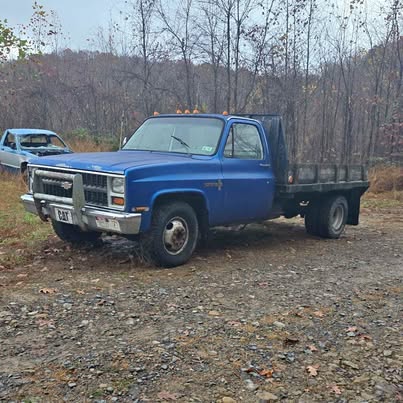
- The all-rounder: a 1973–87 square-body regular-cab C30 with the 350, TH400 and dual rear wheels, in flatbed or pickup form. Full parts support, front discs, the strongest gearbox, and the easiest truck in this guide to keep. Buy the straightest frame and soundest cab you can find; the rest is a service bill.
- The value buy: an ex-municipal or ex-fleet square-body — rescue, utility or dump — with low miles, a service history and a tired interior. Usually honestly maintained and cheap for what it is; budget the interior, the wiring and the tyres, and you have the most C30 for the least money.
- The heavy hauler: a 454, TH400, dual-wheel truck, preferably a crew cab. The only combination that will tow and carry at modern speeds without complaint. Buy on engine health and cooling, not on paint.
- The connoisseur's truck: a 1968–72 Longhorn C30, or a clean Action Line pickup with the 350 or 402. Rarer, prettier and more collectible — and the truck whose value most depends on a straight, original body, so buy condition over specification and verify the Longhorn's 8.5-foot bed and 133-inch wheelbase.
- The frugal worker: a 6.2 diesel square-body with the SM465. The cheapest classic one-ton to run, and a fine working truck if — and only if — the glow-plug system, injection pump and harmonic balancer pass the inspection section's tests. A cheap 6.2 that will not start hot is no bargain.
- The project to avoid: a camper conversion with a damp body, a dump truck with a creeping hoist and a rotten frame under the subframe, or any C30 whose cab needs corners, rockers, floors and supports all at once. Each is a bigger job than the price suggests, and none is the place to start.
The overriding rule: buy the frame and the cab first, the body second, and the engine third — because on a one-ton the frame and the cab are the expensive repairs, the body is the expensive surprise, and the engine is the cheapest problem to fix.
See the 3 1967 Chevy C30 Dually w/ Vintage cars currently listed.
For sale now
$4,500 · 53% below typicalExpand
$25,000 · 163% above typicalExpand
What they sell for: 1967 Chevy C30 Dually w/ Vintage sale prices.