
Chevrolet Camaro RS/SS Hardtop buyer's guide
Chevrolet Camaro RS/SS Hardtop -- the model's own buyer's guide: variants, values and what to check.
Years listed: 1967-1968 · Series: Camaro Gen 1
# Chevrolet Camaro Hardtop — Buying Guide
Overview and history
The Camaro Hardtop is the car Chevrolet built because it had to. Ford launched the Mustang in April 1964 and sold pony cars faster than anyone in Detroit had imagined possible, and for two full model years Chevrolet watched from the sidelines with the rear-engined Corvair. The answer, announced in September 1966 for the 1967 model year, is the F-body: a front-engined, rear-drive, steel unibody coupe and convertible sharing its basic structure with the Pontiac Firebird, built at Norwood, Ohio, and Van Nuys, California. The Hardtop — Chevrolet's word for the pillarless-roof coupe, though the Camaro keeps a slim B-post structure behind the door glass in a way a true 1950s hardtop does not — is the volume body. It outsells the convertible by a wide margin in every first-generation year, it is stiffer and quieter, and today it is the body you will actually find for sale.
Stand in front of one and read its proportions before you read its badges. The long bonnet, short deck and Coke-bottle rear wings are deliberate Mustang answers, but the detailing is Chevrolet: a full-width grille, a front subframe carrying the engine and front suspension and bolted to the unibody through rubber isolators, and a live rear axle on leaf springs. That subframe construction defines ownership — it isolates road noise well when its isolator bushes are sound, and it creates rust and alignment problems specific to this design, covered in detail below.
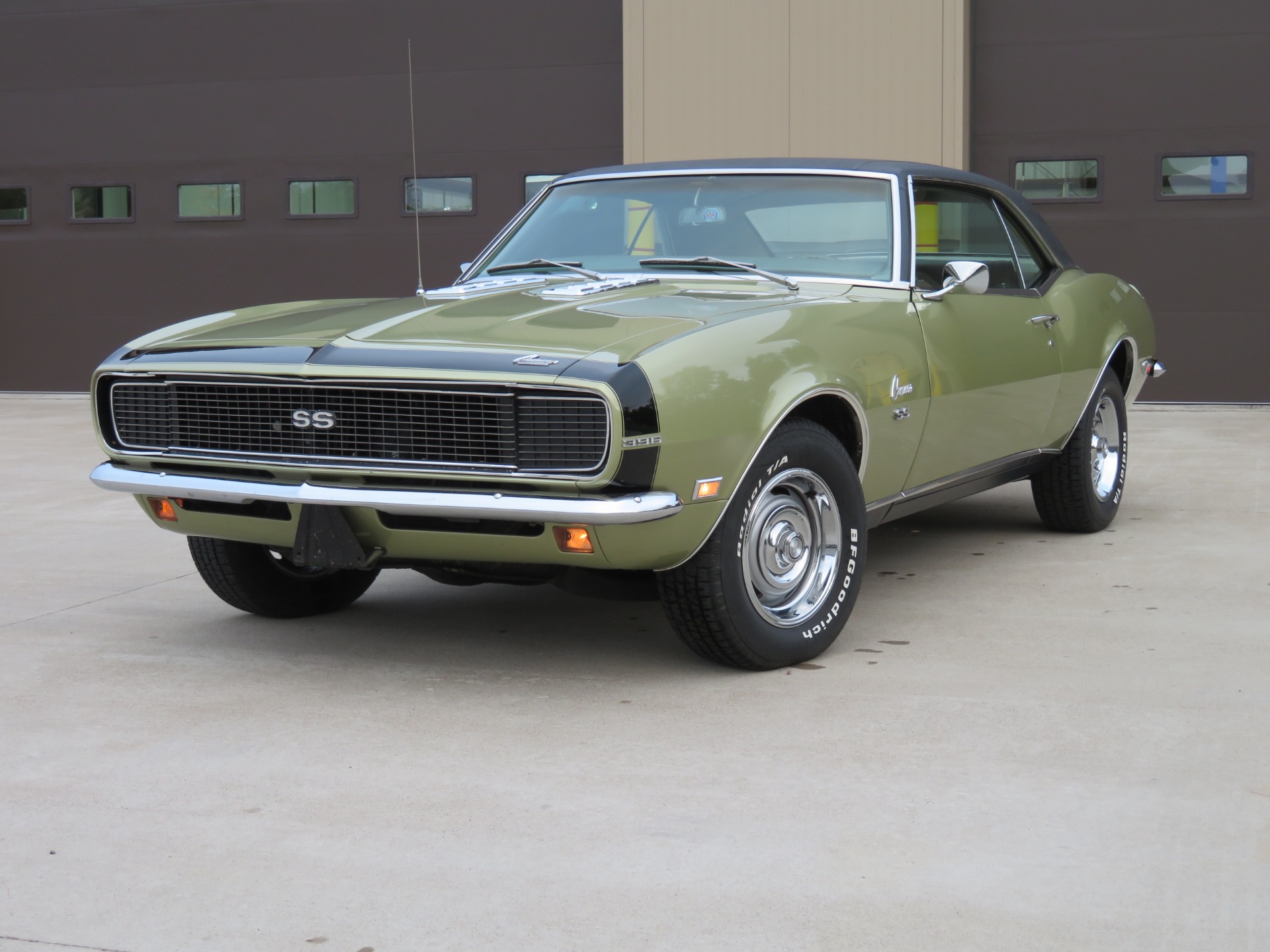
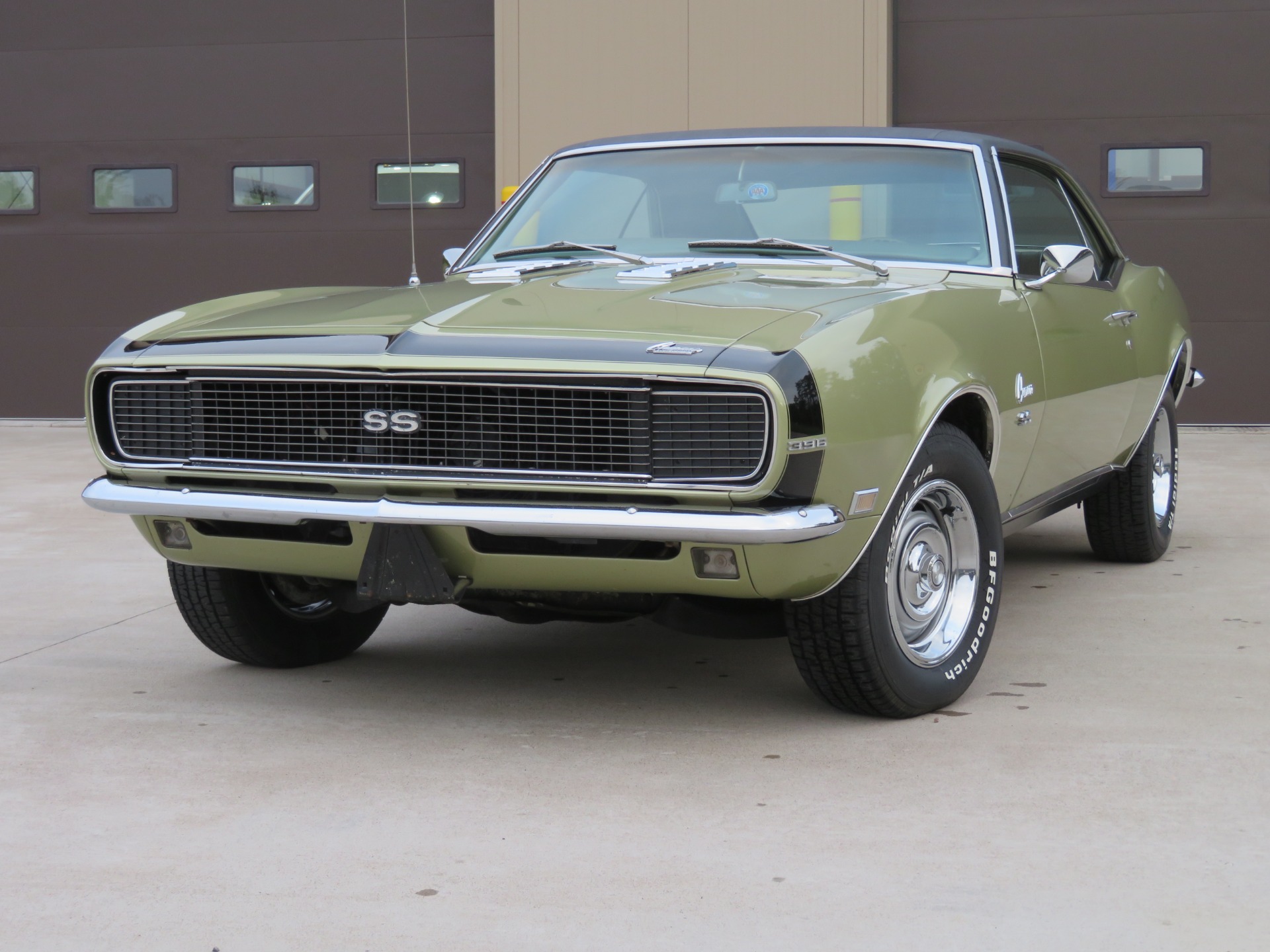
The first generation runs three model years, 1967, 1968 and an extended 1969, and the Hardtop changes visibly each year. The 1967 car has vent windows, no side marker lights and a cleaner look. The 1968 car loses the vent windows, gains side markers, and gets staggered rear shocks to fight axle tramp. The 1969 car is a reskin on the same structure — flatter wheel-arch lips, reshaped grille and tail panel — while the glass, roof and inner structure carry over. On this site the Hardtop pool is small and early — three cars recorded at the time of writing, one 1967 and two 1968s, all RS/SS cars from dealers — which reflects where preservation money concentrates, not what Chevrolet built: far more plain six-cylinder and small-V8 Hardtops than SS cars. That skew is exactly why clones are the central buying risk with this model.
The Camaro's job in period was to be everything to everyone: a six-cylinder commuter, a family coupe, a Trans-Am racer in Z/28 form, a drag car in COPO 427 form, and a boulevard performance car as an SS. Your job is narrower: to establish which of those cars the one in front of you actually left the factory as, because fifty-plus years of parts interchangeability means it can wear almost any identity you care to bolt onto it.
The models
Chevrolet sold the first-generation Camaro as a single model line with option packages layered on top, and understanding that structure is the most useful thing you can learn before buying one. The base Camaro is the car. The Rally Sport (RPO Z22) is an appearance package — hideaway headlights, revised grille and tail lights, extra trim — that can sit on a six, a base V8, an SS or a Z/28. The Super Sport (RPO Z27) is a performance package — a 350 or 396 engine, uprated suspension, power front discs in most applications — that can sit under standard or RS styling. A car can therefore be a plain Camaro, an RS, an SS, or an RS/SS, and the badges alone prove nothing, because every badge, grille and stripe in the catalogue is reproduced and bolts on in an afternoon.
| Model | Years | Engine | Output | Built | Character |
|---|---|---|---|---|---|
| Camaro (six) | 1967–1969 | 230 / 250 cu in inline six | 140 / 155 hp (gross) | — | The commuter coupe; light, simple, now rare unmodified |
| Camaro V8 | 1967–1969 | 327 / 307 / 350 cu in small-block | 200–275 hp (gross) | — | The everyday Hardtop; the honest driver buy |
| Camaro SS 350 | 1967–1969 | 350 cu in small-block (L48) | 295–300 hp (gross) | — | Balanced, torquey, the usable SS |
| Camaro SS 396 | 1967–1969 | 396 cu in big-block (L35 / L34 / L78) | 325 / 350 / 375 hp (gross) | — | Heavy nose, straight-line authority, the collector SS |
| Camaro Z/28 | 1967–1969 | 302 cu in small-block (DZ in 1969) | 290 hp (gross, under-rated) | 602 in 1967; about 7,199 in 1968; about 20,302 in 1969 | High-revving Trans-Am homologation car; no automatic, no air conditioning |
| COPO 427 | 1969 (plus dealer 427 swaps 1967–1968) | 427 cu in big-block (L72 / ZL1) | 425 hp (gross, under-rated) | 997 L72 COPO 9561; 69 ZL1 COPO 9560 | Central Office Production Order drag cars; Yenko, Berger and Gibb dealer cars; document-or-walk territory |
Production totals for the generation are genuinely known — roughly 220,900 Camaros in 1967, roughly 235,100 in 1968 and roughly 243,100 in the long 1969 run — but Chevrolet did not publish clean Hardtop-versus-convertible splits for every package combination, and package counts overlap because RS and SS stack. Treat any exact, tiny production figure for a specific RS/SS/colour/gearbox combination with suspicion unless period paperwork supports it.
Work through the packages in ascending order of buying difficulty. The base six-cylinder Hardtop, with the 230 cubic-inch (3.8-litre) Turbo-Thrift six in 1967 and the 250 (4.1-litre) thereafter, is a pleasant, slow, honest car that survives today mainly as raw material for V8 conversions. An unconverted original six is now genuinely scarce and drives better than its reputation — light nose, uncorrupted steering — but check that scarcity is real and not a V8 car that lost its engine. The base V8 cars — 327 (5.4 litres) in 1967–1968, the unloved 307 (5.0 litres) replacing the 210-horsepower 327 for 1969, the 350 optional and standard in the SS — are the cars Chevrolet actually sold in volume. A 327/275 with a four-barrel Rochester Quadrajet, a Muncie four-speed and a 12-bolt axle is most of the SS experience without the SS paperwork problem.
The SS package is where identity verification becomes non-negotiable. An SS must have started life with either the L48 350 or one of the 396 big-blocks; a car born with a 327 can be a fine car, but it cannot be a factory SS, whatever is bolted to its wings today. The Z/28 is a different discipline: built to legalise the Camaro for the SCCA Trans-Am 5.0-litre limit, it combines a 327 block with a 283 crank to give 302 cubic inches (4.9 litres), revs far beyond any other factory Camaro engine, and comes only with a Muncie four-speed, power front discs and no factory air conditioning. A Z/28 with an automatic is not a rare variant. It is not a Z/28.
Finally, the COPO cars. Through the Central Office Production Order system, buyers could order combinations the regular list forbade — above all the L72 427 iron big-block (COPO 9561) and, in tiny numbers, the all-aluminium ZL1 427 (COPO 9560) for 1969. Dealers such as Yenko also converted cars themselves in 1967–1968 before ordering through COPO in 1969. These are the most valuable and most faked first-generation Hardtops, and they sit outside a normal inspection: paperwork, stampings and expert verification decide them, not badges.


Engines and gearboxes
Every first-generation Camaro engine is a pushrod, overhead-valve, cast-iron design fed by a carburettor, and every one of them is well understood, well supplied and rebuildable. The differences that matter to a buyer are not reliability in the abstract — a neglected example of any of them will be tired — but identity, matching numbers, and the specific wear and bodge patterns each family accumulates. Period power figures are SAE gross ratings, measured on a test stand without accessories; a healthy L48 350 that was rated at 295 gross horsepower will show far less at the rear wheels today, and that is not evidence of a fault.
The inline sixes: 230 and 250 Turbo-Thrift
The base engine for 1967 is the 230 cubic-inch (3.8-litre) Turbo-Thrift six, rated at 140 gross horsepower, with the 250 (4.1-litre), rated at 155, offered alongside it and becoming the standard six thereafter. Both are seven-main-bearing overhead-valve sixes with a one-barrel Rochester carburettor and hydraulic lifters, and their reputation for indifference to abuse is largely earned. Their main enemies are perished vacuum hoses, a worn Rochester Monojet with a sloppy throttle shaft that will not idle cleanly, and decades of short-trip condensation sludging the rocker cover.
Check a six as you check any engine here — cold start, oil pressure, blow-by, coolant — then check what actually matters: whether the car is priced and presented as a six. An original six with a three-speed column shift and honest paint is a charming car. The same car with a crate V8 dropped in, original front springs still fitted so the nose sits low, and a price that assumes V8 value is a conversion, worth what the quality of the whole job is worth, not what the badge says.
The small-blocks: 302, 307, 327 and 350
The small-block Chevrolet V8 is the centre of the Camaro story, and four displacements matter here. The 327 (5.4 litres) is the launch V8, offered at 210 horsepower with a two-barrel Rochester and at 275 horsepower as the L30 with a four-barrel Rochester Quadrajet, higher compression and better breathing. The 350 (5.7 litres) arrives with the Camaro itself in 1967 as the L48 SS engine — 295 gross horsepower, Quadrajet, hydraulic cam — and spreads through the range by 1969, when a 255-horsepower version becomes a regular option and a 300-horsepower L48 continues in the SS. The 307 (5.0 litres) replaces the 210-horsepower 327 as the base V8 for 1969; it is a smog-era economy engine built from a 327 block and a 283 crank, and it is durable but unrewarding. The 302 (4.9 litres) is the Z/28 engine alone: a 327 bore with a 283 stroke, forged internals, a solid-lifter camshaft in its high-output form, a Holley four-barrel on an aluminium intake, and a power band that does very little below 3,500 rpm and a great deal above 5,000.
Mechanically the family shares its checks. The bottom end is strong; wear shows first as low hot oil pressure at idle from tired bearings and a worn oil pump, as timing-chain slack — rock the crank pulley against the distributor rotor to feel it — and as valve-guide and stem-seal wear that puffs blue smoke on start-up and on the overrun. A puff that clears in seconds is usually stem seals, a cheap job; smoke that continues under load is rings and bores, a rebuild. Distinguish them on the test drive, not in the seller's driveway. The rear main seal leaks on two-piece-seal engines and paints the bellhousing; budget a clutch-out or engine-out job to do it properly. Cooling is marginal on big-power cars in modern traffic: a car that creeps upward at every light has a silted radiator core, a collapsing lower hose or retarded timing, in roughly that order — test by feeling for cold stripes across the core once the thermostat has opened.
Carburation divides by model. Two-barrel cars use a Rochester 2GV; most four-barrel small-blocks use the Rochester Quadrajet, whose characteristic bog on sudden throttle opening is almost always air-valve spring tension or a perished accelerator-pump cup, not the carburettor's basic design. The Z/28's Holley 780-cfm vacuum-secondary carburettor needs its float levels, secondary diaphragm and choke set correctly, and a Z/28 that will not pull cleanly to 6,000 rpm under load is usually suffering ignition or valve-float problems before fuel problems. Points ignition is standard; budget for an electronic conversion hidden in the original distributor if you intend real mileage, and keep the points in the glovebox.
Identity on a small-block lives on the stamp pad at the front of the block, on the passenger side, in front of the cylinder head. The pad carries an assembly stamp ending in a suffix code that identifies the engine's original application, displacement, transmission and model — and on Norwood cars from late in the 1969 run, and on many performance engines, a partial VIN derivative that should match the car's VIN. A blank, ground or restamped pad on a car priced as numbers-matching is a stop sign. Casting numbers and dates at the back of the block, by the bellhousing flange, corroborate displacement family and date; the date should precede the car's build date by weeks, not follow it.
The big-blocks: 396 and 427
The Mark IV big-block transforms the Hardtop and complicates it. The 396 cubic-inch (6.5-litre) engine — actually 396 only in name after its early days, and bored to 402 cubic inches for service and late applications while still badged 396 — comes in three factory states of tune in the Camaro: the L35 at 325 horsepower, a hydraulic-cam, Quadrajet, oval-port engine that is the sweet-tempered road choice; the L34 at 350 horsepower (360 in 1967 listings in some references — check the suffix code, not the brochure in the boot), with higher compression and a hotter hydraulic cam; and the L78 at 375 horsepower, with rectangular-port heads, a solid-lifter cam, an aluminium intake and a Holley, which is a genuinely fierce engine that idles like a cement mixer and is the most faked SS specification of all. The 427 (7.0 litres) is not a regular production option in a Camaro at any point in the first generation. A 1967 or 1968 427 car is a dealer conversion; a 1969 427 car is either a COPO car — L72 iron-block or ZL1 aluminium-block — or a later swap. Price and paperwork must match that distinction exactly.
The big-block's virtues are torque and presence. Its vices are weight over the front axle, heat, and the cost of everything attached to it: an SS 396 understeers where an SS 350 turns, cooks its engine bay, and works its front suspension, brakes and subframe mounts harder. Specific checks: exhaust manifolds crack, particularly the passenger side; the correct accessory brackets are a small industry in themselves and a car missing them has usually been apart; and rectangular-port L78 heads on an L35 block is a common period combination that drives well and destroys the claim to originality. Read the block suffix, the head casting numbers under the rocker cover, and the intake material — a magnet settles aluminium versus iron in a second — before you discuss price.
Solid-lifter L78 and ZL1 engines are supposed to clatter lightly at idle, and valve clearances are a service item, not a symptom. A silent solid-lifter engine has probably had its clearances closed up to hide wear, or been converted to hydraulic lifters — ask out loud. Budget $4,000–8,000 for a proper big-block refresh with machining, and $10,000 and upward for a documented L78 or 427 rebuild done to a standard that protects the car's value; a cheap big-block rebuild is the most expensive kind.
Gearboxes: three-speeds, Muncie four-speeds, Powerglide and Turbo Hydra-Matic
Manuals first, because the pool on this site is entirely manual — all three recorded Hardtops are four-speed cars, two listed as 4 Speed Manual and one as 4 speed — and because the manual choice defines the car's character. The base manual is a Saginaw three-speed, column- or floor-shifted, perfectly adequate behind a six or a 210-horsepower 327 and worth little. The four-speeds divide by strength. Low-performance applications use a Saginaw four-speed with a cast-iron case. Performance applications use the Muncie aluminium-case four-speed in three ratio sets: the wide-ratio M20, the close-ratio M21, and the heavy-duty close-ratio M22, the famous Rock Crusher, named for the whine of its straighter-cut gears. An M22 behind a six-cylinder car, or an M20 claimed as an M22, are both common sale-day discoveries: identify a Muncie by its case casting, its side cover with the shift forks, the spline count on the input shaft and the rings — grooves — machined on that shaft, which encode the ratio set. One ring, two rings and no rings tell a story; learn it before you go, and photograph the gearbox numbers where you can reach them, because a correct M22 is worth several thousand dollars more than a correct M20.
Every Muncie needs its synchromesh judged on the drive: second gear baulks first, particularly cold and on the downchange. A gearbox that crunches second only when stone cold and is clean when warm is tired but usable; one that crunches hot, jumps out on the overrun, or whines in every gear except direct fourth — where the mainshaft is locked and the countershaft unloaded — needs a rebuild, typically $1,200–2,500 for synchros, bearings and seals if the gears are sound. Clutches are conventional single-plate; check for judder pulling away (oil contamination, warped plate or tired mounts), slip in top gear uphill (a worn plate), and a release bearing that rumbles with the pedal down. A sloppy Hurst shifter is usually worn linkage bushes, a $50 fix — test for lost motion at the lever with the car stationary before letting a seller price a vague change as a gearbox rebuild, or a rebuild as a linkage fix.
Automatics are the two-speed Powerglide, fitted to sixes and small V8s and far better than its two ratios suggest, and the three-speed Turbo Hydra-Matic — the TH350 behind small-blocks and the heavy TH400, the only automatic offered behind a big-block SS and behind COPO cars. A Turbo Hydra-Matic should engage drive and reverse promptly from cold, change up cleanly without flaring between ratios, and kick down decisively. Delayed engagement first thing in the morning that improves as the car warms is hardened seals shrinking — the morning-sickness symptom — and it means a rebuild is coming, $1,800–3,500 depending on unit and market. Fluid should be red and smell of nothing much; brown, burnt-smelling fluid in a box that still drives well is a discount argument, not yet a catastrophe. No automatic was ever fitted to a Z/28 or to a four-speed-coded SS from the factory, so transmission type is itself an identity check: the trim tag, the block suffix and the gearbox in the car must agree.
Rear axles complete the driveline. The standard unit is the 10-bolt; SS, Z/28 and big-block applications call for the stronger 12-bolt, and Positraction limited-slip (RPO G80) is an option on either. A 12-bolt under a car sold as a plain 327 is a pleasant surprise that deserves a question; a 10-bolt under a car sold as an SS 396 is a serious problem that deserves a walk-away price adjustment at minimum. Axle codes are stamped on the passenger-side tube and decode to ratio, date and Positraction. Ratios from 2.73 to 4.88 were fitted; a 4.10 or 4.56 car is thrilling for ten miles and exhausting on a highway, so drive the car at 60 mph and decide whether you can live with the revs before you fall for the acceleration.
Problem areas
The first-generation Camaro is a simple car built from thin, lightly protected steel, and its problem areas follow from those two facts. Almost everything mechanical can be rebuilt from a catalogue. The shell, the identity and the front subframe cannot be bought back once they are gone, and they are where the money is lost. The site's own photo-note sample for this model is too small to generalise from — one Hardtop photo-checked at the time of writing, with no rust, smoke, leak or damage mentions recorded in that single examination — so treat what follows as the model's known pattern, and verify it car by car rather than assuming any individual car follows the average.
Rust: the map, and the subframe problem
Start underneath, because that is where a Camaro is decided. The body is a unibody from the firewall back, carried at the front by a separate bolted subframe that holds the engine, gearbox crossmember area, front suspension and steering. Rust attacks both halves, in different places and with different consequences.
On the unibody, work in this order. Floor pans rust from the inside out, fed by leaking window seals and wet carpet underlay; lift the carpets — a seller who will not let you has answered your question — and press hard along the front footwells, the toe boards, and under the rear seat. The boot (trunk) floor rusts above the fuel tank and around the rear valance. Rear quarters rust at the arch lip, at the bottom behind the wheel, and where the quarter meets the sail panel. Outer sills (rocker panels) are structural on a Hardtop, and the inner sills and floor edges are the expensive part: outer panels are cheap, but a car needing inners, floors and quarters on both sides is a $8,000–20,000 welding programme before paint. The cowl plenum collects leaves and rots, letting water into the footwells; pour water into the cowl grille and watch where it emerges — behind the front wheels, not onto the carpet. Screen apertures rust under their trims, and a vinyl roof — visible on the blue and green cars pictured in this guide — hides rust on the roof skin and C-pillars beneath it. Bubbling under vinyl is never just the vinyl; budget on peeling it and repairing steel.
Doors rust along their bottoms, and because they are long and heavy they drop on worn hinge pins — a door that needs lifting to close is telling you about hinges first and accident damage second; distinguish them by checking hinge play with the door open a few inches. Front wings rust behind the wheel and where they meet the sill. The tail panel rusts and is also a package-identification panel, so a replaced tail panel can erase evidence.
Now the subframe, the Camaro-specific trap. Its rails rust most seriously at the rear mounting points, under the front seats, and around the front body-mount and core-support mounts. The rubber isolator mounts perish and compress, letting the subframe shift; a car with collapsed mounts sits nose-low, steers vaguely and will not align correctly. Worse, the captive-nut cages in the floor rust and tear, turning a mount replacement into a floor repair. On a lift, examine all six mounting areas, the rails for swelling rust between the seams, and the steering-box mounting face for cracks. A subframe swap is an engine-out, front-clip-off undertaking at $3,000–6,000 in labour alone before the frame itself, and a car priced as sorted must not need it. Also check the rear rails at the leaf-spring hanger pockets: a hanger pulling out of a rail is a structural failure, not an advisory.
The myth to correct here is that a shiny Camaro is a solid Camaro. Many shiny ones wear reproduction quarters, floors and sills fitted over varying amounts of remaining rot. A magnet in a sock finds filler; a paint-depth gauge maps it. Filler over sound, properly prepared repair is acceptable on a driver. Filler over rust or missing inner structure is a car priced a full condition class too high.
Front suspension, steering, brakes and the rear axle
The front suspension is a conventional unequal-length double-wishbone layout with coil springs, mounted to the subframe, with a recirculating-ball steering box. Everything wears and everything is available, so the buying question is cost and setup, not feasibility. Ball joints, control-arm bushes — rubber originally, and the upper arms carry the alignment shims — tie-rod ends and the idler arm all develop play that presents as wander, tramlining and uneven front tyre wear. Lift each front wheel and rock it at twelve and six o'clock for ball-joint and bearing play and at three and nine for steering play, then have a helper rock the steering wheel while you watch each joint in turn to find where the lost motion lives. A car that will not hold an alignment after the worn parts are replaced is telling you the subframe is shifted or bent or its mounts have collapsed — go back to the rust section before you spend money on bushes.
Steering defines how these cars feel. Manual steering is heavy at parking speeds and honest at road speeds. Factory power steering is light and, in period tune, almost entirely feel-free; a declared quick-ratio box is a welcome modification. Play at the wheel centre is usually the rag joint (the flexible column coupling), the box adjustment, or the idler arm, in that order of cost. Do not accept "they all wander" — a sorted F-body on radial tyres tracks straight, and modern radials on wider wheels expose every worn bush in the system.
Brakes divide the range sharply. Base cars have drums all round, adequate in 1967 and inadequate in modern traffic. SS and Z/28 cars have power front discs as part of, or closely associated with, the package; a disc conversion on a base car is common, desirable and not original — all three at once. Test hard from 60 mph: the car should pull up straight, without a sinking pedal (master-cylinder seals bypassing), a springy pedal (air, swollen hoses, rear drums out of adjustment), or judder (warped discs, out-of-round drums). If an early 1967 car still runs a single-circuit master cylinder, budget to convert it. Budget $600–1,500 to put a neglected system right, and check the pipes along the rear axle and subframe — a pipe that weeps at a union will burst under a panic stop.
At the rear, the live axle sits on leaf springs — single-leaf on early and low-power cars, multi-leaf on performance applications — with shocks staggered from 1968 to control axle tramp. Worn springs sag; a Hardtop sitting tail-low usually has tired springs rather than a stance choice. Tramp under hard acceleration in a 1967 car is a design trait, improved by correct multi-leaf springs and sound bushes. Axle whine that rises and falls with road speed points to ring-and-pinion wear or incorrect backlash after a ratio change; a clunk on taking up drive is slack accumulated across U-joints, splines and bushes. Positraction clutches wear; test by confirming both rear wheels drive on a loose surface, and expect a worn Posi to behave as an open axle while still carrying the valuable code stamp.
Engines in service: wear, leaks and cooling
Engine problems on a Camaro are rarely exotic, but they are frequently misdescribed, so work by mechanism. Oil leaks come, in descending order, from rocker-cover gaskets, the rear main seal, the timing-cover seal, the intake manifold end seals on small-blocks (the famous china-wall leak at the back of the block, which mimics a rear main leak almost perfectly — distinguish them by looking high on the bellhousing with a torch and a mirror: oil that starts above the crank centreline is intake or distributor O-ring, oil that starts below it is the rear main), and from the oil-pressure sender. None of these is a reason to walk away; together they are a reason to price the recommissioning honestly at $500–2,000 in gaskets, seals and labour if you are paying a shop.
Oil consumption separates the tired from the merely leaky. Do the start-up and overrun tests described in the engines section, then check the plugs: a single oily plug points to one cylinder's rings or one guide; all eight sooty points to carburation; all eight oily points to general wear. Compression-test any engine you are paying a matching-numbers premium for, and expect readings within about ten per cent of each other rather than any absolute figure — a uniformly low engine is tired evenly, a single low cylinder is a valve, a gasket or a ring pack, and two adjacent low cylinders are a head gasket until proven otherwise. A leak-down test, if the seller permits it, settles arguments a compression test starts.
Cooling faults cause more big-engine damage than any other single factor. Overheating at speed is airflow or radiator capacity — a silted core, a missing shroud, a fan clutch that freewheels when hot. Overheating at idle that clears at speed is fan or shroud. Overheating everywhere, with coolant loss and bubbles in the header tank, is combustion pressure entering the water jacket: head gasket, or a cracked head on an engine overheated before. Big-blocks run hot by modern standards and their gauges are vague; an aftermarket gauge is a sign of an attentive owner, not a defect. Never buy a car whose seller will not let it idle, hot, in traffic for ten minutes. That refusal is data.
Ignition and fuel delivery account for most running complaints. Points wear and dwell drift make a V8 feel flat and thirsty, and a worn distributor bush lets the points gap wander with revs, so a car "tuned" repeatedly without anyone checking shaft play will never hold its settings. Add the fuel pump, which on a stored car can fill the sump with petrol through a ruptured diaphragm — smell the dipstick, and change oil that smells of fuel before driving. Rubber fuel hose will be perished unless documented as replaced, and ethanol-blended fuel accelerates that; a full hose and filter replacement is a $100–300 job to simply do on any purchase.
Interior, trim, electrics and identity
The interior is vinyl, in standard or Deluxe (Custom) form, and its enemies are sun and heat rather than use. Dash pads crack across the top; a replacement is a $300–700 part plus fitting, and a cracked pad on a claimed low-mileage car is a mileage question to ask. Seat covers, foams and door cards are all reproduced, so a fresh interior tells you only that someone spent money recently. Check instead what is rarely replaced — pedal rubbers (wear here contradicts low mileage more honestly than any odometer), the steering-wheel rim, driver's bolster collapse, and the headlining, which sags as its foam backing disintegrates and is a fiddly job at $800–1,800 fitted.
The Hardtop's frameless door glass and quarter windows are its interior weak point. Regulators wear, glass drops out of alignment, channel flocking perishes, and the result is wind noise, leaks and rattling glass. Operate every window fully, twice, watching for hesitation and tilt; a regulator and channel refurbishment is $200–500 per door. Water from misaligned glass is also what rots the floors from the inside: a car with wet carpets and tired window seals has been filling its own floors.
Electrics are simple and mostly reliable, with three Camaro-specific exceptions. First, the RS hideaway headlight system: vacuum-operated on 1967 and 1968 cars, with a vacuum reservoir, a control valve and two actuators, and electric on 1969. Perished hoses and leaking actuator seals make doors open slowly, unevenly, or wink shut at idle when vacuum falls; the fix is hoses, seals and occasionally actuators, $150–600 in parts, and the diagnostic is a hand vacuum pump on each actuator in turn — an actuator that will not hold vacuum is the fault, whatever the seller says about the switch. Second, the fuse box and bulkhead connector corrode where they pass through the firewall, producing intermittent everything; wiggle the harness with the lights on and watch for flicker. Third, the optional console gauges and the in-dash tachometer fail and are misread: a car whose fuel gauge, ammeter and temperature gauge all read oddly together has an earth problem at the dash cluster, not three faulty senders. Heater controls use vacuum and cables and seize; a heater matrix that leaks will fog the screen with a sweet smell and wet the passenger footwell, and it is a dash-out job on air-conditioned cars, so price it at $600–1,200, not at the cost of the core.
Identity is the last problem area and, on an SS, RS/SS or Z/28, the one that costs most when it is wrong. Your tools are the VIN plate on the driver's door jamb (1967) or on the dash, visible through the windscreen (1968 onward), the trim (cowl) tag on the firewall, the engine stamp pad, the gearbox and axle codes, and the hidden partial VINs stamped on the cowl on many cars. The VIN decodes model, engine family as fitted (V8 versus six — not which V8), year, plant and sequence. The trim tag gives build date, body style, trim and paint codes and, on Norwood-built 1969 cars, an X-code that can corroborate SS or Z/28 status; 1967 tags carry group codes that can support an RS or SS claim in a way 1968 tags generally do not. Trim tags are reproduced and can be swapped — a tag whose rivets, patina and codes do not match the car is evidence against it, not for it. The standard is corroboration: VIN, tag, engine suffix and dates, gearbox, axle and physical specification should all point the same way. One contradiction is a question. Two are a different, cheaper car than the one being described.
Correct one more myth before you leave this section, because it empties wallets: there is no such thing as a factory 1967–1969 Camaro SS with a 327, no automatic Z/28, and no regular-production 427 option you could simply tick on an order form. Cars described in those terms exist in large numbers. They are conversions, clones and tributes, and a good one is a fine thing to own at a conversion's price. Pay a factory car's price only for a factory car, proven the slow way.

How to inspect one
Inspect in this order, cold car first, and do not let the seller warm it up before you arrive — a warm engine hides cold-start smoke, choke faults, piston slap and morning-sick automatic seals, and "I just moved it" is the oldest sentence in the classic-car trade. Bring a torch, a magnet in a sock, a tyre-pressure gauge, a hand vacuum pump if you are viewing an RS, overalls for the floor work, and a friend to work pedals and switches while you watch.
- Paperwork and identity first. Before you look at the paint, match the title VIN to the VIN plate on the car, then read the trim tag and write down its build date, paint and trim codes. Photograph all of them. A car whose identity does not survive this step does not get cheaper as the inspection goes on — it gets more expensive to leave, because you will fall for the paint. Cross-reference everything you find here against the identity checks in the problem areas section.
- Cold engine, bonnet up. Check oil level and smell the dipstick for fuel; check coolant level and look for oil emulsion under the filler cap and rusty water in the header tank. Note the engine's stamp pad, suffix code and, if present, VIN derivative, and look at the intake material, the carburettor type and the exhaust manifolds. You are establishing which engine this is before anyone tells you a story about it.
- Cold start, from outside the car. Have the seller start it while you stand at the exhaust. Blue smoke that clears is stem seals; smoke that persists is rings; a puff of black is choke and carburation; white vapour that does not clear and smells sweet is coolant. Listen for piston slap that fades as it warms, a timing-chain rattle at the front, and solid-lifter clatter on an L78 or Z/28, which should be even across all cylinders.
- The shell walk-round. Crouch at each corner and sight along the flanks for ripples. Run the magnet along the lower quarters, sill edges, door bottoms and behind each wheel. Check door gaps and drop, bonnet and boot fit, and nose band alignment against the badges — the figures in this guide are your reference. Mismatched paint shade shows best in flat, overcast light, worst under showroom spots; move the car if you have to.
- Underneath: floors, sills and subframe. This step decides the car. Get it on a lift if at all possible. Work through the rust map from the problem areas section in order — footwells, toe boards, boot floor, inner sills, cowl drains — then examine all the subframe mounting points, the rails, and the rear spring-hanger pockets. Poke suspect areas with a screwdriver handle: sound steel rings, rotten steel crunches.
- Lift the carpets and look in the boot. Front footwell carpet and underlay, under the rear seat, and the boot floor above the tank and in both drop-off wells. Damp here connects directly to the window-seal and cowl checks later, and a freshly shampooed interior on a dry day is itself a finding.
- Suspension and steering, wheels off the ground. Rock each front wheel at twelve and six and at three and nine, then have your friend rock the steering while you watch the idler arm, tie-rod ends and rag joint to locate the play. Spin each wheel for bearing roughness and brake drag. A stack of alignment shims all on one side of an upper control arm suggests the subframe is shifted or the car has been bent.
- Brakes, statically. Pedal feel first: firm, high and repeatable is right; sinking, springy or low sends you to the brake paragraphs in the problem areas section. Check the master cylinder for weeping, every flex hose for cracking, and the discs for scoring, lip and minimum thickness. Confirm whether the car is disc or drum at the front and whether that matches the specification it is being sold as.
- Interior and electrics, everything operated. Every window fully down and up twice, watching for tilt and hesitation. On an RS, cycle the headlight doors at least five times, engine running and engine off. Test lights, indicators, wipers and washers, heater fan on all speeds and the heater controls through their full travel, all gauges for sanity together, and the horn. Note the pedal rubbers and steering wheel against the claimed mileage.
- The road test: at least ten miles, mixed roads. Judge the second-gear synchromesh cold and hot, up and down; feel for clutch judder pulling away and slip in top gear uphill; listen for axle whine on drive and overrun. Note the revs at 60 mph and decide whether the axle ratio is one you can live with. Brake hard from 60 twice and judge straightness and pedal behaviour, using the tests in the problem areas section.
- Hot idle, in traffic, for ten minutes. Watch the temperature gauge and feel for cold stripes on the radiator core once you stop. A car that creeps hot here has the cooling faults listed in the problem areas section, and this is your only chance to see them before they become yours. Check hot oil pressure at idle and look underneath afterwards for fresh leaks a clean, cold engine concealed.
- Re-check identity against specification. Axle code and bolt count against the package claimed — 12-bolt for an SS or Z/28 — gearbox type against the engine, Positraction behaviour if claimed, and every code from step 1 against a reliable decode source, at home, away from the seller. Then talk about money. The cars that punish buyers are not the rusty or tired ones, which announce themselves; they are the misidentified ones, which this step exists to catch.
Values
Read the market figures appended to this guide — the current listings and the recorded sales — as a spread, not as a price, because with a first-generation Camaro Hardtop the spread is the story. The same model year, the same body and superficially the same car can sit an order of magnitude apart in value, and almost all of that distance is explained by three variables you now know how to test: identity, shell condition, and drivetrain originality, in that order. A documented, matching-numbers SS 396 with a sound original shell is not a more expensive version of a cloned SS 396 with a patched shell. It is a different commodity that happens to share a silhouette.
Understand the asking-versus-achieved gap before you use any asking figure as evidence. Dealer asking prices — and on this site the recorded Hardtop pool is entirely dealer-sourced, three cars at the time of writing — are opening positions set against the best comparable the seller can find. Auction results are achieved prices, but they carry premiums, venue effects and the occasional two-bidder contest that tells you nothing repeatable. Compare the car in front of you with achieved results for the same verified identity and condition class, then adjust for the faults your inspection found, priced at the repair figures in this guide. A seller who prices from the highest asking price of a better car is negotiating, not informing.
Variant premiums follow verifiability as much as performance. The Z/28 and big-block SS carry the largest premiums because their specifications are the most valuable and the most faked — so the premium attaches to the proof, not the car. A Z/28 with a correct DZ or MO block, right dates and paperwork keeps its premium; the same car with a service replacement engine is a driver's car priced as one, and that distance is the largest single negotiation you will have over a Camaro. RS equipment adds a modest premium alone and a larger one combined with SS. Four-speeds command more than automatics in performance models, about the same in base models. A colour change hurts value more than an unpopular original colour, because it raises the question of what else was changed while the car was apart.
The project-versus-driver gap is where buyers deceive themselves. A driving small-block Hardtop with needs is usable from day one and can be improved in weekends. A project priced at half that money, needing floors, quarters, paint and an engine rebuild, will consume two to three times the apparent saving at the rates in this guide — welding and paint are the costs amateurs consistently halve in their estimates. Buy the project if you want the work. Buy the driver if you want the car.
Parts and ownership
Ownership is the easy part of a first-generation Camaro, and it is not close. This is one of the best-supplied classic cars in the world: between the Camaro specialists and general suppliers you can buy almost every panel, trim piece, seal, bush and decal the car was built with, much of it from stock. Sheet metal is reproduced in quantity; quality varies, and the most expensive panel is usually cheaper than the labour to make a poor one fit, so buy the best pressing your restorer recommends. Mechanical parts are effectively universal Chevrolet stock, shared with Corvettes, Chevelles and Novas, and any competent transmission shop can rebuild a Muncie or Turbo Hydra-Matic.
Running costs are those of a simple, heavy, thirsty car. Expect fuel consumption in the mid-teens miles per gallon for a small-block driven gently, single figures to low teens for a big-block driven as intended, and budget for premium fuel in the high-compression L78, L34 and Z/28 engines, designed for leaded premium. Any engine here that has not had hardened exhaust valve seats fitted will eventually recess its valves on unleaded fuel; the timescale is years, not weeks, but ask at purchase because the answer affects the rebuild budget. Modern radials in a sensible size are the single best money you can spend on how the car drives. Insurance on agreed-value classic policies is straightforward, servicing is a schedule any home mechanic can keep, and storage advice is: dry, ventilated, used regularly, never put away wet under a vinyl roof.
Two ownership traps are specific to the model. The first is modification debt: headers that cook starters, cams that do not match axle ratios, suspension parts chosen by catalogue photograph. A modified car is not a worse car, but price every modification as a question — does it work, does it match the build, what does it cost to reverse? The second is paperwork decay. Keep every receipt, photograph every code before any component is cleaned or replaced, and never throw away a removed original part: on a car whose value is substantially its identity, the paper file and the take-off parts bin are part of the asset.
Which one to buy
- The all-rounder: SS 350 (L48) Hardtop, four-speed. The balanced car — small-block weight, big-block-adjacent performance, power discs, a 12-bolt, and an identity you can verify from the block suffix. Buy the best shell you can find and let someone else chase 396 badges.
- The value buy: base V8 Hardtop, 327/275 or 350, honestly presented. Most of the look and much of the drive for a fraction of SS money, with no clone premium to protect and no paperwork anxiety to manage. A clean, original 327 car is a better purchase than a doubtful SS at twice the price.
- The enthusiast's car: Z/28. Buy it only with the engine stampings, dates and specification all corroborating, and only if you actually enjoy an engine that works above 4,000 rpm, a mandatory four-speed and no air conditioning. Verified cars are blue-chip; unverified cars are expensive 302-flavoured Camaros.
- The straight-line car: SS 396, L35 for the road, L78 for the collection. The L35 is the big-block to drive — torquey, hydraulic-cammed, civilised. The L78 is the big-block to own carefully, verify exhaustively and budget for honestly. Either way, the 12-bolt, the block suffix and the shell decide the deal.
- The charmer: an unconverted six-cylinder or RS small-block Hardtop. Light steering, the hideaway-headlight face if it is an RS, and a car the market overlooked while it chased SS badges. Check it has not been priced as tomorrow's V8 conversion donor — its value is in its originality, not its potential.
- The project to buy with open eyes: a solid-shell, incomplete car with its identity intact. Missing trim and tired mechanics are cheap and available. Missing floors, a bent subframe or a lost identity are none of those things. Completeness of paperwork outranks completeness of chrome.
The overriding rule: buy the shell and the identity, and let the engine and trim be negotiable — a sound, honestly identified Hardtop with a tired motor is a good car at the right price, and a shiny, misidentified one with a fresh motor is the wrong car at any price.
See the 3 Camaro RS/SS Hardtop cars currently listed.
For sale now
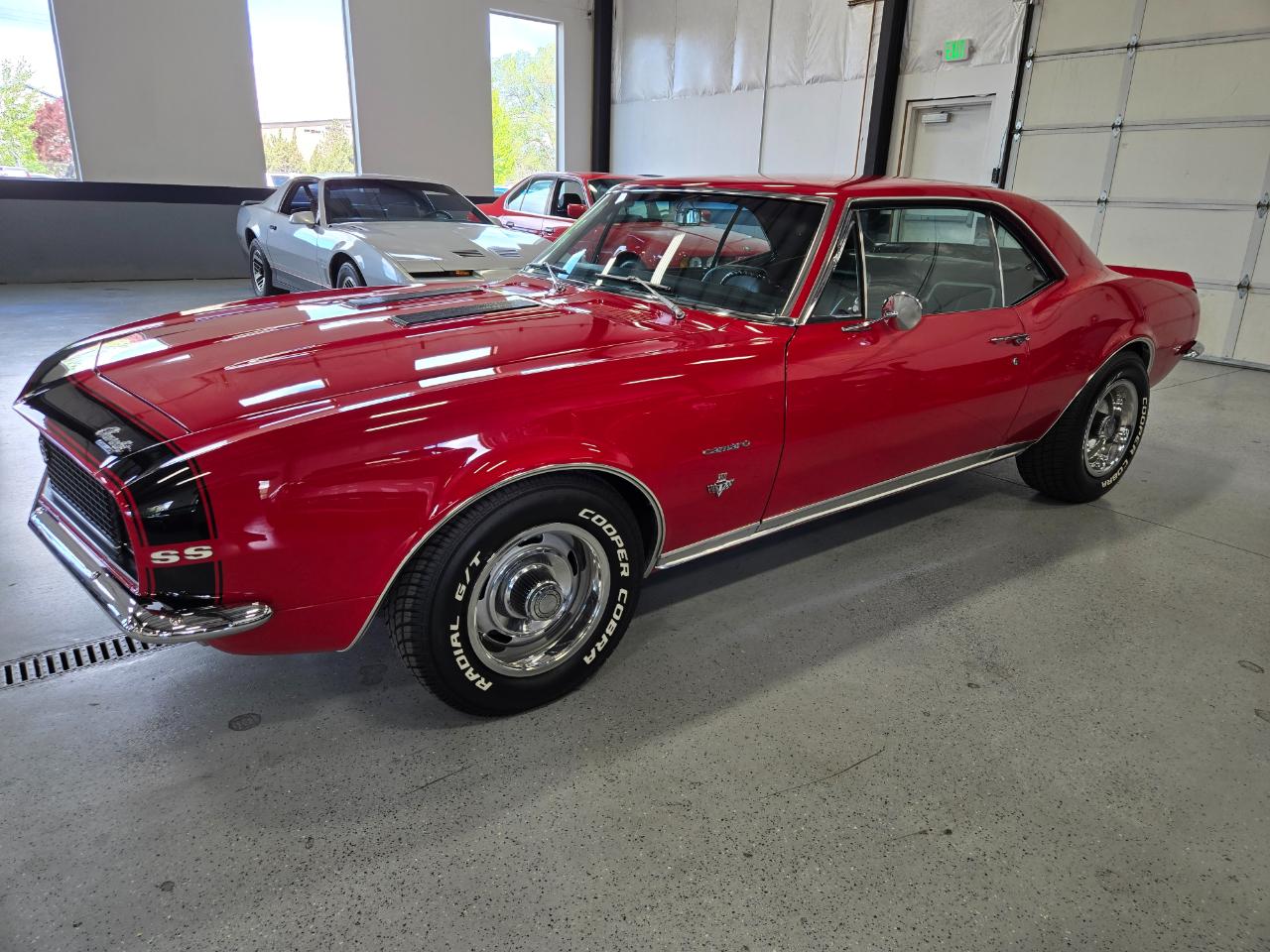 $62,500 · In line with typical
Expand
What they sell for: Camaro RS/SS Hardtop sale prices.