
Chevrolet Chevelle Wagon buyer's guide
Chevrolet Chevelle Wagon -- the model's own buyer's guide: variants, values and what to check.
Years listed: 1965-1972 · Series: Chevelle
Overview and history
The Chevelle wagon is the working member of Chevrolet's mid-size A-body family — the same basic car as the Malibu coupes and convertibles that dominate the Chevelle market, stretched into a long-roof hauler with a flat cargo floor, a tailgate instead of a boot lid, and, in most years, the option of a third seat facing backwards over the rear axle. It was sold from the Chevelle's launch for 1964 through the end of the Chevelle name in 1977, in three distinct generations, and for most of that run it was bought to work: family transport, school runs, towing, trade use. That working life is the single most important fact about buying one now. Coupes were garaged as toys once their values rose; wagons were used until they wore out, and then they were used some more.
The first generation, 1964 to 1967, established the formula. The A-body was Chevrolet's answer to the Ford Fairlane — a true intermediate, smaller than a full-size Impala, bigger than a Nova — with a perimeter frame, coil springs at all four corners, and a wheelbase longer on the wagon than on the coupes, because the wagon needed the room behind the rear seat. The trim ladder ran from the plain Chevelle 300 through the 300 Deluxe to the Malibu at the top, and the engine ladder ran from a straight six that a farmer could fix with hand tools to small-block and, from 1965 onward, big-block V8s shared with the rest of the range. There was even a two-door wagon in the cheapest 300 series for the first two years — a body style aimed at delivery and tradesman buyers that is now the rarest wagon of all, precisely because almost every one was worked to death.
The second generation, 1968 to 1972, is the car most buyers picture and most of the market trades in. The styling went rounder and heavier, the wagon names changed to a system of their own — Nomad at the bottom, Greenbrier in the middle, Concours at the top, and the Concours Estate with its simulated woodgrain sides as the flagship — and the engine bay would now accept everything Chevrolet made, up to and including the 454-cubic-inch big-block in the final years. These are also the muscle-era years, which means parts and knowledge are plentiful — and that wagons have spent fifty years being raided for engines and badges, and dressed up as the Super Sport wagons Chevrolet never catalogued. Read the identity sections before anything else about a dressed-up car.
The third generation, 1973 to 1977, is the Colonnade car: heavier, slower, styled around the new federal bumper rules, and sold as a Malibu, Malibu Classic or Laguna wagon as the Chevelle name faded into a series badge and then disappeared. These cars were smog-era family haulers and were treated as disposable for decades, which makes a genuinely good survivor rarer than the production numbers alone would suggest. They are also the most usable of the three generations as an everyday classic — more safety equipment, more sound deadening, power steering and brakes taken for granted — and the least chased by collectors, which cuts both ways when you come to sell.
Our own listings underline how the surviving population is distributed. We currently track 27 Chevelle wagons for sale or recently sold, 9 of them for sale and 18 recorded as sold, with the tracked cars spanning 1965 to 1975 and the heaviest concentration in the second generation — 1972 is the single most common year in the sample, followed by 1969, 1967 and 1965. Almost all of them, 24 of the 27, came through Bring a Trailer, with the remaining 3 from dealers, which tells you something about where these cars now change hands: the auction market, in public, with photo sets you can study. Of the cars whose transmission is recorded, 20 are automatics and 5 are manuals — the right proportions for a family wagon of the period, and a warning that a manual wagon is a rare find you should verify rather than assume was born that way.
A word of honesty about the photo evidence behind this guide, because it shapes how you should use it. For 18 of the tracked cars we have examined sellers' photo sets in detail, and the photo notes for those 18 cars record no mentions of rust, smoke, leaks or damage at all. Do not read that as a clean bill of health for the model. It is an absence in the notes for a small, auction-skewed sample of 18 cars — cars that were selected and prepared for sale — not a measurement that Chevelle wagons do not rust. They do, in specific and predictable places, and the problem-areas section of this guide is built on where the water goes in this particular body shell, not on that empty aggregate. A wagon that has survived to be photographed for an auction is the top slice of the population. The car in a yard ad with no underside photographs is a different population entirely, and it is the one the inspection checklist is written for.
What defines a good Chevelle wagon today is therefore not rarity or specification, though both matter. It is whether the long, hard-used body shell — the one part of the car that is wagon-specific and cannot be swapped in from a coupe — is still sound: tailgate, rear quarters, cargo floor, spare-wheel well, roof rails and rear window channels. Everything else in the car is shared with one of the best-supported American classics ever built. Buy the shell, verify the identity, and the rest is ordinary Chevelle ownership, which is about as straightforward as classic ownership gets.


The models
Every Chevelle wagon is a four-door long-roof car on the A-body frame, with one exception — the two-door wagon offered in the cheapest series for 1964 and 1965 only. Within that simple outline, Chevrolet changed the wagon trim names more often than it changed the car, and the names are the first thing to learn, because sellers use them loosely and badges are easy to move. A wagon's trim level is a statement about upholstery, brightwork and standard equipment. It is not a statement about the engine: with very few restrictions, any engine in the range could be ordered in almost any wagon, which is why a plain Nomad with a big-block is entirely possible and a woodgrained Concours Estate with a six is entirely possible too. Never price a wagon off its badges. Price it off its build evidence and its engine numbers.
| Model line | Years | Typical engines | Output | Built | Character |
|---|---|---|---|---|---|
| Chevelle 300 wagon (incl. two-door) | 1964–1967 | 194/230 six, 283 V8 | Six to small-block range | Not separated here | The working base car; the two-door is the rare survivor |
| Chevelle 300 Deluxe wagon | 1964–1967 | 230 six, 283/327 V8 | Six to small-block range | Not separated here | The mid-trim family car of the first generation |
| Malibu wagon | 1964–1967 | 230 six, 283/327, 396 from 1965 | Up to big-block range | Not separated here | Top trim of the first generation; best interiors |
| Nomad wagon | 1968–1971 | 230/250 six, 307/350 V8 | Six to small-block range | Not separated here | The base second-generation wagon — plain, honest, often six-cylinder |
| Greenbrier wagon | 1968–1972 | 250 six, 307/350 V8 | Six to small-block range | Not separated here | The middle car; the volume family wagon of 1968–72 |
| Concours wagon | 1968–1972 | 307/350 V8, big-block available | Small- and big-block range | Not separated here | Top trim without woodgrain; more standard equipment |
| Concours Estate wagon | 1968–1972 | 350 V8 typical, big-block available | Small- and big-block range | Not separated here | The flagship: simulated woodgrain sides, the country-club wagon |
| Malibu / Malibu Classic / Laguna wagon | 1973–1977 | 250 six, 305/350/400 V8, 454 early in the run | Smog-era ratings, lower than the same engines earlier | Not separated here | The Colonnade cars; heaviest, quietest, least collected |
Production totals are not given per wagon line because Chevrolet's published figures do not separate these lines cleanly enough to rely on — and invented tidy figures help nobody. The safe shape: wagons were always a minority of output, the mid-trim cars (300 Deluxe, then Greenbrier) were the volume sellers, and plain wagons survive worst because they were worked hardest and scrapped first.
The first-generation cars, 1964–67. The 300 is the utility car: vinyl, rubber mats in place of carpet on the earliest cars, minimal brightwork, and the only route to the two-door wagon in 1964–65. The 300 Deluxe adds the equipment a family actually wanted. The Malibu adds the best upholstery, more chrome and the full engine menu, including the 396 big-block from 1965 — though a big-block Malibu wagon is a rare, special-order-feeling car, and any claim to one needs the paperwork described later in this guide. The 1966 facelift is the visual divide in this generation: stacked headlights and a more sculpted body, and from 1966 the dual-action tailgate, which opens down like a conventional gate or swings sideways like a door, becomes a signature wagon feature to test on any car you view. The 1967 cars are a one-year refinement of the same shell.
The named wagons, 1968–72. Chevrolet gave the wagons names of their own for the second generation, reviving Nomad — a name with real heritage from the 1955–57 two-door wagons — for the base car, which can confuse a careless listing description; a 1969 Nomad wagon is a four-door Chevelle, not a tri-five. Greenbrier, a name borrowed from the Corvair van line, is the middle car and the one you will see most. Concours is the top trim: better upholstery, more brightwork, more standard equipment. Concours Estate is the Concours with simulated woodgrain panelling on the sides and tailgate — the deliberate country-estate look — and it is the wagon that best survives today, because it cost the most new and was most often bought as a second, garaged car rather than a workhorse. Seating is a model point in its own right on these cars: two-seat wagons carry six people; the optional third seat, rear-facing in the cargo well, makes it a nine-seater on paper and changes the cargo floor and the spare-wheel arrangement, so check which layout a car actually has rather than assuming from the listing.


The Colonnade cars, 1973–77. The wagon continued as part of the Malibu line, with the Malibu Classic above it and the Laguna — with its distinctive urethane nose — at the top in the mid-1970s. The third seat and the dual-action tailgate story continue, the engines are the smog-era versions of the same families, and the cars are bigger and heavier in every dimension. Their market position is simple: they are bought for use and for value, not for muscle-era glamour, and the guide's advice for them is to buy condition even more ruthlessly than for the earlier cars, because the parts and trim support, while good mechanically, is thinner for Colonnade-specific wagon pieces.
The SS question, stated once and plainly. In the classic years covered by most of the market, Chevrolet did not catalogue a Super Sport wagon. The SS equipment — SS396, SS454 and their successors — was offered on coupes, convertibles and the El Camino, not on the long-roof body. That means every SS-badged Chevelle wagon you will meet is one of three things: a tribute or clone built by an owner, which is legitimate if it is sold as one; a dealer- or owner-dressed car from new with no factory SS status, which is a story that needs documents, not badges, to carry any weight; or a misdescription, deliberate or careless. It does not mean a wagon cannot have a factory big-block — it can, as an ordinary option in the higher trims, and a documented big-block wagon is a genuinely desirable car. It means the SS badges themselves add no factory value on a wagon, ever, and a price that assumes they do is a price you should walk away from until the seller produces a build sheet, a window sticker or a protect-o-plate that proves what the car actually is. The same discipline applies in miniature to Malibu, Concours and Estate badges on a plainer shell: trim is bolted and glued on, build evidence is stamped and printed, and only the second kind settles an argument.
Engines and gearboxes
A Chevelle wagon could be ordered with almost the whole Chevrolet engine catalogue, and after fifty years it could contain almost anything else as well — the A-body engine bay accepts every Chevrolet V8 of the period with factory parts, which makes swaps easy, common and frequently undisclosed. So this section does two jobs: it describes the engines as Chevrolet built them, and it gives you the checks that tell you which engine is actually in front of you. The governing rule is the same as for the badges. Casting numbers, stamped suffix codes and dates settle identity; valve-cover decals, air-cleaner stickers and a seller's memory settle nothing.
The sixes: 194, 230 and 250 Turbo-Thrift
The base engine for most of the wagon's life was Chevrolet's overhead-valve straight six, in 194-cubic-inch form at the very start of production, then 230 cubic inches, and from the late 1960s the longer-stroke 250 that carried the six-cylinder wagon through the Colonnade years. These are simple, understressed engines: seven main bearings on the later versions, hydraulic lifters, a single one-barrel carburettor (Rochester Monojet on the later cars), and a reputation for outlasting the body around them. In a wagon they are adequate rather than quick — a six-cylinder wagon with an automatic and a full load is a slow car by modern standards — and that slowness is original character, not a fault to be diagnosed.
What actually goes wrong is mundane. The carburettor wears at the throttle shaft and the automatic choke drifts out of adjustment, giving hard cold starts and a rich, lumpy idle that owners blame on the engine. The test is to watch the choke plate from cold: it should be shut at a cold start, crack open as soon as the engine fires, and be fully open within a few minutes; a plate still half-shut on a warm engine explains the running fault and costs adjustment, not a rebuild. Valve-cover and pushrod-cover gaskets weep oil down the side of the block — cosmetic, cheap, and useful evidence of whether anyone has serviced the car. Exhaust manifolds crack, particularly around the centre ports where the heat-riser passage concentrates heat; a ticking that is loud cold and quieter warm is a crack or a failed gasket, and you distinguish them with a length of hose used as a stethoscope along the manifold, listening for where the tick is sharpest. A manifold replacement with studs that snap in the head turns a small job into a $400–900 machine-shop conversation, so price the tick, do not ignore it.
Judge a six on oil pressure, smoke and noise, in that order. A healthy one shows steady oil pressure, no blue smoke under load, and a faint, even valvetrain murmur. Blue smoke on start-up that clears is valve stem seals — a known, bounded job, roughly $350–800 done with the head in place by a shop equipped for it. Continuous smoke under load is rings or bores, and on a six that is an engine-out rebuild, roughly $2,500–4,500 at a general machine shop, which against the value of a six-cylinder wagon means you are buying the car for its shell and should pay accordingly. The six's great virtue in 2026 is honesty: nobody clones a six-cylinder wagon, nobody swaps a six in to fake anything, and an original six in a sound shell is the most truthful car in this whole guide.
The small-blocks: 283, 307, 327, 350 and 400
The small-block Chevrolet V8 is the default engine of the Chevelle wagon and the best-supported classic engine in the world. The first generation used the 283 and the 327; the 307 replaced the 283 as the base V8 from 1968; the 350 arrived in the range at the end of the 1960s and became the standard V8 of the 1970s cars, joined by the siamesed-bore 400 small-block in the Colonnade years and by the 305 in the very last cars. Most wear a two-barrel Rochester 2GC or, later, a Quadrajet on the four-barrel versions, under a large round air cleaner. Outputs vary enormously by year and rating system — gross ratings before 1972, net ratings after — so compare like with like and never quote a seller's horsepower figure back as fact without knowing which system it came from.
The small-block's failure modes are well mapped. Timing chains stretch with mileage: the check is to turn the engine by hand at the crank bolt while watching the distributor rotor through the cap, and any noticeable lag before the rotor moves is chain slack — a chain-and-gears job at roughly $500–1,100 fitted, and a genuine negotiating point because a very slack chain on an interference-free but elderly engine is a reliability risk, not a catastrophe. Flat hydraulic lifters tick after standing and usually pump up within minutes; a tick that never clears on one cylinder, with a rocker visibly moving less than its neighbours when you run the engine with the cover off, is a worn cam lobe, and a cam-and-lifters job runs roughly $900–1,800 fitted. Rear main seals weep — the two-piece seal on the early engines is famous for it — and a few drips on the garage floor are period-normal; a seal that runs rather than weeps is a transmission-out job on most installations, roughly $700–1,400, so distinguish a drip from a leak by cleaning, driving and re-checking, not by looking at old stains.
Carburation is where most running complaints live. On a Quadrajet car, the classic faults are a warped air horn from decades of uneven bolt tightening, which leaks air and defeats idle adjustment, and worn primary throttle-shaft bores, which do the same. The distinguishing test is to spray carburettor cleaner at the base and shaft ends at idle: a change in idle speed confirms an air leak at that point, and no amount of mixture-screw turning will cure it. A proper Quadrajet rebuild by a specialist who will bush the shafts and flatten the castings runs roughly $450–850; a cheap parts-store rebuild that does neither is money spent twice. On two-barrel cars the Rochester 2GC is simpler and hardier, and its usual fault is a perished accelerator-pump cup giving a flat spot on tip-in — press the throttle gently from idle and a stumble that disappears with a richer choke setting points at the pump, not the ignition.
Identity checks matter most here, because the 350 is the engine most often installed in place of something else. The stamped suffix on the pad at the front of the right-hand deck, next to the alternator, codes the engine's original application, and the casting number and date at the back of the block, by the bellhousing flange, must be consistent with the car's year. A casting date after the car's build date proves a swap on its own. None of this makes a swapped car a bad car — a healthy 350 in place of a tired 307 is an improvement you will enjoy — but it makes it a car to price as what it is, not as the matching-numbers car in the advertisement.

The big-blocks: 396, 402 and 454
The big-block — Chevrolet's Mark IV — was available in the wagon from 1965, as the 396, and it is the engine that gives a Chevelle wagon its unlikely second life as a tow car and sleeper. From 1970 the 396 in Chevelles was actually bored to 402 cubic inches while still being sold and badged as a 396 or, in some applications, as a Turbo-Jet 400 — a name that collides confusingly with the 400 small-block, so establish which 400 a seller means by looking at the engine, not the words: a big-block is physically much larger, with widely spaced, canted valves under broad rocker covers and the distributor in the same rear position but a very different bulk around it. The 454 arrived for 1970 and carried the big-block wagon through the early Colonnade years, in progressively softer states of tune as emissions rules tightened.
A big-block in a wagon makes mechanical sense — the torque suits the weight — and it makes forensic sense to be suspicious, because a big-block is also the engine a clone is built around. The failure modes themselves are ordinary Mark IV behaviour. They run hot in traffic if the cooling system is marginal, and a wagon adds a complication: many were fitted with heavy-duty cooling and towing packages, so a car with a small radiator and a big-block is a mismatch worth questioning. Check the fan shroud is present and correct — a missing shroud is the single most common cause of a big-block that boils in a queue and is fine at speed, because without it the fan pulls air around the radiator instead of through it. Oil consumption on a hard-used big-block is usually valve guides and seals first; the test is the same as on the six — smoke at start-up and on the overrun after a long downhill coast is top-end, smoke under sustained load is rings. Cam wear is the other known cost: the Mark IV's valvetrain loads are high, modern oils without the additives these flat-tappet cams were designed for accelerate lobe wear, and a big-block that pops back through the carburettor under load with one rocker barely moving has an exhaust lobe going flat. A cam, lifters, chain and gaskets job on a big-block runs roughly $1,200–2,200 fitted, and an engine-out rebuild is $5,000–9,000 at a competent shop before any performance parts — numbers that should be in your head before you fall for a cheap big-block wagon with a misfire.
Cooling and identity together are the big-block buyer's discipline. Confirm the casting and suffix codes, confirm the radiator and shroud are the heavy-duty items the engine needs, run the car to full temperature and let it idle, and treat any car that cannot sit at a hot idle without the gauge climbing as a car with a cooling bill attached — $600–1,500 for radiator, pump, hoses and thermostat work done properly — rather than as a car with character.
Gearboxes
Most wagons are automatics, as the tracked sample confirms: 20 automatics against 5 manuals among the cars whose transmission is recorded. The automatic story has three chapters. The two-speed Powerglide served the early and lower-powered cars — simple, robust, and unmistakable on the road, with one long ratio change. The three-speed Turbo Hydra-Matic family — TH350 behind small-blocks and sixes, the heavier TH400 behind big-blocks — became the standard automatic from the late 1960s and is the best automatic of the period: strong, well understood, and rebuildable anywhere in America for roughly $1,200–2,500 exchange or $1,800–3,200 rebuilt in the car with the converter. Judge any automatic on fluid and behaviour. Pull the dipstick: the fluid should be red and smell of nothing much; brown fluid with a burnt smell, a long delay engaging drive or reverse from cold, or flaring — revs rising between changes — means a rebuild is coming, and the dipstick test takes ten seconds and settles it before the test drive begins. A TH400 that thumps into gear at idle usually has too high an idle speed or a vacuum modulator fault — the modulator is a small can on the side of the case with a vacuum hose to the manifold, and a split hose or a failed diaphragm (transmission fluid sucked up into the hose is the tell) causes late, harsh changes for the price of a $30–60 part, so test it before letting anyone price you a rebuild.
Manual wagons are the rarity. The standard manual was a three-speed, column-shifted in the early cars; a four-speed floor change — Muncie M20 wide-ratio or M21 close-ratio behind V8s, Saginaw units behind sixes and small engines — was available and is now the gearbox sellers advertise loudest, which is why manual wagons attract conversion. A four-speed conversion done with correct parts is a fine thing to drive; a conversion done with a mismatched shifter, a butchered tunnel and no reverse-light wiring is a discount, not a premium. Judge a manual on second-gear synchromesh on a fast downchange, on clutch judder pulling away, and on whether the car creeps with the clutch fully down, which means the clutch is dragging. A clutch replacement runs roughly $700–1,300 fitted; a Muncie rebuild $900–1,800 at a specialist. And check the shifter location against the car's story: a wagon born as a column-shift automatic that now wears a floor shifter has been converted, whatever the listing says, and the trim tag and build evidence — not the gear lever — tell you what it was born as.
Problem areas
A Chevelle wagon fails in two different ways, and keeping them separate is the whole art of buying one. The mechanical half of the car — engine, gearbox, suspension, brakes — is shared with millions of A-bodies, is understood by every classic shop in the country, and can almost always be fixed for a price you can find out in advance. The body half, from the rear doors backwards, is wagon-only: longer quarters, a tailgate, a cargo floor, a spare well, long roof rails and acres of side glass, none of it shared with the coupes that the reproduction industry serves first. Mechanical trouble is a negotiation. Wagon-body rust is a verdict. This section works through the body first, in the order the water travels, then the chassis and running gear, then the interior and electrics.
Recall the honest limit of our own evidence as you read: in the 18 tracked cars whose photo sets we examined for this guide, the photo notes record no rust, smoke, leak or damage mentions at all. That is a small, sale-prepared, auction-heavy sample, and it does not move a single check in this section. The cars that rot are the cars that were never photographed for an auction, and they rot in the places below whether or not any sample recorded it.
Rust: the tailgate, the rear quarters and the back of the car
The tailgate and its window. This is the wagon's signature failure, and it is structural to the design. The rear window — crank-operated on manual cars, power-operated on better-equipped ones — slides down into the tailgate itself, so the gate is a hollow box that is opened to the weather every time the glass is lowered with rain on it, and whose drain holes sit at the bottom where road dirt packs in. Water that cannot drain sits against the inner skin, and the gate rots from the inside out: the first external sign is paint bubbling along the bottom edge and around the handle and lock, by which time the lower inner structure is usually soft. Press and tap along the whole bottom edge, open the gate both ways on a dual-action car — flat and sideways — and watch whether it sags, twists or drops on its hinges as it swings, which tells you the hinge mounts in the body, not just the gate, are weak. Operate the window through its full travel several times. A manual window that is stiff at one point has a bent regulator or a gate that is distorting; a power window that slows, tilts or stops has a worn regulator, perished channel felts, or a motor drawing against a rotten guide — and the motor and regulator live inside the rust zone, so electrical slowness and structural rust on this car are the same inspection. Reproductions and good used gates exist but are wagon-specific and increasingly expensive to source and ship; repairing a rotten gate properly — cutting out the bottom, fabricating the inner and outer skins, treating the box section — is realistically $1,200–2,800 in metal and paint, and a gate that is perforated in several places is usually a replacement search, not a repair.
The rear window channel and roof rear. The fixed glass around the cargo area and the channels it sits in hold water in exactly the same way. On the side glass, check the lower channels from inside the cargo area with the trim pulled back if the seller allows: staining, lifted paint and soft metal at the bottom corners are the pattern. At the roof, the drip rails run the full length of a very long roof, and seam sealer in the rail channel cracks with age and lets water into the rail, which rots from inside and shows as bubbling along the rail edge and staining at the top of the pillars. Roof and rail rust is the most awkward rust on the car to repair well, because the panels are large, flat and visible, and because a wagon roof that has gone at the rails is telling you the car lived outside for years — price roof-rail work per car after a body shop has seen it, and treat extensive rail perforation on a mid-value wagon as a walk-away rather than a project.
Rear quarters behind the wheels. The long rear quarter panels trap mud thrown up by the rear tyres against their inner faces, and the lower quarter behind the wheel opening is the classic perforation point — the same place as on a coupe, but with a longer panel, a longer repair, and, on a Concours Estate, woodgrain trim whose clips pierce the panel and give water a row of entry points along the side. Run a cloth-wrapped magnet along the lower quarters and over the wheel-arch lips: filler announces itself where the magnet's pull fades, and wagons that have been repaired once often carry thick filler exactly here. From inside the cargo area, look at the inner quarters and the wheel tubs with a torch; a quarter that looks clean outside and is patched or perforated inside has had the cheap version of the repair. A proper lower-quarter repair, cut out and welded with the inner structure made good, runs roughly $1,000–2,500 per side before paint blending, and Estate woodgrain cars add the cost of removing, preserving or replacing the trim and its mouldings.
Cargo floor and spare-wheel well. Lift everything. The cargo floor, the folding seat mechanism if a third seat is fitted, and the spare well underneath or behind it are where tailgate and window leaks finally collect, and the well is a pressed sump that holds water against the metal indefinitely. Staining and surface rust are clean, treat and seal work you can do yourself. Perforation of the well or the cargo floor is a panel repair, roughly $800–2,000 fitted and painted depending on how much of the surrounding floor has gone with it — and, as everywhere on this car, floor rust rarely travels alone: a perforated well with soft inner quarters and a bubbling tailgate is one water story told in three places, and the total is the price of the car several times over if you pay others to fix it.

Rust: floors, frame, sills and the front of the car
Frame. The A-body is a body-on-frame car, which is good news and bad news. The good news is that the body and frame can be judged separately, and a surface-rusted frame on a dry-state car is normal and treatable. The bad news is that the perimeter frame rots in specific places that sellers' photographs avoid: the rear rails and kick-up over the rear axle, the body-mount points, and the front horns and crossmember area where road salt packs. Body mounts are the test you can do anywhere: the rubber cushions perish and compress, the mount bolts corrode, and a car whose body sits unevenly on its frame, whose doors have dropped or whose panel gaps wander along one side may be telling you about mounts and frame, not about hinges. A lift inspection with a torch and a screwdriver to prod the rails is not optional on a northern car. Localised frame repair by a competent fabricator is priced per job, commonly $800–2,500 for a section done properly; a frame perforated in several places, or a car with multiple collapsed body mounts, is a body-off conversation that only makes sense on a valuable, documented car.
Floors and sills. The front and rear footwell floors rot from the inside, fed by windscreen and rear side-window leaks and by wet carpets that never dry in a working wagon. Lift the carpets in all footwells and under the rear seat. The rocker panels (sills) are less structurally critical than on a unitary car, because the frame carries the car, but they are visible, they perforate along their lower edges, and they are part of the honest read of the shell: a wagon with sound frame rails and rotten rockers has usually lived a salty life, and the rest of the underside will agree. Floor sections are reproduced and a side fitted and painted runs roughly $600–1,500; treat any floor rust as a marker to look harder at everything else, not as an isolated line item.
Front panels, doors and the cowl. Door bottoms fill with water when their drain slots block — run a fingertip along every door's bottom edge and feel for bubbling. Front wing (fender) bottoms, the lower cowl, the battery tray area and the windscreen surround complete the standard A-body map. None alone kills a wagon — front panels are shared with coupes and sedans and are the best-reproduced metal on the car — but together they price the cosmetic future: four door bottoms, two wing bottoms and a windscreen surround is a body-shop season, not a weekend.

Suspension, steering and brakes
The A-body chassis is conventional and durable: unequal-length control arms and coil springs in front, with an anti-roll bar on better-equipped cars; a live rear axle on coil springs located by control arms at the back. Nothing in it is exotic, and everything in it wears.
Front suspension and steering. Ball joints, control-arm bushings and tie-rod ends are the wear list. Perished rubber bushings show as cracked, displaced rubber at the arm pivots and as a front end that wanders and clunks; the test is to rock each front wheel at the top and at the sides with the car jacked and supported, feeling for where the play lives — play at the wheel bearing is adjustment or a bearing, play that moves the ball joint or the arm is parts. A full front-end refresh with joints, bushings, alignment and labour runs roughly $900–1,800, and it transforms these cars, which is why a vague-steering wagon is a price chip rather than a rejection. Steering boxes wear in the straight-ahead position and develop play at centre that adjustment only partly cures; power steering pumps and hoses leak with age, and a pump that groans at full lock with aerated, frothy fluid is telling you about a suction-side leak or low fluid, not necessarily a dead pump — top up, bleed by working lock to lock, and judge again. Saginaw boxes and pumps are rebuildable, roughly $350–700 for a box rebuild, which keeps this whole area in the realm of the budgetable.
Rear axle and springs. The 10-bolt rear axle is standard, the stronger 12-bolt appearing behind big-blocks and in performance applications — count the bolts on the rear cover if an axle claim is part of the price, because a 12-bolt under a car being sold as an original big-block wagon is supporting evidence, and a 10-bolt is a question. Axle whine on a light throttle at cruise that changes on and off the power is pinion and crown-wheel wear or setup; a constant rumble that follows road speed is bearings. Rear springs sag — a wagon that sits tail-down with the rear wheels upright usually needs springs, roughly $300–600 a pair fitted with shocks — and rear control-arm bushings perish and let the axle steer the car over bumps. Air shocks and helper springs fitted to a wagon are not automatically a bodge: wagons towed and carried loads, and period towing equipment is part of an honest car's history, but they are a prompt to check the frame's rear rails and the hitch mounting points for the stress and rust that towing brings.
Brakes. Front discs became common through the late 1960s and standard in effect by the early 1970s, with drums on earlier and plainer cars; either system, maintained, stops the car adequately, and either system, neglected after standing, needs a hydraulic rebuild. The standard list after years of storage is seized calipers or wheel cylinders, perished flexible hoses, a master cylinder bypassing internally — the pedal that slowly sinks at a standstill with no external leak is the master cylinder's signature — and corroded steel lines, worst where they run along the frame. A full hydraulic refresh with labour runs roughly $800–2,000 depending on how much hard line must be replaced. Judge a car that pulls to one side under braking as a caliper, hose or alignment question to be priced, and a car with a soft, long pedal as a car you do not drive home.
Interior, cargo area and electrics
Seats and the third seat. Wagon interiors worked for a living. The front bench or buckets wear at the driver's entry bolster first, and the vinyl splits along its seams and stitching. The folding second seat and the rear-facing third seat, where fitted, add mechanisms that seize and latches that wear; fold and latch every seat on a viewing, because a third-seat well that has held water will show it on the mechanism before it shows on the floor. Correct-pattern reproduction upholstery for the common trims is available; a professional retrim of a wagon interior, with its extra seat and cargo-area panels, runs roughly $2,500–5,500 in vinyl depending on how much is done, and Estate and Concours trim details add to it. Cargo-area side panels and headlinings are wagon-specific: a headlining replacement is roughly $600–1,200 fitted, and stained or sagging cargo trim is a reliable witness to the window leaks described above.
Woodgrain and trim. On the Concours Estate, the simulated woodgrain is applied panels and mouldings, and it fades, crazes and peels with sun. Replacement woodgrain material and mouldings exist but matching a faded original set in part is harder than renewing the whole side; price an Estate with failing woodgrain as a full-side renewal, roughly $800–2,000 in materials and labour, and check the metal underneath the mouldings with the magnet, because the trim hides the quarter panel it decorates.
Electrics and the power tailgate window. Fifty-year-old Chevrolet electrics fail at grounds and switches, not in the looms: dim lights, a wandering fuel gauge and intermittent accessories are earth-point work, cheap in parts and tedious in time. The wagon-specific electrical item is the power tailgate window, with its motor inside the gate, its safety interlocks and its key switch on the gate itself. Test it from both the dashboard switch and the gate switch, through full travel, several times; a window that works once and stops is overheating, binding in a rusty channel, or losing its ground through a corroding gate hinge path — all three are the tailgate story again, told electrically. Air conditioning, where fitted, is the other budget item: assume a non-working system needs a compressor, receiver-drier, hoses and a conversion or recommissioning, roughly $1,200–2,500 at a shop, and treat working cold air as a genuine selling point worth paying for, because someone has already spent that money.

How to inspect one
Allow at least an hour, and bring a torch, a cloth-wrapped magnet, a length of hose for listening, and a screwdriver for prodding with the seller's permission. Insist on seeing the car cold, complete and with the cargo area empty — a wagon presented full of spares and blankets is a wagon whose floor you are not meant to see. If the car passes you, pay for a lift inspection before money changes hands; on a body-on-frame car the lift settles the frame, the floors and the brake lines in twenty minutes, and it is the best money in the whole purchase.
- Paperwork and identity first. Match the VIN on the title to the plate on the car, and read the trim (cowl) tag for the body style, trim and build data. The tag should say wagon — the long-roof body code — and the trim it records should match the car's badges and upholstery. Then set the SS question aside permanently: no classic Chevelle wagon was catalogued as an SS, so if the car wears SS badges, price it as the wagon the paperwork proves it to be and treat the badges as decoration. Any claim to a factory big-block, a four-speed or an Estate specification needs the build sheet, window sticker, protect-o-plate or engine numbers to support it, and this is the moment to ask, before you have fallen for the car.
- Cold start. The engine should be cold when you arrive. A six or small-block should fire readily and settle; a car that needs prolonged cranking, pumping or a jump pack is telling you about the carburettor, the choke or the battery and charging system, all priced in the engines section. Watch the exhaust for the first thirty seconds: blue smoke at start-up that clears is valve seals; smoke that persists under load later in the drive is rings. Listen for a lifter tick and note whether it pumps up and disappears.
- Engine identity and the dipsticks. Pull the engine oil dipstick — level, colour and smell — and the automatic transmission dipstick if the car is an automatic: red and clean is right, brown and burnt-smelling is a rebuild conversation. Find the stamped pad at the front of the block and the casting date at the rear, and check them against the car's year and the seller's story. A casting date later than the car proves a swap, whatever the air-cleaner sticker says. Note the radiator and fan shroud on a V8 car: the heavy-duty cooling a big-block needs should be visibly there.
- The tailgate, before anything else on the body. Open the gate both ways if it is a dual-action car. Run the rear window down into the gate and back up, twice, from every switch fitted. Press and tap along the gate's bottom edge, look inside the gate through the window slot with the torch, and check the drain holes are clear. Sag on the hinges, stiffness in the window travel and bubbling along the bottom edge are the rust section's first chapter, found in five minutes — and a seller who will not let you operate the gate has answered the question.
- Cargo floor and spare well. Empty the cargo area, lift the mats and the spare, fold the seats, and inspect the floor, the well and the inner quarters with the torch. Staining is a leak to be sealed; perforation is a panel bill; a third-seat well full of water or silt is evidence the window and gate seals have been leaking for years, and everything below them should be priced accordingly.
- Under the car. On the lift or on stands, prod the frame rails — especially the rear kick-up and the body-mount points — the floors, the rocker bottoms and the brake and fuel lines along the frame. Count the rear-axle cover bolts if an axle claim matters: ten or twelve settles that part of the story. Read the underside's finish honestly: patchy, aged underseal with honest stone chips is a survivor; a fresh, uniform black coat over rails, lines and mounts alike, applied for the sale, is a question, not an answer.
- Quarters, doors and roof. Work the magnet along the lower rear quarters, the wheel-arch lips and the door bottoms. Check the Estate woodgrain moulding lines on a Concours Estate. Look along the roof drip rails for bubbling, open every door and feel its bottom edge, and check the windscreen surround and the lower side-glass channels in the cargo area. This is the step that prices the body shop's year, so take the photographs you will want later, panel by panel.
- Suspension and steering by hand. With the front jacked and supported, rock each front wheel top-to-bottom and side-to-side and locate any play — bearing, ball joint or bushing — before you drive. Look at the control-arm bushings for cracked and displaced rubber, check the rear stance for sag, and note any air shocks or towing hardware, then look at the rear frame rails where a hitch would mount.
- The test drive. Fifteen minutes minimum, including a stretch at highway speed and some low-speed manoeuvring. An automatic should engage drive and reverse without a long pause, change cleanly and not flare between gears; a manual should take a fast downchange into second without grinding, and the clutch should bite without judder or creep. A small-block or big-block should pull cleanly through the rev range — a flat spot on gentle throttle points at the carburettor's accelerator pump or an air leak, a pop back under load on a big-block points at the cam, and both are priced in the engines section. Brake firmly from speed: straight, without judder or pull, and hold the pedal at a standstill afterwards — a pedal that sinks is a master cylinder confessing.
- Heat and electrics, hot. Let the car idle at full temperature. The gauge should stabilise; a V8 that climbs at idle and cools at speed has a shroud, fan or radiator problem, not a personality. Work everything: lights, wipers and washers, heater and blower on all speeds, every window including the tailgate glass again now the car is warm, the horn, the gauges, and the air conditioning if fitted — and price anything dead from the problem-areas section rather than accepting that it is probably a fuse.
- Stance and shutlines from twenty paces. Stand back and look. A wagon should sit level side to side, with the long flank straight and the door and gate gaps even. Tail-down with upright rear wheels is springs; a lean to one side is a spring, a mount or a frame question; ripples down that very long side are filler and accident history announcing themselves at the distance where they are hardest to talk yourself out of.
- Interior last, and the file. Sit in every seat, fold every seat, latch every latch. Check the headlining and cargo panels for the water staining that confirms the leaks you hunted earlier. Then read whatever history file exists — invoices for engine, gearbox, brake and tailgate work are worth real money on this car — and weigh a documented, honestly presented wagon above a shinier car with no paper, every time.

Values
The Chevelle wagon market is best read as three markets wearing one name, and the first skill is knowing which one a given car is actually in. The first is the muscle-era market: second-generation cars, 1968 to 1972, where wagon values are pulled upwards by the heat of the whole Chevelle name and by buyers who want the period look with room for a family. The second is the early-car market for the 1964 to 1967 generation — slimmer, simpler cars valued by the same logic as early Malibus, with condition and originality doing most of the work. The third is the Colonnade market, 1973 onwards, where the cars are valued as usable classics rather than as muscle-era artefacts, and where a good survivor is priced by how much car it is rather than by what the badge might become. A price that looks wrong usually turns out to be a car being offered in the wrong one of the three markets — most often a Colonnade car described in muscle-era language.
Within any of those markets, condition spreads prices wider on a wagon than on a coupe, and the reason is the body. A coupe's value is carried by its drivetrain and its trim as much as by its shell, and almost every coupe part is reproduced. A wagon's value is carried disproportionately by the wagon-only metal — tailgate, quarters, cargo floor, roof — because that is the part that cannot be bought off a shelf. Two wagons with the same year, trim and engine can therefore sit far apart in value for reasons that are invisible in a headline photograph: the one with a sound gate, solid well and original quarters is the valuable car, and the one with a dressed engine bay over a soft back end is the expensive mistake. When you compare asking prices, compare shells first and specifications second, which is the opposite of how most listings are written.
Specification premiums exist, but they are narrower than sellers suggest. A documented factory big-block wagon earns a real premium over the same car with a small-block, because it is rare, because the torque suits the car, and because documentation is exactly what most big-block wagons lack. A factory four-speed earns a premium for the same reason. The Concours Estate's woodgrain carries a modest premium when the woodgrain and the metal under it are both good, and none when either is failing. Six-cylinder and plain-trim cars — Nomad and Greenbrier wagons honestly presented — are the value end of the market, and they are also, not coincidentally, the cars least likely to have been faked, swapped or overheated in pursuit of performance. What earns no premium at all, and should earn a discount for the argument it starts, is SS presentation on a wagon: the factory never catalogued one, so SS badges, stripes and steering wheels on a long-roof car are owner decoration, and any asking price that capitalises them is asking you to pay for a story the paperwork cannot support.
Asking prices and achieved prices part company on wagons in a predictable place. Sellers price from the coupe market upwards — the car is a Chevelle, the engine is the desirable one, the colour is right — while buyers, and auction rooms, price from the shell and the evidence. Cars that are photographed thoroughly, underside and cargo floor and gate included, with paperwork shown, tend to close that gap because they remove the buyer's discount for uncertainty. Cars advertised with glamour photographs and no underside, no gate operation and no documents tend either to sit, or to sell to the buyer who did not ask, and the recorded results in the market block that follows this guide — the build adds our tracked listings and recorded sales beneath every guide, and that block, not this prose, is where the current numbers live — are the honest reference for what the market actually paid, as opposed to what it was asked. Read that block by generation and by trim, treat a single exceptional result as a single exceptional car rather than a new level for the model, and remember that in a population as small as this one — our own tracked sample is 27 cars — every median is a handful of sales wearing a statistic's clothes.
The project-versus-driver gap is the last thing to understand. A project wagon is cheap because its expensive work is body fabrication in panels that are not fully reproduced, and that work does not get cheaper because the car did. A driver-quality wagon with a sound shell, a tired interior and honest mechanics is usually the best value in the market, because every fault sits in the catalogue-supported half of the car; a gleaming wagon over an unexamined shell is the worst. Negotiate accordingly: rust in the gate, quarters and well is priced fabrication; a claimed specification without paperwork is priced at the specification you can prove; and a seller who has photographed the underside, operated the gate and shown the documents has already done the work that justifies holding a price.
Parts and ownership
The Chevelle wagon sits on one of the strongest parts foundations in the classic world, with one wagon-shaped hole in the middle of it. Everything shared with the A-body range at large — and that is most of the car — is supported by a reproduction industry built on the coupe and convertible market, by Chevrolet's own enormous original production, and by a used-parts pool that covers the whole continent. Everything specific to the long roof is supported more thinly, and the ownership strategy that follows from that is simple: spend your money protecting the wagon-specific parts of your car, because those are the parts you cannot simply order.
Easy: engine service parts for every engine in this guide, from six-cylinder gaskets to big-block valvetrain components; carburettor kits for the Rochester 2GC, Monojet and Quadrajet; automatic transmission rebuild parts and complete rebuilt TH350 and TH400 units; clutch and Muncie parts; brake hydraulics, discs, drums and lines; suspension joints, bushings and springs; steering boxes and pumps, rebuilt on exchange; cooling system components; exhaust systems; glass rubbers and weatherstrips for the common years; and front sheet metal, which is reproduced because the coupes need it too. Order today, fit this weekend is a realistic rhythm for the mechanical car.
Harder and dearer: tailgates and tailgate internals — regulators, motors, channels and latches — which are wagon-only, mostly used rather than reproduced, and priced by scarcity and shipping size; rear quarter panels and cargo-floor sections, where coverage varies by year and the Colonnade cars are thinnest; rear side glass and its channels and seals; third-seat hardware and cargo-area trim panels; Concours Estate woodgrain material and mouldings; Nomad and Greenbrier trim pieces specific to one year, 1968 especially; headlinings and cargo panels in the correct patterns; and Colonnade-era interior plastics, which degrade in the sun and were never reproduced with the enthusiasm the earlier cars enjoy. None of this is unobtainable — the A-body community is large and wagons have a devoted following within it — but it is hunt-and-wait rather than click-and-buy, and a car missing several of these pieces is a longer project than its mechanical condition suggests.
Running costs. A sorted Chevelle wagon is a realistic regular-use classic. Fuel consumption is period American: a six or a gently driven small-block is merely thirsty, a big-block wagon used as its makers intended is very thirsty, and none of them should be bought with fuel economy in the calculation. Servicing is within the ability of any competent general classic shop — there is nothing on the car that requires marque-specific diagnostic equipment, and most owners do routine work themselves with ordinary tools, which is part of the model's appeal. The budget lines that catch new owners are the ones this guide has repeated: the first year of deferred maintenance on a running car, honestly $2,000–5,000 before you improve anything; recommissioning a wagon that has stood for years, $4,000–8,000 at a shop once the fuel system is cleaned end to end, the brakes are rebuilt, the tyres are replaced and the tailgate and window seals have been dealt with; and the standing-car tax that ethanol fuel levies on old carburettors, rubber lines and tanks, which is why a car in regular use is worth a premium over a car that has been asleep, even a lower-mileage one. Insurance and club support follow the Chevelle name generally — national Chevelle clubs, A-body forums and wagon-specific communities all exist and are genuinely useful for the wagon-only parts hunt — and a wagon at a Chevelle event draws the crowd that walked past twenty coupes to reach it.

Which one to buy
- The all-rounder: a 1968–72 Greenbrier or Concours with a 350 small-block and a Turbo Hydra-Matic. The volume cars of the best-supported generation, with the engine and gearbox combination that any shop in America can maintain blindfold. Buy the best shell you can find in this specification and you have the wagon the whole guide is quietly written around.
- The value buy: an honest six-cylinder or 307 Nomad or Greenbrier. Plain, slow, almost never faked, and priced at the bottom of the market because the muscle-era crowd walks past it. In a sound shell it is the cheapest route into a good wagon, and a later small-block swap is your choice to make — with your eyes open and the car priced as a six.
- The flagship: a documented big-block Concours or Concours Estate. The torque suits the car, the Estate's woodgrain is the period look at its most complete, and documentation is the whole ballgame — build sheet, protect-o-plate or matching numbers, or it is a small-block-priced car with a big engine in it.
- The family classic: a Colonnade Malibu Classic wagon, 1973–77. The quietest, softest and most usable of the three generations, and the least collected — which makes a genuinely good survivor the bargain of the range for a buyer who wants to use the car rather than discuss it. Judge it on trim completeness and shell, as the parts section warns.
- The rarity: a 1964–65 two-door Chevelle 300 wagon. The rarest body in the range, bought for what it is rather than for comfort or speed. Verify the body from the trim tag, expect a parts hunt, and never pay a rarity premium for a car whose two-door shell is the thing that is rotten.
- The one to walk away from: any SS-badged wagon priced as a factory SS. There was no catalogued SS wagon in the classic years. A tribute honestly sold as a tribute can be a fine car at a tribute price; the same car priced on a factory story that cannot have happened is a walk-away, however good it looks.
And the rule that overrides all of the above: buy the soundest wagon shell you can find — tailgate, quarters, cargo floor and roof — in the specification you can live with. Engines, gearboxes, brakes and interiors on a Chevelle are catalogue items with known prices. The long roof and everything under it is the car, it is the part that cannot be re-ordered, and it is the part a wagon's previous working life wore out first.
See the 17 Chevelle Wagon cars currently listed.
For sale now
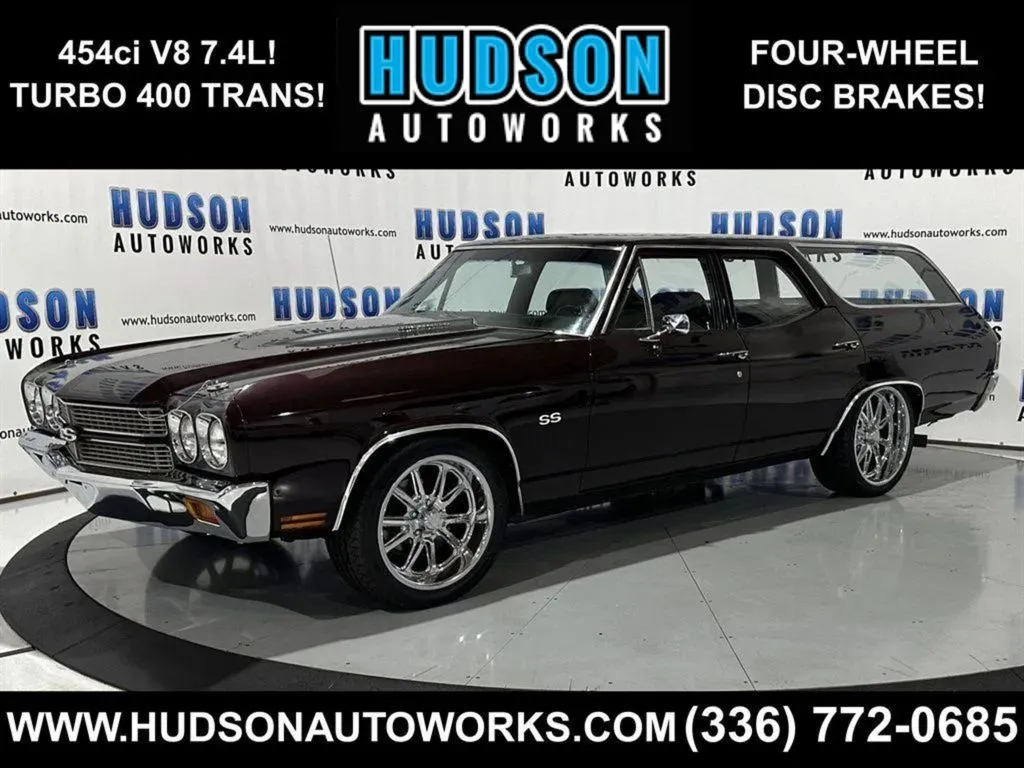 $40,693 · 22% above typical
Expand
What they sell for: Chevelle Wagon sale prices.