
Chevrolet K2500 Fleetside buyer's guide
Chevrolet K2500 Fleetside -- the model's own buyer's guide: variants, values and what to check.
Years listed: 1995-2000 · Series: C/K Trucks
# Chevrolet K2500 — Classic Listings Buying Guide
Overview and history
The Chevrolet K2500 is the three-quarter-ton, four-wheel-drive pickup in General Motors' GMT400 family — the trucks Chevrolet sold as the C/K series from the 1988 model year through 2000, with the last two years overlapping the newer Silverado as "Classic" models. Decode the name before you decode anything else, because sellers use it loosely: C means two-wheel drive, K means four-wheel drive, and 2500 means the three-quarter-ton chassis. A K2500 is therefore always a 4x4 — if the truck in front of you has no front differential, no transfer case and no front drive shafts, it is a C2500 wearing the wrong badge or the wrong advertisement, whatever the paperwork summary says. The 2500 sits between the half-ton 1500 and the one-ton 3500, and for most buyers it is the sweet spot of the whole GMT400 range: heavy enough to tow and haul honestly, light enough to drive every day without the dually's width or the one-ton's unladen ride.
The GMT400 was a revolution when it arrived for 1988, and you need to understand why to judge one now. It was also a manufacturing commitment on a scale that still helps you today: GM built the platform at plants across North America for thirteen model years, sold the basic truck as a Chevrolet and a GMC, and exported the architecture widely, which is why the used-parts and knowledge base is continental rather than regional. The design team worked under a simple brief — make the truck drive like the cars its buyers also owned — and spent the aerodynamic budget accordingly: the GMT400's drag was dramatically lower than the square-body's, which is part of why a Vortec K2500 cruises at modern highway speeds without the roar and wander its predecessor demanded. The trucks were facelifted gently rather than restyled — grille and lamp changes for 1994, the new interior for 1995, running changes to brakes and safety equipment — so the silhouette barely dates across the run, and year-spotting from photographs alone is unreliable. Use the interior (pre- or post-1995) and the engine bay (TBI or Vortec) to place a truck in its era, not the grille. The square-body trucks it replaced had a live front axle on 4x4 models; the GMT400 K-trucks introduced independent front suspension with torsion bars — the first full-size GM 4x4 pickups to ride that way. The result was a truck that steered, rode and cruised like the cars of its day while keeping a separate ladder frame, leaf springs at the rear and proper low-range gearing. Ford and Dodge buyers argued about it at the time; history settled it — every full-size 4x4 pickup since has followed the same basic layout. The styling was equally deliberate: flush glass, composite headlamps on higher trims, a smooth slab-sided body that still looks modern next to its contemporaries, and an interior that moved from vinyl work-truck austerity toward car-like trim as the Silverado and Cheyenne packages climbed.
Production ran long and changed in steps you can use as buying fault lines. The first step is 1988–1994: throttle-body injection, the early interior, and the simplest specification. The second is 1995: a completely new, much more car-like interior with a driver airbag, while the engines carried over for one more year. The third — the big one — is 1996: the Vortec engine programme replaced throttle-body injection with sequential injection and far more power, OBD-II diagnostics arrived, and the trucks became noticeably quicker and more economical. The fourth step is the run-out: the GMT800 Silverado took over as the mainstream truck for 1999, and the GMT400 2500 and 3500 continued for 1999 and 2000, increasingly bought by fleets and loyalists who wanted the old platform's simplicity. The K2500s in the Classic Listings pool sit exactly in that late window — the pool's five trucks span 1995 to 2000, two of them 1998s — which is where most survivors live, because late trucks have had less time to rot and the Vortec specification is the one people keep.
Why buy one now? Three honest reasons. First, capability per dollar of complexity: a K2500 will tow a car trailer, carry a slide-in camper within its rating and clear a rutted track, yet everything on it can be serviced with hand tools and a factory manual — no air suspension, no diesel particulate filter, no CAN-bus archaeology. Second, parts: GM built these trucks in the millions across the C/K range and the mechanical overlap with the 1500, the Tahoe, the Suburban and contemporary vans means almost nothing is truly obsolete. Third, character: the GMT400 is the last GM truck that still feels mechanical — cable-and-lever controls, a column or floor shift you can feel engage, steering with weight. The market has noticed, and clean late trucks are no longer cheap farm tools. Buy on condition, not nostalgia, and read the rest of this guide with a specific truck in mind.

The models
"K2500" names a chassis and a drive layout, not a single truck, and the variations matter more than the badge. Start with the split that decides what you are actually buying: the light-duty and heavy-duty 2500. For most of the run Chevrolet sold two distinct three-quarter-tons under the same badge. The light-duty truck — often called the 2500LD, rated at 7,200 lb GVWR — is essentially a strengthened 1500: six-lug wheels, a semi-floating 9.5-inch 14-bolt rear axle, and the lighter 4L60-series automatic. The heavy-duty truck — the 8,600 lb GVWR car, sold in later years explicitly as the K2500 HD — is a different animal: eight-lug wheels, the full-floating 10.5-inch 14-bolt rear axle, heavier springs, bigger brakes and the 4L80-E automatic or NV4500 manual. Count the wheel lugs before you believe a word of any advertisement: six lugs is the light truck, eight lugs is the heavy one. Neither is "wrong" — the light truck rides better and suits towing at the lighter end — but they tow, carry and cost differently, and a seller who describes a six-lug truck as "heavy duty, one-ton running gear" is either mistaken or hoping you are.
Cab and bed define the rest of the range. The regular cab came with the 8-foot long bed (131.5-inch wheelbase) or, less commonly in 2500 form, the 6.5-foot short bed. The extended cab — Club Coupe in early language, with a small rear bench and, from the mid-1990s, an optional third door on the driver's side from 1996 — rides on the 141.5-inch wheelbase with the short bed or the 155.5-inch wheelbase with the long bed; the pool's maroon 1998 is listed on exactly that 155.5-inch extended-cab long-bed footprint, the maximum-cab, maximum-bed work specification. The crew cab, four full doors on the 168.5-inch wheelbase, arrived for the heavy chassis and is the rarest and most sought-after K2500 body — the pool's grey 2000 is a crew-cab short-bed HD, a configuration built in small numbers for buyers who needed to carry a crew and tow in the same truck. There was also a chassis-cab for flatbeds, service bodies and campers. Beds were Fleetside (smooth-sided, the overwhelming majority) or the rare Stepside sportside on lighter models; in 2500 form, assume Fleetside unless you are looking at the flared fenders themselves.
Trim runs from the Cheyenne work specification — vinyl, steel wheels, minimal brightwork — through the Scottsdale mid-range to the Silverado top trim with cloth or leather, carpet, power equipment and the composite headlamps. Do not confuse trim with capability: a Cheyenne HD with the 7.4-litre engine out-tows a Silverado light-duty with the 5.7 every day of the week. The RPO codes on the glovebox sticker — the Service Parts Identification label — settle every argument about what a truck was built as: engine, axle ratio, GVWR package, locking differential (G80), transmission and paint are all there in three-character codes, and the inspection section of this guide walks you through using it.
Two related vehicles share so much with the K2500 that you will meet them in your search and should not confuse them with it. The K2500 Suburban is the station-wagon body on the same heavy chassis — same engines, same IFS, same axles — and one appears in this guide's listing pool; it is a fine vehicle, but it is a Suburban, priced and insured as one, and its rear suspension and body rust map differ from the pickup's. The GMC Sierra 2500 is the K2500's twin under GMC badges — mechanically identical, sometimes better preserved because GMC buyers skewed older and gentler — and everything mechanical in this guide applies to it unchanged.
| Model | Years | Engine | Output | Built | Character |
|---|---|---|---|---|---|
| K2500 light-duty (6-lug, 7,200 lb GVWR) | 1988–2000 | 5.0 / 5.7 V8, 6.5 diesel | See Engines — varies by era | Not published separately; the minority of 2500 output | A strengthened half-ton: better ride, lighter axles and gearbox, honest towing at moderate weights |
| K2500 heavy-duty (8-lug, 8,600 lb GVWR) | 1988–2000 | 5.7 / 7.4 V8, 6.5 turbo diesel | See Engines — varies by era | Not published separately; the core fleet and tow specification | The real three-quarter-ton: full-float axle, 4L80-E or NV4500, built for trailers and campers |
| K2500 extended cab (incl. 155.5 in WB long bed) | 1988–2000 | As per duty class | As per duty class | Not published separately | The volume family/work compromise; third door from 1996 is the desirable late feature |
| K2500 crew cab HD | 1992–2000 | 5.7 / 7.4 V8, 6.5 turbo diesel | As per duty class | Low volume | The rare one: four doors, short or long bed, the collector and family-tow favourite |
| K2500 chassis cab | 1988–2000 | As per duty class | As per duty class | Fleet volume only | Flatbed/service-body base; judge entirely on the chassis and the body fitted since |
A note on the "built" column, because honesty matters more than a tidy table: GM published production in aggregate C/K volumes — the platform ran to millions — but did not break out surviving, verifiable totals by K2500 cab and duty variant in a form a buyer can rely on, and this guide does not invent any. What is genuinely known is the shape of survival: regular-cab work trucks were used up, extended cabs dominate the surviving pool, crew cabs were scarce new and are scarcer now, and diesels are a small minority of survivors because most diesel buyers bought one-tons.
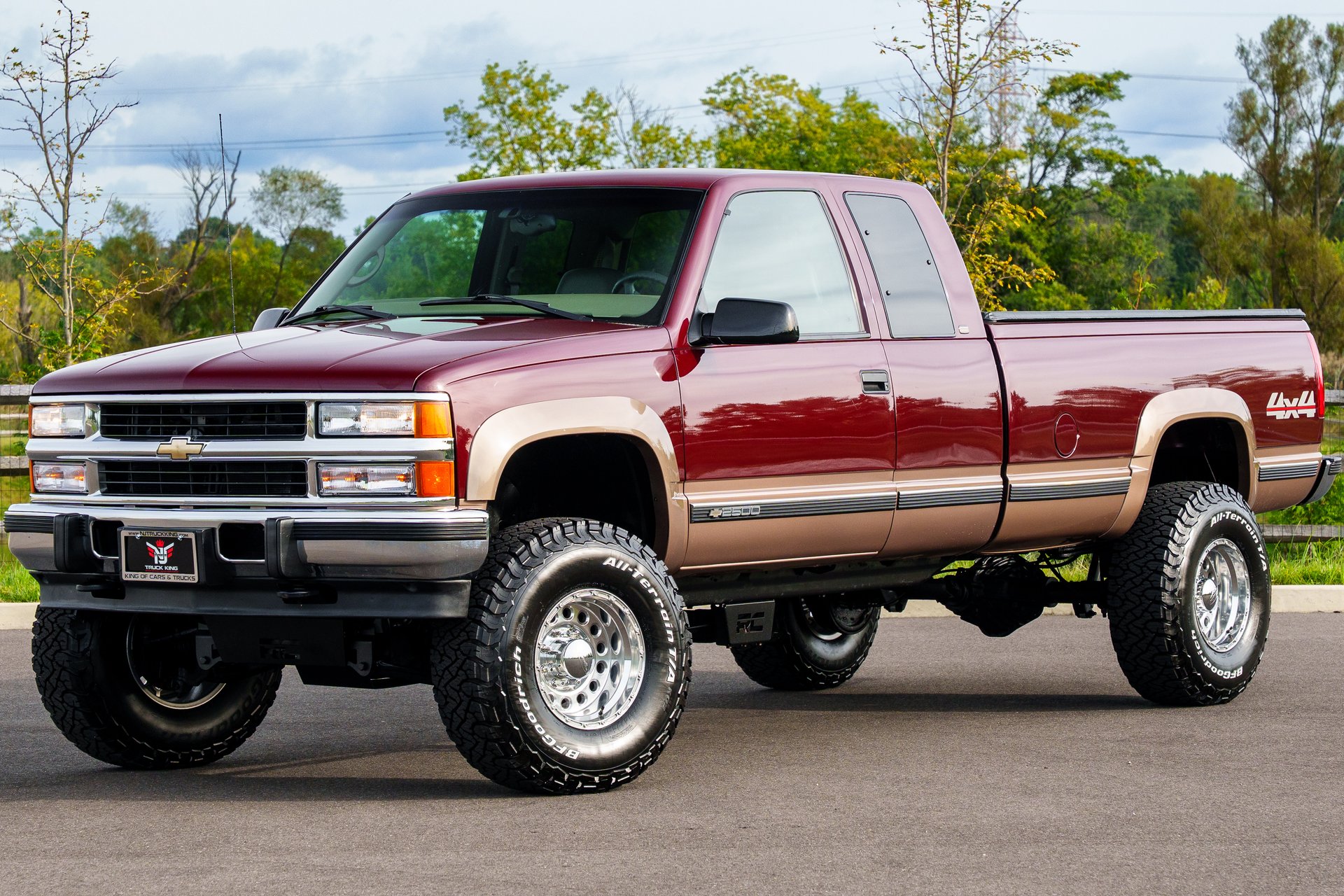
Engines and gearboxes
Three engine families powered the K2500, and the year of the truck decides which version of each you get. Learn the 1996 divide first: before it, gasoline engines breathe through throttle-body injection (TBI) — simple, low-pressure, modest power. From 1996, the Vortec programme brings sequential port injection (and, on the small-block, the CSFI "spider" system described below), higher compression and roller cams, worth roughly 20 percent more power from the same castings. A 1995 and a 1996 truck with "the 5.7" are not the same purchase.
The small-block V8s: 5.0 and 5.7 litres
The default K2500 engine is the Chevrolet small-block in 5.7-litre (350 cu in) form — RPO L05 in TBI years, rated around 200–210 hp, and RPO L31 Vortec 5700 from 1996, rated at 255 hp and 330 lb-ft. The 5.0-litre (305, RPO L03/L30) appears in light-duty trucks; it is adequate unladen and breathless towing — if your use involves a trailer, treat a 5.0 truck as a light-duty runabout and price it accordingly. The small-block's virtues are the ones that built its legend: a deep-skirt iron block, cheap and available everything, and a tolerance for indifferent maintenance that no modern engine matches. A looked-after L31 is a 250,000-mile engine; a neglected one still usually runs, which is precisely why you must test rather than trust.
Small-block specifics: TBI versus Vortec
The TBI engines (1988–1995) meter fuel from two injectors in a throttle body at about 9–13 psi. There is almost nothing to go wrong that a pressure gauge and a $40 injector cannot fix, and the failure signatures are gentle: a lazy cold start from a tired fuel pump, a surge from a worn throttle-body shaft, a rich smell from a leaking injector O-ring. The Vortec engines are stronger and more particular. The L31's CSFI system hides a central injector and six poppet valves inside the intake manifold, fed at 55–62 psi; the poppets clog with age and deposit build-up, producing the classic Vortec misfire that moves between cylinders and defies plug-and-wire diagnosis. The cure — a converted multi-port (MPFI) spider assembly — is a known, finite job, covered in Problem areas. Vortec intake-manifold gaskets are the family's other signature: the plastic carrier gaskets crack and weep coolant externally at the front corners or internally into the valley, and Dex-Cool coolant left in service for decades accelerates the damage. Budget for both jobs on any Vortec truck without paperwork for them, and the engine becomes what it should be: the best gasoline choice in the range.
The big-block: 7.4 litres
The 454 cu in big-block — RPO L19 in TBI form (about 230 hp, 385 lb-ft) and RPO L29 Vortec 7400 from 1996 (290 hp, 410 lb-ft) — is the tow engine, and it transforms the truck. Where the 5.7 works hard on a grade with 7,000 lb behind it, the 7.4 simply leans on its torque and holds the gear. The costs are fuel — expect single figures towing, low teens unladen on a good day — and heat: the big-block fills the engine bay, works its cooling system hard and cooks exhaust manifolds and plug leads. L29s crack exhaust manifolds and snap manifold bolts; listen for the ticking of an exhaust leak on a cold start that fades as the manifold expands and seals. The TBI 454 is softer but simpler and nearly indestructible. A big-block HD with the 4L80-E is the heaviest-duty gasoline combination GM sold in this platform, and the market knows it.
The diesel: 6.2 and 6.5 litres
The diesel option is the Detroit Diesel V8 built for GM: the naturally aspirated 6.2-litre (RPO LH6/LD3 family) in early trucks and the 6.5-litre (RPO L49 naturally aspirated, L56 and L65 turbocharged) that replaced it from 1994. The turbo 6.5 makes about 190 hp and 385–430 lb-ft depending on year and duty rating — on paper a match for the big-block, in practice a slower, thriftier engine that suits steady towing and long distances rather than hills at speed. Understand what this engine is: an indirect-injection, mechanically simple diesel designed for economy and longevity in military and fleet service, not a Duramax ancestor and not a powerhouse. Its ownership proposition is fuel economy in the high teens and a bottom end that outlasts the truck — conditional on its two notorious systems, the electronic injection pump driver and the cooling system, both dealt with at length in Problem areas. The mechanical-pump early 6.5 and the 6.2 are simpler and slower. If you do not specifically want a diesel, the gasoline trucks are cheaper to buy, cheaper to fix and easier to sell; if you do want one, buy the best-documented turbo truck you can find and no other.
Axle ratios, differentials and what they do to the truck
The gearbox is only half the gearing story. K2500 rear axles were most commonly geared 3.73:1 or 4.10:1 (the RPO sticker carries the code — GT4 for 3.73, GT5 for 4.10 in most years), and the ratio changes the truck's character as much as an engine swap: a 4.10 truck tows a grade two gears happier and cruises a few hundred rpm busier, a 3.73 truck is the relaxed highway and economy choice and the one that feels flat with a heavy trailer. Front and rear ratios must match in a 4x4, and a truck that binds or fights itself in 4WD on a loose surface may be wearing a mismatched replacement axle from a previous repair — the RPO codes for both ends and a slow loose-surface test settle it. The G80 Gov-Lok, covered again in Problem areas, is a genuine asset off-road and in snow when it works and a liability when it has been shock-loaded; a standard open differential is the honest, predictable alternative and no disgrace in a truck used on roads. Finally, tyre size is gearing: the lifted, oversized-tyre trucks in the pool have effectively taller gearing than their axle codes promise, with a speedometer and odometer that under-read to match — correct any "low mileage" claim on a long-lifted truck by the size of its tyres and the length of time it has worn them.
Gearboxes and the four-wheel-drive system
Automatics dominate, and the duty split applies again. Light-duty trucks use the 700R4 (later 4L60) and from 1993 the electronically controlled 4L60-E — a car-derived four-speed that is smooth and adequate in a light truck but the weak link when a light-duty 2500 is towed hard; heat is its enemy and a transmission cooler and fluid history matter more than mileage. Heavy-duty trucks use the 4L80-E, a genuinely truck-grade four-speed derived from the Turbo 400 lineage, which tolerates big-block and diesel torque indefinitely with fluid changes; a 4L80-E failure is usually a neglected 250,000-mile event, not a design flaw. Manuals are rare and desirable to the right buyer: the light-duty NV3500 five-speed and the heavy NV4500 five-speed — a cast-iron, granny-low truck gearbox whose fifth-gear nut issue on some applications and worn synchronisers on second and third are its known checks; a notchy NV4500 that baulks second when cold is telling you its oil or its synchros need money.
The transfer case is a New Process/New Venture chain-drive unit: the NP241 with a floor lever in most trucks, the push-button NP243 in later higher-trim cars, and the NP246 AutoTrac — with its automatic 4WD mode and clutch pack — in the final years. All offer 2HI, 4HI and 4LO with a low range around 2.72:1. The front drive is GM's Insta-Trac system: the front differential disconnects via an actuator on the axle — thermal (gas-expansion) on early trucks, notoriously slow to engage on a cold morning, and electric on later ones. A truck that will not engage 4WD on your test is usually the actuator, a cheap part — but "usually" is doing heavy lifting in that sentence, so test engagement before the negotiation, not after. Front suspension is independent: upper and lower control arms, torsion bars adjustable for ride height, and an anti-roll bar. There is no front differential "pumpkin" to drag on ruts, but there are CV joints, idler and pitman arms and ball joints that wear as a set — the front end of a high-mile K2500 is a system rebuild, not a single part, and Problem areas prices it as one.

Problem areas
Every K2500 is now at least a quarter-century old, and the problems below are not possibilities — they are the standard inventory of age, ordered by the systems that decide whether a truck is a purchase or a project. In the site's own photo-checked sample for this model the evidence base is small — 2 trucks photo-checked, with rust mentioned in 1 of the 2 and damage mentioned in 1 of the 2 — so treat those figures as a reminder to look, not as incidence rates, and lean on the inspection routine that follows this section.
Rust and the frame: the map
The GMT400 body resists rot better than the square-body it replaced and worse than anything modern. Work the map in this order. Cab corners and rocker panels go first — the cab corner traps mud thrown from the rear wheel behind a seam you cannot see from outside, so press the corner from inside the wheel arch and look for filler dust lines in the paint above it. The bottoms of the doors and the extended-cab rear side panels bubble from the inside out. The bed floor rusts where it sits on its cross-sills, worst above the fuel tank and at the front panel; a bed liner hides all of it, so a truck photographed only with a liner fitted is a truck whose bed you have not seen. Wheel-arch lips on the bed sides and front fenders are cosmetic until the inner arch separates. The frame itself is strong box-and-channel steel and rarely perforates except in salt-belt trucks, where the rear section around the spring hangers and the fuel-tank crossmember thins first — tap it with a small hammer or screwdriver handle along its length; a ring is steel, a thud is scale over nothing. Brake and fuel lines along the left frame rail are a consumable in the salt belt and a bargaining point everywhere: a full line set in stainless is a few hundred dollars in parts and a long weekend, and a truck that pops a rusted brake line on your test drive has just told you its maintenance standard. Fuel-tank straps and the tank's own top surface rot unseen. Budget honestly: cab corners and rockers welded properly run roughly $800–2,000 a side painted, a bed floor is usually a replacement bed at $500–1,500 used plus paint, and frame perforation at the hangers is the point at which a work truck becomes a parts truck.
Fuel and injection: TBI, the Vortec spider and the pumps
More K2500s are misdiagnosed here than anywhere else, because three different systems share the symptom "runs badly." On a TBI truck, start with fuel pressure: the in-tank pump should hold 9–13 psi, and a pump dying by degrees gives you a truck that idles, cruises and then leans out and surges under load or on a hot restart. The test is a gauge teed into the feed line, not a parts cannon. On a Vortec truck, learn the CSFI signature: a random or cylinder-specific misfire, worse hot, with good plugs and leads, fuel pressure at the rail in the 55–62 psi range but dropping quickly at key-off — that is the poppet spider and its pressure regulator leaking inside the manifold. The definitive fix is the MPFI conversion spider, roughly $300–500 in parts plus the manifold-off labour (plan $700–1,200 fitted), after which the fault does not return. Do not let a seller sell you a "tune-up" as the cure for a spider misfire; the plugs are downstream of the fault. Vortec intake gaskets, covered in the engine section, present as a slow coolant loss with no puddle, a sweet smell at the front corners of the manifold, or coolant in the oil — check the filler cap for emulsion and the dipstick for a rising, milky level. Across all years, the in-tank fuel pump is a 150,000-mile consumable whose replacement means dropping the tank or lifting the bed; a pump that whines loudly through the bed floor is auditioning for the job. Fuel filler necks rust and leak on fill-up. None of this is exotic — but all of it is leverage, because each fault is cheap to verify and expensive-sounding to the unprepared.
The 6.5 diesel's two systems: PMD and cooling
If you are looking at a 6.5, two systems decide the purchase. The first is the Stanadyne DS4 electronic injection pump and its Pump Mounted Driver — the PMD, also called the FSD — a transistor module bolted to the pump in the hottest part of the valley, where it heat-soaks and fails with a signature as reliable as any in diesel ownership: stalling at idle or in traffic, surging, a no-hot-restart that recovers when the engine cools, sometimes a fishbite hesitation at cruise. The pump itself is usually innocent; the driver is cooking. The established cure is a remote-mounted PMD on a heat sink, relocated to the bumper or inner fender on an extension harness — a $250–450 kit and an hour's work — and a truck already fitted with a remote PMD by a knowledgeable owner is worth more, not less, for the modification. A truck that stalls on your test drive and whose seller calls it "a diesel thing" is a truck with a known bill attached; price the kit and the diagnosis, and walk if it also shows cooling symptoms. Those are the second system: the 6.5 runs hot towing by design margins that shrink as radiators silt, fan clutches soften and thermostats age. Overheating a 6.5 cracks heads and blows head gaskets at the rear cylinders, and the repair — heads off, crack-testing, possibly a replacement engine at $4,000–7,000 fitted — exceeds the value of most trucks. On test, watch the gauge on a long grade with load if you can arrange it; at minimum, demand a long fast run, then idle and watch for the gauge climbing, coolant pushing to the overflow, or bubbles in the reservoir with the cap off (a combustion-gas test kit confirms head-gasket failure in minutes for about $40 in fluid). Harmonic balancer and crank pulley rubber deteriorate and, ignored, contribute to crankshaft failure on high-milers — inspect the rubber ring for cracks and wobble at idle. Glow-plug systems and the controller are routine consumables; a 6.5 that needs ether to start in mild weather has glow or compression problems, and ether itself damages these engines.
Four-wheel drive, steering and the front end
The IFS front end wears as a system and must be budgeted as one. The idler arm and pitman arm develop play that shows as steering wander and a dead band at the straight-ahead; ball joints — especially the uppers — wear and, in the worst neglected cases, separate; tie-rod ends and the centre link add their own slop; CV boots split and take the joint with them once grit enters; torsion-bar mount rubbers perish. The test is in the inspection section (a helper rocking the wheel while you watch each joint), but the budgeting belongs here: a full front-end refresh — idler, pitman, tie rods, ball joints, alignment — is a $900–1,800 job at a shop, and a lifted truck like the pool's maroon 1998 accelerates every one of these wears by changing the CV and ball-joint angles, which is why lifted trucks must be cheaper, not dearer, unless the work is documented as done. Transfer cases are durable; the checks are engagement (lever or buttons, all modes, at walking pace on a loose surface), a clunk or binding on full lock in 4HI that exceeds the normal driveline wind-up, and the front actuator's delay — thermal actuators can take 30 seconds or more on a cold morning, electric ones a few seconds; no engagement at all after a minute is a fault to price, starting with the actuator at $80–200. Rear axles: the full-float 10.5-inch is close to unbreakable, the semi-float 9.5-inch wears pinion bearings and axle seals; both suffer when the G80 Gov-Lok locking differential is abused — the G80 locks by flyweight engagement under wheel-speed difference and works well, but shock-loading it on dry pavement breaks its internals, and a truck that bangs and shunts from the rear on tight turns may be showing you a dying locker. Listen, and check the RPO sticker for G80 so you know what is fitted.
Brakes, cooling and electrics
Brakes are specification-dependent and widely misunderstood. Most K2500s have front discs and rear drums with vacuum or hydroboost assistance — diesel and HD trucks use Hydroboost, driven by the power-steering pump, so a heavy pedal and heavy steering arriving together point at the pump or the booster, not at two separate faults. Rear drums wear out of adjustment and leave the fronts to do everything, cooking rotors and pads; a truck that dives and judders is often a $300 rear-brake rebuild away from decency. The ABS is the Kelsey-Hayes rear-wheel or four-wheel system of the period: it is primitive, its control valves corrode, and a hard pedal with an ABS light is commonly the valve or a wheel-speed sensor rather than the master cylinder. Brake hoses perish internally and act as one-way valves, dragging a caliper — feel for a hot wheel after the test drive. Cooling: radiators silt internally, fan clutches lose their bite (a fan you can spin freely by hand on a hot engine is done), and heater cores weep into the passenger footwell — a sweet smell and a misting windscreen with the heater on. Electrics are GMT400-simple, which means the faults are age faults: the multi-function (indicator/wiper) stalk fails its wiper functions, blower resistors burn out leaving only top speed, the fuel-gauge sender lies, grounds at the frame and engine corrode into intermittent everything, and the alternator's rear bearing whines before it fails. The dashboard itself cracks in sun states and the 1995-on interior door handles and window regulators are consumables. None of this stops a purchase; all of it, added up, is the difference between the asking price and the real one.
Myths to leave at the gate
Three myths follow this model around and each one costs buyers money. The first: "every 2500 is a heavy-duty truck." It is not — the six-lug light-duty in The models is a strengthened half-ton, and paying an eight-lug price for a six-lug truck is the commonest K2500 overpayment there is; the lugs, the GVWR sticker and the RPO codes settle it in a minute. The second: "the 4x4 has a solid front axle like the old trucks." No GMT400 K-truck does — the independent front suspension is the platform's defining feature, and a seller describing a solid-axle swap is describing major surgery whose quality you must judge as a one-off build, not as a factory truck. The third: "the diesel is a Duramax." The 6.5 predates the Duramax by a decade, shares nothing with it, and must be judged by its own PMD-and-cooling rules — sellers borrow the later engine's reputation precisely because the 6.5's own is mixed. Price the truck in front of you, by its own systems, and all three myths lose their power.
Interior, body hardware and the worked-truck audit
Finally, audit the truck's working life, because a K2500's mechanical condition is usually just its biography made visible. A gooseneck or fifth-wheel ball in the bed, a brake-controller under the dash and a worn receiver hitch tell you it has towed heavy — not a disqualification (it is what the HD was built for), but it moves the transmission, rear axle and cooling system to the top of your inspection list. Plough mounts on the front frame mean winter salt and low-speed strain. A utility body or evidence of one means fleet life: high idle hours, multiple drivers, maintenance by schedule rather than by love. Check the hour evidence — seat bolsters collapsed, pedal rubbers worn smooth, steering-wheel rim polished — against the odometer, because instrument clusters swap in minutes on these trucks and a "low-mile" truck with a worn-out cab is a story, not a bargain. The VIN plate at the windscreen base, the door-jamb label and the glovebox RPO sticker should all agree; where they do not, the glovebox sticker and the VIN decide, and a truck whose identity needs explaining is a truck to leave for someone else.

How to inspect one
Inspect in this order — identity before cosmetics, cold before warm, static before driving — and take the tools named: a torch, a magnet wrapped in cloth, a small hammer, a tyre gauge, a code reader for 1996-on trucks, and a friend to work the steering while you watch.
- Identity first. Match the windscreen VIN to the door label and the title. Open the glovebox and photograph the RPO sticker: confirm the engine code (L05/L31 small-block, L19/L29 big-block, L56/L65 diesel), the transmission code, the axle ratio and G80 if listed, and the GVWR. Count the wheel lugs — six is light-duty, eight is heavy — and check the truck in front of you is the truck the codes describe.
- Cold engine, bonnet up. You want the engine stone cold; a pre-warmed truck is hiding start, smoke or stall behaviour. Check oil level and colour, coolant level and condition (rusty or oily coolant is a walk-away conversation), brake fluid, power-steering fluid, and the harmonic-balancer rubber on a diesel.
- Start it and listen. A gasoline truck should settle to a clean idle; a Vortec with a wandering misfire is showing you the spider (see Problem areas). A diesel should start on its glow plugs without ether, smoke briefly and clear; blue smoke that persists is oil, white smoke that persists is fuel or coolant, and either needs a price attached.
- The rust map, underneath. Torch and hammer along the frame, spring hangers, cab corners, rockers, bed cross-sills and brake lines, exactly as the rust section maps them. Ten minutes here is worth more than an hour of test drive.
- Front-end play test. With the engine running and your friend rocking the steering wheel gently either side of centre, watch the idler arm, pitman arm, tie-rod ends and centre link for movement that arrives late — play anywhere is a system bill (see Problem areas), not a single joint.
- Jack the front and spin. Rock each front wheel top-and-bottom for ball-joint and bearing play, side-to-side for steering play. Inspect CV boots for splits and grease spray, and the front differential for pinion and axle-seal leaks.
- Engage four-wheel drive. On gravel or dirt, select 4HI and 4LO (lever or buttons), drive slowly, and feel for engagement within seconds on an electric actuator — allow a cold thermal actuator longer, but not forever. Wind the steering to full lock in 4HI: mild binding is normal wind-up; violent banging is not.
- Road test — transmission. From cold, note every shift. A 4L60-E or 4L80-E should shift cleanly without flare or thump; test kickdown, overdrive engagement and torque-converter lock-up at a steady 50–55 mph (a light surging at lock-up speed can be converter shudder — or a Vortec misfire imitating it, which is why step 3 comes first). In a manual, work second and third hard; baulking and grinding are synchro wear, priced, not excused.
- Road test — brakes and steering. Brake firmly from 50 mph: the truck should stop straight, without judder (cooked fronts or dead rear drums — see Problem areas) and without a sinking pedal. Note steering wander at cruise — the front-end test's verdict, confirmed at speed. Feel each front wheel afterwards for the heat of a dragging caliper.
- Work it. If the seller permits, find a grade and hold a steady climb watching temperature — essential on a 6.5 diesel, valuable on a big-block. Listen for the big-block's cold exhaust tick and the diesel's idle evenness. At the top, idle for two minutes and watch the gauge.
- Electrics and cab. Every window, the blower on all speeds, wipers, lights, gauges (does the fuel gauge agree with the seller's story?), air conditioning if fitted, and the heater — misting glass and a sweet smell mean a heater core. Check the extended-cab third door, if fitted, opens and seals.
- Paperwork and the second look. Service history that names the big jobs — intake gaskets and spider on a Vortec, PMD relocation on a 6.5, transmission fluid changes, front-end work — is worth real money; its absence on a high-miler is a discount, not a mystery. Then walk around once more in silence and look at the truck as the sum of its evidence: identity, rust, front end, injection and cooling decide a K2500, and everything else is negotiation.

Values
The K2500 market is a condition market wearing a badge market's clothes, and the computed listings block beneath this guide — the live asks and recorded sales for this model — will teach you more if you read it with the following structure in mind. The spread between the cheapest and dearest K2500 is enormous, and almost none of it is explained by year or mileage. It is explained by the three things this guide has drilled: duty class, rust and documented mechanical sorting. An eight-lug HD with a clean frame and paperwork for its known jobs sits in a different market from a six-lug truck with cab-corner filler, even at identical odometer readings — because the first truck's next five years are servicing, and the second truck's are surgery.
Learn to separate asking from achieved. K2500s are advertised by three kinds of seller: dealers presenting cleaned, photographed trucks at retail asks; private owners who price from the dearest dealer advert they can find; and working sellers — farms, fleets, estates — pricing a tool to move. The first two asks are aspirations; recorded sales, including the auction results in the block below, are the market. Work trucks with honest wear sell close to ask because the buyer pool for a usable three-quarter-ton is deep and practical. Presentable late trucks — Vortec, extended or crew cab, clean colours, no rust — attract the nostalgia buyer as well as the practical one, and that second pool is what has been lifting the top of this market: a sorted 1996–2000 truck is now bought partly as a classic, and priced accordingly at auction, where two bidders who both had one new can carry a clean crew cab well past its utility value.
Variant premiums are consistent. The heavy-duty eight-lug outsells the light-duty at equal condition, the big-block and the turbo diesel each command their following (the diesel premium is real but narrow — it exists only among diesel buyers, and a 6.5 with cooling or PMD questions loses it entirely), the crew cab carries the strongest body premium, and the NV4500 manual brings a small, fierce premium from buyers who will accept no automatic. Modifications subtract more often than they add: a lift like the pool maroon truck's narrows the buyer pool to those who wanted exactly that lift, and the truck's value to everyone else is the stock value minus the cost of the front-end wear the lift accelerated. The project-versus-driver gap is the widest in the truck world: a non-running or rusty K2500 is worth its engine, axles and title to a part-out buyer, while a driving, stopping, sorted truck is worth its utility to everyone — the distance between those two numbers is several multiples, and the cost of crossing it (rust repair, front end, injection sorting, tyres, brakes) is itemised in the problem-areas section so you can check a seller's "just needs a little work" against real job prices. Negotiate from the inspection list, item by item, with costs attached; K2500 sellers respect a buyer who has plainly done the arithmetic.
Parts and ownership
Ownership is the K2500's strongest suit, and it is not close. GM built the GMT400 in vast numbers for thirteen years, the aftermarket adopted it completely, and the result is a truck for which you can buy almost anything — service parts, trim, glass, panels, complete interiors — from multiple suppliers, usually next-day, at prices set by competition rather than scarcity. Mechanical parts are shared across the C/K range, the Suburban and Tahoe and period vans, so a water pump, alternator or axle bearing is a stock item at any parts counter in North America. The Vortec spider conversion, the 6.5's remote PMD kit, stainless brake-line sets, cab-corner and rocker repair panels, and every bushing and joint in the front end are catalogue items with fitting instructions a competent home mechanic can follow; the factory service manuals are reproduced and the model's enthusiast knowledge base is deep and searchable.
Running costs are those of a big, simple truck. Fuel is the headline: a 5.7 returns economy in the low-to-mid teens unladen and single figures to low teens towing; the 7.4 is thirstier everywhere; the 6.5 diesel is the economy choice, capable of the high teens driven gently. Budget tyres in load-range E sizes for the HD — a set costs meaningfully more than car tyres and cheap no-name load-rated tyres are a false economy on a truck that tows. Servicing is conventional: engine oil and filter every 3,000–5,000 miles in hard use, automatic-transmission fluid and filter every 30,000–50,000 miles (sooner and with an auxiliary cooler if you tow — heat is the 4L60-E's whole story), transfer-case and differential oils on a similar cycle, coolant kept fresh and correct because the Vortec intake gaskets and the 6.5's margins both depend on it. Insurance is ordinary classic-or-utility money depending on how you register and use it, and the trucks are simple enough that an agreed-value policy on a genuinely clean late example is easy to justify with photographs and the sales evidence below.
The ownership traps are few and known. If you tow — and most K2500s earn their keep towing — set the truck up as a system rather than trusting the hitch: a weight-distributing hitch for trailers at the heavier end, a properly adjusted electric brake controller, a transmission temperature gauge on an automatic, and cooling margins checked before the first long grade rather than discovered on it. The HD's ratings are genuine but they are period ratings, assessed by period standards; a K2500 at its maximum combined weight is working hard in a way a modern truck at the same weight is not, and driving it accordingly — lower gears held on descents, cooling watched on climbs — is the difference between a tow rig that lasts and one that cooks its transmission in a single summer. Rust protection is an annual ritual in salt country — wash the underside, treat the cab corners and frame, and a sound truck stays sound. A truck that sits unused deteriorates faster than one that works: seals dry, poppets clog, brake lines rot from the inside, so buy a truck in use over a truck in storage at equal appearance. And keep the paperwork file you inherit and extend it — on these trucks, documented sorting is a bankable asset at resale, as the Values section explains.
Which one to buy
- The all-rounder: a 1996–2000 heavy-duty extended cab with the L31 Vortec 5.7 and 4L80-E — the strongest balance of power, economy, parts support and resale, and the specification most of the surviving pool, including the listings below, is built around.
- The tow buy: an eight-lug HD with the L29 Vortec 7.4 big-block, bought on cooling-system and manifold evidence and accepted with its fuel bills — nothing else in the range pulls a heavy trailer as untroubled.
- The economy buy: a turbocharged 6.5 diesel with a remote-mounted PMD already fitted and a cooling system with paperwork — bought only with the diesel inspection in this guide completed in full.
- The value buy: a clean light-duty six-lug truck for runabout and light-trailer work, priced honestly against the HDs it is not — the market discounts it for a capability many buyers never use.
- The manual buy: an NV4500 five-speed HD, in either gasoline form, for the buyer who tows and prefers to choose the gear — check second and third synchros cold and pay the small premium for a good one.
- The collector buy: a 1999–2000 crew cab HD, unlifted and unrusted, bought as much as an appreciating classic as a truck — the rarest body on the strongest chassis, and the hardest to replace once sold.
The overriding rule: buy the frame, the duty class and the paperwork — in that order — and let the engine, the trim and the colour choose themselves afterwards; a rust-free, correctly identified, documented K2500 is the cheap truck at almost any asking price, and a rusty one is the expensive truck at almost any discount.
See the 5 K2500 Fleetside cars currently listed.
For sale now
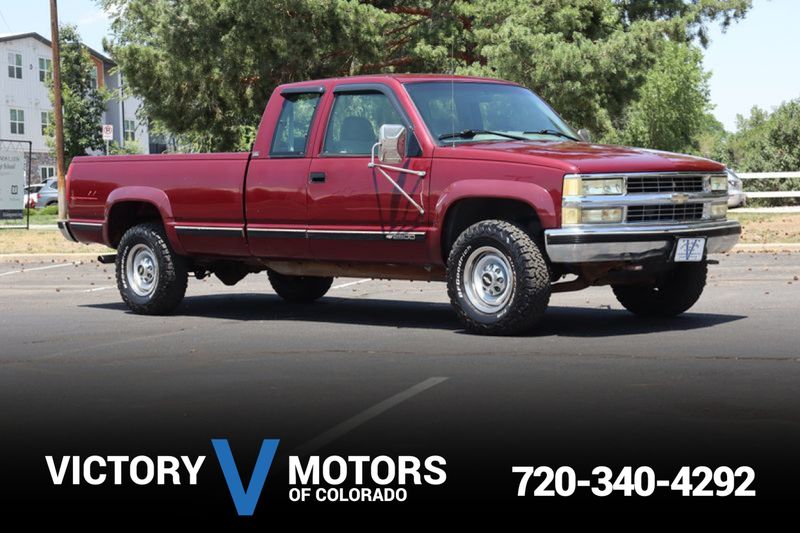 $14,999 · 18% below typical
Expand
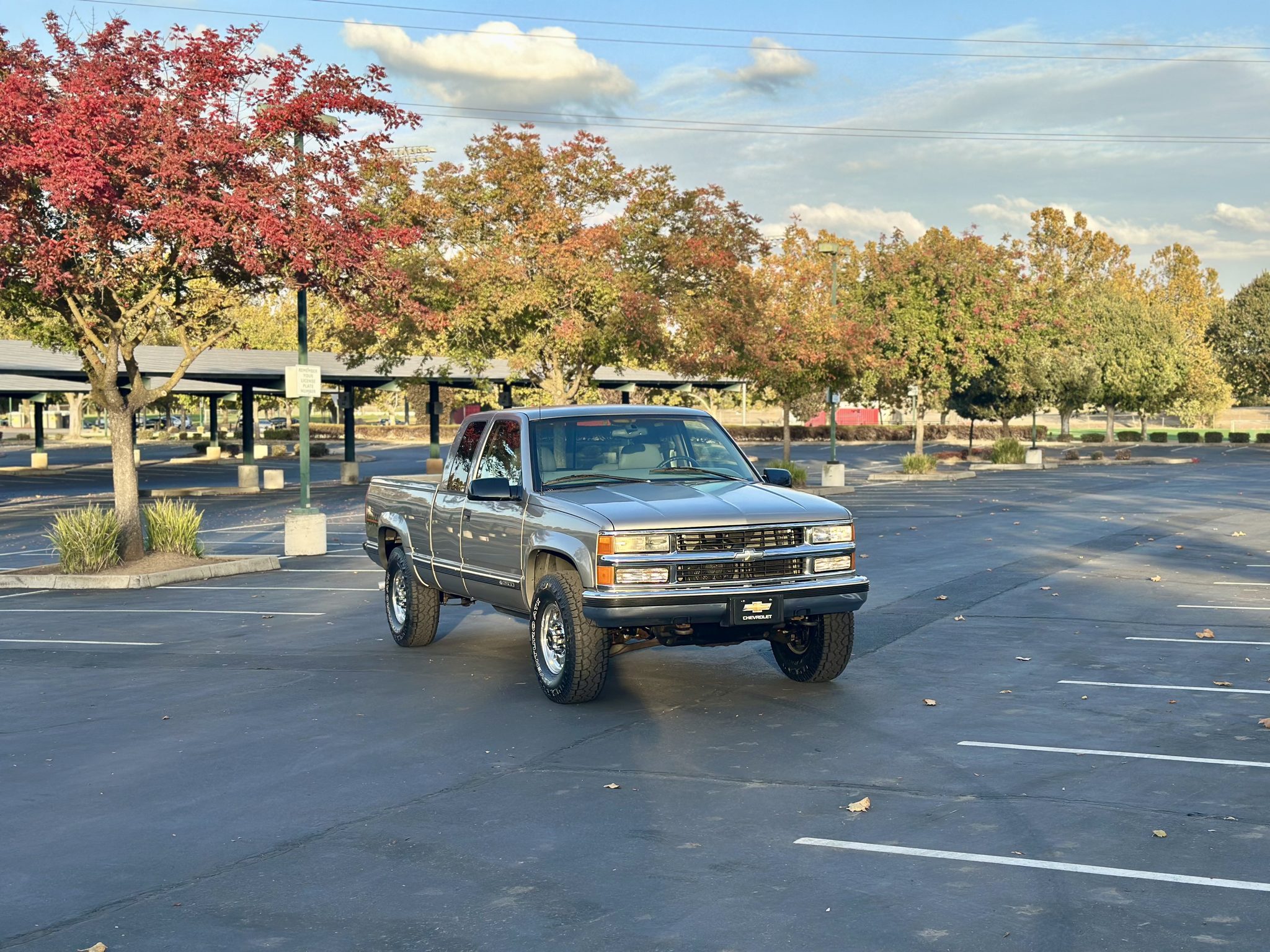 Current bid $8,000
Expand
What they sell for: K2500 Fleetside sale prices.