
Chevrolet Superior K buyer's guide
Chevrolet Superior K -- the model's own buyer's guide: variants, values and what to check.
Years listed: 1925-1925 · Series: Superior
# Chevrolet Superior — Buying Guide
Overview and history
The Chevrolet Superior is the car that turned Chevrolet from Ford's ambitious pursuer into Ford's genuine rival, and you need to understand that job — cheap, conventional, mass-produced transport — before you can judge the car standing in front of you. Chevrolet launched the Superior in January 1923 as a single-model range, replacing the old 490 and the larger FA and FB series at a stroke: for four years the Superior was Chevrolet, in open tourers and roadsters, closed coupés and sedans, and light commercials on the same 103-inch wheelbase. That one-model policy, run at enormous volume, is why the car matters, and why buying one today is an exercise in sorting — hundreds of thousands were built, they were worked hard by first, second and fifth owners, and the survivors divide sharply between cherished restorations, honest old cars never quite worn out, and assembled cars whose parts have not all lived the same life.
The name changed its letter every year, and the letter is the first identity check you learn. The 1923 car is the Series B, the 1924 car the Series F, the 1925 car the Series K and the 1926 car the Series V, introduced in mid-1926 and sold into the early part of the 1927 season before the Series AA Capitol replaced the whole line. The progression is evolutionary rather than dramatic: the same overhead-valve four-cylinder engine, the same basic chassis and the same Fisher-built bodies, improved in detail year by year — a disc clutch and a new banjo rear axle for the K, a belt-driven generator and a headlamp tie-bar for the V. That continuity is good news for an owner, because knowledge and many parts carry across the four years, and bad news for a buyer, because a car can wear the radiator, wheels or trim of a neighbouring year and look entirely plausible while doing it. The serial number, not the styling, settles the year.
What Chevrolet was selling against Ford was modernity at a Model T price point: a conventional three-speed sliding-gear transmission with a floor lever and a proper clutch pedal, where the Ford still asked you to learn its planetary two-pedal system; an overhead-valve engine — "valve-in-head" was the proud advertising phrase — where the Ford's four was a side-valve; electric starting and lighting as ordinary equipment; and closed Fisher bodies with winding glass windows at prices that made a closed car realistic for a family that would previously have bought an open tourer or nothing. Nothing on the car is exotic, everything is a deliberate step beyond the cheapest practice of its day, and its engineering rewards an owner who maintains it as a machine rather than polishing it as an ornament.
That governs the whole purchase. A Superior's lubrication, cooling, braking and electrical systems all assume an owner who checks, oils, greases and adjusts as routine — the car was designed for a world in which the driver was also the mechanic's assistant. Bought by someone willing to live that way, a sound Superior is one of the most usable and best-supported American cars of its period. Bought as a turn-key classic by someone expecting a modern car's indifference to neglect, the same car will disappoint within a month. This guide assumes you are the first kind of buyer, and concentrates on what separates a car you can drive home and improve from one whose restoration economics never close: identity, engine health, the wood beneath the steel skin, the rear-only brakes, and the paper trail that proves which of its hundred years were kind ones.
The two cars currently recorded on this site — a 1925 Series K open tourer and a 1926 closed car — are a snapshot of a thin corner of the market, not the market itself: Superior trading happens at least as much through clubs, auctions and word of mouth as through general listings.

The models
There is one Superior, in four yearly series, and the differences between them are matters of detail and desirability rather than of kind. Every car shares the 103-inch wheelbase, the 171-cubic-inch overhead-valve four, the three-speed gearbox and rear-wheel brakes only. What changes year to year is the clutch, the rear axle, the ignition and charging equipment, the radiator styling, the wheel equipment and the body catalogue — and those changes matter in two practical ways. First, they are your dating evidence: a car described as a 1925 K should have the K's disc clutch and banjo axle, and if it has the earlier cone clutch and bevel axle it is an earlier car or a rebuilt one, and the price conversation changes accordingly. Second, they divide the ownership experience: the later cars are mechanically the most developed and easiest to live with; the earliest are the most purely vintage in feel and the most demanding in their details.
| Model | Years | Engine | Output | Built | Character |
|---|---|---|---|---|---|
| Superior Series B | 1923 | 171 cu in OHV four | 26 hp at 2,000 rpm | 415,814 (1923 calendar production, all Chevrolets) | The original: cone clutch, bevel-gear axle, the car that replaced the 490 |
| Superior Series F | 1924 | 171 cu in OHV four | 26 hp at 2,000 rpm | 262,100 (1924) | Near-identical to the B; new closed body styles join the range |
| Superior Series K | 1925 | 171 cu in OHV four | 26 hp at 2,000 rpm | 444,671 (1925) | The developed car: disc clutch, banjo axle, new radiator, the "Chevrolet hum" engineered out |
| Superior Series V | 1926 | 171 cu in OHV four | 26 hp at 2,000 rpm | 547,724 (1926) | The final form: belt-driven generator, headlamp tie-bar, sold into early 1927 |
Treat the production figures in that table with respect and suspicion both. They are the commonly published calendar-year totals for Chevrolet production — in a one-model era effectively Superior production, cars and light commercials together — and they establish the essential truth, which is scale: this was one of the best-selling cars in the world, and no Superior is rare in production terms, whatever a seller claims. Survival is another matter: open cars sold in smaller proportion as the decade turned to closed motoring, commercials were worked to death, and it is survival — of a body style, of originality, of a documented history — that carries any premium.
Series B (1923). The first Superior is a facelifted, rationalised descendant of the 490, and it drives like one: cone clutch, bevel-gear rear axle whose characteristic whine owners learned to live with, wood artillery wheels, and a body catalogue split between open cars — roadster and five-passenger tourer — and the closed coupé and sedan already becoming the range's centre of gravity. Fisher built the bodies throughout the Superior's life, and the closed/open distinction still matters: a closed car gives you winding glass and weather protection a tourer with side curtains cannot match, on a wood-framed structure whose condition is the single largest cost variable on the car. Buy a B for its purity, and accept that its clutch and axle are the least developed versions of both.
Series F (1924). The F is the B continued, introduced for the 1924 model year in August 1923 — an early example of the annual model-year rhythm that became General Motors doctrine — with slightly larger non-skid tyres and an expanded body catalogue that added a two-door coach and a four-passenger coupé and dropped the sedanette. Mechanically it is the same car: spend no time hunting for F-specific features, because there are effectively none; spend it on the same clutch, axle and wood questions you would ask of a B, and on confirming by serial number that the car is the year claimed, since nothing in its appearance will tell you.
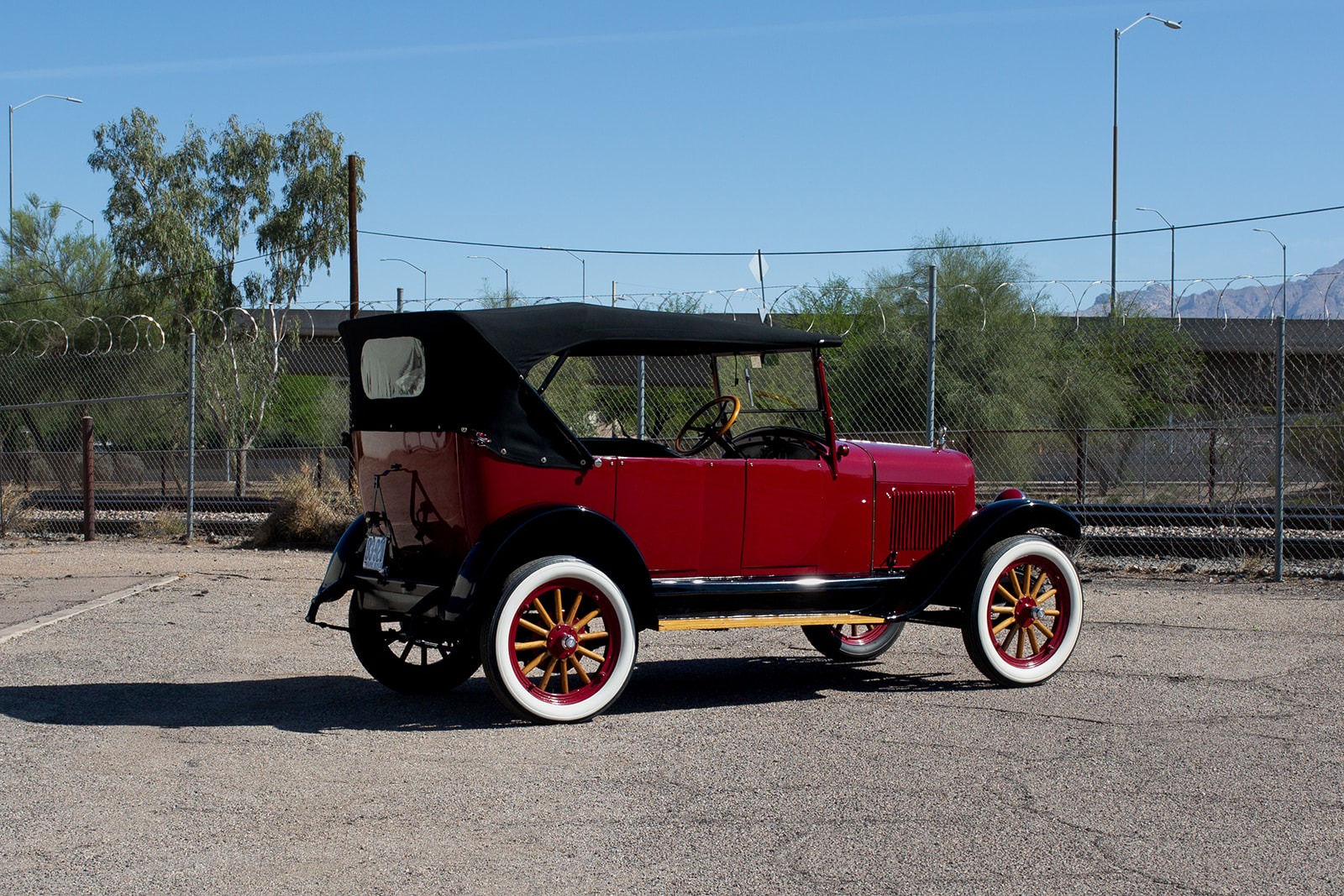
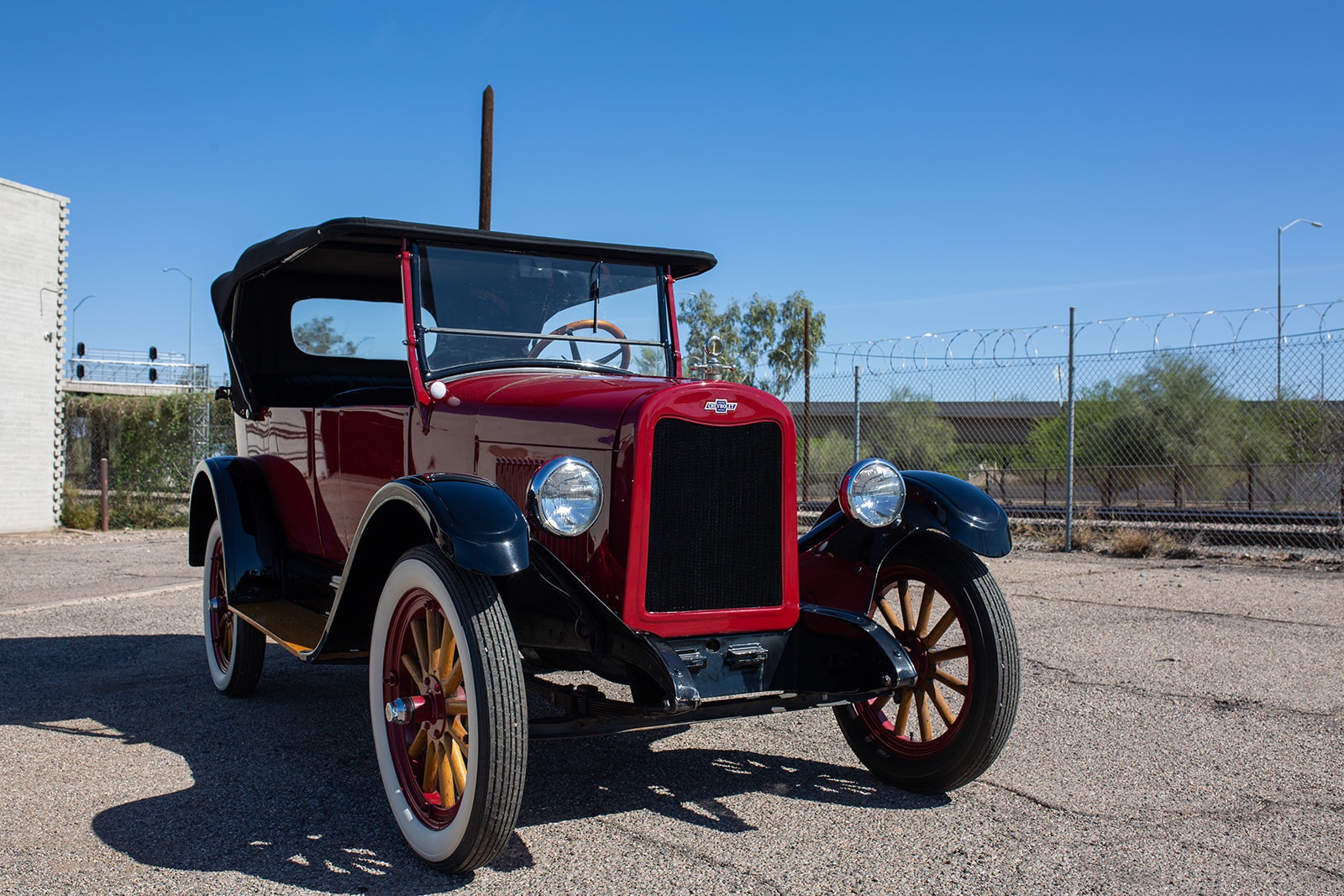
Series K (1925). The K is the step change, and for many buyers the sweet spot of the range. Introduced in January 1925, it wears a new radiator whose nickel shell curves down at the centre, and beneath the skin it is substantially reworked: a new block casting with revised crankshaft and connecting rods, a single-plate dry disc clutch in place of the cone, and a banjo-type rear axle in a carrier on a torque tube that finally eliminated the bevel axle's hum. Closed cars gained ventilating windscreens and a cadet-style sun visor; bumpers, an outside mirror, a heater and a clock were options; cars built after 1 August 1925 have a walnut-effect steering-wheel rim and a new Klaxon horn — small details, but exactly the dated evidence that helps verify a car's claimed originality. Wood-spoke wheels remained standard at first, with pressed-steel discs adopted on closed cars during the run. A K tourer on wooden artillery wheels, like the red 1925 car pictured here, is the period image of the model; a K closed car on discs is the more practical proposition.
Series V (1926). The V, arriving mid-1926, is the K refined once more: a belt-driven generator in place of the earlier drive arrangement, revised tyre equipment, and the headlamp tie-bar that is its quickest visual signature. Production peaked and the range was at its most complete. As a purchase, a V gives you the most developed version of everything this guide discusses — and, because it was sold into early 1927, the greatest need to check the serial number rather than the registration year: a V first registered in 1927 is not a Capitol and should never be priced, or excused, as one.
Across all four series, body style shapes your ownership. Open cars — tourer and roadster — are the most charismatic, the lightest and the most exposed: to weather on the road and to wood deterioration in storage, because an open body flexes more and seals less. Closed cars are heavier, quieter, more usable in a modern calendar of events, and more dependent on their roof timbers and door pillars. The coupé sits between: closed-car weather protection on a shorter, stiffer body. Commercial derivatives on the same chassis are a separate discipline with their own survival scarcity; judge one by the same mechanical rules, plus a hard look at a chassis that has carried loads for a century.
Engines and gearboxes
The 171 four: design and what it means at the kerb
Every Superior is powered by the same fundamental engine: a 171-cubic-inch (2.8-litre) inline four of 3 11/16-inch bore by 4-inch stroke, rated at 26 brake horsepower at 2,000 rpm and 21.75 hp in the old NACC taxable rating quoted in period literature. It is a cast-iron engine with a detachable crossflow cylinder head and overhead valves worked by exposed pushrods — the "valve-in-head" layout Chevrolet advertised relentlessly, because in a market of side-valve Fords it was a genuine distinction: better breathing than a flathead of the same size, and a head its owner could decarbonise, grind valves in and re-gasket on a bench, at home, with hand tools. A century later that serviceability is the engine's defining ownership trait: there is no part of a Superior four that a competent vintage mechanic cannot reach, measure and rebuild.
The bottom end runs a three-main-bearing crankshaft, asked to flex between widely spaced supports — which is why these engines dislike sustained high revs and why a worn one announces itself with a low, heavy knock under load. Lubrication combines pressure feed to the main bearings with splash for much of the rest; the V's specification lists a cam-operated oil pump, and on earlier cars the generator drive is entangled with the oil pump drive, so on an early car an oil-pressure complaint and a charging complaint can be the same complaint wearing two hats. Oil capacity is small, filtration in the modern sense does not exist, and the whole philosophy assumes short change intervals. If the car in front of you has been run on modern extended intervals, price in a thorough internal inspection.
Valve gear is solid lifters with adjustment at the rockers, and it is meant to be audible as all correctly set solid-lifter engines are: a light, even ticking is health; a single loud clack is one loose tappet; a general roar of clatter is a valve train untouched for years. Compression is low — in the region of four-and-a-half to one — so worn rings or a leaking valve cost you a larger share of your modest 26 horsepower than they would on a modern engine. A healthy Superior pulls to 40–45 mph without drama and cruises in the mid-30s; a car that struggles to hold 30 mph on the flat is down on compression, timing, mixture or all three, and the inspection section gives you the order in which to find out which.
Cooling is by water pump through a tall, high-capacity radiator — a major structural and functional component, not a styling panel — and these engines run unpressurised or near it, so the system assumes you check the water level as routinely as the fuel. Ignition is by coil and distributor with contact points, supplied first by Remy and later by Delco-Remy — the changeover falls within the K's run, so ignition equipment that contradicts a car's claimed year joins the list of stories the serial number must settle. The electrical system is six-volt, starting is electric with a hand crank retained as the honest backup it always was, and an engine that starts readily on the crank, ignition retarded, is an engine whose timing and mixture are fundamentally right; sellers of good cars are rarely shy of demonstrating it.
The 171 four: early cars against late cars
The engine's development across the four series is concentrated in 1925, and you should know it because it affects both what you buy and what you can fit. The B and F engines are the original design: original block casting, original crankshaft and connecting rods, and the cone-clutch flywheel arrangement behind them. The K introduced a new block casting encompassing a new crank and rods — "encompassing" is the operative word, because internal parts interchange between early and late engines is not the free-for-all that the shared displacement suggests. When you assess a car, or a spare engine offered with it, establish which generation the block belongs to before you value the spares package: a spare crank that does not fit the engine in the car is ballast, not insurance. The V continued the K's engine with its revised charging drive — the belt-driven generator — which decouples the generator from the earlier drive arrangement and makes the V's engine bay the simplest of the four to keep in charging health.
Carburation throughout is a single Carter updraft carburettor of single-choke form — period literature and the Standard Catalog agree on Carter as the fitment. An updraft instrument lives beneath its manifold, drinks from a vacuum tank on the bulkhead feeding by gravity, and behaves accordingly: simple, rebuildable and tolerant of wear up to a point, but vaporising poorly when cold and flooding readily when its float needle wears. Half the "carburettor faults" you will meet are vacuum-tank faults upstream of a healthy carburettor, and the problem areas separate them properly. What matters here is identity: a car wearing a later downdraft conversion or a non-Carter instrument has been modified — possibly a sensible improvement, but not originality, and it should be priced as the former.
No other engine was offered: there is no six-cylinder, V8 or high-output Superior, and a car presented with any of those claims is a later transplant or a misunderstanding, valued as a modified car either way. Judge a seller's "strong engine" by cold starting, oil pressure behaviour, even running and the compression test — never by a blast down the road at speeds the brakes were never designed to arrest.
Gearboxes, clutches and the rear axle
The transmission is a three-speed sliding-mesh gearbox, central floor lever, conventional H-pattern, no synchromesh on any gear — a box you drive with technique: clutch fully down, a pause as the gears settle, a firm, unhurried lever movement, and double-declutching on downward changes if you want them quiet. A healthy box is not silent, but it selects every gear cleanly, stays in gear under load, and does not leap out of top on the overrun, the classic symptom of worn selector and tooth engagement. A gearbox run low on its heavy gear oil wears its layshaft bearings first and tells you with a rattle at idle in neutral that disappears when you press the clutch — a ten-second kerbside test that separates layshaft wear from engine noises.
The clutch is where the series divide. B and F cars have a cone clutch: a leather-faced cone engaging a matching face in the flywheel, a design that is smooth when its leather is supple and correctly dressed and fierce, juddering or slipping when the leather dries, glazes or soaks up oil. Cone clutches are maintainable — the leather can be cleaned, dressed and ultimately replaced — but the skill is a vintage specialist's skill now, and a slipping cone on a B is a specialist bill, typically $600–$1,200 to reface and set up properly, not a Saturday job for a modern clutch shop. The K replaced it with a single-plate dry disc clutch of recognisably modern pattern, and the V kept it: parts are easier, behaviour is more familiar, and adjustment is by linkage and free play at the pedal in the ordinary way. Whichever clutch the car has, test it the same way: it should take up drive progressively from rest without judder, hold full throttle in top gear up a gradient without the revs rising ahead of the road speed, and release fully enough that first and reverse engage at a standstill without a crunch that a pause cannot prevent.
Drive passes by shaft inside a torque tube on the later cars to the rear axle, and the axle is the other 1925 divide. The early bevel-gear axle earned the car the "Chevrolet hum" — a gear whine that was a running joke in period and a genuine refinement fault. The K's banjo-type axle, its crown wheel and pinion carried in a detachable carrier, eliminated the hum and is the stronger, quieter and more serviceable unit: hypoid-style quietness is not on offer in either, but a K or V axle in health hums only faintly and evenly, while a worn one drones in proportion to road speed and changes its note between drive and overrun, which is your roadside diagnosis for pinion bearing wear or lost preload. The axle is semi-floating, so the half-shafts carry the car's weight as well as its drive — a bent or cracked shaft is a safety item, not a noise item — and axle oil level and condition deserve the same discipline as the gearbox. Brakes, finally, belong to the chassis story rather than this one, but note here that they are external contracting band brakes on the rear wheels only, mechanically operated: the gearbox and clutch you have just assessed are also, through engine braking, a genuine part of how this car slows down, and a car that will not hold a gear is a car with even less retardation than the designer intended.

Problem areas
Body structure: the wood beneath the steel
Start where the money is. A Superior's Fisher body is a composite structure in the original sense: a hardwood frame — pillars, rails, sills, roof timbers — skinned in steel panels nailed, screwed and folded over the wood. The steel rusts in the ordinary places: wing bottoms where they trap dirt against the running boards, lower door and body edges where water sits in the fold, valances, floor edges, cowl sides and panel seams. Rust there is visible, negotiable and repairable by any competent vintage panel man, and a history of wing and valance repair is normal life on a car this age, not a scandal. Budget $800–$2,000 a side for proper sill and lower-body welding, and distrust only the repairs you cannot see: filler over rot has the same silhouette as steel for about two summers.
The wood is the different and larger problem, because it fails invisibly and its failure presents as something else. Rot starts where water is trapped: door pillar bottoms, body sills inside the steel skin, roof and cant rails on closed cars where a perished roof covering has let water in for a decade, windscreen-frame timber, floor bearers. As the wood softens, the body loses its geometry: doors drop and catch their latches, panel gaps wander, the windscreen frame goes out of square and the glass cracks "for no reason", and an open tourer's unbraced tub flexes over bumps a sound car absorbs. None of these symptoms mentions wood, and every one is wood until proven otherwise. The tests are physical: press an awl — with the seller's permission — into accessible timber at pillar bases, sill ends and door bottoms; sound hardwood resists and squeaks, rotten wood accepts the point like cake. Rock each door and watch the pillar, not the door: movement in the pillar is structural. A full re-wood of a closed body is an $8,000–$20,000 coachbuilding proposition before paint; localised timber repairs are a $1,500–$4,000 job. That spread, wider than on any mechanical system on the car, is why this section comes first and why a shiny car with dropping doors is dear at any price.
Chassis rust is usually kinder: the frame is a pressed-steel ladder of generous section, and surface corrosion is the norm. Hunt instead for perforation at the spring hangers, crossmember ends and running-board brackets, and for accident damage — a bent-and-pulled chassis shows in uneven wing fit and a car that crabs, one rear wheel tracking outside the front's line as it drives away from you. A cracked rail near a hanger is weldable ($400–$900) but is also evidence of a hard life that should make you look longer at everything else.
Engine: wear, lubrication and cooling
The 171 four fails slowly and audibly, and almost every failure mode has a test. Wear in the main bearings and big ends gives the deep knock under load described earlier; distinguish it from piston slap by temperature — slap is worst cold and fades as the pistons expand, bearing knock is worst hot, under load, on thin oil. An engine quiet cold and knocking hot is telling you its bearings and its oil are both tired, and a bottom-end rebuild — crank grind, bearings, rebore if needed, pistons and rings — runs $3,500–$6,500 at a vintage engine shop, with the caveat that early and late crankshafts and rods are not freely interchangeable, so the shop must know which generation of engine it has before ordering anything.
Oil pressure and oil consumption are the two numbers that summarise the engine. There is no modern gallery of warning data: you watch the pressure indication the car provides, you watch the exhaust, and you measure consumption over the test drive and by asking the seller the direct question — how much oil does it use between changes, and what is the honest answer in miles per quart? A quart in a few hundred miles with blue smoke on the overrun points at valve guides and stem seals in the overhead-valve head; blue smoke under power points at rings and bores; smoke at start-up that clears points at oil draining down the guides overnight. Each has a different bill: a head overhaul with guides, valves refaced or replaced and the head skimmed runs $800–$1,800 off the car; rings and a hone, with the engine in the frame, is possible on this design and cheaper than a full rebuild, but it is money spent on an engine whose bearings you have not measured. The compression test in the inspection section exists to make this decision with numbers rather than smoke patterns.
Overhead-valve gear wears at the rocker faces, pushrod ends and valve guides, and it is neglected because adjustment is easy to postpone. Run the engine with the rocker cover off — a two-minute job — and you should see oil reaching the valve gear and every rocker moving through a similar arc; a rocker that barely moves has a worn cam lobe or a bent pushrod behind it. Oil absent from the top end warns that passages are sludged, the recurring theme of these engines in modern ownership: decades of short runs and long storage fill the sump and oilways with deposit. The cure is mechanical cleaning during other work and short-interval changes thereafter; the symptom to fear is pressure held cold and lost hot as thin oil escapes past worn bearings — that is wear, not sludge, and no oil change fixes it.
Cooling faults masquerade as engine faults. The radiator core chokes with a century of scale and solder bloom; the car then runs hot on hills, boils after a stop as heat soaks, and gets diagnosed as a head gasket. Test the gasket properly — bubbles in the header tank at a fast idle, coolant pressurising stone cold, mayonnaise under the filler from combustion moisture — before condemning it, because a radiator recore at $600–$1,200 cures the majority of "overheating" Superiors, while a head gasket at $300–$600 in parts and labour cures only the minority that actually have one. The water pump leaks at its gland in the ordinary vintage way and is repackable; a pump that has been sealed with modern sealant instead is a pump you will be replacing. Hoses, fan belt and the fan itself are consumables: a fan blade with a crack at its root is a blade that will come through the bonnet, and you look for the crack with the engine stopped and your fingers, not at 2,000 rpm.
Fuel, ignition and electrics
Fuel supply is a chain — tank, vacuum tank, carburettor — and the weak link is the middle one. The vacuum tank on the bulkhead uses manifold vacuum to lift fuel from the rear tank, then feeds the Carter by gravity. When its internal valves and cork or leather seals age, the symptoms are infuriatingly intermittent: the car runs perfectly until a long hill or a hot day asks for sustained fuel, then starves, dies, and restarts happily after a pause while the tank refills. Owners blame the carburettor for decades. The distinguishing test is a temporary gravity feed from a test can, safely rigged, directly to the carburettor: if the starvation vanishes, the vacuum tank is condemned, and its overhaul with a proper seal kit runs $150–$400 and an afternoon. The carburettor itself wears at the throttle spindle — air leaks there give an idle that will not settle and a mixture screw that seems to do nothing — and floods when its float needle wears. A Carter rebuild with a quality kit is $250–$600 including labour; a worn spindle body needs specialist bushing, and a car that idles sweetly is usually advertising that someone has already done this work.
Ignition faults on a points system are honest faults: pitted points, a tired condenser, a distributor shaft with side play that lets the points gap wander, advance weights seized so the timing is right at one speed and wrong at all others. The symptoms are misfires under load, kicking back on the starter when the timing is over-advanced, and a flat, unwilling engine when it is retarded or the advance is stuck. All of it is diagnosable with a strobe, a feeler gauge and a dwell meter, and all of it is cheap — $100–$300 in parts — compared with the engine work it gets mistaken for. Remember the equipment change: Remy ignition on the earlier cars, Delco-Remy later, with the change falling in the K's run. A car whose distributor and generator are a mismatched mixture from several decades is not automatically a bad car, but it is a car whose electrical history is improvisation, and you should budget to put it back to one correct system.
The six-volt system is the model's standing ownership lesson: double the current for the same power means voltage drop is the enemy, and every corroded earth strap and undersized modern cable steals cranking speed. A Superior that cranks slowly is rarely suffering a dying starter — clean and remake the earths, fit cables of proper heavy gauge, confirm a healthy six-volt battery, and the same starter spins smartly; budget $150–$350 to go through the high-current circuit properly. The generator charges modestly and is regulated crudely; an ammeter showing discharge at cruising speed with the lamps on is telling the truth about a system that was marginal when new, and the fix is generator and regulator attention ($300–$700 rebuilt and fitted), not a bigger battery to hide behind. Lighting is period lighting, and a reason in itself to plan Superior journeys in daylight.
Transmission, axle, brakes, steering and running gear
Gearbox wear shows as the cluster of symptoms the engines section armed you to test: jumping out of gear under load or on the overrun, a layshaft rattle at idle that the clutch pedal silences, and selection that crunches however patiently you change. Internal parts for these boxes survive in the specialist trade and in the club spares economy, but a gearbox rebuild is a $1,200–$2,500 proposition with the box out, and the box comes out with the torque tube and axle disturbed on later cars, so labour follows the familiar vintage pattern of the small job that opens three larger ones. The cone clutch on B and F cars adds its own ledger: leather dried hard gives a take-up like a switch, leather contaminated with oil from a leaking rear main seal gives slip that no adjustment cures, and the correct sequence is always to fix the oil leak and the leather together. The disc clutch of the K and V wears like any early disc clutch — driven plate, pressure surfaces, release bearing — and its parts story is the easier one.
Rear axle faults divide into noise and danger. Noise — the drone that follows road speed and changes between drive and overrun — is crown wheel and pinion wear or lost pinion preload, and on the K and V banjo axle the carrier design makes a specialist rebuild a practical $900–$1,800 job. Danger is the semi-floating half-shaft carrying wheel and load on the same shaft: check for play in the shaft and its bearing, and for oil leaking past the hub seal onto the brake — which brings you to the system's real centre of gravity. The brakes act on the rear wheels only, by external contracting bands, mechanically linked. In perfect adjustment, on a dry road, driven with anticipation, they stop the car in the manner of 1925; in any lesser state they are the weakest system on the car, and the one your inspection must be most ruthless about. Worn, oil-contaminated or unevenly adjusted bands give long pedal travel, pulling to one side, and a handbrake — acting on the same brakes — that will not hold the car on a slope. Relining and setting up runs $400–$900; freeing seized linkage is time more than money. Four-wheel-brake conversions exist, but a converted car is a modified car and a car you plan to convert is a project: price both as such. A Superior's brakes are adequate for the speeds its engine sustains, provided both are in full health and the driver drives the pair as a system.
Steering and front suspension are simple, exposed and entirely dependent on grease and adjustment. The steering box wears at its worm and sector: an inch or two of free play at the rim is wear you can live with while you schedule work; a quarter-turn is a box needing a rebuild ($500–$1,100) and a car that wanders meanwhile. Kingpins and bushes wear and let the wheels lean and shimmy; steering joints develop play that a helper rocking the wheel while you watch each joint finds in minutes. Leaf springs sag and occasionally crack a leaf at the centre bolt. Wood artillery wheels demand their own inspection — loose, shrunken or split spokes, felloes working at the rim, hub bolts run loose until their holes oval — and a wheelwright's overhaul runs $300–$700 a wheel; steel disc wheels trade that romance for simple truth: straight, uncracked at the bolt holes and true, or scrap. Tyres are tall, narrow and available from the vintage specialists at $900–$1,800 a set fitted, and age, not tread, condemns them: a Superior on fifteen-year-old tyres with full tread is a car that has not been driven, shod in rubber that should not be driven on either.
How to inspect one
Inspect a Superior in this order, and do not let a personable seller rearrange it. The order runs from identity to structure to machinery to manners, because each stage can end the purchase cheaply, and the stages that end it most often — the wrong year, the rotten wood — cost nothing but attention to discover.
- Identity before everything. Find the serial number — on the plate and stampings at the dash/cowl area and seat frame on these cars — and read it against the title and the series claimed. The series letter must match the year: B for 1923, F for 1924, K for 1925, V for 1926. Then cross-check the hardware against the letter using the models section: cone clutch and bevel axle belong to the early cars, disc clutch and banjo axle to the K and V, belt-driven generator to the V alone. A car whose hardware contradicts its papers is not necessarily dishonest — engines and axles were swapped in period — but it is a parts-car story at a matching-numbers price until the seller proves otherwise.
- The wood test, while the car is cold and the seller is fresh. Work the door pillars, sill ends, door bottoms and any accessible roof timber with the awl test from the problem areas, rock each door and watch its pillar, and sight down both flanks. On a closed car, look up inside the roof edges for water staining. Wood condition sets the ceiling on what this car can be worth; establish it before you fall for the engine's idle.
- Panels, paint and chassis. Magnet and knuckle along the wing edges, door bottoms and valances for filler over rot; check panel gaps for the wander that means the frame beneath has moved; then get underneath — a torch, a ramp or a lift — for the frame rails, spring hangers and crossmembers. Perforation at a hanger matters; surface rust does not.
- Cold start, from stone cold, arranged in advance. A car presented warm has had its first test taken for you. From cold, watch the starting drill: choke behaviour, cranking speed on the six-volt starter, how readily it fires, and the exhaust in the first minute. Blue smoke that clears is guides; smoke that stays is deeper. An engine that will also start on the hand crank, ignition properly retarded, is an engine whose basics are right — ask for the demonstration.
- Oil and water, before and after. Check the oil's level, colour and smell on the dipstick before starting and the coolant level in the radiator header. After the drive you will repeat both: oil turned milky or coolant lost without a visible leak reopens the head-gasket question from the cooling section, and this time you ask it with evidence.
- Compression test, plugs out, throttle open. On a low-compression four the absolute numbers matter less than the spread: you want four cylinders within about ten per cent of each other. One low cylinder gets a wet test — a teaspoon of oil down the bore — to separate rings (reading rises) from valves (reading stays), because the problem areas priced those two jobs very differently.
- Running checks at the kerb. Rocker cover off for a moment: oil reaching the valve gear, every rocker moving alike. Listen for the knock that comes with heat and load, the layshaft rattle that the clutch pedal silences, and the single loud tappet among the even ticking. Watch the ammeter at a fast idle with the lamps on.
- The clutch and gearbox road test. Drive away gently for take-up judder, then full throttle in top up a gradient for slip. Work through every gear with the double-declutch technique the box expects, and lift off sharply in top to see whether it stays in gear on the overrun. A box that jumps out has told you its price; believe it.
- Axle and brakes, tested as one system. At a steady 30 mph, listen for the drone that changes between drive and coast. Then brake — firmly, from speed, on a quiet straight road, hands light on the wheel: the car must pull up straight, the pedal must have reserve, and the handbrake alone must hold it on the steepest slope nearby. On a rear-braked car this is the test that decides whether the car is safe to use while you improve it.
- Steering, springs and wheels. Measure free play at the rim, have a helper rock the wheel while you watch each steering joint, and bounce each corner. Examine every wooden wheel spoke by spoke — tap them, look for movement at the felloe, check hub bolts — or, on discs, for cracks at the bolt holes and a true rim. Price any tyre you cannot date as a tyre you will replace.
- Fuel system behaviour on a proper drive. Fifteen minutes minimum, including a sustained climb where the vacuum tank must work continuously. Starvation that appears under sustained demand and vanishes after a pause is the vacuum-tank signature from the problem areas; note it, price the overhaul, and do not let it be sold back to you as a carburettor mystery.
- Paperwork and the second look. Service history on a century-old car means club records, restoration invoices, old photographs and previous titles — read them for continuity of identity and for the dates of the big jobs: re-wood, engine rebuild, radiator recore. Then walk round the car once more and reconcile the whole: the best Superior you will see this year is the one whose identity, wood, engine and paperwork all tell the same story. A car where they tell four different stories is priced on the worst of them, or not bought at all.
Values
The Superior market is a club market wearing a public market's clothes, and reading it well starts with accepting that the visible listings are the minority of the trade. Cars change hands at auctions, through the vintage Chevrolet clubs, at swap meets and by introduction, often without ever being advertised generally — which means the asking prices you can see are a sample biased towards dealers, estates and optimistic private sellers, and the achieved prices in club circulation are usually the more honest guide to what a car is worth. When the market block beneath this guide shows you recorded sales, read them by body style and condition rather than as a single figure for "a Superior", because on this model the spread between conditions is not a percentage adjustment. It is the whole story.
Condition drives everything, and on a Superior condition has a specific meaning: it is the state of the wood frame first, the mechanical rebuild history second, and the paint and brightwork a distant third. A car with sound original or properly renewed timber, a rebuilt engine with invoices, and tired cosmetics is worth substantially more than a gleaming car on rotten pillars, because the gleaming car's next owner is buying a coachbuilding bill that exceeds the mechanical car's entire refurbishment. Learn to invert the usual classic-car instinct — shine is cheap on a car whose panels are simple and whose trim is nickel and paint; structure is dear — and the asking prices begin to sort themselves into sense. Project cars price accordingly: an incomplete or long-dead Superior is worth its identity, its body style and its reusable major components, and not a dollar more, because the restoration of a wood-framed vintage car consumes money at coachbuilder's rates regardless of how cheaply the project was bought. The project-versus-driver gap is consequently enormous — wider than on almost any steel-bodied classic — and the middle ground, the car that runs and drives but needs its wood attended to locally, is where the informed buyer finds the value the market's shine-led pricing leaves behind.
Variant premiums are real but modest, and they follow survival and charm rather than production rarity. Open cars — tourers especially — carry a premium over closed sedans of equivalent condition because fewer survive in good order and because the open car is the period image of 1920s motoring. The 1925 K and 1926 V carry a small, rational premium over the B and F for their disc clutch, banjo axle and general development: it is the one premium in this market grounded in engineering rather than sentiment, and it is worth paying. Commercial derivatives are the exception that proves the survival rule — scarce because they were consumed by work, valued by a small and dedicated audience, and priced very much car by car. Originality premiums behave as they do everywhere in the vintage world: an unrestored car with honest wear, its original engine and a continuous history will outrun a better-looking restoration of mixed parentage, and documentation is the currency the premium is paid in.
Negotiation on a Superior is usually a conversation about deferred work, so arrive with this guide's numbers in your head: the re-wood range, the engine rebuild range, the brake and clutch costs. A seller who has priced a car as finished, on a car whose doors drop and whose clutch slips, is pricing the car he thinks he has, and the respectful, itemised case for the car he actually has is the negotiation. Equally, a sound car fairly priced in a thin market is not improved by being bid at project money: the pool of good Superiors is small, sellers often know exactly what they have, and losing the right car over a point of pride costs years of looking for another.
Parts and ownership
Ownership of a Superior is an apprenticeship you serve willingly. The car was built in the hundreds of thousands, the vintage Chevrolet community is one of the oldest organised in the hobby, and the specialist trade — four-cylinder-era parts suppliers, engine shops that know the 171 by heart, wheelwrights, coachbuilders and trim shops working in period materials — is established and reachable. Mechanical consumables are the easy layer: ignition parts, carburettor kits, disc-clutch components, brake band material, bearings, gaskets and seals are all obtainable, many reproduced, none at prices that frighten anyone used to European classics. The factory literature exists in reprint — the 1925–1926 shop manual covering the Superior is readily available — and you should own it before you own the car, because half of ownership is adjustment and the manual gives you the factory's figures rather than folklore's.
The harder layers are the ones this guide has already flagged. Timber work needs a coachbuilder who understands wood-framed construction, and those craftsmen are booked in months, not days. Cone-clutch relining is a specialist within a specialism. Wooden wheel work belongs to a wheelwright. None of this is unobtainable; all of it is scheduled, which is why the standing advice is to buy the car whose big crafts are already done and to keep a rolling list of the small ones. Used parts circulate through the clubs and swap meets in useful quantity — remember, though, the interchange traps: early and late engines differ internally, Remy and Delco-Remy electrics belong to different chapters of the car's life, and a part that fits a 1928 Capitol four is not thereby a Superior part. Buy spares against your car's series letter and serial range, not against the word "Chevrolet" and a hopeful photograph.
Running costs are dominated by your own time and by consumables rather than parts prices. Oil is changed in hundreds of miles, not thousands; grease points want regular attention; tappets, points, clutch free play and brake adjustment are recurring appointments you keep yourself with the manual open. Budget a few hundred dollars a year in fluids, ignition consumables and incidentals, plus a reserve for the age items that arrive unscheduled: a vacuum-tank overhaul, a radiator recore, a set of tyres. Fuel is ordinary modern petrol, which the low-compression engine accepts philosophically; many owners add an in-line filter ahead of the vacuum tank. Storage matters more than mileage: a dry building is a preservation measure for the wood frame in a way it never is for an all-steel car, and a Superior kept damp is being consumed by its storage even while it is being saved from the road.
The community is the final part of the ownership case, and a strong one. The vintage Chevrolet clubs hold a century of accumulated knowledge of these engines — which clearances work, which reproduction part is the good one, which machinist knows the crank — and they are also, as the values section noted, a market in themselves. Join before you buy if you can: the car you want may well be found through the club, and the advice there was earned on the same model by people who still drive them.
Which one to buy
- The all-rounder: a 1925 Series K closed car — sedan or coach, on disc wheels if you find one so equipped. You get the developed engine internals, disc clutch, banjo axle and closed-car usability in one package, at the point where every lesson of the model's life had been learned.
- The final form: a 1926 Series V — any sound body style, verified by serial number rather than registration year. The belt-driven generator makes it the easiest Superior to keep in electrical health, and production peaked, so the spares pool is deepest.
- The period charmer: a Series K tourer — the red 1925 open car in this guide is the template. Buy it for summer motoring and the full vintage experience, and buy it on its wood above all: an open body has no roof to brace it, so its tub timbers are its character and its condition in one.
- The purist's choice: a 1923 Series B or 1924 Series F — for the buyer who wants the first of the line and accepts the cone clutch and humming bevel axle as the price of authenticity. Budget for the clutch as a specialist item from day one, and value a documented, unmodified car above a restored one.
- The value buy: the honest middle car — a K or V that runs, drives and stops, needing localised wood repairs rather than a re-wood, priced by a seller who has mistaken tired cosmetics for low value. This is the car the shine-led market underprices and the informed buyer drives for a decade.
- The one to walk away from: the gleaming car with dropping doors — fresh paint over soft pillars, whatever its series or price. Its restoration bill is a coachbuilder's, and it begins the moment the trim comes off.
The overriding rule: buy the wood, then the identity, then the engine — in that order. A Superior with sound timber, a serial number that matches its series letter and hardware, and a tired engine is a good car at the right price, because engines are rebuilt every week. A Superior with rotten timber is a restoration project at any price, and no shine, story or discount changes what it is.
See the 1 Superior K cars currently listed.
What they sell for: Superior K sale prices.