Chrysler Airflow buyer's guide
Chrysler Airflow (1934–1937) — Airflow: what's listed, and what they sell for.
Years: 1934–1937 · Models: Airflow
# Chrysler Airflow (1934–1937) — Buyer's Guide
Overview and history
You are not buying a styling exercise. You are buying the most serious attempt any American manufacturer made in the 1930s to redesign the car from the wind backwards — and you need to understand both halves of that sentence, the engineering and the commercial wreck that followed, because they explain everything about the car in front of you: why it drives the way it does, why so much of it is unlike any other pre-war Chrysler, and why the supply of good cars is so thin.
The Airflow comes out of Chrysler's Highland Park engineering department in the late 1920s. Carl Breer, working with Fred Zeder and Owen Skelton — the team colleagues call the Three Musketeers — watches birds and aircraft, builds a small wind tunnel, and takes advice associated with Orville Wright's circle. The famous early finding is real: a conventional 1920s sedan, with its upright grille, separate lamps, flat windscreen and abrupt vertical back, makes less drag travelling backwards than forwards.
What reaches the New York show in January 1934 is therefore not a normal car with a rounded nose pasted on. The engine sits forward, over the front axle instead of behind it. The whole passenger compartment moves forward with it, so you and your rear passengers sit inside the wheelbase rather than over the rear axle.
Chrysler sells the car in four eight-cylinder series on four wheelbases for 1934, three of them carrying the Imperial name, and DeSoto — Chrysler's junior division — sells nothing but Airflows in 1934, a six-cylinder car on a shorter wheelbase. That DeSoto decision is the gamble that hurts most. Chrysler hedges, keeping conventional cars in the showroom; DeSoto does not, and when the Airflow stumbles, DeSoto has nothing else to sell until the hastily prepared Airstream arrives for 1935.
And it does stumble, immediately — which brings you to the myth you must unlearn. The schoolbook version says the Airflow fails because buyers hate streamlining. That is at best a third of the story, and on its own it is wrong. Lincoln's Zephyr, launched for 1936 with streamlining every bit as committed, sells strongly. What kills the Airflow's first season is lateness and launch quality. The car is shown in January, orders pile up, and production does not peak until May, by which time impatient buyers have cancelled or bought elsewhere. Worse, the first few thousand cars leave the factory with serious defects born of welding operations the plants have not yet mastered. Fred Breer, Carl Breer's son, later records the most quoted failure plainly: engines on early cars break loose from their mountings at speed.
From there the story is a managed retreat, conducted with real dignity. Raymond LeBaron Dietrich restyles the nose for 1935, 1936 and again for 1937, each year squarer and more conventional, each year closer to the Airstream cars outselling the Airflow several times over in the same showrooms. A bolt-on trunk replaces the smooth tail for 1936, an all-steel roof insert replaces the fabric panel, and trim is trimmed. DeSoto drops its Airflow after 1936. Chrysler builds one last series, the C-17, for 1937, and stops that autumn.
The legacy matters to you as a buyer for a practical reason, not just a sentimental one. Almost everything the modern car takes for granted is visible here in early, inspectable form: aerodynamic development in a wind tunnel rather than by eye, unitary construction, weight distribution treated as a ride and handling tool, an automatic overdrive, and an interior designed around crash behaviour. That is why museums exhibit these cars and why the historical literature on them is so unusually deep for a commercial failure. A well-documented Airflow sits in a recognised place in automotive history, and that recognition underwrites the club support, the published knowledge and the long-term interest that make owning one feasible at all.
That historical weight cuts both ways in the showroom of your mind, so settle it now: you are not buying the Airflow instead of a conventional pre-war Chrysler because it is more usable in every respect — in some respects, parts and panels above all, it is less usable. You are buying it because it is the interesting car, the engineered car, the one whose every detail has a reason you can discover. Buyers who want that, want it completely. Buyers who do not, sell within two seasons.
The models
You identify an Airflow by series code, wheelbase and year — in that order — and you distrust badges, grille swaps and seller shorthand until those three agree. Chrysler changes the codes every year, so learn the grid. Group I is the standard eight: CU for 1934, C-1 for 1935, C-9 for 1936. Group II is the Airflow Imperial Eight on the longer wheelbase: CV, then C-2, then C-10, then — for 1937 only — C-17, effectively the C-10 continued under a new code and no longer sold as an Imperial. Group III is the Custom Imperial: CX, C-3, C-11.
Body styles are simpler than the codes. You choose between a two-door coupe and four-door sedans — a plain sedan and, in the early years, a Town Sedan with the rear quarter windows blanked out — plus a two-door brougham sedan in 1934 and on the early DeSotos. There are no convertibles, no roadsters, no phaetons, ever; an open Airflow is a car cut down later in its life, and you judge it as a modified car, full stop.
The year-to-year changes you use as identity checks run as follows. A 1934 car has the purest shape: the low, sloping waterfall grille — early cars with many thin vertical bars, later 1934 production with a simplified grille of fewer bars — headlamps faired into the front wings, a fabric roof insert, no external trunk, and luggage reached from inside the car. A 1935 car has Dietrich's squared-off hood, a lighter stamped grille with stainless and die-cast trim and chrome strips running back alongside it, one-piece bumpers replacing the easily dented multi-bar originals, and revised cooling louvres.
Now the trap you must learn, because it catches a buyer every season: the Airstream is not an Airflow. From 1935 Chrysler and DeSoto both sell a conventional car called Airstream — Chrysler series C-6 and CZ, DeSoto SF and S-1 — with an upright grille, a normal chassis, the engine in the normal place and a body of entirely different structure. The names differ by two letters, the cars share showrooms and a great deal of period paperwork, and listings confuse them constantly, in both directions. The settle-it checks take thirty seconds.
| Model | Years | Engine | Output | Built | Character |
|---|---|---|---|---|---|
| CU Airflow Eight | 1934 | 299 cu in flathead eight | 122 hp | 8,389 | The volume 1934 car; purest styling, earliest build troubles |
| CV Airflow Imperial Eight | 1934 | 324 cu in flathead eight | 130 hp | 2,277 | Longer wheelbase, richer trim, the connoisseur's 1934 |
| CX Airflow Custom Imperial | 1934 | 324 cu in flathead eight | 130 hp | 106 | Semi-formal rarity on the 137.5-inch wheelbase |
| CW Airflow Custom Imperial | 1934–1936 | 385 cu in flathead eight | 150 hp | 67 in 1934; a handful to special order after | LeBaron-built flagship; the largest Chrysler of its day |
| C-1 Airflow Eight | 1935 | 324 cu in flathead eight | 115 hp | 4,914 | Dietrich facelift; bigger engine, softer tune than the CU |
| C-2 Airflow Imperial | 1935 | 324 cu in flathead eight | 130 hp | 2,571 | The sweet spot of equipment, power and availability |
| C-3 Airflow Custom Imperial | 1935 | 324 cu in flathead eight | 130 hp | 124 | Custom Imperial scarcity at slightly less than CW money |
| C-9 Airflow Eight | 1936 | 324 cu in flathead eight | 115 hp (120 hp with aluminium head) | 1,678 | Trunk and steel roof arrive; standard car now genuinely rare |
| C-10 Airflow Imperial | 1936 | 324 cu in flathead eight | 130 hp (138 hp high-compression) | 4,497 | The best seller of the late cars; the usable Imperial |
| C-11 Airflow Custom Imperial | 1936 | 324 cu in flathead eight | 130 hp (138 hp high-compression) | 74 | Seventy-four cars; buy on condition, never on choice |
| C-17 Airflow | 1937 | 324 cu in flathead eight | 130 hp (138 hp high-compression) | 4,599 | Final year, safety interior, no Imperial badge |
| DeSoto SE Airflow | 1934 | 241.5 cu in flathead six | 100 hp | about 13,900 | The best-selling single Airflow of all; DeSoto's all-in bet |
| DeSoto SG Airflow | 1935 | 241.5 cu in flathead six | 100 hp | about 6,800 | Facelifted six, now sharing the showroom with the Airstream |
| DeSoto S-2 Airflow | 1936 | 241.5 cu in flathead six | 100 hp | about 5,000 | Last DeSoto Airflow; many parts unique to this one year |
A note on those figures, because honesty here is part of the guide's job: 1934 Chrysler totals are quoted differently by different period tallies — serial ranges and factory shipment sheets do not quite agree, and you will see the year's Chrysler total given as anything from about 10,800 to about 11,300. The per-series figures in the table are the commonly quoted production totals; treat the last digit of any 1934 figure as approximate, and any seller who quotes you an exact survival count for a body style as inventing it.
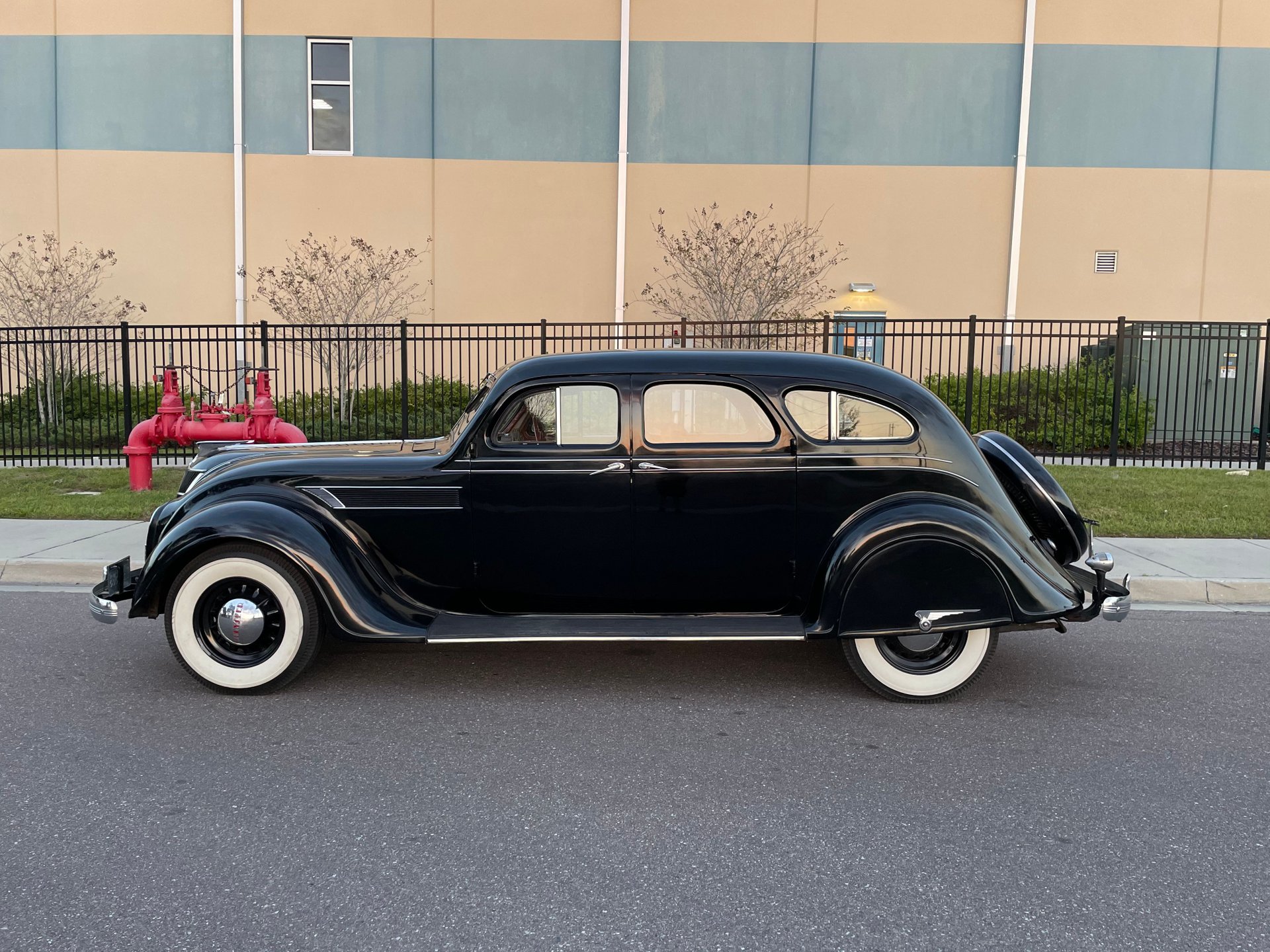
*This black 1935 Airflow, photographed in Clearwater, Florida, shows you Dietrich's first facelift doing its work: the hood is squared off, the grille stands more upright than a 1934 car's, and chrome strips run back alongside it. Learn this nose.

*The same black 1935 car from Clearwater, Florida, in profile — and the profile is the engineering. Look where the rear seat sits: well forward of the rear axle, inside the wheelbase, because the engine sits over the front axle.
Two further distinctions help you place a car quickly. The Imperial cars are not merely longer: they carry richer trim, better instruments, more lavish upholstery and, in the Custom Imperials, an almost formal separation of the rear compartment in some body styles, so check that the equipment a car claims actually matches its group — a standard car dressed with Imperial brightwork is a common and usually innocent period upgrade, but it is not an Imperial. And the Town Sedan, with its blanked rear quarters, is a genuine factory body style in the early years, not a sedan someone has filled in; its blind rear quarters are a period taste for formality, and on a DeSoto it appears only in the first two years.
Engines and gearboxes
Every Chrysler Airflow you will ever inspect has a flathead — L-head, side-valve — straight-eight under its long hood, and every DeSoto Airflow has the smaller flathead six. These are not exotic engines.
The 299 and 324 cu in eights
The 1934 CU carries the smaller eight: 298.7 cu in from a 3.25-inch bore and 4.5-inch stroke, rated at 122 hp at 3,400 rpm on a 6.5:1 compression ratio. Every other catalogued Chrysler Airflow eight, and every Chrysler Airflow from 1935 on, carries the 323.5 cu in version — the same bore with the stroke lengthened to 4.875 inches. In the standard cars, the C-1 and C-9, a single-throat Stromberg downdraught carburettor and a cast-iron head give you 115 hp; in the Imperials, a two-throat Stromberg — the EE-22 is the unit you meet on a 1935 C-2 — and an aluminium head give you 130 hp.
Understand the architecture before you judge noises. The block and crankcase are one iron casting, the head a flat slab — the combustion chamber is in the block deck, beside the bores, over the valves — and the valves sit in the block, driven by solid tappets from a camshaft in the crankcase. Valve adjustment is by tappet screw, done hot, and a car whose clearances have not been set in years tells you so with a sewing-machine clatter at idle that leaves your worry list the moment you confirm it is even across all sixteen and not concentrated on one valve.
Chrysler mounts these engines by its Floating Power system: the engine sits in rubber, on a geometry intended to let it rock around its own centre of mass rather than transmit vibration to the body. Hold that thought, because Floating Power is where the Airflow's launch disaster lives, and the problem areas section takes it apart.
Fuelling is by mechanical pump to the Stromberg, with a sediment bowl you should find clean. The flathead's fuel-system weakness is heat: vapour lock on a hot restart, because the pump and fuel line live in a hot engine bay beside a long iron exhaust manifold, and modern petrol vaporises more readily than 1930s fuel.
Costs, so you can budget rather than dream: a full professional rebuild of a 324 eight — strip, crack-test, rebore or sleeve, crank grind, new pistons, bearings, valve work with hardened seats, timing chain and oil pump attention — realistically runs $12,000–$20,000 depending on how much machining the block needs and whether the crank and rods survive inspection. A carburettor rebuild by a Stromberg specialist is $350–$700. A water pump rebuild is $200–$450.
The CW's 385 cu in eight and the DeSoto six
The CW carries Chrysler's biggest flathead: 384.8 cu in from a 3.5-inch bore and a full 5-inch stroke, rated at 150 hp at 3,200 rpm, with a two-throat carburettor and a nine-main-bearing crankshaft — a genuinely imposing engine, and the reason a CW feels less like a faster Airflow than like a different class of motor car. You will almost certainly never choose between two CWs.
The DeSoto six is the 241.5 cu in L-head unit, 3.375-inch bore by 4.5-inch stroke, rated at 100 hp at 3,400 rpm, that also serves in period DeSoto and Dodge applications in related forms. It is the simplest engine in this guide and the cheapest to rebuild — $8,000–$13,000 professionally — at the cost of performance even period testers call adequate rather than ample in a car of this weight.
Gearboxes: three speeds, free-wheeling and the first automatic overdrive
The gearbox in every Airflow is a three-speed manual with synchromesh on second and third, floor-shifted by a long lever with the deliberate, heavy throw of the period. First is a crawler; the car does most of its real work in second and third, and a healthy box is quiet in direct-drive third, mildly whiny in the indirect gears, and free of the graunch that tells you the synchromesh cones are worn or the clutch is dragging.
The headline feature is the overdrive. The Airflow is the first American production car offered with an automatic overdrive — a Borg-Warner unit, from Warner Gear, behind the main box, which engages at cruising speed to drop engine revolutions and disengages when you press the accelerator down for a pass. Carl Breer later admits it is a late addition, adopted when production cars prove heavier and thirstier than the prototypes promise, and it transforms the car: an overdrive Airflow cruises at speeds that would have a direct-drive car sounding frantic. In 1934 the overdrive is combined with free-wheeling, which disconnects the engine from the driveline whenever you lift fully off, so the car coasts without engine braking.

*This black 1936 Airflow, photographed in Spangle, Washington, wears the one-year die-cast grille — a single heavy casting, not the lighter stamped grille of 1935. Lift the hood on a 1936 car and feel the weight of it.
Servicing these engines is straightforward work, done to period rhythms. You set tappet clearances hot, you change oil far more often than a modern car asks — these engines run without a full-flow oil filter in the modern sense, with bypass filtration at best, so oil is cheap insurance changed in thousands rather than tens of thousands of miles — and you keep the ignition timing where the book puts it, because a flathead run retarded runs hot, and a flathead run hot does everything in the problem areas section faster. Points, plugs and condenser are consumables you carry, not components you fear. A tune-up with carburettor attention by a specialist who knows Strombergs runs $300–$600, and it is the single best money you can spend on a newly bought car before you judge anything else about it: half the Airflows described as temperamentally flawed are simply mistimed, mis-jetted for modern fuel, or running on ignition parts older than their owners.
Judge an engine's manners, finally, by the standards of its own design. It should pull from low revolutions in third gear without snatch or protest, because torque at walking pace is what this long stroke is for. It should cruise with the temperature needle steady and the oil pressure unmoving. It should not smoke blue on the overrun — valve guides — or under load — rings — and it should restart hot without drama once the vapour-lock and coil tests have been passed. An engine that does those four things is a good engine whatever its odometer claims, and an engine that fails two of them is a budget item whatever the seller calls it.
One specification trap deserves its own warning. Because the 299 and the 324 share a bore and a family resemblance, and because eighty years of engine swaps separate many cars from their factory units, you verify the engine in the car rather than assume it: the engine number, stamped on the block, is decoded against the series records, and a CU that has gained a later 324 — a common, sensible period replacement — is a better car to drive and a different car to value. Neither fact is a scandal. What is a scandal is discovering it after you have paid for originality, so the check belongs at the start of the inspection, alongside the serial number, and any mismatch belongs in the negotiation, in writing.
Problem areas
Read this section as a map of where an Airflow's money goes. The design itself is sound — sounder, in its structure, than most of what America builds in the 1930s — so almost everything below is age, corrosion, perished rubber, deferred maintenance or the specific, documented consequences of the rushed 1934 launch. Work through it system by system, and carry every finding into the inspection checklist that follows.
The semi-unitary steel body: rust, and why panels are the whole game
Start with the structure, because on this car the structure is the body. The Airflow's welded steel cage — sills, pillars, roof rails, floor and bulkheads tied together as one truss — gives the car its stiffness, its safety story and its ride. It also means rust is never merely cosmetic.
The rust map is predictable once you know where water sits. The sills and the floor pans along them go first, fed by leaking window seals and wet carpets over a flat floor that dries slowly. Door bottoms bubble from the lower seam. The cowl sides and toe-board rot where the front wings trap mud against them. The rear arches and the valance behind them collect everything the rear wheels throw up, and the spare-wheel well and — on 1936 and 1937 cars — the trunk floor and hinge area hold water against seams that were never well protected.
Now the hard commercial fact that shapes every Airflow purchase: there are effectively no reproduction body panels. No one stamps new Airflow wings, doors, sills or trunk lids. What exists is the club network, a small trade in new-old-stock and used panels from parts cars, and fabricators who can wheel, fold and weld repair sections by hand. That changes your arithmetic completely. A rusty sill on a mass-produced car is a panel order and a welding bill. A rusty sill structure on an Airflow is fabrication: expect $1,500–$3,500 per side for properly made sill and floor-edge repairs, $800–$2,000 for a door bottom rebuilt and re-skinned, and $2,500–$6,000 for serious cowl, pillar and floor reconstruction — before paint.
Accident damage deserves the same structural suspicion. The period body literature boasts that a damaged section can be cut out and a new section welded in, restoring the unit — true in 1934 with factory sections on the shelf, and a warning today: a car repaired that way in period, or straightened hard after a shunt, can carry distortion in the cage that shows up as door gaps that wander, a windscreen aperture that will not take its glass evenly, and a car that crabs or wears its front tyres unevenly. Measure the wheelbase on both sides, sight along the sills, and open and close every door on level ground and again with one front wheel raised on a block: a sound cage barely changes its door fits; a weakened or distorted one complains audibly.
The 1934 launch troubles: engine mounts, shake and what was actually fixed
Treat the famous early-car stories factually, because you will hear them embroidered by sellers in both directions — one man dismissing every 1934 car as a lemon, another insisting the stories are all competitor invention. The documented core is this. Production is rushed to meet a launch date set by anniversary showmanship rather than by engineering readiness.
What does that mean for the 1934 car in front of you, ninety years on? Three practical things. First, no car that has been in club hands for decades still runs on its as-delivered early mountings: mounts are inspected, renewed and in many cases discreetly improved during restorations, so the historical failure is a reason to inspect, not to walk away from 1934 altogether.
Do not let a seller convert this history into a premium story, either. A 1934 car is worth more as an early survivor only where its serial number, documentation and originality support the claim — verified through the club and Chrysler's historical records, not accepted as narrative. Conversely, the later cars are not lesser Airflows for having been built after the lessons were learned. For most buyers they are the better purchase for exactly that reason.
Engine: the flathead's real failure modes
The eight's enemies are heat, old aluminium and neglect, in that order. Cylinder heads first. Iron heads are robust; the optional aluminium heads on the Imperials corrode from the inside out, because ninety years of plain water, mixed metals and depleted corrosion inhibitors eat the water passages and sealing faces, and because aluminium and iron expand at different rates and work their gasket. An aluminium head that weeps at the gasket line, shows white corrosion crust at its edges, or has been skimmed more than once is approaching the end of its life, and good used aluminium heads are scarce — budget $600–$1,500 for a sound used head when one surfaces.
Block cracking is the engine's one unforgivable fault. The long iron casting cracks most consequentially between the valve seats and the bores in the deck, and in the exhaust-valve area where the integral exhaust passages concentrate heat — cracks that may only open when the engine is hot and under load, which is why a cold, idling engine proves almost nothing. The distinguishing test is a proper hot run followed by a pressure test and, on a serious purchase, a specialist inspection with the head off or a borescope and crack-detection dye during a pre-purchase examination you pay for.
Exhaust manifolds crack too, and tick when cold, sealing as they warm; a manifold that ticks hot as well is warped or cracked through, and replacements are used parts at $250–$600 when available. Valves burn and seats recede — these engines are designed for leaded fuel, and while the flathead's low compression and low revs make it tolerant, decades on unleaded without hardened seats wear the exhaust seats. A compression test showing one or two low cylinders that recover with oil down the bore points at rings; low readings that stay low point at valves, and a leak-down test separates the two properly.
Cooling is inseparable from engine health here. The radiator sits behind a grille that styling keeps small and, on early cars, partly shrouded; the core in front of you may be original, recored once, or silted beyond flushing. Overheating follows a short list of mechanisms: a core blocked internally (the car runs cool at 40 mph and climbs at 55, because airflow is adequate but coolant flow is not); a water pump whose impeller has corroded or slipped; a thermostat stuck or of the wrong type; ignition timing retarded, dumping heat into the exhaust side of the block; a slipping fan belt; or combustion gas pressurising the system from a failing head gasket, which overheats fast and blows coolant out rather than merely running hot.
Brakes, steering and suspension: hydraulics from the start
Correct one period confusion before it costs you a car. There is no mechanical-to-hydraulic brake changeover in the Airflow story, at any year. Chrysler pioneers four-wheel hydraulic brakes in America in the 1920s, and every Airflow, Chrysler and DeSoto, from the first 1934 car to the last C-17, stops with Lockheed-type hydraulic drum brakes at all four wheels — with vacuum assistance featuring on the larger cars, which period and club literature rightly list among the car's advanced features.
The failure modes are conventional and therefore cheap to diagnose and unforgiving to ignore. A pedal that sinks slowly under steady pressure is a master cylinder bypassing internally or a wheel cylinder weeping. A car that pulls under braking has one side doing more work — a seized or leaking cylinder, contaminated shoes, or a collapsed flexible hose acting as a one-way valve, which also makes the matching brake drag and overheat after release. Shoes wear, drums score and go out of round, and an out-of-round drum announces itself as a pulsing pedal no adjustment cures; drums can be skimmed only while meat remains.
Suspension is deliberately conservative: a one-piece tubular front axle on semi-elliptic leaf springs, a live rear axle on semi-elliptic springs, and hydraulic lever-arm shock absorbers at all four corners, for the whole run. Anyone who tells you a particular Airflow has independent front suspension as a factory feature is mistaken — some listings say it, and it is never true. What wears is everything that pivots: kingpins and bushes, spring shackles and pins, leaves that sag and occasionally crack at the eye, and lever shocks that lose their oil and let the axle tramp over broken surfaces. Kingpin wear shows as play when you rock the front wheel top-to-bottom with the car jacked correctly; budget $600–$1,400 for kingpins, bushes and reaming done properly.
Electrics: living honestly with six volts
Every Airflow is a 6-volt, positive-earth car with a generator, cloth-braided wiring and a starter that draws heavy current through cables that must be thick, short and cleanly earthed. Six volts is not a defect; it is a system that punishes resistance twice as hard as a 12-volt system, because the same power at half the voltage needs twice the current, and every corroded terminal drops voltage you cannot spare. The classic complaint — a slow, groaning starter, dim lamps and a horn that apologises — is almost never a failed component.
Generators wear brushes and bearings and lose output; a rebuilt unit runs $300–$600. Coils break down hot and mimic fuel faults — the distinguishing test is a fat blue spark at a plug lead, checked the moment the hot fault occurs, versus fuel in the carburettor bowl, which a look down the throat and a pump of the accelerator settles in seconds. Instruments fail individually and are repairable by the pre-war instrument trade; a full cluster restoration runs $800–$2,000 and is a cosmetic decision, not a mechanical one.
Interior, trim and the small parts that are not small
The Airflow's cabin is part of its engineering: broadcloth or mohair upholstery, deep seats placed for the ride the chassis delivers, handsome instrument panels that flatten toward 1937, and on the final cars the safety detailing Chrysler advertises — recessed knobs, padded edges, controls designed not to injure you in a crash, remarkable thinking for 1937. What perishes is everything soft and everything plated. Seat springs collapse, padding crumbles, and a correct retrim in period cloth runs $4,000–$9,000 for a sedan interior done whole — headlining, seats, door cards and carpets. Woodgraining on dash and window surrounds fades and gets painted over in body colour by restorers in a hurry; correct refinishing runs $800–$2,000 a set.

*The same black 1936 car from Spangle, Washington, at the larger size — study the rear. For 1936 the smooth Airflow tail gains this bolt-on bustle trunk, with luggage access from outside instead of through the cabin.

*This 1937 C-17, photographed in Arundel, Maine, is the Airflow at its most conventional: the prow stands proud of the grille in the manner of the ordinary 1937 Chryslers, and only the faired lamps, the cabin placement and the falling tail tell you what it is.
Two further areas close the map. The driveline behind the gearbox is conventional — an open propeller shaft to a hypoid-type rear axle of period Chrysler design — and its wear shows as a clunk on taking up drive, a drone at a steady cruise that changes with throttle rather than road speed, and oil at the pinion seal and axle ends. Universal joints and centre support details are service items at $150–$400 in parts; a worn crown wheel and pinion is a specialist rebuild at $1,200–$2,500 and a reason the test drive includes a quiet road and a closed throttle at speed, listening. Axle ratios suit the overdrive; a car that revs frantically at cruise may have lost its overdrive rather than gained a low axle, and the lift-off test separates the two.
Wheels and tyres decide more of how an Airflow feels than any other single item. The cars run tall, narrow cross-ply tyres on steel artillery or disc wheels depending on year and trim, and a car on old, flat-spotted or mismatched tyres wanders, tramlines and rides harshly in ways owners then blame on the suspension. Date codes, sidewall cracking and evenness of wear are inspection items, and a fresh, correct set runs $1,200–$2,200 fitted depending on size and whitewall choice. Radial conversions exist and divide opinion: they transform steering weight and grip, and they change the period character and, on some cars, the clearance at the rear skirts. Neither choice is wrong. What is wrong is judging a car's chassis on tyres that should have been retired a decade ago, so factor a set into any purchase where the dates are old, and re-drive a car you are serious about once its pressures — set by the book, not by habit — are right.
Storage corrosion is the quiet variant of everything above, and it catches cars that look protected. A welded steel body stored damp breathes condensation into its closed sections — sills, pillars, roof rails — and rots from the inside while its paint stays presentable, which is why a car fresh from long storage deserves a harder structural inspection than a car in regular use, not an easier one. The borescope, run into sill and pillar cavities through their drain and access holes, is the tool that settles it, and a seller who refuses that inspection on a stored car has answered your question by refusing it.
How to inspect one
Inspect an Airflow in this order, cold before warm, structure before cosmetics, documents before driving. Take a magnet in a cloth, a torch, an infrared thermometer if you have one, a compression gauge, and a friend to work the pedals and lights while you watch. Refuse a warm engine on arrival: a seller who has pre-warmed the car has edited your inspection.
- Settle the identity before you touch anything. Record the serial number from the car's plate and frame stamping, the engine number, and the series code the seller claims. Check them against the model grid in this guide — CU, C-1 or C-9 for a standard eight; CV, C-2, C-10 or C-17 for an Imperial eight; CX, C-3 or C-11 for a Custom Imperial; CW for the big car; SE, SG or S-2 for a DeSoto. A code that does not match the year, wheelbase or engine in front of you ends the inspection until it is explained, and an Airstream code — C-6, CZ, SF, S-1 — ends it outright.
- Measure the wheelbase on both sides and sight along both sills. Unequal sides, a sill line that dips or rises, or door gaps that widen at one end point at the structural history discussed in the body section. Then open and close every door, noting the effort and the fit.
- Work the rust map with the magnet and your knuckle: sills, floor edges, lower doors, cowl sides, toe boards, rear arches, spare well, trunk floor and hinges on a 1936 or 1937 car, and the roof — insert, rails and the seams of a steel panel — plus both window apertures. Bubbling at a lower panel is a finding; a magnet that will not hold is a negotiation.
- Lift the carpets where the seller permits and look at the floors from inside, then get under the car and look at the same floors, the sills and the spring hangers from below. Inside and outside must tell the same story. Fresh underseal over everything, applied last week, is a story too.
- Repeat the door test with one front wheel raised on a block. A sound semi-unitary cage keeps its door fits; a car whose doors bind or free dramatically as the body twists is showing you weakened structure, exactly as the problem areas section warns.
- Examine the engine cold. Oil on the dipstick: level, colour, smell of fuel. Coolant: level, rust, oil film. Look at the Floating Power mountings for perished, compressed or displaced rubber and at the brackets for distortion, and check the fan-to-radiator clearance for witness marks of an engine that has moved — the early-car failure you are specifically hunting on a 1934.
- Start it from cold and listen. A healthy flathead eight settles to a near-silent, even idle. Note tappet clatter and whether it is even across the engine or concentrated; note any knock under light load, which is a bearing until proven otherwise; watch the oil pressure gauge come up promptly and remember its cold reading for comparison when hot.
- Run a compression test on all cylinders with the engine warm, throttle open, and record the spread, not just the numbers. Even and within a tenth of each other is health. One or two low cylinders get the oil-down-the-bore retest and, if the reading does not rise, a leak-down test — the valve-versus-rings distinction from the engine section, settled on the spot.
- Drive at least ten miles, including a sustained cruise. An overdrive car should engage its tall gear and settle; perform the lift-off test from the gearbox section so you know whether the car free-wheels, and never learn the answer first on a descent. Note the temperature gauge's behaviour at cruise and at idle afterwards, and use the infrared thermometer across the radiator face to look for the patchy cold map of a blocked core.
- Test the brakes hard from speed, twice, hands light on the wheel. Pulling, pulsing, a sinking pedal or a brake that drags afterwards each name a fault from the brake section — cylinder, hose, drum or master cylinder — and any of them puts a full brake overhaul in your budget, not in your hopes. Remember that every Airflow has hydraulic brakes; judge what is fitted against that fact.
- Work the chassis on the road and on the jack. Steering play at the rim, wander at cruise, patter over broken surfaces from tired lever shocks, and top-to-bottom play at a front wheel for kingpin wear. Check spring stance side to side and look for a cracked leaf at the eye of each front spring.
- Finish with heat, electrics and paperwork together. Hot-restart the engine after a five-minute soak — the vapour-lock and coil test — and watch cranking speed, which grades the whole 6-volt chain of battery, cables and earths. Operate every lamp, the horn, the wipers and every gauge. Then sit down with the title, the club records, the restoration invoices and the parts that come with the car, and confirm that the car you inspected is the car the documents describe. On an Airflow, the documents are a component. Inspect them like one.

*The second view of the 1937 car from Arundel, Maine, takes you to the back of the car, where your inspection should spend real time.
Values
The market content printed beneath this guide — the cars listed now and the recorded sales — gives you the numbers, refreshed as the market moves.
The first thing to understand is that the Airflow market is thin, and thin markets behave differently from the deep markets for mass-produced classics. Few cars change hands in any season, the cars that do are wildly unlike each other — a museum-grade Imperial, a sound club-touring sedan, a DeSoto project missing its trim — and a single exceptional sale can drag an average around for a year without meaning anything for the car in front of you.
Condition drives the spread here more violently than on almost any contemporary, and the reason is the restoration arithmetic set out in the problem areas. Because panels are fabricated rather than bought, and a correct interior costs what it costs, the gap between a genuinely sorted car and a shiny car with structural rust and a tired cabin is not a discount — it is most of the car's worth. In practice the market sorts into three broad bands. At the top sit documented, correctly restored or exceptionally original cars, Imperials and coupes ahead of standard sedans.
Variant premiums follow scarcity and presence, in that order. The CW sits apart, in a semi-custom market of its own where individual negotiation replaces comparables. Below it, Custom Imperials and early Imperials carry a premium over standard cars reflecting both tiny production and equipment. Coupes carry a premium over sedans of the same series and year because so few were built — by the final years the sedan is nearly the whole production — justified only when the coupe is genuine, which your serial and body checks establish.
Asking prices and achieved prices part company on this car in a specific way. Sellers of thin-market cars anchor on the best result they have ever seen and wait; buyers who have done the restoration arithmetic offer on the car, not the anchor.
Finally, hold the long view. The Airflow's historical standing has risen steadily for decades — the car once used as a punchline is now exhibited as a foundational document of automotive aerodynamics and unitary construction — and the club-supported, low-survival population means supply does not grow.
Documentation carries a premium of its own here, and it is worth understanding why. Because identity on an Airflow is a matter of codes, serials and build records rather than of badges, a car with its build information verified, its club history known and its restoration invoiced is a car whose next buyer can repeat your inspection in an afternoon. A car without papers asks every future buyer to take its identity on trust, and the market prices that difference in, whether or not the metal is identical. When you buy, you are also buying the file. Keep it, add to it, and pass it on complete: on a car this rare, the file is part of the asset.
Parts and ownership
Ownership of an Airflow is a club activity whether you join anything or not, because the supply chain for this car is a community: the Airflow Club of America, founded in 1962, with its roster, technical literature, classifieds and collective memory of which car had what done to it and when.
Sort parts into three honest tiers. In the first tier, the car is easy: mechanical consumables for the flathead eights and sixes — gaskets, bearings, pistons, rings, valve gear, timing components, water pump and carburettor kits for the Strombergs — are available from the established pre-war Chrysler supply trade, as are brake hydraulics, clutch components, kingpin sets, spring hardware and most steering wear parts.
In the second tier, parts exist but you hunt: aluminium cylinder heads, exhaust manifolds, overdrive components for the Borg-Warner unit, lever-arm shock absorbers (rebuildable, at $150–$300 per unit, by specialists who do nothing else), instruments, and generator and starter cores for rebuild.
In the third tier, the truth from the body section returns: sheet metal, die-cast grille assemblies — above all the heavy 1936 one-piece casting — pot-metal trim, CW LeBaron fittings and S-2 DeSoto one-year parts are not supplied by anyone. They are found, traded, repaired or fabricated.
Running an Airflow is otherwise a pleasure of the period kind. The cars are geared and torqued for the roads they were built for and, with the overdrive working, remain so for modern secondary roads.
Literature is the cheapest part you will ever buy for this car, and the most valuable. Factory service manuals, the dedicated Airflow body service manual — a remarkable document in its own right, written because the body was unlike anything mechanics had seen — owner's instruction books by series and year, and the club's accumulated technical reprints together answer almost every question this guide raises, usually with the factory's own figures. Budget $150–$400 to assemble a proper shelf for your exact series and year, and read the body manual before you let any restorer cut into the structure: the cage is repaired in a specific order, and a welder who understands conventional frames but not this body can do expensive harm with the best intentions. Interchange knowledge lives in the same literature and in the club: many mechanical parts cross to contemporary Chrysler, DeSoto, Dodge and Plymouth applications, many trim and body parts cross to nothing at all, and the manuals and the club roster are how you learn which is which before you spend, not after.
Which one to buy
Buy on structure and completeness first, series second, year third — and within that order, buy the best car your budget reaches, because the cheap Airflow is the expensive one with the bill deferred.
- The all-rounder: a 1935 C-2 or 1936 C-10 Imperial sedan. The 324 eight at full Imperial tune, the facelifted styling, the steel roof and (for 1936) the trunk, real production numbers that keep spares and knowledge circulating, and a market that prices them as usable cars rather than relics. This is the Airflow most buyers should buy.
- The purist's car: a 1934 CU or CV, bought on evidence. The original shape, the waterfall grille, the first-year significance — and a mandatory inspection of mounts, body welds and build quality, because 1934's troubles are documented, not mythical. Buy the sorted club car with the history file, never the barn story.
- The value buy: a DeSoto SG or S-2. The same engineering idea, the same club, a simpler and cheaper six, and a market that undervalues the junior badge. Accept the unique-parts hunt on the S-2, verify the car is a genuine Airflow and not an Airstream in costume, and enjoy the best shape-per-commitment ratio in this guide.
- The final evolution: a 1937 C-17. The last of the line, with the safety interior, the developed grille and four years of lessons built in, produced in sedan numbers that make finding one realistic. For the buyer who wants to tour an Airflow rather than curate one, it makes a complete case for itself.
- The collector's car: a coupe, any year, or a CX or C-3 Custom Imperial. Scarcity you can verify from the production table, presence nothing else in the range matches, and a purchase you make on condition and documentation alone, because you will not be offered three to choose from.
- The once-in-a-lifetime car: a CW Custom Imperial. You do not shop for a CW; one becomes available, and you respond with a specialist inspection, a build-record search and a decision about completeness. If the LeBaron body and its fittings are substantially there, the rest is negotiation.
The overriding rule: buy the most structurally sound, most complete Airflow you can find, in whichever series it happens to be — a sound standard sedan is a better purchase than a rotten Imperial at any price, because on this car the body is the chassis, the panels cannot be ordered, and condition is the only rarity you cannot restore your way out of.
Listed now
On Classic Listings today: 1 car is listed here; 0 for sale and 0 marked sold.
See the 1 Airflow cars currently listed.
The market — recorded sales
No dated sales recorded for this series yet — as sales are recorded, they will appear here with their dates and prices.