
Dodge Demon buyer's guide
Dodge Demon -- the model's own buyer's guide: variants, values and what to check.
Years listed: 1971-1972 · Series: A-Body
# Dodge Demon (1971–1972): The Buyer's Guide
Overview and history
You are looking at the shortest-lived nameplate in the classic Mopar catalogue, and that brevity is the whole point of the car in front of you. The Dodge Demon exists for exactly two model years, 1971 and 1972, for one reason: Plymouth's fastback A-body, the Duster, was selling so fast from its 1970 launch that Dodge dealers demanded their own version. Dodge took the Duster's 108-inch-wheelbase fastback shell, hung its own front clip, grille, and taillight panel on it, and called the result the Demon. It is a Dart in spirit, a Duster in profile, and a Demon only in badge, trim, and paperwork — which is why the identity checks in this guide matter so much. Underneath sits honest A-body engineering shared with the Dart, Valiant, and Duster: torsion-bar front suspension, leaf springs on a live axle, unit-body construction, and engines running from the Slant Six your grandfather trusted to one of the finest small-block V8s Detroit ever built, the 340.
The name lasted two years because the name was the problem. Church groups and a vocal slice of Dodge's own customer base objected to a car called Demon, sold with a cartoon mascot — a grinning little devil with a pitchfork, rendered in decals on the fenders and decklid. Dodge held out through 1972, then capitulated: for 1973 the identical fastback continued as the Dart Sport, devil deleted. A Dart Sport is a fine car, but it is not a Demon, and the market knows it — the two-year run and the name give the Demon a cultural charge that is a real part of what you are paying for. Check the car in front of you carries its identity honestly, because badges are cheap and two model years is a small pond for clones to swim in.
One separation you must keep absolute: this Demon has nothing whatsoever to do with the 2018 Challenger SRT Demon. That car is a supercharged, 840-horsepower modern drag special built on an unrelated platform four and a half decades later. The shared name is a deliberate revival, nothing more. Parts do not interchange, values do not correlate, communities barely overlap, and any seller who blurs the two — or any listing that uses modern Demon imagery or modern Demon language to sell you a 1971 A-body — is telling you something about the seller, not the car. This guide covers the 1971–72 A-body car only, because that is the car this name means on Classic Listings and the car you are standing in front of.
Why buy one at all, against the Duster it duplicates? Because the Demon 340 is a genuinely great driver's car — light by muscle-era standards, powered by a high-winding small-block period testers rated among the best-balanced performance packages of its day — because the ordinary Demon is one of the cheapest honest entries into early-seventies Mopar ownership, and because attrition through rust, racing, and decades as cheap used cars has thinned the honest survivors hard. You are buying a two-year artefact that also drives beautifully when it is right — and the rest of this guide is about making sure the one in front of you is right.
The models
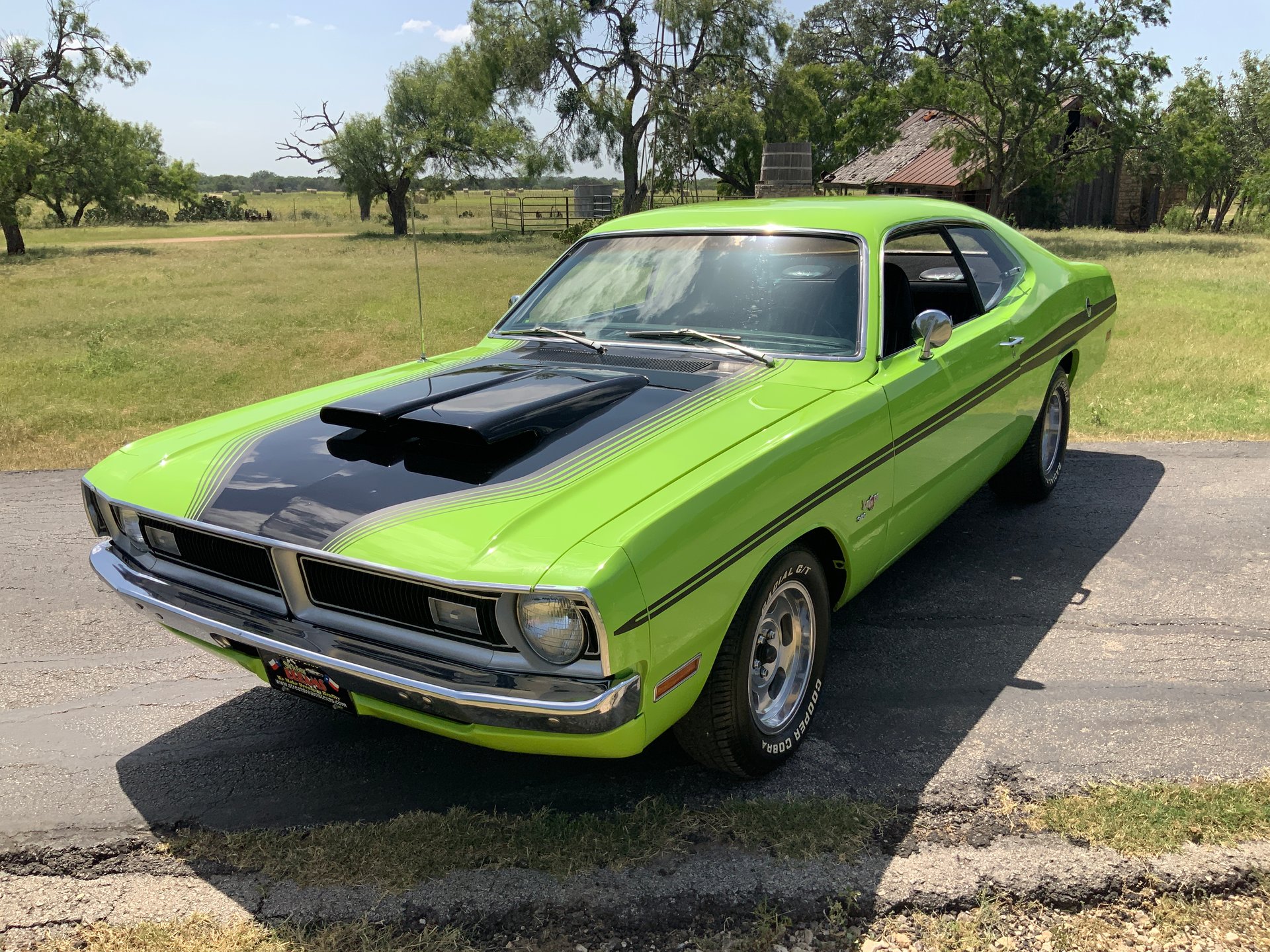
The Demon range is admirably simple, because Dodge was filling a gap in a hurry. There is one body — the two-door fastback coupe, and only that body; no sedan, no convertible, no wagon — and four engines arranged in a ladder you can read straight off the car's paperwork. At the bottom sit the Slant Six economy coupes. In the middle, the 318 cars, which Dodge dressed with the Sizzler appearance package for young buyers who wanted the look. At the top, the Demon 340, a distinct performance model with its own suspension tune and gearing. Judge the car in front of you against its own rung of the ladder, never against the rung above it.
| Model | Years | Engine | Output | Built | Character |
|---|---|---|---|---|---|
| Demon (Slant Six) | 1971–72 | 198 or 225 cu in Slant Six, 1-bbl | 125 hp (225, gross) | The volume base of roughly 129,000 Demons across both years | The economy coupe: unkillable, slow, honest |
| Demon 318 | 1971–72 | 318 cu in LA V8, 2-bbl | 230 hp gross (1971); 150 hp net (1972) | A substantial minority of production | The sweet everyday car; Sizzler cars add the look |
| Demon 340 | 1971–72 | 340 cu in LA V8, 4-bbl | 275 hp gross (1971); 240 hp net (1972) | A small minority — the collector car | The real performance Mopar A-body |
Production honesty matters here. Total Demon production across the two years is commonly documented at roughly 129,000 cars, 1971 the bigger year by far — but any seller quoting you a suspiciously precise rarity figure for a colour-and-gearbox combination is decorating, not documenting. What you can verify from the car itself is the hierarchy: six-cylinder cars were the volume, 318 cars were common, and genuine 340 cars were always the small minority. Rest your valuation on that hierarchy and the paperwork tests in the inspection section, not on a production number recited at you.
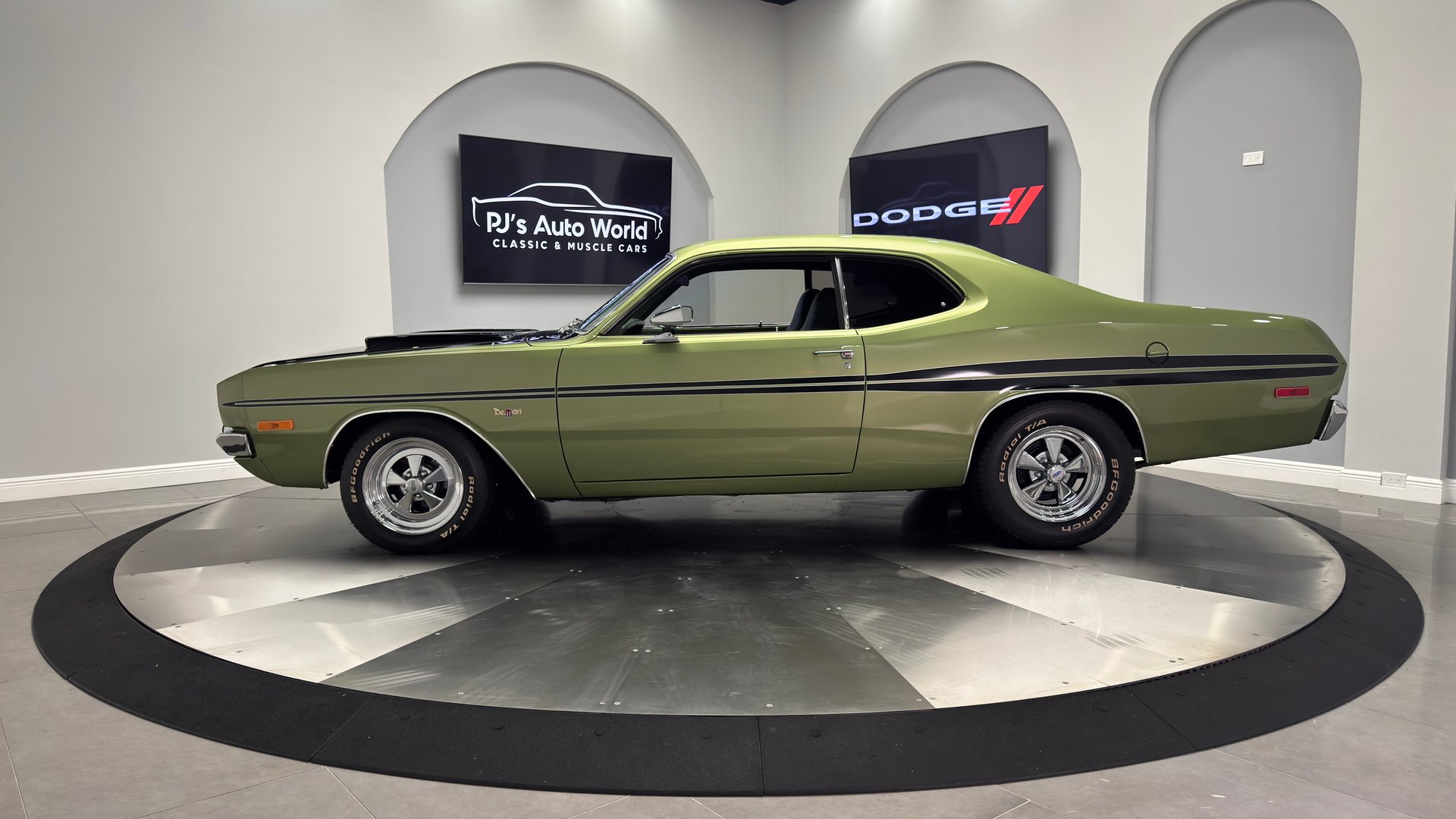
The year split matters more than the trim split. A 1971 car belongs to the last full year of the gross-horsepower era: high compression, the 340 at its sharpest, and none of the detuning that was already arriving. A 1972 car is rated in the new net figures, runs lower compression in the 340, and wears a revised grille — the 1972 nose divides into two plainer openings where the 1971 grille reads as one finer-textured piece — along with detail changes to lamps and trim. Neither year is the wrong one. The 1971 340 is the sharper instrument and the market's favourite; the 1972 cars are often the better-kept survivors and drive with a softness some owners honestly prefer. What you must not accept is a car described as whichever year suits the asking price: the model year is stamped in the VIN, the tenth character logic of the era is unambiguous, and a "1971" with a 1972 VIN is a 1972 with a story.
One package deserves specific warning because it creates the clones. The Sizzler package on 318 cars added the blacked-out hood, stripes, scoops, and Rallye wheels — a Sizzler with 340 decals added later is a Demon 340 at any distance until you open the bonnet and read the numbers. None of this makes a dressed-up 318 a bad car; it makes it a 318 car, to be priced as one. The reverse trap also exists: a genuine 340 that has lost its graphics in a repaint is still a genuine 340, and the paperwork — VIN engine code H, fender-tag code E55 — settles it in your favour while other buyers walk past a plain-looking car.
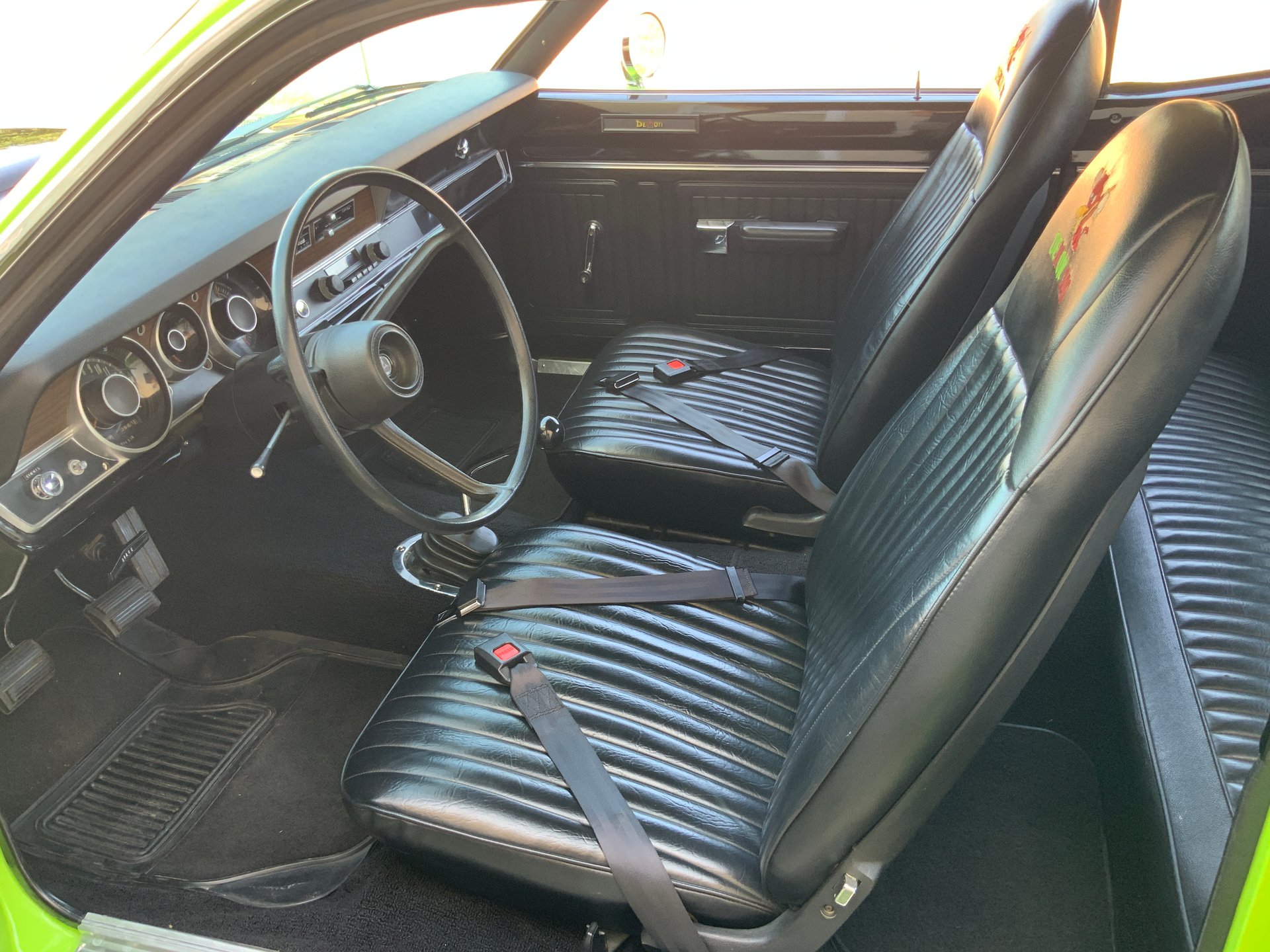
Interiors divide into working-class and dressed, and condition matters more than specification. The standard car gives you a vinyl bench and a plain dash with a sweep speedometer; the dressed car — more common on 340s — gives you high-back buckets, the round-dial Rallye cluster in a woodgrain panel, and a console if the buyer ticked it. Both share the same weaknesses: dash pads crack from the speaker grille outward, seat vinyl splits on its seams, headliners sag. A standard-dash car with a sound, original interior beats a Rallye car retrimmed badly in the wrong grain of vinyl — originality inside is hard to buy back, and you sit in the interior every mile you drive.
Engines and gearboxes
The Slant Sixes: 198 and 225
The base Demon runs Chrysler's famous Slant Six, the inclined inline-six that earned its name from the 30-degree slant of its block, canted over to keep the bonnet line low and to make room for its long intake runners. Two sizes appear in Demons. The 198 cubic inch version serves as the entry engine in 1971; the 225, the size the engine's reputation was built on, is the one you will meet most often and the one to prefer. Both breathe through a single-barrel carburettor — Carter BBS or Holley 1920 depending on year and build — and both produce their power low, lazily, and with a distinctive off-beat thrum that is a feature, not a fault. Do not let anyone sell you a Slant Six Demon as a performance car, and do not let anyone talk you out of one as a driver: the 225 in particular is one of the most durable engines ever fitted to an American car, tolerant of neglect that would kill a V8, and perfectly matched to the Demon's light shell at real-road speeds.
Running faults on the Slant Six are few and specific. The exhaust manifold cracks at its centre branches and ticks loudly when cold, quietening as it expands and seals — a fading tick is the manifold until proven otherwise. A stuck heat riser cooks the carburettor and gives a hot-start stumble owners chase through three rebuilds before anyone checks the flap in the manifold. The single-barrel carburettors wear their throttle shafts and produce an idle you cannot set — if the idle changes when you wiggle the shaft sideways, the bore is worn and a gasket kit will not cure it. Valve clearances are mechanical; a six that has never had them set sounds like a sewing machine in a biscuit tin, and a quarter-hour with feeler gauges transforms it. Budget $400–900 for a manifold, a carburettor rebuild with attention to the shaft, and a tune, and the six will repay you by never troubling you again.
The 318: the LA small-block in working clothes
The 318 cubic inch LA-series V8 is the Demon's middle engine and, for most buyers, its most sensible one. It breathes through a Carter BBD two-barrel carburettor, makes its power without stress, and shares its architecture — thin-wall casting, wedge heads, shaft-mounted rockers, hydraulic lifters — with every other LA small-block, which means parts, knowledge, and upgrade paths surround you on all sides. In 1971 it is rated at 230 horsepower gross; in 1972 the same basic engine is quoted at 150 horsepower net, a change of measuring method and compression detail rather than a change of character, and you should not let a seller present the two figures as two different engines or a buyer frighten you with the smaller number. On the road the 318 Demon is a sweet, torquey, understressed car that will cruise all day, and its two-barrel economy is a genuine virtue on a car you intend to use.
The 318's faults are the LA family's faults in their mildest form. The timing chain stretches — the original sets used a nylon-toothed cam sprocket whose teeth embrittle and shed — and the symptom is an idle that will not settle and a strobe mark that wanders. Rock the crank pulley while watching the distributor rotor: more than a few degrees of crank movement before the rotor answers is chain slack, and a quality double-roller set runs $350–700 fitted. The Carter BBD wears its throttle shafts as the six's carburettor does, and its choke pull-off diaphragm perishes, giving a cold engine that starts, floods, and dies. The rear main seal weeps with age; distinguish its oil — thrown in a fan pattern, wetting the bellhousing — from a sump-gasket leak by cleaning, dusting with talc, and driving. A tired 318 is a known quantity with a known bill, and that predictability is precisely its appeal.
The 340: the engine the car is remembered for
The 340 is a different animal wearing the same architecture, and you should understand it as a racing engine detuned for the street rather than a street engine warmed over. Its bore and stroke were chosen for revs: a large 4.04-inch bore against a short 3.31-inch stroke, forged internals in its early specification, a forged steel crankshaft, a windage tray in the sump, high-flow heads with 2.02-inch intake valves, a dual-plane intake manifold, and a camshaft profile aggressive enough to give the idle its characteristic lope. In the 1971 Demon it breathes through a Carter AVS — the Air Valve Secondary four-barrel, whose spring-loaded air valve meters the secondaries by demand — and is rated at 275 horsepower gross, a figure period testers widely believed conservative. In 1972 the carburettor changes to Carter's ThermoQuad, with its phenolic resin float bowl and spread-bore layout, compression falls from 10.2:1 to 8.5:1 as the industry retreats from leaded premium, and the rating becomes 240 horsepower net. The 1972 engine is not a ruined engine; it is a softer-edged one, still quick in a light A-body, and its lower compression makes it the easier of the two to live with on modern fuel.
Learn the AVS and the ThermoQuad as individuals, because each generates its own folklore of faults. The AVS's signature problem is the secondary air valve: its spring tension sets when the secondaries arrive, and a valve set too loose gives a bog — the engine falls on its face for a beat as you open the throttle, then recovers — while a valve set too tight gives an engine that never quite arrives at full power and feels strangled at the top end. Both are adjustment, not failure, and the test is a road test at full throttle from low revs in a high gear: a clean, progressive pull is a healthy AVS; a bog-then-surge is the air valve asking for its spring to be wound one step at a time. The ThermoQuad's signature problems are its float bowl and its well plugs: the phenolic bowl warps and its internal plugs weep fuel into the manifold, giving you a car that is rich, hot-start reluctant, and smells of petrol after a heat soak, and the cure is a specialist rebuild — budget $450–850 for a proper ThermoQuad or AVS rebuild by someone who knows the model, because a generic kit thrown at either carburettor by a generalist is money spent twice. On both engines, check the choke stove and its linkage, check for a perished accelerator-pump cup behind any off-idle stumble, and remember that half the "carburettor problems" on a 340 are ignition problems in costume: the points or electronic trigger, a tired coil, and plug wires breaking down under load all mimic fuel faults, and the strobe and the vacuum gauge will tell you which system is lying before you spend anything.
The 340's mechanical health checks are specific, so do them specifically. Oil pressure should be strong hot — an LA in health shows a gauge that stays resolutely up at hot idle, and a needle that sags toward the bottom of its range at a hot idle after a hard run is telling you about bearing clearance, not about the gauge; verify with a mechanical gauge screwed into the sender port before you negotiate or walk. Listen at the front of the engine for the timing chain, exactly as on the 318, and listen at the top end for a single ticking lifter that never pumps up — a collapsed hydraulic lifter is a cam-and-lifters conversation if it has been ticking long enough to wear its lobe, and a top-end strip to inspect runs $600–1,200 in labour before parts. Look for the engine's numbers while you are there: the partial VIN stamped on the machined pad on the passenger side of the block, just above the sump rail, should match the car's VIN on a numbers-matching claim, and the casting date should precede the car's build date by weeks, not follow it. A 340 Demon whose engine numbers do not match is not automatically a bad car — engines were swapped in anger for fifty years — but it is a car priced as a non-matching car, and the difference is the seller's problem to absorb, not yours to overlook.
Gearboxes: A833, three-speed, and TorqueFlite
Three transmissions cover the range, and your preference should be honest about how you will use the car. The base manual is a three-speed, column- or floor-shifted depending on build, adequate behind the six and the 318 and nobody's first choice today. The manual you want is the A833 four-speed, Chrysler's famously strong cast-iron-case gearbox, shifted by a Hurst linkage in the Demon. Behind the 340 it transforms the car: the ratios suit the engine's revs, the shift is heavy and mechanical and satisfying, and the box itself is close to unbreakable in street use. Its age faults are linkage faults — worn bushings and a sloppy Hurst mechanism give you a gate you have to hunt for, cured by a bushing and rebuild kit for $150–350 in parts and an afternoon — and synchromesh wear on second gear, announced by a crunch on a fast downchange that a slow, deliberate change avoids; a box that crunches however gently you treat it wants a rebuild at $900–1,600. Check the clutch as a system: a high bite point, judder pulling away, or slip in top gear under load at low revs prices a clutch job at $500–1,000, and on an A-body that job means the gearbox comes out, so combine it with the rear main seal and the pilot bearing while you are there.
The automatic is TorqueFlite, and which TorqueFlite matters. Six-cylinder and most 318 cars use the A904, the lighter unit; the 340 uses the A727, the heavy-duty TorqueFlite whose strength is legendary in drag racing. Both are three-speed, both are simple, and both fail in the same two ways when they fail at all: neglect and heat. The fluid tells the first story — pull the dipstick and read it: bright red and sweet-smelling is health, dark brown is age, black and burnt-smelling is a transmission that has been slipping its clutches and is living on borrowed time. The road test tells the second: changes should be clean and quick at light throttle and firm at full throttle, the kickdown should answer promptly when you floor it from a cruise, and any flare — revs rising between gears as the box hesitates — or any shudder pulling away from rest is wear you will pay to fix, at $1,200–2,200 for a quality rebuild of either unit. A TorqueFlite that changes beautifully cold and misbehaves hot, or the reverse, is giving you diagnostic information: take it. And on any automatic car, check the neutral safety switch and the linkage adjustment by starting the car in every selector position — it should crank in Park and Neutral only — because a misadjusted A-body linkage is common, cheap to fix, and a safety item, not a quirk.

Problem areas
Rust: the map
Everything else in this section is negotiable. Rust is not, because the Demon is a unit-body car: there is no separate frame to save you, the sills, rails, and floor are the structure, and the difference between a Demon that needs cosmetics and a Demon that needs a rotisserie is written in steel you can inspect in twenty minutes if you know the map. Start where A-bodies always start, at the front: the torsion bars anchor into a transverse crossmember under the front floor, and that crossmember and the frame rails around it rot from the inside out, fed by road spray and hidden by undercoating. Get under the car — on a lift, or with a lamp and a mirror if you must — and probe the rails and crossmember with a screwdriver, firmly, in several places. Surface scale is normal at fifty years. A screwdriver that sinks, flakes that lift in sheets, or a crossmember whose edges have gone soft and wavy is structural rust, and structural rust at the torsion-bar anchors is the single most expensive sentence in A-body ownership: professional rail and crossmember repair runs $2,500–6,000 depending on how far the rot has travelled, and it is not work you can defer, because the front suspension literally hangs from it.
Work the map outward from there. The front inner fenders and the tops of the shock towers collect mud behind the wheels and perforate where you can only see them from inside the engine bay, along the seams. The cowl and the plenum at the base of the windshield leak and rot, and their symptom appears inside the car, not outside it: wet front carpets and a rusty front floor are usually cowl water finding its way down, so lift the carpets — all of them, both sides — and read the floor pans directly; a floor that sounds dull and feels soft under a knuckle, or that has been patched with flat sheet pop-riveted over the original, tells you the car has been wet for years. The sills — the rocker panels — rust from inside, bubbling first at the rear, just ahead of the rear wheel, where the quarter panel, sill, and wheelhouse meet in a mud trap that is the Demon's single most reliable rust site: bubbles there are never just bubbles, because the panel you see is the last layer to go. The rear quarters themselves rust at the lower edge behind the wheel and along the lip of the wheel arch; the trunk floor rusts under its mat, fed by a perished trunk seal and by taillight gaskets, and a spare-wheel well full of scale means the water has been sitting there for seasons. The trunk lid's lower seam, the door bottoms, and the edges of the hood all carry seam rust that is cosmetic until it is not. Full professional sill or quarter work runs $1,000–2,500 a side in metal and paint blending; floors run $800–1,800 a side fitted. None of these figures should frighten you off a car whose structure is sound — panels are available and A-body metalwork is well understood — but they should absolutely set the price, and a seller who calls structural rust "surface" has ended the negotiation about everything else he has told you.
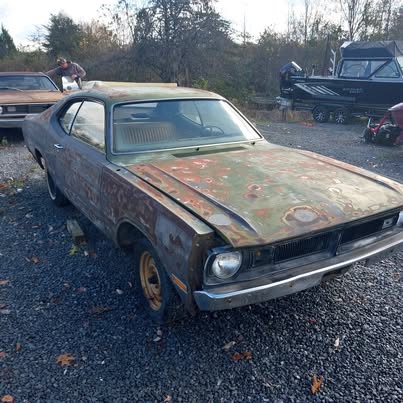
Learn the two disguises, because you will meet both. The first is filler: run a thin fridge magnet, wrapped in a single layer of cloth so you do not mark paint, along the lower quarters, the sill bottoms, and the door bottoms — the magnet pulls evenly on steel and goes weak and vague over filler, and a quarter that will not hold the magnet at all is a quarter made of sculpture. The second disguise is fresh undercoating, sprayed thick over the underside the week before you arrived: it smells new, it looks uniformly black in a way fifty-year-old underseal never does, and it is there to stop your screwdriver, which is exactly why your screwdriver matters. Ask to see under it, or price the car as though the worst you can imagine is under there. And calibrate your judgement with the project cars at the bottom of the market: a Demon that has sat outside for decades wears its rust openly — surface bloom over every panel, perforated lower quarters, a hood skin separating from its frame — and that honesty is, paradoxically, safer than a shiny car with a hidden underside. The openly rotten car is a parts car or a labour of love and is priced as one; the dangerous car is the pretty one whose structure nobody has checked.
Front suspension, steering, brakes, and the rear axle
The Demon's front suspension is Chrysler's torsion-bar system, and it is durable, adjustable, and — by now — almost always tired in the same places. The bars themselves rarely fail; the rubber around them does. Upper and lower control-arm bushings perish and crack, the torsion-bar anchor seals let water into the crossmember sockets, and the result is a front end that clonks over sharp bumps, wanders at speed, and wears its front tyres on their inner edges. The test is to bounce each front corner hard and listen, then have a helper rock the steering while you watch each ball joint and tie-rod end for lost motion — play you can see is play that has already worn past adjustment. Ball joints on these cars are a known wear item and were often neglected because the uppers require unloading the torsion bar to change; a full front-end refresh — ball joints, bushings, tie-rod ends, alignment — runs $900–1,800 in parts and labour and transforms the car, so price it in rather than fearing it. Ride height is set by the torsion-bar adjusters, and a Demon sitting nose-down with its adjusters wound to the end of their travel is telling you its bars have sagged or its anchors have rusted and slipped — connect that observation straight back to the rust map before you blame the bars.
Steering divides into manual and power, and both have a characteristic wear point. The manual box wears at its centre, where it spends its life, giving you free play straight ahead that disappears on lock; the power box adds the pump — whine that rises with revs and effort is low fluid or a dying pump — and a set of hoses that weep at their crimps. A steering coupler with perished rubber adds a vague, rubbery delay between your hands and the road wheels that owners misdiagnose as box wear: have your helper turn the wheel while you watch the coupler at the base of the column, and any visible wind-up there is the coupler, a $40–120 part, not a $500 box. Brakes need the same system-by-system honesty. Base cars run drums all round; many 340s carry front discs, and discs are the ones you want. Either way, the hydraulic system is fifty years old: a pedal that sinks slowly under sustained pressure is a master cylinder bypassing internally; a pedal that is hard and a car that pulls to one side under braking is a seized caliper or a collapsed flexible hose — the hose fails inwardly, acting as a one-way valve, so the brake on that corner drags and overheats while its pedal feels fine, and the test is to crack the bleed nipple on the dragging corner: if fluid spurts and the wheel frees, the hose is your culprit, not the caliper. A full hydraulic overhaul — master, hoses, wheel cylinders or calipers, fluid — runs $600–1,400, and on any Demon whose brake history is unknown it is not an upgrade, it is the price of admission.
At the back, the live axle sits on leaf springs and both halves age audibly. The springs sag — measure the car side to side at the rear arch; a lean of more than about half an inch is a spring or a bent mounting, not character — and their bushings and shackles clonk over bumps. The axle itself, the 7¼-inch unit behind sixes and mild 318s or the stronger 8¾-inch behind 340s and performance cars, whines when its bearings or its ring and pinion wear: a whine that rises and falls with road speed and changes between drive and coast is gear wear, while a constant rumble that does not change with throttle is a wheel bearing, and distinguishing the two on the test drive saves you pricing the wrong repair — an axle rebuild runs $800–1,600, a bearing $200–400 a side. Check the pinion seal and the axle seals for leaks, check the U-joints for play by twisting the propshaft against a held brake, and on a 340 car confirm the axle is what it should be: the 8¾ has a drop-out carrier with a front-loading centre section and no rear cover, while the 7¼ and 8¼ have a bolted rear cover — a genuine 340 wearing a light axle has had a swap, and you want to know why.
Interior, electrics, and the details that date a car
The Demon's cabin fails cosmetically long before it fails functionally, and the order of failure is predictable enough to use as an originality check. Dash pads crack from the centre speaker outward and from the ends inward; a perfect pad on a high-mileage car is either a garaged life or a replacement, and both are fine — what is not fine is a pad cover glued over a cracked pad and presented as original. Seat vinyl splits on its seams, the driver's outer bolster first; door cards warp and lift at their lower edges where water has entered past tired window seals; headliners sag. None of this is structural, all of it is visible, and the bill is in patience more than parts: a quality seat-cover set runs $400–800, a dash pad $300–600, and fitting them well is a weekend each. What you should actually hunt for inside is evidence: the broadcast sheet — the build sheet — was often left under the rear seat springs or above the glovebox by the factory, and finding it is finding the car's birth certificate, listing its engine, gearbox, axle, colours, and options in code. If the seller has it, the car's identity argument is over. If he does not, lift the rear seat cushion anyway and look: finding one the seller never knew about has settled more Demon negotiations than any other single act.
Electrics on a Demon are simple, and their faults are almost never the components — they are the connections, the grounds, and one famous bulkhead. The wiring passes through a bulkhead connector at the firewall whose terminals corrode and overheat, classically on the ammeter circuit, which carries the car's full charge current through the dash: a flickering ammeter, lights that brighten and dim with revs, or melted plastic and green terminals at the bulkhead are the A-body's signature electrical fault, and the cure — cleaning, tightening, or bypassing the ammeter feed as the Mopar world has standardised — runs $100–400. Gauges fail by their senders more often than by themselves; ground the fuel sender wire at the tank and a gauge that sweeps to full has a sender or ground fault, while one that stays dead has a gauge or wiring fault. You want roughly 13.8–14.5 volts at the battery with the engine running and lights on. Heater fans squeak, wiper motors slow, ignition switches wear until the car cranks only if you hold the key just so — each a small bill and a negotiating lever, and collectively a record of whether the car's last decade was maintained or merely survived.
Finally, the details that date a car. The grille must match the year — a 1971 grille on a 1972 VIN is a replaced nose, which is a question about accident history, not a crime. The taillight panel and lenses are Demon-specific and harder to find than Dart items, so cracked or wrong lenses are a real cost, not a footnote. Mascot decals and fender badges should be present on a car sold at Demon money, and their absence after a repaint prompts the question of what else the repaint covered. None of these details alone condemns a car; together they build the picture you are actually buying, which is why you check them in person rather than from photographs chosen to flatter it.
How to inspect one
Work in this order — paperwork first, because it is free, and the test drive last, because it confirms everything else — and do not let the seller hurry you past a step.
- Start with the VIN, before you look at anything else. The plate sits at the driver's end of the dash, visible through the windshield. A Demon reads LM29: L for the Dodge Dart/Demon line, M for the medium price class, 29 for the two-door sports hardtop body. The fifth character is the engine the car was born with — C for the 225 Slant Six, G for the 318, H for the 340. If the car is sold as a Demon 340 and the fifth character is not H, stop negotiating about price and start negotiating about what the car actually is: it is a clone, however good, and it is priced as the car its VIN describes. Note the year character and the assembly plant, and check the plate's rivets and the dash around it for disturbance.
- Decode the fender tag against the car. The tag is screwed to the driver's inner fender in the engine bay and lists the car's build in code: E55 means a 340 engine, E44 a 318, E24 a 225; D21 means the four-speed manual, D32 the heavy-duty automatic. Read the paint and trim codes and compare them with the car in front of you — a tag that decodes to a green 318 automatic under a purple 340 four-speed's bonnet means the tag, the engine, or the story is wrong. Check the tag's screws: a tag that has clearly lived elsewhere, with fresh screws and a patina that does not match its fender, is a warning, and a missing tag on a premium-priced 340 is a discount, full stop.
- Hunt for the broadcast sheet. Lift the rear seat cushion — it pulls up and forward — and look under the springs, then check above the glovebox liner if you can do so without force. A found sheet that matches the VIN settles identity completely. Photograph it, note its engine, gearbox, axle, and colour codes, and compare every one against the car.
- Do the rust map, in the rust section's order. Torsion-bar crossmember and front rails first, with a screwdriver and a lamp; then inner fenders and shock towers from inside the bay; then lift every carpet and read the floors; then the magnet walk along sills, lower quarters, and door bottoms; then the trunk, mat up, spare out. Spend the most time at the rear of the sills, ahead of the rear wheels. Any structural softness reprices the car on the spot.
- Check the engine as a system, cold. Insist the engine is cold when you arrive — a seller who has warmed the car has hidden its cold start, its choke behaviour, and its oil pressure at its worst. Watch the start: a 340 should catch, lope, and settle; note blue smoke on start-up (valve seals), blue smoke under load (rings), and white vapour that does not clear (coolant, and a negotiation-ender until diagnosed). Read the oil on the dipstick for level, colour, and the grey mayonnaise of water contamination, and the coolant for oil and rust.
- Verify the engine's numbers on a 340. Find the machined pad on the passenger side of the block above the sump rail and read the partial VIN stamping; compare it with the dash VIN. Check the casting date against the car's build. A matching-numbers claim that fails this test becomes a non-matching car at a non-matching price — say so plainly and watch the response, which is itself diagnostic.
- Test the carburettor the way the engines section describes. On an AVS car, once warm, accelerate at full throttle from low revs in a high gear and feel for the bog-then-surge of a maladjusted secondary air valve. On a ThermoQuad car, restart it fully hot after a ten-minute soak: a hot-start struggle with a strong petrol smell is the bowl and well-plug story. Check idle quality, and wiggle the throttle shaft for the wear that no rebuild kit cures.
- Work the suspension and steering checks. Bounce each corner and listen for clonks; rock the steering with a helper and watch every joint for lost motion; examine the steering coupler while the wheel turns; measure the rear ride height side to side. Check tyre wear patterns — inner-edge wear at the front is the front end confessing.
- Drive it properly: twenty minutes, mixed roads. Read the oil pressure hot at idle and at cruise. Listen for the axle's whine and note whether it changes between drive and coast. Feel the gearbox: the A833 should be heavy and positive, the TorqueFlite's changes clean with a prompt kickdown. Brake firmly from speed twice — the car should pull up straight, the pedal should stay firm, and afterwards, check whether one front wheel is conspicuously hotter than the other, which is the dragging-brake test from the problem areas section made physical.
- Test every electrical item, including the boring ones. Lights, indicators, wipers, washers, heater fan on every speed, horn, all gauges. Ground the fuel-sender wire if the gauge lies. Check the bulkhead connector in the bay for heat damage and green terminals, and confirm charge voltage at the battery with the engine running and lights on.
- Read the interior as evidence. Dash pad, seat seams, door-card bottoms, headliner, pedal rubbers, and the wear on the driver's seat and carpet against the claimed mileage. A Rallye dash on a car whose paperwork says standard, or bucket seats where a bench is coded, means a previous owner has been improving — fine, if the price knew about it before you did.
- Close on paperwork, not enthusiasm. Title in the seller's name, VIN on the title matching the plate character for character, any lien or brand disclosed. Then make your offer based on the car the checks described — the VIN's car, the structure's car, the numbers' car — not the car in the photographs. The Demon rewards the buyer who checks, because so many of its sellers are selling the badge.
Values
The Values section of this guide deliberately contains no prices, because the market block beneath this guide — the live listings and recorded sales for Demons on Classic Listings — carries the current numbers, refreshed as the market moves, and any figure printed here would be stale before it helped you. What this section gives you instead is how to read those numbers like a buyer who understands what he is looking at, because the Demon market punishes lazy reading harder than most.
Start with the condition spread, which on Demons is enormous. This car exists simultaneously as an openly rotten project, a tired but honest driver, a presentable cruiser, and a small number of genuinely restored 340s — and the gap between those conditions is not a percentage, it is a multiple. Sort the listings by what the car is, not what it is called: a "project" and a "restored" Demon share nothing but a nameplate, and the average of their prices describes neither. The project-versus-driver gap is where Demon money is made and lost, because moving a project up one condition class routinely costs more than the price difference between the classes. Run the rust and repair figures from the problem areas section against any project that tempts you, in writing, before its asking price anchors you.
Within any condition class, identity is the premium. A verified Demon 340 — H in the VIN, E55 on the tag, matching numbers where claimed — carries a substantial premium over a 318 car, and a 318 carries one over a six, and those premiums are rational: the cars are genuinely scarcer as you climb the ladder and genuinely better to drive. What is not rational, and what you must refuse to fund, is the clone priced at the genuine car's level on the strength of its decals. The market below will show you dressed 318s and converted sixes described in 340 language; the VIN check costs you nothing and is the entire defence. After identity, the premiums layer predictably: the four-speed over the automatic in a 340, the 1971 over the 1972 at equal condition, documented history and a broadcast sheet over an undocumented car, and the high-impact period colours — the greens, the purple, the pink — over the sober ones, because the Demon is a car people buy with their eyes and its extrovert colours are its signature. Originality premiums are real but conditional: an unrestored survivor with honest patina commands respect and money from the Mopar faithful, while a restored car is judged on the quality of the work, and a bad restoration is worth less than the honest car it replaced.
Expect the asking-versus-achieved gap to behave as it does across early-seventies Mopar: dealer asking prices sit at the optimistic end, private sales settle below them, and the cars that linger in listings are usually lingering for a reason the photographs do not show — which, on a Demon, is very often the structure. Use the recorded sales, not the asks, as your gravity. Negotiate from the checks: every item in the inspection section that fails is a costed item, and a seller presented with a list — crossmember work, a TorqueFlite rebuild, a ThermoQuad rebuild, a front-end refresh — is negotiating against arithmetic rather than against your opinion. Finally, buy the condition and the identity, never the story: the Demon name generates stories the way its namesake generates trouble, and the cars that hold value are the ones whose paperwork, structure, and numbers survive a sceptical reading. Those are also, not coincidentally, the cars that are best to own.
Parts and ownership
Owning a Demon is owning a share in the A-body ecosystem, and that is the best ownership news in this guide: the Dart, Duster, Valiant, and Demon together sold in the millions, the mechanical architecture is shared across all of them, and the aftermarket has responded accordingly. Mechanical parts are easy. Engine internals, gaskets, and service items for the Slant Six, the 318, and the 340 are stocked by every Mopar specialist and most general suppliers; the LA small-block's performance aftermarket is effectively bottomless, though you should keep a matching-numbers 340 stock rather than modified if its value matters to you. Carburettor specialists who genuinely know the Carter AVS and ThermoQuad exist and advertise to the Mopar world — use them rather than a generalist. TorqueFlite and A833 rebuild parts, clutch kits, brake components, suspension bushes and ball joints, steering couplers, and weatherstrip are all reproduced or stocked, and a front-end or brake refresh never waits on a part. Cooling, charging, and ignition service items are same-week parts everywhere. Budget ownership accordingly: routine servicing is $150–300 a year in consumables if you do your own work, and the car asks for nothing exotic — engine oil and filter every 3,000 miles or annually, coolant every two years, brake fluid every two, and valve clearances checked on the Slant Six as a matter of rhythm.
Where ownership takes patience is the Demon-specific layer. The grille, taillight panel and lenses, mascot badges and decals, and Demon-specific trim are not Dart parts and are not reproduced to the same depth: graphics come from the specialists, but lenses and trim are a used-parts hunt, and a cracked taillight lens is a search, not an order. Sheet metal is the middle case — floor pans, trunk floors, quarter patches, and sills are reproduced for the shared A-body shell — and interior soft trim is reproduced in the correct grains for the popular colours. The rule writes itself: buy the car whose Demon-specific parts are present and sound, even at a premium, because the shared mechanical parts can always be bought later and the specific ones sometimes cannot.
Living with the car is easy in the ways that matter. The Demon is compact by its era's American standards, light on its controls with power steering, and simple enough that a competent home mechanic with the factory service manual — available in reprint, and worth insisting on — can perform nearly everything in this guide. Join the community: the A-body forums and Mopar clubs hold the accumulated knowledge on everything from bulkhead-connector repair to ThermoQuad tuning. Store the car dry, because the rust map in this guide is drawn by water; exercise it monthly rather than laying it up dead, because TorqueFlites, carburettors, and brake hydraulics all deteriorate standing still; and keep every document — the broadcast sheet above all — with the car, because on a Demon, paperwork is not administration. It is value.
Which one to buy
- The all-rounder: the 318 car, honestly presented. A Demon 318 with a sound shell, a TorqueFlite or a manual, and its own identity intact gives you the shape, the sound, and the ownership experience at the range's most sensible money — and it will never need to apologise at a show field for being exactly what it is.
- The value buy: the 225 Slant Six driver. The cheapest route into a real Demon, with the most durable engine Chrysler ever made and running costs that let you spend your money on structure and cosmetics, where Demon money belongs. Buy the best shell you can find and let the six thrum.
- The collector's car: the verified 1971 Demon 340, four-speed. H in the VIN, E55 on the tag, numbers matching, Rallye dash, a high-impact colour — this is the Demon the market wants, the sharpest to drive, and the one whose documentation you must check hardest precisely because it is the one worth cloning.
- The thinking driver's 340: the 1972 Demon 340 automatic. Softer compression that suits modern fuel, the unbreakable A727, and prices that sit below the 1971's at equal condition — the same car in spirit, bought with the head as much as the heart.
- The project to buy, if you buy one at all: the openly tired, structurally honest car. Surface rust you can see, an interior you can price, paperwork that matches — a project whose problems are all on display beats a shiny question mark every time, and the rusty car in this guide's photograph is a better starting point than a filled and undercoated mystery.
The overriding rule: buy the VIN, the tag, and the structure — in that order, every time. A Demon is a two-year nameplate on a shared shell, which means its value lives in its identity and its steel, not in its graphics or its seller's adjectives. Verify the identity from the numbers, verify the steel from underneath, and the rest of the car — engine, gearbox, colour, condition — can be chosen with your heart. Skip either verification and you are not buying a Demon; you are buying a story about one.
See the 4 Demon cars currently listed.
For sale now
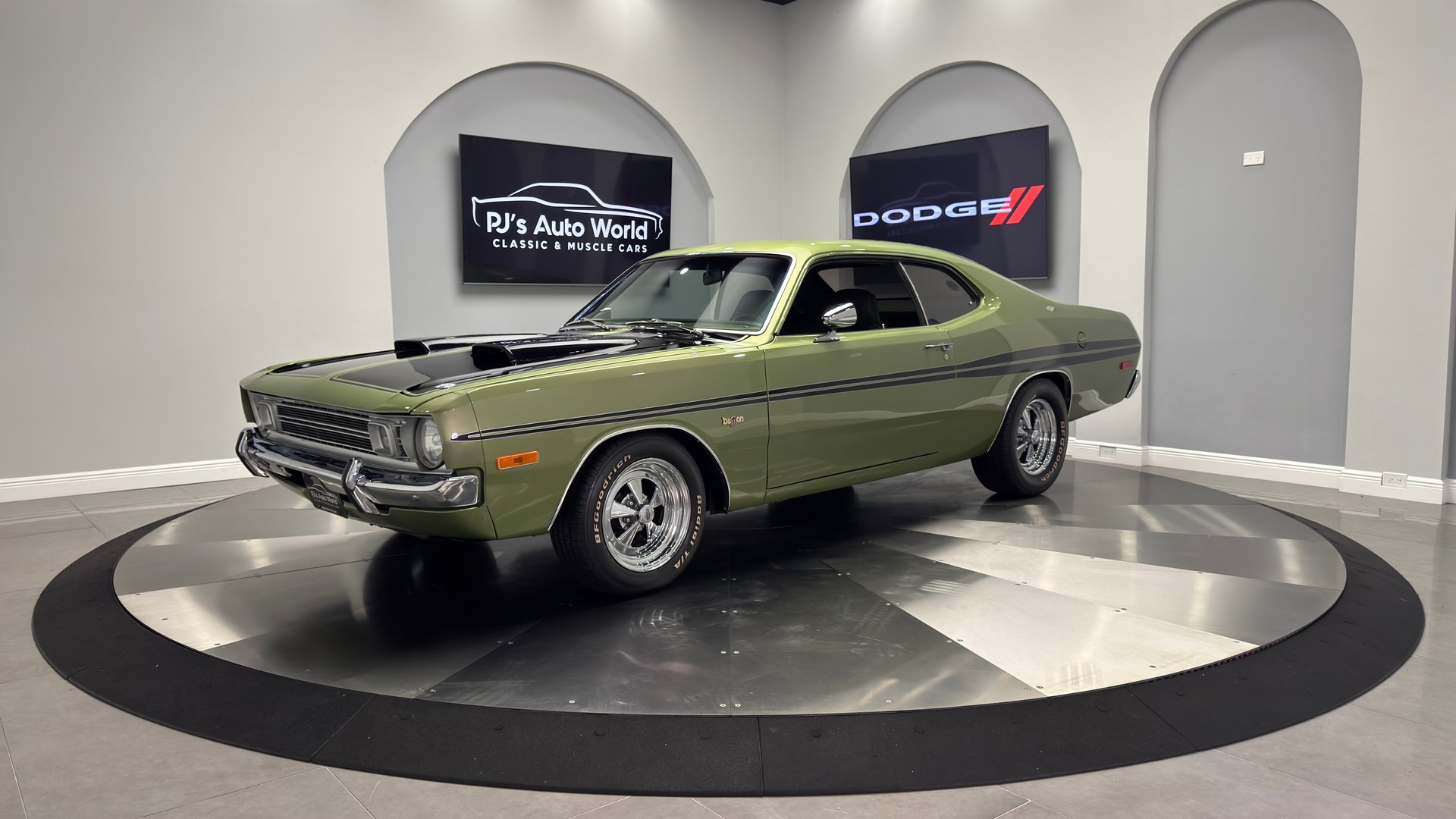 $49,900 · 51% above typical
Expand
$4,000 · 88% below typicalExpand
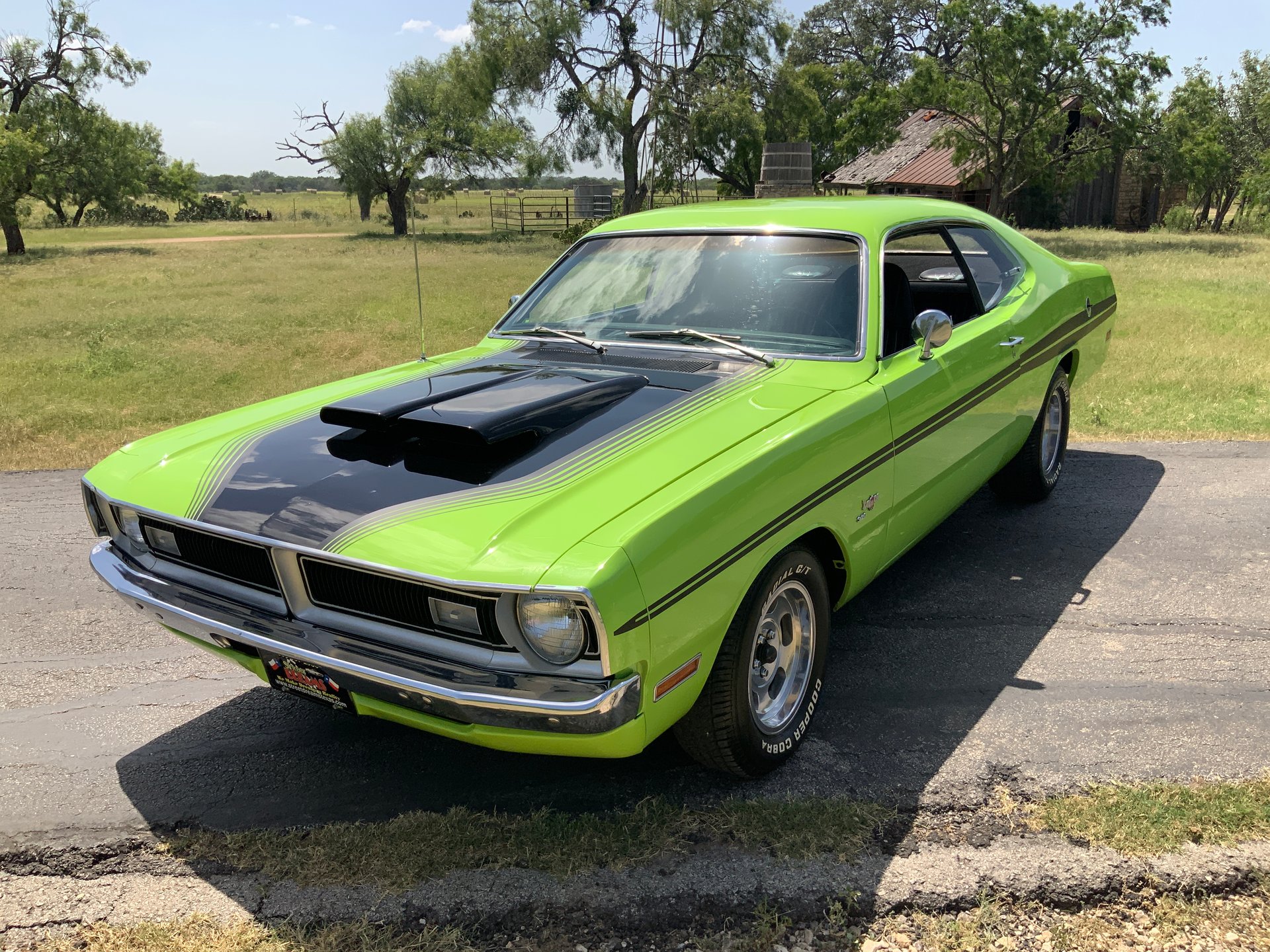 $39,500 · 20% above typical
Expand
What they sell for: Demon sale prices.