
Dodge Ram 150 buyer's guide
Dodge Ram 150 -- the model's own buyer's guide: variants, values and what to check.
Years listed: 1985-1993 · Series: D-Series
# Dodge Ram 150 (1981–1993) — Buying Guide
Overview and history
You are looking at the last of the old-school Dodge pickups: a body-on-frame, leaf-sprung, live-axle half-ton that Chrysler kept in production, with only detail changes, from 1981 to 1993. Understand that longevity first, because it explains everything else about buying one. This is not a truck that was redesigned every four years to chase Ford and General Motors. It is a 1972 design — the third-generation D-Series — given a new name, a new grille and a ram's-head bonnet ornament for 1981, and then left to earn its keep while Chrysler spent its limited money elsewhere. That neglect is now its charm. Where a contemporary Ford F-150 or Chevrolet C10 already feels like a modern vehicle trying to be old, a first-generation Ram 150 feels like what it is: a simple, square, honest work truck with a bench seat, a big steering wheel and almost nothing on it you cannot understand with the bonnet open.
The Ram name itself was a revival. Dodge had used a ram's-head mascot since the 1930s, and for 1981 — under Lee Iacocca's rescued Chrysler — the full-size pickups were rebranded Ram for two-wheel drive (D codes) and Power Ram for four-wheel drive (W codes). So the truck in front of you is badged Ram 150, but its paperwork, its VIN plate and older parts catalogues will call it a D150 if it is two-wheel drive and a W150 if it is four-wheel drive. They are the same model for buying purposes, and this guide covers both. The 150 is the half-ton: below it in period brochures sat nothing in the full-size line once the D100 faded, and above it sat the 250 and 350 three-quarter- and one-ton trucks, which share the cab, much of the frame thinking and — from 1989 in the heavier trucks only — the famous 5.9-litre Cummins diesel. Hold that last point firmly: no factory Ram 150 of this generation carries a Cummins. If a seller advertises a "Cummins 150," you are looking at a swap, a rebadged heavier truck, or a misunderstanding, and you price and inspect it as a modified vehicle, not as a rare factory variant.
The production run divides into three buying eras, and you should learn to see them at a glance. The 1981–1985 trucks wear the eggcrate grille, keep carburettors throughout, and offer the 225 Slant Six alongside the 318 and 360 V8s. The 1986–1990 trucks get the simpler horizontal-bar grille, lose the Slant Six after 1987 in favour of the 3.9-litre V6, and — the big mechanical step — gain throttle-body fuel injection on the V8s for 1988. The 1991–1993 trucks wear the chunkier crosshair-style grille, and for 1992 the 318 becomes the 5.2-litre Magnum with multi-point injection, followed by the 5.9-litre Magnum 360 for 1993. Each step makes the truck easier to live with and slightly less simple to fix at the roadside. None of them changes the basic proposition: a separate chassis, a steel cab that rusts in predictable places, running gear borrowed from Chrysler's passenger cars and proven over decades, and an interior trimmed in vinyl and hard plastic that was cheap when new and is fragile now.
Why buy one today, over the more numerous Ford and Chevrolet equivalents? Three honest reasons. First, character: the square-rig styling, the ram ornament and the unmistakable LA small-block exhaust note give it a presence its rivals have to be modified to match. Second, mechanical honesty: a carburetted 318 with a TorqueFlite automatic is about as well understood as any drivetrain in America, and almost every wear part is still made. Third, relative scarcity without exoticism — Dodge was a distant third in the truck market, so a good Ram 150 is unusual at a show yet never orphaned for parts. The counterweight is condition spread. These were bought to work, most were worked hard, and the pool reflects it: on Classic Listings the Ram 150 appears only in small numbers — five trucks in the current pool, spanning 1985 to 1993 — so you cannot wait for the perfect specification to appear locally. You buy the best surviving shell and drivetrain you can find, in whatever colour it happens to be, and you let rarity of good survivors, not rarity of trim, set your expectations.

The models
The Ram 150 range looks bewildering in brochures and is simple in metal. Every truck is a combination of four choices: drive (D150 two-wheel drive or W150 four-wheel drive), cab (standard cab, or the extended Club Cab offered through most of the run), bed (short-bed of about 6.5 feet, or long-bed of about 8 feet, in Fleetside — Dodge called it Sweptline — form, with the narrow Utiline step-side bed a rare early survivor), and engine. Trim layered over the top: base Customs and Miser specials at the work end, mid-range Prospector packages that bundled appearance and convenience options, and Royal / Royal SE and later LE trim at the top, with plusher bench seats, more chrome, two-tone paint and air conditioning. Trim changes value at the margins. It never rescues a rusty shell, and a base truck with a sound cab is always a better buy than a Royal SE with perforated floors.
Wheelbase follows the combination: short-bed standard cabs sit on the short chassis, long-beds and Club Cabs on longer ones, and the four-wheel-drive W150 rides higher on its Dana 44 front axle with a noticeably different stance — a difference you can use, because a supposed W150 that sits low and carries no front differential, transfer case or front driveshaft is a D150 with badges, and the VIN and the front axle settle it in seconds. Payload and towing ratings rose modestly across the run and with the heavier optional spring packs, but do not buy a 150 of this age to work at its period maximum: you are buying a classic that can still do light work, and the trucks that have spent thirty years at maximum payload are exactly the ones with cracked spring hangers and tired rear axles described later in this guide.
Two special threads deserve a sentence each, because sellers inflate both. The earlier D-Series performance specials — the Li'l Red Express and Warlock of 1978–1979 — belong to the pre-Ram D150, not to this guide's truck, and no Ram 150 of 1981–1993 carries that provenance; a red 1980s D150 with stacks and decals is a tribute, priced as a tribute. Conversely, the genuinely desirable late trucks — a 1992–1993 Magnum V8 in a short-bed two-wheel drive, or a tidy W150 Power Ram — are desirable for their drivetrains and usability, not for limited-edition status, and you should pay for condition and injection, not for a story.
| Model | Years | Engine | Output | Built | Character |
|---|---|---|---|---|---|
| D150 Slant Six | 1981–1987 | 225 cu in (3.7) inline six | ~95 hp | Not published by variant | The unburstable work truck; slow, simple, carburetted |
| D150 / W150 3.9 V6 | 1988–1993 | 239 cu in (3.9) V6 | ~125 hp (180 hp Magnum, 1992–93) | Not published by variant | The economy buy; a shortened 318 in design, adequate unladen |
| D150 / W150 318 | 1981–1991 | 318 cu in (5.2) LA V8 | ~140–170 hp by year | Not published by variant | The all-rounder; carburetted, then throttle-body injected from 1988 |
| D150 / W150 360 | 1981–1992 | 360 cu in (5.9) LA V8 | ~155–175 hp by year | Not published by variant | The puller; thirstier, torquier, four-barrel on many years |
| Ram 150 5.2 Magnum | 1992–1993 | 318 cu in (5.2) Magnum V8 | 220 hp | Not published by variant | The modernised truck; multi-point injection, real pace |
| Ram 150 5.9 Magnum | 1993 | 360 cu in (5.9) Magnum V8 | 230 hp | Not published by variant | The last and strongest of the line; one year only in this body |
| W150 Power Ram | 1981–1993 | Six, V6 or V8 as above | As engine | Not published by variant | The 4x4; Dana 44 front axle, part-time transfer case |
A note on the figures in that table, because honesty here protects your money. Chrysler did not publish a clean production breakdown by Ram 150 variant, so the "built" column refuses to invent one — anyone quoting you an exact production figure for, say, a 1987 Club Cab 360 owes you a source. Outputs are period net ratings and move year to year with emissions equipment and fuelling; treat them as orientation for how a truck should feel, not as a dyno promise. A healthy carburetted 318 feels willing but relaxed. A Magnum 5.2 that feels no stronger than a carburetted truck is telling you something is wrong — usually ignition, fuel pressure or a blocked catalytic converter — and that gap between expected and delivered performance is one of the most useful free tests on a viewing.
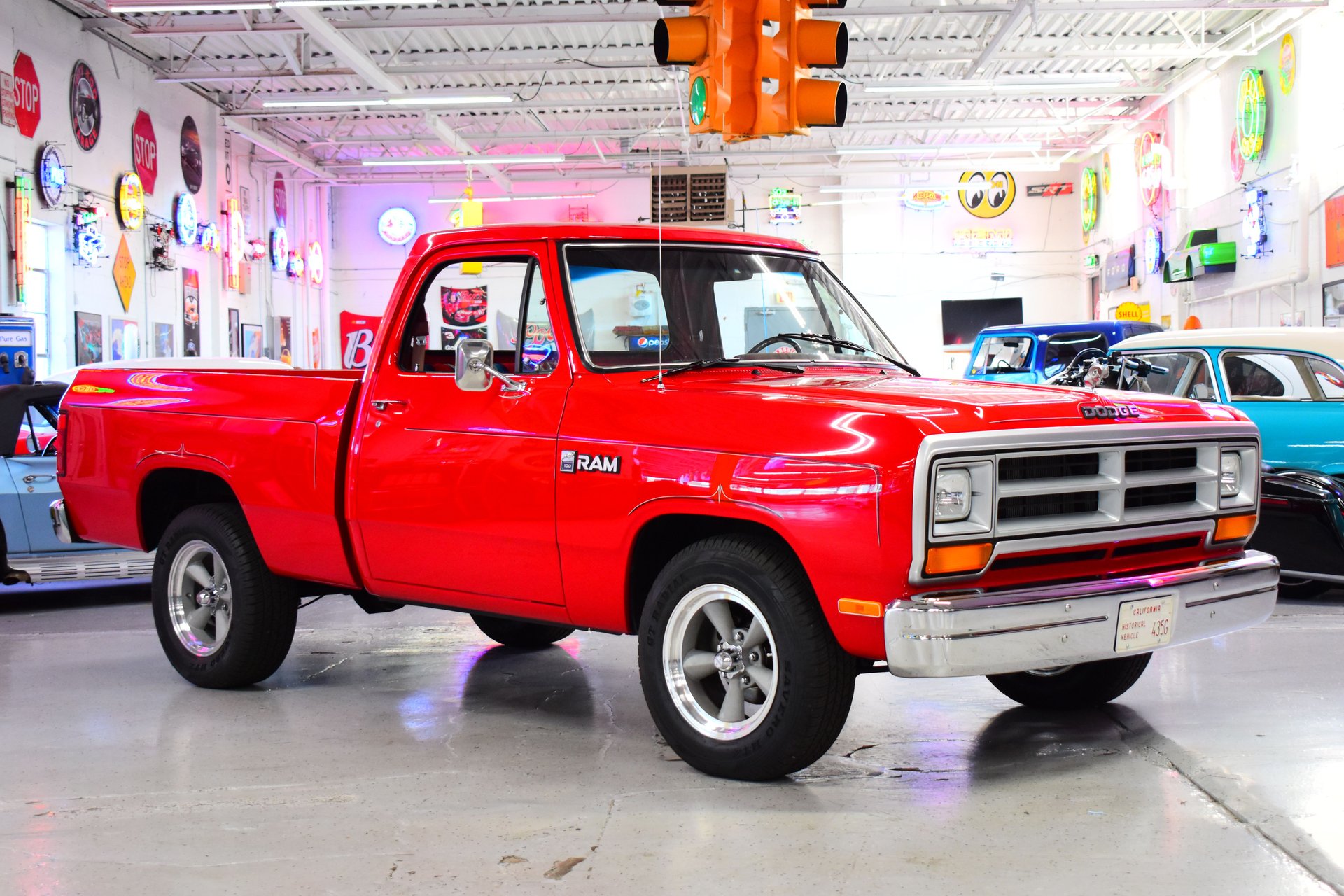
Cab and bed condition deserve equal billing with the mechanical specification, because they decide what the truck is. The standard cab seats three across on a bench, in theory; in practice two adults and a column shifter is the comfortable limit, and the Club Cab's extra space behind the seats is storage, not seating for adults on a journey. Short-beds look right and carry less; long-beds work better and park worse. None of this is rare enough to pay a premium for on its own. What you pay for, in order, is: a cab that has not rusted at its mounts and corners, a bed floor that is not perforated over the wheel arches, an engine that starts and idles cleanly on the system it left the factory with, and paperwork that agrees with the VIN plate. Everything else is negotiable, replaceable or cosmetic.
Engines and gearboxes
The 225 Slant Six and the 3.9 V6
The 225-cubic-inch Slant Six is the engine this truck's reputation for indestructibility rests on, and it earns it. Chrysler's RG-family six leans over at 30 degrees — hence the name — under a long aluminium or cast intake manifold, with a single Carter or Holley one- or two-barrel carburettor depending on year, solid or hydraulic lifters by year, and a bottom end that tolerates neglect that would kill a V8. Output is modest, around 95 horsepower in these emissions-era trucks, and torque is what matters: it pulls from idle, runs happily on regular fuel and returns the best economy of any engine in this guide. Its faults are age faults. The carburettor warps and its choke pull-off fails, so cold starting becomes a ritual of pumping and nursing; the distributor drive gear wears and timing scatter makes the idle hunt; valve clearances on solid-lifter years drift until the top end rattles — a rhythmic tick that quiets with a feeler gauge and an hour's patience is normal Slant Six ownership, not a death rattle. Oil leaks from the rocker cover and the rear of the head are endemic and cheap. What kills Slant Sixes is overheating from a silted radiator, because the long head warps; a six that has boiled repeatedly and shows coolant staining down the block side is a rebuild, not a service.
The 3.9-litre V6 that replaced it from 1988 is, in design, a 318 V8 with two cylinders removed — same bore architecture, same LA-family thinking, a balance-shaft-free design that idles with a characteristic lope you should not mistake for a misfire. In throttle-body form it makes about 125 horsepower and moves an unladen short-bed adequately; loaded or towing, it works hard and drinks like a V8 doing the same work, which is why the honest advice is to buy the V6 for price and simplicity, not for economy under load. For 1992–1993 the V6 became a Magnum with multi-point injection and a useful jump to about 180 horsepower, and those late V6 trucks are quietly good buys. V6-specific checks: timing-chain stretch (listen for rattle at the front cover on a hot restart and watch for retarded, lazy throttle response), TBI injector spray pattern as described below, and oil pressure — a flickering oil light at hot idle on any of these engines means worn bearings or a tired pump until a mechanical gauge proves otherwise.
The LA small-block V8s: 318 and 360
The 318 (5.2) and 360 (5.9) are Chrysler's LA small-blocks, in production since the 1960s, and they are the default choice in a Ram 150 for good reason: pushrod-simple, hydraulic-liftered, with a single cam in the block, a Carter or Holley carburettor on early trucks, and parts priced like the mass-market components they are. The 318 is the sweeter engine — smoother, slightly thriftier, and strong enough for anything a half-ton should do. The 360 adds torque low down, usually carries a four-barrel carburettor (the Carter Thermoquad on many years, identifiable by its black phenolic float bowl), and drinks noticeably more; in a working truck or a W150 it earns its fuel, in a cruiser it mostly costs you. Both engines share the same buying checks, and the first is identity: the displacement is stamped on the left front of the block, and the engine number pad tells you what you actually have. Sellers confuse 318s and 360s constantly, innocently and otherwise — a "360" that stamps up as a 318 is worth 318 money, and the stamp, not the air-cleaner decal, settles it.
Fuelling divides the LA trucks into three sub-eras, and each has its own signature faults. Carburetted trucks (to 1987, and some configurations beyond) suffer the classic trio: choke faults making cold starts smoky and reluctant, accelerator-pump diaphragms perishing so the truck stumbles on tip-in, and — specific to Chrysler — the Lean Burn / Electronic Spark Control computer on many late-1970s-to-mid-1980s applications, a silver box on the air cleaner that retarded spark for emissions and now fails with age, causing intermittent cutting out and no-starts that vanish when the box cools. Generations of owners have converted Lean Burn trucks to a conventional electronic ignition with a vacuum-advance distributor; a tidy conversion is a plus, a nest of Scotch-Lok connectors is a warning. The Thermoquad's phenolic bowl warps and its internal plugs leak fuel into the manifold overnight, so a 360 that needs long cranking hot and smells rich is usually a carburettor rebuild ($250–$600 in parts and labour), not an engine fault. Throttle-body trucks (1988–1991 V8s) use a Holley-built TBI unit with one or two injectors over a throttle body, controlled by a simple computer; they start better in winter, tolerate altitude, and fail in new ways — injector O-rings weeping, the throttle-position and MAP sensors drifting, idle-air control motors gumming so the idle surges or stalls at junctions. Watch the injector spray at idle with the air cleaner off: you want a fine, even cone, not dribbles. Fuel pressure and a $30 sensor fix most TBI complaints; budget $150–$450 for diagnosis and parts before you let anyone sell you a computer.
Underneath the fuelling, the LA engines wear predictably. Timing chains stretch — originals used a nylon-toothed cam sprocket that sheds teeth with age and heat, so a high-mile LA with a rattling front cover and wandering timing marks is due a chain set ($400–$900 fitted), and many have already had one; ask. Valve-stem seals harden, giving the classic puff of blue smoke on start-up after standing, which is tolerable and cheap to improve at a head refresh, while continuous blue smoke under load is rings and bores and a different conversation. Exhaust manifolds crack and their studs snap in the head; a ticking that fades as the engine warms is usually manifold, not lifter. Oil pressure on a mechanical gauge — around 40–60 psi hot at road speed, and not collapsing at idle — is the single best health certificate an LA can offer, and fitting a temporary gauge for a viewing is neither rude nor unusual.
The Magnum V8s, 1992–1993
The Magnum conversion is the most significant mechanical event in this truck's life, and if you want one Ram 150 to use daily, it is where your money belongs. Chrysler kept the LA block architecture and fitted new heads with better ports, a roller-cam valvetrain, a higher compression ratio and sequential multi-point fuel injection with a distinctive barrel-style intake manifold — the "beer barrel" — and the results transform the truck: 220 horsepower from the 5.2, 230 from the 1993-only 5.9, with cleaner starting, better economy and far sharper throttle response. The Magnum has its own known fault, and you must test for it: the intake manifold's bottom is closed by a stamped-steel plenum pan on a gasket that fails, letting the engine suck oil from the valley into the intake. Symptoms are oil consumption with no external leak, pinging under load from oil-contaminated charge, and a fouled number-eight plug. The test is in the inspection section; the fix is a gasket or an aftermarket aluminium pan, $350–$800 fitted, and it is a known, bounded cost — negotiate it, don't walk away from a good truck over it. Magnum heads also crack between the valve seats more readily than LA heads when overheated, so a Magnum with a history of coolant loss needs a cooling-system pressure test before money moves. Ignition is distributor-based still, with the pickup and cap/rotor as service items; the crank and cam sensors and the automatic-shutdown relay cause most no-starts, and a seller who says "it just stopped, probably the computer" is usually describing a $40 relay or a $60 sensor.
Gearboxes and four-wheel drive
The automatic you will meet most is the TorqueFlite, and its reputation is deserved. The A727 three-speed behind V8s is one of the strongest light-truck automatics ever made; the lighter A904-family units sit behind sixes and some V6s. Behaviour to expect: firm, distinct shifts, a decisive kickdown, and no flare between ratios. Behaviour to reject: delayed engagement into drive or reverse from cold (front pump and seal wear, or simply old, burnt fluid — smell it; burnt TorqueFlite fluid is unmistakable), slipping on the 2–3 shift, or shuddering lockup on later overdrive units. From the late 1980s the four-speed overdrives arrive — the A500 (42RH) behind the V6 and light V8 applications and the A518 (46RH) behind the 360 — adding an overdrive top and, on many, a lockup converter, both controlled hydraulically on these RH units rather than electronically. Overdrive faults are usually electrical at the solenoid or a failed overdrive switch, or wear in the overdrive unit itself, which is a known weak point when the truck has towed in overdrive — something period advice said not to do. A rebuild for a TorqueFlite runs roughly $1,800–$3,200 depending on unit and region; an A518/A500 with overdrive damage sits at the top of that range. Fluid that is clean and red and a shift quality that matches the description above are worth more than any receipt for a "shift kit."
Manual trucks are in the minority — the Classic Listings pool shows five-speed manuals as the most common recorded gearbox among its five Ram 150s, which says more about which trucks dealers photograph than about period production — and they divide into the heavy-duty four-speeds (the granny-low NP435, first gear a crawler for starting loads, unsynchronised in first) and the later five-speed overdrive units (the New Process NP2500 family) behind V6 and 318 engines. Checks are generic and decisive: synchromesh that baulks on the 3–2 downchange when warm is wear, not character; a clutch that bites at the very top of pedal travel with slip under load in a high gear is a clutch due ($700–$1,200 fitted); whine in every gear except direct usually means bearings, whine in one gear means that gear. The NP435's granny first is genuinely useful in a W150 off-road and pointless on the road — you will start in second, always.
Four-wheel-drive W150s run a part-time transfer case — NP208 on most early-1980s trucks, NP241 later — driving a Dana 44 front axle, with manual or automatic locking hubs by year and, from the mid-1980s, Chrysler's CAD (centre axle disconnect) system on many trucks, which uses a vacuum-operated fork to disconnect one front axle shaft. CAD is the W150's signature no-4WD cause: the vacuum actuator and its hoses perish, the light on the dash lies or stays dark, and the front axle never engages even though the transfer case lever moves correctly. It is a cheap system to fix and an expensive one to misdiagnose as a transfer-case failure. Part-time four-wheel drive must never be used on dry tarmac — a W150 that the seller demonstrates in 4WD on asphalt, winding up and hopping, is being abused in front of you. Rear axles are the Chrysler 8¼-inch on lighter trucks and the stronger 9¼-inch widely fitted; both whine when the pinion bearings wear and both leak from the pinion seal, and a 9¼ with a c-clip axle showing end-float clunks is a known wear pattern, not an immediate rebuild.
Problem areas
Rust: the map
Rust decides whether a Ram 150 is a purchase or a project, and on this truck it follows a map so consistent that you can walk it in order. Start at the cab, because cab rust is the expensive rust. The cab corners — the small panels behind the doors, below the cab back — trap road spray against the cab mount area and perforate from inside; press them with a thumb and look from underneath, because filler and underseal present a smooth face over a hollow panel. The rocker panels under the doors rust along their bottom seam, and the door bottoms themselves bubble along the lower skin fold where the drain holes block. Floors go at the driver's footwell, where a leaking windscreen or a perished cowl seal drips onto sound-deadening that holds the water against the steel, and around the cab-mount bolts; lift the mat or carpet — a seller who will not let you lift a mat is telling you something — and look for daylight, patches and the tell-tale black of fresh underseal over rot. The cab mounts themselves matter as much as the floor: the rubber insulators perish and the steel cups rust, the cab settles, door gaps change and the cab-to-bed alignment you saw in the first figure goes visibly crooked. A cab that needs corners, rockers, floors and mounts is a welding programme of $2,500–$6,000 at shop rates before paint, and it is the commonest reason a cheap Ram 150 is not cheap.
Move to the front clip. The inner front wings rust at their rear edges and along the top rails where leaves and silt sit; the radiator support panel rusts at its bottom corners and around the headlamp buckets; bonnet leading edges bubble. Front wings themselves are bolt-on and replaceable, so wing rust is a negotiation point, while support-panel and inner-wing rust is structural work. The cowl panel and the plenum under the windscreen deserve special attention: leaves enter through the cowl grille, compost in the plenum, block the drains and rot the cowl sides, and the first symptom the owner notices is wet carpets blamed on the windscreen. Pour a jug of water into the cowl on your inspection and watch where it exits — it should pour from the drains behind the front wheels, not into the footwells.
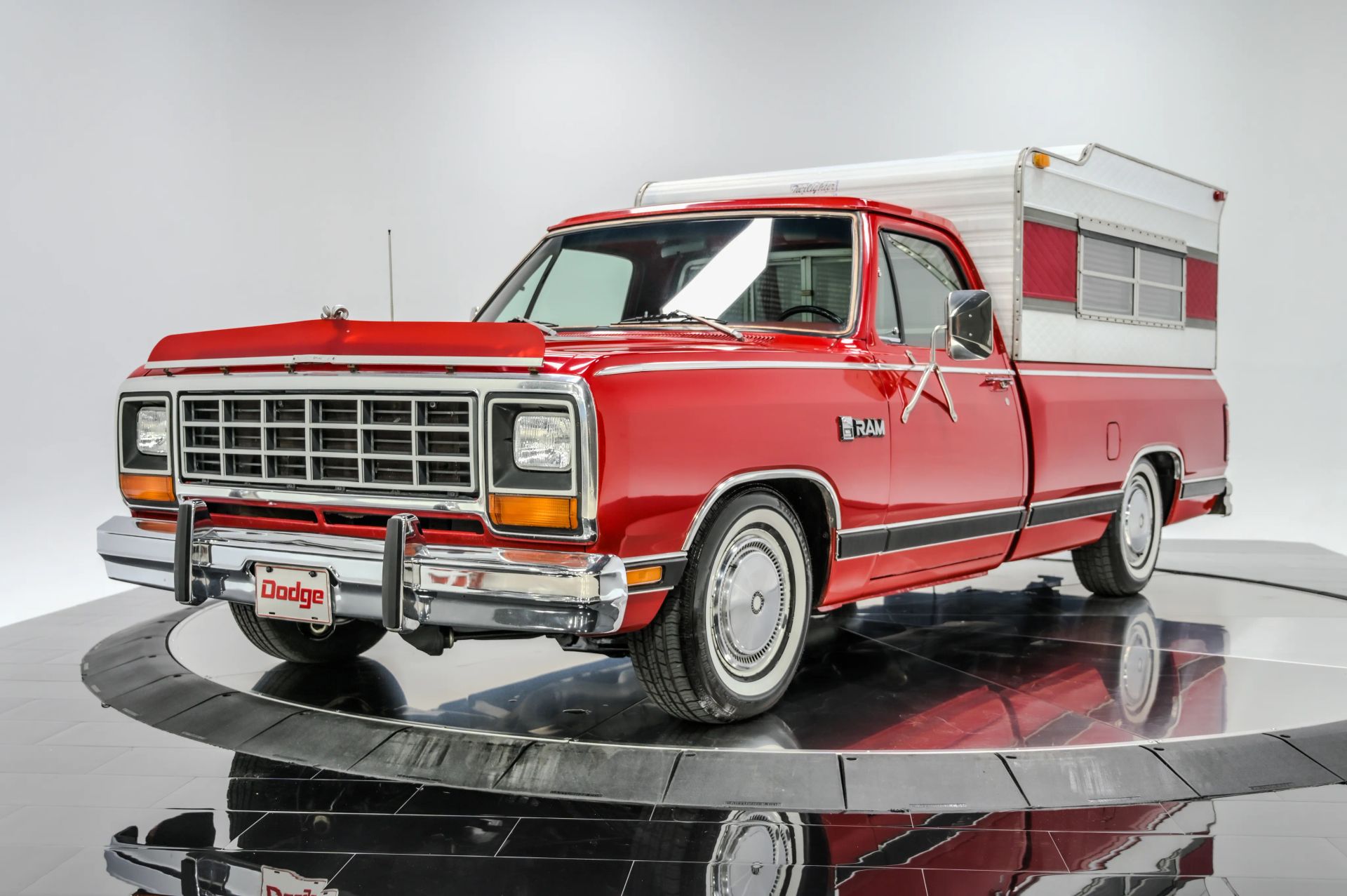
The bed rusts where every American pickup bed rusts, plus one Dodge-specific place. Wheel-arch lips perforate from the inside where the inner and outer skins sandwich mud; bed floors rust in the channels, worst at the front corners and over the crossmembers; the tailgate rots along its bottom edge and around its handle. The Dodge-specific place is the bed floor and cab back on trucks that have carried a slide-in camper or a shell for decades — like the 1985 truck in this guide's first figures — because the load traps moisture and the owner never sees the floor. If a shell or camper is fitted, insist on looking under or behind it, or price the truck as if the floor needs work. Frame rust, finally, is the walk-away category: surface scale on the rails is normal and harmless, but perforation or heavy laminar rust at the rear spring hangers, around the steering-box mount on the left rail, at the crossmembers under the cab and at the fuel-tank straps is structural, and frame repair on a half-ton of this value rarely pencils out. Take a screwdriver and a torch; tap, don't stab, and listen for the change from a ring to a crunch. For calibration, the site's own photo-note sample for this model is tiny — of the Ram 150s in the pool, only one truck has an examined photo note at all, and that one note mentions both rust and damage — so treat that as a reminder to do your own rust survey rather than as a statistic about the model.
Front suspension, steering and brakes
Two-wheel-drive trucks ride on independent front suspension — upper and lower control arms, coil springs and an anti-roll bar on most — while W150s carry the Dana 44 live axle on leaf springs. The 2WD front end wears its ball joints, idler arm and control-arm bushes in a predictable order, and the test is physical: jack under the lower arm, lever the wheel at six and twelve o'clock for ball-joint play, at three and nine for steering play, and watch which joint moves. Excess camber change and feathered front tyre wear tell the same story from the outside. Worn front ends on these trucks are usually a parts bill of $400–$1,000 and a weekend, not a catastrophe — unless the wear has been ignored so long that the tyres and the steering box have suffered with it. Coil springs sag, especially on the driver's side and on air-conditioned V8 trucks, giving the lean you check by measuring arch-to-tyre on level ground.
Steering is a recirculating-ball box with a linkage, assisted on most trucks, and its signature faults are play at the centre position and leaks. Play comes in layers: the flexible coupling ("rag joint") at the column, the intermediate shaft, the box adjustment itself, and the linkage joints. Have a helper rock the wheel through the free play while you watch each joint in turn from underneath; the joint that moves late is the culprit, and a truck whose play is all in a $30 coupling is a different buy from one whose box is worn out ($350–$700 for a rebuilt box, fitted). Boxes also leak from the sector and input seals, coating the left frame rail in ATF — which, incidentally, preserves that rail while the right one rusts. W150 steering adds the lifted-truck questions: dropped pitman arms, extended links and death wobble — a violent front-axle oscillation after a bump at speed, caused by the combination of worn joints, incorrect caster and oversize tyres, and cured by fixing the wear, not by fitting a bigger steering damper to mask it.
Brakes are front disc, rear drum, vacuum-assisted, with rear-wheel anti-lock (RWAL) appearing on later trucks. The system is simple and its faults are age: perished flexible hoses that balloon or crack, calipers that seize on their slides so the truck pulls under braking and eats one pad, rear wheel cylinders that weep inside the drum, and steel lines that corrode along the left frame rail and across the rear axle. A hard pedal with poor stopping is usually a failed booster or its vacuum supply — hiss at the pedal and a rough idle that smooths when you pinch the booster hose confirm it. A low, spongy pedal that pumps up is air or a master cylinder bypassing internally. Budget $500–$1,200 for a full hydraulic refresh on a neglected truck and treat it as non-negotiable safety work, not as a bargaining chip to defer. Handbrake cables seize in their housings, particularly on W150s that have been in mud; test the handbrake on a slope, not on the flat.
Engines in service: leaks, cooling and the smoke tests
The problem-areas view of the engines is about separating the cheap smoke from the expensive smoke, because every LA V8, Slant Six and Magnum smokes a little somewhere by now. Blue smoke in a puff at start-up after standing overnight, clearing within seconds, is valve-stem seals: live with it or fix it at leisure. Blue smoke that follows you under load and on the overrun is rings and bore wear: walk away or price an engine rebuild at $3,000–$5,500. White smoke that smells sweet and continues when fully warm is coolant — head gasket, or on a Magnum a cracked head — and the cooling system will usually confess under a pressure test. Black smoke is fuel: choke stuck, float level high, TBI injector dribbling or a dead MAP sensor, in ascending order of modernity and descending order of cost. A seller who has "just serviced it" yet presents a truck that smokes blue under load is hoping you will confuse the two blue smokes; the test drive sequence in the inspection section separates them deliberately.
Cooling systems on these trucks are marginal when neglected and adequate when maintained, and neglect is the norm: original radiators silt up, heater cores block and then leak onto the passenger floor, water pumps weep from their tell-tale hole, and the viscous fan clutch freewheels when it should drive, so the truck runs cool on the road and cooks in traffic. That pattern — temperature climbing at idle, recovering at speed — is the fan clutch or a blocked radiator, and it matters because overheating is what warps Slant Six heads and cracks Magnum heads. Oil leaks are universal: rocker covers, the rear main seal (a fine mist on the bellhousing is normal; drips that mark the ground are a $600–$1,000 job because the gearbox comes out), the oil-pressure sender at the back of the block that mimics a rear-main leak for a tenth of the price, and on Magnums the plenum pan drawing oil invisibly inward. Learn the sender trick: clean, run, and watch the sender first before condemning any seal.
Electrics and the Chrysler specifics
Chrysler electrics of this era have three signature faults, and knowing them saves you from other people's misdiagnoses. First, the bulkhead connector, where the wiring harness passes through the firewall on a multi-pin plug: its terminals corrode and overheat, causing intermittent loss of charging, lights or ignition that comes and goes with a wiggle of the harness. Look for melted plastic and green terminals; cleaning and tightening fixes most, and a bypass of the ammeter circuit is a common period repair on early trucks, where the full charging current passed through the dash ammeter and its terminals loosened and heated — a melted ammeter connection is a known fire risk carried into this era from the earliest D-Series trucks, so inspect any truck with a dead ammeter and a scorched smell twice. Second, the ballast resistor and electronic ignition box on carburetted trucks: a truck that starts on the key's start position and dies the instant you release it has a failed ballast resistor, a $10 part that has stranded more Mopars than any mechanical fault, and carrying a spare is a rite of passage. Third, grounds: the engine-to-body ground strap corrodes and produces a festival of unrelated symptoms — dim lights, wandering gauges, slow cranking — that all vanish for the price of a strap. Later trucks add RWAL warning lights from a failed rear-axle speed sensor, TBI and Magnum fault codes you can read by cycling the ignition key and counting check-engine flashes on many years, and air-conditioning that uses R12 on early trucks (expensive to refill legally, commonly converted to R134a with varying quality). Test every electrical consumer on the viewing; window motors, blower speeds and the fuel gauge (senders fail and read empty or full permanently) are all cheap individually and expensive as a list.
Interior, trim and the things that crumble
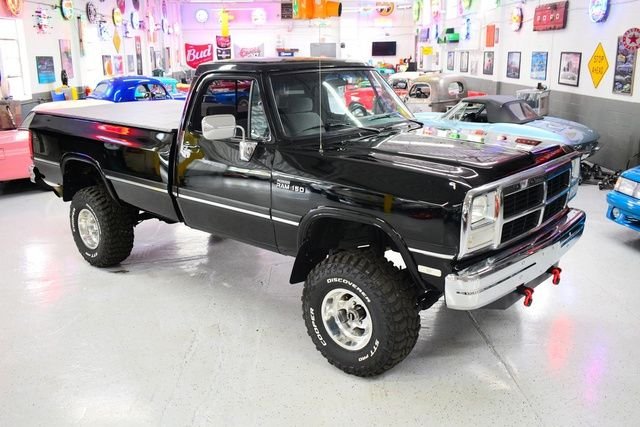
The cab is where a working life shows and where restoration money quietly disappears. Dash pads crack across the top in sun states — Florida and Tennessee trucks in the pool will show it — and replacement pads are costly or unavailable, so a cracked dash is priced in, not fixed cheaply. Seat vinyl splits along the driver's bolster seams, bench foams collapse so you sit on the frame rail, and the striped and patterned cloths of the period (the 1988 truck in this guide wears a bold striped bench cover over its seat) are not reproduced: a torn original seat in a rare pattern is retrimmed in plain vinyl or covered, exactly as you see there. Door cards warp, window winders strip, vent-window rubbers perish and whistle, and the headlining on Club Cabs sags. None of this stops the truck working, which is why interiors were neglected first — but price a full interior refresh honestly at $1,500–$4,000 if originality matters to you, and prefer the truck whose interior is tired-but-original over one retrimmed badly in the wrong materials. Glass is available, rubbers are reproduced for the common seals, bright trim and grilles are the scarce items: an unbroken eggcrate grille for an early truck or a straight crosshair grille for a late one is worth real money, and cracked grille surrounds are a reason to negotiate, because finding better is a swap-meet hobby, not a phone call.


How to inspect one
Work in this order. It is arranged so the cheap, decisive checks come first and the truck can fail early, before you have invested an hour and fallen for it.
- Paperwork and identity first. Match the VIN plate (driver's side of the dash, visible through the windscreen, and on the door label) to the title. Decode the basics: D in the body code means two-wheel drive, W means four-wheel drive. A truck whose paperwork, badges and hardware disagree — a "W150" with no front differential — is priced as what it is, or left.
- Cold start, bonnet up, no radio. Insist the engine is cold. A carburetted truck should start with the seller's stated pedal ritual and settle to a fast idle that steps down; a TBI or Magnum truck should fire immediately and idle evenly. Listen for timing-chain rattle, exhaust-manifold tick and lifter clatter that does not fade within a minute.
- The smoke sequence. Watch the exhaust at start-up (a brief blue puff is stem seals), then have the seller blip the throttle (a blue cloud is worse), and remember to repeat the observation under load and on the overrun during the drive (continuous blue is rings — see the smoke tests in Problem areas).
- Under-bonnet identity and fluids. Find the engine displacement stamp on the block and confirm 318 versus 360 with your eyes, not the decal. Check oil (level, mayonnaise under the filler cap means coolant or chronic short trips), coolant colour and level, brake fluid, and power-steering fluid. Smell the automatic's fluid on its dipstick if it is an auto; burnt is bad.
- The rust walk, in map order. Cab corners, rockers, door bottoms, floors (lift the mats), cab mounts, cowl drains (pour the jug of water), inner wings, radiator support, bed arches and floor, tailgate bottom, then underneath: spring hangers, steering-box rail, crossmembers, tank straps. This is the rust map from Problem areas, walked physically.
- Cooling and charging proof. From cold, watch the temperature gauge rise and stabilise, feel the top hose pressurise, and check the fan clutch drags when hot. Confirm the alternator charges (lights brighten slightly off idle; a voltmeter across the battery shows roughly 13.8–14.4 volts running).
- TBI and Magnum specifics. On a TBI truck, air cleaner off, watch the injector cone at idle — even mist, no dribbles. On a Magnum, do the plenum test: with the engine idling, remove the PCV valve and check for vacuum sucking at the crankcase breather — strong vacuum at the breather with the PCV removed indicates the plenum pan gasket has failed and the manifold is drawing on the crankcase. Also check for oil consumption history and a fouled rear plug if you can pull one.
- Steering and front-end play. Helper rocking the wheel, you underneath watching the rag joint, idler arm and linkage in turn; then the jack-and-lever test at each front wheel for ball joints (2WD) or kingpin/bearing play and CAD engagement (W150).
- Four-wheel drive engagement (W150). On gravel or dirt, never tarmac: engage 4-High and 4-Low, confirm drive to the front axle actually happens (a front wheel pulling, not just a lever moving), and suspect the CAD vacuum actuator first if it does not.
- The road test, in a set order. Cold manners, then a steady 45–55 mph cruise: note automatic shift quality and kickdown, overdrive engagement on A500/A518 trucks, steering centre play, brake pull, and any death wobble over bumps on a W150. Accelerate hard once (blue smoke under load?), lift off at speed (smoke on the overrun?), and brake firmly from 50 mph to a stop.
- Hot restart and idle. Back at base, switch off, wait five minutes, restart. A carburetted 360 that cranks long and smells rich is showing you the Thermoquad's heat-soak habits; a Magnum that will not restart hot wants its sensors and ASD relay checked; any truck whose oil light flickers at hot idle needs a mechanical gauge on it before you agree a price.
- The electrics sweep and the second look. Every switch: lights, wipers and washers, blower speeds, windows, gauges (especially fuel), horn, RWAL and brake warning lights proving out and extinguishing. Then walk the truck once more, slowly, looking at panel gaps and paint match in daylight — the viewing you do last, calmly, finds the filler the first excited walk missed.
If the truck passes 1, 5 and 10 cleanly, it is a real candidate and the remaining findings are price negotiations. If it fails identity, cab structure or frame condition, no engine sweetness compensates — there are other Ram 150s, and the pool turns over.
Values
Read this market by condition first and specification second, because the spread between a tired Ram 150 and a good one is wider than the spread between any two engines in the range. The same model year, in the same colour, can be a parts-grade work truck with a perforated cab or a garaged survivor with a straight bed, and those two trucks share almost nothing except a badge. The listings and recorded-sales figures appended below this guide show you the current shape of the market; your job is to place the truck in front of you on the condition ladder honestly before you compare it with any of them. The ladder, from the bottom, runs: parts and project trucks with structural rust or dead drivetrains; rolling projects that drive but need the cab welded and everything recommissioned; honest drivers with patina, working mechanics and interiors that show their years; tidy, largely original survivors; and restored or exceptional low-mileage trucks at the top. Most Ram 150s that change hands live on the middle two rungs, and most asking prices are written as if the truck stood one rung higher than it does. Your inspection, not the advert, assigns the rung.
Asking prices and achieved prices diverge in a particular way with these trucks. Because Dodge was third in the market, the audience is smaller than for a Ford or Chevrolet of the same year, so a correctly priced good truck sells steadily while an optimistically priced one sits — and sitting trucks accumulate the "reduced" adverts that make the market look softer than it is. Dealer asking prices, which is what most of the current pool represents, include preparation, warranty expectations and margin; private sales of equivalent trucks usually settle lower, and auction results for square-body-era trucks of all makes have pulled the best survivors upward while leaving ordinary trucks where they were. Variant premiums are real but modest: the Magnum V8 trucks of 1992–1993 command the strongest money for their usability, tidy W150 Power Rams carry a four-wheel-drive premium that grows in snow-belt states, short-bed standard cabs are the most wanted shape, and Club Cabs and long-beds trade at a small discount despite being rarer — rarity without demand is not a premium. Six-cylinder and V6 trucks are the value end, priced for their simplicity, and a Slant Six truck in genuinely sound order is better value than a V8 truck that needs welding, every time.
The project-versus-driver gap is where buyers lose money. A project Ram 150 looks cheap until you add the cab welding, the brake refresh, the tyres, the carburettor or TBI work and the interior, at which point you own a driver for more than the driver would have cost — with a year of weekends spent. The gap between a project and a driver in this market is rarely as large as the cost of closing it, which is the quantitative version of the oldest advice in this guide: buy the best shell you can afford. Negotiation, finally, is straightforward and factual. Arrive with your inspection findings itemised and priced — cab corners, plenum gasket, timing chain, brake refresh — and negotiate on the sum of real costs, not on a percentage off the asking price. Sellers of these trucks respond to a buyer who clearly knows what a cab corner is; they have usually met several who did not.
Parts and ownership
Ownership is easy in the ways that matter and fiddly in the ways that do not. Mechanical parts supply is excellent: the LA V8, Slant Six and Magnum engines were built in the millions across cars and trucks, so service items, engine internals, water pumps, alternators, starters and ignition components are available from any American parts store, usually off the shelf, and TorqueFlite rebuild parts are equally universal. Suspension, brake and steering wear parts are reproduced and cheap. The specialists in classic Dodge trucks, plus the general Mopar reproduction trade, cover weatherstrips, lenses, emblems and interior soft trim for the common configurations. What is genuinely scarce is large sheet metal and brightwork specific to this cab: good used grilles, straight bumpers, unrusted tailgates and clean Club Cab trim, all of which you source used, at swap meets and through the owners' clubs and forums, at prices set by patience. A truck missing its grille surround or carrying a smashed tailgate should be priced with that hunt in mind.
Running costs are period-truck costs. Fuel economy is what it is: a carburetted V8 returns figures in the low-to-mid teens in mixed use, the TBI trucks a little better, the Magnums the best of the V8s, and the sixes the best overall if driven gently — budget by the tank, not by the brochure. Insurance on agreed-value classic policies is straightforward for standard and lightly modified trucks; heavily lifted W150s need a specialist conversation. Servicing is driveway work: oil and filter every 3,000–5,000 miles, plugs and ignition service annually on carburetted trucks, coolant every two years (the cooling system is the engines' life insurance), automatic fluid and filter every 30,000 miles, and a grease gun on the front-end and driveshaft points that have nipples. Keep a ballast resistor and, on a Magnum, an automatic-shutdown relay in the glovebox; both are cheap, both fail without warning, and both turn a breakdown into a five-minute stop. Store the truck dry if you possibly can — every rust location in this guide starts with trapped water — and if you must choose one preservation job, clean the cowl drains and the bed-arch lips and wax-protect the cab corners. The community is a strength: the first-generation Ram has an active forum and club scene, factory service manuals are reprinted and affordable, and almost every fault in this guide has a documented fix with photographs a search away. Buy the manual for your year before you buy parts for any significant job.
Which one to buy
- The all-rounder: a 1988–1991 D150 with the 318 and throttle-body injection — easier starting and better manners than the carburetted trucks, simpler and cheaper to fix than a Magnum, and the widest choice of survivors.
- The modernised buy: a 1992–1993 Ram 150 with the 5.2 Magnum (or the 1993-only 5.9) — the strongest, cleanest-driving truck of the line; budget for the plenum-pan test and fix, and check the heads' cooling history.
- The character buy: an early 1981–1985 truck, ideally a Slant Six or 318 in honest original order — the eggcrate grille, the ram ornament and the carburettor ritual are the purest form of the model, bought for charm, not convenience.
- The working buy: a W150 Power Ram with the 360, unlifted or mildly lifted, with proven CAD and transfer-case operation — the truck that still earns its keep, provided the frame and spring hangers pass the rust walk.
- The value buy: a 3.9 V6 or Slant Six truck with an exceptional cab and bed — you are buying the shell at a discount for its engine badge, and a sound shell is the one thing money cannot easily add later.
- The one to avoid: any truck, however rare its trim or strong its engine, with perforated cab mounts, cab corners and frame rails together — that combination is a restoration, not a purchase, and should be priced as one.
The overriding rule: buy the cab and the frame, and let the engine be the bonus — a Ram 150's drivetrain can always be rebuilt in a weekend-scale budget, but a rusted-out cab and chassis will cost more than the truck is worth, every single time.
See the 3 Ram 150 cars currently listed.
For sale now
 $20,100 · 11% above typical
Expand
What they sell for: Ram 150 sale prices.