
Fiat 500 buyer's guide
Fiat 500 -- the model's own buyer's guide: variants, values and what to check.
Years listed: 1970-1973 · Series: 500
Overview and history
The Fiat 500 is two entirely different cars sharing one name and one silhouette, and the first job of any buyer is to know which of the two is standing in front of them. The original — the Nuova 500, built from 1957 to 1975 — is a tiny rear-engined, air-cooled two-cylinder car designed by Dante Giacosa to put postwar Italy on wheels. The revival car, launched in 2007 and sold in the United States from 2012 to 2019, is a modern front-engined, front-wheel-drive hatchback in a retro-styled suit. They share a shape, a badge and almost nothing else: no panel, no engine part, no mechanical component of any consequence interchanges, they drive nothing alike, they fail in completely different ways, and they are bought by different people for different reasons. Sellers blur the line constantly, sometimes innocently — our own listings have carried a classic car titled with a modern trim name, as the models section explains — so learn the tells now.
The tells are easy once you know them. A classic 500 has its engine in the back: look for the slatted, louvred engine lid behind the rear window, the little air-cooled twin's cooling slots, and no radiator grille of any function at the front — the smooth front panel hides a small luggage boot and the fuel tank. It is genuinely tiny, just under ten feet long, with 12-inch wheels, a canvas sunroof panel on most cars, a painted metal dashboard with a single round speedometer pod, and a four-speed gearbox with no synchromesh. A modern 500 is a foot and a half longer, has a proper water-cooled engine under a front bonnet, five seats' worth of modern crash structure, airbags, air conditioning that works, and a dashboard full of electronics. If the car has a touchscreen, it is not a classic. If it has cooling slots in the rear lid and a choke lever between the seats, it is.
The classic story starts in July 1957. Italy in the 1950s was a country of scooters and bicycles; the Vespa and Lambretta had mobilised it on two wheels, and Fiat's 600 of 1955 had shown that a small four-seater could sell in enormous numbers. The Nuova 500 — "Nuova" to separate it from the prewar 500 Topolino — went one step smaller and cheaper: a unitary steel body barely three metres long, an air-cooled 479 cc twin-cylinder engine in the tail making just 13 horsepower, independent suspension all round, and room, in theory, for four. It was slow, noisy and crude, and Italy bought it in the millions. Over eighteen years the car was developed in small, careful steps — more power, proper doors, better trim, a bigger engine at the end — without ever changing its fundamental architecture, and total production reached roughly 3.9 million cars, plus licensed and related production abroad. The 500 did for Italy what the Beetle did for Germany and the Mini would do for Britain, and it has the same cultural afterglow: it is loved far beyond its objective merits, which is precisely why you must inspect one with your head and not your heart.
Fiat never officially sold the classic 500 in the United States in period — American Fiat dealers sold the larger 600 and its derivatives — so every classic 500 in America today is an import: brought in by servicemen, immigrants, collectors, and, in the last two decades, a steady trade in European cars imported under the 25-year exemption once values made shipping worthwhile. That import history matters to a buyer. Paperwork varies, European-market specification is the norm, speedometers read in kilometres as often as miles, and the car's life before America is frequently undocumented. The American market is also thin compared with Europe's: parts and knowledge cross the Atlantic easily, but local comparable sales are few, which cuts both ways on price, as the values section discusses.
Our own current listings show the American market in miniature. All seven Fiat 500s currently listed with us are classic cars, built between 1965 and 1972 — the mature F and L era of the model — and every one of them carries the manual gearbox, as every classic 500 must: no automatic classic 500 exists, so an "automatic" classic is a listing error, full stop. No modern 500 sits in our current pool at all. That weighting is honest for a classic-car marketplace, but the modern cars fill the wider market and the classifieds you will search, and a modern 500 at classic-500 money — or a classic advertised with modern trim names — is a confusion you will meet within your first week of looking. This guide therefore covers both cars, weighted toward the classic, and flags the split at every point where it changes what you should do.
One more framing point. The classic 500 is a simple car — two cylinders, one carburettor, drum brakes, a dynamo — and almost everything on it can be understood, tested and repaired by a competent home mechanic, with superb parts support. But simple is not the same as forgiving. The newest classic 500 is fifty years old, the bodies were thinly protected against rust when new, and the car's charm has made it a magnet for cosmetic restorations over tired structure and for tribute cars wearing badges the factory never fitted. Buy the car, not the story, and use the inspection routine in this guide in order.
The models
Every classic 500 is a two-door saloon with a rear-mounted air-cooled twin and a four-speed manual transaxle; the variations are in capacity, trim, door hinges and roof. The range also includes a longer estate, the open-topped Jolly beach car, and the Abarth performance derivatives, which are different enough in value and risk to be treated as models in their own right. The modern car is a separate range entirely and is listed at the bottom of the table so the split stays visible.
| Model | Years | Engine | Output | Built | Character |
|---|---|---|---|---|---|
| Nuova 500 / 500N | 1957–1960 | 479 cc twin | 13–16.5 hp | Part of c.3.9 million total | The original: suicide doors, minimal trim |
| 500D | 1960–1965 | 499.5 cc twin | 17.5 hp | Large volume | The car finds its form; suicide doors to 1965 |
| 500F | 1965–1972 | 499.5 cc twin | 18 hp | The bulk of production | Front-hinged doors; the definitive classic 500 |
| 500L | 1968–1972 | 499.5 cc twin | 18 hp | Large volume | The luxury trim: padded dash, better seats |
| 500R | 1972–1975 | 594 cc twin | 23 hp | Final run | Bigger engine, plainer trim, built alongside the 126 |
| 500 Giardiniera | 1960–1977 | 499.5 cc twin (laid flat) | 17.5–18 hp | Substantial minority | The estate: longer, load flat floor, outlived the saloon |
| 500 Jolly (Ghia) | 1958–1966 | 479/499.5 cc twin | 16.5–18 hp | c.650 | The beach car: open body, wicker seats, fringe canopy |
| Abarth 595 | 1963–1971 | 594 cc Abarth twin | 27 hp | Low thousands | The first hot one: real ones are documented |
| Abarth 695 / 695 SS | 1964–1966 | 695 cc Abarth twin | 30 hp / c.38 hp (SS) | Very low | The serious Abarth; the most faked badge in the range |
| 500 (modern) | 2007–2019 (US 2012–2019) | 1.2/1.4 petrol, TwinAir, diesel | 69–100 hp | Millions | Front-engined revival; US cars built in Mexico |
| 500C (modern) | 2009 onward | As modern 500 | 69–100 hp | — | Roll-back canvas roof over fixed arches |
| Abarth 500 (modern) | 2008 onward (US 2012) | 1.4 turbo MultiAir | 135–180 hp (US 160 hp) | — | The modern hot one; a different species entirely |
| 500e (modern) | 2013–2019; new car 2020 onward | Electric | 111 hp (first gen) | Compliance-car volume, then a full EV range | Silent, front-drive; the name's third act |
Production figures for individual classic variants were never published by Fiat in a reliable split, so the table gives exact numbers only where they are genuinely documented — the Jolly's tiny Ghia run and the model's roughly 3.9 million total — and honest volume descriptions elsewhere. Anyone quoting you a precise build count for, say, the 500L is inventing it.
The early cars: Nuova 500 and 500D (1957–1965). The 1957 car is a museum piece as much as transport: 479 cc, 13 hp at launch (rising to 16.5 hp within the run), rear-hinged "suicide" doors, a full-length canvas roof on the earliest cars, and trim so sparse it makes the later cars look plush. The 500D of 1960 brings the definitive 499.5 cc engine at 17.5 hp and a smaller steel sunroof panel in place of the full canvas top. Suicide doors last until 1965, which makes hinge wear and doors that sit flush a genuine inspection item on D cars. Early cars are the most collectible of the standard range and the least usable: slowest, crudest, and with the thinnest parts support for their unique trim.
The 500F (1965–1972). The car most buyers will meet, and the one our listings are made of. Front-hinged doors arrive with the F — the single easiest dating tell on the whole range — along with a stronger clutch, better brakes in detail and the 18 hp version of the 499.5 cc engine. The F is the sweet spot of the classic range: old enough to be the real thing, developed enough to be usable, and built in such numbers that every part is available. Modified Fs are common and can be great fun, but they are worth modified-car money, not original-car money, and the work's quality becomes part of the inspection.
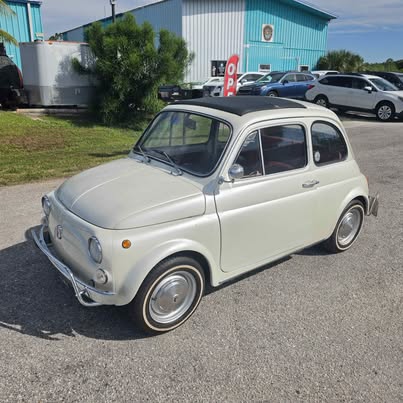
The 500L (1968–1972). The L is an F in a better suit: a padded dashboard, reclining seats with plusher trim, carpet instead of rubber mats, chrome nudge bars on the bumpers and a fuel gauge — a real novelty in a range where the standard car makes do with a reserve warning light. Mechanically it is identical to the F, so buy an L on condition exactly as you would an F, and pay the premium only for a genuinely complete, correct interior, because L-specific trim is the expensive part to put right.
The 500R (1972–1975). The last of the line, built alongside its successor, the Fiat 126, from which it borrows the 594 cc, 23 hp engine — the classic 500's biggest power step and a useful one on modern roads. In exchange, Fiat trimmed the specification back: plainer trim, simpler seats, wheels shared with the 126. The R is the most usable classic 500 and, because it was the cheap end of the range, survivors in good order are scarcer than the F. A correct R is a smart buy; a scruffy one offers nothing an F does not.
The Giardiniera (1960–1977). The estate — also sold as the Autobianchi Giardiniera in later years — stretches the wheelbase, lays the engine on its side under the load floor to give a flat cargo deck, and adds a side-hinged rear door. It outlived the saloon by two years and is the most practical classic 500 by a wide margin. Its unique panels, glass and laid-flat engine parts are the ownership catch: saloon mechanicals mostly fit, Giardiniera body parts do not grow on trees.
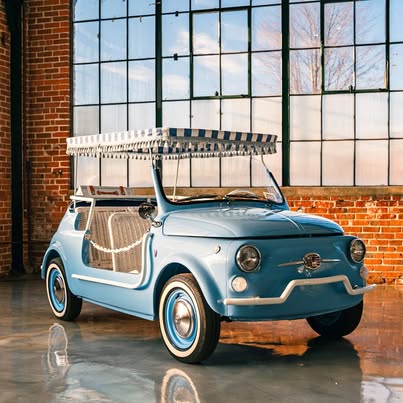
The Jolly (1958–1966). Ghia's beach car for Fiat's chairman Gianni Agnelli and his Riviera set: the roof and doors cut away, wicker seats, a fringed surrey canopy on slim poles, and no weather protection whatsoever. Around 650 were built, period prices were roughly double a standard car's, and survivors are valuable, blue-chip collectibles. They are also the most replicated car in this guide: cutting a standard 500 into a Jolly tribute is a known conversion, and tributes are openly sold as such — and sometimes not openly. A genuine Jolly is a documented car; its premium lives in Ghia provenance and paperwork, not in the wicker. Treat any undocumented Jolly as a tribute and price it as one, however good it looks.
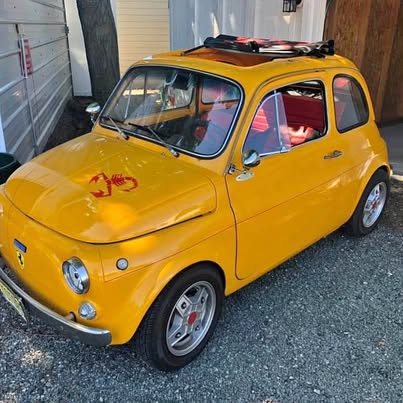
The Abarth cars (1963–1971). Carlo Abarth's versions — the 595 with 594 cc and 27 hp, the 695 with 695 cc and 30 hp, and the 695 SS at around 38 hp — transformed the 500 with raised compression, a hotter camshaft, a larger carburettor, a free-flowing exhaust and an engine lid propped open on struts to cool the harder-worked twin. Genuine cars were built in small numbers, carry Abarth identity in their engine numbers and build records, and are worth serious multiples of a standard car. The predictable consequence: tribute Abarths outnumber real ones many times over. The yellow car in our pool, photographed below, shows the tribute presentation — enjoyable and legitimate as a style, but a buyer pays Abarth money only for an Abarth engine number and paperwork, never for badges.
The modern cars (2007 onward). The revival, styled from the 2004 Trepiùno concept, is a front-engined hatchback on Panda-derived underpinnings: 1.2 and 1.4 FIRE petrol engines, the characterful 0.9 TwinAir two-cylinder turbo — a deliberate echo of the original — and a 1.3 diesel in Europe. The 500C adds a roll-back canvas roof over fixed side arches; it is not a true convertible, which is why the modern trim name "500C" attached to a classic car is always an error. American cars were built in Toluca, Mexico, sold from 2012 to 2019 in Pop, Sport and Lounge trims with a 1.4 MultiAir engine, plus the 160 hp turbocharged Abarth and the 500e electric compliance car. A wholly new electric-only 500 arrived in 2020 and reached the US as the 2024 500e. Modern cars are used cars, not classics: buy them on service history, electronics health and accident record, and never let a seller price one off classic-500 nostalgia.
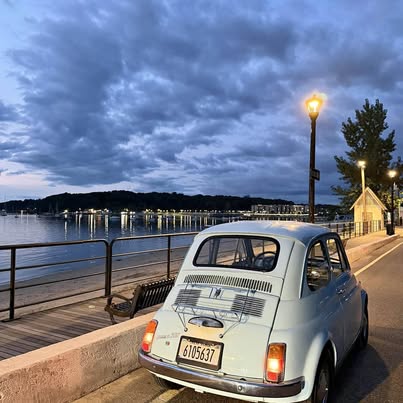
That naming trap deserves one direct example, because it sits in our own pool: a blue 1969 car in our listings is titled with the words "500C Lounge Convertible" — Lounge and 500C are modern trim names that did not exist until four decades after the car was built, and the car itself, photographed from the rear below, is a classic closed saloon with the slatted engine lid of the air-cooled car. The title is wrong; the car is a classic 500. When paperwork and car disagree, believe the car, then make the seller fix the paperwork before money moves.
Engines and gearboxes
Two engine stories run through this guide and they never meet. The classic car has one engine in three capacities — an air-cooled, overhead-valve parallel twin of 479, 499.5 or 594 cc — developed gently over eighteen years and tuned hard by Abarth. The modern car has a range of water-cooled fours (and one two-cylinder) from Fiat's FIRE and MultiAir families, plus electric drive. Judge each by its own rules: the classic twin is judged on cooling, oil control and how it sounds; the modern engines are judged on service history, belts and electronics.
The classic twin: Tipo 110 in 479, 499.5 and 594 cc
The engine Giacosa chose for the Nuova 500 is a two-cylinder four-stroke with its cylinders in line fore-and-aft, air-cooled by a belt-driven fan, with overhead valves worked by pushrods from a single camshaft. It displaces 479 cc in the 1957 car (13 hp, soon 16.5 hp), grows to 499.5 cc for the D of 1960 (17.5 hp, and 18 hp in F and L form), and ends at 594 cc in the R (23 hp), an engine shared with the Fiat 126. A single downdraught Weber 26 IMB carburettor feeds all standard versions. There is no water pump, no radiator, no thermostat in the water sense and no heater matrix: cabin heat comes from air ducted over the exhaust, which is why a classic 500's heater smells of the engine and why exhaust leaks are a cabin-fume issue, not just a noise.
Understand the cooling system, because it is the engine's life. The fan, driven by a belt that also drives the dynamo, blows air over finned cylinders inside a tin cowling; a thermostat-operated flap regulates the airflow. Anything that reduces that airflow or the fan's speed cooks the engine in traffic on a hot day: a slack or glazed belt, missing or ill-fitting cowling tinware, oil and road dirt caked between the fins, or a thermostat flap stuck shut. Air-cooled engines give little warning before damage — there is no temperature gauge on a standard 500, just an oil-pressure light and a dynamo light — so the first sign of overheating is often a loss of power, pinking, and a hot-oil smell, by which time the heads may already have suffered. The inspection section gives you the checks; the ownership rule is simpler: belt, tinware and clean fins are service items, not details.
The twin's character is honest and mechanical. It starts on a choke — the lever between the seats, next to the hand-operated starter lever on early cars — settles to a busy, offbeat idle, and pulls with more willingness than 18 hp suggests because the car weighs barely 500 kg. Valve clearances are set with feeler gauges, ignition is by points and condenser in a distributor driven from the camshaft, and the whole engine can be removed downwards in an afternoon. Oil leaks are endemic — rocker cover, pushrod tubes, crank seals — and a dry classic twin is either freshly sealed or out of oil; what matters is rate, not presence. Oil consumption from worn valve guides and rings shows as blue smoke on the overrun and after idling at lights. Compression should be even across the two cylinders; with only two, one weak cylinder is half your engine, and you will feel it as a lopsided, chuffing idle that no amount of carburettor adjustment will smooth.
Swaps are common and not necessarily bad. The 594 cc engine from a 126, and even the later 652 cc 126 BIS engine's internals, drop into a classic 500 with little drama, and many F and L cars now run 594 power. A well-done 594 swap makes the car better to drive and is widely accepted in the classic market — but it must be priced as a modification, and it instantly settles any "matching numbers" claim the seller is making. The engine number is stamped on the block; check it against the seller's story before you pay for originality.
Abarth derivatives
Abarth's 595 and 695 are the same architecture worked hard: capacity out to 594 or 695 cc with a different crankshaft and pistons, compression raised, a larger carburettor, a camshaft with real overlap, a bigger-capacity sump, and the famous Abarth exhaust. Output climbs to 27 hp for the 595, 30 hp for the 695 and roughly 38 hp for the 695 SS — trivial numbers by modern standards, transformative in a 500 kg car, and bought at the price of heat, noise and shorter service intervals. The propped-open engine lid on Abarth cars is functional: the hotter engine needs the airflow. On a genuine Abarth, identity lives in the engine: Abarth-stamped components, the correct engine number sequence and build documentation. On a tribute, everything you can see is copyable, and usually copied. Never let the inspection of an "Abarth" start anywhere but the engine number and the paperwork.
Modern engines: FIRE, TwinAir, MultiAir and electric
The modern 500's European range centres on the FIRE fours: the 1.2 with 69 hp — simple, slow and nearly unburstable — and the 1.4 with 100 hp. The 0.9 TwinAir is the character pick: a turbocharged two-cylinder with an offbeat thrum deliberately reminiscent of the original, 85 or 105 hp, and real economy when driven gently. American cars standardised on the 1.4 MultiAir (101 hp, turbocharged to 135 hp in the 500 Turbo and 160 hp in the US Abarth), where the MultiAir electro-hydraulic inlet system is the known weak point: it is oil-sensitive, and skipped oil changes with the wrong grade of oil show up as misfires and MultiAir unit failure, a repair that runs into four figures. Timing belts on the petrol fours are a scheduled replacement, not a lifetime item — a modern 500 with no belt history needs one immediately, budgeted into the price. The first-generation 500e (2013–2019) is a 111 hp electric conversion sold for Californian compliance; the 2020-onward 500e is a purpose-built EV with a choice of battery sizes. Both are judged like any used EV: verified range on a test drive, charging behaviour, and battery-health evidence, not nostalgia.
Gearboxes
The classic 500's four-speed transaxle is the feature that surprises every first-time driver: it has no synchromesh at all. Every shift, up and down, is a double-declutch shift if you want it clean, and first gear is for starting only. This is not a defect to be negotiated away — it is how every classic 500 ever built behaves, and a seller who apologises for "a bit of crunch" is describing a healthy box being shifted like a modern car. What a healthy box does not do is jump out of gear (worn detents and engine mounts are the usual causes), whine excessively under load, or refuse second gear when shifted with a proper double-declutch pause. The clutch is a simple single dry plate with cable operation; a heavy pedal is usually the cable and its routing, not the clutch itself. Gear linkage bushes wear and make the change vague — cheap parts, fiddly access. The transaxle shares its oil with the gearbox; leaks from the driveshaft boots and seals are the norm, and a car that has run the box dry will whine forever after. Rear swing axles mean the rear wheels change camber dramatically with load — normal, and part of the handling you are buying.
The modern car offers a conventional five-speed manual (the pick of the range), the Dualogic robotised manual — a manual gearbox with automated clutch and shift actuators, whose hesitation and actuator faults make it the one to avoid unless it is demonstrably healthy — and, in America, a six-speed automatic. The modern Abarth's five-speed manual is strong; its clutch takes the abuse of the turbo engine's torque and is a wear item to test on hills. Electric 500es are single-speed. None of this has anything in common with the classic box beyond the badge, which is the split in miniature.
Problem areas
A classic 500 fails in a short, knowable list of places: the body rusts, the engine overheats or leaks, the running gear wears, and the paperwork lies. The modern car fails like any modern Fiat: electronics, robotised gearboxes, MultiAir units and accident damage. Work through the classic list first — it is where our market lives — then the modern notes.
Rust: the map
Rust is the classic 500's defining problem, and it is structural, not cosmetic, because the little unitary shell has no chassis to hide behind. These cars were built from thin steel with minimal rustproofing, and most have lived in wet European climates. Learn the map and check it in this order.
The floor pans rot from the inside out: water from leaking screens and sunroof drains sits under rubber mats (or under an L's carpets) and eats the floors around the seat mountings and the front footwells. Lift the mats — a seller who will not let you lift the mats has told you what is under them. The sills are the car's main strength member and its favourite rust trap: they go at the jacking points first, then along their length, and a sill that crunches under thumb pressure or flexes when the car is jacked on it is a welding job, not a filler job. Expect proper sill replacement, with the car braced, to cost in the region of $800–2,000 a side depending on how far the rot has travelled into the floor and inner sill.
The front end collects water around the battery, which sits in the front boot: battery acid and standing water attack the boot floor and the inner wings, and the front panel below the headlamps rusts from behind its own seams. The front crossmember and the transverse leaf-spring mounting area are structural and must be solid. Door bottoms and door skins go on all cars; on suicide-door D and early cars, check the hinge pillars twice as hard, because the door's weight hangs off them. Rear wheel arches rust at the lip and where they meet the sill, the rear valance and engine-lid edges bubble from the seams, and the panel around the sunroof aperture rusts where the canvas frame traps water — check the roof skin around the aperture with the roof open, and look for headlining stains that betray it. The Giardiniera adds a long load floor and a side-hinged rear door to the list; treat every extra seam as suspect.
Distinguish restoration from concealment. Fresh underseal over rust, new paint with bubbling already returning at the seams, and magnetic filler over the sill ends are the three classic tells. A magnet, a torch and your thumbnail are the tools: filler does not ring like steel, and rust bubbles push back softly. A properly restored shell — floors, sills, arches, documented with photographs of bare metal — is the most valuable thing a classic 500 can have, worth more than any engine work, because engine work is cheap and shell work is not.
The classic engine and gearbox in service
Overheating is the mechanical killer. The causes, in order of frequency: a slack, glazed or wrong fan belt; missing cowling pieces after previous engine work — the tinware is a system, and two missing pieces can halve the airflow; cooling fins packed with oily dirt; a thermostat flap stuck closed; and, on cars that have been "improved," a bigger engine making more heat than the standard cooling can shed. The damage shows as pulled cylinder-head studs, warped heads, scored barrels and an engine that uses oil and loses compression. A twin that has been cooked is a rebuild: budget $2,500–4,500 for a proper engine rebuild with machining, and treat a seller's "they all run hot" as an admission.
Oil control is the second theme. Worn valve guides puff blue smoke on start-up; worn rings smoke under load; tired crank seals fling oil over the engine bay, where it coats the cooling fins and feeds the overheating problem above — the two faults compound each other, which is why a smoky, oily twin deserves a compression test before any other negotiation. Ignition is points-based: a car that will not idle or misfires under load often needs nothing more than points, condenser and plugs, a $50 parts bill and an hour, but the same symptoms hide a worn distributor shaft, so check for play. The Weber 26 IMB wears at the throttle spindle and ices in cold damp weather; a flat spot just off idle is usually spindle wear or a perished accelerator-pump diaphragm, both cheap, both commonly misdiagnosed as "needs a bigger engine."
The crash gearbox wears honestly: jumping out of gear, especially second on the overrun, means internal wear and a rebuild — a gearbox rebuild with bearings and synchro-less dog components typically runs $900–1,800 in labour and parts through a specialist — while vagueness is just linkage bushes. Clutch judder is usually oil contamination from a leaking crank seal, which means the engine or gearbox comes out either way; price it in. Driveshaft couplings and boots perish, and the rear swing-axle geometry eats rear tyres on cars whose tracking and ride height have been fiddled with. None of this is exotic; all of it is checkable on a test drive, which is why the inspection section insists on one.
Suspension, steering and brakes
The front suspension is Giacosa simplicity: a transverse leaf spring doubles as the upper suspension member, with lower wishbones, telescopic dampers and kingpins that must be greased — neglected kingpins wear oval, giving steering shake and vague straight-line behaviour that owners misdiagnose as tracking. Grab the front wheel at twelve and six o'clock and rock it: play means kingpin or bearing work. The steering is a worm-and-roller box with a long column; play at the rim beyond an inch or so of free movement means box wear or loose mountings, and a car that wanders is telling you about kingpins, steering box and rear swing-axle bushes together. Rear suspension is by semi-trailing arms and coil springs; tired dampers make the light rear end patter and hop on broken surfaces, which in a rear-engined car is a handling issue, not a comfort footnote.
Brakes are drums all round on every classic 500, with a single-circuit hydraulic system on standard cars — one failed wheel cylinder or perished hose can take the whole system, so brake hydraulics on a classic 500 are a replace-on-age item: budget $400–800 for a full hydraulic overhaul of cylinders, hoses and shoes, and treat any car without evidence of recent brake work as needing it. The test is a firm, high pedal that stays firm, a car that pulls up straight, and a handbrake that holds on a hill — the handbrake works on the rear drums through cables that stretch and seize. Stopping distances are 1960s distances; a well-sorted 500 stops adequately, a neglected one is genuinely dangerous, and there is no upgrade path that keeps the car original beyond quality components and correct adjustment.
Electrics, trim and the sunroof
Classic electrics are minimal — a dynamo, a regulator, a fusebox you can count on one hand — and faults are almost always earths, corroded bullet connectors or a tired dynamo rather than anything mysterious. Dim lights and a flickering charge light at idle are normal dynamo behaviour to a degree; no charge at all is brushes or regulator, both cheap. The wiper motor, the single-speed heater fan and the horn are the whole comfort load. What is not cheap is trim: the L's padded dashboard cracks and is hard to replicate correctly, seat vinyl splits at the seams, the little plastic switchgear crumbles, and chrome — hubcaps, bumpers, the moustache grille trim on early cars — pits. A full retrim in correct materials runs $1,500–3,000; price shabby interiors accordingly, and remember the F's plain trim is easier and cheaper to make right than the L's.
The canvas sunroof is a feature and a leak path. The fabric perishes, the frame's seals harden, and the aperture rusts as described above. A new canvas and seals is a few hundred dollars in parts; a rotted aperture is welding. Operate the roof on inspection — it should slide and latch without force — and pour no water over it unless the seller agrees, but do look for the water stains that tell you what happens when it rains.
Identity, tributes and paperwork
The classic 500's risks concentrate where money meets badges. Abarth tributes and Jolly conversions have been covered above: the rule is that provenance is paperwork, and an undocumented car is a tribute whatever it looks like. Engine swaps to 594 cc are common and acceptable when disclosed and priced; undisclosed, they void any originality claim. Year claims drift: cars are titled by import year, first-registration year or seller optimism, and the F's front-hinged doors, the D's suicide doors and the R's 594 engine are better evidence than the title's model year — check the car against the chronology in the models section. Chassis numbers on classic 500s are stamped on the body in the front boot area and on the maker's plate; the two must agree with each other and with the title. Imported cars may carry European paperwork in Italian, French or German — the red car in our pool still wears a French registration plate in its photograph, which is normal for a fresh import and a reminder to check that US title and import documents are complete before money moves, not after. A car that cannot be titled in your state is not a bargain at any price.
The modern car: its own list
Modern 500s rust far less — galvanised shells see to that — but bring modern faults. MultiAir failure from neglected oil changes leads the list on US cars, followed by Dualogic actuator faults on robotised cars, failed rear hatch wiring looms (the wires fatigue where the hatch flexes them, killing the wiper, lock and number-plate lights), worn front suspension arms and drop links on city cars, and air-conditioning condensers holed by road debris. The 500C's canvas roof mechanism is reliable but expensive when its cables or motor fail, and accident damage is the modern car's rust-equivalent: check panel gaps and paint match, because a cheaply repaired modern 500 is worth no premium over an honest one. First-generation 500es add battery-health questions; a car that will not demonstrate its claimed range on your test drive is telling you the truth about its battery. None of these faults is a reason to avoid the modern car — it is a reason to buy it like a used car, on history and evidence, not like a classic.
How to inspect one
Inspect a classic 500 in this order: identity first, then shell, then engine, then the drive. The order matters because the cheap checks kill the bad cars — there is no point falling for a sweet-running engine in a car whose sills are filler or whose chassis number does not match its title. Allow an hour, bring a magnet, a torch, a rag and a friend to work the pedals and steering while you watch.
- Settle the split. Before anything else, establish which 500 this is: slatted rear engine lid and cooling slots mean classic; a front bonnet over a water-cooled engine means modern. Then check the listing's words against the car — modern trim names like Lounge or 500C on a classic car, or a classic year on a modern car, mean the paperwork needs correcting before the sale, as the models section's example shows.
- Check the identity. Read the chassis number in the front boot and on the maker's plate, and the engine number on the block. All three must agree with the title and with each other. On an "Abarth" or a "Jolly," this step is the inspection: no Abarth engine number and documentation, no Abarth price; no Ghia provenance, no Jolly price.
- Date the car from its features. Front-hinged doors say F or later; suicide doors say D or earlier; a 594 engine in a saloon says R or a swap. If the features and the claimed year disagree, the features are right and the price follows the features.
- Do the sill test. Crouch at each side and press the sill hard with your thumbs along its length, especially at the jacking points. It must feel like steel everywhere. Soft spots, crunching or fresh thick underseal exactly at the jacking points end the inspection until the seller explains them — the rust section explains why this panel carries the car.
- Lift the mats and look at the floors. Front footwells, seat mountings, rear floor. Surface discolouration is normal; holes, plates riveted over rot, and damp insulation are not. While the mats are up, look at the battery area in the front boot for acid damage and boot-floor rust.
- Walk the rust map. Arches, door bottoms, front panel, rear valance, engine-lid edges, and the skin around the sunroof aperture, with the magnet working every seam. Bubbling at a seam is rust arriving from behind it; price the panel, not the bubble.
- Open the sunroof and the engine lid. The canvas should slide and latch; look for headlining stains. At the back, check the cowling tinware is all present around the engine, the fan belt is tight and unglazed, and the cooling fins you can see are clean, not caked in oily dirt — the three checks that predict overheating, per the engine section.
- Start it from cold. Insist on a cold engine — a warmed-up twin hides starting and smoke faults. It should fire on the choke, smoke little and briefly, and settle to an even, busy idle. Blue smoke that persists, or a lopsided chuffing idle, points at rings, guides or one weak cylinder: ask for a compression test before proceeding.
- Check the oil story. Oil on the dipstick at a sane level and not tar-black; filler cap free of mayonnaise-like emulsion (short-trip condensation can cause a trace, heavy deposits mean neglect). Look under the engine for the leak rate — drips on the ground after the test drive will quantify what you see.
- Drive it, and shift it properly. Double-declutch your changes and judge the box by the gearbox section's standard: clean engagement when shifted correctly, no jumping out of second on the overrun, no whine that rises with road speed. A box that crunches only when you rush it is healthy; one that crunches when you do it properly is not.
- Brake and steer. From 40 mph, brake firmly in a straight line, hands light on the wheel: it must pull up straight with a high, firm pedal that does not sink. Rock the steering at rest for free play, and on the move note wander — then have your friend rock each front wheel at twelve and six while you watch the kingpins for play.
- Test the heat. End the drive with ten minutes of slow traffic or idling, then park and watch: pinking, power loss, a strong hot-oil smell or the engine running-on when switched off all say the cooling system is marginal. Switch off, restart after five minutes — a heat-soaked twin that will not restart hot is telling you the same story.
- Do the electrics lap. Lights, indicators, wipers, horn, heater fan, and both warning lights behaving — oil light out once running, charge light out above idle. On a modern car this step expands: every switch, the hatch electrics (rear wiper, lock, plate lights — the loom fault), air conditioning cold, and no warning lights at all.
- Close on paperwork. Title in the seller's name, import documents complete for a classic, service history for a modern car (belt and oil history above all), and restoration photographs for any car claimed as restored. Photographs of bare-metal shell work are worth more than a folder of parts receipts.
Values
The build's market block below this guide carries the current numbers — what is listed now and what recorded sales show — and this section teaches you how to read them, because the Fiat 500's spread between cheapest and dearest is among the widest of any car in our listings, and the reasons are structural.
Condition is the first driver, and on the classic car it means shell condition above all. The gap between a project classic 500 — running, complete, but needing floors and sills — and a properly restored car is not a percentage, it is a multiple, because the restoration work costs roughly the same whether the car is an F or an L while the finished values differ. Read any price against the shell evidence: a shiny car with undocumented bodywork sits, for pricing purposes, nearer the project end than the restored end until photographs prove otherwise. Mechanical condition moves money less, because the twin is cheap to rebuild relative to bodywork; a car with a tired engine and a superb shell is a better buy at the same price than the reverse, every time.
Variant is the second driver, and it is where the premiums live. Genuine Jollys and genuine Abarths sit in a different market from the saloons — documented cars, auction results, international buyers — while tributes trade at a modest premium over the standard car they are built from, valued as styling and workmanship, not as the real thing. Within the saloons, early suicide-door cars carry a collector premium, the L's trim earns a small one when complete, and the R's usability earns another; the plain F, the best car to own, is also the most plentiful, which holds its price to honest levels. Beware the asking-price pattern this creates: sellers of tributes and mislabelled cars anchor to genuine-car prices, so the top of any asking range you see is likely to contain the range's least honest cars. Judge every car against its own variant's evidence, never against the badge it wears.
Geography is the third driver, and it is peculiar to this model. The classic 500 is a European car with a thin American market: European demand is deep, values there are established, and the cost of shipping a car across the Atlantic sets a floor and a ceiling on US prices — a US car priced far above European levels plus shipping will wait for a buyer, and one priced below it attracts exporters. Asking prices in America therefore scatter widely around a value that European evidence pins down better than local sales can. The modern car inverts the logic: it is a depreciated used car in America, worth what used Fiats are worth, and classic-500 nostalgia adds nothing to it — a modern 500 priced with reference to classic values is simply overpriced.
The project-versus-driver gap deserves a final word, because 500s are bought emotionally and the gap is where money is lost. A non-running project is worth its shell and its completeness and nothing else — the engine work is the cheap part, so "just needs the engine sorting" is a small discount, while "just needs sills and floors" is the biggest discount on the car. Drivers with needs are the market's sweet spot: priced off the restored cars, fixable in weekends, usable immediately. Buy the best shell you can afford, in the variant you actually want, at a price set by that variant's documented evidence — and let the market block below show you where today's listings sit against that discipline.
Parts and ownership
Ownership is where the classic 500 repays you. The car was built in millions, has been a beloved classic in Italy for forty years, and sits inside one of the best-supported ecosystems of any classic: specialist suppliers in Italy, Germany, the Netherlands and Britain reproduce or stock effectively everything — panels including floors, sills and arches; complete interiors in correct F and L materials; engine and gearbox internals; brake, suspension and steering components; chrome, glass and rubber. American owners order from the same European specialists and from a handful of US Fiat specialists who stock the fast-moving lines; shipping adds days, rarely weeks. A classic 500 is one of the few classics where "parts availability" can be struck off the worry list entirely for the standard cars.
The exceptions are variant-specific. Giardiniera body panels and glass, early-car trim, correct L dashboard components and genuine Abarth parts are scarcer and dearer, and Jolly-specific fittings — wicker, canopy hardware — are reproduction or artisan work. None is unobtainable; all reward a car bought complete. This is the practical form of the guide's recurring rule: completeness is value, because the missing part is always the expensive one.
Running costs are as small as the car. The twin sips fuel, tyres are inexpensive 12-inch items, insurance is classic-car cheap, and routine servicing — oil, points, plugs, valve clearances, kingpin grease — is an afternoon's home work with a basic toolkit. The jobs that need professionals are the ones this guide has priced as it went: shell welding is the big one, an engine rebuild is a moderate one, and a gearbox rebuild sits between. Budget a realistic annual sum for the rolling programme of a fifty-year-old car — brake hydraulics on age, perishable rubber, the odd electrical earth — and the 500 will be among the cheapest classics you can run. Storage is the hidden cost it does not have: it fits in half a garage, under a cover on a drive, anywhere.
The modern car is supported differently: mechanical parts are plentiful and cheap through the Fiat and Mopar networks and the aftermarket, but the American dealer network thinned when Fiat withdrew the 500 from the US market after 2019, so many owners rely on independent specialists and Alfa Romeo and Jeep dealers who share the group's parts system. MultiAir units, Dualogic actuators and 500C roof mechanisms are the expensive lines; everything else is ordinary used-car money. The electric cars need a high-voltage-capable workshop for anything beyond tyres and brakes, and first-generation 500e support in particular should be confirmed locally before you buy one outside California.
Ownership, finally, is a social fact: the classic 500 has clubs on both sides of the Atlantic, a dense calendar of Italian-car events, and a community that has solved every problem you will ever meet and documented the solution. Few classics are easier to live with, and none makes more friends per dollar.
Which one to buy
- The all-rounder: a 500F. The definitive classic 500 — front-hinged doors, the 18 hp engine, total parts support, honest prices. Buy the best shell you can find and enjoy the car the range is remembered by.
- The comfort pick: a 500L. Identical mechanics to the F with a genuinely nicer cabin. Pay the premium only for a complete, correct interior; walk away from one whose padded dash and trim are ruined, because that is the expensive half of the car.
- The driver: a 500R. The 594 cc engine makes the classic 500 least breathless in modern traffic, and plainer trim means less to restore. The smart buy for someone who intends to use the car weekly.
- The collector: an early suicide-door car or a documented Giardiniera. The early cars are the purest and the least usable; the estate is the most practical classic of the range and the rarest good one. Both reward patience and punish impulse.
- The blue-chip: a documented Jolly or a documented Abarth 595/695. Real cars, real markets, real money — and "documented" is doing all the work in that sentence. Without paperwork, you are looking at the next bullet.
- The honest fun car: a declared tribute. A well-built Abarth-look or Jolly-style conversion, bought as a tribute at a tribute price, is enormous fun and no risk at all. The risk was never the conversion; it is only ever the price and the story.
- The modern pick: a manual modern 500 or a US Abarth. The revival as a used buy wants a manual gearbox, full oil history and, on MultiAir cars, evidence of correct oil at correct intervals. Avoid the Dualogic unless it is demonstrably perfect, and buy a 500e only with a demonstrated range test.
- The one to avoid: the shiny unknown. Fresh paint, no photographs of the work, soft sills, a badge the paperwork does not support. The 500's charm is engineered to make you forgive it; do not.
The overriding rule: on a classic 500, buy the shell and the paperwork, and let the engine be the car's smallest problem — a twin can be rebuilt in a week, but rust and false identity are forever.
See the 4 500 cars currently listed.
What they sell for: 500 sale prices.