
GMC Typhoon buyer's guide
GMC Typhoon -- the model's own buyer's guide: variants, values and what to check.
Years listed: 1992-1992 · Series: S-15/Sonoma
# GMC Typhoon (1992–1993): Buyer's Guide
Overview and history
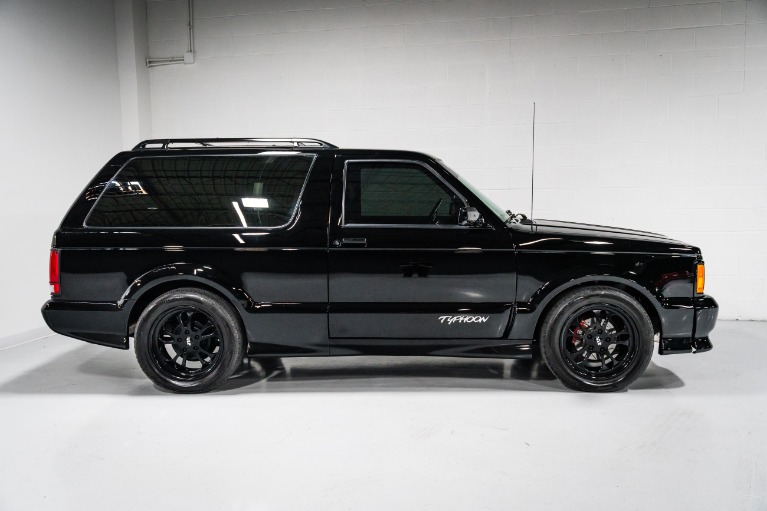
You are looking at the fastest way to embarrass a sports car while carrying a spare tyre, two rows of seats and a load of camping gear. The GMC Typhoon is a two-door GMC Jimmy — the GMC version of the Chevrolet S-10 Blazer — into which GMC and its contractor, Production Automotive Services (PAS) of Troy, Michigan, installed the turbocharged, intercooled 4.3-litre V6 and full-time all-wheel drive first proven in the 1991 GMC Syclone pickup. The result, sold for just two model years, 1992 and 1993, is a boxy, cladding-covered SUV that accelerates from rest to 60 mph in roughly five and a half seconds in period testing, in any weather, on ordinary tyres, with no wheelspin drama at all. Nothing else built in America in 1992 does that trick in this shape of body, and very little built since does it with this much stealth.
Understand the recipe, because every buying decision follows from it. PAS takes a four-wheel-drive Jimmy, lowers it, fits the LB4 turbo engine with its liquid-to-air intercooler, a strengthened 700R4 four-speed automatic, and the BorgWarner 4472 transfer case that sends roughly 35 per cent of the drive to the front wheels and 65 per cent to the rear, all the time. It adds deep plastic lower-body cladding, 16-inch alloy wheels with 245/50 VR16 tyres, a leather-trimmed interior and a boost gauge. There is no manual gearbox, no two-wheel-drive version, no low range and no off-road ability worth the name: the transfer case has a viscous coupling instead of a lockable centre differential, the ride height is car-low, and the cladding kisses speed bumps. The Typhoon is a road car wearing an SUV costume, and you judge it as a road car.
Its context matters too. The Syclone pickup comes first, in 1991 only, and stuns the magazines by out-dragging a Ferrari 348 in one famous comparison test. The Typhoon follows for 1992, offering the same powertrain with a back seat and a roof, and it is the more usable and — many owners argue — the better-balanced of the two, because the extra weight sits over and behind the rear axle rather than in an empty pickup bed. GMC builds just 4,705 Typhoons across the two years, a tiny number beside ordinary Jimmys, and production ends after 1993 as the S-series is redesigned. There is no second generation and no revival. Every Typhoon is now more than three decades old, most have been modified at some point — this is a turbocharged engine from the first great era of cheap electronic tuning, and owners tuned it — and a significant number have been crashed, blown up or cloned from ordinary Jimmys. Rarity, fragility and fakery: hold those three words in mind throughout this guide.
The good news is that the Typhoon sits on one of the most common truck platforms in America, so the ordinary parts of it — brakes, suspension joints, window motors, switches — are cheap and everywhere. The bad news is that everything that makes it a Typhoon rather than a Jimmy — the turbo engine's internals, the intercooler system, the cladding, the transfer case's viscous coupling, the specific transmission calibration — is low-volume, ageing and increasingly specialist. You do not buy one of these with your eyes on the shiny cladding. You buy it with a scan tool, a fuel-pressure gauge and a cold start, and this guide works through exactly how.

The models
There is exactly one Typhoon model, in two model years, and the differences between those years are trim-deep rather than mechanical. The engine, turbocharger, transmission, transfer case, gearing, brakes and suspension carry over unchanged. What changes is presentation — most visibly the cladding treatment — plus seat design and small equipment details. That simplifies your search enormously: you are not choosing between variants, you are choosing between individual cars, and condition and originality swamp model-year differences everywhere except in the cladding and seats described below.
| Model | Years | Engine | Output | Built | Character |
|---|---|---|---|---|---|
| Typhoon | 1992 | 4.3 V6 turbo (LB4), liquid intercooler | 280 hp, 350 lb-ft | 2,497 | First year; contrasting grey lower cladding on most colours; slimmer seat design |
| Typhoon | 1993 | 4.3 V6 turbo (LB4), liquid intercooler | 280 hp, 350 lb-ft | 2,208 | Second and final year; cladding painted body colour; wider, softer seats |
The 1992 cars wear, on most colours, a two-tone scheme: body colour above, contrasting grey (argent) cladding below. A black 1992 is typically black over grey unless it is one of the black-on-black cars. The 1993 cars move to monochromatic cladding painted to match the body, which most buyers find the cleaner look and which simplifies paint matching after repair — one colour, not two, though the cladding itself is just as fragile. Colours across the run include Midnight Black, Frost White, Garnet Red, Aspen Blue, Forest Green and, for 1992, the vivid Raspberry Metallic — a pinkish-purple that polarises opinion and draws a following of its own — with further blues joining for 1993. Do not buy on colour from a listing description alone: colour names in adverts for these trucks are routinely wrong, resprays in non-original colours are common, and the paint code on the glovebox Service Parts Identification label, checked against the car in front of you, is the only evidence that counts.
Seats are the other year tell owners actually feel. The 1992 front seats are relatively slim — the community calls them the "skinny" seats — while the 1993 cars get wider, plusher seats, inevitably nicknamed the "fat man" seats. Neither is better built; both are leather-trimmed, both split and wear on the driver's bolster, and both are Typhoon-specific enough that a retrim in the correct grain costs real money. The 1993 car also picks up detail equipment changes of the kind GM made yearly across the S-series, none of which changes value. What does change value between years, slightly, is taste: some collectors prefer the first-year two-tone look, others the monochrome 1993. Treat that as a wash and spend your attention on the individual car.
Two identity points belong here, because the model section is where clones get caught. First, the VIN: a genuine Typhoon's eighth character — the engine code — is Z, denoting the turbocharged LB4. An ordinary Jimmy's 4.3 carries a different code. The VIN plate sits at the base of the windscreen on the driver's side; read it yourself, photograph it, and check it matches the title, the driver's door label and the glovebox SPID label. A truck wearing cladding and Typhoon decals whose VIN does not carry the Z code is a Jimmy in costume, whatever the seller calls it, and it is worth Jimmy money. Second, the hardware census: a real car has the Mitsubishi turbocharger and its oil and coolant plumbing, the liquid intercooler and its separate coolant circuit with a cap on the reservoir beside the intake, the BorgWarner 4472 transfer case with no selector lever or switch anywhere in the cab, and a boost gauge in the cluster. A "Typhoon" with a transfer-case lever, a naturally aspirated intake or no intercooler plumbing is not a Typhoon with parts missing; it is a different truck.
Finally, place the Syclone correctly in your mind: it is the Typhoon's sibling, not a variant of it — same powertrain in the S-15 pickup, built for 1991 only. Owners, parts knowledge and the specialist community cover both trucks together, and much of this guide's mechanical content applies to both. But do not let a seller blur them on paperwork, and do not pay Typhoon money for anything whose VIN and body say otherwise.

Engines and gearboxes
The LB4 4.3-litre turbo V6
One engine serves both years: the LB4, a 4.3-litre (262 cu in) 90-degree V6 derived from the familiar Chevrolet small-block architecture via the standard 4.3 truck V6 — cast-iron block and heads, pushrods, two valves per cylinder. In this application it is far more than a truck engine with a turbo bolted on, and the differences are precisely the parts you must verify and protect. Compression drops to about 8.35:1 on hypereutectic pistons suited to boost; the main bearing caps are nodular iron; the camshaft, fuel injectors, intake system and engine management are all specific to the turbo application; and the multi-point fuel injection breathes through an upper plenum that carries the throttle body and sits under a cast cover lettered for the turbo programme. Output is rated at 280 horsepower at 4,200 rpm and 350 lb-ft of torque at 3,600 rpm — figures period testers widely believed conservative, since the trucks' measured performance matched cars claiming more.
In service, the bottom end is strong within its design envelope and unforgiving outside it. The design envelope is this: stock boost, good fuel, a working knock-sensor system and a working intercooler. The pistons are the fuse in the system. Hypereutectic pistons are dimensionally stable and quiet in a stock engine, but brittle under detonation: sustained knock — from overboost, a lean mixture, a dead intercooler pump or poor fuel — cracks ring lands, and the engine then breathes oil vapour, loses compression on the affected cylinder and needs a rebuild rather than a repair. This is why the Typhoon's supporting systems, covered next, are not accessories. They are the engine's life insurance, and a car whose previous owners defeated them (a manual boost controller, a chip of unknown origin, a disconnected knock sensor) is a car whose pistons have been spending that insurance, invisibly, for years.
Ordinary wear, by contrast, is unremarkable: valve-stem seals harden and give the classic puff of blue smoke on a cold start after standing; the timing chain stretches gradually; rear main seals weep; oil consumption rises gently with mileage. None of that is a Typhoon-specific trap, all of it is checkable, and a smoky start that clears is a negotiation point, not a rejection. A smoky start that does not clear, or smoke that arrives under boost, is a different conversation — see the problem areas.
Turbocharger and charge-air cooling
The turbocharger is a Mitsubishi TD06 unit with an integral wastegate, controlled by the engine computer through a boost solenoid, with maximum boost held at roughly one bar — about 14 to 15 psi — in stock trim. The computer can cut boost and retard ignition when the knock sensor reports detonation, and an overboost condition triggers a fuel cut: a stock Typhoon protects itself, which is exactly why defeated protection is so serious. The turbo is oil-fed and its oil feed and return lines, banjo fittings and the heat-soaked environment around the exhaust manifold are all leak and coking points on a 30-year-old truck. A turbo that whines, screams or shows radial shaft play beyond a trace is a rebuild; a turbo that merely weeps oil at a fitting is a Saturday job. Learn to tell them apart on inspection, because sellers price them the same and they are not the same.
Charge cooling is by liquid, not air, and this is the system buyers most often misunderstand. Compressed air from the turbo passes through a charge-air cooler mounted at the engine, through which a separate coolant circuit circulates, pumped by a small electric pump to a heat exchanger behind the grille. The reservoir with its own pressure cap sits beside the intake plenum — you can see it clearly in the engine-bay photographs in this guide. The system's weakness is that its pump fails silently. No warning light tells you the intercooler coolant has stopped circulating; the truck simply runs hotter intake air, the computer pulls timing and adds protection, performance dulls, and detonation margin shrinks — on a hot day, under sustained boost, it can shrink to nothing. Owners upgrade the pump (a Johnson pump is the common fitment) and sometimes the heat exchanger; an upgraded pump is one of the few modifications you should welcome, provided the wiring and hoses are done properly. The test is physical and takes ten seconds: with the engine running and the reservoir cap removed, you should see the coolant moving — a visible swirl or flow in the reservoir. Still coolant in a running engine means a dead pump, air lock or blocked circuit, and you treat the car's recent history as unprotected until proven otherwise.
Fuel, ignition and engine management
The management is early-1990s GM: a distributor with a cap, rotor and ignition module; a coil; a knock sensor; an oxygen sensor; and a computer whose calibration lives on a removable PROM chip. Three consequences follow. First, ignition condition is everything. Under boost, cylinder pressures are high and a tired cap, rotor, module, coil or set of plug leads produces a misfire that appears only at full throttle — the classic Typhoon complaint, "it breaks up under boost," is an ignition service overdue far more often than it is an engine failure. Plugs are gapped tight by modern standards, around 0.035 in, and worn plugs with widened gaps misfire under boost while idling perfectly. Second, fuel delivery must keep up with boost: fuel pressure sits in the low-40s psi at idle with the regulator's vacuum hose disconnected, and must rise one-for-one with boost pressure — at full boost you want to see pressure in the high 50s. A tired in-tank pump or clogged filter cannot do that; the engine runs lean exactly when it can least afford to, and the pistons pay. The in-tank pump is the single most-replaced fuel part on these trucks, and an uprated pump (the Walbro 255-litre-per-hour unit is the standard fit) is another welcome modification. Third, the PROM is a liability and an opportunity: the aftermarket sold chips for these trucks for decades, some good, many crude, and a car on an unknown chip is a car of unknown boost, fuel and timing. Ask what chip is fitted; a stock or well-documented calibration is a selling point, and "it has a chip, it's faster" is a warning, not one.
Diagnosis on this generation is by scan tool reading live data — knock counts, timing retard, fuel trims, boost — and the specialist community's whole diagnostic method rests on it. You do not need to own the tool to buy well, but you do need a seller who does not object to one being connected. Refusal to allow a scan, a fuel-pressure test or a cold start is information, and it is never good information.
Gearboxes and the all-wheel-drive system
The gearbox is the GM 700R4 — by 1993 renamed 4L60 — a four-speed automatic with a lock-up torque converter, in a Typhoon-specific calibration with uprated components for the turbo engine's torque. There is no manual option; anyone who tells you otherwise is describing a conversion. The 700R4's great vulnerability, on every vehicle that uses it, is its throttle-valve (TV) cable: the cable does not merely signal kickdown, it controls line pressure, and a stretched, misrouted or maladjusted TV cable starves the clutches of pressure and burns the 3–4 clutch pack in short order — sometimes in a single drive. On a Typhoon, whose engine makes 350 lb-ft from low rpm, the margin is thinner still. Check the TV cable's condition and adjustment on any car, learn what correct adjustment feels like (full cable travel exactly at full throttle), and budget for a specialist rebuild — realistically $2,500 to $4,500 for a proper job with a converter — if the gearbox flares between shifts, shudders in lock-up or shows burnt fluid. A gearbox that shifts crisply with clean, red, unsweetened fluid is worth real money, because so many do not.
Drive passes from the gearbox to the BorgWarner 4472 transfer case, a single-speed, full-time unit with a viscous coupling that apportions torque about 35/65 front to rear and allows the front and rear axles to turn at different speeds in corners. There is nothing to select and nothing to lock. The viscous coupling is a sealed, non-serviceable unit filled with silicone fluid, and it has one mortal enemy: mismatched tyre circumference. If front and rear tyres differ in diameter — different sizes, or one new tyre against three worn ones — the coupling works constantly to reconcile the difference, overheats, and its fluid degrades until the coupling either binds (the truck hops and winds up in tight turns) or goes slack (drive to one end fades). All four tyres on a Typhoon must be the same size, the same make and model, and close in wear; measure tread depths on inspection and treat a mismatched set as a transfer-case question, not a tyre question. From the transfer case, drive goes forward through a front driveshaft to a front differential in the 4WD S-series front axle, with CV-jointed half-shafts to the front wheels, and rearward to a leaf-sprung live axle. The whole system runs on ordinary fluids — ATF in the transfer case, gear oil in the differentials — and neglect, not design, is what kills it.

Problem areas
Rust, body and cladding
Start where the money is. The Typhoon's body is a standard S-series Jimmy shell, and it rusts the way S-series shells rust — the difference is that the cladding hides half of it and the truck's value makes the other half expensive. Work the known map: the rocker panels along their full length, especially behind the front wheels and ahead of the rears; the lower rear quarters behind the rear wheels; the bottoms of both doors; the tailgate's lower edge and the panel around the rear window; the front fender lips; the floor pans above the frame rails; and the body mounts, whose rubber and steel both perish. Northern and salt-belt trucks suffer worst, and the cladding's role is sinister: it traps road salt and moisture against the rockers and quarters it covers, so a truck can present crisp cladding over rockers that have the structural integrity of wet cardboard. You cannot assess the rockers from outside. Get under the truck with a light, prod with a blunt screwdriver where you are allowed to, and look at the inner rocker and the cladding mounting points from below. Bubbling paint at a cladding edge is not a paint defect; it is rust announcing itself from behind the plastic.
The cladding itself is the second half of the problem. The full set — front air dam, fender flares, rocker covers, rear quarter pieces — is Typhoon/Syclone-specific, was never common, and original pieces in unbroken condition are increasingly scarce. Pieces crack at mounting tabs, split at the air dam's lower edge from kerb and ramp strikes, and warp or ripple with age and bad storage. Reproduction pieces exist, largely in fibreglass, and vary in fit; a truck with a complete, tight, original cladding set carries a real premium over one with cracked, gapped or missing pieces, and a truck missing its air dam is telling you it has met something solid. Check every piece for cracks around the fasteners, for lifted edges, for filler repairs visible from behind, and for paint that does not match panel to panel — cladding is painted off the car and resprayed piecemeal after damage, so mismatched cladding is often a crash diary written in plastic. Welding a pair of rockers properly, with the cladding off and refinished, runs $1,500 to $3,000 a side by the time paint is included; price structural rust as the serious money it is.
Accident history matters more than usual because the frame is a separate ladder chassis and bent trucks hide under straight panels. Sight down both sides for panel alignment, check the cladding gaps are even, look for replaced core supports, overspray on the intercooler heat exchanger and radiator, and mismatched fasteners in the engine bay. A Typhoon sits low and launches hard; a proportion were crashed young, and a proportion of those were repaired cheaply.
Ignition, vacuum and the misfire under boost
The most common Typhoon fault, by a wide margin, is a misfire or break-up that appears only under boost. Work it in the order the specialists work it, because the cheap causes outnumber the expensive ones ten to one. The distributor cap and rotor burn and track with age and heat; the ignition module in the distributor fails intermittently when hot; the coil weakens; plug leads bake beside the turbo and their insulation breaks down; spark plugs wear and their gaps open past what boost pressure allows. Any one of these gives a truck that idles sweetly, cruises cleanly and stumbles the moment the boost gauge climbs — and sellers will describe exactly that symptom as "probably needs a tune-up," which is true, or as "they all do that," which is false. A full ignition refresh — cap, rotor, module, leads, plugs, coil if suspect — is $300 to $700 in parts and an afternoon, and it cures most break-up. What it does not cure is a misfire from low fuel pressure or a cracked piston, which is why you test rather than guess: the fuel-pressure test in the inspection section separates the fuel causes, and a compression test separates the mechanical ones.
Vacuum is the second half of this system, and on a 30-year-old turbo truck the original rubber vacuum lines are perished as a class. The network is extensive — boost control, fuel-pressure regulator, heater controls, cruise, the MAP sensor — and split or collapsed lines cause lean running, erratic idle, lazy boost control and heater flaps that only work at cruise. The MAP sensor's hose deserves special attention: if it leaks, the computer misreads manifold pressure and fuels and times the engine wrongly under boost, which is a piston risk, not a drivability quirk. Silicone vacuum-line kits are a standard community fitment; fresh, correctly routed silicone lines are a good sign, while brittle original rubber is a small bill and a medium warning about the previous owner's thoroughness. The distinguishing test for the whole vacuum system is a hand vacuum pump and ten minutes: lines and diaphragms should hold vacuum; anything that bleeds down gets replaced, not adjusted around.
Fuel system and detonation damage
Covered in principle in the engines section, the fuel system's failure pattern deserves its own paragraph because it is the one that destroys engines. The in-tank electric pump weakens with age and with the sediment of decades; output falls first at high demand, so the truck drives normally until full boost, where pressure sags, the mixture leans, the knock sensor screams and — if the knock system is healthy — the computer saves the engine by pulling timing, which the driver feels as a truck that lays down at full throttle. If the knock system is not healthy, the engine saves nothing and the pistons crack. The regulator fails the other way: its diaphragm ruptures and fuel is drawn up the vacuum hose into the intake — pull the regulator's vacuum line on inspection; fuel in it condemns the regulator on the spot. Injectors gum and dribble after long storage, giving hot-start flooding and a rich, lumpy idle. Budget $400 to $900 for a pump replacement done properly with the tank dropped, cleaned and the filter changed, and treat documented recent fuel-system work as a genuine asset in a sale.
Detonation damage itself is diagnosed, not seen: a compression test that shows one cylinder down, a leakdown test that hisses past the rings on that cylinder, oil consumption and blow-by out of the breather, and in the worst cases a borescope view of a cracked piston crown or ring land. An engine rebuild to stock specification, done by a shop that knows these engines, is a $6,000 to $12,000 event depending on the crank, bores and heads; a rebuild with forged pistons and modern parts costs more and is what most owners choose, which is fine for a driver and a deduction for a collector. Either way, an engine with a dead cylinder is priced as a core plus a Jimmy, not as a Typhoon with an issue.
Turbocharger and charge-air cooler
Turbo failures divide into wear, leaks and control faults. Wear shows as shaft play you can feel at the compressor wheel with the intake hose off — a trace of side play is normal, radial clunk or any sign of the wheel contacting the housing is not — and as oil in the intake tract beyond a light film, blue smoke under boost, or a whine that turns to a scream. A professional rebuild of the Mitsubishi unit runs roughly $800 to $1,500; replacement upgraded turbos cost more and change the car's character and calibration needs. Leaks are simpler and commoner: the oil feed and return, the coolant lines to the centre housing, and the exhaust-side joints all weep with age, and oil on a hot turbo is a fire risk as well as a mess. Control faults centre on the wastegate actuator (a tired diaphragm gives lazy or low boost), the boost solenoid and its hoses (wrong routing gives overboost or none), and the knock-driven protection doing its job so often that the truck feels slow — which is a symptom of the fuel, ignition or intercooler faults above, not of the turbo.
The charge-air cooler's own faults are the pump, already covered — test for flow at the reservoir, every time, without exception — plus leaks at its hoses and heat exchanger, a pressure cap that no longer holds the circuit's pressure, and air locks after coolant work that leave the cooler half-empty. The coolant in this circuit is separate from the engine's; a seller who does not know the truck has two coolant systems has not maintained either of them. Heat-soaked, a Typhoon loses performance dramatically; if a test drive on a hot day shows the truck strong for one pull and feeble for the next, suspect the intercooler circuit before anything else.

Transmission, transfer case and driveline
Transmission problems present as shift flare (rpm rising between gears), delayed or harsh engagement, shudder as the converter locks at cruise, and fluid that is brown and smells burnt rather than red and sweet. Any of these on a test drive moves the car into rebuild-budget territory — $2,500 to $4,500 as noted — because 700R4 faults do not heal, and a Typhoon's torque finds every weakness. Check the TV cable first and always: if the cable is frayed, kinked, disconnected or obviously maladjusted, the gearbox has been running at wrong line pressure for an unknown distance, and you price it as damaged even if it shifts acceptably today. Also verify the converter locks and unlocks cleanly at a steady 45–55 mph cruise; a truck whose previous owner defeated the lock-up to hide a shudder is hiding converter or clutch wear.
The BorgWarner 4472 transfer case fails in the two directions described earlier: a viscous coupling that binds — felt as tyre scrub, hopping and driveline wind-up in tight, slow turns on dry pavement — or one that has gone open, felt as the truck spinning one end's wheels and feeling oddly two-wheel drive. The parking-lot test is decisive: full-lock circles at walking pace, both directions, windows down. A healthy truck rolls around with mild resistance; a binding truck fights, chirps its tyres and loads the steering. Chain stretch inside the case gives a clunk or ratcheting under hard launch. Replacement viscous couplings are scarce and specialist-sourced; a transfer-case rebuild with a good coupling is a $1,500 to $3,000 proposition when parts can be found, and "when parts can be found" is doing real work in that sentence. Front driveline wear — CV boots split and joints clicking, front propshaft joints dry and loose, front differential pinion seals leaking — is ordinary S-series fare and ordinary money, but a hard-launched Typhoon wears it faster than a Jimmy does, and the front tyres tell the story: uneven front wear means alignment, worn steering joints or both.
Tyres, again, are a driveline component here. Different sizes front to rear, or one axle's pair replaced without the other, is not a cosmetic mismatch — it is the mechanism that cooks viscous couplings, and a car presented on mismatched tyres has been run by someone who did not know or did not care. Either way you inherit the coupling question, and you answer it with the parking-lot test before you answer anything else.
Suspension, steering, brakes and rear level control
The front suspension is the 4WD S-series torsion-bar layout, lowered for the Typhoon, and its wear items are the catalogue of every ageing GM truck: ball joints, idler and pitman arms, tie-rod ends, control-arm bushings and torsion-bar mounts. The test is a pry bar and a helper rocking the steering: play anywhere in the chain gives the vague, wandering straight-line feel owners describe as "loose," and a full front-end refresh is $800 to $2,000 in parts and labour depending on how much is worn. Steering boxes wear and develop on-centre play; a box adjusted tight to hide it binds off-centre, so check lock to lock. The rear is a leaf-sprung live axle, simple and durable, with one Typhoon-specific system on top of it: automatic rear level control, using air-assisted rear shocks, a compressor and a height sensor to hold ride height under load. It fails by leaking shocks, a dead compressor or a detached sensor linkage, and it announces itself as a truck that sits low at the rear, pumps its compressor endlessly, or both. Many owners delete it for conventional shocks; a deleted system on a driver is acceptable if the stance is right, while a collector will want it present and working. Either way, a sagging rear is a fault to price, not a look to accept — and measure the stance, because a truck can also sit low at the rear from tired springs or sit unevenly from a bent frame.
Brakes are front disc, rear drum, with anti-lock control, and they are adequate rather than generous for the performance. Faults are the usual ones — seized calipers, perished flex hoses, a tired master cylinder, ABS faults that light the warning lamp and disable the system — plus one specific to a fast, heavy truck: warped front rotors from repeated hard stops, felt as pedal pulsation. The ABS lamp must light at key-on and go out; a lamp that never lights has often been removed to hide a fault, which tells you about the seller as much as the truck. Tyres deserve a final word here: the original 245/50 VR16 size is a period fitment with limited modern choice, and many trucks run later wheels in larger sizes. Non-original wheels are not a fault on a driver, but the original 16-inch turbine-style alloys are Typhoon-specific and increasingly valuable loose — a car still wearing them, unbent and uncurbed, starts ahead.
Electrics, interior and trim
Electrics are early-1990s GM: generally robust architecture, ageing execution. Work the checklist of functions — power windows (slow or dead motors are common and cheap), power locks, mirrors, the rear wiper and defroster, the air conditioning (a working R12 system converted properly to R134a is fine; a system "just needing a recharge" needs a leak found and fixed, at $500 to $1,500 depending on the component), the blower speeds, and every gauge including the boost gauge, whose needle should sweep smoothly with manifold pressure. The instrument cluster's gauges fail individually; the boost gauge in particular is both a diagnostic tool and an originality item. Wiring faults concentrate where heat and previous owners have been: the engine bay harness near the turbo, alarm and remote-start installations cut into the loom, and trailer wiring at the rear. An unmolested harness is a real asset; a bay full of scotch-lock connectors is a forecast.
Interior wear is honest and visible: the driver's seat bolster splits and the leather dries and cracks; the 1993 wider seats sag in the base; headliners drop, as all GM headliners of the era drop; door cards warp at the top rail; the dash pad cracks in sun states; carpets fade. None of it is structural, all of it is expensive to make right because the Typhoon-specific pieces — seats, embroidered trim, cladding-adjacent plastics — are not Jimmy parts. A complete, original, uncracked interior in the correct materials is one of the strongest value signals the model gives, precisely because so many trucks were used hard, smoked in, stereo-butchered and left in the sun. Check the glovebox for the SPID label and any paperwork; check the spare-tyre well and under the rear seat for the damp that betrays rear-window and tailgate seal leaks; and check that the jack, spare and tools the truck came with are still with it — completeness is the collector market's currency.
How to inspect one
Inspect in this order. It runs from identity to structure to systems to the road, and each step cross-references the problem areas so nothing is checked twice and nothing is skipped. Bring the tools the order assumes: a torch, a blunt screwdriver, a tread-depth gauge, a fuel-pressure gauge with the correct adapter for the test port, a compression tester, a hand vacuum pump and, ideally, a scan tool that reads live data from this generation of GM management. None of it is exotic, most of it fits in one bag, and a seller who is comfortable with you using all of it on the car is already telling you something good about the car. A seller who is not comfortable has told you something too — listen to that before you listen to the engine.
- Identity first. Read the VIN plate at the windscreen base yourself: the eighth character must be Z. Match it against the title, the door label and the glovebox SPID label, and check the SPID's paint code against the colour in front of you. A car that fails identity is finished — walk away before you have invested feelings in it.
- Paperwork and history. Service records, receipts for fuel pump, ignition work, intercooler pump, transmission work; ask directly what chip is fitted, what turbo is fitted, and what has been modified. Documented stock or documented quality upgrades are assets; vagueness is priced as modification unknown.
- Cold start, arranged in advance. Insist the engine is stone cold when you arrive. Watch for the valve-seal puff that clears (acceptable) versus smoke that persists (not), listen for lifter clatter that fades versus knock that stays, and note how it idles as it warms. A seller who has warmed the truck up "to be helpful" has answered a question you did not ask.
- Cladding and panel census. Walk the full cladding set piece by piece for cracks, lifted edges, filler and colour mismatch, per the rust and cladding section. Sight down both flanks, check gaps, and look for overspray on the intercooler heat exchanger and core support.
- Underneath, with a light. Rockers inside and out, rear quarters, door bottoms, tailgate edge, floor pans, body mounts, frame rails for bends and repairs. Prod suspect metal with a blunt tool where permitted. This step, not the paint, decides what the body is worth.
- Engine bay census. Find the turbo and its plumbing, the intercooler reservoir, the distributor, the MAP sensor hose, the regulator. Pull the fuel-pressure regulator's vacuum line: fuel inside condemns it. Check the vacuum lines' material and routing — fresh silicone, good; brittle rubber, budgeted.
- Intercooler flow test. Engine running, reservoir cap off: look for visible coolant movement. Still coolant means pump, air lock or blockage, and the car's detonation protection has been absent — remember that when you reach the compression test.
- Fuel pressure, gauge on. Low-40s psi at idle with the regulator hose disconnected, and pressure rising one-for-one with boost on the road test — high 50s at full boost. Sagging pressure under boost is the pump or filter, and it outranks every other explanation for a truck that lays down.
- Compression test, and leakdown if any cylinder is low. One cylinder down with the intercooler or fuel faults above in evidence is the detonation story complete: price the car as needing an engine, per the problem areas, or walk away.
- Gearbox and TV cable. Fluid colour and smell; TV cable condition and adjustment; then on the road: shift quality through all four gears, converter lock and unlock at cruise, no flare, no shudder. Burnt fluid or a bad cable reprices the car by a rebuild.
- Parking-lot circles, full lock, both ways. The viscous-coupling test from the driveline section: smooth mild resistance is health; hopping, chirping and wind-up is a binding coupling and a four-figure negotiation. Measure all four tread depths while you are out there — mismatched tyres explain, and do not excuse, a coupling fault.
- Full-boost road test, last and longest. Twenty minutes minimum, engine fully warm: idle quality, part-throttle manners, then full boost in the higher gears. It must pull cleanly to full boost — about 14–15 psi on the gauge — without break-up, laying down, smoke or strange noises, and it must do it twice, the second pull exposing a heat-soaked intercooler circuit. End with the brake test, the ABS lamp check and a final look underneath for fresh leaks. A car that passes all twelve steps is a good Typhoon. A car whose seller refuses any step is not.
Values
The Typhoon market is small, thin and condition-driven to a degree that surprises buyers arriving from commoner classics. With only two model years, one specification and a few thousand cars built, there is no variant ladder to climb: the spread you see in asking prices is almost entirely a spread in condition, originality and documentation, and learning to read that spread is the whole skill this section teaches.
At the top sit low-mileage, unmodified, documented cars with complete cladding, original wheels, working level control and intercooler systems, and interiors that have never been apart. These are collector cars, bought by people who also considered the Syclone, and their prices reflect how few survive in that state — every year, hard use and cheap modification remove a few more from the pool, which is why the best cars detach from the rest of the market and keep doing so. In the middle sits the honest driver: higher miles, sensible maintenance, perhaps an uprated fuel pump and intercooler pump, perhaps a quality rebuild somewhere in its history, presentable rather than perfect. This is the broadest part of the market and the part where asking prices vary most for identical-looking cars, because sellers price the money they have spent while buyers price the work that remains. At the bottom sit the projects: blown or tired engines, burnt gearboxes, rust under cladding, missing pieces. A project Typhoon is not a cheap Typhoon — the model's specific parts make restoration economics harsher than the purchase price suggests, and the gap between a project and a good driver, properly costed, is usually smaller than the gap between their asking prices. Buyers who understand that buy drivers; buyers who do not, buy projects and then buy drivers' worth of parts.
Originality premiums work in a particular direction here. Because modification was the culture around these trucks when they were cheap, stock is now the scarce specification: an unmodified engine on its factory calibration, original turbo, original wheels and intact emissions equipment all add value, while period tuning parts subtract it unless they are rare, documented and reversible. The exceptions are the invisible reliability upgrades the community itself endorses — the uprated fuel pump, the better intercooler pump, silicone vacuum lines — which buyers treat as maintenance rather than modification. Colour matters at the margins: the vivid one-year colours have followings, black and white are perennially saleable, and a respray in a non-original colour costs the car its collector audience entirely. Year, by contrast, matters little: the two-tone 1992 look and the monochrome 1993 look each have their partisans, and neither commands a consistent premium over the other in equivalent condition.
Two reading skills protect you. First, distrust asking prices as evidence of value in a thin market: a handful of optimistic listings can make a model look dearer than the prices cars actually change hands for, and recorded sales — including the sales history published alongside this guide — are the corrective. Compare like with like on condition and documentation, not on year or colour. Second, price the specific car from its faults upward, using the costs in this guide: a car needing an engine, a gearbox and cladding is not "cheaper" than a sorted car by the difference in asking prices unless that difference exceeds the full, honestly totalled cost of the work — and on this model it rarely does. Negotiation, finally, is factual rather than theatrical: the seller of a good Typhoon knows how few good ones remain, and the buyer of a flawed one holds the repair estimates. Bring the estimates.
Parts and ownership
Ownership divides cleanly into the Jimmy half and the Typhoon half. The Jimmy half is a pleasure: the S-series platform sold in the millions, so brake parts, suspension joints, steering components, window regulators, switches, glass, lamps, weatherstrips and most interior hardware are available new, used and reproduction at ordinary truck prices, from ordinary suppliers, today. A Typhoon never needs to sit off the road waiting for a ball joint. Filters, belts, hoses, plugs and fluids are shelf items, and any competent shop can do the routine work — oil at sensible intervals with quality oil (the turbo cooks oil; 3,000-mile changes are cheap insurance), coolant in both systems, ATF and filter services, gear oil, and brake fluid on a two-year rhythm because the truck is heavy, fast and old.
The Typhoon half requires a different posture. The specific parts — cladding pieces, the viscous coupling, turbo-engine internals and gaskets in the correct specification, the intercooler pump and heat exchanger, the level-control shocks and compressor, the seat trim, the PROM calibrations — range from "available from specialists" to "available when a parts car dies." The community is the supply chain: the long-established SyTy owner forums and registries, the specialist vendors who grew out of them, and the network of breakers and hoarders who keep these trucks alive. Join the community before you buy, not after: you will source parts through it, diagnose faults with its accumulated knowledge (the scan-tool diagnostic method is a community craft as much as a factory one), and learn which of the car's previous owners the registry already knows. Budget accordingly: routine running costs are truck-cheap, but keep a reserve for the specific parts — a transfer case, a cladding set, an engine event — because when you need them, you need them at the market's price and timetable, not yours.
Living with the truck is easy in the ways that matter and demanding in one way that matters more. It is compact, comfortable, genuinely quick in all weathers, and it draws a knowing crowd everywhere — the people who recognise a Typhoon really recognise it. Fuel consumption is heavy, as a boosted 4.3 pushing a brick through the air must be; premium fuel is not optional, because the knock margin is the engine's life. Insurance should be on an agreed-value basis from day one: book values for a 1992 Jimmy and the market value of a Typhoon are different numbers, and a total-loss settlement at the former is a loss you cannot argue your way back from. Store it dry if you can, exercise it properly when you drive it — full operating temperature, some boost, no endless idling — and keep both coolant systems, the ignition consumables and the fuel filter on a written schedule. These trucks deteriorate by standing as surely as by abuse: pumps gum, vacuum rubber perishes, intercooler pumps seize and tyres flat-spot and age out, and an aged-out, mismatched tyre set is, as you now know, a transfer-case threat and not merely a tyre bill.
Which one to buy
- The collector buy: a 1993 in monochrome paint, unmodified and documented. The final-year car in collector condition — factory calibration, original turbo and wheels, complete cladding, working level control, full paperwork — is the blue-chip Typhoon. You pay for the scarcity of survivors, and the scarcity is real.
- The all-rounder: any year, honest miles, maintained by the book. A driver-grade car with the fuel pump, intercooler pump and ignition consumables recently done, clean structure and presentable cladding is the Typhoon to own and use. Year and colour are irrelevant at this level; the service file is everything.
- The value buy: a sound car with cosmetic faults. Faded paint, worn seat leather, tired cladding finish — provided the structure is clean, the engine compresses evenly, the coupling passes the parking-lot test and the gearbox shifts as it should, cosmetics are the cheapest faults this model offers, because they are the only ones priced in Jimmy money.
- The enthusiast's buy: a documented modified car. A truck with quality, reversible modifications — forged-piston rebuild, sensible turbo and fuelling upgrades, full records — can be the fastest, strongest Typhoon you will ever drive. Buy the paperwork as much as the parts list; an undocumented modified car is not this bullet, it is a warning.
- Avoid: the project priced like a driver, and the clone at any price. A car needing an engine, a gearbox or a coupling has a correct price, and it is far below driver money; a Z-code check takes thirty seconds and settles the clone question permanently, so never skip it.
The overriding rule: buy the structure, the identity and the compression figures, and let everything else be negotiable — a Typhoon with a clean shell, a Z in its VIN and six even cylinders can be made right with money, while no amount of money makes a rusty, blown or fake one into the car you thought you bought.
See the 1 Typhoon cars currently listed.
What they sell for: Typhoon sale prices.