
Mercedes-Benz 220d buyer's guide
Mercedes-Benz 220d -- the model's own buyer's guide: variants, values and what to check.
Years listed: 1973-1973 · Series: W115
Overview and history
The Mercedes-Benz 220D is not fast, was never meant to be, and makes no apology for it. What it is — and what made it one of the most successful Mercedes models of its era — is durable in a way few cars have ever matched. If the W108 set the template for the S-Class, the 220D's chassis, the W115, set the template for every mid-size Mercedes that followed: the car a taxi driver in Stuttgart, a farmer in Andalusia and a doctor in Ohio could all buy and run, in principle, for the rest of their working lives.
The W114 and W115 arrived in January 1968, replacing the fintail sedans. Germans nicknamed them the Strich-Acht — "stroke eight," for /8, the model year 1968 — and owners still use the name today. The split in the codes matters: W114 is the six-cylinder line, W115 the four- and five-cylinder line, and every 220D is a W115. Styling, by Paul Bracq's team, was a clean break from the fins: a lower, wider, slab-sided sedan with a tall glasshouse and none of the ornament that had dated the fintails overnight. Underneath it was more modern than the W108 it sold alongside — most importantly at the rear, where a new semi-trailing-arm independent suspension replaced the old swing axle — and it kept Béla Barényi's safety thinking throughout: a rigid passenger cell, crumple structures, a padded interior, and a steering column designed to yield in a crash.
Into that shell Mercedes put its proven diesel four, the OM615, in 2.2-litre form, and badged the result 220D. The formula was not new — Mercedes had sold diesel cars since the 1930s and the 180D and 190D pontons and fintails had already built the taxi trade's loyalty — but the W115 packaged it in a car that was quieter, safer, roomier and far better to drive than anything diesel buyers had been offered before. Production ran from 1968 to 1976, through a substantial facelift in the summer of 1973, and for most of that run the 220D was the default diesel Mercedes: the taxi specification across much of Europe and the Middle East, the economy choice for high-mileage private owners, and, in North America, an unlikely cult car bought by people who valued economy and longevity over performance in the years around the fuel crises.
That working life defines the market today. A 220D was bought to be used, and most were used completely — taxi mileages, farm work, decades as a family's only car. Survivors are either cherished, garaged cars kept by owners who loved the ritual of them, or honest workhorses worn to a shine in every place a hand touches. What almost every survivor shares is the model's one true weakness: the mechanicals are as tough as the legend says, and the body is not. A W115 rusts, thoroughly and structurally, and the whole art of buying a 220D is judging a very strong mechanical package in a shell that has been dissolving, in most climates, for fifty years.
The pool sampled for this guide on Classic Listings is small and should be read as such: 5 cars, all of them W115 220Ds, all sourced from Facebook listings, spanning the 1969 and 1973 model years recorded in the pool's year histogram (two cars for 1970, two for 1973, one for 1969), with 3 manuals and 2 automatics, in Brown (2 cars), Beige, Green and White, spread across North Carolina, Illinois, California, Nebraska and Washington, one car in each state. That spread — pre- and post-facelift-era years, both gearboxes, five different states — is a fair miniature of the US market as a whole: this is a car you will find anywhere, in any condition, at the mercy of the climate it lived in.

Hold one idea in mind through everything that follows. With a 220D, performance is a constant — they are all slow — so value lives almost entirely in two things: the structure of the shell, and originality. A sound, original car is one you can drive, slowly and happily, for decades on routine care. A rusty one is a welding project with a diesel engine attached.
The models
There is only one 220D — a four-door sedan on the W115 chassis, powered by the 2.2-litre OM615 diesel four — but "only one" conceals eight years of production, a major facelift, two gearboxes, and two quite different market specifications. Every 220D carries the chassis code 115.110 in its VIN prefix family; the digits that follow encode left- or right-hand drive and manual or automatic transmission, in the usual Mercedes fashion, and the data card — or a decode of the chassis number — settles what a car was when it left the factory, whatever has been changed since. Learn the phases below and you can date a car from across the street, which matters, because sellers routinely misdate these cars by a year or two and because the facelift genuinely changed the car for the better.
| Model | Years | Engine | Output | Built | Character |
|---|---|---|---|---|---|
| 220D (pre-facelift) | 1968–1973 | 2.2 diesel four (OM615) | 60 hp DIN | Large production; the taxi staple of the range — exact audited total varies by source, so treat any single figure with care | The original Strich-Acht diesel; loop glow plugs, vent windows, the purest form |
| 220D (facelift) | 1973–1976 | 2.2 diesel four (OM615) | 60 hp DIN | Large production to the end of W115 production in 1976 | Wider, lower grille, ribbed tail lamps, better mirrors and trim; the more usable car |
| 220D (US market) | 1968–1976 | 2.2 diesel four (OM615) | Around 55–60 hp depending on year and rating method | A minority of production, but the majority of US survivors | Sealed-beam lamps, US bumpers (heavier from 1974), air conditioning common, automatics far more common than in Europe |
(Outputs are period DIN figures for European cars. US figures were quoted in SAE terms and change with the rating method and the model year; the honest summary is that every 220D makes roughly sixty horsepower, and no variant is meaningfully quicker than another.)
The pre-facelift cars, 1968 to mid-1973. The original 220D has the narrower, taller grille, smooth tail-lamp lenses, small door mirrors mounted on the door, opening front quarter-vent windows, and a four-spoke steering wheel with a padded hub that owners either love or replace. Inside, the dashboard is simpler, the trim plainer, and the whole car feels a little more 1960s. These are the cars the taxi trade bought by the thousand, which means two opposite things for a buyer: specification is usually honest and basic — vinyl (MB-Tex) seats, rubber mats in working cars, few options — and mileages, on European-market cars especially, can be astronomical. A German-market early 220D with a thin history file should be assumed to have worked for a living until it proves otherwise. US-market early cars lived softer lives and are the easier buy.
The facelift, from the summer of 1973. Mercedes revised the whole W114/W115 range for the 1974 model year, with production of the revised cars beginning in 1973 — which is why you will see facelift cars described as both 1973 and 1974, and why the VIN and data card, not the seller's memory, should settle a car's year. The visible changes are the ones to memorise: a wider, lower grille in the style of the then-new S-Class, ribbed ("dirty-edge") tail-lamp lenses designed to stay visible when filthy, a larger driver's door mirror and a proper interior-adjustable mirror on later cars, new door handles, the deletion of the front quarter-vent windows in favour of improved ventilation, and rain channels revised so water no longer drips onto occupants getting in and out. Inside there is a new, more heavily padded steering wheel, revised seats and trim, and a general lift in perceived quality. Underneath, the changes were smaller — this was a facelift, not a re-engineering — but the later cars benefit from eight years of running production fixes, and most experienced owners, given two otherwise equal cars, take the facelift.
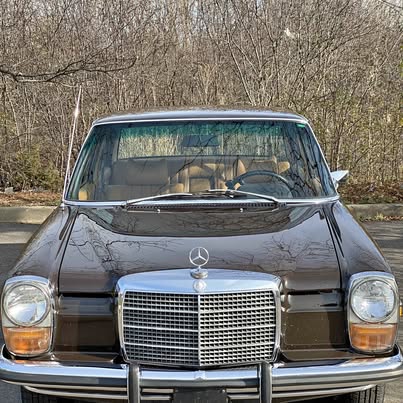
US-market specifics. North America took the 220D seriously in a way that surprises Europeans: 35-plus mpg economy, a 500-mile range, diesel fuel then cheaper than gasoline, and Mercedes durability well below six-cylinder prices — and after the 1973 fuel crisis it briefly became fashionable. Read US cars by their differences: sealed-beam headlamps in place of European glass lenses; bumpers that grow through the run, with large, heavy federal 5-mph assemblies from 1974; and air conditioning — rare in Europe, where many taxis were ordered without it — common on US cars, to be budgeted as a system to recommission, not a switch to flick. Automatics are far commoner in the US than in Europe (in the Classic Listings pool sampled for this guide, 2 of the 5 cars are automatics — a proportion no European sample would show). Emissions equipment on a diesel of this era is minimal compared with a gasoline car, one reason US 220Ds have survived in running order at higher rates.
Trim and options. MB-Tex vinyl is the normal seat covering and is close to indestructible; cloth (European cars) wears faster; leather is rare and usually tired. A steel sunroof adds desirability and inspection work (see the rust section). Power steering was optional and transforms low-speed manoeuvring; manual-steering cars are honest but hard work in town. Central locking, where fitted, is vacuum-operated — a system to test, not a feature to assume. Factory taxi equipment on European imports should be read as a mileage warning, not charm, unless the taxi history is documented and priced in.
The neighbours, so you can place the car. Below the 220D sat the slower 200D; above it, the 240D (from 1973) and the five-cylinder 300D (W115, from 1974 in the US) — a different guide and a noticeably quicker, more valuable car. If a seller is asking 300D money for a 220D, the data card is your friend: the OM615 in a 220D is a four-cylinder, and no boot-lid typography makes it anything else.
Engines and gearboxes
The OM615: one engine, honestly understood
Every 220D carries the same engine: the OM615, a 2,197 cc overhead-camshaft inline four, indirect injection, cast-iron block and head, chain-driven camshaft, and a compression ratio around 21:1 — it has to be that high, because a diesel ignites its fuel with the heat of compression alone. Output is 60 hp DIN at about 4,200 rpm, with torque of roughly 93 lb-ft low in the range. In a sedan weighing around 1,400 kg that means a top speed in the region of 80 mph and 0–60 mph in the high twenties of seconds with the manual gearbox. Think about it differently from a petrol engine: there is no ignition system and almost nothing electrical except the starter, glow plugs and alternator. A diesel that has compression, clean fuel at the right moment, air, and a starter spinning it fast enough will run. Nearly all diagnosis is working through those four requirements in order — and nearly all expensive mistakes come from skipping to the last one (compression) before proving the first three.
The injection system. Fuel is metered by a Bosch inline injection pump — a plunger-per-cylinder mechanical pump, cam-driven from the engine, delivering fuel at high pressure to pintle-type injector nozzles that open at a set pressure (around 115 bar when correctly set). The pump on the OM615 is governed pneumatically on most versions: a venturi in the intake tract generates a vacuum signal proportional to airflow, acting on a diaphragm in the governor housing at the back of the pump, and that diaphragm — not a direct mechanical linkage alone — controls fuel delivery against the driver's demand. This one design decision explains a family of faults that baffle petrol-trained mechanics. A split or hardened governor diaphragm, or a leaking vacuum line between intake and pump, gives you a car that will not idle properly, will not shut down cleanly in related vacuum faults, surges, or — in the alarming failure — revs beyond what the pedal is asking, because the governor has lost its signal. A diaphragm is a cheap part. An injection pump rebuilt because nobody tested the diaphragm is not: pump overhaul by a diesel specialist runs roughly $800–1,800 depending on what is found, and a full set of nozzles serviced, pop-tested and reset is typically $300–600. Before any pump verdict, the cheap tests come first: diaphragm integrity, vacuum lines, fuel supply pressure from the lift pump, and filters.
The pump also has a lubrication story you must check. Depending on year and version, the pump is either fed oil from the engine's system or carries its own oil supply, checked and topped up at a filler/check point on the pump itself. A pump run dry wears its plungers and cam rapidly and turns a service item into a rebuild. On any viewing, find out which arrangement the car has, check the level if it has its own reservoir, and ask when it was last done — a seller who knows the answer is a seller who has maintained a diesel before. The hand primer pump on the filter/pump assembly matters just as much: the original plunger-type primers leak with age, draw air, and are a classic cause of a car that starts, runs briefly on the fuel in the pump, and dies. The later screw-type primer is the standard upgrade, costs little, and its presence is a good sign; its absence, with a weeping original, is a first-week job.
Glow plugs: the system that decides whether the car starts. A cold indirect-injection diesel cannot ignite its fuel on compression heat alone in cool weather; each prechamber carries a glow plug that pre-heats it. Two generations of system appear on 220Ds, and telling them apart is a core buying skill.
The original system uses series-wired loop (filament) plugs — heavy hairpin elements wired in series, like old Christmas-tree lights, controlled through a dash-mounted preglow indicator: the famous "salt shaker," a perforated metal cap in the dashboard behind which a wire element glows as the system warms. You pull (or turn and hold) the starter/glow control, watch the indicator glow, wait — 30 to 60 seconds on a cold morning is normal — and only then crank. The engineering consequence of series wiring is brutal and simple: if one plug burns out, the whole circuit dies and no cylinder gets heat. A car that started yesterday and will not start at all today, cranking healthily, with a dead or dim dash indicator, is describing an open circuit in the glow system until proved otherwise. Loop plugs also draw very heavy current, so every cable, earth and connection in the circuit is part of the diagnosis: voltage drop at a corroded connection steals heat from all four plugs at once. Testing is done plug by plug with an ohmmeter or by removing and bench-testing; budget roughly $150–350 in parts and labour to renew a tired set, more if seized plugs fight removal — and a plug seized or snapped in the head is the one glow job that stops being cheap, so penetrating oil, patience and a warm engine are the method, never force.
The later system — fitted to the newest cars and retrofitted to a great many earlier ones, because it is simply better — uses parallel-wired pencil plugs: slimmer, faster elements, each fed independently, usually with a proper timer relay and a dashboard glow lamp that goes out when the plugs are ready, in seconds rather than the better part of a minute. If one pencil plug fails, the other three still work, and the symptom degrades gracefully: the car still starts, but roughly, on three cylinders' worth of heat, with white smoke and a lumpy first ten seconds. A car advertised as "upgraded to pencil plugs" has had real money and thought spent on it — verify the claim in the engine bay (pencil plugs and a relay/control unit, neat wiring, not a bodge) and count it in the car's favour. Either way, test the system on your viewing exactly as the inspection section describes: time it, watch the indicator or lamp, and listen to how the engine catches. A 220D that glows correctly and still will not start cold has a fuel, cranking-speed or compression problem — and the glow test is what lets you say so with confidence.
Valve clearances: the diesel discipline. The OM615 uses mechanically adjustable valve clearances — there are no hydraulic lifters to take up the slack silently. Clearances close up over time as valves and seats wear, and on a diesel the consequence is more serious than a noisy top end on a petrol car (though here, paradoxically, tight clearances are quiet). A valve held fractionally off its seat leaks compression, and a diesel that has lost compression at one cylinder is a diesel that starts badly, smokes, and runs lumpily — symptoms owners routinely blame on injectors and pumps. The factory discipline is a clearance check at roughly every 15,000 miles, done cold, with feeler gauges, at the rocker adjusters. It is an hour's work for someone who knows the engine, typically $150–300 at a specialist if you are not doing it yourself, and the single most revealing line in a service history. Ask for it by name. A car with documented, recent valve clearances, a recent nozzle service and a healthy glow system is a car whose cold-start behaviour you can predict. A car with none of the three is a diagnostic project, whatever the seller says about it "running great when warm" — warm running is the easy part; any tired diesel runs acceptably once it is hot.
Blow-by and compression: judging the bottom end. The bottom end of an OM615 — crank, bearings, pistons — is genuinely long-lived, and 300,000 miles is unremarkable on a maintained engine. Wear, when it comes, shows as blow-by: combustion pressure leaking past the rings into the crankcase. Assess it the diesel way. With the engine warm and idling, remove the oil filler cap and rest it loosely in the filler neck. A healthy engine stirs it gently. An engine that dances the cap vigorously, puffs visible vapour in rhythm, or blows the cap off has significant blow-by — worn rings, worn bores, or both. Some vapour is normal on any high-mileage diesel; a rhythmic chuffing, oil mist spraying from the filler, and heavy breathing through the breather are not. Distinguish ring wear from a simpler cause before you price a rebuild: a blocked crankcase breather pressurises the crankcase on a sound engine, so check the breather path first. The definitive test is a compression test, done through the glow-plug or injector holes with a diesel-rated gauge (petrol gauges do not read high enough): a healthy OM615 shows figures broadly in the 300 psi-plus region with cylinders close to each other, and it is evenness as much as the headline number that matters — one cylinder well down on its neighbours points at that cylinder's valves or rings, and a wet test (a little oil down the bore) that restores the figure points at rings, while no change points at valves. An engine-out rebuild on an OM615 is a $5,000–9,000 conversation at a specialist, which is why these tests, done before purchase, are the whole game on a high-mileage car.
Cold starting, synthesised. Work a non-starting car in a strict order. One: cranking speed — a lazy starter or tired battery that would still start a petrol car will not start this one, because slow cranking means low compression heat; a starter rebuild is roughly $250–450. Two: glow, proved as above. Three: fuel — fresh filters, no air leaks on the suction side (perished leak-off hoses between injectors are the classic: cheap rubber, replaced as a set for a few dollars, and a cause of overnight drain-back that has sold many good cars cheap), a working primer, fuel reaching the pump. Four: compression and valve clearances. Work the list in that order and you will fix most "terminal" 220Ds for the price of a battery, plugs, hose and a morning's labour.

Gearboxes
The four-speed manual is the gearbox this car wants. It is Mercedes' own all-synchromesh four-speed, offered with a floor change (the normal US fitment and the one to prefer) and, on early and European cars, a column change that frees up the front bench feel and dates the car instantly. Ratios cannot disguise sixty horsepower, but the manual lets you keep the engine in its narrow working band, stirs along at a 55–65 mph cruise without drama, and returns the best economy. Judge it on second-gear synchromesh (the first to wear — a crunch on a hurried downchange into second is the tell), on a clutch that bites smoothly without judder or slip under load in a high gear, and on whine in the indirect gears. A clutch renewal is roughly $600–1,100 fitted; gearbox rebuilds are rarely needed and rarely economic to do badly — a good used box is the usual answer, and they exist because the boxes outlive the shells.
The four-speed automatic is Mercedes' own automatic of the period, with a fluid coupling rather than a torque converter on most versions — and on a 220D it is a character decision as much as a mechanical one. It spends a noticeable share of what little performance there is: acceleration stretches from slow to genuinely leisurely, and overtaking on a two-lane road moves from "choose your moment" to "do not." In return you get the easiest possible town driving — for many US buyers, who used these cars as economical commuters, exactly the car they wanted. What is wrong is buying an automatic expecting manual performance. In the Classic Listings pool sampled for this guide, the split was 3 manuals to 2 automatics out of 5 cars — drive both if you can. Mechanically, the automatic should engage promptly without a thump, change firmly without flaring, and not hunt at a steady cruise. Its shift quality is vacuum-influenced, which links it to the vacuum system in the next section: a harsh-shifting automatic with a vacuum leak is a rubber-connector repair, not a rebuild — while a box that slips under load with correct vacuum and fluid is a rebuild conversation in the $2,500–4,500 region.
One trap applies to both gearboxes: read the type off the data card, not the shifter. Column and floor changes were trim and market choices across the same basic transmissions, cars have been converted in both directions over fifty years, and a converted car is worth what it is, not what its tunnel suggests it was.
Problem areas
Everything mechanical on a 220D can be fixed at prices you can plan for, and most of it can be fixed by any competent diesel or Mercedes specialist. The body cannot be fixed cheaply, and the electrics and vacuum system sit in between: not expensive in parts, but capable of consuming weekends. Work through this section in the order it is written — rust first, because rust decides whether the rest of the car matters at all.
Rust: the whole story of the W115
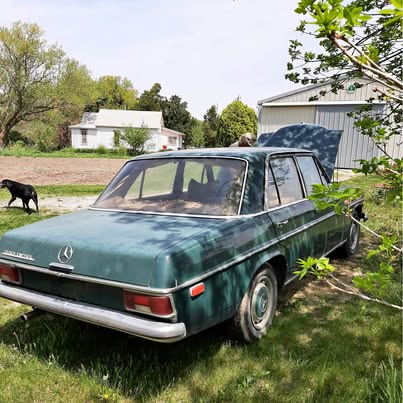
Rust on a W115 follows the water, the mud and the salt, and after fifty years it has had time to follow them everywhere. Assume a forensic examination, and be pleasantly surprised by the rare car that passes one. The W115's reputation among Mercedes people is blunt: the shell rusts more eagerly than the bigger W108's, factory rust protection was modest by modern standards, and a generation of cars spent their lives outdoors as working vehicles. None of that makes a good car impossible — dry-state US cars, garaged European cars and cherished one-owner cars exist — but it makes the inspection non-negotiable.
Sills, jacking points and the sill-jack test. The sills are structural, they trap everything the front wheels throw up, and they rot from the inside out: by the time the paint bubbles along the bottom of the car, the inner structure is usually ahead of what you can see. Press hard along the full length of both sills, examine the four jacking points with particular care, and treat fresh underseal, fresh paint along the sill alone, or new sill covers as questions, not answers. The definitive test is the one the factory built in: the car's own jack plugs into a socket in each sill. Take the car's weight on each socket in turn. A sound sill lifts the corner cleanly and silently. A rotten one creaks, flexes, or begins to fold — and a seller who will not allow the test has answered it. Cutting out and replacing a sill properly, with paint, runs roughly $1,000–2,500 per side, and sills rarely travel alone.
Floor pans and the bulkhead. Water enters past the windshield seal, the rear window seal, the heater box and perished door membranes, and it sits under carpets and sound deadening, rotting the floors from above while road salt attacks them from below. Lift every carpet you are allowed to lift, in all four footwells and under the rear seat. Surface scale is treatable; perforation is a panel job at roughly $500–1,500 a side fitted — and, as with the W108, floor rust is a marker for the whole shell, not an isolated defect. The front bulkhead (firewall) deserves its own minute, because on a W115 it is a known and serious trap: water and debris collect in the plenum and around the heater box, the bulkhead corrodes behind the dash and around the pedal and steering-column apertures, and the repair is dashboard-out fabrication work priced per car, not per panel. Look from the engine bay, along the bulkhead seams and below the windshield, for bubbling, staining and previous patching, and from inside for damp, water tracks and rust dust on the carpets at the base of the dash. A car with bulkhead rot is a project car at any price that pretends otherwise.
Front inner wings, battery tray and headlamp bowls. In the engine bay, work around the inner wings and the suspension turret areas feeling for soft metal under the paint and underseal, check the headlamp bowls (a mud trap, and a perforation here is fiddly, visible work), and lift the battery — or at minimum rock it and inspect the tray edges and the metal below with a torch. The tray rots from the top down under acid attack, invisibly, with the battery in place, and the damage track runs down the inner wing and bulkhead behind it. A tray alone is small money; the panel damage underneath it is not.
Doors, wings and arches. Door bottoms fill with water when their drain slots block, and rot along the lower edge and the skin's folded seam — run a fingertip along the bottom edge of every open door and feel for bubbling and flaking, then check the drains are clear. The bottoms of the front wings behind the wheels, the rear wheel arches (especially the lip and the inner arch where it meets the sill), and the lower rear quarters collect mud and go quietly. None of these alone kills a car; together they are how a "solid" car turns into a four-panel welding programme. A magnet wrapped in cloth, run over arches, sills and lower doors, will find the filler that hides all of it.
Trunk floor and spare wheel well. The rear window and trunk seals leak, and the water collects under the spare wheel and in the well corners, exactly where a casual viewing never looks. Lift the spare and the mat on every car. Staining is a clean, treat and seal afternoon; a perforated well is a panel replacement in the $800–2,000 region done properly; and a trunk floor you can see the road through is the shell telling you, again, to price the whole car as a project.
Spring perches, subframe and structural underside. On a lift — and you should pay for a lift inspection on any car that passes the first viewing — examine the front subframe and its mounting points, the front spring perches, the rear spring seats and the semi-trailing-arm mounting areas, the frame rails and crossmembers, and every seam where underseal meets an edge. Perforation in perches, mounts or rails is fabrication work, priced per car, and it exceeds the value of a cheap 220D faster than any other single finding. Read the underseal while you are under there: factory coating, honestly aged, is patchy, chipped at the edges and dirty. A uniform fresh coat of black blown over everything — seams, jacking points, brake pipes, the lot — the week before a sale is a cover-up until the seller proves otherwise.
The vacuum system: locks, shutoff and the faults that imitate everything
A petrol Mercedes of this era uses vacuum as a convenience. A diesel 220D uses it as a control system, because a diesel engine produces no useful manifold vacuum of its own — so Mercedes fitted an engine-driven vacuum pump (on the front of the engine, diaphragm-type on these cars) to supply it. That one fact organises a whole family of otherwise baffling faults.
What the vacuum does. It powers the brake servo (booster) — a hard brake pedal on a 220D is a vacuum or servo problem until proved otherwise, not a hydraulic one. It operates the engine shutoff: there is no ignition switch cutting a spark, so turning the key off (or pulling the stop control on early cars) applies vacuum to a shutoff actuator on the injection pump, which pulls the rack to zero. It runs the central locking, where fitted, from a vacuum reservoir, with an actuator in each door and the trunk and filler flap. And it influences the automatic transmission's shift behaviour, as described in the gearbox section. The pump's diaphragm is the wear item at the heart of it all: a split pump diaphragm gives weak vacuum everywhere at once — heavy brakes, slow or dead locks, an engine that will not shut off — and, in the failure mode to know about, can allow engine oil to be drawn into the vacuum lines and eventually the servo. Oil in the vacuum system is a pump-diaphragm verdict; a diaphragm kit is inexpensive (roughly $50–150 in parts) and the job is well within home-mechanic territory, which makes it the highest-value repair on many cars.
The symptoms, decoded. Engine will not shut off (or shuts off slowly, or stops only when stalled): vacuum leak or a failed shutoff actuator diaphragm — test the actuator with a hand vacuum pump; it must hold vacuum and move the lever. The manual stop lever on the pump is your get-home and your diagnostic: if the engine stops instantly on the lever, the pump and rack are fine and the fault is vacuum. Door locks slow, working one at a time, or dead, with a hiss from a door: perished rubber vacuum connectors and cracked lines — the system is plumbed in rubber elbows and tees that harden and split after decades, and the fix is methodical replacement, a few dollars in parts and an afternoon of patience, testing door by door with a hand pump. Hard brakes plus any of the above: think system vacuum (pump, main line, servo) before hydraulics. Keep a hand vacuum pump in your inspection kit: on this model it diagnoses more faults per dollar than any other tool you own.
Suspension, steering and brakes
The front suspension — double wishbones on a subframe, coil springs, an anti-roll bar — is strong and conventional, and its wear items are the familiar ones: ball joints, bushings, subframe mounts, dampers. Perished subframe mounts make the front end feel loose and knock over bumps; a mount and bushing refresh is a few hundred dollars in parts and transforms a vague car. Steering is by recirculating ball, with power assistance optional: judge it for free play at the wheel, leaks from the box or (on assisted cars) the pump, and a centre feel that should be light and accurate, not woolly. Play that survives a front-end refresh is steering-box wear, an adjustment first and a rebuild (roughly $400–800) only when adjustment fails.
The rear semi-trailing-arm suspension was the W115's great advance and is correspondingly durable, but its bushings and the differential mounting are now fifty years old: clunks from the rear over bumps and a car that steers itself gently on and off the throttle are bushing and mount wear, not character. Rear wheel bearings and half-shaft joints give the usual rumble and clicking verdicts. Brakes are servo-assisted with front discs: parts are cheap and available, and the standard recommissioning list on a car that has sat — seized calipers, perished flexible hoses, a tired master cylinder, a rust-banded disc set — runs roughly $800–1,800 fitted for a full hydraulic refresh. Judge a standing car as needing it until the history proves otherwise.
Interior, trim and electrics
The cabin is where a working car's life shows honestly. MB-Tex survives decades; its failure mode is the padding beneath it — rubberised fibre pads that crumble to dust, leaving you sitting in the spring frame. Sit in the driver's seat, feel for the frame through the pad, and look under the seats for debris; re-padding a front seat runs roughly $300–600. Cloth seats fade and split; the headlining sags and stains at the pillars where window seals have leaked (read a stained headlining as a water-leak report, not a trim defect); dashboard tops crack in sun-state cars. The heater blower lives behind the dashboard and is, as on the W108, a dashboard-out job if it dies — test it on every speed on every viewing, in July as in January, because a dead blower is a four-figure repair behind a quiet switch.
Electrics on a diesel are mercifully simple — no ignition system, few accessories — and faults follow the universal rule: connections and earths first, components last. Dim lights and a wandering fuel gauge are earth points until proved otherwise. The starter circuit carries diesel-sized currents and punishes tired cables. The glow-plug circuit, covered in the engine section, is the one electrical system that is also an engine system — treat its cables and earths as seriously as the plugs. Finally, the sunroof, where fitted: drains block, seals perish, and the water goes into the headlining, pillars and eventually the floors — price a leaking sunroof car as a car with an active water supply to its own interior.
How to inspect one
Allow at least an hour, and insist on one condition before you travel: the engine must be cold when you arrive. A warm 220D hides every fault this guide has described — glow, cranking, compression, valve clearances — and a seller who has "just warmed it up for you" has removed the most valuable evidence in the viewing. Bring a torch, a magnet wrapped in cloth, a hand vacuum pump, and a screwdriver for prodding (with permission).

- Paperwork and identity first. Match the chassis number on the title to the car's stampings and plates, and decode it: a 220D is a W115 (115.110 family). Ask for the data card or a decode, and check the engine is the four-cylinder OM615 the badge claims. A thick history file — especially one with valve clearances, nozzle services and glow-plug work recorded — is worth real money on this model.
- The cold start, performed by you. Sit in the car and run the glow procedure yourself. Loop-plug car: time the preglow — 30 to 60 seconds to a bright dash indicator is normal; a dead indicator is a failed plug or circuit until proved otherwise. Pencil-plug car: the lamp should go out in seconds. Then crank: the starter should spin the engine briskly. A lazy crank is a battery, cable or starter verdict, and it invalidates every judgement you make next, because a slowly cranked diesel cannot show you its compression.
- The first ten seconds. A healthy engine catches, runs lumpily for a few seconds at most, and settles. Prolonged cranking, a start on some cylinders only, white smoke that takes minutes to clear, or a car that starts and dies points you back to the engine section's order: glow, fuel (air leaks, primer, filters), cranking speed, then compression and clearances — in that order, not the reverse.
- The shutoff test. Turn the engine off with the key or stop control. It should stop promptly. An engine that runs on, stops slowly, or needs the manual lever on the pump has a vacuum or shutoff-actuator fault — cheap in parts, and a perfect test of the vacuum system as a whole. While you are there, work the central locking twice and note any door that lags, and press the brake pedal for servo assistance. One minute, three systems.
- Blow-by, warm. With the engine warm and idling, rest the oil filler cap loosely in its neck, as the engine section describes. Gentle movement is fine; a dancing cap and rhythmic chuffing of vapour is ring and bore wear, priced as such. Check the breather is clear before delivering the verdict.
- The sill-jack test. Using the car's own jack, take the car's weight on each of the four sill sockets in turn, as the rust section describes. Creaking, flexing or folding ends the negotiation about the sills. A refusal ends the viewing.
- The full rust map. Torch and magnet, in the rust section's order: sills and jacking points, floors under every carpet you may lift, the bulkhead from both sides, inner wings and battery tray (lift the battery if you are allowed), door bottoms and their drains, wing bottoms and rear arches, trunk floor under the spare wheel. Perforation in sills, bulkhead, perches or rails is structural; price it as fabrication, or walk away.
- Underneath, on a lift if it passes so far. Subframe and mounts, spring perches front and rear, trailing-arm mountings, rails and crossmembers — and read the underseal as you go: honestly aged and patchy is factory; fresh, uniform and over everything is a question. The lift inspection is the best money in the whole purchase.
- Fuel system details. Look at the leak-off hoses between the injectors (perished rubber here is morning non-starting, bought for a few dollars), the primer pump (weeping plunger-type originals draw air), the filters and any sign of the injection pump's oil supply being checked or neglected. Smell for diesel leaks around the pump and nozzles; look for the black, sooty signature of a leaking nozzle seal at the head.
- The test drive — allow time, and use a hill. Fifteen to twenty minutes minimum. A manual should change cleanly, with second-gear synchromesh the specific test on downchanges; the clutch should bite without judder or slip. An automatic should engage promptly, change without flaring, and — accept it on the drive, not later — redefine your expectations of acceleration entirely. Find a gradient: a healthy 220D climbs steadily and smokes lightly; heavy black smoke under load is over-fuelling or nozzle wear, blue smoke is oil, and either is priced in, not excused. Brakes should stop the car straight, with servo assistance evident; a hard pedal sends you back to the vacuum pump.
- Heat, vacuum and electrics, hot. Let the car idle hot and watch temperature and oil pressure behaviour. Run the heater and blower on every speed (dashboard-out money if it is dead), work the locks again now the vacuum system is warm, test lights, wipers, washers and gauges, and re-test the shutoff. Everything electrical working on a fifty-year-old working car is the signature of a maintained car.
- Interior and originality, last. Sit in every seat and feel for collapsed pads; look under the seats for crumbled padding; check headlining stains against the window seals above them; and then stand back and judge originality — unmolested trim, correct details for the car's phase (grille, lamps, mirrors, wheel), honest wear in the places hands touch. On a car whose performance is a constant, this and the shell are the value, and they are what you are actually buying.
Values
The figures that matter for this model are computed from this site's own listings and recorded sales, and they sit below this guide — the listed-now summary and the market block are refreshed every time the site rebuilds, so use them rather than any number quoted elsewhere. What follows is how to read them. Note the shape of the evidence before you read any figure in it: the pool sampled for this guide contained 5 cars, all for sale, all from Facebook listings, with no recorded sales in the sample — a thin, asking-price-only snapshot, and exactly the kind of sample in which a single exceptional or desperate listing moves every summary number. Treat small-sample figures for this model as a range to think inside, never a price to transact at.
The 220D market is a condition market in its purest form. Because every car performs identically — slowly — and because the mechanical package is broadly fixable, the spread between the cheapest and the dearest 220D is set almost entirely by three things: the structure of the shell, originality, and documented maintenance of the diesel-specific systems (glow, nozzles, valve clearances, pump). A rust-free, original, documented car and a rusty, undocumented one are the same model in name and two different goods in fact, and the price gap between them understates the true gap, because the rusty car's welding bill is still to come. Project cars price at the value of their parts and their shell's salvageable panels; drivers with sound structure price on usability; and the small top tier — low-mileage, garaged, original cars, often one-family US cars — prices on a scarcity that is real, because so few 220Ds were ever cosseted.
Variant premiums are modest and rational. Manuals are preferred by most enthusiast buyers and carry a small premium over automatics in equal condition — but an automatic with a sound shell beats a manual with rotten sills at any relative price, and US buyers who want an economical automatic classic form a genuine second market for the auto cars. Facelift cars carry a slight premium for their usability and trim; early cars carry a slight charm premium for their purity. Neither outweighs condition. Sunroofs, power steering and working air conditioning each add a little, when they demonstrably work; each subtracts when it demonstrably does not.
Two cautions close the section. Asking prices for this model are routinely optimistic at the top and despairing at the bottom, and the auction and achieved-price record — where the market block below shows recorded sales — is the corrective to both. And never price a 220D against a 240D or a 300D listing without adjusting for the model gap: the five-cylinder 300D in particular trades in a different class, and a seller pricing a 220D off 300D evidence is telling you something about the negotiation to come. There is no such thing as a cheap 220D that stays cheap — there are only cars whose bills you have already seen, and cars whose bills are still in the sills.
Parts and ownership
The 220D is one of the best-supported diesel classics you can own, for a structural reason: Mercedes built the W114/W115 family in very large numbers, the diesel cars were kept running as working vehicles on every continent, and the parts trade — factory Classic Center, specialists in Germany and the US, and a deep used-parts pool from rusted-out shells — reflects that working afterlife.
Easy: service filters (oil, fuel — carry both fuel filters as spares, because a clogged filter is the commonest roadside stop on any old diesel), glow plugs in both loop and pencil types, leak-off hose and vacuum connectors by the metre, brake discs, pads, calipers and hydraulics, suspension bushings, ball joints and dampers, clutch kits, exhaust systems, glass seals and most trim rubbers, starter and alternator service parts. Most of it is order-today, fit-this-weekend, at prices close to modern-car money.
Harder and dearer: injection-pump overhaul (specialist work, roughly $800–1,800 as the engine section notes — never let a generalist "have a go" at a Bosch inline pump), nozzle servicing (cheaper, but use a diesel shop with a pop tester), vacuum-pump diaphragms (available, and the first thing to check, but know which pump type your car carries), bulkhead and structural panels (repair is fabrication more often than panel-swapping), good chrome, crack-free dashboards for sun-state cars, correct early trim, and facelift-specific items in unmarked condition. A quality repaint starts in the same five-figure territory as any Mercedes of the era — which is why this guide's mantra is the W108's mantra, sharpened: buy the shell, because the engine will forgive you and the body will not.
Running one. Budget the first year honestly. Catching up deferred maintenance on a running car — full service, valve clearances, filters, glow system proved, vacuum rubbers renewed, brake hydraulics inspected, every fluid changed — runs roughly $1,500–3,500 at a specialist, less if you do the straightforward majority yourself, and the 220D rewards the home mechanic more than most classics: it is simple, spacious in the engine bay, and documented in factory literature that is widely available. Thereafter, running costs are the model's whole point: fuel economy in the mid-30s mpg (US) in normal use, diesel's traditional longevity between interventions, and servicing any good independent Mercedes or diesel specialist can handle. Two ownership disciplines matter more than any other. Keep the battery, starter and glow system in first-class order, because a diesel that starts instantly is a pleasure and one that does not is a car you stop using. And use the car: diesels of this era thrive on regular, fully warmed, loaded running and deteriorate when used for short cold trips — soot, diluted oil and glazed bores are the diseases of the under-used 220D, and a weekly proper run is preventive medicine, not indulgence.
Which one to buy
- The all-rounder: a facelift (1973–76) manual. The most usable 220D — the better trim and mirrors, the production fixes of the late cars, the gearbox the engine wants, and the deepest pool of survivors to choose from. If you want one 220D to drive for years, this is it.
- The purist's car: a pre-facelift manual with pencil plugs retrofitted. The original Strich-Acht form, quarter vents and all, with the one upgrade that transforms its mornings. Verify the conversion is a proper parallel system, not a wiring improvisation.
- The value buy: a sound automatic. The market discounts the automatic for its performance, and the discount is your opportunity — provided the shell is genuinely sound and you have driven the car and made peace with its pace. In town and traffic it is arguably the nicer car.
- The commuter classic: a documented US car with working air conditioning and power steering. The specification Americans actually bought, bought by the buyer it was built for. Documentation of diesel-system maintenance matters more than mileage on the odometer.
- The car to avoid at any discount: the rusty bargain. Bulkhead, sill or perch perforation on a cheap car is not a discount; it is the purchase price of a welding programme, with a free diesel attached.
And the rule that overrides all of the above: buy the least rusty, most original car you can find, and let the gearbox, year and colour fall where they may. On a model where every example is equally slow and the mechanicals equally fixable, structure and originality are the value itself.
See the 1 220d cars currently listed.
For sale now
$11,000Expand
What they sell for: 220d sale prices.