
Mercedes-Benz 280SL buyer's guide
Mercedes-Benz 280SL -- the model's own buyer's guide: variants, values and what to check.
Years listed: 1969-1984 · Series: R107
Overview and history
The 280SL badge covers two different Mercedes-Benz roadsters, built in two different decades, and the first job of this guide is to keep them apart — because sellers, listings and even registration documents routinely blur them, and the money is very different.
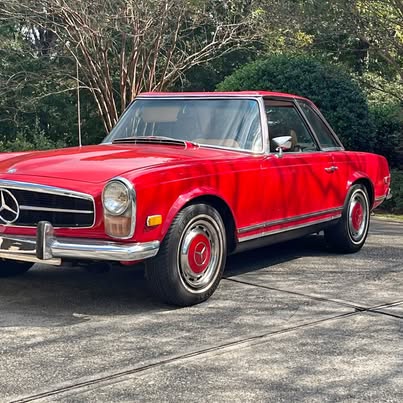
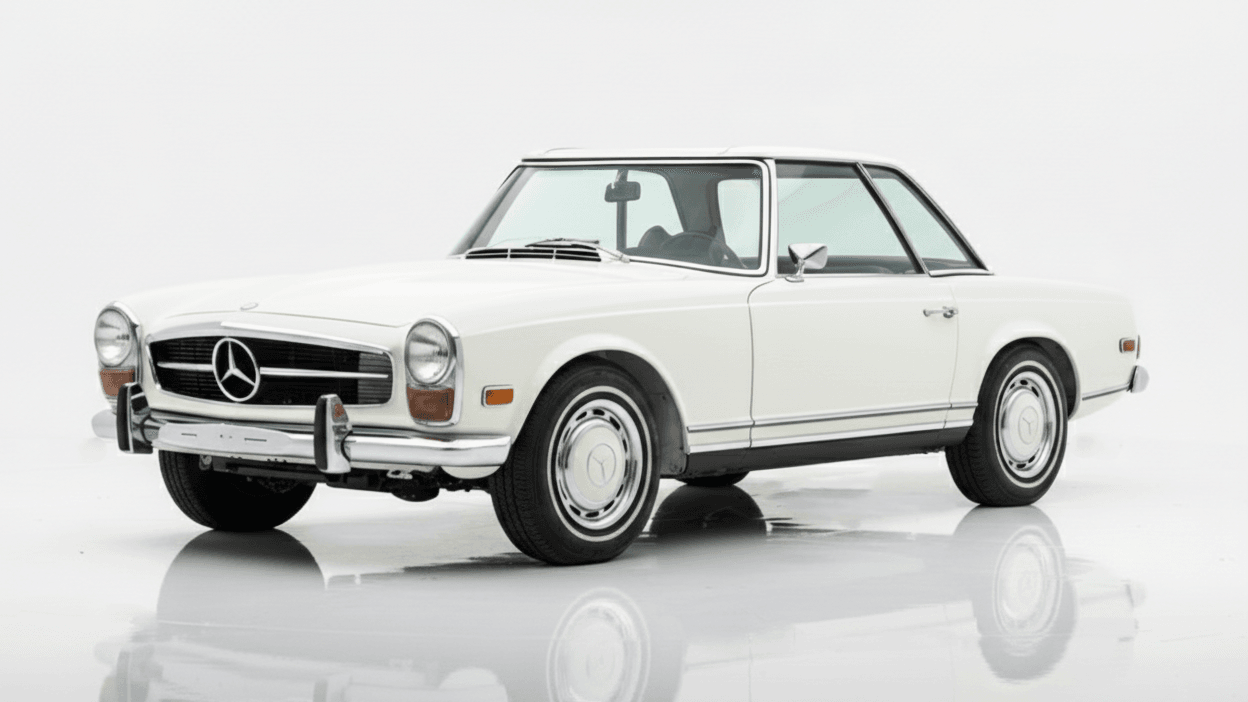
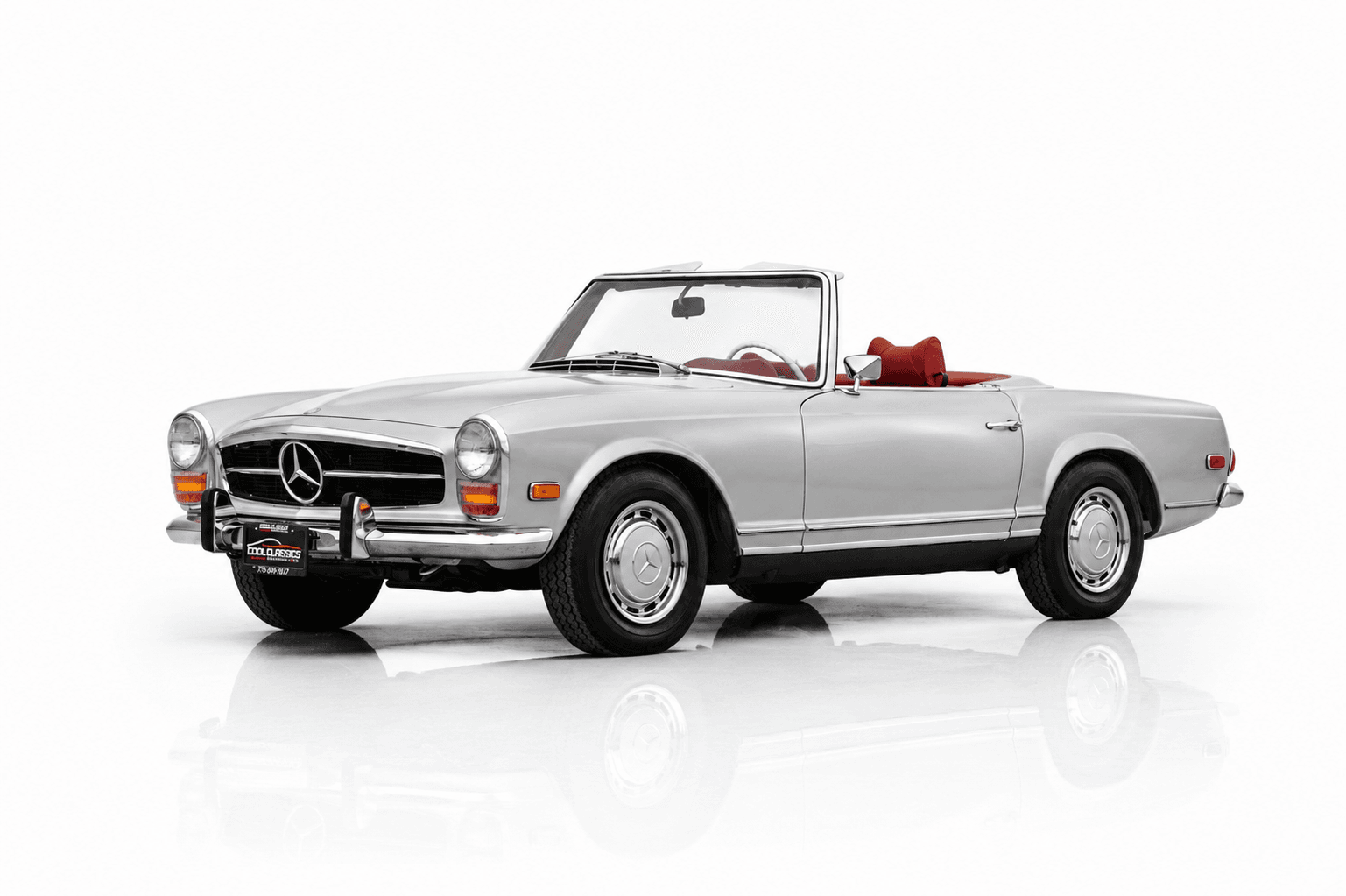
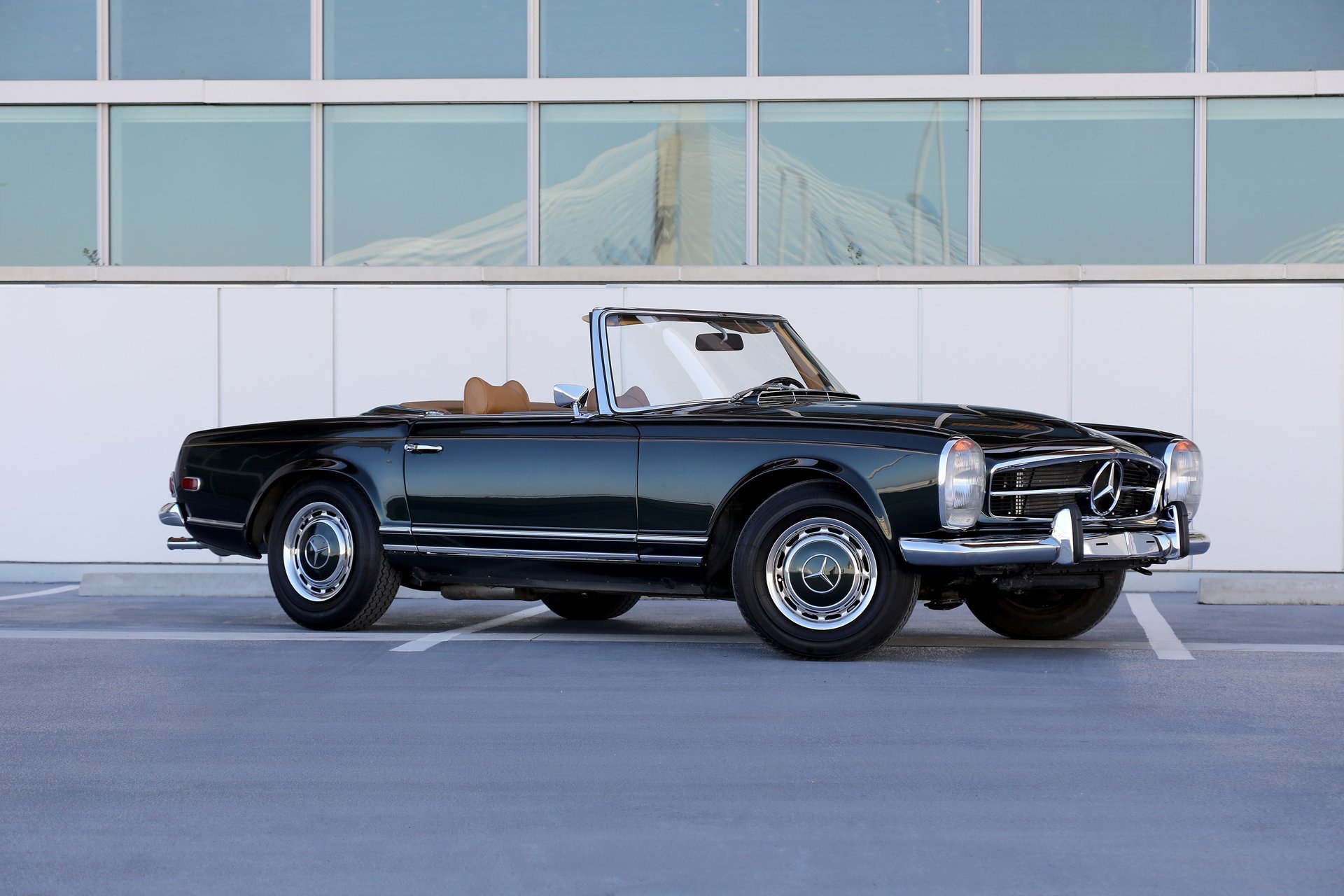
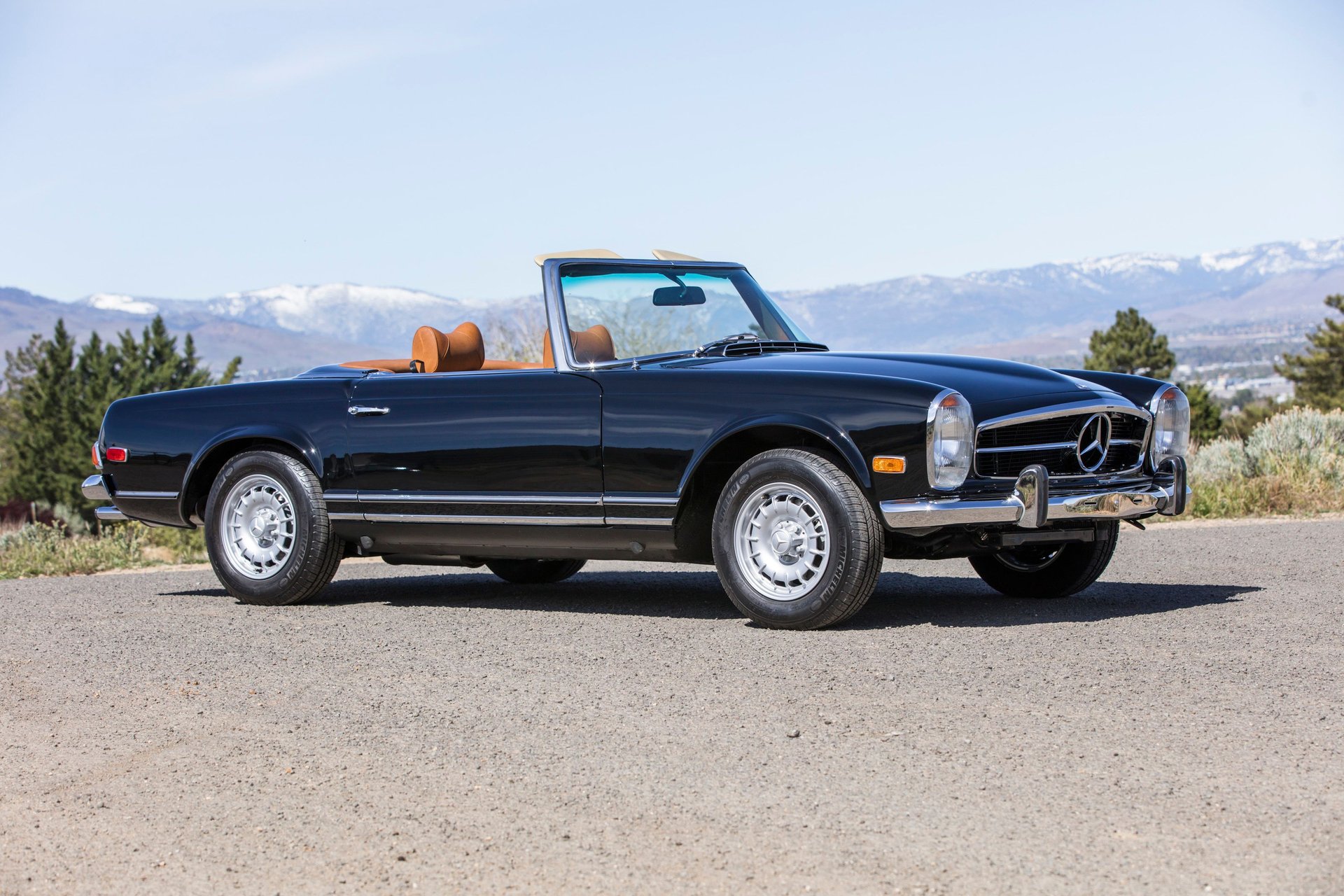
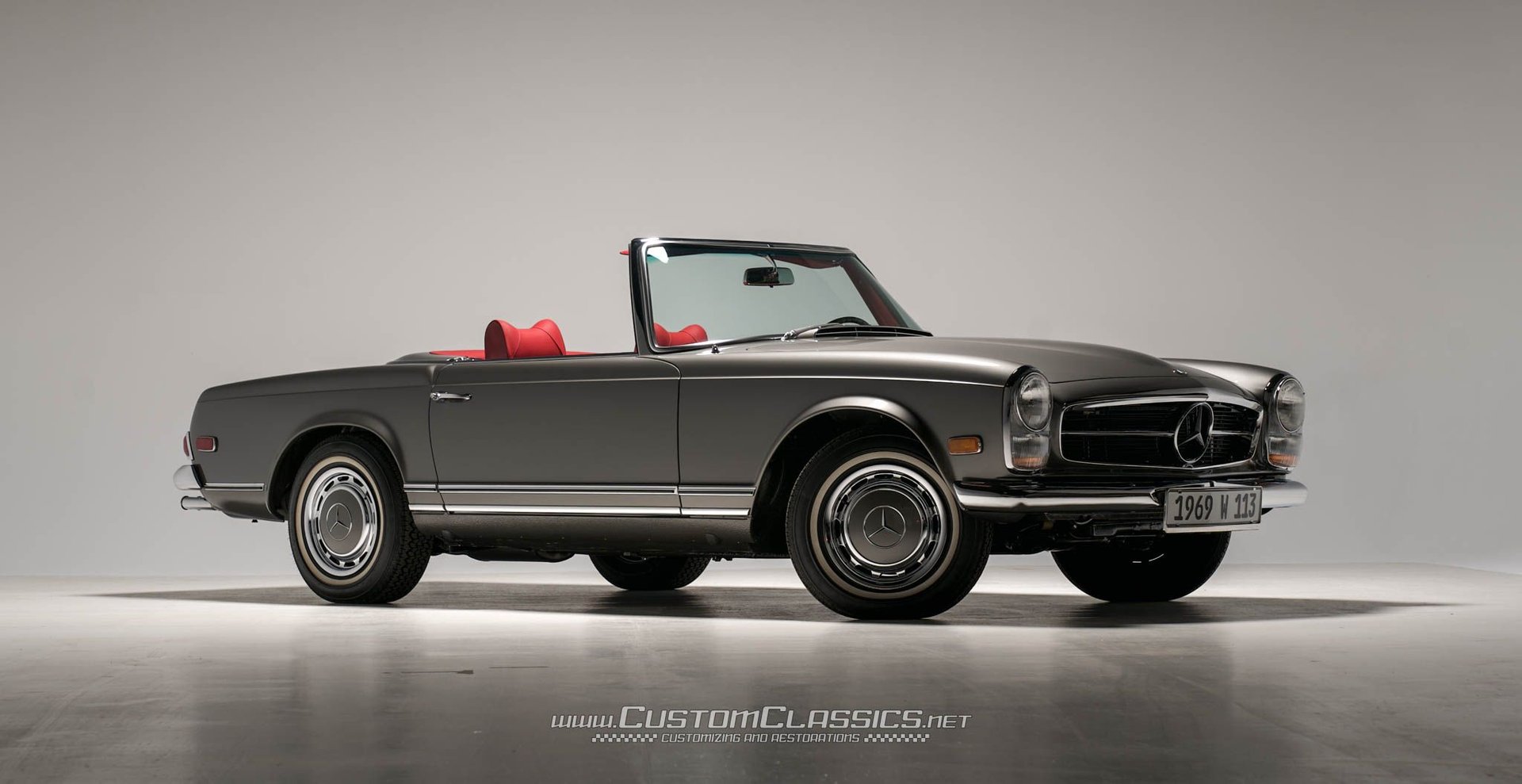
The famous one is the W113 "Pagoda" 280SL of 1968–71: the third and final version of the SL line that began with the 230SL, launched at the Geneva show in March 1963. The W113 was a deliberate change of direction from the 190SL and 300SL it replaced — one car instead of two, aimed squarely at the comfortable, safe, fast touring role, with the safety cell, crumple structures and padded interior that Barényi's team had pioneered on the sedans. The 250SL followed in late 1966, and the 280SL was announced in December 1967, gaining the sedan's 2.8-litre engine and a programme of small, continuous refinements rather than any restyle — the Pagoda's shape barely changed across its whole eight-year life, which is part of why the market reads the three versions as one car with three engines. The W113 was styled under Paul Bracq, and its nickname comes from the removable hardtop, whose roof panel dips in the middle — a concave profile shaped by Béla Barényi's safety thinking, because the raised outer edges stiffened the roof structure. Underneath, the car is closely related to the W108 sedan covered elsewhere in these guides: the same overhead-cam six, the same Bosch mechanical fuel injection, the same kingpin front suspension and low-pivot swing axle. What the sedan's engineering gained in the roadster was lightness and proportion — this is a compact, upright, beautifully detailed two-seater, a grand tourer rather than a sports car, and it has become one of the defining classic Mercedes of all.
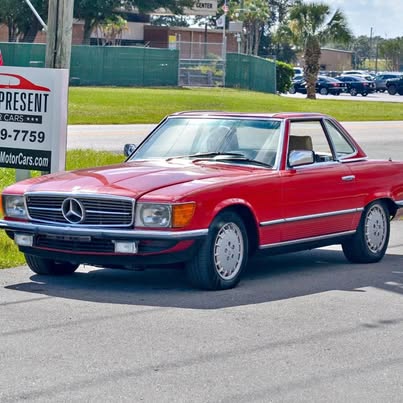
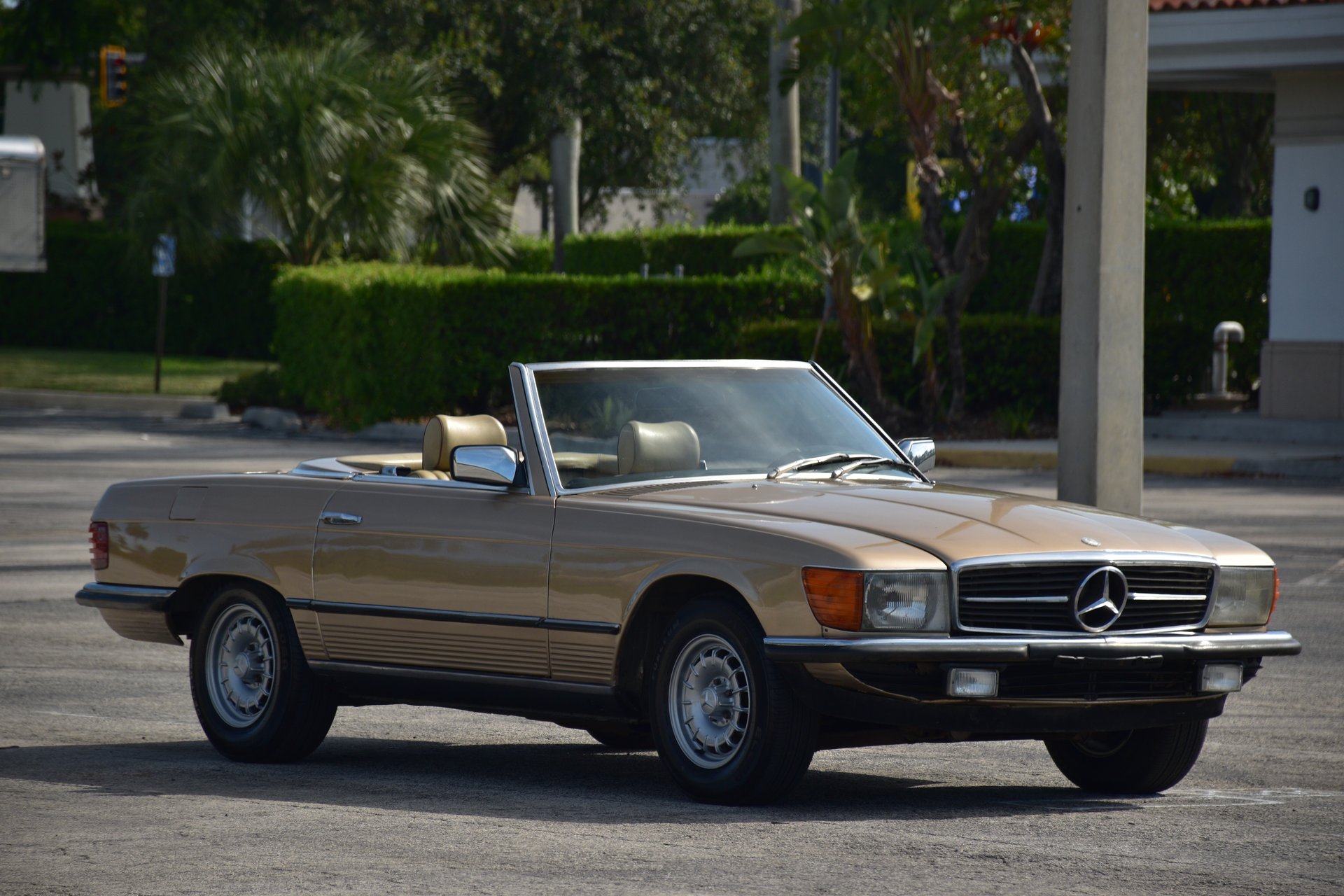
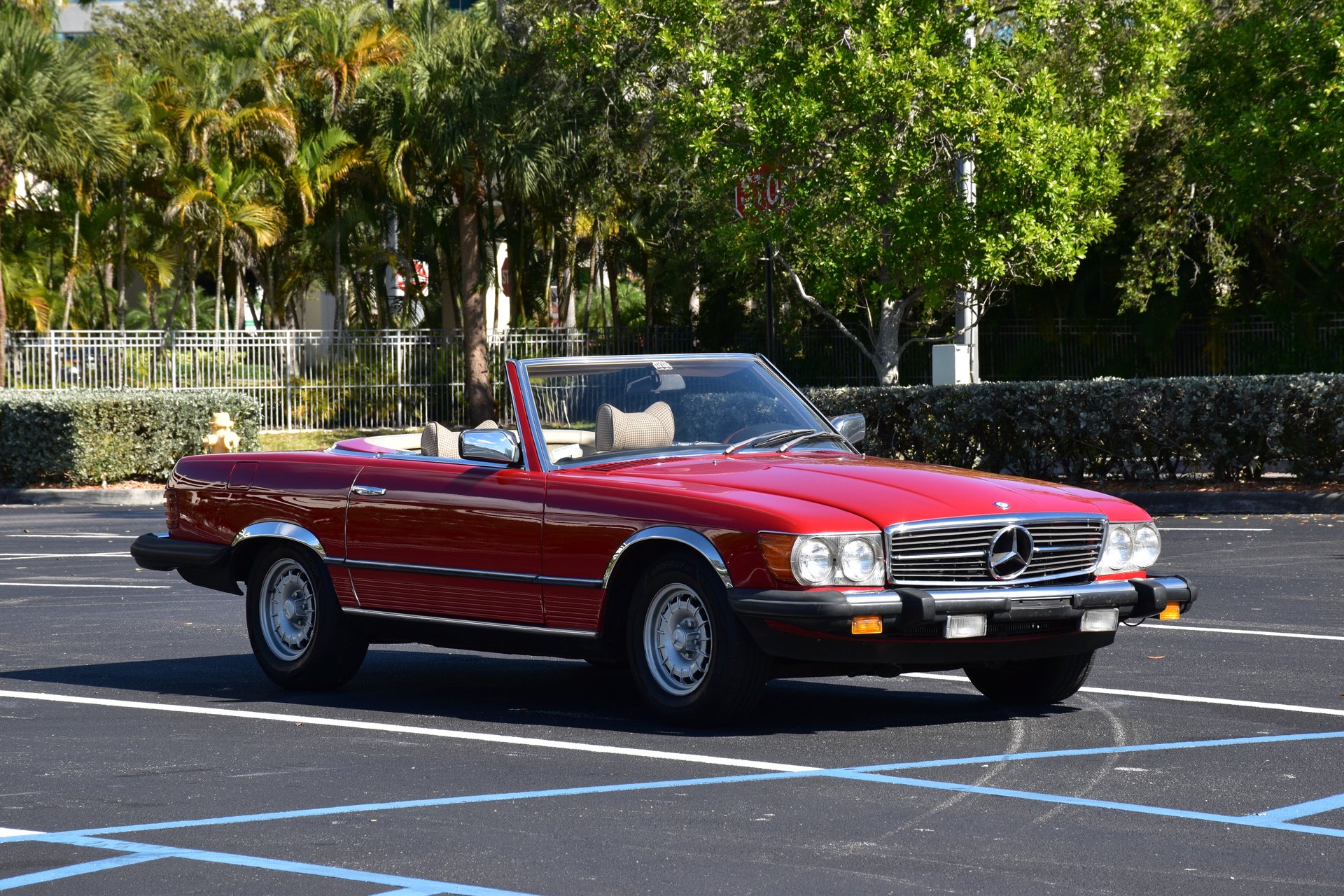
The second car is the R107 280SL of 1974–85: the six-cylinder version of the SL that replaced the Pagoda. The R107 was sold new in Europe and other markets but never officially offered in the United States, where the range was V8-only. Every R107 280SL in America is therefore a grey-market import, most of them brought in during the 1980s import boom and converted — "federalized" — to meet US safety and emissions rules. It is a bigger, softer, more modern car than the Pagoda: a twin-cam six, proper independent rear suspension, and the thick, safety-first styling of the 1970s. It is also, specification for specification, a genuinely good car that the US market never got the chance to buy new.
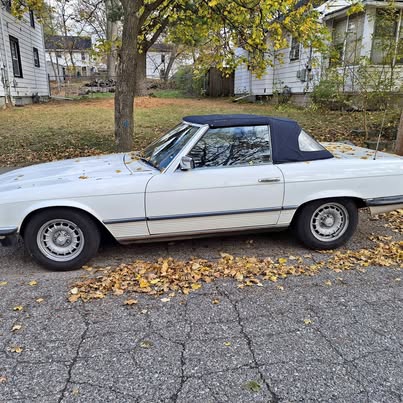
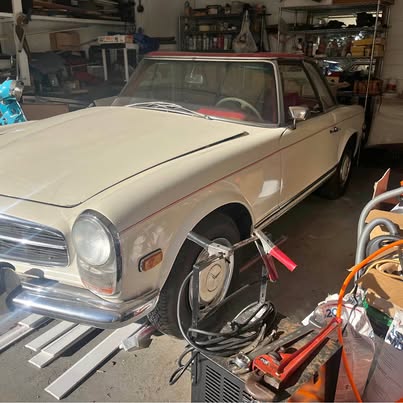
Our own listings show the two cars living side by side under one badge. We currently track five 280SLs, all of them for sale and all of them sourced from Facebook Marketplace: three are W113 Pagodas (a 1968 car and two 1970 cars) and two are R107s (1984 and 1987). All five are automatics, and the colours split red, white and green. That small sample makes the guide's central point by itself: when you go shopping for a "280SL", you are shopping in two markets at once, and the first question on any car is not the price, the colour or the mileage — it is which 280SL it is.
The two cars share more than a badge, though. Both were expensive, well-made roadsters that were maintained properly early in life and then, as values dipped, often run on a budget, stored badly, or both. Both are fundamentally tough mechanically. And on both, the difference between a good car and a money pit is rust and deferred maintenance, not the odometer. Where they differ is in what the market forgives: a Pagoda is now a blue-chip collectible whose buyers pay for originality and documentation, while an R107 280SL is an enthusiast's car whose value sits in condition and in clean import paperwork. Buy each on its own terms and both are rewarding. Confuse them, and you will overpay for one or under-inspect the other.
The models
Because the badge spans two generations, the table below lists both cars — and, for context, the Pagoda's two predecessors, because 230SLs and 250SLs are constantly cross-shopped against the 280SL and occasionally misdescribed as one.
| Model | Years | Engine | Output | Built | Character |
|---|---|---|---|---|---|
| 230SL (W113) | 1963–1967 | 2.3 six (M127), injection | 150 hp | 19,831 | The original Pagoda; drum rear brakes on early cars |
| 250SL (W113) | 1966–1968 | 2.5 six (M129), injection | 150 hp | 5,196 | The rare middle car; four-wheel discs arrive |
| 280SL (W113) | 1968–1971 | 2.8 six (M130), injection | 170 hp | 23,885 | The final, strongest Pagoda; the collector default |
| 280SL (R107) | 1974–1985 | 2.8 six (M110), injection | 185 hp | 25,456 | The Euro six-cylinder R107; grey import in the US |
| 280SLC (C107) | 1974–1981 | 2.8 six (M110), injection | 185 hp | 10,666 | The fixed-roof coupé sister; not a convertible |
(Outputs are period DIN figures for European cars. US-market Pagodas were rated under the SAE gross system then in use, so period American figures are not directly comparable — judge a US car by how it drives, not by a number in an old brochure.)
The W113 280SL (1968–71). Production ran from late 1967 to February 1971, and at 23,885 cars the 280SL is the most numerous Pagoda — which is precisely why it anchors the market: there are always cars to choose from, parts support is the best of the three, and the 2.8-litre engine gives the performance the earlier cars promise but don't quite deliver. It kept the 250SL's four-wheel disc brakes and added a long list of small refinements — and, for the US market, the beginnings of emissions equipment and safety trim that make late American cars slightly softer in feel than European ones. Most US-delivered cars are automatics; European cars are more often manuals. A tiny number were built with a five-speed ZF manual gearbox, and those cars are hunted today — verify any claimed five-speed from the data card, because the premium invites fiction.
The R107 280SL (1974–85). The six-cylinder R107 was the entry point to the SL range everywhere except North America. It ran for the model's whole middle life, outliving several of the V8 variants sold alongside it, and 25,456 roadsters plus 10,666 of the SLC coupés were built — respectable numbers, but spread across the whole world, so US supply is only what the grey-import years brought in. Early cars (1974–76) use Bosch D-Jetronic electronic injection; from 1976 the car moved to K-Jetronic continuous mechanical injection, and detail changes followed the rest of the R107 range through the late 1970s and early 1980s. The very last cars overlap the arrival of the facelifted 1986-onwards range, by which time the six-cylinder SL in Europe had become the 300SL — so a "1987 280SL", like one of the cars in our current listings, is a car whose build date and specification deserve a careful read of the paperwork rather than an assumption from the badge. None of this is a reason to walk away; it is a reason to buy an R107 280SL on its documents as much as its condition.
The badge trap, stated plainly. A W113 and an R107 share nothing but the badge and the three-pointed star: no panels, no trim, almost no mechanical parts. Any listing that mixes the two — a "1975 Pagoda", a "1970 R107" — is telling you the seller does not know what they have, which cuts both ways: it can mean a bargain, and it always means you must verify everything yourself. The chassis prefixes settle identity instantly: a Pagoda's VIN begins 113.044, an R107 roadster's 107.042. Check it before you check anything else.
Engines and gearboxes
The Pagoda's six: M130 with Bosch mechanical injection
The W113 280SL's engine is the M130 — the same 2,778 cc overhead-cam six that powers the 280SE sedan, in a slightly hotter state of tune: 170 hp DIN where the sedan makes 160. It is a famously durable engine. The block and bottom end are effectively unburstable in road use, the chain-driven cam wears slowly, and a healthy example starts easily, idles evenly, pulls cleanly through the rev range and shows strong oil pressure — the gauge high at speed, dropping at a hot idle, which is normal. A top-end rattle at start-up that fades within a second is usually the hydraulic chain tensioner filling; a rattle that stays is a worn chain or guides. Head gaskets typically last around 100,000 miles; oil in the coolant, or coolant in the oil, is the failure sign.
The fuel system is where the engine earns its reputation — in both senses. The 280SL uses a Bosch six-plunger mechanical injection pump, driven from the engine, metering fuel against a three-dimensional space cam inside the pump. When it is right, the car starts instantly hot or cold and runs with a crispness no carburettor of the period matches. When it is wrong, diagnosis needs a specialist, because the system has no electronics to interrogate and its faults mimic each other.
The wear that matters is plunger wear, and it announces itself as fuel dilution: petrol gets past the plungers into the lubricant. On the Pagoda's pump, which carries its own oil supply, check the pump's own dipstick — the level rises between services and the oil reeks of fuel. That rising level is a far more reliable test than how the car happens to run on the day you view it. A pump rebuild from one of the handful of US specialists runs roughly $2,000–3,500, so documented pump work is worth a real premium, and a car whose pump is passing fuel needs the job priced into the offer, not waved away.
Two cheaper causes of a rich-running M130 catch buyers out, and both are in the exemplar sedan guide because the hardware is identical. The pump's wax-element thermostat fails with age and holds cold enrichment on when the engine is warm — and a stuck-open engine thermostat produces exactly the same result, because an engine that never reaches temperature is an engine the pump correctly believes is still cold. Read the temperature gauge's story on the test drive before condemning a five-figure-adjacent pump. Likewise the cold-start system — an electric solenoid and enrichment circuit that should work for seconds, not minutes: a car that needs its cold-start circuit to keep running when warm is telling you the base mixture or the thermostat is wrong.
Ignition on the M130 is conventional points and coil, and it is the third member of the fault-finding trio: worn points, a tired condenser or a stretched advance mechanism produce the flat, hesitant running that owners blame on the injection, and a strobe check of the advance curve belongs in any diagnosis before the pump is touched. The cooling system is generous by period standards, but the viscous fan coupling and the water pump age, and a Pagoda that creeps up in temperature in traffic is usually one of the two — test the fan coupling's resistance when hot before pricing radiators.
US-market cars add emissions hardware as the years progress — later American Pagodas carry air-injection and retarded ignition timing that blunt the engine's edge slightly and add under-bonnet clutter that rots, leaks and gets removed by owners, sometimes well, sometimes not. A European-delivery car feels a touch sharper; a US car with its equipment intact and working is the more original artefact. Neither is a reason to reject a car; both are reasons to know which one you are looking at.
The R107's six: M110 twin-cam
The R107 280SL's M110 could hardly be more different in character: a 2,746 cc twin-overhead-cam six, an engine Mercedes built in large numbers for the W123 and W126 saloons as well as the SL, rated at 185 hp DIN in the SL — more than the Pagoda, in a heavier car, so performance ends up broadly comparable: brisk rather than fast, and happiest being revved. It is a smooth, willing engine with a harder-edged exhaust note than the M130, and it is fundamentally strong — bottom-end trouble is rare, and the duplex timing chain lasts well if oil changes have happened.
Its fuel injection comes in two generations. Cars built before 1976 use Bosch D-Jetronic, the electronic system also found on the W108 V8s, with the same period failure points: the trigger points in the base of the distributor, whose fibre rubbing blocks wear and whose contacts foul with oil that creeps up the distributor shaft, giving a cold misfire that clears as the engine warms; and the manifold pressure sensor, whose diaphragm eventually perforates and sends the mixture rich — testable in minutes, because the sensor must hold vacuum from a hand pump. From 1976 the 280SL uses K-Jetronic, a continuous mechanical system governed by airflow and fuel pressure. K-Jetronic's classic faults are pressure faults: a tired warm-up regulator gives wrong mixture during warm-up (the clue is a car that starts fine cold and fine hot but misbehaves in between), a failing fuel pump or accumulator gives hot-start trouble because the system must hold rest pressure to stop the fuel vaporising in the lines, and the fuel distributor itself wears or gums up after long storage. Fuel pressure gauges, in the correct order, diagnose all of it — the system wants its pressures in spec before any component is condemned. Budget roughly $800–2,000 to sort a neglected K-Jetronic car properly with pump, accumulator, filters and a regulator, more if the fuel distributor needs rebuilding.
The M110's routine weaknesses are smaller but constant. Valve clearances are screw-adjusted at the rockers and drift with miles, so a top-end tick is usually adjustment, not doom — but it must actually be done, and a car with no record of it is a car whose services have been skipped. Oil leaks from the cam cover and front seals are near-universal and mostly cosmetic until they reach the exhaust. Valve stem seals harden with age and give the classic puff of blue smoke on start-up and on the overrun; that is a known, bounded job. And on federalized US cars, look hard at what the conversion did to the engine: catalysts were sometimes added, sometimes not, ignition and mixture settings vary by converter, and the under-bonnet wiring of a converted car is only as good as the shop that did it in 1985. A car that runs cleanly and evenly has answered most of these questions; a car with a lumpy idle and a spaghetti engine bay is a project wearing a driver price tag.
Gearboxes
Pagoda. European 280SLs came standard with a four-speed manual; the four-speed automatic was the option most US buyers chose, and most American cars are automatic. The automatic is Mercedes' own fluid-coupling box (the K4A 025 family), and it pulls away in second gear by design — first comes only on full throttle or kickdown — so a second-gear start is correct behaviour, not slip. Changes should be firm and clean; flaring between gears, or a long delay engaging reverse, means a rebuild at roughly $3,000–5,500 at a specialist. The manual is a sweet, deliberate gearbox; judge it on second-gear synchromesh, which goes first, and clutch judder. The rare ZF five-speed manual is the collector's prize — and, as noted above, a claim to verify on the data card, because a standard four-speed car rebadged by its description is worth no premium at all.
R107. The six-cylinder R107 was offered with a four-speed manual as standard in Europe, a five-speed manual in later production, and a four-speed torque-converter automatic as the popular option — the automatic most grey imports carry, though manual R107 280SLs exist in the US in numbers no US-market R107 V8 can match, which is one of the quiet pleasures of the model. The automatic is a strong, simple box; the same rules apply — firm changes, prompt reverse, clean fluid. On manuals, test second-gear synchromesh cold, when it is at its worst. On any R107, also check the flexible couplings and centre bearing in the propshaft and the differential mounts: thumps on take-up are usually rubber, not gears, and are priced accordingly.
On both cars, never read the gearbox from the shifter or the seller's description — read the data card and the VIN plate, and make the title agree with both before money moves.
Problem areas
Everything in this section applies to cars that are now between roughly forty and sixty years old. The mechanical story on both 280SLs is reassuring; the structural story is where the money goes. One honest limitation before the detail: our current tracked pool for this model is five cars, all Facebook Marketplace listings with a single lead photograph each — enough to show the shape of the market, not enough to compute photo-incidence figures of the kind the sedan guides carry. So this section makes no percentage claims. It is built instead on what these two well-documented models are known to do, and every check in it is one you can perform yourself with a torch, a magnet and an hour.
Rust: the map
Pagoda (W113). Rust on a Pagoda follows the water and the road dirt, in this order:
Front wings and inner wings. The headlamp bowls and the tops of the front wings collect mud thrown up behind the wheels, and the wings rot from the inside out around the lamp and along the wing's upper seam. The inner front wing carries a small pressed notch — a factory feature whose presence is a well-known originality tell: an inner wing without the notch has usually been replaced, which is not a crime but is a question (why? accident or rust?) that the seller's story must answer. Wing and inner-wing work on a Pagoda is panel-beating money, and a quality repaint of one wing, blended properly, runs well into four figures.
Sills and floor pans. The sills are structural, trap mud, and rot from inside; press hard along their full length and check the jacking points. Floors go where the water gets in — past the windscreen seal and the heater box — and sit under the carpets. Lift the carpets in both footwells. Surface rust is treatable; holes are a welding bill, roughly $500–1,500 a side for floor sections fitted, and floors rarely rot alone.
The soft-top well and boot floor. The well the folded soft top lives in collects water whenever the top's drains block, and it rusts quietly out of sight — fold the top and look. The boot (trunk) floor and spare-wheel well take water from the rear window and boot seals; lift the spare wheel and look in the well corners. A rusted boot floor is a panel replacement and paint at roughly $800–2,000 done properly.
The hardtop. The Pagoda roof is steel, and it rusts along its lower edges and around the rear window — and a hardtop is not a spare part you simply buy another of in matching trim. Inspect it like a second, smaller body: edges, window surround, headlining, and the chrome trims, which pit.
R107. The later car rusts in different places, and one of them is serious enough to lead with:
The bulkhead (firewall) and blower box. The R107's scuttle and heater blower compartment trap leaves and water, and the bulkhead rots from inside the blower box outward — invisibly, until water starts entering the footwells and the rust is structural. This is the R107 equivalent of the Pagoda's sill test: shine a torch into the blower compartment, look at the bulkhead from the engine bay and from inside the footwells, and treat perforated bulkhead metal as fabrication work priced per car, not a patch. Cars that have lived outside under trees are the worst; a wet carpet in an R107 is never "just the door seal" until the bulkhead has been cleared.
Floors, sills and jacking points. As on the Pagoda: water past the windscreen seal and from the bulkhead above ends up in the footwells, and the sills and their jacking points rot from inside. The same pressing, prodding and carpet-lifting applies, and the same rule — fresh underseal blown uniformly over everything the week before a sale is a cover-up until proven otherwise.
Boot floor and rear wings. The boot seal and rear lamp seals leak into the boot floor and the wells behind the rear wheels; lift the boot carpet and the spare. Rear wheel-arch lips bubble from inside. None of it is exotic, all of it adds up, and on an R107 the parts and panel situation is better than the Pagoda's while the labour is the same — so rust still prices the car.
Front subframe and its mounts. The R107's front subframe carries the engine and suspension; its rubber mounts perish (making the front end feel loose and the steering vague) and the frame itself can corrode around the mounting points. Mounts are a kit, not a rebuild — a few hundred dollars in parts, $600–1,100 fitted — but perforation in the frame is fabrication.
Heating, ventilation and the vacuum system (R107). Later R107s run their heating and ventilation through vacuum-operated flaps and actuators, and the vacuum system also serves the central locking on many cars. Perished vacuum hoses and failed actuator diaphragms give the classic symptoms — heater flaps that won't change over, vents stuck on one setting, locks that work on three doors out of four — and the diagnosis is a hand vacuum pump worked patiently through the circuit, not a parts cannon. The heater blower and its compartment are also the top of the bulkhead water path described above: leaves in the blower box hold the moisture that rots the scuttle, so clearing that compartment is the first maintenance job on any R107 you buy, before it is a repair on one you're selling. Cars with air conditioning carry the period compressor and a condenser in front of the radiator; a working system is a plus, a dead one is a recommissioning budget of its own, and on federalized cars the system may be factory, dealer-fitted or conversion-era aftermarket — three very different things wearing the same controls.
Suspension, steering and brakes
Pagoda. The front suspension is the W108's kingpin design: immensely strong, maintained with a grease gun, with nipples on the kingpin and its joints that want attention roughly every 3,000 miles. Skipped for years, the kingpins and threaded link pins wear, giving vague steering, knocks over bumps and uneven tyre wear. But never condemn a kingpin dry: old grease hardens in the passages, and a joint that rocks like a worn one can come back into specification once it is actually lubricated. Grease first — warming the joint if the gun won't push grease through — then rock the top of each front wheel and judge the play. A specialist kingpin rebuild runs roughly $800–1,500 a side, which is why the grease-first check is worth real money. At the rear, the swing axle uses coil springs plus a hydropneumatic compensating spring over the differential, self-pumping with axle movement: load the boot heavily, drive around the block, and a live compensator pumps the car back to level while a dead one leaves it sitting down. Replacements are expensive — overhauled units from European specialists run around €1,700 before fitting — and many cars have been converted to a plain coil spring, which works but gives up the self-levelling and often leaves the car sitting tail-high when unloaded. Brakes are discs all round on the 280SL, cheap in parts; what costs is undoing twenty years of sitting — seized calipers, perished hoses, a tired master cylinder, $800–2,000 for a full hydraulic refresh with labour.
R107. The later car is conventionally modern underneath: double-wishbone front suspension on the subframe, semi-trailing-arm rear suspension — no swing axle, no compensator, and much more forgiving geometry. Wear shows as tired ball joints, perished bushes, leaking dampers and sagging springs, all of it ordinary workshop work at ordinary prices. The steering is recirculating-ball, power-assisted, and should be light and free of play at the straight-ahead; play is usually adjustment or worn linkage, occasionally the box. Brakes are discs all round with the same standing-car caveats as the Pagoda. The R107-specific trap is rubber: subframe mounts, suspension bushes, engine and gearbox mounts and propshaft couplings all perish on the same schedule, and a car that thumps, wanders and vibrates is usually asking for a full rubber refresh — budget $1,500–3,000 with labour — rather than any single dramatic repair.
Tops, interior and trim
Both cars are two-seaters that live three lives — top down, soft top up, hardtop on — and each roof is a separate inspection.
Soft tops. The canvas rots, the rear window clouds and cracks, and the frame's bows bend when forced. A quality replacement soft top, fitted, runs roughly $1,500–2,500 on either car; check the frame operates smoothly by hand before blaming the canvas. On the Pagoda, the top folds into the well behind the seats — the rust trap described above. On the R107 it disappears under a flush panel, and the same water check applies inside the compartment.
Hardtops. Both cars came with a removable steel hardtop, and both hardtops rust at their edges, carry expensive chrome and rubber, and are worth real money in good order — a car offered "with hardtop" whose top turns out to be rusty, dented or missing its trim is a car whose price just changed. Check the headlining, the rear window seal, and that the latches are complete. On the R107, also confirm the top actually fits the car: tops get swapped between cars over fifty years, and a poor fit shows at the windscreen header rail.
Seats and trim. Pagoda seats are trimmed in MB-Tex vinyl on most US cars, leather on some, over horsehair (rubberised coconut fibre) pads that crumble — the tell is greenish dust under the seats and a sitting position like a hammock. Sit in the driver's seat; it goes first. Re-padding runs roughly $300–600 a seat; a professional leather retrim is five figures, so a good original interior is worth real money. The R107 uses foam pads that collapse with age instead — same test, same conclusion, slightly cheaper fix. Pagoda wood is limited to small trim pieces; the R107's dash wood and console veneer cracks and lifts and is refinished at $1,000–2,500 for the set done properly. Carpets on both cars tell the water story: damp, staining and a musty smell are evidence, not ambience.
Chrome and brightwork. Pagoda chrome — bumpers, grille surround, lamp rims — is extensive, pitted on most cars, and re-plating a full set is a serious bill; count the bad pieces and price them. The R107 carries less chrome but its anodised aluminium trim and rubber bumper mouldings have their own replacement costs, and on federalized cars the big US bumpers are part of the car's converted identity — some owners retrofit the slimmer European bumpers, which changes both the look and the paperwork story.
Electrics and instruments
Fifty-year-old wiring fails at its connections, not in the middle of wires. On both cars, dim lights, intermittent accessories and wandering gauges are almost always earth (ground) points — cheap to fix, tedious to find. Work everything on a viewing: windows, blower on all speeds, washers, wipers, clock, radio, every lamp. A car where everything works has usually been used and maintained, which is the best sign there is.
Model-specific items: on the Pagoda, the mechanical injection's electrical helpers — cold-start solenoid, thermo-time switch — fail quietly and produce the hard-starting that gets blamed on the pump. On D-Jetronic R107s, the ECU and pressure sensor are the hunted parts (see the engine section). On K-Jetronic cars the electrics are simpler but the fuel-pump relay and the ignition switchgear earn their keep in hot-start complaints. On federalized R107s, add one more circuit to check: the conversion itself. Added catalysts, air pumps, warning lights and altered lighting circuits were installed by dozens of different shops to dozens of different standards, and a converted car's wiring diagram is partly a work of fiction. Everything working, on a grey car, is worth more than usual — because the opposite is harder to unpick than on a car Mercedes built for the market it was sold in.
How to inspect one
Allow at least an hour, bring a torch, a magnet wrapped in cloth and a screwdriver for prodding (with the seller's permission). Decide which 280SL you are looking at before step 1 — Pagoda or R107 — because half the steps branch. If the car passes you, pay for a lift inspection before money changes hands; on either car it is the best $150 you will ever spend.
- Start with identity and paperwork. Read the VIN: 113.044 means a Pagoda, 107.042 an R107 roadster. Match it to the title, the plate in the engine bay and the chassis stamping. On an R107, this step doubles: ask for the import and federalization paperwork — the DOT/EPA conversion records and the car's US title history. A grey car with clean, continuous paperwork is worth more than the same car without it, and in states with emissions testing it may be the difference between registering the car and owning a sculpture. Ask for the data card and invoices on either car; a thick history file is worth thousands.
- Cold start. Insist the engine is cold when you arrive. An injected car should start at once and settle. Watch for blue smoke (valve stem seals or worse) and listen for timing-chain rattle. On a K-Jetronic R107, note how it behaves through warm-up, not just at start — the in-between misbehaviour is the warm-up regulator's signature.
- The dipstick test (Pagoda). Smell the engine oil for petrol and read the level. On the injection pump's own dipstick, do the same: a rising level that reeks of fuel means the pump is passing petrol past its plungers — the $2,000–3,500 conversation from the engine section. On the R107 there is no pump dipstick; instead check for fuel smell in the oil (a neglected engine tells the same story differently) and ask when the injection last had its pressures checked.
- Under the car. Torch along both sills, prod the jacking points, check the floor seams and the rear spring perches (Pagoda) or subframe mounts (R107). Perforation in sills, perches or rails is structural. Read the underseal as you go: patchy and honest is factory; a fresh uniform black coat over everything is a question, not an answer. This step decides whether you continue at all.
- The water traps. Pagoda: fold the soft top and inspect the well; lift the spare wheel and check the boot floor and well corners; look at the hardtop's lower edges if one is fitted or offered. R107: torch into the blower compartment and bulkhead, check both footwells for damp, then the boot floor. Water evidence anywhere means finding the entry point, not just drying the carpet.
- Floors inside. Lift the carpets in both footwells. Look for water tracks from the windscreen base and heater box, and prod the pans. Wet carpets in a "dry-stored" car mean leaking seals, a rotten bulkhead (R107) and rust starting.
- Body and gaps. Run the magnet over the sills, arches, lower doors and — on the Pagoda — the tops of the front wings around the headlamps. On a Pagoda, look for the pressed notch in the inner front wing; its absence means a replaced wing and a story you need to hear. Check panel gaps for accident history and count the pitted chrome pieces (Pagoda) or damaged bumper and trim parts (R107), pricing as you go.
- Kingpins and steering (Pagoda) / front end (R107). Pagoda: rock each front wheel top-to-bottom for kingpin play — but treat dry play as a question, not a verdict; a kingpin starved of grease for a decade can feel worn and come back once greased, so price the rebuild in ($800–1,500 a side) and let the post-grease check after purchase confirm it. R107: rock for ball-joint and bearing play, then check steering play at the straight-ahead and look at the subframe mounts. On the drive, either car's steering should be light, accurate and free of knocks.
- The test drive. Fifteen minutes minimum, including a freeway stretch. The automatic should pull away in second on the Pagoda (normal) and change firmly on both cars, engaging reverse without a long pause or a thump. A Pagoda's M130 should pull cleanly to 4,000 rpm; an R107's M110 should rev willingly and evenly — hesitation on either is fuel system until proven otherwise. Brake hard from speed: straight stop, no judder, and check the handbrake separately.
- Heat, idle and electrics. Let it idle hot. Check oil pressure behaviour and temperature stability — an M130 that never warms up is feeding its injection pump a false "cold" signal (engine section), and an M110 that runs hot is a cooling system asking for its budget now. Run the heater and blower on every speed, whatever the weather. Work every window, the washers, lights, horn and radio. On a federalized R107, confirm the warning lights behave as they should.
- Ride height and stance. Stand back and take a photograph from ten paces. A Pagoda should sit level; a sagging rear with the wheels tipping in at the top points to the compensating-spring circuit — load the boot, drive around the block, and see whether it pumps itself back up — while a tail-high rear usually means a coil conversion is fitted. An R107 should sit even and level; sag or lean is springs, and a nose-up or nose-down rake is a question. Look down each flank for ripples.
- Tops and interior last. Operate the soft top yourself, fully, once — bows, latches, rear window. Fit or inspect the hardtop if there is one. Sit in both seats and feel for collapsed pads; look under the Pagoda's seats for the green dust of dead horsehair. A sound, original interior is the hardest thing to recreate on either car, so weight it heavily — and on a Pagoda, originality here is part of what the next buyer will pay you for.
Values
This guide deliberately prints no price figures: the market block beneath this guide on the site carries the current listings and recorded-sales data, refreshed at every build, and any number printed here would be stale before the season turned. What follows is how to read that block — and the market behind it — for these two cars.
Two markets, one badge. Read every figure against the car's identity first. Pagoda values and R107 280SL values are set by different buyers for different reasons: the Pagoda trades in a mature, international collector market with auction depth, where originality, documentation and specification move the number as much as condition; the R107 280SL trades in a thinner enthusiast market where the comparison set is muddied by the US-market V8 cars it was never sold alongside. A price that looks absurd for one car can be ordinary for the other, in either direction.
The condition spread is the story. On both cars the gap between a project and a sorted driver is wider than the gap between models. The cheap cars at the bottom of any listing set share the same biography — rust, long storage, or both — and the recommissioning arithmetic set out in the ownership section — a four-figure sum to catch up even a running car, and more for a sleeper — applies before any improvement begins. At the top, Pagoda money follows matching numbers, a data card that agrees with the car, original colours and interior, and invoices. In the middle, honest drivers with needs priced in are where the value sits for both cars.
Asking is not achieving. Marketplace asking prices — the source of all five cars in our current pool — are the optimistic end of any market, and private-party asks on these cars routinely sit well above what auction results and recorded sales support. Use the recorded-sales block below as the gravity: where an ask floats far above comparable achieved prices, the burden of proof is on the car's condition and paperwork, and sellers of genuinely good cars can usually carry it with invoices. Where they can't, the gap is your negotiation.
Specification premiums. On Pagodas: manual gearboxes carry a premium over automatics in the current market (the reverse of the car's period sales pattern), European-delivery cars attract the originality-minded, the rare five-speed commands its own money, and factory air conditioning — uncommon on Pagodas — is a genuine plus where it works. On R107 280SLs: the premium attaches to manual cars (unobtainable in a US V8), to clean and complete federalization paperwork, and to cars whose conversion was done lightly and well; a car that needs emissions compliance work in a strict state is discounted for a reason, and should be.
Where the two markets are heading. The Pagoda's market is mature: the cars are catalogued, the specialists are established, and prices move with the wider blue-chip classic market rather than with fashion — which rewards buying condition and documentation over chasing the next upswing. The R107 280SL's market is younger and thinner, and thinner markets cut both ways: a good car can sit unsold for want of the right buyer, which is the patient buyer's opportunity and the impatient seller's problem. If you buy the R107, buy it because the car suits you, and treat any appreciation as a bonus; if you buy the Pagoda, its liquidity is part of what you are paying for.
Project versus driver. For a Pagoda, a project makes sense only at a price that leaves the full restoration arithmetic — welding, paint, injection, interior — inside the finished car's value, which in practice means the project must be very cheap indeed or very special in specification. For an R107 280SL, the sums are kinder: the car's value ceiling is lower, but so are parts costs, and a sound-bodied car with mechanical needs is often the smartest buy in this whole guide. On both cars, the rule from the sedan guides holds: there is no such thing as a cheap one that stays cheap.
Parts and ownership
Both 280SLs are among the best-supported Mercedes roadsters of their eras, for different reasons. The Pagoda shares its engine, injection and much of its running gear with the W108 sedans built in the hundreds of thousands, and its own production run plus decades of collector demand keep the specialist trade deep. The R107 was built for eighteen years in large numbers, and its six-cylinder engine was shared with high-volume saloons — so mechanical parts are plentiful even though the model was never sold new in the US.
Easy: service items, filters, plugs, points and ignition consumables, brake discs, pads and hydraulics, suspension wear parts, kingpin kits (Pagoda), water pumps, exhaust systems in standard form, glass rubbers and most seals, and for the R107 almost every M110 engine part that a W123 would use. Order today, fit this weekend, at prices close to modern-car money.
Harder and dearer: the Pagoda's mechanical injection pump (rebuild $2,000–3,500, and the car's value hinges on it), the rear compensating spring (overhauled units around €1,700 from European specialists), Pagoda chrome in good order, correct Pagoda trim and hardtop parts, D-Jetronic pressure sensors and ECUs for early R107s, K-Jetronic fuel distributors, R107 bulkhead repair sections (a fabrication job on many cars), crack-free wood sets, and quality soft tops fitted properly ($1,500–2,500). A quality repaint starts around $10,000 on either car — which is why the mantra of this guide is to buy the body and the paperwork, and fix the mechanics.
Running costs. A sorted example of either car is a realistic regular-use classic: fuel consumption in the high teens mpg for the Pagoda and similar for the R107 six, servicing any good independent Mercedes specialist can handle, and insurance in line with other cars of the value. The budget line that catches new owners is the first year — catching up deferred maintenance on a running car honestly costs $2,000–5,000 before you improve anything, and recommissioning a car that has sat for years runs $4,000–8,000 at a shop. Cars that have sat need the fuel system cleaned end to end (modern ethanol fuel attacks old rubber and leaves varnish in tanks — doubly true for K-Jetronic, whose fine passages gum up in storage), every brake component inspected, and all fluids and seals renewed. Buy a car that has been in regular use over one that has been asleep, even at a higher price. R107 owners should add one line: keep the paperwork file with the car, always. The import documents are part of the car's value and part of its registrability, and they are far easier to keep than to reconstruct.
Which one to buy
- The collector buy: W113 280SL, manual, documented. The final Pagoda in the specification the market prizes most — injected 2.8, a manual gearbox, a data card that matches the car and invoices behind it. Buy the best body you can find and let the specification follow.
- The driver buy: W113 280SL automatic. Most US Pagodas are automatics, which makes them the deepest pool to buy from and — driven as the grand tourer it is — no lesser car. The automatic suits the Pagoda's character; don't pay a manual premium for a car you'll drive gently.
- The value buy: R107 280SL with clean paperwork. The twin-cam six, the modern chassis and the manual gearbox the US market never got, at enthusiast money — provided the federalization documents are complete and the bulkhead is sound. This is the most car per dollar in this guide.
- The project buy: a sound-bodied car with mechanical needs, either generation. Welding is what kills budgets, not injection pumps. A rust-free car that needs its fuel system, brakes and rubber refreshed is a winter's work; a shiny car that needs sills, floors or a bulkhead is a restoration.
- The walk-away: any car whose identity or paperwork doesn't check out. A Pagoda with the wrong engine story, an R107 with missing import documents in a strict-emissions state, either car with a VIN that doesn't match its title — these are not bargains at any price, because the defect cannot be repaired with money alone.
And the rule that overrides all of the above: buy the least rusty car you can find, with the paperwork that proves what it is. Engines, gearboxes, injection pumps and blower motors are all fixable at prices you can plan for. A rotten shell — or a grey-import car whose documents have evaporated — costs more to put right than the finished car will be worth, and on a 280SL of either generation, the body and the file are the car.
See the 13 280SL cars currently listed.
For sale now
 $175,000
Expand
 $140,000
Expand
Expand
Expand
Expand
$6,000Expand
Expand
Expand
What they sell for: 280SL sale prices.