
Mercedes-Benz E-Class buyer's guide
Mercedes-Benz E-Class -- the model's own buyer's guide: variants, values and what to check.
Years listed: 1978-1985 · Series: W123
Overview and history
The Mercedes-Benz 300CD is the most unlikely coupe Mercedes ever sold in America: a pillarless two-door with the manners of a small S-Class and the engine of a taxi. It is a W123 coupe — factory code C123 — fitted with the 3.0-litre five-cylinder diesel, the OM617, sold only in North America: naturally aspirated from 1978 to 1981, then as the 300CD Turbodiesel from 1982 to 1985. Understand why that combination existed, and you will buy one with your eyes open.
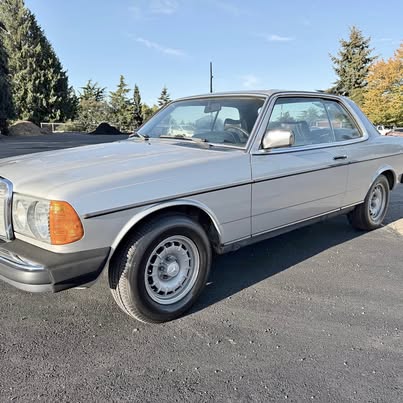
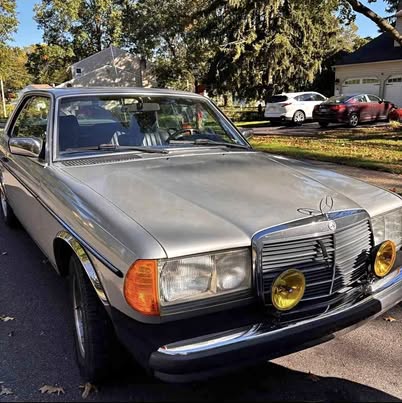
Start with the coupe itself. The C123 that followed the W123 sedan in 1977 was not simply a sedan with two doors welded shut. It sits on a wheelbase of 2,710 mm, 85 mm — about 3.3 inches — shorter than the sedan's 2,795 mm, all of the loss taken out of the rear compartment. The roofline is lower, the windshield more raked, the doors longer and frameless, and when you drop all four side windows there is no B-pillar at all: a clean, open span from windshield to rear quarter, divided only by a slim retractable pillar section carried on the rear window mechanism. Almost every panel from the waist up is coupe-specific, and much below it — doors, rear quarters, trunk lid, roof — does not interchange with the sedan either. A 300CD cost meaningfully more than a 300D sedan when new, bought you less rear seat, and was slower. That was rather the point: it was a personal car, not family transport.
Then there is the diesel. By the late 1970s Mercedes' American business ran on diesel in a way no other premium maker could match. The Corporate Average Fuel Economy standards that followed the 1975 Energy Policy and Conservation Act punished thirsty fleets, and a diesel Mercedes returning economy in the high twenties on the highway was a compliance tool, a hedge against fuel prices after two oil shocks, and, for a particular kind of American buyer, a badge of rational virtue. Offering the diesel in the coupe body completed that strategy: the customer who wanted the coupe's looks and the diesel's running costs no longer had to choose. Europe, which had the 280C and 280CE petrol coupes, never got a 300CD; this is a US-market car, and every genuine example was delivered in North America.
That origin explains the model's two chapters. The first, 1978 to 1981, is the naturally aspirated car: about 80 horsepower pulling roughly 3,400 pounds of coupe — one of the slowest Mercedes ever sold in America by the stopwatch, and one of the most charming if your driving suits it. The second, 1982 to 1985, is the Turbodiesel: a stronger version of the same five-cylinder and performance that finally matches the coupe's looks — still not fast by modern measure, but entirely adequate on an American freeway. Production tells you how niche the idea remained. Mercedes built 99,884 W123 coupes in total, but the diesel coupes were a small slice: 7,502 naturally aspirated 300CDs and 8,007 Turbodiesels by the factory figures most often cited — roughly fifteen and a half thousand cars, against more than a million W123 sedans. That rarity is real, but read it correctly: the 300CD is rare because demand was specialised, not because it was a limited edition, and rarity alone does not make a poor example valuable. It does mean the pool to choose from is always thin, coupe-specific parts carry a scarcity tax the sedan never pays, and a good car is worth travelling for.
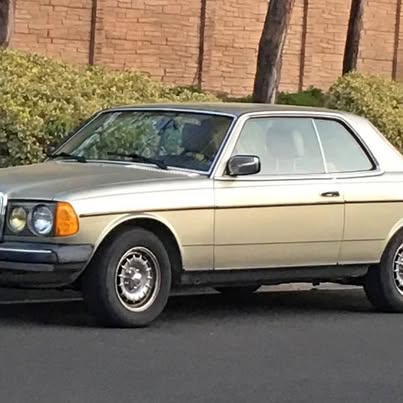
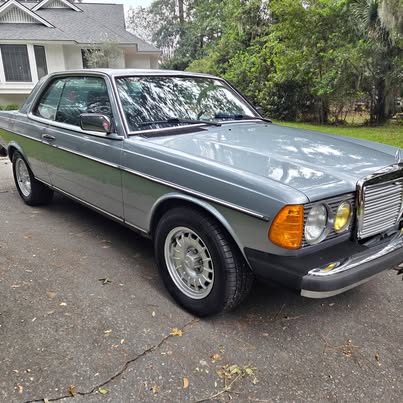
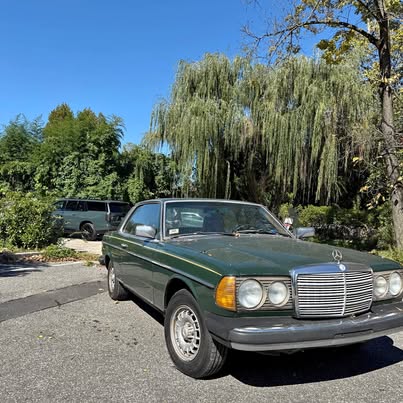
This site's own current pool underlines how thin the market is: in a sample of 5 cars, all 5 are automatics, the years run from a 1978 car through two 1979 cars to a 1983 and a 1984, colours split between Silver, with 3 cars, and Green, with 2, and the cars in that sample of 5 sit one each in Ohio, New York, Washington, Georgia, and Pennsylvania.
Buy the car as a coupe first and a diesel second — shell, glass, trim, and interior before engine heroics. The engine will outlast almost everything around it if serviced, which tempts buyers to forgive the body; the body is a W123, which tempts buyers to assume parts are cheap — true for a sedan door, false for a coupe door. Buy it the other way round, seduced by a sweet-running OM617 in a tired shell, and you have bought the one part of the car that was never going to be the problem.
The models
There are only two 300CDs, and the dividing line is absolute: a turbocharger. Everything else — trim changes, the climate-control revision — matters second. Learn the two generations first, because sellers routinely blur the line: a naturally aspirated car described hopefully as a turbo, a turbo badge glued to a non-turbo trunk, or a model year claimed from the title rather than the build.
| Model | Years | Engine | Output | Built | Character |
|---|---|---|---|---|---|
| 300CD | 1978–1981 | 3.0 five-cylinder diesel (OM617.912), naturally aspirated | about 80 hp | 7,502 | The original diesel coupe; slow, simple, unstressed |
| 300CD Turbodiesel | 1982–1985 | 3.0 five-cylinder diesel (OM617.952), turbocharged | about 120–125 hp | 8,007 | The car the coupe always wanted to be; the default buy |
(Outputs are US-market net figures and vary slightly by year; judge the car by how it drives. Production figures are the factory totals most commonly published for the two variants.)
The naturally aspirated 300CD (1978–81). The launch car, and the purest expression of the idea. Its OM617.912 makes its modest power honestly, with torque that peaks low and acceleration that belongs to an earlier decade: period road tests recorded 0–60 mph in the region of 19 to 21 seconds. Around town the car feels willing enough because the torque arrives early and the automatic is geared to use it; on a freeway on-ramp, on a grade, or overtaking anything at all, it feels exactly as slow as the figures say. Equipment followed the US W123 pattern: automatic transmission, air conditioning, power windows, vacuum central locking, and a cabin trimmed to the coupe's higher station — better seats, more wood, more chrome than a 300D sedan. Early cars carry the first version of the automatic climate control discussed below. By 1980 and 1981 the model was fully sorted in the small ways — tuning, trim, equipment — without getting any faster.
The 300CD Turbodiesel (1982–85). Mercedes had turbocharged the five-cylinder for the 300SD in 1978 and for the W123 sedan and wagon in 1981, and the coupe got the engine for 1982. The change is not a detail. Output rises by roughly half, torque by more, and the car transforms from a vehicle you drive around its limitations into one you simply drive: 0–60 mph in roughly 13 to 14 seconds in a healthy car, relaxed 70 mph cruising, and air conditioning, altitude, and load stop being performance variables. The OM617.952 is not the naturally aspirated engine with a blower bolted on: it has strengthened internals, including oil-spray piston cooling, and its own fuel and boost management, all covered in the engines section. The Turbodiesel also coincides with the revised climate control — vacuum-operated flaps and a pushbutton control unit in place of the earlier servo system — so a turbo car buys you the later, more serviceable climate system as well. If you are choosing between generations on condition alone, choose condition. If two cars are equal, the turbo is worth a clear premium, and the market knows it.
What did not exist. There was no manual-transmission 300CD for the US market, no 300CD after 1985, and no diesel coupe below it: no 240CD was ever offered. A claimed factory manual 300CD is a conversion until the data card proves otherwise, and conversions do exist, usually using the four-speed manual from a 240D; some are done well, but they are modified cars and should be priced as such. The petrol coupes that share the shell — the carburettor 280C and the fuel-injected 280CE, both using the M110 twin-cam six — matter to a 300CD buyer for one practical reason: they are the donor pool and the impersonation risk. A 280CE is quicker and smoother, and badges are cheap. The identity checks in the problem-areas section show you how to tell a genuine diesel coupe from a re-badged petrol car or a diesel engine swapped into a petrol shell.
Dating a car within the range. Model year is settled by the VIN and the door-jamb plate, not the seller's memory — and where details disagree with the stamped numbers, believe the numbers.
In this site's current pool, in a sample of 5 cars, 1 car from 1978 and 2 from 1979 represent the naturally aspirated years, and 1 from 1983 and 1 from 1984 the turbo years. Do not wait for your exact year to appear locally: shop the whole country, both generations, and let condition sort the shortlist.
Engines and gearboxes
The OM617 naturally aspirated: OM617.912
Every 300CD engine is a version of the same idea: the OM617, a 2,998 cc inline five-cylinder diesel with a cast-iron block and head, a single overhead camshaft, two valves per cylinder, and indirect injection into a prechamber. Five cylinders was an unusual choice in 1974, when the engine debuted in the 300D sedan: Mercedes took the proven four-cylinder OM616, added a cylinder to get six-cylinder displacement and something approaching six-cylinder smoothness without six-cylinder length, and built one of the most durable passenger-car engines ever made. The prechamber design and Bosch inline pump are shared across the OM616/617 family, which is why a good diesel Mercedes specialist already knows your engine before the hood is open.
In the 300CD the naturally aspirated version is designated OM617.912. Fuel is metered by a Bosch PES-series five-plunger inline pump, driven from the timing chain, with a pneumatic governor: engine vacuum, created by a throttle butterfly in the intake that a diesel would not otherwise need, signals load to the pump. That detail matters for diagnosis, because it means the butterfly, its linkage, and its vacuum lines are fuel-system components, not decoration. A split vacuum line or a sticking butterfly makes the car run badly in ways owners blame on the pump — the most expensive thing in the chain to condemn wrongly.
Expect about 80 hp and modest torque delivered low in the range. The engine should start from cold with a brief glow-plug wait, fire on essentially the first compression stroke that catches, idle with a firm, even diesel clatter, and pull without a stumble or visible smoke beyond a light haze under hard load. A healthy OM617 is not quiet and not smooth in the petrol sense; it is even. Listen for evenness: five cylinders contributing equally, no single-cylinder knock, no hunting at idle, no rattle that comes and goes with rpm in the way a stretched timing chain announces itself.
Longevity, honestly stated. The OM617's reputation for 300,000, 400,000, even 500,000 miles is earned, but it is conditional, and the conditions are service, not luck. The engine has no hydraulic valve lifters. Valve clearances are set mechanically, with a feeler gauge and two slim wrenches, at a factory interval of roughly every 15,000 miles. Neglected clearances close up — exhaust valves especially — and a tight exhaust valve does not announce itself with noise; it announces itself, eventually, with a burned valve and a dead cylinder. In a service history, valve adjustments at interval are the single most reassuring line item after oil changes. On a test, hard starting in warm weather, a lumpy idle, and low power together are a valve-clearance check before they are anything else: the adjustment is a few hours' labour, roughly $250–500 at a specialist, while the burned valve it prevents is a head-off job. Oil is the second condition: changes at roughly 5,000 miles, or annually at minimum, with a diesel-rated oil. An OM617 run on stretched intervals wears its timing chain and cam lobes; one kept on interval routinely outlives the car around it.
Timing chain stretch is the measurement that prices a high-mileage OM617. The chain drives the camshaft and the injection pump, so stretch retards valve and injection timing together: the car loses power, starts harder, smokes more, and idles worse, gradually enough that an owner adapts to it. The check is mechanical — bring the engine to top dead centre on the crankshaft marks and read the camshaft mark alignment, or measure with a dial indicator by the workshop method, and express the result as degrees of stretch. A few degrees is wear to monitor; stretch approaching the high single digits is a chain, rails, and tensioner conversation, roughly $800–1,800 at a specialist, and a chain allowed to jump a tooth is a valves-meet-pistons rebuild. Any pre-purchase inspection on a car over 150,000 miles without documented chain work should include this measurement. It takes under an hour and settles the biggest mechanical question on the car.
The vacuum shutoff confuses every first-time owner. A diesel has no ignition to switch off, so Mercedes stops the OM617 by applying engine vacuum to a shutoff diaphragm on the injection pump, which pulls the fuel rack to zero. When the diaphragm perishes — and after forty years, they perish — the car keeps running after you switch off, or shuts off reluctantly. The fix is the shutoff valve on the pump, roughly $200–450 fitted. But the same vacuum system also works the door locks, the climate flaps on later cars, and the transmission modulator, all fed by a vacuum pump on the front of the engine. A car that will not shut off, whose locks are lazy, and whose shifts are harsh may have three faults or one: a dying vacuum pump or a single large leak. Diagnose the system as a system, with a hand vacuum pump and gauge, before buying parts one symptom at a time. A failed vacuum pump is the serious version — roughly $300–700 fitted — and a pump shedding internal parts is an engine-risk item, because its drive is inside the timing case.
Glow plugs and starting. From stone cold, a healthy system lights the dash lamp for a few seconds, the engine fires cleanly on all five, and any roughness clears within seconds. Extended cranking, firing on three, or white smoke on cold start means dead plugs, a weak relay, or low compression — in that order of probability and cost. Plugs are roughly $15–30 each and usually an hour's labour for the set, though a seized plug can turn it into a specialist job. Never buy a diesel the seller has "warmed up for you": a warm OM617 starts politely with faults a cold start exposes in five seconds.
The OM617 turbocharged: OM617.952
The Turbodiesel engine looks like the naturally aspirated engine and shares its architecture, displacement, and service routine — and is a substantially re-engineered unit underneath. The OM617.952 was developed for the 300SD of 1978, Mercedes' first turbocharged diesel production car, and reached the coupe in 1982 with a turbocharger blowing through no intercooler into revised intake plumbing that crosses over the valve cover, the visual signature of the turbo engine bay. Internals were strengthened for the extra pressure and heat: pistons with oil-spray cooling jets, uprated bearings, and increased oil and cooling capacity. This is why the standing rule exists: you cannot turn a .912 into a .952 by bolting on a turbo, and a home-converted turbo should be valued as an experiment, not as a Turbodiesel.
Output is about 120 to 125 hp depending on year, with torque in the region of 170 lb-ft — and the torque, arriving as boost builds from roughly 2,000 rpm, is what transforms the car. A healthy turbo 300CD pulls cleanly from rest, gathers speed with genuine intent once the turbo wakes, and cruises at freeway speed with reserve. It should be essentially smoke-free once warm: a puff on a hard launch is period normal, a continuous black trail is over-fuelling, and continuous blue is oil — from turbo seals, valve seals, or rings, in roughly that order of likelihood.
Boost and the ALDA. Fuel delivery on the turbo pump is corrected for boost by the ALDA — the aneroid compensator on top of the injection pump, with a pressure line from the intake manifold via a switchover valve on the firewall. When boost rises, the ALDA allows more fuel; when the line is blocked, the switchover valve fails, or the ALDA diaphragm hardens, the car gets air without fuel and feels strangled — a Turbodiesel that drives like the naturally aspirated car, with no smoke and no fault you can hear. This is the most common, most misdiagnosed, and cheapest performance fault on the model. Verify boost with a gauge teed into the line (a healthy system makes roughly 10–12 psi under full load), verify the line is clear, verify the switchover valve passes boost and vents correctly — it is also the overboost protection — and only then suspect the turbo or the pump. The turbo itself is robust if its oil feed has stayed clean; shaft play, oil in the intake tract beyond a light film, or a whistle turned into a scream are its failure languages, and a rebuilt or replacement unit fitted runs roughly $900–2,000. Resist any car whose ALDA seal has been broken and the adjustment wound up for more fuel and smoke: that modification, done without discipline, cooks pistons.
Valve adjustments, oil intervals, timing-chain measurement, glow plugs, and the vacuum shutoff apply to the turbo exactly as to the naturally aspirated engine, with one addition: the turbo's extra heat makes cooling-system condition a performance item as well as a durability one. A turbo car that runs hot under load is losing its designed margin, and the cause — radiator flow, fan clutch, thermostat, water pump, in that order of testing — should be found before the head gasket finds it for you.
Gearboxes
In this site's current pool, in a sample of 5 cars, all 5 are automatics — and for once the sample matches factory reality exactly, because the US-market 300CD was automatic-only. The box is Mercedes' own four-speed automatic of the 722 family — the 722.1-series in earlier cars and the 722.3-series in later production, the designation recorded on the data card. It is a conventional hydraulic automatic with a torque converter, vacuum-modulated shift pressure, and a kickdown switch under the accelerator, tuned for the diesel's narrow power band: it changes up early, and under light throttle pulls away in second gear by design, using first only from a full-throttle or kickdown start. A second-gear pull-away is correct behaviour, not slip.
On test, shifts should be firm, prompt, and consistent — Mercedes automatics of this era shift with a definite engagement modern drivers read as harshness. What is not normal: flaring, where revs rise between ratios; a long, lazy engagement of reverse, the classic early warning of internal wear; hunting between third and fourth at a steady cruise; or shifts brutal at light throttle and soft at full throttle, which points at the vacuum modulator signal — shift quality here is set by engine vacuum, so a vacuum leak is a gearbox fault on a 300CD until proved otherwise. The modulator is replaceable at roughly $100–250 fitted; a full rebuild runs roughly $2,500–4,500. Fluid should be red and smell of nothing much; dark or burnt fluid, or a seller who cannot say when it was last changed, prices a service at minimum — fluid and filter roughly $200–400 — and a rebuild at worst. The interval that keeps these boxes alive is roughly every 30,000 miles.
Manual conversions, usually with the four-speed from a 240D, arise on many sales. Mercedes never sold the car that way in America, and a converted car has left the documented, data-card world permanently: drive one if it appeals, pay a modified-car price, and never pay a Turbodiesel premium for its novelty. The automatic is not the compromise on this model. It is the specification.
Problem areas
A 300CD shares the W123 sedan's toughness but not its forgiveness. The sedan's failure modes are cheap because sedan parts are everywhere; the coupe's concentrate exactly where the coupe is different — shell, glass, seals, trim — and those parts are coupe-only, forty years old, and finite. Work through this section in order: rust first, then the coupe body, then the systems every W123 shares.
Rust: the map
The W123 rusts less catastrophically than the Mercedes generations before and after it — and it still rusts, in known places, mostly where water is trapped by a failed seal or a blocked drain. Assume any 300CD that has lived outside the dry Southwest has rust somewhere; your job is to find whether it is cosmetic, repairable, or structural. Bring a magnet wrapped in cloth, a torch, and a screwdriver for prodding, with the seller's permission.
Jack points and sills. Start here, as on every Mercedes of the era. The factory jack engages sockets in the sills, and the structure around each socket is both a jacking point and a structural member. The sockets collect dirt and water, the sill interiors rot from inside, and the first external sign is bubbling at the bottom of the sill or around the socket cover, by which time the inside is worse. Press and prod the full sill length on both sides, open every socket cover, and look inside with the torch. The sill-jack test settles it: take the car's weight on each socket in turn with the factory jack. A sound sill lifts silently; a rotten one creaks, flexes, or begins to fold, and a seller who refuses the test has given you the answer. Sill repair done properly runs roughly $1,000–2,500 per side, and it is welding you cannot defer.
Floor pans and the firewall. Water enters past the windshield seal, past the rear window seal, and through the hood-hinge pockets described below, and sits under the carpets and the thick factory sound-deadening pads, which hold it against the floor like a sponge. Lift the carpets in both front footwells and under the rear seat. Surface rust is a clean, treat, and reseal job; soft metal, holes, or deadeners that come up in wet sheets are a welding job, roughly $600–1,500 a side, and a marker that the leak causing it must be found or the new floor rots on the same schedule.
Hood hinge pockets and the battery tray. Look into the pockets where the hood hinges mount, at the rear corners of the engine bay. Leaves collect there, the drains block, and the pockets rot through into the footwells — one of the W123's signature rust spots and one of the least photographed. The battery tray rots from the top down under the battery, acid-assisted, and takes its support and the firewall beneath with it. Lift the battery out if the seller allows; if not, rock it and torch the tray edges. A tray is a cheap panel; firewall fabrication underneath it is not.
Wheel arches, lower doors, and trunk. Rear wheel-arch lips trap mud and bubble from inside; front wings rot at the bottom rear corner behind the wheel. Door bottoms fill with water when their drain slots block — run a fingertip along every door's lower edge for bubbling and check the slots are clear — and coupe doors are coupe-only panels: a rusty sedan door is a breaker's-yard errand, a rusty coupe door is a search. In the trunk, lift the mat and the spare wheel: the rear window seal leaks directly into the well, and the well corners and trunk floor edges rot in the dark. Trunk floor replacement and paint runs roughly $800–2,000 done properly; staining alone is a weekend's cleaning and sealing. Check the sunroof drains too — the steel sunroof fitted to most US coupes drains through tubes in the pillars and trunk, and a displaced tube waters the car from inside its own structure.
Window surrounds. The windshield and rear window seals perish, lift, and leak, and the channel beneath them rusts where the rubber holds water against it. On the coupe the rear quarter windows deserve the same attention, because that glass is coupe-specific and its seal is the water's way into the rear quarter. Budget a reseal with new rubber at roughly $300–600 per screen fitted, more if the channel needs metal work once the glass is out — a condition you only learn with the glass out, so price perished seals as an unknown, not a detail.
The coupe body: glass, seals, and trim
The pillarless design that makes the car beautiful makes its weather-sealing a mechanism, not a gasket.
The pillarless window system. With all four side windows down, a C123 has no B-pillar. To achieve that, the front door glass seals against the rear quarter glass, and the rear quarter window is carried on a regulator mechanism with a short pillar section attached to it: as the rear window rises, its pillar section rises with it to meet the roof rail; as it drops, the whole assembly disappears into the quarter panel. Every part of that sentence is a wear item. Regulators wear and slow; the pillar section's seals perish and whistle at speed and leak in rain; glass alignment drifts until the door glass meets the quarter glass imperfectly and the car drips onto the rear seat and rusts its own quarter from inside. On a viewing, operate every window through its full travel, twice. They should move at an even speed, without groaning, tipping, or needing a helping hand, and at the top the door glass should meet the quarter glass and the roof rail seal in one clean line. A window that will not drop fully is not a small fault on this car — it is the car's signature feature broken — and regulator and alignment work runs roughly $300–800 per side, with some coupe-specific parts sourced used.
Coupe-only panels and brightwork. Doors, roof, rear quarters, trunk lid, rear glass, quarter glass, and the bright trim framing the pillarless opening are unique to the C123 and were made in coupe numbers, not sedan numbers. Dented or rusty coupe panels cannot be replaced from the sedan pool that makes W123 ownership cheap; good used coupe panels exist but are hunted, and new old stock is effectively gone for many pieces. Price body damage on a coupe as coupe damage. The same applies inside: coupe seats, door cards, rear trim, and headliner are all specific. A torn sedan interior is a shopping list; a torn coupe interior is a research project.
The vacuum seat-back locks. US-market coupes lock the front seat backs with vacuum actuators that release when a door opens, so the seat can fold for rear access. When the elements perish or the lines leak, the backs either refuse to fold or refuse to lock. An unlocked front seat back is a safety defect, not a quirk: test both seats, locked solid with the doors shut and the engine running, releasing when a door opens. Budget roughly $200–500 per seat if a specialist does it.
Climate control: two systems, two tempers
There are two entirely different automatic climate control systems across the model's life. Identify which one a car has before you judge it, because their faults, costs, and reputations are opposites.
The servo system (earlier cars). Cars built before the 1982 revision use the automatic climate control derived from a Chrysler design, centred on a large servo unit under the hood — a motorised valve assembly that meters coolant flow to the heater core and directs vacuum to the flap actuators. When it works, it works well. When it fails, it fails comprehensively: the servo's seals and body crack and leak coolant and vacuum, the amplifier behind the glovebox fails, and the system defaults to defrost, to full heat, or to nothing. Rebuilt servos run roughly $600–1,200 for the unit, with fitting and diagnosis on top, and a full system resurrection on a neglected car can reach $1,500–2,500. The servo is identifiable at a glance: a bulky unit on the firewall side of the bay with coolant hoses and a bundle of vacuum lines. If an early car has cold air, accurate temperature control, and correct flap behaviour, someone has already paid this bill — ask for the invoice and value it.
The vacuum-pod system (1982 onward). The Turbodiesel generation replaced the servo with a pushbutton control unit, electronic logic, and vacuum pods — small diaphragm actuators — working the air flaps, with a monovalve metering coolant to the heater core. This system is more reliable and far more diagnosable, and its failure modes are component-sized: pods whose diaphragms perish (roughly $50–150 per pod in parts, labour varying wildly by which pod — some are reachable, others are a dashboard-depth job); the monovalve insert, whose torn diaphragm gives uncontrollable full heat, fixed with an insert kit for roughly $30–80 in parts and under an hour's labour — beware cheap pattern inserts, a known repeat-failure item; pushbutton units with cracked solder joints, exchanged by rebuilders for roughly $200–400; and vacuum leaks in the coloured-line network under the dash. Test the system as a system: every mode, full cold to full hot, fan on every speed, air from the correct vents. A late car that passes every test has had money spent in the right place.
Air conditioning itself. The compressor is a GM-derived Harrison/Delco R4, the refrigerant was R12 when built, and most surviving cars have either been converted to R134a or are running low, leaking, or seized on their original charge. A conversion done properly — flush, seals, receiver-drier, correct oil, charge by weight — is an $800–1,800 professional job; a parts-store-can conversion is a compressor failure scheduled for a hot day. Check cold air at the vents and a compressor that cycles without groaning, and ask for the last professional A/C invoice. On a naturally aspirated car, also judge the A/C's effect on performance: the compressor's load is a meaningful fraction of 80 hp.
Suspension, steering, brakes, vacuum, interior, and identity
The W123 running gear is conventional and strong: double-wishbone front suspension, a semi-trailing-arm rear, recirculating-ball power steering, and four-wheel disc brakes — all rebuildable, and after forty years all a wear audit rather than a design question. At the front, ball joints, tie-rod ends, drag link and idler bush, control-arm bushes, and the steering damper wear together; the symptoms — vagueness on centre, a knock over bumps, uneven tyre wear — are the sum of small plays, not one failed part. A full front-end renewal runs roughly $1,200–2,500, alignment included. Springs sag and occasionally break at the bottom coil, where it sits in the control-arm pan and holds water — look into the pan with a torch. At the rear, worn bushes and differential mounts make the car steer subtly from the rear on throttle changes, and half-shaft CV boots perish; budget roughly $300–600 per shaft fitted.
Brakes are discs all round with a vacuum servo — fed by the same engine vacuum pump as everything else, so a heavy pedal belongs in the vacuum diagnosis before the brake diagnosis. Calipers seize on cars that sit; hoses perish internally and hold a brake on; old fluid rots the system from inside. A full hydraulic refresh runs roughly $800–2,000, and it is money to expect on any car without a recent invoice. The parking brake is a separate drum inside the rear disc hat and fails from disuse.
The vacuum system deserves treatment as a whole because on a diesel Mercedes it replaces much of what electricity does on a petrol car. The engine-driven pump feeds a network of colour-coded lines, check valves, and rubber connectors that perish at every joint, running the brake servo, the engine shutoff, the central locking, the climate flaps, the transmission modulator, and the coupe's seat-back locks. The correct tool is a hand vacuum pump with a gauge, and the correct method is isolation: cap off branches at the main line and find which branch will not hold vacuum. Central locking lazy on one door is almost always a perished actuator diaphragm in that door, roughly $40–100 in parts plus trim labour; lazy everywhere is supply, not actuators. Keep perspective: vacuum rubber is pennies, and a car with multiple vacuum symptoms is often one split $2 connector away from behaving — which is why you diagnose before you discount, in either direction.
Inside, coupe interiors were trimmed a step above the sedan's, with MB-Tex vinyl standard in most years and leather on a minority of cars. MB-Tex is famously durable; the seat pads beneath are the real wear item — the rubberised fibre pads crumble, the spring boxes sag, and the driver's seat goes first. Sit in it and feel for the frame through the pad; re-padding runs roughly $300–600, more with spring repair. Dashboards crack in the sun belt; a crack-free dash is a genuine value item because good used dashes are finite. Wood trim lifts its lacquer and fades unevenly; refinishing the set runs roughly $800–2,000. A musty interior is a rust inspection that has already reported its result.
Electrically, the W123's faults are age faults: corroding earth points, and fuses that develop invisible contact resistance — rotate every fuse in its holder before diagnosing anything electrical; it cures a remarkable share of W123 electrical ghosts. Window switches fail before window motors do. The odometer deserves a specific mention: its gears perish and it stops while the speedometer keeps working, so a mileage reading is a claim, not a fact, unless the history file supports it. Buy on condition and evidence, not on the number in the window.
Identity: proving a 300CD is a 300CD. Because badges are cheap, coupes are valuable, and swaps exist in both directions, verify the car in metal and paper before you value it. The VIN, on the A-pillar plate and door-jamb label, should carry chassis prefix 123.153; a petrol 280CE coupe carries 123.053. A car whose VIN says petrol coupe but whose engine bay says diesel is an engine swap, whatever the trunk badge claims. The engine number is stamped on the block: a naturally aspirated 300CD carries a 617.912 and a genuine Turbodiesel a 617.952; a turbo badge on a car with a .912 engine and no turbocharger is a badge, and a .952 in a .912 car is a swap to be priced as a modification. The data card — obtainable through Mercedes' classic channels from the VIN — records the original engine number, paint and trim codes, and options, and settles every argument. Cross-check the small evidence too: a genuine diesel has no ignition system, and carries the glow-plug relay, the diesel fuel filter and primer pump, and the vacuum pump on the front of the engine. A re-badged 280CE conversion betrays itself in the leftovers — petrol wiring, a fuel system adapted rather than built. None of this makes a converted car worthless; it makes it a different car from the one in the advertisement, at a different price.
How to inspect one
Allow two hours, insist on a stone-cold engine, and bring a torch, a cloth-wrapped magnet, a hand vacuum pump with gauge if you have one, and a screwdriver for prodding with the seller's permission. A specialist lift inspection — roughly $150–250 — is money well spent on any car that passes your own check.
- Paperwork and identity first. Match the VIN on the title to the A-pillar plate and the door-jamb label. Confirm the chassis prefix reads as a diesel coupe (123.153), find the engine number on the block, and confirm it matches the badge: 617.912 naturally aspirated, 617.952 turbo. Ask for the data card and the history file, and treat valve-adjustment and oil-change records as the file's most valuable pages.
- Cold start. With the engine cold, watch the glow lamp, time the wait, and start it yourself. It should fire evenly on all five cylinders within seconds of cranking. White smoke that clears is condensation or a glow fault; blue smoke is oil; a single-cylinder knock that fades as it warms is a cylinder contribution question. A pre-warmed engine voids this step — reschedule rather than proceed.
- Shutoff and vacuum. Switch off: the engine should stop promptly. Lazy shutoff, lazy door locks, and a heavy brake pedal together mean vacuum-system diagnosis with the hand pump — isolate branches at the main line and find the leak before pricing anything.
- Sills and jack points. Prod both sills along their full length, open the jack-socket covers, torch inside, and — with permission — take the car's weight on each socket with the factory jack. Creaking or flexing ends the inspection: structural rust outranks every other finding.
- Floors, pockets, and trunk. Lift the carpets in both footwells and under the rear seat; look into the hood-hinge pockets; lift the battery or torch its tray; lift the trunk mat and spare wheel. Damp, soft metal, or wet sound-deadening anywhere means find the leak — windshield seal, rear window seal, hinge pocket, sunroof drain — before you price the repair.
- The pillarless test. Operate all four side windows through their full travel twice. Watch the rear quarter windows rise with their pillar sections and meet the roof rails; watch the door glass seal against the quarter glass. Slow, tipping, groaning, or misaligned glass is coupe money — and check the front seat-back vacuum locks lock with the doors shut and release when a door opens.
- Engine on the road. Fifteen minutes minimum, including a freeway stretch and a hill. A naturally aspirated car should pull evenly to its modest limit without smoke or hesitation; a turbo car should build boost from about 2,000 rpm and pull decisively harder — if it drives like the slow car, work the ALDA, switchover valve, and boost-gauge checks from the engines section before suspecting the turbo.
- Gearbox behaviour. Note the second-gear pull-away (normal), then judge the shifts: firm and prompt is right; flaring, hunting, or a long delay into reverse is wear. Check the fluid afterwards — red and clean, or dark and burnt — and ask when it was last changed.
- Climate, mode by mode. Identify the system first — servo under the hood on early cars, pushbutton-and-pods on 1982 and later — then test every mode: full cold to full hot, air from each set of vents in turn, fan on all speeds, A/C compressor cycling without complaint. On a servo car, a fully working system is a documented asset; on a late car, full heat that will not moderate is the monovalve until proved otherwise.
- Suspension, steering, and brakes. Drive over broken pavement and listen; brake firmly from speed and feel for pull, judder, and a sinking or rock-hard pedal; check steering play on centre. Then, on the lift, rock the front wheels for joint play and look at the spring pans, subframe mounts, and half-shaft boots.
- Timing chain and valve evidence. On any car over 150,000 miles without paperwork, have the specialist measure chain stretch and check valve clearances as part of the lift inspection. These two measurements, plus a compression or leak-down test if the cold start gave any doubt, price the engine more honestly than any test drive.
- Interior and odometer last. Sit in the driver's seat and feel for the spring frame; check the dash for cracks in full daylight; rotate the fuses before declaring any electrical fault; and read the odometer as a claim to be supported by the history file, remembering that failed odometer gears are common and innocent — and indistinguishable from fraud without records.
Values
The figures that matter for this model are computed from this site's own listings and recorded sales, and they sit below this guide — the listed-now summary and the market block are refreshed every time the site rebuilds, so use them rather than any number quoted elsewhere. What follows is how to read them, because the 300CD market is small enough that reading it badly is easy.
This is a thin market. In this site's current pool there are just 5 cars, all 5 of them for sale and none recorded as sold in that sample of 5, and that thinness is typical nationally: at any moment the choice is a handful of cars, not a field. Thin markets punish two opposite mistakes. The first is treating a figure built from a few cars as a price: one exceptional car or one desperate seller moves a small-sample number violently, so read the individual cars behind it, never the headline alone. The second is waiting for the right year, colour, and price to appear within driving distance. With roughly fifteen and a half thousand diesel coupes built and attrition running for forty years, the right car is the sound car that exists, wherever it is, and travelling or shipping is part of this model's purchase price in a way it never is for a 300D sedan.
Within the market, the spread is driven first by generation and then, as always with a W123, by the shell. The Turbodiesel carries a clear premium over the naturally aspirated car in like condition, and it is justified — but it is a premium on condition, not a rescue for it: a rusty turbo car is worth less than a sound naturally aspirated car to anyone who has priced coupe sill work. Condition spreads are wide because repair costs are so asymmetric. The mechanical distance between the best and worst OM617 is a few thousand dollars of service and adjustment; the body distance between the best and worst C123 shell is a five-figure restoration or an unsellable car. That asymmetry is why project 300CDs are priced so low relative to finished cars, and why most are correctly priced: the gap between a project and a driver is the welding, the glass work, the interior, and the climate system, each priced in the sections above.
Asking and achieved prices part company in a specific way. Sellers price the rarity and the engine's legend; buyers who have done the reading price the shell and the systems. Auction results are the corrective to asking-price optimism, and they reward documented history — a thick file with valve adjustments, chain measurement, and climate invoices moves real money — far more than low odometer readings unsupported by paper. Originality matters in proportion to price: at the top of the market, a matching engine number and a data card that agrees with the car are part of what is being bought, and a swapped or re-badged car should never be priced in that company whatever its condition.
Parts and ownership
The 300CD splits into two ownership experiences sharing one engine. Everything mechanical it shares with the W123 sedan and wagon is as well supported as any classic Mercedes gets: the W123 was built in the millions, the Classic Center and the specialist trade support it actively, and a good independent diesel mechanic is findable in most parts of the country. Everything that makes it a coupe is supported in proportion to fifteen thousand cars, not two million — know which list a part is on before you need it.
Easy: engine service items for the OM617 — filters, glow plugs, belts, hoses, valve-cover gaskets, injector service through any Bosch diesel shop — brake discs, pads, calipers and hoses, suspension wear parts, gearbox service items, exhaust systems, cooling-system components, vacuum connectors and most vacuum elements, and glass rubbers for the windshield and rear window. Order today, fit this week, at prices that will not frighten anyone used to modern cars.
Harder and dearer: anything with C123 in its description. Coupe doors and their internal hardware, rear quarter glass and its regulator mechanism, the pillar-section seals, coupe brightwork, coupe seats and interior trim, crack-free dashboards, and good used coupe body panels generally. None of it is unobtainable — the cars are broken for parts, the forums and specialists know where things live, and some seals and wear items are reproduced — but it is sourced by searching, not by ordering, and priced by scarcity. The servo for the early climate system, rebuilt injection pumps (roughly $1,200–2,500 exchanged through a Bosch specialist), and turbochargers sit between the lists: available, professional, and priced like it.
Running costs. A sorted 300CD is a realistic regular-use classic. Fuel economy is the model's party trick — expect figures in the mid-to-high twenties miles per gallon in mixed use from the naturally aspirated car and slightly less from the turbo, which you will drive harder because you can — and tyres and annual servicing are ordinary money. The servicing routine is the ownership contract: oil and filter roughly every 5,000 miles, valve clearances roughly every 15,000, gearbox fluid and filter roughly every 30,000, brake fluid and coolant on time rather than on failure. Budget honestly for the first year: catching up deferred maintenance on a running car runs roughly $2,000–5,000 at a specialist before you improve anything, and recommissioning a car that has sat for years runs $4,000–8,000, because sitting is the one use this car punishes: seals dry, calipers seize, fuel systems varnish and grow algae in the tank, and every vacuum diaphragm ages at once. Fuel that has sat can carry water and microbial growth that clog filters and mimic pump failure — a car that loses power and recovers with a fresh filter is telling you to clean its tank, not rebuild its pump. Buy a car in regular use over a sleeping beauty at the same money, every time.
Which one to buy
- The all-rounder: 300CD Turbodiesel (1982–85). The engine the coupe deserved, the later climate system, and performance that works in modern traffic. If you want one 300CD to drive everywhere, this is it — in the best shell you can find.
- The purist's car: 300CD naturally aspirated (1978–81). The original idea, unfiltered: simple, unstressed, and slow in a way you must genuinely enjoy rather than tolerate. Buy it for local roads, long horizons, and the best fuel economy in the range — and buy the early climate servo only with a working system and an invoice.
- The value buy: the sound naturally aspirated car nobody wants. Because the market pays for turbos, a genuinely rust-free, well-documented non-turbo car is often the cheapest route into a good C123 shell — the expensive part of the car — at a discount set by the cheap part, its performance.
- The project to avoid: the rusty turbo. The premium badge on a shell that needs sills, floors, and quarter work is the worst arithmetic in the model range. The turbo premium buys an engine; it does not buy back a body.
And the rule that overrides all of the above: buy the least rusty coupe you can find, with working pillarless glass and a history file, in whichever generation you can live with. Engines can be adjusted, chains can be measured and replaced, climate systems can be rebuilt, and gearboxes can be overhauled, all at prices you can plan for. A rotten C123 shell and a broken coupe window system cost more to put right than the finished car will be worth — and they are the two things about a 300CD that can never be made original again.
See the 13 E-Class cars currently listed.
What they sell for: E-Class sale prices.