
MG TD buyer's guide
MG TD -- the model's own buyer's guide: variants, values and what to check.
Years listed: 1951-1953 · Series: T-Series
Overview and history
The MG TD is the T-series car that turned a charming pre-war anachronism into a sports car an American could actually use every day — the most numerous, most supported and most usable of all the T-types. Announced at the end of 1949 and built at Abingdon from January 1950 to August 1953, the TD kept everything the returning GIs had fallen for in the TC — upright grille, cut-down doors, folding windscreen, separate wings and running boards — and quietly replaced almost everything underneath it with something better. Where the TC had a beam front axle, a narrow body and 19-inch wire wheels that demanded commitment, the TD brought independent front suspension, rack-and-pinion steering, a wider cockpit, smaller and stronger 15-inch wheels and Lockheed hydraulic brakes. It looked like 1936. It drove, by the standards of 1950, like a modern car.
That combination was aimed squarely at one customer. Britain in 1950 was exporting or starving, steel was allocated to makers who earned dollars, and the TD was designed from the first sketch for left-hand drive and the United States. The great majority of the roughly 29,600 TDs built crossed the Atlantic, which is why almost every car you will look at in the United States is a left-hand-drive export model rather than a converted home-market car.
The mechanical recipe was deliberately conservative, and that conservatism is the TD's great virtue today: a 1,250 cc XPAG pushrod four fed by twin SU carburettors, a four-speed manual gearbox and a live rear axle, all carried in a separate steel chassis frame derived from the Y-type saloon — and a body that is not all-steel in the modern sense, but steel panels nailed and screwed over a frame of ash timber, coachbuilt in the pre-war manner. Hold those three facts — separate chassis, ash-framed body, simple pushrod engine — in your head at all times, because between them they explain how a TD survives, how it rots, what it costs to put right and how you tell a real one from the many imitations described later in this guide.
The TD arrived in two main forms. The standard car is the one nearly everybody has: 54 horsepower, steel disc wheels, a single spare carried on the back, and trim that was plain even by 1950 standards. Alongside it MG offered the TD Mk II — often called the Competition model — a factory-tuned version with a higher-compression engine, twin fuel pumps, additional friction dampers and a lower rear-axle ratio, built in small numbers for owners who intended to rally and race. About 1,700 Mk IIs were made, and because a Mk II carries a premium today, its identity is something this guide teaches you to verify rather than assume. In 1953 the TD gave way to the TF, a restyle of the same basic car; the TF is a close cousin, but it is not a TD, and the two should never be blurred together in a listing.
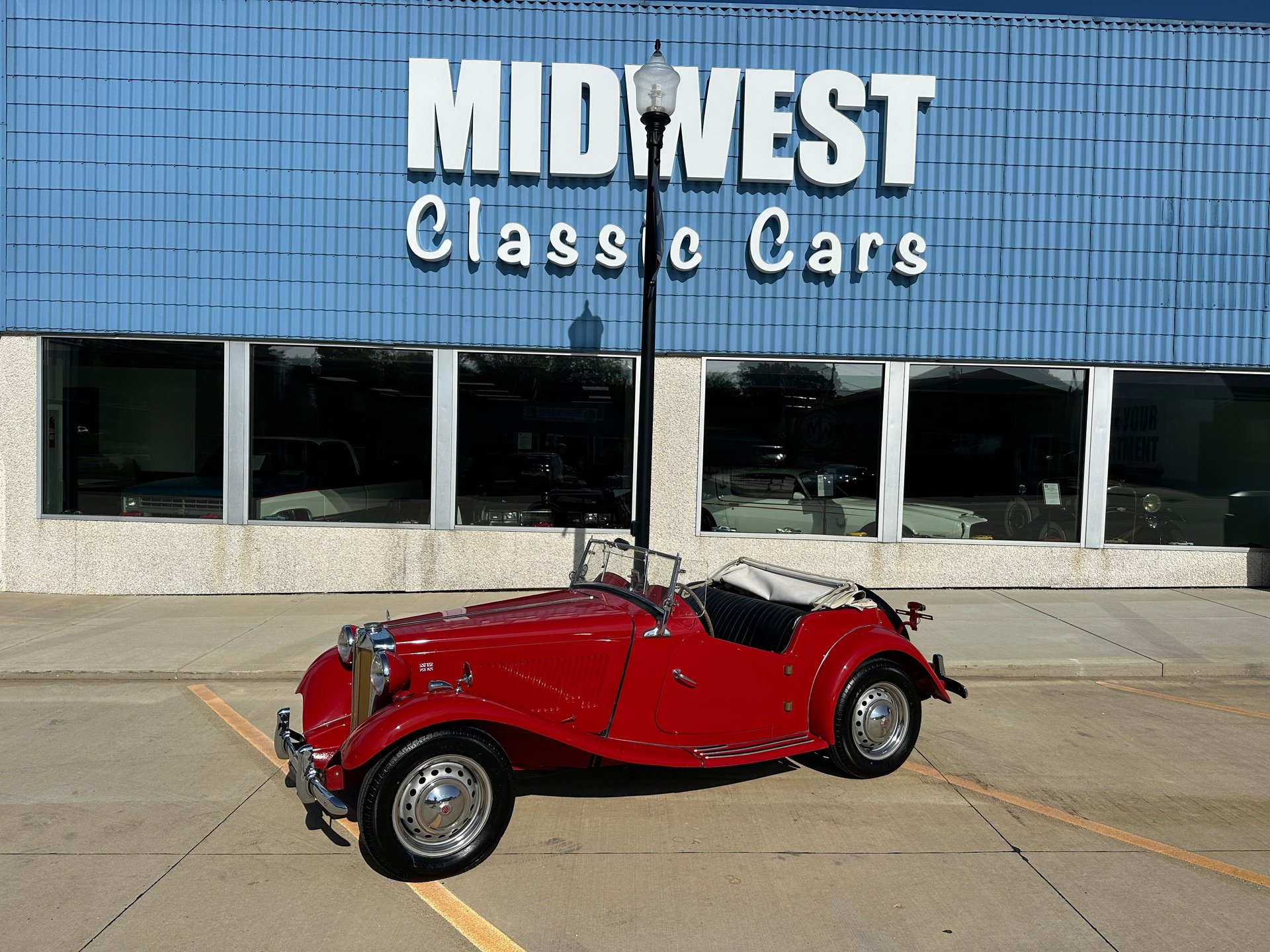
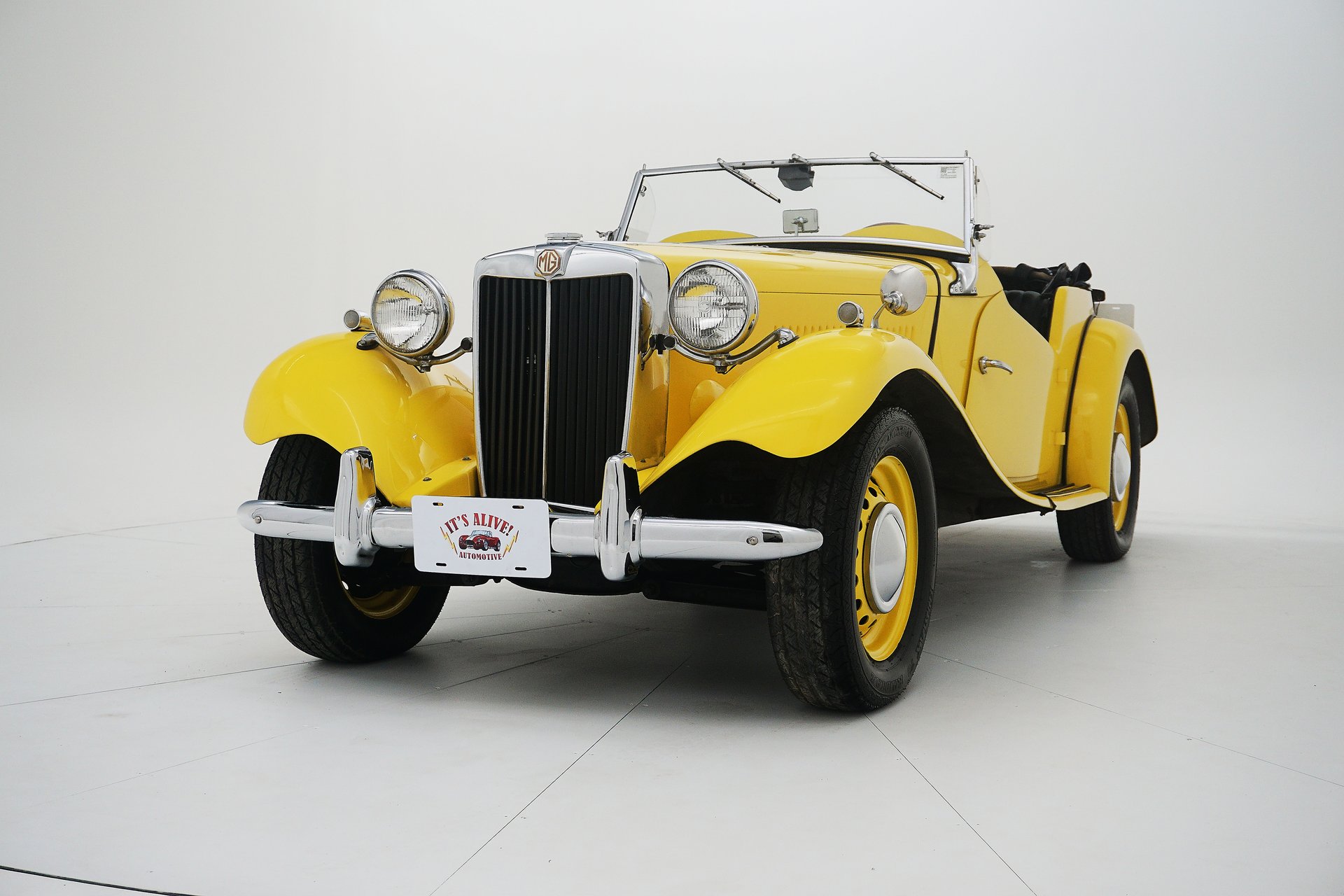
Our own current listings give you a fair picture of the American TD market as it actually presents itself. We currently track five MG TDs, all of them offered for sale, all sourced from Facebook Marketplace sellers, and all from the last two model years of the run — two 1952 cars and three 1953 cars, in red (three), white (one) and blue (one), spread across Ohio, North Carolina, Texas and Pennsylvania. What no listing photograph can show you is the condition of the ash timber inside the body, the single most important thing about any TD you buy. These were never expensive cars, and for decades they were cheap cars, maintained on a budget and restored in the 1980s and 1990s to standards from concours to cosmetic. The difference between a good TD and a money pit is almost entirely the wood and the chassis underneath the paint, not the mileage — an odometer that, on a car this old, should be treated as decoration anyway. Buy the structure, verify the identity, and let the shiny parts be a bonus.
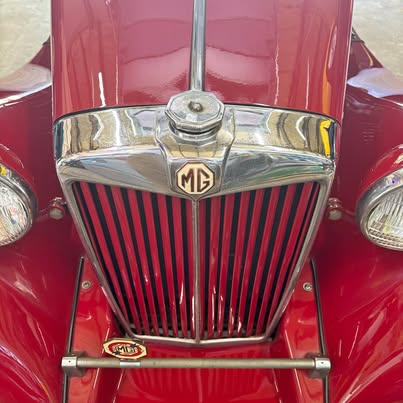
The models
Every TD is a two-seat open roadster with a folding soft top, detachable sidescreens instead of winding windows, and a spare wheel mounted externally at the rear. There was no factory coupé, no automatic and no engine option beyond the two states of tune below. The badge stayed the same for the whole run; the differences that matter are the standard car against the Mk II, the running changes MG folded in as production went on, and the few TD chassis clothed by outside coachbuilders.
| Model | Years | Engine | Output | Built | Character |
|---|---|---|---|---|---|
| TD (standard) | 1950–1953 | 1,250 cc XPAG four, twin SU | 54 hp | about 27,900 | The car nearly everybody has; the default buy |
| TD Mk II (Competition) | 1950–1953 | 1,250 cc XPAG four, higher compression | 57 hp | about 1,700 | Factory-tuned; twin fuel pumps, extra dampers, rarer and faked |
| Arnolt-MG (TD chassis) | 1952–1953 | 1,250 cc XPAG four, twin SU | 54 hp | about 100 | Bertone coupé and convertible bodies on TD running gear |
(Outputs are the period factory figures. Total TD production, standard and Mk II together, is generally quoted at about 29,664 cars. The Arnolt-MG is a genuine period coachbuilt derivative, sold through S. H. Arnolt in Chicago with Bertone bodywork — a collector curiosity, not a trim level.)
The standard TD. This is the car the production figures, the parts catalogues and this guide are mostly about. Early and late cars differ in detail rather than in kind — MG made running changes through the run, among them a revised clutch linkage and detail changes to lamps, trim and fittings — so a 1952 or 1953 car is not automatically better than a 1950, just slightly more developed. Our own listings, like the wider American market, are dominated by 1952 and 1953 cars, so those are what you will mostly be offered; judge each on its structure and history file, not its model year. One specification point catches buyers out constantly: the standard TD wears bolt-on steel disc wheels, 15-inch, and that is correct. Tall 19-inch centre-lock wire wheels belong to the TC. A TD presented on wires has either been converted by an owner — a legitimate, popular change, done with the right hubs — or is being dressed up to look older and more valuable than it is. Either way, ask the question.
The TD Mk II. The Mk II — period literature also calls it the Competition model — was a factory performance package, not a separate model line. For your money you got a higher-compression version of the XPAG (raised from the standard car's 7.25:1, by way of the cylinder head), stronger valve springs, twin SU fuel pumps where the standard car has one, Andrex friction dampers in addition to the standard hydraulic dampers, and a 4.875:1 rear axle in place of the standard 5.125:1, trading a little acceleration for more relaxed cruising. The gain on paper is small — about 57 hp against 54 — and on the road a Mk II feels like a slightly keener TD, not a different car. Its value today is rarity and period competition flavour, not speed.
That rarity is exactly why you verify it. A genuine Mk II carries the TDC prefix in its chassis number where a standard car carries TD, and the extra equipment — second fuel pump, friction dampers with their distinctive linkages — should all still be present and look factory-fitted, not freshly added. A standard TD can be dressed with a second pump and a set of Andrex dampers in a weekend, and at Mk II prices the temptation has existed for forty years. The chassis number settles it, just as it settles the replica question below. Pay the Mk II premium only for a car whose number, equipment and history all agree.
The earlier T-cars, in proportion. Listings occasionally blur the family together, so here is the whole line in one short paragraph. The TA (1936–39) and TB (1939–40) are pre-war cars, narrower, cruder and much rarer. The TC (1945–49) is the famous one — the car the GIs brought home — with the same XPAG engine in a narrower body, a beam front axle and 19-inch wire wheels. The TF (1953–55) is the TD's successor, mechanically very similar under a restyled body, with the XPAG enlarged to 1,466 cc in the later TF1500. Our own T-series listings pool, examined in an earlier wave of this programme, held TD and TF cars only — no TA, TB or TC cars at all — which matches the wider market: the TD is the T-car you can actually go out and buy, in choice, this month.
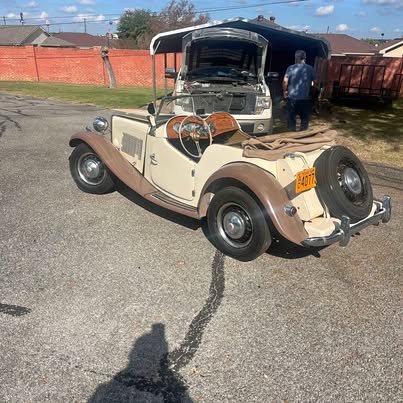
Engines and gearboxes
The XPAG 1,250: one engine, two states of tune
There is only one engine in a TD, and it is a good one. The XPAG is a 1,250 cc overhead-valve four — bore 66.5 mm, stroke 90 mm, a long-stroke, undersquare design that makes its power with torque rather than revs — with a cast-iron block and head, pushrods from a camshaft in the block, a three-main-bearing crankshaft and a chain-driven camshaft. In standard tune, on a 7.25:1 compression ratio, it produces 54 hp at 5,200 rpm and roughly 64 lb ft of torque low down where a TD actually uses it. The Mk II raises the compression and fits stronger valve springs for about 57 hp. Nothing about either version is exotic, and that is the point: any competent engine shop can rebuild one, with every wearing part — pistons, bearings, timing chains, valves, guides, gaskets — available new today.
A healthy XPAG starts readily, hot or cold, once the carburettors are set up properly, idles with a soft, slightly uneven burble, ticks audibly from the tappets if the clearances have opened up, and is busy rather than strained at a 50 mph cruise — with the standard 5.125:1 axle the gearing is short, as designed. Oil pressure should be well up the gauge at driving speeds and lower, but present, at a hot idle. An XPAG that shows almost no oil pressure hot, knocks under load from the bottom end, or breathes heavily is at the end of its life, whatever the seller says about a rebuild. Receipts settle this; adjectives do not.
Top end and smoke. The XPAG wants tappet clearances checked and oil changed on a short, old-fashioned schedule — a few thousand miles — and engines that got that care are the ones still showing good oil pressure today. Rocker gear, tappets and the timing chain all wear, audibly, and all are replaceable with the engine in the car; a professional top-end overhaul runs roughly $1,500–3,000. Learn to separate that honest noise from the deep, load-dependent knock of worn big ends, which is a rebuild noise. Blue smoke on start-up that clears is valve guides and seals; blue smoke under load is rings and bores.
The rear crankshaft seal that is not a seal. The XPAG has no lip seal at the rear of the crankshaft. It uses a scroll — an Archimedes-screw thread machined into the crankshaft that winds oil back into the sump as the engine turns, against a close-fitting housing. With tight main bearings it works surprisingly well; as the bearings wear and the crank gains movement, the scroll can no longer cope and the engine leaks from the rear main, out of the bellhousing drain hole. Two practical consequences. A TD that leaves no oil spot at all is either empty or freshly wiped — a light weep is the normal condition of a used XPAG, not a defect to reject a car over. And a heavy rear-main leak is a symptom whose disease is usually main-bearing wear: the honest fix is measuring the crank, and an engine-out rebuild at roughly $4,000–8,000 at a specialist, depending on the machining needed. Aftermarket lip-seal conversions exist and are popular; one fitted at rebuild time, with paperwork, is a genuine plus.
Cooling, and the overheating that is usually maintenance. The XPAG is not a chronic overheater, but the cooling system is seventy years old and small in capacity, and the margin disappears quickly. The usual causes, in check order, are a radiator core furred up with silt (the commonest — a professional recore runs roughly $500–1,000), a stuck or wrong thermostat, a slack belt, a worn water pump, retarded ignition timing and a weak mixture. A TD that boils in traffic is telling you one of those things, not that TDs boil. On a viewing, the temperature gauge should climb, settle, and stay settled through a drive and a spell of idling. A disconnected gauge, or a seller who tells you not to worry about the reading, is a warning about the cooling system itself. Electric fan conversions are common and sensible if neatly fitted — but ask what problem the fan was fitted to solve.
Carburettors, fuel and ignition: where most running faults live
Most XPAGs that run badly do not have an engine problem. They have a carburation, fuel-delivery or ignition problem, usually all three in small amounts, and this is the section that saves you from paying engine money for a tune-up fault.
Twin SU carburettors. The TD breathes through a pair of SU semi-downdraught carburettors, 1.25-inch H-type instruments, one feeding each pair of cylinders. The SU is a simple constant-depression design — a piston rising and falling in a suction chamber, carrying a tapered needle through a fixed jet — and it fails in simple ways. The throttle spindles wear in the bodies, admitting air the needle cannot meter for: the symptom is an idle that will not settle and a mixture that adjusts differently every time you touch it, on a car that runs acceptably at speed. The cure is re-bushing the bodies and new spindles, roughly $400–800 for the pair properly rebuilt, after which a pair of SUs is fit-and-forget for years. The other classic faults are perished jet seals and cork glands leaking fuel onto a hot manifold (smell for fuel in the engine bay of any car you inspect, and treat a strong smell as a fire risk to fix before the car is driven, not after), sticking pistons from dry damper dashpots — the dashpots take engine oil, and dry ones cause a hesitation on acceleration that owners misdiagnose for years — and float needles sticking after storage. Ethanol in modern fuel attacks the old cork and rubber, so a car recommissioned after storage wants the carburettors gone through as a matter of course.
The SU fuel pump. Fuel is delivered by an SU electric pump, a points-operated diaphragm pump that ticks audibly when you turn the ignition on — and that tick is one of the most useful sounds in TD ownership. It should tick briskly, then slow to an occasional tick as the float chambers fill. Silence usually means the pump's contact points have oxidised and stuck, especially on a car that has stood; a sharp tap that restarts the ticking confirms the diagnosis and confirms the points need cleaning or replacing, not that the pump is fixed. Continuous rapid ticking that never slows means a leak, a stuck float needle, or air drawn in on the suction side. Solid-state electronic conversions of the pump are common, reliable and invisible; the Mk II's twin pumps are the same units doubled, and the same checks apply, twice.
Ignition. The Lucas distributor is a points-and-condenser instrument whose condition explains more poor running than everything else in this section combined. Worn points, a failing condenser, a cracked cap, tired leads and a worn shaft that lets the points gap wander all produce the same family: hard starting, a misfire under load, a car that will not pull cleanly to speed. The centrifugal advance mechanism wears and gums up too, so check for smooth advance, not just a static timing figure. A full ignition refresh — points, condenser, cap, rotor, leads, plugs — is under a few hundred dollars in parts and is the first money to spend on any TD that runs roughly. Electronic modules hidden inside the original distributor are a common, practical upgrade that should not count against a car.
Gearboxes, clutch and the rear axle
The TD's gearbox is a four-speed manual with synchromesh on the upper gears and none on first or reverse — first is a get-away gear, selected at a standstill, and a driver who snatches it on the move earns a graunch that is his fault, not the gearbox's. The change, through a long upright lever, is slow, mechanical and precise in good order: it will not be hurried, and it should not crunch into second or third on a normal change, hot or cold. Second-gear synchromesh takes the wear, so test it with unhurried changes through second once the oil is warm. A box that crunches second both ways has worn synchromesh at best; one that jumps out of gear on the overrun has a more serious conversation coming, and a specialist rebuild runs roughly $1,500–3,000 plus removal and refitting. Check the oil level before you condemn anything: a TD gearbox that is nearly empty — it happens, because nobody checks — whines in a way that disappears remarkably once it actually has oil in it.
The clutch is a single dry plate, mechanically operated, biting progressively in the upper half of the pedal travel with no judder and no slip. Slip shows first in top gear on a hill, revs rising without road speed following; judder on take-up is usually oil on the plate — and on an XPAG that oil usually arrived from the rear crank scroll, which is why clutch and rear-main work so often share an invoice. A clutch change is an engine-or-gearbox-out job, so labour dominates: budget roughly $1,200–2,500 all-in, and ask what else was done while everything was apart, because a seller who paid for a clutch and ignored the rear main has left you the second half of his bill.
The rear axle is a hypoid live axle, 5.125:1 in the standard car and 4.875:1 in the Mk II, on semi-elliptic leaf springs. It is strong and noisy by modern standards — a gentle whine at cruise is period character, but a whine that changes dramatically between drive and overrun, or a clunk as you take up drive, is wear in the crown wheel and pinion or the half-shaft splines and deserves a price deduction. Leaks from the pinion and hub seals are endemic and cheap; the check that matters is whether the axle still has oil in it. Half-shafts occasionally break on cars driven hard on modern sticky tyres, which generate grip the 1950 drivetrain never expected; a documented replacement is simply an honest history file.
There was no automatic, overdrive or five-speed TD from the factory. All three exist as owner conversions — five-speed conversions are well developed and transformative for a car that tours — and a conversion is a modification, to be judged on the quality of its fitting and declared honestly in a listing: a touring owner will pay for it, a concours judge will deduct for it. What is never acceptable is one the seller does not mention.
Problem areas
Everything else in this guide is secondary to this section. A TD's engine can be rebuilt by any competent shop, its gearbox and axle are simple, its electrics are primitive and its parts supply is excellent — but its body is wood underneath and its identity has been imitated for fifty years, and those two facts are where buyers lose money. Work through it in order: timber first, chassis second, identity always, mechanical systems after — because a mechanically tired TD with a sound body is a project, and a mechanically sweet TD with rotten timber is a restoration wearing a driver's clothes.
The ash frame: the body is wood, and the wood rots
The TD's body tub is built the way a 1930s coachbuilder built bodies, because in 1950 that is still what it was. A frame of ash timber — the main sills running the length of the cockpit, the door pillars, the scuttle frame, the framing around the rear of the tub — is assembled first, and the steel outer panels are fitted over it, nailed, screwed and folded to the wood. The steel gives the body its shape; the wood gives it its strength and holds every panel, hinge and latch in position. When the wood rots, nothing dramatic happens at first, which is precisely the trap: the car still looks like a car, the doors still open, and the rot is invisible behind steel and trim until it is advanced.
Ash rots where water sits, and on a TD the water sits in predictable places. The main sills rot from the bottom and the ends, where road water is thrown against them and the running boards trap damp against the joint. The bottoms of the door pillars rot where water running down inside the door and scuttle collects at the base. The doors are timber-framed under their steel skins and rot at the bottom rail and around the hinge fixings. The scuttle frame rots where the windscreen and bulkhead leak, and the rear tub framing rots where the hood folds down wet against it. The plywood floorboards rot and delaminate too, though those are cheap to replace and are a maintenance item rather than a verdict.
The symptoms are all in how the car fits together, and you can read them from outside before you touch anything. Doors that have dropped, so the latch has to lift the door onto its striker. Door gaps wide at the top and tight at the bottom, or that change when the car is jacked or sat in. A door that flexes or creaks when you pull its bottom corner. Panels no longer flush where they meet — running board, wing edges, scuttle — because the timber they are fixed to has softened. Inside, lift the carpets and floorboards and look at the sills and pillar bases directly: sound ash is pale, hard and dry and rings when tapped; rotten ash is dark, soft, fibrous and damp, and an awl pushed at it — with the seller's permission — goes in with hand pressure. Probe the bottom six inches of everything; rot works upward from the wet end.
Now the money, because this is what separates a TD you can live with from one you cannot. Individual timber repairs are entirely feasible: a skilled restorer can scarf in a new sill section, a pillar base or a door bottom rail, at roughly $500–1,500 per area in professional hands, more if panels come off and paint has to be made good. The disaster case is a tub needing wholesale re-timbering — both sills, both pillars, scuttle and rear framing — because that means stripping the body to the frame: $8,000–15,000 professionally before paint, with complete ash frame kits alone at roughly $1,500–3,000 in parts. At that point the arithmetic changes past the value of most TDs. Hence this guide's mantra, the same as for any ash-framed car: buy the wood, and let everything else be negotiable. A documented professional re-timber in the history file, with photographs of the bare frame, is worth more than a fresh paint job will ever be.
The chassis: rust in the frame the wood sits on
Under the timber sits a separate steel chassis frame, a ladder of channel-section rails and crossmembers derived from the Y-type saloon, and it has its own rust map. The frame is strong and, compared with the unit bodies of later cars, forgiving — sections can be cut out and new metal let in by any competent welder — but it is seventy years old, it was never rustproofed in any modern sense, and it traps mud in the same places on every car.
Work along it. At the front, the dumb irons — the forward rail extensions that carry the front bumper and, on the left-hand rail, the stamped chassis number you will need for the identity checks below — corrode and bend in parking knocks, and a plated-over dumb iron deserves a prod. The front crossmember and the independent suspension mountings carry the loads of the whole front end; perforation there is structural in the truest sense. Along the middle, the rails collect mud on their top flanges under the floorboards, the battery carrier suffers acid attack from above, and the crossmembers rot where they are never washed. At the rear, the spring hangers, the rails over the axle and the rear crossmember all live in the spray zone and rot accordingly. Surface rust on a chassis that still rings solidly to a hammer tap is normal and treatable — roughly $300–800 in materials and your own labour. Perforation in a rail, or a hanger pulling out of soft metal, is fabrication work priced per car, and a badly rotten chassis, like a badly rotten tub, reprices the whole purchase.
The replica problem: the identity check that comes before everything
No honest guide to the TD can bury this in a footnote, because the TD is one of the most replicated classic cars in America. From the 1970s onward, and in large numbers through the 1980s, kit manufacturers sold TD replicas — most famously the kits sold under names such as Fiberfab and Classic Motor Carriages — that reproduced the TD's shape in fibreglass over a Volkswagen Beetle floorpan, with the VW's air-cooled flat-four in the back where a TD carries its spare wheel. Others were built on other donors, and later revival cars wear modern running gear under TD-shaped fibreglass. Some replicas are perfectly enjoyable cars. None is an MG TD, none is worth MG TD money, and they reach the market described loosely — sometimes innocently, by a seller who inherited the car and believes what he was told, and sometimes not innocently at all. Your defence is that a real TD and a replica differ in almost every component, and the differences are impossible to hide from someone who checks.
Run the checks in this order, because the first two settle the matter on their own.
Where is the engine, and what is it? A real TD has a water-cooled XPAG four under a long bonnet at the front, with a radiator, hoses and a fan. A VW-based replica has an air-cooled flat-four at the rear, under the deck where the spare wheel should be, and luggage space under its front bonnet. Open both ends of any TD you are serious about; this single check identifies the great majority of replicas in under a minute.
What is the body made of, and what is under it? A real TD's body is steel panels over ash timber on a separate MG steel chassis, with a chassis number stamped into the left-hand front dumb iron and a maker's plate carrying the car number in the engine bay. A replica's body is fibreglass — tap the panels, look at inner surfaces for the matt, woven texture of glassfibre and for the absence of seams, fixings and timber — sitting on a VW floorpan with a VW chassis number, or on whatever donor the kit used. Feel inside a door and along a sill: a real TD has wood and steel edges, screws and nails; a replica has a smooth fibreglass shell. A magnet tells you little over timber-framed steel, so use your eyes and fingers.
The supporting evidence. On a real TD, the XPAG carries its engine number on a plate on the block, the gearbox sits in a tunnel between the seats driving the rear wheels from the front engine, the instruments, steering wheel and column are MG, the wheels are 15-inch steel discs on MG hubs, and underneath there is a separate chassis with coils and wishbones at the front and leaf springs at the rear. On a VW replica you will typically find VW instruments, gear lever and pedals, and VW torsion-bar front suspension. The title settles the legal question on its own: a genuine TD is titled as an MG of its period year, while a car titled as a Volkswagen, a later-year special construction or a kit is a replica for valuation purposes even if the seller's family has called it the MG for thirty years. None of this makes a replica a bad car; it makes it a different car, priced against other replicas. What you must never do is pay TD money first and do these checks afterwards.
The same identity discipline, at a lower temperature, applies inside the genuine TD world. Engines get swapped between T-cars, so a non-matching engine number should be declared and priced; Mk II equipment gets added to standard cars, so the TDC chassis prefix is what makes a Mk II; and TDs and TFs get blurred in listings, so confirm the upright grille, separate headlamps and cut-down body sides rather than the TF's sloped grille and faired-in lamps. Identity on a TD is not pedantry. It is the price.
Suspension, steering and brakes: simple systems, honest wear
The TD's front suspension was its big advance over the TC: independent, by coil springs and unequal wishbones, with a kingpin and stub axle at each side and Armstrong lever-arm dampers. It wears in the kingpin bushes, the swivel and trunnion joints and the wishbone bushes, and faster when it is not lubricated — this front end has grease points that expect attention, and a greased one feels tight and accurate while a neglected one knocks, wanders and wears its tyres on one edge. Rock each front wheel and separate the play you find into kingpin wear (a professional rebush and ream, roughly $600–1,200 a side fitted) and the cheaper play of wheel bearings and track-rod ends. Lever-arm dampers leak and lose their damping with age; exchange or rebuilt dampers are a few hundred dollars a pair, and the difference a good set makes to the feel of the car is out of all proportion to the cost.
The steering is rack and pinion — another TD first for MG — light, direct and free of lost motion around the straight-ahead in good order. Wear shows as play at the rim before the road wheels answer, clonks from the rack mountings and inner joints, and a need for constant small corrections on a straight road; budget roughly $400–900 for a rack overhaul or exchange unit plus fitting. Read front tyre wear as the report card: even wear is a good sign, one-sided wear is geometry and wear talking to you.
At the rear, semi-elliptic leaf springs locate the live axle, again with lever-arm dampers (plus the Andrex friction dampers on a Mk II). Springs sag and lose leaves to fatigue and rust between the leaves; a TD sitting down at the back, or down on one side, usually needs its springs re-tempered or replaced — roughly $300–700 a pair plus bushes and fitting — and shackle bushes are cheap and transform a sloppy rear end. Broken leaves hide inside the pack, so count the leaves and look for rust dust between them.
The brakes are Lockheed hydraulics, drums all round, single-circuit, with no servo — correct, adequate and entirely dependent on condition. Everything about them perishes in storage: wheel cylinders seize and leak, the master cylinder bore corrodes, flexible hoses swell internally and act as one-way valves, and steel pipes corrode in their clips. A TD that has stood needs the hydraulics treated as guilty until proven innocent: a full professional refresh — master and wheel cylinders, hoses, pipes as needed, shoes and skimmed or new drums — runs roughly $1,200–2,500, and it is the least negotiable money in TD ownership, because a single-circuit system has no second chance designed into it. On the test drive the pedal should be firm and high and the car should pull up straight from speed with a hard push — the effort is period effort, and heavy is normal — while sponginess, pumping-up, pulling or fluid loss is a bill, not a characteristic. The handbrake is a simple linkage to the rear drums and should hold the car on a slope; one at the top of its travel that barely holds needs adjustment or rear brake work, in that order.
Wheels and tyres close this section because they are safety items disguised as cosmetics. The standard steel disc wheels rust around the rim and, more seriously, crack around the stud holes after seventy years of being overtightened and kerbed; cracked wheels are available new and are not a repairable item. Tyres will almost certainly be the wrong age even when they look new — a TD does few miles, so its tyres perish by date rather than wear — and a date-expired set is a $600–1,000 replacement to price into the purchase, in the correct tall, narrow size that keeps the steering light. Oversize modern tyres make the steering heavy, load the kingpins and half-shafts, and tell you the previous owner was decorating the car rather than maintaining it.
Interior, hood and weather equipment
A TD's cockpit is a simple, exposed place — two seats, a flat dashboard, a large thin-rimmed steering wheel, and no concessions to weather beyond a folding hood and detachable sidescreens — and its condition is a reliable guide to how the car has been stored, because trim suffers in damp storage almost as fast as timber does.
Seat frames and springs sag and break, and the coverings split at the seams and piping; sit in both seats, feel for the frame through the cushion, and price a retrim accordingly — a trim kit in the correct materials is roughly $1,000–2,000 in parts, with professional fitting and seat rebuilding taking a complete interior renewal to roughly $3,000–6,000. Carpets are cheap and often the newest thing in a tired car, which is why you lift them. The instruments are rebuildable by specialists, but a full set needing professional restoration is a four-figure conversation.
Judge the hood as a system — folding frame plus canvas top, completed by sidescreens that slot into the doors. Bent or seized frame joints, torn or shrunken canvas, an opaque rear window and missing sidescreens are all common; a new hood fitted professionally runs roughly $1,000–2,000 with the frame work it usually turns out to need, and restored sidescreens are several hundred dollars more. A TD is never weatherproof in the modern sense even with everything new, so price completeness and condition, not perfection. A car with no sidescreens and a torn hood is a fair-weather car at a fair-weather price, and the seller's insistence that you will never drive it in the rain is a negotiating position, not a fact about the car.
Electrics: Lucas, 12 volts, positive earth
The TD's electrics are 12-volt Lucas, positive earth as built, charged by a dynamo through a separate voltage regulator. The enemies are the standard ones for the era: earth connections corroding where they meet the chassis, wiring insulation hardened and cracked, worn dynamo brushes, and a regulator adjusted by optimism. The symptoms — dim lights, a charge warning that glows at idle, indicators flashing at a speed of their own, a fuel gauge with opinions — are almost all connection and earth faults before they are component faults, cured by methodical cleaning and testing rather than parts. A correct modern rewire in the right colours is a genuinely valuable job done; a nest of Scotchlocks and household flex is a warning sign fitted, and a new loom plus professional fitting runs roughly $800–1,800. Many TDs have been converted to negative earth, usually for a modern radio or an alternator; both are legitimate, but should be declared and labelled in the engine bay, because the next person to connect a battery — possibly you, at the roadside, in the dark — needs to know which way round this car is wired.
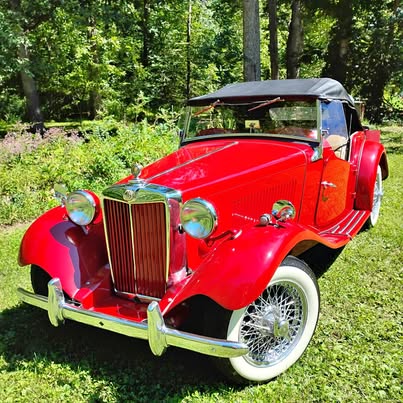
How to inspect one
Allow at least an hour, and bring a torch, a small awl for probing timber (with the seller's permission) and a friend to work the pedals and steering while you watch. Inspect in this order: identity first, structure second, mechanics last — the first two decide whether the third is worth your time.
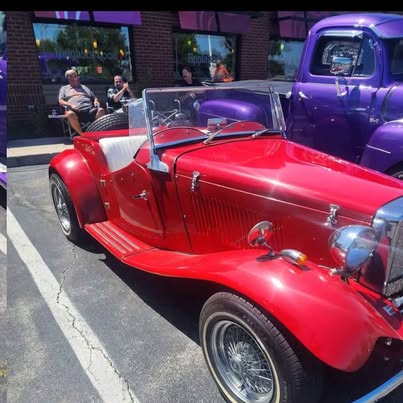
- Identity before everything. Open both ends. Confirm a water-cooled XPAG engine at the front and a spare wheel, not an engine, at the rear. Find the chassis number stamped on the left-hand front dumb iron and the maker's plate in the engine bay, and match both to the title. A Volkswagen title, a fibreglass body or a rear engine ends the inspection here.
- The chassis number against the badge. A standard car carries the TD prefix, a genuine Mk II the TDC prefix. Check the engine number plate on the block for an XPAG-series number. Numbers that have been ground, restamped or freshly painted over are a question the seller answers before you go any further.
- Doors and gaps, the timber's report. Open and close both doors. They should latch without lifting, sagging or flexing, and the gaps should be even. Pull gently on the bottom corner of each open door and feel for movement. Then stand back and read the running boards, wing edges and scuttle for panels that no longer sit flush.
- Probe the wood. Carpets and floorboards up. Prod the bottom six inches of both sills, both door pillars, the door bottom rails and the scuttle frame with the awl. Hard, pale, dry ash is a pass; dark, soft timber that takes the point under hand pressure is rot, priced by the money paragraphs in the problem areas section — localised by the area, wholesale by the tub.
- The chassis. Torch along both rails, the front crossmember and suspension mountings, the battery carrier, the rear spring hangers and the rear crossmember. Scale and surface rust are normal; perforation, soft hangers and overlapping patch plates are fabrication bills. Sight down the car for a bent front end while you are there.
- Cold start and the pump tick. Insist the engine is cold. Ignition on: listen for the SU fuel pump ticking and slowing as the float chambers fill — silence or endless rapid ticking is the fuel section's diagnosis in one sound. Start it, watch for blue smoke, and listen for bottom-end knock under a blip of throttle.
- Oil pressure and the dipstick. Warm, the gauge should sit well up at driving revs and hold pressure at idle. Check the oil itself: thin, petrol-smelling oil points at carburation washing the bores; mayonnaise under the filler cap points at the head gasket conversation. Note the rear-main weep — light is normal, a drip trail is bearing wear talking.
- Front end and steering. Rock each front wheel top-to-bottom and side-to-side and separate kingpin play from bearing and track-rod play. On the move, the rack should answer the rim with no lost motion, and the car should track straight without constant correction. One-sided front tyre wear confirms what your hands found.
- The test drive. Fifteen minutes minimum. The XPAG should pull cleanly from low revs without hesitation — a stumble on acceleration is dashpots, points or spindles, in that order of cheapness. Work through second gear up and down once warm for the synchromesh test, feel the clutch for slip on a hill and judder on take-up, and listen to the axle between drive and overrun.
- Brakes, hard. From speed, brake firmly: firm high pedal, straight stop, no pumping-up. A TD's pedal effort is heavy by modern standards and that alone is not a fault; sponginess, pulling or a sinking pedal is the hydraulic refresh from the problem areas section, priced into your offer. Test the handbrake on a slope.
- Cooling and electrics. Let it idle hot after the drive and watch the temperature gauge settle, not climb. Work everything electrical: lights, indicators, horn, wipers, gauges. Dead electrics on a TD are usually earths and connections, and cheap — but a car where everything works has been maintained, and that is information.
- Hood, sidescreens and interior last. Raise the hood, check the frame joints and canvas, and confirm the sidescreens exist and fit. Sit in both seats and feel for broken springs through the cushions. Complete, sound weather equipment is worth real money against a car missing its screens, however good its paint is.
Values
The TD market is a condition market, not a rarity market: the badge explains very little of any individual car's worth. MG built these cars in numbers, most came to America, and a great many survive — so what you are paying for, up and down the whole spread, is structure and history: the state of the ash frame, the state of the chassis, and the paperwork that proves both. The computed market block beneath this guide carries the current listing and recorded-sales figures; read it with the drivers below in mind rather than as a single number for the model.
At the top of the market sit the cars with everything aligned: genuine and numbers-consistent, sound or professionally renewed timber with the photographs to prove it, a rebuilt engine with receipts, and a history file that goes back years. A documented re-timber and a documented engine rebuild are the two pieces of paper that move a TD's value most, because they are the two jobs a buyer cannot see and cannot cheaply repeat. Originality of specification matters at this level too — correct disc wheels, instruments and trim materials — and a genuine Mk II, verified by its chassis prefix and equipment, carries a real premium over an equivalent standard car.
In the middle sits the honest driver: sound wood, a tired but healthy engine, older paint, complete interior and weather equipment, in regular use. This is the deepest part of the market and the best value in it, because these cars are priced on appearance while their structures are as good as cars asking considerably more. At the bottom sit the projects, with a trap built in: a shiny project with rotten timber is worth less than a scruffy project with sound timber, because the scruffy car needs cosmetics and the shiny one needs its body rebuilt. Asking prices run ahead of achieved prices, particularly where a seller is pricing a restoration he paid for; recorded sales are the better guide to what money actually changes hands. Replicas, finally, are not the bottom of the TD market — they are a different market entirely, and any car whose identity checks fail should be priced there or not bought at all.
Parts and ownership
The TD is one of the best-supported cars of its era, because it was built in numbers, exported in numbers, and adopted by an American club scene — the New England MG T Register and the wider MG clubs — that has kept specialists, remanufacture and knowledge alive for decades. Almost nothing on the car is truly unobtainable, and the major suppliers stock everything from ash frame kits to individual SU needles.
Easy: service items, plugs, points and ignition parts, SU rebuild kits and exchange pumps, brake cylinders, hoses, shoes and drums, suspension bushes, kingpin kits, steering wear parts, leaf springs, dampers on exchange, exhaust systems, tyres in the correct size, trim kits, carpets, hoods and sidescreen materials, and ash timber sections from a single sill to a full frame kit. Most of it is order-today, fit-this-weekend, at ordinary classic-car money.
Harder and dearer: good original instruments (specialist restoration rather than replacement), correct early detail parts, a good used XPAG cylinder head if yours is cracked, quality chrome work — re-plating a full set of TD brightwork is a serious bill at roughly $2,000–4,000 for the set — and professional timber work, where the parts are cheap and the skilled labour is the cost. A quality repaint, with the panels off a timber body and made good properly, starts around $6,000–10,000, which is another way of stating this guide's rule: buy the body, fix the mechanics.
Running costs. A sorted TD is a realistic regular-use classic for the driving it was designed for: short trips, club runs, back-road touring at 45–55 mph, returning fuel consumption in the mid-to-high twenties per gallon. Servicing is well within home-mechanic territory — oil, tappets, points, grease, on a short old-fashioned schedule — and insurance is in line with other cars of its value. The budget line that catches new owners is the first year: catching up deferred maintenance on a running car honestly costs $1,500–4,000 before you improve anything, and recommissioning a car that has sat for years — fuel system cleaned end to end, brake hydraulics renewed, tyres replaced — runs $3,000–6,000 at a shop. Buy a car in regular use over one that has been asleep, even at a higher price: on a TD, use is maintenance.
Which one to buy
- The all-rounder: a late standard TD, 1952–53. The most developed version of the car, the deepest market to buy from and sell into, and the specification most of the parts and knowledge base assumes. A sound late car is the default TD purchase.
- The value buy: a sound early standard car, 1950–51. Mechanically the same TD, often overlooked beside the later cars. If the timber and chassis pass the inspection, the earlier date is no reason to pay less — or to walk away.
- The collector car: a verified TD Mk II. Rarer, keener and genuinely different in feel, at a premium that is justified only when the TDC chassis prefix, the twin pumps, the friction dampers and the history all agree. A dressed standard car at Mk II money is the one TD purchase to refuse.
- The tourer: a standard car with honest upgrades. Electronic fuel pump and ignition, an electric fan, radial tyres in the correct size, perhaps a five-speed conversion — declared, well fitted and documented, these make the TD you will actually drive furthest.
- The project buy: the scruffy car with sound wood. Dull paint, tired trim and timber that passes the awl test beat a shiny car with rotten sills every time.
And the rule that overrides all of the above: buy the least rotten car you can find — wood first, chassis second — and verify that it is a real TD before you value it as one. Engines, gearboxes, brakes and carburettors are all fixable at prices you can plan for; a rotten ash frame costs more to put right than the finished car will be worth, and a replica bought at TD money is a loss no amount of driving will repay.
See the 8 TD cars currently listed.
For sale now
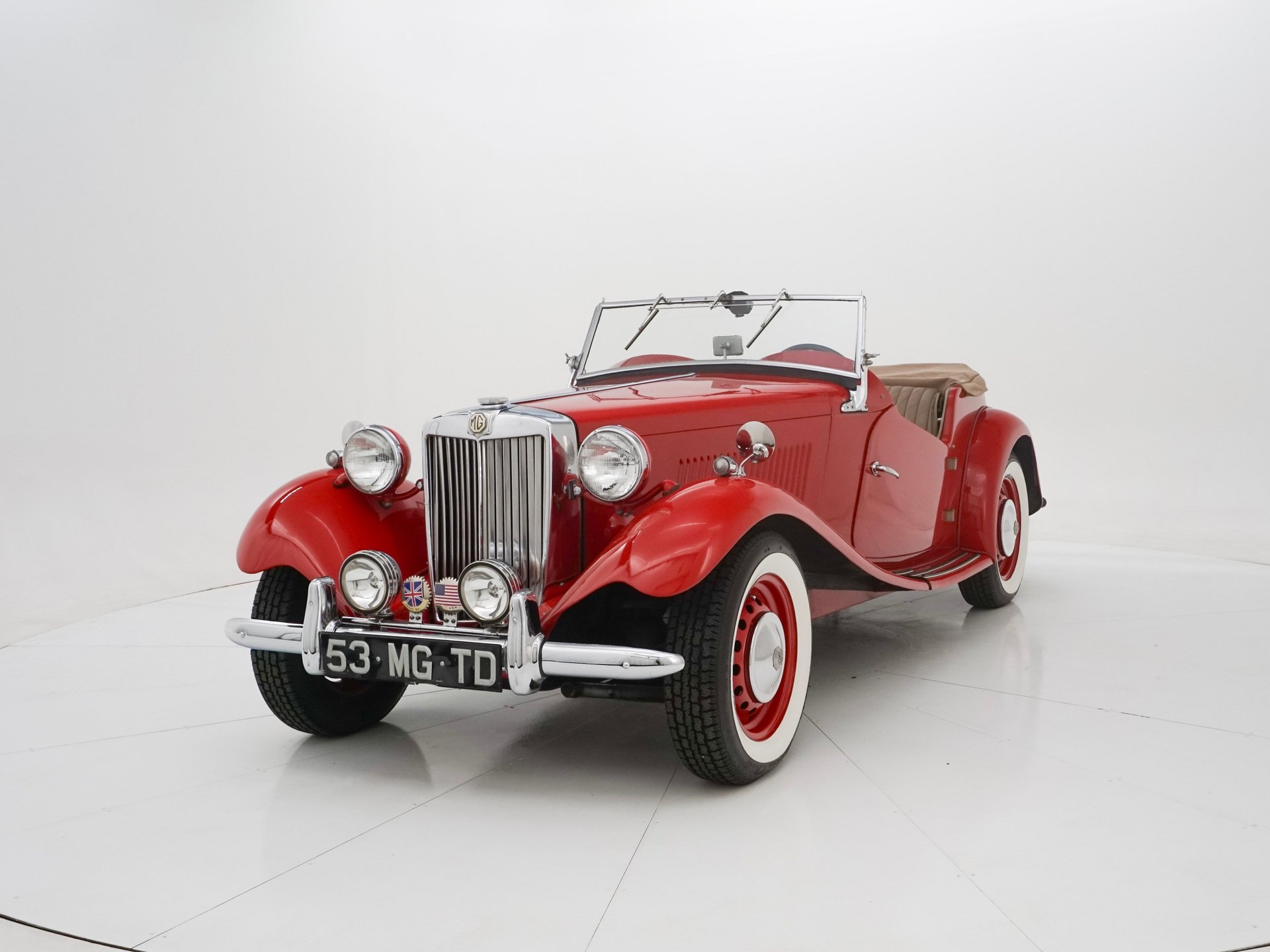 $26,900
Expand
 $13,500
Expand
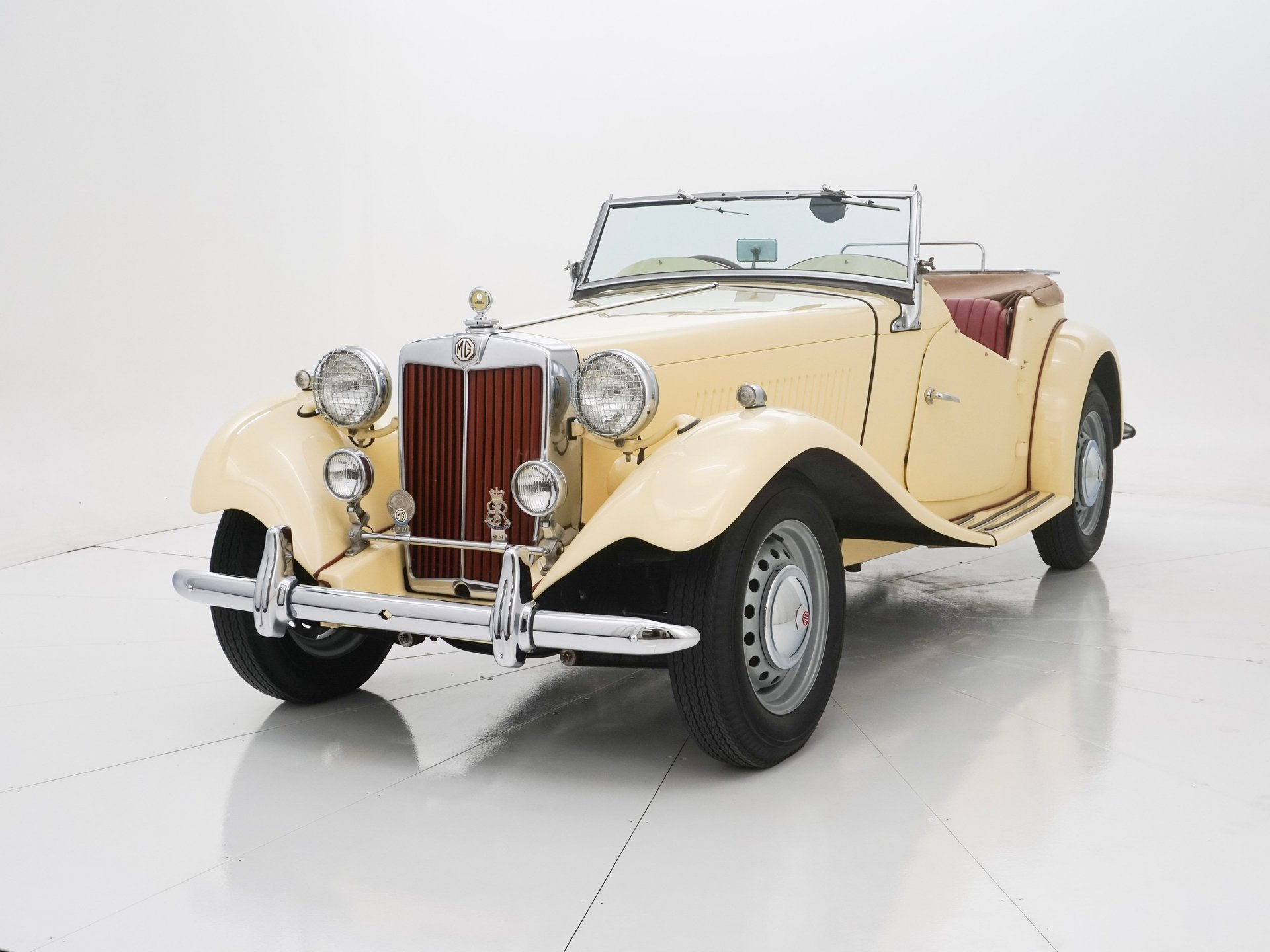 $29,900
Expand
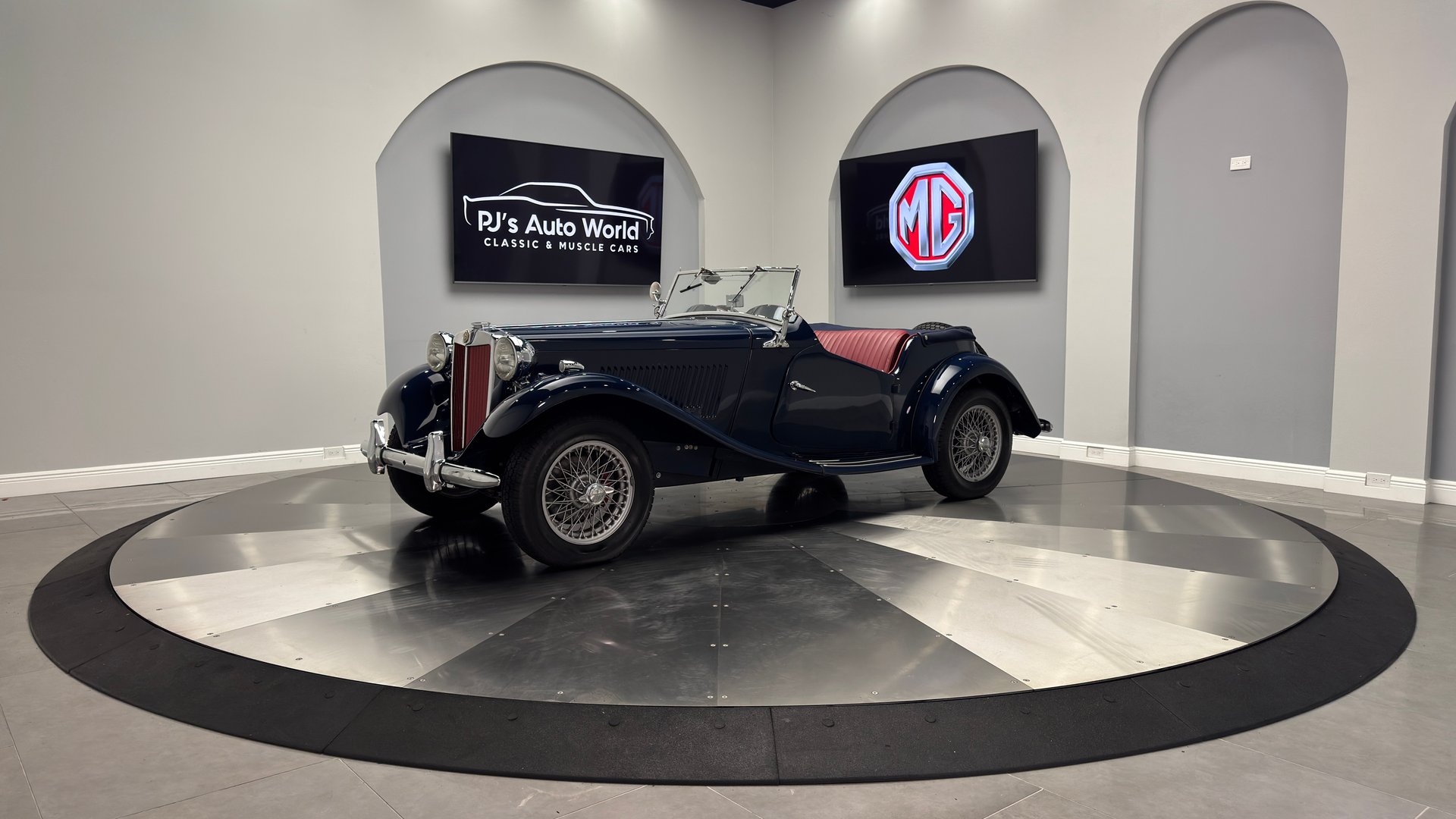 $29,900
Expand
Expand
Expand
What they sell for: TD sale prices.