
Packard Panoz Clipper deluxe Packard buyer's guide
Packard Panoz Clipper deluxe Packard -- the model's own buyer's guide: variants, values and what to check.
Years listed: 1954-1956 · Series: Clipper
Overview and history
The Packard Clipper is not one car. It is three different cars, built in two cities by two companies, sharing a name and a grille family — and if you do not understand which of the three you are standing in front of, you will pay the wrong money for it and order the wrong parts for it. Learn the three lives first.
The first Clipper, of 1941–42 and 1946–47, is the famous one: the streamlined fastback that dragged Packard out of the upright, separate-fender era in a single step. The second, of 1953–54, is a name revived — Packard's entry-level line wearing the last of the great L-head straight eights, mechanically a car from an earlier decade sold into the overhead-valve V8 age. The third, of 1955–56, is thoroughly modern again: Packard's own overhead-valve V8, torsion-bar suspension on the upper models, push-button automatic on the last of them, built inside a corporate collapse that had nothing to do with how good the engineering was.
The original was introduced in April 1941, mid-model-year, as a single four-door sedan, and it was a sensation because it looked like nothing else on an American road. The design, developed from work by Howard "Dutch" Darrin and executed by Packard's stylists under Werner Gubitz, swept the front fenders back into the doors in one unbroken "fade-away" line, hid the running boards, faired the headlamps into the fender crowns and tapered the roof into a fastback tail. It was the widest American production car of its day and, famously, wider than it was tall. Underneath, it rode the senior 127-inch wheelbase but used the junior One Twenty's 282 eight, placing it between the One Twenty and One Sixty, against Buick's Roadmaster, the Cadillac Sixty-One, the Chrysler New Yorker and the Lincoln-Zephyr. Despite arriving halfway through the model year it sold about 16,600 copies.
For 1942 Clipper styling spread across almost the whole range: six-cylinder and 282-eight juniors on 120 inches, One Sixty and One Eighty seniors on 127 inches with the mighty 356 eight, plus club sedans and a junior convertible. On 9 February 1942 civilian production stopped for the war; Packard built Merlin aero engines instead, and the barely year-old Clipper went into storage as a design.
It returned unchanged for 1946 and 1947, there being no time or money to tool anything else. The 1946–47 range is the first Clipper's fullest expression: Six, Eight and Deluxe Eight on 120 inches, Super and Custom Super on 127 inches, and seven-passenger and limousine Custom Supers stretched to 148 inches. Packard moved more than 30,000 cars in 1946 and more than 50,000 in 1947, the great majority Clippers — and the Super and Custom Super are recognised by the Classic Car Club of America as Full Classics, one of very few post-war designs so honoured.
For 1948 Packard fattened the Clipper shell into the "bathtub" Twenty-Second Series and dropped the name; it slept for five years. It returned for 1953 because James Nance, Packard's president from 1952, wanted the junior line distanced from the senior cars. The 1953 Clipper and Deluxe replaced the old 200 series on the 122-inch junior chassis, still with flathead eights — a 288 in the standard car, a 327 in the Deluxe — when Oldsmobile, Cadillac and Chrysler had all gone to overhead-valve V8s. They were well made, quiet and durable, and they carried the company: more than 60,000 were built for 1953. For 1954 a Super line and the Panama hardtop were added, but the range was a mild facelift in a recession year and output fell to roughly 23,000. In October 1954 Packard merged with — in substance, bought — a failing Studebaker, a transaction whose consequences poisoned everything that followed.
The third Clipper arrived in January 1955 in a genuinely impressive relaunch: new styling by Dick Teague's team, a new overhead-valve V8 in 320- and 352-cubic-inch sizes, 12-volt electrics, a revised Twin Ultramatic, and, on the Custom line, Torsion-Level suspension. For 1956 Nance finally got his separate marque: Clipper became a make in its own right, with its own badging, new rear sheet metal, a standard 352 V8 and push-button gear selection. It was too late. Detroit production ended in June 1956, and the "Packard" cars of 1957–58 were Studebakers built in South Bend.
Our own current pool for this model is small — 12 cars recorded, 10 for sale and 2 recorded sold — spanning 1942 to 1956 with three from 1954 alone. Treat that as a reminder of how thin the market is, not a census: you wait for the right car, in the right one of its three lives, then inspect it very carefully.
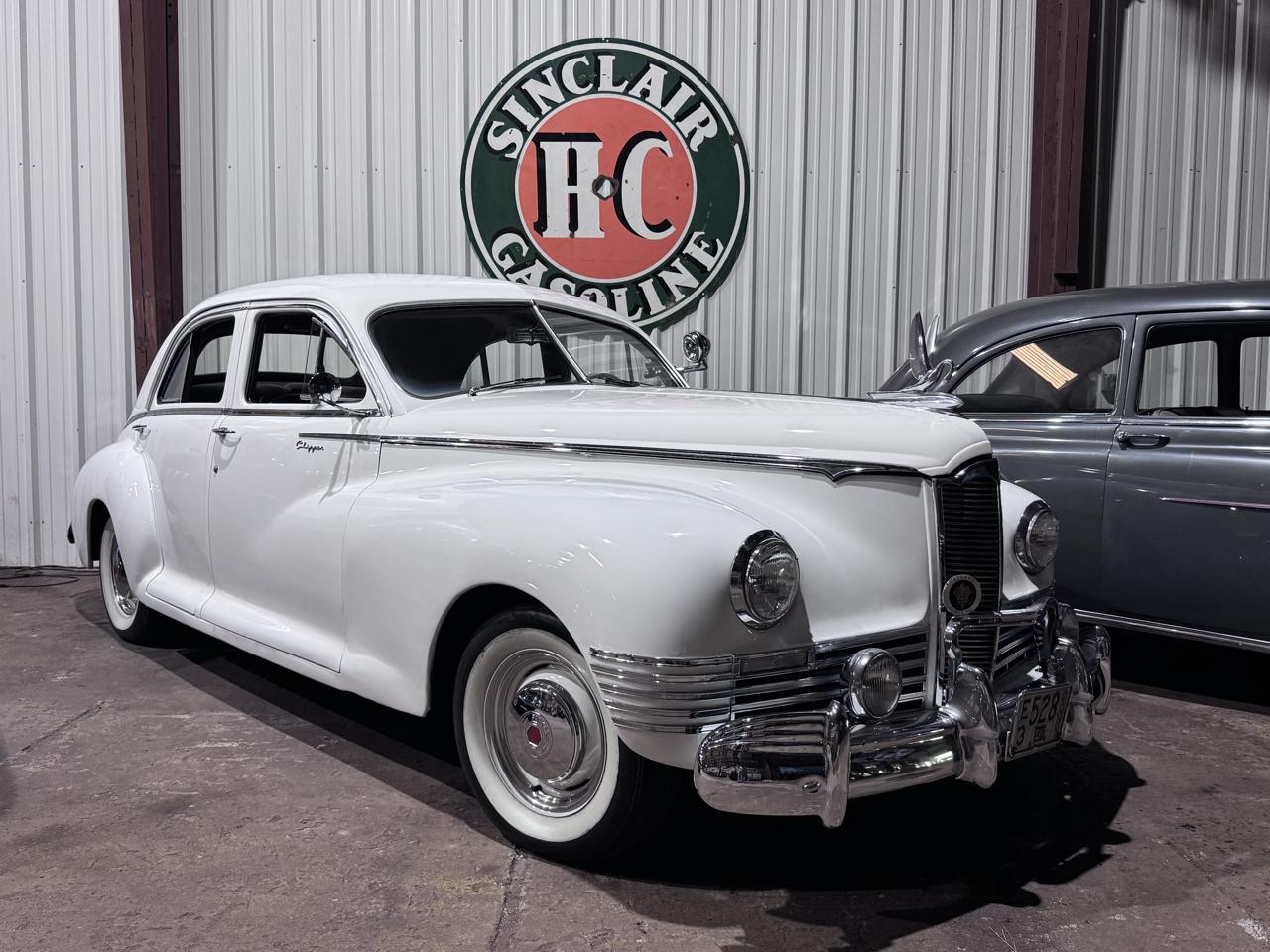
The models
Notice that "Clipper" tells you almost nothing on its own: the year, the wheelbase and the engine do the real work. A 1947 Custom Super and a 1953 Deluxe are both "Packard Clippers" in a listing headline, and they are as different as a car can be — nine-main-bearing senior eight, Full Classic status and a 127-inch wheelbase on one side; a junior eight in a car Packard itself was trying to pretend was a separate make on the other. Insist on the full designation — series, trim and body — before you discuss money.
| Model | Years | Engine | Output | Built | Character |
|---|---|---|---|---|---|
| Clipper (senior-wheelbase sedan) | 1941 | 282 cu in L-head eight | 125 hp | 16,600 | The original: Darrin-influenced fastback, 127 in senior chassis, junior engine |
| Clipper Six | 1942, 1946–47 | 245 cu in L-head six | 105 hp | Not separately recorded | The economy Clipper; same body, six-cylinder gear, 120 in wheelbase |
| Clipper Eight / Deluxe Eight | 1942, 1946–47 | 282 cu in L-head eight | 125 hp | 23,855 (Deluxe Eight, 1947) | The volume post-war Clipper; the one you will actually find |
| Super Clipper / Custom Super Clipper | 1942, 1946–47 | 356 cu in L-head eight | 165 hp | 4,802 / 7,480 (1946 series) | The senior cars: 127 in, nine main bearings, CCCA Full Classic status |
| Custom Super Clipper 7-passenger / limousine | 1946–47 | 356 cu in L-head eight | 165 hp | Included in Custom Super total | 148 in, Henney-built long bodies; rare, formal, demanding |
| Clipper / Clipper Deluxe | 1953–54 | 288 / 327 cu in L-head eight | 150 / 160–165 hp | Over 60,000 (1953, all Clippers); c. 23,000 (1954) | The revived name: entry-level Packard, last flathead eights |
| Clipper Super / Panama hardtop | 1954 | 327 cu in L-head eight | 165 hp | Panama c. 3,600 | Super trim and the first Clipper hardtop — pick of the revival cars |
| Clipper Deluxe / Super | 1955 | 320 cu in OHV V8 | 225 hp | Not separately recorded | The V8 arrives; conventional suspension, two-barrel carburettor |
| Clipper Custom / Constellation hardtop | 1955 | 352 cu in OHV V8 | 245 hp | Not separately recorded | Torsion-Level and the big engine; the connoisseur's 1955 |
| Clipper (standalone marque): Deluxe, Super, Custom | 1956 | 352 cu in OHV V8 | 240 hp (Deluxe/Super), 275 hp (Custom) | 18,572 (all 1956 Clippers) | A make, not a model, for one year only; push-button Twin Ultramatic |
| Clipper (South Bend) | 1957 | 289 cu in Studebaker OHV V8, supercharged | 275 hp | Under 5,000 (all 1957 Packards) | A Studebaker President in Packard trim; buy it as a Studebaker |
The 1941 car. One body, one engine, one wheelbase — a four-door touring sedan on 127 inches with the 282 eight at 125 hp. It is the design statement, genuinely rare, and the hardest first-generation car to find correct trim for. Buy one because you want the original artefact, not because it is the best first Clipper to own.
The 1942 range. Six and Eight juniors on 120 inches (touring sedan, the pretty fastback club sedan, and the junior convertible), One Sixty and One Eighty seniors on 127 inches with the 356. Production stopped in February 1942, so every 1942 is a short-year car. Watch the identity trap: conventional-bodied 1942 convertibles, taxis and commercial cars are not Clippers, even when a seller calls the whole range by the name.
The 1946–47 juniors. The Clipper Six (245 six, 105 hp) and the Clipper Eight and Deluxe Eight (282 eight, 125 hp) share the 120-inch chassis and the same touring sedan and club sedan bodies. The Deluxe was the volume seller and is the car you will meet most often; of the 1947 Deluxe Eights, only 621 were club sedans, which is why a genuine post-war Clipper two-door always draws a crowd. The six is a good engine in a car that flatters the eight: it cruises happily but works harder, and the market prices it accordingly. In honest condition these are the best value in this entire guide.
The 1946–47 seniors. The Super and Custom Super put the 356 eight — 165 hp, nine main bearings, hydraulic lifters, a crankshaft over 100 lb — into the 127-inch body, with richer trim and, on the Custom, the 148-inch seven-passenger sedan and limousine with Henney-built long bodies. This is the CCCA-recognised car, capable of over 100 mph in period, and the first-generation car to buy if the budget allows. It is also bigger, heavier and more expensive to restore in every dimension, and the long bodies do not fit every garage — measure yours.
The 1953–54 revival cars. Standard Clipper (288, 150 hp), Deluxe (327, 160 hp in 1953, 165 hp in 1954) and, for 1954, the Super with full-length bright trim and the Panama hardtop at the top of the line. The 1954 Special was a low-volume stripped fleet series you should not pay Deluxe money for. These cars ride the 122-inch junior chassis and are the last Packards with the flathead eight; their appeal is smoothness and build quality, not performance — a 1953 Clipper took a leisurely 17-odd seconds to 60 mph in period testing, and it feels exactly as unhurried as that sounds.
The 1955 cars. Deluxe and Super with the 320 V8 (225 hp, two-barrel), Custom with the 352 V8 (245 hp, four-barrel) and the Constellation hardtop as the Custom's coupe. Teague's styling is the most glamorous of any Clipper. The mechanical dividing line is suspension: Deluxe and Super cars were built with conventional coil-and-leaf springing, the Custom line carried Torsion-Level, and late-build cars blur the picture, so verify the individual car rather than trusting the badge.
The 1956 cars. Badged simply as Clippers, a separate make: Deluxe and Super with the 352 at 240 hp, Custom at 275 hp, Panama and Constellation hardtops, new rear fenders and tail-lamps, push-button Twin Ultramatic. Total 1956 production was 18,572. These are the most developed Detroit Clippers and the easiest to live with — provided the push-button unit and transmission are healthy, a real proviso treated in the problem areas below.
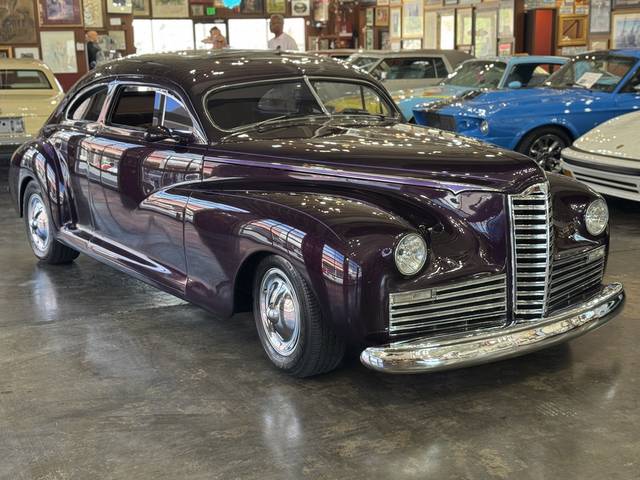

Engines and gearboxes
Four engine families power the Clipper across its three lives: the L-head six, the L-head straight eights in junior and senior sizes, the revived line's late flathead eights, and the 1955–56 overhead-valve V8. All are long-lived, understressed designs whose enemies are age, neglect and overheating rather than inherent weakness — with one famous exception, the V8's oil pump, which gets its own treatment in the problem areas. Learn the families separately: their characters, costs and failure modes have almost nothing in common.
The 245-cubic-inch L-head six
The junior engine of the first Clipper: 245.3 cubic inches, side valves, seven main bearings, 105 hp, fitted to the Clipper Six of 1942 and 1946–47. Its virtues are smoothness for a six, simplicity, and parts that interchange with a wide family of Packard sixes; it moves a 120-inch Clipper adequately rather than effortlessly. Mechanically it asks for what every flathead asks for: valve clearances checked and set (these are mechanical-lifter engines; a "quiet" six that has never had its clearances checked usually has several valves riding tight, which burns seats), clean oil, and a cooling system in full health. A top-end rattle that does not respond to adjustment points to worn guides or camshaft drive; a top-end rebuild runs roughly $1,500–3,000, a full rebuild $6,000–10,000.
The junior L-head eights: 282, 288 and 327
The 282 (1941–42, 1946–47) is the definitive first-generation junior engine: five main bearings, 125 hp, and a reputation for running so smoothly that period owners balanced coins on the head at idle. The 288 of 1953 is its direct descendant — same architecture, slightly larger bore — rated at 150 hp with higher compression and post-war carburation. The 327, standard in the 1953 Deluxe and the 1954 Deluxe and Super, is the stretched version; in senior applications it carried nine main bearings, but in Clipper service it is the junior-specification engine, so check the engine number rather than assuming limousine specification from a seller's description. Outputs run 160 hp (1953) and 165 hp (1954).
All three share the flathead eight's service personality: quiet, torquey, tolerant, and killed in predictable ways. Overheating from a scaled cooling system cooks the long head and block faces; exhaust manifold studs seize and snap; the manifold itself cracks between the centre ports where heat concentrates; valve seats recess and guides wear on modern unleaded fuel (hardened seats at rebuild time are the permanent answer, roughly $800–1,500 as part of a head and block overhaul); and the long block's core plugs corrode from inside, weeping coolant where you need a mirror to see it. A healthy junior eight shows even compression — any cylinder more than about 10 per cent down on its neighbours wants a leak-down test before money moves — and holds its temperature in traffic. Budget $7,000–12,000 for a proper full rebuild; a car that needs one is a project whatever the paint looks like.
The 356-cubic-inch senior eight
The engine that makes the Super and Custom Super special. Introduced for the senior cars in 1940, the 356 runs nine main bearings on a crankshaft of over 100 lb, uses hydraulic lifters — unusual refinement in a flathead — and produces 165 hp, the most of any American production engine in its day, Cadillac's V8 included. It weighs close to 1,000 lb dressed and delivers its performance as a swell of torque rather than revs: a good 356 pulls from walking pace in top gear without complaint and pushes these cars past 100 mph.
Its weaknesses follow from its size and sophistication. Lifters that tick cold and quieten are usually just bleeding down; lifters that tick hot, all the time, mean low oil pressure, worn lifter bores or a tired pump — a set of lifters plus the labour to reach them runs $600–1,200. The cooling system has more work to do than on any other Clipper and less margin: a 356 that runs hot will warp, and surfacing the long head is specialist work. The engine's weight sags its mounts, misaligning the driveline into a vibration the seller will blame on the tyres. A full 356 rebuild is a $10,000–16,000 undertaking at the few shops that do them well; the offset is that a properly rebuilt 356 is a 100,000-mile engine.
The Packard overhead-valve V8: 320 and 352
Packard's answer to Cadillac and Oldsmobile arrived for 1955, a decade of development behind it: a cast-iron overhead-valve V8 with a short, stiff block, five main bearings and hydraulic lifters — 320 cubic inches for the Deluxe and Super (225 hp, two-barrel, 8.5:1 compression), 352 for the Custom (245 hp, four-barrel Carter WCFB). For 1956 the 320 was dropped, Deluxe and Super took the 352 at 240 hp with compression raised to 9.5:1, and the Custom's 352 made 275 hp. (The 374 version powered senior Packards only and was never a Clipper engine — a "374 Clipper" is a swap or a mistake, and the engine number settles it.) The same basic engine went to Hudson and Nash in detuned 320 form and to Studebaker's Golden Hawk as a 352, which helps parts hunting more than you might expect.
It is a strong, torquey, durable engine with one design flaw that defines its ownership: the oil pump, which sits unusually high in the sump because a vacuum pump for the wipers is stacked beneath it in the same drive. As the pump's drive and clearances wear, it aerates the oil and loses pressure exactly when the hydraulic lifters need it. The full mechanism and tests are in the problem areas; here, note the ownership rules. Keep the sump at the full mark and check it often — many experienced owners run a fraction over full. Treat hot-idle lifter clatter as a pressure problem to be measured with a mechanical gauge in the gallery, not a noise to be cured with thicker oil. A rebuilt or upgraded pump, fitted, runs roughly $600–1,200 and is the best money you can spend on a V8 Clipper. Full rebuilds run $8,000–14,000; the bottom end, given oil, is rarely the reason.
Carburation is Carter throughout — two-barrel on the 320 and 1956 Deluxe/Super 352, four-barrel WCFB on Customs — and the usual complaints (hot-start flooding, a flat spot off idle) are float level, a perished accelerator-pump cup and vacuum leaks at a 70-year-old throttle shaft, in that order. A professional rebuild runs $350–700. Ignition is Delco points; check the vacuum advance diaphragm with a hand pump — one that will not hold vacuum is the flat spot everyone blames on the carburettor.
Gearboxes
Manual three-speed. The standard gearbox on first-generation and 1953–54 cars, column-shifted, synchromesh on second and top. Strong and simple; wear shows as jumping out of second on the overrun and a whine in the indirect gears that quietens in top, which is direct drive. Rebuildable by any competent transmission shop for $1,200–2,500.
Overdrive. The Borg-Warner overdrive, electrically engaged above a cut-in speed and dropping revs substantially in top, was the option that made a flathead Clipper a genuine long-distance car, and it was widely fitted. Test it on the road: it should engage smoothly as you lift off above cut-in, disengage on the kickdown switch under full throttle, and never engage in reverse. Failures are usually electrical — relay, solenoid, governor switch — and often a $200–500 repair. A working overdrive earns a real premium over an identical car without it; a dead one is not a reason to walk away.
Ultramatic (1949 design, fitted to Clippers from 1953). Packard's own automatic — the only one designed and built in-house by an American independent — is a two-range design with a lock-up torque converter giving direct drive in high range, which is why these cars cruise with an un-slurred, manual-like connection between engine and road. The 1954 Gear-Start version starts in low automatically and shifts up. Its vices are heat, age-hardened seals, and a converter and valve body that demand a specialist when they misbehave: flaring on the low-to-high shift, a groan as direct drive engages, or burnt-smelling fluid all point to a rebuild at $3,500–6,000. General transmission shops will offer to "look at it" — decline, and use a Packard specialist.
Twin Ultramatic (1955–56). The V8 cars' transmission added a two-stage converter, aluminium bell housing and case parts, and, for 1956, electronic push-button selection. The 1955 version was rushed and earned its poor reputation: a soft sleeve bushing in the rear pump wears, pressure falls, and the transmission slips and burns. Packard corrected it with a hardened sleeve, revised converter thrust arrangements and new valving for 1956, and the improved parts were retrofitted to many 1955 cars under warranty — so a 1955 Twin Ultramatic with documented later-specification internals is a different proposition from an untouched one, and the paperwork matters. The 1956 push-button unit adds its own failure mode: the electric actuator motor, its cable drive and the button contacts. A button that needs pressing twice, or a car that creeps in neutral, is an actuator problem first and a transmission problem second. Specialist rebuilds run $4,000–6,500; actuator overhaul, $400–900.
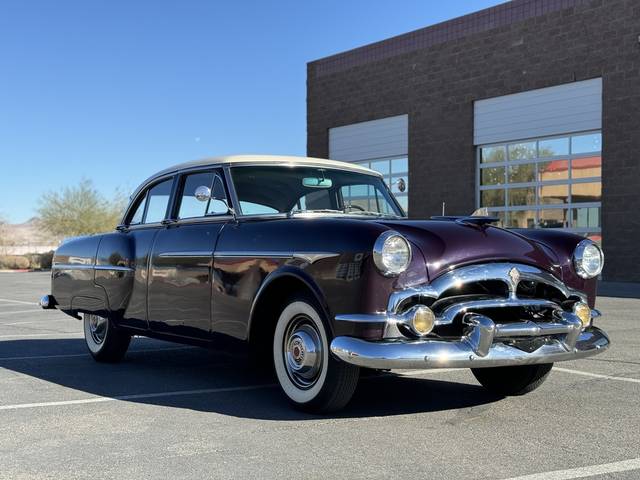
Problem areas
Every Clipper is now between roughly 70 and 85 years old, so "problem areas" means the places where age, heat, water and neglect have had the longest to work. Notice how often the expensive version of a fault is the one ignored when it was cheap: a scaled radiator becomes a warped flathead; a worn oil pump becomes a V8 rebuild; a bubbling rocker becomes a structural car. The inspection checklist that follows is built directly on this section, in the same order of consequence.
Rust and body structure: the map
Packard built heavy bodies with generous steel, which cuts both ways: more metal to rust through before a panel fails, and more hidden structure to be quietly rotten behind sound-looking skin. The first-generation fastback has a specific rust map. Water sits in the bottom of the fade-away front fenders where they meet the doors, in the rocker panels (sills) along their whole length, in the lower rear fenders ahead of the rear wheels, around the rear window and boot-lid apertures where seals have hardened, and in the floor pans under the front carpets, fed by leaking cowl vents and windscreen seals. The club sedan's long rear quarters trap mud behind the wheels; the touring sedan's doors rust at their bottoms from blocked drain holes. On the 148-inch cars, add the extended floor and the Henney body's coachbuilt joints.
The 1953–54 cars rust in the same junior-body places — rockers, lower fenders, floors, boot floor — plus the headlamp pods and lower valance, and their simpler trim leaves less brightwork to hide evidence under, which is in your favour. The 1955–56 cars add the wraparound windscreen's lower corners (a leak here rots the floor and kills the under-dash electrics), the sills beneath stainless rocker trim that traps salt against the steel, and the fender skirts' mounting edges.
Distinguishing surface from structural rust is the whole skill. Carry a magnet in a cloth: it slides off filler on lower fenders and rockers. Tap rockers and floor with a knuckle — sound steel rings dully, thin steel crunches. Lift the carpets if permitted; if not, press the floor through the carpet with your heel and watch the seller's face. A fastback whose boot lid sits proud on one side has usually been hit or has a rotted hinge panel. Rust repair is the most expensive work on any Clipper because the panels are large and mostly unavailable as reproductions: a rocker replacement runs roughly $800–1,800 per side before paint, a floor section $600–1,500, and a car needing sills, floors and lower fenders both sides is an $8,000–15,000 metalwork bill before a paintbrush is lifted — which is why the overriding rule at the end of this guide is what it is.
The exception is the 1948 Station Sedan listed as a Clipper woodie: its rear body is structural wood framing, and rot there is a coachbuilding job, not a welding job, at $5,000 and upward. Probe the joints with an awl — soft wood at the tailgate pillars is structural, not cosmetic.
Flathead engines: cooling, cracks and breathing
The straight eights' defining vulnerability is heat. The L-head design runs exhaust passages through the block, water distribution depends on an internal distribution tube in the head that corrodes and collapses with age, and decades of weak antifreeze scale the long water jacket. The sequence is always the same: the car runs warm in traffic, the owner fits a bigger fan or removes the thermostat (making warm-up worse and running no better), the head gasket weeps between cylinders, and eventually the head or block face warps or cracks between valve seats and bores — the classic flathead crack, diagnosable by two adjacent cylinders down together on a compression test, coolant in the oil, or bubbles in the header tank at idle with the cap off. A crack check and surface runs $400–900 if the castings are sound; a cracked block is an engine-out, find-another-block event, which is why a car's temperature behaviour matters more than its mileage.
Exhaust manifolds crack between the centre cylinders and their studs snap flush with the head; budget $500–1,200 for replacement with the stud extraction done properly, and treat a blowing manifold gasket as a quote to obtain, not a noise to ignore. The Carter carburettors of the flathead years (WDO and WGD two-barrels on post-war juniors) wear at the throttle shaft and flood when hot; rebuilds run $350–650. Fuel pumps are mechanical, with a vacuum booster section for the wipers on many cars — weak wipers under load and fuel starvation at speed can be the same tired pump wearing two hats; a rebuilt pump is $150–350 exchange.
The V8 oil pump, and V8 top ends
This is the one mechanical issue every 1955–56 buyer must understand before viewing a car. The V8's oil pump is driven at the rear of the camshaft and stacked with the vacuum pump that powers the wipers, placing its gears higher above the sump oil than on almost any contemporary design. As the pump's drive tang, bushings and gear clearances wear, it draws air as well as oil — aerated oil is compressible, pressure falls, and the first components to complain are the hydraulic lifters at the top of the engine, furthest from the pump. The symptom sequence is consistent: lifter clatter on a hot restart, clatter that quietens as revs rise, a gauge sitting lower at hot idle than it once did, and in neglected cases bearing wear from sustained low pressure.
The distinguishing test is a mechanical gauge, not the dashboard: screw it into the main gallery and read pressure cold, at hot idle, and at a steady 2,000 rpm hot. A healthy engine holds strong pressure hot at speed and a respectable figure at hot idle; a worn pump shows adequate cold pressure collapsing as the oil thins. Check the oil level before condemning anything — oil retained in the upper engine drains back slowly, a dipstick read straight after shutdown reads low, and some "oil pump failures" are engines run a quart down. The fix is a rebuilt or improved pump (buy from a known Packard supplier, not a generic listing), fitted for roughly $600–1,200. What you must not do is buy a V8 Clipper with hot lifter clatter and no gauge readings on the assurance that "they all do that." Some do it harmlessly for years; some are 500 miles from a spun bearing, and the gauge is the only thing that tells you which car you are looking at.
The rest of the top end is conventional: lifters are replaceable in a set for $400–800 fitted, and hardened valve-stem seals give a puff of blue smoke on start-up — unsightly, cheap in parts, and no reason to reject a car whose compression and oil pressure are right.
Transmissions: Ultramatic and Twin Ultramatic
The Ultramatic's age failures are seal failures: hardened seals leak pressure internally, so the transmission is lazy when cold, flares on the low-to-high shift, and delays engagement after sitting. Check the fluid first — it should be red and sweet-smelling; brown, burnt-smelling fluid in a badly shifting transmission is a rebuild quote, $3,500–6,000 at a specialist, with no cheap version, because converter, direct-drive clutch and valve body all live in the same unit and wear together. A groan or shudder as the direct-drive clutch locks up at cruise is the converter clutch complaining, and it does not heal.
The 1955 Twin Ultramatic adds the rear-pump bushing problem from the engines section: the soft sleeve wears, pressure drops, the transmission slips under the V8's torque. Ask directly whether it has been rebuilt and to what specification; a documented rebuild with the hardened sleeve and later converter parts has had its known fault fixed, while an "all original, never touched" 1955 transmission is a liability wearing originality as a disguise. The 1956 push-button system fails at the actuator: the selector-cable motor tires, the cable frays, button contacts pit. Selection that lags the button, or a neutral that creeps, is an actuator fault first — overhaul runs $400–900, and a transmission condemned for an actuator fault is the classic expensive misdiagnosis on a 1956 car. Test every button, several times, hot and cold, before pricing any transmission work.
Manual gearboxes fail simply and audibly, and the Borg-Warner overdrive fails electrically far more often than mechanically — a relay or solenoid is $100–300, so a car discounted heavily for a dead overdrive is often a cheap fix mispriced in your favour.
Suspension, steering and brakes
First-generation cars ride on coil-spring independent front suspension with lever-arm shocks and a leaf-sprung live rear axle. The shocks leak and go slack; a car that wallows usually needs them rebuilt ($150–300 per unit exchanged) rather than springs. Kingpins and bushings wear — jack the front up, grip the wheel top and bottom, and rock; play there is a $600–1,200 job. The steering box develops centre wear: an inch or two of free play at the rim is period-normal, three inches is a rebuild ($500–900). The 1953–54 and conventional 1955–56 cars share this layout, with the same checks.
The Torsion-Level cars are a different world: full-length torsion bars front and rear, interlinked, with an electric load-levelling motor at the rear that should wake, run briefly and level the car when you sit on a rear fender. Test it exactly that way. A car sitting level and rising correctly is a joy and a selling point; a car sitting nose-high or tail-down with a silent leveller has an electrical fault ($300–900 to sort), a broken torsion bar (rare, serious, $1,500–3,000 at a specialist) or seized linkage. Never buy a tail-dragging Torsion-Level car assuming the cheap fault until you have heard the leveller motor run.
All Clippers have hydraulic drum brakes, adequate when maintained and terrifying when not: single-circuit systems on the earlier cars mean one failed hose or cylinder is total brake failure, so every hose, line and cylinder is a safety inspection, not a haggle point. A full overhaul — cylinders, hoses, shoes, master cylinder — runs $900–1,800 and should be assumed on any car that has sat. The warning item is the Bendix Treadle-Vac power unit fitted to many 1953–56 Clippers: booster and master cylinder in one underfloor unit whose seals can fail to give a hard pedal and drastically reduced braking, sometimes intermittently. A Treadle-Vac car whose pedal effort varies between stops, or whose booster hisses, needs a specialist rebuild ($600–1,100) before it is driven anywhere; experienced owners treat this as the first job on any newly bought car so equipped. Pedal feel that is merely heavy and consistent is usually adjustment and glazed shoes; pedal feel that changes is the booster.
Electrics: six volts, then twelve
First-generation and 1953–54 cars are six-volt, positive earth. Six volts is not a defect — a healthy six-volt Packard starts reliably — but the system has half the voltage margin of a twelve-volt car, so resistance anywhere shows up everywhere: corroded earth straps, tired cable ends and a sulphated battery give slow cranking, dim lamps and a generator that cannot keep up at night in the rain. The cure is unglamorous and cheap: correct heavy-gauge cables, clean earths including the engine-to-frame strap, and a battery of the correct group — $150–400 sorts most "six-volt problems" owners blame on the system. Twelve-volt conversion is common and legitimate when done completely — starter, charging, bulbs, gauges, radio; done partially, it is a box of future faults. Ask what was changed.
The 1955–56 cars are twelve-volt, negative earth, generator-charged (alternator conversions are common and harmless if neatly done). Their weak points are the push-button actuator covered above, the Torsion-Level leveller circuit, power window and seat motors whose switches pit and mechanisms gum solid ($200–500 per window to free, re-grease and re-switch), and the vacuum wipers — driven on V8 cars by that combined oil/vacuum pump, so wipers that stall under acceleration are reporting on the pump stack as well as the wiper motor. A dead radio, tube or later hybrid, is a $300–800 specialist repair and a cosmetic matter, never a reason to reject a sound car.
Interior, trim and brightwork
Packard trim is where restoration budgets go to die: the company used a great deal of it, much of it die-cast, and die-cast chrome pits from within as the zinc alloy ages. Re-chroming a full first-generation car's brightwork runs $4,000–8,000, and a 1955–56 car's $5,000–10,000 — which is why excellent original chrome is worth a substantial premium, and why "chrome is driver quality" in a listing should be priced as a major future decision, not a detail.
Interiors run from wool broadcloth on the early seniors to leather and nylon in the 1950s, all now 70 years old. Original, intact, dry interiors are precious because correct-pattern retrimming costs $4,000–8,000 and so many cars were retrimmed in the 1980s in velour that suits nothing. Check for water damage under the carpets (tying back to the leaks in the rust section), headlining sag, and, on 1955–56 cars, the padded dash and instrument lenses. Wood appears only in the Station Sedan's framing, so a "wood dash" claim on a true Clipper deserves a photograph and a question.

How to inspect one
Inspect a Clipper in this order, and do not let the seller's enthusiasm reorder it. Identity and structure come first, because they cannot be fixed with a cheque of any reasonable size; then the engine in the condition that tells the truth, which is cold; then the systems in the problem areas' order. Take a magnet in a cloth, a torch, a mechanical oil-pressure gauge for a 1955–56 V8, and a friend to work pedals and switches while you watch.
- Establish which Clipper it is. Settle the identity from its data: the vehicle number plate (left front door hinge pillar on post-war cars; the patent plate on the firewall earlier) gives series and body style, and the engine number — stamped on a machined pad on the block, left side on the flatheads, rear of the block on the V8s — gives engine family and size. Match them against the models section: a "Custom Super" with a 282 engine number is a junior car with senior badges; a "352" car whose number says 320 is a Deluxe with a story. On a 1956 car, confirm the badging is Clipper, not Packard — the standalone marque is part of its identity and value.
- Do the rust walk, in the map's order. Front fender-to-door junctions, rockers with the magnet, lower rear fenders, around the rear window and boot seals, then floors — heel pressure through the carpet, and underneath with the torch on a lift or ramps. Crunching rockers, filler on both lower fenders, or a soft floor moves a car from "driver" to "metalwork project" in one step; price it from the rust section's figures or walk away.
- Check panel fit and the fastback line. Sight down both sides for ripples in the fade-away fender line, check the boot lid sits level, and confirm every door closes with the same effort and gap.
- Cold start, from outside the car. Insist the engine is cold — a warmed-up Clipper hides flathead gasket weeps and V8 lifter clatter alike. Watch the exhaust: blue smoke that clears is stem seals; persistent white, sweet-smelling vapour is coolant; a heavy knock for the first seconds that fades is a bearing or lifter bleeding down. Listen to a flathead for its famous near-silence — a ticking mechanical-lifter junior wants its clearances checked; a ticking 356 wants its lifters and oil pressure investigated.
- Compression and cooling on flatheads. A compression test is fair on a serious seller's straight eight: even figures, no adjacent pair down together (the head-gasket/crack signature from the problem areas). Then drive it in traffic at temperature: the gauge should settle and stay. A flathead that climbs steadily has a scaled cooling system or a failing distribution tube, and it is negotiating its price downward as it climbs.
- The V8 oil-pressure test, with a real gauge. On a 1955–56 car, this is the inspection. Fit the mechanical gauge, read cold idle, hot idle and hot 2,000 rpm, and listen for lifter clatter on the hot restart after a ten-minute heat soak. Strong hot pressure and quiet lifters: proceed. Collapsing hot pressure or persistent hot clatter: the car needs the oil-pump job at minimum, priced accordingly — never on the seller's word that they all do that.
- Gearbox, exactly as it will be used. Manual: every gear up and down, listen for second-gear jump-out on the overrun, and test the overdrive's engagement and kickdown. Ultramatic: engagement of drive and reverse from cold (count the delay), the low-to-high shift for flare, direct-drive lock-up at cruise for groan or shudder; check the fluid's colour and smell. Twin Ultramatic: the same, plus, on a 1956, every push-button pressed several times, hot and cold, watching for lag or a creeping neutral — the actuator test from the problem areas.
- Torsion-Level, if fitted. Engine running, sit on a rear fender, then get off: you should hear the leveller motor run and feel the car correct itself. Check the stance first — level, nose-high or tail-down — and look underneath at the torsion bars and linkage for damage or seizure. A silent leveller on a level car is a question; on a tail-down car it is a quote to obtain.
- Brakes, as a safety verdict, not a haggle. Pedal firm and consistent across several stops from speed; no pull; no hissing. On a Treadle-Vac car, any variation in pedal effort ends the road test and starts a rebuild conversation. Check every hose for cracking and behind each wheel for cylinder weep. Assume the full overhaul cost from the problem areas on any car that has sat.
- Steering and front end. Centre free play at the rim, kingpin rock with the front jacked up, lever-arm shock behaviour over a rough surface. Price what you find from the suspension section; none of it is fatal, all of it is negotiable.
- Electrics under load. Six-volt car: start it hot, then run lamps, wipers and heater together and watch the ammeter — a system that copes has been maintained. Twelve-volt car: windows, seat, leveller, push-buttons, wipers under acceleration (the V8's vacuum-pump clue). Price dead windows at the per-window figure in the problem areas, not as a mystery.
- Interior and trim census. Count what is missing or wrong: pitted die-cast, cracked steering wheel, incorrect retrim, sagging headlining, water staining under the carpets. Compare the count against the re-chroming and retrimming figures — on a car with tired chrome and interior, the cosmetic bill can exceed the mechanical one, and the seller rarely prices it that way.
- Paperwork and provenance. Title matching the vehicle number, service records, club history, and — on a 1955 Twin Ultramatic car — documentation of a rebuild to later specification; on any V8 car, any record of oil-pump work. Paperwork that answers the known-fault questions is worth money; its absence removes a premium.
- The hot restart. After the road test, start the car again, hot, and listen once more. The hot restart is where the V8's lifters speak, where a flathead's flooding carburettor refuses, and where a tired six-volt starter gives up. A Clipper that starts cleanly hot and cold, holds its temperature and oil pressure, and sits on sound rockers has passed everything that matters. The rest is price.

Values
The market block beneath this guide carries the current numbers — what Clippers are listed at now, and what recorded sales have achieved — and it is refreshed from the listings themselves, so this section deliberately carries no figures at all. What it can teach you, durably, is how the Clipper market is structured, because this is a market where the spread between the cheapest and the dearest car wearing the same nameplate is wider than for almost any other American car of the period, and where an uninformed buyer can pay senior money for a junior car without anyone technically lying to him.
Start with the three lives, because they are three different markets. The 1946–47 Super and Custom Super cars sit at the top — Full Classic recognition, the 356 engine, low production — while the long-wheelbase bodies trade in a thin specialist market where rarity and restoration cost pull in opposite directions. The junior first-generation cars are the volume market: plentiful enough to be choosy about, with club sedan two-doors carrying a clear premium over touring sedans because so few were built. The 1941 car trades on design significance rather than usability. The 1953–54 cars are the softest part of the market, caught between collectors who want the earlier fastbacks and collectors who want a V8; the Panama hardtop is the exception, consistently the most sought-after revival car. The 1955–56 cars have climbed in respect for a generation, Custom lines, Constellation hardtops and well-documented Torsion-Level cars leading, the standalone-marque 1956 cars carrying a small extra premium for their one-year identity.
Condition spreads are brutal, driven by the restoration arithmetic in the problem areas: the gap between a project Clipper and a finished one is not a discount on the same car — it is most of the price of the restoration, and the market knows it. A project junior sedan can change hands for a small fraction of a restored Deluxe's money and still be the more expensive car by the time both sit at the same show. Buyers who understand this pay up for finished cars. Originality carries unusual weight, too: correct trim, correct upholstery, a documented engine match and unmolested specification all hold value, while incorrect retrimming and engine swaps discount a car beyond the cost of putting them right, because the Packard buyer pool is small, knowledgeable and patient.
Asking and achieved prices diverge most at the extremes. Driver-quality juniors are usually advertised realistically, and the negotiation lives in the inspection findings — the rust map, the brake overhaul, the dead overdrive. Senior cars and rare bodies are often advertised optimistically and held for months; recorded sales, not asking prices, are the evidence, which is what the market block below is for. Two warnings apply to our own figures: the pool behind this guide is small, so treat any single listing as an anecdote; and a nameplate spanning a six-cylinder junior sedan and a Full Classic limousine produces averages that describe no actual car. Read the block by year and line, not by headline. The 1957 South Bend cars trade in the Studebaker market: test any premium for the Packard name against the equivalent President.
Parts and ownership
Packard ownership is supported by one of the best club and specialist ecosystems of any defunct American marque — Packards International and The Packard Club, a mature specialist network, and a parts trade built on cars worth restoring. Kanter Auto Products and Max Merritt Packard Parts are the two names every owner learns first, covering an enormous range of mechanical, rubber, brake, suspension and trim parts for all three lives; Steele Rubber covers the seals; and a healthy trade in new-old-stock and used parts runs through the clubs. Routine service parts are ordinary-money items, mostly $20–200 per part, and none of the three lives is hard to keep serviced.
By era: first-generation mechanical parts are well covered because the running gear was shared across the range for a decade, but body panels and Clipper-specific die-cast trim are used-parts-only — a grille or a set of straight, unpitted spears can be a $500–2,000 hunt through the club network. The 1953–54 cars are easiest for mechanical parts and hardest for some trim, production having been high but survival low. The 1955–56 cars have the strongest support for their known faults — upgraded oil pumps and rebuilt Treadle-Vac units are catalogue items, Torsion-Level components are increasingly reproduced, Twin Ultramatic overhaul is offered by a few shops whose names the clubs will give you — but specialist jobs carry specialist prices: an exchange Treadle-Vac runs roughly $600–1,100, a leveller motor overhaul $300–700, actuator service $400–900.
Running one asks for a few habits. Use the car: flathead eights and Ultramatics deteriorate faster sitting than driving, and a monthly run to full temperature beats any additive. Keep the cooling system on a two-year coolant cycle and never let a flathead's temperature drift upward uninvestigated. On V8 cars, check the oil on a rested engine, keep it at the full mark, and change it more often than the period schedule suggests — clean oil is the oil pump's only friend. Grease the chassis on schedule; a first-generation car whose nipples are dry and painted over has not been serviced, whatever the invoices say. Join the club before you need it. Storage is conventional, with two Clipper notes: support a Torsion-Level car stored for months so the levelling system is not holding it up indefinitely, and exercise the brakes periodically, because a Treadle-Vac that sits is a Treadle-Vac that ages.
Honestly stated: a sorted Clipper is a moderate car to run — fuel in the low-to-mid teens per gallon, servicing in the few-hundred-dollar range annually if you do the simple work yourself — and an unsorted one is a restoration that happens to have wheels.
Which one to buy
- The all-rounder: a 1946–47 Clipper Deluxe Eight touring sedan. The volume car, the best-supported first-generation Clipper, the 282 eight in its sweet spot, and the easiest resale when you move on. Buy the best body you can find.
- The value buy: a 1953–54 Clipper Deluxe sedan. The softest prices in the Clipper story buy genuine Packard build quality, the smooth 327 flathead and a car that tours beautifully. It may be the most enjoyment per unit of money in this guide.
- The connoisseur's car: a 1946–47 Super Clipper or Custom Super Clipper. The 356 engine, nine main bearings, Full Classic status and the finest expression of the fastback body. Pay for documented mechanical health and original trim; these cars reward correctness and punish shortcuts at resale.
- The glamour buy: a 1955 Clipper Custom or Constellation hardtop. Teague styling, the 352 V8 and Torsion-Level — with the oil-pressure gauge test passed and, ideally, paperwork for the transmission.
- The sorted modern classic: a 1956 Clipper Custom or Constellation. The standalone marque, the 275 hp 352, the improved Twin Ultramatic and push-button selection that works. The easiest Detroit Clipper to live with, provided the actuator and leveller tests come back clean.
- The hardtop hunter's pick: a Panama (1954 or 1956 Super). The prettiest body in the revival and standalone ranges, scarce in every year, and the one variant whose premium has consistently been justified by demand.
- The brave buy: a 1941 Clipper, a 148-inch limousine, or a 1957 South Bend car. Each is a specialist purchase — the 1941 for its design significance, the limousine for its presence and coachbuilt demands, the 1957 as a Studebaker bought with open eyes. Buy for love only.
The overriding rule: buy the body and the structure, and let the mechanics be the negotiation — a Clipper's rust and chrome will always cost more to put right than its engine, so the best Clipper is the solid, straight, correctly trimmed car with a mechanical fault you can price, never the shiny car whose rockers crunch.
See the 3 Panoz Clipper deluxe Packard cars currently listed.
What they sell for: Panoz Clipper deluxe Packard sale prices.