
Subaru SVX buyer's guide
Subaru SVX -- the model's own buyer's guide: variants, values and what to check.
Years listed: 1992-1996 · Series: SVX
# Subaru SVX — Buyer's Guide
Overview and history
The Subaru SVX is the car Subaru built to prove it could do more than practical, boxy, all-weather transport, and it still surprises people who think they know the marque. You are not looking at a sporty trim level of a family saloon. You are looking at a purpose-built luxury grand tourer, styled by Giorgetto Giugiaro at ItalDesign, built around a 3.3-litre flat-six Subaru never fitted to anything else, and sold with a specification — leather, climate control, all-wheel drive, a drag coefficient quoted at 0.29 — that put it against coupés from makers with far grander badges. It failed commercially, for reasons that have almost nothing to do with how good it is, and that failure is precisely why you can consider one today.
The concept, the Subaru Alcyone SVX, appears at the Tokyo Motor Show in 1989, and the production car reaches Japanese and American buyers for the 1992 model year, with production running from 1991 to the end of 1996 and final American sales trailing into 1997. The name matters when you search: in Japan the car is the Alcyone SVX, succeeding the wedgy XT, while in the United States and most export markets it is simply the SVX. Parts listings and workshop literature use both names, and a seller who calls the car an Alcyone is not inventing a special edition.
Giugiaro's contribution is the whole car, not a badge on the wing. The glasshouse is the signature: an aircraft-inspired canopy in which the side window is split, with a smaller window set inside the main glass area, and only that lower, inner section winds down. Everyone calls it the window-within-a-window, and everyone who has never lived with one assumes it makes the car unusable. In practice you open the inner window far enough for tolls and tickets, the fixed upper glass keeps the cabin remarkably quiet at speed, and the arrangement is a large part of how the body achieves its slippery shape. It is also a mechanism you must test on every car, because its switches and regulators are now old and the glass is not something you replace from a pattern-parts catalogue.
Underneath, Subaru builds a tourer, not a rally car: a heavy kerb weight in the region of one and three-quarter tons in American trim, soft damping by sports-car standards and gearing chosen for quiet motorway work. The flat-six sits low in the traditional Subaru layout, keeping the bonnet line down but putting much of the mass over the front wheels. The SVX therefore drives the way it looks: stable, planted, hushed and fast in a sweeping sense, never remotely interested in behaving like an Impreza. If you want the strangest, most distinctive Japanese coupé of its decade, you are in the right place.
Why did it not sell? Price, mostly, and timing. The SVX arrives expensive — far above anything Subaru had sold in America before — into a recession, with a strengthening yen pushing prices higher through the run, and with only an automatic gearbox when much of the enthusiast audience still regarded an automatic-only flagship as a contradiction. Total production is commonly quoted at roughly twenty-four thousand cars over six years, with a little over fourteen thousand sold in the United States; treat any seller quoting a precise, tiny figure for a particular colour or trim with suspicion, because the surviving records do not support such claims. This was always a rare car, cheap long enough that many were run into the ground, and good survivors are genuinely scarce.
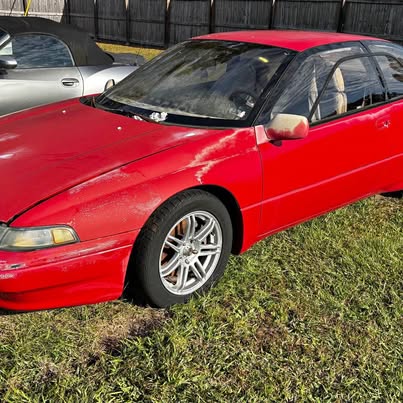
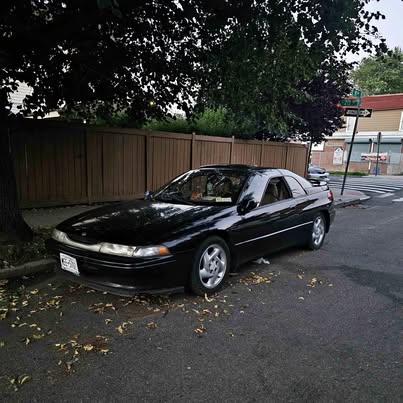
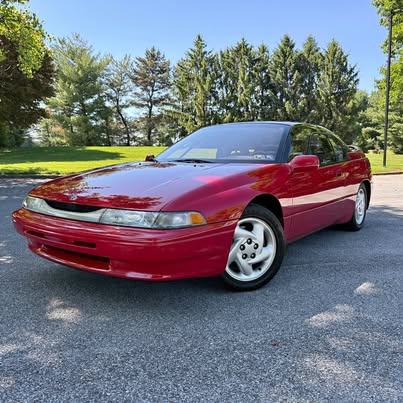
That scarcity frames the buying task. On this site at the time of writing the SVX pool is exactly four cars, all four offered for sale, all four through Facebook Marketplace sellers, dividing evenly between the 1994 and 1996 model years — two of each. All four are automatics, as every SVX ever built for sale is an automatic. Three are listed in red and one in tan. Two are in Pennsylvania, one in North Carolina and one in New York — a north-eastern weighting that should put rust inspection at the top of your agenda. Four cars is a small pool, and this guide does not pretend otherwise: the site's evidence tells you where the current supply sits, while the buying knowledge covers the full 1992 to 1997 American run. The pool shows the typical shape of the modern SVX market: private Marketplace sellers, middle-year cars, and the flagship LSi trim prominent — three of the four listings here carry the LSi name.
The models
The SVX range looks complicated in classified advertisements and is simple once you separate three things sellers blur together: trim level, driven wheels, and model year. Every SVX is a two-door coupé with the same body, the same 3.3-litre EG33 flat-six and the same four-speed automatic gearbox. No SVX leaves the factory with a manual gearbox, a different engine, a turbocharger or a convertible roof. What varies is equipment, whether the car drives all four wheels or only the front two, detail styling, and — most importantly — how the transmission story evolves after the troubled early cars.
At launch in America, for the 1992 model year, the range is the LS and the LSi. The LS is the standard car, which in SVX terms still means a generously equipped coupé: automatic climate control, power windows and mirrors, anti-lock brakes and a driver's airbag are part of the proposition from the start, because Subaru is selling a flagship, not a stripped special. The LSi adds the luxury layer — leather upholstery, a power-adjustable driver's seat, a power sunroof on most cars so equipped, and suede-effect dashboard and door trim — aiming at a buyer cross-shopping a Lexus SC or an Acura Legend coupé. When a listing calls a car an LSi, verify it from the equipment on the car — leather, roof and seat — rather than the headline, because Marketplace titles are seller-written; this site's pool illustrates the point, describing LSi cars, an L and a plain SVX, all from seller-entered titles.
For 1993 the range continues, with a limited anniversary edition offered in America; anniversary cars are equipment packages, not mechanical specials, valued on condition like any other 1993 car. The significant event comes for 1994, when Subaru, stung by the price problem, introduces cheaper front-wheel-drive versions in America. The line-up broadens into L, LE and LSi grades, with entry cars driving the front wheels only. A front-wheel-drive SVX is a real factory car, not a conversion or a broken all-wheel-drive car — but you must establish which driveline a car has before you value it, because all-wheel drive is central to the SVX's identity and pricing, and because a front-drive car eliminates some failure modes (transfer clutch, rear driveline) while its transmission works no less hard. Through 1995 the structure is broadly L and LSi; for 1996 and 1997 the range settles back to L and LSi, all-wheel drive standard again.
The table summarises the American range as you will meet it. Production is given for the model as a whole rather than invented per trim, because reliable per-trim build splits are not published in a form you should rely on when negotiating; anyone who needs a build figure to justify a price is selling you a story, not a car.
| Model | Years | Engine | Output | Built | Character |
|---|---|---|---|---|---|
| SVX LS | 1992–1993 | 3.3 EG33 flat-six | 230 hp | Part of c. 24,000 total SVX production | Launch-year standard car; generously equipped |
| SVX LSi | 1992–1997 | 3.3 EG33 flat-six | 230 hp | Part of c. 24,000 total SVX production | The flagship: leather, power seat, sunroof on most |
| SVX L | 1994–1997 | 3.3 EG33 flat-six | 230 hp | Part of c. 24,000 total SVX production | The value grade; front drive offered mid-decade, AWD thereafter |
| SVX LE | 1994 | 3.3 EG33 flat-six | 230 hp | Part of c. 24,000 total SVX production | Short-lived price-fighter trim; judge on condition |
| SVX L (FWD) | 1994–1995 | 3.3 EG33 flat-six | 230 hp | Part of c. 24,000 total SVX production | Front drive only; simpler driveline, narrower appeal |
Two identity checks settle most arguments. First, the VIN plate and paperwork must agree on model year and identity, and the engine must be the EG33 — the flat-six is unmistakable once the bonnet is open, wide, low and filling the bay; a car presented as an SVX with anything else under the bonnet is a car you walk away from. Second, establish the driven wheels physically: look for the rear differential and driveshafts on an all-wheel-drive car, and do not take a seller's word or an advertisement's AWD in the title — this site's listings carry AWD in the title for the LSi cars, which is encouraging, but titles are not inspections.
Engines and gearboxes
There is one engine, one gearbox and two driveline layouts, and the SVX makes a better buying proposition once you understand all three. The EG33 is a magnificent engine with no parts-bin substitute. The 4EAT automatic is an adequate gearbox asked to do a hard job in a heavy car, with marginal early cooling, and it is the single most likely source of a four-figure bill. The all-wheel-drive system is durable in its major hardware and capable of one very distinctive fault — torque bind — that you can diagnose in a car park in two minutes.
The EG33 flat-six: the engine Subaru built once
The EG33 is a 3,318 cc flat-six, developed from the smaller flat-four architecture that powers the rest of the range but sharing far less with it than sellers assume: EG is the engine family, 33 the 3.3 litres. It runs double overhead camshafts, four valves per cylinder — twenty-four in total — electronic multi-point fuel injection and distributorless ignition, and produces 230 horsepower at 5,400 rpm and 228 lb-ft of torque at 4,400 rpm in American specification, on premium fuel, with a compression ratio of 10.0:1. Those factory figures are the only output figures you should accept: every production SVX, in every trim and year, makes the same power, because there is only the one engine tune. A seller advertising a higher-output special is describing a car that does not exist.
The engine's service items are conventional in kind and specific in detail. The camshafts are belt-driven, and the timing belt has a long but finite life: you want a dated, invoiced replacement in the history, and if there is none you budget for the job on purchase rather than gamble. The EG33 is generally regarded as a non-interference design, so a failed belt is less likely to mean bent valves than on many period engines — but it still strands the car, and the labour to reach the front of a flat-six in a crowded bay is the cost, not the belt itself. Budget roughly $700–1,400 for a timing-belt service done properly, with pulleys, tensioner attention and a water pump considered while access is paid for. Oil leaks come with age: cam and crank seals weep on neglected cars, and oil on the front of the engine contaminates the belt, shortening its life — which is why the checklist has you examine the front of the engine with a torch, not merely the dipstick. The cooling system works hard in a heavy, low-nosed car: radiators silt up, hoses perish, and thermostat and water pump are age items. An EG33 that runs hot is telling you about the cooling system first and the engine second; one run hot repeatedly is a car whose head-gasket health you cannot verify from the kerb, so overheating history is a walk-away trigger unless the price reflects an engine-out future.
Ancillaries follow the nineties Subaru pattern and mostly give warning. The alternator and power-steering pump sit accessibly on top of the engine; pumps weep and whine, and a groan on lock with frothy fluid points at air entering on the suction side — classically a hardened O-ring at the pump inlet — before it points at a failed pump or rack. The air conditioning works well when gassed and fails expensively when the system has sat open or dry; test it on every viewing, in every season, because a compressor replacement runs to several hundred dollars before gas. Coil packs, the mass-airflow sensor and idle-control components all age, and a car that hunts at idle or hesitates wants diagnosis with the factory procedures, not a parts cannon. Engines oiled and cooled properly routinely cover very high mileages; the bottom end is rarely the reason an SVX dies. SVXs die of gearboxes, bearings, rust and neglect. The engine is the reason to save one.
The 4EAT automatic: the known weak point
Now the myth-busting, because SVX transmission folklore contains one flat falsehood and one dangerous half-truth. The falsehood: no manual gearbox was ever offered in a production SVX, in any market, in any year — not as an option, not in Japan, not in a special edition. Manual-converted cars exist, and some conversions are done very well, but a converted car is a modified car, valued and inspected as such. If a seller tells you a car is a factory manual, the seller is wrong or lying, and either possibility tells you to check everything else twice.
The half-truth concerns the cooler, stated precisely: fitting an auxiliary transmission cooler is good practice on an SVX, widely recommended and genuinely helpful — and it does not repair, rescue or excuse a gearbox that is already failing. A cooler fitted to a box with burnt fluid, slipping clutches and debris in its circuit is a decoration. You assess the gearbox on how it behaves and what its fluid looks like today; you treat a cooler already fitted as evidence of an informed previous owner; you never let it substitute for the road test.
The gearbox itself is Subaru's 4EAT, a four-speed electronically controlled automatic with a lock-up torque converter, used across the Subaru range. In lighter Subarus it leads a reasonably durable life. In the SVX it works under loads that expose every weakness: a heavy car, a torquey engine whose best work happens high in the rev range, tall gearing that keeps the converter working on hills and in traffic, and — on early cars especially — cooling that relies on a radiator heat exchanger and a small in-line filter arrangement that can restrict flow as it ages and loads with debris. The result is the signature failure: the automatic runs hot, the fluid degrades, clutch packs wear and slip, the debris circulates and accelerates the process, and the gearbox progresses from an occasional flare to a failure to drive. Early cars, particularly 1992 and into 1993, suffer worst; running changes and retrofitted coolers improve later cars' prospects, but no SVX automatic should be described as strong. It is the car's consumable major component.
Learn the symptoms in order, because the order is the diagnosis. A healthy 4EAT changes cleanly, engages drive and reverse without a long pause or a thump, holds each gear without the revs flaring between changes, locks its converter at cruise without shuddering, and kicks down willingly. Early trouble shows as a flare — revs rising briefly during the 2–3 change is the classic — a delayed engagement on a cold morning, or a shudder as the converter locks. Established trouble shows as slipping under load, harsh changes, hunting on a light throttle, or behaviour that deteriorates as the car warms, which is the heat story telling itself. Terminal trouble is no drive, drive in some gears only, or fluid that is dark brown or black and smells burnt. That fluid check takes one minute: pull the transmission dipstick and look at the colour against a white tissue — healthy fluid is red and translucent. Burnt fluid in a box that still drives fine means the wear has already happened; you are negotiating over a rebuild, whether the seller knows it or not. A professional rebuild or quality remanufactured unit, fitted, with the cooler circuit cleaned and an auxiliary cooler added, typically lands in the $2,500–4,500 range — the single most important number in SVX ownership, and the reason a documented recent rebuild outweighs any other line in a service history.
Duty cycle explains why two identical cars age differently. The 4EAT suffers most in short-trip, stop-and-go, hot-climate and mountainous use, where the converter generates heat the cooling cannot shed; it lasts longest in steady motorway use where the converter locks and stays locked. Weight a high-mileage motorway car with cool, red fluid above a low-mileage city car with dark fluid. Servicing matters the same way: fluid and filter attention, cooler lines and the heat exchanger verified clear, and any in-line filter renewed rather than left to clog. And test the gearbox hot — a five-minute loop tells you nothing about a heat-driven failure — which is why the checklist insists on at least twenty minutes, including a hill and a fast merge.
The all-wheel-drive system — and the front-drive exception
American all-wheel-drive SVXs use Subaru's ACT-4 system in automatic form: an electronically controlled multi-plate transfer clutch in the tail of the gearbox distributes torque between the front and rear axles, running predominantly front-biased in steady cruising and apportioning more drive rearward as conditions and throttle demand dictate. Some other markets receive a centre-differential system, which is why imported literature describes different hardware; for the American cars you will inspect, the transfer-clutch description is the one that matters, and the fault that matters is the one it produces.
Torque bind is that fault, with a mechanism you can explain and a test you cannot argue with. The transfer clutch is applied by hydraulic pressure under electronic control; a solenoid — known universally in Subaru circles as Duty Solenoid C — regulates that pressure. When the solenoid, its wiring or the clutch pack ages, the clutch can stay applied when it should release, most obviously at parking speeds on full lock, when the front and rear axles need to rotate at different speeds and a locked-together driveline cannot let them. The car then hops, binds and scrubs its tyres through tight turns, sometimes with a clunk as the wind-up releases. The test: in a car park, windows down, drive slowly in a full-lock circle in both directions. A healthy car circles smoothly; a binding car protests through the steering wheel. Distinguish bind from its imitators: mismatched tyres force the same wind-up on a healthy system, which is why an SVX must run four matched tyres, and why you check all four corners before condemning the transfer clutch. Subaru even provides a diagnostic aid, a fuse position that forces front-wheel drive for testing; a car that binds in service and runs free with the transfer disabled has told you where the fault lives. Repairs range from a solenoid and fluid service at a few hundred dollars to transfer-clutch renewal at $800–1,500 with labour — but the test costs nothing.
The rest of the driveline is honest Subaru hardware: constant-velocity joints that click on lock when worn, a propshaft whose joints age, and a rear differential quiet for life if its oil has ever been changed and whining expensively if it has not. And remember the exception: the mid-decade front-wheel-drive cars have none of this — no transfer clutch, no rear differential, no torque bind — which simplifies ownership at the cost of the all-weather traction that is half the SVX's point. Neither layout is a defect. Buying the wrong one because you never checked is.
Problem areas
Every SVX problem worth knowing about belongs to one of five systems, and they are not equal. The transmission decides whether the car is a bargain or a liability. The wheel bearings are the model's most repetitive maintenance insult — not catastrophic, but recurrent and widely botched. The brakes suffer from the car's weight. The electrics, centred on the famous windows, are where age shows daily. And rust, quietly, is what actually ends cars, particularly the north-eastern cars that dominate the current supply — two of the four cars listed on this site are in Pennsylvania and one is in New York. Work through the systems in that order of financial consequence.
Transmission: heat, fluid and the slow death
The engines section explains the mechanism — a hard-worked 4EAT, marginal early cooling, heat-degraded fluid, clutch wear feeding debris back into the circuit — so here the emphasis is on recognition, staging and what each stage costs you. Treat the automatic as a component with a state, not a pass-or-fail, and place the car you are inspecting on the scale honestly.
Stage one is the healthy box: red, translucent fluid with no burnt smell, prompt engagement, clean changes hot and cold, no flare, no shudder on converter lock-up. Stage one cars exist — usually late cars, motorway cars, or cars with a documented rebuild and an auxiliary cooler — and they are the cars to pay for. Stage two is the tired box: fluid darkening toward brown, an occasional flare on the 2–3 change when hot, a slight delay engaging reverse cold, perhaps a soft shudder as the converter locks. A stage-two box may run for years or be months from failure, and nobody can promise you which; price it as though the rebuild is in your near future. Stage three is the failing box: burnt black fluid, slipping under load, harsh or hunting changes, behaviour worsening as the car warms, or any loss of a gear. A stage-three car is a project car regardless of how shiny its paint is, priced as the value of shell, engine and interior minus the $2,500–4,500 fitted cost of putting the transmission right.
Three traps recur. The first is the fresh-fluid disguise: a seller changes black fluid the week before sale, and the dipstick shows clean red over a worn box. Ask when the fluid was changed and why, and weight behaviour on the hot road test above colour alone, because new fluid does not restore worn clutches. The second is the cooler-as-cure claim, already corrected in the engines section: a cooler prevents heat damage, it does not reverse it. The third is the radiator: its heat exchanger can fail internally and mix coolant and transmission fluid, destroying the gearbox, with milky, pink-tinged fluid as the evidence. Cross-contamination is a stop-and-think event involving both systems, not a minor leak to note and forget.
Wheel bearings: the job you will do twice if you do it wrong
Rear wheel bearings are the SVX's most notorious recurring fault after the transmission, and the story is about installation as much as about the bearing itself. The symptom is unmistakable once heard: a droning, roaring hum from the rear that rises with road speed, changes character when you weave gently and load one side then the other, and is indifferent to throttle and gear — which is how you separate it from differential whine, which changes on the overrun, and from tyre roar, which changes with the road surface. Bearings fail at mileages that would be unremarkable on a lesser Subaru, because the car is heavy, the bearing works hard, and — the crucial point — the replacement procedure is widely done wrong.
The mechanism of the repeat failure is this: the sealed bearing units are shipped protected by a packing grease that is a preservative, not a service lubricant, and a bearing pressed in without being properly packed with correct wheel-bearing grease starts life under-lubricated and fails early; add pressing damage, incorrect hub-nut torque or a worn hub reused without inspection, and you have the SVX folk tale of bearings lasting ten thousand miles. Done properly — correct grease, correct press technique, new seals, hub inspected, torque to specification — a replacement gives a normal service life. Your buying response is therefore two questions: does a bearing drone now, and if bearings appear in the history, who fitted them and how? Budget a current drone at roughly $350–700 per side at a shop that knows the procedure, and scrutinise a car with three bearing invoices in five years. On the test drive, run at forty to sixty on a smooth road and weave gently: a drone that swells as one side loads names the failing side. Front bearings give less trouble, and the same test applies; a bearing can drone long before it shows play at the wheel, so the road test remains the primary instrument.
Brakes, wheels and the weight problem
The SVX stops with disc brakes all round and anti-lock control, adequate for the car driven as a tourer. The recurring complaint is front brake judder — pulsing through the pedal and shaking through the wheel under braking from speed — which owners universally call warped rotors. The mechanism matters because it changes the fix: true warping of a cast-iron rotor is rare; what you feel is usually uneven disc thickness from uneven pad-material deposition, or corrosion and run-out at the hub face, aggravated by a heavy car, unevenly torqued wheels or a hub face refitted dirty. The cure is quality rotors and pads fitted to a cleaned hub with run-out checked, at roughly $300–600 for a front-axle set fitted — but a car that judders a year after new rotors were fitted has a hub, caliper or fitting problem, not a rotor problem, and repeating the job repeats the result. A sticking caliper shows as one wheel hotter than the others after a drive, pulling under braking, or uneven pad wear; budget $200–450 per caliper fitted, and treat a dragging brake as urgent, because its heat cooks the bearing and the transmission's working environment alike — everything on this car is connected to heat.
Tyres and wheels carry more diagnostic weight on an SVX than on most cars. The factory alloys are part of the car's look and increasingly hard to replace individually; check all four for damage, cracks and mismatches, and check the spare. Tyre sizes must match on all four corners of an all-wheel-drive car — read every sidewall — and uneven wear points at alignment, worn bushes or a bent component, while feathered rears can be another fingerprint of driveline bind. The SVX should ride quietly over broken surfaces with thumps, not crashes; any knock over low-speed bumps deserves a look at drop links, bushes and top mounts before you blame the dampers, whose renewal as a set is a four-figure conversation.
Electrics and the window switches: small parts, daily irritations
The SVX's electrical system is early-nineties Japanese in architecture — sound looms, reliable major components — wrapped around a flagship's worth of powered equipment now three decades old. The failures therefore concentrate where use and age concentrate: switches, motors, and the driver's door, through which every control passes and whose loom flexes every time the door opens.
Start with the windows, because the car is famous for them. Each door's opening glass is driven by a regulator and motor, and the driver's master switch panel, which commands both windows and carries the most use, is the classic failure. Symptoms progress from an intermittent window that works when the switch is wiggled, to a window that works from one switch but not the other — which tells you the motor and regulator live and the switch is at fault — to a dead window, which requires you to separate switch, motor, regulator and wiring before spending. Replacement master switches are a known cost, in the region of $100–300 for the part when you can find one, with used and refurbished units circulating; a slow, laboured window points at the regulator and motor straining, often with the glass misaligned, and regulator work inside the big SVX door is a half-day of careful labour, $300–600 fitted. Test every window, from every switch, more than once — and test the sunroof on LSi cars through its full travel and tilt, checking the headlining around it for the water stains that betray blocked drains or a tired seal. A sunroof you are advised not to open is a repair you are being handed.
Beyond the glass: the climate control should blow hot and cold on demand without clicking from behind the dashboard; the aerial, central locking, seat motors on the LSi, mirrors, wipers and every lamp belong on your checklist because each is a small negotiation and together they are a large one. Warning lamps matter diagnostically — the check-engine and transmission warnings must illuminate with the ignition and extinguish after starting; a lamp that never lights has sometimes been helped not to. Period Subaru engine management stores fault codes a specialist can read, and a persistent check-engine light needs the code read before purchase, not a promise that "they all do that." A car that has sat — many SVXs sit — wants its battery load-tested, not jump-started and complimented. None of these faults is exotic; their significance is cumulative, and a long list of electrical niggles is what separates a cherished car from a stored one.
Rust: the map of a north-eastern car
The SVX's body is well protected by the standards of its era, galvanised in key areas and built by a company that sold cars in snow belts, and a southern or garaged car can be remarkably clean at thirty years old. But the current supply is weighted to the salt states — Pennsylvania twice and New York once in this site's four-car pool, the fourth car in North Carolina — and on a salted-road car the corrosion map is consistent enough to walk around with a torch and a magnet.
Begin at the rear wheel arches, the model's signature rust site: the lip and the panel behind the rear wheel trap mud and salt against the seam, and bubbling at the arch edge is the visible tip of corrosion working outward from inside. Press gently along the arch and look inside the lip with a torch; blisters here mean metal work, and proper arch repair — cutting out, fabricating, painting to match a thirty-year-old colour — runs $800–2,000 per side done to a standard that lasts, against a filler-and-blow-over that lasts a winter. Continue to the sills and jacking points, the underside of the doors, the boot floor and spare-wheel well where water past tired seals pools unseen, both subframes and their mounting areas, and the brake and fuel lines running the length of the floor — a corroded brake line fails an inspection and your own standards simultaneously. Surface rust on subframes and arms is normal and treatable; perforation at mounting points is structural, expensive and, on a car of this value, frequently terminal. Get the car on a lift if the purchase is serious: thirty minutes of lift time tells you more about an SVX's future than any other money you will spend.
Distinguish the three grades of car honestly. A clean southern or garaged car with factory underseal intact and no arch bubbling is the car to stretch for. A northern car with arch bubbles, scabby subframes and sound mounting points is a usable car priced for rolling metalwork. A car with perforated sills, holed subframes or a patched boot floor is a parts car or a welding project, whatever its trim or mileage, because SVX values — covered qualitatively in the values section — do not repay structural restoration the way a contemporary Porsche's would. Check, too, for accident repair masquerading as rust work: overspray on window rubbers, filler at the arches detected by a magnet that will not hold, inconsistent gaps around the huge doors, and fresh black underseal over everything are all evidence — and on a car this rare, evidence is what you are buying.
How to inspect one
Work this checklist in order: the checks that can end the viewing come early, the road test comes when the car is fully warm, and every step cross-references the problem area it settles. Take a torch, a white tissue for the dipsticks and a magnet for the arches, and allow a full hour. A seller who will not allow an hour, a lift visit or a proper road test has given you your answer before you begin.
- Paperwork and identity first. Match the VIN on the plate to the title and the seller's documents, confirm the model year, and establish the trim and driven wheels from the car itself — leather, roof and seat for an LSi claim; a rear differential and driveshafts for an AWD claim, remembering the front-drive L cars of 1994 and 1995. A car whose identity does not settle in five minutes does not get cheaper as the viewing goes on.
- Cold start, bonnet up. Insist the engine is cold when you arrive. Watch for blue smoke on start-up, listen for rattles that fade or persist, and confirm the warning lamps light with the ignition and go out after starting — a transmission or check-engine lamp that never appears is the electrics section's warning in action.
- Fluids before you drive anywhere. Engine oil for level and colour, and for emulsion under the filler cap; coolant for level and any oily film; and above all the transmission dipstick against your white tissue — red and sweet-smelling is stage one, dark and burnt is stage three, and milky contamination means the radiator heat exchanger has failed and the gearbox is involved.
- The front of the engine with a torch. Look for oil weeping from cam and crank seals onto the timing-belt area, perished hoses, a tired radiator and any sign of past overheating — stained coolant trails, a new radiator on an otherwise original car, a seller who mentions topping up. Ask directly for the timing-belt invoice; no invoice means you budget the job.
- Rust walk, in the order of the map. Rear arches inside and out with the magnet, sills and jacking points, door bottoms, boot floor and spare-wheel well, then underneath as far as you can see. Grade the car clean, rolling metalwork or structural on the spot, and let that grade frame every number discussed later.
- Windows, roof and every switch. Both windows from both switches, repeatedly; the sunroof through full travel on an LSi; mirrors, locks, seat motors, aerial, lights and wipers. This is the electrics section in five minutes, and a dead driver's master switch or a forbidden sunroof goes on the negotiation list at real money.
- Tyres and wheels, all four corners plus the spare. Read every sidewall: sizes must match on an all-wheel-drive car, because mismatched tyres manufacture the torque bind you are about to test for. Note brands, tread depths and uneven wear, and inspect the factory alloys for cracks and heavy kerbing.
- Stationary driveline checks. Engage drive and reverse several times from rest. Prompt, gentle engagement is healthy; a long pause or a thump is the transmission telling you its stage before you have moved. Note it, and proceed to warm the car up properly.
- The long road test — at least twenty minutes. Include a hill, a fast merge and sustained cruising. Judge the gearbox hot, not cold: flares on the 2–3 change, shudder as the converter locks, hunting on a light throttle and any slip under load are the transmission section's symptoms, and a five-minute loop hides all of them. Judge the engine at the same time — clean pull, even idle at every stop, temperature gauge steady.
- The bearing and brake test. On a smooth road at forty to sixty, weave gently and listen for the rear bearing drone swelling as each side loads; then brake firmly from speed twice and feel for judder through pedal and wheel — the brakes section's disc-thickness story — and for pulling that betrays a sticking caliper. Each symptom has a different price, so name the one you have.
- The car-park circle test. Windows down, full lock, slow circles in both directions. Smooth is healthy; hopping, binding and scrubbing is torque bind, and with matched tyres confirmed at step 7 the suspicion falls on the transfer clutch and its solenoid, exactly as the driveline section explains. Also listen for clicking from the constant-velocity joints on lock.
- Hot restart and the lift decision. Switch off, wait five minutes and restart hot — reluctant hot starting and a hunting idle are diagnostic gold. Smell the transmission fluid once more now it is fully hot. Then decide: a car that has passed steps 1 to 11 deserves a lift inspection for subframes, lines and leaks before money moves; a car that has failed the transmission, identity or structural-rust steps does not become good because the seller drops the price a little.
Values
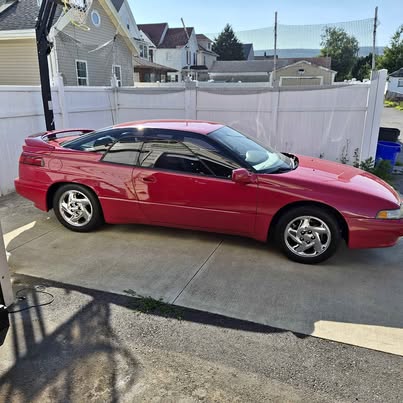
The SVX market is small, thin and driven by condition to a degree that surprises buyers arriving from commoner classics: there may only ever be a handful of cars on offer at once. On this site the pool at the time of writing is four cars, all for sale, none yet recorded as sold — two from 1994, two from 1996, three described in red and one in tan, spread across Pennsylvania, North Carolina and New York. A pool that size cannot tell you what an SVX is worth in any statistical sense, and this section deliberately offers no figures: the market block appended to this guide at build time carries the site's current listing and recorded-sales numbers, refreshed as the pool changes. What follows is how to interpret those numbers, and how SVX value is actually constructed, which changes far more slowly than any week's listings.
Condition spread is the whole story. The distance between the cheapest SVX and the best one is not a modest percentage, as with a mass-market car; it is a multiple, earned almost entirely by three things you have already inspected: the state of the automatic gearbox, the state of the bearings and brakes, and the state of the rear arches and underside. A car with a documented transmission rebuild, a proper auxiliary cooler, quiet bearings and a clean underside sits at the top of the market because the next owner buys years of use rather than a schedule of repairs. A car with burnt fluid, a bearing drone and bubbling arches sits at the bottom even if its mileage is low and its paint photographs well, because the work it needs is worth a large fraction of the finished car's value. Mileage moves SVX values less than sellers expect: the flat-six tolerates miles well, and a high-mileage car with invoices beats a low-mileage car with none, every time.
Trim and driveline premiums are real but modest. The LSi, with its leather, powered seat and sunroof, is the car most buyers picture and the one they pay a premium for, and all-wheel drive commands more than the short-lived front-wheel-drive cars, which appeal mainly to buyers who value their simpler driveline. Colour plays its part — the bright launch colours present the Giugiaro shape at its best, and the red that dominates this site's small pool is the colour the car was born to wear — but no colour or trim combination justifies paying flagship money for a car whose gearbox is failing. Rarity claims deserve the scepticism set out in the models section: the SVX is rare as a model, full stop, and subdividing that rarity by colour, year or trim is a negotiating performance rather than a valuation method.
The asking-versus-achieved gap on SVXs is characteristically wide at both ends of the condition range. Sellers of tired cars anchor on what the best cars are advertised for; sellers of good cars sometimes anchor on rarity alone; in both cases the achieved price settles where the inspection evidence says it should. Private and Marketplace sales dominate the supply — all four cars in the current pool are Marketplace offerings — so presentation varies wildly, service history is often a shoebox rather than a file, and patience is a genuine financial asset: in a market this thin, the buyer who has done the reading and can move quickly on a good car does better than the buyer who negotiates hard on a bad one. The project-versus-driver gap is correspondingly stark. A project SVX is cheap to buy and, given the transmission and metalwork costs set out earlier, not especially cheap to finish; a driver with the big jobs done costs more on the day and less in every year that follows. Buy the driver unless you specifically want the project.
Parts and ownership
Owning an SVX divides into two halves, and knowing which half a job falls into before you buy is most of ownership wisdom. The first half is ordinary Subaru: consumables, brake components, bushes, bearings, filters, belts, hoses, and ignition and injection components shared in spirit — and often in fact — with the wider Subaru world of the period, available through normal motor-factor and specialist channels at prices that will not frighten you, and fittable by any competent mechanic willing to read the manual. Oil, coolant, brake fluid and transmission fluid attention on a sensible schedule are the cheapest reliability the car will ever be offered, the transmission in particular repaying fluid discipline. Budget for a thirty-year-old flagship, not a hatchback — a thorough annual service with fluids and inspection at a specialist typically runs $400–800 depending on what the inspection finds — and keep a contingency fund for the age items that arrive uninvited: an alternator, a power-steering pump, an air-conditioning compressor, a radiator.
The second half is SVX-only, where low production numbers collect their toll. The EG33's unique components — engine internals, the intake system, flat-six-specific management parts — have no cheaper flat-four substitute and come from remaining factory stock, specialist breakers or the used market, with lead times to match. Body and glass are the sharp end: the window-within-a-window glass, canopy panels, lamps, trim and suede-effect interior pieces are unique to a car built in small numbers three decades ago, effectively irreplaceable new, and priced accordingly when good used examples surface. This is why the checklist weighs glass and cosmetic condition so heavily for a car whose mechanical faults are mostly fixable: you can rebuild a gearbox, but you cannot commission a new side glass. A complete, unmolested interior is a genuine asset worth paying for.
The ownership community is the compensating asset, and on this model it is unusually strong: a devoted following with active forums, technical archives covering everything from the bearing-packing procedure to the transfer-solenoid diagnosis, and specialists and breakers who know the car by name. Join before you buy, not after: the members will know the cars that come up for sale — in a pool this small, a car may be known by its previous owners — and community classifieds are a supply channel alongside the public listings. Manual-conversion knowledge, cooler installations and bearing write-ups all live there, documented by people who have done the jobs.
Which one to buy
Every SVX variant shares the same engine, gearbox and body, so your choice is made on trim, driveline, year and — above all — the individual car's evidence. The picks, by buyer:
- The all-rounder: a 1996 or 1997 LSi with all-wheel drive, a documented transmission history and quiet rear bearings. The late flagship gives you the full Giugiaro-and-leather experience, the most developed version of the automatic installation and the strongest resale audience, and it is the car the three LSi listings in this site's current pool point you towards.
- The value buy: a sound mid-run L with all-wheel drive and a thick history file. You give up the leather, the powered seat and usually the sunroof, and you keep everything that makes an SVX an SVX — the flat-six, the glasshouse, the driveline — at a noticeably gentler entry point, provided the gearbox fluid is red and the arches are clean.
- The simplicity seeker: a 1994 or 1995 front-wheel-drive L, bought knowingly. No transfer clutch to bind, no rear differential to whine, the same engine and the same looks — a rational choice for a fair-weather tourer, bought at a front-drive price and never at an all-wheel-drive one.
- The project buy: an early LS or LSi with a failing gearbox and a rust-free shell, bought at project money. The early cars carry the automatic's worst reputation and therefore the keenest prices; if the body and glass are genuinely clean and you budget the rebuild and a cooler from day one, you end with a sorted launch-year car for driver money.
- The conversion curious: a documented manual-converted car, inspected as a modified car. Judge the conversion on its parts, its driveline matching and its finish, drive it extensively, and pay for the car that exists — never for a claim that the factory built it that way, because the factory never did.
The overriding rule: buy the individual car, not the variant — a well-documented SVX with red transmission fluid, quiet bearings and clean rear arches beats a rarer trim or a lower mileage with burnt fluid and bubbling arches, every single time.
That rule is the whole guide in one sentence. The SVX is one of the great under-recognised cars of its decade: a Giugiaro flagship with a bespoke flat-six, a glasshouse nothing else has, and a market that still prices it by its failures rather than its qualities. Buy the car whose failures have already been paid for by somebody else, and you own the most interesting Subaru ever made at the friendliest end of its life.
See the 3 SVX cars currently listed.
What they sell for: SVX sale prices.