
Triumph TR7 buyer's guide
Triumph TR7 -- the model's own buyer's guide: variants, values and what to check.
Years listed: 1975-1980 · Series: TR7/8
Overview and history
The TR7 is the Triumph that broke with everything the TR badge had stood for, and it did so on purpose. When British Leyland unveiled it in January 1975 — in the United States first, because America was the market that mattered — there was no soft top, no separate chassis, no wood dashboard and no engine you could trace back to a tractor. In their place was a unitary steel coupé styled by Harris Mann as a pure wedge, nose low enough to need pop-up headlamps, with a single-overhead-cam engine canted over at 45 degrees, MacPherson struts at the front and a live axle at the back. The project code name was Bullet, and the shape was the point: Leyland wanted a sports car that looked like the future, because the TR6 it replaced looked, by 1975, like the past.
The engineering underneath the wedge was more conventional than the styling, and deliberately so. The 2.0-litre slant-four was an existing British Leyland design, related to the engine Triumph already built for the Dolomite saloon and had earlier supplied in smaller form to Saab. The suspension was chosen for cost, strength and predictable handling rather than sophistication. The cabin was modern, roomy by TR standards and trimmed in the plaid-and-plastic idiom of the late 1970s.
What it could not escape was where and when it was built. The first cars came from Leyland's Speke plant, No. 2 factory on the outskirts of Liverpool, and Speke's industrial relations were as troubled as any in the British motor industry. Strikes interrupted supply, quality varied car to car, and the TR7's early reputation — in Britain especially, where the car did not even go on sale until May 1976, more than a year after the US launch — was formed by those early cars rather than by the design itself. When Speke closed in 1978, production moved to Canley in Coventry, and quality measurably improved. In October 1980 it moved again, to Solihull, alongside the Rover SD1 whose five-speed gearbox the TR7 already shared, and the Solihull cars are generally regarded as the best-built of the run. Production ended in October 1981, killed not by any failure of demand in America — the US took the great majority of the roughly 112,000 TR7s built — but by Leyland's decision to concentrate car production and by a strong pound that had wrecked the export economics.
Two developments define the model's life. The first is the drophead coupé, the convertible that everyone had expected from the start and that finally arrived for the US in 1979 and for Britain in 1980; it transformed the car's appeal and accounts for a large share of the late production. The second is what the wedge became in other hands: the sixteen-valve TR7 Sprint, built in tiny numbers in 1977, the works rally cars that campaigned first with the Sprint engine and then with the Rover V8, and the V8 car itself, sold as the TR8 and covered by its own guide. This guide is about the four-cylinder TR7 in depth — but you cannot judge a TR7 without knowing the Sprint and the V8 exist, because they shape both the traps and the opportunities in the market.
The TR7's reputation has travelled a long way since 1981. For two decades it was the cheap wedge, bought for pennies and run on a shoestring, and many cars were simply used up. What survives now splits sharply: neglected cars with structural rust and deferred everything, and cherished cars — often late, often convertibles — that have been maintained by owners who understand them. The difference between a good one and a money pit is, as with so many unitary British cars of the 1970s, rust first, cooling-system neglect second, and everything else a distant third.
The models
Every four-cylinder TR7 carries the same basic ingredients: the 1,998 cc slant-four, a unitary coupé or convertible shell, and a choice of four-speed manual, five-speed manual or three-speed automatic gearbox. What changes across the run is the body style, the state of tune the market demanded, the factory that built it, and — from 1977 — the option of the gearbox that should have been standard from the start. Badging is simple: a TR7 is a TR7, with no trim-level alphabet to decode, which means the individual car's year, plant and specification have to be read off the car itself rather than off the boot lid.
| Model | Years | Engine | Output | Built | Character |
|---|---|---|---|---|---|
| TR7 Coupé, 4-speed | 1975–1981 | 2.0 slant-four, twin carbs | 105 bhp (UK); about 86 hp (US) | The bulk of about 112,368 TR7s in total; body and gearbox splits not separately recorded | The original wedge; early cars simplest, build quality varies by plant |
| TR7 Coupé, 5-speed | 1977–1981 | 2.0 slant-four, twin carbs | 105 bhp (UK); about 86 hp (US) | Not separately recorded | The driver's pick — the LT77 five-speed transforms cruising |
| TR7 Coupé, automatic | 1975–1981 | 2.0 slant-four, twin carbs | As manual | Not separately recorded; always a small minority | Borg-Warner 65 three-speed; relaxed, rare, and slow-selling when new |
| TR7 Drophead Coupé | 1979–1981 | 2.0 slant-four, twin carbs | 105 bhp (UK); about 86 hp (US) | Not separately recorded; a large share of late production | The convertible the range always needed; the most sought-after standard TR7 |
| TR7 Sprint | 1977 | 2.0 slant-four, 16-valve head | 127 bhp | About 60 | The Dolomite Sprint engine in the wedge; a homologation ghost, almost never for sale |
| TR7, California fuel injection | 1980–1981 | 2.0 slant-four, Bosch L-Jetronic | Similar to US carburettor cars | Small numbers, California market | The emissions endgame; smoother, and a specialist niche of its own |
(Outputs are period figures: the UK car's 105 bhp is a DIN rating, the US figure is SAE net, strangled by the federal emissions installation described in the engines section. The total of about 112,368 covers all four-cylinder TR7s; Triumph's own records do not break that down by body style or gearbox, and any source that gives you a precise coupé-versus-convertible split is guessing.)
The coupé. The fixed-head car was the only TR7 there was until 1979, and it is still the most numerous. It is a better car than its period reviews suggest: the shell is stiff, the cabin is genuinely roomy, there is a usable boot, and the wedge shape that critics mocked is now precisely what people buy the car for. Early cars (1975–76) have the four-speed gearbox, plainer trim and the rawest Speke build quality. The five-speed arrived as an option during 1977 and progressively became the norm; a late coupé with the five-speed is a relaxed motorway car in a way the four-speed never is. A factory sunroof was offered on later coupés and is a leak check of its own, covered in the problem areas.
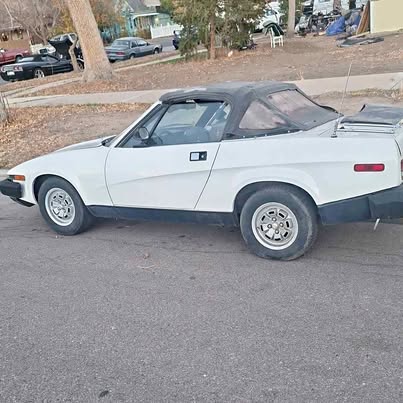
The drophead coupé. The convertible was part of the original programme — the shell was designed to lose its roof — but Leyland's finances and Speke's troubles delayed it until 1979 in the US and 1980 in the UK. The conversion is a proper factory job: the roof comes off, bracing goes in, and the hood is a neat, well-sealed design by period standards. Dropheads were built at Canley and then Solihull, so they start from the better end of the build-quality range, and they have been cherished at a higher rate than coupés. They are the TR7 most buyers picture today.
The Sprint. In 1977 Triumph built a small batch of coupés fitted with the sixteen-valve Dolomite Sprint version of the slant-four — 127 bhp, twin SU carburettors and a very different character at the top of the rev range. The usual figure quoted is about sixty cars. They were never catalogued for public sale; the batch existed to support the rally programme, which used the sixteen-valve engine in works TR7s from 1976, and the cars were eventually sold off through dealers and to staff. A genuine Sprint is identified by its engine and its commission number, not by badges, and almost none survive unmodified or come to open market. Treat any claimed Sprint as a research project, and any "Sprint replica" as what it is: a TR7 with an engine swap, worth TR7 money.
Where it was built matters. A TR7's commission plate tells you more than its year. Speke cars (1975 to autumn 1978) span the full quality range from fine to Friday-afternoon; Canley cars (autumn 1978 to October 1980) are consistently better assembled; Solihull cars (October 1980 to October 1981) are the most consistent of all and also the youngest, which compounds the advantage. None of this makes a Speke car a bad buy — condition today outweighs plant of origin every time — but between two otherwise equal cars, the later car from the later plant is the rational pick, and the market knows it.
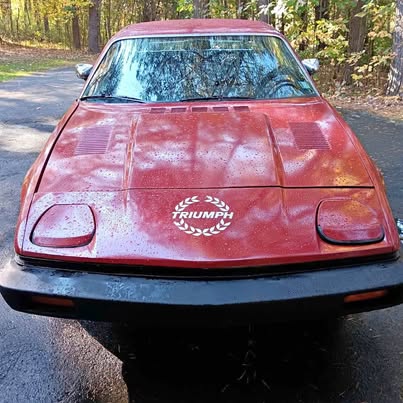
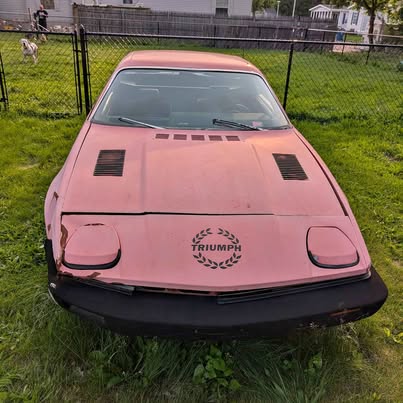
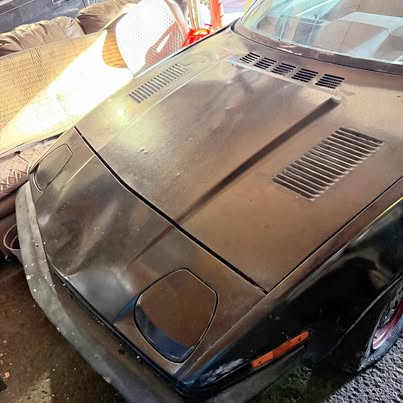
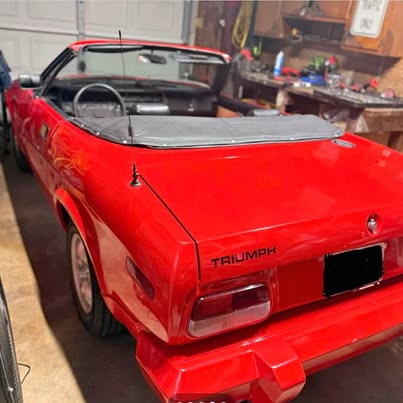
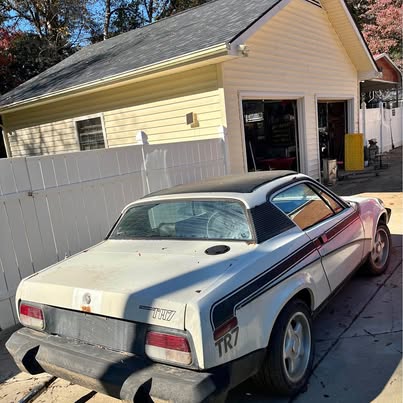
The cars in our listings. The TR7s we currently track are all early coupés from the Facebook marketplace end of the market — six cars, spanning 1975 to 1979, five of them manual and one automatic, in red (three), white, black and orange. That is a fair picture of where the volume in this market sits: the fixed-head cars that survive in ordinary private hands, offered by private sellers. The cherished dropheads and the best Solihull cars change hands through clubs, specialists and auctions as much as through open listings, which is worth remembering when you read the market section below.
Engines and gearboxes
The slant-four: one engine, two characters
Every standard TR7 runs the same engine: a 1,998 cc four-cylinder with a cast-iron block, an aluminium cylinder head, a single overhead camshaft and two valves per cylinder, the whole unit inclined at 45 degrees — the layout that gives the family its "slant-four" name. Triumph had developed the design in the late 1960s; versions of it powered the Dolomite saloon and, in its earliest 1.7- and 1.85-litre forms, the Saab 99, built under licence in Sweden before Triumph took production in-house. In the TR7 it breathes through twin carburettors, runs a compression ratio of 9.25:1 in home-market tune, and produces 105 bhp at 5,500 rpm with 119 lb ft of torque at 3,500 rpm. In a car weighing barely over a ton that makes a UK-specification TR7 a brisk rather than fast car — 0–60 mph in about nine seconds and a top speed around 110 mph — but the delivery is the pleasure: the engine pulls from low revs with a flexibility that suits the wedge's grand-touring brief better than outright pace would.
It is a tough engine when it has been looked after, and an unforgiving one when it has not. The design's defining weakness is the partnership between the iron block and the alloy head: neglect the coolant — run it weak, let it age, top up with plain water — and the head corrodes internally, the waterways fur up, and the head gasket eventually gives way, usually announced by overheating, pressurised hoses and mayonnaise under the filler cap rather than by any dramatic failure. The water pump is the second design quirk every buyer must understand. It lives inside the front of the block, driven from the jackshaft, under a cover — a neat, compact arrangement that becomes a serious job when the pump seizes or its seals fail after decades of corrosion, because a pump that has grown into the block has to be drawn out with a slide hammer or the correct puller, and ham-fisted removal damages the drive. A pump replacement done properly is a $600–1,200 job at a specialist; done badly it is the start of an engine-out conversation. The third quirk is the head itself: the studs that clamp it run at the slant angle, corrode into the alloy, and can make a head that needs to come off for a simple gasket change refuse to move at all. None of this is a reason to avoid the car. It is a reason to buy the one whose coolant history you can see — clean, correctly mixed antifreeze in the header tank, a radiator that flows, hoses that are supple rather than crunchy, and invoices that show the cooling system was treated as a system.
In normal health the slant-four should start readily, idle evenly, pull cleanly to the red line and run at a steady temperature with the electric fan cutting in and out in traffic. Oil pressure is not displayed — there is a warning light only — so judge the engine by its sounds and its leaks: a rattle from the front on start-up that persists points to timing-chain and tensioner wear (the chain is a service item, not a life-of-car component), and oil leaks from the cam cover and the rear of the engine are endemic rather than alarming. Blue smoke on start-up after standing is valve-stem seals; smoke under load is rings, and on an engine this cheap to rebuild relative to most classics, the honest answer to a worn TR7 engine is usually a rebuild — budget $2,500–4,500 for a proper job — rather than despair.
Home-market tune, federal tune, and the FASD
The same engine left the factory in two very different states of tune, and knowing which one you are looking at explains most of what you will find under the bonnet of a US car. Home-market and most export cars use twin SU HS6 carburettors, the 9.25:1 compression ratio, and a straightforward exhaust. US federal cars got a lower 8.0:1 compression ratio, twin Zenith-Stromberg 175 CD carburettors, exhaust-gas recirculation, an air-injection pump blowing into the exhaust ports, evaporative-loss plumbing, and — as the rules tightened through the run — a catalytic converter. The result was about 86 hp SAE net, a 0–60 time that stretched towards eleven seconds, and an engine bay crowded with equipment that has now had more than forty years to perish, be disconnected, or be removed entirely by a previous owner with more enthusiasm than understanding.
The single most troublesome federal fitting is the FASD — the Fully Automatic Starting Device, Zenith-Stromberg's wax-and-vacuum automatic enrichment unit fitted in place of a conventional choke on US cars. When it works, a federal TR7 starts and fast-idles exactly as it should. When its wax element ages and its seals harden — which is to say, on most surviving cars at some point — it enriches when it should not, giving flooding, a rich stumbling idle, terrible fuel consumption and hot-start problems that owners routinely blame on the carburettors themselves. The test sequence on a rough-running federal car is: FASD first, then the Strombergs' diaphragms (a split diaphragm gives a flat, gutless response that mimics ignition trouble), then the state of the emissions plumbing — a disconnected air pump is cosmetic, but a bodged EGR valve and perished vacuum hoses are air leaks, and air leaks are running faults. Specialists who know these cars can rebuild or correctly set up the FASD and carburettors for $400–900; the cottage industry in blanking things off produces cars that run worse, not better, and in states with emissions testing for classics it produces cars that cannot be registered. For the last California cars of 1980–81, Triumph replaced the whole arrangement with Bosch L-Jetronic fuel injection, which is smoother, cleaner and — in the small numbers built — a variation worth a specialist's pre-purchase look rather than a generalist's guess.
None of this makes the federal car a bad buy; in the US it is simply the car there is, and a sorted federal TR7 is a pleasant, torquey cruiser. But it does mean two things for a buyer. First, the performance gap between a US car and a UK-specification car is real, and "European specification" claims for US-delivered cars should be read as "someone has changed things" until proven otherwise. Second, the state of the under-bonnet plumbing is a direct read on the previous owner's quality: neat, complete, connected emissions equipment on a federal car is one of the best character references a TR7 can carry.
The Sprint's sixteen valves
The Dolomite Sprint engine that powered the 1977 Sprint batch is the same block wearing a completely different head: sixteen valves operated by a single overhead camshaft through a clever arrangement of rockers, breathing through twin SU HS6 carburettors in home tune, and producing 127 bhp at 5,700 rpm with a willingness to rev that the eight-valve engine never attempts. It powered the works rally TR7s before the V8 took over, and it remains the connoisseur's version of the slant-four. It is also, for the purposes of this guide, mostly a cautionary tale: genuine Sprints number in the dozens, the engine turns up far more often as a swap into ordinary TR7s and Dolomites than in original Sprints, and a sixteen-valve engine in a car that did not leave the factory with one adds character but not Sprint value. The sixteen-valve head has its own appetite for cooling-system care — everything said above about alloy heads and neglected coolant applies with interest — and its own parts prices. If you are offered a Sprint, verify the commission number against the known batch before you discuss money, and take the car to a marque specialist, because the premium rides entirely on identity.
Gearboxes
Three gearboxes were offered, and the choice between them changes the car more than any other single specification decision.
The four-speed fitted to all early cars and the base specification throughout is a light, all-synchromesh single-rail unit from Leyland's smaller-car parts bin. It changes sweetly when new and was never really strong enough for the job: synchromesh — second gear first — wears, bearings grow noisy, and the change goes vague as the linkage bushes perish. It is geared through a 3.63:1 final drive and runs out of breath on the motorway, where a four-speed TR7 is a busy, noisy place at 70 mph. A rebuild is $1,200–2,200 at a specialist, and plenty of owners instead take the opportunity to convert to the five-speed — a well-trodden path, but one that should be declared and priced as a modification, not passed off as factory specification.
The five-speed is the LT77, the gearbox Leyland developed for the Rover SD1 and fitted to the TR7 from 1977, first as an option and progressively as the standard manual. It is a much stronger box, with an overdrive fifth that transforms the car: five-speed cars run a shorter 3.90:1 final drive for acceleration and still cruise more quietly than the four-speed. Its known habits are specific. The layshaft bearings can rumble at idle in neutral, a noise that often changes little in ten thousand miles and is not, by itself, a death sentence; second-gear synchromesh wears on hard-used boxes; and the box has its own internal oil pump, which is why the correct lubricant matters and why flat-towing a five-speed car any distance in neutral is unwise. Oil choice is a standing debate — the factory recommendation changed over the years, and many specialists now fill LT77s with automatic transmission fluid for a sweeter cold change. A box that crunches second hot and cold, jumps out of gear on the overrun, or whines in every gear but fourth is a rebuild, $1,500–2,800, and should be priced into the offer.
The automatic is Borg-Warner's Type 65 three-speed, offered throughout the run and taken up by a small minority of buyers, mostly in the US. It suits the car's torquey, relaxed side better than purists admit, and it is a durable unit whose failures are usually neglect failures — old fluid, a slipping second band, a tired vacuum modulator. Judge it as you would any period automatic: fluid that is red and smells sweet rather than brown and burnt, changes that are prompt without being violent, and no long delay engaging drive or reverse from cold. A rebuild is $1,800–3,000. Automatic TR7s were slow sellers new and are the cheapest route into the model now; the one automatic in our current listings is typical of how they surface — as the overlooked car in the advert list.
Problem areas
The TR7's problems divide into the ones that cost hundreds and the ones that cost the car. Everything mechanical on a TR7 is fixable at prices that are modest by classic-car standards, because the parts network is deep and the car is simple. The structure is the exception: the TR7 is a unitary shell built from 1970s British steel with 1970s British rustproofing, which is to say very little, and a structurally rotten TR7 costs more to put right than the finished car is worth. Read this section in that order — rust first and longest, then the cooling system that kills engines, then everything else.
Rust: the map
Rust on a TR7 follows the water and the mud, and it starts where you cannot see it. Work through the shell in this order:
Sills. The most important check on the car, as on almost every unitary Triumph. The sills are structural, they carry the jacking points, and they trap everything the front wheels throw up. Rot starts inside and works out, so paint bubbles along the sill are a late symptom, not an early one. Press hard along the full length, look at the sill from underneath where it meets the floor, and check the rear end of the sill where it flows into the rear wheelarch — a favourite failure point, and a structural one, because the rear suspension's trailing arms anchor in this neighbourhood. A sill replaced properly, cut out and welded rather than plated over, runs $800–1,800 per side with paint; a sill that has been plated over fresh underseal is a car priced as though the job still needs doing, because it does.
Floor pans and footwells. The windscreen seal and the heater intake let water into the front footwells, and the carpets and sound-deadening hold it against the floor. Lift the carpets on both sides — a seller who will not let you do this has answered the question. Surface rust is a wire brush and a treatment; perforation is panel work, $600–1,400 a side fitted, and floors rarely rot alone: treat floor rust as a marker for the whole shell's condition and go looking for the rest of it.
Front suspension turrets and inner wings. The MacPherson strut tops mount to turrets in the inner wings, and those turrets live in the spray zone behind the front wheels. Rust here is structural in the truest sense — it is the metal your front suspension hangs from. Look down at the turret tops in the engine bay for bubbling around the strut mounting, and up inside the wheelarch for the other side of the same story. Turret repair is fabrication, priced per car, and perforation here on a cheap TR7 is a walk-away unless you weld.
Headlamp pods and the front valance. The pop-up lamp pods sit in wells that collect water and road filth, and the pods themselves, their surrounds and the front panel around them corrode; the lower front valance takes stone damage and rots behind it. Pods that sit unevenly or show filler around their apertures are telling you about both rust and past accident attention. Panel and pod repairs are individually modest — a few hundred dollars each in metal and paint — but they add up, and they are the visible tip of how the car has been kept.
Wheelarches, door bottoms and the boot floor. Rear arch lips bubble where the inner and outer skins meet, and the trailing edge of the front wings rots behind the wheels. Door bottoms fill with water when their drain holes block, and rust from the inside — run a fingertip along the bottom edge of each door and feel for the roughness under the paint. The boot floor and spare-wheel well collect whatever gets past the boot seal and the rear lamp seals; lift the spare and look in the well corners. A boot floor replacement is $700–1,500 done properly.
Bulkhead, battery area and windscreen surround. The bulkhead around the pedal box and the heater, the panel below the windscreen, and the screen surround itself all corrode, and repairs here are labour-heavy because everything is in the way. Screen-surround rust also breaks the seal that keeps the footwells dry, so it feeds the floor problem above. Budget specialist time, not panel prices, for anything in this area — $1,000 and up for proper metal repairs once the screen and trim are out and back.
The honest summary: a TR7 with sound sills, turrets, floors and trailing-arm mounts is a car you can improve forever at sensible money. A TR7 that fails in two or more of those places is a parts car or a welding project, whatever the paint looks like, and in the current market the welding project only makes sense if you do the work yourself.
Cooling system and the head gasket
If rust is what kills TR7 shells, cooling neglect is what kills TR7 engines, and it is the second forensic examination every viewing needs. The system is conventional — radiator, electric fan switched by a thermal switch, rubber hoses, a header tank — but it has no margin for neglect, because the alloy head on the iron block tolerates overheating very badly.
Read the system as a whole. The coolant should be clean antifreeze mixture at the right colour, not brown water; the header tank should not be stained with oil; the hoses should be supple, not rock-hard or crunchy with internal corrosion debris; the radiator core should look open, not furred. On the test drive the temperature gauge should climb to the middle and stay there, with the fan cutting in audibly in traffic and bringing the gauge back down. A car that runs hot at speed has a flow problem — radiator first, water pump second. A car that runs cool on the road and boils in traffic has a fan or fan-switch problem, which is cheaper but just as urgent. A car whose hoses pressurise hard from cold, whose header tank bubbles, or whose oil filler cap carries mayonnaise has combustion gas in the water or water in the oil, and that is a head-gasket conversation: $900–1,800 at a specialist including a head check and skim, assuming the head comes off willingly — which, per the engines section, it may not, and a truly seized head can double the labour. Documented cooling-system work — a recored or replacement radiator ($300–600 fitted), a water pump, a fan switch — is worth a premium on any TR7, because it is evidence the previous owner understood the car.
Pop-up headlamps and electrics
The pop-up headlamps are the TR7's signature party trick and a reliable source of small bills. Each pod is raised by its own Lucas electric motor through a linkage, controlled by relays and limit switches. The failure modes are mechanical and electrical in equal measure: motors tire and seize from disuse, linkages wear and let a pod sit crooked or wink, limit switches drift so a pod stops half-raised or hunts up and down, and the pods' wells corrode, as described above. Every motor has a manual winding knob for exactly this eventuality. Test both lamps through several cycles on any viewing; a pod that rises slowly, unevenly or not at all is usually a motor or linkage job at $150–400 a side with good used or reconditioned parts, not a catastrophe — but two dead pods plus corroded wells is a weekend and a budget you should price in.
The rest of the electrics are standard period Lucas, which means the failures live at the connections. Earth points corrode and produce dim lamps, lazy wipers, wandering gauges and indicators that flash at whatever speed they choose; the fuse box and its connections age; the printed circuit behind the instrument cluster gives intermittent gauge and warning-light behaviour; and the electric cooling fan's switch and relay, covered above, are the one electrical failure that can cost you an engine. A car where everything electrical works — lamps rising together, fan cycling, all gauges alive, wipers parking — has almost always been used and maintained rather than stored and forgotten, and that correlation is one of the most reliable signals in this whole guide. Budget $200–600 of auto-electrical time to sort a neglected car's connections, and treat a car with a visibly bodged, Scotch-locked loom as a car whose other maintenance was probably done the same way.
Suspension, steering, brakes and the rear axle
The TR7's chassis hardware is simple and mostly durable, and its wear items announce themselves honestly. At the front, MacPherson struts do the work: worn strut inserts give a crashy, uncontrolled ride and patter over rough surfaces, top mounts perish and knock, lower ball joints and track-control-arm bushes wear into vague steering and uneven tyre wear, and the anti-roll bar links are consumables. A full front-end refresh of inserts, mounts, joints and bushes is $700–1,400 fitted, and it transforms how the car feels — a worn TR7 front end masquerades as a design fault. The steering is an unassisted rack and pinion: it should be light, direct and free of play at the straight-ahead. Play is usually rack wear or perished rack mountings and column bushes rather than anything exotic; a rebuilt rack is $300–600 exchanged.
At the rear, the live axle is located by trailing arms and located laterally, sprung by coils, and its condition is read through three things. First, the trailing-arm mounting areas in the shell — structural, covered in the rust section, and the single most important rear-end check. Second, the axle itself: a whine on the overrun or under load that has been there for years is often simply lived with, but a whine that is getting louder, or clonks from worn halfshaft bearings and universal joints, is a $500–1,200 axle-out job. Third, the dampers and springs: a car sitting low or unevenly at the rear usually needs springs, and stance faults should always make you re-check the trailing-arm mounts before blaming them. Brakes are front discs and rear drums with a servo — adequate, cheap to maintain, and on a car that has stood, seized: calipers, wheel cylinders, perished flexible hoses and a tired master cylinder are the standard recommissioning list, $600–1,400 for a full hydraulic refresh with labour. A TR7 that has been standing needs the fuel system treated with the same suspicion as the brakes — old fuel, varnish in the tank and perished rubber lines are the usual reasons a "ran when parked" car does not run now.
Interior, trim and the convertible hood
The cabin is where a cheap TR7 feels cheapest and a good one wins you over. The seats were trimmed in cloth — famously in bold tartan check on many cars — or vinyl, over foam that is now forty years old and crumbles: sit in the driver's seat, because it goes first, and once you can feel the frame the job is foam and covers together, $400–900 a pair for covers and foams fitted, more for a full retrim. The tartan cloth is reproduced, which matters, because sun-bleached and worn-through tartan is the commonest interior fault and a car with a sound original interior is worth real money over one that needs it all. Dashboard tops crack in the sun, the padded trim splits, door cards warp, and the plastic of the centre console goes brittle; good used trim is the usual source, and prices are kind by classic standards. Carpets hide the floors — which is why the inspection below has you under them — and wet carpets in a coupé mean the screen or heater leaks described above; in a convertible they mean the hood or its seals as well.
On the drophead, examine the hood as a system: the fabric for tears and a cloudy rear window, the frame for bent or seized links, the seals for perishing, and the fit at the windscreen header rail, because a hood that does not pull down evenly will leak and whistle no matter how good the fabric is. A replacement hood fitted is $800–1,600 depending on material, and a hood that fits well and keeps the cabin dry is a genuine selling point, not a detail. Factory coupé sunroofs, where fitted, deserve the same treatment: check the drain tubes are clear and the seal sound, because a blocked sunroof drain delivers its water into the same footwells as every other leak on this car.
How to inspect one
Allow an hour, bring a torch, a cloth-wrapped magnet and overalls, and arrange the viewing so the engine is cold when you arrive — a warmed-up TR7 has had its two most revealing tests, the cold start and the cold cooling system, taken away from you.
- Paperwork and identity first. Match the commission number on the car — the plate lives in the engine bay and on later cars by the windscreen — to the title or registration document, and read the plate for the car's original colour, trim and build details. Check the engine number against what the car claims to be: a standard TR7 should carry the eight-valve slant-four, and a sixteen-valve head or a V8 under the bonnet of a car sold as an original TR7 means a conversion, whatever the story. Ask for the history file. On a car whose value lives in its structure and its cooling system, invoices for sills, a radiator or a head gasket are worth more than a shiny service book.
- Cold start. From stone cold, the car should start promptly — a federal car with a working FASD will fast-idle and settle as it warms; a car that needs endless cranking, floods, or will only start warm is showing you its first fault for free. Watch the exhaust: a puff of blue that clears is stem seals, continuous blue is wear, and white vapour that does not clear on a warm engine is coolant.
- The cooling system, cold. Before the drive, look at what the system is telling you at rest: coolant colour and level in the header tank, oil on the filler cap, hose condition, radiator fins. Milky oil, brown coolant or hoses already drum-tight on a cold engine each end the viewing's optimism on the spot — the full reasoning is in the cooling section above.
- Sills, floors and trailing-arm mounts. Torch along both sills, press hard, check the jacking points, and get to the rear ends of the sills where the trailing arms anchor. Then lift the carpets in both footwells and prod the floors. Perforation in sills, floors or mounts is structural: this step decides whether the rest of the inspection is worth doing.
- Turrets and inner wings. Open the bonnet and read the strut turret tops for bubbling around the mountings, then look up inside each front wheelarch. Turret rust plus sill rust together mean the shell, not the car, is what is for sale.
- Boot and arches. Lift the spare wheel and check the well corners and boot floor. Run the magnet over the rear arch lips, the sill ends and the lower front wings, and a fingertip along every door bottom. Count the filler and the bubbles; they are the paint budget.
- Headlamps and electrics. Cycle the pop-up lamps several times — together, fully, and parking level. Then work everything: cooling fan (let the car idle until it cuts in), wipers, washers, indicators, gauges, interior lights, heater fan. On a convertible, power nothing but check the hood frame by hand through a full raise and lower. Electrical completeness is the best proxy for a maintained car that this model offers.
- Engine at temperature. With the car fully warm, listen: timing-chain rattle that persists, a uniformly tappety top end asking for a shim service, exhaust blowing from the manifold joint. Check for oil leaks at the cam cover and the rear of the engine, and re-check the header tank for bubbles with the engine running — combustion gas in the coolant is the head-gasket test that does not need a garage.
- The test drive. Fifteen minutes minimum, including a fast road. A five-speed car should cruise quietly in fifth; a four-speed will be busy, which is normal. The gearbox should select second cleanly hot — the LT77's known wear point — and the automatic should engage drive and reverse without a long pause and change without flaring. Note axle whine on the overrun, clonks over bumps from the front suspension, and steering play at the straight-ahead.
- Brakes and stance. Brake firmly from speed: straight, no judder, no pulling, a pedal that stays firm rather than sinking. Then stand back and read the stance — level is right; low or uneven at the rear sends you back to the trailing-arm mounts and springs from steps 4 and the problem areas, not to the dampers first.
- Interior and hood. Sit in the driver's seat and feel for the frame through the foam. Check the tartan or vinyl for splits and sun damage, the dashboard top for cracks, and on a drophead the hood's fit at the header rail and the clarity of the rear window. Price what you find against the parts section below — interiors on this car are fixable, but not free.
- Decide on structure, then specification. Add up what you have found in the order this guide ranks it: structure, cooling system, engine and gearbox, then everything else. A sound shell with a tired engine is a project with a future; a rotten shell with a sweet engine is a donor. If the car passes, the lift inspection confirms steps 4 and 5 from underneath before money moves.
Values
The TR7 market is a condition market more than a specification market, and understanding that is worth more than any individual figure. The build's market block beneath this guide carries the current numbers — the cars listed now and the recorded sales — and it is those live figures you should read, because the TR7's prices move with the supply of good cars, which is thin and seasonal. What follows is how to read them.
The spread within the model is enormous, and it is driven by structure and body style, not by mileage or colour. At the bottom sit the project coupés: early cars, usually four-speeds, with rust in the places the problem areas describe, offered by private sellers who have run out of appetite. These cars are cheap for a reason that arithmetic exposes quickly — the welding bill on a structurally poor TR7 exceeds the value of the finished car, so the project only makes sense for a buyer whose labour is free. Our current listings sit mostly in this territory: a handful of early coupés, all from private marketplace sellers, is what the open market at this end looks like, and the asking prices there are the start of a negotiation, not a verdict. At the top sit the dropheads and the best late coupés — Solihull-built, rust-free, with documented cooling-system and structural care — and these sell to buyers who have done the same sums and would rather pay for a finished car than fund a restoration. The gap between a project coupé and a first-class drophead is wider, in proportion, than for almost any other Triumph, because the restoration costs are similar for both and the finished values are not.
Within that spread, the premiums are predictable. The convertible premium over an equivalent coupé is the largest single factor. The five-speed earns a real premium over the four-speed, and the automatic a discount against both, which makes a good automatic the value route into a sound shell. Late cars — Canley and especially Solihull — are worth more than Speke cars of equal condition, and originality of colour and trim, particularly a surviving tartan interior, is starting to matter as the cars cross from cheap classic to collected one. Two traps sit at the edges of the market. The first is the V8 conversion: a TR7 converted to Rover V8 power is a fun car and should be priced as a modified TR7, not as a TR8, whose value rests on a factory identity the conversion does not have. The second is the Sprint claim, covered in the models section — the premium is real but so is the burden of proof, and it sits entirely on the seller.
Negotiation reality on a TR7 is friendly to the informed buyer. The car still carries its period reputation, sellers of ordinary coupés know the audience is small, and a buyer who can point to specific structural or cooling-system findings — with the repair costs from this guide attached — is making an argument, not an insult. Buy on structure, pay for documentation, and let the live figures below arbitrate the rest.
Parts and ownership
The TR7 is one of the best-supported British classics you can own, and that support is the foundation of the whole ownership case. Triumph built over 112,000 of them, the club scene is large and technically literate — the TR Register and the TR Drivers Club in Britain, and a strong wedge community in North America — and the specialist trade treats the car as core business. Rimmer Bros in the UK and Moss Motors in the US both carry deep TR7 catalogues, US wedge specialists hold the knowledge generalist suppliers do not, and the car's mechanical overlap with the Dolomite range and, for the five-speed gearbox, the Rover SD1 widens the net further.
Easy: service items, filters, plugs and ignition parts; brake discs, pads, calipers and hydraulics; suspension bushes, ball joints, dampers and springs; clutch kits; water pumps, radiators, hoses and fan switches; exhaust systems; carburettor rebuild kits for both SU and Stromberg installations; seat covers and foams, including the tartan cloth; hood fabric and seals. Order today, fit this weekend, at prices that undercut most modern cars.
Harder and dearer: structural panels are available but the labour is the cost, as the rust section prices out; cylinder heads and sixteen-valve Sprint parts are specialist territory; headlamp motors and mechanisms rely on reconditioned and good used supply; FASD units for federal cars need a specialist who still understands them; dashboard tops and un-cracked interior plastics are a used-parts hunt; and automatic gearbox parts assume a transmission shop comfortable with a Borg-Warner 65. A quality repaint starts around $6,000–10,000 — which, on a car at this value level, is exactly why the guide's mantra is to buy the shell and the interior and fix the mechanics.
Running costs. A sorted TR7 is a realistic regular-use classic: fuel consumption in the mid-to-high twenties mpg in UK tune, a little worse in federal tune; servicing any competent classic specialist can handle, with the shim-set valve clearances the only job that separates the marque-aware from the generalist; insurance in line with other classics of the value. The budget lines that catch new owners are the first-year ones. Catching up deferred maintenance on a running car — cooling system overhaul, brake hydraulics, suspension wear items, a carburettor and FASD service on a federal car — honestly costs $1,500–3,500 before you improve anything. Recommissioning a car that has stood for years runs $3,000–6,000 at a shop, because standing is what seizes the brakes, perishes the hoses, varnishes the fuel system and grows the water pump into the block. Buy a car in regular use over a sleeping one even at a higher price: on a TR7, use is maintenance.
Which one to buy
- The all-rounder: a late five-speed coupé. Canley or Solihull-built, LT77 gearbox, sound sills and turrets, documented cooling-system care. This is the TR7 as it should have been launched — brisk, comfortable, quiet at speed — and the deepest part of the market to buy from.
- The one to enjoy: the drophead. The convertible is the TR7 the market wants, for good reason: it keeps the coupé's room and comfort and adds the open car the range always promised. Buy the best hood and the soundest shell, in that order, and expect to pay the premium — it is the one TR7 premium that has never gone away.
- The value buy: the automatic coupé. The market discounts the Borg-Warner car for a gearbox that suits its torquey nature well. If your driving is cruising rather than chasing, a sound automatic is the cheapest route into a good shell — and the shell is what you are really buying.
- The early car, knowingly: a 1975–76 Speke coupé. Bought with open eyes — four-speed, federal plumbing, variable build — an early car is the purest wedge and the cheapest entry, and for a buyer who welds, it is where the projects are. Bought unknowingly, at sorted-car money, it is the market's commonest disappointment.
- The collector car: the Sprint. About sixty built, a rally pedigree, and a premium that rests entirely on provenance. Specialist verification before money, always — and a sixteen-valve conversion, however good, is not one.
- The project to avoid: any car, of any year or body style, that fails on sills, turrets and trailing-arm mounts together. The parts exist; the arithmetic does not.
And the rule that overrides all of the above: buy the least rusty car you can find, with the cooling system you can verify. Engines, gearboxes, headlamp motors and interiors are all fixable at prices you can plan for. A rotten shell costs more to put right than the finished car will be worth, and a neglected cooling system is quietly turning a sound engine into the same kind of bill — the two checks that open this guide's inspection are the two that decide every TR7 purchase.
See the 3 TR7 cars currently listed.
For sale now
$5,500Expand
What they sell for: TR7 sale prices.