
Volvo 850 Wagon buyer's guide
Volvo 850 Wagon -- the model's own buyer's guide: variants, values and what to check.
Years listed: 1994-1997 · Series: 850
Overview and history
You meet the Volvo 850 in a listing, not in a museum, and that shapes everything about buying one. The advertisement says "850" and perhaps one more word — GLT, Turbo, R, wagon — and from those few characters you are supposed to work out which engine is under the bonnet, which gearbox is behind it, how hard the car has been used, and whether the asking price bears any relation to what the car actually is. No other Volvo of its era packs so much variation behind so plain a name. This guide is about reading the individual car in front of you: decoding the badge maze, judging sedan against estate, and separating a sound, honest 850 from a tired one wearing a desirable badge.
The bones underneath are the same on every car, and they are good bones. The 850 was Volvo's Project Galaxy, the car that moved the company from rear-wheel drive to front-wheel drive in one deliberate step. It was unveiled in Sweden in June 1991 as a sedan, reached North America for the 1993 model year, and gained the estate in February 1993. Production ran through 1997, after which the car was facelifted and renamed S70 (sedan) and V70 (estate) — mechanically close relatives, but not 850s.
Instead of adapting an existing drivetrain, Volvo designed a new one around a transverse five-cylinder engine — the aluminium "white block" modular family — driving the front wheels. Transverse mounting freed cabin space, and the five-cylinder layout gave a distinctive engine note, strong mid-range torque, and a family that could be built as a four, five or six from shared tooling. At the rear, Volvo fitted its Delta-link semi-independent axle, designed to allow a small, controlled amount of passive rear-wheel steering under cornering load, so the car tucks in rather than washing wide. At the front there are MacPherson struts. The structure was built around safety in the Volvo tradition: a strong safety cage, crumple zones, and SIPS, the Side Impact Protection System, which channels side-impact loads through the B-pillars, sills and cross-members. SIPS side airbags, mounted in the front seat backrests, followed for 1995 — a world first in this class at the time.
That engineering seriousness is why the 850 still makes sense as a used car three decades on. It is roomy, square, honest transport with excellent seats, a huge estate variant, and — in turbo form — performance that embarrassed contemporary sports sedans. Volvo built over 1.36 million 850s, so this was never a rare car when new; survival, specification and condition create rarity now.
The catch is that "850" on its own tells you almost nothing about performance or value. The range spans a 126 hp 2.0-litre European economy model and a 250 hp 850 R, a relaxed naturally aspirated sedan and a low-pressure-turbo GLT that looks identical to it but drives like a different car, manual and automatic, front-wheel drive and a viscous-coupled all-wheel-drive estate sold for one year only. Sellers get badges wrong, imports carry market-specific trim names, and a previous owner can fit an R badge in an afternoon. Ignore the badge until you have verified the engine code, the gearbox, and the paper trail — in that order.
Hold three facts in your head through the whole guide. First, every petrol 850 engine is an interference design: if the timing belt fails, valves meet pistons. Second, the most informative ten-second test on any 850 is the crankcase-breathing check in the problem areas, because a neglected PCV system quietly causes the oil leaks sellers blame on "old seals". Third, condition beats specification at this age — a maintained base car is a better buy than a neglected R, however good the R looks in photographs.
The models
Start with body style, because it is the one thing a seller cannot easily misdescribe. The sedan is a four-door, three-box car with a generous boot, a split-folding rear seat on most versions, and the cleaner profile of the two. The estate is the five-door wagon with the near-vertical tailgate, huge flat load floor, and the famous integrated child booster cushion in the centre rear seat on many cars. Mechanically the two are near-identical ahead of the C-pillar; the estate adds tailgate wiring, a rear wiper, load-area trim and, on seven-seat conversions, a fold-out rear-facing bench in the boot floor that you must check for seatbelts and correct mounting if fitted. Estates carry a small premium because buyers still want them as working classics, and because the performance estates — the T-5R and R wagons, the cars that raced in the British Touring Car Championship in 1994 — are the image-defining 850s.
Trim names are where the maze begins, and they change by market and by year, so treat this as a map, not a law. In North America the launch car for 1993 was the GLT sedan with the 168 hp naturally aspirated 20-valve engine. For 1994 the range widened: a base 850, the GLT, and the new Turbo, with the estate joining across the range. In Europe the ladder typically ran from 2.0 and 2.5 10-valve cars through GLE and GLT trim to the T-5, the same high-pressure-turbo car North America badged simply "Turbo" until the T-5 name was adopted there later. A European GLT is a trim level that could sit over several engines; a North American GLT is more predictable but still changes character completely in 1997, when it gains the low-pressure turbo engine. Never buy on the trim badge alone — open the bonnet and read the engine.
The naturally aspirated cars are the volume of the range. The base engine in North America is the 2.4-litre 20-valve B5254S at 168 hp, a smooth, willing engine that suits the car well. Some markets also received the 10-valve B5252S at 144 hp and the smaller 2.0-litre units; these are slower and thriftier, but simple and durable. If a listing just says "850" with no trim word, assume a naturally aspirated car until proven otherwise, and price it that way.
The GLT is the badge that changes meaning most. From launch to 1996 in North America it denotes the well-equipped naturally aspirated car: alloy wheels, better trim, often leather, sunroof and climate control. For 1997 the GLT keeps the equipment but swaps to the B5254T low-pressure-turbo engine at 190 hp. That one change transforms the car — the light-pressure turbo fills in the torque curve from low revs rather than delivering a top-end hit — and makes the 1997 GLT the quiet sweet spot of the range, as the final section explains. European GLT badging is less consistent, so on an import the engine code settles it.
The high-pressure-turbo cars are the Turbo (North America) and T-5 (Europe and later North America). Both use the 2.3-litre B5234T at 222 hp, driving through either the M56 five-speed manual or the four-speed automatic. These are genuinely quick cars even now, understated in sedan form and faintly absurd in estate form, which is precisely their appeal. Check for the turbo-specific equipment — larger brakes, firmer suspension, 16-inch wheels in most markets — and be suspicious of a "T-5" with base-car brakes and wheels.
Above them sit the two flagships, and this is where identity checks matter most. The 850 T-5R, launched for 1995, was a limited edition developed with input from Porsche on the engine tune: its B5234T5 gives 240 hp with an overboost function, on lowered, stiffened suspension with 17-inch Titan wheels. The launch colour is Cream Yellow, with black and Dark Olive Pearl added because demand outran the yellow allocation. Interiors are black leather with dark wood and Alcantara-style trim. For 1996 the T-5R was succeeded by the 850 R, a regular-production flagship: 250 hp in manual form, automatic cars torque-limited to protect the gearbox, with 17-inch Volan wheels, a deeper front spoiler and suede-effect seat inserts. A genuine T-5R or R is worth a substantial premium; a base car with R wheels and a badge is worth base-car money. The VIN plate, engine code, interior trim and original specification — not the seller's description — settle which you are looking at.
Two niche variants complete the picture. The 850 AWD estate, sold for 1997 only, pairs the low-pressure-turbo engine with a viscous-coupling all-wheel-drive system and the M58 manual gearbox in most markets, riding slightly higher than a front-drive estate. It is rare, characterful, and carries AWD-specific parts you will wait longer for. And in Europe Volvo sold a 2.5 TDI diesel using an Audi-sourced five-cylinder, the D5252T at 140 hp — economical and torquey, almost never seen in North America, though its chassis and interior checks are identical to the petrol cars'.
| Model | Years | Engine | Output | Built | Character |
|---|---|---|---|---|---|
| 850 2.0 (Europe) | 1991–1996 | B5202S / B5204S 2.0, 10v/20v | 126 / 143 hp | Not reliably published by variant | The economy entry point; adequate, never quick |
| 850 (base, N. America) | 1994–1997 | B5254S 2.4 20v NA | 168 hp | Not reliably published by variant | The honest all-rounder; most survivors live here |
| 850 GLT (to 1996) | 1993–1996 | B5254S 2.4 20v NA | 168 hp | Not reliably published by variant | Same engine, better equipment; the comfortable buy |
| 850 GLT (1997) | 1997 | B5254T 2.4 low-pressure turbo | 190 hp | Not reliably published by variant | The sleeper: turbo torque, no flagship price or fragility |
| 850 Turbo / T-5 | 1994–1997 | B5234T 2.3 high-pressure turbo | 222 hp | Not reliably published by variant | Genuinely fast, especially as an estate; wants maintenance |
| 850 T-5R | 1995 | B5234T5 2.3 turbo, overboost | 240 hp | Limited edition; approx. 6,964 all markets | The collectible; verify identity before paying for it |
| 850 R | 1996–1997 | B5234T 2.3 turbo, R tune | 250 hp (manual) | Regular production, figures vary by source | The flagship without the limited-edition premium ceiling |
| 850 AWD estate | 1997 | B5254T 2.4 low-pressure turbo | 190 hp | One model year only | Rare, capable, and the most parts-specific 850 of all |
| 850 TDI (Europe) | 1995–1996 | D5252T 2.5 diesel (Audi-sourced) | 140 hp | Not reliably published by variant | Torquey and frugal; a European curiosity elsewhere |
A note on that "built" column: Volvo published a solid total for the programme, but variant-by-variant figures circulate in conflicting versions, and some trim totals were never published in verifiable form. Where a figure is genuinely documented, this guide says so; where it is not, the table says so too. Apply the same scepticism to any seller quoting a suspiciously precise rarity figure for an ordinary trim level.
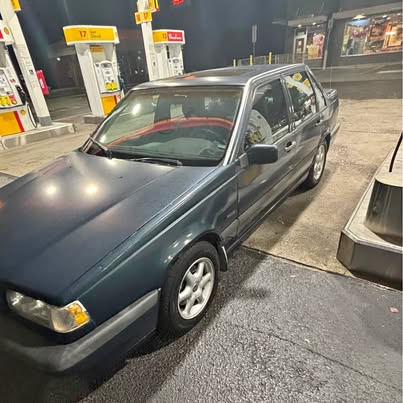
Look at this green GLT sedan as evidence, not atmosphere. Check the panel gaps around the bonnet and front wings, whether the headlamp lenses match in clarity (a single new lens often means a front corner has been repaired), and whether the trim strips sit level. On a GLT you expect alloy wheels and body-coloured mirrors; steel wheels or black mirrors on a claimed GLT mean a lower trim car or parts swapped in. Finally, look at the stance — an 850 sitting nose-high or sagging at one rear corner is telling you about tired springs and dampers before you drive it.
Engines and gearboxes
Every petrol engine in the 850 belongs to one family, and understanding that family is more useful than memorising outputs. Volvo's modular engine — the "white block", named for its unpainted aluminium — shares its bore spacing and basic architecture across four, five and six cylinders. The five-cylinder versions are all aluminium block and head, double overhead camshafts, two or four valves per cylinder depending on version, with hydraulic tappets, running Bosch Motronic management in most applications. It is a fundamentally strong design: bottom ends are rarely a problem on a maintained car, and high mileages are normal. What kills these engines is almost never the core engineering — it is neglected belts, neglected crankcase breathing, and overheating, all covered below and in the problem areas.
Read the engine code before anything else. You find it on the timing-belt cover label and stamped on the block, and it decodes simply: B for petrol, 5 for five cylinders, the next two digits for displacement in decilitres, the next digit for valves per cylinder, and a final letter for aspiration — S for naturally aspirated, T for turbocharged. So a B5254S is a 2.5-class (actually 2,435 cc) five-cylinder with four valves per cylinder, naturally aspirated; a B5234T is the 2.3 (2,319 cc) turbo. If the code does not match the badge on the tailgate, believe the code.
The naturally aspirated engines
The volume engine is the B5254S: 2,435 cc, 20 valves, 168 hp, fitted to the North American base car and GLT and to higher-trim European cars. It pulls cleanly from low revs, revs willingly for a family-car engine, and makes the characteristic five-cylinder warble under load. Expect fuel economy in the mid-20s (US mpg) in mixed use, and strain only when the car is fully loaded, automatic, and in hot, hilly country.
Below it sit the 10-valve engines: the B5252S (2,435 cc, 144 hp) and the European 2.0-litre B5202S (1,984 cc, 126 hp), plus the 20-valve 2.0-litre B5204S at 143 hp. The 10-valve cars trade top-end power for simplicity and a softer, torquier feel at town speeds. They are not bad engines, but the market values them lower for a reason: an 850 is a heavy car, and the smaller engines work hard. Buy one cheaply and on condition, and do not let a seller price a 10-valve car at 20-valve money because the badge just says 850.
All of these engines share the same service spine. The timing belt interval is 70,000 miles (about 105,000 km) or the handbook time limit, whichever comes first, and because the engine is an interference design, a belt of unknown age is one you replace immediately after purchase — budget for belt, tensioner, idlers and, sensibly, the water pump while you are in there. Oil changes are not a place to save money: the PCV system described below punishes extended intervals, and turbo cars punish them faster. Spark plugs, the distributor cap and rotor on earlier cars, and the breather components on the earliest cars all belong on your first-service list.
The turbocharged engines
Turbocharging transforms the 850, in two distinct flavours that you must not confuse, because they drive differently, cost different money, and wear differently.
The high-pressure turbo is the B5234T: 2,319 cc — the smaller displacement comes from a reduced bore, keeping cylinder walls thick for boost — with a Mitsubishi TD04HL turbocharger, an intercooler, and 222 hp in standard Turbo/T-5 tune. Boost arrives with a noticeable step in the mid-range and the car surges forward in a way no naturally aspirated 850 does. The T-5R's B5234T5 tune raises this to 240 hp using an overboost function that temporarily allows higher boost under full throttle, and the 850 R tune reaches 250 hp on manual cars; automatic R cars are torque-limited to protect the AW50-42LE gearbox, which is why an automatic R does not feel as violent as the headline figure suggests. These engines are strong when maintained and fragile when they are not: oil quality, oil changes, and cooling-system health matter more here than anywhere else in the range.
The low-pressure turbo is the B5254T: the full 2,435 cc displacement with a smaller, lighter-pressure Mitsubishi turbocharger, giving 190 hp but, more importantly, a fat, flat torque curve from just above idle. It powers the 1997 GLT and the AWD estate. On real roads it often feels as effective as the high-pressure car, because you use its torque constantly rather than visiting its power occasionally. It is also gentler on its gearbox, its tyres and itself. If you want a turbo 850 to use every day rather than to cherish, this is the engine to look for.
Turbo-specific checks are simple and non-negotiable. The turbocharger should be quiet — a siren-like whine rising with boost suggests worn bearings. Blue smoke on a trailing throttle or after idling points to turbo seals or, just as often, the PCV system; the inspection section shows you how to separate the two. Boost hoses and intercooler pipework perish and split, causing a car that feels flat and hisses under load; replacements are cheap. The turbo oil return pipe leaks at its block seal and is routinely misdiagnosed as a rear main seal leak — look before you condemn the expensive seal. And a turbo car that has been chipped by a previous owner deserves extra scrutiny everywhere: raised boost on an engine with a clogged breather and an old timing belt is how white blocks die.
Gearboxes and final drive
Most 850s you will meet, and nearly every North American survivor, carry the AW50-42LE: a four-speed electronically controlled automatic built by Aisin-Warner, with Sport, Economy and Winter modes selected by buttons beside the lever. In Sport it holds gears longer; in Economy it changes up early; Winter starts the car in a high gear to limit wheelspin on ice. It is durable when its fluid has been changed, and neglected when it has not — Volvo's period "filled for life" implication has not aged well, and dark, burnt-smelling fluid with delayed engagement shows you the car's maintenance history in one dipstick. The common electronic fault is the PNP (park/neutral position) switch on top of the gearbox: its contacts wear, the up-arrow warning light flashes, the car may start in a high gear, and the traditional field test — rowing the lever briskly through its range twenty or so times to wipe the contacts — sometimes restores it temporarily, which confirms the diagnosis rather than fixing it.
The manual alternative is the M56 five-speed, a Volvo-built box with a light, precise change that suits the car in every tune, and the one to have in a T-5 or R if you can find it — manual flagships are the minority of production and the market knows it. Check for a high, vague clutch bite (replacement is a subframe-down job, priced accordingly), synchromesh baulking into second and third when cold that does not clear when warm, and driveshaft gaiter condition while you are underneath. The AWD estate uses the related M58 manual with the viscous coupling driving the rear wheels when the fronts slip; it has no low range, and it demands matched tyres — a mismatched set winds up the viscous coupling and wears it out, so check that all four tyres match in size and tread depth on any AWD car.
Front-wheel-drive 850s put everything through the front tyres, and turbo cars will spin them in the wet despite the optional TRACS low-speed traction control, which brakes a spinning wheel and is a starting-off aid, not a performance system. Do not let a seller present TRACS as evidence of a limited-slip differential — the 850 was not offered with one from the factory in this period, whatever the listing says.

Study the estate profile before anything else on a wagon. The long, flat roof should be unrippled, the tailgate flush with even gaps, and the rear side glass rubbers not lifting — water passes tired rear-quarter seals and collects where you cannot see it. Look along the sill line for the straightness that tells you the car has not been jacked up carelessly. On a silver car like this, mismatched paint shade between tailgate and rear wings is easy to spot in flat light and points at a past rear-end repair.
Problem areas
An 850 rarely fails in one dramatic place. It declines by accumulation — a breather system here, an evaporator there, a set of tired bushings underneath — and the art of buying one is adding up the accumulation honestly before you agree a price. The systems below are ordered by how much they should influence your decision, not by how often they occur. None is a reason to avoid the model; all are reasons to price a specific car correctly, and to walk away from one whose seller will not let you test.
Engine breathing, timing belt and oil leaks
The crankcase ventilation system — Volvo's PCV arrangement of oil trap (separator box), hoses and ports in the block and inlet manifold — is the 850's defining maintenance item, and the one most often skipped because the parts are cheap but the labour is not: the inlet manifold has to come off to do the job properly. Over years of short journeys and stretched oil intervals, the trap and hoses coke and clog with sludge. Pressure then builds in the crankcase instead of being drawn back into the intake, and it finds the weakest exit: the camshaft seals, front crank seal, oil filler cap seal and, most expensively, the rear main seal. This is why so many 850s "leak a bit of oil": the seals are often the symptom, not the disease.
The test takes ten seconds and you do it on every car. With the engine fully warm and idling, hold a thin disposable glove over the oil filler neck. A healthy system holds slight vacuum: the glove is drawn in gently. A clogged system blows outward, puffing vapour, and you may see smoke wisping from the dipstick tube. Smoke alone can mislead on a cold engine; the glove test at full operating temperature does not. A full PCV service — trap, hoses, seals, manifold gaskets — runs roughly $600–1,100 at a shop. A rear main seal is cheap as a part and expensive as a job because the gearbox comes out, typically $900–1,600 all-in. Never pay to have seals replaced on a car whose breathing test fails: breathing first, then see which seals still leak.
The timing belt is the second engine-room gate, and it is binary. The white block is an interference engine: if the belt breaks or jumps, pistons strike open valves and you are pricing a cylinder-head rebuild or a replacement engine, not a belt. The interval is 70,000 miles or the handbook time limit, and on a car with patchy history you cannot know either, so a car without a dated, receipted belt change in interval gets the job priced into the deal — belt, tensioner, idlers and water pump together, typically $700–1,200 at an independent shop. Look for the belt-change sticker on the timing cover or ECU box, and for weeping from the water pump. While the bonnet is up, check the top engine mount: its rubber bush tears visibly, causing a clunk on throttle application, and it is a cheap fix that tells you whether previous owners bothered with cheap fixes. The lower mounts sag with age and show up as vibration at idle in gear on automatics.
Oil consumption deserves a calibrated eye. A high-mileage white block can use some oil without being worn out, particularly on turbo cars, but heavy consumption with blue smoke needs a cause: PCV first (free to test), then turbo seals, then valve stem seals — which typically smoke on start-up after standing and on the overrun — and only then rings. A compression test, and a leak-down test if compression is uneven, settles it. Do not accept "they all use a litre every thousand miles" without the breathing test passing.
Cooling faults kill these engines faster than wear does. The radiator has plastic end tanks that embrittle and crack; the expansion tank and cap, the bulkhead heater hoses and the thermostat are the same generation of ageing parts. An aluminium head on an aluminium block does not forgive overheating, and a car with fresh coolant, a new radiator and a vague story about "a hose went" deserves a combustion-gas (block) test of the coolant before you buy. Milky residue under the oil cap on a cold, short-trip engine is usually condensation, not gasket failure — the block test, plus whether the residue clears after a long hot run, distinguishes the two.
Air conditioning, heating and the dashboard
The 850's most notorious single job is the air-conditioning evaporator. It sits inside the dashboard, corrodes and leaks refrigerant with age, and replacing it means removing the entire dashboard — a full day's labour or more, typically $1,200–2,200 all-in, most of it labour. Sellers know this, which is why so many listings say "air-con just needs a re-gas". Sometimes that is even true. Your defence is simple: test the system on the day, at full cold, after the engine has run for ten minutes. Ice-cold air that stays cold is a pass. Air that starts cool and fades, or a system the seller will not demonstrate, is priced as an evaporator job until proven otherwise. A recent re-gas receipt on a car whose air-con is weak today is evidence of a leak, not of maintenance.
The rest of the climate system fails in smaller, cheaper ways that still add up. The electronic climate control (ECC) unit's flashing lights on start-up report a stored fault — a failed cabin temperature sensor fan, a jammed damper motor, or a blend motor out of range — and damper motors are dashboard-adjacent labour even when the part is modest. The heater core leaks into the front footwells: lift the mats and feel for dampness and the sweet smell of coolant, because a core is another labour-heavy job, though less brutal than the evaporator. The blower motor and its resistor or power stage fail with age; a blower that works only on full speed is the classic symptom. Check every stage, check that air changes direction and temperature when commanded, and check the heated seats, rear demister and heated mirrors while you are pressing buttons — together they describe how the car has been kept.
The dashboard cracks on sun-baked cars, around the passenger airbag cover and speaker grilles, and its brittle mounting points produce the creaks owners chase for years. The instrument cluster has its own known fault on earlier cars: the mechanical odometer stops when a small internal gear loses teeth, while the speedometer keeps working — so displayed mileage can under-read by an unknown amount. Cross-check mileage against service records, inspection certificates and pedal, seat and steering-wheel wear. A car whose odometer "just stopped" is not automatically dishonest, but its mileage is unknown, and you price unknown mileage as high mileage.
Suspension, steering and brakes
The front suspension is conventional MacPherson strut, and its wear points are well mapped. The lower control arms carry bushes and a ball joint as an assembly — when the ball joint or rear bush wears, you replace the arm, at roughly $250–450 a side fitted. Clunks over broken surfaces, vague straight-ahead feel and uneven front tyre wear are the symptoms; the test is a lever under the joint and a hard look at the bushes with the weight off the wheel. Strut top mounts and, especially, the spring seats — the rubberised bearing plate at the top of the strut — crack and separate, giving a groan or knock when steering at parking speeds. Turn lock to lock at a standstill and listen.
At the rear, the Delta-link axle depends on large rubber bushes to deliver its designed passive-steer behaviour. When those bushes perish, the rear feels loose, the tail steps oddly over mid-corner bumps, and rear tyre wear goes uneven. Replacing them is a known, priced job — awkward rather than exotic — but frequently skipped because the car still passes a casual drive. Bounce each rear corner, inspect the bushes with a torch, and budget accordingly. Dampers will be tired on any car still wearing old ones; an 850 on fresh dampers is transformed, at ordinary money.
Steering racks leak from their seals, showing as fluid on the rack boots and a falling reservoir level; a rack replacement is a mid-three-figure job, and a groaning pump is usually low fluid from that leak rather than a dead pump — top up and see, but price the leak. Notchiness at the straight-ahead on a high-mileage car is rack wear, not alignment.
Brakes are strong and conventional, and the flagship cars get larger front discs that you should verify are actually fitted on a claimed T-5, T-5R or R. The electronic fault that matters is the ABS module: on the later ATE-built systems in particular, the solder joints inside crack with heat and age, bringing on the ABS and TRACS warning lights intermittently — classically as the car warms up — and disabling anti-lock and traction functions while normal braking continues. Specialists rebuild the module for typically $150–350 against many hundreds for new, and the intermittent-with-heat pattern is the fingerprint. A car with the ABS light on permanently may instead have a failed wheel sensor or broken reluctor ring, so do not assume. Test the ABS on a safe, loose or wet surface from modest speed: you should feel the pedal pulse, not lock a wheel.
Body, rust and the estate's tailgate
Here is the good news, stated plainly because a persistent myth says otherwise: the 850 is not a rust-prone car by the standards of its era. Volvo galvanised much of the shell, and structurally sound survivors are common. The myth that "old Volvos all rot" belongs to earlier generations. But salt-belt cars do corrode in specific places: the rear wheel-arch lips, sill ends and jacking points, the front subframe and its mounting areas, the bottoms of the front wings where mud packs in, and around the estate's tailgate aperture where water sits. Surface bubbling on an arch lip is cosmetic today and structural in a few winters; probe with a magnet and a blunt screwdriver, and get the car on a ramp if you can — subframe condition matters because so much bolts to it. Welding an arch or sill section is typically $500–1,500 a side; a rotten subframe is a bigger conversation and a reason to prefer a dry-state car.
The estate's tailgate brings its own checklist. The wiring loom flexes where it passes into the tailgate and its conductors fatigue and break one by one, taking out the rear wiper, heated rear window, number-plate lights and tailgate locking in no particular order. Test every function; faults that change when you open and close the tailgate confirm the loom. The struts sag — the gate should stay up unaided, even in cold weather — and the interior trim panel works loose as its clips break, producing the estate's trademark rattle. Inside, the load cover's spring weakens and the seat folding mechanisms seize on cars whose seats have never been folded. On sedans, check the boot floor and spare-wheel well for water instead: lamp and boot seals let water in, and a damp well rusts quietly from the inside.
Door check straps click and then tear their mountings if ignored — open each front door slowly and listen for the crack that says the strap is failing. Door lock motors tire, window regulators slow, and central locking may work from the key but not the remote; none of this is expensive individually, and all of it together separates a cared-for car from a neglected one. Sunroof cars need their drain tubes checked: blocked drains put water into the headlining and footwells, and a stained headlining is the receipt.
Electrics, seats and the interior
The 850's electrics are of their era: mostly robust, with a short list of repeat offenders. The ignition switch's electrical portion wears and causes baffling, intermittent faults — accessories cutting out, warning lights flickering, occasionally a no-start that cures itself when you wiggle the key. If a car has a bunch of unrelated gremlins that come and go together, suspect the switch before you suspect five separate components. Check charging voltage at idle with loads on, around 13.8–14.4 volts, because a tired alternator masquerades as a dozen other faults on a car this electronic.
Power seat mechanisms use flexible drive cables whose housings stretch, so one side of the seat moves and the other lags, twisting the seat as it travels; the fix is fiddly rather than ruinous. Seat heaters fail at the element or thermostat, and a heater with one hot spot instead of even warmth has a damaged element — test both front seats in any season. The famous seat comfort survives if the foam does; retrimming a collapsed, cracked interior properly costs more than most buyers expect, so value a good cabin highly — you cannot cheaply buy your way back to one. Headlinings sag when the foam backing fails, and a pinned-up headlining tells you the job has been deferred; retrimming is $400–800 done professionally.
Finally, the automatic gearbox and the AWD system, because both are tested, not inspected. The AW50-42LE should engage drive and reverse promptly, change smoothly at light throttle, and kick down without a bang or a flare of revs. Delayed engagement when cold, slipping under load, or a flashing up-arrow with the car stuck in a high gear point to the PNP switch first (electrical, moderate cost) and to internal wear second (a rebuild is $1,800–3,000, which on many 850s exceeds the car's value — price accordingly or walk away). On the AWD estate, any vibration under load, mismatched tyres, or sign the propshaft has been removed to "fix" a driveline problem means the viscous coupling needs professional verification before money changes hands.
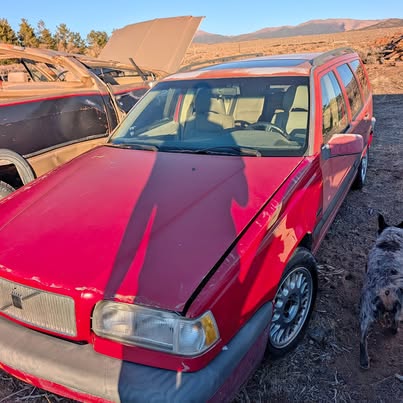
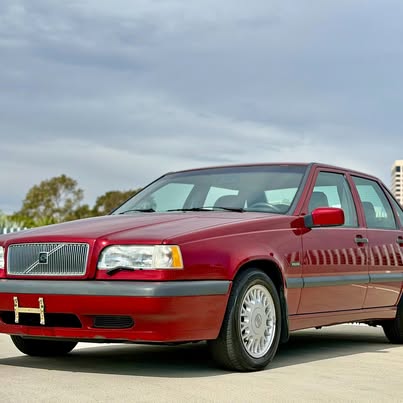
A red 850 of the earliest shape is your chance to practise the front-end checks. The headlamp wipers, where fitted, should park neatly and both lamps should match; the grille and badge should sit straight, because the whole front panel unbolts and a careless refit shows here first. Look for the intercooler behind the lower grille on a car claimed to be a Turbo — no intercooler, no turbo, whatever the tailgate says. Stone chips on the leading edge are honest wear; fresh paint confined to one wing is a question that needs an answer.
How to inspect one
Inspect an 850 in order, cold car first, and do not let the seller warm it up before you arrive — a warm engine hides the start-up smoke and cold gearbox behaviour the first minutes reveal. Take a torch, a disposable glove for the breathing test, and a magnet wrapped in cloth for the arches. Work through these twelve steps in sequence; each cross-references the problem areas above, and together they take about an hour.
- Paperwork and identity first. Match the VIN on the dashboard plate and door sticker to the title. Read the engine code on the timing-cover label and decode it against the badge — B5254S, B5254T or B5234T — because, as the models section warns, the engine code settles every trim argument. On a claimed T-5R or R, check trim, wheels and specification against the flagship description, and treat any mismatch as a rebadged car until documents prove otherwise.
- Cold start, bonnet up. Start from stone cold and watch the exhaust: a puff that clears is stem seals or condensation; continuous blue smoke needs the breathing test before you blame the turbo. Listen for tappet clatter that should fade within a minute or two, and for belt and idler noise. Note idle quality — a hunting idle when warm points to air leaks or a dirty throttle body.
- The breathing test. With the engine now fully warm after your test drive (note it here, do it then), perform the glove-over-the-filler test from the engine problem areas. Vacuum drawing the glove in is a pass; pressure blowing it out means a PCV service goes on the bill, and every oil leak on the car is re-read in that light.
- Timing belt evidence. Look for the change sticker on the timing cover or ECU box, and for a receipt with a date and mileage, not just an invoice for a belt. No evidence inside the 70,000-mile interval means you budget the full belt, tensioner, idler and water-pump job — and you say so during negotiation, not after.
- Fluids and cooling. Check oil level and colour, coolant level and colour, and brake and power-steering fluid levels. Dark automatic transmission fluid with a burnt smell is the gearbox's maintenance history in one sniff. Look at the radiator end tanks for hairline cracks and crust, and at the bulkhead heater hoses for swelling. If the cooling system looks suspiciously all-new, ask why, and consider a block test.
- The climate test. Run the air conditioning at full cold for ten minutes, as the dashboard problem areas insist — this is the evaporator test, and a fading system is priced as an evaporator job. Work every blower speed and vent direction, the heated seats, rear demister and mirrors. Feel the front carpets under the mats for heater-core damp.
- Underneath and arches. With magnet and torch, work the rear arch lips, sill ends and jacking points, then the front subframe and its mounts. From underneath, read the Delta-link bushes for cracking, the control-arm bushes and ball joints for play, the rack boots for fluid, and the turbo oil return and rear main seal areas for leaks — remembering step 3's verdict before you price either leak.
- The road test — gearbox and boost. Drive at least twenty minutes, including a hill and a motorway slip road. The automatic should engage promptly, change smoothly and kick down cleanly; treat a flashing up-arrow as a fault to price, not a quirk. On turbo cars, boost should build smoothly with no siren whine, no hissing from split hoses, and no hesitation — and watch the temperature gauge: it should rise to the middle and stay there.
- Steering, suspension and brakes on the road. At parking speed, turn lock to lock and listen for the spring-seat groan. Over broken surfaces, listen for control-arm and drop-link knocks. Brake firmly from speed: the car should pull up square, and on a loose or wet patch the ABS test from the problem areas — pedal pulsing, no locked wheel — confirms the system. Note whether the ABS or TRACS lights behave oddly as the car warms; the heat-intermittent pattern means the module.
- Estate functions, if it is an estate. Test every tailgate-fed function — rear wiper, heated window, number-plate lights, tailgate locking — and open and close the gate twice to expose the loom faults from the body section. Check the struts hold the gate up, fold the rear seats, work the load cover, and inspect any seven-seat conversion's belts and mountings. On a sedan, check the spare-wheel well for water instead.
- Electrics sweep and interior. Work every window, the sunroof if fitted (looking for headlining stains from blocked drains), central locking from key and remote, both power seats through their full travel watching for the twist that means stretched cables, and every warning light. Wiggle the ignition key gently with the engine running: flickering accessories point at the ignition switch. Verify the odometer advances during your drive — the cluster gear fault in the problem areas means a static odometer turns mileage into an unknown.
- The second cold look, and the maths. Walk round again in different light, checking panel colour match and tyre matching, which on an AWD car is a mechanical requirement, not a cosmetic one. Then add up everything you have found at the job prices in the problem areas, and compare the total, plus the asking price, against the values logic in the next section. An 850 needing a belt service, a PCV service and an evaporator is not a bad car; it is a car whose price must fall by roughly the sum of those three jobs.
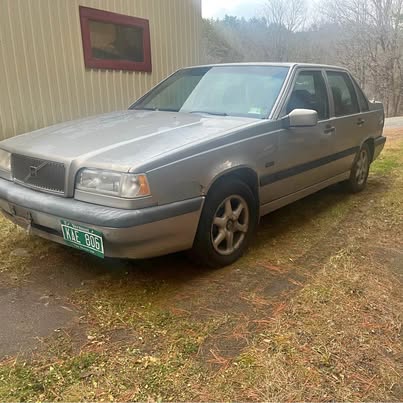
Use a plain grey sedan like this to calibrate your eye for originality. Base and GLT sedans should sit level on modest wheels, with unbroken rubbing strips and mirrors that match each other. What you are hunting is asymmetry: one clear headlamp lens against one yellowed, one new tyre against three old, one wing a half-shade off. Each asymmetry is a small story — ask for it. A car with no stories at all at this age has usually just had them painted over, so look in the shut lines for evidence photographs cannot show you.
Values
Read the market block beneath this guide first — it carries the current listings and recorded figures, refreshed as the market moves — and then apply what follows to interpret it, because raw numbers on a model this varied will mislead you. The 850's spread between cheapest and dearest is enormous, and almost all of it is explained by three things: which variant the car actually is, which body style it wears, and how much of the deferred-maintenance bill in the problem areas has already been paid by somebody else.
Variant is the first filter. Ordinary naturally aspirated sedans are the softest part of the market: they are plentiful, and buyers who want an 850 usually want either the estate's utility or the turbo's performance, so the plain sedan sits between two stronger demands. Estates carry a premium over equivalent sedans. The 1997 low-pressure-turbo GLT trades above its naturally aspirated namesakes because informed buyers know what the badge hides. High-pressure Turbo and T-5 cars sit a clear step above that, with manuals commanding more than automatics. The T-5R and R occupy their own market entirely: genuine cars, verified by specification and documents, attract collectors as well as drivers, yellow T-5Rs most of all — and that premium is exactly why identity verification, not enthusiasm, should drive any flagship purchase.
Condition is the second filter, and on this model it can outweigh variant. The gap between a project 850 and a sorted one is not a percentage; it is the itemised sum of the known jobs — evaporator, timing belt service, PCV service, suspension bushes, gearbox work — and a cheap car needing all of them is dearer, finished, than a fairly priced car needing none. This is why the spread within a single variant looks irrational until you read the descriptions properly: the market is pricing maintenance history as much as cars. A full, receipted specialist history is worth real money, and a folder of receipts is the best predictor that an asking price is honest.
Asking and achieved prices are not the same thing, and the gap is widest at the two ends. Optimistic sellers of ordinary cars anchor on flagship money because "850s are going up"; ordinary cars do sell, but at ordinary money, and listings that ignore this sit for months. At the flagship end the opposite distortion appears: a correctly priced, verified T-5R or R in a desirable colour can sell quickly and quietly, so absence from the market is not evidence of absence of demand. Mileage distorts less than sellers hope: these engines tolerate high mileage when maintained, and the market increasingly prices a 180,000-mile car with a full history above a 110,000-mile car with none — quite correctly, for the reasons the inspection section gives you.
Geography matters too. Dry-state cars carry a quiet premium for their subframes and arches; salt-belt cars must be cheaper unless their undersides are proven. Whatever you pay, keep the negotiation grounded in the inspection maths: the costed list of jobs the car needs today is the most persuasive document in any 850 negotiation.
Parts and ownership
Owning an 850 is a mainstream proposition, not an exotic one, and that is a large part of its appeal. Volvo built the car in volume, the S70 and V70 that followed share a great deal underneath, and the enthusiast base is large and generous with knowledge. Service parts — filters, plugs, belts, brake discs and pads, dampers, control arms — are available from multiple suppliers at ordinary prices, and the wear items this guide has priced are routine work for any competent independent garage; you do not need a marque specialist for most of the car, though a Volvo-experienced independent earns their keep on PCV services, climate faults and module diagnosis.
New trim and body parts are the thinning layer. Mechanical and electrical components remain well supported, including rebuilt ABS modules and PCV kits sold as complete sets. But interior trim in the right colour, estate load-area plastics, flagship items such as R and T-5R spoilers and wheels, and small brightwork are increasingly breaker's-yard and owners'-club territory. The practical consequence: a mechanically tired car with a perfect interior is usually a better purchase than a sweet-running car with a ruined cabin, because engines can be rebuilt from catalogues and interiors cannot. AWD-specific driveline and rear-suspension parts are the scarcest mainstream items — another reason the AWD estate suits an enthusiast rather than a depend-on-it-daily owner.
Running costs are honest rather than cheap. Fuel consumption sits in the mid-20s (US mpg) for a naturally aspirated car driven gently, lower for a high-pressure turbo used as intended. Insurance is unremarkable except for the flagships, which some insurers price as performance cars. The ownership rhythm that keeps an 850 cheap is preventive: timing belt on interval without exception, oil changes at sensible intervals, PCV health checked at every service with the glove test, automatic transmission fluid changed despite the period "sealed for life" implication, and coolant and brake fluid renewed on schedule. Budget a realistic annual sum for age-related items on top of servicing — a car of this age always has a next job — and the 850 repays you by never presenting a bill out of proportion to the car.
The community is a genuine asset. Owners' forums hold photographed procedures for every major job in this guide, including the evaporator and the PCV service, and the diagnostic knowledge for the ECC codes and ABS module is freely shared. If you do your own work, the 850 is satisfying: the engine bay is roomy by transverse standards and the front panel unbolts for access. If you do not, buy the best-maintained car you can find and keep it that way — the model's economics reward continuity and punish rescue missions.
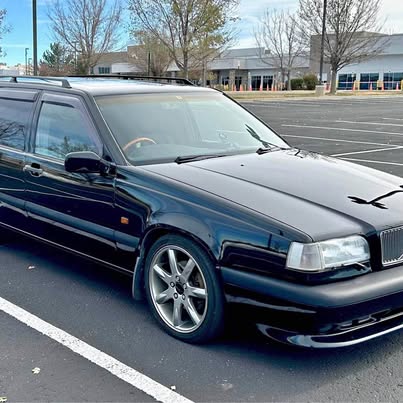
A second green 1995 car gives you the comparison exercise that sharpens every viewing. Put two same-year cars side by side in your mind and note what differs: wheel style against trim badge, ride height corner to corner, the condition of the black bumper and side trims (greyed, streaked trim is sun and age; freshly blacked trim can be honest detailing or a quick cosmetic pass over tired paint), and whether the glass all carries matching markings. Original glass throughout is a quiet mark in a car's favour; one replaced side window is a question the seller should answer easily.
Which one to buy
- The all-rounder: the naturally aspirated B5254S sedan or estate, bought on history — the car that does everything the 850 was designed to do, at the lowest entry and running costs in the range.
- The value buy: a 1997 GLT with the low-pressure-turbo B5254T — flagship-adjacent torque and the best equipment in the ordinary range, at prices reflecting the GLT badge rather than the turbo reality.
- The working classic: any well-kept estate, naturally aspirated or GLT — the load space, booster seat and square tailgate make it the most useful old car you can own, and the premium over the sedan is money you will likely see again.
- The enthusiast's pick: a Turbo or T-5, estate for preference, manual if you can find one — genuinely quick and cheap for the performance, provided the PCV, belt and boost checks in this guide all pass.
- The collector: a verified T-5R, Cream Yellow above all, or a manual 850 R — buy the documents and the originality first and the car second, because the premium lives entirely in the identity.
- The specialist choice: the 1997 AWD estate — all-weather ability and real rarity, for a buyer who accepts the scarcest parts supply in the range and checks the tyres and viscous coupling with particular care.
- The cautious buy: a European 10-valve or 2.0 car at a genuinely low price — slower and less sought-after, but the same structure, seats and safety, if your expectations are set by the engine code, not the badge.
The overriding rule: buy the individual car, not the badge — a maintained, receipted, rust-free ordinary 850 is a better purchase than a neglected flagship at any price, because on this model the maintenance history is the specification that matters most.
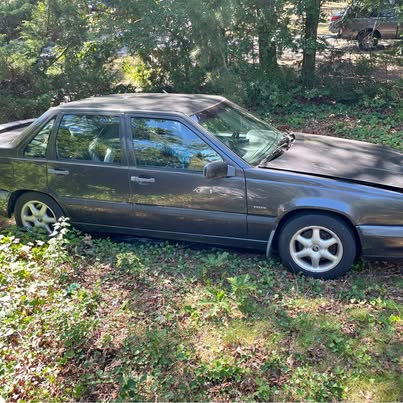
Finish with this purple 1996 sedan as your reminder that colour and presentation are the last things to weigh, not the first. An unusual colour photographs beautifully and can carry an otherwise ordinary listing; it changes nothing about the breathing test, the belt evidence or the evaporator. Check the same front-end alignment, lamp match and trim fit as on the green GLT earlier, note whether the colour is even and original in the door shuts, and then go back to the twelve steps. The right 850 is the one that passes them — in whatever colour it wears.
See the 6 850 Wagon cars currently listed.
For sale now
 $7,500
Expand
What they sell for: 850 Wagon sale prices.