
Volvo P1800 buyer's guide
Volvo P1800 -- the model's own buyer's guide: variants, values and what to check.
Years listed: 1972-1972 · Series: P1800
Overview and history
The P1800 is the car Volvo never quite meant to build, built by people Volvo never quite meant to use, and it became the most durable sports car reputation of the twentieth century. That contradiction is the whole story, and understanding it tells you how to buy one. Underneath the Italian-looking body sits the running gear of the Volvo Amazon saloon: a pushrod four-cylinder engine of almost agricultural toughness, a four-speed gearbox, a live rear axle on coil springs, and electrics simple enough to diagnose at the roadside. Over the top of that sits a hand-finished 2+2 coupe body of real elegance and, in the early cars, genuinely troublesome rust protection. Buy the mechanicals and you will rarely be stranded. Buy the body carelessly and you will spend years paying a welder. Every decision in this guide flows from that split.
The project began in 1957. Volvo's president Gunnar Engellau wanted a sports car to lift the company's image in the United States, where the worthy PV444 and PV544 saloons sold on durability rather than desire. Volvo had tried once before: the fibreglass P1900 of 1956 was so poorly made that Engellau cancelled it after a single weekend driving one, and only a few dozen were built. The lesson he drew was not to abandon the idea but to control it. The new car was designed by Pelle Petterson, a young Swede who had studied at the Pratt Institute in New York and was working at the Carrozzeria Frua studio in Turin; his father Helmer Petterson had been involved in Volvo projects for years. The styling was done under Frua's roof, which is why the car looks Italian, but the hand on the pencil was Swedish, which is why it also looks restrained. Three prototypes were built, and the shape changed remarkably little on the way to production: the long bonnet, the kicked-up rear wings with their small fins, the wraparound rear screen and the neat, upright grille all survived.
The finished car was shown at the Brussels motor show in January 1960, but Volvo had no spare factory capacity to build it. That is the accident that defines the first chapter of the model. Jensen Motors of West Bromwich in England, which had spare assembly capacity, took a contract for 10,000 cars. Pressed Steel at Linwood in Scotland made the bodyshells and shipped them south by rail; Jensen trimmed, painted and assembled the cars using mechanical components sent from Sweden. Production started in 1961. Quality, particularly paint, panel fit and rust protection, never matched what Volvo expected, and after exactly 6,000 cars Volvo ended the contract early and brought assembly home to its Lundby plant in Gothenburg in 1963. From that point the car is called the 1800S, the S standing for Sweden, and the P prefix quietly disappears.
Fame arrived from an unexpected direction. When the television series The Saint needed a car for Simon Templar in 1962, the production approached Jaguar first and was refused; Volvo supplied a white P1800, and Roger Moore drove the type on screen for the rest of the decade and bought one for himself. Be careful with it when you buy: the association attaches to the model, not to any individual car, and a seller who talks about The Saint for ten minutes is usually avoiding talking about the sills.
The second fame is better evidence. In 1966 a New York science teacher named Irv Gordon bought a new 1800S and simply kept driving it, commuting and touring, with fastidious maintenance and an original B18 engine that was rebuilt only at mileages most cars never see once. The car passed one million miles, then two, then three million miles in 2013, becoming the highest-mileage car in the world. Treat that correctly. It does not prove that the car you are looking at is durable; it proves what the design does when it is maintained without interruption for half a century, garaged properly and never allowed to rot. The engine and gearbox forgave Gordon everything. The body would not have, and he never asked it to.
The model then evolved in the slow, logical Volvo way rather than in model-year fireworks. The engine grew from the 1.8-litre B18 to the 2.0-litre B20 for 1969. Fuel injection arrived for 1970 and the car became the 1800E, with disc brakes all round and a much improved interior. In its last phase the coupe was joined, and finally replaced, by the 1800ES of 1972 and 1973: the same car from the windscreen forward, with an extended roof and a frameless all-glass tailgate behind, a sporting estate decades before the term was fashionable. Production ended on 27 June 1973, killed not by failure but by tightening American safety and emissions rules that a low-volume car designed in the 1950s could not economically meet. In total 47,492 cars were built: 39,414 coupes by the usual factory count, give or take a handful depending on how prototypes are treated, and 8,077 of the ES. Most went to the United States, and most survivors are therefore left-hand drive.
The models
Four badges cover the whole life of the car, and the differences between them matter more than the differences within them. A Jensen-built P1800, a Swedish 1800S, an injected 1800E and an 1800ES are recognisably the same car and drive in recognisably the same way, but they differ in build quality, braking, performance, interior, rarity and the specific traps they set a buyer. The table gives the skeleton; the paragraphs after it give the flesh, including the changes inside each badge that sellers routinely get wrong or quietly blur.
| Model | Years | Engine | Output | Built | Character |
|---|---|---|---|---|---|
| P1800 (Jensen) | 1961–1963 | 1,778 cc B18B, twin SU HS6 | 100 hp | 6,000 | The original: English-built, cow-horn bumpers, rarest and most fragile |
| 1800S | 1963–1969 | 1,778 cc B18B, then 1,986 cc B20B for 1969 | 108 hp, rising to 115 hp, then 118 hp | 23,993 | The Swedish car: better built, the volume model, the sensible classic |
| 1800E | 1970–1972 | 1,986 cc B20E or B20F, Bosch D-Jetronic | 130 hp (lower for the US B20F) | 9,421 | The developed car: injection, four-wheel discs, best performance |
| 1800ES | 1972–1973 | 1,986 cc B20E or B20F, Bosch D-Jetronic | 130 hp, 112–125 hp in US emission tune | 8,077 | The shooting brake: glass tailgate, real luggage space, a cult of its own |
Period outputs are quoted in the SAE gross figures Volvo used in America at the time, which flatter every car of the era; the later DIN figures are lower for the identical engine, and the US emission-tune B20F is lower again. Never compare a seller's quoted figure for one car against a different rating system for another, and never let a horsepower argument distract you from a chassis number, which is where the real identity of an 1800 lives. On all cars the chassis number is stamped on the body and repeated on the maker's plate in the engine bay, and the engine type is stamped on a machined pad on the block. Those two stamps, read together, settle most arguments about what a car actually is.
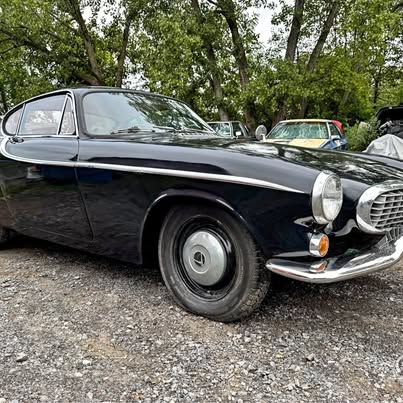
The Jensen P1800 (1961–1963). Chassis numbers 1 to 6,000. These are the cars with the elaborate cow-horn front bumpers that wrap up and over, the egg-crate grille, the most delicate brightwork and, in the cabin, the earliest instruments and trim. The engine is the B18B with twin SU carburettors and 100 hp. They are the rarest coupes, the most collectible on paper and the most dangerous in practice, for three reasons. First, the English assembly and Scottish pressings were protected against rust to a standard Volvo itself found wanting, so a Jensen car has had sixty years to dissolve in places a Swedish car has not. Second, several panels and details are unique to these cars: the doors of a Jensen car fit only Jensen and very early Swedish shells, so a bent or rotten Jensen door is a fabrication problem, not a breaker's-yard problem. Third, precisely because they are rare, they attract optimistic descriptions. A genuine, sound Jensen car with its correct early details is a lovely thing. A Jensen car held together by filler and hope is the most expensive 1800 you can buy, whatever the asking price.
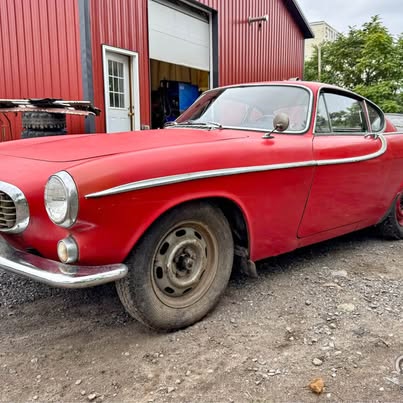
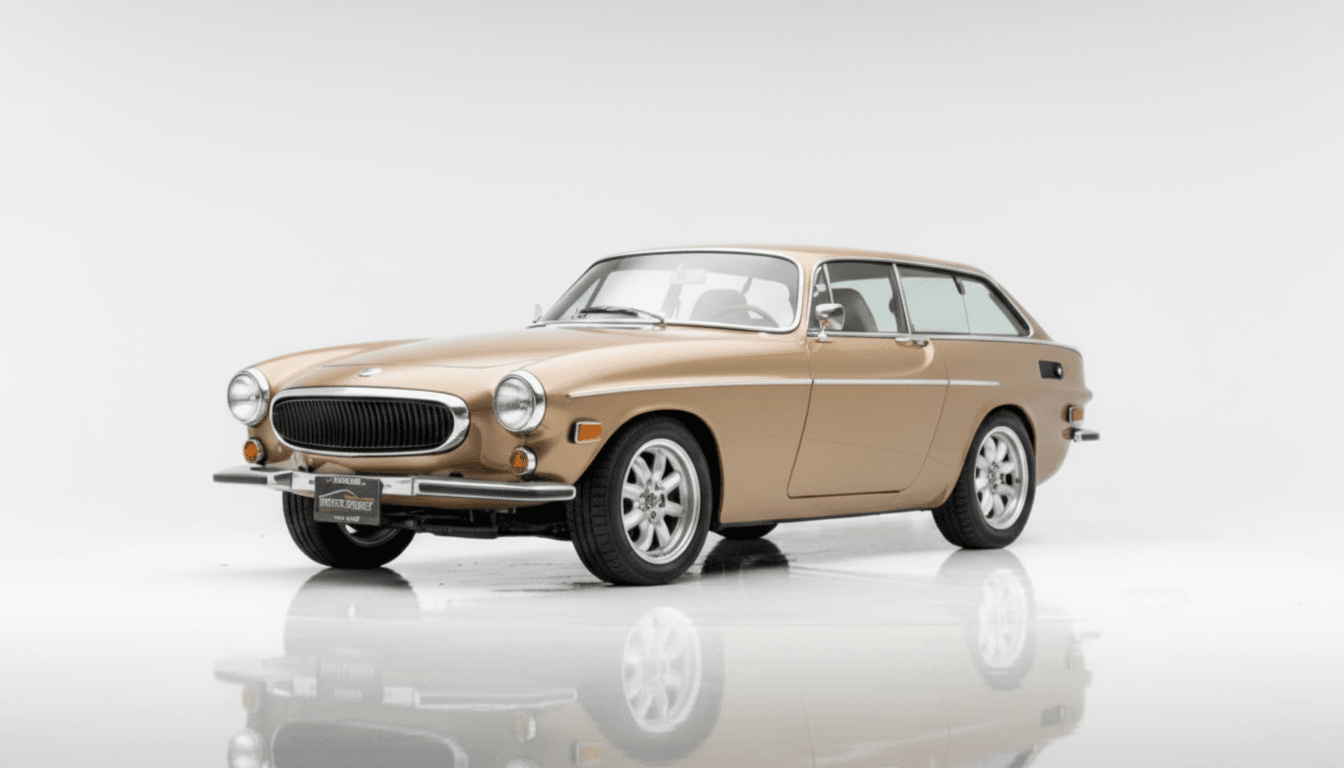
The photograph above is worth studying for what it cannot show you. A Jensen car presents beautifully in a single front three-quarter shot, and nothing in that view tells you whether the sills are steel or filler or whether the front crossmember under the radiator is sound. That is the Jensen bargain in one image: you are paying for the earliest and prettiest version of the shape, and the price of admission is the most forensic body inspection in the whole range.
The 1800S (1963–1969). Chassis numbers from 6,001 onward, 23,993 built, and the car most buyers should be studying. Swedish assembly brought better paint, better sealing and more consistent panel fit from the start, and the model improved steadily. The first Swedish cars kept the 100 hp engine briefly; output rose to 108 hp, and from the 1966 model year the B18B was retuned to 115 hp. The bumpers simplify into the straight blades most people picture, the grille changes, seats and trim improve in detail, and for the final year, 1969, the B20B engine arrives: 1,986 cc, still on twin carburettors, 118 hp and noticeably more torque in the middle of the range where a touring car lives. A 1969 1800S is therefore a sleeper in the range: the classic carburettor car, with the bigger engine, before the complexity of injection. Overdrive, on the M41 gearbox, was a popular option throughout and transforms motorway use; a car without it is not wrong, but it is busier and less relaxed. Disc brakes at the front and drums at the rear are standard throughout the S years; the braking is adequate rather than strong, and its condition matters more than its specification.
The 1800E (1970–1972). This is the thorough modernisation. The B20 engine gains Bosch D-Jetronic electronic fuel injection and a higher compression ratio as the B20E, producing 130 hp in European tune; American cars move to the lower-compression B20F as emissions rules bite, with output quoted lower and falling further by the last year. The E gains disc brakes on all four wheels, a stronger gearbox story discussed in the engine and gearbox section, a redesigned dashboard with proper wood facing and a full set of instruments, better seats, improved ventilation with extractor vents in the rear wings, a matt black grille and new wheel styling. It is objectively the best coupe to drive: faster, sharper, better braked and more comfortable. It is also the coupe with the most to go wrong electrically, because D-Jetronic is an analogue electronic system now more than fifty years old, and the only 1800 whose previous owners include people who removed the injection in frustration and fitted carburettors. A converted E is not necessarily a bad car, but it is no longer the car the badge claims, and it should be priced as an S with better brakes, not as an E.
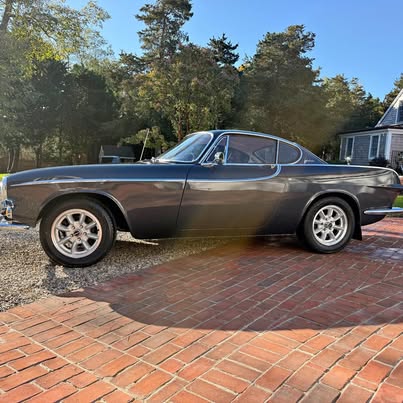
That changeover point deserves emphasis because 1963 cars are misdescribed constantly, sometimes innocently and sometimes not. The model year, the registration year and the build location are three different facts: a car registered in 1963 may be a late Jensen car, and a car badged P1800 may be an early Swedish one. The chassis number settles it in ten seconds, costs nothing to check, and changes both the value and the inspection plan. Do it before you travel, and walk away from any seller who will not give you the number.
The 1800ES (1972–1973). The estate that is not called an estate. Volvo took the E coupe, kept everything forward of the windscreen, and designed a long roof ending in a frameless glass tailgate hinged at the top, with the rear seat folding to give a genuinely flat, genuinely useful load floor. The mechanical specification follows the late E, including the injected B20 in European or American tune and the option, shared with the late E, of the Borg-Warner three-speed automatic. Only 8,077 were built in two model years, and the car has a following entirely separate from the coupe's: it is rarer at any given meeting, more practical every single day, and the direct ancestor of the glass-tailgated Volvo estates that followed decades later. Its specific weaknesses are the tailgate itself, its hinges, struts, seal and lock, and rust in the extended rear body that the coupe does not have. A good ES is the easiest 1800 to justify to a sceptical household, because it can actually carry things.
One trap spans all four badges: the year on the title is not the year of manufacture. Volvo built in model years that began in the autumn, cars sat in stock, and American titles were often written from the year of first sale. A car described as a 1968 may be a 1967 model-year car, which is harmless, or a seller may use a flattering year to move a car across the Jensen or injection boundary, which is not. The chassis number ranges, published and well documented, are the authority. Learn the range for the car you are chasing and check the number against it before money is discussed.
Engines and gearboxes
There are only two engine families in this car, and really only one engine in two sizes. Everything is a development of Volvo's overhead-valve, cast-iron, five-main-bearing four-cylinder: the B18 of 1,778 cc and its bored-out successor the B20 of 1,986 cc. It is one of the strongest production engines of its period, with a bottom end that tolerates neglect a British or Italian contemporary would not, and it is the reason high mileages are normal here rather than exceptional. What changes across the years is not the architecture but the breathing: twin SU carburettors, then bigger carburettor engines in higher states of tune, then electronic fuel injection.
The B18B: twin SUs and a five-bearing bottom end
The B18 displaces 1,778 cc from an 84.14 mm bore and an 80 mm stroke, a short-stroke layout that revs more willingly than most pushrod fours and does not punish revs. The block and head are cast iron, the camshaft sits in the block and works the valves through pushrods and rockers, and the crankshaft runs in five main bearings where most rivals made do with three. In the 1800 the engine is always the sporting B18B variant, never the single-carburettor B18A or the milder B18D of the saloons, and it breathes through two SU HS6 carburettors of 1.75 inches. Output starts at 100 hp, rises to 108 hp in Swedish production and reaches 115 hp from the 1966 retune, achieved with camshaft, compression and carburation changes rather than any structural difference.
The SU installation is simple and its faults are specific. Each carburettor has a piston damped by oil in a dashpot; if the oil is missing or the wrong weight, the piston rises too fast on a snap throttle opening, the mixture goes momentarily weak and the car hesitates in exactly the way owners describe as a flat spot. The cure is a few drops of the correct light oil, not a rebuild. The serious wear point is the throttle spindle bushes in the carburettor bodies. After decades the spindles wear the bodies oval, air leaks in past the butterfly at idle, and no amount of mixture adjustment will produce a steady tickover because the engine is breathing unmetered air downstream of the jet. The test is to spray a little carburettor cleaner or unlit propane at the spindle ends on a running engine: if the idle changes, the leak is found. Re-bushing a pair of HS6 bodies is a routine specialist repair job, typically a few hundred dollars in parts and labour for the pair, and it transforms cars that have been blamed on ignition for years. Needles and jets wear too, and a car that is rich at cruise and weak at idle is usually worn, not maladjusted. Budget for a proper carburettor overhaul on any car that has sat, and treat a car that starts instantly, idles evenly and pulls cleanly through a hot restart as evidence of an owner who understood the car.
Two engine details catch buyers out. First, the B18 and B20 drive the camshaft by gears, not a chain, and the original cam gear is a fibre composite that can strip its teeth with age, stopping the engine dead without damaging the valves, since this is not an interference design in the destructive modern sense. A sudden, silent failure to run on an otherwise healthy engine is often this gear, and many cars now carry a steel replacement, which is noisier and effectively permanent. Ask which is fitted. Second, the engines use a cartridge oil filter arrangement and a simple breather system that blocks with sludge on short-trip cars, pressurising the crankcase and pushing oil out of seals that are then wrongly condemned. Clean the breather before you believe a rear main seal diagnosis.
The B20B: the bigger engine on carburettors
For 1969 the bore grows to 88.9 mm and capacity to 1,986 cc, and the engine becomes the B20. Nothing else about the architecture changes, which is why a B20 drops into an earlier car with ease and why so many earlier cars have one: it is the single most common engine swap in the model, it is mechanically sensible, and it destroys originality while improving the drive. In the 1800S the B20B runs twin carburettors, SU HS6s on most cars and Zenith-Stromberg 175 CD units on some markets and years, and produces 118 hp with a useful lift in torque. The Stromberg cars use a diaphragm in each carburettor to lift the piston; a perished diaphragm gives a car that idles perfectly and will not pull, and the part costs very little while the diagnosis, if you do not know it, can consume a workshop day. Check the diaphragms on any flat-running Stromberg car before anything else.
The B20E and B20F: Bosch D-Jetronic injection
The injected engine is the same B20 with larger valves, opened-up ports, a wilder camshaft and, in the B20E, a 10.5 to 1 compression ratio, breathing through Bosch D-Jetronic. D-Jetronic is the first mass-produced electronic injection system and it works on a beautifully simple principle: there is no airflow meter. An analogue electronic control unit calculates fuelling mainly from engine speed and from a manifold pressure sensor, a sealed canister with an aneroid bellows that measures inlet vacuum, with correction for temperature. Four injectors fire in pairs, triggered by a set of contact points in the base of the distributor, the trigger points, quite separate from the ignition points above them. Fuel is supplied by an electric pump at a regulated pressure of about 28 psi, roughly 2 bar, at the rail. In European tune the B20E makes 130 hp and gives the 1800 the performance its shape always promised, with a top speed around 115 mph and a flexibility the carburettor cars cannot match. The American B20F lowers compression to 8.7 to 1 with a thicker head gasket and revised tuning for emissions, and gives away a noticeable slice of that performance.
D-Jetronic has a reputation for unreliability that it only half deserves. Its components are mostly durable; what fails is specific, testable and too often misdiagnosed by people who replace the expensive parts first. The manifold pressure sensor is the heart of the system and the part everyone blames last: its bellows crack or its seal leaks, the ECU then reads a false load signal and the car runs rich, hunts or drowns. The test is simple and decisive: the sensor must hold vacuum from a hand pump without leaking down. Test it before anyone sells you an ECU. The trigger points wear and bounce, giving an intermittent misfire that feels electronic; they are a service item, not a catastrophe. The auxiliary air valve, which provides the fast idle from cold, sticks with age, and a faulty cold-start injector circuit presents as flooding. Perished vacuum hoses upset the one signal the whole system depends on, so a full set of hoses is the cheapest D-Jetronic repair there is. ECU failure is possible but rare, and a car converted to carburettors because the ECU died should make you ask for evidence: nine times out of ten the sensor, the trigger points or a hose were the real fault, and the removed parts, if kept, are valuable. A sorted E starts hot or cold without throttle, idles evenly and pulls to the red line without a hiccup; insist on seeing all three.
That point generalises across the range and is one of the most useful in this guide. Because the B18 and B20 share a block architecture, swaps are easy, common and frequently undocumented, and because the swap usually improves the car, sellers present it as an upgrade rather than a change of identity. Your position should be neutral on the engineering and firm on the paperwork: a swapped car bought knowingly at the right price is a good buy, and a swapped car bought as original is a bad one at any price. The engine pad stamp and the chassis number, checked together, take five minutes and settle the question permanently.
Gearboxes, overdrive and the automatic
The standard gearbox is Volvo's own M40 four-speed manual, a strong, simple unit with synchromesh that survives well; whine in the indirect gears and tired synchromesh on second are the usual age faults, and laygear needle bearing wear is the known internal weakness on high-mileage boxes. The option that matters is the M41, the same gearbox with a Laycock de Normanville overdrive on the output, operated by a stalk or switch and working on top gear, and on later units third as well. Early cars use the D-type overdrive, later cars the stronger J-type; the J-type is the one you want for hard use, and both share the same rules. The overdrive has its own oil, shared with the gearbox on most installations, its own filter and an electrical solenoid that engages it. An overdrive that will not engage is most often low oil, a dirty filter or a failed solenoid or switch, in that order of cost, and only after those are eliminated should you believe a story about internal failure. An overdrive that engages but slips under load is a genuine internal wear problem and a rebuild bill. Test it properly on the road, under power, several times, hot.
For 1970 the E was launched with the heavier M410 gearbox from the 164 saloon, before Volvo returned to the M41 line for later production; an M410 car is correct for its year, not a conversion, and parts and knowledge for it are thinner than for the M41. From 1970 the Borg-Warner 35 three-speed automatic was offered on the E and became a common fitment on American-market ES cars. It is durable and suits the ES's touring character, but it takes the edge off the performance and most of the fun; automatic coupes are the cheapest way into an E and the hardest to sell on, while automatic ES cars carry a much smaller penalty. Rear axles are long-lived if the oil has ever been changed; a whine that rises and falls with road speed is axle wear, while a whine that follows engine speed is gearbox or overdrive. Learn to separate those two sounds on the test drive and you will diagnose the back half of the car for free.
Problem areas
Everything on this car divides into one expensive problem and a long list of manageable ones. The expensive problem is rust in a unitary body whose panels are scarce and whose structure hides its condition. Everything else — the engine, the injection, the overdrive, the trim — can be fixed with money measured in hundreds and low thousands. Rust is measured in the price of the car, again. Read this section in that order and weight your inspection the same way.
Rust: the map
The 1800 has no separate chassis. The Pressed Steel unitary shell carries everything, and water was designed into its traps as surely as if the stylists had specified them. Work through the map in the order a welder would.
Start at the front with the box-section crossmember under the radiator. It closes the front of the structure, it catches every drop of road water thrown up ahead of the front wheels, and it rots from the inside out, so the outside can look painted and sound while the section is lace. Access is poor and proper repair is effectively an engine-out job, which is why it is so often left. A rotten crossmember on an otherwise pretty car is a four-figure repair bill before you have looked at anything else. Next, the nose cone and front panel around the headlamps and sidelights, where the lamp apertures are formed between wing and panel and trap mud; bubbling around a headlamp rim means section replacement, not a skim of filler. The front wings themselves rot at the top rear corner by the scuttle, along the join to the front panel, and behind the wheel. Know this before you price a wing repair: the top of the front wing forms part of the windscreen surround lip, so a full wing change involves removing the windscreen, and the wing-to-panel and wing-to-scuttle joints were lead-loaded at the factory because they flex. Filler in those joints cracks; if you see cracked filler there, the joint has moved or rusted beneath it.
Move down the sides. The sills are the structural heart of the car and its most abused repair. The sill is a multi-piece closed section; water enters from the wheel arches and from failed seams, and the section rots from inside, taking the jacking points and the floor edges with it. The classic bodge, repeated on hundreds of cars when values were low, is a cover sill welded over the rotten original: it looks smooth, it passes a casual glance, and it leaves the structure exactly as weak as before while adding a second skin to trap more water. Correct sill work, cutting out all three elements and rebuilding the section in the right profile, is a repair job in the region of $1,500 to $3,500 a side at specialist labour rates, and a car needing both sides and the associated floor work has consumed the price difference between a project and a good car before paint is discussed. Doors rot along the bottom of the skin and in the frame beneath it; remember that Jensen and very early Swedish doors fit only their own shells, so a rotten Jensen door is a fabrication and repair job, never a replacement. Check also the bonnet hinge mountings: the hinges seize, owners force them, and the thin metal around the mounts tears, so a bonnet that sits crooked at the back is telling you about metal, not adjustment.
Underneath, the floor pans rot comprehensively on neglected cars, especially at the front footwells and around the seat mountings, and the outriggers and the steering box mounting area on the front structure are difficult, expensive repairs that few sellers mention. At the rear, the wheel arches collect debris behind the wheels and rot through into the boot; the boot floor and spare wheel well hold water under the mat; the rear panel and the area around the fuel filler suffer; and the trailing arm mountings and spring seats of the rear suspension are structural points where rust stops being cosmetic entirely. On the ES add the whole extended rear: the tailgate aperture surround, the rear quarters and the glass tailgate's own frame and fittings. The rule that governs all of it: on this model, visible rust is a sample, not a total. Every bubble you can see has relatives you cannot, and the honest price of a rusty 1800 is the price of the car plus the welding, which is why rusty cars are expensive at any price.
Engine, cooling and fuel systems
The B18 and B20 themselves rarely present serious trouble: expect worn valve guides and hardened valve stem seals giving a puff of smoke on start-up and on the overrun, tired timing gears as covered in the engine section, oil leaks from a blocked breather, and, on cars that have sat for years, stuck rings and stale fuel varnish through everything. A compression test sorts the truth quickly, and an engine that needs a top-end overhaul is a known, priceable job; a bottom-end rebuild on these engines is uncommon enough that a seller claiming one should produce the invoice. The cooling system is conventional and marginal only when neglected: the radiator cores silt up, the heater matrix leaks into the footwell and is a miserable job to reach, and the water pump bearing gives warning noise long before it fails. Overheating on a test drive is almost never a head gasket on this engine; it is radiator, thermostat, pump or a collapsing hose, in that order, and it should still stop the test until explained, because the one thing that does kill these engines is being cooked repeatedly.
Fuel systems split by induction. On carburettor cars, beyond the SU and Stromberg wear already covered, the fuel tank and lines suffer on stored cars, and ethanol in modern fuel attacks old rubber hoses and some carburettor components, so a full hose renewal is a first-month job on any new purchase. On injected cars the D-Jetronic faults are covered in the engine section; add the electric fuel pump, which grows noisy before it fails, the fuel pressure regulator, whose diaphragm failure shows as rich running and a fuel smell, and the injectors themselves, which clog after long storage and can be cleaned and flow-tested by a specialist for a modest parts and labour cost rather than replaced. Never buy a non-running injected car on the promise that it just needs a tune-up. A non-runner is priced as a non-runner because the fault is, by definition, undiagnosed.
Suspension, steering, brakes and driveline
The front suspension is double wishbones with coil springs, an anti-roll bar and lever-arm or telescopic dampers depending on year, and its wear points are the ball joints, the wishbone bushes and the kingpin-era hardware on the earliest thinking — in practice, check for play at the wheel top and bottom for ball joints, side to side for steering and track rod ends, and look for perished rubber everywhere. A car that wanders and tramlins is usually bushes and alignment, a job of hundreds in parts and labour, not a steering box. The steering is a cam-and-roller box, not a rack; it has an adjustment, it wears in the straight-ahead position, and a box worn beyond adjustment is a specialist rebuild. The rear axle is a live unit located by trailing arms and a Panhard rod on coil springs; tired bushes let the axle steer the car under power, which presents as a disconcerting wiggle on lift-off, and tired springs leave the car sitting low at the rear.
Brakes divide by era. Carburettor cars have front discs and rear drums; the E and ES have discs all round, with the rear calipers incorporating a handbrake mechanism that seizes when the car sits, so a dragging rear wheel and a poor handbrake on an injected car are usually caliper pistons, not adjustment. Servo assistance is by a remote or direct booster depending on year, and a hard pedal with a hissing booster is a vacuum or diaphragm fault. On every car, the flexible hoses, the steel lines along the floor, and the master cylinder are now old enough that a full hydraulic overhaul — a repair cost in the hundreds, not thousands, if the calipers are rebuildable — should be assumed on any car without a recent invoice for it. Driveline faults are covered with the gearboxes: overdrive engagement, axle whine and the fibre timing gear are the three sounds and failures that matter.
Add one fault that crosses every system in this section: long storage. This is a car that survives use and suffers from standing still, and a large share of the cars offered today have stood for years. Storage perishes every rubber bush, hose and seal at once, flats-spots tyres, seizes brake calipers and clutch plates, gums carburettor jets and injection components with varnished fuel, and lets condensation work on the inside of the sills and floors while the paint still shines. A low mileage claimed as a virtue should therefore be read as a recommissioning bill: price a stored car as a car that needs every fluid, every hose and every hydraulic seal renewed before its first proper drive, because it does.
Interior, trim, glass and electrics
The interior is where completeness pays, because trim for this car ranges from readily available to effectively unobtainable. Early Jensen trim and instruments differ from Swedish production and are the scarcest of all. Dashboards crack in the sun, and a cracked dash top on an E, with its wood-faced panel, is a specialist repair or an expensive used part. Seat foams collapse and the vinyl and leather split at the seams; a retrim in correct materials is a four-figure job and a cheap retrim in wrong materials permanently cheapens the car. Carpets hide the floor, which is why you lift them. The Smiths instruments are generally reliable; a dead gauge is usually its sender or the voltage stabiliser, and a fuel and temperature gauge that both read oddly together point at the stabiliser, not at two senders failing in sympathy.
Brightwork is a budget line of its own. The cow-horn bumpers of the Jensen cars, the grille surround and the delicate side trims are expensive to re-chrome properly — allow a substantial four-figure sum in re-chroming costs for a full set of tired brightwork — and stainless steel reproduction bumpers exist as the pragmatic alternative that purists debate and drivers fit. Glass is mostly available for the coupe; the ES glass tailgate is the exception in spirit, because the glass itself, its hinges, struts, handle and seal are ES-only parts on a car built for two years, and a damaged tailgate assembly can take months to source. Electrics are Lucas-era simple on the early cars and grow with the model: check the overdrive circuit, the injection loom on E and ES cars where heat and age crack the insulation at the connectors, the alternator conversion many cars have received in place of the original dynamo, and every earth point before condemning any component. On this car, as on most of its era, a surprising share of electrical faults are one corroded earth strap wearing a disguise.
How to inspect one
Inspect in this order and do not let the seller rearrange it: identity first, structure second, mechanicals third, cosmetics last. The order is the discipline, because a pretty car inspected backwards sells itself before you reach the sills. Take a magnet in a cloth, a torch, a trolley jack if the seller permits, a hand vacuum pump if you are chasing an injected car, and this list.
- Identity before everything. Read the chassis number from the body and the maker's plate, and the engine type from the stamped pad on the block. A number of 6,000 or below is a Jensen car; above it, Swedish. The engine stamp settles B18 against B20 and exposes a swap. A car whose numbers do not match its description is renegotiated or rejected at this step, before you have invested any emotion in it.
- The sill and jack test. Run the magnet along both sills and press hard with your thumb along their length; filler and cover sills announce themselves by a dull note and a magnet that will not hold. Then, if permitted, jack the car at one jacking point and watch the door gaps as it lifts: on a sound unitary shell nothing moves, and a gap that opens or a door that will not shut on the jack is the sill-jack test from the rust section settling the sills in thirty seconds.
- The front structure. Torch on the crossmember under the radiator, the nose cone behind the grille, the headlamp bowls and the wing tops by the scuttle. Prod with a screwdriver handle, not the tip, and listen: sound steel rings, rotten steel crunches. Remember that crossmember repair is an engine-out job, and price what you find accordingly.
- Floors, outriggers and the underside. Get the car in the air or get yourself under it. Lift the carpets first and look at the footwells and seat mountings from above, then examine the same metal, the outriggers and the steering box mounting from below. Disagreement between the two views means a patch has been laid over rot.
- The rear end. Wheel arches inside and out, the boot floor with the mat up and the spare wheel out, the rear panel, the trailing arm mountings and spring seats. On an ES, spend equal time on the tailgate: open and close it, check the glass, hinges, struts, seal and lock, and look for rust in the aperture surround.
- Doors, bonnet and panel truth. Check door bottoms with the magnet, confirm whether the doors are the correct type for the shell, especially on a Jensen car, and work the bonnet hinges: stiffness or a torn mounting shows as a bonnet that will not sit square. Sight down both flanks for filler ripples and check every shutline; this car was hand-finished and gaps were never perfect, but they were consistent, and inconsistency is repair history.
- Cold start, from stone cold. Insist on it. A carburettor car should start on the choke, settle as the choke comes off and idle evenly; an injected car should start with no throttle, fast-idle, then settle. Blue smoke that clears is valve stem seals; smoke that stays is rings or bores. Listen for timing gear rattle and for the valvetrain, and watch the oil pressure gauge behaviour as it warms.
- Under the bonnet, hot. Look for the breather system pushing oil mist, coolant stains at the water pump and heater hoses, perished vacuum hoses on an injected car, and the state of the wiring at the injection connectors. On an SU car, check the dashpot oil and try the spindle-wiggle test for worn throttle bushes; on a Stromberg car, ask when the diaphragms were last changed.
- The D-Jetronic tests, on E and ES cars. With the engine off, put the hand vacuum pump on the manifold pressure sensor: it must hold vacuum without leaking down, the test from the engine section that separates the sensor from the ECU. Then drive the car and demand a clean hot restart, an even idle and a pull to high revs with no hiccup. Any one of the three failing is a diagnosis to be priced, not a characteristic to be accepted.
- The road test: gearbox and overdrive. Drive every gear, load the synchromesh on second with a brisk change, and engage the overdrive at least three times under power, hot. It should engage promptly and hold under full throttle without slipping. Note whether whine follows engine speed, which is gearbox, or road speed, which is axle, and whether the car wiggles on lift-off, which is rear bushes.
- Steering, suspension and brakes. On a quiet road, feel for straight-ahead steering play, then brake firmly from speed with a light grip: the car should stop straight, without a hard pedal, a dragging corner or a handbrake that barely holds on a slope. On an E or ES, a weak handbrake points at the rear calipers. Rock each front wheel for ball joint and bearing play.
- Paperwork and completeness, last. Only now look at the history file, the parts that come with the car and the trim you have been ignoring. Invoices for sill work, a crossmember or an overdrive rebuild are worth real money. Missing trim, a cracked dash or a missing ES tailgate component is a deduction you can now size calmly, because you already know whether the shell underneath deserves the spending.
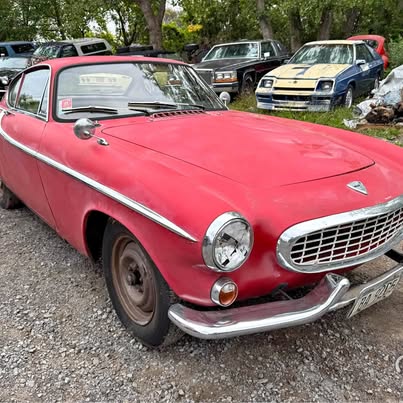
Use that comparison deliberately. Two Jensen cars side by side will show you a correct sill profile against a cover sill and an original door fit against a forced one, and once seen, the difference cannot be unseen. The same trick works across the range: inspect the best car you can find first, even one you cannot afford, and let it calibrate your eyes.
Values
Read the market figures printed beneath this guide as a snapshot of asking behaviour, not as a verdict on any car, because on this model the spread between the cheapest and the dearest example is not really a spread of prices. It is a spread of welding. A restored 1800 and a rotten one share a badge, a shape and an engine family and almost nothing else, and the market, which understands this, prices the metal and treats the badge as the entry ticket. Condition is the first driver, variant the second, and everything else is commentary.
Within condition, the variant premiums are real but modest and they move. A genuine Jensen car in sound, correct order carries a premium for rarity and for the early details, but the same car needing body work loses it again to the cost of putting Jensen-specific panels right, so the Jensen premium belongs to finished cars, not to projects. The 1800E carries a premium as the fastest and most developed coupe, and the ES carries its own, supported by genuine rarity and by buyers who want the shape and the load bay together; a good ES has been the firmest part of this market for years. The plain 1800S is the value centre of the range, and a late, overdrive-equipped S is usually the most classic motoring bought per unit of money anywhere in the model. The automatic takes money off a coupe and very little off an ES. A documented engine swap takes money off any car sold as original and very little off a car sold honestly as a driver.
The asking-versus-achieved gap follows the usual classic pattern with one 1800 twist. Sellers of restored cars ask for a fraction of the restoration cost and usually achieve a fraction of the asking price too, because a full body restoration on this model costs more than the finished car is worth. Sellers of projects ask as if the welding were minor, and buyers who know the model discount harder than the general market does, because they have priced a crossmember and two sills before. The project-versus-driver gap is therefore the widest honest signal in the market: a driving car with a sound shell is worth several times a non-running car with a rotten one, and the gap is not sentiment, it is the welder's invoice, discounted. Negotiate on evidence: a seller shown a leaking manifold pressure sensor test, a cover sill and a slipping overdrive has very little left to argue with.
Parts and ownership
Ownership is one of the pleasures of this model, because the mechanical car is a Volvo of the over-engineered era and the parts world knows it. Engine, gearbox, axle and brake consumables are well supported by the classic Volvo specialists in Sweden, Britain and the United States, helped by the fact that the B18 and B20 lived on in Amazons and 140-series cars built in far larger numbers. Seals, gaskets, bearings, bushes, dampers and brake components are routine orders. D-Jetronic service parts — trigger points, pressure sensors on an exchange or repaired basis, pumps and regulators — are available through injection specialists, and the knowledge base is deep, because the same system served several European makers.
Body and trim are the honest difficulty. Repair sections for the common rot areas, including sill components in the correct profile, are reproduced and available, and some larger panels can still be found, but the front panel, some wing sections and ES rear panels are scarce and priced accordingly, and used panels from breaker cars are usually rusty in the same places as yours. Trim divides sharply: Swedish-production coupe trim is findable with patience, Jensen-specific items and early instruments are a hunt, and ES tailgate components should be treated as assets and insured as such. Stainless reproduction bumpers have taken the terror out of the commonest brightwork problem. Before you buy any car, walk around it pricing the missing and broken trim as if you had to order it this month, because on a car with an incomplete interior that exercise, not the engine, sets the real budget.
Running one is straightforward. These engines want regular oil changes, valve clearances checked on schedule, SU dashpots topped up, coolant renewed before it turns to silt, and use: a car driven weekly gives a fraction of the trouble of one stored badly and woken violently twice a year. Expect the fuel economy of a well-kept period touring car, insurance through a classic policy at agreed value, and a club and register scene — the Volvo owners' clubs keep model registers that can also help verify a car's history — that is knowledgeable without being precious. The ownership bargain is simple: spend your money on the shell once, and the rest of the car will repay ordinary maintenance with extraordinary longevity.
Which one to buy
- The purist: a genuine Jensen P1800. Chassis 6,000 or below, correct cow-horn bumpers, correct early trim and, above all, a shell that has already been restored properly or never rotted. Buy the best one in existence or none at all; a cheap Jensen car is a down payment on someone else's restoration standard.
- The all-rounder: a late 1800S with overdrive. Swedish build quality, the classic twin-carburettor character, the simplest ownership in the range, and a manual gearbox with the overdrive that makes modern distances painless. A 1969 car adds the B20 engine and is the connoisseur's version of this pick.
- The driver: a sorted 1800E. The performance, the brakes and the interior are the best the coupe ever offered, and the injection, once tested and sorted as this guide describes, is a strength rather than a risk. Insist on the vacuum test and the hot restart, and walk away from a carburettor-converted car at E money.
- The value buy: a sound-shell 1800S that needs cosmetics. Faded paint, tired seats and worn brightwork on a structurally honest Swedish car is the cheapest route into the model that does not end in a welding bill, because everything it needs unbolts.
- The life-style buy: an 1800ES, manual if you can find it. The rarest, most useful and firmest value in the range, bought on the condition of the rear body and tailgate assembly as much as on the usual structure.
The overriding rule: buy the shell, and let the variant choose itself afterwards — the least rusty 1800 you can afford, in any badge, beats the rarest badge on a rotten shell, every time.
See the 1 P1800 cars currently listed.
For sale now
 $35,000
Expand
What they sell for: P1800 sale prices.