
Acura MDX buyer's guide
Acura MDX (2001–2001) — MDX: what's listed, and what they sell for.
Years: 2001–2001 · Models: MDX
Overview and history
The Acura MDX is the car that invented the three-row luxury crossover as Americans now understand it — and it did it by refusing to be a truck. When it went on sale in the autumn of 2000 as a 2001 model, the luxury SUV field was body-on-frame iron: the Lexus LX, the Land Rover Discovery, the Mercedes ML. The MDX was built instead on Honda's global midsize car platform, the same basic architecture as the Accord and the Odyssey minivan, with a transverse V6, a unibody shell, four-wheel independent suspension and seating for seven. It drove like a tall, heavy Accord rather than a short pickup, and buyers understood immediately. The MDX became Acura's best-selling model and the template every competitor eventually copied.
There are four generations. The first (2001–2006, chassis code YD1) is the car this guide mostly concerns, because it is the car the used market is full of: a 3.5-litre VTEC V6, a five-speed automatic, and Honda's VTM-4 all-wheel drive, built at Alliston, Ontario. The second generation (2007–2013, YD2) grew a 3.7-litre engine, the torque-vectoring SH-AWD system and a much more sporting brief — Acura tested it at the Nürburgring. The third (2014–2020, YD3) went lighter and more efficient, added a front-wheel-drive version, direct injection, a ZF nine-speed automatic from 2016 and a Sport Hybrid flagship. There was no 2021 MDX; the fourth generation arrived for 2022 with a double-wishbone front suspension, a ten-speed automatic and a turbocharged Type S.
The MDX's story across all four generations is the same tension you are buying into today. The engines are classic Honda: strong, smooth, long-lived V6s that tolerate neglect better than most. The transmissions are the opposite story in the early cars — the five-speed automatic fitted to the first generation is one of the most failure-prone gearboxes Honda has ever built, and its condition, more than mileage, more than bodywork, is what separates a good cheap MDX from a cheap MDX that is about to cost you a transmission. Read the gearbox sections of this guide twice.
A word about the market you are shopping in. The MDXs we currently track number 13 cars, every one of them a first-generation example, all automatics, and all surfaced through Facebook Marketplace listings — silver is the commonest colour in that small sample, followed by blue and black. That is representative of where first-generation MDXs now live: old, inexpensive family haulers sold privately, often by the second or third owner, often with partial history. The later generations exist in the wider market in large numbers, and this guide covers them, but if you are reading listings at the affordable end you are reading about 2001–2006 cars, and the inspection discipline below is written for exactly that encounter.
Buy the MDX for what it is: seven seats, Honda running costs on everything except one gearbox, all-weather security, and a cabin that wears its age honestly. Bought with your eyes open — and with the transmission test in this guide done properly — it remains one of the most sensible used family cars in America.
The models
Every MDX is a three-row, transverse-engined unibody SUV with a V6 (the Sport Hybrid's smaller V6 and electric motors are the only exception) and an automatic gearbox. There is no manual, no diesel and no two-row version in any generation. The badges and packages change; the basic recipe does not. What changes materially between cars is the all-wheel-drive system — VTM-4 on the first generation, SH-AWD from the second onwards, with front-wheel drive offered on the third generation — and the gearbox, which is why the table below names both where they matter.
| Model | Years | Engine | Output | Built | Character |
|---|---|---|---|---|---|
| MDX | 2001–2002 | 3.5 V6 (J35A3) | 240 hp | not published by trim | The original; the gearbox-risk years in their purest form |
| MDX Touring | 2001–2002 | 3.5 V6 (J35A3) | 240 hp | not published by trim | Leather, Bose, memory seats; navigation optional |
| MDX / Touring | 2003–2006 | 3.5 V6 (J35A5) | 265 hp | not published by trim | More power, revised gearbox internals; the sweet spot of the first generation |
| MDX (2nd gen) | 2007–2009 | 3.7 V6 (J37A1) | 300 hp | not published by trim | SH-AWD arrives; the driver's MDX |
| MDX (2nd gen) | 2010–2013 | 3.7 V6 (J37A1) | 300 hp | not published by trim | Six-speed automatic; Advance adds active dampers |
| MDX (3rd gen) | 2014–2015 | 3.5 V6 DI (J35Y5) | 290 hp | not published by trim | Lighter, front-drive available, six-speed automatic |
| MDX (3rd gen) | 2016–2020 | 3.5 V6 DI (J35Y5) | 290 hp | not published by trim | ZF nine-speed automatic; push-button selector |
| MDX Sport Hybrid | 2017–2020 | 3.0 V6 hybrid | 321 hp combined | not published by trim | Three electric motors, seven-speed DCT; rare and quick |
| MDX (4th gen) | 2022– | 3.5 V6 (J35Y5) | 290 hp | not published by trim | Ten-speed automatic, double-wishbone front end |
| MDX Type S | 2022– | 3.0 turbo V6 (J30AC) | 355 hp | not published by trim | Air suspension, SH-AWD, the flagship |
A note on the "built" column, because honesty matters more than a tidy table: Acura publishes US sales figures, not production figures broken down by trim, and per-variant production numbers for the MDX are not in the public record. What is genuinely known is the scale: the first generation sold in the tens of thousands every year in the US alone, and total MDX production across four generations runs well past a million. You will never struggle to find another one for sale — and that abundance is itself a buying tool, because it means you can walk away from a bad car without regret.
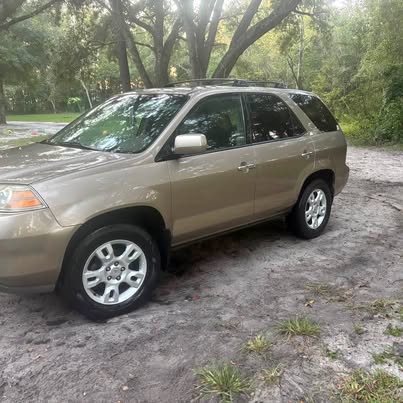
First generation (2001–2006). Two trim levels: the base MDX and the Touring, which added leather upholstery, a Bose stereo, memory driver's seat, heated seats and mirrors, and a roof rack, with navigation and later a rear DVD player as Touring options. The 2003 model year brought the stronger J35A5 engine, revised transmission internals and an upgraded VTM-4 system; the 2004 facelift smoothed the front end, added curtain airbags and dual exhaust tips, and 2005–06 cars added small equipment gains. If you are shopping the first generation — and our listings sample says you almost certainly are — the 2003-onwards cars are the ones to hunt, for reasons the gearbox section will make plain.
Second generation (2007–2013). One engine, the 300 hp J37, and a ladder of packages: base, Technology (navigation, ELS audio, rear camera), Sport (adding the Active Damper System — magnetorheological dampers — plus auto-levelling xenon headlamps), Entertainment (rear DVD), and from the 2010 facelift, the Advance package combining the active dampers with adaptive cruise and blind-spot monitoring. The 2010 cars also swapped the five-speed automatic for a six-speed. These are the keenest-driving MDXs of all — and the most complex cheap ones.
Third generation (2014–2020). Longer, lower and lighter, with the direct-injected J35 and, for the first time, a front-wheel-drive model for Sun Belt buyers — check for a rear differential before assuming any third-generation car is all-wheel drive. The ZF nine-speed replaced Honda's six-speed for 2016, identified by its push-button gear selector. The Sport Hybrid (2017–2020) paired a 3.0-litre V6 with three electric motors and a seven-speed dual-clutch gearbox, driving the rear wheels electrically — quick, economical and rare.
Fourth generation (2022–). A clean-sheet car with double-wishbone front suspension, the familiar J35 with a ten-speed automatic, standard panoramic roof, and the Type S above it: a 355 hp turbocharged 3.0-litre, air suspension, Brembo front brakes and the most capable SH-AWD yet fitted to an MDX. There was no 2021 model year, so a listing advertising a 2021 MDX is mislabelled, full stop.
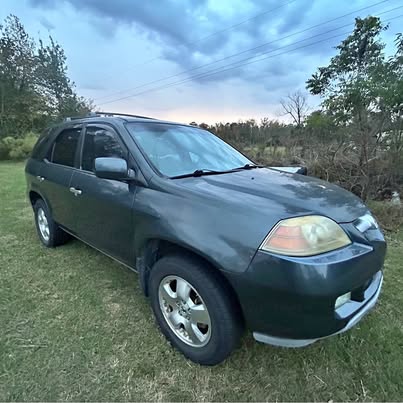
Which brings up the identity trap our own listings illustrate. One car in our current pool is advertised as a "2005 MDX SH-AWD with Advance Package." No such car exists: SH-AWD arrived in 2007 and the Advance package in 2010; the photograph shows a first-generation car on VTM-4. Sellers copy trim names from newer listings and type titles from memory. Verify generation, engine and equipment from the VIN plate and the car itself, never from the listing headline — step 1 of the inspection exists for this reason.
Engines and gearboxes
The J35: first generation (J35A3 and J35A5)
Every first-generation MDX carries a 3.5-litre, single-overhead-cam, 24-valve V6 from Honda's J family, mounted transversely and fitted with VTEC variable valve timing on the intake side. The 2001–02 cars use the J35A3, rated at 240 hp; the 2003-onwards cars use the J35A5, with a revised intake, higher compression and 265 hp. The difference is real but not transformative — both pull the MDX's roughly 4,400 lb with adequate rather than generous enthusiasm, and both are, by the standards of used-car engines, exceptionally hard to kill.
The J35's defining service fact is its timing belt. This is a belt-driven, interference engine: the belt drives both camshafts and the water pump, and if it breaks or strips, pistons meet valves and the engine is effectively finished. Honda's service interval is 105,000 miles or seven years, whichever comes first, with a shorter interval specified for severe service. On a twenty-year-old MDX the question is never whether the belt is due on mileage — it is whether anyone can prove when it was last done. A car at 130,000 miles with a timing belt invoice from a Honda or Acura dealer at 105,000 is worth more than the same car at 110,000 miles with no paperwork, because the second car needs the job now: belt, tensioner, idlers and water pump together run roughly $900–1,400 at an independent shop, and you should budget it into any purchase without proof. A sticker on the timing cover or under the hood recording the date and mileage is the mark of a conscientious previous owner. Learn to look for it.
On the road, a healthy J35 starts instantly, idles at a smooth, near-silent 700 rpm or so, and pulls cleanly through a VTEC changeover you can hear as a hardening of the exhaust note in the upper rev range. It should not smoke. A puff of blue on a cold start that clears within seconds points to valve stem seals — tolerable, monitor it. Continuous blue smoke under load is ring or bore wear, which on this engine almost always means a life of missed oil changes, and it is a walk-away on a cheap car because a rebuild never makes financial sense against the MDX's value. Oil consumption is the J35's one common vice as miles climb; a quart every 1,500–2,000 miles on a 200,000-mile engine is typical and manageable, a quart every 500 miles is a car burning its way towards catalytic converter failure as well.
Two ancillary habits to know. The engine mounts — particularly the front mount — fail with age and announce themselves as a clunk on throttle application and excessive vibration at idle in Drive; a full set fitted runs roughly $500–900 and transforms a car that feels finished into one that feels merely old. And the J35 wants its valve clearances checked periodically — they are mechanically adjusted, they tighten as well as loosen, and a top-end tick on a cold engine that fades as it warms is the engine asking for the adjustment nobody has done. Budget roughly $300–500 for a valve adjustment with fresh gaskets if the history is silent.
The J37: second generation
The 2007 redesign brought the J37A1, a 3.7-litre development of the same architecture — the largest engine Honda had then put in a production car — with 300 hp, a magnesium intake manifold and the same belt-driven, interference layout and 105,000-mile belt interval as the J35. It makes the second-generation MDX genuinely quick and suits the SH-AWD chassis. It also introduced a vice the first-generation engine largely avoids: oil consumption serious enough that Honda faced class-action litigation over the related J37, centred on carbon fouling of the piston rings, which lets oil past into the combustion chamber. Consumption on an affected car can reach a quart in under 1,000 miles. There is no cheap cure — the proper fix is pistons and rings, an engine-out job costing more than most second-generation cars are now worth — so the test at purchase is everything: check the oil level yourself on arrival (a seller who has just topped it up is telling you something), look for soot-blackened exhaust tips, and ask directly how much oil it uses. A documented low-consumption J37 is a fine engine. A thirsty one is a subscription.
The later engines: direct-injected J35, Sport Hybrid and the Type S turbo
The third generation's J35Y5 keeps the 3.5-litre displacement and the timing belt, and adds direct fuel injection and Honda's VCM variable cylinder management, which shuts down one bank of cylinders under light load to save fuel. It makes 290 hp and is the most economical MDX engine of all. VCM is its talking point: on some cars the cylinder-shutdown transition produces a vibration or drone at steady highway speeds, and long-term VCM operation has been associated with oil fouling of the deactivated cylinders' plugs and rings on Honda V6s generally. The fourth generation continues with a J35 of the same family and output.
The Sport Hybrid replaces it with a 3.0-litre port-injected V6 driving the front wheels through a seven-speed dual-clutch gearbox, plus a twin-motor electric unit driving the rear axle — no propshaft at all. It is smooth, quick and economical, and its hybrid battery and power electronics are, at the age these cars are now reaching, an unknown long-term cost rather than a known one; buy it for how it drives, with a dealer hybrid health check as a purchase condition.
The Type S (2022–) uses the J30AC, a 3.0-litre turbocharged V6 making 355 hp, with direct injection, a single twin-scroll turbo and an appetite for premium fuel that is mandatory, not advisory. It is too new for this guide's cheap-car discipline to bite hard, but the same rules apply in kind: full dealer history, oil consumption asked about directly, and no purchase without a cold start.
Gearboxes
Here is where MDXs are won and lost, so take it generation by generation.
The first-generation five-speed automatic is the single most important component in this entire guide. The MDX launched with a five-speed automatic related to the units in the V6 Accord, Odyssey and Pilot, and those gearboxes failed in numbers that forced Honda into recalls, warranty extensions (in the US, coverage on many 2001–03 cars was extended to 7 years or 109,000 miles) and a lasting reputation. The failure mechanism is heat and wear inside the clutch packs — most notoriously the third-gear clutch pack, which runs short of lubrication and overheats, shedding friction material that then circulates, clogs the internal filter (which is not serviceable without splitting the gearbox) and starves the rest of the box. A separate 2004 recall addressed a second-gear overheating issue on some cars with an oil-jet kit. The revised internals fitted from the 2003 model year improved matters without curing them; a 2004–06 car is a better bet, not a safe one.
The symptoms, in the order they usually appear: a flare or slide on the 2–3 or 3–4 upshift, where revs rise briefly before the next gear takes hold; a shudder under light-throttle acceleration around 35–50 mph; delayed or harsh engagement of Drive or Reverse from Park; and finally slipping, warning lights (a flashing D on the selector indicator is the gearbox asking for help) and loss of drive. Distinguish the shudder carefully, because two different faults produce it: torque-converter clutch shudder feels like driving over a rumble strip at a steady light throttle and disappears if you lift off or accelerate harder, while clutch-pack slip shows as revs climbing without matching road speed. The first may respond to fresh fluid; the second is a rebuild. A full rebuild or quality remanufactured unit, fitted, runs roughly $2,800–4,500 — on a first-generation car, frequently more than the car is worth, which is why the gearbox test in the inspection section is the whole ballgame. Fluid is your forensic evidence: the gearbox has a dipstick, so use it. Healthy fluid is pink-red and smells neutral. Brown, burnt-smelling fluid in a car that still shifts well is a negotiation; black fluid in a car that flares is a farewell.
Second generation. The 2007–09 cars use a stronger five-speed; the 2010 facelift brought a six-speed. Both are markedly more reliable than the first-generation box. The six-speed's known issue is a torque-converter shudder at light throttle, which Honda addressed with software updates and, in many cases, converter replacement under extended coverage — ask for the paperwork. The Sport Hybrid's seven-speed dual-clutch has a good record so far.
Third and fourth generations. The 2014–15 six-speed is Honda's own and generally sound. The ZF nine-speed (2016–2020) is the characterful one: early cars shifted harshly and hunted between ratios, particularly in the low gears where the box uses two dog-clutch engagements that are inherently slower and firmer than a normal shift; software updates improved but never entirely disguised this. Judge a nine-speed car on a long test drive, in traffic and at parking speeds, and treat jerkiness that updates have not fixed as a reason to choose another car — you will not fix it short of a replacement box. The fourth generation's Honda-built ten-speed is the best automatic ever fitted to an MDX: quick, smooth and, so far, durable.
One rule covers every generation: Honda automatics want Honda-specification fluid (ATF DW-1 in the later cars), changed on schedule. A seller who can show regular fluid changes on a first-generation car is showing you the single best predictor that the gearbox will live.
Problem areas
Start with the honest summary. The MDX's problem list is unusually concentrated: one component — the early automatic gearbox, covered in full in the engines and gearboxes section — accounts for most of the model's reputation risk, and everything else on the car is ordinary Honda wear arriving on an ordinary Honda schedule. That is good news for a buyer, because it means the inspection can be focused: pass the gearbox, the timing belt paperwork and the all-wheel-drive checks, and the rest of the car is very unlikely to ambush you. Work through what follows in that spirit.
All-wheel drive: VTM-4 and SH-AWD
The first generation's VTM-4 system is front-wheel drive in normal cruising. An electronically controlled wet clutch pack in the rear differential engages progressively as the front wheels slip or as you accelerate hard, sending up to roughly half the torque rearwards. A VTM-4 Lock button on the dashboard locks the rear clutch packs fully at low speed — it disengages progressively above about 18 mph — for extricating the car from mud, snow or a boat ramp. It is a simple, effective system with one absolute requirement: its fluid. The rear differential uses a specific fluid, VTM-4 Differential Fluid, on a 30,000-mile change schedule in the early service schedules (15,000 for the first change) and whenever the Maintenance Minder asks on later cars. Neglected fluid wears the clutch packs, and the symptoms are distinctive: a groaning, chattering or juddering from the rear of the car on tight, low-speed turns, because the clutches can no longer slip smoothly against each other. The test that distinguishes causes is the fluid itself: if the groan disappears after a fluid change (an hour's labour at most, roughly $100–200 all-in), the clutches were merely dirty; if it persists, the clutch pack is worn and you are pricing a rear differential. Never accept "they all do that" — a healthy VTM-4 rear end is silent.
Also check that the system works at all. On a loose or wet surface, a firm start should produce no prolonged front-wheel spin before the rears join in. A car whose rear drive has failed silently is a front-wheel-drive MDX, and should be priced as one. The VTM-4 warning light should illuminate with the ignition and go out after starting; a bulb that never lights has sometimes been removed to hide exactly this conversation.
SH-AWD, fitted from 2007, is a far more sophisticated system: it can overdrive the outside rear wheel in a corner and vector torque side to side across the rear axle, which is why the second-generation MDX handles the way it does. Its rear differential uses ATF (DW-1 on most years) and has the same deal as VTM-4 — fluid changes on schedule, or judder and wear. The transfer assembly at the gearbox takes hypoid gear oil on its own schedule. The second generation adds one expensive option to interrogate: the Sport and Advance packages' Active Damper System uses magnetorheological dampers whose fluid changes viscosity in a magnetic field. They are superb when working and roughly $700–1,000 per corner for the part alone when they are not. A Sport or Advance car that knocks over bumps or sits with a damper warning is carrying a four-figure bill; test it on the roughest road you can find, and cycle the Comfort/Sport damper switch to confirm the ride actually changes.
Suspension, steering and brakes
The first-generation MDX rides on struts at the front and a multi-link rear, and its wear pattern is the standard heavy-Honda one. Front struts and rear dampers are tired by 120,000–150,000 miles; the test is a bounce at each corner and a look for oil misting on the damper bodies. Sway-bar end links knock over broken pavement at low speed — cheap parts, an hour a side. Lower control arm compliance bushings perish and tear, producing a clunk under braking and vague straight-line behaviour; shine a torch on them and look for split rubber. Ball joints and tie-rod ends are checked the standard way: rock the wheel at 12-and-6 and at 3-and-9 with the car lifted — vertical play is bearing or ball joint, horizontal play is steering.
The steering itself is hydraulically assisted on the first three generations. The power steering pump whines when its inlet O-ring hardens and lets air in — a famous Honda fault with a famous fix: the O-ring costs a few dollars, and a pump that whines on a cold morning but steers quietly once warm is usually asking for the O-ring, not a $300–500 pump. Distinguish it from a failing pump by the fluid: aerated fluid in the reservoir looks foamy. Rack leaks weep from the boots; a rack replacement fitted runs roughly $800–1,300, so wet boots matter in the negotiation.
Brakes are conventional discs all round with a drum-in-hat parking brake, and the recurring complaint is pedal judder under braking from highway speed, caused by disc thickness variation that owners universally call "warped rotors." The mechanism matters for the fix: the MDX is heavy, its front discs do most of the work, and uneven pad deposits or genuinely worn discs produce the same judder — new discs and pads cure either, at roughly $300–500 an axle fitted, so price it rather than fear it. What should concern you more is a car that has sat: seized slide pins and rusted disc faces are the standard recommissioning list. The parking brake should hold the car on a slope; a non-functioning one on an automatic that has lived its life in Park is common and fixable, but it will fail an inspection in states that test it.
Air conditioning, electrics and the battery-drain trap
The MDX's air conditioning gives us the single best myth-busting test in this guide. When the air conditioning stops blowing cold on a first- or second-generation car, the seller (and, too often, a shop) will tell you the compressor has failed, and quote accordingly — a compressor replacement runs roughly $800–1,400 fitted. Very often the actual fault is the compressor clutch relay in the under-hood fuse box, a part that costs roughly $15–25 and takes two minutes to change: the relay's contacts stick or fail, the clutch never engages, and the system sits there full of refrigerant doing nothing. The distinguishing test is in the relay box: swap the air conditioning clutch relay with an identical relay from another circuit (the horn relay is the same part on many of these cars), and if the clutch clicks in and the air goes cold, you have just saved yourself a compressor. Check the relay on every car with dead air conditioning before you negotiate a dollar off for it — and if you buy the car, replace the relay on principle. Genuine compressor and condenser failures do happen, of course, and the sight glass era is long past, so a system that blows cool-but-not-cold wants a proper gauge diagnosis; budget a regas and leak check at roughly $150–300 before assuming hardware.
The second-generation car adds a genuinely sneaky electrical fault: the HandsFreeLink Bluetooth module fails internally and begins drawing current continuously, flattening the battery over two or three days of standing. The presentation is a car that starts fine all week in daily use and is dead every Monday morning, with a battery that tests good and an alternator that charges correctly. The distinguishing test is a parasitic-draw measurement at the battery with the car asleep — anything much above about 50 milliamps is a drain — and then pulling the HandsFreeLink fuse or unplugging the module and watching the draw fall. The permanent fixes are a replacement module or simply leaving it unplugged and losing the Bluetooth function; either way, a second-generation car with a recent battery and a vague story about "electrical issues" deserves this exact question.
The rest of the electrical picture is age rather than design. Navigation screens on Touring models dim, delaminate or die; the parts are used-market only and the car works fine without one. Power window regulators slow down, especially the driver's; door lock actuators chatter. The alternator is a known Honda wear item at high miles — a battery light, dimming at idle or a whine that follows engine speed is the standard presentation, and a replacement fitted is roughly $450–700. On third-generation cars, the push-button shifter and electronic parking brake mean a flat battery is a bigger event than it used to be: know the manual release procedure before you need it, not after.
Body, rust and interior
The MDX does not rust like a Mercedes of the sixties — but a twenty-year-old unibody that has lived in the salt belt has specific places to check, and our own photo pool, drawn from cars in Illinois, Maryland and Pennsylvania as well as the Sun Belt, shows the full range of outcomes. Work through them in this order.
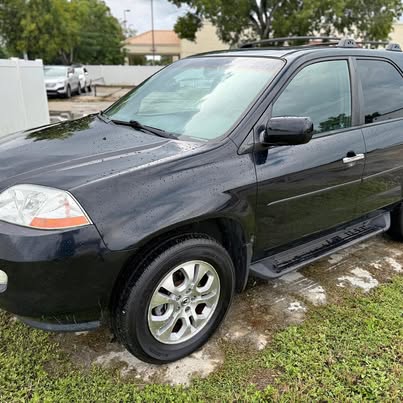
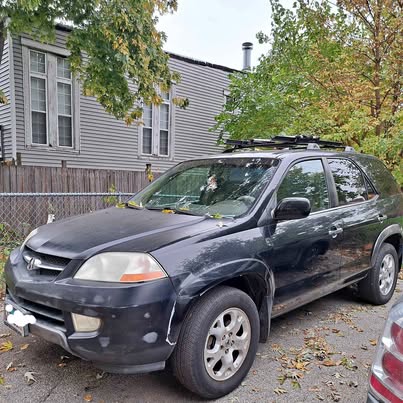
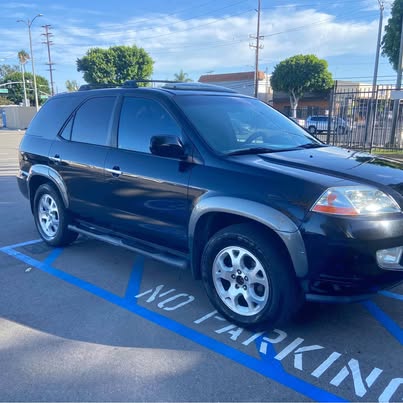
Rear wheel arches and quarter panels. The lip of the rear arch traps mud against the inner panel and bubbles from inside out; run a fingertip around the inside of the lip and feel for roughness under unbroken paint. The tailgate, around the lower edge, the licence plate lamps and the handle, where water sits in the seams. The subframes, front and rear: these are structural steel, surface rust is normal and honest, but perforation or heavy flaking scale on a salt-belt car is a lift inspection and a serious conversation — subframe replacement is possible (the part is a bolt-on) but at roughly $1,000–2,000 fitted it reprices the car. Under the running boards and side steps, where fitted: the brackets trap brine against the sill, and a car wearing boards deserves to have them looked behind, as the black Touring in our photographs reminds you — the boards are the first thing a buyer admires and the last thing anyone inspects. The roof, around the roof-rack mounts and the sunroof frame: sunroof drains block, and the water announces itself as a stained headliner or a wet front footwell, which owners misdiagnose as a windscreen leak; the drains clear with compressed air and patience, but the staining tells you it has been happening for a while.
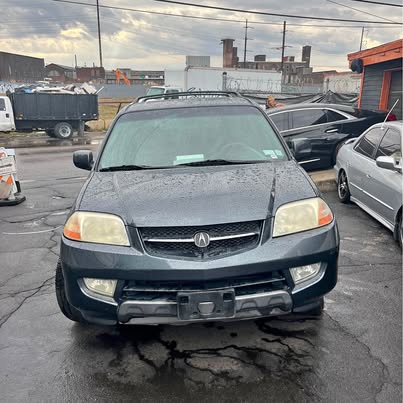
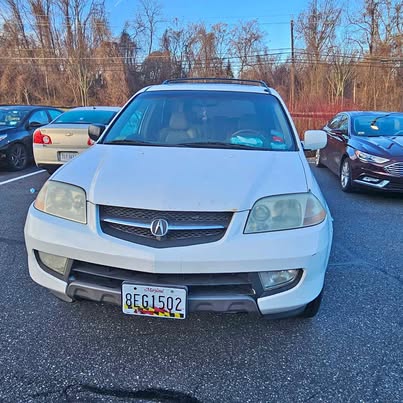
Cosmetically, the first-generation car's signature age marker is its headlamp lenses: the polycarbonate clouds and yellows until night vision genuinely suffers, and you will see it in photograph after photograph in this guide — the white 2002 car below has it badly. Polishing kits restore them for a season; replacement lamp units restore them for a decade, at roughly $150–350 a pair for pattern parts. Cloudy lamps are not a reason to reject a car, but they are an honest gauge of how the car has been kept: a seller who never bothered is telling you about the fluid changes too.
Inside, the MDX wears better than most. The leather on Touring models cracks on the driver's bolster first — sit in the driver's seat, as always, not the passenger's — and the foam beneath collapses with it; a retrim of one seat or a good used seat from the enormous breaker supply is the realistic fix, at roughly $300–700 depending on route. The third row folds flat into the floor and is the first thing to test on any viewing: pull every strap and lever, because a third row that has not moved in a decade may not move now, and the mechanism's cables stretch and snap. Headliners sag on cars that have lived in heat. The rear entertainment screens on equipped cars are almost never worth repairing or paying for. And check the tailgate struts by opening the tailgate and standing under it: a strut that lets it creep down onto your head costs roughly $40–80 a pair to replace and tells the same deferred-maintenance story as the headlamps.
How to inspect one
Allow an hour, insist on a cold engine, and bring a torch, a paper towel for the dipsticks and a code reader if you have one. The order is deliberate: paperwork first, the gearbox in the middle while the car is fully warm, and the expensive verdicts before the cosmetic ones.
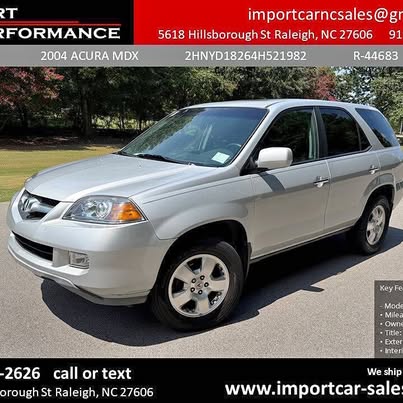
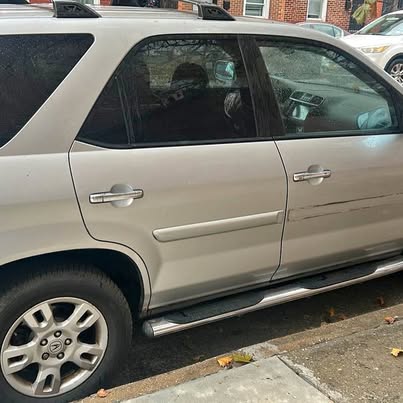
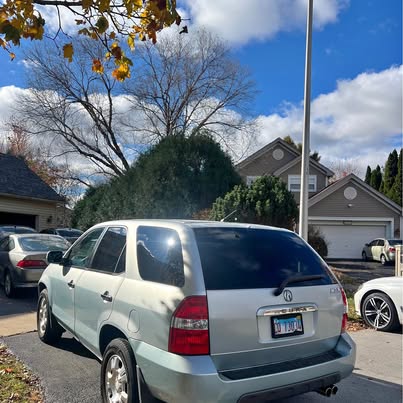
- Start with the paperwork and the VIN. Match the VIN on the title to the plate at the base of the windscreen and the sticker on the driver's door jamb. The tenth character gives the model year — the silver 2004 car pictured earlier carries a 4 in that position, exactly as it should. Then apply the identity lesson from the models section: if the listing says SH-AWD on a car built before 2007, or Advance package before 2010, or any model year 2021 at all, the listing is wrong somewhere, and you should find out where before you trust anything else in it. Ask for service history, and look hardest for three documents: a timing belt invoice, transmission fluid changes, and rear differential fluid changes.
- Cold start. The engine should be stone cold when you arrive — a warmed-up car is hiding its start-up behaviour, and on a first-generation car it may be hiding gearbox behaviour too. A healthy J35 or J37 fires instantly and settles to a smooth idle. Watch behind the car for a blue puff (valve stem seals, tolerable) or continuous smoke (walk away). Listen for a brief top-end tick that fades (valve clearances asking for attention) and for power steering whine on the first turn of the wheel (the pump inlet O-ring from the problem section, cheap — but confirm it is only that).
- The dipsticks — engine and gearbox. Check the engine oil level and colour, and on a J37 ask yourself whether the level has been freshly topped up for your visit. Then pull the transmission dipstick, wipe it on the paper towel and read it like evidence: pink-red and neutral-smelling is healthy; brown and varnished is a negotiation; dark and burnt-smelling is the gearbox telling you its clutch packs are shedding. This thirty-second test, from the gearbox section, is the most valuable one in this guide.
- The timing belt question. Ask directly: when was the belt last changed, and what proves it? Look for the sticker on the timing cover or under the hood. No proof on a car past 105,000 miles or seven years since the last known change means the job is due now, at roughly $900–1,400 — say so, and price it into the offer or walk. On an interference engine this is not a deferred-maintenance nicety; it is the difference between an engine and a boat anchor.
- The gearbox test drive. Drive at least twenty minutes, long enough for the gearbox to reach full temperature — the early five-speed's faults are temperature faults and a five-minute loop around the block is designed, consciously or not, to hide them. Include gentle suburban acceleration and watch the 2–3 and 3–4 changes for flare (revs rising before the gear takes), hold a steady light throttle at 35–50 mph and feel for the rumble-strip shudder, and make several stops and starts to test Drive and Reverse engagement from a standstill: a pause, then a thump, is wear announcing itself. A flashing D indicator at any point ends the viewing.
- The all-wheel-drive checks. In a car park, drive tight, slow, full-lock circles in both directions and listen for groaning or juddering from the rear — the VTM-4 or SH-AWD clutch-pack test from the problem section. If it groans, the fluid change is the first suspect and the price should assume the second. Then find a loose or wet surface and make a firm start: prolonged front-wheel spin with no rear assistance means the system is not working, whatever the dashboard says. Press the VTM-4 Lock button on a first-generation car and confirm the light comes on.
- Body and underside. Walk the rust map from the problem section in order: rear arch lips with a fingertip, tailgate seams, roof-rack mounts, headliner edges for drain stains, and — with the torch, on your knees — the subframes and the sills behind any running boards. Check the headlamp lenses as the maintenance barometer they are, look down each flank for ripples and at the panel gaps for accident history, and check the spare wheel well for water.
- Suspension, steering and brakes. Bounce each corner; find a broken road surface and listen for sway-link knock and damper complaints; brake firmly from highway speed and judge whether any judder is disc money (acceptable, priced) or something vaguer. On a second-generation Sport or Advance, cycle the damper switch on that rough road and confirm the ride changes — and check for damper warnings. Full-lock steering both ways, listening for pump whine and feeling for notchiness.
- Air conditioning and the relay test. Run the air conditioning at full cold for several minutes. If it never gets cold, do the relay swap from the problem section before you negotiate — two minutes in the fuse box separates a fifteen-dollar relay from a compressor quote, and you should know which car you are buying. Test the heater too, every window, the tailgate struts, both seat heaters on a Touring, and every row of seats: slide, tumble and fold them all, including the third row.
- The battery question on second-generation cars. Ask how the car behaves after standing for a weekend, look at the battery's date sticker, and if the story smells wrong — new battery, vague "electrical issues" — remember the HandsFreeLink drain from the problem section and make a parasitic-draw test part of any pre-purchase inspection.
- Codes and a lift. Plug in the reader and look for stored transmission and all-wheel-drive codes, including pending ones a seller may have cleared along with the light. Then, if the car has passed you so far, pay for a lift inspection: subframes, rear differential leaks, rack boots, compliance bushings and the underside are all lift judgements, and on a car whose whole value can be consumed by one gearbox or one subframe, it is money spent exactly where the risk lives.
- Interior last. Sit in the driver's seat and judge the bolster and the foam; sit in the third row and judge whether your family actually fits the use you have planned; check the navigation screen and the headliner. A clean, complete, working interior on a twenty-year-old family bus is evidence of the same owner attitude that changes gearbox fluid — weight it accordingly.
Values
The build below this guide carries the current market numbers — what is listed now, and what has actually been recorded as sold — and those figures move, so this section deliberately carries none. What does not move is how to read them, and the MDX market rewards readers.
First, understand what our sample is and is not. The MDXs we currently track are 13 cars, all first-generation, all automatic, all surfaced through Facebook Marketplace. That is the bottom layer of the MDX market — the oldest cars, sold privately, in the channel where condition varies widest and descriptions run shortest. It tells you a great deal about what a first-generation MDX costs and almost nothing about what a 2013 or a 2019 costs. When the computed block shows you a median, ask which generation and which channel produced it before you let it anchor you.
Second, the condition spread on first-generation cars is not really a spread of prices for the same car — it is two different markets sharing a badge. At one end sit the parts-value cars: slipping gearbox, unknown timing belt, cloudy lamps, tired interior, sold as-is by an owner who has already bought the replacement. At the other sit the maintained cars: belt done with an invoice, fluid changes on record, VTM-4 silent, everything working. The maintained car costs meaningfully more and is worth disproportionately more than the gap, because the two big-ticket risks — the gearbox rebuild and the belt service — together can exceed the entire value of the cheap car. The most expensive MDX is the cheapest one, bought twice: once at purchase and once at the transmission shop. On these cars you are not really haggling over the vehicle; you are haggling over who pays for the deferred maintenance, and the invoices are the currency.
Third, know which variants carry premiums and which carry discounts, and why. Within the first generation, 2003-onwards cars deserve their premium over 2001–02 cars, and a Touring with navigation is worth no more than a Touring without — the screen's novelty value expired a decade ago. Second-generation Sport and Advance cars carry a hidden discount you should apply yourself: the active dampers are a four-corner liability priced like a feature, so a damper-tired Advance is worth less, not more, than a plain car in the same condition. Third-generation front-wheel-drive cars are worth less than SH-AWD cars anywhere it snows and the same where it does not. Sport Hybrids are rare enough that asking prices are optimistic by default; achieved prices are the ones to trust.
Finally, the asking-versus-achieved gap. Private sellers of first-generation cars routinely price from hope — from what the car cost them, or what they have spent on it — and these cars sit. The ones that sell are priced against the recorded sales, not against other people's asking prices. As a buyer, your strongest sentence is not an offer but a question: what has been done to the gearbox and the belt, and what is the proof? The answer reprices the car more honestly than any haggling.
Parts and ownership
The MDX is one of the easiest used SUVs in America to keep, for one structural reason: underneath the Acura badge it is a Honda, built in Honda volumes, sharing its mechanical life with the Pilot, Odyssey, Ridgeline and Accord V6. Over a million MDXs and several million close relatives mean the parts ecosystem is deep, competitive and fast.
Easy and cheap: service items, filters, brake discs and pads, dampers and struts in standard form, sway links, control arms and bushings, alternators, starters, water pumps, radiators, exhaust sections, headlamp units, tailgate struts, window regulators and the famous power-steering O-ring. Most of it is order-today, fit-this-weekend, at prices that would make a German-brand owner weep. The air conditioning clutch relay deserves its place in this list: carry a spare in the glovebox of any first- or second-generation car and you have pre-paid the commonest air conditioning repair there is.
The known big tickets: the first-generation gearbox rebuild or remanufactured replacement (roughly $2,800–4,500 fitted — the number around which the whole purchase decision orbits); the timing belt service (roughly $900–1,400 with tensioner and water pump, on every J35 and J37, every 105,000 miles or seven years); Active Damper System dampers on second-generation Sport and Advance cars (roughly $700–1,000 a corner for the part); a steering rack (roughly $800–1,300 fitted); a J37 piston-and-rings cure for oil consumption (engine-out money, rarely justified); and a replacement navigation screen, a used-parts hunt rather than a catalogue order. None of these is exotic, and all of them are knowable before you buy — which is the entire point of the inspection section.
Running costs. Fuel consumption is the MDX's honest weakness: the first generation returns figures in the mid-to-high teens in town and the low twenties on a highway run, on regular fuel for the first two generations — the Type S wants premium — and the later direct-injected cars improve on that by a useful but not transformative margin. Tyres are mainstream sizes and sensibly priced. Servicing at an independent Honda specialist is straightforward; the one discipline to keep is fluid: engine oil on schedule, gearbox fluid changed rather than believed in, VTM-4 or SH-AWD rear differential fluid on its own schedule. Owners who keep that discipline report the dull, happy ownership these cars were built for.
The first-year budget. Expect the first year to be a catching-up exercise: a timing belt service if unproven, fluids end to end, tyres or brakes or both, and the small stuff — lamps, struts, a relay, a battery — that the previous owner's last year deferred. Buy the car with the shortest catch-up list rather than the lowest sticker, and the MDX will repay you the way Hondas do: by starting every morning and asking for very little.
Which one to buy
- The all-rounder: 2004–2006 MDX Touring. The facelifted first-generation car with the stronger J35A5, revised gearbox internals and the best equipment — bought, as every first-generation car must be, on gearbox behaviour and belt paperwork rather than mileage. This is the MDX most buyers should end up with.
- The value buy: 2003 MDX. First year of the 265 hp engine and the improved transmission, without the facelift cars' price premium. A 2003 with fluid-change history is the cheapest route into a good first-generation MDX.
- The driver's pick: 2007–2009 MDX with Technology package. The 300 hp J37, SH-AWD at its keenest and the five-speed at its strongest — and no active dampers if you avoid the Sport package. Ask the oil-consumption question out loud and check the level yourself.
- The family flagship: 2010–2013 MDX. The six-speed automatic completes the second-generation package. Choose the base or Technology trim and let someone else own the Advance's dampers at this age — unless the damper bill is documented as already paid.
- The economist: 2014–2015 MDX SH-AWD. The lighter third-generation car with the direct-injected engine and Honda's own six-speed, before the ZF nine-speed's manners enter the conversation. Front-wheel-drive cars are the same bargain in the Sun Belt and a compromise anywhere it snows.
- The specialist choice: 2017–2020 MDX Sport Hybrid. Quick, frugal and rare, with an electric rear axle and no propshaft. Buy it with a dealer hybrid health check as a condition of sale.
- The modern flagship: MDX Type S (2022–). A genuinely fast, genuinely luxurious car. Full dealer history and a cold start, as always — the rules do not stop applying just because the car is newer.
And the rule that overrides all of the above: buy the gearbox, the belt paperwork and the fluid history — the car attached to them is the one to own. An MDX with a sweet-shifting transmission, a documented timing belt and silent all-wheel drive is a good car in any generation and trim. An MDX without them is a bill looking for somewhere to land, and no discount has ever been deep enough to change that.
Listed now
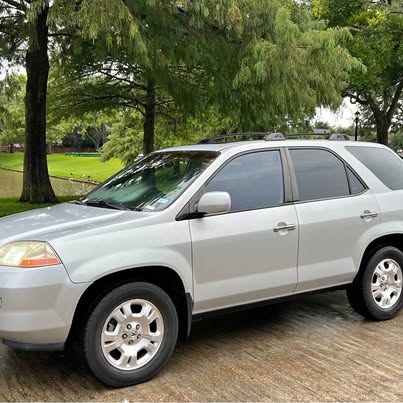
On Classic Listings today: 2 cars are listed here; 2 for sale and 0 marked sold; average asking price $3,000; asking range $2,500 to $3,500.
See the 2 MDX cars currently listed.
The market — recorded sales
No dated sales recorded for this series yet — as sales are recorded, they will appear here with their dates and prices.
For sale now
 $2,500
Expand
 $3,500