
Chrysler Six buyer's guide
Chrysler Six (1924–1933) — G70, CM, CI: what's listed, and what they sell for.
Years: 1924–1933 · Models: G70, CM, CI
# Chrysler Six (1924–1933) — buyer's guide
Overview and history
The Chrysler Six is not one car. It is the car that created a company, and then the name that company gave to its six-cylinder line for a decade while the line changed almost everything underneath the badge. When you stand in front of one, the first job is to work out which Chrysler Six you are actually looking at, because a 1924 Model B-70 tourer and a 1932 Series CI coupé share a philosophy and almost no parts.
The story starts in January 1924 at the Commodore Hotel in New York, where Walter P. Chrysler — fresh from turning around Willys and from running Buick — showed the first car carrying his own name. He had taken over the ailing Maxwell Motor Corporation and inherited its Detroit plant (the old Chalmers works), but the car itself was new, designed by the engineering trio of Fred Zeder, Owen Skelton and Carl Breer. The specification read like a car costing far more: a high-compression six (4.7:1 when rivals ran nearer 4:1, using a Ricardo-type cylinder head), a seven-main-bearing crankshaft, full-pressure lubrication, aluminium pistons, a replaceable oil-filter element — an industry first — and, most radical of all, four-wheel hydraulic brakes at a time when most American cars braked only the rear wheels, mechanically. The model number was a promise: B-70 meant a genuine 70 mph. About 32,000 were sold in the first year, and the car finished credibly at Le Mans in 1925 and raced in the great road races of the decade — Chryslers were entered at Le Mans in 1925, 1928 and 1929.
Through the 1920s the Six multiplied. The B-70 became the G-70 for 1926 with a larger engine; a smaller, cheaper Series 60 joined for 1927; the numbers crept upward year by year (62 and 72, then 65 and 75, then 66, 70 and 77) as wheelbases and displacements grew, and the Imperial sat above the Sixes as the flagship. Then, at the turn of the decade, Chrysler re-engineered the Six around a cheaper four-main-bearing engine and letter codes: CJ, then the Cord L-29-styled CM of 1931, then the CI of 1932, by which time the Six was Chrysler's only six-cylinder line and shared showrooms with the new eights. The Depression thinned production savagely, and the letter-series cars are correspondingly scarcer today.
Why buy one now? Because these are among the most usable and best-engineered American cars of the vintage era: hydraulic brakes that actually stop, engines that cruise at speeds a Model A Ford cannot sustain, and engineering that rewards maintenance rather than punishing it. They are eligible for a wide range of vintage touring, they carry real historical weight as the founding Chryslers, and the open cars — roadsters and phaetons — have the presence of cars from a class above. Against that, you are buying a car between roughly ninety and a hundred years old, built around wood-framed bodywork, poured-babbitt bearings on the early engines, six-volt electrics and a vacuum fuel feed on the early cars. None of that is a reason to walk away. All of it is a reason to inspect properly, which is what the rest of this guide is for.
One naming warning before you go further: period numbers were top-speed claims, not engine sizes or trim levels, and sellers routinely mislabel cars by a series or a year. A "70" can be a 1924 B-70, a 1926 G-70, a 1927 Series 70 or a 1930–31 Series 70, and those are three different engines in two different chassis families. The serial number and the engine number — covered in the inspection section — settle what a car is. The badge does not.

The models
Chrysler changed the Six's designation almost every year, but the line falls into three clear generations. The first (1924–26) is the original Zeder-Skelton-Breer car: B-70, then G-70. The second (1927–30) splits into a smaller six (Series 60 and its successors) and a larger six (Series 70 and its successors, up to the big Series 77), all still on the seven-main-bearing engine architecture. The third (1930–33) is the letter series — CJ, CM, CI and their successors — built around the new four-main-bearing engine, a lower double-drop frame and, from the CM, the wide, vee'd radiator shell copied from the Cord L-29.
Body styles across the decade cover the full period catalogue: two- and four-door sedans, coaches, coupés (with and without rumble seats), roadsters, touring cars and phaetons, convertible coupés, and a scattering of town cars and semi-custom bodies on the longer chassis. Closed cars vastly outsold open ones when new; open cars are what the market wants now, which is why so many surviving "roadsters" deserve a hard look at their numbers — see the identity checks in the inspection section.
| Model | Years | Engine | Output | Built | Character |
|---|---|---|---|---|---|
| Model B-70 | 1924–25 | 201 cu in L-head six, seven mains | 68 hp | about 108,600 (B-70/G-70 combined reporting varies) | The original: the first Chrysler, 112¾ in wheelbase, 70 mph |
| Model G-70 | 1926 | 219 cu in L-head six, seven mains | 68 hp | 72,039 | Bored-out B-70; the most sporting mid-20s Chrysler in roadster form |
| Series 60 / 62 / 65 | 1927–29 | 180 cu in L-head six (later 196 cu in in the 65) | 54 hp (60: 54; 65: 65–72) | not reliably separated | The smaller, cheaper Six on a 109 in wheelbase |
| Series 70 / 72 / 75 | 1927–30 | 219 cu in, growing to 249 cu in (72) L-head six | 68–85 hp | not reliably separated | The mainstream big Six; longer wheelbases, fuller body choice |
| Series 70 (late) / 77 | 1930–31 | 268 cu in L-head six, seven mains | 93 hp | not reliably separated | The last and strongest of the seven-main cars |
| Series CJ | 1930–31 | four-main-bearing L-head six | not reliably recorded here | not reliably separated | The reset: low-slung chassis, internal-expanding hydraulic brakes, rubber mountings |
| Series CM ("New Six") | 1931–32 | 217 cu in "Silver Dome" L-head six, four mains | 77–78 hp | about 38,800–40,000 | Cord L-29 looks, double-drop frame, 116 in wheelbase |
| Series CI | 1932 | 223–224 cu in L-head six, four mains | 82 hp | roadster about 1,000; total not reliably separated | The CM updated: narrower radiator surround, cowl lamps moved to the body, sole Chrysler six for 1932 |
(Outputs are period factory ratings and vary slightly by source and market; production figures are given only where they are reliably documented, and left open where period reporting entangles the series with each other — treat any seller quoting you an exact build figure for a mid-range series with suspicion unless they can show the source.)
The B-70 and G-70 (1924–26) are the historically significant cars. Everything that made Chrysler's reputation is here: the high-compression seven-main engine, hydraulic brakes, a chassis that handles by the standards of the day. They are also the most primitive to live with — vacuum-tank fuel feed, external-contracting brake bands on the earliest cars' descendants' hardware evolving year by year, and bodies framed in wood with steel skin. The G-70 roadster is the collector's pick of the early cars; the sedans are the value way into a genuinely important motor car.
The split-range cars (1927–30) are the touring choice. The Series 60 family gives you the Chrysler experience in a smaller, lighter package; the 70 family gives you room, pace and the full body catalogue. The 1928–29 cars benefit from steady detail development, and the late Series 70/77 with the 268 cu in engine is a genuinely fast vintage car — 93 hp in a chassis designed when its maker raced at Le Mans. These are also the cars most often misdescribed, because the numeric badges overlap across years: check the engine number against the series claimed, every time.
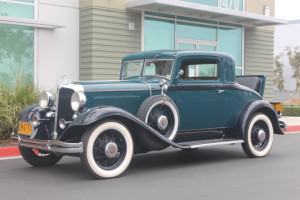
The letter cars (CJ, CM, CI, 1930–33) are the most modern-feeling: lower, with internal-expanding hydraulic brakes, hydraulic shock absorbers, rubber engine mountings and (on the CM/CI) styling that still turns heads. The CM roadster and convertible coupé, with the vee'd radiator and sidemounts, are among the best-looking American cars of 1931 at any price. The CI of 1932 adds Floating Power engine mounting, freewheeling and an optional vacuum automatic clutch — features that need understanding, and checking, rather than fearing (see Engines and gearboxes). Production collapsed with the Depression, so letter-series open cars are rare: about 2,281 CM roadsters and roughly 1,000 CI roadsters were built.

Engines and gearboxes
The seven-main-bearing sixes: B-70, G-70 and the numeric series
The founding engine is an L-head (side-valve, flathead) inline six of 201.5 cu in (3.3 litres; 3 in bore × 4¾ in stroke), designed by the Zeder-Skelton-Breer team and built around ideas that were advanced for 1924: a counterbalanced crankshaft carried in seven main bearings, full-pressure lubrication to the mains and big ends, aluminium pistons, a replaceable-element oil filter, an air cleaner, and a Ricardo-type high-compression head giving 4.7:1 compression and 68 hp at 3,000 rpm. Period road-testers recorded 5–25 mph in 7.5 seconds and a top speed around 75 mph — performance that embarrassed eight-cylinder cars costing far more, which is precisely why the number on the badge was the top speed.
For 1926 the G-70 bored the block out to 3⅛ in, giving 218.6 cu in (3.6 litres) at the same 68 hp rating and the same 4¾ in stroke. That 219 cu in unit carried the Series 70 through 1927 and, with development, to 75 hp in early 1930 Series 70 form. The smaller Series 60 of 1927 used a shortened-stroke derivative of 180.2 cu in (3 in × 4¼ in) rated at 54 hp; the Series 65 of 1929 stroked that family to about 196 cu in and 65 hp (72 hp with the optional high-compression "Red Head"). The bigger line grew the other way: the Series 72 of 1928 took the big six to 248.9 cu in, and for 1930 the Series 77 engine — adopted by the late Series 70 — reached 268.4 cu in (3⅜ in × 5 in) and 93 hp at 3,200 rpm, the strongest of the seven-main cars.
What defines these engines in ownership is not the specification but the bearing technology. The mains and big ends are poured babbitt — white metal cast directly into the caps and rods and machined to fit the crank, with clearance set by shims. Done well, babbitt is quiet, durable and tolerant; the seven-main crank is stiff and these engines have a deserved reputation for smoothness. But babbitt work is a specialist trade now. A worn engine does not get a set of shells off a shelf: it gets stripped, the metal re-poured or the rods exchanged, line-bored and scraped in. Budget accordingly (see Problem areas) and interrogate any claim of a "rebuilt engine" for the machine-shop invoice that says who poured the bearings.
Induction is a single updraft carburettor on the early cars (period fitments include Carter and Stromberg units depending on year), fed on the 1920s cars not by a pump but by a vacuum tank on the firewall: engine vacuum draws fuel from the rear tank into the vacuum tank, which then feeds the carburettor by gravity. Ignition is by coil and distributor with the distributor mounted on top of the engine on the seven-main cars — a useful identification tell, because the later four-main engines carry the distributor low on the side of the block. Cooling is by pump and a tall honeycomb or tube-and-fin radiator under that mesh grille, unpressurised in the early years.
The four-main-bearing "Silver Dome" sixes: CJ, CM and CI
By 1929 Chrysler needed a six it could build more cheaply across Chrysler, DeSoto and Plymouth, and the answer — developed from the DeSoto Series K engine — was a new L-head six with deep block skirts and only four main bearings, the distributor moved to the side of the block. This is the engine family (the long-running Chrysler flathead architecture in its first form) that arrived in the Chrysler line with the Series CJ of 1930 and powered the CM and CI.
In the CM "New Six" of 1931 it displaces 217 cu in and carries the "Silver Dome" cylinder head — Chrysler's name for its high-turbulence combustion-chamber design, the silver-painted dome head being the standard fitment, with a higher-compression "Red Head" offered in period as the performance option on Chrysler sixes generally. Output is 77–78 hp. The CI of 1932 takes the same architecture to 223–224 cu in and 82 hp at 3,400 rpm, breathing through a single Ball & Ball carburettor (the Model 6A1 is the documented fitment on the CI roadster) — by now a downdraft unit on the later cars, fed by a mechanical fuel pump rather than the 1920s vacuum tank.
Do not let anyone tell you the four-main engine is "the weak one." Four mains on a low-revving, low-compression six of this size is adequate engineering, and this engine family's descendants powered Chrysler products for three more decades. What changes for the buyer is the bearing story: you are into the era where bearing practice varies by engine and rebuild history, and owners of CM engines still debate insert versus babbitt in the club world because both appear in period practice and in later rebuilds. The only way to know what is inside a specific engine is the rebuild documentation or a sump-off inspection — one more reason the paper trail matters more than the paintwork.
The CI also brought Floating Power to the six: Owen Skelton's engine-mounting system, which carries the engine at two points on an axis through its centre of mass (high at the front, below the water pump; at the rear under the gearbox), with a transverse spring and rubber-lined snubber limiting rotation. The engine is meant to rock slightly on its mounts. Perished mount rubbers and a collapsed snubber turn that designed-in movement into a thump on take-up and a shake at idle — cheap parts, transformative difference, and covered in Problem areas.
Gearboxes, freewheeling and the automatic clutch
Every Chrysler Six in this guide has a three-speed manual gearbox, floor- or centrally-mounted lever, driving the rear axle through an open propeller shaft. The 1920s boxes are sliding-gear units: no synchromesh anywhere, straight-cut or early helical gears, and a requirement that you double-declutch on downchanges and match revs on upchanges if you want silence. This is technique, not defect — a healthy box driven properly is quiet, and a box that crunches in the hands of a driver who can demonstrate the technique on another vintage car is telling you about worn dogs and tired bearings. Gearbox internals for these units are not catalogue items; a noisy box is a specialist rebuild, so its condition is a price lever.
Clutches are single dry plates, mechanically operated on the early cars. Two period devices complicate the early-1930s cars. Freewheeling — a one-way clutch in the transmission, engaged or locked out by a dash control (the brass "FREEWHEELING" knob on 1932 Chrysler products) — lets the car coast with the engine at idle and allows clutchless shifts between second and top. It was standard on 1932 Chrysler products. It also removes engine braking, which is why period factory bulletins and generations of owners disabled or locked out the units. When you inspect a CI, establish whether the freewheel is connected, locked out, or removed, and drive the car in the state it will be used in — a car that coasts unexpectedly on a descent is a hazard, not a curiosity. The vacuum-operated automatic clutch, an extra-cost accessory on 1932 cars, uses manifold vacuum (through a canister on the right side of the engine, linkage to the clutch arm and a control tied to the throttle) to work the clutch for you once moving. Most survivors have it disconnected. A working one is a talking point; a half-connected one is a vacuum leak with a pedal attached. Either way, it is not a reason to reject a car — but its state must be known, and the riveted 1932 vacuum canisters are effectively unserviceable, so "it just needs the canister" means sourcing a used unit from any 1932 Chrysler product.
Rear axles are conventional live units on semi-elliptic leaf springs front and rear, with a beam front axle. Gear whine from the axle on the overrun, and slack you can feel by rocking a rear wheel against the transmission brake, are the wear tells; high-speed axle gear sets were a period and club preoccupation for the CM/CI cars precisely because their cruising ability exposes axle noise that a town car never reveals.
Driving one well is a skill worth budgeting learning time for. First gear is for starting only; the engines have the torque to pull second from walking pace, and top is a direct drive that a healthy car holds down to 25 mph. Downchanges into second want a proper double-declutch with a blip; downchanges into first are done at a standstill or not at all. On a freewheeling CI, remember the sequence the other way: lock the freewheel out before a long descent, every time, because the drum brakes — good as they were for their day — will fade if asked to do the engine's braking work for a whole mountain. Owners who master the technique find these gearboxes sweet; owners who fight them conclude wrongly that the box is worn. When you test-drive, ask the seller to drive first: a quiet box in their hands and a crunching box in yours is a lesson, not a defect.

Problem areas
Body structure: the wood underneath everything
The single most important thing to understand about a Chrysler Six — any year, any body — is that the steel you see is a skin over a wooden skeleton. Sills, pillars, door frames, roof rails and the framing around the rumble seat and boot are ash and other hardwoods, jointed, screwed and glued, and the steel panels are nailed and screwed to that frame. When the wood is sound, the body is rigid, the doors shut with a thunk and the panel gaps stay even. When the wood rots — and it rots from the inside, fed by water trapped behind trim and under floorboards — the body sags, doors drop and bind, gaps open at the top and close at the bottom, and the steel skin, now carrying loads it was never meant to carry, cracks around its fastenings.
Rot starts where water sits: the bottom of the door pillars, the sill ends, the lower cowl, the framing at the base of the windscreen, the wood around the rumble-seat aperture and boot floor, and the floorboards themselves. On open cars add the top-well and the header rail. You cannot see most of it without lifting trim and carpets, which is why the door test matters so much: open each door fully, lift it gently at the handle end, and feel for movement at the hinges — movement means worn hinge pins, rotted pillar wood, or both, and the distinction is made by watching where the flex happens. Press a small screwdriver (with the seller's permission) into exposed wood at the sill ends and pillar bases: sound ash resists; rotten wood lets the blade sink like cake. A car needing structural wood is not a weekend job — a proper re-wooding of a sedan body by a specialist runs well into five figures, and even a localised sill-and-pillar repair is typically $2,000–5,000 a side once trim, paint blending and re-hanging are counted. This, not the engine, is where Chrysler Six money disappears.
The steel itself rusts in the predictable places: lower door skins, the bottoms of the rear wings where they meet the running boards, running-board aprons, the valance panels, the bottom of the boot lid and rumble lid, and the fuel tank. Look along the flanks in raking light for the ripples and filled edges that betray old repairs, and use a magnet over a thin cloth on door bottoms and wing edges. Chassis frames are stout channel steel and rarely rot structurally except at the rear crossmember, around the spring hangers and battery box area, and where mud packs behind the running-board brackets — but check, because a cracked frame rail near a spring hanger is a known period failure on hard-used cars and a welding job that must be done by someone who understands riveted chassis.
The seven-main engines: babbitt, oil pressure and the vacuum tank
A healthy seven-main six starts easily, idles smoothly and shows strong oil pressure that stays respectable when hot. The failure pattern to hunt is the classic babbitt one: oil pressure that is fine cold — 40 lb or better on the gauge — and falls away as the engine reaches temperature, accompanied eventually by a deep knock under load. The mechanism is simple: bearing clearances grow with wear, hot oil is thin, and a worn pump cannot maintain pressure across the enlarged clearances. Cold pressure proves nothing; judge the engine fully hot, at idle and at a fast cruise, on the car's own gauge and, if the seller permits, a test gauge. Owners of the later four-main cars report the identical pattern (a CM6 holding 40 lb cold and fading hot is a documented club-forum complaint), so apply the test to every car in this guide.
Distinguish the causes before you price the cure. Low pressure at all temperatures points to the pump, a stuck relief valve, a clogged pickup or diluted oil. Pressure that collapses only when hot points to bearing clearances. A rear-main leak that pours rather than weeps — oil dripping steadily from the weep hole at the bottom of the flywheel housing — is often the rear main bearing itself worn enough that the slinger-and-drain arrangement at the back of the crank cannot cope: period design relies on an oil slinger and a drain-back passage, not a modern lip seal, so a worn rear main overwhelms it. Some weeping is normal on these engines; a drip that leaves a puddle after a run is a symptom, not a character trait. A full babbitt rebuild of a seven-main engine — strip, re-pour, line-bore, crank grind, pistons, valves, gaskets — is a $10,000–20,000 undertaking at a specialist in today's money; a four-main engine rebuild is broadly comparable once machine work is counted. An engine with documented recent bearing work is worth a substantial premium; an engine described as "rebuilt" with no invoice is an unknown engine wearing paint.
Valve gear is side-valve simple: tappets that need periodic clearance adjustment (a noisy top end on a flathead is usually just tappet clearance, set with the engine hot per the manual), valve guides that wear and let the engine smoke on the overrun, and valves that burn if clearances close up. A compression test, plugs out and throttle open, should show even figures across all six; one low cylinder on a side-valve six is most often a valve, not a ring, and a wet test separates the two. Cooling systems fail by neglect: the tall radiators silt up, water pumps weep and develop play, and hoses perish. Overheating on a flathead six cooks the head gasket and, worse, can crack the long cast-iron head or block between cylinders — an engine that "just needs a head gasket" after overheating deserves a crack test before money moves.
The vacuum tank (1920s cars) is the other signature failure. Its internal float valve and needle wear, its vacuum check valve leaks, and the result is a car that runs the carburettor dry on long climbs, stalls at idle after a run, or floods. The test is a long hill or a sustained fast run: fuel starvation that never happens in town is the vacuum tank (or a perished line) until proved otherwise. Rebuild kits and exchange units exist through the vintage trade, and many cars have been converted to an electric pump — acceptable if done neatly with a pressure regulator, since the updraft carburettor wants only about 2–3 psi; a raw electric pump without regulation will flood it.
The four-main engines and the letter cars
The CM/CI engine repeats the oil-pressure and cooling checks above, with additions. Its distributor sits low on the side of the block, driven from the camshaft; worn drive gears and a worn distributor shaft give a wandering dwell and a timing scatter you can see with a timing light as a jittering mark — the car will idle unevenly and feel flat, and owners blame the carburettor. Check for shaft play by rocking the rotor. The Ball & Ball downdraft carburettor on the CI is a simple, rebuildable unit; flat spots are usually accelerator-pump or float-level issues, and flooding after a hot soak points to a sinking float or a needle valve held off its seat by modern-fuel debris. Fit an inline filter if one is not present, and expect to clean the system of any car that has sat.
Floating Power mountings (CI, and Plymouth practice of the period) perish: the rubber in the front mount and the snubber bracket hardens and collapses, the engine sits low and rocks too far, and the exhaust and linkages take the strain. Rock the engine by hand at the rocker cover (engine off) and look for excessive movement and cracked rubber; replacement mounts are available through the vintage Mopar trade and fitting them is a half-day job that transforms the car's refinement. Rubber spring shackles and engine mountings, introduced with the CJ generation, are likewise consumables now ninety years old — budget to replace every rubber bush in the chassis of any letter car that still wears its originals.
Brakes, steering, suspension and wheels
Chrysler's hydraulic brakes were the 1924 headline, and the system is a conventional single-circuit Lockheed-type layout: master cylinder, steel and flexible lines, wheel cylinders and drums — external-contracting bands on the earliest cars' transmission brake arrangement aside, by the later 1920s and on the letter cars you have internal-expanding drum brakes at all four wheels. A single circuit means a single failure empties the system, so the inspection standard is absolute: any weeping wheel cylinder, any perished flex hose, any rusted steel line is a replace-before-driving item, and a full hydraulic overhaul (wheel cylinders sleeved or replaced, master cylinder rebuilt, hoses and lines renewed) at $800–2,000 in parts and labour is best treated as a first-year cost on any car without documented recent brake work. The pedal should be firm and high; a pedal that sinks slowly under sustained pressure is a master-cylinder bypass or a leak, and a pedal that needs pumping is air or maladjustment. Brake drums on these cars are not thick castings with a lifetime of skims in them — measure before assuming a skim is possible.
Steering is a worm-and-roller or worm-and-sector box (depending on year) with a long drag link and tie rod to a beam axle. Wear shows as free play at the wheel rim — an inch or two is period-normal, a quarter-turn is not — and as wander that owners misdiagnose as alignment. Kingpins wear and let the front wheels lean and shimmy; the test is to jack the wheel and rock it top-to-bottom (kingpin and bush play) versus side-to-side (wheel bearing and steering play). Shackle pins and spring bushes wear oval; lever-arm or early hydraulic shock absorbers leak and go slack, and a car bouncing twice after a push on the wing has no damping left. None of this is exotic, all of it is available through the vintage trade, and all of it is negotiating leverage because a front-end overhaul is a $1,500–4,000 job done properly.
Wheels define the era of the car: wooden-spoke artillery wheels on the 1920s cars, steel disc or wire wheels increasingly through the period, wires standard-looking on the CM/CI sporting bodies. Wooden spokes loosen — the test is to grip each spoke and try to move it, and to listen for the creak as the car is rocked; a wheel with loose spokes needs a wheelwright, and a set of five rebuilt artillery wheels is a four-figure purchase. Wire wheels need the same spoke-by-spoke check plus a look for rust at the rim well and broken spokes at the hub. Tyres will almost certainly be aged rather than worn: check the date codes and sidewall cracking, and budget for a set — vintage sizes are available but not cheap, and a car on twenty-year-old tyres is not a driver whatever the tread says.
Electrics, instruments and trim
Six volts, positive earth practice varying by year — confirm before you connect anything — a generator (not an alternator) with a cutout or early regulator, and a starter that draws heavy current through cables that were marginal when new. Slow cranking on these cars is almost never a "weak battery": it is resistance — corroded terminals, a tired earth strap, undersized modern replacement cables. The diagnostic is a voltage-drop test while cranking; the cure is cables and connections, not a bigger battery. Charging faults trace to brushes, the cutout/regulator and the third-brush adjustment on period generators; a car that has been "converted to 12 volts" deserves scrutiny of how completely the conversion was done (bulbs, gauges, coil, starter duty) — a half conversion is worse than either original state.
Instruments are mechanical and repairable; the ammeter tells you the truth about the charging system and the oil gauge — where fitted — is your engine's report card, so both must work. A dead oil gauge on a car with a babbitt engine is a walk-away-until-fixed item: you cannot assess the engine without it. Lighting is feeble by modern standards even when perfect; reflectors tarnish and period bulbs dim, and many cars carry later sealed-beam conversions in the original buckets — judge night use accordingly.
Interiors are leather or cloth (broadcloth/mohair) over wood framing, and open cars add side curtains, top fabric and irons. Retrimming a sedan in correct materials is a $6,000–15,000 job; a roadster top with curtains is $2,500–5,000 made properly. Top irons bend and their sockets wear; side curtains yellow and crack and are frequently missing entirely — a complete, present set of curtains for an open car is a genuine value item. Brightwork is nickel on the 1920s cars and chrome increasingly into the 1930s; replating a full set of lamps, bumpers and handles is a four-figure job, so pitted-but-original often beats shiny-but-wrong. Check the wood-framed windscreen surround and the glass: delaminating laminated glass and cracked panes in wooden frames are glass-shop work that requires the frame to come apart, which tests the wood again.


How to inspect one
Work in this order, and do not let the seller rush you past the structural steps to hear the engine — the engine is the cheapest part of a bad Chrysler Six to fix, and the body wood is the most expensive.
- Identity first. Record the serial number from the car's data plate/frame stamping and the engine number from the block (on the later four-main engines, the number is stamped with the series prefix — a CI engine carries a CI-prefixed number, a CM engine a CM prefix, exactly as period records show). Confirm the engine's architecture matches the car claimed: seven main bearings and a top-mounted distributor for the 1920s cars, four mains and a side-mounted distributor for CJ/CM/CI. A "1932 CI" with a seven-main engine, or a "1926 G-70" with a side distributor, is not what its title says.
- The door test. Open, lift and close every door, as set out in the body section. Doors that drop, bind or need lifting to latch are telling you about pillar wood and hinge wear. Check the shut-line gaps are even top and bottom on both sides of the car.
- Wood probing. With permission, probe sill ends, pillar bases, cowl bottoms, the rumble-seat/boot framing and floorboard edges with a small screwdriver. Lift carpets and the rumble-seat cushions. Any structural softness reprices the car immediately — this is the $2,000–5,000-a-side (or worse) conversation from the problem areas.
- Steel and chassis. Magnet-check door bottoms, wing edges and rear valances; look for ripples in raking light. Underneath (a lift transforms this inspection; ask for one), check the frame at spring hangers and the rear crossmember, the running-board brackets, the fuel tank and the exhaust.
- Cold start, watched. Insist the engine is cold when you arrive. Watch for oil smoke on start-up (guides/rings), listen for bearing rumble in the first seconds before oil pressure rises, and note how readily it fires. A car that must be "warmed up for you" is hiding its cold behaviour.
- Oil pressure, hot. Drive the car at least twenty minutes. At full temperature, note oil pressure at idle and at cruise on a working gauge. Cold 40 lb means nothing; hot pressure that fades toward nothing at idle is the babbitt/clearance warning from the engine sections. Check for the rear-main drip pattern after the drive — a weep is period, a puddle is a worn rear main.
- Compression and plugs. If the car is a serious candidate, do or commission a compression test and read the plugs. Even figures with light tan deposits are what you want; one low cylinder sends you to the valve-versus-ring wet test described in Problem areas.
- Fuel system behaviour. On a 1920s car, find a long hill or sustain a fast run: starvation under sustained load is the vacuum tank. On a CM/CI, check for hot-soak flooding and a flat spot that a pump shot cures. Smell the oil on the dipstick for fuel dilution.
- Brakes, properly. From 40 mph, brake firmly in a straight line: the car should pull up square with a firm, high pedal. Then hold pedal pressure at a standstill for thirty seconds — a sinking pedal fails the car until the hydraulics are overhauled. Inspect every flex hose and look behind each wheel for wheel-cylinder weepage.
- Steering and front end. Measure free play at the wheel rim, then jack each front wheel and rock it top-to-bottom and side-to-side to separate kingpin play from bearing/steering play (see Problem areas). Drive over a rough surface and listen for shackle and spring-bush knocks.
- Gearbox and (on a CI) the gadgets. Drive with the technique the box expects — double-declutch downchanges — and judge noise and jumping out of gear under load and on the overrun. On a 1932 car, establish the state of the freewheeling (connected, locked out, removed) and of the vacuum automatic clutch, and make one descent in the car's normal configuration so you know exactly how much engine braking you have.
- Wheels, tyres, electrics and paperwork. Spoke-test every wheel (grip and twist each spoke on wood and wire wheels alike), read the tyre date codes, crank the engine from cold with the lights on to judge the six-volt system, confirm the ammeter and oil gauge work, and then read the file: rebuild invoices naming who did the bearings, brake work, wood work. On these cars the paperwork is not a bonus; it is the difference between two price classes of the same-looking car.
Values
The Chrysler Six market splits first by body, then by generation, then — far more than with most cars — by structure. Open cars command the money: roadsters and phaetons lead, convertible coupés follow, and closed sedans and coaches trail by a wide margin despite being the better touring tools, because the market pays for the vintage open-car silhouette. Within open cars, the CM and CI roadsters carry a rarity premium (their production was a few thousand and a thousand respectively, in a collapsing market) on top of their styling appeal, while the historically important B-70/G-70 open cars trade on significance as much as looks.
Condition spread is brutal and is driven by the wood. Two externally similar cars can be a full restoration apart: a car with sound original or properly restored structure, documented engine bearings and fresh hydraulics is a finished purchase, while a shiny car with soft sills is a restoration project wearing a driver's clothes, and the gap between those two states is the cost of the wood and engine work set out in the problem sections — money you should deduct in full, not split with the seller. Asking prices for pre-war cars routinely sit well above achieved prices, especially for closed cars that linger; recorded sales, not advertisements, are the evidence, and the market block beneath this guide shows both what is listed now and what has actually been recorded as sold. Use the sold record to calibrate, and expect negotiation room on any car that has been marketed for a season.
Project cars need cold arithmetic. A non-running sedan with sound wood can be a rational buy at project money because the mechanical car is simple; a non-running open car with bad wood is a liability at almost any price, because the restoration cost exceeds the finished value of all but the rarest variants. Completeness is the other silent variable: side curtains, top irons, correct lamps, the spare and its hardware, original instruments — assembling these piecemeal for a letter-series car can consume the price difference between a project and a driver. Buy the most complete car you can find, in the body style you actually want, and let the numbers below this guide tell you what that currently costs.
Parts and ownership
Ownership of a Chrysler Six runs through the vintage Mopar world rather than the modern parts trade, and it is better organised than you might fear. The Walter P. Chrysler Club (WPC) is the centre of gravity: its members hold the production knowledge, the serial-number references and the classifieds through which series-specific parts actually move. The Antique Automobile Club of America forums carry deep, searchable technical threads on exactly these cars — babbitt practice on the CM engine, rear-main oil leaks on the 1920s sixes, automatic-clutch layouts on 1932 cars — and reading them before you buy is free insurance.
Mechanical consumables are broadly available: gaskets, ignition parts, brake cylinders and sleeving services, hoses, bearings for the later engines, carburettor kits and water-pump rebuilds are all supplied by the established vintage Mopar specialists (the Bernbaum operation and its peers have supplied pre-war Chrysler parts for decades), and machine shops that pour babbitt still exist — ask the club for current names, because the good ones are booked ahead. Series-specific trim, lamps, instruments and body hardware are the hard layer: they come from donor cars, swap meets and club classifieds, which is why completeness at purchase matters so much. Wooden body framing is reproduced by specialist coachwood shops working from patterns or your old timber; budget time as well as money, and keep every piece of original wood as a pattern even when it is rotten.
Running one is straightforward vintage practice. Fuel is modern regular with an eye on ethanol: it attacks old cork floats, rubber lines and tank coatings, so renew soft lines in ethanol-rated material and keep the tank full in storage. Oil is a quality 20W-50 or straight grade per the manual's season guidance, changed often — the early cars' filtration is primitive by modern standards. Grease points (chassis, shackles, kingpins) want attention every 1,000 miles or so; tappets want checking at service intervals; the cooling system wants clean water and antifreeze with corrosion inhibitor, drained and flushed annually. Insurance is agreed-value through the classic market, club tours are welcoming to these cars, and their cruising ability — a healthy Six holds 45–55 mph comfortably — makes them genuinely usable in modern vintage touring rather than trailer exhibits.
Storage matters more than mileage for these cars. Wood-framed bodies hate damp garages and hate dry heat almost as much; a ventilated, stable environment keeps both the timber and the leather alive, and a car stored badly for a decade can need the wood attention described in Problem areas even if it never turns a wheel. Lay-up procedure is period standard: fresh oil, full fuel tank with stabiliser, tyres over-inflated or the car on stands to spare the sidewalls, battery on a maintainer (six-volt maintainers exist), and the cooling system left full of inhibited antifreeze rather than drained — a drained flathead block rusts internally with enthusiasm. Parts hoarding, within reason, is rational ownership: a spare vacuum tank or fuel pump, a set of brake cylinders, a water-pump kit and a spare distributor drive gear bought when they appear will save a touring season one day, because the supply of series-specific parts is episodic — it surfaces when a collection is dispersed or a specialist remanufactures a batch, and vanishes again just as fast.
Which one to buy
- The historian: a 1924–25 B-70, ideally an open car. The first Chrysler, the Le Mans heritage, the full Zeder-Skelton-Breer specification. You accept vacuum-tank manners and the earliest hardware as the price of significance.
- The sporting driver: a 1926 G-70 roadster. The bored-out seven-main engine, the lightest sporting body, and the best-looking of the early cars. Verify it is a genuine roadster by its numbers, not a cut-down tourer.
- The tourer: a 1928–30 Series 72/75 or late Series 70 sedan or phaeton. Room, the big 249/268 cu in engines in the later cars, hydraulic brakes and real cruising pace, at closed-car money if you choose the sedan.
- The value buy: a Series 60/62/65 closed car. The full Chrysler Six experience — engineering, presence, club eligibility — for the least entry cost in the range, with the smaller engine's lighter appetite for fuel and parts.
- The stylist: a 1931 CM roadster or convertible coupé. The Cord L-29 face, the double-drop chassis, the Silver Dome engine — and genuine rarity, with about 2,281 roadsters built. Completeness of top, curtains and sidemount hardware is everything here.
- The connoisseur: a 1932 CI, coupé or roadster. Floating Power, freewheeling, the last and most developed of the early Sixes, and Depression rarity (about 1,000 CI roadsters). Buy the gadgets' condition as carefully as the car's.
The overriding rule: buy the wood, then the bearings, then the paint — in that order. A Chrysler Six with sound structure and documented engine work is a car you can use for decades; a beautiful one with soft sills and silent bearings is two five-figure invoices waiting for a signature. Whatever the series, the most complete, best-documented car you can find is the cheap one.
Listed now
On Classic Listings today: 2 cars are listed here; 0 for sale and 0 marked sold.
See the 2 Six cars currently listed.
The market — recorded sales
No dated sales recorded for this series yet — as sales are recorded, they will appear here with their dates and prices.