
Dodge Power Wagon buyer's guide
Dodge Power Wagon -- the model's own buyer's guide: variants, values and what to check.
Years listed: 1946-1968 · Series: Power Wagon
Overview and history
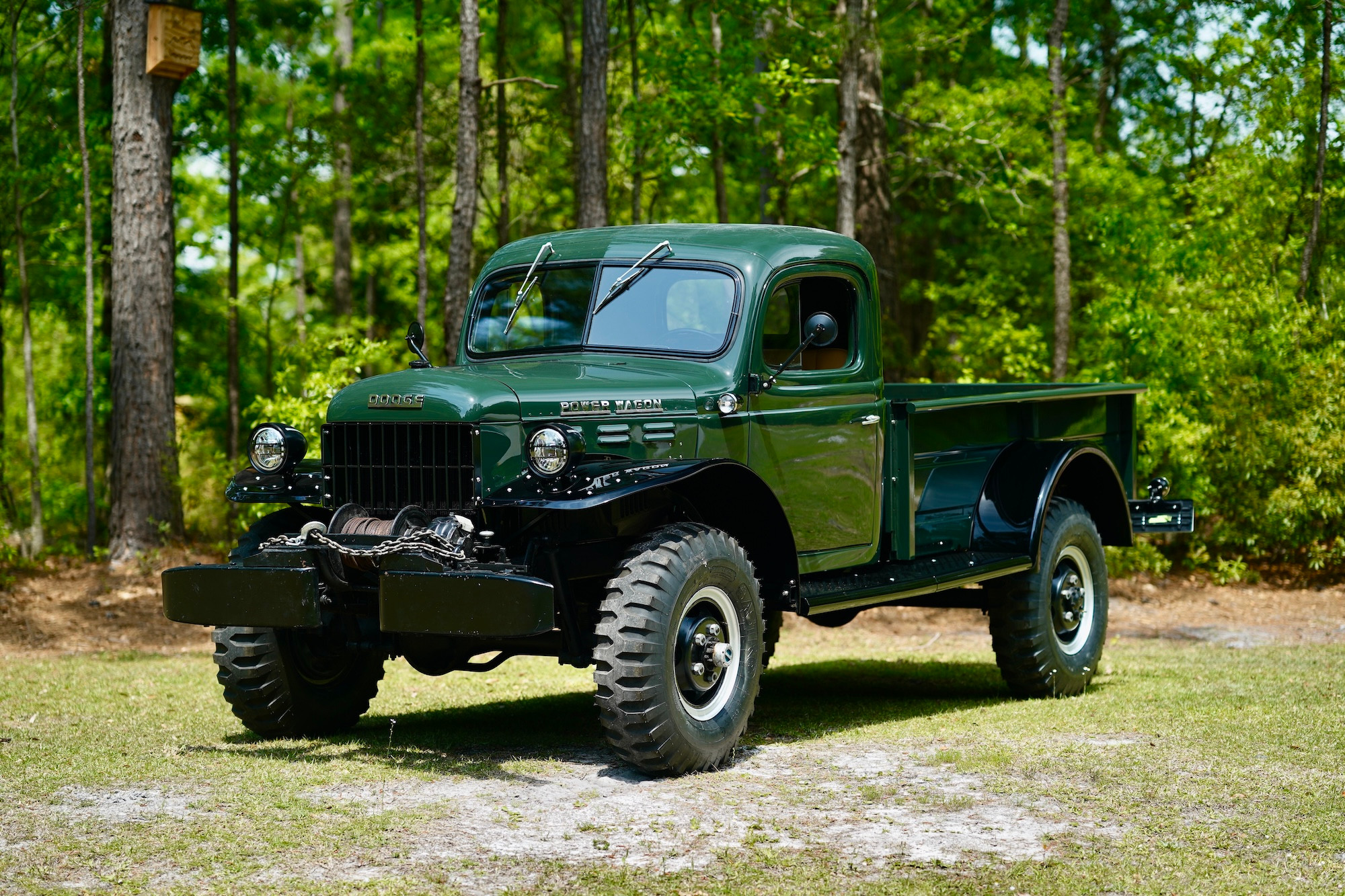
The Dodge Power Wagon is the truck that taught America what a civilian four-wheel-drive pickup was supposed to be. When sales began in March 1946, nothing else like it sat on a showroom floor: a one-ton factory 4x4 with a weather-tight steel cab, an eight-foot box, a two-speed transfer case, and power take-offs front and rear that let it drive farm machinery as readily as it drove itself.
The Power Wagon was not a clean-sheet design, and that explains both its toughness and its limitations. Underneath, it is a direct development of Dodge's wartime three-quarter-ton WC series — the weapons carriers, command cars and ambulances that served on every front of the Second World War. Dodge lengthened and reinforced the WC frame to a 126-inch wheelbase, fitted the civilian cab it had built since 1939, and added what a peacetime truck needed: a purpose-designed pickup bed and a two-speed transfer case where most wartime WCs had a single-speed unit. The development name was WDX General Purpose Truck — W for the wartime model-year series, D for the one-ton rating, X for four-wheel drive — and its engineering code, T137, is still how the registry identifies the series.
Everything about the specification was chosen for low-speed work under load. Gross vehicle weight ran from 7,600 lb to 9,500 lb by equipment and year, with a maximum payload of 3,000 lb and a bed rated to carry 2,000 lb off-road. The axles are full-floating, the gearing is for pulling rather than cruising, and the whole truck is built around the power take-off: a winch at the front, and a belt pulley, saw, mower, auger, generator or pump at the back. Dodge sold it to farmers, utilities, fire departments and highway departments — anyone whose workplace had no pavement in it. Most were worked without sympathy for decades, then worked again by private owners. That history — hard use, outdoor storage, maintenance by whoever was nearest — is the single most important fact about the survivors you will look at today.
From the first WDX of 1946 to the last US-market WM300 of 1968, the flat separate front fenders, the centrally hinged hood, the upright cab and the basic mechanical layout remained recognisably the same vehicle. Dodge improved it in steps — more compression, then more displacement, a synchronised gearbox, 12-volt electrics, lock-out hubs, a dual brake master cylinder at the very end — but never restyled it. United States sales ended after the 1968 model year, because new federal safety and emissions requirements could not be met economically by a design of this age; the same basic truck continued for export markets, wearing Fargo badges in Canada and De Soto badges elsewhere, until 1978. In total, 95,145 of the flat-fender trucks were sold in the United States between 1946 and 1968.
Two warnings about the name, because both will cost you money if you miss them. First, from 1957 Dodge also applied the Power Wagon badge to its ordinary styled pickups in four-wheel-drive form — the W100, W200, W300 and W500 — and from 2005 the name returned on an off-road version of the Ram heavy-duty pickup. Those are entirely different trucks, and an advertisement that says only "Power Wagon" tells you nothing until you have seen the shape of the front fenders. Second, the military Dodge M37 is a close mechanical cousin — same 230 flathead six — but a separate military model with its own body and 24-volt electrics, regularly advertised as a Power Wagon and not to be priced as one.
A final orientation point on evidence. The site's own pool for this model is small: 12 records in total, 4 listed for sale and 8 recorded as sold, spanning exactly the years this guide covers, 1946 to 1968. The pool is weighted towards dealer-offered trucks and one restorer-heavy cluster in North Carolina — a flavour of what reaches the open market, prominently including modernised builds, rather than a census of survivors. Where this guide cites examined-photo evidence, it does so with the sample size attached: seven photo-checked cars.

The models
Dodge changed the Power Wagon's model code almost as often as it changed the calendar, while changing the truck itself hardly at all. The codes matter because they date the truck when paperwork is thin, and expose the commonest misdescription in the market — the truck wearing the code, and the price, of a different year. The registry divides the flat-fender run into three series, and the divisions are visible in two places you can check in thirty seconds: the bed and the dashboard.
First-series trucks, late 1945 to 1950, have four rectangular stake pockets per bed side and slab-sided panels; inside, a round speedometer is flanked by two gauge housings with lettering on the glass, not the faces. Second-series trucks, 1951 to early 1956, have three slightly curved stake pockets per side, stamped bed sides whose top rail angles outwards at 45 degrees from behind, and a central group of four gauges with silver-grey faces. Third-series trucks, from late 1956 to the end, keep three stake pockets but square in section, the bed top is flat with a rounded edge from behind, and the four central gauges have black faces. If the bed, the dash and the claimed year do not agree, at least one of them has been changed, and you need to know which and why before you discuss money.
| Model | Years | Engine | Output | Built | Character |
|---|---|---|---|---|---|
| WDX | 1946–1947 | 230 cu in flathead six | 94 hp | Part of 95,145 US total | The original; purest form, crash gearbox, 6-volt electrics |
| B-1-PW | 1948–1949 | 230 cu in flathead six | 94 hp | Part of 95,145 US total | First-series truck under the B-series code; detail changes only |
| B-2-PW | 1950 | 230 cu in flathead six | 94 hp | Part of 95,145 US total | Last of the first series; four-pocket bed, glass-lettered gauges |
| B-3-PW | 1951–1952 | 230 cu in flathead six | 94 hp, rising with compression | Part of 95,145 US total | Second series begins: new bed, stronger axles, better mountings |
| B-4-PW | 1953 | 230 cu in flathead six | Up to 103 hp | Part of 95,145 US total | One-year code; compression rises, output follows |
| C-1-PW | 1954 | 230 cu in flathead six | 103 hp class | Part of 95,145 US total | C-series code, same second-series truck underneath |
| C-3-PW / C-4-PW | 1955–1956 | 230 cu in flathead six | 103 hp class | Part of 95,145 US total | Late second series, then the third-series bed arrives during 1956 |
| W300 / W300M | 1957–1959 | 230 cu in flathead six | 103 hp class | Part of 95,145 US total | Sold as the "Military Type" beside the new styled trucks; NP420 gearbox |
| WM300 | 1960–1968 | 230 cu in to 1960; 251 cu in from 1961 | 103 hp class; 115–125 hp for the 251 | Part of 95,145 US total | The final form: 12-volt, alternator, lock-out hubs, dual master cylinder at the end |
On the Built column: the 95,145 US total is supported, but factory splits by model code are not published — any precise figure for one code alone is an estimate.
The WDX and the first-series B trucks are the Power Wagon in its most collectible form, and also its most demanding. You get the four-pocket slab-sided bed and the earliest detailing. You also get the full period experience, unfiltered: no synchromesh at all, 6-volt positive-ground electrics, a foot-operated starter on the earliest trucks, and the lowest output the 230 ever carried.
The second series, 1951 to early 1956, is the quiet improver. The 1951 revisions were the largest single step the model ever took: a redesigned bed, increased axle capacities, optional heavier springs, new rubber mountings, and a revised transfer-case angle. Compression increases through 1953 to 1955 lifted the 230 from 94 hp to the 103 hp class — felt not as speed but as slightly less frantic work on a grade. These trucks keep the unsynchronised gearbox and 6-volt electrics almost to the end: a first-series driving experience over a better bed and stronger chassis.
The third series, from late 1956, is where the Power Wagon becomes measurably easier to live with, and for most buyers it is where the sensible money goes. The New Process NP420 gearbox brought synchromesh on third and fourth, which transforms the truck in traffic; the electrics had already gone to 12 volts, negative ground, for 1956, and starting became a key operation rather than a foot lever. Dodge marketed the flat-fender truck as the Military Type: W300 for 1957, W300M for 1958 and 1959, WM300 from 1960 to the end of US sales in 1968. Within the WM300 run, 1961 is the watershed year: the 251 flathead arrived, needing a grille shell extended forwards to clear the longer engine — the quickest external tell of a genuine 251 truck — plus an alternator and an 11-inch clutch. Lock-out front hubs followed for 1962, and a dual master brake cylinder for 1967 and 1968, the only meaningful safety upgrade the model ever received. If you want one Power Wagon to use rather than to curate, a 1961-onwards WM300 is the specification to hunt.
The standard truck, and the overwhelming majority of survivors, is the express pickup on the 126-inch wheelbase: steel cab, eight-foot box with a hardwood floor. Alongside it Dodge sold a chassis-cab and a flat-faced cowl, on wheelbases up to 147 inches, for special bodies — fire tenders, utility bodies, wreckers, ambulances, one-off farm and oilfield equipment. A genuine special-body truck, equipment intact and documented, is industrial history and should be judged as one; one stripped and wearing a reproduction pickup bed is a chassis-cab in fancy dress, priced as one. Factory options that matter were the Braden MU-2 front winch, the rear power take-off with belt-pulley assembly and governor, heavier springs, and the deluxe cab package — second wiper, sun visor, armrest — with a heater always separate and frequently absent. Survivors with winch and rear PTO complete and working sit at the top of the original-truck market for their series.
Finally, the modern phenomenon you cannot ignore, because it dominates the visible market — including the Classic Listings pool for this model, where the North Carolina cluster consists largely of one specialist's builds. The restomod Power Wagon keeps the 1946 silhouette and replaces almost everything underneath it: a modern turbodiesel or V8, a modern gearbox, power steering, disc brakes, air conditioning, a stretched four-door cab in the most elaborate builds, and highway gearing. Done by the established specialists, these are superbly capable trucks that happen to look like 1946 — and a separate market, where value lives in the builder's name and the fabrication quality, not in serial numbers. Never pay original-truck money for one, or restomod money for an original.


Engines and gearboxes
Every US-market flat-fender Power Wagon left the factory with Chrysler's L-head — flathead — inline six: valves in the block, cast-iron block and head, four main bearings, full-pressure lubrication and a single one-barrel carburettor. There was no V8 option, no automatic and no diesel from the factory at any point in the 23-year run. That uniformity is the great ownership advantage: two displacements cover the entire production, and specialists stock for both. It is also the defining limitation: a low-speed, low-output engine in a heavy, low-geared truck, offering in exchange torque at walking pace and a tolerance for neglect few engines can match.
The 230 flathead six
The 230 — 230.2 cu in, bore 3.25 by stroke 4.625 inches, engineering family T137 — powered every Power Wagon from 1946 until 1960, and powers the great majority of survivors. In first form it carried a 6.7:1 compression ratio and produced 94 hp at 3,200 rpm with 185 lb-ft of torque at just 1,200 rpm. Maximum pull arrives barely above idle, which is why a Power Wagon climbs, tows and winches at speeds where a modern engine would stall. Compression increases between 1953 and 1955 lifted output into the 103 hp class; period ratings vary by source, so treat any single quoted figure as approximate.
Induction is a single one-barrel Carter Ball & Ball carburettor on most trucks, breathing through an oil-bath air cleaner, fed from an 18-gallon tank. A mechanical governor on PTO-equipped trucks holds engine speed under load, and can produce a held-back feel on the road that owners mistake for a fault. The cooling system is generous, as stationary PTO work demanded. A full professional rebuild of a 230 typically runs $4,500–$7,500 depending on region and machining needs, with a further $600–$1,200 if the carburettor, distributor, starter and generator all need rebuilding too. A carburettor rebuild alone is $250–$450, a radiator recore $500–$900, and a water pump $120–$250 plus fitting. So a truck with a documented recent rebuild by a known shop is worth real money over an identical truck with a tired engine under fresh paint. Hot oil pressure, even compression and cooling that holds temperature under load tell you more than any odometer.
The 251 flathead six
For 1961 Dodge enlarged the flathead to 250.6 cu in — universally called the 251 — by lengthening the engine: the grille shell projects further forwards on a genuine 251 truck, the most useful identification check in this guide after the serial number. Output rose to the 115 hp class on introduction and reached 125 hp at 3,600 rpm with 216 lb-ft of torque at 1,600 rpm in final US form. The character is unchanged, but the extra torque is genuinely useful in a truck this heavy, and the 251 trucks also bring the alternator and the 11-inch clutch. A 251 rebuild costs broadly what a 230 rebuild costs, $4,800–$8,000 professionally, with the caveat that some 251-specific components are less common on the shelf and may add waiting time rather than money. A 230 in a post-1961 truck, or a 251 shoehorned under an early flush grille, both happen in the wild, and both are swaps that must be priced as swaps however neatly they were done. The engine number, stamped on the block, settles what you are looking at; check it against the year claimed, every time.
Swaps, restomods and the engines you did not expect
Open the hood of a Power Wagon in a listing photograph and you may find almost anything: a Chrysler or Chevrolet V8 on conversion mounts, a 225 slant six in a very late build, or, in the modern specialist builds, a Cummins turbodiesel — most often the 5.9-litre 24-valve engine — with cooling, gearing, braking and steering re-engineered around it. A well-executed V8 conversion makes the truck dramatically more roadable. What a swap always does is move the truck into the modified market, where the questions change. Who did the work, to what documented standard? Is the cooling adequate at sustained load, not just on the test drive? Were the axles, brakes and steering upgraded to match the new performance? Is the title clean for the engine now fitted? Price the answers, not the silhouette. A swapped truck with a fat build file from a known specialist is a known quantity; one with no paperwork is a project wearing a finished truck's price tag, and putting an undocumented conversion right — $3,000–$10,000 for cooling, mounts, wiring and driveline mismatches — lands on whoever owns it when the truth comes out.
Gearboxes, transfer case and power take-off
The gearbox is a four-speed manual in every truck, but there are two distinct driving experiences divided by late 1956. Early trucks use an unsynchronised — crash — four-speed that demands double-declutching on every change, up and down, and punishes haste with noise. Budget $1,200–$2,500 for a professional rebuild of an early box with worn gear teeth and tired bearings, and expect parts hunting to take longer than the labour. From late 1956 the New Process NP420 brought synchromesh to third and fourth gears — first and second still require respect — and the truck becomes far easier to operate in traffic; an NP420 rebuild typically runs $1,000–$2,200. The clutch was a 10-inch single dry plate until 1960 and an 11-inch unit from 1961; a full clutch replacement, parts and labour, is $700–$1,400, and a truck that needs one shows it as slip under load in a high gear.
Behind the gearbox sits the New Process two-speed transfer case that gives the truck its advertised eight forward speeds: direct 1:1 High and 1.96:1 Low, part-time four-wheel drive, with no neutral position — which is why flat-towing one any distance without disconnecting shafts is a bad idea. The dash placard's instruction — do not run with the front axle engaged on hard, dry pavement — is mechanical law: with no centre differential, wind-up damages shafts, joints and tyres, and a truck that feels tight and hopping on tarmac may simply still be in four-wheel drive. A transfer-case reseal is $400–$800; a full rebuild runs $900–$1,900. Final drive is by full-floating hypoid axles, geared 4.89:1 with 7.50-16 tyres or 5.83:1 with 9.00-16 tyres on the heavy equipment most survivors carry. With 5.83 gearing the arithmetic is unforgiving: comfortable cruising is 35–45 mph, 50 mph is busy, and sustained modern highway speed is outside the design brief entirely. Anyone who tells you his standard Power Wagon cruises happily at 65 is describing a truck with changed gearing, changed tyres or a changed engine — establish which before you value it.
The power take-off is not an accessory on this truck; it is half the point of it. Every Power Wagon was equipped with cab-controlled PTO outputs for front and rear work. At the front, the classic installation is the Braden MU-2 winch, driven through the PTO, enormously strong and still supported with parts and knowledge; a winch overhaul with cable, seals and clutch work runs $800–$1,600, and a missing winch on a truck whose data shows it was built with one is a value deduction, not a detail. At the rear, the PTO drove a tail shaft and, in the full farm installation, a governed belt-pulley assembly that could run flat-belt machinery. Complete rear PTO and pulley assemblies are the most sought-after equipment in the hobby, because so many were removed or scrapped with the machinery they drove. A full set of universal joints is $150–$350 in parts — cheap insurance on any truck whose history is unknown.

Problem areas
A Power Wagon fails differently from a classic car. It was built to be worked to death outdoors, most were, and the survivors divide sharply: trucks maintained as tools by owners who depended on them, and trucks that were consumed. Cosmetics tell you almost nothing — some of the soundest survivors wear their work openly, and some of the most dangerous wear fresh paint over structural rust. Work through the systems below in order: each names the components, the failure mechanism, the distinguishing test, and what putting it right costs.
Rust: the frame and cab map
Start with the frame: everything else bolts to it, and frame condition is the line between a restoration and a parts truck. The chassis is a double-drop ladder frame with five crossmembers, and its known trap is the double-walled section under the cab, where inner and outer pressings meet. Water and road dirt enter, cannot dry, and corrode the sandwich from inside; the outer face can look sound while the section swells, separates and loses its strength between the layers. Test it with screwdriver and hammer along both rails under the cab, at the spring hangers, around the steering-box mounting — where high manual-steering loads also crack the rail — and at the rear crossmember. Lamination, swelling between the layers, holes, or cracks radiating from the steering box are structural findings. Localised frame plating by a fabricator who understands chassis work runs $800–$2,500 per area; a frame rotten in several sections means a frame swap or a walk-away, and a swap is a $5,000–$10,000 labour project before anything else is repaired.
The cab rots in a predictable map, and you should walk it in order: floor pans and toe boards first, then the lower cab corners behind the doors, the cowl sides and kick panels, the bottoms of the doors, the battery tray, the fender mounting points and inner wheel arches, the headlamp buckets, the seams around the front and rear glass, the windshield header inside the cab, and the roof seams. The mechanism is the same throughout: a pre-rustproofing body with water traps at every folded seam, parked outdoors for decades, often with a leaking windshield seal feeding the floors from above. Distinguish repair from concealment from the underside and inside, not the painted face: magnet, torch in the footwells, and a hand under the floor mat tell you whether you face welded steel or filler over holes. Replacing both floor pans and cab corners professionally, painted to blend, runs $1,800–$4,000; doors needing lower skins and frame repair are $600–$1,400 before paint; a cab needing floors, corners, cowl and door work is a $4,000–$8,000 bill — which is why the specialists' advice, that a good cab and good doors are must-haves, is economics, not fussiness. Reproduction sheetmetal exists for the common panels; it keeps these jobs possible, not cheap.
Check the stamped bed sides along their lower edges and around the stake pockets, the front bed panel where it meets the cab, and the subframe rails beneath. The hardwood floor is a service item, not a structural finding: a complete bed wood kit runs $675–$900 in parts, and tired wood is a negotiating point, not a rejection. A bed floor replaced with steel plate over rotten subframe rails is a rejection — lift the boards or get underneath and look.
The site's own evidence, honestly sized: in the Classic Listings pool, seven cars carry examined photo notes, and rust is mentioned in one of the seven. Do not read that as a rust rate for the wider population: the pool is dominated by restored, dealer-offered trucks, in which rust has already been dealt with or concealed. Even in a restored-heavy pool, rust still surfaces; on unrestored trucks it is the first, second and third thing to check.
The flathead six: wear, cooling and fuel
The flathead's failure modes are slow, audible and testable — but a tired example will still start, idle and pull itself around a yard, so a five-minute demonstration proves nothing. Insist on a cold start: an engine that needs prolonged cranking or ether to wake up is telling you about compression, fuel delivery or ignition, and a seller who has "just warmed it up for you" has removed your best evidence.
Low compression — worn rings and bores, and worn valves and seats — is the core wear pattern. The distinguishing test is a compression test on all six cylinders, dry and then wet with a spoonful of oil: readings that rise substantially wet point to rings and bores; readings that stay low point to valves and seats. A top-end overhaul — head off, valves and seats cut or inserts fitted, guides attended to — runs $1,200–$2,500 — the test that decides between that and a full rebuild. Oil pressure is the second test: fully hot, a healthy flathead holds steady pressure at idle; pressure that collapses hot, with a deep knock under load, is bearing wear, and no oil grade or additive changes that verdict. Blue smoke on the overrun and under load corroborates ring and guide wear. White smoke that does not clear, oil in the water or water in the oil, and a system that pressurises immediately from cold point to head-gasket failure or a crack — flatheads crack around the valve seats and exhaust side, which is why a crack-test is standard in any proper rebuild. Budget $600–$1,100 for a head-gasket job with the head crack-tested and skimmed; a confirmed cracked block moves the conversation to rebuild-or-replace money.
Cooling faults masquerade as engine faults here more than on almost any other truck. The system was sized for stationary PTO work, so a healthy one copes easily on the road; overheating always has a specific cause: a radiator core furred after decades of untreated water; a thermostat stuck or missing entirely — a classic concealment for a marginal radiator, because the engine warms slowly and the test drive ends before the truth arrives; a worn water pump; retarded ignition timing. The distinguishing test is a loaded run of at least half an hour, including a slow climb, then checking for bubbling in the header tank and feeling for cold patches across the radiator core. A recore at $500–$900 and a pump at $120–$250 plus labour cure most of it; an engine that still overheats with the system proven is telling you about a head gasket or a crack.
Fuel and ignition faults are the cheapest problems on the truck, and the most misdiagnosed as terminal. The Carter Ball & Ball carburettor wears its throttle shaft and gums solid after storage; the fuel pump's diaphragm hardens and leaks back, giving long cranking after a lay-up that owners blame on the carburettor. Points burn, condensers fail with heat, and on 6-volt trucks every earth is a voltage drop waiting to happen. Test in order — spark, then fuel delivery at the carburettor, then compression. A carburettor rebuild at $250–$450, a fuel pump at $60–$140, and a full ignition service at $150–$350 in parts will return most "non-running" Power Wagons to life — which is why a non-runner with good compression is often the best buy in the market, and a non-runner without a compression test is a lottery ticket.
Gearbox, transfer case, axles and PTO
Gearbox diagnosis begins with the year. On a pre-late-1956 truck, graunching changes are the design, not a defect: the test is whether the box is quiet in each gear under load, stays in gear on the overrun, and shifts cleanly with proper double-declutching. A box that whines in one gear, jumps out of third under load, or shows metallic sludge on the drain plug has worn gears and bearings and needs the $1,200–$2,500 rebuild from the engines section. On an NP420 truck, third and fourth should engage silently with a single clutch movement; baulking or grinding there means worn synchromesh and the $1,000–$2,200 rebuild, while noise in first and reverse — still unsynchronised — is normal. On both boxes, check the clutch first — slip under load in a high gear on a hill — because a dragging clutch will falsely convict a healthy gearbox.
The transfer case should engage high, low and four-wheel drive positively, hold its selection under load, and run without a howl that rises with road speed. Seal leaks are endemic and, within reason, normal; a reseal at $400–$800 is routine ownership. What is not normal is a case that jumps out of low range under load — worn engagement dogs and forks, meaning the $900–$1,900 rebuild — or evidence of sustained pavement running in four-wheel drive: scored joints, worn splines, mismatched tyre wear. Test four-wheel drive on loose ground, never on tarmac, and confirm the front axle actually drives — a failed front shaft or stripped hub can leave a badged 4x4 as a two-wheel-drive with extra weight. Axle faults announce themselves as hum that changes with load, clunks on taking up drive from worn differential gears or splines, and oil at the brake backplates from failed hub seals — which also means oil on the brake shoes and a brake that grabs. A differential rebuild runs $800–$1,600 per axle; hub seals and a set of joints are a few hundred in parts.
The power take-off and winch need functional tests, not visual ones. Engage the PTO stationary, wheels chocked and nobody in the line of the cable, and run the Braden MU-2 winch in and out under light load: it should pull smoothly, hold on its brake and free-spool as designed. Check that the winch has oil in it — running dry is the classic killer — and inspect the cable for kinks, crushing and broken strands, because a failed cable under load is the one genuinely dangerous fault on this truck. A winch overhaul is $800–$1,600 and a replacement cable $200–$450.
Steering, suspension and brakes
The steering is a worm-and-sector box, heavy at parking speeds by modern standards and to be judged against its own. The faults are wear at every joint in the chain: play in the box, worn tie-rod ends and drag-link joints, worn spring and shackle bushes — and, the serious one, cracks or corrosion in the frame rail at the box mounting, which turn play into failure. The test is an assistant rocking the wheel while you watch each joint from underneath: movement must arrive at the road wheels without being absorbed on the way. A steering-box rebuild runs $600–$1,200; a full set of tie-rod ends, drag link and bushes is $400–$900 in parts. Power-assist conversions are a legitimate upgrade on a working truck, but on an original truck they are a modification to be priced, not a bonus.
Suspension is leaf springs at both ends; rear shock absorbers were an option many trucks never had. Springs sag, leaves crack — most often the main leaf at the eye — and shackles wear oval. Tired bushes on sound springs need $300–$700 of bushes, pins and labour; a full set of replacement springs is a $1,200–$2,400 job fitted. Check the hangers' attachment to the frame in the same look: a sound spring on a rotten hanger is not a sound truck.
Brakes are drums all round, no servo, and must be assessed as a system. A single master cylinder served every truck from 1946 to 1966 — any one hydraulic failure is a total failure; the 1967–1968 dual system is a genuine safety dividing line. Wheel cylinders seize and leak, hoses perish internally and act as one-way valves, shoes contaminate with axle oil, and the handbrake — a transmission brake on the driveline — is frequently inoperative and always worth testing on a slope. The distinguishing test is a series of firm stops from 40 mph: the truck should pull up straight, with a pedal that is firm, consistent and not creeping under sustained pressure. Creep means master cylinder; pulling means a contaminated or seized wheel; a pedal that pumps up means air or adjustment. A complete hydraulic overhaul — master cylinder, four wheel cylinders, hoses, lines as needed, shoes and machining — runs $900–$1,900, and on any truck with an unknown history it should be budgeted as recommissioning before the truck is used, not negotiated as a defect.
Wheels and tyres carry one safety warning that overrides everything else here. The standard 16-inch wheels are split-ring designs, and split rims can be lethal if mishandled during inflation. Have tyre work done only by a shop experienced with split-ring wheels and a safety cage, and inspect for bent or corroded rings — a replace-don't-repair item: a serviceable correct set runs $600–$1,500. Tyres, in correct military-pattern or modern mud-terrain equivalents, run $250–$450 each fitted, so a truck needing five needs that money in the negotiation.
Electrics, cab and working equipment
Electrical diagnosis starts with which system the truck should have. Trucks to 1955 run 6 volts, positive ground, with a generator; 1956 brought 12 volts, negative ground, still generator-charged; the alternator arrived with the 251 in 1961. Conversions of early trucks to 12 volts are common and sensible for a truck in use, but they are done to every standard from factory-neat to dangerous: inspect for correct bulbs and instruments, a starter that is not being over-run, and wiring fused and routed rather than twisted and taped. The faults are the faults of age — perished insulation, corroded earths, worn brushes, tired regulators — and the tests are a charging check at working revs, a drop test across the earth straps under cranking load, and a walk round every lamp, gauge and the horn. A new wiring harness runs $400–$800 in parts plus fitting; a generator rebuild $250–$500; an alternator conversion on a later truck $300–$600. A dash whose gauge style disagrees with the truck's series is evidence of a cab or dash swap that should already have been priced in the rust conversation.
The cab itself is a test of completeness. Doors, hoods and the upper radiator cowl are the panels specialists flag as hardest to source, so sound, well-fitting originals start ahead of prettier, poorly fitting replacements. Seat frames survive while covers and padding do not, and correct-pattern vinyl and trim are reproduced — a full interior refresh in materials runs $800–$2,000. Heaters were optional and are often absent; inoperative wipers on a truck you intend to drive are a fix-before-use item, not a quirk. Finally, work the equipment the truck was sold with: PTO controls, winch, governor, tailgate chains, spare carrier. On a Power Wagon the equipment is the specification, and every missing or dead item is either money off or money you will spend. Add it up honestly, because five "small" items on this truck are routinely a four-figure list.
How to inspect one
Inspect in the order below, where the truck stands, with a torch, a magnet, a screwdriver and a tyre gauge — and, arranged in advance, permission for a cold start, a compression test and a proper road run. A seller who refuses any of those three has answered your most important question already. Allow two hours.
- Start with identity, before condition. Read the serial number on the frame and check it against the cab plate and the title, as the rust section insists: a Power Wagon's worth depends heavily on matching frame, cab, bed and gauge layouts. A mismatch is not automatically fraud — cabs and beds were swapped in working life — but it must be known and priced before you fall for the truck.
- Date the truck from its own metal. Count the bed stake pockets, note the bed-side shape, then read the gauge layout and faces against the series descriptions in the models section. The pockets, gauges and paperwork year should all agree; where they disagree, work out which component is the interloper.
- Check the engine's identity. On a truck sold as a 1961-or-later WM300, look for the extended grille shell that clears the 251, then confirm with the engine number on the block, as the engines section directs. A flush grille and a 230 in a claimed late truck moves the truck into swap territory and changes every later question.
- Do the frame circuit from the rust section, on your back, with hammer and screwdriver: the double-walled sections under the cab, both rails in full, the steering-box mounting, spring hangers, crossmembers and rear crossmember. Swelling, lamination or holes here outrank every other finding of the day; no engine, however sweet, compensates for them.
- Walk the cab rust map in its published order — floors, cab corners, cowl, door bottoms, battery tray, fender mountings, glass seams, header, roof seams — testing with the magnet from inside and underneath. Price what you find against the rust section's ranges while you are still standing next to the truck.
- Examine the bed, and any special body, with the same discipline: stake pockets, lower bed sides, front panel, subframe rails, and the floor from underneath. Tired hardwood is a service item; steel plate welded over rotten subframe is a concealment. On a fire, utility or other special body, remember there is no reproduction safety net, and grade condition accordingly.
- Insist on the cold start the engine section prescribes: cranking speed — especially on a 6-volt truck — smoke colour as it clears, oil pressure from cold, any knock or miss. An engine already warm when you arrive voids this step; reschedule rather than proceed without it.
- Run the engine tests in order: compression, dry and wet, on all six; hot idle oil pressure after a full warm-up; cooling on a loaded half-hour run, checking afterwards for header-tank bubbling and cold patches across the radiator core. These three tests, from the flathead section, separate a top-end job from a rebuild from a healthy engine.
- Test fuel and ignition health in the flathead section's order — spark, fuel delivery, then settings — and note the small things: a missing thermostat, a fuel pump showing its age as long cranking after a lay-up, a carburettor with visible throttle-shaft play. None is expensive; together they describe how the truck has been kept.
- Assess the clutch before the gearbox, as the gearbox section warns: take up drive from rest, then load the truck in a high gear on a hill and watch for slip. Only then judge the box — double-declutching an early crash box properly, checking the NP420's synchromesh with single movements, listening in each gear under load and on the overrun, confirming no gear jumps out.
- Test the transfer case and four-wheel drive on loose ground, never on tarmac: engage high, low and the front axle, confirm the front wheels genuinely drive, and listen for howl, for jumping out of low range under load, and for the hopping feel of wind-up that betrays a truck already locked in four-wheel drive. Note the seal weep that is normal and the damage that is not.
- Run the power take-off and winch test from the PTO discussion, stationary, chocked, with nobody in line with the cable: winch in and out under light load, brake holding, free-spool working, oil present in the winch, cable free of kinks and broken strands. Work the rear PTO and governor if fitted, and list every missing equipment item by name — equipment is specification.
- Do the steering test with an assistant rocking the wheel while you watch each joint from underneath, following the chain from box to road wheel as the steering section sets out, and finish by re-examining the frame at the box mounting with steering load moving through it. Play absorbed in joints is a parts list; movement at the mounting is a structural finding.
- Walk the suspension and wheels: leaves for cracks at the eyes, ride height, shackle and bush wear, hanger attachment, then every wheel for split-ring condition, correct 9.00-16 fitment and date stamps. Corroded or bent rings are a safety stop, not a haggling point.
- Brake-test as a system on the road run: a series of firm stops from speed for straightness and pedal feel, sustained pedal pressure at rest for master-cylinder creep, and the transmission handbrake on a slope. Note whether the truck is single-master or a dual-master 1967–1968 build, and budget a full hydraulic overhaul as recommissioning if the brake history is undocumented.
- Finish in the cab and on the paperwork together: electrics by system year, door, hood and cowl fit against the completeness warnings in the electrics and cab discussion, heater and trim state, then the build file, any registry entry, and the equipment list against the truck in front of you. Price only what the metal, the machine and the documents all agree on.

Values
The market block beneath this guide carries the current numbers, refreshed as the market moves, so this section deliberately carries none. What it gives you, durably, is how to read those numbers — because this market punishes a buyer who reads a single figure without understanding the spread underneath it.
The first thing to understand is that there is no single Power Wagon market. There are at least three, overlapping in the listings and sharing a nameplate, and a figure drawn from one tells you nothing about a truck in another. The original-truck market values correctness, completeness and condition: matching serials, the right bed and gauges, original flathead power, and factory equipment — above all winch and rear PTO — present and working. The working-truck market values soundness and usability: a straight frame, a healthy engine, honest mechanics and presentable work clothes, with correctness secondary. The restomod market values the builder, the specification and the driving experience, and its ceiling is set by the cost of commissioning an equivalent build. Before comparing any two asking figures, establish which market each truck belongs to: most pricing confusion comes from paying across the boundaries.
Within the original-truck market, the condition spread is extreme, because the starting points are so different: a field-find that has not run in decades, a maintained working truck, an older restoration holding up well, or a fresh professional restoration of every system. These are not shades of one value but different purchases with different money still to spend, and the recorded-sales evidence below only becomes meaningful when sorted by that condition ladder first and by year second. Originality interacts with condition specifically here: because so many trucks were modified in working life, a genuinely unmolested truck with matching numbers and factory equipment intact carries a premium out of proportion to its cosmetic state — and a cosmetically perfect truck assembled from donors does not. The specialists' hierarchy is consistent: early trucks with winch and rear PTO sit at the top, final-series trucks follow on usability, and middle-series trucks follow them.
Asking and achieved figures diverge predictably. Sellers of restored trucks price against the cost of the restoration, which the market does not reimburse in full; sellers of projects price against the restored figure, which ignores the cost of getting there. Achieved results cluster where condition, correctness and equipment justify them. Your protection is the inspection discipline in this guide: a truck whose frame, cab, bed, gauges and serials all agree, with equipment working, is the truck the recorded sales describe at the strong end; a truck that fails those checks belongs to a weaker line in the same table, whatever its paint suggests.
The project-versus-driver gap is where Power Wagon money is most often lost: the distance between a non-running project and a sorted driver is the sum of the frame, cab, brake, steering and equipment work priced section by section here, and on a truck needing several of them it approaches the cost of the finished article. That is why sound, running, honestly presented trucks achieve strong results while cosmetically tempting projects linger. Buy the arithmetic, not the photograph: grade the truck, verify the correctness points its market pays for, then read the figures below.
Parts and ownership
Power Wagon ownership is supported better than its age and numbers suggest: a 23-year production run, a long export afterlife, and an unusually organised hobby. Vintage Power Wagons of Fairfield, Iowa is the anchor specialist, stocking NOS, used and reproduction parts across the whole truck and publishing much of the hobby's technical knowledge. The Power Wagon Advertiser and the T137 registry cover the information side: dating, and the accumulated workshop knowledge of owners who have done every job you are about to do. Reproduction sheetmetal — front and rear fenders, running boards and the common repair sections — is manufactured today, glass, seals, trim and fasteners are available, and bed wood kits, correct-pattern seat vinyl and interior trim are all reproduced. Mechanical parts are largely available in a mix of NOS, reproduction and good used, with NP420 and 251-specific components occasionally requiring patience rather than money. The genuinely difficult items are the ones the inspection section flags: good original doors, hoods and upper radiator cowls, complete rear PTO and belt-pulley assemblies, and series-specific details such as the late-1950s flywheel and starter combination.
Running one is a commitment to a rhythm, not to high costs. The flathead wants regular oil changes, valve clearances checked as part of routine service, grease at the chassis points on a schedule measured in thousands of miles rather than tens of thousands, coolant maintained rather than topped up with whatever water is nearest, and the oil-bath air cleaner serviced instead of forgotten. Parts for that rhythm are cheap, and a season's consumables is a modest budget for a truck in regular use; set aside a four-figure annual reserve if the truck works for a living or is being recommissioned, because wheel cylinders at $30–$60 each, a bed wood kit at $675–$900 and a harness at $400–$800 arrive on their own schedule, not yours. Correct 9.00-16 tyres run $250–$450 each, and split-ring wheel work belongs only with a shop equipped for it.
Living with the truck means accepting its terms, and most owners find the terms are the pleasure. You plan routes on secondary roads, allow following distance that reflects drum brakes and a single master cylinder on all but the last two years. Buy the best-supported truck you can — complete, documented, known to the specialists — and ownership is a long, deeply satisfying conversation with 1946. Buy a stripped orphan, and the same conversation starts with a parts hunt.
Which one to buy
- The purist's pick: a first-series truck, 1946 to 1950, with matching serial evidence, its four-pocket bed intact, and — the specification that defines the top of this market — a factory Braden winch and complete rear power take-off equipment. Hardest to drive, easiest to justify.
- The driver's pick: a WM300 from 1961 onwards, with the 251 confirmed by the extended grille and engine number, NP420 gearbox, 12-volt alternator electrics and lock-out hubs — and, if you can find one, a 1967 or 1968 truck for the dual master cylinder.
- The working pick: a sound second- or third-series truck in honest working order, bought on frame, cab and mechanical condition with cosmetics last, its winch and PTO tested and working. If the truck will earn its keep, completeness of equipment matters more than series or shine.
- The value buy: a second-series truck, 1951 to 1956, in genuinely sorted mechanical condition. The market prices these below both the early trucks and the late WM300s, yet you get the improved bed, stronger chassis and stronger 230 — provided you accept the crash gearbox and learn to double-declutch.
- The restomod route: a specialist-built modernised truck from a builder with a name, a build sheet and a reputation — diesel or V8 power, sorted cooling, braking and steering to match, and documentation for all of it. Buy the builder and the file as much as the truck.
- The one to walk away from: any truck, of any series or specification, whose frame is rotten in the double-walled cab section or cracked at the steering box, whose serials cannot be reconciled with its title, or whose price assumes equipment, originality or condition that your inspection could not find. There is always another Power Wagon; there is no cheap cure for a bad frame or a bad title.
The overriding rule: buy the frame, the cab and the paperwork first, the equipment second, and the paint last — a Power Wagon's value lives in its structure, its serials and its working gear, and every dollar of cosmetic shine on a truck that fails those three tests is money spent hiding the bill, not paying it.
See the 7 Power Wagon cars currently listed.
What they sell for: Power Wagon sale prices.