
Dodge Power Wagon buyer's guide
Dodge Power Wagon (1941–1968) — Power Wagon, WC, WC53, Carryall: what's listed, and what they sell for.
Years: 1941–1968 · Models: Power Wagon, WC, WC53, Carryall
Overview and history
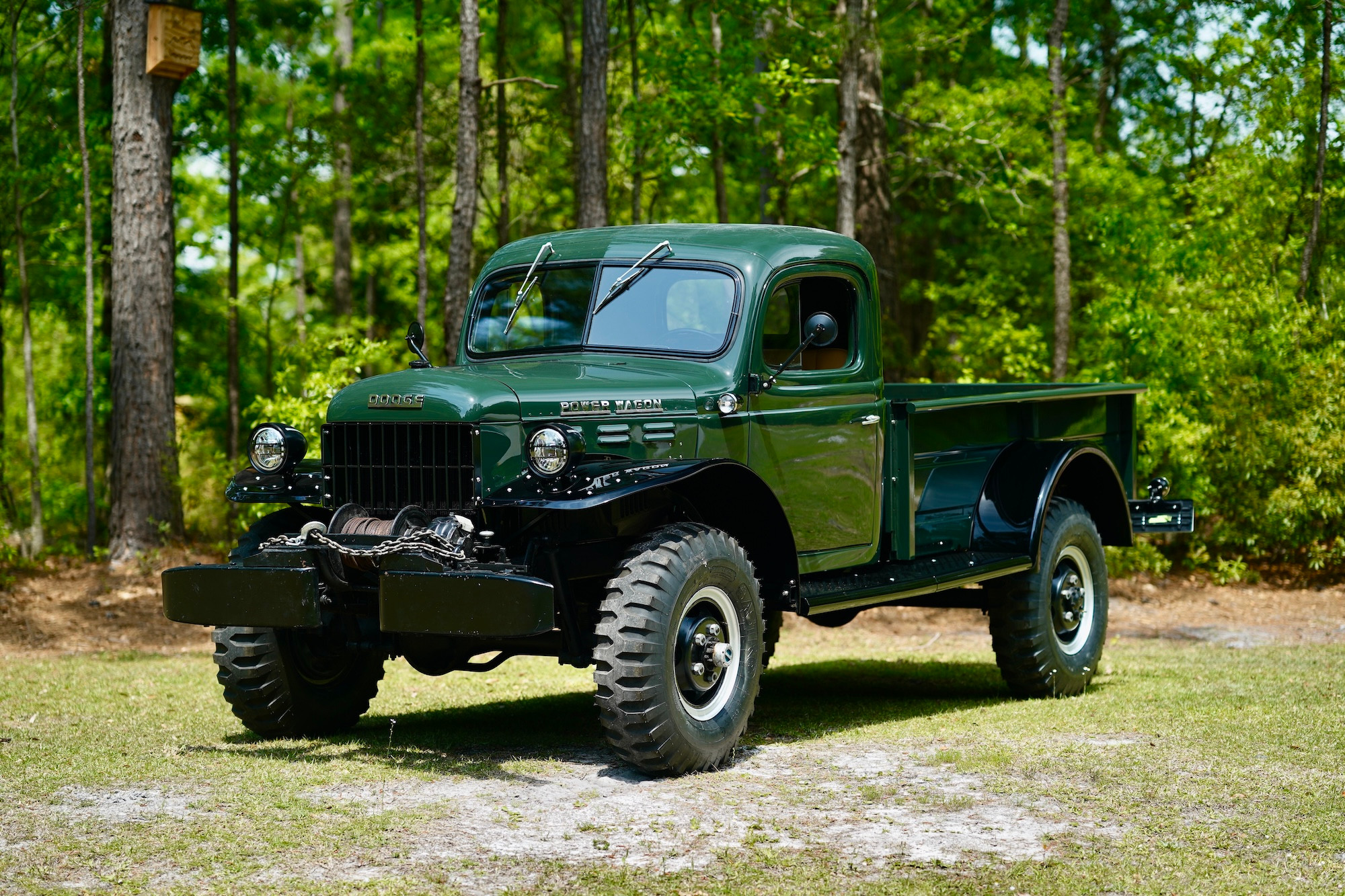
The Dodge Power Wagon is not one truck but two, and the first job of this guide is to keep them apart, because they share a name, a badge and almost nothing else. The original is the flat-fender civilian Power Wagon of 1946 to 1968: a one-ton, four-wheel-drive working truck derived directly from Dodge's wartime three-quarter-ton WC weapons carriers, with separate flat-topped front fenders, a narrow upright cab, a split windshield on the early cars, running boards, and a power take-off that could run a winch, a generator, a saw or farm machinery. The second is the Power Wagon badge as Dodge applied it from the late 1950s onward to the four-wheel-drive versions of its ordinary W-series Sweptline pickups — conventional, styled trucks that are a different machine in every panel, frame rail and part number. Parts do not interchange in any way that matters, and the collector markets price them on different logic.
Our store's centre of gravity is unambiguous, and this guide follows it. Of the 13 Power Wagons we currently track, 12 are listed simply as Power Wagon spanning 1946 to 1968, and the thirteenth is a 1941 WC — the military ancestor itself. Every photograph in the pool supplied for this guide shows the flat-fender truck or its wartime parent; there is not one Sweptline W-series in the set. So this is a guide to the flat-fender truck: the WDX of 1946 and the WM300 that closed the line in 1968, with the Sweptline cars covered honestly but briefly where the badge makes them relevant.
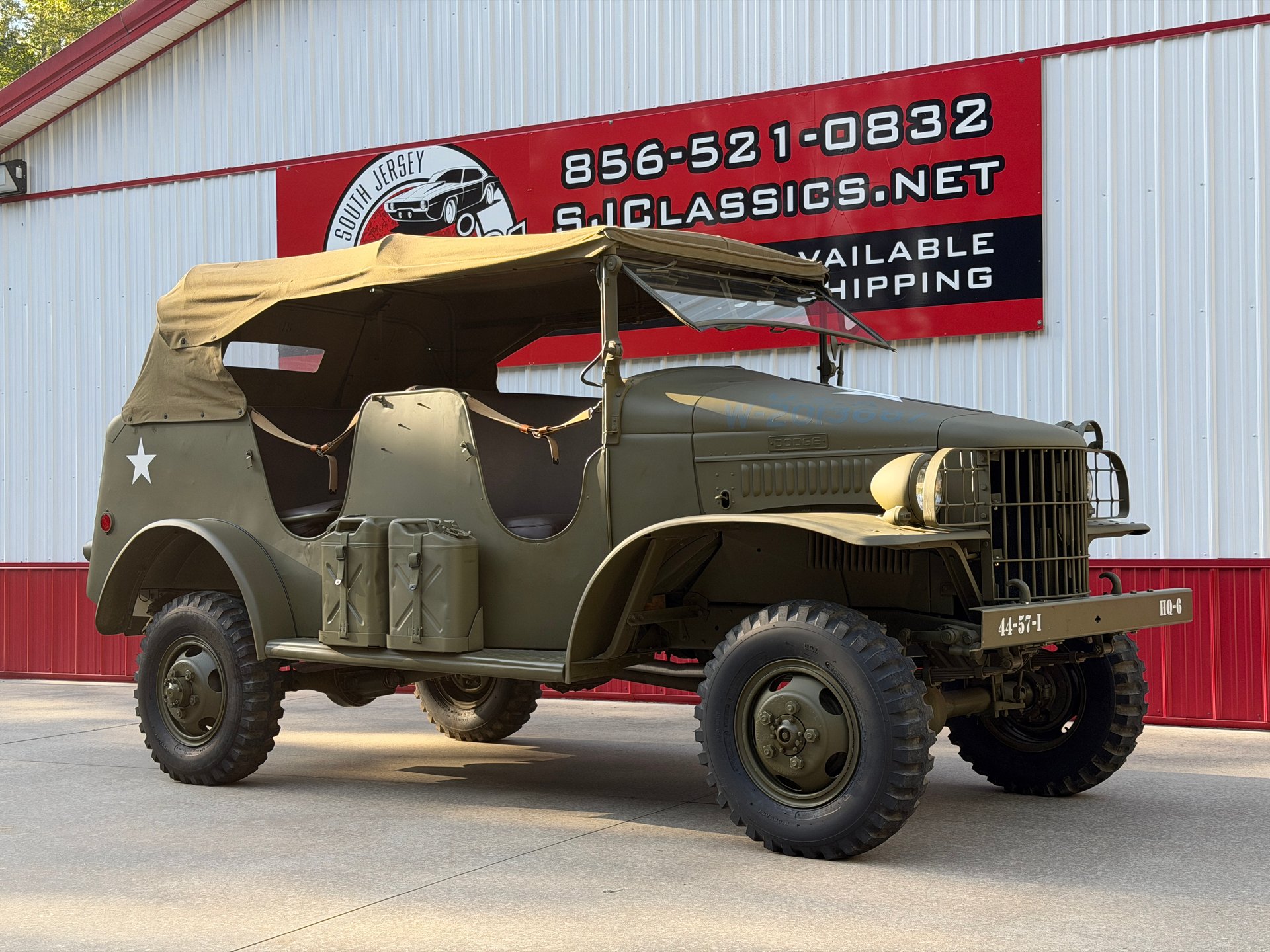
The story starts in the war. Dodge's WC series — weapons carriers, command cars, ambulances and the WC53 Carryall — earned a reputation in every theatre for being simple, over-built and nearly impossible to kill, and when peace came Dodge did something no other American maker had done: it sold the military truck, lightly civilised, to farmers, loggers, miners, oilfield crews, utilities and fire departments. Launched for 1946 as the WDX, it kept the WC's formula — a 230-cubic-inch flathead six, a four-speed gearbox, a two-speed transfer case and gearing low enough to climb a wall slowly — and added a closed cab, a pickup bed and a power take-off as standard. It was, in effect, America's first factory four-wheel-drive pickup offered to the general public.
It changed slowly because its buyers did not want it changed. The designation evolved through the B-series and C-series years and settled as WM300, the wheelbase stayed at 126 inches, the flat fenders stayed flat, and the flathead six stayed under the hood long after the industry had gone to overhead valves and V8s. Domestic flat-fender production ended in 1968; export versions lingered later. The M37, the Power Wagon's 1950s military cousin, shares the engine family and turns up in the same collections, but it is a military vehicle, not a civilian Power Wagon.
What defines the flat-fender today is that it was bought to work, and most of them worked for thirty or forty years — ploughing, towing, winching, carrying fire pumps and snowploughs, maintained by owners who fixed what broke and ignored what merely looked tired. The engineering is so understressed that a worn Power Wagon usually still runs, but every survivor carries decades of repairs and hard use in its metal. The difference between a good one and a money pit is not the engine — it is the cab, the frame, the transfer case and how honestly the truck matches what it claims to be.

The models
Every civilian flat-fender Power Wagon is the same basic truck: a one-ton, 126-inch-wheelbase, four-wheel-drive chassis with a closed cab and a pickup bed, varying across the run in trim, equipment and detail rather than in concept. There was no model ladder to climb. What changed were the series designations on the paperwork, the electrical system, small cab and grille details, and — late in the run — a larger version of the flathead six. The designations matter less for choosing a truck than for identifying one: sellers describe these trucks loosely, model years drift in titles, and the series letters are one of the few hard checks on what you are looking at.
| Model | Years | Engine | Output | Built | Character |
|---|---|---|---|---|---|
| WC series (military) | 1940–1945 | 230 flathead six | about 92 hp | wartime production, many variants | The military original; weapons carriers, command cars, the WC53 Carryall |
| WDX | 1946–1947 | 230 flathead six | 94 hp | not separately published here | The first civilian Power Wagon; split windshield, 6-volt electrics |
| B-series PW-126 (B-1 to B-4) | 1948–1954 | 230 flathead six | 94 hp | not separately published here | The post-war truck tidied; the 1953 in our pool is a B-4-PW-126 |
| C-series PW-126 | 1955–1956 | 230 flathead six | about 100 hp | not separately published here | Detail changes and the move toward 12-volt electrics mid-decade |
| WM300 | 1957–1968 | 230 flathead six, then 251 flathead six | 94 hp, later about 125 hp | not separately published here | The final flat-fender; the form in which most survivors are found |
| W-series Sweptline Power Wagon | 1957–1980 | Slant six and V8s, incl. the 318 | varies by year | a separate, larger line | The badge on a conventional pickup; a different truck, covered briefly below |
A note on the production column, because honesty matters more than a full table: Dodge did not publish tidy per-series civilian production splits in the form modern buyers expect, and this guide does not invent them. The flat-fender run as a whole, 1946 to 1968, is the unit the history books count. Anyone who quotes you an exact build figure for a single model year of civilian Power Wagon should be asked for their source.
The WDX (1946–47). The original civilian truck, and the purest: split windshield, minimal trim, 6-volt electrics, a specification aimed squarely at farms and fleets. Our pool holds both a 1946 and a 1947 WDX — the early trucks are strongly represented among restored survivors, because they are the ones collectors restore first. Originality is the whole game: correct early details are hard to replace, and a truck "updated" with later parts has given away what made it special.
The B-series and C-series trucks (1948–56). Dodge folded the Power Wagon into its B-series and then C-series truck lines as the PW-126 — the number is the 126-inch wheelbase — while changing the truck itself only in detail: grilles, badging, cab fittings, and incremental mechanical tidying. The 1953 B-4-PW-126 in our pool is the representative car here. These middle trucks are often the best value in the flat-fender world precisely because they lack both the first-year romance of the WDX and the final-form recognition of the WM300, while being mechanically the same tool.
The WM300 (1957–68). The final designation, and the truck most buyers will actually find: our pool alone holds a 1961 and a 1968, the last year of domestic production. The WM300 kept the flat fenders and the 126-inch wheelbase to the end. The significant mechanical step came in the early 1960s, when the larger 251-cubic-inch flathead six replaced the 230 in the WM300, giving the late trucks noticeably more to work with on the road. A 1968 WM300 like the one in our listings is therefore not a primitive early truck in late paint — it is the most developed version of the design, and the easiest flat-fender to live with.
The WC and the M37. The 1941 WC in our store is military, not civilian: open or lightly closed bodies, 24-volt-adjacent military thinking in its later cousins, and a collector world of its own. The WC53 Carryall — the enclosed, station-wagon-bodied WC — is the military variant our taxonomy also carries, and the most civilian-usable of the wartime trucks. The 1950s M37, one of which appears in our wider listings in yellow civilian dress, is the post-war military development: same flathead philosophy, waterproof ignition, 24-volt electrics, and a removable top. Buy one as a military vehicle and judge it by military standards; do not pay civilian Power Wagon money for one on the assumption they are the same thing, and do not pay M37 money for a civilian truck either.
The Sweptline Power Wagons. From 1957 Dodge also sold four-wheel-drive versions of its conventional pickups, and from the Sweptline era of the 1960s those W100 and W200 trucks carried the Power Wagon name prominently. They are roomier, faster and far more modern to drive, with slant-six and V8 power including the 318 — but for this guide they are a different purchase: check them as you would any period American pickup, not with the flat-fender sections below. If a listing says Power Wagon and the truck has a styled, full-width body, you are in Sweptline territory whatever the year.


Engines and gearboxes
The 230 flathead six: the engine the truck was built around
Almost every flat-fender Power Wagon you will ever look at — every WDX, every B- and C-series truck, the early WM300s, and the wartime WC and post-war M37 besides — runs the same engine: Chrysler's long-stroke, L-head (flathead, side-valve) inline six of 230 cubic inches, rated at 94 hp in civilian trim. It is one of the most durable engines ever put in an American truck, and one of the least powerful for its size, and both facts follow from the same design: valves in the block beside the cylinders, low compression, a long stroke, and a brief for torque at walking pace, tolerance of poor fuel, and survival under neglect. In a truck geared as low as this one, that is exactly the right engine. Judge it by flathead standards, never by modern ones.
A healthy 230 starts readily, idles slowly and evenly with a soft, busy tick from the valve gear, pulls from barely above idle without complaint, and shows modest oil pressure that falls at a hot idle — on these engines, low hot-idle oil pressure on the gauge is a characteristic to note, not an automatic death sentence, provided pressure rises cleanly with revs and there is no bearing rumble. What it should never do is overheat in ordinary use, blow blue smoke under load, or knock under power. Flatheads run their exhaust through passages in the block, which makes them prone to running hot when the cooling system is neglected and makes the cooling system — radiator core, water distribution tube inside the block, thermostat, hoses, fan belt — a first-order inspection item rather than an afterthought. A 230 that "just runs hot" is usually telling you about silt, scale and a blocked distribution tube, and the fix is a cooling-system overhaul, realistically $600–1,800 depending on whether the radiator needs re-coring, not a head gasket guess.
The valve gear is mechanical, with adjustable tappets, and it needs periodic adjustment — this is a service item owners forget because the engine keeps running while the clearances wander. Tight valves, especially exhaust valves, are the dangerous direction: a valve held off its seat loses its cooling path, burns, and takes compression with it, presenting as a misfire and low compression on one cylinder that owners misdiagnose as rings. The distinguishing test is a compression check followed by a valve-clearance check before any talk of a rebuild: a cylinder that comes back with the clearances corrected was a $150–300 adjustment job, not a $4,000–7,000 engine. Worn guides and tired springs are the other top-end wear items on an engine whose head comes off with hand tools — one of the flathead's genuine virtues is that nearly all of this work is accessible, in-frame, and within the competence of a good general machine shop rather than a marque specialist.
Fuelling is by a single-barrel Carter carburettor — the Ball and Ball pattern — fed by a mechanical pump, and the system's faults are period faults. The carburettor is simple and rebuildable, with kits in the $50–120 range and a professional rebuild at $300–600, but the symptoms blamed on it are as often fuel delivery: a tired pump, a clogged tank outlet after decades of farm storage, perished lines drinking air, or ethanol fuel attacking old gaskets and leaving varnish in a truck that sits. Heat is the other enemy — a hot-soak restart problem is frequently vapour and percolation in a carburettor above a hot manifold, cured by heat shielding, fuel-line routing and a carburettor that seals, not by an electric pump fitted to mask the fault. Ignition is points and coil, 6-volt early and 12-volt later; weak spark, hard starting and dying in rain are points, condenser, cap, leads and grounds, in that order. Budget $200–500 to go through the ignition properly.
The bottom end is famously strong; its classic failure is not failure at all but wear announced by falling oil pressure under load and a deep rumble on a hot restart. Oil leaks are universal: the rope-type rear main seal weeps on otherwise perfect engines, cover gaskets seep, and the honest question is whether the leaks are weepage you manage or a rear main dripping onto the clutch — a clutch that judders and slips with oil on the bellhousing has turned a seal into a gearbox-out job, $900–1,800 with the clutch replaced while you are there. Exhaust manifolds crack with age, and a ticking that fades as the engine warms is a manifold crack until proven otherwise; supply keeps this in the $400–1,000 fitted range.
The 251 six and the late WM300
In the early 1960s the WM300 received the larger 251-cubic-inch version of the flathead six — the long-stroke Chrysler six long used in Canadian production — rated at around 125 hp. Nothing about the character changes: it is the same L-head architecture, the same tappet routine, the same cooling-system sensitivities and the same unburstable bottom end, with meaningfully more torque and a truck that holds road speed with less strain. For a buyer who intends to drive rather than show, this is the engine to have, and the late WM300 that carries it — the 1968 in our pool is the type specimen — is the most usable flat-fender of all. Two cautions follow. First, verify the engine that is actually in the truck: seventy years of farm and fleet maintenance means 230s and 251s have been swapped both ways, and the engine number stamped on the block, not the seller's description, settles which six you are buying. Second, do not let a seller price a 230 truck as a 251 truck on the strength of the year alone — confirm the engine, because the premium belongs to the iron, not the calendar.
The other engines wearing the badge
For completeness only: the Sweptline W-series Power Wagons used Dodge's ordinary truck engines — the 225 slant six and V8s including the 318 — and the military M37 used a 230-family engine in military specification with waterproof ignition and 24-volt electrics. Neither belongs to the flat-fender story mechanically: judge a slant six or 318 as in any Dodge truck of its year, and an M37's sealed ignition and two-battery 24-volt system as specialised military equipment. Engine swaps into flat-fenders exist, including modern diesels in heavily rebuilt trucks — one photo filename in our own pool references a Cummins-powered build — and a swapped truck is a custom vehicle, priced and inspected as one, never as an original with a bonus.
Gearboxes, the NP200 transfer case and the power take-off
The flat-fender's transmission is a four-speed manual with a very low first gear intended as a working gear — pulling stumps, climbing out of a ditch, walking a load up a grade — rather than as a road gear. Early trucks have limited synchromesh by modern standards and demand deliberate, unhurried changes with double-clutching technique on the way down; later trucks are easier but never slick. Judge the box on what it tells you under load: whine that rises with road speed in the gears is wear talking, jumping out of gear under load or on the overrun points to worn engagement and bearings, and a box that is merely slow and heavy is a box being itself. Clutch condition is read through the take-up point, judder from oil contamination as described above, and slip in the higher gears under full throttle on a grade. A clutch replacement is $700–1,400 in parts and labour at a general truck shop; a gearbox rebuild, where bearings and worn gears are still obtainable, runs $1,500–3,000, which is why a truck that jumps out of gear needs that figure in the negotiation, not a promise that it is a linkage adjustment.
Behind the gearbox sits the component that defines the truck: the New Process NP200 two-speed transfer case, part-time four-wheel drive with a low range of roughly two-to-one, and a power take-off drive to the front winch and accessories. The NP200 is strong and famously vocal — its gear drive whines and growls in a way first-time buyers mistake for imminent failure. Learn the distinction before you view a truck: a steady whine that tracks road speed is character; new roughness, a clunk on taking up drive, metal in the drained oil, or a case that jumps out of range is wear. Seals are its real weakness — several outputs, each sealed, and a case that marks its territory at every shaft is describing seal and possibly yoke wear, a $400–1,000 reseal. Check engagement on the test drive — high, low, front drive in and out, at a crawl on a loose surface — and confirm the front drive is not permanently engaged to mask a fault or permanently disengaged because something has failed.
The power take-off and the Braden winch are the Power Wagon's party pieces and a real part of its value. The PTO drives the front winch — the Braden MU-series unit fitted to most civilian trucks — through a shaft from the transfer case, and a correct, working winch with its cable, fairlead and controls is equipment a working buyer would otherwise pay $1,000–2,500 to replicate in period form. Test it under supervision on any serious viewing: PTO engagement, drum turning in and out, cable condition along its full length, and the state of the drum and fairlead. A winch that does not run is usually a PTO engagement, shaft or shear-pin story rather than a dead winch, but "usually" is a word to price, not to trust — a non-working winch is a deduction until the cause is demonstrated. Finally, the axles: full-floating at the rear, built far beyond the engine's ability to hurt them, and geared very low, which is why a flat-fender is content at speeds that feel absurdly modest on a modern road. Locking front hubs were an option and a common later fitment; free-wheeling hubs that do not engage, or a front axle that has plainly not turned in years, are findings to run down before money moves, because the front axle's constant-velocity joints are among the more specialised parts on the truck.


Problem areas
Everything in this section comes with a sample-size warning. For 7 of the Power Wagons in our store we hold detailed photo notes, and in those 7 examinations rust was noted in just 1 truck, with no mentions of smoke, leaks or damage at all. Do not read that as evidence that Power Wagons do not rust — read it as evidence about the sample: most of the trucks in our pool are dealer-presented, several restored, and a restored truck's photographs record the restoration, not the fifty years before it. The problem areas below are drawn from what these trucks are and how they lived. On an unrestored working survivor — the truck the statistic does not describe — work through every heading below as if it applies until the truck proves otherwise.
Rust and the body: the map
A Power Wagon's rust map is a farm truck's rust map, drawn by mud, manure, road salt and water standing where it fell. The steel is thick, which saves these trucks — panels corrode for years before they perforate — but thickness also hides the damage, because a cab corner can be structurally gone under paint that still looks presentable from five feet away.
Cab floors and toe boards. The first place to look and the place that decides most purchases. Water and mud come in on boots, sit under mats that are rarely lifted, and rot the floor from the top down around the pedals, the seat mounts and the transmission tunnel. Lift every mat and prod, do not tap politely. Surface scale is a clean-and-treat job you can do yourself; perforation at the seat mounts or pedal area is welding, $800–2,000 for both floors done properly with the cab on, and considerably more if the rot has taken the cab mounts with it. A truck with new floor pans already fitted is not automatically a good truck — ask whether the mounts and the metal under the pans were done at the same time, because pans welded over rotten mounts are the classic cosmetic repair on these.
Cowl, windshield frame and door bottoms. The cowl and the frame around the split or single windshield catch water at the seams and at the wiper and hinge mountings, and leaks here run down inside the pillars and present as floor rust that gets blamed on the floors. Door bottoms fill through failed window seals and blocked drains: run a fingertip along the bottom edge of each door, feel for bubbling, then check the drain slots are open. A door that is sound in the skin but rotten in the bottom frame is a repair-section job, $300–700 a door fitted and painted to match a working truck; show-truck paint matching is a different conversation entirely.
Fenders, running boards and steps. The flat front fenders rot at their rear edges and where they meet the running boards, and the boards themselves — mud traps by design — thin from underneath while the tread surface still looks honest. Rear fenders on the pickup bed go at the mounting flange. None of this is structural in the frame sense, but reproduction and good used panels for a low-volume truck are neither instant nor cheap, and a full set of fender and board repairs with paint is a $1,500–4,000 conversation. Fresh, uniform black paint or underseal on boards and fender undersides in the week of the sale deserves the same suspicion it deserves on any classic: nobody undercoats a sound underside for your benefit.
The bed. Wood-floored beds rot the wood and then the steel cross-sills beneath it — a re-wood with correct hardware is $600–1,500 in materials, but sills rusted through are fabrication. Steel floors rust at the seams and around the wheel tubs. Bed sides and tailgates carry the working history in dents and repaired tears at the stake pockets; read them as a record, but price a tailgate that no longer latches as the welding it is.
The frame. The frame is the truck's great strength — a deep, simple ladder frame that survives extraordinary abuse — and its rust points are specific: the rear spring hangers and frame horns, the area around the fuel tank and battery box, and anywhere mud has packed between frame and bed or cab for forty years. Surface rust is normal and largely cosmetic; flaking rust that comes away in sheets, or perforation at a spring hanger, is structural fabrication work priced per truck, quickly into four figures per area. Cracks appear where trucks were overloaded or where ploughs and non-factory equipment were mounted — walk the frame with a torch looking for non-factory welds, fish-plating and drilled holes that were never Dodge's. A bent frame is not automatically a walk-away, but a bent frame sold as straight restarts the negotiation from zero.
The flathead six in old age
The engine section covered the design; this is the failure catalogue, with the tests that separate the cheap causes from the dear ones.
Overheating is the flathead's signature complaint and almost never the engine's fault in the way sellers mean it. The mechanism: exhaust heat is carried in the block, coolant distribution depends on an internal water distribution tube that silts and corrodes, radiator cores fur up over decades, and the result is a truck that runs cool at a crawl — where a Power Wagon lives — and climbs steadily on a sustained road run or a long grade. The distinguishing sequence is to verify the gauge first (an infrared thermometer on the top hose settles it in a minute), then the thermostat, then the radiator's flow and the tube's condition, before anyone mentions gaskets. A cooling-system recommission — radiator re-core, tube, thermostat, hoses, pump check — is $800–2,000 done whole, and a truck with documented cooling work is worth a real premium because the next owner will otherwise buy exactly that job.
Low compression on one or two cylinders is, as the engine section explained, valves before rings on this engine: burnt exhaust valves from tight tappet clearances, then worn guides, and only then bore and ring wear. The wet-and-dry compression test plus a tappet clearance check separates the three in under an hour. A valve job on a flathead — head off, valves and seats attended to, guides as needed — is $1,200–2,500 at a machine shop precisely because the engine is simple; a full rebuild with boring, pistons, bearings and crank work is $4,000–7,000, and on a truck bought to work, that figure belongs in the purchase arithmetic from the start.
Oil pressure and leaks. Falling pressure that is still within the engine's modest norms, with no noise, is monitoring territory. Pressure that collapses hot under load, accompanied by rumble, is bearings, and no additive changes that verdict. Leaks are priced by location, not by drama: side covers and valve cover are gaskets and an afternoon; the rope rear main is the gearbox-out job described earlier; a front seal weep is tolerable on a working truck and a bargaining chip on a restored one. In our photo-note sample of 7 examined trucks, leaks were mentioned in none — again, a restored-pool artefact, not a property of the breed. Assume an unrestored flathead weeps somewhere and find out where before you buy, not after.
Fuel and ignition decay on standing trucks. More Power Wagons have sat than have run continuously, and standing is its own failure mode: varnish in the tank and carburettor, a fuel pump diaphragm hardened by age and ethanol, points oxidised, plug leads breaking down, and a 6-volt system on early trucks whose marginal starting when new becomes no starting at all through corroded grounds and tired cables. The mechanism that catches buyers is the truck that starts and idles for the viewing and dies at temperature or under load — heat-soaked ignition components and a starving fuel supply both present exactly that way. A fifteen-minute drive that includes a hot restart, set out in the inspection section, is the test; the recommissioning bill for fuel and ignition systems together is $500–1,500 in parts and labour, and it is the single most predictable first-year cost on any truck that has been asleep.
Transfer case, axles, clutch and steering
The NP200 transfer case fails slowly and announces itself honestly. Seal weepage at the outputs is the norm on a used truck and a reseal is $400–1,000; the serious findings are jumping out of range under load, which points to worn engagement components and bearings and is a rebuild conversation at $1,200–2,500, and metallic debris in the oil, which means something inside is consuming itself. Distinguish both from the case's normal gear whine, which is loud, constant and harmless — the trap runs both ways, with good cases condemned by nervous buyers and worn cases excused by sellers as character. The evidence is in the oil and in whether it stays in gear, not in the noise alone.
Front axle and hubs. The front axle's constant-velocity joints and the steering knuckles live a hard life on a truck steered at full lock under load, and they are among the more specialised components on the vehicle. Clunking on lock, torn or long-missing joint boots (where fitted), and a front drive that has plainly been disconnected or left unengaged for years are the findings. A front axle that engages, drives quietly and steers without protest is a major point in a truck's favour, because putting a neglected one right is specialist parts hunting in the $800–2,000 range rather than a catalogue order. Check that locking hubs, where fitted, actually lock and free on both sides.
Clutch and gearbox. Covered mechanically in the engine section; the problem-area summary is that judder means oil or wear, slip means the disc is done, and jumping out of gear means internal wear — three different bills ($700–1,400, $700–1,400 and $1,500–3,000 respectively) that sellers habitually blur into "the clutch is a bit tired". Make the truck demonstrate which one it is, on a grade, under load, before you agree which bill you are sharing.
Steering. A Power Wagon steers heavily at parking speed by design — there is no power assistance — but heavy is not the same as worn. The wear points are the steering box, drag link, tie-rod ends and kingpins, presenting as free play at the wheel, wandering that demands constant correction, and shimmy after bumps. Have a helper rock the wheel while you watch each joint under the truck; the joint that moves late is the worn one. Individual joints are cheap parts and an afternoon's labour; a steering box rebuild is $500–1,100; kingpin work is $600–1,200 a side. A truck that steers straight and tight was maintained by someone who greased things — a proxy for the whole truck.
Brakes, wheels and tyres
Brakes are drums all round, hydraulically operated, and on early trucks through a single-circuit master cylinder — which means a single failed hose or cylinder is a total brake failure, a fact that should shape both your test drive and your first month of ownership. The standing-truck failure set is seized or leaking wheel cylinders, perished flexible hoses, a master cylinder bypassing internally (the pedal sinks slowly under sustained pressure — test it at a standstill, hard, for thirty seconds), and drums scored or oversize from decades of relining. A full hydraulic recommission with cylinders, hoses, master cylinder and shoes is $900–2,000 in parts and labour, and it is non-negotiable money on any truck without documented recent brake work. Brake performance when sorted is adequate for the truck's speed and gearing, never more: judge it against 1950, not against the car you drove to the viewing.
Wheels and tyres carry a genuine safety trap. These trucks run tall, narrow 9.00-16 tyres, and many sit on period multi-piece lock-ring wheels. A lock-ring wheel serviced incorrectly is dangerous in a way modern wheels are not: never let anyone — including you — inflate or work on one without confirming the ring is correctly seated and using a cage or the period-correct precautions, and treat corroded or mismatched rings as scrap, not character. Budget for tyres honestly: correct tall tyres are a specialist purchase, $1,200–2,000 for a set fitted, and a truck on ancient, cracked bias-plies has that bill waiting regardless of how much tread they show. Check the spare, the jack and whether the wheel nuts have been disturbed this century.
Electrics, cab and trim
Electrics on the early trucks are 6-volt, positive-ground thinking in a world that has forgotten it, and the failure mode is resistance: every corroded ground and tired connection steals voltage a 6-volt system cannot spare, presenting as dim lights, a lazy starter and a horn with opinions. The cure is methodical — cables, grounds, connections cleaned and proven — at $150–400 in materials plus your own hours, and a truck already converted to 12 volts should be judged on the quality of the conversion, because a good one is a genuine usability gain and a bad one is a wiring loom you will replace anyway at $600–1,500 for a harness and the labour to fit it. On 12-volt trucks the faults are the universal ones: charging that fades, gauges that lie, and switches worn past their detents.
The cab is a working space trimmed in paint, steel, vinyl and rubber, and its costs are honest ones: seat springs and covers ($400–1,000 to retrim to working standard), door seals and window channels whose failure causes half the rust in this section, a heater that must be tested in July because its blower and core are cab-out work, and glass — flat and cheap to replace, one of the few bargains in the whole proposition. A full set of working gauges on a truck of this age is a sign of a maintained vehicle rather than a lucky one.

How to inspect one
Allow two hours, not one — everything important on this truck is underneath, inside, or at the end of a test drive long enough to get it properly hot. Bring a torch, a magnet in a cloth, a tyre gauge, an infrared thermometer if you have one, overalls, and a helper for the steering check. Insist on a cold engine and on ground loose enough to test the four-wheel drive. If the truck passes you, a lift inspection is still worth paying for; the frame and spring hangers are judged best from below.
- Paperwork and identity first. Match the title to the truck's serial plate and frame stamping, then read the engine number off the block and settle which six is actually fitted — the 230 versus 251 distinction from the engines section is worth money and is decided here, not from the badge or the year. Decode the series designation (WDX, B-series PW-126, WM300) against the truck in front of you, and treat a Sweptline-bodied truck titled as an early Power Wagon, or the reverse, as a listing to walk away from until the paperwork explains itself.
- Cold start. A flathead that has sat overnight should start with choke and settle to a slow, even idle. Note cranking speed on a 6-volt truck (lazy cranking through clean connections is a finding, per the electrics section), watch for smoke on start-up and as it warms, and listen for the exhaust tick of a cracked manifold before the engine gets loud enough to hide it.
- Floors, cowl and doors before anything cosmetic. Lift every mat and prod the cab floors at the pedals, seat mounts and tunnel — the test that decides most purchases, per the rust map. Run a fingertip along every door bottom, check the drain slots, and look at the cowl and windshield frame for the leaks that feed the floors.
- Underneath: frame, hangers, boards. Torch the full frame, concentrating on the spring hangers, the tank and battery area, and anywhere mud packs against the rails. Separate surface rust from flaking perforation, look for non-factory welds and fish-plating, then check the running boards and fender undersides and the bed's cross-sills from below.
- Cooling system, verified not assumed. With the engine hot from the coming drive in mind, check the radiator core's visible condition, hose age, belt, and any sign of sealant abuse or chronic topping-up. Plan to verify the temperature gauge against an infrared reading on the top hose during the drive — the overheating sequence in the problem areas starts with a gauge you can trust.
- Compression story and oil. If the seller permits, a compression test with a tappet-clearance check is the highest-value hour you can buy on a flathead, separating a valve adjustment from a rebuild exactly as the problem areas describe. Short of that: pull the dipstick (level, smell, condition), look under the filler cap, and map the leaks by location — gasket weepage versus the rear main that oils the clutch.
- Four-wheel drive and the NP200, on loose ground. Engage front drive and low range at a crawl, drive in each combination, and confirm the case stays in range under load and on the overrun. Steady gear whine is character; jumping out of range or metallic roughness is the rebuild bill from the problem areas. Check the drained oil's story if a recent change is claimed.
- The winch and PTO. With the seller's supervision, engage the power take-off and run the Braden winch in and out, walking the cable's full length for frays, kinks and crushing. A working winch is real money in the truck's favour; a silent one is a deduction until its cause — engagement, shaft, shear pin — is demonstrated.
- Clutch and gearbox under load. Find a grade. Slip in a high gear at full throttle is a disc; judder from rest, with oil at the bellhousing, is the rear-main-and-clutch job; jumping out of gear is internal wear. Name which one the truck has shown you, using the three-bill distinction from the problem areas, before any price discussion.
- Brakes, tested like a single-circuit system. At a standstill, hold hard pedal pressure for thirty seconds — a sinking pedal is a bypassing master cylinder. On the road, brake firmly from speed: pulling, grinding or a long pedal are the wheel-cylinder and drum findings. Check every flexible hose for perishing and ask for the date of the last hydraulic work; no date means the recommissioning bill is yours.
- Steering and front axle. Helper rocking the wheel, you underneath watching each joint respond — the joint that moves late is the worn one. Then drive: wander and shimmy confirm the static findings, heavy-but-accurate is the truck being itself. Engage the front drive and check for clunks on lock, and confirm both locking hubs, where fitted, actually lock and free.
- The long drive and the hot restart. Twenty minutes minimum, including sustained road speed and a grade — the conditions under which flathead overheating, fuel starvation and heat-soaked ignition faults appear. Then switch off, wait five minutes, and restart hot. A truck that restarts cleanly, holds its temperature and has shown you working four-wheel drive, a working winch and honest brakes has passed the tests that matter; finish with stance (level, both ends), tyre age and the lock-ring wheel check from the problem areas, and the state of the spare.
Values
There are no prices in this section, deliberately: the market block the build appends below this guide carries the current figures from our own listings and recorded sales, refreshed as the market moves, and anything printed here would be stale before it was wrong. What this section teaches is how to read those figures when you get to them, because the Power Wagon market is one of the easiest classic markets to misread.
Start with the split the whole guide has insisted on. Flat-fender trucks and Sweptline trucks wearing the same badge are two markets, not one, and any figure that blends them is meaningless. Within the flat-fender market, the spread between the cheapest and dearest truck is driven less by year or designation than by three things, in this order: the honesty and condition of the cab, frame and bed; whether the truck is a restored example, a preserved working survivor, or a project; and completeness of the equipment that makes a Power Wagon a Power Wagon — the winch, the power take-off, correct wheels and the details that working life removes. A restored WDX and a project WM300 are not two prices for one truck; they are different goods.
Condition language needs translating. "Original" can mean a preserved truck that has never been apart, or a tired truck that has never been fixed — opposite ends of the value scale under the same word. "Restored" ranges from a mechanical recommission with honest paint to a full nut-and-bolt rebuild, and the invoices, not the adjective, tell you which. Our own pool illustrates the skew: most trucks we track are dealer-presented and several are restored, so a median drawn from such a pool describes the prepared end of the market, not the farm-sale end where most flat-fenders change hands. Read asking figures against achieved auction results for comparable trucks, and expect the familiar gap between what sellers of low-volume vehicles ask and what the small pool of real buyers pays.
Premiums in this market are rational and specific. The first-year WDX carries a collector premium for purity; the late WM300 with the 251 six carries a usability premium; a working winch and power take-off add real value because they are expensive to restore to a truck that has lost them; and documented history beats a shinier truck with no past. The discounts are just as specific: cab and frame rust, a transfer case that jumps out of range, a missing or dead winch, an engine swap sold as originality, and any identity confusion between the flat-fender and Sweptline lines. The project-versus-driver gap is at its widest here, because the distance between a running, honestly worn truck and a non-running project is measured in the recommissioning bills itemised throughout this guide — brakes, fuel and ignition, cooling, tyres — and a project priced as if those bills were small is the most common expensive mistake in the market. Negotiate from the itemised list, not from the percentage.
Parts and ownership
The Power Wagon's parts position is better than its low production would suggest, for one structural reason: it was a working and military-adjacent truck for decades, so a specialist trade grew up around keeping it working rather than around concours correctness. Dedicated Power Wagon specialists in the United States stock or reproduce a remarkable share of what the truck needs, the military surplus and interchange world around the WC and M37 supports the shared mechanicals, and the flathead six itself is one of the best-understood engines in the hobby.
Easy: service items for the 230 and 251 sixes — gaskets, ignition components, carburettor kits, water pumps, thermostats, hoses and belts; clutch components; brake shoes, cylinders and hydraulic parts; universal joints, seals and bearings for the drivetrain; flat glass, cut locally; seat covers and cab rubber from the specialist trade; and the manuals, including reprinted factory and military technical literature that documents nearly every job on the truck to torque-spec level. A competent general truck shop can do most mechanical work on a Power Wagon without marque-specific knowledge, because the truck was designed to be fixed in the field by the people who used it.
Harder and dearer: body panels in good order — cab corners, floors are reproduced but fenders, doors and bed components in quality steel are a hunt; correct early WDX details; NP200 internal components beyond seals and bearings; front-axle constant-velocity joints; Braden winch parts, which exist but price like the specialised equipment they are; steering boxes; and correct lock-ring wheels in safe, uncorroded condition. None of this is unobtainable in the way that orphan-marque parts are unobtainable — it is a matter of the specialist network, patience and shipping, and it is why completeness on the truck you buy is worth paying for: every missing Power Wagon-specific part is a search, not an order.
Running costs and the ownership reality. Plan journeys by the truck's comfortable cruising speed, which is modest, and by its range: a Power Wagon is a vehicle you drive at its pace or not at all. The first-year budget follows the pattern itemised above: on a truck that has been standing, fuel and ignition recommissioning, a full brake hydraulic overhaul, a cooling-system service and a set of tyres are the predictable opening bills. Against that, routine servicing is cheap and genuinely do-it-yourself — tappets, points, grease at the many chassis points, fluids — and insurance is unremarkable for a classic truck. The ownership trap is not cost but expectation: owners who buy a flat-fender wanting a modern truck's road manners sell within a year; owners who buy it wanting exactly what it is tend to keep them for decades.

Which one to buy
- The all-rounder: a late WM300 with the 251 six. The most developed flat-fender, the strongest engine, the easiest to live with and to sell on. If you want one Power Wagon to use, this is it — the 1968 in our listings is the type.
- The collector's truck: a WDX. The 1946–47 original, bought on purity and early detail. Pay for originality and paperwork, and walk away from an "updated" one at WDX money.
- The value buy: a B-series or C-series PW-126. The same truck without the first-year or final-form premium. A sound, honest mid-1950s truck that has worked and been maintained is the cheapest route into a good flat-fender — the 1953 B-4 in our pool is the shape of the buy.
- The working truck: any flat-fender with a proven winch, PTO and transfer case. If the truck will earn its keep, buy the drivetrain demonstration, not the paint: four-wheel drive that engages and stays engaged, a winch that pulls, and brakes with a date on the work.
- The military detour: a WC or M37, bought as what it is. Fascinating, usable and its own market — the 1941 WC in our store included — but priced and judged as a military vehicle, never as a cheap civilian Power Wagon.
- The different answer: a Sweptline Power Wagon. If you want the badge with road speed, comfort and V8 power, buy the W-series truck knowingly and use a period pickup's checklist, not this guide's.
And the rule that overrides all of the above: buy the truck whose cab, frame and identity are honest, in the version you can live with. Engines, clutches, brakes and transfer cases on a Power Wagon are all fixable at prices you can plan for; a rotten cab on a bent frame wearing the wrong paperwork is the one purchase no amount of flathead charm will rescue.
Listed now
On Classic Listings today: 7 cars are listed here; 0 for sale and 7 marked sold; sold cars average $212,950.
See the 7 Power Wagon cars currently listed.
The market — recorded sales
Recorded-sale figures: 7 recorded sales · median $99,950 · range $99,950 to $409,950 (Nov 2024 – Nov 2026)
Based on 7 recorded sales — too few for a benchmark value.
| Date | Car | Sale price | Source |
|---|---|---|---|
| Nov 19, 2026 | 1952 Power Wagon | $409,950 | Dealer |
| Nov 19, 2026 | 1948 Power Wagon | $364,950 | Dealer |
| Nov 19, 2026 | 1946 Power Wagon Wdx | $315,950 | Dealer |
| Nov 19, 2026 | 1947 Power Wagon Wdx | $99,950 | Dealer |
| Nov 19, 2026 | 1949 Power Wagon | $99,950 | Dealer |
| Nov 19, 2026 | 1953 Power Wagon B 4 Pw 126 | $99,950 | Dealer |
| Nov 19, 2026 | 1968 Power Wagon Wm300 | $99,950 | Dealer |
Dates are the sale date where the source states one; otherwise the date the sale was recorded here.