
Dodge w100/w150 Blue buyer's guide
Dodge w100/w150 Blue -- the model's own buyer's guide: variants, values and what to check.
Years listed: 1980-1985 · Series: D-Series
# Dodge W100 — Buyer's Guide
Overview and history
The W100 is the half-ton, four-wheel-drive pickup in Dodge's D-Series line — the truck Dodge sold, on and off, from the late 1950s through 1989. The letter tells you the drivetrain: in Dodge's system a D truck is two-wheel drive and a W truck is four-wheel drive, and the number tells you the rating, so a W100 is the lightest four-wheel-drive pickup Dodge builds, sitting below the three-quarter-ton W200 and the one-ton W300. For most of its life it also carries the Power Wagon name, and that name is the first thing you need to untangle, because Dodge uses it loosely. The original Power Wagon is the flat-fendered civilian truck Dodge builds from 1946, itself a direct descendant of the wartime WC weapons carriers. When Dodge restyles its pickups at the end of the 1950s, the Power Wagon badge migrates onto the ordinary W-series trucks and becomes a marketing name for the four-wheel-drive range rather than a separate model. A seller who calls a 1975 W100 a Power Wagon is not lying to you — the badges on the fender say exactly that — but he is not describing the flat-fender truck either, and the two machines share almost nothing but the name and the driven front axle.
That distinction matters because the W100's long life spans three distinct generations, and the truck changes completely either side of two styling breaks. The first generation you meet in today's listings is the Sweptline of 1961–1971: slab-sided, with a choice of narrow Utiline stepside or wide Sweptline fleetside bed, leaf springs at both ends and a solid Dana front axle. The second is the redesigned D-Series of 1972–1980, squarer and more comfortable, gaining the Club Cab extended cab partway through its run and, in the middle 1970s, a full-time four-wheel-drive system that defines how those trucks wear. The third is the Ram generation of 1981–1993. Here the naming gets slippery: through most of the 1980s the half-ton 4x4 is badged W150, and the W100 nameplate returns for 1986–1989 as the lower-priced half-ton 4x4 beneath it, mechanically the same truck in plainer specification. A listing describing a mid-1980s truck as a W100, a W150, or both is usually badge and trim confusion rather than fraud — but you settle what the truck is from its VIN plate and equipment, never from the advert.
Across all three generations the formula never changes: a separate ladder frame, a solid front axle on leaf springs, a part-time or (briefly) full-time transfer case with a proper low range, and a choice between six-cylinder economy and V8 torque. No independent front suspension, no coil spring, no concession to car-like ride at any point in the W100's life. That is precisely why the truck survives and why you want one: every wearing part is a truck part, designed to be unbolted in a field, and the specification changed so slowly that knowledge and parts transfer across decades. It is also why condition varies so wildly — these are bought new as tools and used as tools until something expensive stops working. A W100 tells you its life story honestly if you know where to look: the frame, transfer case and front axle record the work; the cab and bed record the weather; the wiring records every previous owner's impatience. Read all three records before you read the asking price.
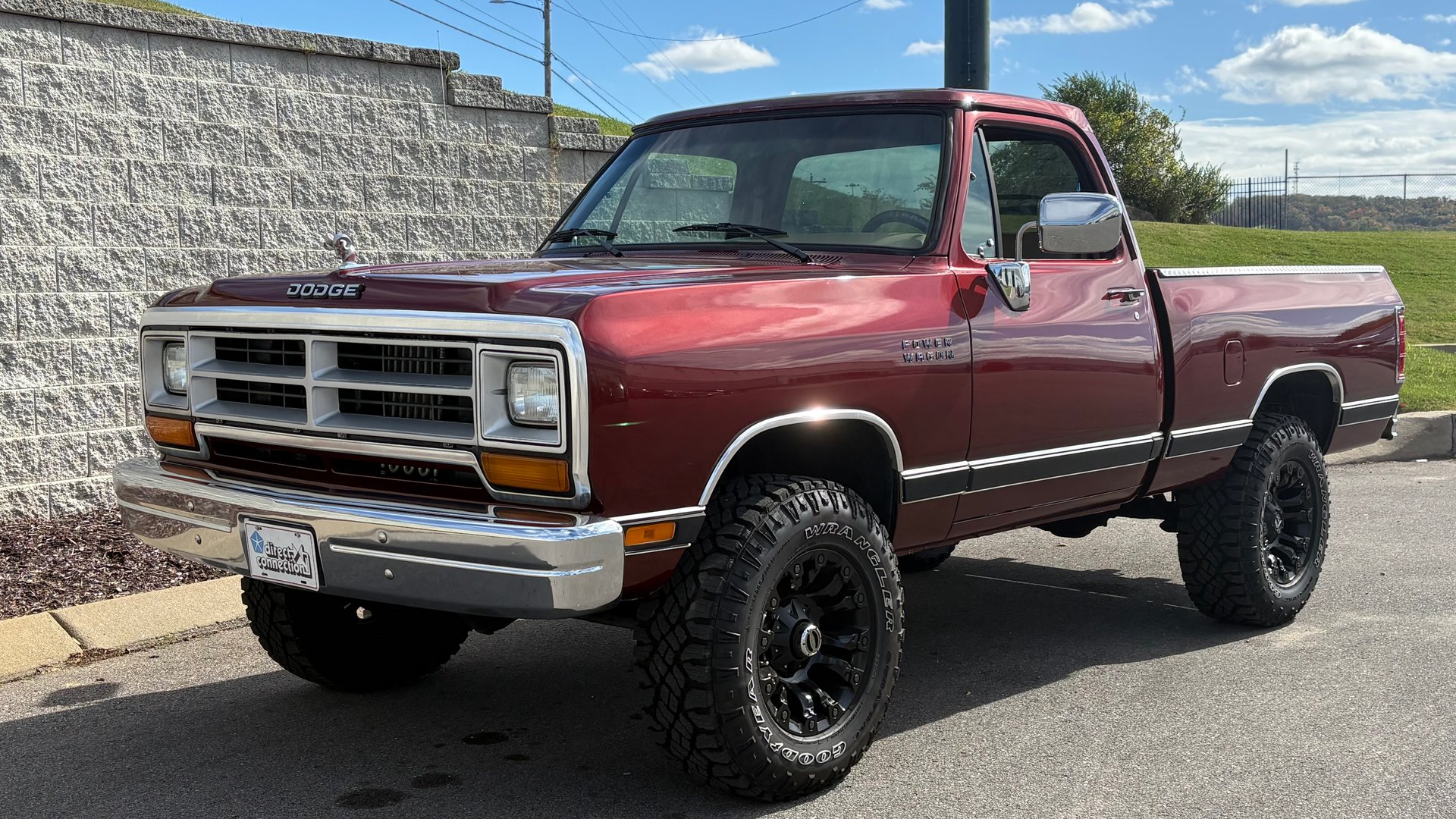
The models
The W100 range is best understood as three generations, two bed styles, two cab styles and a ladder of trim that rises from bare work truck to something approaching a leisure vehicle in the special editions of the late 1970s. Engines and outputs are covered in the table below and in detail in the next section; treat the output figures as period ratings, and remember that American manufacturers switch from gross to net horsepower ratings for 1972, so a 1971 engine and a 1972 engine with identical hardware carry very different numbers on paper. Production figures by individual model are not published separately for the W100 — Dodge reports truck production in aggregate — so the table says so rather than inventing a number for you.
| model | years | engine | output | built | character |
|---|---|---|---|---|---|
| W100 Sweptline | 1961–1971 | 225 Slant Six; 318 V8; 383 V8 | c. 145 hp gross (six); c. 230 hp gross (318); c. 250–330 hp gross (383) | not published separately | The classic working Power Wagon: slab sides, solid axles, everything rebuildable |
| W100 (D-Series redesign) | 1972–1980 | 225 Slant Six; 318 V8; 360 V8; 440 V8 (some years) | c. 100–110 hp net (six); c. 150 hp net (318); c. 155–175 hp net (360) | not published separately | Squarer, roomier, more comfortable; full-time 4WD in the middle years changes the wear pattern |
| W100 Power Ram | 1986–1989 | 318 V8 (carburettor, then throttle-body injection); 360 V8 | c. 140–170 hp net depending on year and fuel system | not published separately | The Ram generation in its plainest half-ton 4x4 form; the youngest, easiest W100 to live with |
Within each generation, the choices that change the truck are these. First, the bed. The Utiline is the traditional stepside, with separate rear fenders and a narrow floor of wood planks over steel crossmembers on earlier trucks; it looks wonderful, carries less, and its wooden floor and fender seams are rot traps you inspect board by board. The Sweptline fleetside is a wide steel box, more useful and more honest to inspect, though its floor, wheel tubs and lower rear corners rust in their own places. Short beds ride on the shorter wheelbase — around 115 inches in the later generations — and are what most buyers want; long beds, around 131 inches, carry more, ride better loaded and are usually cheaper for equivalent condition, because fashion has not found them yet.
Second, the cab. The standard cab is a bench seat and a steel headliner world. From 1973 the Club Cab adds a longer cab with space behind the seat — jump seats are offered, but this is not a modern rear seat — on a longer wheelbase, and it transforms the truck if you carry tools, dogs or children. Club Cabs have their own rust map: the extended floor and rear cab corners hold water the standard cab never sees. Crew cabs appear only rarely under a W100 badge; if you are offered one, verify the VIN plate especially carefully, because a crew cab on half-ton running gear is unusual enough to deserve proof rather than a story.
Third, trim and packages. The base truck is exactly that: rubber mats, painted bumpers, minimal brightwork. Custom and Adventurer trim in the 1970s, and Prospector packages in the Ram era, add carpets, better seats, chrome and sound deadening — all of which improves the truck daily and hides rust from a careless inspection, because carpets cover the floors you most need to see. The snow-plough packages — sold under names such as Sno-Fiter and Sno-Commander — add heavy-duty front springs and plough hardware. Treat one as a warning as much as a feature: ploughing is the hardest work a half-ton truck does, loading the front axle, frame horns and transmission in ways road miles never do. Ask directly whether the truck has ploughed, and look for mounting scars and extra wiring if the answer is no.
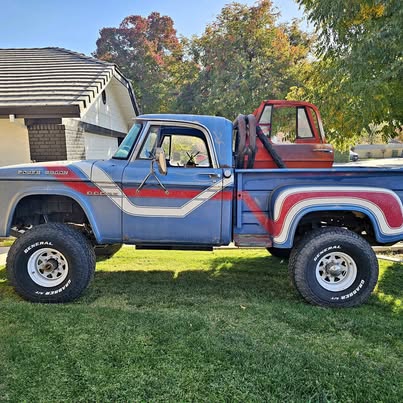
The special editions deserve a paragraph because sellers price them as if they were different trucks. The Macho Power Wagon of 1977–1980, part of Dodge's Adult Toys line alongside the Li'l Red Express and the Warlock, is a W100 (or W150/W200 in some years) with bold stripes, a roll bar in the bed, off-road tyres and trim changes. The mechanical specification is standard. A genuine, documented Macho in original paint is a collectible object and priced as one; a standard truck with reproduction stripes is a standard truck, and the difference lives entirely in documentation — original build information, period photographs, unbroken ownership history — not in anything you can see in a yard. The Li'l Red Express, often mentioned in the same breath, is a two-wheel-drive D150 and is not a W100 at all; if one is offered to you as four-wheel drive, walk away from the seller, not just the truck.
Engines and gearboxes
The 225 Slant Six
The base engine for most of the W100's life is Chrysler's 225-cubic-inch Slant Six, the famous inclined six whose block leans thirty degrees to the passenger side so that a low bonnet line and long, equal-length intake runners both fit in the same engine bay. It is one of the most durable engines ever fitted to an American truck, and its durability has a specific mechanical basis: seven main bearings on a six-cylinder crankshaft, a forged crank in most applications, generous bearing areas and a state of tune so mild that nothing is stressed. In a W100 it produces modest power — around 145 gross horsepower in the 1960s, falling to roughly 100–110 net in the emissions-era 1970s — and in a four-wheel-drive truck with low gearing that is adequate rather than brisk. What it gives you back is torque delivered low, an engine that tolerates neglect, poor fuel and overheating better than any V8 in this guide, and running costs a working truck can justify.
The 318: first the Poly, then the LA
The commonest V8 in a W100 is the 318, and there are two entirely different engines wearing that displacement, which is your first identity check on a 1960s truck. The earlier A-series 318, universally called the Poly for its polyspherical combustion chambers, is fitted through the middle 1960s. You recognise it instantly: very wide valve covers with a scalloped lower edge, spark plugs that enter through the covers at an angle, and a heavy, wide look across the top of the engine. The later LA 318, the small-block that powers Dodge trucks into the 1990s, arrives in cars for 1967 and follows in trucks; it is narrower, lighter, has thin-wall casting, wedge chambers and conventional valve covers held by bolts around the perimeter. Parts interchange between Poly and LA is limited, Poly-specific parts — manifolds, gaskets, valvetrain pieces — are scarcer and dearer, and a Poly truck is not worse, just more specialised to own. The seller who tells you "it's a 318, parts are everywhere" has told you something true about the LA and only half true about the Poly. Look at the valve covers and know which engine you are buying.
The LA 318 itself is the W100's natural engine. Period ratings run from about 230 gross horsepower in the late 1960s down to the 140–150 net range of the later 1970s and 1980s — the falling numbers describe the rating system and emissions tuning, not an engine getting weaker in any way you can feel. What you feel is a smooth, understressed V8 with a two-barrel Carter BBD in most truck applications, hydraulic lifters, a timing chain that is its one scheduled weakness, and an appetite for valve stem seals after high mileage, shown by a puff of blue smoke on start-up after sitting. The 318 has no catastrophic failure mode in truck service: it wears, it leaks, it loses timing precision, and it keeps running while it does all three — which is why the inspection section insists on measuring it rather than listening to it idle, because a worn 318 idles beautifully.
The 360 LA
The 360 is the larger LA small-block, with a longer stroke, a taller deck's worth of torque and, in trucks, a specification aimed at work rather than performance: a four-barrel carburettor in many applications — frequently the Carter Thermoquad, a spread-bore design with a phenolic resin centre section — heavier main bearing journals than the 318 and external balancing, which is why 360 flywheels and torque converter weights are engine-specific and why a mismatched converter after a swap produces a vibration sellers blame on everything else. Output in the truck years sits broadly in the 155–245 horsepower range depending on year, market and rating system, with the earlier 1970s versions at the top and the emissions-era versions lower. In practice the 360 is the engine you choose for a Club Cab, a long bed, towing or altitude: the difference over the 318 is not top-end speed, it is how little the truck notices a load or a gradient.
The big-blocks: 383 and 440
In the Sweptline years the 383 B-series big-block is the top W100 option, and in the 1970s the 440 RB appears in Dodge trucks in some years and markets. These are large, simple, immensely strong engines — forged cranks, deep-skirt blocks, and in the 383's case a short stroke that feels entirely different from the lazy big-block stereotype. Period gross ratings for the 383 run from about 250 to over 330 horsepower depending on specification, with truck versions at the conservative end; the truck 440 is tuned for torque and rated far below its passenger-car equivalents. Either engine in a half-ton 4x4 makes a truck that is quick by period standards, heavy over the front axle and hard on front tyres, fuel and brakes. Verify a claimed big-block by the engine stamping pad and the VIN, because a fender badge proves nothing, and a big-block swapped in without matching mounts, cooling and front springs is a worse truck than the small-block it replaced.
Throttle-body injection: the last W100s
For 1988 the 318 in Dodge trucks gains throttle-body fuel injection — a unit on the intake manifold that looks like a carburettor, sprays fuel from two injectors at low pressure and is managed by a simple computer with few sensors — and the 360 follows for 1989. These are the engines in the last W100s, and they change ownership more than any styling change: cold starts without a choke ritual, altitude compensation and no float bowl to flood at an off-road angle. The failure modes are as often mechanical as electronic: a tired fuel pump delivering low pressure, a degraded injector spray pattern, perished vacuum hoses and a coolant temperature sensor lying about a cold engine. Budget a fuel pressure test into any inspection of an injected truck, and read the fault codes before believing a diagnosis that begins with replacing the computer — the computer is the last thing that fails and the first thing guessed at.
Gearboxes and transfer cases
Manual gearboxes first. The commonest serious fitment is the New Process NP435 four-speed: a heavy cast-iron truck gearbox with a very low first gear — the "granny" gear, around six-and-a-half to one — for starting a loaded truck on a grade and crawling off-road without riding the clutch; second is your normal starting gear on the road. The NP435 is close to indestructible; it wears synchromesh on second and third, leaks from its seals, and its shifter bushings slop until the lever feels vague. A lighter NP445 close-ratio four-speed appears in some applications, and three-speed manuals linger as the base fitment nobody ordered. Clutches are conventional, large and cheap; a heavy pedal is a worn release mechanism, not "a heavy-duty clutch", and you price it as a clutch job — typically $600–1,200 fitted — until proven otherwise.
The automatic is Chrysler's A727 TorqueFlite, a three-speed of legendary strength that handles every engine in this guide, including the big-blocks. TorqueFlite failure in a W100 is rarely sudden: it is slipping on the 2–3 shift, delayed engagement on a cold morning, dark fluid that smells burnt, and a kickdown linkage misadjusted after carburettor work so the gearbox never gets the throttle signal it needs and burns its clutches in slow motion. Check that linkage on every automatic — it must move through its full travel, and a disconnected one is a rebuild deferred, typically $1,500–3,000 for a proper overhaul. Fluid and filter changes are cheap insurance and the first service question to ask.
The transfer case defines the generations, so learn the three you will meet. Early trucks and the 1980 model year use part-time cases, principally the cast-iron, gear-driven NP205: heavy, noisy by modern standards and effectively unbreakable, with a low range around two to one and manual locking hubs. From 1975 to 1979 Dodge fits the NP203, a full-time case with an inter-axle differential, a drive chain inside the case and a low range with a lock position. It is a good system that punishes neglect: the chain stretches and begins to slap and jump under load, and the centre differential wears if the truck runs mismatched tyres. Many have been converted to part-time with aftermarket kits of varying quality; establish what was fitted and whether the conversion included locking hubs, because a conversion without them gains nothing. The Ram generation uses the aluminium, chain-driven NP208 and, from 1988, the NP241: lighter, quieter part-time cases with a lower low range, around 2.6 to 2.7 to one. Run low on fluid after a seal leak, they wear fast, and a case that jumps out of four-wheel drive under load is telling you about internal wear, not adjustment.
From the middle 1980s, Ram-era trucks add one more system to inspect: the vacuum-operated central axle disconnect, which splits the right-hand front axle shaft when the truck is in two-wheel drive so the front differential can rest. It is actuated by engine vacuum through a switch on the transfer case and a small motor on the axle housing, and it fails in the ways vacuum systems fail — perished hoses, a corroded shift fork, a diaphragm that no longer holds vacuum — leaving you with a truck whose dashboard light and whose front wheels disagree about whether four-wheel drive is engaged. The distinguishing test is in the inspection section, and it takes five minutes on a loose surface. Never take a seller's word that "the four-wheel drive works" on a disconnect truck; make the front wheels prove it.
Problem areas
Rust: the map
Rust is the W100's defining problem, and it is a structural problem before it is a cosmetic one, because these trucks rust from the inside of closed sections outward and from the bottom of wet carpets upward, so the paint you see is the last thing to fail. Learn the map generation by generation, and probe with a magnet and a small screwdriver in the places a seller's photographs never show.
Start underneath every truck, whatever its year. The ladder frame itself is thick steel and rarely rots through in the middle of a rail, but it traps mud and road salt against its inner faces, and the places to attack with a light hammer and a torch are the spring hangers and shackle mounts at both ends, the crossmembers under the cab and bed, the area around the steering box mounting on the left rail — where flex and trapped dirt combine — and the rear rail sections behind the axle where spray collects. Surface scale is normal on a working truck; flaking, swelling or a screwdriver that sinks is a welding bill. Frame repair done properly means cutting back to sound metal and plating or sectioning, at $800–2,500 per serious area at a fabrication shop, and a truck needing frame work in several places is a parts truck priced as a project, whatever its paint says.
On Sweptline trucks (1961–1971) the cab rusts at the floor pans under the rubber mat, at the bottoms of the cowl sides where leaves collect behind the front wheels, at the lower door skins and door bottoms, and around the windscreen pillars where the seal perishes and water runs inside the pillar and out through the floor. The distinctive Sweptline trap is the hood and the front of the cab roof: the design holds water in seams that look sound from outside. The Utiline bed's wooden floor rots and takes its steel crossmembers with it; the Sweptline bed rusts along its floor seams, above the wheel tubs and at the lower tailgate skin. Replacement panels for Sweptlines exist but the range is thinner than for the later trucks, so a rusty Sweptline is a fabrication project, not a panel-ordering project — price skilled welding time, at $1,500–4,000 for a thorough cab-floor, rocker and corner programme, into any cheap example.
On the 1972–1980 trucks the cab floor, rockers and cab corners remain the core map, joined by the Club Cab's extended floor and rear corners, the drip rails above the doors, and the lower front fenders behind the wheels where mud packs against the inner structure. The bed floor rusts in ribs that hold water under any load liner — always lift a liner, because a plastic bed liner in a steel-bed truck is a rust incubator and a favourite hiding place — and the wheel arch lips bubble from the inside where the inner and outer skins meet. These trucks also rust around the windscreen aperture and at the base of the cowl, and a wet passenger footwell after rain is your clue: the water arrives through the cowl and wiper pivot seals as often as through the screen rubber.
On Ram-generation trucks (1981–1989) the steel is better protected and the map narrows but does not disappear: cab floors at the seat belt anchorages, rockers, door bottoms, bed wheel arches — the flared arch lip is a mud trap that rusts from behind while the face still shines — and the tailgate's lower seam. Check the roof and drip rail on trucks that have carried campers, and every truck for rust at the battery tray and the inner wing beneath it, where acid and water work together. The rule for all generations: bubbling at an arch or rocker means the panel is perforated or close to it behind the paint, because these panels rust inside-out. Budget honestly — rockers and cab corners, welded and painted to a decent standard, are $1,200–3,000 — and remember that a truck painted recently over unphotographed rust is worth less than the same truck in honest original paint, because you cannot inspect what someone has just sealed in.
The four-wheel-drive system: transfer cases, hubs and the front axle
The four-wheel-drive hardware is the reason the truck exists, and it is the system sellers test least and describe most optimistically. Work through it in order. The transfer case should engage every range cleanly, stay engaged under load, and run without chain slap, whine that rises sharply with road speed, or clunks on taking up drive. On NP203 full-time trucks, chain stretch is the headline wear item: a stretched chain announces itself as a rhythmic slap or a bang under the floor on acceleration and overrun, and eventually jumps teeth under load. A chain and associated wear parts, fitted, runs $700–1,500; a full case rebuild $1,200–2,500 depending on generation and parts. The NP203's centre differential also wears when a truck runs tyres of mismatched size or wear front to rear — the differential works constantly to absorb the difference until it is loose — so mismatched tyres on a full-time truck are not a cosmetic fault, they are evidence of the mechanism that wears the case. Ask what tyres it has run and look at all four, not two.
Front axles are Dana units — a Dana 44 in nearly every W100 — and they wear at the points that steer and drive at once. On earlier closed-knuckle axles, the kingpin bearings and knuckle seals are the wear items; the knuckles hold lubricant that turns to contaminated paste, and a truck never serviced there wanders and leaks in equal measure. On open-knuckle axles, check the ball joints loaded and unloaded as the inspection section describes, because a worn lower joint on a heavy truck on oversized tyres is a safety item, not a negotiation point. Universal joints in the front axle shafts click and bind on full lock when worn — test on a loose surface at walking pace, windows down — and the front driveshaft's double-cardan joint wears into a vibration that appears only in four-wheel drive, which is why you test four-wheel drive at speed, not just across the yard. Locking hubs must engage and release by hand; a hub that needs pliers is telling you about water inside.
Steering, suspension and brakes
A W100 steers through a recirculating-ball steering box, a drag link and tie rods, over a solid axle on leaf springs. Every joint in that chain wears, and the total is what you feel as wander, so diagnose by component. The steering box develops play at centre; a box adjusted tight to hide wear binds off-centre, so steering that is tight in the middle and stiff at the locks has been adjusted, not repaired — a rebuilt box is $300–600 exchanged plus fitting. The flexible rag joint in the column perishes and adds play you can see by watching the shaft while an assistant rocks the wheel. Tie rod ends and the drag link are cheap parts whose combined play is not cheap in effect, and the steering damper is the great mask: a fresh, stiff damper hides worn joints at speed while doing nothing for the wear, so a seller who proudly mentions a new damper on a truck that still wanders has told you where the problem is not. Springs sag too, especially fronts carrying a plough history; re-arched or replacement front springs run $400–900 fitted, and the job usually exposes seized shackle bolts and worn bushings that add to it.
The so-called death wobble — a violent front axle oscillation set off by a bump at moderate speed, cured only by slowing down — deserves a mechanism, not a myth. On a leaf-sprung solid axle it is a resonance fed by play and imbalance: worn kingpin or ball joint bearings, worn spring bushings letting the axle shift, incorrect caster after a lift or sagged springs, out-of-round oversized tyres and loose steering joints each lower the threshold until a bump triggers the axle to steer itself in a growing oscillation. There is no single death-wobble part, and anyone selling you one part as the cure is guessing with your money; the cure is measuring and replacing the worn geometry, typically $500–1,500 once the contributors are found. Lift kits deserve special suspicion: blocks under the front springs are an unsafe practice on a steering axle and a reason to walk away on their own, and a lifted truck with unknown pitman arms and uncorrected driveshaft angles has its handling faults built in. Stock ride height on stock-size tyres is the specification against which you judge everything.
Brakes divide by generation. Sweptline trucks stop on drums all round in most specifications — adequate when perfectly maintained, sensitive to adjustment and condition. Front discs arrive with the 1972 redesign and become the norm, with rear drums throughout. On any truck the inspection is the same: pedal feel and travel, an even stop, a handbrake that holds on a grade, and a look at every steel line, because brake pipes rust along the frame rail and inside the rear crossmember area where you need a torch and a mirror to see them. A truck with one new-looking pipe section has had one failure; budget $400–1,000 for a full line set fitted if the rest are original and crusty. Disc-era trucks wear pads unevenly when caliper slides seize, rear wheel cylinders weep into the drums and contaminate the shoes, and a master cylinder that sinks slowly at a stoplight is bypassing internally. None of it is exotic, all of it is safety-critical, and none of it should be deferred on a truck you intend to drive home.
Engines: the wear patterns that matter
Each engine family has its signature wear, and the inspection section turns these into tests. Chrysler truck engines wear gradually rather than failing suddenly, so your job is measuring how far the wear has got. The LA small-blocks stretch their timing chains and, on many years, use a camshaft gear with a nylon-toothed rim that age and heat make brittle; teeth shed, valve timing wanders and eventually jumps. Symptoms are a slapping noise from the front cover at idle and ignition timing that will not sit still under a strobe. A chain set is a $60–150 part and $400–800 fitted, and it transforms a tired-feeling engine, so a sloppy chain is a negotiating point, not a rejection. Valve stem seals harden and pass oil on start-up; guides wear later. Hot oil pressure at idle tells the truth about bearing wear — put a mechanical gauge on a serious purchase — and an engine that needs thick oil to keep its pressure and quieten its lifters is at the end of its bottom-end life, with a quality small-block rebuild at $3,000–5,500.
The Slant Six cracks exhaust manifolds — look for the soot track and listen for the tick that fades as the manifold expands with heat — and its valve gear drifts out of adjustment into a sewing-machine tick owners ignore until performance and economy suffer. Its carburettors wear throttle shafts and draw air that produces the classic rough idle no amount of tuning cures until the carburettor is bushed or replaced. The big-blocks snap exhaust manifold bolts in the heads, especially the rear ones, and extracting a bolt snapped flush, engine in place, turns a $200 gasket job into an $800–1,500 bill; listen for the tick and look for missing bolt heads before you buy. Big-block truck cooling is marginal with the wrong radiator or a missing fan shroud, and a 440 that runs hot in traffic so equipped is mis-built, not mysterious.
Carburettors across the range share the faults of age: the Carter BBD two-barrel wears its throttle shaft bores and draws air that leans the idle beyond adjustment; the Thermoquad's phenolic centre section warps and cracks and its well plugs leak fuel into the manifold overnight, giving a long crank and a rich stumble every morning that owners misdiagnose as a choke fault; and every carburetted truck suffers heat soak after a hot stop. Ethanol in modern fuel attacks old rubber, floats and pump cups, so a truck that "ran fine when parked" needs its fuel system recommissioned — tank cleaned, lines and pump renewed, carburettor rebuilt — at $500–1,200 before it needs anything else. The injected trucks replace most of that with a pump, a regulator and sensors: test fuel pressure at the throttle body and watch the injector spray pattern with the air cleaner off.
Electrics: the ammeter, the bulkhead and the ballast resistor
Chrysler electrics of this era have one famous structural weakness you must understand, because it is a fire risk and not a quaint foible. On trucks through the 1970s, the entire charging current passes from the alternator through a multi-pin connector in the bulkhead, across the dashboard to an ammeter that reads the full charge current, and back out through the bulkhead to the battery. With age the bulkhead terminals corrode, resistance rises, the connector heats, the plastic softens, resistance rises further, and the sequence ends in melted connectors, charging faults and, in bad cases, a dashboard fire. Look for it on every truck: a bulkhead connector with browned or melted plastic, an ammeter needle that flickers or sits oddly, signs of a previous owner's bypass wire run directly from alternator to battery — a common and, if neatly done with proper gauge cable and fusing, acceptable repair. The correct long-term fixes are a properly executed ammeter bypass with the charging circuit rerouted and protected, or a voltmeter conversion; what is not acceptable is a melted connector left in circuit because "it still charges". Budget $150–400 for an auto electrician to make a suspect charging circuit safe, and treat visible melting as a do-not-drive-home item.
Beyond that headline, the faults are the era's usual ones, each with a test. The ballast resistor fails open and produces the classic Chrysler symptom — the engine fires while cranking and dies when you release the key, because the resistor is bypassed during cranking and in circuit during running — and a spare in the glovebox is period wisdom, not paranoia. Electronic ignition boxes fail with heat and cause intermittent cutting out that owners chase through carburettors for months; substitution with a known-good box is the test. Fusible links corrode invisibly inside their insulation near the starter relay and produce total electrical death that comes and goes with temperature; wiggle-test them while watching the lights. Trailer and plough wiring spliced in with twist-and-tape joints corrodes under the bed — an afternoon with a soldering iron, or $200–500 at a shop, to put right. Gauges fail individually and senders lie; annoying, never fatal, always worth listing in your negotiation notes.
Cooling, fuel delivery and the sitting-truck syndrome
Most W100s you inspect have sat — farms and fleets park trucks for seasons — and a truck that has stood for two years presents a syndrome, not a list: varnished fuel in tank and carburettor, a dried-out fuel pump diaphragm, brake fluid that has absorbed water and rusted the cylinders from inside, perished tyre sidewalls regardless of tread, rodent damage, and a cooling system full of rusty water that was antifreeze once. Radiator and heater cores rot from inside; a bypassed heater, shown by looped hoses at the bulkhead, means the matrix leaks and its dashboard-out replacement — $600–1,200, mostly labour — is being saved for you. Budget recommissioning at $1,500–3,500 on any truck that has stood for years, however shiny, and distrust utterly the phrase "just needs a battery and fresh gas". It never just needs a battery and fresh gas.
Interior, glass and trim
The cab is where you live with the truck, and its faults arrive in small, irritating instalments. Bench seats collapse on the driver's side — a seat that leans you toward the door is a re-trim at $400–1,000. Dashboard pads crack in the sun, Ram-era plastic embrittles until trim clips break on removal, and window regulators wear at the point where the glass spends its life, so windows that drop the last inch are normal wear. Windscreen rubbers perish and leak onto the floor, feeding the cab rust in the map above; wiper pivots seize and burn out motors, so free the pivots before condemning the motor. Test the heater on a cold morning viewing, not a warm afternoon one. None of it is ruinous; all of it is the difference between a truck you enjoy and one you endure, and sellers rarely price it in — so you must.
How to inspect one
Inspect in this order, cold engine first, and do not let the seller warm the truck up before you arrive — a warm engine hides cold-start faults, choke and injection problems, piston slap and half the noises this checklist exists to hear. Bring a torch, a magnet, a tyre pressure gauge, overalls, and a friend to work the steering and pedals while you watch.
- Paperwork and identity first. Match the VIN plate — on the driver's door pillar or the dashboard depending on year — to the title, and read the plate's codes for the original engine, axle and trim. On a 1960s truck, look at the engine itself and settle Poly versus LA 318 from the valve covers before you discuss price, as the engines section explains. A truck whose plate, title and engine tell three different stories is priced as the least valuable of the three until documents prove otherwise.
- Cold start. From stone cold, a carburetted truck should start with the choke routine in the owner's handbook — one press of the throttle to set the choke, then crank — and settle to a fast idle that steps down. An injected truck should start at once and idle evenly. Blue smoke that clears is stem seals; blue smoke that stays is rings or bores; a rattle that fades in two seconds is lifters filling; a knock that stays is your cue to stop and renegotiate or leave.
- The rust walk. Torch and magnet, in the order of the rust map: spring hangers and steering box area of the frame, cab floors (lift the mat — insist), rockers, cab corners, cowl sides, bed floor under any liner, wheel arch lips from behind, door bottoms, windscreen pillars. A magnet that will not stick is filler; a screwdriver that sinks is a welding bill. Photograph everything for your notes.
- Engine measurements, not impressions. Hot, check oil pressure behaviour at idle and at speed, look for blow-by by removing the oil filler cap and feeling for a strong pulse of gas, and check the coolant for oil, bubbles and rust. On any serious purchase, run a compression test — cylinders within roughly ten percent of each other matter more than the absolute numbers — and put a vacuum gauge on the manifold: a steady needle in the high teens is a healthy engine, a needle that drifts or flicks points you back to the specific faults in the problem areas.
- Timing chain and ignition check. With a strobe on the timing marks, watch whether the mark sits still or wanders — wander is chain slack, as the engines section describes. Check the distributor shaft for side play, and on electronic ignition trucks, ask when the control box and ballast resistor were last replaced and whether the truck has ever cut out hot.
- The ammeter and charging circuit. Before the test drive, inspect the bulkhead connector for browning or melting and watch the ammeter or voltmeter as you switch loads on. Any sign of heat damage in that connector moves the truck into the do-not-drive category until it is made safe — this is the one electrical fault in this guide that can burn the truck, not just strand it.
- Gearbox, hot and cold. Manual: the NP435 should engage every gear without graunching, with second-gear synchromesh the first to complain; test the granny gear only to confirm it engages. Automatic: check the fluid's colour and smell on the dipstick, confirm the kickdown linkage is connected and moves fully, and feel for slip or flare on the 2–3 shift under load on the drive. Delayed engagement after sitting is a converter drain-back or seal story; price it as the beginnings of the overhaul, not as a fluid change.
- Four-wheel drive, proven, not promised. On a loose surface — gravel, dirt, grass — engage four-wheel drive high and low. A part-time truck should bind and hop slightly on a tight turn on that surface, proving both axles drive. An NP203 truck should drive all four without its lock engaged and feel tighter with it. On a vacuum-disconnect truck, this test is the only evidence that matters: make the front wheels pull on the loose surface, because the dashboard light is not evidence. Listen for chain slap from an NP203 and for clicks from the front universal joints on full lock.
- Axle ratios and hubs. If tyres are oversized or gears are claimed changed, put the truck on stands and count: mark a tyre and the driveshaft, turn the wheel one full turn and count shaft turns, front and rear, and confirm they match — a mismatched pair must never be engaged in four-wheel drive on a hard surface. Turn every locking hub by hand; pliers mean water and neglect inside.
- Steering and front axle, measured. With the truck on the ground, have your friend rock the steering wheel through the free play while you watch, in turn, the rag joint, the drag link, the tie rod ends and the steering box output — the joint that moves late is the worn one. Then jack each front wheel and rock it at twelve and six o'clock for ball joint or kingpin play and at nine and three for steering play. Any clunk you can feel is a part you are buying.
- Brakes and lines. Pedal firm and high, no slow sink under sustained pressure, straight stop from speed without hands hovering, handbrake holding on a slope. Then underneath with the torch along every steel line, especially along the frame rail and behind the rear crossmember, and look inside the rear drums' backing plates for the damp dust of a weeping cylinder.
- The road test, loaded with questions. Twenty minutes minimum: cold manners, motorway cruise for axle whine and driveline vibration, a rough road for death-wobble tendencies and spring and bushing noise, full-lock parking for joint clicks, and a hot restart at the end for heat soak and starter health. Check the speedometer against a phone GPS — oversized tyres lie about speed and mileage alike — and confirm every gauge, the heater and the wipers work.
- Price the faults before you discuss the truck. Total the list from the problem areas — rust programme, chain or gearbox work, front axle joints, brake lines, recommissioning if it has sat — and negotiate from the costed list, not from enthusiasm.
Values
The build below this guide carries the live market — the trucks listed now and the recorded sales — and that block, refreshed at every build, is where the numbers live. This section teaches you how to read it, because W100 values are driven by a spread of condition and configuration wider than the spread of asking prices suggests, and the skill is knowing which differences are worth money.
The first driver is generation and fashion. Sweptline trucks trade on looks and rarity: fewer survive, fewer still survive unrusted, and a straight, honest Sweptline with its correct bed and trim is a collector's object in a way a 1980s truck is not yet. The 1972–1980 trucks sit in the middle — old enough to be classics, new enough to be usable, with the Club Cab and the special editions pulling the strongest interest. The Ram-generation W100s are the value end of the market in every sense: the youngest trucks, the easiest to live with, the best parts support, and prices that still reflect work-truck status more than collector status. Within any generation, a short-bed truck outdraws a long-bed in the private market, while commercial buyers reverse the preference — so the same truck is worth different money to different rooms, and a long-bed at a sensible price is often the rational buyer's arbitrage.
That is the third and overriding driver: condition, and specifically rust, outweighs everything else. The mechanical W100 is cheap to fix by classic standards — engines, gearboxes and transfer cases are rebuildable with parts on the shelf — while structural rust consumes skilled welding hours at a rate no other system matches. So the price gap between a project and a driver is mostly a rust gap, and the gap between a driver and a genuinely sorted truck is mostly the recommissioning and detail work the previous owner either did or deferred. Read asking prices against that structure. Achieved prices for ordinary trucks sit below both, and the trucks that sit unsold for months are almost always rusty trucks priced as sound ones, or standard trucks priced as special editions without documents. Use the recorded sales below, filter them mentally by generation, bed and cab, and treat any asking price that ignores the condition spread as an opening position, not information.
Parts and ownership
Owning a W100 is an exercise in pleasant mechanical conservatism. The truck shares its running gear across the D and W series, the Ramcharger and, in the LA engines' case, the whole Chrysler passenger car world, so the supply of service parts — bearings, seals, brake components, universal joints, water pumps, ignition parts — is deep, cheap and available from general suppliers as well as Mopar specialists. Filters, hoses, belts and brake consumables are same-week parts everywhere in North America. Engine internals for the Slant Six, the LA small-blocks and the big-blocks are supported by a performance aftermarket that keeps standard parts in production as a by-product; a full gasket set, a timing chain set or a set of rings is never a treasure hunt. The Poly 318 is the exception noted in the engines section: its specific parts exist but come from specialists at specialist prices, and an owner should stock its gaskets and service items opportunistically.
Body and trim are where supply thins by generation. For the 1972–1980 and Ram-generation trucks, reproduction floor pans, rockers, cab corners, arches and bed panels are available from truck restoration suppliers, and good used panels circulate because two-wheel-drive D trucks — far more numerous — donate their cabs and beds to W trucks. For Sweptlines the reproduction range is smaller and the used supply older, which is the practical reason the rust section prices Sweptline repair as fabrication. Glass is available for all generations, rubber seals are reproduced for most, and interior trim ranges from good support for the Ram era to make-do-and-mend for the 1960s. Brightwork, badges and the specific trim of special editions are the hardest parts of any W100 to source, which is why a complete, unmolested truck is worth its premium over a mechanically identical truck with its trim stripped.
Running one is straightforward if you respect three disciplines. The first is lubrication: engine oil and filter at sensible intervals — 3,000–5,000 miles on a carburetted truck in short-trip service, because fuel dilution and moisture are the enemies, not the oil itself — and gearbox, transfer case and axle oils checked at least annually and changed on any truck new to you, because the transfer case in particular fails from the neglect described in the problem areas. The second is the front axle: grease every fitting, keep hub and knuckle service current, and treat the steering and ball joints as inspection items at every service rather than failures to be discovered. The third is use. These trucks deteriorate sitting: seals dry, brakes corrode, fuel varnishes. A W100 driven a few thousand miles a year with its fluids warm and its four-wheel drive exercised monthly — engage it on a loose surface so the chain, joints and disconnect mechanism all move — will outlast a garaged truck of half the mileage, and will be worth more when you sell it, because everything on it demonstrably works.
Which one to buy
- The all-rounder: a 1972–1980 W100 Club Cab with the 360 and the TorqueFlite. Room for people and kit, the strong engine and gearbox combination, disc front brakes, panels and parts still findable. Watch the Club Cab floor and the transfer case chain, and it will do every job in this guide.
- The classic buy: a Sweptline W100, 1961–1971, fleetside bed, 318 LA or 383. The looks, the simplicity and the rising rarity — bought entirely on the strength of its frame and cab, because Sweptline rust is fabrication work, not panel work.
- The value buy: a Ram-generation W100, 1986–1989, with throttle-body injection. The youngest, cheapest and easiest W100 to run daily, with modern starting manners and the best parts support. Verify the vacuum axle disconnect works and the frame horns have never carried a plough.
- The worker: any sound long-bed W100 with the NP435 manual and the 360. Unfashionable, underpriced, geared to pull from nothing and simple enough to fix anywhere. The granny first gear earns its keep the first time you start a load on a hill.
- The economy buy: a Slant Six truck in honest condition. Discounted by fashion, durable beyond argument, and cheaper to run than any V8 — provided you accept its pace and buy it on compression figures, not on the badge snobbery that made it cheap.
- The collector buy: a documented Macho Power Wagon or a verified big-block truck. Only with paperwork — build documentation, history, originality you can prove — because the premium lives in the documents, and an undocumented example is a standard truck wearing stripes.
- Avoid: a plough truck with front spring and frame-horn damage, a truck with a melted bulkhead connector still in circuit, and any truck whose front and rear axle ratios cannot be proven to match. Each is a safety or structural problem wearing a cheap price as camouflage.
The overriding rule: buy the frame, the cab and the transfer case — in that order — and let the engine, the trim and the badges argue about whatever money is left. On a W100, rust and four-wheel-drive wear are the purchase; everything else is a service item.
See the 2 w100/w150 Blue cars currently listed.
For sale now
$7,000 · 63% below typicalExpand
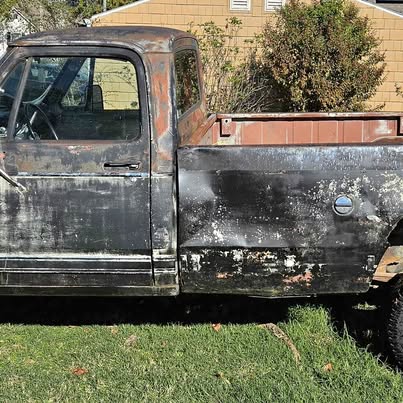 $4,000 · 79% below typical
Expand
What they sell for: w100/w150 Blue sale prices.