
Dodge w250 Base buyer's guide
Dodge w250 Base -- the model's own buyer's guide: variants, values and what to check.
Years listed: 1990-1990 · Series: D-Series
Overview and history
The W250 is the three-quarter-ton, four-wheel-drive version of Dodge's first-generation Ram pickup — and the first thing to understand is how old the bones under it are. The cab, frame and basic architecture date to the D-series redesign of 1972. Dodge rebadged the range as the Ram for 1981, with "Power Ram" badges on the four-wheel-drive trucks, and then kept building essentially the same truck, with detail changes, all the way to 1993. The letter tells you the driven wheels: D means two-wheel drive, W means four-wheel drive. The number tells you the weight class: 150 is the half-ton, 250 the three-quarter-ton, 350 the one-ton. A W250, then, is a 4x4 three-quarter-ton — leaf springs at both ends, a solid front axle, a part-time transfer case, and a gross vehicle weight rating that lets it carry and tow loads that would flatten a half-ton.
That long production run cuts both ways, and you feel both edges when you stand in front of one. The good edge: this is one of the simplest, most repairable trucks ever sold in America. Almost every mechanical part is shared with the D250, the W150, the W350 or the Ramcharger, production ran for two decades, and there is very little on the truck that a competent home mechanic cannot fix on a driveway. The bad edge: the newest W250 is now more than thirty years old, the oldest Ram-badged ones are past forty, and these were working trucks. They ploughed snow, hauled firewood, towed trailers and sat outside. Condition varies far more than age or mileage predicts, and the truck in front of you must be judged as an individual, not as a model year.
One event divides the range in two, and it is the reason values and interest concentrate where they do. For 1989 Dodge offered the 5.9-litre Cummins 6BT turbo-diesel in the 250 and 350 — the first modern, direct-injection, turbocharged diesel in an American pickup, years before Ford and GM fielded an equivalent. The Cummins W250 pairs that engine with a Dana 60 front axle and a Dana 70 rear, and it has become a genuine collector truck: the "first-gen Cummins" of the diesel world. The petrol trucks — 318 and 360 V8s, with the slant-six as a rare base engine early on — are cheaper, simpler and in some ways easier to live with, but they sit in the diesel's shadow and are priced accordingly.
Correct one myth before you shop, because it distorts asking prices. The W250 is not a rare truck, and a petrol W250 is not a "pre-Ram" curiosity with scarcity value: Dodge built this platform in large numbers for twenty-one years. What is scarce is not the model — it is a solid, unrusted, unmodified example of any variant, because rust and hard work consumed most of the fleet. Rarity claims belong to specific configurations — a documented Cummins Club Cab, a short-bed truck, a genuinely original survivor — not to the badge.
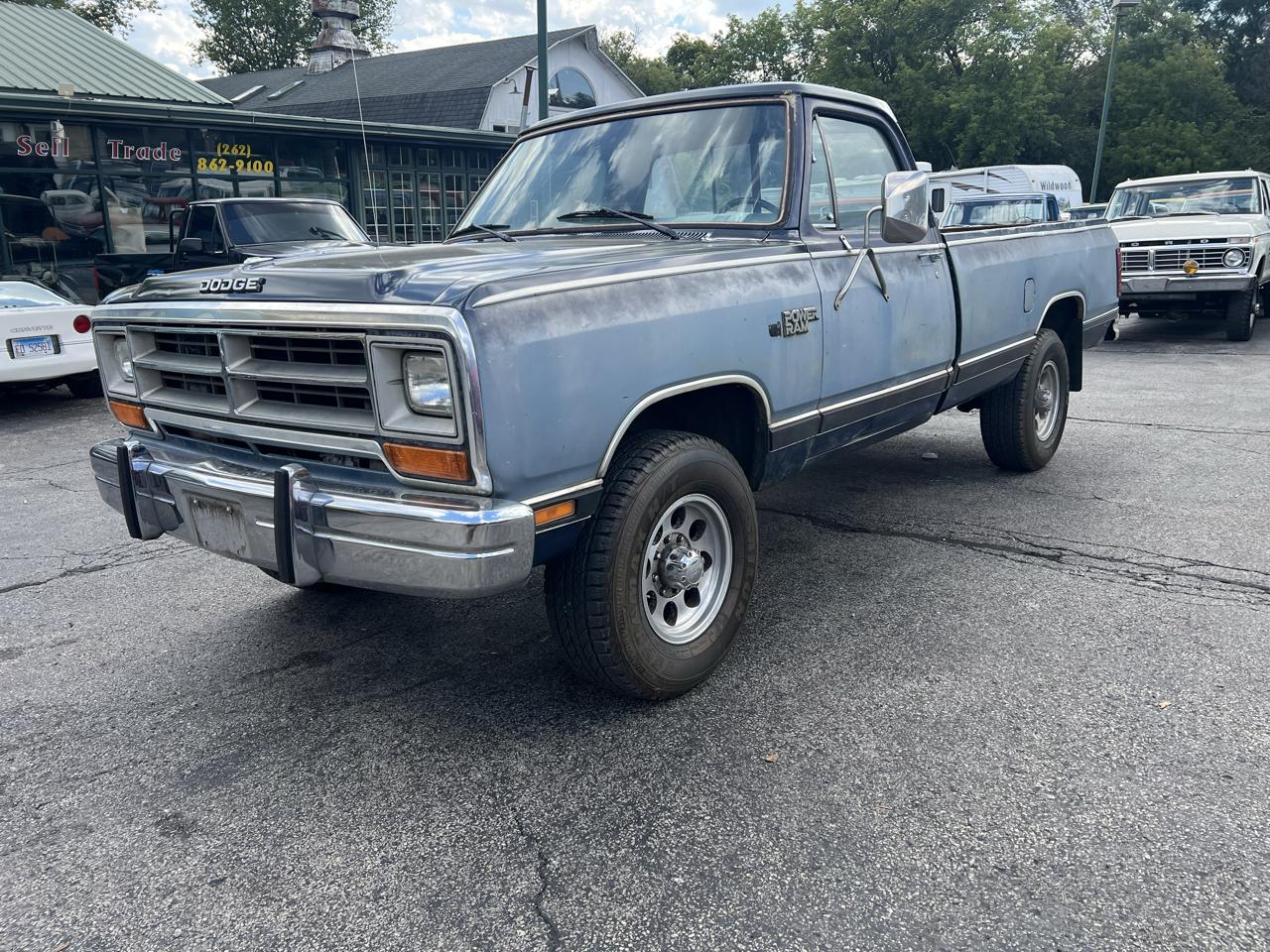
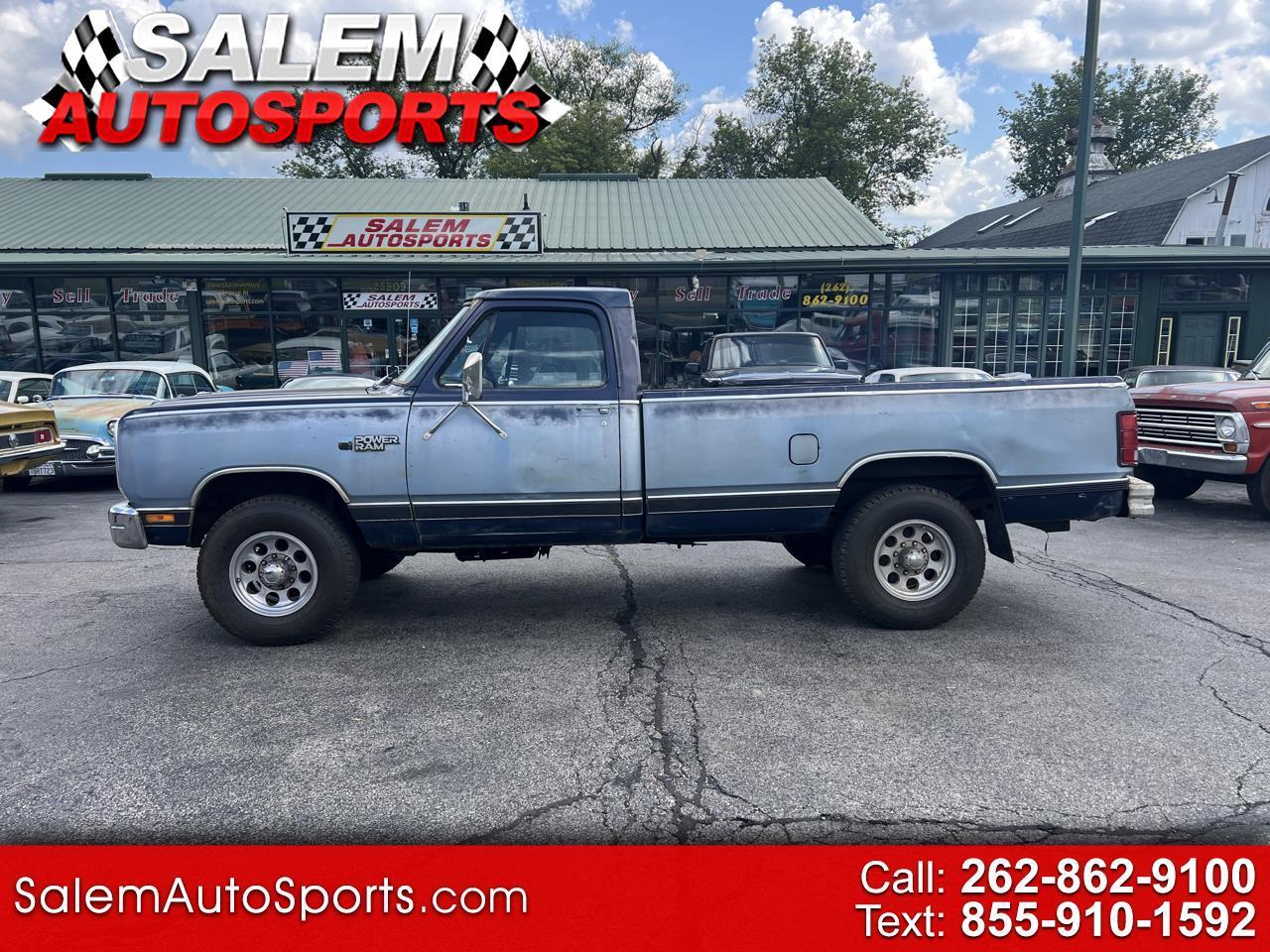
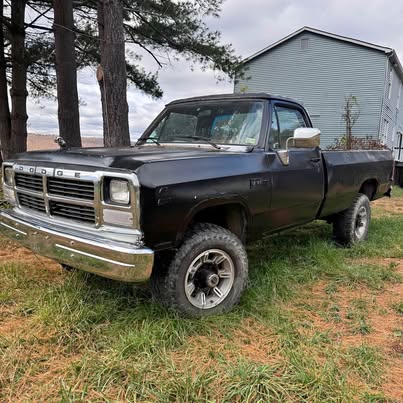
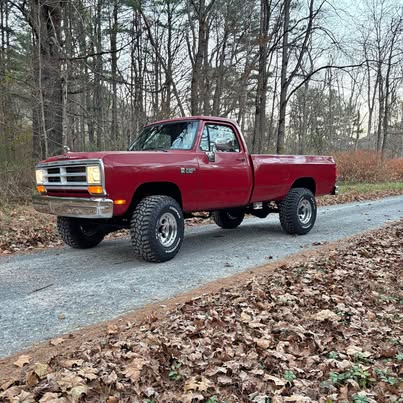
The site's own pool underlines how individual these trucks now are. At the time this guide was prepared the store holds just three W250s, all for sale: a 1986, a 1991 and a 1992 — one grey, one blue, one black, all listed as automatics, two from dealers and one from a Marketplace seller, in Ohio, Wisconsin and Virginia. Three trucks is a snapshot, not a census, but the spread is typical of the market you will actually shop: one generation, three decades of different lives, and no two alike. Judge each one on its frame, its axles and its paperwork, in that order.

The models
The W250 range looks confusing in classified adverts only because Dodge changed badges, trim names and engine offerings across a thirteen-year Ram run without ever changing the truck underneath. Lay it out by what actually varies — cab, bed, engine and trim — and it becomes simple. Every W250 is a three-quarter-ton 4x4 on a separate chassis, with a solid Dana front axle on leaf springs, a live rear axle on leaf springs, and a part-time transfer case. There is no independent front suspension, no coil springs and no full-time four-wheel drive anywhere in the Ram-era W250 range; if a seller describes any of those, you are looking at a different truck or a different decade.
Cabs come in three forms. The regular cab is the volume seller and the one you will meet most often. The Club Cab — Dodge's extended cab, a short stretch behind the doors with small rear side windows and, on later trucks, an optional folding rear seat — adds the room that makes the truck usable as family transport, and it is the cab to have on a Cummins. The crew cab, four full doors on the long wheelbase, was offered in the early Ram years and dropped in the mid-1980s; a genuine crew-cab W250 is uncommon and usually well worn, because fleets and farms bought them to work. Beds divide into the 8-foot long bed, standard on most W250s, and a 6.5-foot short bed offered on regular-cab trucks; the short bed is the prettier and less useful choice, and it is noticeably scarcer. Bed style is Sweptline — the smooth-sided fleetside box — on almost every truck you will see; the Utiline step-side bed was gone from the heavy range by the mid-1980s, so treat a step-side W250 with identity-check suspicion until the VIN and paperwork settle it.
Trim walks up from a base truck — vinyl bench, rubber mat, painted bumpers — through mid-level trims to the LE, the top specification: cloth or velour trim, carpet, chrome bumpers and trim, air conditioning, cruise control, power windows and locks on later trucks, and two-tone paint. Prospector was a popular value package in the 1980s grouping appearance and convenience options. Trim matters less than sellers claim: the LE's extras are exactly the parts — power window motors, air-conditioning components, cruise servos — that are now thirty-plus years old and failing, so a tidy base truck is not automatically worth less to own than a tired LE.
| Model | Years | Engine | Output | Built | Character |
|---|
Wheelbase and weight follow the cab and bed: a regular-cab long-bed truck is the standard article, Club Cab adds length and a little weight, and gross vehicle weight ratings run from roughly 7,500 lb on lighter specifications to 8,510 lb on the heaviest — the door-jamb label on the truck in front of you carries its own figure, and that figure, not the badge, is what the truck is legally rated to carry and what its springs and brakes were specified for. A truck whose label shows the higher rating but which sits nose-down on tired springs is telling you the rating has been used, often.
| W250 base (slant-six) | 1981–1987 | 225 cu in (3.7) slant-six | About 95 hp | A small minority; no reliable separate count published | The fleet and farm base truck; tough, slow, and rarely worth seeking out |
|---|---|---|---|---|---|
| W250 318 | 1981–1993 | 318 cu in (5.2) LA V8; Magnum from 1992 | About 140–170 hp (LA); about 230 hp (Magnum) | The volume petrol W250; exact split not reliably published | The all-round petrol truck: adequate everywhere, remarkable nowhere |
| W250 360 | 1981–1993 | 360 cu in (5.9) LA V8; Magnum in 1993 | About 155–175 hp (LA); about 245 hp (Magnum) | A substantial minority of petrol production | The worker: more torque for towing and ploughing, thirstier for it |
| W250 Cummins | 1989–1993 | 5.9 (359 cu in) Cummins 6BT 12-valve turbo-diesel | 160 hp, 400 lb-ft | A minority of late production, and the majority of surviving interest | The icon: Dana 60 front, Dana 70 rear, and the engine that outlives the truck |
A note on the Built column, because this guide does not invent figures. Dodge published production in aggregates that do not yield a clean, verifiable per-variant count for the W250, and the numbers repeated on forums vary too widely to print as fact. What is reliable — and what you actually need — is the ordering in the table: petrol trucks dominate the early years, the Cummins takes a growing share from 1989, and within any year the regular-cab long-bed is the common configuration. Verify any individual truck's identity from its VIN plate, its door-jamb certification label and its axle tags, never from a seller's production claim.
Two naming traps catch buyers out. First, sellers advertise these trucks as "Power Wagons." The Power Wagon name belongs to the earlier, separate model line that ended in 1980; Ram-era 4x4s are Power Rams. A seller using the wrong name is not necessarily dishonest — the terms blur in everyday speech — but it tells you to check everything else twice. Second, the same truck appears in listings as a "W-250," a "Ram 250" and a "D/W Series," and two-wheel-drive D250s are regularly misdescribed as W250s by sellers who never look underneath. The check takes ten seconds: a W250 has a front differential, a transfer case and a second gear lever or its floor slot beside the seat. No transfer case, no W250, whatever the advert says.
Engines and gearboxes
The petrol V8s: 318 and 360 LA engines
The petrol heart of the W250 is the LA small-block V8, in 318 cu in (5.2 litres) and 360 cu in (5.9 litres). The LA is a pushrod, cast-iron, hydraulic-lifter engine of 1960s design, and its virtues are the ones that matter in an old work truck: it is understressed, tolerant of neglect, cheap to rebuild, and understood by every machine shop in America. The 318 is the sweeter engine — smoother, keener to rev, and adequate for an unloaded truck. The 360 gives up some of that polish for torque lower down the range, which is what you want with a trailer, a plough or a bed full of gravel, and it pays for it at the fuel pump. Expect either engine, in a three-quarter-ton 4x4, to return economy in the low teens of miles per gallon at best, and single figures working hard.
Fuelling divides the LA years into three eras, and the era decides your running problems. Carburettor trucks (to 1987) run a two-barrel carburettor on most 318s and a two- or four-barrel on 360s — Carter and Holley units, including the Carter Thermoquad four-barrel on some 360s, whose phenolic resin float bowl warps with heat and age and produces flooding and hot-start misery that no amount of adjustment cures; a warped Thermoquad is replaced or swapped, not rebuilt back to health. Early-1980s trucks also carry Chrysler's Lean Burn ignition computer on the air-cleaner housing — a system that was troublesome when new and is the first suspect in any early truck with an erratic idle or a miss that moves around; many trucks have already been converted to a conventional electronic ignition, and a tidy conversion is a plus, not a demerit. From 1988 the LA engines get throttle-body fuel injection — a simple, single-point system that starts better, runs cleaner and removes most carburettor grief, at the price of ageing sensors and a fuel pump in the tank. TBI is the petrol sweet spot for a truck you intend to use.
LA failure modes are mechanical and predictable. The timing chain stretches with mileage — a slack chain retards the cam timing, and the symptoms are a lazy engine, poor economy and an idle that will not settle; you can feel gross slack by rocking the crankshaft pulley against the distributor rotor's movement. Oil consumption past the valve stem seals shows as a puff of blue smoke on start-up after standing, distinct from the continuous smoke of worn rings. Exhaust manifold bolts snap and manifolds crack, ticking when cold and quietening as they warm. None of this is fatal or expensive by V8 standards: a full LA rebuild is ordinary machine-shop work, roughly $2,500–4,500 for a quality long engine build, and every wear part is on the shelf. What kills LA trucks is not the engine — it is the rust and the steering covered later in this guide.
The Magnum engines, 1992–93
For the last two years of the run the petrol engines change enough to matter. The Magnum 5.2 arrives for 1992 and the Magnum 5.9 for 1993: same LA architecture, but with multi-point fuel injection, better cylinder heads, a roller camshaft and a distinctive "beer barrel" intake manifold. Output jumps — about 230 hp for the 5.2, about 245 hp for the 5.9 — and the Magnum trucks are noticeably the quickest petrol W250s, with cleaner starting and better manners everywhere. A 1992–93 petrol truck is the one to buy if you want a petrol W250 to drive daily.
The Magnum brings one signature fault of its own. The intake manifold's lower plenum plate is steel, sealed to the aluminium manifold with a gasket that fails with age; the failure lets the engine draw oil from the lifter valley into the intake. The symptoms are oil consumption with no external leak and no smoke you can catch, a spark knock under load from oil in the combustion chambers, and sometimes a fouled plug on one bank. Look down the throttle bores with a torch: a dry manifold floor is healthy, an oil-pooled floor is the plenum gasket, a repair in the $400–800 range at a shop, or a weekend's work at home. Do not let a seller blame the oil use on "old V8s all use a bit" until you have looked.
The Cummins 6BT: the engine that defines the late W250
The Cummins option, from 1989, is a 5.9-litre (359 cu in) inline six, direct-injected and turbocharged, with twelve valves and a Bosch VE rotary distributor injection pump. In the truck it is rated at 160 hp — a modest figure that misleads everyone who has not driven one, because it also makes 400 lb-ft of torque at diesel engine speeds, and it makes it all day, uphill, with a trailer. It has no ignition system, no throttle plate and almost no electronics: fuel shut-off is a single solenoid, starting is by grid heaters in the intake rather than glow plugs, and the engine's reputation for covering several hundred thousand miles is earned — provided the fuel system and the truck around it are maintained.
Two sub-variants matter. The 1989–90 trucks are non-intercooled; from 1991 (often called the 1991.5 changeover, with the facelift) an air-to-air intercooler arrives, with larger injector tips and detail changes. Intercooled trucks run cooler under sustained load and are the better buy for towing; the early trucks are simpler and lighter. Either way, the inspection points are specific. Cold starting should be near-instant after the grid-heater light cycle; long cranking points to air leaks in the fuel lines, a weak lift pump or low compression, in roughly that order of likelihood and cost. The VE pump's seals harden with age and low-sulphur fuel and begin to weep — look for dampness and diesel smell around the pump, because a reseal is a few hundred dollars while a full pump rebuild runs roughly $900–1,600. The fuel shut-off solenoid fails in two instructive ways: a truck that cranks but will not start may simply have no power to the solenoid, and a truck that will not stop has a failed solenoid or a stuck linkage — both cheap, both regularly misdiagnosed as pump failure.
The Cummins has one famous defect you must ask about directly: the killer dowel pin. A steel locating dowel in the front timing case can work loose over time, fall into the timing gears and crack the case or wreck the gear train. The fix — opening the case and fitting a retaining tab, or peening the bore — is a well-known preventive job, a few hundred dollars in parts and labour if the case is undamaged. Ask the seller, in so many words, whether the dowel pin has been tabbed, and ask for the receipt. "Never heard of it" from a long-term owner is an honest answer that prices the job into your offer; visible oil weeping and a repaired crack at the front case is the evidence the pin has already been out.
Support equipment decides how a Cummins truck behaves. The brake booster is vacuum-assisted, and because a diesel makes no manifold vacuum, a belt-driven vacuum pump provides it: a hard brake pedal with a healthy master cylinder is the pump or its hoses until proven otherwise. The charging and starting systems work harder than on a petrol truck — expect a heavy-duty starter and, on many trucks, two batteries' worth of cranking demand from a single large battery; slow cranking in winter is usually cables, connections and battery condition, not the starter itself. A Cummins rebuild, if you ever need one, is heavy-engine work at roughly $6,000–10,000 — which is why compression evidence and service history move Cummins prices more than any other single factor.
Gearboxes and the four-wheel-drive system
Petrol trucks offer the NP435 four-speed manual — a heavy, truck gearbox with a very low first gear intended for starting loads, not for speed — or the A727 TorqueFlite three-speed automatic. The NP435 is close to indestructible and its faults are honest ones: worn synchromesh on second and third, a whine in the indirect gears, and a gear lever that flops in a worn top cover. The 727 is equally tough, with no overdrive: a 727 truck cruises at engine speeds that feel busy today, and that is normal, not a fault. Band adjustment and fluid condition are its maintenance; a 727 that slips or flares on the 2–3 shift after a proper fluid and band service is a rebuild, roughly $1,500–2,500.
From about 1990 the automatic becomes the A518 (also called the 46RH) — a 727-derived four-speed with an overdrive top gear and, on later trucks, a lock-up torque converter. The overdrive transforms cruising, but it adds the range's most common automatic complaint: an A518 that will not shift into overdrive, or hunts in and out of lock-up, is usually suffering an electrical or adjustment fault — the overdrive solenoid, its wiring, or the throttle-valve cable adjustment that tells the gearbox how hard the engine is working — rather than internal failure. Price a non-shifting A518 as a diagnosis, not automatically as a rebuild, but get the diagnosis before you agree a price.
The Cummins manual is the Getrag G360 five-speed, and it needs informed handling. The G360 is adequate at the Cummins' standard output and intolerant of two things: lugging the engine at low revs in a high gear, which hammers its bearings, and running at the factory fill level, which under-fills it — experienced owners overfill the G360 by about a quart through the top, and a seller who knows this detail is telling you something good about the truck's care. A G360 that is noisy in fifth, jumps out of gear or crunches into second when cold is wearing out; rebuilds are specialist work at roughly $2,000–3,500, and this is the main reason many buyers prefer the Cummins automatic despite the early A727's lack of overdrive.
Transfer cases are the NP208 on earlier Ram-era trucks and the NP241 on later ones — both part-time, chain-driven cases with 2WD, 4-High and 4-Low ranges, shifted from a floor lever. Neither is a common failure point; a stretched chain rattles under load in 4WD, and a case that will not select low range is usually linkage, not internals. Front axles divide by engine: petrol W250s carry a Dana 44, Cummins trucks a Dana 60, and from the mid-1980s most Dana 44s carry Chrysler's vacuum-operated central axle disconnect (CAD), which engages the front axle by sliding a collar on the right-hand shaft. CAD failure — a perished vacuum diaphragm, rotted vacuum lines or a stuck collar — is the single most common reason a W250 "has 4WD" that does not work: the transfer case engages, the front driveshaft turns, and one front wheel does nothing. The test is in the inspection section; budget a few hundred dollars for hoses, actuator and labour, not an axle. Rear axles are a Dana 60 in petrol trucks and a Dana 70 behind the Cummins, both leaf-sprung, both strong; check the axle code tag on the cover bolts before you believe any claim about ratios or a limited-slip differential.
Problem areas
Rust: the map
Rust is what ends these trucks, and it follows a map you can learn before you ever crouch down. Start with the cab, because cab rust is the expensive kind. The cab corners — the small panels behind the doors, below bed height — trap mud thrown up by the rear wheels and rot from the inside out; by the time a bubble shows in the paint, the corner is usually perforated behind it. Press firmly with your thumb: sound metal pushes back, filler and thin rust flex and crunch. The rocker panels and the lower door skins follow, then the floor pans, which rust from above as much as below — water leaks in past the cowl and the vent windows, soaks the sound deadening and carpet underlay, and eats the floor quietly for years. Lift the carpet or mat at the driver's footwell on every truck, without exception: a truck can present clean sills and still have a floor like lace. On Club Cabs, check the floor and inner panels of the cab extension too, where the extra seams trap the same water.
The cowl deserves its own paragraph because it is both a rust site and the source of the water that rusts everything else. Leaves and debris collect at the cowl intake, hold moisture against the seams, and the seams perforate; rain then runs down inside the firewall and into the footwells. A musty smell, tide marks on the kick panels, or rust staining below the dash are the fingerprints. Repairing perforated cowl seams properly means screen and dash access and hours of labour — this is one of the few rust jobs on the truck that is genuinely awkward, and a truck with a rotten cowl and rotten floors together is a parts truck wearing a for-sale sign.
The bed rusts where you would expect and one place you would not. Wheel-arch lips and the bed floor's crossmembers are the usual story — check the floor from underneath, at the seams where the floor meets the crossmembers, because a bedliner or a sheet of plywood hides a floor that is mostly holes. The surprise is the front bed panel and the cab back panel: leaves and grit pack into the gap between bed and cab, stay wet, and rot both panels at their bases. Frame rust is usually the last stage, but look hard at three places: the rear spring hangers and the frame around them, the area around the steering-box mounting on the left rail (which also cracks — see the steering section), and the crossmember under the cab. Surface scale on a frame is normal at this age and no reason to walk away; flaking, holed or visibly thinned rails are. A frame repair is $800–2,500 per section done properly, and a holed frame behind the rear hangers is a walk-away on any truck you intend to load or tow with.
Paint tells the truth if you let it. Two-tone trucks fade at different rates on the two colours — the chalked, oxidised finish on the 1980s truck in this guide's photographs is typical and honest. What is not honest is fresh, cheap paint over everything including the rubber seals, applied to a truck with no paperwork: on a W250, a recent blow-over is filler evidence until the magnet and your thumb prove otherwise. Run a fridge magnet along the cab corners, arch lips and lower doors; where it will not stick, there is filler, and filler on these panels always has a reason.
Steering, suspension and the front axle
If rust decides whether you buy the truck, steering decides whether you enjoy owning it. Vague, wandering steering is the defining dynamic fault of the breed, and it is almost never one component: it is the sum of wear in a system that was loose-tolerant when new. Work through it in the order the play appears. The steering box itself wears, and adjustment of the sector-shaft preload takes out some of it — but a box adjusted tight to hide wear will bind at the centre and wear faster; a box with real internal wear is a rebuild or exchange unit at roughly $350–700. Between box and column sits the steering shaft coupler, a sliding joint in a housing that dries out, wears oval and introduces a clunk and several degrees of free play all by itself; it is cheap, commonly overlooked, and the first thing to check on a truck that clunks over bumps or as you rock the wheel. The drag link and tie-rod ends wear next, then the ball joints on a Dana 44 or the kingpins on a Dana 60. Kingpin wear shows as a shimmy after bumps and uneven front tyre wear, and a Dana 60 kingpin job is real money — roughly $600–1,200 in parts and labour for both sides done properly.
The frame's part in this is specific to the model and worth knowing: the left frame rail can crack around the steering-box mounting bolts, particularly on trucks that have run oversize tyres or a snowplough. The crack adds flex exactly where you least want it, and the steering feels wooden and inconsistent rather than simply loose. Clean the area and look with a torch; hairline cracks radiate from the bolt holes. A cracked rail is weldable by a competent fabricator with the box removed, and repair plates exist — but find it before you buy, not after.
Leaf springs and their bushes are the rest of the front end. Front springs sag with age and plough duty, leaving the truck nose-down and the bump stops close to the axle; tired shackles and perished spring-eye bushes let the axle steer itself slightly over bumps, which feels like steering play but is not. Rear springs suffer broken leaves on trucks that have been overloaded — count the leaves and compare sides — and worn rear bushes make the truck crab and clunk on take-up. None of this is exotic: springs, bushes and dampers are all available and affordable, and a full suspension refresh is a satisfying weekend-scale project. What you are pricing on inspection is not whether it needs doing — at this age it does — but whether the tyres, the frame and the steering box turn a refresh into a rebuild.
"Death wobble" — a violent front-end shake triggered by a bump at speed — deserves a calm word, because folklore overstates it. On a leaf-sprung truck it is not a design curse; it is the symptom of accumulated looseness, usually kingpins or ball joints plus a worn coupler and tired dampers, sometimes excited by a bent wheel or a tyre with a shifted belt. A truck that wobbles on the test drive is telling you its front end is worn out as a system. Price the whole system, not the one part the seller offers to change.
Drivetrain wear in service
Beyond the gearbox-specific faults in the previous section, the drivetrain ages in predictable places. Universal joints dry out and notch — a chirp on take-up, a vibration that changes with load, rust dust at the joint caps. The rear pinion seal weeps on almost every truck; a damp pinion is normal, a dripping one with play in the pinion flange is a bearing job. Transfer-case output seals leak the same way. Engine and gearbox mounts collapse with age and oil soaking, and on a Cummins the torque reaction finds every weak mount: a truck that thumps and rocks on shut-down is showing you its mounts. Clutch condition on a manual truck is judged exactly as on any vehicle — bite point height, slip in a high gear under load, judder on take-up — with the addition that a Getrag truck's clutch is a heavy-duty unit and replacement with the flywheel work it usually needs runs roughly $900–1,500.
Brakes are discs at the front and drums at the rear, with rear-wheel anti-lock on later trucks. The system is conventional and its faults are the faults of age: seized front calipers and collapsed flex hoses that make the truck pull under braking, rear drums worn oval and self-adjusters seized so the rear brakes contribute little and the pedal travels, and steel lines corroded along the frame rail — the line run to the rear axle is the one that bursts, usually under the first genuinely hard stop. Budget a full hydraulic overhaul — lines, hoses, calipers, wheel cylinders — at roughly $800–1,800 on any truck without recent documented brake work, and treat a seller's "brakes are fine" as unproven until you have done the hard stop in the inspection checklist. On a Cummins, add the vacuum pump check from the engine section: hard pedal plus healthy hydraulics equals vacuum supply.
Fuel systems age by era. Carburettor trucks suffer hardened accelerator-pump cups and perished rubber lines; TBI and Magnum trucks suffer in-tank pumps that fail with little warning and sending units whose gauges lie — a gauge that reads empty with half a tank, or sticks at a quarter, is the sender, and replacing it means dropping the tank or lifting the bed. Diesel trucks grow air leaks at every aged rubber joint in the suction side of the fuel system, and the symptom — long cranking after standing, then a normal start — is regularly misdiagnosed as a failing injection pump. Test with a length of clear hose in the line before you let anyone sell you a pump.
Electrics, cab and trim
Chrysler electrics of this era have one famous hazard and a hundred small ones. The famous one is the bulkhead connector — the multi-pin plug that carries the harness through the firewall — whose terminals corrode, overheat and melt, taking the charging circuit with them; trucks with an ammeter route heavy current through the dash, and a melted bulkhead or a bypassed ammeter is common history. Look at the connector from the engine side for heat discolouration, and treat intermittent charging, flickering lights and hot smells under the dash as bulkhead symptoms until proven otherwise. A proper repair — cleaning, re-pinning or bypassing the heavy circuits — is $200–600 of electrician time and transforms the truck's reliability. Fusible links, the sacrificial wire sections in the main feeds, get replaced with plain wire by careless previous owners; check they are present and correct, because their absence removes the only protection those circuits have.
The small faults fill a page: voltage regulators that let the charge voltage wander, starters that crank slowly on corroded cables (measure voltage drop, don't just replace parts), wiper linkages with worn pivots, blower motors on their third set of brushes, and gauges that read what they feel like. Air conditioning, where fitted, will almost certainly need work — compressor seals, hoses and a receiver-drier at minimum, roughly $600–1,400 to recommission properly — and the vacuum-operated heater controls on later trucks default and misbehave as the vacuum hoses perish. In the cab, door hinges sag until the doors drop and clunk, window regulators slow and strip, vent-window seals whistle and leak, and the bench seat's foam collapses on the driver's side so you sit in a hollow. All of it is fixable with parts that exist; none of it is free. The honest summary is that a W250's cab and electrics reward a systematic weekend with a wiring diagram and a parts order, and punish the buyer who assumed "everything works" because the engine started.
How to inspect one
Inspect in this order: identity and structure first, because they decide whether the truck is worth inspecting at all; engine and drivetrain second; the test drive last, when you know what to listen for. Bring a torch, a fridge magnet, a tyre gauge, a length of clear fuel hose if it is a diesel, and a friend to work the steering wheel while you watch underneath.
- Identity before metal. Match the VIN on the dash plate to the door-jamb certification label and to the title. Confirm the truck is what it claims to be: front differential, transfer case and floor lever present for a W250; the Cummins badge backed by a Cummins engine, not a badge on a petrol truck. Note the axle codes and GVWR from the door label. Any mismatch stops the inspection until it is explained in writing.
- Frame, in the three places. Torch along the rear spring hangers, the crossmember under the cab, and the left rail around the steering box — the cracking point from the steering section. Scale is acceptable; holes, flaking or visible thinning are not.
- Cab rust circuit. Thumb-press both cab corners, run the magnet along rockers, arch lips and lower doors, then lift the driver's floor covering and look at the pan and the cowl's lower seams. This is the rust map from the problem areas, walked in five minutes.
- Bed and its gap. Look up at the bed floor from underneath at the crossmember seams, then into the gap between bed and cab for packed debris and rot at both panel bases.
- Cold start, petrol. From stone cold: a carburettor truck should start with the choke procedure and settle; a TBI or Magnum truck should fire immediately and idle clean. Blue smoke at start-up that clears is valve stem seals; smoke that stays is rings. Look down a Magnum's throttle bores for the plenum oil pool before you accept any explanation of oil consumption.
- Cold start, Cummins. Watch the wait-to-start cycle, then crank: near-instant firing is healthy. Long cranking after standing points to fuel-system air leaks — fit your clear hose and look for bubbles before blaming the pump. Check the pump body for weeping seals, ask the killer-dowel-pin question, and look for a tab receipt in the paperwork.
- Under the engine. Timing-chain slack on a petrol V8 by rocking the crank against the rotor; oil leaks mapped (rear main, valve covers, oil pan); coolant condition and any sign of stop-leak; on the diesel, the vacuum pump hoses and a hand on the booster test to come.
- Steering, with your friend. Engine running, friend rocks the wheel through the free play while you watch, in order: coupler movement, box input versus output, drag link and tie-rod ends, then ball joints or kingpins with the wheel jacked and levered. You are not just finding play — you are pricing which parts of the steering section's list this truck needs.
- Four-wheel drive, properly tested. On loose ground, select 4-High and 4-Low and drive in a circle. On a CAD truck, confirm the front axle actually engages — the transfer case lever moving proves nothing about the collar. A truck whose 4WD cannot be demonstrated working is priced as a 2WD with a fault.
- Gearbox behaviour. Manual: synchromesh on second and third, noise in each gear, and on a Getrag truck particular attention to fifth-gear noise and jumping out. Automatic: fluid colour and smell on the dipstick, shift quality cold and hot, and on an A518 a definite run long enough to prove overdrive engages and lock-up holds without hunting.
- The test drive, loaded with tests. Include one genuinely hard brake stop from speed — pedal feel, pulling, and on a Cummins whether the pedal stays assisted (vacuum pump) or goes hard. Note wander at highway speed, shimmy after bumps, driveline chirps on take-up and vibrations that change with throttle. Every symptom maps to a named section above; write down which ones this truck has.
- Paperwork and the walk-away sum. Service records that name the dowel-pin tab, the timing chain, the plenum gasket or a gearbox rebuild change the value of the truck in front of you more than its paint does. Add up what you have found — brakes, front end, rust repairs — and if the total turns a cheap truck into an expensive one, walk away: the next W250 is always coming, and the one unforgivable purchase is a rotten frame under a shiny engine.
Values
The build's figures below this section carry the live numbers for this model; what follows is how to read them, because W250 values are driven by a hierarchy that the raw spread of asking prices conceals. At the top of the hierarchy is engine identity. A Cummins truck and a petrol truck that look identical in a thumbnail are different vehicles in the market: the diesel carries a large, durable premium because the engine has a following of its own, because it was the minority of production, and because a good one is genuinely hard to substitute. Within the Cummins cars — trucks, rather — the premium layers again: intercooled 1991–93 trucks over the early non-intercooled cars, Club Cab over regular cab, manual gearbox over the early three-speed automatic for buyers who tow, and documented dowel-pin and pump work over unknown history. Petrol trucks price on condition almost purely, with the Magnum-engined 1992–93 cars earning a modest premium for being simply better to drive, and the 360 earning a small working premium over the 318.
Condition spread is wider than model-year spread, and it is not linear. The gap between a project and a driver is the widest in the market: a rusty, non-running W250 is worth close to its parts and scrap logic, while a solid driver is worth several times that, because the work that separates them — cab rust, frame attention, a full brake and front-end overhaul — is measured in thousands of dollars and hundreds of hours, and the market knows it. The gap between a good driver and a genuinely excellent, original, low-rust truck is narrower in money but harder to cross, because originality cannot be bought back at any price once it is painted over. When you compare two trucks, compare them within a condition band; a cheap truck in the band below is not a bargain version of the one above it.
Asking prices and achieved prices part company most on two kinds of listing. The first is the petrol truck priced by Cummins association — a tidy 318 wearing a diesel-market asking price because "they're all going up." They are not all going up at the same rate, and petrol trucks sit unsold at diesel money for months; the achieved figures below this guide are the corrective. The second is the freshly painted truck, priced as though paint were structure. On this model, paint is the cheapest layer of the truck to renew and the easiest to abuse; pay for frame, cab metal, axle condition and engine evidence, and treat cosmetics as a tie-breaker between equals, never as the reason for a premium. Conversely, the honest, faded, mechanically documented truck is where value hides in this market — the chalked paint on a 1980s survivor costs a fraction of what the same money buys in rust repair.
Negotiation reality: sellers of good Cummins trucks know the queue behind you is real, and haggling hard on a documented, intercooled Club Cab usually just loses you the truck. Sellers of petrol projects, misdescribed trucks and fresh-paint specials have far less leverage than their asking prices suggest. In both cases your strongest instrument is the inspection list — a priced, itemised account of brakes, front end and rust is harder to argue with than an opinion about the market.
Parts and ownership
Ownership is the W250's strongest suit, because the truck sits at the crossing of three deep parts pipelines. The first is the sheer production volume of the 1972–93 platform: mechanical parts — brakes, steering, suspension, bearings, seals, universal joints, water pumps, alternators — are ordinary catalogue items, mostly shared with the D-series, the Ramcharger and in many cases the wider Chrysler range, and priced like working-truck parts rather than collector parts. The second is the Cummins ecosystem: the 6BT powers industrial and marine applications as well as trucks, so engine parts, injection components and rebuild services are available from both Dodge channels and Cummins distributors, and will be for decades. The third is the used market: two decades of trucks in yards and part-outs supply the trim, glass, doors and interior pieces that no catalogue reproduces.
What is hard is body and trim, and it is hard in a specific pattern. Rust-repair panels for the common rot sites — cab corners, rockers, floor sections, arch repair panels — are reproduced and affordable. What is scarce is the good used sheet metal itself in the salt belt, complete uncracked dashboards, Club Cab-specific trim and glass, and late LE interior pieces in the right colours. When you find a parts truck with a good cab, that cab is the asset; price it accordingly. Chrome and grille pieces for the 1991–93 facelift are thinner on the ground than the earlier parts. Glass is available; rubber seals are reproduced for the main openings and should be budgeted on any truck whose vent windows whistle.
Running one is a study in modest bills and honest labour. Service items are cheap and the service itself is simple: engine oil and filters, grease points that actually exist and need greasing, gearbox and transfer-case oils, coolant on schedule. The Cummins asks for fuel filters on time and clean fuel, and repays it by ignoring mileages that would retire a petrol engine; the petrol engines ask for ignition parts, the occasional carburettor or sensor, and acceptance of their thirst. Tyres in the original sizes are ordinary light-truck items. Insurance and registration treat the truck as what it is — an old pickup — and most owners do their own maintenance, because the truck was designed in an era when that was assumed. The ownership trap is not cost; it is the project that stalls. Buy the truck whose structural work is already done or unnecessary, keep it driving while you improve it in stages, and it will reward you. Buy a frame-off ambition at driver money and you will own a static monument.
One ownership habit matters more than any other: keep the truck in use. These are machines that deteriorate standing still — brake cylinders seize, fuel goes stale in tanks and carburettor bowls, seals dry out, and the cowl fills with leaves while you are not looking. A W250 driven weekly asks for a steady trickle of small jobs; the same truck parked for two years asks for everything at once. If your life does not include regular use for a three-quarter-ton truck, buy the best one you can and drive it anyway — the fuel bill is cheaper than the recommissioning bill.
Which one to buy
- The all-rounder: a 1991–93 Cummins W250, intercooled, Club Cab if you can find one — the strongest engine, the heavy axles, the facelift cab, and the configuration the market will always want if you sell.
- The working buy: a 1989–90 Cummins regular cab — the same engine and axles without the intercooler premium; check the three-speed automatic's cruising manners suit your roads, or find the Getrag manual and ask the overfill question.
- The value buy: a 1992–93 petrol truck with the Magnum engine — nearly the pace of the diesel-era trucks to drive, at petrol money, with the plenum gasket as your one named check.
- The honest workhorse: a 1988–91 360 TBI truck — fuel injection without Magnum scarcity, torque enough for real work, and the cheapest route into a solid W250 if the frame and cab check out.
- The project buy: a slant-six or 318 carburettor truck only if the shell is genuinely rust-light — you are buying the body; the engine is the easy part, and on this model the body is never the easy part.
The overriding rule: buy the frame and the cab, and let the engine be the tie-breaker — a solid petrol truck is a better purchase than a rotten Cummins at any price the market is likely to ask, because engines unbolt and rust does not.
See the 1 w250 Base cars currently listed.
For sale now
 $19,500 · 29% above typical
Expand
What they sell for: w250 Base sale prices.