
Dodge Wayfarer Sedan buyer's guide
Dodge Wayfarer Sedan -- the model's own buyer's guide: variants, values and what to check.
Years listed: 1950-1950 · Series: Full Size
# Dodge Wayfarer (1949–1952): The Buyer's Guide
Overview and history
The Wayfarer is the cheapest new Dodge of the postwar era, and that is precisely its charm. When Chrysler finally launched its all-new postwar cars for 1949 — late, in February of that year, after selling warmed-over 1942 designs as early "first series" 1949s — Dodge's range was rebuilt around three names. At the top sat the Coronet, in the middle the Meadowbrook, and at the bottom, on its own shorter chassis, the Wayfarer: a 115-inch wheelbase against the 123½ inches of its bigger brothers, one engine, three body styles, and a specification pared back to what a working buyer actually needed. It was Dodge's answer to the Chevrolet Styleline and the Ford Custom, and it undercut the Coronet by a useful margin because Dodge left things out, not because it built the car badly.
What you get for that paring-back is honest engineering from the last years of the flathead era. Every Wayfarer carries Dodge's 230-cubic-inch L-head straight six — the bigger of Chrysler's two car sixes, not the smaller Plymouth unit — driving the rear wheels through a three-speed manual gearbox, usually with Chrysler's Fluid Drive fluid coupling in front of it, and optionally with the Gyromatic semi-automatic. The suspension is independent coils and kingpins at the front, a live axle on leaf springs at the back. The electrics are six-volt, positive earth. The brakes are Lockheed hydraulics with drums all round. None of this is exotic, all of it is fixable, and almost every mechanical part on the car is shared with the far more numerous Plymouths, DeSotos, Chryslers and Dodge trucks of the period, which is why a Wayfarer remains a realistic car to run rather than a museum problem.
The three body styles define the model's character. The two-door sedan is the volume car: a close-coupled fastback with a proper rear seat and a big boot. The three-passenger coupe — the business coupe — deletes the rear seat for a vast carpeted cargo deck behind a single bench, a car built for the travelling salesman and now the rarest-looking of the closed cars. And then there is the roadster, the Wayfarer's claim on history: a genuine open roadster with a simple folding top and, on the first cars, clip-in plastic side curtains instead of wind-up windows — the first true roadster offered by an American volume maker in well over a decade, and a brave thing to sell as your cheapest model. For 1951 the roadster was renamed Sportabout and given wind-up windows, and the whole range received cleaner front-end styling; the name ran to the end of 1952, after which the Meadowbrook took over the bottom of the range and Wayfarer disappeared.
Set your expectations by what the car is. A Wayfarer is not fast — 103 horsepower moving roughly 3,100 pounds never is — but it is torquey, quiet, mechanically simple and styled with the upright, chrome-heavy confidence of 1949 Detroit. Survivors divide sharply into dry-state originals, older restorations, and a large population of cars that have been hot-rodded or V8-swapped over the decades, because a cheap, handsome two-door Dodge was exactly what a young buyer in 1965 wanted as a starting point. An unmodified flathead car is now the scarcer thing, and the identity checks in this guide matter: you are checking that the car in front of you is the car the seller says it is, with the engine it was born with.
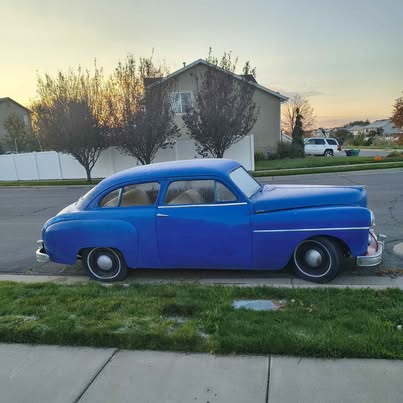
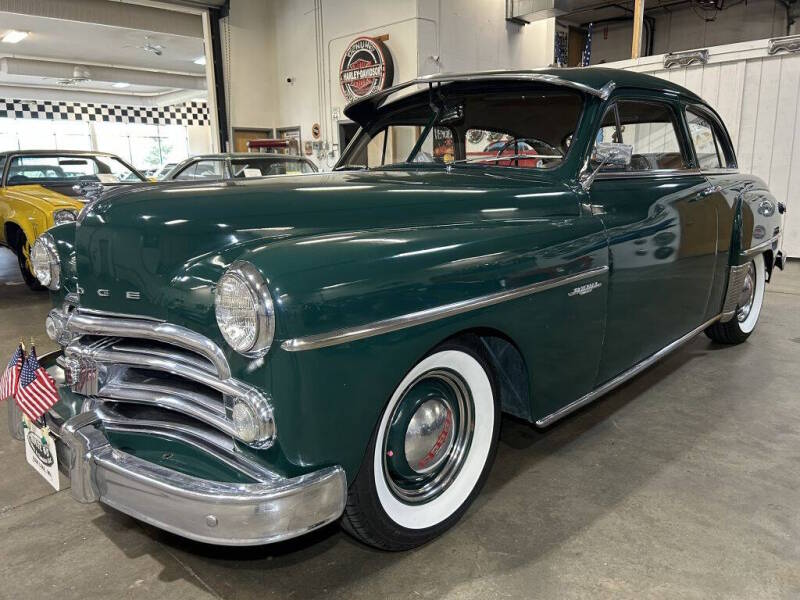
Our own listings underline how thin the surviving pool is: every Wayfarer currently in our records is a 1950 car — two-door sedans and a coupe, in green, black, blue and burgundy, split between dealer stock and private Marketplace sellers across Minnesota, Georgia, Utah and Washington. That is a fair picture of the market as a whole. You do not choose a Wayfarer from a long list; you wait for a sound one, in the body style you want, and you buy condition.

The models
The Wayfarer range is small enough to hold in your head, and you should, because sellers routinely describe these cars loosely — "convertible" for the roadster, "club coupe" for the sedan — and the body style is where most of the value difference lives.
The two-door sedan is the standard car and the one you will find. It is a fastback: the roofline runs in one curve from windscreen to tail, the rear side windows are small, and the boot is a separate lid behind the rear seat rather than a hatch. Inside there is a full rear bench, so this is the only Wayfarer besides the bigger Dodges that genuinely carries five. The three-passenger coupe shares the front sheetmetal and doors but cuts the cabin short: a steeply raked rear pillar, a much longer deck, and no rear seat at all — behind the bench is a flat, carpeted load floor with a spare-wheel well, reached through the boot lid. In period it was the salesman's car; today it is the most distinctive closed Wayfarer, and the one whose profile people photograph. The roadster is a different proposition again: two doors, a bench seat, a manually erected folding top that disappears under a flush boot, and on 1949 cars no wind-up windows and, on the earliest production, no exterior door handles — you reached inside to open the door. Dodge called the 1951–52 version the Sportabout and fitted proper wind-up windows, which tells you what customers thought of the curtains.
Year by year, the changes are trim-deep rather than structural. The 1949 "second series" cars launch the model with the heavy horizontal-bar grille and high, separate front wings. The 1950 cars — the year of every car in our current pool — are tidied in detail: revised trim, a cleaner instrument layout, small changes to badging and brightwork. For 1951 the front end is restyled with a lower, wider grille treatment and the range is rationalised; the roadster becomes the Sportabout. The 1952 cars are 1951 cars with trim changes. Underneath, nothing that matters changes across the four years: same 115-inch chassis, same 230 six, same gearboxes, same brakes. Buy on condition and body style, not on year — with one exception. If you want the true roadster experience, curtains and all, only a 1949–50 car gives it to you, and you should verify the curtains and top irons are with the car, because they are the parts that got thrown away.
Two structural facts shape everything that follows. First, this is a body-on-frame car — a separate chassis with an X-member, unlike the unitised Plymouths that followed in later decades — so a rusty body is not automatically a dead car, but a bent or rotted frame is a far bigger problem than on the bigger Dodges because Wayfarer-specific panels are scarce. Second, the Wayfarer shares almost nothing of its body with the Coronet and Meadowbrook despite the family resemblance: the shorter wheelbase means shorter wings, doors and rear quarters, and none of it interchanges. Mechanical parts interchange freely across the Chrysler range; Wayfarer sheetmetal interchanges with nothing. That asymmetry — cheap mechanics, precious bodywork — is the single most important fact about buying one.
| Model | Years | Engine | Output | Built | Character |
|---|---|---|---|---|---|
| Wayfarer two-door sedan | 1949–1952 | 230 cu in flathead six | 103 hp | Not reliably published by body style | The volume car; the family Wayfarer, and the easiest to live with |
| Wayfarer three-passenger coupe | 1949–1952 | 230 cu in flathead six | 103 hp | Not reliably published by body style | The business coupe; short cabin, huge boot, the distinctive one |
| Wayfarer roadster | 1949–1950 | 230 cu in flathead six | 103 hp | Not reliably published; small minority of production | The true roadster; curtains, no wind-up windows, the collector car |
| Wayfarer Sportabout | 1951–1952 | 230 cu in flathead six | 103 hp | Not reliably published | The roadster civilised, with wind-up windows; verify it is not a cut-down coupe |
A word on those missing production figures, because sellers will quote you numbers. Dodge published totals by model line in period reporting, but reliable splits by individual Wayfarer body style are not consistently documented, and roadster figures in particular attract invention. Treat any precise production claim for a specific body style as unverified unless the seller produces a factory source. What is safe to say is qualitative: sedans dominate survivors, coupes are a clear minority, and genuine roadsters and Sportabouts are rare enough that a cut-down coupe dressed as one is a real risk — the inspection section gives you the checks.

Engines and gearboxes
The 230-cubic-inch flathead six: what it is
One engine serves the whole range, and it is a good one. The Dodge 230 is an L-head (flathead, side-valve) straight six of 230.2 cubic inches — 3.8 litres — with a 3.25-inch bore and a long 4.625-inch stroke, a compression ratio of 7.0:1, and a factory rating of 103 horsepower at 3,600 rpm with about 190 lb-ft of torque arriving at just 1,200 rpm. Those numbers describe the driving experience exactly: nothing happens at the top end because there is no top end, and everything happens just off idle. The engine pulls from walking pace in top gear without complaint, which is why these cars are so undemanding in modern traffic despite their age.
The design is Chrysler's long-serving flathead six architecture, in production in various displacements since the 1930s and shared, in this 230 form, with Dodge trucks — a fact that matters enormously for parts supply, as the ownership section explains. The block and head are cast iron. The crankshaft runs in four main bearings. The valves sit in the block beside the cylinders, operated directly by tappets; there are no pushrods, no rocker shaft, and no timing chain slack to speak of beyond a simple chain drive to the camshaft. Fuelling is by a single Carter Ball & Ball downdraft carburettor with a manual choke, fed by a cam-driven mechanical pump. Ignition is an Autolite distributor with points and condenser, driven from the camshaft, with the coil and the rest of the electrics working on six volts, positive earth. Lubrication is full-pressure to the mains and big ends, but note the filter arrangement: where a filter is fitted it is a bypass (partial-flow) canister that only ever processes a fraction of the oil in circulation. Many engines were delivered without one. This is a 1930s lubrication philosophy — frequent oil changes are not a service nicety on this engine, they are the filtration system.
Identity matters here because the engine bay invites swaps. The Dodge 230 is not the Plymouth engine: Plymouth's six is the smaller 217.8-cubic-inch unit with a shorter stroke, and the two look near-identical to a casual glance. Nor is a 230 the same as the bigger 251/265 Chrysler and DeSoto sixes, which are visibly longer. The check is the engine number, stamped on a machined pad at the front of the block on the left-hand side, at the top edge beside the front cylinder. A correct Dodge car engine number begins with the model code of the car it was built for — and the car's own serial plate, riveted to the left front door hinge pillar, carries the model code too: D29 for a 1949 Wayfarer, D33 for 1950, D41 for 1951–52, against D30, D34 and D42 for the bigger Meadowbrook and Coronet. A Plymouth-code engine, or no number at all on a ground-flat pad, tells you the car has had a transplant. That is not automatically a reason to walk away — a good Plymouth 218 runs sweetly — but it is a reason to pay transplant money, not original-car money, and to ask what else was changed to fit it.
Living with the flathead: tune, timing and honest performance
A healthy 230 is defined by three qualities: it starts easily, it idles almost silently, and it does not overheat. If the car in front of you fails any of the three, the cause is diagnosable and usually cheap in parts — the skill is in not letting a seller bundle all three into "they all do that."
Starting is a six-volt question before it is an engine question. The starter turns slowly by modern standards even when everything is right; what you are listening for is even, rhythmic cranking. Slow, laboured cranking with a hot engine is the classic flathead complaint and is almost never the starter motor: it is voltage drop through undersized modern replacement cables, a tired earth strap between engine and chassis, or corroded terminals, in that order. The test is a voltmeter across the battery posts while a helper cranks — a healthy six-volt system holds around 4.5–5 volts under cranking load; much below that, clean and remake the connections before condemning any component. A car that has been converted to 12 volts is not automatically a better car: conversions are often done to mask exactly these faults, and they bring their own compromises in gauges, bulbs and the heater motor. Judge the conversion's workmanship, not its existence.
Ignition timing on the flathead is set statically and checked with a strobe at the flywheel or crank pulley marks, and the engine is tolerant of a degree or two — but it is intolerant of a worn distributor. Check for play in the distributor shaft by rocking the rotor arm; side play here scatters the timing and produces a maddening intermittent misfire that owners chase through carburettors for years. Points gap and dwell are routine service items every few thousand miles, as are plugs. Valve clearances are set at the tappets with the engine warm, working through the access covers on the side of the block — a fiddly, oily job that is skipped on neglected cars, which is why a clattering top end (insofar as a flathead has one) usually means the clearances have simply never been done, while a silent engine with low compression on one cylinder suggests a valve that has been run tight and burnt. A compression test, dry then wet, separates the causes cleanly: low on one cylinder that does not improve with oil is a valve; low across all six that improves with oil is rings and bore wear.
Performance honesty: a Wayfarer in good tune cruises at 55–60 mph comfortably and will hold 65, with the engine turning fast enough that you will not want to sit there all day. Acceleration is leisurely and overtaking is a planned event. Anyone who tells you their standard car "pulls like a train to 90" has a speedometer lying to them — and check that too, because speedometer error from changed axle ratios and tyre sizes is common. What the engine should do is pull cleanly from 15 mph in top without snatching, and that low-speed flexibility, not speed, is the test-drive measure of a good one.
Gearboxes: three-speed manual, Fluid Drive and the Gyromatic
Three transmissions hide under three descriptions in adverts, and sellers confuse them constantly, so establish which one the car actually has before you value it.
The base gearbox is a conventional three-speed manual with synchromesh on second and top, shifted by a column lever, with a dry single-plate clutch. It is strong, simple and shared across the Chrysler range; its wear points are second-gear synchromesh (a crunch on the 3–2 downchange, hot or cold, is the tell) and a sloppy column linkage, which is linkage bushes, not gearbox internals, nine times out of ten. Learn the distinction on the test drive: a vague gate with good changes underneath is an afternoon's work; a precise gate with a crunch is a gearbox-out job at $600–1,200 in specialist labour and parts.
Most Wayfarers add Fluid Drive to that manual box. Fluid Drive is not an automatic gearbox and not a torque converter in the modern sense: it is a sealed fluid coupling — a torus filled with oil — interposed between the crankshaft and the clutch. It lets the engine idle in gear with the clutch out, lets you pull away in any gear including top, and smooths every take-up. You still have a clutch pedal and you still change gear yourself. Its failure modes are few but specific: the coupling's seal can weep its oil onto the clutch, producing slip and a burnt smell that owners misdiagnose as a worn plate, and a coupling run low on fluid (its filler is reached through an access hole in the bellhousing, with the engine turned to bring the plug to the top) makes take-up snatchy. Check the level and look for oil mist inside the bellhousing before blaming the clutch. A myth to retire: Fluid Drive does not "sap half the power." It costs a little slip at low speed and nothing measurable at cruise.
The Gyromatic is the genuine semi-automatic, and it is the gearbox behind the "automatic" description you will see in listings — including, in our own current pool, one of the four cars recorded as an automatic, which on a 1950 Wayfarer can only mean a Gyromatic or a later conversion. The Gyromatic keeps the fluid coupling and a clutch, but the gearbox itself has two ranges, selected with the clutch and the column lever, and within each range it shifts between two ratios by itself, governed by road speed through an electrical circuit of solenoid, governor switch and an interrupter switch on the carburettor linkage. In practice you select High range, release the clutch, and drive away; the box changes up by itself as speed rises and down again as you slow. The system works well when its electrics work, and produces baffling behaviour — refusing to change up, hunting, or changing with a bang — when the solenoid, the governor contacts or the wiring degrade. Almost all Gyromatic faults are electrical or adjustment faults, not mechanical breakage, but the knowledge pool is thin and shrinking: budget for a specialist, and value a Gyromatic car on whether it demonstrably changes up and down correctly on the test drive, not on the seller's assurance. A later full-automatic conversion (PowerFlite or a modern box behind a V8 swap) is a different car entirely and should be priced as a modified car.
Problem areas
Rust: the map
Start where the money goes. A Wayfarer body is conventional all-steel construction on a separate frame, and it rusts the way every 1949 American car rusts — from the inside of closed sections outward, so that the first visible blister is the last stage of a long process. Our own examined-photo evidence is a tiny sample and should be treated as a prompt, not a statistic: of the cars in our pool, just one has been photo-checked in detail so far, and rust was noted on that one car. Look for yourself, in this order.
The floor pans go first, front footwells especially, where water from a leaking windscreen seal or a perished cowl vent sits under the mat. Lift the mats — do not accept "the floors are solid" from a seller who will not let you — and press along the inner sill seam with your thumb. The sills (rocker panels) themselves are structural on the body and rot from the ends inward; bubbling at the bottom of the front wing behind the wheel, or at the dog-leg ahead of the rear wheel, is sill rust announcing itself, not wing rust. The boot floor goes around the spare-wheel well and along its rear edge where it meets the valance, and on the coupe the huge boot lid collects water along its lower seam and rots from inside while the top face still shines. Door bottoms, the lower rear quarters behind the wheels, and the panel below the rear window on the sedan — where the fastback's window seal leaks straight into the parcel shelf and down — complete the usual map. On roadsters and Sportabouts add the top well and the floor beneath it: a car that has sat outside with a torn top has been filling its own rear footwells for years.
The frame is the second half of the inspection. The X-member chassis is strong, but check the rear kick-up over the axle, the spring hanger mountings, the body outriggers and the front crossmember for perforation, and look for the ripples and fresh underseal that betray an old accident or a patched rail. Surface rust on a frame is normal and treatable; a rail that flakes in scales or has been plated over without cutting out the rot is a car to price as a project. Body mount rubbers perish and let the body settle, which shows as doors that have dropped and shutlines that no longer match — a car can look "rusty" in its gaps when the real fault is forty dollars of rubber and an afternoon's shimming, and the reverse is also true, so diagnose before you despair. Realistic welding costs, for budgeting: a floor pan or sill side properly cut out and replaced runs $1,000–2,500 a side at a restoration shop, boot floors rather less, and a car needing both sills, both front floors and a boot floor is a car whose purchase price should assume $4,000–7,000 of metalwork before paint.

The engine: heat is the enemy, and it has one favourite cause
The flathead six has a reputation for overheating that it only half deserves. A sound 230 in a Wayfarer, with a clean radiator and the correct thermostat, runs at temperature all day. When one overheats, work through the causes in the order the factory would.
The cause unique to this engine — and the one general mechanics miss — is the water distribution tube. Inside the block, behind the water pump, runs a long perforated tube that directs incoming coolant along the block toward the exhaust valve seats and the rear cylinders, the hottest, furthest corner of the design. The tube is thin steel or brass, it lives its whole life immersed, and after seventy years many are perforated, collapsed or rotted away entirely. Without it, coolant short-circuits at the front of the block: the temperature gauge, sensing at the front, reads near normal while cylinders five and six cook. The symptoms are a car that overheats under sustained load but idles cool, blows head gaskets at the rear, or shows a history of them. The test is indirect but telling — an infrared thermometer swept along the head on a hot engine shows a healthy engine within a few degrees front to back, and a tube-less engine dramatically hotter at the rear. Replacing the tube means removing the water pump and extracting the old tube with a hooked tool; a tube that disintegrates on extraction can turn a Saturday job into an engine-out job, which is why a documented tube replacement in a car's history is worth real money.
After the tube, the ordinary causes: a radiator core furred with decades of sediment (flow-test it, or simply feel for cold patches across the core on a hot engine — a good core is evenly hot), a thermostat stuck or of the wrong type, a slipping fan belt, a water pump with a worn impeller or a weeping seal — check the pump's drain hole for coolant stains and rock the fan for bearing play — and retarded ignition timing, which makes any flathead run hot and is free to fix. Head gaskets fail at the rear cylinders first, for the reasons above; combustion gas in the coolant (a chemical block test settles it in minutes) plus a rear-biased overheating pattern is the signature. A warped head is skimmed cheaply; a cracked block, usually between a valve seat and the bore at the rear, is the one genuinely terminal diagnosis, and it is why the hot test drive in the inspection section is non-negotiable.
Oil tells the other half of the story. Hot idle oil pressure on a worn 230 falls low enough to frighten modern drivers; the factory expectation is modest, and what matters is pressure that rises with revs and a gauge that behaves consistently. A flickering light at hot idle with good pressure at 30 mph is usually wear in the mains and pump, livable for years on the right oil. Blue smoke on the overrun is valve guides; blue smoke under load is rings; a car that does both needs a rebuild, and a full rebuild of this engine — rebore, crank grind, new pistons, valves and seats, tube and pump — runs $3,500–6,000 at a specialist who knows flatheads, against which you should weigh that a rebuilt engine transforms the car and the parts are all available. The rope rear main seal weeps on most of them; a few drips on the garage floor are character, a clutch contaminated by oil is a fault (see Fluid Drive, above). Finally, listen at start-up: a brief rattle that dies as pressure builds is normal for the design; a deep knock that stays is a big end, and no oil grade will save it.
Fuel, ignition and the six-volt system
Most "unreliable old car" stories about Wayfarers are written here, in systems that are simple, worn and cheap to put right — if you diagnose instead of swapping parts.
The Carter Ball & Ball carburettor's wear points are the accelerator pump cup, which is leather on period rebuilds and dries out to give a flat spot on tip-in that everyone blames on ignition; the float needle, which modern ethanol fuel attacks in older rubber-tipped form; and the throttle shaft bushes, whose air leak makes a clean idle impossible. Ethanol is the standing modern problem across the whole fuel system: it swells old rubber, loosens tank sediment and holds water. A car that has sat for years needs its tank inspected before its carburettor is blamed — rust flakes from the tank will block a fresh filter and a rebuilt carburettor in a hundred miles. The mechanical fuel pump's diaphragm ages the same way, and a pump that delivers volume but low pressure produces the classic fault of a car that cruises at 40 and starves at 55. Test pressure and volume at the carburettor inlet before condemning anything downstream. Vapour lock on hot days is real on this design — the pump and line live in engine-bay heat — and the honest cures are a sound pump, correct line routing away from the exhaust, and an insulating spacer, not an electric pump lashed in as a first resort.
Ignition faults are points, condenser and coil, in that order, plus the distributor shaft wear already described. A condenser failing hot gives a car that dies after twenty minutes and restarts when cool — carry a spare, they cost almost nothing, and a seller whose car "just needs warming up properly" may be describing exactly this. The six-volt electrics punish neglect and reward cleanliness: the generator's brushes and the voltage regulator's contacts are service items, and dim lights with a charging system that tests well are earth connections, every time. Wiring insulation on an unrestored car is now seventy years old; cloth-covered looms crumble at the bulkhead and around the engine bay, and a car with a history of electrical gremlins may simply need a new loom — available, and a known cost at $400–800 plus fitting — rather than being a lemon. The starter motor itself is robust; the solenoid and the cable run are not.
Brakes, steering and suspension
Chrysler's Lockheed brakes of this period have two quirks you must know before you judge a car's pedal. First, each front wheel carries two wheel cylinders, one acting on each shoe — the system gives good braking when right and confusing, uneven wear when one cylinder seizes, which they do, usually from moisture in old fluid. A car that pulls under braking with a firm pedal is telling you about a seized front cylinder, not about alignment. Second, adjustment is by eccentrics, and a proper set-up uses a gauge through the inspection slot to set shoe-to-drum clearance; the "adjust until it drags, then back off" method gets you a pedal, not a brake. Budget a full hydraulic overhaul — cylinders, hoses, master cylinder, fluid — at $800–1,500 on any car without documented recent work, and treat it as a first-month job, not an optional one. The rear drums are the famous trap: drum and hub are one assembly on a tapered axle shaft, and removing one without the correct puller bends the drum or damages the shaft. If a previous owner has attacked the hub nut with a chisel, look at the threads with suspicion. Handbrake cables seize in their conduits; check the car actually holds on a slope.
The front suspension is kingpins, not ball joints, and kingpin wear shows as play you can feel rocking the wheel at 12 and 6 o'clock, plus a wander on the road that owners misattribute to the steering box. Greasing is a service item on this chassis — kingpins, tie-rod ends and the centre steering link all take grease, and a car that has been greased lives twice as long here as one that has not. A kingpin and bush job is $600–1,200 a side fitted. The steering box itself (a worm-and-roller Gemmer-type unit) wears in the straight-ahead position; a small amount of free play is period-normal, but play plus wander plus uneven front tyre wear is a shopping list, not a character trait. Rear springs sag and occasionally crack a leaf at the eye; shackles and bushes perish. None of this is exotic, all of it is available, and a car that steers straight, brakes straight and sits level has usually been maintained by someone who also did the invisible jobs — which is why the test drive matters more than the polish.
Interior, trim and the open cars
The Wayfarer was the cheap Dodge, and its interior was built down to a price that seventy years have not improved. Seat springs sag and break, the broadcloth and vinyl of the period splits at the seams, headlinings sag and stain from the leaks described above, and the plastic of the steering wheel and dash knobs cracks and shrinks. A full retrim in correct-style materials runs $2,500–5,000; a serviceable older retrim is worth far more than a torn original to most buyers, whatever the purists say. What you cannot easily replace is the brightwork: the grille bars, the side spears, the bonnet lettering and the model scripts are Wayfarer-specific castings and pressings, and replating a tired grille is an $800–1,500 conversation. Inventory the trim on any car you inspect, piece by piece, and price what is missing before you price what is broken.
Rubber is the other consumable: window channels, door seals, the windscreen seal and the boot seal are all available as reproduction, and a car with perished rubber is a car whose floors you should suspect automatically — the rust map and the rubber are the same story told twice. On roadsters and Sportabouts, the examination is specific: the top irons must be complete and unbent, the top canvas is replaceable but the frame is not; early roadster side curtains are almost never with the car, and a set's absence is a negotiating point, not a surprise. Check the top well and the floor under it with particular care, check that a claimed Sportabout has the wind-up window mechanisms a genuine car has, and check any claimed roadster's body number and door construction with double care — a coupe with its roof cut off is worth coupe money minus the cost of the damage, and they exist.
How to inspect one
Inspect a Wayfarer in this order — identity before beauty, structure before mechanics, and a hot engine before money — and bring a magnet, a torch, a compression gauge, an infrared thermometer if you have one, and a friend to work the pedals and lights while you watch.
- Identity first. Read the serial plate on the left front door hinge pillar and confirm the model code is a Wayfarer code — D29 (1949), D33 (1950) or D41 (1951–52) — then find the engine number on the pad at the front left of the block and check it belongs to a Dodge car engine, not a Plymouth unit or a truck swap. A mismatch does not end the inspection, but it reprices the car before you fall for it.
- Body style honesty. Confirm the car is the body it is sold as. A coupe has no rear seat and a load floor behind the bench; a roadster or Sportabout has factory top irons, a top well and — on a Sportabout — wind-up window mechanisms. Look for cut lines, fresh paint in the door shuts and a roof that does not match the body's age on any "roadster" that started life closed.
- The rust circuit. Work the rust map from the problem areas section in order: front footwells under the mats, inner sill seams, sill ends and dog-legs, door bottoms, boot floor and spare well, rear quarters, and the panel under the sedan's rear window. Magnet on the sills and lower wings; torch and thumb pressure everywhere else. Blistering at the bottom of the front wing means the sill behind it, every time.
- The frame. Underneath, check the rear kick-up, spring hangers, body outriggers and front crossmember for perforation and plating, and sight along the rails for accident ripples. Then check the body mounts: perished rubbers explain dropped doors and bad shutlines, and are cheap; a rotted outrigger is not.
- Cold start, from outside. Have the seller start the car stone cold while you stand at the exhaust. Note the cranking speed (the six-volt test from the engines section), any start-up rattle and how long it lasts, and the smoke: a puff of blue that clears is guides, a haze that stays is rings, white that smells sweet is coolant and ends the negotiation until explained.
- Under the bonnet, engine running. Listen for tappet clatter (adjustment, usually) against any deep knock (bearings, walk away). Rock the distributor rotor for shaft play. Look for oil mist in the bellhousing area on a Fluid Drive car, coolant stains at the water pump drain hole, and perished cloth wiring at the bulkhead. Check the oil: milky residue under the filler cap plus low coolant is the head-gasket conversation from the engine section.
- Compression and cooling evidence. If the seller allows, run a dry-then-wet compression test — even, moderate readings are fine on this engine; one cylinder down that oil does not help is a valve, all down that oil helps is wear. Then, on the test drive below, use the infrared thermometer along the head: a rear end dramatically hotter than the front is the water distribution tube telling on itself.
- The gearbox, identified and tested. Establish which transmission the car actually has — plain three-speed, three-speed with Fluid Drive, or Gyromatic — before driving it. On a manual, test the 3–2 downchange for synchromesh crunch and the gate for linkage slop. On a Fluid Drive car, check the coupling has not wept onto the clutch (slip and a burnt smell under load). On a Gyromatic, the car must change up and down by itself in High range, smoothly and repeatedly; one correct change proves nothing.
- The drive: pull, brakes, steering. From 15 mph in top gear the engine should pull cleanly without snatching — that is the flathead's party trick and the best single measure of its health. Brake firmly from 40: a pull points to a seized front cylinder (two per wheel on these cars), a long pedal to adjustment or hydraulics. At 50–55, note wander (kingpins and centre link before steering box) and whether the car will hold that speed without the temperature gauge climbing — sustained load is where a bad distribution tube confesses.
- Hot restart and hot idle. Back at base, switch off, wait five minutes, and restart. The hot crank is the six-volt system's hardest exam: laboured cranking hot is cables and earths until proven otherwise. At hot idle, watch the oil pressure behaviour — a light that flickers at idle but clears with revs is wear you can live with; pressure that falls away and stays away is not.
- Trim and completeness inventory. Walk the car with a notebook and list what is missing or tired: grille bars, side spears, bonnet letters, scripts, hubcaps, interior handles, the coupe's load-floor boards, the roadster's side curtains and top irons. Price the list against the parts reality in the next sections — on this model the missing trim can cost more than the mechanical faults.
- Paperwork and history. Title matching the serial plate, any record of engine work (a documented distribution tube, pump and radiator overhaul is the flathead's equivalent of a full service history), and receipts that name the car. An older restoration with photographs of the metalwork stages is worth more than a shiny recent paint job with none — paint is the cheapest way to hide the rust circuit you walked at step 3.
Values
The build's market block beneath this guide carries the current numbers; what follows is how to read them, because the Wayfarer market is small, thin and easy to misread from a handful of listings.
The first thing to understand is the condition spread, which on a car of this age and original price is enormous — wider, proportionally, than on almost any later classic. A Wayfarer is a simple car built from cheap materials, so the distance between a car that needs everything and a car that needs nothing is not a matter of degrees; it is the difference between a rolling restoration that will absorb years and a car you drive to breakfast tomorrow. Project cars change hands at money that looks like a bargain until you price the metalwork circuit, the retrim and the chrome honestly, at which point the finished driver that seemed expensive usually proves to have been the cheaper car all along. The project-versus-driver gap is the defining feature of this market: buy the project only if the work itself is the hobby.
Within the range, body style is the premium. Roadsters and Sportabouts sit at the top, priced on rarity and on the romance of a genuine pre-war-style roadster from a volume maker, and they are the cars where verification matters most, because the premium is exactly what tempts a seller to present a cut-down coupe as the real thing. The three-passenger coupe carries a smaller premium over the sedan for its looks and its scarcity. Sedans are the value end — the same engine, the same chassis, the most room, the least money — and a good sedan is the cheapest honest way into pre-1953 Dodge ownership. Originality moves money in both directions: an unmodified flathead car with its correct engine commands a growing premium as survivors are used up, while a well-executed V8 conversion finds its own buyers but in a different, modified-car market whose prices tell you nothing about the value of an original car, and vice versa. Do not let a seller price a swap by original-car numbers, or an original by swap numbers.
Asking prices and achieved prices diverge here more than in faster-moving markets. These cars sell slowly, to a small pool of buyers, often through marque channels and word of mouth rather than the big listing sites, so a car advertised optimistically can sit for a year and then sell quietly for substantially less — while a correctly priced sound car can go quickly to the one buyer who has been waiting for that body style. Treat any single listing, including the ones in our own pool, as an anecdote. The honest comparables are achieved results for the same body style in the same condition band, and the honest question is never "what are these worth?" but "what is this car's structure, completeness and originality worth against the cost of putting a worse one right?" On a Wayfarer, condition is not a factor in the value. Condition is the value.
Parts and ownership
Owning a Wayfarer is a study in two halves. Mechanically, you are well looked after: the 230 flathead six served in Dodge cars and trucks for years, the gearboxes and axles are shared across the Chrysler empire, and the vintage Mopar parts trade — specialists such as Andy Bernbaum Auto Parts and Roberts Motor Parts among others — stocks or reproduces almost everything that wears: engine internals, gaskets, water pumps and distribution tubes, clutch and Fluid Drive parts, brake cylinders and hoses, kingpin kits, steering joints, suspension bushes, wiring looms, rubber seals and weatherstrip. Plymouth and Dodge truck suppliers widen the net further, because so much crosses over. If a mechanical part exists for any postwar Chrysler product, someone has it for this car, and prices are working-class rather than exotic.
Body and trim are the other half. Wayfarer sheetmetal was made for four years in modest numbers and fits nothing else, so wings, doors, boot lids and quarters are a matter of finding good used panels, repairing what you have, or paying a fabricator — there is no catalogue page to order from. The same applies to the model-specific brightwork and scripts. This is why the guide keeps returning to completeness: a mechanically tired car with a whole body and full trim is a better ownership proposition than a sweet-running car missing its grille, because you can buy your way out of the first problem and not the second. Glass is straightforward flat and curved work through the usual channels; interior materials in correct style are available from the Mopar trim suppliers, though exact-pattern originality takes patience.
Running one is undemanding. The service rhythm is period: oil changes at short intervals (remember the bypass filter philosophy — the oil change is the filter), grease at the chassis points regularly, points, plugs and tappets on a few-thousand-mile cycle, brake fluid renewed before it can corrode the cylinders it feeds, and coolant kept fresh to protect the distribution tube and the block it serves. None of it needs a specialist for routine work — any mechanic comfortable with pre-war-derived machinery, or a willing owner with the factory shop manual (reprints are readily available and you should own one), can do all of it. Fuel economy is respectable for the era, the car is happiest on regular fuel with attention to ethanol's effects on old rubber, and insurance and club support through the Dodge and Chrysler clubs are easy. The ownership trap is not cost but scope creep: these cars invite "while we're in there" until a driver becomes a decade-long restoration. Buy the best body you can, keep it a driver, and let it be what it is.
Which one to buy
- The all-rounder: a 1950 two-door sedan, manual with Fluid Drive. The volume car, the roomiest Wayfarer, the easiest to find and the cheapest to buy well — and 1950 is the year the surviving pool actually offers, including every car in our current listings.
- The character buy: the three-passenger coupe. The business coupe's short cabin and long deck make it the best-looking closed Wayfarer and the one people remember; pay the modest premium for a straight boot lid and an intact load floor.
- The collector buy: a genuine 1949–50 roadster. The real roadster, curtains and all, is the historically significant car — but only with verified identity, complete top irons, and paperwork, because the premium invites fakes.
- The civilised open car: a 1951–52 Sportabout. Wind-up windows and the later styling make it the usable open Wayfarer; verify the window mechanisms and the top well before anything else.
- The value buy: any sound sedan with a tired engine. The flathead is the cheap half of this car to fix and the body is the expensive half — a complete, straight, rust-free sedan needing mechanical work is the smartest money in the range.
- The one to avoid: a "roadster" that began life as a coupe, and any car, at any price, whose sills, floors and frame need the full circuit. Conversion fakes and structural rust are the two ways to lose serious money on a cheap Dodge.
The overriding rule: on a Wayfarer you are buying a body and a chassis, and renting the mechanicals. A complete, straight, honestly rust-free car with a worn engine is a bargain at money that would be madness for a shiny car with rotten sills — because the engine can be rebuilt from a catalogue and the body cannot.
See the 2 Wayfarer Sedan cars currently listed.
For sale now
 $13,990 · 75% above typical
Expand
What they sell for: Wayfarer Sedan sale prices.