
Ford Country Squire buyer's guide
Ford Country Squire -- the model's own buyer's guide: variants, values and what to check.
Years listed: 1963-1975 · Series: Torino
# Ford Country Squire — Buying Guide

Overview and history
The Country Squire is the Ford station wagon — the top-trim, wood-sided flagship of Ford's full-size wagon range, built from 1950 to 1991 and, for most of that run, the most expensive wagon Ford sold. If you grew up in America between Eisenhower and the first Bush, you almost certainly rode in the back of one, quite possibly facing backwards. That ubiquity is now the car's problem and its charm in equal measure: millions were built, they were worked to death as family transport, and the survivors you meet today divide sharply between cherished, garaged originals and tired cars that have been passing down through owners who could afford the fuel but not the restoration.
The name arrives for 1950 on Ford's Custom Deluxe line, and the first two years are genuine woodies: real mahogany panels set into maple and ash framing, with the wood supplied from Ford's own forests and mills around Iron Mountain, Michigan. From 1952 the body goes all-steel and the wood becomes simulation — first steel panels with a wood effect, then the fibreglass framing and Di-Noc vinyl grain that define the mature Squire look. Understand this before you pay a premium for an early car: only the 1950–51 cars carry structural, varnish-it-yourself timber. Everything after that wears its wood as decoration, and on a later car "the wood is perfect" means the vinyl and its surround trim are perfect, which is a different and cheaper claim.
Through the 1950s the Squire sits on top of whichever full-size line Ford is selling — Crestline to 1954, Fairlane from 1955 to 1958, Galaxie from 1959. The six-passenger and nine-passenger versions, the tailgate that becomes a two-way "Magic Doorgate" for 1966 (it swings sideways as a door with the window up, or drops flat as a tailgate with the window down), the rear-facing third seat that takes capacity to ten in the big LTD-era cars — all of it is in service of one idea: the Squire is the wagon you buy instead of a second car, specified like a sedan and finished like one too.
The shape of the market today follows the shape of the production run. The 1950–51 woodies and the 1955–57 cars are established collector pieces. The 1959–68 Galaxie-based cars are the rising heart of the market — recognisable, handsome, mechanically simple. The 1969–78 LTD cars are the biggest wagons Ford ever made and the ones nostalgia is currently chasing hardest, helped by every film and television appearance that ever put a family in one. The 1979–91 Panther-platform cars, sold first as LTD and then as LTD Crown Victoria and finally simply Crown Victoria Country Squire, are the last of the line: downsized, fuel-injected in later years, and still closer to used-car money than collector money, which makes them the easiest way into the nameplate if you actually intend to drive the thing.
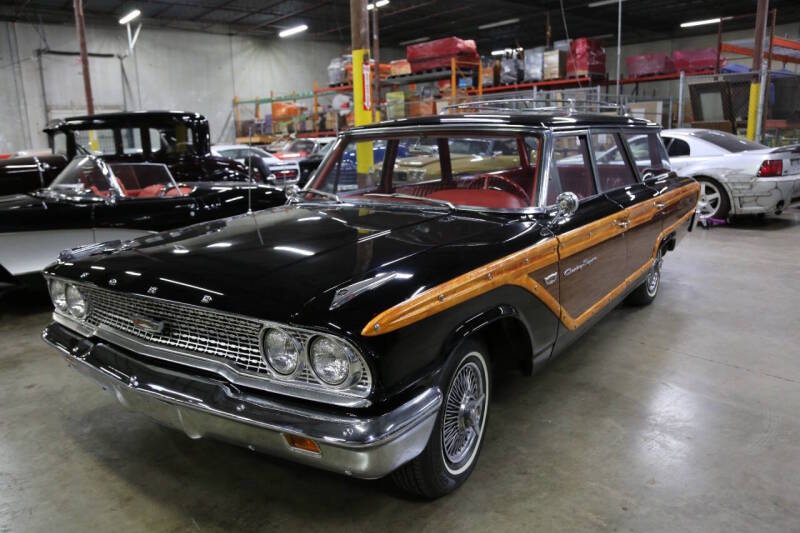
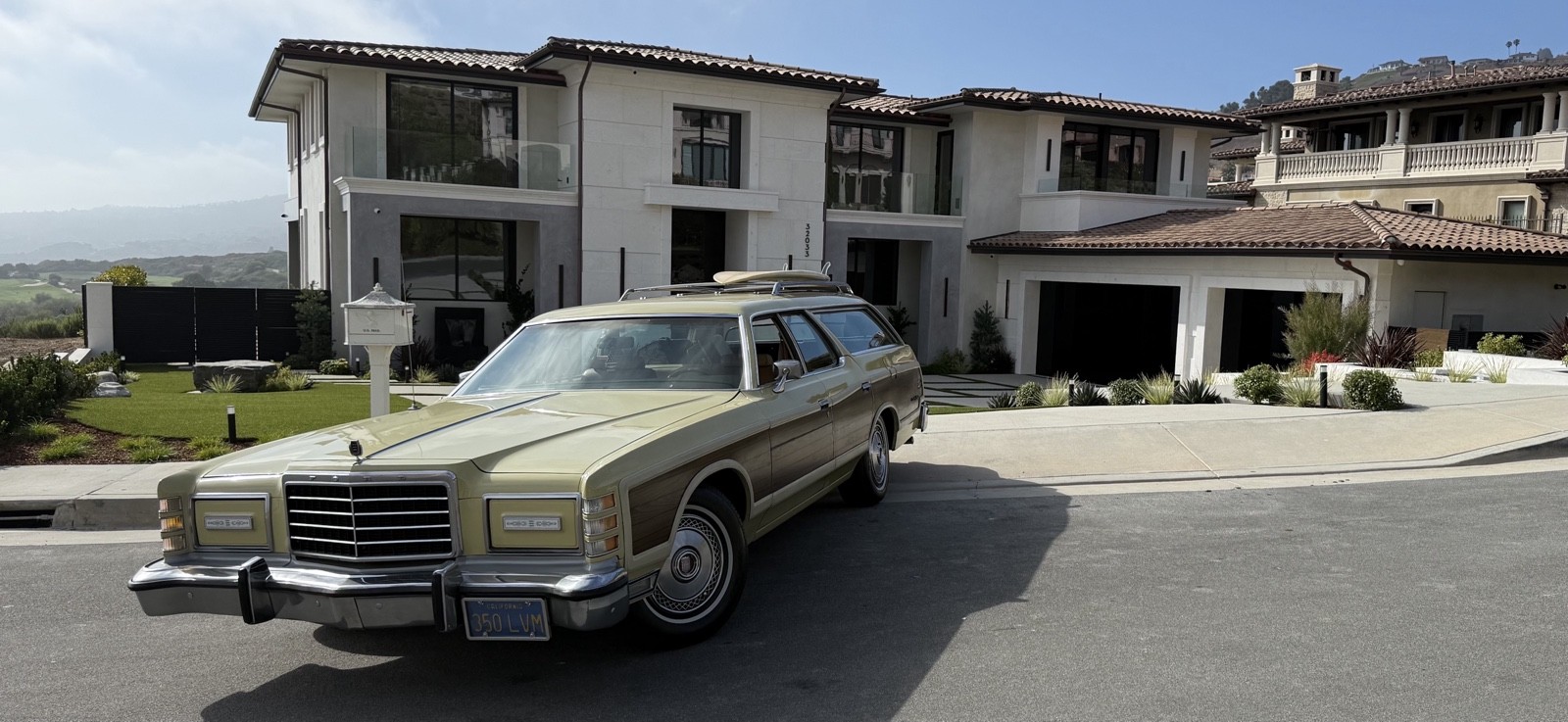
On this site the pool is small — three cars listed at the time of writing, spanning 1963 to 1975, all automatics, in black with wood trim, yellow and green — so treat the listings here as a sample of the species rather than the whole market, and read the market block below this guide for the live numbers. What follows is written for the car in front of you: what it is, what breaks, what it costs to put right, and how to tell a good one from a coat of wax over a tired frame.
The models
Every Country Squire is a full-size, body-on-frame, front-engined, rear-drive wagon with a V8 in the great majority of cases — and that one sentence clears up the two confusions that follow this nameplate everywhere. First, the Country Sedan is not a Squire: it is the plainer full-size wagon one rung down, without the woodgrain sides, and sellers blur the two names constantly. Second, there is no such thing as a Torino Country Squire. Ford sold a mid-size Squire — badged Fairlane Squire, then Torino Squire and Gran Torino Squire from 1968 to 1976 — which is a smaller, separate car on the intermediate platform. A genuine Country Squire is always the big car: Galaxie, LTD or Crown Victoria underneath, whatever the listing headline says. Check the wheelbase and the VIN before you check anything else; the big cars run 119 inches or more in the classic years, the Torino-based Squire is a visibly smaller wagon.
| Model | Years | Engine | Output | Built | Character |
|---|---|---|---|---|---|
| Country Squire (Custom Deluxe) | 1950–1951 | 239 cu in flathead V8 | 100 hp | Low thousands per year; the rarest Squires | The real woodie — mahogany panels, ash framing, varnish and upkeep |
| Crestline Country Squire | 1952–1954 | 239 flathead V8; 239 Y-block V8 for 1954 | 110–130 hp | Squire totals not published separately from Crestline wagons | All-steel body, simulated wood; the woodie look without the wood |
| Fairlane / Fairlane 500 Country Squire | 1955–1958 | Y-block 272, 292, 312 V8s; FE 352 for 1958 | 162–300 hp | Fairlane-line production combined | Fins, two-tone paint and the 1950s at full volume; the '57 is the looker |
| Galaxie Country Squire | 1959–1960 | 292 Y-block, 332 and 352 FE V8s | 200–300 hp | Galaxie-line production combined | Wide, low and chrome-heavy; the last of the 1950s extravagance |
| Galaxie 500 Country Squire | 1961–1964 | 292, then 289 small-block; 352 and 390 FE V8s | 135–300 hp | Galaxie 500-line production combined | Cleaner styling year by year; the '63–'64 cars are the sweet spot of the early cars |
| Galaxie 500 / LTD Country Squire | 1965–1968 | 240 six (rare), 289, 352, 390 and 428 FE V8s | 150–345 hp | Full-size-line production combined | Stacked headlights, Magic Doorgate from '66, the first truly modern Squire |
| LTD Country Squire | 1969–1972 | 302 small-block; 390 FE; 429 big-block | 220–360 hp (gross) | LTD-line production combined | Hidden headlamps, rear-facing third seat, the definitive family Squire |
| LTD Country Squire | 1973–1978 | 351 Windsor, 351M, 400 and 460 V8s | roughly 145–212 hp (net) | LTD-line production combined | The largest Squires ever built; emissions-era tuning, immense presence |
| LTD Country Squire (Panther) | 1979–1982 | 302 and 351W V8s | roughly 130–140 hp (net) | Panther-line production combined | Downsized by over a foot; same idea, less of it, easier to live with |
| LTD Crown Victoria / Crown Victoria Country Squire | 1983–1991 | 5.0 (302) V8, most with sequential EFI from 1986; 351W on the option sheet | roughly 150–160 hp (net) | Panther-line production combined | The last Squires; injected 5.0 cars are the drivers of the range |
(Outputs are period factory ratings — gross before 1972, net from 1972 on, which is why the numbers fall off a cliff on paper while the cars themselves merely get slower and heavier. Ford published wagon production inside the parent line's totals for most years, so honest Squire-only build figures do not exist for most of the run; anyone quoting you an exact build count for a mid-1960s Squire is quoting something they cannot prove either.)
The woodies, 1950–51. A separate species. The wood is structural trim over a steel body — the panels and framing are real timber, maintained like boat brightwork, and a car with rotten or replaced-with-plywood framing is a restoration project wearing a finished car's price. These belong to woodie specialists; buy one the way you would buy a wooden boat, with a survey.
The 1950s cars, 1952–58. All-steel from 1952, with the wood reduced to trim, which makes them far more usable than the true woodies and far cheaper to keep. The 1955–57 Fairlane cars carry the decade's styling — and its values. Watch specification drift: engines were swapped between Y-blocks freely in period, so the engine in the car matters more than the engine on the paperwork.
The Galaxie cars, 1959–68. The core of today's market, and the run that contains the black 1963 car in our listings. Styling calms down from the 1959 excess to the clean 1963–64 cars, then the 1965 redesign brings stacked headlights, coil-spring rear suspension in place of leaves and a much more modern drive. The Magic Doorgate arrives for 1966 and the third seat becomes a proper fixture. A 390-powered 1965–68 car is, for most buyers, the best blend of presence, pace and parts support in the whole forty-one-year run.
The LTD cars, 1969–78. Bigger in every direction, and after 1972 bigger still, with 5-mph bumpers and emissions hardware strangling the big-blocks year by year. The 1969–72 cars, with their vacuum-operated hidden headlamps and available 429, are the collectors' pick of the era. The 1973–78 cars are the cheapest way to own the full land-yacht experience and the most expensive to feed, park and re-trim.
The Panther cars, 1979–91. The 1979 downsizing takes more than a foot out of the length and several hundred pounds out of the weight, and the wagon keeps its woodgrain, its rear-facing seat and its dignity while gaining — eventually — proper electronic fuel injection on the 5.0. These are the Squires you buy to use: road trips, school runs, parts runs, with air conditioning that works and an engine management system a modern technician can interrogate. The nameplate ends after 1991, killed not by failure but by the minivan and the SUV taking its job.
Engines and gearboxes
Ford never built a Squire-specific engine. Every powerplant in this guide is a mainstream Ford V8 (or, rarely, six) shared with the sedans, the trucks and half the American road — which is the single best thing about owning one of these cars. Parts are catalogued, cheap by classic standards and understood by every machine shop on the continent. What changes across forty-one years is not the basic architecture but the layers around it: carburation gives way to emissions carburation and then to injection, gross horsepower gives way to net, and the failure modes move from the mechanical to the vacuum-operated and electronic.
The early engines: flathead, Y-block and the FE (1950–1970)
The 1950–53 cars carry the 239 cu in flathead V8, 100 hp of side-valve simplicity. Its known weaknesses are cooling and cracking: the flathead runs its exhaust through the block, loads the water pumps (there are two) and the radiator, and overheats in modern traffic if the radiator, thermostats and fan belt tension are not all exactly right. A flathead Squire that "runs a bit warm" is telling you something specific — work through the cooling system in order (radiator flow, both pumps, head gaskets, ignition timing) before accepting the folk diagnosis that they all do that. They do not, when sorted. Blocks crack between valve seats and bores; a crack check is part of any engine-out work.
The Y-block (272, 292, 312, fitted 1954–62 in various sizes, plus the short-lived 239 overhead-valve version for 1954) replaced it with overhead valves and a new problem: top-end oiling. Oil reaches the rocker shafts through passages that sludge up, and a Y-block with a noisy top end and low oil pressure at the rockers is usually starved, not worn out. The period fix — an external oil line feeding the rockers — is common on survivors and is a sign of an owner who knew the engine, not a bodge to fear. Check for it, check that it is plumbed neatly, and confirm oil actually reaches both rocker shafts with the covers off and the engine idling.
From 1958 the FE big-block family (332, 352, 390, 406 in sedans, 428 from 1966) becomes the Squire's serious engine, and the 390 is the one you will meet most often in 1961–70 cars. The FE is a deep-skirt, cross-bolt-in-big-versions truck-tough engine with two signature faults. The first is exhaust manifold cracking and broken manifold bolts — the manifolds run hot, the rear bolts seize, and extraction is a machine-shop job, budget $400–900 per side if studs snap. The second is oil consumption past the valve stem seals, which harden and crumble; blue smoke on start-up that clears is stem seals ($600–1,200 in a shop, heads on), blue smoke under load is rings, and the test that separates them is exactly that start-up-versus-load observation plus a wet/dry compression test. Carburation is Autolite or Holley four-barrels on the 390s, the Autolite 2100 two-barrel on lesser cars; fuel pressure at the carburettor should be a steady 4.5–6.5 psi, and a car that starves at sustained speed with correct pressure has a collapsing rubber fuel line or a blocked tank sock, not a carburettor fault.
Identity matters here. FE engines are externally near-identical across 352, 390 and 428, and displacement fraud — innocent and otherwise — is endemic. The casting numbers sit by the starter; the stroke check (a dowel down a plug hole, measuring travel at the piston) settles 352 versus 390 versus 428 in ten minutes without opening the engine. Do the check before you pay a 428 price for a car whose engine number you have not read.
The small-blocks: 289, 302 and 351 Windsor (1963–1991)
The Windsor small-block is the Squire's longevity champion. The 289 (1963–68) and 302 (1968 on) are the same architecture — thin-wall cast block, wedge heads, hydraulic lifters — and the 351W (1969 on) is the taller-deck, stronger version. These engines tolerate neglect that would kill most classics, and their failure list is short and specific. Timing chains stretch and the nylon-toothed cam sprockets fitted in the emissions years shed teeth into the oil pan; a small-block with retarded, wandering timing and plastic crumbs in the drained oil needs a chain set ($500–1,000 fitted) before it needs anything else. Rear main seals weep — two-piece rope seals on early engines — and a drip at the bellhousing that leaves a saucer-sized spot overnight is a $700–1,200 engine-in-or-out job that many owners simply live with; price it, don't panic about it. The Autolite/Motorcraft 2100 and later 2150 two-barrel carburettors are among the most rebuildable units ever made ($350–600 for a proper rebuild with throttle-shaft bushings), and most "carburettor problems" on a Windsor are actually a perished choke pull-off, a blocked accelerator-pump passage or vacuum leaks at the carb base and the brake-booster hose.
From 1978 Ford fits the Motorcraft 7200 Variable Venturi carburettor to many 302 and 351W cars, and this one earns its reputation: the sliding venturi pistons wear, the metering rods stick, and the result is a flat spot and hunting idle that no amount of mixture adjustment cures. Diagnosis is visual — with the air cleaner off, watch the venturi valves move as you open the throttle; sticky, uneven movement confirms it. A rebuilt VV is specialist work; many cars have been converted to a conventional 2150 or a modern four-barrel, which is a practical improvement and a small originality deduction. Decide which you care about before, not after, you buy.
DuraSpark electronic ignition arrives in the mid-1970s and adds one classic fault: the ignition module, heat-soaked on the inner fender, fails when hot — the car cuts out, cools, restarts, and repeats. Carry a spare module ($40–70) in any DuraSpark Squire; substitution is a five-minute test that beats an hour of wiring diagnosis, and it is the correct first move on any hot no-start.
The emissions big-blocks: 351M, 400 and 460 (1971–1978)
The 1973–78 LTD Squires run the 351M, the 400, or the 460 — the 385-series and modified-Cleveland engines of the smog era. The 351M and 400 share the tall-deck Cleveland-derived block; the 400's long stroke makes genuine torque at low rpm, which suits the wagon, but both engines left the factory with cam timing retarded for emissions and low compression, so they feel softer than the figures suggest. A straight-up (non-retarded) timing set at chain-replacement time transforms driveability — the single best modification on these engines, invisible and reversible. Their oiling system prioritises the mains over the top end, so sustained high rpm is unkind to them, but at wagon speeds they are understressed and long-lived. The 460 (the 385-series Lima engine) is the torque answer: watch for cracked exhaust manifolds, a sagging timing chain with the same nylon sprocket issue, and Thermactor air-pump plumbing that has been cut, capped and bodged through four decades of emissions-test evasion. On any 1973–78 car, establish what emissions equipment your state or province requires and whether the car still has it — a "deleted" smog system is a $500–2,000 reinstatement if your inspection demands it, and the seller's problem becomes yours at the first test.
The injected 5.0 (1986–1991)
The last Squires are the easiest to own. The 5.0-litre (302) with sequential electronic fuel injection — SEFI, from 1986 — starts instantly, idles cleanly and returns fuel economy the carburettor cars cannot approach. Its faults are age faults, not design faults: vacuum hoses perished throughout the engine bay, a throttle position sensor worn at the cruise spot causing a surge at steady speed, an idle air control valve gummed into sticking ($60–120 and twenty minutes), and fuel pressure that should hold roughly 30–40 psi at the rail — test it at the Schrader valve before condemning injectors, because a tired in-tank pump or a split in-tank hose mimics injector failure exactly. The 351W remained available on Panthers to the end of production, mostly behind towing packages; it kept simpler induction longer and drinks accordingly.
Gearboxes
Almost every Squire you will meet is an automatic — all three cars currently listed on this site are — and the manual three-speeds and rare overdrive cars of the 1950s are bought as curiosities. The early Ford-O-Matic is a two-speed (with a low-gear start only when selected) and feels it; the Cruise-O-Matic three-speeds that follow divide into the light C4, the iron-case and later FMX, and the C6 behind big-blocks, which is close to unbreakable in wagon service. On any Cruise-O-Matic, judge by fluid and behaviour: fluid should be red and sweet-smelling, shifts should arrive without a flare or a thump, and a delayed engagement into drive on a cold morning is the front pump and seals announcing a rebuild — $1,800–3,000 for a C6 done properly, less for a C4. The vacuum modulator is the cheap deceiver: a ruptured modulator diaphragm gives harsh or late shifts and white smoke from engine oil being drawn up the vacuum line — a $25 part that has sold many unnecessary rebuilds. Test it with a hand vacuum pump before authorising anything.
From 1980 the Panther cars use the AOD, Ford's four-speed automatic overdrive. It is a good gearbox with one lethal dependency: the throttle-valve (TV) cable that sets line pressure is attached to the throttle linkage by a small nylon bushing that crumbles with age. When it fails, the cable drops, line pressure collapses, and the transmission can destroy itself in a few miles of gentle driving — not a limp-home fault, a stop-now fault. On any AOD car, find the bushing before the test drive; if it is cracked, missing or replaced with wire, budget a pressure check and treat the gearbox's remaining life as unknown until a gauge proves line pressure is in specification. AOD rebuilds run $2,200–3,500. This single $5 part is the most important inspection item on any 1980–91 Squire, ahead of the engine, ahead of the rust.
A word on the manual cars, because you will occasionally meet one and the seller will price it as a rarity. The column-shift three-speed behind a six or a small V8 is honest, durable transport and nothing more — parts are truck-common, the linkage wears into vagueness rather than failure, and the Borg-Warner overdrive fitted to some 1950s cars is a delightful period device whose solenoids and governor switches are now specialist items. Rarity here is real but demand is thin: a manual Squire is worth a premium to the one buyer who wants exactly that, and a discount to everyone else, which makes it a negotiating fact rather than a valuation. Whichever gearbox a car carries, the test is the same: cold behaviour first, because a gearbox that is rude cold and polite warm is telling you about seals and fluid, while one that misbehaves hot is telling you about clutches and money.
Problem areas
A Country Squire is a full-size Ford sedan wearing a very large, very complicated extra room on the back — and nearly everything that makes a Squire expensive instead of merely old lives in that room: the tailgate, the third seat, the rear glass, the woodgrain and the structure underneath it. The sedan half of the car shares the Galaxie/LTD/Crown Victoria fault list and the sedan parts supply. Budget your attention accordingly: an hour on the back half for every twenty minutes on the front.
Rust: the map
Start with the frame, because the Squire is body-on-frame and the frame is the car's skeleton and its value. The full-size Fords rust their frames in predictable places: the torque boxes where the body mounts behind the front wheels, the side rails where they kick up over the rear axle, and the rear crossmember and rail ends behind the back wheels, where road spray off the tyres feeds them salt and grit for decades. Surface scale is normal and largely harmless; perforation, flaking layers and a screwdriver going through with hand pressure is structural. A frame with holed rails is not automatically a parts car — sections can be fabricated and welded, at $800–2,500 per side depending on how far the rot has travelled — but it converts the car from a driver into a project at any price, and it must change what you pay.
The body rusts from the inside out at the water traps. Work this list in order. The spare-wheel well and the third-seat footwell under the cargo floor: the tailgate and rear glass seals leak, water runs down inside the quarters, and it sits in the lowest sheet metal on the car — lift the spare and the trim and look, because a Squire can present beautifully and be rotten under the cargo mat. The tailgate itself, covered below. The lower rear quarters behind the rear wheels, the doglegs at the back of the rear door openings, and the bottoms of all four doors. The cowl and the front floor pans, fed by a leaking windshield seal and blocked cowl drains. The roof, at the drip rails and — Squire-specific and expensive — around every roof-rack screw hole and along the seams of the raised rear roof section; a rack fitted for forty years is forty years of tiny leaks into the headlining and pillars. On the 1969–78 cars add the hidden-headlamp doors' surrounding panel work and the leading edge of the hood.
Our own photo evidence, small as the sample is, points the same way: of the two Squires listed on this site whose photographs we have examined in detail, rust was noted in both — two of two. That is not a statistic to hang a market on, but it matches what every wagon specialist will tell you: assume rust is present somewhere in the back half until you have personally proved otherwise, panel by panel.
Distinguish the three grades honestly. Cosmetic bubbling in the lower quarters is a $600–1,500 per panel repair at paint time. Holed floors and seat wells are welding, interior-out, $1,500–4,000 done properly. Frame perforation is the structural conversation above. Fresh underseal, fresh paint in the wheel wells and a seller who will not let you lift the cargo mat are all the same sentence in different words.
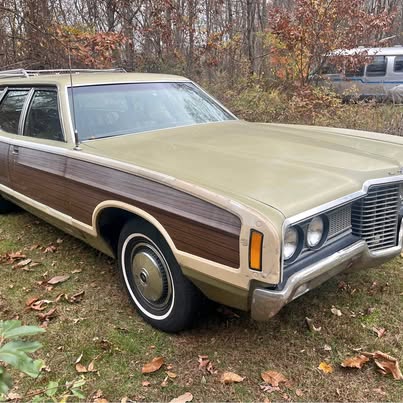
One of the cars in our current listings, a 1971 LTD-era Squire, is photographed where too many of these wagons live: on grass, in the weather, in the autumn leaves. Grass parking is a rust sentence for a car whose weak points are all underneath and at the back — moisture wicks up, splash stays wet, and the rear quarters and seat wells rot quietly while the topside still photographs well. On any car presented like that, spend your first ten minutes underneath the rear quarters and in the spare well, not admiring the woodgrain.
The woodgrain and the tailgate
From 1952 on, the Squire's wood is a system: a Di-Noc vinyl appliqué printed with the grain, applied to the steel panel, surrounded by moulded fibreglass (later plastic) framing strips that imitate the ash framing of the real woodies. It fails three ways. The vinyl fades, chalks and peels at its edges, starting at the tailgate and the rear quarters where sun and spray hit hardest. The framing strips crack, yellow and lose their painted grain. And water gets behind both, so a lifted edge of appliqué is also a rust inspection point — press along the panel edges and feel for the crunch of corrosion under the film.
Restoring the system is materials-plus-patience: reproduction Di-Noc and transfer material is available from wagon specialists, a full re-grain of a big LTD runs into the low thousands in materials and professional labour ($2,000–4,500 for a complete car done well), and the framing strips are the constraint — good originals and reproductions exist for the popular years, but a car missing strips entirely is a car you price as a Country Sedan with ambitions. The myth to correct here is the reverse of the usual one: sellers of later cars talk about "the wood" as if it were timber needing a French polisher. It is vinyl and fibreglass. It needs a heat gun, patience and a specialist supplier — not a boatbuilder — and a quote from a woodworker is a sign you are asking the wrong trade.
The Magic Doorgate (1966 on) is the Squire's party piece and its most complicated panel. It drops flat like a tailgate with the window lowered, or swings sideways like a door with the window up, through a system of hinges, latches, torsion assistance and interlocks. Wear shows as a gate that sags on its hinges, needs a slam, or refuses one mode entirely. The electric rear window that must work for any of it to work runs on a regulator and motor buried in the gate, fed by wiring that flexes at the hinge every time the gate moves — broken conductors in that hinge loom are the commonest cause of a dead rear window, ahead of the motor. Diagnosis order: fuse and switch, then voltage at the gate connector while an assistant works the switch, then the loom, then the motor. A full gate rebuild with seals, regulator work and latch adjustment is $800–2,000 in a shop; the rubber seals themselves are reproduced for most years and a leaking gate seal is a maintenance item, not a disaster — but it is the leak that fills the spare well, so it is never only cosmetic.

Suspension, steering and brakes
The chassis is conventional: independent front suspension with coil springs and ball joints, a live rear axle on coil springs from 1965 (leaf springs before that), recirculating-ball power steering and, from the mid-1960s on, front disc brakes on most cars. Nothing here is exotic and everything here is heavy — a big LTD Squire weighs well over two tons, and it wears its front end accordingly. Ball joints, idler arm and centre link wear show as wander, tramlining and uneven front tyre shoulders; a full front-end refresh with quality parts is $900–1,800 fitted and transforms the car. Rear coil springs sag with age and with decades of cargo; a Squire sitting low at the back with the third seat and a spare aboard is usually springs and tired shocks, not frame damage — measure ride height at the rocker, both sides, before concluding anything.
The steering box itself wears at the centre of its travel, giving free play exactly where you drive. Adjustment takes up some of it; a rebuilt box is $400–700 exchanged. Power steering pumps whine when low or aerated — check the fluid and the return hose before condemning the pump. On brakes, the age faults are seized calipers, perished flexible hoses (replace all three on any new purchase, $150–300 the set, before you trust the pedal), and rear drums that have not been apart in twenty years. The 1973–78 cars stop two and a half tons with period hardware; budget for a full hydraulic overhaul — master cylinder, hoses, calipers, wheel cylinders, fluid — at $800–1,600 on any car without documented recent brake work, and treat it as non-negotiable safety spend, not haggling material.
Air conditioning deserves its own sentence because every Squire buyer asks: the factory systems are big, simple and rebuildable, the compressors (York/Tecumseh on early cars, later Ford units) are available, and a full recommission with a conversion to modern refrigerant runs $800–2,000. A car advertised "A/C just needs a charge" needs, on the evidence of every experienced buyer, a compressor seal, two hoses and a receiver-drier as well. Price accordingly.
Interior, electrics and the vacuum empire
The cabin is where a Squire's size works against it: there is simply more of everything — more vinyl, more carpet, more seat, more glass — and re-trimming a nine- or ten-passenger LTD interior to a high standard costs sedan money multiplied, $3,000–7,000 for seat covers, foam, carpets and a headliner done properly, with the rear-facing third seat and the cargo-area side panels the pieces most often missing or ruined. Check what is actually there. The dual-facing rear seats fold into the floor; a car whose third seat has been removed, or whose well is full of water damage and a spare tyre, has lost a piece that is genuinely hard to source. Dash pads crack in the sun across every era; reproduction pads exist for the popular years. Seat foam collapses on the driver's side first — sit in it, don't just look at it.
Electrics are simple in architecture and perished in detail. The charging system, the ignition switch and the headlight switch all carry real current on the early cars and their connectors cook over fifty years; flickering lights and a hot headlight switch are connector resistance, not a haunted car. Power windows on the later cars fail one motor or one switch at a time and are all available. The special Squire burden is vacuum. Ford ran the 1969–72 hidden headlamps on engine vacuum, stored in a reservoir canister, through actuators, check valves and yards of small-bore hose — and automatic climate control on the later cars adds a second vacuum system behind the dash. A car whose headlamp doors creep open overnight, open unevenly, or open only at idle has a vacuum leak, and the diagnostic tool is a hand vacuum pump and patience: isolate the reservoir (it must hold vacuum), then each actuator, then the hoses. The parts are cheap — hose by the foot, actuators rebuildable, canisters available used — but the labour of tracing is what you are buying, so a car with fully working vacuum systems is worth real money over one where "the headlights just need a hose somewhere." The doors must also open by hand with the manual override if vacuum is lost entirely; check that the mechanism is not seized, because seized linkages are what turn a hose job into a fabrication job.
Two smaller systems deserve a check on any car. The rear window and gate electrics, covered above, and the cruise control on 1970s cars, whose servo and vacuum dump valve fail into either dead cruise or — the one to catch — a throttle that does not release cleanly; test it on the road test, once, somewhere with room. And on the Panther cars, add the modern layer: the AOD's TV cable from the gearbox section, power accessories, and an EFI system whose fault codes you can blink out with a test light — a seller who has cleared codes just before your visit has usually left a car that runs worse cold, so always insist on a cold start.
Cooling, fuel and exhaust: the supporting systems
Three systems cut across every era and fail in era-specific ways. Cooling first: a Squire's radiator was sized for period traffic, and a car that creeps up in temperature in a queue is usually carrying a radiator whose core is half-silted, a fan clutch (on later cars) that no longer locks up, or a missing fan shroud — the shroud is not decoration, and its absence alone explains many "mystery" overheats. Test the fan clutch by spinning the fan on a hot, stopped engine: it should resist and stop within a turn or two. A re-core or quality replacement radiator runs $400–800 depending on era, and it is money spent before any engine work on a car that runs hot, because an overheated FE or 460 warps and cracks exhaust manifolds and cooks valve stem seals as a bonus.
Fuel systems age at both ends. Steel tanks rust from the inside once ethanol-blended fuel and condensation have had their decades; rust flakes block the tank sock and the filters, and the symptom — starvation at sustained load that recovers after a rest — impersonates a failing pump or carburettor. Drop the tank on any car with recurring starvation and look inside before buying parts in sequence. Replacement tanks for the popular years are reproduced ($250–500), wagon tanks for the odd years less so. Rubber fuel lines perish everywhere, and any original cloth-braided line is a fire risk to replace on purchase, not to monitor. At the other end, the filler neck and its seals on the wagons live behind the rear quarter or in the gate area depending on year, and a fuel smell in the cargo area after a fill is that seal or the vent hose — find it, because fuel vapour in the third-seat well is the one fault in this guide you do not drive home with.
Exhausts rot from the rear forward, and the wagon's long system with its over-axle bends is a fabrication job on the early cars ($600–1,200 in stainless or aluminised steel) and nearer to catalogue money on the Panthers. Manifold-to-head leaks on the FE and 460 were covered in the engines section; the system behind them fails quietly, and a drone at cruise that the seller calls character is usually a holed mid-silencer. None of this is exotic. All of it belongs on the written list you build during inspection, priced, because three $800 systems are how a fairly bought car becomes an expensive one by spring.
How to inspect one
Inspect a Squire in this order — structure before cosmetics, the back half before the front, cold before warm — and take a magnet, a torch, a hand vacuum pump, a tyre gauge and a friend. Allow ninety minutes. A seller who will not allow the cargo mat up, the spare out and a cold start is giving you the inspection result for free.

- Paperwork and identity first. Read the VIN plate (driver's door jamb or dash, depending on year) and the door data sticker where fitted, and decode the engine code letter. Then read the engine itself: FE cars get the stroke check from the engines section, small-blocks get their casting numbers checked by the starter. A "429" or "428" car whose numbers say 390 is priced on its numbers, not its badge.
- Cold start, bonnet up, hands off. The engine should be stone cold when you arrive. Watch for blue smoke at start-up (stem seals), listen for top-end clatter on Y-blocks and Windsors (oil delivery and lifters), and note how long the oil light takes to go out. A warm engine on arrival erases all of this evidence — reschedule rather than guess.
- The frame, on your back. Torch along both rails, the torque boxes, the kick-up over the rear axle and the rear crossmember, per the rust map. Poke suspect scale with a screwdriver handle. Perforation anywhere moves the car into project pricing on the spot.
- The back half, inside. Cargo mat up, spare out, third seat up and down. Read the spare well and seat footwell for water lines, scale and previous patches. Smell the carpet. Water here means the gate or glass seals — find which, by looking for the track marks down the inner quarters.
- The tailgate, both modes. Window down, gate dropped flat; window up, gate swung open as a door. Both should latch and unlatch without slamming or lifting. Cycle the rear window from both the dash switch and the key switch at the gate. Sag, stiffness or a dead mode is the $800–2,000 conversation from the problem areas, priced now.
- Woodgrain, panel by panel. Sight along both sides in raking light. Lifted edges, chalking, mismatched grain across door gaps, cracked framing strips. Press along the lower edges for corrosion crunch under the film. Photograph every panel — your record of what "original wood" actually meant on this car.
- Floors, cowl and roof. Carpets up where they will lift, torch on the front pans and toe boards. Headliner down at the edges with your eyes only: staining at the pillars and around the roof rack points to rack-screw and drip-rail leaks. Check the cowl drains are clear by pouring a cup of water into the cowl grille and watching it exit behind the front wheels, not into the footwell.
- Front end and steering, engine running. Rock the wheel: free play at the centre is box wear; clunks are linkage. Bounce each front corner. Look at the front tyres' shoulders — they record the alignment and ball-joint history more honestly than any invoice.
- Under the bonnet, systems check. DuraSpark car: note the module's condition and ask about hot cut-outs. AOD car (1980 on): find the TV cable bushing at the throttle linkage before anything else — cracked or missing, the test drive becomes a line-pressure test or no sale, per the gearbox section. Check every vacuum hose you can reach on a 1969–78 car by flexing it; perished hose crumbles, good hose bends.
- The vacuum empire, demonstrated. On a hidden-headlamp car, run the engine, switch the lights on and off, then switch off and watch the doors for ten minutes while you do other checks — creep is a leak, and the hand pump isolates reservoir, actuators and hoses in that order. Climate-control cars: run through every mode and confirm the air actually changes direction and temperature.
- Road test, in a set order. Cold driveability first (choke behaviour, VV-carb flat spots, EFI cold surge), then a steady 45–55 mph cruise for AOD lockup behaviour, steering wander and driveline vibration, then three firm brake applications from speed — pull, judder and pedal feel — then a full-throttle merge to watch for smoke under load and transmission flare. Test the cruise control once, somewhere open. Listen, at the end, for the exhaust note at idle: a rhythmic puff is a burnt valve or a manifold leak, and the manifold-bolt history from the engines section tells you which to suspect.
- Hot restart and the electrics sweep. Switch off, wait five minutes, restart: the DuraSpark hot-start test and the vapour-lock test in one move. Then everything electrical, in one pass — windows, locks, seats, rear window again, lights, wipers, washers, A/C through its full range, radio. Write the failures down as a priced list, because that list, plus the welding list, is your negotiation.
Values
Read the Squire market as three markets wearing one badge, because condition and era move prices more than specification does. The recorded-sales block below this guide carries the actual numbers; what follows is how to interpret them when a specific car is in front of you.
The condition spread on these cars is enormous — wider than on the sedans they are based on — because the wagon-specific restoration work (woodgrain, tailgate, third seat, the extra interior) is expensive, specialised and impossible to shortcut. That means the gap between a project and a sorted driver is not a percentage, it is a multiple, and the project car is usually the expensive way to own a good one: add the welding, the re-grain, the gate rebuild and the interior to a cheap car's price and you pass the good car's price with a year of your life spent as well. Buy the best structure you can find and let someone else have done the wagon work.
Asking prices and achieved prices part company predictably. Sellers price the nostalgia — the childhood summers, the film appearances — while buyers at auction price the welding list. Cars with fresh cosmetic work over unaddressed structure sit for sale the longest; honest drivers with documented mechanical work sell quietly and quickly, often without ever reaching a public listing. When you compare a car against recorded sales, compare like with like on the three things the market actually pays for: the frame and back-half structure, the state of the woodgrain system, and originality of specification — a car still carrying its born-with engine, its third seat and its uncut dash is worth a premium over a tidier car that has lost them.
Variant premiums follow era more than engine. The 1950–51 real woodies sit in the woodie market, priced by wood specialists against wooden-boat logic. The 1955–57 cars carry the decade premium. Within the Galaxie and LTD years, big-block cars (390, 428, 429) command more than small-block cars in the same condition, and the premium is real but modest next to the condition spread — do not pay a big-block premium for a car whose engine numbers you have not verified, per the inspection section. The Panther cars remain the value end: injected 5.0 cars are bought as usable classics, priced against use rather than scarcity, and a towing-package 351W car is worth a small premium to the buyer who will actually tow with it and very little to anyone else. Colour matters less than it does on convertibles; woodgrain condition matters more than colour ever will.
Parts and ownership
Ownership is the Squire's strongest suit. Mechanically the car is a full-size Ford, and the full-size Ford aftermarket is one of the deepest in the hobby: engine, gearbox, suspension, brake and steering parts for every era in this guide are in ordinary catalogues at ordinary prices, much of the Panther running gear was in production for decades, and the small-block and FE engine families are supported by an entire industry. Service information is everywhere — factory shop manuals are reprinted, and there is no Squire mechanical problem that has not been solved, photographed and argued about online.
The thin ice is wagon-specific and trim-specific. Woodgrain material and framing strips come from a small number of wagon specialists — available for the popular years, slower and dearer for the odd ones. Tailgate internals, third-seat hardware, cargo-area trim and wagon rear glass are used-parts hunting, not catalogue ordering; a car missing those pieces is missing them in a way money fixes slowly. Big LTD-era brightwork, hidden-headlamp mechanisms and year-specific grille and bumper pieces sit in between: findable, priced by patience. The practical rule is to buy completeness over shine — a dull car with every wagon piece present is a better ownership proposition than a gleaming car missing its third seat and two framing strips.
Running one is straightforward. Expect fuel consumption in the low-to-mid teens per gallon for the carburettor big cars, better from an injected Panther, and budget tyres, brake work and front-end wear at heavy-car rates. Insurance and club support are easy — the wagon clubs and the full-size Ford community are active, and the cars are welcome everywhere from drive-ins to national meets. Garaging matters more than mileage: a Squire kept dry will outlast its owner's interest; a Squire kept on grass is the rust section, happening in real time.
Which one to buy
- The all-rounder: a 1965–68 Galaxie 500 or LTD car with the 390 FE — stacked-headlight looks, Magic Doorgate, the deepest parts support of the classic era and enough torque to use anywhere. This is the default recommendation.
- The value buy: a 1979–91 Panther car with the injected 5.0 — the same silhouette and woodgrain, modern manners, used-classic money. Check the AOD's TV bushing before you check anything else.
- The collector: a 1950–51 real woodie, bought with a wood specialist's survey and a dry garage waiting. Buy the wood, not the story.
- The 1950s statement: a 1955–57 Fairlane car, bought on engine identity and panel fit; the decade premium means fakes and spec-drift are priced in unless you verify.
- The big presence: a 1969–72 LTD with the 429 and working hidden headlamps — the definitive family Squire, provided the vacuum systems demonstrably work and the frame's rear half is sound.
- The honest project: a 1973–78 LTD, bought cheap with open eyes — the most wagon per dollar there is, as long as the spare well, the gate and the frame pass inspection and the emissions equipment your state requires is still on the car.
The overriding rule: buy the frame, the back half and the woodgrain — in that order — and let the engine be whatever it is, because every engine in this guide is fixable with catalogue parts, while a rotten frame, a ruined tailgate and a stripped woodgrain system are the three bills that turn a Country Squire from a hobby into a debt.
See the 2 Country Squire cars currently listed.
For sale now
 $48,000 · 93% above typical
Expand
 $14,000 · 44% below typical
Expand
What they sell for: Country Squire sale prices.