
GMC 100 Series buyer's guide
GMC 100 Series (1947–1959) — 100, 250: what's listed, and what they sell for.
Years: 1947–1959 · Models: 100, 250
Overview and history
The GMC 100 is the half-ton pickup of the two great post-war General Motors truck generations — and the first thing to learn about it is that it is not a Chevrolet with a different grille badge screwed on. The body shells are shared, the frames are close cousins and a great deal of the sheet metal interchanges, but under the bonnet a GMC of 1947 to 1959 is a different machine from its Chevrolet 3100 counterpart: a GMC-designed overhead-valve six with full-pressure lubrication where the Chevrolet still used its own, older Stovebolt line, Pontiac-built V8s when the V8 era arrived, and a four-speed Hydra-Matic automatic offered years before Chevrolet truck buyers could have an automatic at all. Buyers in period knew the difference and paid a premium for the GMC. Buyers today often do not know the difference, which is why so many GMCs are misdescribed, mis-engined and mispriced — and why the identity checks in this guide matter more than the cosmetics.
GMC itself was General Motors' truck division, built from the old Rapid and Reliance truck companies and run as the corporation's dedicated commercial-vehicle arm. Where Chevrolet sold volume to farmers and small trades, GMC sold through its own dealer network to buyers who wanted heavier specifications, longer engine life and a truck that could be ordered deep into commercial territory — the same division built everything from this half-ton up to highway tractors and coaches. That positioning explains the 100 Series: it is the lightest thing GMC made, but it was engineered by the heavy-truck people, and it feels like it — heavier castings, a more substantial engine and a specification sheet aimed at work rather than price.
The story divides cleanly in two. The first generation, sold from mid-1947 to early 1955, is GMC's version of the Advance Design trucks — GMC called its line the New Design at launch. These are the upright, separate-fender trucks with the tall cab, running boards and the five horizontal grille bars that mark a GMC out from a Chevrolet at a hundred paces. The second generation arrived in the spring of 1955 as the 1955 second series — GMC marketed it as the Blue Chip line — and ran to 1959. These are the Task Force-era trucks: wrap-around windscreen, slab sides, hooded headlamps, a V8 on the option list and, from 1958, quad headlamps and the wide Wideside bed alongside the traditional stepside. Both generations sit on a straight, simple ladder frame with a beam front axle on leaf springs; independent front suspension did not reach GMC light trucks until the generation that replaced these trucks in 1960.
On our own listings, the shape of today's market is easy to read: we currently track 13 of these trucks, 7 for sale and 6 recorded sold, spanning 1948 to 1959, and 11 of the 13 came through dealers rather than private or marketplace sellers. That dealer-heavy mix is typical of the model now. The rough farm trucks mostly died in service decades ago; what survives, and what gets traded, is the restored pickup, the patina shop truck and the street-rodded cruiser — which means the originality questions in this guide are not academic. A large share of the trucks you will look at have been modified, re-engined or both, sometimes honestly described and sometimes wearing a GMC grille over a specification the factory never built.
Hold on to the hierarchy of value that governs everything below. On a Chevrolet of this era, the engine is a known quantity and the body is the question. On a GMC it is the other way round as well: the Jimmy six and the Pontiac V8 are the reasons to buy the GMC instead of the Chevrolet, so a GMC that has lost its GMC engine to a generic small-block swap has lost the very thing that made it worth more. Rust still writes the biggest cheques, as it does on every truck of this age, but engine identity comes a close second — and unlike rust, it can be settled in five minutes with a torch and the stamped pad behind the distributor, as the inspection section explains.
The models
Every GMC 100 is a half-ton on the short chassis of its generation, and the range is a body-style range rather than a trim range: pickup, panel, Suburban Carryall and chassis-cab, with the trim and equipment layered on top by option — most visibly the Deluxe cab with its curved corner windows, the so-called five-window cab on the first-generation trucks. The heavier 150 (three-quarter-ton) and 250 (one-ton) lines share the cabs and much of the sheet metal, and one 250 flat bed appears in our listings alongside the 100s — it is covered by a note below rather than in the main table, because its chassis, gearing and brakes are one-ton hardware and it should be inspected and priced as such.
| Model | Years | Engine | Output | Built | Character |
|---|---|---|---|---|---|
| 100 pickup, New Design | 1947–1953 | 228 cu in Jimmy six | about 100 hp | Not separately published | The original; split windscreen, foot starter, 6-volt |
| 100 pickup, New Design | 1954–1955 first series | 248 cu in Jimmy six | about 125 hp | Not separately published | One-piece windscreen, bigger six, Hydra-Matic available |
| 100 panel and Suburban | 1947–1955 first series | 228, then 248 six | about 100–125 hp | Not separately published | The enclosed half-tons; Suburban is the rarity |
| 100 pickup, Blue Chip | 1955 second series–1957 | 248 six; Pontiac 287/316/347 V8 option | 125 hp six; 180–227 hp V8 | Not separately published | Wrap windscreen, 12-volt, the V8 arrives |
| 100 pickup, Blue Chip | 1958–1959 | 270 six; Pontiac 336 V8 option | about 130 hp six; about 200 hp V8 | Not separately published | Quad lamps, Wideside bed option, biggest Jimmy six |
| 100 panel and Suburban | 1955 second series–1959 | 248/270 six; V8 option | as above | Not separately published | Carryall bodies on the new shell; very scarce now |
A word about the "Built" column, because it is blank in a way a Mercedes or Porsche guide's would not be. GMC published production in aggregate truck figures, and reliable, audited production splits by model year and half-ton body style for 1947–59 do not exist in the way enthusiasts sometimes pretend they do. Anyone who quotes you an exact production figure for, say, a 1952 GMC Suburban is repeating a number with no solid source behind it. What can be said honestly is that GMC built substantially fewer light trucks than Chevrolet in every one of these years — Chevrolet was the volume division by a wide margin — so a GMC is the scarcer truck on any given day, and the enclosed bodies are scarcer than the pickups by another wide margin again.
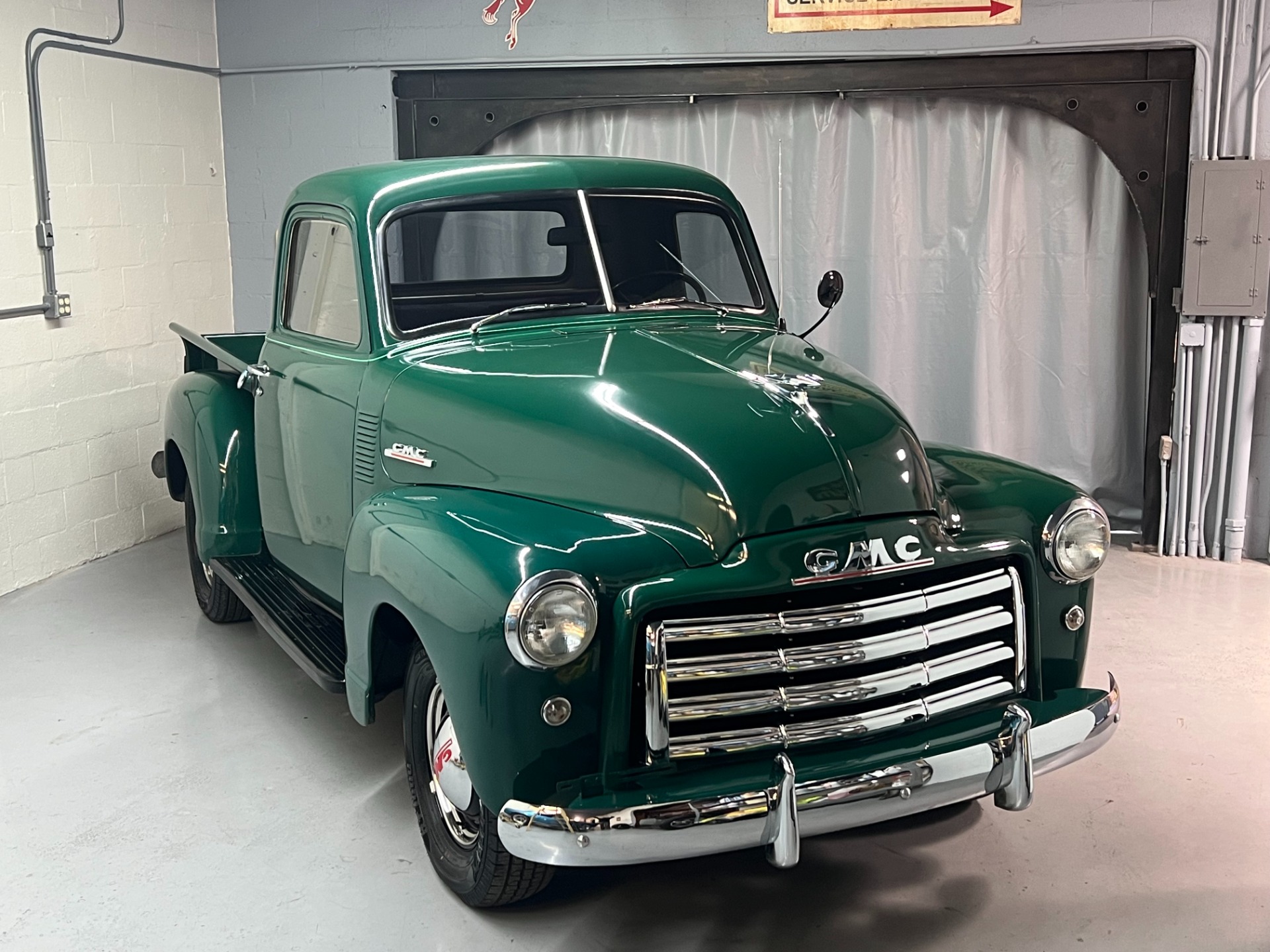
The first-generation pickups (1947–55 first series). The standard truck is a stepside pickup on a 115-inch wheelbase with a bed a little over six feet long, steel cab floor framing with a wooden bed floor over steel strips, and the five-bar grille with GMC lettering that is the division's signature. The cab is the thing to learn: the standard cab has a small flat rear window; the Deluxe cab option adds the curved corner windows that turn it into the five-window, and five-window trucks carry a real premium today because the corner glass transforms the cab — and because the corner glass and its rubbers are exactly what a standard-cab truck cannot cheaply become. Model years are told apart by details rather than redesigns: 1947–50 cars have the split windscreen, lever-action shock absorbers early on and the vent windows arriving for 1951; 1954 brought the one-piece curved windscreen, a single horizontal grille bar in place of the five bars, a redesigned bed and the bigger 248 engine as standard in the half-ton — the 1954 and early-1955 trucks are a distinct, short-lived specification and the first-generation trucks most buyers seek out.
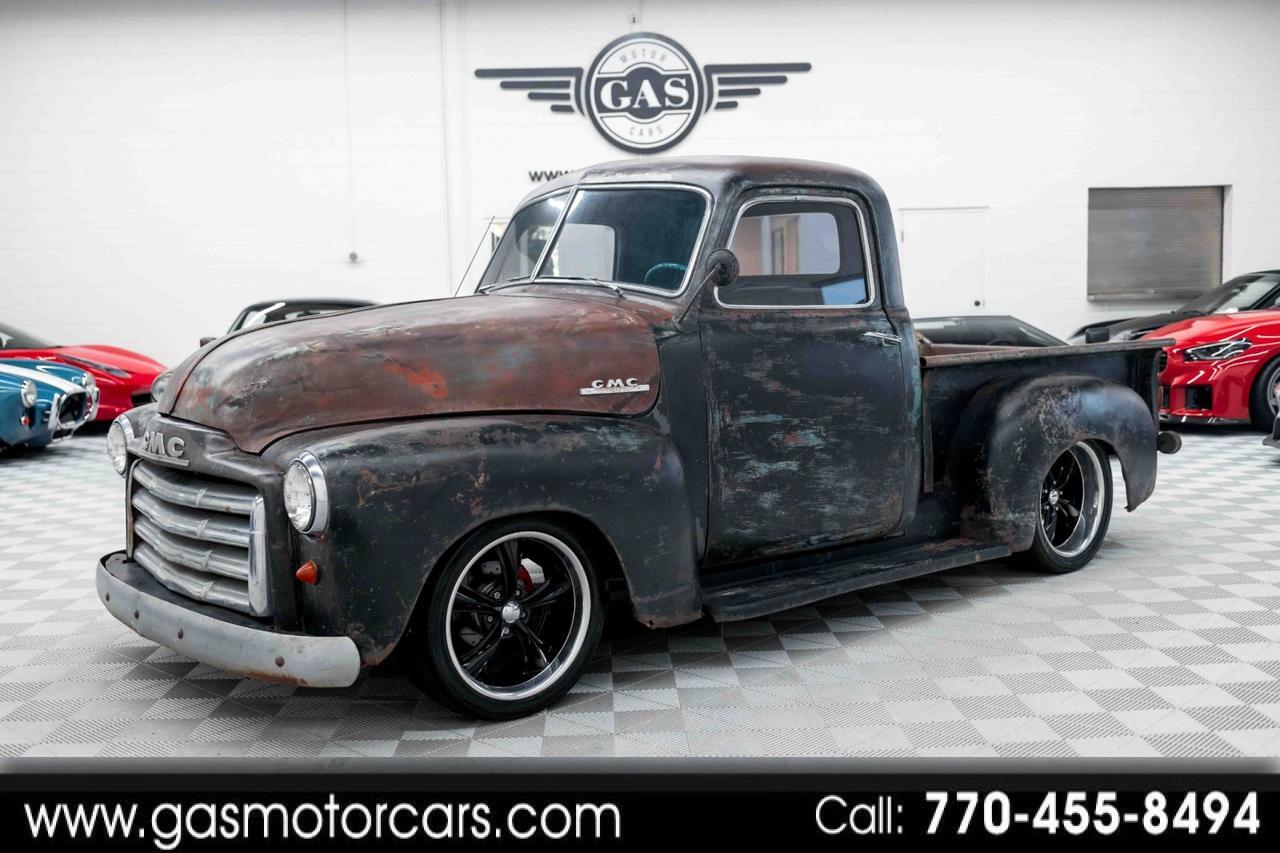

The enclosed trucks: panel and Suburban. The panel truck is the pickup's chassis under a full-height van body — the tradesman's truck, worked hard and now rare because so few were saved. The Suburban (GMC also used the Carryall name) is the windowed wagon version, the ancestor of the modern SUV, sold in tiny numbers against the pickup and now the most sought-after body of the range when a genuine one surfaces. Both share the pickup's cab-forward sheet metal and engines. Judge them by the pickup rules plus one more: the long roof and side panels oil-can, dent and rust along their gutters, and panel- and Suburban-specific trim and glass is far harder to replace than pickup parts. A cheap enclosed truck with missing trim is not the bargain the same money buys in a pickup.
The Blue Chip pickups (1955 second series–1959). The new shell changed the truck's whole stance: the cab grew, the windscreen wrapped, the front fenders became part of a slab-sided body and the bed sides rose to meet them. Short-bed trucks sit on a 114-inch wheelbase, long-beds on 123 inches, and the bed itself is the stepside in the traditional pattern until 1958, when GMC added the Wideside — a full-width, smooth-sided bed in the Fleetside manner — as the fashionable alternative. 1955 second-series trucks still wear single headlamps and the eggcrate grille; 1958 brought quad headlamps, a wider grille treatment and heavier front sheet metal, and 1958–59 trucks are visibly broader-faced cars. The V8 option runs through the whole Blue Chip run and transforms the truck — see the engines section — and a factory V8 Blue Chip, verified by its serial and engine, is the most collectable specification of the second generation.

The 250 in the room. Our listings include a single 1948 250 flat bed, and it deserves a line so nobody buys it by mistake for a big 100. The 250 is the one-ton: longer and heavier chassis, lower gearing, heavier springs and brakes, and in flat-bed form usually a truck that earned its living. Everything in the rust and inspection sections applies, doubled — and its value sits in a different, more commercial market where originality of the bed and body counts for less than chassis soundness.
Engines and gearboxes
The Jimmy sixes: 228, 248 and 270
The GMC overhead-valve six — the "Jimmy" six — is the heart of this guide and the single biggest reason the GMC exists as a separate truck from the Chevrolet. GMC designed it before the war as a proper truck engine and built the family in a ladder of displacements — 228, 248, 270 and, in heavier trucks, 302 cubic inches — from the same basic architecture: a deep, stiff cast-iron block and head, overhead valves, a timing chain rather than the Chevrolet's fibre timing gear, and, crucially, full-pressure lubrication to the main bearings, connecting rods and camshaft from the start. Chevrolet's rival six oiled its rods by splash and dipper in its early form and only gained full pressure late in its life; the GMC engine was the modern, durable design from day one, built to run at working loads for commercial mileages. That is why period fleet buyers paid more for GMCs, and it is why a Jimmy six in good order is a genuinely sweet engine today: slow-revving, torquey from walking pace, and unstressed in a way that makes 70-year-old examples still perfectly usable.
The displacements map onto the model years, and this is your identity key. The 228 (228.6 cu in) is the standard half-ton engine from 1947 to 1953, rated at around 100 hp. The 248 replaced it in the half-ton for 1954 and carried through the first Blue Chip years to 1957, at around 125 hp. The 270 — the engine of GMC's heavier light trucks earlier in its life — became the standard six for 1958 and 1959, at around 130 hp with the torque to match its extra capacity. All three are visually near-identical from ten paces, which is exactly why the stamped number matters: the engine serial is stamped on a machined pad on the side of the block, behind the distributor, and its opening digits are the displacement. A pad that reads 248 is a 248 whatever the seller's advert says; a pad ground smooth, or a number that belongs to no GMC sequence, is a conversation you have before money moves, not after. Photograph that pad on any truck you are serious about — it is step 2 of the inspection for a reason.
Fuel arrives through a single downdraft carburettor — Zenith-built instruments are the period fitment on the sixes — and ignition is by a conventional Delco-Remy distributor with points. Neither system is exotic, and both are covered as failure areas below; what matters here is character. A healthy Jimmy six starts from cold with a little choke, idles slowly and evenly with a soft, deep note, and pulls from low revs without needing to be worked. Oil pressure should be strong and steady — these are full-pressure engines with real gauges or warning lights depending on specification, and an engine that shows low pressure hot, rattles its mains on start-up for more than a second or two, or breathes heavily from the oil filler is telling you its bearings and rings have done their work. Top-end noise is usually valve clearances — the six uses adjustable valve gear and wants its clearances checked as a service item — and a six that has been kept in adjustment and oil is quiet in a way a neglected one never is.
What wears, and what it costs, is refreshingly modest by classic standards, because the engine is simple, all-iron and generously proportioned. A carburettor rebuild done properly runs roughly $250–500; a distributor overhaul with points, condenser and a vacuum-advance unit $150–350; a water pump $120–300 in parts. A full engine rebuild — machining, pistons, bearings, timing chain, valve work — is a $4,500–8,000 job at a generalist machine shop, less if you remove and refit the engine yourself, and the parts exist because the same family powered so many GMC trucks for so long. The expensive Jimmy is not the worn one; it is the cracked one. Blocks crack from frost damage in trucks that sat with water instead of antifreeze, usually around the external water jacket, and heads crack between the valve seats when an engine has been run hot. A crack test belongs in any rebuild quote, and a truck with a visibly welded block should be priced as a truck that needs an engine.
The Pontiac V8s: 287, 316, 347 and 336
When the industry went V8 in 1955, GMC did not take Chevrolet's new small-block — it went to its sister division Pontiac, whose overhead-valve Strato-Streak V8 had been designed with exactly the low-speed torque a truck wants. That choice makes a Blue Chip V8 a genuinely different machine from a V8 Chevrolet Task Force, and the Pontiac engine is the second identity check of this guide: a 1955–59 GMC with a Chevrolet 265, 283 or 350 under the bonnet may be a fine truck, but it is not a factory V8 GMC, and it should not be priced as one.
The sequence runs a year at a time. For the 1955 second series, the option is Pontiac's 287 (287.2 cu in), rated around 180 hp in GMC truck tune with a two-barrel carburettor. For 1956 the engine grew to the 316 (316.6 cu in), around 205 hp. For 1957 came the 347, around 227 hp in truck specification — the strongest of the line in period and, with the manual gearbox, a genuinely quick truck by 1950s standards. For 1958 and 1959 GMC used the 336, an engine Pontiac created for GMC by fitting a smaller bore to its 370 architecture: capacity went down on paper, but the engine kept the big engine's bottom end and its torque, around 200 hp in truck tune, and it is a sweet, lazy, understressed unit. All four are cast-iron overhead-valve V8s with hydraulic lifters, a single two-barrel carburettor in GMC service and Delco-Remy electrics, and all share the Pontiac family's architecture — which means Pontiac car knowledge, and Pontiac parts channels, apply where Chevrolet small-block knowledge does not.
Judging one is conventional V8 work. It should start cleanly, idle without a lope (a lumpy idle on a stock two-barrel truck engine is a fault, not a cam), and pull without hesitation or detonation. Listen for lifter clatter that does not fade as the oil warms — the hydraulic lifters sludge up in engines that sat — and look for the Pontiac family's known weeps around the valley and rear of the engine, which bake onto the block and make an honest engine look worse than it is; the test is whether the oil is going down between changes and whether the underside is wet, not whether the block carries old staining. Overheating is the V8's real enemy in a truck that works: the cooling system was sized in period for period traffic, and a V8 truck with a silted radiator, a missing fan shroud or a tired water pump will boil in modern summer queues while the six behind it does not. Parts are the V8's weak suit compared with the six: service items are easy through the Pontiac trade, but GMC-truck-specific V8 pieces — exhaust manifolds above all, which crack and are not shared with the Pontiac cars — are hunted parts, and a cracked manifold is a $300–800 problem in parts alone if a sound used one can be found at all. A full rebuild of a Pontiac V8 runs roughly $5,500–9,500 at a specialist, and documented recent work is worth a clear premium.
The engine that does not belong: the 305 V6, and swaps generally
Every GMC guide has to deal with the 305 V6, because sellers deal in it. The facts: for 1960, GMC replaced the Jimmy six in its light trucks with a family of big 60-degree V6 engines of its own design — the 305 first among them, built 1960 to 1966 in the successor 1000 Series trucks, with larger 351, 401 and 478 versions in heavier models. It is a remarkable engine — massively built, with its spark plugs set into the top of the heads between the rocker covers and a torque output that embarrasses its horsepower figure — and it is a genuine GMC engine with a devoted following. But it was never, in any year, fitted to a 1947–59 GMC 100. A truck advertised as a 1957 GMC 100 with a 305 V6 is one of three things: a later truck misdated, an earlier truck with a later engine swapped in, or a listing written by someone who did not look under the bonnet. Each has a different value, and none of them is the value of an original truck. The same discipline applies to the far commoner Chevrolet small-block and LS swaps — our own photo pool for this model includes an LS-powered 1950 truck, listed openly as such, which is the honest way to sell one. A swap is not a sin; hot-rodded GMCs are a whole culture, and a well-engineered swap is worth real money as a modified truck. It is simply a different market from the original truck, and the price should say which market you are in.
Gearboxes
Three gearboxes cover the range, and GMC's automatic is the headline. The standard manual is a three-speed with column change, synchromesh on second and third and a non-synchromesh first — so a crunch engaging first at anything above a crawl is correct behaviour, while a crunch into second or third is worn synchromesh and a rebuild conversation at roughly $900–1,800. The optional four-speed is Muncie's SM420, one of the great truck gearboxes: a cast-iron, floor-shifted box with a very low first gear of about 7 to 1 — a crawler gear for starting loaded on grades, not a road gear — synchromesh on the upper gears and a reputation for outliving the truck. SM420s whine in first and reverse, which is normal; jumping out of third under load is the wear sign that matters, and a rebuild runs roughly $1,200–2,200 with the box out.
The Hydra-Matic is the GMC distinction. GM's four-speed automatic — a fluid-coupling box, not a torque-converter design — was offered in GMC light trucks from the 1953 model year, while Chevrolet truck buyers waited years longer for an automatic of any kind. In a 1953–55 first-series truck it is a rare and desirable factory option; in the Blue Chip years it becomes the natural pairing for the V8. Learn its manners before judging one: there is no Park position in the modern sense — the quadrant runs through neutral, drive ranges, low and reverse, and the truck is parked with the handbrake — shifts are firm to the point of abrupt by modern standards, and a degree of whine is native to the design. What is not normal is flaring between changes, a long delay taking up drive, or fluid that smells burnt. Hydra-Matic fluid level and adjustment are specialist territory — the throttle linkage sets the shift behaviour, and a maladjusted linkage mimics a dying box — so have a suspected box assessed by someone who knows the type before pricing a rebuild; a genuine rebuild, when it is needed, is roughly $2,500–4,500 at a transmission specialist who still handles them, and that shrinking pool of specialists is itself a running-cost fact to weigh. Manual or automatic, the clutch on manual trucks is a conventional single dry plate; judder pulling away is usually oil contamination or a tired cover rather than the plate itself, and a full clutch job is $700–1,400 with labour.
Problem areas
A GMC 100 is a simple machine, and its problems are the simple machine's problems at seventy years old: rust in the cab and bed, wear in an engine family that hides it well, brakes and steering that were adequate in 1952 and need to be at their best to be adequate now, and the accumulated electrical and rubber decay of any vehicle that has spent decades working or sitting. One honesty note on our own evidence before the detail: of the trucks behind this guide, only 1 has a detailed photo-note examination on file, and that examination recorded no mentions of rust, smoke, leaks or damage. A sample of one proves nothing in either direction, so nothing below rests on it — the failure patterns here are the model's known patterns, and your inspection, not our sample, is what settles any individual truck.
Rust: the map
Rust follows water and trapped mud, and on these trucks it has had decades to follow both. Work the map in this order, because the order is also the order of repair cost.
Cab corners, cab mounts and the cowl. The rear cab corners are the classic first-generation failure: the corner is a closed pocket, water off the rear window and condensation collect in it, and it rots from the inside out until the paint blisters over a hole. Prod both corners low down, from outside and, where trim allows, inside. The front of the cab rusts where the cowl sides meet the floor and around the cowl vent on early trucks — the vent that makes a 1947–53 cab pleasant in summer is a funnel into the cowl when its seal dies, and cowl-side rust at floor level is structural cab work, not a patch. Cab mounts matter as much as panels: the cab sits on rubber-and-wood mounting arrangements at the frame, the mounts perish and sink, and a cab sitting low or crooked throws every door gap out and cracks the cab at its mounting points. A set of mounts is cheap in parts — roughly $100–250 — but fitting them means lifting the cab, and if the mounting points themselves are rotted the job becomes fabrication. Cab corner and cowl repair, cut out and welded properly, runs roughly $800–1,800 a side at a body shop; both sides plus floors is the point at which a cheap truck stops being cheap.
Floors, steps and toe boards. Lift every mat and carpet. The cab floor rusts from the top down where water sits under matting and from the bottom up where mud packs against it, and the step wells and toe boards — the angled panel your feet rest against — go with it. Surface rust with sound metal underneath is a clean, treat and paint job you can do at home; perforation at the seat mounts or cab mounts is welding. Floor sections are available for the popular years, and a floor side fitted and painted runs roughly $600–1,500 depending on how far the rot has spread into the surrounding structure.
Fenders, running boards and the front clip. First-generation front fenders rust at their rear lower edge, where mud thrown by the front wheel packs behind them, and around the headlamp bowls. Running boards rust from beneath, where they are never washed, and their support brackets rot with them. Rear fenders on stepside trucks rust at the mounting flange against the bed side — a crevice that holds wet dirt for years — and at the lower rear where the road throws everything at them. Blue Chip trucks move the problem rather than solving it: the slab front fenders rust around the headlamp eyebrows and at the lower rear corners, the inner fenders and radiator support rust where they trap splash, and the bigger, flatter panels dent and oil-can in ways the separate fenders never did. Fender repair sections and good used fenders exist for the common years; budget $400–1,200 per panel for repair and paint, and remember that a truck needing all four corners is a repaint, and a quality repaint on a truck starts around $8,000 and rises quickly.

The bed: wood, strips and steel. A stepside bed floor is wood — boards over steel cross-sills, held by steel strips — and it is a service item with a seventy-year service life that has expired. Rotten boards are normal and a new bed-wood kit runs roughly $400–900 in parts depending on species and finish, plus the strips and hardware if those have rusted with the boards. What matters is what the wood hides: the cross-sills and the front bed panel rust under the boards, and the bed sides rust at the lower flange and around the stake pockets. Lift or look under the boards before pricing a truck on its bed. On Wideside trucks the bed is all steel, and its floor and inner walls rust like any steel bed — check the floor under any liner or mat, because sellers fit both over holes.
Doors, glass channels and the tailgate. Door bottoms fill with water through perished window seals and drain through holes that block; feel along the bottom edge of each door for bubbling and check the drains are open. Windscreen surrounds rust from the seal outward, and on Blue Chip trucks the wrap-around screen's corners are the expensive version of the same fault — a rusted screen aperture is skilled welding in a place that must end up exactly glass-shaped. Tailgates bend, rust along the bottom tube and lose their chains and latches; a straight original gate is worth money because so many were removed, worked as a bench and lost.
Frame. The ladder frame itself is the last word. Surface rust is normal and meaningless; the failures are at the spring hangers, the crossmember rivets, around the steering box mounting, and anywhere a previous repair has plated over rot. Get under with a torch and a screwdriver and prod: a frame that rings is sound, a frame that crunches is a walk-away or a frame-swap budget, and there is no cheap middle answer. Frame repair by fabrication is priced per car and quickly passes the value of a project truck.
Engine, cooling and fuel system
The Jimmy six's vices are age vices. Valve gear and timing: clearances open up with wear and the engine gets tappety; a six that stays noisy after a proper adjustment is showing cam and follower wear. Timing chains stretch and retard the valve timing a degree at a time, which owners chase as carburation for years — the distinguishing test is to check the timing mark against true top dead centre and feel for slack by rocking the crank against the distributor rotor. Oil leaks come from the side cover, the timing cover and the rear main seal, in ascending order of annoyance; a rear main is an engine-or-gearbox-out job, so a dry bellhousing area is worth real money. Cooling: the six's radiator silts, its water pump bearing wears until the fan wobbles, and thermostats stick after long sitting — a truck that runs cool on the road and boils at idle usually wants a radiator recore, roughly $400–800, before it wants an engine. The head gasket fails the conventional way — overheating history, a marginal cooling system, one boil too many — and shows as coolant loss, bubbles in the radiator neck at idle, or oil and water mixing; a compression test and a cooling-system pressure test separate a gasket from a cracked head, and that distinction is the difference between a $900–1,600 top-end job and a hunt for a casting.
The fuel system is where sitting trucks suffer most. Modern ethanol fuel attacks period rubber, swells old hose and leaves varnish in tanks, pumps and carburettors; a truck recommissioned without cleaning the tank end to end will block its filters and starve under load no matter how well the carburettor was rebuilt. The mechanical fuel pump's diaphragm hardens and either stops delivering or passes fuel into the sump — petrol-smelling oil on a six is the fuel pump or the carburettor needle valve until proven otherwise, and the fuel pressure at the carburettor should be a modest 3–4 psi; more floats the needle open and floods the engine at idle. Carburettor flat spots are usually the accelerator pump's perished cup or a vacuum leak at the base gasket and worn throttle shaft, not the jets everyone changes first. Budget $300–700 to go through a laid-up truck's fuel system properly — tank clean, lines, pump, carburettor kit — and treat any truck that "just needs the carb cleaned" as needing exactly that full list.
On the Pontiac V8s, add exhaust manifolds that crack with heat cycles, hydraulic lifters that sludge during long storage, and a cooling system with less margin than the six's. A V8 that runs hot, ticks when warm and weeps from the valley is showing you its three standard jobs at once; none is fatal, together they are $1,500–3,500 of somebody's money, and it should be the seller's, priced into your offer.

Chassis, steering and brakes
The front axle is a solid I-beam on semi-elliptic leaf springs, steered through a steering box and drag link, and every joint in that sentence wears. Kingpins are the front end's service item: they wear in their bushes, the wheel gains camber play, and the truck wanders and eats front tyres. Rock each front wheel top and bottom with the weight off it; play that disappears when a helper presses the brake pedal is wheel bearings, play that stays is kingpins — that one test separates a $150 bearing job from a kingpin rebuild at roughly $600–1,200 a side with the machining. Steering boxes wear at the centre of their travel, where trucks live, giving free play at the straight-ahead that no adjustment fully removes; adjustment takes out the easy slack, and a box that is still vague after adjustment and after the linkage joints are proven tight is a rebuild at roughly $500–1,000. Tie-rod and drag-link ends are cheap parts and expensive neglect — a truck with fresh ends and a worn box drives far better than the reverse. Springs sag, usually on the driver's side, and broken leaves hide inside the pack; a truck sitting level with even arch gaps is a good early sign, and re-arched or new spring packs run roughly $300–600 a corner fitted.
Brakes are drums all round with a single-circuit hydraulic system on most of the range, and the design fact that matters is the single circuit: one failed hose or cylinder is all of the brakes, which is why the recommissioning rule for these trucks is absolute — every rubber hose, every wheel cylinder and the master cylinder get renewed or proven on any truck that has sat, whatever the pedal feels like in the yard. Early trucks to about 1950 use the older Huck-type brake design, whose parts are scarcer and whose adjustment is fussier; from 1951 the Bendix duo-servo design takes over and parts become easy. A full hydraulic refresh — master, wheel cylinders, hoses, shoes and hardware — runs roughly $900–2,000 with labour, and a dual-circuit master conversion is the one modification even originality-minded owners make, because it converts a single failure from total to partial. Judge stopping in the test drive: a truck that pulls is showing a seized or contaminated cylinder on the side it pulls away from, and a pedal that sinks slowly at a standstill is a master cylinder bypassing internally, not air in the system.
The rear axle and driveline are strong and mostly silent about their wear. Listen for a whine that changes between drive and overrun — that is crown wheel and pinion wear or bearing noise, and an axle rebuild is $1,200–2,500. Universal joints clunk on taking up drive; they are cheap and should be greased or replaced before they take the pinion seal with them. Gear oil that comes out grey has water in it, which on a truck usually means it has been wading or sitting in damp storage — either way the bearings have been bathing in it.
Cab, trim and electrics
The cab is where a working truck's life shows. Seat springs collapse and covers split along their seams; the remedy ranges from a $200–500 re-cover kit you fit yourself to $1,000–2,500 for a professional retrim of bench and backrest. Door latches and window regulators wear until doors need a slam and windows need a helping hand — regulators and latches are available, fiddly rather than dear. The heater is a simple hot-water box with a fan, and testing it matters because its matrix leaks into the cab floor and feeds the floor rust described above; a sweet smell and damp passenger footwell on a warm engine is the matrix announcing itself. Rubber — windscreen seals, door seals, window channels — perishes wholesale at this age, and a full cab rubber kit is a few hundred dollars and a weekend; perished screen rubbers are not a cosmetic item, they are the top of the water path that rots the cab.
Brightwork and badges carry the GMC identity and some of it is GMC-only: the grille assemblies, the GMC lettering and the hubcaps do not interchange with Chevrolet, the market for good originals is thin, and re-chroming a first-generation grille is a serious bill — price pitted or missing GMC brightwork as a hunt, not an order. Instruments are simple and repairable; the fuel gauge lies because its sender or its earth is tired, in that order of probability.
Electrics divide at 1955. First-generation trucks are 6-volt, and a 6-volt system in good order — fat cables, clean earths, a healthy generator — starts and lights perfectly well; a 6-volt system with thin modern cables and corroded earths cranks like a dying tractor and gets misdiagnosed as needing a 12-volt conversion. Restore the connections before converting anything. Many trucks have been converted to 12 volts and an alternator by now; a tidy conversion is a plus for a driver, a bird's nest of Scotchlocks is a rewiring budget of $800–2,000 at an auto electrician. Blue Chip trucks are 12-volt from the factory. On any truck, work everything on the inspection: lights, indicators, horn, wipers and heater fan. A truck where everything electrical works has been used and maintained, and that remains the best single predictor of the rest of it.
How to inspect one
Allow an hour, bring a torch, a cloth-wrapped magnet, a screwdriver for prodding (with the seller's permission) and a tyre-pressure gauge you trust. If the truck passes you, pay for a lift inspection before money changes hands — on a seventy-year-old working vehicle it is the best money in the whole purchase.

- Start with the paperwork and the serial. Match the title to the serial plate on the driver's door hinge pillar, and expect period complications: trucks of this age were sometimes titled by engine number or registered a year after they were built, so a small mismatch with a paper trail is a question, while a plate that has clearly been re-riveted is a stop. Decode what you can — the serial identifies the series and chassis, and a truck sold as a 100 should not carry a heavier series' serial.
- Read the engine pad. Torch the machined pad behind the distributor on a six: its opening digits are the displacement — 228, 248 or 270 — and they should suit the year, 228 to 1953, 248 for 1954–57, 270 for 1958–59. On a V8 truck, confirm you are looking at a Pontiac engine — the architecture, the manifold pattern and the casting numbers — and not a Chevrolet small-block wearing GMC rocker covers. A 305 V6 in a pre-1960 truck is a swap, per the engines section, whatever the story is. This step, with step 1, settles what the truck actually is.
- Cold start. Insist the engine is cold when you arrive. A six should fire with a little choke and settle to a slow, even idle; a V8 should start cleanly with no lifter clatter lasting beyond a few seconds. Blue smoke at start-up that clears is valve seals; smoke that stays under load is rings. Listen for main-bearing rumble in the first seconds and for timing-chain rattle.
- The dipstick and filler tests. Smell the oil for petrol — the fuel pump and carburettor faults in the problem areas announce themselves here — and read its level and colour. Then run the engine with the filler cap off: heavy chuffing and oil mist mean blow-by and worn rings; a gentle vapour is normal for the age. Check the coolant for oil, rust and bubbles at idle, which together separate a sound cooling system from the head-gasket conversation.
- Under the truck. Torch the full rust map from the problem areas: cab corners, cowl sides at floor level, cab mounts, floor seams, spring hangers, steering-box mounting and the frame around the crossmembers. Prod what you can reach. Perforation in the frame or at the cab mounts is structural and reprices or ends the deal; honest surface rust does not. Read any fresh underseal as a question — nobody re-coats a sound underside the week before a sale for your benefit.
- The bed. Lift the mat, look between and under the boards, and check the cross-sills and front bed panel from underneath. On a stepside, judge the rear fender flanges and stake pockets; on a Wideside, prod the steel floor. A bed-wood kit is a weekend; rotted sills and a holed front panel are welding.
- Body and gaps. Run the magnet over cab corners, fender lowers, door bottoms and bed sides — filler announces itself. Check door fit and latch action, the windscreen surround, the headlamp eyebrows on Blue Chip trucks, and count the damaged or missing pieces of GMC-only brightwork, priced as a hunt in the problem areas. On a five-window cab, check the corner glass and its rubbers specifically: they are the option's value and its weak point.
- Front end and steering. With the front jacked, rock each wheel top-to-bottom, then have a helper press the brake and rock again: play that vanishes is wheel bearings, play that stays is kingpins, and the prices of those two jobs are set out in the chassis section. Then rock the steering wheel and watch the linkage for lost motion joint by joint, so a vague truck tells you whether it is the box, the ends, or both.
- The test drive. Fifteen minutes minimum, including a stretch at road speed. A three-speed should crunch only into first at a crawl; an SM420 should whine in first and hold third under load; a Hydra-Matic should shift firmly with no flare and take up drive promptly — remembering that firm is native to the design. The truck should track straight hands-off on a flat road and stop straight from speed with a firm pedal that does not sink at the next junction. Note the oil pressure and temperature behaviour as it warms.
- Heat and electrics. Idle it hot. Run the heater and fan — a sweet smell or a misting screen is the heater matrix from the problem areas — and work every light, the indicators, horn, wipers and gauges. On a 6-volt truck, judge the electrics by their connections, not their voltage; on a converted truck, open the bonnet and actually look at how the conversion was wired.
- Stance and ride. Stand back and take a photograph from each side. The truck should sit level, arch gaps even, no broken-leaf sag on the driver's side, no cab lean on sunk mounts. Ripples down the slab sides of a Blue Chip truck in raking light show old repairs the magnet missed.
- Interior last. Sit on the bench and feel for broken springs; check the floor under the mats one more time from inside, the headlining and door cards, and the condition of the GMC-specific trim. A sound, original cab interior is the hardest part of one of these trucks to recreate, so weight it the way the parts section does.
Values
The market for a GMC 100 is really two markets sharing a grille, and learning to tell them apart is worth more than any price list. The first market is the original truck: a GMC-engined, correctly specified pickup, panel or Suburban, valued by the people who know what the Jimmy six and the Pontiac V8 mean. The second is the modified truck — small-block and LS swaps, air suspension, street-rod cruisers — valued as hot rods, on the quality of the build rather than the originality of the specification. Neither market is wrong, but they price the same truck differently, and the commonest way to overpay for a GMC is to pay original-truck money for a modified truck, or to assume a modified truck's build cost is recoverable in its price. It usually is not: modifications return a fraction of their cost, while originality, once present, is the thing the next buyer will pay for.
Within the original market, condition spreads prices wider than specification does. The ladder runs from the project — complete but rusted, seized or long asleep — through the honest driver with patina and needs, to the restored truck, and the gaps between the rungs are set by the repair costs in this guide: cab and bed welding, an engine rebuild, a brake refresh. A project is worth the finished truck minus those bills and minus a margin for the work, and when the arithmetic does not leave that margin, the project is worth its parts. The trucks that break the ladder upward are the ones with the scarce specifications done right: a genuine five-window Deluxe cab, a verified factory V8 Blue Chip, a Suburban in any honest condition, and any truck — at any rung — with a documented, correct engine and a sound frame, because those are the attributes money cannot easily add later.
Asking prices and achieved prices part company in a predictable way on these trucks. Dealer asking prices, which make up most of the visible market, are set against the best comparable the seller can find and tend to sit ahead of what auctions and private sales achieve; the gap narrows on correctly described trucks and widens on trucks whose descriptions dissolve under the engine-pad check in step 2 of the inspection. Auction results are the honest cross-check: they show what the room paid, on the day, for a truck photographed well — and a truck that has been bid to a number in public carries information a listing never does. Use the computed market block beneath this guide for the current figures, and read it with the sample in mind: the GMC market is thin, a handful of trucks changes hands in a season, and a single exceptional restored truck or a single desperate sale can bend a median that a thicker market would hold steady.
Negotiation on a GMC is usually about the list you made on the inspection, not about theatre. Price the cab corners, the kingpins, the brake refresh and the missing GMC brightwork from the ranges in the problem sections, put the list on the table, and let the seller argue with the arithmetic. Sellers of good trucks expect exactly this; sellers who resist the engine-pad check, the cold start or the lift are telling you which market they think they are in.
Parts and ownership
The GMC 100's parts position is a tale of two trucks. Everything it shares with Chevrolet — and it shares a great deal of cab, glass, chassis and brake hardware with the far more numerous Chevrolet line — is easy: the Chevrolet reproduction industry is enormous, and seals, glass, brake parts, suspension wear items, bed wood and sheet-metal repair sections for the shared architecture are orderable today at ordinary classic-truck prices. Everything that is GMC's own is the other tale. The Jimmy six is well supported at the service level — gaskets, bearings, pistons, timing chains and carburettor kits exist because the family powered so many trucks — but GMC-specific castings, and above all the GMC-only brightwork, grilles and badges, live in the used and new-old-stock market, where finding the part is the job and the price is whatever the holder asks. Pontiac V8 service parts come through the Pontiac trade; GMC-truck V8 exhaust manifolds, as the engines section warns, are the hunt of the range.
Easy: service items for both engine families, brake hydraulics and shoes, kingpin and bearing kits, springs, universal joints, glass and most cab rubber, bed-wood kits, Chevrolet-shared repair panels, and SM420 and three-speed service parts. Harder and dearer: GMC grilles and lettering in good chrome, five-window corner glass rubbers in periods when stock runs dry, Pontiac truck exhaust manifolds, Hydra-Matic overhaul parts and the specialists to fit them, panel- and Suburban-specific trim and panels, and sound used Jimmy-six blocks and heads when a cracked casting needs replacing. None of it is unobtainable; all of it rewards joining the GMC owners' community early, because the knowledge of who holds what lives there and not in catalogues.
Running costs. A sorted GMC 100 is an inexpensive classic to keep. The six returns fuel economy in the mid-teens per gallon in mixed use, the V8 a little less, and both ask for the period service rhythm rather than the modern one: oil and filter on a short interval, valve clearances checked on the six, chassis grease points attended to, brake fluid renewed because the single-circuit system forgives nothing. Insurance sits in line with other classics of similar value, and the truck earns its keep in usability — a half-ton that can still carry, tow moderately and be driven anywhere at road speed once its brakes and steering are at their best. The budget line that catches new owners is the first year: catching up deferred maintenance on a running truck honestly costs a few thousand before any improvement begins, and recommissioning a truck that has sat for years — fuel system end to end, every brake component, all fluids, tyres that have aged out standing still — runs well beyond that at shop rates. Buy the truck that has been in regular use over the one that has been asleep, even at a higher price; with these trucks more than most, use is maintenance.
Which one to buy
- The all-rounder: a 1954–55 first-series pickup with the 248. The best of the first generation in one truck: the bigger six, the one-piece windscreen, Hydra-Matic on the option list, and the classic separate-fender shape. If you want one GMC to drive everywhere, this is it.
- The value buy: a standard-cab Advance Design pickup with a 228. The plain trucks are the cheapest way into a genuine Jimmy-six GMC, and a sound standard cab beats a rusty five-window at the same money every time — the corner glass is an option, the cab corners are the truck.
- The cruiser: a Blue Chip V8 with Hydra-Matic. Verified Pontiac power, the automatic GMC offered before anyone else, and the specification that makes a 1950s truck effortless in modern traffic. Verify the engine is Pontiac, not Chevrolet, before paying the V8 premium.
- The worker: an SM420 four-speed truck, either generation. The granny-gear box, the simplest specification, the cheapest to keep, and the truck that still does what it was built for. Whine in first is character; jumping out of third is the fault to price.
- The collector car: a genuine Suburban Carryall. The scarcest body in the range, in either generation, and the one whose values have the firmest floor — provided the long roof, gutters and wagon-specific trim are complete, because those are the parts that cannot be ordered.
- The modified buy: an honestly described swap truck. An LS or small-block GMC bought as a hot rod, at hot-rod money, with tidy engineering, is a good truck. The same truck at original money is not — the market distinction in the Values section is the whole game.
And the rule that overrides all of the above: buy the soundest cab and frame you can find, with the correct GMC engine verified on its pad. Gearboxes, brakes, bed wood and brightwork are all fixable at prices you can plan for. A rotten cab costs more to put right than the finished truck will be worth, and a GMC that has lost its GMC engine has lost the reason it was worth more than the Chevrolet in the first place.
Listed now
On Classic Listings today: 1 car is listed here; 0 for sale and 0 marked sold.
See the 1 100 Series cars currently listed.
The market — recorded sales
Recorded-sale figures: 1 recorded sale · median $21,999 · range $21,999 to $21,999 (Nov 2024 – Nov 2026)
Based on 1 recorded sales — too few for a benchmark value.
| Date | Car | Sale price | Source |
|---|---|---|---|
| Nov 8, 2026 | 1950 100 | $21,999 | Dealer |
Dates are the sale date where the source states one; otherwise the date the sale was recorded here.