
GMC 100 buyer's guide
GMC 100 -- the model's own buyer's guide: variants, values and what to check.
Years listed: 1954-1954 · Series: 100 Series
Overview and history
The GMC 100 is the half-ton pickup that proves a badge can hide a completely different truck. Park one beside the Chevrolet 3100 it shares its cab and box with, and from twenty feet away they look like trim variations of the same vehicle — which, in sheet metal terms, they mostly are. Lift the bonnet, and the resemblance ends. Where the Chevrolet carries the familiar Stovebolt six, the GMC carries GMC's own overhead-valve inline-six, a heavier, longer-stroke engine line the truck division designed and built as its own. That engine, a distinctive grille and a more commercial sales pitch are the whole GMC story in this period — and exactly why these trucks have a following distinct from the much larger Chevrolet crowd.
GMC — by this period the GMC Truck and Coach Division — had been building trucks since before the First World War, and by the 1940s it occupied a deliberate position inside GM. Chevrolet sold volume, price and dealer convenience. GMC sold to buyers who worked their trucks harder, through a smaller, more truck-focused dealer network. That matters now: GMC built far fewer half-tons than Chevrolet, so survivors are scarcer and some GMC-specific parts are harder, and GMC buyers tended to be commercial users, so a surviving 100 has often genuinely worked for its living — expect wear and modifications that reflect use, not cosseting.
The truck this guide covers spans two generations united by the 100 name. The first is the generation GMC marketed as the New Design — Chevrolet's Advance-Design — launched in mid-1947 as GM's first all-new postwar truck line and built, with running changes, through the first months of 1955. The second is the Blue Chip generation — Chevrolet's Task Force — introduced in 1955 as the Second Series and built through 1959, when the 100 name gave way to the 1000-series nomenclature for 1960. Between them they cover the whole transformation of the American half-ton: from a six-volt, torque-tube, split-windscreen work truck with vacuum wipers to a twelve-volt, V8-powered, optionally automatic pickup with a wraparound windscreen and a wide smooth-sided box. Buy them as different trucks, though: almost nothing mechanical interchanges casually between the two.
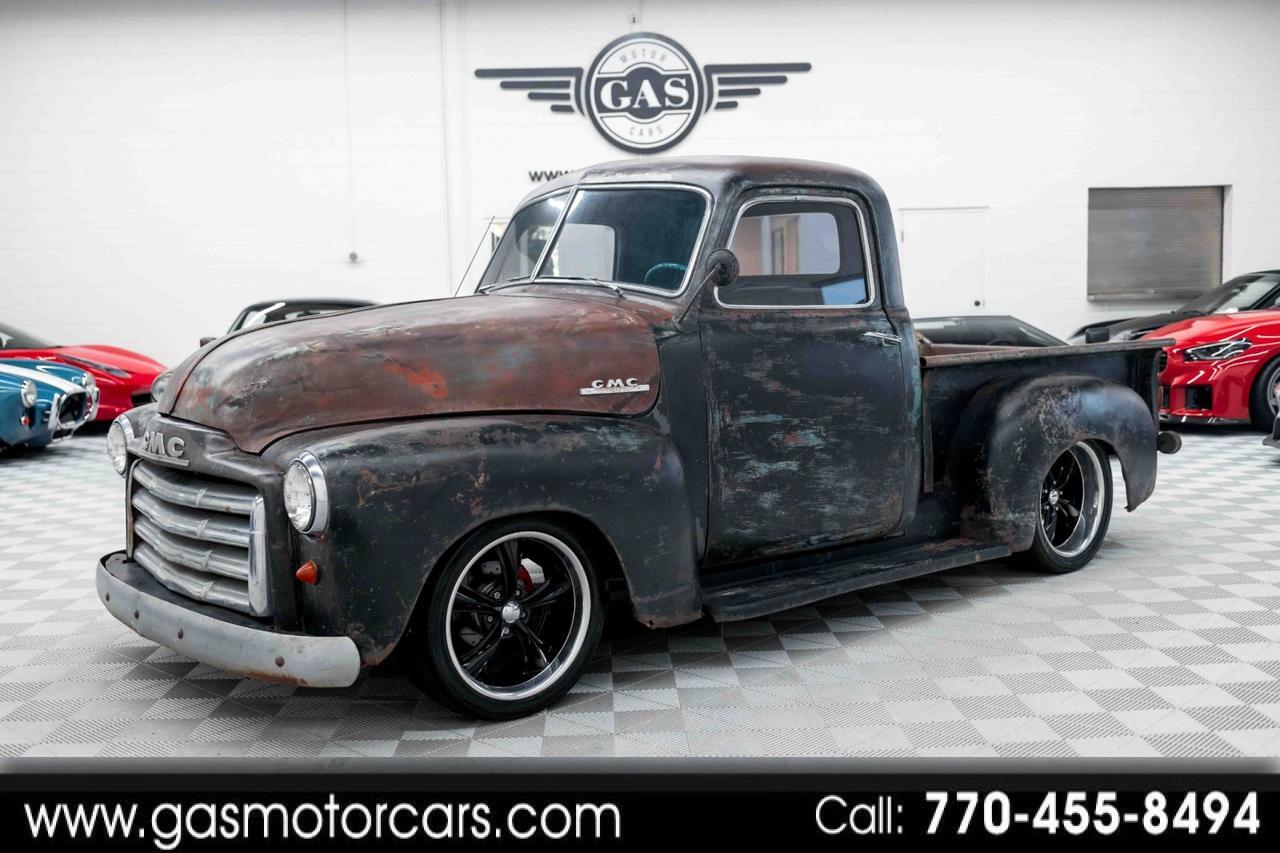
On Classic Listings' own pool the shape of survival is visible in miniature. The pool holds 12 GMC 100 records at the time of writing — six offered for sale and six recorded sold — running from 1949 to 1959, with the weight where you would expect: the early-1950s New Design trucks dominate, with a smaller tail of 1954, 1957 and 1959 trucks. Treat that sample honestly: twelve trucks is a snapshot, not a census. But it matches the national picture. The 1949–54 truck is the GMC 100 most buyers mean, the five-window Deluxe cab is the variant most listings advertise, and a striking share of survivors are no longer stock: patina shop trucks, lowered cruisers and V8-swapped restomods now probably outnumber faithfully restored originals.
Against that, be clear-eyed about the compromises. A stock early 100 is a 1940s truck in its manners: a solid front axle on leaf springs, unassisted steering with real weight at parking speeds, drum brakes that demand anticipation, a top speed set by gearing and noise, and a narrow, upright, loud cab. None of that is a defect; it is the product. But buyers who secretly want a modern truck in period clothing should buy a modified truck from the start and judge it as one. The worst purchase is the truck in the middle: altered just enough to lose its originality but not enough to gain modern usability. Much of this guide is about spotting exactly that truck.
One more piece of orientation. GMC's numbering is simple: 100 is the half-ton, 150 the three-quarter-ton, 250 the one-ton. Suffixes like 100-22 denote wheelbase and chassis variants, not different trucks in any sense that matters now. The half-ton came in two wheelbases in the Blue Chip years, short and long, and in the New Design years essentially one — 116 inches — with pickup, panel and Suburban all built on it. When a seller advertises a "100," the questions that matter are generation, cab type, engine — original GMC six, later six, or swap — and gearbox.
The models
The 100 was never a range of distinct models in the car sense. It is one half-ton chassis sold as a pickup in several box and cab configurations, plus a panel truck and a wagon — the Suburban — on the same running gear, across two generations. The table below sets out the variants you will actually meet. A note on the Built column: GMC did not publish clean, surviving production breakdowns by body style for these years, and the figures quoted online for individual variants are frequently invented or transposed from Chevrolet. Where a reliable total is not genuinely known, the table says so.
| Model | Years | Engine | Output | Built | Character |
|---|---|---|---|---|---|
| 100 Pickup (New Design) | 1947–1955 First Series | 228 or 248 GMC six | c. 100–125 hp | Not separately published | The standard truck: step-side box, split screen to 1953, the GMC 100 most people mean |
| 100 Deluxe Cab Pickup ("5-window") | 1951–1955 First Series | 228 or 248 GMC six | c. 100–125 hp | Not separately published | Corner-window cab, better trim; the headline variant in today's listings |
| 100 Panel and Suburban (New Design) | 1947–1955 First Series | 228 or 248 GMC six | c. 100–125 hp | Low; panel especially scarce | Enclosed bodies on the same chassis; Suburban is the family wagon, panel the delivery truck |
| 100 Pickup (Blue Chip) | 1955 Second Series–1959 | 270 six or Pontiac-based V8 | c. 140–227 hp by engine/year | Not separately published | Wraparound screen, 12-volt, V8 option, short or long wheelbase |
| Suburban Carrier | 1955–1957 | V8 principally | c. 155–227 hp | Low hundreds claimed, unverified | GMC's Cameo equivalent: smooth fibreglass box sides, deluxe trim, the collector special |
| 100 Wideside / Fenderside | 1958–1959 | 270 six or 336 V8 | c. 140–200 hp | Not separately published | Quad lamps; Wideside is the wide smooth box, Fenderside the traditional step-side |
The New Design pickup, 1947–1955 First Series
This is the core truck. GM's postwar design — clean, rounded, headlamps integrated into the front wings, a wide horizontal-bar grille carrying the GMC name, a cab roomier than the pre-war trucks — was a sensation in 1947 and stayed in production because it worked. The box is what everyone now calls a step-side: narrow, with a step ahead of each rear wing, a wooden plank floor on steel strips, and a tailgate lettered GMC. Underneath sits a ladder chassis, a solid front axle on semi-elliptic springs, and — on most three-speed trucks — an enclosed torque-tube driveshaft, a layout that matters when you come to gearbox swaps and rear-axle work.
Running changes define the sub-variants, and knowing them is how you date a truck whose paperwork is vague. The 1947–50 trucks have a two-piece split windscreen, lever-action shock absorbers until the change to telescopic dampers around 1950, and the early Huck-type brakes. Vent windows arrive for 1951, along with Bendix brakes; push-button door handles replace the turn-down type for 1952. The 1953 truck is the last of the split screen. For 1954 the cab is substantially revised: a one-piece curved windscreen, a single-bar "bullnose" grille, a redesigned box, and the larger 248 engine as standard. The 1955 First Series is the run-out, near-identical to 1954. The 1954–55 trucks are the most developed of the generation, and the 1951–53 five-windows the most sought after.
The Deluxe cab and the five-window question
From 1951 GMC offered the Deluxe cab option, whose signature is the pair of small curved corner windows at the rear of the cab, turning the three-window standard cab into the "5-window" of every listing headline. The corner windows transform rear three-quarter visibility in a truck whose standard cab has a blind spot you could hide a motorcycle in. The premium for a genuine five-window is real and durable, which creates the predictable trap: cabs get swapped, and corner-window sections get grafted. A five-window cab on an early chassis, or a cab whose serial plate does not match the frame, is not necessarily a bad truck — but it is a modified truck and should be priced as one. Check the cab as a unit: corner glass in undisturbed factory metal, details matching the claimed year, a serial-plate story that agrees with the chassis number.
Panel and Suburban
The enclosed bodies share the pickup's chassis, nose and running gear. The Panel is the delivery body scaled to the half-ton: tall, windowless behind the cab, double rear doors, built for fleets and worked accordingly — survivors are scarce and usually tired. The Suburban — GMC used the same name as Chevrolet — is the windowed wagon, the direct ancestor of the modern full-size SUV, and it has ridden the wagon boom hard. Both bodies concentrate rust where the pickup does not suffer — roof gutters, rear door frames, the panel sides' lower edges — and both are worth a premium over an equivalent pickup when genuinely sound, because restoring an enclosed body costs more. Beware Suburbans assembled from panel bodies or Chevrolet shells with GMC noses; apply the identity checks strictly, because the money is bigger.
The Blue Chip 100, 1955 Second Series–1959
The 1955 Second Series truck is a clean-sheet design in the new GM styling language: wraparound windscreen, hooded headlamps, an egg-crate grille, a wider cab with a car-style dashboard, and — the mechanical headline — a V8 on the options list and twelve-volt electrics. GMC called the line Blue Chip and marketed it hard on power. The half-ton now came on a 114-inch short or 123-inch long wheelbase, and the box choice widened over the run: the traditional step-side (Fenderside from 1958), the Suburban Carrier's smooth sides, and from 1958 the full Wideside box.
Year spotting runs: 1955 trucks have the egg-crate grille of the first design; 1956 restyled the grille; 1957 brought a more open grille again and is the last year of the Suburban Carrier; 1958 brought the quad headlamps that define the late trucks, plus the Wideside box; 1959 is a light-trim run-out year. In our own pool the later generation is the minority — a 1957 and a 1959 among the early trucks — mirroring the wider market, where the New Design truck is the icon and the Blue Chip the connoisseur's alternative. The Blue Chip is objectively the better road vehicle — faster, quieter, better braked — and the New Design the better piece of 1940s industrial design. Paying one generation's money for the other, without knowing which you wanted, is the mistake.
The Suburban Carrier
GMC's answer to the Chevrolet Cameo Carrier was the Suburban Carrier of 1955–57: a deluxe short-box pickup with smooth fibreglass outer box panels concealing the step-side structure beneath, full trim, two-tone paint and the V8 as the expected engine. It was expensive, sold in small numbers, and is the one Blue Chip variant with genuine collector heat — and the most faked, since the fibreglass panels fit ordinary trucks. A claimed Carrier needs documentary support; without it, you are buying a standard 100 with fibreglass panels and should pay for exactly that.

Engines and gearboxes
The engine is the GMC difference. Chevrolet men will tell you the GMC six is "just a bigger Stovebolt." It is not: it is a separate design — longer, heavier, with a different block, crankshaft and head — developed for truck and military work. Being able to tell a 228 from a 270 at a glance is the most valuable skill a GMC buyer can have, because engines have been swapped for seventy years and the value follows the engine as much as the cab.
The GMC six: 228, 248, 270 and 302
All four are overhead-valve inline sixes of the same architecture: a deep-skirt block, a strong seven-main-bearing bottom end, individual-port head, gear-driven camshaft, and full-pressure lubrication to the mains and rods at a time when the early Chevrolet six still relied partly on splash and dippers. That last point is the GMC six's genuine engineering advantage, and the reason these engines tolerate sustained road speed better than a 216 Chevrolet. They are torque engines, tuned to pull from low speed in high gear, and should feel unstressed and slightly agricultural.
The 228 (about 3.7 litres) is the standard New Design engine from 1947 through 1953, rated at around 100 horsepower in period gross terms. It is adequate rather than brisk: a 228 truck cruises happily at 45–50 mph and works hard beyond that, partly because of gearing. The 248 (about 4.1 litres) arrived as standard for 1954, with a useful lift to roughly 125 hp, and is the pick of the New Design sixes. The 270 (about 4.4 litres) was the larger-truck and later engine, standard in Blue Chip six-cylinder trucks and a period upgrade in earlier ones, at around 130–140 hp; it is recognisably stronger in the mid-range. The 302 (about 5.0 litres) was the family's big engine, fitted to heavier GMC trucks and much military hardware, and never the standard factory fitment in a 100 — which is precisely why it matters. A 302 in a half-ton is the classic period hot-rod swap: honestly declared, a desirable modification; undeclared and sold as original, a pricing problem.
Identification is refreshingly mechanical. The surest field check is the flat machined pad at the distributor side of the block, whose stamped engine-number prefix encodes the displacement — a 228's number begins with 228, and so on through the family. Do not rely on the rocker cover, which swaps in minutes, or on a seller's assurance. Read the pad yourself, with a rag and a torch. The GMC unit is also visibly longer than a Chevrolet six, and a Chevrolet 235 or 261 swapped into a GMC — it happens, because Chevy engines are cheaper and everywhere — sits differently on the mounts. If the "GMC" in front of you has a Chevrolet engine, the price changes completely: you have lost the thing that makes the truck a GMC.
Mechanically, the six wants simple things done on time. Valve clearances are set mechanically — there are no hydraulic lifters to hide neglect — and a top end that clatters loudly at hot idle means the clearances have not been set in years, or the rocker shaft and rockers are worn. Oil pressure on a healthy engine is strong, rising promptly from cold and holding at cruise. The engines are long-lived but seventy years old: expect oil consumption in pints per thousand miles even from a good one, weeps from the rocker and side covers, and a rear main seal that marks its territory. What you should not accept is blue smoke under load (rings or bores), white smoke that does not clear (head gasket or cracked head), or a bottom-end knock at hot idle that fades as revs rise (main bearings). Those are rebuild conversations, and a proper rebuild of a GMC six is a $4,000–7,500 job.
Carburation is by a single-barrel downdraft carburettor — Rochester and Zenith units both appear across the years — on a manifold combining intake and exhaust functions in the period manner. The carburettors are simple and rebuildable for $150–350 if the throttle shaft is not worn; a worn shaft draws air, makes the idle unstable, and cannot be fixed with a gasket kit — test by wiggling the shaft and spraying around its bushes on a running engine. The manifold is the weak point: exhaust manifolds crack, and the heat-riser passage that warms the intake corrodes and sticks, giving a truck that runs sweetly warm and terribly cold, or cooks its mixture in summer. A seized heat-riser is a $300–800 problem, because seventy-year-old studs snap on removal.
The V8s: Pontiac power in the Blue Chip trucks
For the Blue Chip generation GMC did something characteristic: instead of using the new Chevrolet small-block, it went across the corporation to Pontiac for its V8s. The sequence runs: the 287 (about 4.7 litres) for 1955, the 316 for 1956, the 347 for 1957, and the 336 — a smaller-bore derivative of the Pontiac 389 architecture — for 1958 and 1959. Period outputs run from roughly 155 hp to a little over 200 hp, as gross ratings that flatter by modern standards. In the truck they feel entirely different from the six: quieter at cruise, genuinely willing at highway speed, and matched to taller gearing and the automatic option in a way that makes a V8 Blue Chip usable on modern roads as no New Design truck is.
These are Pontiac engines, with Pontiac strengths — a robust bottom end, good torque, hydraulic lifters — and Pontiac ownership realities. Parts support is good through the Pontiac world, but the GMC truck versions carry their own ancillaries and manifolds, so "it's just a Pontiac" is true at the core and false at the edges. The checks mirror any period V8: cold-start oil pressure and any lifter clatter that does not fade within seconds, smoke on the overrun (valve stem seals and guides), even compression across all eight, and cooling behaviour at idle after a run — a truck that creeps up the gauge in traffic has a cooling story to be priced. A full rebuild runs $5,000–9,000; a carburettor rebuild is $250–600. The GMC-specific trap is substitution: Pontiac car engines, Chevrolet small-blocks and later V8s all fit the bay, so read the numbers on the engine, not the air-cleaner decal.
And then there is the modern swap, which the pool itself documents — LS-powered trucks appear in the listings openly. A well-executed swap with a modern automatic, disc brakes and power steering is a legitimate, enjoyable truck, and the market pays for good ones. Judge the execution, not the concept: wiring loomed and fused, cooling sized for the engine, brakes upgraded to match, mounts fabricated properly, paperwork that matches. A bad swap is the worst vehicle in this guide.
Gearboxes and the driveline behind them
Three transmissions cover the whole run. The standard box is the three-speed manual, column-shifted — "three on the tree" — with synchromesh on second and third and a non-synchro first you engage at rest. It is light and pleasant once you learn its slow, deliberate change, and honest: worn synchromesh crunches into second, especially cold, and a box that jumps out of third on the overrun has worn engagement teeth. Rebuilding one is a $900–1,800 job; good used boxes are Chevrolet-shared in many applications, so verify details rather than assuming.
The alternative is the four-speed manual with a very low "granny" first — the SM420 in the New Design years and its successors later — floor-shifted, unsynchronised in first, and effectively a three-speed on the road with a crawler gear for starting loaded on a hill. It is nearly indestructible and completely in keeping with a working truck. For distance driving the three-speed is the nicer companion; for work or towing, the four-speed earns its place. A four-speed that whines in every gear including top is low on oil or worn throughout; top is direct, so whine in top points to bearings.
The third option surprises people: GMC offered the Hydra-Matic — GM's original four-speed automatic, in Dual-Range truck form — in the half-ton line from the early 1950s, years before automatics were normal in pickups. In our pool, automatics in fact outnumber manuals among trucks whose transmission is recorded, reflecting how many survivors are later or modified trucks as much as period fitment. A good Hydra-Matic is a delight: decisive, early upchanges, unlike a modern torque-converter box. A tired one flares between ratios, delays reverse when cold, and leaks from every seal. Diagnosis belongs to a specialist, and a rebuild is a $2,500–4,500 commitment with the right person. The fluid tells the first story: bright red and sweet is maintained; brown and burnt is a negotiation.
Behind the gearbox, know which driveshaft your truck has. Three-speed New Design trucks use the enclosed torque tube: the driveshaft runs inside a tube rigid with the axle, which locates the axle and means rear-end and gearbox work interact — you cannot casually swap ratios or gearboxes without addressing the tube, and its hidden centre bearing and seals are a specialist $600–1,400 job when they rumble or leak. Four-speed and automatic trucks, and all Blue Chip trucks, use an open Hotchkiss driveline — simpler to live with and to modify, though worn universal joints knock on take-up (a $30 part, and a telling one: a seller who has not fixed a knocking UJ has not fixed anything you cannot see either). Rear axles are sturdy hypoid units; whine on a light throttle at cruise that vanishes on lift-off is pinion or mesh wear, and a rebuild runs $800–1,800. Clutches are conventional single-plate units, $600–1,200 fitted — on a torque-tube truck the labour to get there is the larger half of the bill, which is why you test the clutch properly.


Problem areas
Everything on a GMC 100 is repairable. That is not the same as everything being cheap, and the difference between a good purchase and a bad one is knowing which problems are weekend jobs and which are four-figure commitments before you shake hands. One principle first: structure outranks mechanics, always. Engines and brakes are bolt-on items with known costs. A rotten cab is a restoration, whether you planned one or not.
Rust: the map
Start at the bottom of the cab and work up, because that is the direction rust travels. The classic failure is the cab corners — the small panels at the rear lower corners of the cab, behind the doors. They rot from the inside out: the design traps moisture and dirt against the inner structure, the first external sign is bubbling at the bottom edge, and by the time paint blisters visibly the inner corner is usually gone too. Press firmly with a thumb; a corner that flexes or crunches is a repair, not a blemish. Patch panels are cheap; the labour is the cost — cutting out, welding both skins and refinishing runs $800–2,000 per side, the single most common welding job these trucks need.
Next, the floor and toe boards. Lift the mat — always lift the mat. The floor rusts around the seat riser, at the outer edges where it meets the steps, and around the battery box, which on New Design trucks lives under the floor and vents its fumes and acid into the structure around it. Surface rust on a dry-climate floor is cosmetic; perforation at the edges means the floor is losing its connection to the cab mounts, and that is structural. A proper floor replacement with mounts is a $1,500–3,500 job. Related and worse is the cowl and A-post area: rust where the cab meets the cowl sides lets the doors drop and the cab flex, and it is harder, slower work than floors — $2,000 and upward, because everything you touch is visible and structural. A door that has to be lifted to close is telling you about hinges, posts or both; diagnose which before you price it.
The steps and running-board area rust where the step meets the cab and along the rear wing's front edge. The front wings go at the bottom rear, behind the wheel, where mud packs between wing and cowl, and around the headlamp rims. Rear wings go at their front lower edge and along the top where they bolt to the box — the bolt line traps water and rust creeps under the paint in a neat line sellers call "a little bubbling." The box is mostly wood and simple steel: bed wood rots, steel strips rust, tailgates suffer along their bottom edges, but a step-side box is the cheapest body on the truck to make good — a bed-wood kit fitted runs $600–1,500, and tailgates are reproduced. Spend your worry on the cab.
On the Blue Chip trucks the map moves but does not shrink. The wraparound windscreen's frame and the cab roof and drip rails become the serious areas: water sits in the rail, rust starts inside the seam, and repair means screen-out welding on the most visible panel of the truck — $1,500–3,500 and a paint blend. Cab corners and floors rot exactly as before. The Wideside box rusts along its lower rear quarters and wheel openings, and because those panels are large and double-skinned in places, repairs cost more than step-side work. The Suburban Carrier adds a fibreglass trap: the panels do not rust, but they crack and delaminate, and the steel hidden beneath them rusts unobserved — price it as suspect until proven otherwise.
Underneath, the chassis is a heavy ladder frame that rarely rots through except on salt-belt trucks, but check the spring hangers, the crossmembers under the cab and box, and the area around the battery tray and fuel tank. Surface scale is normal; laminated, flaking rust at a hanger or mount is a welding bill and a safety item. Finally, the myth to correct: "patina" is not a preservation strategy. Honest original paint with surface wear is a legitimate finish, but active rust under a clear coat keeps eating, and several trucks in today's market — the pool includes patina shop trucks by the handful — are sold with the word doing heavy cosmetic lifting. Patina over sound structure is charm; patina over cab corners you can push a thumb through is a project wearing a costume.
Front suspension, steering and brakes
The front axle is a solid I-beam on leaf springs, and its wear points are the kingpins and their bushes. Jack the front up, grasp the wheel top and bottom, and rock: play that moves at the kingpin — distinguish it from wheel-bearing play, which shows at the hub — means a kingpin job, $600–1,200 with reaming and alignment, and it transforms a wandering truck. Spring bushes and shackle pins wear and let the axle shift under braking; tired springs sag. Steering runs through a recirculating-ball box with a long linkage, every joint a source of play. More than a couple of inches of free play at the wheel rim means you are buying joints or a box: individual ends are $40–120 each in parts, a rebuilt steering box $400–900, and the labour to chase play through the system is where the money goes.
Blue Chip trucks keep the same solid-axle architecture — independent front suspension arrives with the 1960 generation, not this one — but may add factory power steering, which leaks from hoses, pump and control valve in the usual period ways and costs $500–1,200 to put right. On both generations, dampers matter: the early lever-action units are rebuildable specialist items, the later telescopic dampers are cheap ($50–120 a corner) and routinely ignored for decades; a truck that crashes and floats over bumps is worn out, not showing "period character." Brakes divide by year. The 1947–50 trucks use the Huck brake system — an articulated-shoe design already old-fashioned when fitted — less effective, fussier to adjust and served by a smaller parts pipeline. From 1951 the trucks use conventional Bendix duo-servo drums, better in every way and fully supported. All are single-circuit hydraulics: one failure anywhere is all the brakes gone, which is why the steel lines' condition is a safety inspection, not a cosmetic one. Look along every line for corrosion, at every hose for perishing, and in the reservoir for fluid that looks like tea. A full hydraulic refresh — master cylinder, wheel cylinders, hoses, lines where needed — is $800–1,800 done properly, and it is the first money to spend on any truck whose history is unknown. What to fear is a swap truck whose dual-circuit master cylinder and disc brakes were fitted badly — kinked lines, a guessed proportioning valve, a wooden pedal.
Engine and driveline problems beyond the obvious
The GMC six's specific weaknesses are few but well defined. Exhaust manifold cracking is the family's signature fault: the casting lives a hard thermal life, cracks between the centre ports, and announces itself with a ticking on cold start that fades as the metal expands and seals. Confirm it with a cold start and your ear before blaming the valve gear, which also ticks — the manifold tick fades with heat, valvetrain noise does not. Good used manifolds are getting scarce, reproductions and headers exist, and the job is $400–1,000 depending on how many studs snap on the way out. The heat-riser valve seizes, as covered in the engines section, and mimics carburettor faults. Valve guides and stem seals wear and give the classic puff of blue smoke on start-up and on the overrun; a top-end refresh — guides, seals, a valve job, the head skimmed and crack-tested — is $1,200–2,500 and is often the right answer to an engine whose bottom end is sound. Rear main seals leak on sixes and V8s alike and are routinely misdiagnosed as sump leaks; the distinction matters because the seal is a gearbox-out job on most variants.
The Pontiac V8s add their own list: timing-cover and water-pump weepage, lifter wear on engines run on neglected oil, exhaust manifold bolts that seize in the heads, and cooling systems marginal enough that any neglect shows immediately. On both families, cooling deserves emphasis. Radiators are old, often original, and frequently half-blocked with scale; the truck that is fine at 40 mph and boils in traffic has a radiator or airflow problem, and a re-core is $500–900. Treat overheating as a symptom to be diagnosed — head gasket failure pressurises the system and bubbles in the header tank, retarded timing makes an engine run hot and is free to check — never as a quirk.
Electrics, instruments and the six-volt question
New Design trucks are six-volt, positive-earth in GMC practice of the period — verify on the individual truck, because conversions abound — with a generator and regulator. Six volts is not a problem in itself: a healthy system with thick, clean cables and good earths starts these low-compression sixes perfectly well, and the system's reputation for failure is mostly a reputation for seventy years of neglected cable. Slow cranking is almost always resistance — undersized modern replacement cables are the classic culprit. Budget $150–400 for cables, earths and a regulator service before condemning anything expensive. Blue Chip trucks are twelve-volt and conventional, with the usual faults: generator brushes, regulators that overcharge and boil batteries, and insulation that crumbles at the bulkhead.
Instruments are simple and repairable, and their failures are informative. The fuel gauge lies because of the tank sender or its earth ($60–150), not the gauge. The speedometer waves because its cable is dry. The ammeter tells the truth about the charging system if you learn to read it. Vacuum windscreen wipers — standard on New Design trucks — slow to a stop when you accelerate, because they run on manifold vacuum; that is design, not fault, but a worn wiper motor makes it dangerous rather than charming, and electric conversions are legitimate if neatly done. Lighting is the safety item: dim headlamps are earths and reflectors, and a full rewire with a reproduction harness ($400–900 in parts) is among the best-value jobs on a truck you intend to drive at night. On modified trucks, the wiring is where swap quality is most honestly revealed — the fuse area tells you whether the builder was an electrician or an optimist.
Interior, glass and trim
The cabs are simple, durable and — compared with car interiors — cheap to put right, so a scruffy interior should worry you less than any other defect. Seat springs break and vinyl splits; a re-trim in correct-style material runs $800–2,000. Door cards, headlining and rubber seals are all reproduced; a full cab rubber kit is $200–450 and transforms draughts, rattles and water leaks in a weekend. The expensive items are made of unobtanium rather than cloth: GMC-specific trim, the correct grille and badges, horn buttons, gauge faces, and the small bright parts that distinguish a GMC from the Chevrolet the parts books serve better. Price a truck with its GMC trim missing as a truck plus a treasure hunt. Glass is flat except the curved windscreens and five-window corners, all available; a wraparound Blue Chip screen is the pricey one at $400–800 fitted. A door that closes beautifully is a good sign about the cab's structure; one that does not is a structural question before it is a hardware one.

How to inspect one
Inspect in this order and do not let the seller rearrange it. The sequence puts the cheap, decisive checks first and delivers the structural verdict before you have emotionally bought the truck, and every step refers back to the problem areas above by name. Bring a torch, a cloth-wrapped magnet, a rag, a tyre gauge, and a friend to work the pedals and steering while you watch.
- Paperwork and identity first. Match the title to the serial plate and the frame stamping before you look at paint. GMC serial plates live on the driver's door pillar on New Design trucks; the frame number is stamped on the chassis. A plate held by fresh screws or a number that disagrees with the title is a stop-and-think moment. Hold the claimed year against the dating features from the models section — split versus curved screen, vent windows, door handles, grille.
- The engine identity check. With the engine cold — insist on cold; a warmed-up truck has had its cold-start evidence erased — find the stamped pad by the distributor and read the displacement prefix yourself, as described in the engines section. 228, 248, 270, 302, or a Chevrolet engine: write down which. This single fact sets the value band for everything that follows.
- Cold start. Turn it over and listen. You want prompt firing, no bottom-end knock, and the oil gauge up within seconds. Note the manifold tick that fades with heat (cracked exhaust manifold) versus valvetrain clatter that stays (clearances or rocker wear). Watch the exhaust: a puff of blue that clears is stem seals; continuous blue is rings; sweet white that persists is coolant.
- Cab corners, with your thumbs. Press both rear cab corners hard, low down. Crunch, flex or filler over rust here is the most common structural finding on the model — the cab-corner failure from the rust map. Check both sides; they rarely match, and the worse one is the price.
- Floors, steps and battery box. Lift the mats. Work the outer floor edges, the seat riser and around the battery box with your knuckles and the magnet. Perforation at the edges is structural; centre-floor surface rust is not. Step on each step and rock your weight: movement means the step-to-cab joint is going.
- Doors as structure. Open and close each door. It should latch with a push, not a lift and a slam. Sag points to hinges, A-post or cowl rust — the cowl problem from the rust section. Sight down the cab-to-box gap on each side: even and parallel is a straight truck; a tapering gap is a bent frame, a shifted cab or tired cab mounts.
- The five-window test, if fitted. Examine the corner-window apertures for undisturbed factory seams and consistent finish inside the cab. Grafted corners, filler at the pillars or a cab that does not match the truck's year details mean the premium is not payable.
- Underneath: chassis and hangers. Torch along the frame rails, spring hangers, crossmembers and cab mounts. Scale is fine; flaking lamination at a hanger is a welding bill. On a three-speed New Design truck, check the torque tube for oil at its rear joint — the centre-bearing problem. Check the brake lines along the frame while you are there: corrosion here is a safety fail until fixed.
- Front-end play. Jack the front, rock each wheel top-to-bottom for kingpin play, then spin for bearing roughness. Have your friend rock the steering while you watch every joint in the linkage — play shows as lost motion at one joint at a time. Total the joints that move before the wheels do; that is your steering bill from the suspension section.
- Brakes, statically. Pedal feel first: firm and high, or does it pump up (air/adjustment) or sink under steady pressure (master cylinder)? Pull the reservoir cap and judge the fluid. Look at each backing plate for the wet sheen of a leaking wheel cylinder. If the truck is a 1947–50, note that you are on Huck brakes and price the parts pipeline accordingly.
- The road test: clutch, gears, driveline. From rest, feed the clutch in at idle in top gear on a slight rise: a good clutch pulls the engine down and stalls it; a slipping one lets the revs hang. Drive every gear. Crunch into second is synchromesh; jumping out of third on the overrun is engagement wear. In a Hydra-Matic, demand every change, cold and hot, and a prompt reverse. Listen at 40 mph for axle whine, and on lift-off for UJ knock.
- The road test: steering, brakes, temperature. On a straight, quiet road, note how much you correct to hold a line — wander is kingpins, bushes and steering play adding up. Brake firmly from 40: the truck should pull up straight; a dive to one side is a brake or suspension fault, not character. Then idle for five minutes after the run and watch the temperature gauge: creep and bubbles in the header tank take you back to the cooling and head-gasket checks in the problem areas.
- Electrics in one pass. Every light, the horn, the gauges, the wipers under load — remember vacuum wipers slowing on acceleration is design. On a six-volt truck, crank again now it is hot: a healthy system spins it eagerly; a lazy hot crank is the cable-and-earth story, cheap to fix and useful to know. Check the fuel gauge against what the seller says is in the tank.
- The modified-truck pass, if applicable. If anything is swapped — engine, box, brakes, suspension — slow down and grade the workmanship: wiring loomed and fused, mounts properly fabricated, cooling sized for the engine, brake plumbing neat with correct flares. Then check the paperwork matches the truck as it stands. A good swap passes this test easily; a bad one fails it in the first minute, which is the point of doing it last and deliberately.

Values
The first driver is condition, expressed as structure. The market prices these trucks in bands that have less to do with year than with what the cab needs. A truck with a sound, unrepaired cab sits in a different band from an identical-looking truck whose corners, floors and cowl are filler and hope — and the two can look the same in photographs. In value terms, the cab is the truck, and the mechanicals are a priced list of known jobs attached to it. Read every asking price as a claim about structure, and discount any truck whose seller will not show you the corners, floors and frame.
The second driver is identity and originality, and here the market splits into three sub-markets that barely talk to each other. The originality market pays for the correct GMC engine — the stamped pad matters in money, not just in principle — the right cab configuration, and a story that checks out; within it, a genuine five-window, a sound Suburban, and above all a documented Suburban Carrier command the premiums. The driver market pays for condition and usability and is relaxed about a 270 in a 228 truck or a sensible twelve-volt conversion, provided the work is honest. The modified market — patina trucks, lowered cruisers, LS swaps — pays for execution and specification, and there the original engine's absence is a starting point, not a deduction. Decide which market the truck in front of you belongs to before you decide what it is worth.
Third, asking prices are not achieved prices, and the gap on classic trucks is systematic. Dealers — who account for most of the listings in our pool, ten of the twelve records — price with margin and preparation built in, and their asks sit at the optimistic end of what the same truck achieves privately. The recorded-sales side of the market block beneath this guide is your anchor: it shows what buyers actually paid, including for trucks that sold quickly (usually the correctly priced ones) and after long exposure (usually the optimistic ones). Compare like with like — generation, cab, engine, structure — and treat any ask far above the achieved band for comparable trucks as a request to fund the seller's patience.
Fourth, the project-to-driver gap is wide and honest. A running, driving, structurally sound truck costs multiples of a non-running project with the same badge, and the arithmetic favours the driver almost every time: add the welding, the brake refresh, the engine work and the hundred small items a project always needs, at real labour rates, and the "cheap" truck passes the driver's price before it turns a wheel — unless you are doing the work yourself for the pleasure of it, in which case buy the project with your eyes open and the problem sections as your budget. The exception is the rare variant: a rough but genuine Carrier or Suburban can justify restoration money a rough pickup cannot.
Finally, hold geography and season in mind. Dry-state trucks — the pool's Arizona example is typical — carry a structural premium that is rational: unwelded original metal is worth money everywhere. Trucks surface in spring and thin out in winter, and a patient buyer watching recorded sales rather than asks will see the same truck reappear, repriced, more often than sellers would like. The GMC 100 is not a thin market — the Chevrolet kinship keeps it liquid — but the right truck, correct engine and sound cab, is always scarcer than the headline count suggests. When one appears at a fair achieved-band figure, it does not wait for you.
Parts and ownership
Owning a GMC 100 is an exercise in enjoying the best-supported end of classic-truck life while managing one specific scarcity: the parts that are GMC's alone. Everything the truck shares with the Chevrolet 3100 and the Task Force line — most of the cab, glass, chassis, suspension, brakes and box hardware — is reproduced, stocked by a dozen specialists, and priced by competition. The reproduction industry for these trucks is one of the deepest in the hobby: patch panels, bed wood, rubbers, chrome, wiring harnesses, brake and suspension components, all a phone call away. Routine mechanical life — kingpins, brake cylinders, clutch, water pump, carburettor kits — is ordinary-parts-counter motoring at $30–300 per item.
The GMC-only list is where you plan ahead. The engines head it: GMC six components — pistons, bearings, manifolds, head castings — are available through the GMC and vintage-truck specialists, helped by the engine's military and industrial afterlife, but a cracked 248 head or a broken exhaust manifold can mean weeks of hunting rather than days. The Pontiac-based V8s draw on the strong Pontiac hobby, but GMC truck-specific ancillaries are hunt-items again. Grilles, badges and GMC trim are the cosmetic equivalent: correct lettering, Blue Chip trim pieces, horn buttons and small brightwork are reproduced patchily or not at all, and good originals trade at real prices. The rule follows: when you find correct GMC trim at a fair price, buy it, even ahead of need — and when buying a truck, weight its GMC-specific completeness heavily, because that is the part money cannot quickly fix.
Running costs are period-truck costs. The sixes return fuel economy in the mid-teens at best; the V8s less. Oil is cheap and should be changed often — 2,500–3,000 miles is a sensible rhythm for engines with period filtration — and valve clearances on the six want checking on the same visit, a half-hour job that keeps the top end quiet and the valves alive. Grease points are numerous by modern standards and ignoring them is how kingpins and shackles wear out early; a grease gun and an hour twice a year is the cheapest suspension maintenance in the hobby. Tyres in the original sizes are available from classic-truck suppliers, and radials transform the steering and braking feel of a truck you drive, at a small cost in period looks. Insurance through the classic schemes is inexpensive for agreed-value cover. The recurring administrative trap is the swapped truck whose title does not reflect its engine; resolve paperwork before purchase, not after.
Storage and use pattern decide how much of the problem section you ever meet. These trucks rust from standing damp as surely as from road salt: a dry garage, a truck driven monthly rather than mothballed, and fuel kept fresh will prevent more faults than any product. Ethanol-blended modern fuel attacks period carburettor components and perishes old rubber lines; replace rubber fuel lines with modern ethanol-rated hose ($50–100 in materials) as a first-week job, and treat a swollen or weeping original line as the fire risk it is. Join the community: the GMC-specific forums and the wider Advance-Design and Task Force world hold the accumulated knowledge on everything from Hydra-Matic adjustment to five-window cab dating, and GMC owners are a smaller, keener subset who know exactly which parts are scarce.
Which one to buy
- The all-rounder: a 1954–55 First Series pickup — the developed end of the New Design, with the 248 six, one-piece screen and the best parts story of the early trucks. If you want one GMC 100 to keep and drive, it is this one.
- The headline buy: a genuine 1951–53 five-window Deluxe cab with factory corner glass and a correct GMC six. The premium is real, the desirability durable, and the visibility alone justifies it every time you reverse. Verify the cab before you pay for it.
- The value buy: a standard-cab New Design truck with a sound cab and a 270 fitted, honestly declared. The market underprices the stronger engine when it is not original, and you get the best-driving early truck for the least money — provided the structure passes the same tests as any other.
- The road buy: a Blue Chip V8 truck, 1957–59, ideally a Wideside. Twelve volts, real highway pace, an automatic if you want it — the GMC 100 you can use like a vehicle rather than visit like an exhibit. Check the screen frame and roof rails as hard as the corners.
- The collector buy: a documented Suburban Carrier, or a genuinely sound Suburban wagon. Small numbers, real premiums, and a verification burden to match: no documents, no premium.
- The project buy: a Panel truck or a rough standard pickup, bought only if the frame is sound and the GMC-specific trim is present. Rare bodies forgive much; missing unobtanium does not.
- The fun buy: a well-executed patina or LS-swapped truck, judged purely on workmanship and paperwork. Bought right, it is the most usable GMC 100 of all. Bought wrong, it is the most expensive. Step 14 of the inspection exists for this truck.
The overriding rule: buy the cab and the engine number, in that order — the soundest structure with the correct GMC engine is the right truck at almost any reasonable price, and no amount of paint, chrome or patina makes a rotten cab or a Chevrolet-engined "GMC" into the truck you thought you were buying.
See the 1 100 cars currently listed.
What they sell for: 100 sale prices.