
Jaguar XJ buyer's guide
Jaguar XJ -- the model's own buyer's guide: variants, values and what to check.
Years listed: 1986-2001 · Series: XJ
Overview and history
The Vanden Plas is not a Jaguar model in the way an XJ6 or an XJ8 is a model. It is a name — borrowed from a Belgian-British coachbuilder, Vanden Plas of Kingsbury, London — that Jaguar has applied since 1982 to the most lavishly trimmed version of its big saloon, the car you bought when the standard XJ was not quite enough. In most of the world that car wore a Daimler badge: Daimler Six, Daimler Eight, Daimler Super V8. In North America the Daimler name was unusable for trademark reasons, so the same car, built on the same line at Browns Lane in Coventry, arrived wearing Vanden Plas badges instead. Understand that and you understand the whole range: every Vanden Plas is an XJ underneath, with the same engines, gearboxes, suspension and faults as the XJ6 or XJ8 of its year, plus a layer of equipment and hand-finishing on top. You are never buying a different machine. You are buying the best-appointed version of a known machine, and this guide treats it that way.
The formula was set with the Series III XJ6 Vanden Plas of 1982 to 1987: fluted grille surround and boot plinth in the Daimler manner, individual rear seats divided by a walnut console, picnic tables folded into the front seatbacks, deep-pile rugs, and door and dash wood with inlaid boxwood lines that the standard car did not get. Every generation since has repeated that recipe with its own technology. The XJ40 generation (1988–94) added electronic everything and a digital-dash experiment. The X300 (1995–97) made the Vanden Plas a long-wheelbase car as standard and is the last of the six-cylinder cars. The X308 (1998–2003) swapped the straight six for Jaguar's AJ-V8 and kept the long wheelbase, the tables and the fluting. The aluminium-bodied X350 (2004–09) closed the line, latterly joined by the supercharged Super V8, which is a Vanden Plas in all but name and equipment taken one step further again.
What the extra money bought, in every generation, was rear-seat theatre and materials. Connolly leather with contrast piping, figured walnut you could choose in darker stains than the base car offered, lambswool over-rugs, reading lamps, rear vanity mirrors, chrome and fluting where the standard car used body colour or plain brightwork. None of it makes the car faster or more reliable. Some of it — the picnic-table hinges, the extra seat motors, the additional wood and leather to crack, shrink and delaminate — actively adds to the inspection list. That trade is the Vanden Plas bargain, and it is a fair one only when the underlying XJ is sound.
Our own store sample is small and, usefully, perfectly spread: we currently track just 4 Vanden Plas cars, all four for sale, and they land one to a generation — a 1988 XJ40 car in green, a 1996 X300 in white, a 1998 X308 in tan and a 2002 X308 in blue, every one an automatic, every one sourced through Facebook Marketplace. Treat that sample of four as a map of where the affordable market lives rather than as statistics: the Series III and X350 cars have largely passed into keeper hands or out of the cheap listings altogether, while the XJ40, X300 and above all the X308 remain the cars a modest budget actually meets. This guide weights those three generations accordingly, while covering the bookend cars honestly.
One principle governs everything that follows. A Vanden Plas is bought on the condition of its XJ bones — sills, subframes, timing chains, gearbox history — and only then on its trim. The walnut and the picnic tables are the reason to choose one over an XJ8; they are never a reason to forgive a rotten shell or a rattling V8. The market, as the Values section explains, prices these cars the other way round more often than it should, which is exactly where a prepared buyer profits.
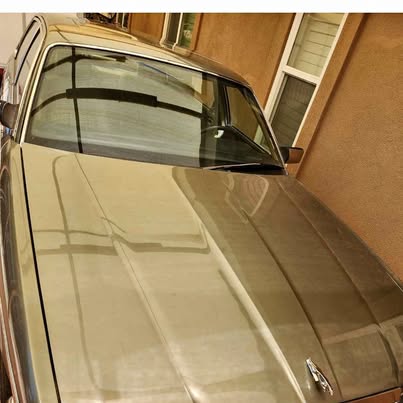
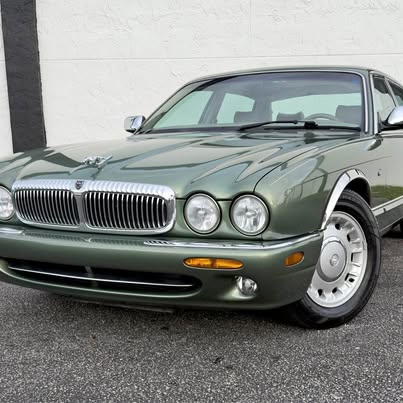
The first of the modern cars: a 1988 XJ40-generation Vanden Plas in green, the year the name moved onto Jaguar's electronic, square-cut flagship. From this angle check the panel gaps around the rectangular headlamp units and the shut line of the long bonnet, then look low — the front subframe and the bottoms of the front wings behind the wheels are where an XJ40 confesses first, whatever the paint is doing up here.
The models
The table is organised by generation, because that is the level at which engines, gearboxes, faults and values divide. Outputs are period factory ratings as sold in North America. The Built column is left as a dash throughout: Jaguar published series totals, not Vanden Plas trim totals for the US market, and any trim-level production figure you see quoted for these cars is an estimate wearing a suit. Judge the car, not a number nobody can stand over.
| Model | Years | Engine | Output | Built | Character |
|---|---|---|---|---|---|
| XJ6 Vanden Plas (Series III) | 1982–1987 | 4.2 XK six | 176 hp | — | The original; coachbuilt manners, 1970s engineering |
| XJ6 Vanden Plas (XJ40) | 1988–1989 | 3.6 AJ6 six | 221 hp | — | Digital dash, self-levelling rear, the brave first draft |
| XJ6 Vanden Plas (XJ40) | 1990–1994 | 4.0 AJ6 six | 223 hp | — | The XJ40 matured; analogue gauges, better electrics |
| Majestic | 1990, 1992 | 4.0 AJ6 six | 223 hp | — | US-market special above Vanden Plas; rare, trim-led |
| Vanden Plas (X300) | 1995–1997 | 4.0 AJ16 six | 245 hp | — | Long wheelbase standard; the last six-cylinder car |
| Vanden Plas (X308) | 1998–2003 | 4.0 AJ-V8 | 290 hp | — | The V8 arrives; tensioners and Nikasil define the buy |
| Vanden Plas (X350) | 2004–2009 | 4.2 AJ-V8 | 294 hp | — | Aluminium body, air suspension, six-speed automatic |
| Super V8 (X350) | 2004–2009 | 4.2 supercharged AJ-V8 | 390–400 hp | — | The flagship's flagship; Vanden Plas equipment, real pace |
Series III (1982–87). The last car from the original XJ line, designed in the 1960s and refined for two decades: XK twin-cam six, three-speed Borg-Warner Model 66 automatic, double-wishbone front suspension and Jaguar's famous independent rear suspension in its own subframe cage. The Vanden Plas trim brought the Daimler-style fluted brightwork, individual rear seats and picnic tables. These are now bought as classics rather than as cheap luxury, and their problems are classic-car problems — rust, tired rubber, Lucas electrics of the older school — rather than the electronic problems of everything after them.
XJ40 (1988–94). The clean-sheet electronic Jaguar, and the generation our sample's 1988 car represents. Rectangular styling, a 3.6-litre AJ6 six at launch replaced by the 4.0 for 1990, a ZF four-speed automatic, self-levelling rear suspension on most cars, and — for 1988 and 1989 — an all-digital vacuum-fluorescent instrument pack that was futuristic for about eighteen months and has been a repair topic ever since. Analogue gauges returned for 1990 and the cars improved steadily; a 1993 or 1994 car is a materially better-built object than a 1988 car, and the Majestic specials of 1990 and 1992 sat above the Vanden Plas with yet richer trim. Early XJ40 Vanden Plas cars were standard wheelbase; the long-wheelbase option arrived late in the run.
X300 (1995–97). A heavy restyle back towards the classic XJ curves over XJ40 bones, and for the Vanden Plas the decisive change: long wheelbase became standard, giving the rear seat the legroom the trim had always promised. The engine is the AJ16, the final development of the AJ6 six, with coil-on-plug ignition and 245 hp. Three model years only, all 4.0-litre in the US, and widely regarded by specialists as the sweet spot of the whole nameplate — modern enough to use daily, simple enough to fix at home, and the last Vanden Plas with a straight six.
X308 (1998–2003). The same X300 shell, subtly re-detailed, with Jaguar's all-new AJ-V8 under the bonnet and a ZF five-speed automatic behind it. The Vanden Plas remained long-wheelbase and range-topping: fluted grille and boot plinth, picnic tables, lambswool rugs, the works. The generation splits in two at the 2000 model year, and the split matters more than any other fact in this guide: the earlier cars carry the Nikasil-bore engine and the most fragile generation of plastic timing-chain tensioners, while 2000-on cars (the AJ27 engine revision, with variable valve timing) received steel cylinder liners and detail improvements, though not fully metal tensioners. Our sample holds one of each — a 1998 and a 2002 — which is a tidy illustration of the choice every X308 buyer faces.
X350 (2004–09). An aluminium monocoque under styling that deliberately apes the X308, with air suspension all round, a ZF six-speed automatic and the 4.2-litre development of the V8. The Vanden Plas continued as the luxury trim and the Super V8 added the Eaton-supercharged engine and every option in the book. These are the most capable cars here and the most dependent on electronic diagnostics; they are also, so far, the least common in the cheap listings, which is why this guide treats them fully but briefly relative to the three older generations. Two identity notes matter on this generation. The standard-wheelbase X350 Vanden Plas and the long-wheelbase car are different purchases — the rear legroom is the point of the badge, so confirm which wheelbase you are looking at before comparing prices — and the Super V8, which carries no Vanden Plas badge at all, is nevertheless the same formula taken to its limit, which is why it appears in this guide's table and its buying advice. When the X350 line ended in 2009, the Vanden Plas name in North America ended with it; the all-new XJ that followed sold its top trims under different names, and the coachbuilder's badge has not returned to a Jaguar price list since.
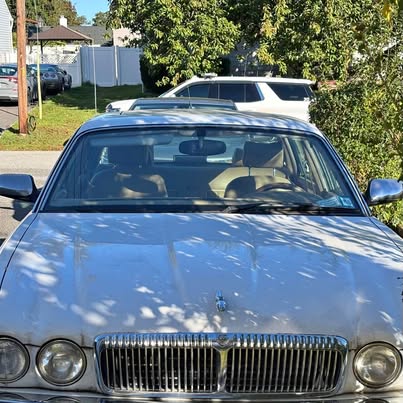
The X300 at its best: a 1996 long-wheelbase car in white, recognisable by the return of the curved flanks and round lamps over XJ40 structure. The long wheelbase is not obvious from the front — check for it in the rear door, which is visibly longer than a standard X300's. On any white car, look hard along the sill line and around the rear arch lips: white shows the brown bleed of early rust earlier and more honestly than any dark colour.
Engines and gearboxes
The XK six and the AJ6/AJ16 sixes
The Series III car uses the 4.2-litre XK engine, a design older than most of its buyers: twin overhead camshafts, hemispherical combustion chambers, twin SU-derived carburation long gone by this point in favour of Lucas-Bosch fuel injection in US trim, and 176 hp in federal tune. It is a known quantity — tappet shims, a simplex timing chain that stretches audibly, oil consumption that was respectable in 1982 and is simply normal now — and any competent classic Jaguar shop knows it by heart. Buy it as you would any XK: on oil pressure (40 psi at 3,000 rpm hot is the healthy figure), on evidence of head-gasket health, and on rust rather than mechanics.
The AJ6 that powers the XJ40 is a clean-sheet 24-valve six with an aluminium head on an aluminium block in its early 3.6 form and a cast-iron block for the 4.0, electronic management that was advanced for 1986: twin overhead camshafts, four valves per cylinder, and a duplex timing chain. In service it has earned a reputation as one of the strongest engines Jaguar ever made, and the reputation is earned: duplex timing chains that routinely outlast the car, a bottom end that shrugs off 200,000 miles, and no structural weakness. Its known faults are specific and cheap relative to the car. The cylinder-head gasket weeps oil externally at the front of the head, by the distributor drive, on high-mileage AJ6s — a mess, not a failure, cured at a head-gasket job costing $900–1,600 in parts and labour if you choose to cure it. Cam-cover gaskets harden and leak onto the exhaust side. The crankshaft position sensor fails with heat and age and causes the classic crank-no-start that recovers when cold; a spare in the glovebox, at roughly a $60–120 parts cost, is standard AJ6 ownership wisdom. Throttle bodies gum up and cause a hunting idle that a clean, not a replacement, fixes.
The AJ16 of the X300 is the same engine developed: coil-on-plug ignition in place of the distributor, a revised management system, 245 hp, and a reputation a shade better even than the AJ6's. Its signature faults are cracked ignition coils (the plastic bodies split with heat cycles; misfire under load is the symptom, and a set of coils is a $250–450 parts cost), a failing crank sensor shared with its predecessor, and an occasional idle-control stepper motor fault. Neither six has a timing belt, neither has a bore-liner problem, and neither will be the reason a well-bought car dies. On any six-cylinder Vanden Plas, budget for cooling-system age — radiator, hoses, water pump, viscous fan coupling on XJ40s — rather than engine internals.
The AJ-V8: AJ26, AJ27 and the 4.2
The X308's AJ-V8 is a 4.0-litre, quad-cam, 32-valve all-aluminium V8 making 290 hp, and it is a genuinely fine engine wrapped around three specific, well-documented problems that every buyer must price in. Learn the generations. The AJ26 (1998–99) uses Nikasil silicon-carbide cylinder bore coatings. The AJ27 (2000–03) adds variable valve timing on the inlet cams and, from partway through 2000 production, steel cylinder liners in place of Nikasil. The 4.2 of the X350 (2003 onward in the wider range) is a stroked, strengthened development that left both early problems behind.
Problem one is Nikasil. In markets with high-sulphur petrol — and the United States in the late 1990s qualified in many regions — the sulphur attacked the coating, bore wear accelerated, compression fell, and the engine began to use oil, blow by excessively and eventually refuse to start on a cold morning. Jaguar replaced many engines under warranty; survivors in 2026 have usually either had a replacement steel-liner engine or lived on better fuel. The test is a compression or leak-down check plus the engine number: a car that starts instantly from cold, idles cleanly and shows even compressions has told you what you need. Do not buy a 1998–99 car on a warm engine and a seller's assurance; the cold start is the examination, and Nikasil wear is a $4,000-plus engine-replacement problem, not a repair.
Problem two is the timing-chain tensioners, and it applies to every AJ-V8 up to the 4.2. The secondary (upper) chain tensioners on early cars have plastic bodies that crack with heat and age; the plastic slipper on the primary tensioners wears and sheds debris. When a secondary tensioner fails, the chain jumps, valve timing is lost, and on an interference engine the bill is a cylinder-head rebuild at best — a $3,000–5,500 repair cost range by the time heads are off, valves replaced and chains renewed. The fix is preventative and total: replace upper tensioners with the later metal-bodied design, renew chains, guides and primary tensioners while you are in there, a parts cost of roughly $600–1,000 and a full job cost of $1,800–3,000 at a specialist. On any X308 without a dated invoice for this job, assume it is owed and negotiate accordingly. Listen at cold start for a brief rattle from the front of the engine: that is chain slack announcing itself, and it is a walk-away-or-renegotiate sound, not a quirk.
Problem three is the plastic cooling system. The thermostat housing and its tower are plastic and crack; the water pump on early cars carries a plastic impeller that can shed blades; hoses hide under the inlet manifold in the valley of the V and cook quietly for twenty years before letting go. None of this is exotic — a metal thermostat housing is an $80–150 parts cost, a pump $150–300 — but a V8 that has been run hot while its plastic tower wept is a head-gasket car, so the cooling system's service history matters as much as the chains. The 4.2 in the X350 keeps the architecture with the worst of it engineered out, though its valley hoses and plastic coolant pipes still age on the same clock.
Gearboxes
Every Vanden Plas is an automatic; there was never a manual option in North America. The Series III uses the Borg-Warner Model 66 three-speed, simple, durable and rebuildable anywhere for a $1,200–2,000 rebuild cost. The XJ40 uses ZF four-speeds — the 4HP22 behind the 3.6, the stronger 4HP24 behind the 4.0 — both conventional, both long-lived with fluid changes, both now old enough that a flare on the 2–3 shift or a delayed reverse engagement means a rebuild conversation in the $2,000–3,200 cost range. The X300 continues the 4HP24 with electronic control. These ZF four-speeds are the least worrying gearboxes in this guide: they fail slowly, announce themselves clearly, and cost sane money to put right.
The X308's ZF 5HP24 five-speed is a better gearbox to use and a more serious one to own. It was sold as sealed for life, and the cars whose fluid was never changed are the ones that now suffer harsh shifts, torque-converter shudder and failure of the A-clutch drum, a known weak point that announces itself with lost or slipping drive. A fluid and filter service — there is a filter, whatever "sealed" implied — costs $350–600 in parts and labour with the correct fluid and measurably extends the box's life; a full rebuild runs $2,800–4,200. Test every gear hot and cold, and test reverse on a slope. The X350's ZF 6HP26 six-speed is smoother again and generally robust, with its own known ageing items: a leaking mechatronic connector sleeve (a cheap part, an annoying drip), occasional harsh downshifts cured by fluid and software, and the same sealed-for-life mythology to undo with a service at $400–700.
One myth to retire here, because sellers repeat it: no Vanden Plas gearbox fault is "just a sensor" until a specialist has proven it, and no X308 with a slipping 5HP24 is a bargain at any discount smaller than the rebuild. The gearbox is half the purchase judgement on the V8 cars, exactly as the timing chains are the other half.
The supercharged 4.2
The Super V8's engine is the 4.2 with an Eaton M112 supercharger in the valley, charge-coolers under the covers, and 390 hp in its first form, 400 hp from 2006 — enough to move a long-wheelbase limousine at a pace the picnic tables were never designed for. It inherits the 4.2's freedom from Nikasil and from the worst of the tensioner story, and adds its own short list. The coolant hoses that run under the supercharger cook in the hottest place in the engine bay and are a supercharger-off job to replace, a $900–1,600 job cost in parts and labour that owners defer until a hose settles the question at speed; ask for the invoice. The charge-cooler pump fails silently and costs power rather than reliability — the car simply feels flat, and few owners notice what they have lost. Supercharger oil is a service item nobody services. Buy a Super V8 exactly as you buy a 4.2, plus the under-charger hose invoice, and you own the strongest engine in this guide.
Problem areas
Heating, ventilation and air conditioning
The climate systems deserve their own paragraph because they fail expensively and invisibly, and because a seller's "the air just needs a charge" is the oldest sentence in Jaguar classifieds. The XJ40's automatic climate control blends air with vacuum-operated flaps and a pair of blend motors whose potentiometers wear; the symptom is air at the wrong temperature from one side, or a system that hunts between hot and cold, and diagnosis means the centre console apart. Its air-conditioning evaporator lives behind the dashboard, and an evaporator leak is a dashboard-out job with a labour cost of $1,200–2,000 before the part — which is why so many XJ40s are sold with the air conditioning "not tested". The X300 and X308 use electric blend motors that strip their gears and click behind the dash, a $150–400 repair cost per motor in parts and labour depending on access, and heater matrices that block with age and leave the cabin lukewarm on the coldest day — the day you will test the car in summer and discover it in January. On the X308, check the air conditioning actually blows cold at idle in traffic, not just at speed: the electric fan and the condenser are ageing together, and a system cold at 50 mph and warm at a standstill is telling you about both. None of this is fatal to a purchase. All of it belongs on the list, priced, before money changes hands, because climate work on these cars is labour-shaped, and labour is the one cost that never comes down.
Rust: the map
The Vanden Plas badge buys you no rust protection whatsoever, and the rust map changes by generation, so learn the map for the car in front of you. The Series III rusts as a 1970s car rusts: sills, front and rear valances, the bottoms of all four wings, the boot floor around the spare-wheel well, floor pans where the sound deadening traps water, and the rear suspension cage mountings, whose failure is structural and expensive. An XJ40 improves on materials but adds its own traps. The front subframe — a pressed-steel V-mount structure — corrodes from the inside out and can look sound while being thin; press and probe it, do not just look. The bulkhead and the plenum at the base of the windscreen rot where leaves block the drains, and water then enters the cabin and the electrics, so an XJ40 with wet front carpets is telling you two stories at once. Sills rot at the jacking points, the rear wheel-arch lips blister, the boot floor corrodes around the fuel-filler drain, and the front wings bubble behind the wheels where mud packs against the inner wing. Sill welding runs $1,000–2,500 per side in repair cost depending on how far the rot has travelled into the floor and the jacking reinforcement, and a car needing both sills and a subframe is a parts car wearing a price tag.
The X300 and X308 are better protected and rust later, but they are now old enough that "later" has arrived. The places to work through, in order: the ends of the sills where they meet the rear arches; the rear arch lips themselves; the front subframe and its mounting points; the rear subframe mounts and the A-frame bushes' housings behind them; the bottom edges of the doors where the skin folds over the frame; and the boot lid around the number-plate lamps and the fluted plinth, where water sits behind the trim. The X308 adds one more: the front crossmember and radiator support panel, which lives in the spray and rots quietly behind the bumper. None of these cars dissolves like a Series III, and a genuinely rot-free X300 is a realistic find — but a blistered arch on an X308 is never just a blister, because the sill end and the inner arch are usually travelling with it. Budget a $600–1,400 repair cost per arch-and-sill-end corner done properly in metal, and treat any car priced as if filler were a cure as a car you have already decided not to buy.
Suspension, steering and brakes
The XJ40's party trick was self-levelling rear suspension, hydraulically pumped from the engine, and it is the single most troublesome system on the early cars. The ride-height sensor, the struts and the hydraulic mineral-oil circuit (shared, on early cars, with the brake boost) age together: the rear sits low or pumps itself high, the ride turns harsh, and leaks appear at the struts and valve block. Most surviving cars have been converted to conventional springs and dampers with a conversion kit at a $500–900 parts cost, and a converted car is worth more, not less, than one still levelling — check which you are looking at before valuing either. Brake boost on the early XJ40 is hydraulic too, with an accumulator sphere that loses its nitrogen charge; the test is in the inspection section, and a failed accumulator is a $150–300 parts cost that sellers love to describe as "the brakes need bleeding". It does not. The later cars use a Teves ABS system whose pump, accumulator and pressure switch give the same lesson in a different accent: a brake warning light that lingers, or an ABS light that comes and goes over bumps (a wheel-speed sensor or its wiring, usually at the front), belongs on the negotiation list.
Across X300 and X308 the suspension is conventional coil springs and wishbones, and the wear list is honest and predictable: front lower ball joints and wishbone bushes, front shock-absorber top mounts and lower bushes (a clunk over sharp bumps that owners chase for months through the steering is usually the lower shock bush), rear A-frame bushes that let the rear subframe shift and make the car feel vague at speed, and rear wheel bearings supplied as sealed hub units at a $200–400 parts cost per side. The X350 replaces all of this with air suspension, which rides beautifully and fails expensively: a sagging corner is a leaking air spring ($400–800 in parts per corner), a car that sinks overnight on all four corners is usually a valve-block or line leak, and a tired compressor that runs long and loud on every start is a $300–600 parts cost waiting its turn. Steering on the hydraulic cars is a ZF rack that weeps from its seals with age; budget a $500–900 replacement cost for a rebuilt rack rather than believing in stop-leak. None of this is exotic. All of it is the difference between a cheap Vanden Plas and a dear one, because four corners of deferred suspension work quietly total more than the timing chains everyone fears.
Electrics
The XJ40 was Jaguar's first fully electronic car and it shows its age in its connectors, its earth points and its modules rather than in its wiring diagrams. The 1988–89 digital instrument pack flickers, loses segments and dies; specialists rebuild them for a $300–600 repair cost, and a dead dash on an early car should be priced as that repair, not waved away. The bulb-failure modules generate false warnings that teach owners to ignore real ones. Door handles are a mechanical fault in an electrical section's clothing — the exterior handles on XJ40s snap their linkages and castings with age, and a car whose doors open only from inside is showing you a $100–250 per-door parts-and-fitting cost and a clue about how the rest of the car has been maintained. Central locking, window regulators and seat motors all fail one at a time and are all available; the skill is counting how many have failed on the car in front of you, because the count is the maintenance history in miniature.
The X300 simplified much of this and added its own signatures: the little LCD clock in the centre console fades to illegibility (a ribbon-cable fault, a $50–150 repair), seat and mirror memory modules lose their minds and move seats unprompted, and the security system can immobilise a car whose fob batteries were allowed to die. The X308 multiplies modules again — body processor, seat modules, door modules — and adds failing solder joints in the ABS module (intermittent ABS and traction lights, a $150–350 module repair cost) and electronic throttle bodies on 1998–99 cars that wear their tracks and throw the car into limp mode; a rebuilt throttle body is a $400–800 parts cost. On the X350, assume any electrical fault needs proper Jaguar SDD/IDS-level diagnostics rather than a generic code reader, and price a car with a Christmas-tree dashboard as a diagnostics bill plus whatever the diagnostics find. The rule for all four generations is the same: electrical faults on these cars are almost always age, water or earths, in that order — find the water first, especially under XJ40 and X300 front carpets and in every generation's boot, where a perished aerial grommet or lamp seal fills the spare-wheel well and bathes the modules and battery connections in it.
Interior and trim
This is the Vanden Plas's reason to exist, and it is where cheap cars hide their true condition, because trim ages on a calendar, not an odometer. The headlining sags on every generation without exception — the foam backing disintegrates, the cloth drops, and the only cure is removal and retrimming at a $400–800 job cost; a headlining held up by pins or a seller's promise is that bill deferred, and on the long-wheelbase cars it is a big, awkward panel to do well. The walnut veneer cracks its lacquer and lifts at the edges, worst on the dash and the ski slope around the gear selector where sun and heat concentrate; a full re-veneer or good used set runs $800–2,000 in parts and labour, which is why a Vanden Plas with perfect wood is worth a real premium over one with crazed wood and why sellers photograph interiors in flattering shade. The picnic tables — the badge's signature — sag on worn hinges, lose their veneer first (they face the sun through the rear window) and are frequently missing their correct finish; check both tables fold, latch and sit level.
Leather is Connolly on the older cars and ages by shrinking and cracking where the sun lands: the top of the rear seat and the dashboard top on X308s pull and split, seat bolsters wear through their colour on the driver's entry side, and contrast piping splits at the seams. A professional recolour and feed works wonders for a $300–700 cost; a split dash top or a shrunken rear headrest panel is upholstery money, $800–1,800, and should be priced as such. Lambswool over-rugs vanish — most cars have lost them, and their presence is a small but genuine originality plus. Carpets lift to reveal the floor and, on XJ40s, the state of the water war; always lift them. Finally, smell the car. A Vanden Plas cabin should smell of leather and wood. A cabin that smells of mildew is a car with a water leak you have not found yet, and a cabin heavy with air freshener is a car whose seller has found it for you.
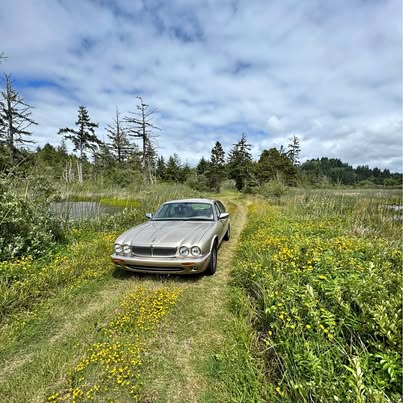
The first V8 car: a 1998 X308 in tan, the generation where the Vanden Plas formula met the AJ-V8. Measure the car with your eyes — the long-wheelbase rear door, the sill line unbroken by blistering, and the car sitting level on its springs. A 1998 car sits in the Nikasil and early-tensioner window, so this photograph is the start of the conversation; the cold start, the engine number and the tensioner invoice are the rest of it.
How to inspect one
Work in this order: cold and static first, because the two most expensive Vanden Plas verdicts — Nikasil wear and timing-chain rattle — are only audible and visible before the engine warms; structure second, because rust outranks everything; the drive third; and the trim last, because trim is where your heart will try to overrule the evidence the first three stages gathered.
- Start it from stone cold, bonnet up, and listen. On an X308 you are listening for two things: a brief rattle from the front of the engine in the first seconds (chain slack — the tensioner story from the problem areas, live) and a lumpy, hunting idle that smooths as it warms (possible Nikasil bore wear on a 1998–99 car). A six should settle to a near-silent, even idle within a minute. Refuse a pre-warmed car; ask to come back tomorrow morning instead.
- Read the identity before the condition. Check the VIN plate and, on an X308, the engine number, and match them against the paperwork. The engine number settles whether a 2000 car carries the steel-liner engine, and a replacement engine in a 1998–99 car's history is a plus, not a minus — it usually means Jaguar already paid for the Nikasil problem. A Vanden Plas badge on the boot proves nothing; the fluted grille, long rear doors (X300 onward), picnic tables and the build record prove the trim.
- Do the rust circuit with a torch and a fingertip. Sills at the jacking points, sill ends into the rear arches, arch lips, door bottoms, boot floor and spare-wheel well, and — on an XJ40 — the front subframe and the bulkhead at the windscreen base. Press the subframe; do not just admire it. Any car that fails here fails outright, however good the wood is.
- Lift the carpets and look in the boot. Front footwells dry on a six-cylinder car and dry in the boot are non-negotiable baselines. Wet carpets mean blocked plenum drains or a leaking screen, and on an XJ40 they mean the electrics have been bathing. Check the spare, the jack and the battery connections while you are there.
- Test the brake boost and the ABS behaviour. On an early XJ40, pump the pedal with the engine off, then start the car: a healthy hydraulic accumulator gives you a firm, consistent pedal and no lingering warning light. On every car, confirm the ABS light comes on with the ignition and goes out — a light that never appears has usually been removed to hide the fault it was reporting.
- Work every electrical item, one by one, in a fixed order. Windows, seats (all directions, plus memory), mirrors, locks, sunroof if fitted, air conditioning (cold at the vents, not just a running compressor), heated seats, cruise, and both picnic-table reading lamps. Count the failures. One failure is a haggling point; five failures are the car's maintenance history written in your notebook.
- Examine the interior like an upholsterer. Headlining first (look up before you sit down), then veneer edges on the dash and ski slope, then the driver's bolster, the top of the rear seat, and both picnic tables — fold them, latch them, check the veneer faces. A perfect interior in a Vanden Plas is genuinely rare and genuinely worth paying for; a tired one is four-figure money, as the trim section sets out.
- Check the self-levelling question on an XJ40. Ask directly whether the car still levels or has been converted, then look: a converted car sits level and rides on conventional dampers; a car still on its hydraulics should rise and settle evenly after a start. A low, harsh-riding car on original hydraulics is a conversion bill arriving with the car.
- Drive it for at least twenty minutes, hot and cold gearbox. On the ZF five-speed in the X308, feel for torque-converter shudder at light throttle around 40–50 mph, flared shifts, and a lazy or slipping reverse on a slope — the A-drum announcing itself. On the four-speeds, feel for the 2–3 flare. Everywhere, listen for the front-end clunk of worn shock bushes over sharp edges and the rear-end vagueness of tired A-frame bushes at speed.
- On an X350, watch it wake up and put it to sleep. Start from cold and time the air suspension rising; a compressor that runs long and loud is tired. After the drive, lock the car and look back in ten minutes: a corner down means an air spring, the whole car down means a leak to find. Factor both as the parts costs given earlier, not as character.
- Read the paperwork for the three invoices that matter. On an X308: timing tensioners and chains, with a date and a parts list naming metal-bodied tensioners. On any car: gearbox fluid service, despite the sealed-for-life story. On an XJ40: evidence of self-levelling conversion or hydraulic work. A thick history file that lacks these three is thick in the wrong places.
- Finish underneath, on a lift if you can possibly arrange one. Subframes, mounts, brake and fuel lines, the exhaust (a full system is real money), and oil leaks mapped rather than merely noted — an AJ6's cam-cover weep is a shrug, a rear main seal or a steering rack pouring oil is a budget line. Twenty minutes under a Vanden Plas settles arguments that two hours of photographs cannot.
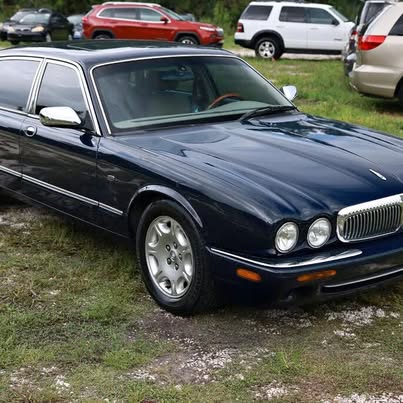
The later X308: a 2002 car in blue, from the steel-liner, AJ27 years that this guide steers you towards. The inspection does not change — cold start, rust circuit, gearbox hot and cold — but the questions narrow: tensioner history and gearbox fluid history are nearly the whole negotiation on a car like this, because the engine's structural question has already been answered at the factory.
Values
Read the market figures printed beneath this guide first — the build computes them from the live store and recorded sales, and they move; what follows here is the durable part, how to interpret whatever numbers you find there. The Vanden Plas market is defined by a condition spread wider than almost any other car's, because the distance between the best and worst example of the same model year is not a matter of polish but of five-figure deferred maintenance. Two X308s of the same year can be, in truth, two different financial objects: one with metal tensioners fitted, a serviced gearbox, dry carpets and perfect wood, and one with none of those things and a purchase price that already spends the difference. The cheap car is not the bargain version of the dear car. It is the dear car with its bills unpaid, plus interest.
Within that spread, premiums attach to specific, provable things. On the X308, the 2000-on steel-liner cars carry a premium over 1998–99 cars, and a documented tensioner replacement carries another on top — paperwork, in this market, is a value item in itself. On the X300, the premium is for the model itself: three years only, the last six-cylinder car, and the one specialists recommend, so good X300s resist the depreciation that swallows the others. The XJ40 inverts the usual pattern — the late, sorted 1993–94 cars are worth more than the novel early digital-dash cars, rarity notwithstanding, because buyers have learned what the early cars cost to keep. Series III cars trade in classic-car logic, where originality and rust-freedom dominate. The X350 and especially the Super V8 sit at the top of the range on capability, with the Super V8 holding the strongest premium of any car in this guide — it is genuinely scarce, genuinely fast, and bought by people who know exactly what it is.
Asking prices and achieved prices are different countries in this market. Private sellers price from memory — from what the car cost new, or from the one exceptional sale they saw reported — and the cars sit. The cars that sell are priced against the work they still need, and an honest seller with invoices can hold a firm price while a dreamer with a tired car discovers the market's verdict over six months of silence. As a buyer, your leverage is the inspection list: every item on it has a real cost, and presenting those costs calmly is not lowballing, it is arithmetic. As a seller, the same list is your preparation — the tensioner invoice and the gearbox service record are worth more than a detail and a wax.
The project-versus-driver gap is the trap that defines this nameplate. A project Vanden Plas — cosmetically tired, mechanically deferred, cheap to buy — almost never makes financial sense, because the restoration costs are identical to those of the expensive cars while the finished value is not: you cannot re-veneer, retrim, re-chain and re-bush a car into profit at these values. The rational buys are the best driver you can find, bought at driver money, or a genuinely excellent car bought at a premium you have verified item by item. The middle — the shiny car with no paperwork — is where the money goes to die. Buy condition, buy documents, and let the badge be the bonus it was always meant to be.
Parts and ownership
Ownership support for these cars is better than their prices suggest, because the Vanden Plas shares everything mechanical with the high-volume XJ range and because Jaguar's classic parts operation never really stopped. Jaguar Classic Parts supplies a surprising depth of XJ40-onwards components, and the independent specialists — SNG Barratt above all, plus Moss Motors, Welsh Enterprises and Terry's Jaguar in the US — between them cover wear items, trim, wood sets, suspension, cooling and most electrics at prices that undercut the German rivals these cars competed with when new. The wear-and-tear catalogue is complete: coils, sensors, bushes, ball joints, hub units, water pumps, thermostat housings (buy the metal one), tensioner kits in the later metal-bodied specification, headlining material, veneer sets and seat foams are all catalogue items, not treasure hunts. What is genuinely scarce is generation-specific trim and electronics for the XJ40 — digital dash components, early modules, Majestic-specific trim — and some X350 electronic modules, which come from breakers and module-repair specialists rather than shelves.
The used-parts ecosystem is strong and honest: these cars were worth so little for so long that breakers hold deep stock, and a used seat, door card, picnic table or wood set in the right colour and grain is usually findable with patience. The knowledge ecosystem is stronger still. Jag-lovers, the longest-running Jaguar community on the internet, holds model-by-model archives that answer most faults from lived experience, and the Jaguar Clubs of North America network puts you in reach of people who have done every job in this guide in their own garages. Factory workshop manuals exist for every generation; for the X308 and especially the X350, budget for proper diagnostic access — a specialist with Jaguar SDD/IDS, or a good independent's equivalent — because module-level faults are guesswork without it.
Running one as a car, rather than as a project, is a known budget. The sixes return fuel economy in the high teens to low twenties on a run and rather less in town; the V8s are similar on a run and thirstier everywhere else, and all of them want premium fuel. Tyres are ordinary sizes on the six-cylinder and X308 cars and are not a budget event; the X350's larger wheels and the weight of every generation mean brakes and tyres are consumed at big-car rates, so a car arriving on four mismatched budget tyres is, once again, a maintenance history you can read from the pavement. The Vanden Plas also carries one ownership cost the standard XJ escapes: its trim. Lambswool rugs, correct picnic-table veneer and the fluted brightwork are Vanden Plas-only in detail, so the cosmetic restoration of this model costs more than the same work on an XJ8 — another reason the Values section steers you to a car whose cosmetics are already done. Servicing at a specialist is ordinary European-car money; the ownership cost is not the services but the deferred-maintenance mountain you either bought cheap and climb deliberately, or bought already climbed by paying for a sorted car. Insurance on agreed-value classic policies is reasonable for the older generations. The ownership rule that experienced hands repeat is simple: spend the money in the order the inspection lists it — structure, chains, gearbox, suspension, and only then cosmetics — because a Vanden Plas rewards that order every mile and punishes the reverse of it every winter.
Which one to buy
- The all-rounder: a 1996–97 X300 Vanden Plas. The last six-cylinder car, long wheelbase, the strongest engine in this guide relative to its bills, no Nikasil, no tensioner sword overhead, and trim at full Vanden Plas richness. Buy the best one you can find and keep it forever.
- The value buy: a 2001–03 X308 with the tensioner job invoiced. Steel liners, the V8's pace and sound, the full fluted-grille theatre — at prices that still assume the worst, provided the paperwork proves the worst has been paid for. Without the invoice, it is not the value buy; it is the gamble below.
- The brave buy: a 1998–99 X308, bought cold. Only with a stone-cold start witnessed, even compressions, and a price that assumes the tensioner job is owed. Bought that way, with eyes open, it can be the cheapest route into a superb car. Bought warm and trusting, it is the most expensive.
- The classic buy: a rust-free Series III. A different purchase — a classic car that happens to be a Vanden Plas, bought on shell condition and originality, for high days and dry roads. The trim is the most beautiful here and the engineering the oldest; want it for what it is.
- The modern buy: an X350 Super V8. The fastest, most capable and most complete car in this guide, for the buyer who has a specialist with real diagnostics and wants the flagship experience without modern-flagship prices. Check the air suspension's manners as the inspection describes.
- The one to avoid: any generation, shiny, with no paperwork. Fresh paint and valeted leather over unrecorded chains, an unserviced gearbox and unexamined sills is the single most common Vanden Plas for sale, and it is priced for the buyer who inspects with their heart.
The overriding rule: buy the invoices, then the structure, then the car — the walnut, the tables and the lambswool are the reward for getting the first three right, never a substitute for them.
See the 5 XJ cars currently listed.
For sale now
 $11,450
Expand
What they sell for: XJ sale prices.