
Jaguar XKE Roadster buyer's guide
Jaguar XKE Roadster -- the model's own buyer's guide: variants, values and what to check.
Years listed: 1965-1974 · Series: E-Type
Overview and history
You are not buying the Jaguar XKE — called the E-Type everywhere outside North America — because it is sensible. You are buying it because, launched at the Geneva Motor Show in March 1961, it puts 150 mph, independent suspension all round, disc brakes all round and one of the most beautiful production bodies ever drawn into a car that costs, new, a fraction of an Aston Martin or a Ferrari. That combination is why Enzo Ferrari is widely reported to have called it the most beautiful car ever made, why the Museum of Modern Art in New York adds one to its permanent collection, and why, sixty years on, every other classic you consider gets measured against it. Your job as a buyer is to separate that legend from the specific, rust-prone, heat-soaked, forty-to-sixty-year-old monocoque standing in front of you.
The engineering underneath the shape matters as much as the shape. Malcolm Sayer, Jaguar's aerodynamicist, draws the body from the D-Type racing car, and the structure follows the D-Type too: a steel monocoque tub for the passenger compartment and floor, with a bolt-on tubular front subframe — the picture frame and bonnet frames — carrying the engine, front suspension and the huge one-piece bonnet. There is no separate chassis. That gives you lightness and stiffness when the metal is sound, and it gives you a car whose strength literally disappears when the sills, floors and bulkhead rot. You do not assess an E-Type like a body-on-frame American car. You assess it like an aircraft structure that happens to have wheels.
Power comes, for the first decade, from the XK twin-cam straight six in 3.8-litre and then 4.2-litre form — the engine family that powers Jaguar's Le Mans winners in the 1950s, with a cast-iron block, an aluminium twin-overhead-camshaft head, hemispherical combustion chambers and, in home-market form, triple SU carburettors. At the back you get Jaguar's independent rear suspension in a self-contained subframe cage, with inboard disc brakes mounted next to the differential to cut unsprung weight. In 1961 almost no road car at any price offers that specification. The front suspension is conventional for Jaguar — double wishbones with torsion bars — and the steering is rack and pinion, light and direct when the mounts and joints are tight.
Production runs from 1961 to 1975 in three series you must learn to tell apart on sight, because they drive differently, cost different money to run, and attract different buyers when you sell. Series 1 (1961–1968, including the unofficial Series 1.5 of 1968) is the pure Sayer shape: covered headlamps on the early cars, a small mouth, slim bumpers, toggle switches, and either the 3.8 or the 4.2 six. Series 2 (1968–1970) is the federalised car: open raised headlamps, a larger mouth, tail lamps below the rear bumper, rocker switches, headrests, and — on US cars — twin Zenith-Stromberg carburettors that blunt the six. Series 3 (1971–1975) is the V12 car: a grille and power bulge, flared arches, power steering as standard, and only two bodies — roadster and 2+2. The pure fixed-head coupé dies with the Series 2.
Three bodies run through the six-cylinder years. The roadster — Jaguar calls it the Open Two-Seater, or OTS — is the open car with a folding soft top and no fixed roof structure. The fixed-head coupé, or FHC, is the closed fastback with a side-hinged rear door that gives you genuine luggage access. From 1966 the 2+2 stretches the coupé on a nine-inch-longer wheelbase (105 inches against 96 inches), adds a small rear seat suitable for children and luggage rather than adults, raises the roofline slightly, and — crucially for many US buyers — offers an automatic gearbox the short-wheelbase cars never get in six-cylinder form. The Series 3 roadster moves onto that long wheelbase, which is why a V12 roadster looks longer and sits differently from a Series 1 roadster even before you notice the arches.
Most cars you see in the United States are left-hand-drive US deliveries. The US is the E-Type's biggest market from new, so supply is deep — but US specification also means, depending on year, Stromberg carburettors, emission equipment and safety trim that change both the look and the performance. Know which specification you are looking at before you judge how a car runs.
The myth to kill first is that the E-Type is fragile exotica you cannot maintain at home. It is not. The fragility lives in specific, knowable places: the monocoque rusts from the inside out, the cooling system has no margin in modern traffic, the rear brakes live where you cannot reach them easily, and decades of cheap paint and filler hide all three. Buy the structure first, the identity second, and the shine last.
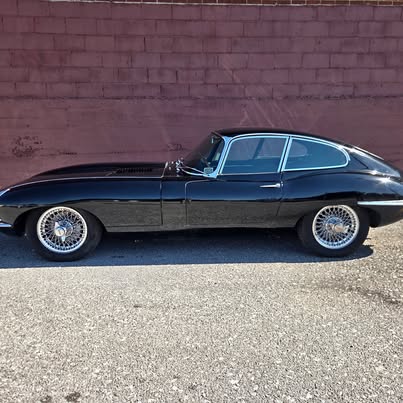
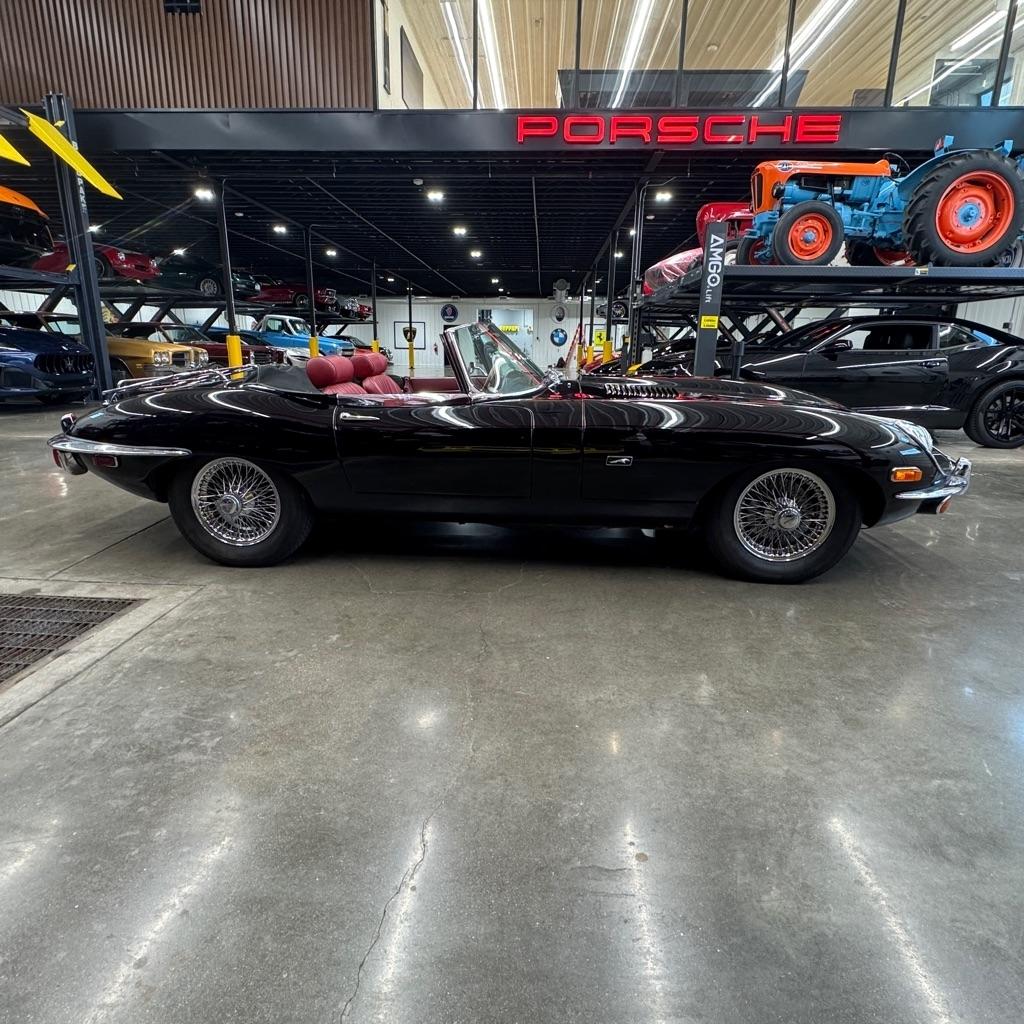
Look at this view first on any E-Type you inspect. The bonnet is one huge pressing that includes both front wings, so the shut lines around the scuttle, doors and sill tops tell you whether the front subframe is straight and whether the bonnet has been bent, filled or replaced. Sight along the sill line: it should run clean and unrippled. A wire wheel that sits differently from its pair points at suspension or subframe trouble, not at a bad photograph.
The models
You choose an E-Type in two decisions: which series, and which body. Series decides character, running gear and specification. Body decides how you use the car and — on the 2+2 — which wheelbase and gearbox options you get. Sellers blur both, calling a 1968 Series 1.5 a Series 1 or a 2+2 a coupé without the qualifier. The table below is your first filter. Production figures are the widely published factory totals, rounded where changeover records blur the Series 1 to Series 1.5 boundary.
| model | years | engine | output | built | character |
|---|---|---|---|---|---|
| Series 1 3.8 OTS | 1961–1964 | 3.8 XK six, triple SU HD8 | 265 bhp gross | ~7,800 | The original open car; Moss gearbox, free-revving, rawest of all |
| Series 1 3.8 FHC | 1961–1964 | 3.8 XK six, triple SU HD8 | 265 bhp gross | ~7,700 | The original coupé; same running gear, stiffer use, superb fast tourer |
| Series 1 4.2 OTS | 1964–1967 | 4.2 XK six, triple SU HD8 | 265 bhp gross | ~9,500 | All-synchro gearbox, better seats and brakes; the classic all-rounder |
| Series 1 4.2 FHC | 1964–1967 | 4.2 XK six, triple SU HD8 | 265 bhp gross | ~7,800 | The 4.2 improvements in the closed body; strong, usable, sought-after |
| Series 1 4.2 2+2 | 1966–1968 | 4.2 XK six, triple SU / US Stromberg | 265 / ~246 bhp gross | ~5,600 | Long wheelbase, occasional rear seat, automatic available; softer, roomier |
| Series 1.5 (all bodies) | 1968 | 4.2 XK six, US twin Stromberg | ~246 bhp gross | Included in Series 1/2 totals | Transitional: open headlamps, Series 1 tail and interior details; verify by chassis number |
| Series 2 OTS | 1968–1970 | 4.2 XK six, US twin Stromberg | ~246 bhp gross | ~8,400 | Federalised open car; air conditioning and power steering options, easier to live with |
| Series 2 FHC | 1968–1970 | 4.2 XK six, US twin Stromberg | ~246 bhp gross | ~4,900 | The last short-wheelbase coupé; underrated driver, often the best value FHC |
| Series 2 2+2 | 1968–1970 | 4.2 XK six, US twin Stromberg | ~246 bhp gross | ~5,300 | Long-wheelbase family tourer; automatic common, check the roofline rust carefully |
| Series 3 OTS | 1971–1975 | 5.3 V12, four Stromberg | 272 bhp gross (UK) | ~8,000 | V12 torque and smoothness on the long wheelbase; a grand tourer, not a sports car in the Series 1 sense |
| Series 3 2+2 | 1971–1975 | 5.3 V12, four Stromberg | 272 bhp gross (UK) | ~7,300 | The V12 closed car; automatic common, vast pace, vast engine bay to maintain |
Total production across all series is roughly 72,500 cars: rare enough to be valuable, common enough that parts, knowledge and comparable cars exist. You never need to buy the first one you see.
The Series 1 divides at October 1964, and the divide matters more than the badge. The 3.8 cars (1961–1964) have the original Moss gearbox with synchromesh on the upper three ratios only, a dynamo on the earliest cars changing to an alternator late in 3.8 production in some markets, bucket seats that locate you poorly by modern standards, an aluminium dash and console on the earliest cars, and a revvier, harder-edged engine character. Details evolve constantly: flat floors on the very early cars give way to dished footwells, outside bonnet latches on the first few hundred cars give way to internal latches, and covered headlamps, slim tail lamps above the rear bumper, and exhausts exiting under the rear valance define the look throughout. A 3.8 is the connoisseur's car and the least forgiving daily driver. The 4.2 cars (1964–1968) keep the same headline power figure but add torque where you use it, the all-synchromesh gearbox described in the next section, an alternator as standard, a larger radiator with an electric fan installation that evolves through production, improved brakes with a new servo arrangement, and seats you can sit in for three hours. If you intend to drive the car rather than polish it, the 4.2 Series 1 is where most experienced buyers land.
The Series 1.5 is not a factory designation — Jaguar never badges a car Series 1.5. The term covers the 1968 transitional cars, which combine open, uncovered headlamps and, on US cars, twin Stromberg carburettors with much of the Series 1 shell and interior still in place. The changeover is phased, so two cars built weeks apart differ in detail. You identify a 1.5 by chassis number and build date, not by a seller's label, and value it as a slightly softer, usually cheaper route into a Series 1 shape.
The Series 2 (1968–1970) completes the federalisation: open headlamps moved up and forward, a larger mouth, tail lamps below a full-width rear bumper, headrests, rocker switches and a collapsible column. A US Series 2 runs twin Zenith-Stromberg 175 CD-2 carburettors and a lower state of tune than a triple-SU car, but power steering and air conditioning are options you actually find fitted, and twin electric fans improve the cooling. It is a different car, not a lesser one — easier in traffic, better cooled, visually heavier — and, coupé for coupé, usually the cheapest way into a short-wheelbase six-cylinder E-Type in comparable condition.
The Series 3 (1971–1975) replaces the six with the 5.3-litre V12, built for smoothness and torque rather than the XK's racing edge. The shell changes with it: a chrome grille, a bonnet power bulge, flared arches over a wider track, ventilated front discs and power steering as standard. There is no Series 3 FHC; your choices are the long-wheelbase 2+2 and a long-wheelbase roadster that drives like a grand tourer. Four Zenith-Stromberg carburettors feed the V12 — the fuel injection of later Jaguar V12s is not fitted to the production E-Type — and the Borg-Warner Model 12 automatic is far more common here. A good Series 3 is magnificent. A neglected one is the most expensive E-Type to put right, because everything in that bay is doubled, buried or both.
Body choice deserves the same rigour. The roadster gives you open motoring, the strongest demand, a soft top that leaks and flaps, and scuttle shake a coupé never shows. The FHC gives you the purest line, a rigid shell and a useable rear hatch, in a cabin that gets hot. The 2+2 gives you length, room for children and an automatic option, at the cost of proportions many buyers judge less elegant. The wrong answer is buying a body you have not sat in — top up if it is a roadster, passenger in the back if it is a 2+2.
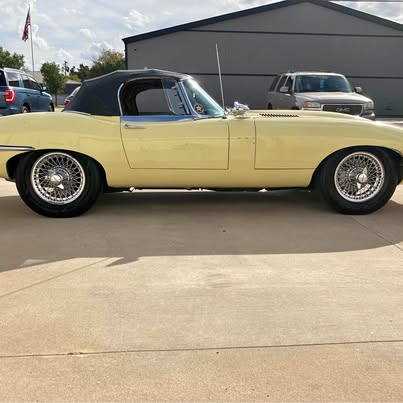
Use the roadster profile for the checks that only apply to the open car. Sight down the door tops and rear deck: a door that sits proud or drops on its hinges shows here first. Look at the hood frame irons where they meet the windscreen header and at the base of the A-posts, where open-car flex and water entry combine. Check the rear deck line runs level to both wings — rear corner repairs hide in filler exactly where this view catches the light. Wire wheels should show even spoke tension and no rust weeping from the nipples.
Engines and gearboxes
The XK six: 3.8 and 4.2
Every six-cylinder E-Type runs a version of the XK engine, Jaguar's twin-overhead-camshaft straight six, and understanding its architecture explains almost every strength and failure you will meet. The block is cast iron. The cylinder head is aluminium alloy with hemispherical combustion chambers, two valves per cylinder set at an included angle, and chain-driven camshafts — duplex chain at the front, with an upper and lower chain and tensioners that become a service item with age and mileage. Displacement is 3,781 cc on the 3.8 (bore 87 mm, stroke 106 mm) and 4,235 cc on the 4.2 (bore 92.07 mm, same long 106 mm stroke). That long stroke is the engine's character: the XK does not need revs to pull, it produces torque low down and keeps producing it, and it sounds — with the correct exhaust — like nothing else in its class.
Period output is quoted gross, on the old SAE basis without full ancillaries, and you must not compare it directly with a modern net figure. Jaguar quotes 265 bhp gross at 5,500 rpm for both the 3.8 and the 4.2 in triple-carburettor home-market form, with torque rising from about 260 lb ft on the 3.8 to about 283 lb ft on the 4.2, delivered lower in the range. In the car the 4.2 feels stronger everywhere below 4,000 rpm and no faster at the very top, which is exactly what the figures predict. US emission specification changes the picture: the twin-Stromberg Series 1.5 and Series 2 cars are quoted at about 246 bhp gross, and in the car they feel softer still at low speed because the Stromberg installation, its cross-over plumbing and its tuning prioritise emissions and driveability on US fuel over throttle response. A later conversion to triple SUs, correctly jetted and set up on a rolling road, transforms a Stromberg car. A conversion done with worn carburettors, the wrong needles and no attention to the distributor curve transforms nothing except your bank balance.
Carburettors are the first thing to identify under any six-cylinder bonnet. Home-market and early US cars run three SU HD8 carburettors — 2-inch constant-depression instruments on a cast manifold, with a manual or automatic choke arrangement depending on year and market. The HD8 is a simple, durable carburettor whose wear points are knowable: throttle spindle wear in the bodies, which lets in air and makes a stable idle impossible; worn jets and needles, which richen the mixture unevenly across the three instruments; and float and needle-valve trouble, which floods or starves one carburettor while its neighbours behave. US Series 1.5 and Series 2 cars run two Zenith-Stromberg 175 CD-2 carburettors with emission plumbing. The Stromberg is not a bad carburettor, but on the E-Type it works with a secondary throttle and cross-over arrangement on many US cars that dulls response, and its rubber diaphragms perish with age and modern fuel, producing a flat spot and a reluctance to pull that owners routinely misdiagnose as ignition trouble. Test the diaphragms before you condemn anything else on a Stromberg car: a split diaphragm costs little, a misdiagnosed distributor rebuild costs a great deal and fixes nothing.
The XK's bottom end is strong. The crankshaft runs in seven main bearings, and a six that has had oil changes and has not been overheated will cover high mileages without crank or bearing drama. The failures cluster elsewhere, and they have mechanisms you can test for. Oil consumption rises through valve-guide wear and hardened valve-stem seals on the inlet side — the XK originally relies on close guide clearances rather than the modern seal arrangement on early cars — and through piston-ring wear on high-mileage engines, and you distinguish them by when the car smokes: a puff on start-up and on the overrun after a long downhill points to guides and seals, smoke under sustained load points to rings and bores. Oil leaks are endemic and mostly honest: the rear crank seal arrangement, the cam covers, the timing-cover joint and the sump all weep on a car that is used, and you budget for weeping while you hunt for the one leak that matters, a pressurised leak or a leak onto the exhaust. Timing chains rattle when tensioners and guides wear, most audibly as a light rattle from the front of the engine at idle and just off idle that changes with oil pressure; a quiet engine with a documented top-chain adjustment and healthy oil pressure is worth more than a silent engine achieved with thick oil for the sale.
Cooling is part of the engine section on this car because the XK's head, its water pump and its installation conspire against you, and it gets its full treatment in Problem areas below. The short version belongs here: the aluminium head on an iron block expands at a different rate, so repeated overheating works the head gasket and, eventually, the head itself; the water pump is driven from the front of the engine and its bearing and seal wear announce themselves as play at the pulley and a weep from the drain hole; and the thermostat and its bypass arrangement must be the correct type, because a generic thermostat that does not close the bypass correctly sends coolant around the radiator instead of through it and produces overheating that no radiator recore will cure. When a seller tells you an E-Type runs hot because they all do, translate it correctly: this one runs hot, and the cause is findable.
Oil pressure is your single best instrument on a six-cylinder inspection. A healthy XK at operating temperature shows strong pressure at cruising revs — period gauges vary, but you look for a gauge that rises promptly from idle, holds steady rather than flickering, and does not collapse at a hot idle after a run. The dash gauge and its sender are themselves unreliable with age, so a suspicious reading earns a test with a mechanical gauge screwed into the gallery, not an instant verdict on the engine. That distinction — instrument fault versus engine fault — recurs all over this car, and the buyer who tests rather than assumes buys the better car at the better price.
The Series 3 V12
The 5.3-litre V12 (5,343 cc, bore 90 mm, stroke 70 mm) is a fundamentally different engine from the XK and you inspect it differently. It is an all-aluminium single-overhead-camshaft-per-bank design — one camshaft per bank operating two valves per cylinder through a flat-face combustion chamber arrangement in the original production form — built for refinement and torque. Jaguar quotes 272 bhp gross for the home-market car, with US cars in a lower state of tune for emissions; torque, at around 304 lb ft in home-market form, is the figure that describes the car, delivered smoothly from low revs in a way no XK matches. Four Zenith-Stromberg 175 CD carburettors, two per bank, feed it through inlet manifolds that fill the vee, with the distributor mounted at the front and, on later cars, OPUS electronic ignition — Lucas's Opus system, whose amplifier lives in the heat of the engine bay and fails with age and temperature, producing misfires and cutting out that vanish when the engine cools and return when it warms. That heat-related pattern is the diagnostic: an OPUS car that dies hot and restarts cold needs its ignition amplifier and its relocation or replacement assessed before you suspect fuel.
The V12's bottom end has an excellent reputation; crankshaft, bearings and block give little trouble on a maintained car, and oil leaks are again honest background noise. The trouble lives in the top end, the ancillaries and access. Valve clearances are set by shims and are labour-intensive to adjust, so they get skipped — a top-end rattle with no record of clearance checks is a bill arriving, not a character trait. The cooling system has even less margin than the six's, with a forest of hoses, every one a leak point. Dropped valve seats are the catastrophic version: a severely overheated V12 can drop an inlet valve seat, announced by a sudden misfire and mechanical noise on an engine that was merely running hot the week before. You do not buy a V12 that runs hot. On the six, overheating is a negotiation. On the V12, it is a walk-away trigger until the cause is proven minor.
Access shapes V12 ownership. The engine fills the bay, jobs take longer and cost more in labour, and previous owners defer them — so a Series 3 with a thick, specialist-stamped history is worth a materially larger premium over a thin-history car than the same gap on a six. Check for the deferred jobs actually done: coolant hoses as a set, water pump, ignition amplifier, carburettor diaphragms. A V12 with only oil changes in its file is a car whose bills are waiting for you.
Gearboxes, clutch and automatic options
The gearbox divides the six-cylinder cars as sharply as the engine size does. The 3.8 cars use Jaguar's Moss gearbox — a four-speed manual with synchromesh on second, third and top only, no synchromesh on first or reverse, and a slow, deliberate change that punishes rushing. First gear whines, because it is a straight-cut sliding engagement in character if not in strict description, and selecting first at anything above a crawl requires a pause in neutral or a full stop. None of that is a fault. A Moss box that crunches into second when cold, jumps out of gear on the overrun, or whines loudly in the indirect gears under load is worn, and a rebuild is a specialist job. Many 3.8s have been converted to later all-synchro Jaguar boxes or to modern five-speed conversions over the decades; a conversion done well improves the car to drive and complicates its originality, and you value it according to whether you are buying a driver or a matching-numbers show car. Establish which box is in the car before you judge its change quality — judging a Moss box by all-synchro standards condemns every honest 3.8 ever built.
The 4.2 introduces Jaguar's own all-synchromesh four-speed (the EJ and later KE series gearboxes), with synchromesh on all forward gears including first, a lighter and faster change, and a much easier life in traffic. It is a strong box whose wear shows as tired synchromesh on second gear — the classic test is a brisk change into second, up and down, once the oil is warm; a single graunch on a hurried cold change is common and minor, a graunch on every warm change is a rebuild. Reverse selection should be clean, the lever should not buzz or jump under load, and the overdrive you may expect from Jaguar saloons of the period is not an E-Type fitting — no production E-Type leaves the factory with overdrive, so a car advertised with it has been modified, which is neither good nor bad until you know who did the work. The clutch is hydraulically operated, and its failure modes are hydraulic before they are mechanical: a slave cylinder that leaks and draws air gives you a pedal that pumps up and a bite point that wanders, a collapsing flexible hose gives you a clutch that will not clear cleanly, and both masquerade as a worn clutch plate. Test the hydraulics first. A genuinely worn clutch slips in top gear under full throttle up a hill, and that test, done once on the road test, settles it.
The Series 3 manual is a strengthened four-speed derived from the six-cylinder all-synchro box, adapted to V12 torque, with the same synchromesh wear logic and a heavier change. It is the rarer Series 3 choice and the more desirable one for most drivers. The automatic story runs the other way. On the six-cylinder 2+2 from 1966, Jaguar offers the Borg-Warner Model 8 three-speed automatic; on the Series 3, the Borg-Warner Model 12 three-speed automatic becomes the common fitment. Both are robust, conventional torque-converter autos whose health you judge by fluid colour and smell, by the quality and timing of the shifts, and by a clean engagement of drive and reverse without a delay or a thump. Burnt, dark fluid and a flare between second and third condemn a box as surely on an E-Type as on any other car of the era. An automatic 2+2 or Series 3 is not a lesser E-Type; it is a different tool, a relaxed grand tourer, and it is usually cheaper to buy — which makes a genuinely good one, with a documented fluid history, one of the smarter buys in this whole guide.
Final drive is through a Salisbury limited-slip differential on most cars — a Salisbury 4HA unit in the rear cage, with ratios varying by market and series. The differential itself is durable; its mounts, output bearings and seals are the service items. Listen for a whine that rises and falls with road speed rather than engine speed — final drive or wheel bearing territory — and a clonk on taking up drive, which is more often worn universal joints, splines or mounts than the differential itself.
Problem areas
Rust: the monocoque map
Rust decides whether an E-Type is a car or a liability, and it decides it in places a casual look never reaches. The structure is a monocoque: the sills are not trim, they are the main longitudinal strength between the front and rear bulkheads; the floors, transmission tunnel, bulkhead, rear wheelarches and the box sections around the rear suspension mountings all carry load. When they rot, the car does not merely look scruffy. It flexes, the doors drop and catch, the bonnet fit wanders, and in the worst case a rear radius-arm mounting tears away from metal that no longer exists. You inspect accordingly: structure first, cosmetics only after the structure passes.
Start with the sills, inner and outer. The outer sill is the curved panel below each door; the inner sill and the floor edge behind it are where the rot lives, hidden by the outer panel and by underseal. Prod — with permission, and with a magnet and a blunt probe rather than a screwdriver through somebody's paint — along the sill bottom, at the front where the sill meets the bulkhead and at the rear where it meets the wheelarch closing panel. Filler feels dead under a magnet and sounds dull under a knuckle. The sill-jack test settles arguments: the car should lift on its jacking points without creaking, cracking paint or a door gap that visibly changes. A car whose door opens and closes differently once it is jacked has flex where strength should be, and that is a structural conversation, not a paint conversation. Proper sill and floor repair, done with the car braced and the panels cut back to sound metal, runs roughly $2,500–5,000 a side once inner and outer panels, closing panels and paint are counted, and a car needing both sides plus floors is a restoration, whatever the seller calls it.
Move to the bulkhead and floors. Water enters through perished seals and a leaking windscreen seal, then sits under carpets that hold it against the floor pans. Lift every carpet you can. Surface rust is cleanable; perforation at the floor-to-sill joint, seat-belt mountings or radius-arm mountings is structural. Check the bulkhead low down, behind the pedals and under the battery tray, where acid and trapped water attack together. On coupés, check the hatch surround and the boot floor around the spare-wheel well and fuel-tank mountings, where water past a perished seal collects unseen. A damp boot smell is a rust inspection you can do with your nose.
The bonnet is the largest and most expensive panel on the car. It rusts at its centre seams, lower valance, headlamp apertures and wheelarch lips, while accident damage hides under filler across its broad curves. A replacement bonnet supplied, fitted and painted properly runs well into five figures, so a sound original is a genuine asset. Doors rust at their lower skins and frames; rear arches rust at the lip and inner arch. The bolt-on front subframe bends in accidents and corrodes at its joints, and it is safety-critical — it carries the engine and front suspension — so a cracked or heavily corroded frame is a replace-it item, roughly $2,000–4,000 for the frame set before labour, never a weld-it-and-hope item. Check the rails for ripples and fresh paint that betray an old frontal impact.
The myth to correct here is that a shiny E-Type with no visible bubbles has no rust. On this car visible bubbles are the late stage. The early stage is inside the sills, under the underseal, under the carpets and behind the closing panels, which is why the inspection section below puts the car on a lift, takes a torch and a magnet, and treats a seller who refuses a lift inspection as an answer in himself.
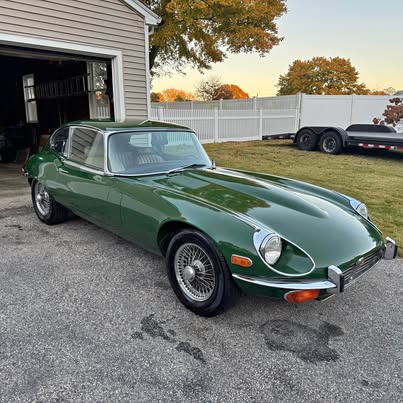
Read the 2+2 shape critically, because its rust map differs from the short-wheelbase cars. The longer roof and taller windscreen put more sealed joint and channel length over your head, so check the screen surround, the roof gutters and the cant rails for bubbling that starts under the chrome and the seals. The rear side windows and the hatch surround collect water in their channels, and the first sign is often a damp rear carpet and a musty trim smell rather than visible paint damage. From this angle you can also judge the 2+2's proportions honestly: the extra nine inches sit in the doors and cabin, so door length, door fit and the shut line at the sill tell you more about this car's structural life than on any other variant. If the long doors drop, sag or need a lift to latch, suspect sill and hinge-pillar wear together and price both.
Cooling, brakes and the rear suspension cage
The cooling system has no reserve, and you treat any overheating claim as a system diagnosis, not a shrug. The radiator is modest for the engine's output and the bonnet's low nose restricts airflow; the original fan arrangements — a simple electric fan on early sixes, twin fans on Series 2 and Series 3 — are adequate when every component is healthy and inadequate the moment one is not. Work through the system in order. The radiator core blocks internally with age and silts up; a radiator that is hot at the top and cool in patches at the bottom, checked carefully with an infrared thermometer, is partially blocked. The thermostat must be the correct bypass-closing type for the six, as described in the engine section. Hoses perish from the inside and collapse or weep at the clamps. The water pump bearing wears. The fan, its motor, its relay and the Otter switch that controls it all fail, singly and together, and a fan that does not cut in by the time the gauge climbs past normal is a fault you find in the seller's driveway, not in traffic on your drive home. The V12 multiplies the hoses and adds its own radiator and fan demands. A full cooling-system overhaul — radiator recore or replacement, pump, thermostat, hoses and fan work — runs roughly $1,500–3,500 on a six and more on a V12, and it is the best money a new owner spends. A car with a documented recent overhaul is worth a premium. A car that overheats on your test drive does not get the benefit of the doubt.
Brakes are discs all round — Dunlop systems on early cars, with Girling equipment becoming standard through the Series 1 period, and Lockheed servo assistance on later cars; the exact maker matters less than the architecture. The front discs are accessible and conventional. The rear discs are mounted inboard, either side of the differential, inside the rear suspension cage, where they run in the heat and oil mist of the final drive and where changing pads is awkward and changing discs or calipers is a cage-out or cage-lowered job on many procedures. Two consequences follow for you. First, rear brakes get neglected because they are hard to reach, so you specifically ask when the rear pads, discs and calipers were last done and you look for the invoice, not the assurance. Second, a leaking differential output seal or a leaking caliper contaminates the rear discs with oil, producing a car that pulls, squeals or simply stops poorly from the rear while the fronts test fine. Handbrake pads are separate small pads acting on the rear discs, operated by the lever and, on many cars, adjusted poorly or seized; a handbrake that barely holds on a slope is normal enough to be common and wrong enough to fix, and it is an MOT and safety item, not a quirk. A full rear-brake overhaul with the cage out, combined with the suspension work below, runs roughly $2,000–4,000 in parts and labour, which is exactly why you want to know its status before you buy.
The rear suspension lives in a removable steel cage: differential, inboard brakes, driveshafts, hub carriers, wishbones and the coil-spring damper units — four of them, two per side — all mounted to the body through rubber V-blocks and Metalastik mounts, with radius arms running forward to mountings on the body floor. The design is brilliant and the rubber is perishable. Perished cage mounts and radius-arm bushes let the whole rear assembly move, producing a rear-steer vagueness, clonks over bumps and a car that wanders under power. Worn universal joints in the driveshafts clonk on drive take-up. The hub splines for wire wheels wear, and a worn spline is a safety item: check for play by rocking a jacked rear wheel, and budget for hubs and wheels together if the splines are hooked and thin, because a new wheel on a worn hub wears the new wheel. Dampers leak and go soft in pairs per side. None of this is exotic, all of it is labour, and the sensible owner drops the cage once and does brakes, mounts, bushes, joints and dampers together. Ask whether that job has been done, and when. On a car with no record of it, assume it is due and price the car accordingly — roughly $3,000–6,000 for a thorough cage-out overhaul depending on how much of the brake and hub work it includes.
Front suspension is double wishbones on torsion bars, with rack-and-pinion steering. The rack mounts are rubber-bonded and perish, letting the rack move before the wheels do, which feels like steering play and is cured with mounts, not a rack. Ball-joint wear shows as play at the jacked wheel and uneven front tyre wear. Torsion-bar adjusters seize, so check the car sits level and at the right height. Power steering, where fitted, adds a pump and hoses that leak with age; a heavy-then-light, notchy feel points to pump pressure rather than alignment. Budget roughly $1,200–2,500 for a full front-end refresh of joints, bushes and mounts.
Electrics, trim and the details that date a car
Lucas electrics power the E-Type: the components are simple and repairable, while the wiring, earths and switches are now fifty to sixty years old. Most faults on a viewing are earth faults, corroded bullet connectors, or fuse clips that have lost their tension. The faults that cost money are a heat-hardened loom, especially on a V12; a failed OPUS amplifier on a Series 3; charging trouble; and fan and Otter-switch failures that present as overheating. Test every switch on your inspection. A seller who says a dead circuit is just a fuse may be right — verify it with a fuse, in front of him, before it becomes your diagnosis to fund.
The interior dates and authenticates a car as reliably as its numbers. Early Series 1 cars have aluminium dash panels, bucket seats and toggle switches; Series 2 cars have rocker switches and headrests; Series 3 cars have their own wheel and switches. Wrong-period seats or a Series 2 dash in a claimed Series 1 are price and originality facts. A full quality retrim runs roughly $6,000–12,000, so a tired interior is not a cheap fix, and a good original interior with honest patina beats a fresh, incorrect retrim. Roadster hoods perish and shrink; budget roughly $1,500–3,000 for a quality hood fitted on a sound frame, and check the frame before you price only the cloth.
Chrome and brightwork finish the picture. Wire wheels, bumpers and lamp rims in good order are expensive to restore piecemeal, and rechroming is a lottery you avoid by buying a car whose chrome already passes. Perished screen rubbers leak onto the bulkhead and floors, connecting trim straight back to rust. On an E-Type, the sections always connect — and the inspection that follows is built to follow those connections in order.
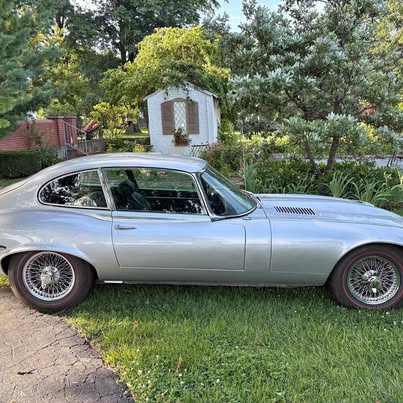
Use the Series 3 front three-quarter to check the V12 car's distinguishing metal. The flared arches should be crisp pressed shapes, not filler swells; run your eye along the flare lip where stone chips start the rust and along the sill below it. The chrome grille in the mouth is a Series 3 signature and a parking-damage target, so check it for bends and for the bonnet alignment it reveals — a grille that sits crooked in its aperture means the bonnet or its hinges sit crooked too. The wider wheels and tyres fill the arches differently from a six-cylinder car, so stance is diagnostic here: a Series 3 that sits nose-high, tail-low or uneven side to side has suspension, spring or accident history to explain. Finally, look at the length. The long wheelbase moves the cabin back and stretches the doors, and once you have this proportion in your eye you will never mistake a Series 3 roadster for a Series 1 at a show again — which is precisely the skill that stops you paying Series 1 money for the wrong car.
How to inspect one
Inspect in this order, and do not let a seller reorder it into a drive first and questions later. You need a lift or at least ramps and a torch, a magnet wrapped in cloth, a tyre gauge, an infrared thermometer if you have one, and the car's numbers written down before you arrive so you can compare them with the car, not with your memory.
- Start with identity, before condition. Find the data plate — riveted in the engine bay, on the bulkhead or inner wing depending on year — and read the four numbers Jaguar stamps there: chassis (car) number, engine number, body number and gearbox number. Compare the chassis number with the number stamped on the frame — on six-cylinder cars, stamped on the right-hand front frame member by the shock absorber mounting; the picture frame also carries identification on many cars — and compare the engine number with the stamping on the block, above the oil filter on the six and in the vee area locations used on the V12. A car whose plate, frame and title disagree is a legal and value problem you solve before any other inspection. This is the identity check the Values section depends on.
- Walk the exterior in daylight with the magnet. Check sills, lower doors, wheelarch lips, bonnet seams and the lower valance for filler, following the rust map in Problem areas. Sight along both flanks, check door and bonnet gaps, and look for the ripples and mismatched paint texture that mark old repairs.
- Do the sill-jack test and the door test from the rust section. Lift on the jacking points, watch the door gaps, open and close each door while the car is lifted, and treat creaks, cracking paint or changed gaps as structural evidence.
- Get the car on a lift and inspect the underside systematically: inner sills, floor edges, seat-belt and radius-arm mountings, boot floor from below, front subframe rails and joints, and the rear cage and its mounts. Torch, probe with permission, and photograph everything. Refusal of a lift inspection ends the inspection.
- Inspect the rear cage as its own item, per Problem areas: cage mounts and radius-arm bushes for perishing and movement, driveshaft universal joints for play, hub splines for wear, dampers for leaks, and the inboard rear discs for oil contamination from differential or caliper seals.
- Check the front suspension and steering with the car jacked: ball-joint and bush play, rack-mount movement while an assistant rocks the wheel, torsion-bar ride height and level stance, and power-steering hoses and pump for leaks if fitted.
- Run the engine from stone cold — insist on it, and arrive early enough that a pre-warmed engine is obvious from a warm radiator hose. Listen for timing-chain rattle at the front of a six, top-end rattle on a V12, and bearing knock under light load. Watch the exhaust: start-up puff versus load smoke separates guide wear from ring wear, as the engine section explains.
- Test oil pressure and cooling together on a proper run. Confirm the gauge rises promptly, then drive long enough — twenty minutes minimum, including a hill and a period of low-speed running — for the thermostat, fan and Otter switch to prove themselves. Use the infrared thermometer on the radiator to look for cold patches. A car that cannot complete this run coolly has a cooling bill attached to it.
- Test the gearbox and clutch on that same run. On a Moss box, judge it by Moss standards: no synchro on first, a deliberate change. On an all-synchro box, make brisk warm changes into second, up and down. Test the clutch for slip in top gear up the hill, and for hydraulic faults — a wandering bite point or a pedal that pumps up — before condemning the plate. On an automatic, check the fluid colour and smell afterwards and judge shift quality and engagement delay against the gearbox section.
- Test the brakes from speed, in a straight line, hands light on the wheel. The car should pull up square; pulling points to caliper, pad or contaminated rear discs, and a soft or sinking pedal points to hydraulics or the servo. Test the handbrake on the hill. Ask for the rear-brake invoice while the seller is still impressed that you asked.
- Work every electrical item, per the electrics section: lights, panel lights, wipers and park, washers, heater fan, indicators and, on a Series 3, watch for the hot-cut-out pattern that indicts the OPUS amplifier — a car that misfires or dies as it warms and restarts cold needs that diagnosis priced in.
- Finish with the paperwork and the trim audit together. Heritage certificate or build record against the data plate; history file for the big-ticket jobs this guide names — sills and floors, cooling overhaul, rear-cage overhaul, rear brakes, clutch, retrim — and interior and chrome checked against the correct period specification for the claimed series. Then, and only then, talk about price, using the structure the next section gives you.
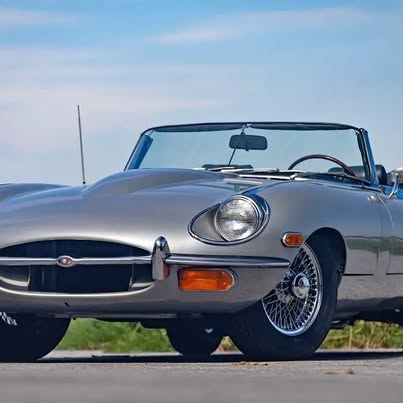
Finish with a Series 2, because misidentification is the most expensive beginner's error here. The open headlamps, larger mouth and bigger lamps are the visible signature of the federalised specification, Stromberg carburettors and different interior that come with it. Learn to spot them from across a car park: you will not pay Series 1 money for a Series 2, and you will not walk past a good Series 2 that, as a driver, may suit you better. Check the headlamp nacelles and surrounding bonnet for filler and cracking, where the revised front end concentrates repair history.
Values
Read the market figures in the computed block below this guide as a spread, not a price. On the E-Type, condition moves value further than on almost any comparable car, because the gap between a structurally sound, matching-numbers car and a shiny car over rotten sills is not a discount — it is the cost of a restoration, and the market knows it. The hierarchy is stable: Series 1 cars carry the premium, roadsters over coupés, the 3.8 valued for purity and the 4.2 for usability; Series 1.5 and Series 2 cars sit below them; 2+2s and automatics sit below their short-wheelbase, manual equivalents; and Series 3 values turn on V12 history and specification more than on series prestige. Matching numbers, a Heritage certificate that agrees with the data plate, and invoices for the structural and cage work named in this guide each add real money. Asking prices run ahead of achieved prices on tired cars and close to them on exceptional ones, so judge any car against recent recorded sales of the same series and body — not against the best car advertised nationally. A project is only cheap if the structure is sound; a driver with needs is usually the best value on the page. Colour changes, non-original gearboxes and later specifications all discount a car against its original build record, which is why you verify identity before you negotiate, not after.
Parts and ownership
Parts supply is a genuine E-Type strength. The big Jaguar specialists in Britain and the United States catalogue almost everything: panels, including sills, floors and bonnet sections; XK and V12 engine internals; SU and Stromberg rebuild parts; suspension, brake and rear-cage components; trim, hoods and chrome. Reproduction quality varies, so you buy panels and safety items from established specialists and you test-fit panels before paint, always. Mechanical parts for the XK six are the easiest and cheapest to source; V12 ancillaries, trim specific to one series and body, and early 3.8 details take longer and cost more. Ownership itself is conventional classic-car work: engine oil and filter every 3,000 miles or annually, coolant and hoses watched as a system, brake fluid changed on time because the rear calipers punish neglect, and regular use — an E-Type deteriorates faster sitting than driving. Insure it on an agreed-value policy that reflects the matching-numbers and structural evidence you gathered at purchase, store it dry, and keep every invoice. The Jaguar Daimler Heritage Trust certificate for your car, the clubs, the registers and the marque specialists form a support network few classics of any country or era can match. Budget for specialist labour on the cage, the V12 top end and structural welding, and do the routine work yourself if you are able — the car rewards it. Expect fuel consumption in the mid-teens to low twenties depending on series, tune and use, and expect tyres, being period sizes on wire wheels, to come from specialist suppliers rather than a high-street rack.
Which one to buy
- The purist: a Series 1 3.8, roadster or FHC — the original specification, Moss gearbox and all, bought on structure and originality.
- The all-rounder: a Series 1 4.2 FHC or roadster — all-synchro gearbox, torque, better seats and brakes in the classic shape.
- The value buy: a Series 2 FHC — the federalised coupé the market underrates, the driver in modern traffic emphatically does not, and the easiest six-cylinder car here to live with daily.
- The family tourer: a 4.2 2+2, manual if you find one, automatic if you tour — length, luggage and a rear seat children actually fit.
- The grand tourer: a Series 3, manual roadster if your budget reaches, automatic 2+2 if it does not — V12 smoothness and long-wheelbase calm, bought only on a thick specialist history and a cooling system with recent invoices.
The overriding rule: buy the structure and the numbers, not the series and not the shine — the best E-Type is the one whose sills, floors and data plate all tell the same honest story, whatever its badge.
See the 10 XKE Roadster cars currently listed.
For sale now
Expand
Expand
 $99,500
Expand
 $109,900
Expand
 $60,000
Expand
What they sell for: XKE Roadster sale prices.