
Jeep cj-7 buyer's guide
Jeep cj-7 -- the model's own buyer's guide: variants, values and what to check.
Years listed: 1979-1986 · Series: Jeep
# Jeep CJ-7 — Buyer's Guide
Overview and history
The CJ-7 is the Jeep that civilised the CJ without softening it. American Motors launched it for 1976 alongside the shorter CJ-5, and the whole point sits in one measurement: a 93.3-inch wheelbase against the CJ-5's 83.5 inches. Those ten extra inches buy you everything that defines the model — a squared-off door opening you can climb through, room for full steel doors and a proper factory hardtop for the first time on a CJ, space for an automatic behind the six and the V8, and a ride that pitches less on the road. Underneath, nothing is reinvented: ladder frame, live axles on leaf springs, part-time four-wheel drive on manual cars, engines AMC already built by the hundreds of thousands. That combination — familiar mechanicals, usable body — is why the CJ-7 ran for eleven model years, 1976 to 1986, and why it, not the CJ-5, became the template every Wrangler since has followed.
The CJ line descends from the wartime Jeep through Willys and Kaiser; AMC bought the company in 1970. By the mid-1970s the CJ-5's compromises were the story: cramped entry, a soft top that fought you, no automatic worth having, and growing press attention on short-wheelbase handling. The CJ-7 is AMC's answer, engineered cheaply out of CJ-5 parts: new longer frame, changed rear floor and tub sides, and a driveline that is pure AMC — its own straight sixes and small V8, gearboxes borrowed from its passenger cars and from GM and Chrysler suppliers. You benefit from that parts-bin honesty today, because almost everything mechanical has a second application somewhere in the AMC or light-truck world.
Production ran at Toledo through hard years for the American industry, and the car changed more than its silhouette suggests. Early cars, 1976 to 1979, are the simple ones: three engines topped by a factory V8, a three-speed manual or a full-time Quadra-Trac automatic, narrow-track axles and minimal emissions hardware by later standards. The 1980 reset is the big one — the Dana 300 transfer case arrives, the automatics become Chrysler TorqueFlites, a four-cylinder joins, and the V8 enters its final two seasons, gone after 1981. From 1982 the axles widen, five-speed manuals appear, trim peaks with the Limited, and the range settles until production ends after 1986, when the Wrangler YJ replaces the entire CJ line. Total production is usually quoted at just under 380,000 cars — common enough to choose between, and old enough that rust and forty years of modification have done the choosing for many buyers already.
That governs your whole search. A CJ-7 was bought to be used — trailed, ploughed, hunted, lifted, locked and left outside — and survivors divide sharply: documented, uncut cars on standard suspension with original tubs and engines at one end; Jeeps rebuilt three times around a tired frame at the other, where the badges say Renegade and almost nothing else matches the title year. Both are called CJ-7s in adverts. They are not the same purchase, and most of this guide exists to help you tell them apart with a magnet, a tape measure and a torch.
The pool behind this guide on Classic Listings is small: five CJ-7s recorded, four listed for sale and one recorded as sold, spanning 1979 to 1986 — two cars from 1979, one from 1984 and two from 1986 — sourced from Bring a Trailer and from dealers. Treat that as a snapshot, not the market itself. CJ-7s trade in volume elsewhere, and the right car is worth travelling for: the difference between a sound frame and a rotten one is worth more than any distance you will drive to check it.
One myth dies at the start. No CJ-7 left Toledo with a 360 or 401 V8, fuel injection, coil springs or a Dana 44 front axle, however many adverts imply otherwise. The factory V8 is the AMC 304, two-barrel, 1976 to 1981 only. Everything beyond the factory menu is a swap — sometimes a good one, always priced as a modification and verified as a stranger's engineering, never as factory specification.

The models
There is one CJ-7 body, and learning what does not vary saves you paying for variations that never existed. Every car is a two-door open tub on the 93.3-inch frame, with folding windshield, tailgate, removable doors and a roll bar. What you choose between is year, engine, gearbox, transfer case, axle track and trim — choices that matter far more than colour or stripes, because they decide how the car drives, what breaks, and what the parts cost. A soft top, a steel hardtop, a bikini top or no top are configurations any car can wear; tops swap in an afternoon and prove nothing about how a car left the factory.
The range divides into three eras. Early cars, 1976–79, offer the full engine menu — 232 and 258 sixes and the 304 V8 — with a T-150 three-speed manual and Dana 20 transfer case, or the GM Turbo Hydramatic 400 automatic paired exclusively with full-time Quadra-Trac. Axles are narrow-track. The middle cars, 1980–81, are transitional and interesting: the gear-driven Dana 300 replaces both earlier cases, TorqueFlite automatics replace the TH400, four-speed manuals become common, the GM Iron Duke four arrives — and the 304 V8 is still, briefly, available. A 1980–81 V8 with a Dana 300 is the driveline builders try to recreate; the factory built it for two years. Late cars, 1982–86, standardise on wide-track axles, offer T-4 and T-5 manuals alongside the stronger Tremec four-speed, drop the V8, swap the Iron Duke for AMC's own 150 four from 1984, and carry the fullest options lists. One footnote: a small number of the last 1986 cars left the line with a Dana 44 rear axle in place of the AMC 20 — a genuine bonus you confirm by the housing and cover shape under the car, never by the advert.
Trim packages are appearance and equipment, not engineering — pay for them only when the evidence survives. The base car is plain vinyl and painted wheels. Renegade, offered across the run, brings stripes, hood lettering, styled wheels and trim upgrades; it is the package you see most and the one most often faked with a decal kit, so original paint under the stripes and period paperwork are what make one worth more than the stickers. Golden Eagle, 1977–80, adds the eagle hood decal and gold wheels. Golden Hawk runs for 1980 only, rarer than the Eagle and worth verifying carefully for exactly that reason. Laredo, 1980–86, is the chrome-and-comfort flagship — grille overlay, high-back seats, leather-wrapped wheel, tachometer and clock — and the tach-and-clock dash pod is the quickest tell that a Laredo is more than a chrome grille screwed on later. Limited, 1982–84, goes furthest: colour-keyed hardtop and wheels, air conditioning, the plushest trim AMC ever put in a CJ; genuine cars are scarce and their trim is hard to replace, so completeness is the whole value. The 1982 Jamboree is the true limited edition — a run usually quoted at 630 cars in Topaz Gold, built to mark the 30th Jeepers Jamboree — and the one CJ-7 where documentation drives the premium, because a gold Renegade with Jamboree stickers is a morning's work to create.
Engines and gearboxes cross-cut every package: a Renegade can be a four-cylinder automatic and a base car a V8 manual, so never let a trim name substitute for opening the bonnet and counting. The table lays out the factory menu. Outputs are period net figures, varying slightly by year and emissions tune; treat any production figure a seller quotes for a single package with suspicion unless paperwork backs it — AMC's records support totals for the model, not a census of every stripe kit.
| model | years | engine | output | built | character |
|---|---|---|---|---|---|
| CJ-7 base / Renegade, six | 1976–86 | AMC 232 (to 1979) or 258 cu in inline-six | about 100–115 hp | part of about 379,000 CJ-7s total | the default CJ-7: torquey, simple, the one to use daily |
| CJ-7 V8 (base, Renegade, Golden Eagle) | 1976–81 | AMC 304 cu in V8, two-barrel | about 150 hp | not separately published | the muscle CJ: sound and shove, drinks and rusts like the six |
| CJ-7 four-cylinder | 1980–83 | GM Iron Duke 151 cu in four | about 82–85 hp | not separately published | the economy car: light and willing, slow everywhere |
| CJ-7 four-cylinder, late | 1984–86 | AMC 150 cu in four | about 105 hp | not separately published | a better four: perkier than the Duke, still no motorway car |
| CJ-7 Laredo | 1980–86 | 258 six (304 to 1981) | about 112–150 hp | not separately published | the chrome flagship: same bones, best seats and dash |
| CJ-7 Limited | 1982–84 | 258 six, usually automatic | about 112 hp | not separately published | the luxury CJ: colour-keyed top, air conditioning, scarce trim |
| CJ-7 Jamboree | 1982 only | 258 six | about 112 hp | about 630 | the documented special: value lives in proof, not gold paint |
Two consequences fall out of the table. First, year matters mechanically: a V8 means shopping 1976–81 and nowhere else; wide-track stability and a five-speed mean 1982–86, V8 given up. A seller blurring that line — a "factory V8" 1984 car — is telling you the car is swapped or the advert is wrong, and either answer changes the price. Second, the transfer case follows the year, not the badge: Dana 20 or Quadra-Trac before 1980, Dana 300 from 1980 on. Hardware that contradicts the year means a story — sometimes honest improvement, sometimes forty years of shortcuts. The rest of this guide teaches you to tell which.


Engines and gearboxes
The AMC straight sixes: 232 and 258
The six is the CJ-7's natural engine, and the 258 cubic inch (4.2-litre) version is the one you will meet in most cars. Both engines belong to AMC's long-lived inline-six family: cast-iron block and head, seven main bearings, overhead valves with hydraulic lifters, and a design brief that prizes low-speed torque and tolerance of neglect over everything else. The 232 (3.8 litres, roughly 100 hp) is the base engine of the early cars and disappears after 1979. The 258 (roughly 110–115 hp in early tune, a little less on paper in the heaviest emissions years, with torque around 195–210 lb-ft low in the rev range) runs the whole production span and pulls a CJ-7's gearing exactly as it should: it will lug in high gear at speeds where a four-cylinder is rowing the gearbox, and it will climb in low range at idle with the clutch out. Identify what you are looking at before you judge it — the engine code is stamped on a machined pad on the block and the VIN carries the engine letter, and a 232 sold as a 258, or a later 4.0-litre Wrangler engine wearing CJ clothes, are both common enough sights. A 4.0 swap is not a defect in itself; priced as a factory 258, it is.
Fuelling defines the six's ownership by era. Early cars breathe through a Carter BBD two-barrel, a simple and honest instrument. From 1981 the 258 gains Computerised Engine Control: a feedback BBD with a stepper motor, an oxygen sensor, a primitive ECU and a thicket of vacuum hoses managing mixture, idle and spark. When it works, a feedback car idles cleanly and passes emissions. When it does not — and forty years of perished hose and tired sensors mean it usually does not, entirely — you get hunting idle, stalling at junctions and hesitation, blamed in turn on carburettor, ignition and engine. Learn the mechanism: the BBD's idle circuit passes fuel through two tiny idle tubes, and they clog with varnish. The result will not idle but runs perfectly the moment you open the throttle onto the main circuit. That test — stalls at idle, clean everywhere else — points at the idle tubes first, and the fix is a strip and clean or a rebuild at roughly $250–450, not an engine overhaul. The second classic is the plastic valve cover on later 258s, which warps and weeps oil no matter how many gaskets you fit; an aluminium cover is the permanent cure, roughly $150–300 fitted.
The six under load: cooling, oil and ignition
The rest of the six's character is cooling and housekeeping. The engine is fundamentally durable — bottom ends routinely outlive the bodies — but it lives in a small bay behind a small grille and depends on a fan clutch, a shroud and a radiator that age fills with scale. A six that creeps hot in traffic but cools on the move is describing airflow and fan clutch; one that heats under load on a climb is describing radiator capacity and head gasket, in that order, and you test with a pressure check and a combustion-gas test at the radiator neck rather than by buying parts. Ignition is Motorcraft DuraSpark on most cars, with the module as the usual sudden-death component — a six that cuts dead when hot and restarts when cool is a module suspect until proven otherwise. Oil pressure is modest by modern standards and the gauges lie cheerfully; judge by a mechanical gauge if the number worries you, and judge the engine by its sounds — a light lifter tick is a different purchase from a deep knock under load.
The AMC 304 V8
The 304 is AMC's small V8 — 304 cubic inches, 5.0 litres, about 150 hp and 245 lb-ft in CJ tune, breathing through a Motorcraft 2100 two-barrel carburettor — and it transforms the car's character out of proportion to its modest output, because the torque arrives immediately and the soundtrack arrives with it. It is a stout, understressed engine from the same family as the 360 and 401, which is precisely where the trouble starts for buyers: the three engines are externally near-identical, a 360 or 401 bolts in where a 304 sat, and displacement is cast into the side of the block, low down, where you have to get under the car with a wire brush and a torch to read it. Do that on every V8 car. A genuine 304 car is a factory V8 CJ-7, 1976–81. A car carrying a 360 or 401 is a conversion — often a very enjoyable one — and you value it as a conversion, inspect its cooling and mounts twice as hard, and never pay the factory-V8 premium for it.
The 304's failure modes are ordinary V8 ones. It runs hotter than the six in the same bay and finds out weak radiators and tired fan clutches on the first summer hill. The Motorcraft 2100 is one of the best two-barrels ever fitted to anything — simple, tolerant, rebuildable for roughly $200–400 — and most running complaints trace to it or to perished vacuum hoses before they trace to the engine. Rear main weeps, valve-cover leaks and a worn distributor drive gear that scatters the timing are the other regulars; a V8 whose timing mark dances under the strobe wants its drive gear and cam gear inspected, a known AMC wear point, rather than another tune-up. Exhaust manifolds crack and their bolts seize in the heads, so listen for the cold tick that fades as the manifold expands, and budget accordingly.
The four-cylinders: Iron Duke and AMC 150
From 1980 Jeep needed an economy answer, and for three years it bought one from General Motors: the 151 cubic inch (2.5-litre) Iron Duke four, about 82–85 hp, fed by a Rochester two-barrel, an engine with a deserved reputation for surviving abuse in everything from mail trucks to Monzas. In a CJ-7 it is adequate in low range, where gearing does the work, and slow everywhere else — motorway cruising is a negotiation, hills are planned events, and overtaking is a rumour. From 1984 AMC replaced it with its own 150 cubic inch four, a design derived from its six-cylinder practice, making about 105 hp and noticeably keener at road speeds, though still no one's idea of fast. Both fours share the same buying logic: the engine is rarely the problem; the car around it is the question. Four-cylinder cars also carry the lightest-duty gearboxes in the range, which matters more than the engine's health, and they are always the hardest CJ-7s to sell on. Buy one for low weight and simplicity off-road, at a four-cylinder price, never because the advert calls it rare — rare and desirable are different words. A handful of export-market cars were built with a bought-in diesel four; they are curiosities with thin parts support, priced as the oddity they are.
Gearboxes and transfer cases
Manual gearboxes are where CJ-7 knowledge pays for itself, because the range spans excellent and fragile and they look alike on a test drive. The Borg-Warner T-150 three-speed (1976–79) is old-fashioned and tough, with a non-synchromesh-feeling honesty and ratios that suit the six. The Tremec T-176 and its close relatives (1980–86, behind sixes and V8s) are the strong four-speeds — the manual you want behind a 258 or 304. The Borg-Warner SR4 four-speed (1980–81) is the weak link: a light, aluminium-case box borrowed from passenger cars, marginal behind a six in a Jeep even when new, and the first suspect when an early-eighties car jumps out of gear, whines or shows you glitter in its oil. The Borg-Warner T-4 and T-5 (1982–86) are also light-duty boxes, fitted mostly behind fours and sixes; a T-5's fifth gear is a genuine road benefit and its synchros and bearings are the wear items, and a T-5 behind a swapped V8 is living on borrowed time. Rebuilds run roughly $900–1,800 for the light boxes and $1,200–2,200 for a T-176 done properly, which is why the gearbox fitted is a price input, not a footnote. Automatics divide by era: the GM Turbo Hydramatic 400 (1976–79) is strong and always paired with Quadra-Trac, and the Chrysler TorqueFlite 904 and 999 (1980–86) behind the Dana 300 are well-proven, cheap to service and the easiest CJ-7s to live with in traffic and on rock alike; the brief behind this guide lists a TorqueFlite 999 car among its five records, which is exactly the late automatic specification most daily-use buyers should hunt.
Transfer cases divide the same way. The Dana 20 (to 1979, behind manuals) is gear-driven and cast iron, with a 2.03:1 low range — simple and strong. The Borg-Warner 1339 Quadra-Trac (1976–79, automatics) is a different philosophy: full-time four-wheel drive through a chain-driven case with a centre differential, a vacuum emergency-drive lockout switched from the glovebox, and a hunger for its own specific fluid; its chain stretches with age, announcing itself as a clunk under load, and wrong fluid or mismatched tyres wind the differential up. The Dana 300 (1980–86) is the case the Jeep world wants: gear-driven, cast iron, a deep 2.62:1 low range, and an aftermarket that twin-sticks and re-gears it to this day. Behind everything sit a Dana 30 front axle, narrow-track to 1981 and wide-track from 1982, and the AMC 20 rear, whose two-piece hub design gets its own warning in the problem areas. Change every driveline fluid on any car you buy: what drains out tells you the truth about what you bought.
Problem areas
Rust: the frame is the car
Every CJ-7 conversation starts under the car, because the body unbolts and the engine swaps, but the frame is the car's identity and its bank account. The CJ-7 frame is a ladder of boxed and open sections that traps mud and road salt in exactly the places you cannot see from a standing position, so you inspect it lying down, with a torch, a small hammer and a screwdriver you are prepared to push. Work the known map in order. The rear of the frame, from the kick-up over the rear axle to the back crossmember, is the classic kill zone: the rear spring shackle hangers and the frame horns around them rot from the inside out, fed by everything the rear wheels throw up, and a car can present shiny paint topside with rear hangers you can flex by hand. Tap and push here first — a hanger that moves, a rail that rings dull and flakes in layers, or a crossmember holed at its ends ends the inspection until price reflects a frame repair or a frame swap, roughly $800–3,000 for proper welded section repairs and far more for a full replacement frame once labour and transfer of every component is counted. Move forward: the frame around the steering-box mount cracks as well as rusts, especially on lifted cars, so look for hairlines radiating from the box bolts and for previous weld — a plated box area is a confession, not a catastrophe, but you price the repair you can see. Check the centre rails where the skid plate bolts up, because the plate traps mud against the rail. Check every body-mount outrigger: perished mount rubbers let the tub sit down on the frame and misalign every panel, and a bolt pulling through a rotted outrigger is structural, not cosmetic.
The honest context from this guide's own evidence is thin and should be stated as such: the site's photo-note sample behind this guide examined just one car, and rust is mentioned in that one examination. A sample of one proves nothing about rates — it simply agrees with everything the wider CJ world knows, which is that rust, somewhere, is the default condition, and a seller claiming a forty-year-old CJ-7 has none is claiming the exception and should be asked to prove it on a lift.
Rust: the tub, floors and windshield frame
The steel tub rots in its own map, and you read it separately from the frame because the repairs differ in kind and cost. Floors go first — driver and passenger footwells and the toe boards — because carpets and mats hold water against them and the drain holes block; lift every mat and press every floor with your palm and then a knuckle, because filler and fresh underseal sing a different note from steel, and a magnet slides differently over both. The rear floor and the seams where the wheel tubs meet it follow, then the cowl sides and the panel below the windshield, where water sits behind the hinges. The windshield frame itself is a consumable on these cars: it rots around the glass seal and at its lower edge, wipers and all, and a frame that bubbles at the corners will need replacement — a frame and glass swap runs roughly $400–900 in parts — so price it, do not fear it. Body mounts hide inside the tub's torque boxes under the front floors and at the rear crossmember sill; rot there is the tub equivalent of frame rot, harder to see and more expensive to put right, and you detect it by the symptoms — doors that will not align, a tub that rocks on its mounts, bolts that turn without tightening. The tailgate, the rear corners and the seams around the fuel filler all bubble early and matter mostly as evidence of how far the rest has gone. Roll-bar feet deserve a paragraph of their own: the bar bolts through the floor and wheel tubs, owners trust it with their lives, and its mounting plates sit in exactly the panels that rot — a bar footed in filler is decoration, and you should rock the bar hard on every car and watch its feet.
Replacement tubs complicate identity. Steel, aluminium and fibreglass tubs have all been available for decades, and a re-tubbed car is not automatically a bad car — a quality tub on a sound frame is a rational restoration. What it is not is an original car, and it must not be priced as one. Fibreglass brings its own problem, covered under electrics: nothing grounds through the body, so half the electrical faults on a glass-tub CJ trace to missing earth wires. Ask directly what the tub is, knock on it, look for factory spot-welds, and find the VIN evidence — the plates live on the firewall and dash, and a re-tub should come with a paper trail explaining how the numbers travelled.
Carburation, emissions and the engines' supporting cast
Most CJ-7s that "run rough" are suffering in the supporting cast, not the engine. On a Carter BBD car, start with the idle test from the engines section: stalls at idle, clean above it, clogged idle tubes until proven otherwise. Add a choke that never fully opens and a perished pull-off, and you have accounted for most cold-running complaints for the price of a rebuild kit and a Saturday. On feedback-BBD cars, 1981-on sixes, the vacuum system is the engine's nervous system — dozens of hoses, thermal switches, a charcoal canister, an air pump on many cars — and every cracked hose leans the mixture and confuses the ECU. Do not diagnose these by ear: follow the under-bonnet vacuum diagram hose by hose, replace the lot as a set for roughly $50–120, and only then judge carburettor and computer. Sellers call this "needs a tune-up". Sometimes the stepper motor is dead and the car has run on a fixed bodge for years — workable, but know which car you are buying. A feedback system with its ECU unplugged is a de-smogged car whose legality depends on where you register it, and that point is financial, not moral: where visual emissions inspection applies, a stripped car can be unregistrable until reinstated, and reinstating costs $500–1,500 in hunted-down parts if the removed pieces did not come with the car.
Ignition and charging follow the same pattern. DuraSpark modules fail hot. Alternator output on a car now carrying a winch, lights and a stereo it never left Toledo with is marginal, and corroded battery cables and earth straps imitate every other fault in this section — a CJ that cranks slowly, idles badly and shows a flickering charge light often needs $60 of cable and an hour with a wire brush before it needs anything else. Fuel delivery closes the cast: mechanical pumps weaken, the tank pickup blocks, steel lines rust along the frame rail, and early steel tanks weep at their seams onto the skid plate. A car that starves on long climbs is describing fuel delivery until a pressure and volume test says otherwise, and a fuel smell at the rear is a stop-and-look item, not a quirk.
Axles, transfer cases and the driveline's weak points
The AMC 20 rear axle is a strong part with one weak joint. The housing and ring gear are not the problem; the two-piece shafts are. Each shaft drives its hub through a keyed, tapered joint held by a single nut that must stay at very high torque, around 250 lb-ft. Let it lose torque and the keyway frets, the hub works loose, and eventually it spins on the shaft — classically at the worst moment. The viewing test is non-negotiable: check for play and witness marks at the rear hubs, ask when the nuts were last torqued, and on your own car mark nut and hub with a paint line so movement shows. The permanent cure is a one-piece shaft conversion, roughly $500–900 in parts, so common and so sensible that its presence should reassure you — what should worry you is a seller who has never heard of the issue. The Dana 30 front is honest and adequate at standard tyre sizes; its wear items are ball joints, serviceable tapered bearings and knuckle joints, and its strength is exceeded by big tyres, a locker and enthusiasm, in that order of blame.
Transfer cases follow the engines-section map. A Dana 20 that jumps out of low range is usually linkage or mounts before it is internals. A Dana 300 with a noisy front output bearing is a rebuild of roughly $600–1,200, and its oil tells the story at the drain plug. Quadra-Trac is the specialist case: its chain stretches and skips under load with a bang through the floor, its centre differential's cone clutches wear until the car binds on tight turns, its glovebox vacuum switch perishes, and the unit depends on its specific fluid — a case run on ordinary ATF wears at a rate its designer never intended. None of this makes a Quadra-Trac car a bad buy; a well-kept full-time CJ-7 is a lovely winter vehicle. It makes it a buy requiring evidence — fluid, chain behaviour at full lock, and a seller who knows what is under the car. Driveshafts close the section: lifted cars run rear shafts at angles the factory never planned, U-joints wear in half the time, and a vibration that leaves when you grease the joints is the car itemising its own maintenance bill.
Steering, suspension and brakes
A CJ-7 steers like what it is — a short, tall, leaf-sprung truck with a recirculating-ball box — and the skill is separating design from decay. Design: some wander, some kickback, modest self-centring, and a turning circle that redeems everything in car parks and on trails. Decay: play you can measure. Work the system with a helper rocking the wheel while you watch each joint in turn — tie-rod ends, drag link, the steering box itself moving on a cracked mount or loose bracket, then the shaft couplings and the column. The Saginaw box's mounting area on the frame cracks on hard-used and big-tyre cars, as noted in the frame section, and a box that visibly rocks is a repair, not an adjustment. Shackles and spring bushes are the other half of the wander story: CJ front shackles wear their bushes oval, the axle steers itself a few degrees on every bump, and the driver chases it with the wheel and calls the car nervous. New bushes are cheap — a full set of spring and shackle bushes runs roughly $100–250 in parts — and transform cars whose owners had budgeted for a steering box. Death wobble, the violent front-axle oscillation big-tyre Jeeps are famous for, is never one part: it is the sum of worn joints, tired bushes, tyre imbalance and caster lost to a lift, and any seller who tells you a wobbling car "just needs a steering damper" is selling you the mask for the disease. A damper hides wobble; it has never cured it.
Springs sag unevenly — the famous CJ lean, usually to the driver's side, is a tired pack plus forty years of one heavy occupant — judged by measuring arch on flat ground, not by eye against a kerb. Lift kits rewrite the geometry: longer shackles change caster, spring-over conversions change everything at once, and quality runs from engineered kits to stacked blocks and hope. Your rule is not "no lifts"; it is that every lift is engineering you inspect — welds, angles, brake-hose length — and price as risk until a long test drive proves it. Brakes are conventional: front discs became the norm as the seventies ended, rear drums throughout, dual-circuit master cylinder. The faults are age faults: flex hoses that balloon, seized rear cylinders, a master cylinder that sinks the pedal at lights, hard lines rusting along the rails. The brakes are adequate when every component is honest and frightening when two are not, so the pedal test in the inspection section is a pass/fail gate.
Electrics, interior, tops — and the modification audit
CJ electrics are simple in design and treacherous in condition. The dash carries a central speedometer cluster with fuel and temperature gauges whose regulator and senders fail independently, so a car showing empty and cold may be lying about one, both or neither — verify with a multimeter and a known fuel level. Wiring is where the decades live: chafed looms at the firewall, melted insulation near manifolds, and previous owners' additions — spotlights wired without relays, stereos earthed to hope, alarms spliced into the ignition feed. On a fibreglass-tub car, add the grounding problem in full: every lamp, gauge and motor needs its own earth path, and a glass CJ with random ghosts is usually a car with three missing earth straps, a $30 fix that eludes owners for years. Price electrical chaos honestly — a replacement loom is a $600–1,200 parts decision plus your weekends, while a car that merely needs cleaning, earthing and un-bodging is a bargain hiding behind a reputation.
Interior and tops are condition and completeness, not complexity. High-back vinyl seats split at their seams; the rear bench is often missing entirely, worth asking after because its absence is a negotiating fact. Laredo and Limited trim — seat materials, door cards, the tach-and-clock pod, colour-keyed hardtop parts — is the hardest material on the car to replace like-for-like, so a top-trim car with trim intact is worth its premium and one stripped is a base car wearing a badge. Hardtops crack at their mounts and their liftgate struts tire; soft tops are consumables whose frames bend and zips die, a new quality one running roughly $700–1,400. Door fit, as the Renegade figure shows, is your tub diagnostic: steel doors that shut evenly certify the cowl and sills beneath them.
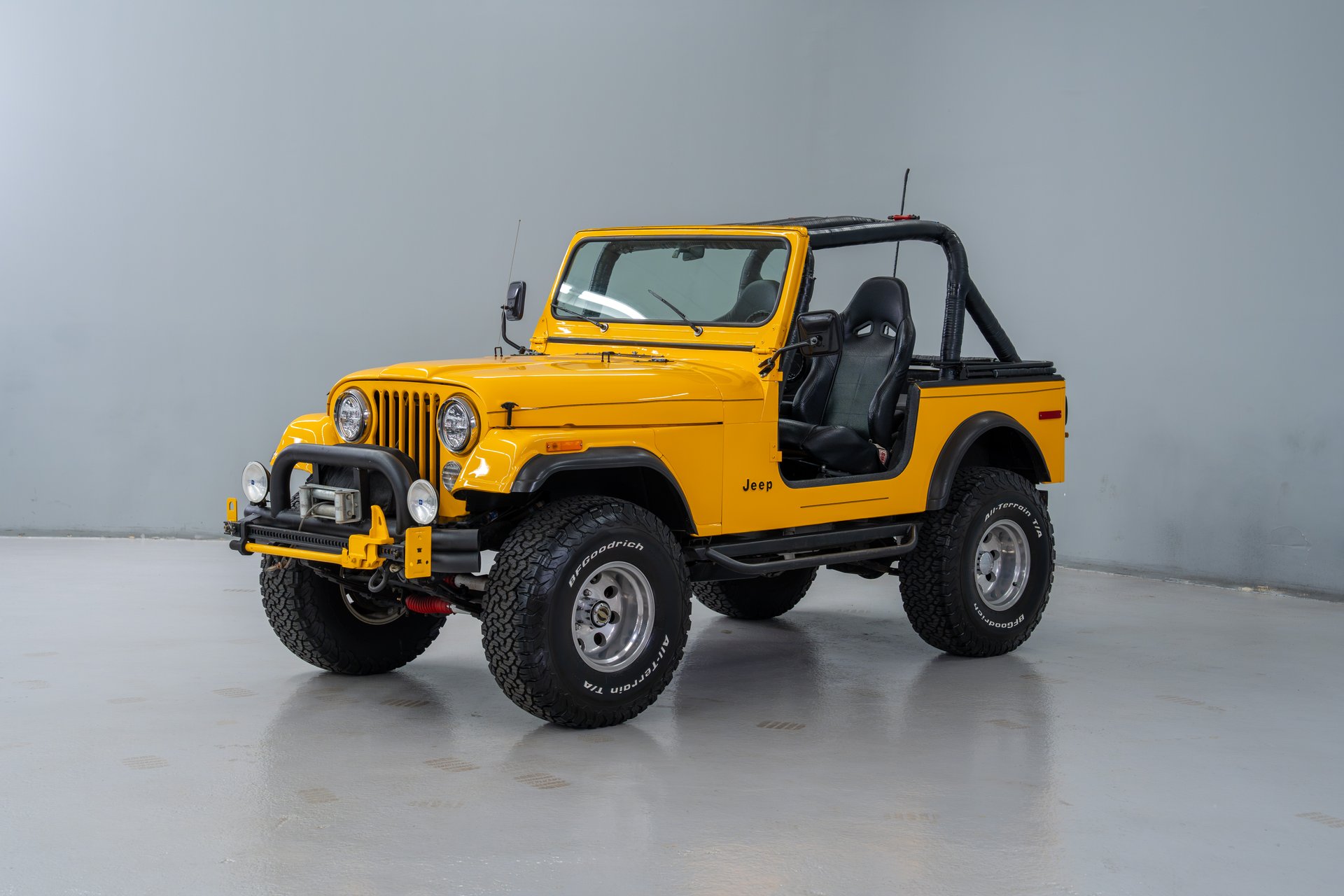
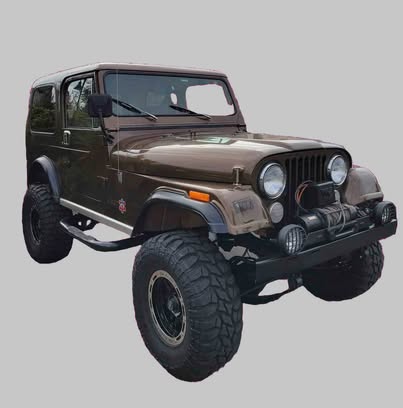
Finally, the modification audit, because the average CJ-7 is a palimpsest: lifts, lockers, winches, cages, engine swaps, carburettor swaps — a Weber or Motorcraft 2100 conversion on a six is a well-trodden, often excellent answer to a tired feedback BBD — each moving the car from factory specification towards its builder's judgement. You need not reject modified cars; this guide's own pool includes a yellow 1979 car on a lift with a winch bumper and aftermarket seats, and such cars can be the right trail buy. Price the work as the work it measurably is — receipts, brand names, weld quality, geometry — never as the sum of the seller's invoices, and remember every modification is also a subtraction: of originality, of the next buyer's market, and of your certainty about everything it touches.
How to inspect one
Inspect a CJ-7 in this order, cold, on flat ground, with permission to crawl, press, rock and remove mats. Identity and structure first — no engine ever redeemed a rotten frame — and the test drive last, when you know what you are driving.

- Identity before everything. Read the VIN plate and any door or firewall tags, and check the year they describe against the hardware in front of you: Dana 20 or Quadra-Trac before 1980, Dana 300 from 1980; V8 only 1976–81; wide-track axles from 1982. Measure the wheelbase — 93.3 inches between axle centres is a CJ-7; 83.5 is a CJ-5 and 103.5 is a CJ-8, whatever the badges say. A car whose numbers and hardware disagree is a conversion or a misdescription, and you proceed, if at all, at conversion money.
- The frame, lying down. Torch, hammer, screwdriver, in the order of the rust section: rear shackle hangers and frame horns first, then steering-box mount, skid-plate rails, outriggers and body mounts. Push hard at every suspect scab. Any structural give here reprices or ends the viewing, and no seller's surprise is your problem — this is where CJ-7s die.
- The tub. Lift the mats, press the floors, toe boards and rear floor, rock the roll bar and watch its feet, then shut each door slowly and read the gaps. Doors that need lifting to latch are reporting on the cowl, hinges and sills beneath them. Knock the tub panels and ask outright whether the tub is original steel.
- Cold engine, bonnet up. You want the engine stone cold — a warmed-up car at a viewing is a car whose cold start you were not meant to hear. Check oil level and condition, coolant colour, the valve cover for the late six's plastic-cover weep, and the general truth of the bay: original Carter or feedback hardware present, vacuum hoses connected, or capped stubs and a story.
- Start it and apply the idle test. A BBD car that stalls at idle but runs cleanly above it is showing you the clogged idle tubes from the problem areas — a carburettor job, not an engine job. Listen for the V8's cold exhaust-manifold tick, the six's lifter tick that should fade, and any knock under a blip that should end negotiations. Watch for blue smoke on start-up that clears (valve seals) versus smoke that stays (rings and bores).
- Gearbox and transfer case, stationary then moving. Every gear, including reverse, twice. Note which box you are actually shifting — SR4 or T-4/T-5 lightness versus T-176 substance — then select low range and confirm it engages, holds under load, and, on a Quadra-Trac car, that the glovebox emergency-drive switch and its vacuum system do something. Full-lock slow circles in a car park expose a binding Quadra-Trac centre differential and unhappy front joints.
- The rear hub check. On the AMC 20 axle, examine the rear hub nuts and their witness marks, rock each rear wheel for play, and ask directly when the hub nuts were last torqued and whether one-piece shafts are fitted. Fresh paint lines across nut and hub are a good sign; a seller who has never heard the question is information too.
- Steering, with a helper. Engine running, helper rocks the wheel through its free play while you watch tie-rod ends, drag link, box mount and shackles in turn, exactly as the steering section lays out. Play you can see at a joint is play you will pay to remove; a box rocking on its mount is a frame conversation, not an adjustment.
- Brakes, pedal first. Engine on, press and hold the pedal for thirty seconds — a pedal that sinks is failing the master cylinder test on the spot. Then check flex hoses for cracking, look for weeping rear cylinders, and confirm the handbrake holds both rear wheels, not one.
- The test drive, long enough to get everything hot. Twenty minutes minimum: low-speed wander, a hands-light test for pull under braking, full-lock work, a hill for cooling and fuel delivery, and motorway speed if the car and your nerve allow — many faults, from Quadra-Trac wind-up to marginal cooling, only report for duty at temperature.
- Electrics and equipment, all of it. Every gauge against reality, lights, wipers, heater fan, the lot, in daylight, because a CJ's electrical faults hide politely until night and rain. On a fibreglass-tub car, treat random ghosts as the grounding problem from the problem areas until proven otherwise.
- Paperwork and the modification ledger. Title against VIN, receipts against the modifications you have just inspected, and a straight question about what was removed — emissions equipment above all — and whether it comes with the car. Then decide what the car is: original, restored, converted or accumulated, and pay for that thing, not for the badge on the grille.
Values
A CJ-7's value is decided by structure, identity and specification, in that order, and the market block beneath this guide — cars listed now and recorded sales — is where you watch those forces turn into numbers. Read it as the trade does. First, split every listing by tub and frame truth before comparing anything else: an original steel tub on an unrepaired frame is a different commodity from a re-tubbed or frame-repaired car at the same asking figure, and the spread between a structurally honest car and a cosmetically shiny one is the widest single gap in this market, wider than between any two engines. A car that photographs beautifully and fails step two of the inspection is not a cheaper version of a good car; it is a different purchase with a welder in its future.
Second, understand the asking-versus-achieved gap, which runs in both directions by specification. Common cars — a tired six-cylinder automatic with needs in every system — are advertised hopefully, sell slowly, and their recorded results land well beneath the asks of comparable listings still sitting unsold: the listings page is a museum of prices sellers wanted, the sales record is prices buyers paid, and the distance between them is your negotiating room, documented. Desirable specifications behave oppositely: a genuine factory V8 car, a documented Jamboree, a complete Limited, a late car with the strong gearbox and an original tub are contested, their achieved figures hold close to optimistic asks, and waiting for one to soften mostly produces other people's purchase announcements. Know which side of that divide your target sits on before you offer.
Third, price the premiums correctly, because CJ-7 premiums attach to proof, not to words. The V8 premium belongs to cars whose block casting and VIN say 304 and whose year allows it; the Renegade and Laredo premiums belong to cars whose stripes, trim and dash equipment survive and agree; the Jamboree premium belongs to paperwork. A decal kit and a chrome grille are worth their retail price and an afternoon, and you should pay exactly that for them when they arrive without evidence. Modifications, symmetrically, are worth what the next buyer can verify: a receipted one-piece axle conversion, a quality lift with corrected geometry, a documented engine rebuild add real money to the right buyer and nothing to the wrong one, which is why modified cars show the wildest asking spreads in the listings — sellers pricing their invoices, buyers pricing their risk.
Finally, the project-versus-driver gap, which is where CJ-7 money is really made and lost. A project car is cheap because its costs are unbundled and unknown: structure, then driveline, then everything the driveline was hiding. Price a project by working backwards from the driver you could buy instead, subtracting honest worst-case figures for frame and tub work, and you will usually find the gap is smaller than the asking figures suggest — sometimes negative, when the project is a desirable specification whose bones justify the spend. Buy the project for its identity and bones, buy the driver for its verifiable present tense, and never pay driver money for a project because its paint photographs well. In this market, paint is the cheapest thing on the car.
Parts and ownership
Owning a CJ-7 is one of the easiest classic-car propositions in America, because the car sits at the centre of the largest four-wheel-drive aftermarket ever built. Almost everything mechanical is available new, used, rebuilt or upgraded: the six and 304 share service parts with the wider AMC world, kits for the Carter BBD and Motorcraft 2100 are shelf items, DuraSpark parts are cheap and everywhere, and the Dana 30, Dana 300 and TorqueFlite supply chains are effectively immortal. The Borg-Warner light gearboxes are the exception — SR4 parts and good used boxes are genuinely scarce, a running-cost argument for the T-176 cars no fuel saving will repay. Body and trim divide the same way: floors, panels, windshield frames, tops and seals are reproduced in depth and a replacement steel tub is a catalogue purchase, while Laredo and Limited trim, correct Renegade stripe kits and good original high-back seats are hunt-and-wait items you buy when you see them, not when you need them.
Running one is a commitment to short intervals and simple tools: oil and filter every 3,000 miles or so, grease at its many nipples on the same rhythm, AMC 20 hub-nut torque checks as a ritual, and driveline fluids — with Quadra-Trac's specific fluid non-negotiable — changed on time and inspected for what they reveal. None of it needs a specialist, and the factory manuals and wiring diagrams are all in circulation. What it punishes is deferral: a CJ run on the assumption that nothing needs touching between annual services will wear its shackle bushes, fret its rear hubs, clog its idle tubes and cook its marginal cooling in one season, then present the whole account at once.
The ownership experience is the point of the car, bought with open eyes. It is loud, slow by modern measure, thirsty as a six and greedier as a V8, draughty with any top and open to the sky with none — and it remains one of the most direct mechanical pleasures available at any price: low-range torque at walking pace, doors that come off with hand tools, a bonnet short enough to place the front wheels by eye. Insure it as the classic it now is, garage it if you can — every winter outside is a withdrawal from the frame and tub account — and budget a modest annual sum for hoses, bushes, seals and the next thing the last owner deferred. Bought on structure, a CJ-7 asks little and gives back a great deal. Bought on shine, it gives the same pleasures and sends the invoices to you.
Which one to buy
- The all-rounder: a 1982–86 258 six with the Tremec T-176 four-speed or a TorqueFlite automatic and the Dana 300 — wide-track axles, the strongest transfer case, the fullest parts support, and a car you can drive anywhere a CJ-7 was ever meant to go.
- The factory V8 buy: a 1976–81 304 car, ideally 1980–81 with the Dana 300 behind it, bought on a block casting you have personally read under the car — the sound and the torque are real, and so is the premium, so make the identity earn it.
- The value buy: an honest early six-cylinder car on narrow-track axles with a sound frame and a tired everything else — the market discounts what it cannot photograph, and the six's needs are the cheapest needs in this guide to fix.
- The trail buy: a modified car like the lifted 1979 in this guide's own pool, bought strictly on engineering — one-piece rear shafts, corrected steering, a cage mounted to structure — where the modifications are the specification and originality was never the point.
- The collector buy: a documented Jamboree, a complete Limited or an original-paint Renegade or Laredo with its trim and paperwork intact — the cars whose premiums live in proof, bought only when the proof is in your hand.
- The one to walk away from: any car, at any specification, whose rear frame horns, shackle hangers or body mounts fail the push test at a price that pretends they did not.
The overriding rule: buy the frame, the tub and the identity, in that order — engines rebuild, gearboxes swap and stripes peel, but a CJ-7 is its structure, and every dollar of value in the car stands on it.
See the 6 cj-7 cars currently listed.
For sale now
 $33,995 · 204% above typical
Expand
 $14,994
Expand
 $5,000
Expand
 $17,000
Expand
 Current bid $10,000
Expand
What they sell for: cj-7 sale prices.