
Mercedes-Benz 190 buyer's guide
Mercedes-Benz 190 -- the model's own buyer's guide: variants, values and what to check.
Years listed: 1984-1993 · Series: W201
Overview and history
The 190E 2.3 is the car that took Mercedes-Benz downmarket without taking it downhill — the volume petrol version, for North America, of the W201 "Baby Benz", the compact sedan that spent the best part of a decade in development and arrived determined to prove that a small Mercedes would be engineered exactly like a big one. The W201 was presented in December 1982, styled under Bruno Sacco, and it was a technical manifesto in a compact four-door body: a proper Mercedes safety cell with a front structure designed to deflect offset impacts, anti-dive and anti-squat suspension geometry, and a rear axle the industry had never seen — a five-link multilink design, patented by Mercedes, that located each rear wheel so precisely that the layout became the template for almost every rear-wheel-drive car that followed, including Mercedes' own E-Class and C-Class.
The 2.3 exists because of America. The launch cars were the carburettor 190 and the injected 190E, both 2.0-litre fours, and Mercedes judged — correctly — that a 122 hp 2.0 would not sell against American expectations in a car carrying a Mercedes price tag. So North America got a bigger four from the start: the 2.3-litre version of the same M102 engine family, sold here from the 1984 model year and, until September 1986, built as an export model for North America only. After that the 2.3 joined the wider range, and it bookends the W201's life: it was there at the US launch, and it was still there at the end, returning to the US line-up for 1991–93 as the sensible, lower-priced 190E after a two-year absence in which the six-cylinder 2.6 held the fort alone.
In total Mercedes built some 1.87 million W201s between 1982 and 1993, at Sindelfingen and Bremen, before the W202 C-Class replaced the car and inherited its role. The 2.3 was never the glamour model — that was the Cosworth-headed 2.3-16, the DTM homologation car. It is something more useful: the honest core of the range, the car bought by people who wanted the engineering without the theatre, and the W201 you are most likely to find today at money that still makes sense.
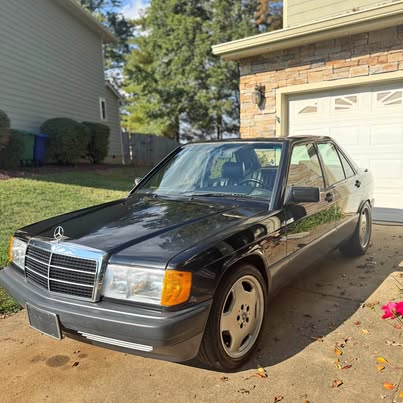
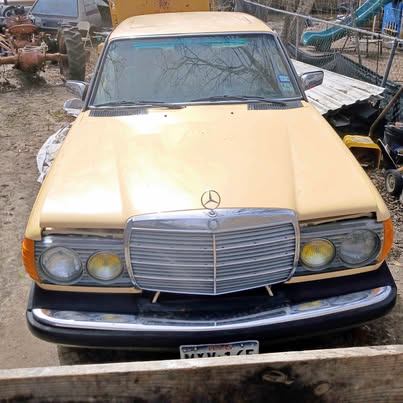
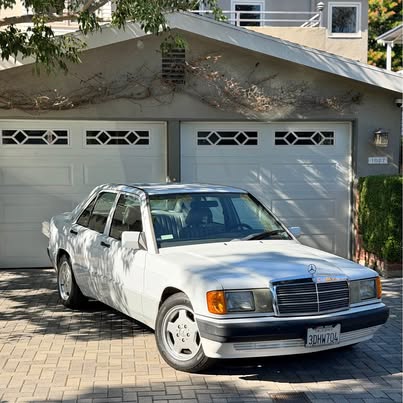
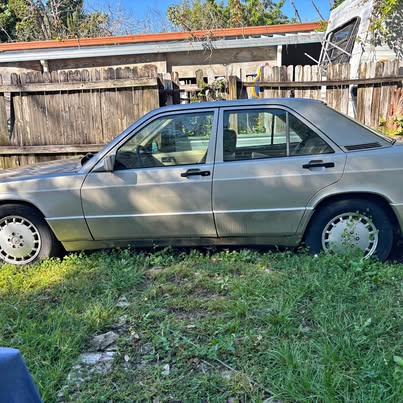
That shapes the market you are shopping in. We currently track seven 190E 2.3s for sale in the US, every one of them an automatic, every one offered through Facebook Marketplace, spanning 1983 to 1993 model years with three of the seven being 1992 cars. Treat that as a fair picture of the surviving stock: these were family cars and commuter cars, used properly and often run to high mileages, and the difference between a good one and a liability today is not the badge, the colour or even the mileage — it is whether the fuel injection, the timing chain and the rear suspension bushes have been looked after, and whether the shell has stayed solid at the jacking points. The good news is that a W201 hides very little: almost everything that goes wrong with a 190E 2.3 announces itself in a test drive, a cold start or a look underneath. That is what the rest of this guide is for.
The models
Every 190E 2.3 is a four-door sedan on the W201 shell — there was no estate, no coupé and no cabriolet version of any W201, whatever a listing claims. The badge arithmetic is simple once you know it: 190 alone means carburettors, 190E means petrol injection (E for Einspritzung), the number is the nominal engine size, and a D means diesel. The 2.3's own story falls into two chapters, early and late, and telling them apart matters because the engine, the chain drive and the trim all changed between them.
| Model | Years | Engine | Output | Built | Character |
|---|---|---|---|---|---|
| 190E 2.3 (early, US) | 1984–1986 | 2.3 four (M102.961), KE-Jetronic | 120 hp | not published separately | The launch US car; single-row timing chain, pre-facelift trim |
| 190E 2.3 (late) | 1987–1988, 1991–1993 | 2.3 four (M102.985), KE-Jetronic | 130 hp | not published separately | Stronger, better trimmed; the facelift cars from late 1988 are the pick |
| 190 (carburettor) | 1982–1984 | 2.0 four (M102), carburettor | 90 hp | 35,021 | The European base car; context only, not sold new in the US |
| 190E / 190E 2.0 | 1982–1993 | 2.0 four (M102), injection | 122 hp | 638,180 | The European core model; the 2.3 is its bigger US-market brother |
| 190E 2.6 | 1987–1993 | 2.6 six (M103), KE-Jetronic | 160 hp | not published separately | The smooth six; quicker and quieter, thirstier, tighter engine bay |
| 190E 2.3-16 | 1984–1988 | 2.3 four (M102.983), Cosworth 16v head | 167 hp (US) | about 19,500 | The homologation special — a different car and a different market |
| 190D 2.2 / 2.5 | 1984–1993 | Diesel fives and fours (OM601/OM602) | 72–93 hp | not published separately | The economy wing of the range; slow, frugal, very durable |
(Outputs are period figures: US net ratings for the US-market cars, DIN figures for the European context rows. Mercedes published production totals for some W201 variants but not a clean separate count for the US 2.3, so this guide does not invent one; the range as a whole totalled roughly 1.87 million cars.)
Early cars (1984–86), chassis 201.024, engine M102.961. The first US 2.3s are recognisable by their plainer trim: less lower-body cladding, simpler bumpers, and interiors a step plainer than the later cars. They are mechanically honest but carry the earliest version of everything this guide warns about — most importantly a single-row timing chain, covered in the problem section. None of that makes an early car a bad buy; it makes the inspection less forgiving.
Late cars (1987–88 and 1991–93), chassis 201.028, engine M102.985. The revised engine brought output to 130 hp with better manners, and the cars gained equipment steadily: anti-lock brakes and a driver's airbag became part of the US specification during this period, and trim and sound deadening improved. The big visual break is the facelift that reached production in autumn 1988 for the 1989 model year — deep lower-body cladding panels (the so-called Sacco panels) along the sills and doors, revised bumpers, and a tidier interior with better seats. A 1991–93 car is the most developed W201 of all, and the 2.3's return for those years was as the range's value model — which means late 2.3s were often bought by exactly the careful, long-term owners you hope to buy from. Desirable late options include the Sportline package offered on final-year US cars — lower, firmer suspension, quicker steering, wider wheels and sport seats — which turns the 2.3 into a genuinely entertaining car without the 16-valve's costs.
Identity: check the numbers, not the badge. A 2.3's VIN decodes its chassis: early cars carry the 201.024 code (the VIN's model block reads DA24), late cars 201.028 (DA28). The engine number is stamped on the block and begins 102.961 on an early car, 102.985 on a late one. Use both. Boot lids get swapped and badges get upgraded, and a car advertised as a 2.3-16 on the strength of a body kit is the oldest trick in this market: a real 16-valve has the Cosworth twin-cam head with its wide, finned cam cover, a dog-leg five-speed or an automatic, proper wheel-arch extensions and a chassis code of 201.034. A standard 2.3 wearing the kit is worth standard 2.3 money, and there is no shame in that — just do not pay the other car's price for it. Equally, a plain-looking car with a DA28 VIN, a 102.985 engine and a thick history file is exactly what it claims to be, and that is the car this guide is written for.
Engines and gearboxes
The M102 2.3: one cam, eight valves, no vices
The M102 is a thoroughly conventional engine, and that is its strength. An iron block carries a crossflow alloy cylinder head with a single chain-driven overhead camshaft operating two valves per cylinder through rocker arms, with hydraulic lash adjusters on the later engines that ended the ritual of manual valve-clearance adjustment. The 2.3 displaces 2,299 cc from a bore of 95.5 mm and a stroke of 80.25 mm — oversquare dimensions that let it rev more freely than its lazy character suggests. Compression is a modest 9.0:1, period Mercedes fuel recommendations called for premium unleaded, and nothing in its design is highly stressed: 130 hp from 2.3 litres is a gentle state of tune, which is why these engines, fed clean oil, routinely run past 200,000 miles with their bores and bearings still serviceable. On the road the late M102.985 makes its 130 hp at 5,100 rpm and 146 lb-ft of torque at 3,500 rpm, and the numbers describe it accurately: it is a torque engine, not a rev engine. It pulls cleanly and without drama from low speeds, does its best work between 2,500 and 4,500 rpm, and becomes vocal rather than eager above that. In an automatic car — and remember, every one of the seven cars we currently track is an automatic — it is a relaxed, slightly agricultural companion that suits the W201's grown-up character; a manual car feels a full class livelier, because you can keep the engine in its willing middle range. Judge a 2.3 against itself, not against the six: it should start instantly, idle evenly at around 750–800 rpm once warm, pull without hesitation or flat spots, and show no smoke beyond a possible faint puff on a cold start. Its real enemies are neglect items — the timing chain drive, the head gasket and the fuel system — covered as problem areas below.
KE-Jetronic: the system that prices the car
Every 190E 2.3 uses Bosch KE-Jetronic, which Mercedes called CIS-E. Understand it and you understand half of everything that goes wrong with these cars. It is not electronic fuel injection in the modern sense. At its heart it is the older K-Jetronic mechanical system: fuel is delivered continuously, not in pulses, and the quantity is metered mechanically. Air entering the engine lifts a sensor plate in the airflow meter; the plate's movement raises a plunger in the fuel distributor; the distributor splits the fuel evenly between the four injectors, which spray continuously whenever the engine runs. System pressure is high — around 5 bar and more — supplied by an electric pump mounted under the rear of the car alongside the filter and a pressure accumulator that holds residual pressure after switch-off to help hot restarting.
The "E" is an electronic trim layer laid over that mechanical base. An ECU reads the throttle position, coolant temperature, engine speed and the oxygen sensor, and drives the EHA — the electro-hydraulic actuator, a small unit bolted to the side of the fuel distributor — to nudge the metering richer or leaner moment by moment. Idle speed is handled separately by an idle air control valve, and cold starts by a fifth, cold-start injector in the manifold. The system's great virtue is that its mechanical core cannot suffer a total electronic death: a KE car with a failed ECU usually still runs, in a fixed default mixture. Its great vice is two systems' worth of ageing components, and faults that present as a family of overlapping symptoms — hard cold starting, hard hot starting, stalling at junctions, hunting idle, hesitation — that lazy diagnosis blames on whichever part is most expensive.
The components that actually fail, in roughly the order you will meet them: the OVP relay (overvoltage protection), a small relay with its own fuse on top, whose cracked solder joints starve the ECU and idle control of power and produce exactly the cold-start and stalling symptoms everyone blames on the fuel distributor — it is cheap, and it is the first thing to test. The fuel pump relay, which also drives the cold-start logic, and whose failure stops the car entirely or intermittently. The EHA itself, which seeps fuel from its body with age and drifts out of calibration; a fuel smell at the distributor is the tell, and a replacement is a few hundred dollars rather than a fortune. Vacuum leaks, the single most common cause of poor running on any KE car: the system meters fuel by measuring air, so air entering downstream of the sensor plate — through perished hoses, hardened injector seals, a split idle-valve hose — arrives unmetered and leans the mixture, worst at idle where the leak is proportionally largest. And stale fuel: a car that has sat for years varnishes the distributor's fine metering slits and sticks its plunger, and no adjustment cures that — it is a specialist rebuild, realistically $600–1,200 exchange, which is why a running, regularly used car is worth so much more than a sleeping one. The proper diagnostic instruments are a fuel pressure gauge set and the ECU's duty-cycle reading at the diagnostic socket; a mechanic who diagnoses KE-Jetronic by swapping parts is spending your money as tuition.
The other engines, in proportion
This guide is about the 2.3, but you will cross-shop the range, so here is the honest context. The European 2.0 is the same M102 in smaller form — sweeter, slower, and rare in the US. The 2.6 uses the M103 six, a close relative of the four with two more cylinders: 160 hp, a genuinely lovely engine note, seamless low-speed manners and the same KE-Jetronic strengths and weaknesses, in a tighter engine bay and with a greater thirst. The 2.3-16 shares only the block architecture and the badge numbers: its Cosworth twin-cam head, 167 hp in US trim, dog-leg Getrag option and body kit make it a sports sedan with sports-sedan parts prices, bought with its own guide, not this one. The diesels are the durability legends of the range and the slowest cars Mercedes sold in America. For the buyer who wants a W201 to use every day at sane running costs, the eight-valve 2.3 remains the rational centre of the range.
Gearboxes
Most US 2.3s — all seven in our current listings — carry Mercedes' own four-speed automatic, the 722.4. It is a compact, fully hydraulic box with a torque converter, and it suits the car: changes should be firm, prompt and consistent, with kickdown arriving without a long think. Two adjustments govern its behaviour and explain most complaints. Shift timing is set by a Bowden cable from the throttle linkage — a stretched or misadjusted cable makes the box change up absurdly early or hang on to gears, and owners condemn the gearbox for a cable adjustment. Shift firmness is set by a vacuum modulator on the side of the box; a split vacuum line or a failed modulator diaphragm gives harsh, thumping changes, and the part is cheap. A box that flares — revs rising between gears — or delays engaging drive or reverse from cold is a different matter: that is internal wear, and a specialist rebuild runs roughly $2,500–4,000. Fluid should be clean and red; dark, burnt-smelling fluid in a box that shifts badly is evidence, not just a service overdue.
The five-speed manual (the 717.4 family) is the driver's choice and the rare find in the US. It is a light, pleasant change when its linkage bushes are fresh and a vague, obstructive one when they are not — the bushes are pennies and an hour's labour, so a sloppy manual change is a negotiating point, not a verdict. Second-gear synchromesh is the first wear item, tested by a brisk change down into second on the test drive. Clutches are conventional and durable; judder usually means a worn driven plate or tired engine and gearbox mounts. The dog-leg Getrag box belongs to the 16-valve only; any standard 2.3 claiming one has a story to explain.
Problem areas
The W201 was a better-built car than the models it sat beneath, and a better-protected one too, so the problem list reads differently from an older Mercedes guide: rust matters, but it no longer dominates, and the money is more often spent on rubber, relays and the fuel system than on welding. That said, these cars are now thirty to forty years old, and everything made of rubber, plastic or solder in them is at or past its design life. Work through the car by system.
Rust: the map
A W201 shell starts from a stronger position than a W108 or W123 — better steel preparation, better cavity sealing, and a design that sheds water more intelligently. What kills them is not general rot but specific water traps, and the map is short enough to learn.
Jacking points and sills. The most important check on the car, as on any Mercedes of the era. The four jacking points are tubes set into the sills, covered by plastic plugs or flaps in the cladding, and they collect road filth and water. A rotted point takes its surrounding sill with it, and the repair is structural welding, realistically $800–2,000 a side done properly with the cladding off. The test is the one this series of guides uses on every Mercedes: with the seller's permission, put the car's own jack in each socket in turn and take the corner's weight. A sound point lifts silently; a rotten one creaks, flexes or crushes. On facelift cars, also run your fingers along the bottom edge of the Sacco panels and look for bubbling paint at their seams — honest protection on a sound car, a blindfold on a rotten one.
Wheel arches and the bottoms of the wings. The rear arch lips trap mud against a folded seam and bubble from inside; the front wings rot at their bottom rear corners, behind the front wheels, where spray is thrown into the joint with the sill. Neither is structural, both are visible in listing photographs if you look at the bottom six inches of the car instead of the shiny middle, and both are panel-and-paint money — until they are left to spread into the sill ends, at which point they join the structural list.
Door bottoms. The doors drain through slots in their bottom edges; the slots block, the doors hold water, and the bottom seam swells and splits from inside. Run a fingertip along the bottom edge of every door with it open: a door that is starting goes crusty along the seam while its outer skin still looks perfect in photographs.
Around the glass, and the floors it feeds. The windscreen and rear window seals harden and shrink, water finds the corners, and the classic Mercedes floor story follows: water runs down behind the trim and sits under the carpets and their thick foam backing, which holds it against the floor pan indefinitely. Lift the carpets in all four footwells and press the foam — a car can present a dry carpet top over a saturated pad and a scaling, rusting floor. The same water path rots the windscreen frame itself, which is a screen-out repair. Sunroof cars add their drains: blocked front drains overflow into the headlining and A-pillars, blocked rears into the boot sides.
Boot floor and spare wheel well. The rear window seal and the boot seal leak into the well, and the well is where the water stays. Lift the spare wheel — the pressing beneath it should be sound and painted, not scaled. Staining is a clean-and-seal afternoon; perforation is a panel repair, and it tells you the seal story has been running for years.
Battery tray and the front inner wings. The battery sits in the engine bay, and its tray rots from beneath the battery, invisibly, with the acid track running onto the inner wing below. Rock the battery and look at the tray edges with a torch. While you are there, look at the front spring seats and the inner-wing structure around them: surface corrosion is common and treatable, but perforation in the metal the front springs and dampers bear on is structural, specialist work.
Rear subframe mountings. The multilink axle hangs from a subframe bolted to the shell at four points, and the shell metal around those mountings is a known inspection point on an elderly W201. This is lift territory, not driveway territory — one of the two reasons, the jacking points being the other, that this guide insists on a lift inspection before money changes hands. Perforation here is the closest thing a W201 has to a terminal diagnosis.
Engine: chain, gasket and seals
The timing chain — the one date that matters. Early M102s in the 2.3 drive their camshaft with a single-row timing chain. Single-row chains stretch, and a stretched chain retards the valve timing, rattles at start-up while the tensioner takes up the slack, and in the worst case jumps or fails — and the M102 is an interference engine, so a failed chain means bent valves and a cylinder-head rebuild at minimum. Mercedes knew: the factory phased in a double-row chain during production, with the changeover on the US 2.3 engines (102.961/985) landing around the start of 1988, and issued service guidance that converting an earlier engine to the double-row set-up was not recommended — the fix for a worn single-row engine is a new notched single-row chain, with the tensioner inspected and renewed as needed. So: on any pre-1988 car, and on any car of any year without paperwork, the chain is a question that must be answered. Start-up rattle that lasts more than a second or two, a history of valvetrain noise, or a high mileage with no chain invoice all point the same way. A chain rolled in with tensioner and guides inspected is a few hundred dollars in parts and half a day's labour — budget $700–1,400 at a specialist — and it is cheap insurance priced against a head rebuild. On a car that has it documented, this whole paragraph becomes a non-issue, which is why the invoice is worth money.
Head gasket. The M102's gasket typically fails politely before it fails catastrophically: an external oil weep, classically at the rear of the head and down the back of the block, that coats the bellhousing and gets misdiagnosed as a rear main seal leak. Read it correctly — oil that starts high and runs down is the gasket or the cam cover; the rear main seal is blamed for both more often than it is guilty of either. The serious failure is the conventional one: overheating, coolant in the oil or oil in the coolant, pressurised hoses from cold. A head-gasket job with the head checked for flatness runs roughly $1,200–2,000 at an independent specialist; overheating history is what turns it into a warped-head conversation, so the temperature gauge's behaviour on the test drive is evidence, not trivia.
Valve stem seals and oil consumption. The classic M102 signature: a puff of blue smoke on start-up after the car has sat, and a bigger one when you pull away after a long idle or a long downhill overrun, clearing under way. That is oil running down the valve guides past hardened stem seals, not worn bores. The seals can be renewed with the head in place by a specialist with the right tools — a few hundred dollars — and the job transforms both the smoke and the oil consumption. Smoke under sustained load is the different, dearer diagnosis of rings and bores, and the inspection section's test separates the two.
The supporting cast. Front crankshaft and timing-cover seals weep with age; the cam cover gasket hardens and leaks onto the exhaust side; engine mounts collapse — the M102's mounts sag until the engine sits low and the whole car buzzes at idle, and a new pair makes a startling difference to refinement. The cooling system wants the same forensic look as any Mercedes of the period: the radiator's plastic end tanks and neck go brittle and crack, the viscous fan coupling loses its drive so the car runs hot in traffic but cool on the open road, and thermostats stick. A 2.3 that runs at a steady temperature in traffic, with a fan that roars when hot and a heater that blows properly hot, has passed a test that eliminates a whole family of bills.
Suspension, steering and driveline
Front ball joints — the safety item. The W201's front suspension is a damper-strut design with the coil spring seated separately between the lower arm and the body — a Mercedes variation on the MacPherson theme. The lower ball joint carries the corner's loads, is pressed into the lower arm, wears dry and, left long enough, can separate, which folds the wheel under the car. This is the one component on a W201 where wear is not a negotiating point but a safety verdict: any play, any knocking over bumps from the front corners, any history of the joint being "watched" means renewal before the car is driven in anger. A pair fitted with an alignment runs roughly $400–800. Strut top mounts crack their rubber and knock, lower-arm bushes soften and let the front wheels wander under braking, and anti-roll bar links perish — all ordinary, all budgetable, none ignorable in aggregate.
The multilink rear — five links, twenty bushes. The famous rear axle locates each wheel with five links, and every link runs in rubber bushes that were supple in 1990 and are not now. Worn rear bushes do not knock, usually; they steer. The symptoms are a rear end that feels loose and tardy over lane changes and in crosswinds, a car that needs constant small corrections on the motorway, uneven rear tyre wear on the inner edges, and a faint sense that the back of the car is making its own decisions half a second after the front. A full rear link and bush refresh — specialists often renew the set with the subframe mounts and the differential mount while access is good — runs roughly $800–1,800 in parts and labour depending on scope, and it is the single most transformative job you can do to a tired W201: it restores the exact quality the axle was famous for. A 2.3 that tracks arrow-straight and feels planted at speed has either low miles or a previous owner who spent this money, and either is good news.
Steering. Recirculating-ball steering box, as Mercedes used for decades: some free play at the straight-ahead is normal, excessive play is adjustment first and wear second, and a box that is stiff, notchy or leaking is a rebuild or exchange unit. The drag link, tie rods and idler-arm bushings produce most of the play blamed on the box; the idler bush kit is cheap and its renewal tightens the whole front end noticeably. Power steering pumps groan when low on fluid and leak from the front seal; hoses perish. All of it shows up in the test drive if you look for it.
Driveline. The propshaft runs through two rubber flex discs and a centre support bearing. The discs crack with age and heat — look for fraying around the bolt holes — and a failed disc is a violent event, so cracked discs are a renew-now item at modest cost. The centre bearing's rubber mount sags and lets the shaft thump on take-off. The differential should be silent; a whine that rises and falls with road speed, worst on a light throttle, is pinion bearing wear, liveable for a while and expensive eventually. Half-shaft boots split and throw their grease. On automatic cars the gearbox mount collapses with the engine mounts, and the powertrain's refinement goes with it.
Brakes. Discs front and rear, with anti-lock brakes on US cars of the later period — test the ABS on a quiet stretch of poor surface, because a car with a dead sensor or failed pump drives perfectly normally until the day you need it. Calipers seize on cars that have sat, hoses perish internally and act as one-way valves holding a brake on, and the handbrake is a small drum inside the rear disc hat with its own shoes and its own neglect. A full hydraulic refresh — calipers or seals, hoses, fluid, pads and discs as needed — is $800–1,800 at a shop and is the standard recommissioning bill on any stored car.
Electrics and climate
The W201's electrics are a generation simpler than what followed, and most faults are connections, relays and solder joints rather than modules. Start with the OVP relay from the engine section — its failing solder joints cause cold-start, idle and ABS faults simultaneously, because it powers the engine ECU and the ABS together, which is why an ABS light that comes and goes in company with rough running points at one small relay before anything else. The fuel pump relay and the idle control unit are the other solder-joint suspects. The ignition switch and steering lock deserve their own warning: the lock tumbler wears, the key begins to need a jiggle, and the day it will not turn at all, a small tumbler replacement becomes a drilling-and-grinding ordeal. Renew it while the key still turns; treat a stiff key as urgent, not charming.
Climate control on US cars is the push-button automatic system, and it fails in layers: the push-button unit itself (solder joints again), the vacuum pods that move the air flaps — the centre-vent and defrost pods are the usual casualties, and some are dashboard-deep in labour — the compressor and its relay, and the auxiliary electric fan and its resistor. Test every button, every vent position and the air conditioning on the viewing, in winter as in summer: a system that blows cold and switches vents correctly has been maintained, and one that does none of those things is several separate jobs wearing one disguise. Heater blower motors squeal and slow as their brushes and bearings age; on the W201 the blower is reached from the engine-bay side of the bulkhead, which keeps the labour sane by Mercedes standards.
The rest of the electrics are period-standard: electric window regulators and their console switches (the switches collect coffee and fail one window at a time; regulators wear their lifting arms), sunroof cables and motors, central locking run by a vacuum pump in the boot that fails or leaks at the door actuators, instrument-cluster bulbs and the VDO odometer whose drive gears crumble with age — a stopped odometer is common, is repairable, and means the mileage on any car so afflicted is a claim, not a fact. A car on which everything electrical works — windows, locking, roof, cruise and all — is a car that has been used and maintained, and that correlation is worth money.
Interior and trim
The W201 cabin is the part of the car that most often sells it, because Mercedes built it to an old-school standard: deep, supportive seats, clear instruments, switchgear that still clicks with intent at thirty years old. The standard US trim is MB-Tex vinyl, which wears so well that tidy examples routinely look half their age; leather was the option and ages the usual way, cracking on the driver's bolster first. Under either covering, the seat pads and spring frames tire: a driver's seat that lets you feel its frame, lists on a broken spring, or shows the greenish dust of disintegrating pad material underneath is a retrim-or-repad bill, roughly $300–600 a seat for pads and labour before covering material. Dashboards crack across the top in sun-state cars — a replacement dash is a big, fiddly job, so a crack-free dash on a Texas or Florida car is a genuine asset — and door cards warp at their tops, headliners sag at the rear, and the zebrano wood on the console (where fitted) crazes at its edges. None of it stops the car; all of it is visible in photographs; and a truly good original interior is the hardest part of the car to recreate at any price, so weight it accordingly.
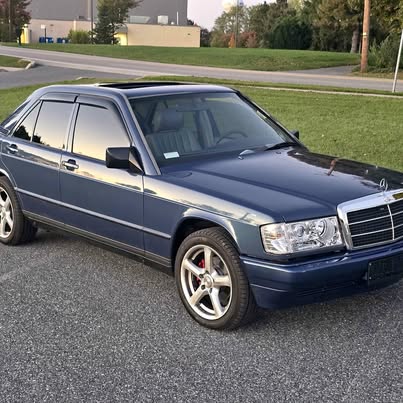
How to inspect one
Allow an hour, bring a torch, a cloth-wrapped magnet and a friend to work the controls while you watch the car. Insist on a cold engine — a 190E that has been warmed up before you arrive is a car whose cold-start behaviour, the single most informative event in a KE-Jetronic car's life, is being hidden from you. If the car passes you, pay for a lift inspection before money changes hands; the jacking points and rear subframe mountings can only be judged properly from underneath.
- Start with the paperwork and the numbers. Match the title VIN to the plate and the stamping. Decode it: DA24 in the model block is an early 201.024 car, DA28 a late 201.028. Check the engine number begins 102.961 (early) or 102.985 (late). Then read the history file looking for four invoices above all others: timing chain, head gasket, rear suspension bushes, and fuel-system work. Each one present is money you will not spend; each one absent on a high-mileage car is a question the rest of the inspection must answer.
- Cold start. From fully cold, the engine should start within a couple of seconds of cranking, flare briefly to a fast idle and settle as it warms. Long cranking, a start that needs throttle, stalling in the first minute, or a hunting idle all point into the KE-Jetronic family — OVP relay, idle valve, vacuum leaks, cold-start injector — in roughly that order of cost. A rattle from the front of the engine for the first second is the chain tensioner filling; a rattle that persists is the chain section's warning made audible. Walk to the exhaust: blue smoke now, after the car has sat, is valve stem seals; white vapour that clears is condensation and nothing.
- Warm idle and the gauges. Warm, the idle should sit steady around 750–800 rpm, in gear as well as in neutral on an automatic. Watch the temperature gauge settle and stay — it should sit rock-steady in traffic with the fan cutting in audibly when hot. Oil pressure should be strong at speed and may fall at a hot idle, which is normal; pressure that is low everywhere, with a noisy top end, is not. Switch everything electrical on at once — lights, blower, rear window heater, air conditioning — and watch the idle hold: the idle control system should compensate without drama.
- Under the bonnet. Look for the fuel smell and weeping at the EHA on the fuel distributor, perished vacuum hoses (squeeze them; they should be supple, not crunchy), oil weeping from the rear of the cam cover and head joint, and the state of the belts and coolant hoses. Pull the dipstick: mayonnaise-fouled oil ends the viewing's optimism. Check the coolant — it should be coolant-coloured, not rust-brown or oily. Look down at the battery tray edges and the inner wings with the torch, as the rust section describes.
- The sill and jack test. Crouch and work along both sills and all four jacking points, pressing hard, looking behind the facelift cladding's lower edge where you can. With the seller's permission, jack each corner on the car's own jack in its socket. Creaking, flexing or crushing is structural rot, and structural rot on a car at this value is a walk-away or a price that assumes welding — there is no third option.
- Floors, boot and glass seals. Lift all four carpets and press the foam backing beneath: dry is right, damp means the glass-seal water path is active and the floor needs prodding, not just drying. In the boot, lift the spare wheel and inspect the well. Run a fingertip along the windscreen and rear window seals and along the bottom edge of every open door, feeling for the bubbling that starts door rot.
- Front suspension and steering, stationary. With the engine running, rock the steering wheel: free play should be modest and even, without notchiness. Bounce each front corner and listen for ball-joint and top-mount knocks; then, with the car on the lift later or a helper rocking the wheel, any play in a lower ball joint is a renew-before-driving verdict, as the problem section explains. Check the front tyres for the shoulder wear that betrays tired lower-arm bushes.
- The test drive: gearbox first. Fifteen minutes minimum, town and highway. The automatic should engage drive and reverse promptly, without a long pause or a thump; changes should be firm and consistently timed, kickdown should arrive on demand, and there should be no flare — no rise in revs — between gears. Note when it changes as well as how: absurdly early or late changes are the Bowden cable, harsh thumps are the vacuum modulator, and both are cheap; flare and delay are neither. In a manual, test second-gear synchromesh with a brisk downchange and feel for linkage slop.
- The test drive: engine and smoke. Accelerate hard through the gears from low speed: the engine should pull cleanly with no hesitation or flat spot — hesitation on a KE car is fuel system or ignition, never "character". Then find a long gentle downhill or a long idle at a light followed by a brisk pull-away, and have your friend watch the exhaust, or watch the mirror: a puff of blue at that moment is stem seals (budgetable); smoke that continues under load is rings (a different negotiation entirely).
- The test drive: chassis. On the highway the car should track straight, hands-light, with no rear-end looseness in lane changes or crosswinds — the multilink test from the problem section. Brake firmly from speed: straight, no judder, no pull. Find a poor surface and brake gently to confirm the ABS wakes up on a car that has it. Listen over broken pavement for front-end knocks and driveline thumps on and off the throttle, which point to flex discs, centre bearing and mounts.
- Heat, air conditioning and every switch. Whatever the season, run the climate system through everything: full heat, full cold, every vent position, every fan speed, air conditioning on and off. Work every window, the sunroof if fitted, the central locking, mirrors, cruise control, washers and wipers, and turn the ignition key slowly and deliberately several times — a key that needs a jiggle is the steering-lock warning from the electrics section, and it is urgent, not quaint.
- Interior last, from the driver's seat. Sit in the driver's seat and feel for frame through the pad and for a list to one side. Check the dash top for cracks, the door cards at their tops, the headliner at the rear, and the odometer: if it is stopped, the mileage is a claim, and pricing should rest on condition alone. A sound, original, crack-free interior is the hardest part of this car to replace — let it count in the car's favour as heavily as the problem section says.
Values
Read this model's market through the listings and recorded-sales figures that follow this guide, because with the 190E 2.3 the numbers only make sense once you understand what drives the spread — and the spread, on this model, is most of the story. This was a mass-market Mercedes bought in large numbers, used as everyday transport, and in many cases run until the maintenance stopped being worth more than the car. The result, decades on, is a market in two completely different parts that happen to share a badge.
At the top sit the kept cars: late facelift examples, 1991–93 especially, with continuous history, the chain and injection work documented, sound jacking points, a crack-free dash and an interior that still looks like the brochure. These cars sell on condition and paperwork, and hold their value because the supply of genuinely good W201s shrinks every year while the car's reputation — the over-engineered Baby Benz — keeps growing. A Sportline-equipped late car, a genuine low-mileage car, or a manual-gearbox car (rare in the US, and sought after precisely because the automatic suits the car's pace but not every driver's taste) each carries a real premium over an equivalent automatic, justified by scarcity rather than fashion.
At the bottom sit the projects: cars with needs in several systems at once, and here the arithmetic is brutal and worth learning before you bid. A cheap 2.3 that needs a timing chain, a set of rear bushes, ball joints, a fuel-distributor rebuild and sill welding is not a bargain version of the good car — it is the good car's price paid in instalments to specialists, plus your time, plus the risk, ending with a car worth no more than the sorted one you could have bought. The gap between project money and driver money on this model is narrower than the cost of closing it, which is the single most important sentence in this section. Buy the project only if you do your own work and enjoy it — the 2.3 is one of the most home-mechanic-friendly Mercedes ever made — and buy it as a hobby, priced as a hobby.
Between those poles, the honest drivers — sound shells, working injection, cosmetic wear, mileages well into six figures — are where most transactions happen, and they are priced by condition and history, not by mileage or model year alone. A high-mileage car with a fat history file is worth more than a lower-mileage car with none, because on this model the file is the condition: it proves the chain, the gasket and the bushes have been done. Asking prices and achieved prices diverge in the usual way for cars sold largely through informal channels — our current tracked sample of seven cars comes entirely from Facebook Marketplace, all automatics, which is typical of how these cars trade — so treat any single asking price as an opening position, and recorded sales as the firmer evidence. The 16-valve's halo, finally, does not transfer: a standard 2.3 is not "the next 2.3-16" and not an investment car, and anyone selling it as one is selling you a story. Buy it because it is a good car. On the evidence of the last forty years, that has always been reason enough.
Parts and ownership
The 2.3 sits in the sweet spot of Mercedes parts support: new enough and numerous enough that the supply chain still works, old enough that everything about it can be understood and fixed without a laptop. Mercedes built the M102 family in the millions across the W201, W124 and other ranges, and the W201 shares a long list of components with the W124 E-Class, which keeps both the factory Classic programme and the aftermarket interested.
Easy: service items, filters, plugs, ignition components, brake discs, pads, calipers and hoses, suspension wear parts including ball joints, links and bush kits, flex discs, engine and gearbox mounts, water pumps, thermostats, radiators, exhaust systems in standard form, glass rubbers and seals, window regulators, and the relays — OVP, fuel pump — that cause so much drama for so little money. Order today, fit this weekend, at prices that will pleasantly surprise anyone coming from a rarer classic.
Harder and dearer: the KE-Jetronic fuel distributor (specialist rebuild rather than new), the EHA and idle control components in known-good order, climate-control vacuum pods and push-button units (repairable by specialists, dashboard-deep in labour for some pods), crack-free dashboards and good door cards and seat covers in the right colours, facelift cladding and trim in unmarked condition, steering boxes in tight order, and differential rebuilds. None of it is unobtainable; all of it rewards buying the car that does not need it.
Running costs. A sorted 190E 2.3 is a realistic everyday classic: fuel consumption in the mid-to-high twenties per gallon on a run, less in town; servicing that any competent independent Mercedes specialist can handle; and an engine and gearbox that do not punish regular use. The budget line that catches new owners is the first year of catching up. On a running, driving 2.3 with deferred maintenance, plan on a four-figure sum in the first year to bring servicing, rubber, brakes and the small electrical faults up to standard before you improve anything, and materially more if the car has slept for years and needs the fuel system cleaned end to end and all fluids and perished rubber renewed. Ethanol in modern fuel is unkind to the KE system's rubber components and to cars that sit; a 2.3 in regular use, on fresh fuel, is a happier car than a garaged one. Insurance sits in line with other classics of similar value, and the car's size and manners make it one of the few classics in this programme that genuinely works as a household's second — or only — car.
Which one to buy
- The all-rounder: a 1991–93 facelift 190E 2.3, automatic, with history. The most developed version of the car, built at the end of an eleven-year production run, in the specification most US buyers actually want. Find one with the chain, bushes and injection documented and you have bought the W201 experience with the shortest problem list.
- The value buy: a sound 1987–88 car. The revised engine and the double-row chain era without the facelift premium. Less cladding to hide behind — which, on a genuinely sound car, works in your favour at inspection time, because everything is on display.
- The driver's car: any year with the five-speed manual. Rare in the US and worth seeking out: the manual transforms the 2.3's pace and involvement. Judge it on synchromesh and linkage bushes, and expect to wait for the right car.
- The enthusiast's pick: a late Sportline car. Lower, firmer, quicker-steering and genuinely entertaining, without the 16-valve's parts prices or fragility. Verify the package from the car's data rather than the seller's description.
- The project, bought knowingly: an early 1984–86 car, cheap, solid in the shell. Everything else on an early car is fixable at prices you can plan; the shell is the one thing that must be right. Budget the single-row chain question into the purchase on day one.
- The one to walk away from: any car, any year, with rotten jacking points or rear subframe mountings and a seller who will not let you jack it or lift it. The refusal is the inspection result.
And the rule that overrides all of the above: buy the car with the history file and the solid shell, in the specification you can live with. On a 190E 2.3 the mechanicals are honest, well understood and fixable at sane prices — it is the undocumented car with structural rust that turns this most sensible of Mercedes into an expensive one.
See the 10 190 cars currently listed.
For sale now
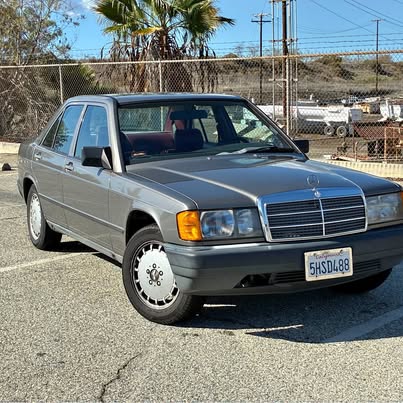 $7,800
Expand
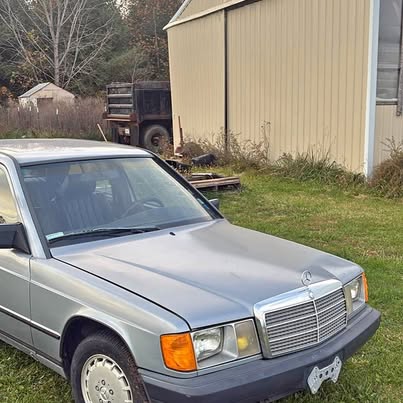 $12,345
Expand
What they sell for: 190 sale prices.