
Mercedes-Benz 280SE buyer's guide
Mercedes-Benz 280SE -- the model's own buyer's guide: variants, values and what to check.
Years listed: 1967-1984 · Series: W108
Overview and history
The 280SE is not one car. It is one engine wearing two very different bodies, and almost everything you need to know as a buyer flows from understanding which of the two you are standing in front of. The engine is the M130, a 2,778 cc overhead-cam straight six fed by a Bosch mechanical fuel-injection pump, and it is the last and best-developed of Mercedes' post-war sixes. The bodies are the W108 sedan — the big, upright four-door that carries the S-Class idea in its original form — and the W111 coupé and cabriolet, the low, pillarless two-doors that Paul Bracq drew at the start of the 1960s and that Sindelfingen still builds largely by hand at the end of them.
The name arrives late in 1967, as a model-year 1968 car in most markets. In the sedan range it replaces the 250SE at the top of the six-cylinder line: same W108 shell that has been in production since 1965, but with the enlarged engine, standard power steering on most markets, and a specification that puts it one step below the V8 cars and one clear step above everything with carburettors. In the coupé and cabriolet range it does the same job, replacing the 250SE two-doors and giving the ageing W111 body a final, fully sorted engine for its last four years of production. Sedan production runs to 1972, when the W116 S-Class replaces the W108 outright. The six-cylinder coupé and cabriolet end earlier, in May 1971, because the new SL and SLC take over the two-door flagship role.
One badge warning before anything else, because it settles arguments at kerbside: the 280SE 3.5 is a different car — a coupé or cabriolet with the M116 V8, covered in its own guide — so a "3.5" badge on a car with a six-cylinder engine under the bonnet means a badge has been swapped, not a discovery made, and the engine number, which starts 130 on every car in this guide, settles the question in seconds.
What the M130 gives you, in either body, is the definitive version of the classic Mercedes six: mechanically injected, so it starts cleanly, pulls from low revs without the carburettor flat spots of the 280S, and holds a steady tune far longer than twin carburettors ever do. It is not a fast car by modern measure, but it is a genuinely rapid one by the measure of 1968 — a sedan that cruises at speeds its contemporaries reach only in bursts, in near-silence, with the steering, brakes and structure to match. The sedan is the rational classic: roomy, comparatively numerous, comparatively affordable to keep. The coupé and cabriolet are the emotional ones: the same mechanical package wrapped in one of the most elegant production bodies of the twentieth century, built in small numbers, and priced accordingly ever since.
Most survivors you meet for sale are North American cars, because America takes the bulk of production of both bodies and because dry-state American cars survive where European cars rust away. That shapes the market you shop in: automatic gearboxes dominate, air conditioning is common on sedans, and European-specification cars — manual gearboxes, single-piece glass headlamps, no side markers — are the exception you will occasionally be lucky enough to find. It also shapes the faults you will meet, because the youngest 280SE is now well past fifty years old, and time attacks rubber, leather, injection seals and steel in that order of visibility but the reverse order of cost. Read the problem areas before you fall for the paint.
Hold the two bodies apart in your mind by their designers' intent, because it predicts how they age. The sedan is a working flagship: every panel is a pressing, every part is shared with a production line that builds tens of thousands of cars, and its dignity is the dignity of a well-made tool. The coupé and cabriolet are coachbuilt in spirit long after the word leaves the brochure — panels finished by hand, seams lead-loaded, interiors trimmed like furniture — which is why they cost so much more new, why they cost so much more now, and why their repair bills follow the same ratio. Neither is the better car. They are the same mechanical idea at two different levels of ceremony, and this guide treats them as equals with different maps.
The models
Four variants carry the 280SE name on the M130 engine, and a fifth car — the carburetted 280S — is constantly confused with them in listings, so learn the whole family before you shop.
| Model | Years | Engine | Output | Built | Character |
|---|---|---|---|---|---|
| 280SE sedan (W108) | 1967–1972 | M130.980, 2.8 injected six | 160 hp | ~91,000 | The mainstream car: upright four-door saloon, the full-size Mercedes in its purest six-cylinder form |
| 280SEL sedan (W108) | 1968–1972 | M130.980, 2.8 injected six | 160 hp | ~8,250 | Long-wheelbase sedan, 100 mm extra in the rear doors; rarer, plusher, mechanically identical |
| 280SE coupé (W111) | 1967–1971 | M130.980, 2.8 injected six | 160 hp | ~3,800 | Pillarless two-door, hand-finished, wood and leather everywhere; the connoisseur's car |
| 280SE cabriolet (W111) | 1967–1971 | M130.980, 2.8 injected six | 160 hp | ~1,390 | The same car with a manual folding top; the rarest and most valuable of the four |
| 280S sedan (W108) | 1967–1972 | M130.920, 2.8 carburetted six | 140 hp | ~94,000 | Not an SE at all: twin Zenith carburettors instead of injection; listed as a 280SE often enough that you must check |
The table teaches the first lesson: production volume and value run in opposite directions. Mercedes builds roughly ninety thousand 280SE sedans and fewer than fourteen hundred cabriolets, and the market has priced that ratio, plus the cabriolet's looks, ever since. The second lesson is the 280S trap. The S and SE are the same shell and near-identical trim, the badges differ by one letter, and sellers — innocently and otherwise — describe carburetted cars as SEs. The distinction is mechanical, not cosmetic: open the bonnet and look for the injection pump, a finned aluminium unit mounted low on the left side of the engine with six steel pipes leaving its top for the injectors. No pump, no SE, whatever the boot badge says. The engine number confirms it: 130.980 is the injected engine, 130.920 the carburetted one.
Telling the two chassis apart is easier, and you should be able to do it from the listing photographs alone. The W108 is a four-door sedan with a conventional B-pillar, a tall grille flanked by vertical headlamp units, and a boot separate from the cabin. The W111 two-doors have two long doors, no B-pillar at all — wind every window down and the side of the car is one open sweep of glass — and a lower, wider grille on the later cars. The cabriolet adds the folded top under a tonneau behind the rear seat. Where photographs leave doubt, the chassis number settles it absolutely: it is stamped into the body and repeated on the data plate, and it begins 108 on the sedan, 111 on the coupé and cabriolet. Check that number against the title paperwork on any car you are serious about; a mismatch is a walk-away event, not a negotiating point.
Within the sedan run, the changes are detail rather than substance. Early cars carry the cleaner pre-1970 detailing; American cars gain side marker lights and sealed-beam headlamps in place of the European single-piece glass units; a long-wheelbase SEL is identifiable by its visibly longer rear doors and the extra chrome on the C-pillar. A small number of US-market sedans are also badged 280SE 4.5 in the final years — those are V8 cars, a separate model outside this guide's scope, and the eight-cylinder engine under the bonnet identifies them instantly. On the coupé and cabriolet, the significant divide is early versus late grille and trim treatment, and the steady migration of options — electric windows, air conditioning, leather — from the options list into near-standard fitment on American cars. None of these divides matters as much as condition. A documented, rust-free sedan beats a shiny coupé with filler in its sills every day of the week, and the sections that follow exist to teach you to tell the difference.

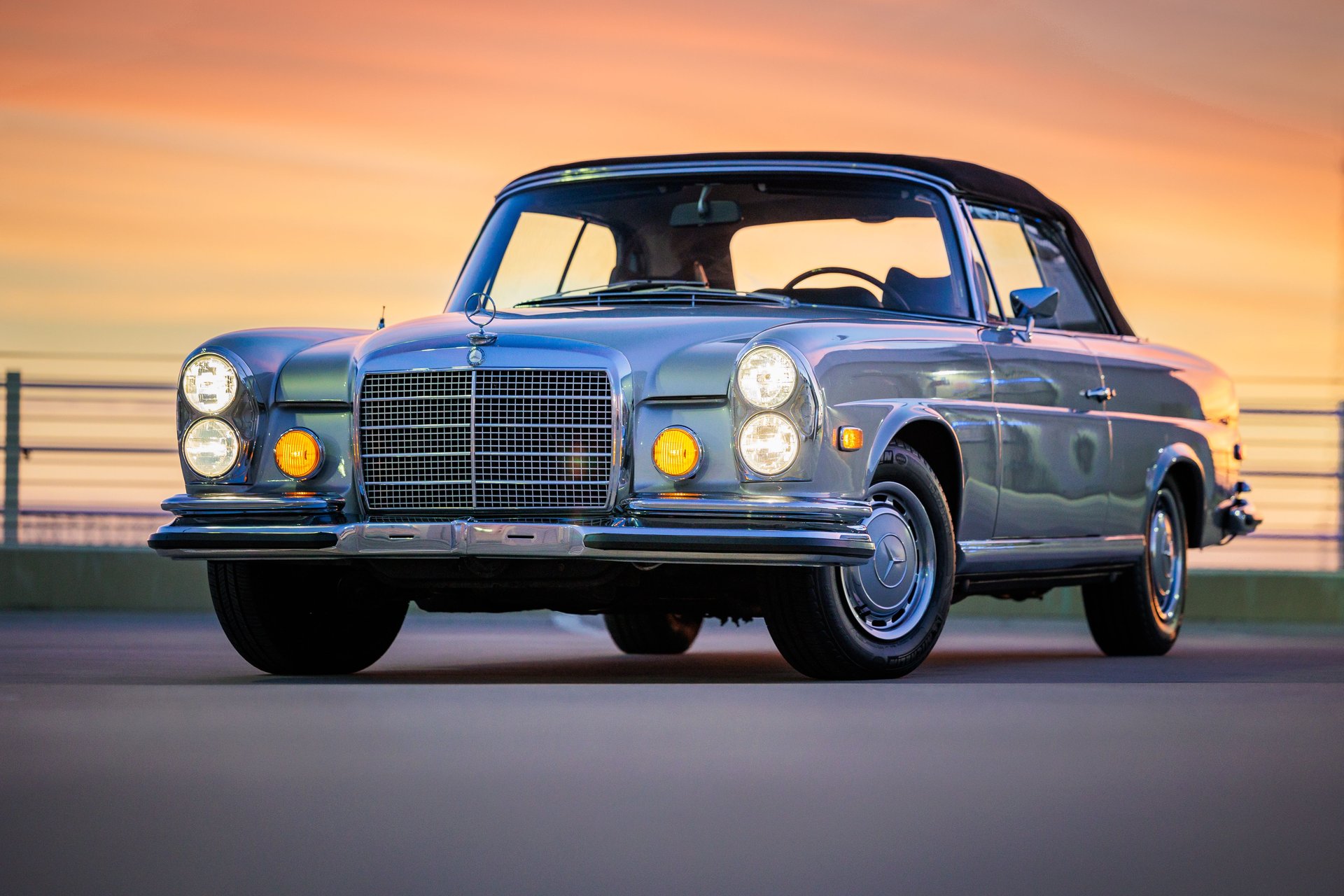
Use a photograph like this one the way an inspector uses the car itself. The W108's lines are honest: the shoulder crease runs unbroken from headlamp to tail lamp, the wheel arches sit concentric with the wheels, and the door gaps stay even along their whole length. A car whose crease ripples, whose rear wheel sits forward in its arch, or whose doors need a slam has usually been repaired or is sagging on tired subframe mounts — both covered in the problem areas. On a sedan listing, this view is also where you check the brightwork: the 280SE carries chrome around the windows and along the waistline, and missing or pitted trim here is expensive to replace piece by piece, however good the paint looks.
Engines and gearboxes
The M130 six
The M130 is a development of the M129 that powers the 250SE, enlarged by bore and stroke to 86.5 × 78.8 mm and 2,778 cc. The architecture is the classic Mercedes six: a cast-iron block with seven main bearings, an aluminium cylinder head, and a single overhead camshaft driven by a duplex chain, working the valves through rocker arms with threaded adjusters. In injected form — engine code M130.980 — it produces 160 hp at 5,500 rpm and 240 Nm of torque at 4,250 rpm, on a 9.5:1 compression ratio. Those numbers make the 280SE sedan a 118 mph car that reaches 60 mph in a little over ten seconds, but the figures undersell it. What you notice on the road is the spread of the torque and the cleanliness of the delivery: the car pulls from 2,000 rpm in top gear without protest, and it holds motorway speeds at a relaxed, unstressed gait that smaller-engined contemporaries cannot imitate.
It is a durable engine with three characteristics you need to understand. First, the valve clearances are mechanical and they drift. Adjustment is by threaded adjuster at each rocker, it wants checking roughly every 10,000–12,000 miles, and a neglected engine announces itself with a top-end rattle at idle that disappears as the revs rise. Budget a valve service into the first year of any car without recent paperwork, and treat a silent, freshly adjusted top end as a good sign about the previous owner. Second, the valve stem seals harden with age and heat. The classic symptom is a puff of blue smoke on start-up after the car has sat, and a bigger cloud when you lift off at speed and then accelerate again — oil drawn down the inlet guides under vacuum. It is an oil-consumption and embarrassment fault, not an engine-out fault: seals can be renewed with the head in place by a competent workshop, typically $600–1,200 in labour and parts, and many engines run for years in this state. Distinguish it from bore wear by the pattern — worn rings smoke under acceleration load, worn seals smoke on the overrun and at start-up. Third, the timing chain and its tensioner wear slowly and announce themselves honestly, with a brief rattle on cold start that lengthens as wear grows. A rattle that persists beyond the first seconds, or that you can hear at a hot idle, means chain, rails and tensioner are due; done in time it is a workshop job in the $900–1,600 range, and it protects an engine that is otherwise very hard to kill.
Oil pressure is your dashboard health gauge, and the M130 gives you a proper mechanical instrument. A healthy engine pegs the needle at 3 bar once the revs rise above fast idle and holds a clear reading at hot idle. A low hot-idle reading with a quiet engine is as often a tired sender as a tired engine — verify with a master gauge before you condemn bearings. Oil consumption of up to a litre per thousand miles is within period tolerance on a used engine; more than that, with clean start-up behaviour, points to rings. The bottom end itself — crank, bearings, oil pump — rarely gives trouble at any mileage you will encounter, and a full rebuild, when it finally comes, is a $6,000–10,000 specialist job that the sedan's value seldom justifies and the coupé's sometimes does. Buy the engine that does not need it.
Cooling deserves a paragraph here because it interacts with everything. The system is conventional — belt-driven water pump, viscous fan coupling, a large crossflow radiator — and it is marginal only when neglected. The viscous coupling is the silent failure: it should resist being spun by hand when hot and roar briefly on a hot start. A coupling that freewheels lets the car idle happily and overheat in traffic on the first warm day. The test costs nothing and the part, while not cheap, is a bolt-on. Radiators silt up over decades; a recore runs $500–900 and transforms a car that "always runs hot." Treat any 280SE that genuinely overheats as a car with a known, priceable list of causes — coupling, radiator, thermostat, water pump, head gasket in that order of probability — and test your way down it rather than accepting the seller's theory.

A first-year car like this one is where you practise the identity checks the models section teaches, because early production is where specification drift and later engine swaps hide most easily. The car in the photograph should carry the M130.980 and nothing else: verify the engine number before you admire anything else, then look at the details that date it — the lamp units, the trim treatment, the badging — and ask whether they agree with a 1967 build or tell a story of later parts fitted over decades. On any 280SE, agreement between the data card, the chassis number and the visible specification is worth money. Disagreement is not automatically fraud — fifty years of ownership changes things — but it is always a question the seller answers before you pay, not after.
The Bosch mechanical injection
This is the system that defines the car, frightens the uninitiated, and rewards the buyer who understands it — because a sorted M130 injection is superb and a neglected one is the single most expensive thing on the car to put right.
The pump is a Bosch six-plunger in-line unit, one pumping element per cylinder, driven from the engine at half crankshaft speed. Inside it, a three-dimensional "space cam" translates throttle position and engine speed into plunger stroke, so fuelling follows a mapped surface rather than a simple linkage. Around that core sit the correction devices, and it is the correction devices, not the pump core, that cause nearly all the trouble you will meet. A warm-up thermostat — an expansion element washed by engine coolant — holds the mixture rich when the engine is cold and leans it progressively as the coolant warms. A barometric capsule trims fuelling for altitude and air pressure. A starting magnet gives extra fuel for cranking, worked with an auxiliary air path so a cold engine idles up instead of stalling. Feed the pump from the back of the car: an electric fuel pump at the tank pushes fuel forward at modest pressure through a filter, with a return line carrying the surplus back, and the injection pump meters from that supply. The injectors themselves are simple spring-loaded poppet valves in the inlet ports; they open on pump pressure and atomise, they do not time anything.
Now the failure modes, with the tests that separate them. The commonest is an engine that runs rich when warm: blackened plugs, sooty exhaust, fuel smell, poor economy. The usual cause is the warm-up thermostat stuck in its cold position, holding cold enrichment on a hot engine — the pump is doing exactly what it is told. The test is to watch the warm-up device's linkage travel as the engine warms from cold; no travel, or a device that stays at full enrichment with the coolant at full temperature, convicts it. The second classic is fuel in the pump's own oil. The pump carries its own oil supply, separate from the engine's, with a small dipstick or level plug, and it wants that oil checked and changed with the engine oil. Smell the dipstick. If the oil is thin and reeks of petrol, fuel is passing the plunger seals inside the pump, and that is a specialist rebuild — $2,000–3,500 from one of the handful of workshops that still overhaul these pumps properly, including calibration on a bench. There is no cheap substitute and no adjustment that fixes it; price the car accordingly. Third, hard starting when hot. The system should hold residual pressure; leaking injector seals, a tired feed pump or perished lines let pressure fall, vapour forms in the hot lines, and the engine cranks long before it catches. A fuel-pressure and leak-down test at the feed line distinguishes supply faults from pump faults in half an hour, and it should be the first test on any car with a starting complaint, before anyone touches the pump. Fourth, uneven running — one or two cylinders off song. Work in order: compression first, because injection cannot fix a mechanical fault; then spark; then have the injectors pop-tested and cleaned, a $300–600 service for the set; only then suspect individual pump elements.
Two disciplines protect you. Never let anyone "adjust" the pump who cannot bench-calibrate it: the external adjustments interact, the space cam wears in ways that mimic maladjustment, and a pump fiddled into running worse is a core charge waiting to happen. And keep the fuel clean and the car used. These systems tolerate unleaded fuel well — the pump's enemies are dirt, corrosion from standing, and dried seals after long storage, which is why a regularly driven 120,000-mile car is a better injection risk than a stored 60,000-mile one. A car that has sat for years wants its tank, lines, feed pump and filter gone through before first start, a $400–900 recommissioning exercise that prevents the debris of a decade reaching the one component you cannot afford to feed it to.
Gearboxes: the K4A 025 automatic and the four-speed manual
Most 280SEs you meet, and nearly every American sedan, carry the K4A 025 four-speed automatic. Understand what it is and its behaviour stops worrying you. It couples the engine to the gearbox through a fluid coupling, not a torque converter, so there is no converter multiplication off the line; in D it normally starts in second gear and takes first only on kickdown or a full-throttle start, which makes it feel leisurely away from rest and is entirely normal. Shifts are firm by modern standards — a well-set-up K4A 025 changes with a definite, clean engagement, and the change quality is governed by a control-pressure rod from the throttle linkage. That rod is the first thing to check on a car that flares between gears or shifts at the wrong speeds, because any engine work that disturbs the linkage disturbs the gearbox, and correct adjustment by the book transforms cars that sellers describe as "needing a gearbox." Selector layout is P-R-N-D-3-2, on the column in most sedans and on the floor in most coupés and cabriolets. Delayed engagement of reverse, heavy flaring under load, or fluid that is brown and burnt-smelling on the dipstick are the genuine wear warnings; a fluid and filter service — these gearboxes want fresh ATF on a roughly 20,000-mile rhythm — is cheap insurance at $250–450, and a full rebuild by a Mercedes specialist runs $2,500–4,500, which is real money but a known quantity.
The four-speed manual is the enthusiast's gearbox and the rarer find, especially in America. It is a fully synchronised Mercedes unit, worked by a column change in sedans — which goes vague as its linkage bushes wear, and is transformed by a $150 bushing kit and patience — or by a floor lever in the two-door cars and in sedans ordered with it. There is no fifth gear and no overdrive; the car is geared for the autobahn, and at motorway speed the engine is turning briskly by modern standards, which it does without complaint. Clutch action is hydraulic, the clutch itself is conventional and long-lived, and the gearbox is strong: whine in the indirect gears and jumping out of gear on the overrun are the wear signs, and both are uncommon. If you want a manual 280SE, expect to shop European-specification cars and to pay a premium for the privilege in a coupé, where the combination is the most sought-after specification of all. In a sedan, the manual is rarer than it is valuable — buy it because you want to drive it, not as an investment thesis.
Behind either gearbox sits the low-pivot swing axle, Mercedes' signature rear suspension of the era, with a horizontal compensating spring above the differential to control camber change. Its quirks belong to the suspension section below; here, note only that the final drive is a separate unit that whines when worn, leaks from its pinion seal when neglected, and wants its oil changed on the same schedule as the gearbox — a $40 job that sellers' service histories routinely omit.
Problem areas
Rust: two different maps
Every 280SE is old enough to have rusted, and the only real question is whether the rust you find is cosmetic or structural. Learn the two maps separately, because the sedan and the two-door cars share a floor structure but rot in different places and at very different repair costs.
On the W108 sedan, start at the sills, because they are structural and because everything else is secondary until they are proven. The sill is a box section that carries the jacking points, and it rusts from the inside out, fed by blocked drain holes and by water that enters at the front from the wheel arch. The sill-jack test is the classic: the car's own jack lifts it by the sill points, and a sound sill takes the car's weight without creaking, cracking or visible flex at the door gaps. Do it on both sides. A seller who will not let you is telling you something. From the sills, work through the sedan map in order: the floor pans, especially the front footwells, where a leaking windscreen seal or a perished heater intake sends water under the carpets for years; the front inner wings and the battery tray, attacked by acid and road spray together; the tops of the front wings behind the headlamps, where mud packs into a shelf you cannot see from outside until the paint bubbles; the lower rear wings behind the rear wheels; the boot floor and spare-wheel well, which collect every leak the boot seal allows; and the door bottoms, where the skin folds over a frame that traps water. Front subframe mounts deserve a look while you are underneath, because the rubber-and-steel mountings corrode and collapse, and their failure mimics suspension wear. Sedan panels are comparatively available, and the standard repair figures apply: professional sill replacement runs $1,000–2,500 per side, floor sections less, which is why a rusty sedan is a negotiation rather than an automatic rejection — as long as the rust is confined to panels a welder can reach.
The W111 coupé and cabriolet share the sedan's floor and sill structure — and then add problems of their own, at prices that reflect hand-built bodies and scarce panels. The sills matter even more here, because the two-door shell has less inherent stiffness to spare, and on the cabriolet the sills are reinforced precisely because there is no roof: deep sill rust on a cabriolet is a structural event, not a panel repair, and it is the single most expensive sentence in this guide to ignore. Add these to the map: the long doors, whose bottoms rot along the fold and whose sheer weight makes tired hinges drop them onto their catches; the rear quarters around the wheel arch, where the decorative chrome arch trims trap mud against the steel for decades; the coupé's roof gutters and C-pillar seams, lead-loaded at the factory and bubbly when corrosion gets under the lead; the cabriolet's hood well and the boot floor beneath it, which live damp by design; and the scuttle and windscreen frame on open cars, where a screen-out repair is the only honest cure. Coupé and cabriolet wings, quarters and doors are scarce and expensive when they exist at all, and skilled repair of what is there is the norm — budget half as much again as sedan money for equivalent metalwork, and treat evidence of filler in a sill or quarter, found with a magnet and a tap, as a price-cutting discovery.
On both bodies, remember that bright paint is the rust's best disguise and originality its best revealer. A car in tired original paint with solid sills is a better buy than a freshly painted car of unknown history, because fresh paint over fresh filler is the oldest trick in this market — and fresh underseal underneath, applied over rust, is the second oldest.
Two water paths feed both maps and deserve their own mention. The windscreen and rear-window seals harden and shrink, and once they leak they deliver water silently into the front footwells and the rear parcel-shelf area respectively — which is why a car can have rotten floors under perfect carpets, and why lifting the carpets is a step in the inspection, not an impertinence. Cars fitted with the steel sliding sunroof add four drain tubes, one at each corner of the roof cassette; the fronts drain down the A-posts, the rears down the C-pillars, and a blocked or perished tube rots the pillar it runs inside, invisibly, until the paint blisters at its base. If a sunroof car shows any blistering at a pillar base, assume the tube and the pillar need a conversation with a welder, and check that the roof itself slides, seals and sits flush — a cassette repair is dashboard-and-headliner work, priced like the heater work described below.

Read a side view like this as a rust report. The sill line below the doors should be straight and unbroken, with the jacking-point covers sitting flush; bubbling along the bottom of the doors or a wavy sill edge means the box section is working from inside. The front wheel arch tells the headlamp-shelf story: paint bubbles at the top rear of the arch are the first visible sign of the mud trap behind the lamp. At the rear, look where the arch meets the sill — the two worst sedan rot spots join there. On a coupé or cabriolet listing, apply the same reading, then look harder at the door bottoms and the rear arch trims, for the reasons the rust section gives.
Suspension, steering, brakes and the swing axle
The front suspension is a double-wishbone layout with kingpins, and the kingpins define its maintenance: they are grease points, they want grease roughly every 3,000 miles, and an owner who greases them owns a front end that lasts indefinitely, while an owner who does not owns one that wears its kingpin bushes oval and wanders. The test is to jack the car under the lower arm so the suspension stays loaded, then rock the wheel top and bottom; movement with a clunk is kingpin or wheel bearing wear, and you separate the two by having a helper press the brake — movement that disappears is bearing, movement that stays is kingpin. Kingpin overhaul is a specialist press job, $800–1,500 a side with the associated bushes, and it is the commonest big front-end bill. The front subframe that carries it all sits on rubber mountings that perish and collapse with age; a car that clunks over bumps, will not hold its alignment, or shows the engine sitting oddly low between the wings usually needs subframe mounts, $400–800 fitted, and drives transformed afterwards. Ball joints, tie rods and the steering idler wear conventionally and cheaply by comparison.
Steering is recirculating-ball, with power assistance standard on most 280SEs and near-universal on American cars. Some free play at the wheel centre is inherent to the design; excessive play is wear in the box or the linkage, and you separate them by watching the drop arm while a helper rocks the wheel — play before the arm moves is in the box, play after it is in the joints. Boxes can be adjusted within limits and rebuilt when beyond them, $600–1,200 exchange. A car that steers heavily at parking speed with the fluid full and the belt tight usually has a tired pump. None of this is exotic; all of it is detectable in ten minutes on a test drive, which is why the inspection section makes you do one properly.
At the rear, the swing axle's service items are its rubber boots, the compensating spring, and the differential mountings. The axle half-shafts run in boots that split with age and throw their oil out; look for oil flung around the rear of the floor and renew boots before the joints run dry. The compensating spring — the horizontal coil spring above the differential — sags and occasionally breaks, leaving the rear sitting low with excessive negative camber; stand behind the car and look at the rear wheels' stance, because a 280SE should sit level with only slight negative camber. Brakes are dual-circuit discs all round with a servo, advanced for the period and effective now. The age faults are seized rear calipers, perished flexible hoses, and handbrake shoes — the handbrake works on small drums inside the rear discs — that have worn or been contaminated. A car that pulls under braking, or whose pedal sinks slowly at a standstill, wants hydraulic work before it wants anything else; budget $800–1,800 for a full hydraulic refresh of calipers, hoses and master cylinder on a car that has sat.
Interior, trim, electrics and the cabriolet top
Interiors decide how a 280SE feels, and the two bodies differ in what they cost you. Sedans come in MB-Tex vinyl, which is nearly indestructible and usually needs cleaning rather than restoration, or in leather, which dries, cracks on the driver's bolster, and costs $3,000–5,000 to retrim properly. Coupés and cabriolets are leather and real wood veneer as a matter of course, and both materials age expensively: crazed or lifted veneer is a specialist refinishing job, and the coupé's full-width wood dashboard is a significant part of what you are paying for, so grade it honestly. On every car, sit in the seats and then look under them. The seat pads are rubberised fibre over springs, the fibre crumbles with age, and a seat that feels like a hammock plus a drift of brown dust under it means pads and possibly spring work, $300–700 per seat done properly. Headliners sag and stain; dashboards crack on sun-baked American cars, and a correct replacement pad is far harder to source than a cracked one is to find.
The heater is the interior's notorious trap. Ventilation and heating are worked by dashboard levers driving cables and flaps, the plastic levers snap with age, and the blower motor lives buried behind the dashboard where access is measured in hours. A car with snapped levers and a dead blower is not a car with a small fault: full heater-box and blower work is one of the most labour-heavy jobs on a W108, $1,500–3,000 at a specialist, and it matters in any climate where you will drive the car in winter or need the screen demisted. Test every lever's travel and every blower speed on inspection. American sedans frequently carry under-dash air conditioning, dealer- or factory-fitted with a York-type compressor: assume any non-working system needs $1,000–2,500 to revive properly, and check that the seller's "just needs a charge" is not standing in for a seized compressor and perished hoses.
Electrics are simple and mostly robust, with one systemic quirk: the ceramic torpedo fuses corrode at their contact ends and cause intermittent faults that owners chase for months. Half the electrical gremlins on any newly bought 280SE are cured by removing every fuse, cleaning its contacts, and refitting — twenty minutes, no parts. Beyond that: alternator brushes and regulators wear conventionally; electric windows on the two-door cars slow down as their mechanisms gum up and respond to cleaning and lubrication before they need motors; the Becker radios are desirable and repairable; and the clock is broken on nearly every car and is a rite of passage, not a bargaining chip. The cabriolet's top is a manual frame — no hydraulics to fail — covered in canvas that costs $2,500–4,500 to replace fitted, with a rear window that yellows and splits; check the frame for bent bows and the well it folds into for the rust described earlier, and always see the top raised and latched, not just folded away in the photographs.
How to inspect one
Inspect in this order, because it puts the cheapest checks first and the walk-away faults earliest. Allow two hours, insist on a cold engine, and take a magnet, a torch and a friend.

This is the moment the photographs end and the inspection begins, and the discipline is to work the checklist in order rather than wander round the car admiring it. Everything you can see in a listing photograph — paint, chrome, stance, gaps — you re-verify in person, because the camera forgives what the magnet does not. The stance check comes free at this distance: the car should sit level, rear wheels near-vertical, front wheels straight ahead matching the steering wheel's centre. A car that sits down at the back or leans is already telling you about compensating springs and subframe mounts before you have opened a door.
- Paperwork and identity first. Match the chassis number on the car — stamped in the body, repeated on the data plate — against the title, and confirm the prefix: 108 for a sedan, 111 for a coupé or cabriolet. Read the engine number and confirm it starts 130.980. A carburetted 130.920 in a car sold as an SE, or numbers that do not match the documents, ends the inspection here.
- Cold start, bonnet up. From stone cold, the injected engine should start promptly on the starting enrichment, idle fast briefly, and settle as it warms. Watch the exhaust: a brief blue puff is the valve-seal signature from the engine section; continuous blue smoke under load later is rings. Black smoke that persists hot is the warm-up thermostat fault from the injection section. Note the oil-pressure needle: pegged at 3 bar as revs rise is healthy.
- The sill-jack test. From the rust section: lift the car on its own jack at both sill points, both sides, watching the door gaps. Creasing, cracking or gap movement means sill structure work, priced there. On a cabriolet, treat any sill weakness as structural and reprice the whole car.
- The rust walk. Torch and magnet, in the rust section's order: footwells under the carpets, boot floor and spare-wheel well, front inner wings and battery tray, wing tops behind the headlamps, rear arches, door bottoms. On coupés add roof gutters and C-pillar seams; on cabriolets, the hood well. Fresh underseal counts as a finding, not a reassurance.
- Injection health. With the engine fully warm, check idle quality and plug colour if you can pull one plug. Smell the injection pump's oil on its dipstick: petrol-thin oil means the pump rebuild priced in the injection section. Ask when the feed pump, filter and tank were last touched, and be suspicious of any car that has sat for years and been started "just to show it runs."
- Kingpins and front end. Jack under the lower arm, rock each front wheel top and bottom, then repeat with a helper on the brake pedal to separate bearing play from kingpin play, as the suspension section describes. Then look up at the subframe mounts for collapse and perishing.
- Steering play. Helper rocking the wheel, you watching the drop arm: play before the arm moves is the box, play after is linkage. Check the power-steering fluid and listen for pump groan at full lock.
- Rear stance and axle. Stand behind the car: level ride height, slight negative camber only. Look under for split axle boots, oil fling, a sagging or broken compensating spring, and pinion-seal leakage at the differential nose.
- The test drive — gearbox. In an automatic, confirm the K4A 025's normal behaviour: second-gear start in D, first on kickdown, firm clean shifts, no flare, prompt reverse. Wrong shift speeds point first at the control-pressure rod, as the gearbox section explains. In a manual, work every gear under load and on the overrun, and judge the column change's vagueness against worn bushes rather than the box itself.
- The test drive — brakes, cooling and smoke. Firm, straight stops from speed; a sinking pedal at the next set of lights is hydraulic work. Watch the temperature gauge in traffic afterwards and listen for the viscous fan. On a trailing throttle downhill, then back on the power, watch your friend's mirror view for the blue cloud that confirms stem seals.
- Interior systems, every switch. All heater levers through their travel, every blower speed — remember the heater section's labour warning. Windows up and down, especially the long coupé glasses. Lights, wipers, horn, Becker radio. If air conditioning is fitted, run it for a full five minutes and demand cold air at the vents, not a promise.
- The top, on a cabriolet; the boot and tools, on everything. Raise and latch the hood yourself, check frame bows and the well beneath, and price canvas by its real condition. Then lift the boot carpet and spare: the well's condition closes the rust story you started at step 4, and a car that has passed steps 1 to 11 with its faults priced is a car you can buy with your eyes open.
Values
Read this model's market as two markets sharing a badge, because the sedan and the two-door cars obey different economics. The sedan is a plentiful, usable classic whose value is set by condition and by little else: the spread between a rusty project and a sorted, documented driver is enormous, wider than the spread between model years or specifications, because the cost of moving a bad sedan up the scale — sills, injection, interior — so easily exceeds what the finished car returns. The coupé and cabriolet are scarcity goods. Their values are set first by body style, cabriolet above coupé, then by the same condition logic, but with the arithmetic inverted: a two-door car's restoration can be justified by its finished value, which is exactly why so many of them have been restored, and why genuinely original, unrestored two-doors now command a premium of their own.
Within either market, the premiums are predictable. A manual gearbox adds money to a coupé and interest rather than money to a sedan. European specification — the glass headlamps, the cleaner bumpers, the manual box — is prized in America precisely because it is rare there. Matching numbers and a data card that agrees with the car matter more each year, because the M130's interchangeability with the carburetted engine makes undocumented swaps a real feature of this market; the 280S wearing SE badges, covered in the models section, is the standing example. Air conditioning adds value to a sedan only when it demonstrably works. Fresh paint adds less than sellers think and should add less than you pay, for the rust reasons already covered.
On asking versus achieved prices, expect the familiar pattern of this corner of the market: dealer and classified asking prices for sedans sit optimistically above what auctions achieve for comparable cars, and the gap closes only when the seller meets reality. Auction results are the honest evidence — a deep pool of sold cars changes hands in public — but read them by condition, not by headline: the same model name covers the project and the concours car, and the distance between those results is the condition spread, not market confusion. Colour and specification move individual results more than the guides to the market admit: the period palette's strong colours and a well-judged interior combination draw bidders in a way that a respray in a fashionable modern shade does not, because originality of specification is read — correctly — as a proxy for an undisturbed car. A data card that confirms the car still wears its delivered colours and trim is a document with cash value, and a colour-changed car should be priced as what it is, however well the work was done. The project-versus-driver gap is the number that matters to you as a buyer. On a sedan, price a project as a shell plus parts and assume the gap to a driver is real money you will spend; on a coupé or cabriolet, a complete, rust-free project can be the rational route into a car whose finished examples have run away from you. Negotiate from the inspection, not from the advertisement: every fault in the problem sections carries a workshop price, and a seller presented with the sill figure, the pump figure and the heater figure, itemised, is negotiating against arithmetic rather than opinion.
Parts and ownership
A 280SE is one of the better-supported classics of its era, for a structural reason: Mercedes keeps its old cars alive through the Classic Center and a deep aftermarket, and the M130 engine is shared with the 280SL Pagoda, which guarantees a level of specialist attention most engines never get. Mechanical consumables — filters, ignition parts, brake components, suspension bushes, water pumps, clutch parts — are available off the shelf at prices close to modern-car money. Injection components are the exception that proves the rule: pumps and injectors are serviced by exchange and by the small number of specialists who rebuild them, not bought new, and a known-good spare pump is a genuinely valuable thing to acquire with a car.
Body and trim supply follows the production numbers in the models table. Sedan repair panels, seals and glass are reproduced or still findable; coupé and cabriolet panels are the scarce end of the catalogue, and good used panels and brightwork change hands at prices that make careful storage of your own trim a financial activity. Chrome is a budget line of its own on the two-door cars, which carry so much of it: rechroming a full set of coupé brightwork is a four-figure decision, and it is priced into good cars. Rubber — window seals, door seals, suspension bushes, axle boots — is comprehensively available and comprehensively necessary, because a fifty-year-old 280SE on original rubber leaks water, air and oil in proportion. Budget a rolling programme rather than a single spend.
Running one is straightforward in the ways that matter. The service rhythm is period Mercedes: engine oil and filter at 3,000–5,000-mile intervals by modern habit, kingpin grease at roughly 3,000 miles as the suspension section insists, valve clearances every 10,000–12,000, gearbox and final-drive oils on their own schedule, and the injection pump's oil checked and changed with the engine's. Tyres are 185 R14 or the modern 205/70 R14 equivalent, widely available in suitable ratings. Fuel consumption sits in the high teens to low twenties per gallon depending on gearbox and use, and the car runs happily on modern unleaded premium, with the caveat that fuel-system rubber of unknown age should be renewed once and then forgotten. Insurance, club support and workshop knowledge are all easy: the model sits inside the best-documented corner of the Mercedes world, with workshop literature, a data-card service from the manufacturer that decodes your car's build specification from its chassis number, and an owner community that has solved every problem in this guide in public. None of that makes the car cheap to restore. All of it makes the car cheap to keep, which is a different and better thing.

A 1970 sedan like this one is the ownership sweet spot the parts section describes: late enough to carry the run's accumulated detail improvements, early enough to predate the final emissions-era complications, and supported by the full depth of the W108 parts trade. When you assess one, spend your attention where this view cannot help you — under the sills, inside the boot well, at the pump's dipstick — because the visible car is the easy part. The 280SE's ownership bargain is that everything invisible is either cheap and available, or expensive and knowable in advance. There is no third category, and that is rarer in a fifty-year-old car than any option on the data card.
Which one to buy
- The all-rounder: a W108 280SE sedan with the K4A 025 automatic. The full experience — the engine, the ride, the presence — in the body with the deepest parts supply and the most cars to choose from. Buy the best-documented, rust-free example you can find and drive it everywhere.
- The value buy: a sound 280SEL. The long-wheelbase sedan is rarer than the standard car, mechanically identical, and habitually underpriced against it because buyers overlook the badge. The extra rear legroom is free; the rarity may not always be.
- The enthusiast's car: a manual-gearbox coupé, European specification if you can find it. The combination of the pillarless body, the floor change and the M130's delivery is the most involving 280SE there is, and the market knows it — expect to pay for the privilege and to wait for the car.
- The collector: the cabriolet. The rarest variant, the most valuable, and the one where originality and documentation move the price most. Buy the car with the file of paperwork and the honest top, and have the sills inspected by someone who has done it before.
- The project buyer: a complete, rust-free sedan that fails on mechanics. Injection, kingpins, heater and hydraulics are all priceable and fixable; completeness and a sound shell are not. The reverse car — shiny, mechanical, rotten — is the one to leave.
The overriding rule: buy the body, not the badge, the paint or the story — on a 280SE every mechanical fault has a known price, but a rotten shell is the one fault that never pays, so the best car is always the most rust-free car your budget reaches, in whichever of the four variants that happens to be.
See the 66 280SE cars currently listed.
For sale now
 $149,500
Expand
What they sell for: 280SE sale prices.