
Mercedes-Benz S-Class buyer's guide
Mercedes-Benz S-Class -- the model's own buyer's guide: variants, values and what to check.
Years listed: 1973-1973 · Series: W108
# Mercedes-Benz 280SEL (W108) — Buyer's Guide
Overview and history
The 280SEL is the quiet connoisseur's version of the W108, the Paul Bracq-styled flagship saloon Mercedes-Benz launched in 1965 with the 250S and 250SE. In November 1967 the range was renewed around a single new six-cylinder engine, the 2,778 cc M130, and the line settled into the 280S (carburettors, standard wheelbase) and the 280SE (fuel injection, standard wheelbase). In January 1968 a third car joined them. The 280SEL takes the 2,850 mm wheelbase of the plutocratic W109 300SEL — 100 mm, almost exactly four inches, longer than the standard shell — but keeps the W108's steel coil springs, its simpler trim and its chassis code. That is the whole idea: the long body and the legroom, without the air suspension and running costs of the W109.
Everything the extra length buys sits behind the front seats. Dash, engine bay and boot are standard W108; the rear doors are longer, the rear bench sits in a deeper footwell, and a rear passenger can cross a leg without negotiating with the front seat back. If you carry adults in the back, or you simply prefer the proportions — the long car looks lower and more formal, because the extra metal sits in the middle of the silhouette — the SEL is the one to have. Mercedes-Benz clearly expected it to be a niche: just 8,250 six-cylinder 280SELs were built between January 1968 and April 1971, against 91,051 examples of the standard-wheelbase 280SE. The long shell then passed to the V8s, the 280SEL 3.5 and the North-American 280SEL 4.5, before the W116 S-Class replaced the whole family in 1972.
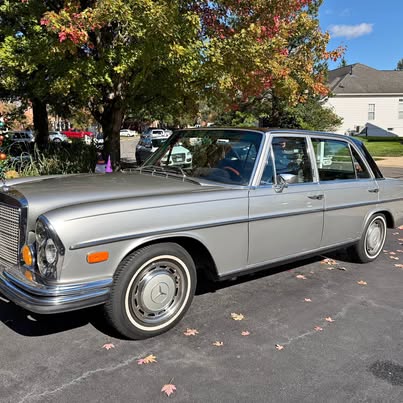
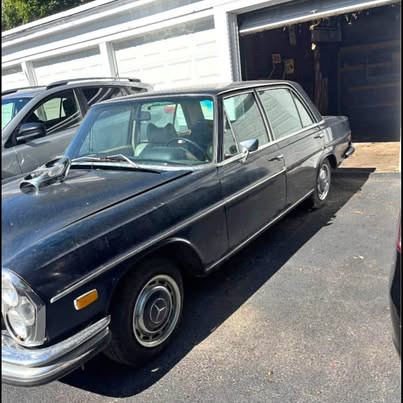
The pool of cars listed with us as we write is small — three cars, all currently for sale: a blue 1970 car in Massachusetts, a silver 1970 car in Virginia, and a Reed Green car in California sold through an auction listing. Read that as a snapshot of how thin the six-cylinder SEL market is, not as the market itself. The W108 family behind this model is one of the most thoroughly documented Mercedes ranges of its era, and everything in this guide is written against that full body of knowledge. The small pool means you will probably have to travel, and you must judge the individual car in front of you rather than the model in the abstract — which is what the rest of this guide is for.

The models
There is exactly one six-cylinder 280SEL, but you cannot shop for it intelligently without the cars around it, because sellers blur them — accidentally and otherwise. The table below is the 280-generation landscape the SEL sits in.
| Model | Years | Engine | Output | Built | Character |
|---|---|---|---|---|---|
| 280S | 1967–1972 | M130.920, twin Zenith carburettors | 140 hp | 93,666 | Standard wheelbase, carburetted; the car a careless SEL badge most often hides |
| 280SE | 1967–1972 | M130.980, Bosch mechanical injection | 160 hp | 91,051 | Standard wheelbase, injected; the volume seller of the range |
| 280SEL | 1968–1971 | M130.980, Bosch mechanical injection | 160 hp | 8,250 | This guide's car: the long shell on steel springs |
| 280SEL 3.5 | 1971–1972 | M116 V8, D-Jetronic | 200 hp | 951 | The V8 takes over the long shell; rare and quick |
| 280SEL 4.5 | 1971–1972 | M117 V8, D-Jetronic | 198 hp | 8,173 | North America only; torque-rich and thirsty |
| 300SEL | 1968–1970 | M130.980 in 170 hp tune | 170 hp | 2,519 | The W109: same engine family, air suspension, plusher trim |
Three identity checks follow from that table, and you should run all three on any car you are serious about. First, measure the wheelbase. The L is not a trim level, a badge or a longer boot — it is 2,850 mm between the wheel centres against 2,750 mm for the standard car, and a tape measure between the hub centres settles it in a minute. The rear door tells the same story at a glance once your eye is in: on an SEL the rear door is the longest panel on the car. Second, read the chassis number. A genuine six-cylinder 280SEL begins 108.019; a 280SE is 108.018 and a 280S is 108.016. A 280SE badge on a long car, or an SEL badge on a standard-wheelbase car, means the badges have been moved, and you should price the car as what the number says it is, not what the boot lid claims. Third, open the bonnet. The SEL left the factory with the injected engine, engine number prefix 130.980. If you find a pair of Zenith carburettors on a car badged 280SEL, you are looking at an engine swap or a rebadged 280S — either way the data card, which you can obtain from the Mercedes-Benz Classic Center against the chassis number, settles what the car was born as. Do not pay SEL money until it does.
Specification splits along market lines. US-delivered cars — and all three cars in our current pool are US cars — carry the stacked twin headlamp units in place of the European single lamp, side marker lamps, heavier bumper overriders, and usually the under-dash air conditioning unit and power steering. European cars keep the cleaner single-lamp nose. Neither is better; the US lamps are sealed beams you can replace anywhere, while the European units give a better beam pattern and cost real money to replace when the reflectors dull. Trim is deliberately a step below the W109: you get the padded W108 dash with its wood fillet, MB-Tex or leather seats, and less brightwork around the windows than a 300SEL. Options to look for are power windows, a steel sliding sunroof (rare, and check it works and drains), headrests on US cars, and a Becker radio. A manual gearbox was on the list and a handful of SELs were built with it; treat any manual car as a curiosity worth verifying against the data card rather than a premium in itself.
One more namesake to keep out of your search results. From 1973 the 280SEL badge passes to the W116 S-Class, a different car entirely with the M110 twin-cam six. Nothing mechanical interchanges with the W108, the driving experience is a generation apart, and the two cars only share a name and a badge font. If a car you are offered as a W108 280SEL has a W116 chassis number, you are shopping in the wrong guide.
Engines and gearboxes
The M130 and its carburettors: the Zenith 35/40 INAT pair
Every 280-generation W108 runs the same basic engine, and you need to understand both of its fuel systems even though the SEL itself is injected — because the carburetted car is the one you will be offered as an SEL by mistake, and because a swapped engine is the oldest trick in this market. The M130 is a 2,778 cc overhead-cam straight six (86.5 mm bore, 78.8 mm stroke) with a cast-iron block, an aluminium cylinder head, seven main bearings and a chain-driven single overhead camshaft. It is a development of the M129 2.5 with a longer stroke and siamesed bores, and it shares the family virtues: a stiff bottom end that rarely wears out, a willingness to rev, and a smoothness that depends entirely on the engine mounts and the valve clearances being right. It also shares the family vice — an alloy head on an iron block, in a car whose radiator is now fifty years old, means overheating is the one insult the engine does not forgive. A warped head shows as a persistent misfire, coolant loss with no visible leak, and mayonnaise under the oil filler; the temperature gauge's behaviour on your test drive matters more than anything the seller says about it.
In carburetted form the engine is the M130.920, rated at 140 hp at 5,200 rpm with 224 Nm of torque at 3,600 rpm, and it breathes through two Zenith 35/40 INAT downdraught carburettors, one feeding each trio of cylinders. Each INAT is a twin-barrel instrument: the primary barrel is mechanically linked to the throttle, and the secondary barrel is opened by a vacuum diaphragm as airflow demands. The pair must be balanced — airflow synchronised at idle and the linkage set so both carburettors begin to open together — and a 280S that idles roughly and pulls cleanly, or idles sweetly and stumbles at cruise, is usually a balance problem before it is anything more sinister.
The Zeniths have two signature faults, and the standard diagnosis of both is wrong. The first is the flat spot: the car hesitates or bogs as you open the throttle from cruise, and generations of owners have blamed and rebuilt the carburettor bodies. The bodies are rarely the cause. The vacuum diaphragm that opens the secondary barrels perishes with heat and age; a split diaphragm means the secondaries never open on time, and the engine falls into the hole exactly as described. Test it before you condemn anything else: a hand vacuum pump on the diaphragm must hold vacuum. A diaphragm is cheap; a pair of rebuilt carburettors is not. The second fault is heat soak. The INAT's top cover warps under years of under-bonnet heat cycling, the float chamber seal stops sealing, and after a hot stop the car floods, stinks of petrol and refuses to restart until it cools. The cure is to have the covers skimmed flat or replaced, not to keep cranking. Worn throttle spindles complete the trio — they leak air at idle, the idle speed wanders, and no amount of mixture adjustment stabilises it; you detect them by wiggling the spindle and by a change in idle when you spray the spindle bushes with carburettor cleaner. A full professional rebuild of the pair, with spindles rebushed, runs roughly $700–1,400; budget for it on any carburetted car that has not had it done, and remember that on a genuine SEL the whole question is academic — Zeniths under the bonnet of an SEL are an identity problem, not a tuning problem.
The injected M130: Bosch six-plunger mechanical injection
Your 280SEL runs the M130.980: the same block and head with a 9.5:1 compression ratio and Bosch mechanical fuel injection in place of the carburettors, worth 160 hp at 5,500 rpm and 240 Nm at 4,250 rpm. Period figures put the automatic car at about 185 km/h and 0–100 km/h in roughly eleven seconds; the point is not the numbers but the character — the injected engine starts cleanly in any weather, pulls from lower revs without the carburetted car's hesitation, and uses noticeably less fuel doing it. This is the engine that makes the SEL feel like a modern car in period dress.
The system is mechanical, not electronic, and understanding its logic tells you how it fails. An engine-driven Bosch six-plunger inline pump — one plunger per cylinder — meters fuel through steel lines to poppet injectors in the inlet ports. Metering is governed by a three-dimensional space cam inside the pump, which maps engine speed against throttle position; a barometric capsule compensates for altitude and air pressure, which is why period road tests praised the injected cars for running identically in the mountains and at the coast. Warm-up enrichment is handled by a coolant-fed thermostat element in the pump that holds the mixture rich while the engine is cold and leans it out as the coolant warms. A separate electric cold-start valve in the manifold, switched by a thermo-time switch, handles cranking enrichment. There is no ECU, no wiring loom of sensors, and nothing to plug a laptop into: the whole system is cams, springs, plungers and thermostats, and it is diagnosed with a pressure gauge, a CO meter and patience.
The failure modes follow the mechanisms. The warm-up thermostat is the big one: when its element tires or sticks, the pump never learns that the engine is warm, and the car runs permanently rich — black smoke on acceleration, sooty plugs, dreadful fuel consumption, and petrol washing past the rings into the sump. Learn the test: on a car you are inspecting, smell the dipstick. Fresh petrol on the dipstick, an oil level that has risen, or oil that feels thin between your fingers points at over-fuelling, and on an injected M130 over-fuelling starts at the pump, not the injectors. The space cam wears next: a worn cam corrupts the mixture across the whole operating range, producing a car that is rich in one band and lean in another and cannot be adjusted into correctness, because the idle and part-throttle adjustments only trim the edges of the map. The distinguishing test is a CO reading at several engine speeds, not just idle — a car that passes at idle and fails at 2,500 rpm is showing you its cam. Cold-start valves leak with age and dribble fuel into the manifold of a warm engine, giving a lumpy hot idle and a rich hot start; clamp the valve's feed line on a test and see whether the idle cleans up. The pump also has its own oil supply in a small reservoir on the pump body, and it is the most neglected service item on the car: a pump run dry destroys its plungers and barrel faces, and then you are not adjusting anything. A specialist rebuild of the pump runs about $2,000–3,500 and transforms a car; a car with a documented recent pump rebuild is worth a real premium over an identical car without one, and a car whose pump has never been touched should be priced as if the bill is coming.
Shared M130 service points are simple and non-negotiable. Valve clearances are set with shims-and-screws mechanical adjustment and drift with mileage — a top-end rattle that quiets as the engine warms is clearances, and a car serviced on the rhythm will have invoices for them. The timing chain stretches and its tensioner tires; listen for a brief rattle from the front of the engine on a cold start that disappears as oil pressure builds — a second or two is age, a persistent rattle is a chain job. Engine mounts collapse with age and oil contamination; because the big six is so smooth when they are right, a trembling idle and a thump on gearchange usually mean mounts, not an engine rebuild. The exhaust manifold cracks at its centre branches on high-mileage cars; a ticking that fades as the engine warms is the classic signature.
Gearboxes: the K4A 025 automatic, the fluid coupling and the rare manual
Nearly every 280SEL you will ever see is an automatic, and the automatic is not what you expect. The K4A 025 is a four-speed gearbox coupled to the engine by a fluid coupling, not a torque converter. A fluid coupling transmits drive hydraulically but multiplies nothing, so the car pulls away with a smooth, slightly elastic feel and none of the converter's low-speed surge. The box is programmed to pull away in second gear in normal driving; first is engaged only if you floor the throttle through the kickdown switch under the pedal, or if you select the lowest gate position before moving off. This is the origin of the most durable myth in the model's listings: sellers advertise the car as a three-speed because they count three upshifts on a normal drive. Count them yourself on the test drive — from a standing start with a firm throttle you should feel three changes on the way to top, and a full-throttle start should add the lower first gear beneath them. A car that genuinely has three ratios is not a 280SEL at all.
Shift quality is governed from outside the gearbox, and that is where you diagnose it. A vacuum modulator on the box reads inlet manifold vacuum and sets shift firmness against load; the rubber pipe feeding it splits and perishes, and a leaking pipe gives you harsh, late upshifts that owners misdiagnose as a dying gearbox. Before you accept any story about a rebuild, check the vacuum pipe and the modulator diaphragm — a hand pump on the modulator should hold vacuum, exactly as with the Zenith diaphragms. The throttle linkage also drives a pressure control, and linkage bushes that have crumbled to dust make the box shift at the wrong speeds; a set of linkage bushes costs little and transforms the car. Fluid and filter changes are straightforward and often neglected; burnt-smelling fluid that is brown rather than red tells you the box has been run hot or ignored. A full rebuild by a specialist who knows the type runs about $2,500–4,000, but most K4A 025s that change badly need vacuum, linkage and fluid, not a rebuild. The fluid coupling itself is sealed and effectively immortal unless it leaks; a car that has lost its coupling fluid creeps weakly and slips at speed, and that is a gearbox-out job, so test hill starts and full-throttle acceleration carefully.
The manual alternative is a four-speed with synchromesh, supplied with a column change as standard and a floor change as a rare option. In an SEL it is a unicorn: if you find one, verify it on the data card, because a manual conversion tells a story about the car's past. The manual itself is robust; its hydraulic clutch slave cylinder weeps with age, the column-change linkage wears into vagueness, and both are cheap beside the automatic's bills. Do not pay a rarity premium for a manual SEL until the data card confirms the factory built it that way.
Problem areas
Rust: the map
Rust decides what a W108 is worth, and the 280SEL's extra length gives it more of the panels that rust. These are unitary cars: the sills, floors and inner wings are the structure, and cosmetic rust on a wing is a different conversation from rust in a sill. Work the map in order of consequence, not in order of visibility.
Start with the sills, because everything else is negotiable and they are not. The sill is a box section running the full length of the car — longer on the SEL than on any other six-cylinder W108 — and it carries the jacking points. It rusts from the inside out, fed by blocked drain holes and by water entering at both arch ends. Paint bubbles along the sill's lower edge are the last stage, not the first. The test that settles it is the sill-jack test: put the car's own jack in each jacking point in turn and take the car's weight. A sound sill lifts the car silently with the door gaps unchanged. A rotten sill crackles, the jack tube tears or pushes into the box, and the door shut lines move as the shell flexes. Any car that fails this test needs sill replacement — cutting out the full length, inner and outer, and welding in new sections — at roughly $1,000–2,500 per side depending on how far the rot has travelled into the floor edges and jacking tubes. Walk away from a car whose seller will not let you jack it.
The front of the car rusts in a chain. The headlamp buckets collect water and mud behind the lamps; on US cars the stacked lamp units hide this completely, so feel behind the bucket with your fingers and look for filler dust and flaking in the inner wing behind it. The front wings themselves bolt on — genuinely good news, because a rotten wing is a panel bill, not a welding bill — but they rust along the top seam where they meet the inner wing, behind the wheel at the bottom rear corner where they meet the sill, and around the side trim holes. The inner wings and the battery tray beneath them suffer from fifty years of battery acid and standing water; a tray you can flex with a thumb is a tray that needs cutting out. At the bulkhead, the heater air intake plenum is a water trap whose drains block with leaves; the water then sits against the bulkhead and the front floor pans, and a car with wet front carpets or a sweet antifreeze smell is telling you the plenum or the heater matrix is leaking into exactly the metal you cannot see. Lift the carpets. Front floors rust from the inside out under sound-deadening that holds moisture against the steel, and the only honest check is from underneath, tapping along the pan for the change in note that means thin metal.
The middle and rear of the car have their own list. Door bottoms rust where the drain holes block, and the SEL's long rear doors carry a longer seam and cost more to repair or replace; check the bottom edge with the door open and look for paint that has been blown over a swelling seam. The A-post bases and the windscreen surround rust where the screen seal shrinks and admits water, and bubbles at the screen corners mean the surround is going under the seal — a screen-out repair. Rear wheel arches rust at the lip and, more seriously, where the arch meets the inner wing and the boot side wells behind it: open the boot and look down into the wells either side of the spare wheel, because water that gets past the boot seal and the rear lamp seals collects there and rots the well, the boot floor and the rear panel from inside a boot that looks dry from above. The spare wheel well itself holds water against the tank, and the fuel tank's lower seam rusts through and weeps petrol long before it leaks visibly — a petrol smell in the boot is a tank inspection, not a quirk. Finally, get underneath and look at the mounting points: the front subframe bolts to reinforced sections of the floor, and the rear axle mounts to the shell at points that carry real loads. Rot at a mounting point is the one rust finding that turns a restoration into a reshell conversation.
Climate writes the car's history. Our pool makes the point neatly: the blue car sits in Massachusetts, in the salt belt, and deserves the full underside interrogation above, while a lifelong California or Virginia car starts with a presumption of innocence it still has to prove. Intact original undercoating is a good sign; fresh black underseal over everything is the oldest concealment in the trade. Prod with a blunt screwdriver — you are testing soundness, not making holes — and bring a magnet for the arches and sill covers, because filler does not hold one.

Front suspension, steering and the rear axle
The W108 front suspension is a double-wishbone design that steers through kingpins, not ball joints, and the kingpin is the single most neglected service item on the car. Each kingpin runs in threaded bushes at the top and bottom of the stub axle carrier, and the assembly depends on grease: there are nipples, and they want greasing roughly every 3,000 miles. On a car that has been greased, the kingpins last indefinitely. On a car that has not — which is most of them, because the nipples hide behind the brake backplate and get forgotten — the bushes wear oval, the wheel gains camber and castor play, and the car wanders, tramlined and vague, while eating its front tyres' inner edges. The test is specific: jack the car under the lower wishbone so the suspension is loaded as it sits on the road, grip the wheel at twelve and six o'clock, and rock. Play that disappears when a helper presses the brake pedal is wheel bearing; play that remains is kingpin and bush wear. A proper kingpin job means pressing out the pin, reaming new bushes to fit and reassembling with new seals — roughly $800–1,500 a side at a specialist — and a car with fresh kingpin invoices has had the single most valuable chassis job on the model already done.
Around the kingpins, the rest of the front end fails by rubber. The front subframe mounts — large rubber blocks between the subframe and the shell — collapse and split with age and oil, letting the whole front suspension move under braking and steering loads; the symptoms are a clunk on brake application, alignment that will not stay set, and a car that changes direction slightly when you lift off. Coil springs sag and occasionally crack at the bottom coil where it sits in the wishbone pan, and the pans themselves rust. Shock absorbers are conventional and cheap. The steering is a recirculating-ball box, power-assisted on US cars and most others by now: wear shows as free play at the wheel rim, and there is an adjuster on the box, but learn the discipline — the box is adjusted at its straight-ahead position only, and a box wound tight to hide wear binds off-centre and wears its centre track into a notch that no adjustment then removes. A car whose steering is tight at centre and loose at lock has been adjusted honestly; the reverse means someone has been hiding something. The drag link, tie rods and the idler arm bush all wear and are all available; budget for a front-end refresh on any car without recent invoices, and treat perished steering coupling rubber as a safety item, not a service item.
The rear axle is the low-pivot single-joint swing axle Mercedes used across the range, and it has two things you must inspect. The first is the joint itself: the axle pivots on a single joint at the differential, sealed by a large rubber boot, and when that boot splits — they all do, eventually — grit enters and the joint wears until the axle clunks on take-up and the rear wheels' camber goes visibly wrong. The boot is awkward but cheap; the joint is not. Look at the car from behind on level ground: the rear wheels should sit close to upright, and a car squatting with obvious negative camber is showing you sagging springs or worn compensating-spring mounts before it shows you joint wear. The compensating spring — a transverse coil spring above the axle that resists body roll — sits in rubber mounts that perish, and its failure makes the car roll and pitch in a way owners blame on shock absorbers. The differential itself is strong; its front mount and the big rubber drive coupling perish, producing a thump on gearchange that feels like the gearbox and is not. Brakes are discs all round with a vacuum servo and a dual circuit, plus a drum handbrake inside the rear discs. On a car that has stood, calipers seize and pistons pit; the honest assumption for a long-stored car is a full hydraulic refresh — calipers rebuilt or exchanged, hoses renewed, fluid changed — at roughly $900–1,800 in parts and labour, and the handbrake shoes inside the rear hats are always forgotten until the test station fails the car on them.
Interior and trim
The W108 cabin is built like the rest of the car — heavily, and to be retrimmed rather than replaced — but fifty years finds the soft materials. Start with the seats, because they hide their failure. The seat pads are horsehair over steel springs, and the horsehair crumbles with age into a coarse dust that you will find under the seats and in the boot; a seat that looks the right shape but feels like sitting in a hammock has lost its pads, and re-padding a pair of front seats with modern foam shaped to the original profile, or with replacement hair pads, runs roughly $600–1,200 depending on the trimmer. Seat springs break at the front corners, the recliner mechanisms wear, and the seat runners seize. Upholstery is MB-Tex vinyl on most cars — nearly indestructible, and original MB-Tex in good order is a selling point, not a poverty spec — or leather, which cracks on the driver's bolster and the top of the rear bench where the sun lands through the rear screen. A full leather retrim costs several thousand dollars; price a car needing one accordingly.
The wood and the dash date the cabin. The dash carries a wood fillet — walnut veneer on lacquered backing — and the veneer lifts and crazes where windscreen leaks have fed it water, which links straight back to the screen surround rust in the section above: a car with lifting veneer at the dash ends has been letting water in, and the floors will know about it. The padded dash top cracks in the sun belt and shrinks at the speaker grille. The headliner is a suspended perforated vinyl that sags as its backing foam dies and stains brown around the screen pillars from the same leaks. Carpets are wool or loop pile over felt sound deadening, and the felt is the problem: it holds water against the floor pans for months, so a car can have rotten floors under carpets that look and smell acceptable. Always lift them.
The heater deserves its own warning, because it is the worst job in the car. The heater controls are sliding levers that move cables to flaps in the heater box, and the plastic lever ends and cable outers break with age, leaving you with full heat, no heat, or heat on one side. Worse, the heater matrix itself leaks with age, announcing itself with a sweet smell, a misting screen and wet front carpets — and replacing it is a dashboard-out job that runs to $1,500–2,500 in labour at a specialist, on top of the rust it has been feeding into the bulkhead and floors. Test the heater on every viewing, in both directions, whatever the weather. Window regulators — manual cranks on most cars, electric on optioned ones — wear their channels and slow down; the electric motors are strong but the switches and the wiring through the door pillars fail, and on the SEL the long rear doors carry longer glass runs and longer cable paths. Door seals perish and let in wind noise and water; a full set of quality seals is a few hundred dollars and an afternoon, and it transforms the car's refinement. The boot should carry its spare, tools and jack — the jack matters, because you need it for the sill test — and the boot mat lifts to show the spare wheel well discussed above.
Electrics
W108 electrics are simple, robust and fifty years old, and most electrical faults on these cars are connection faults, not component faults. The fuse box uses the ceramic bullet fuses common to the era, and their holders corrode invisibly: the fuse looks intact, the circuit is dead, and the cause is a film of oxidation between the fuse ends and their clips. Before you diagnose any dead circuit on a viewing — a window, the blower, the clock — rotate each fuse in its holder and clean the contact points. You will fix a third of the car's electrical faults in five minutes, and you will learn something real about how it has been maintained.
The charging system is an alternator with a separate regulator on later cars and a dynamo on none of this range — the 280s are alternator cars. Test it properly: with the engine running and the lights on, you want to see roughly 13.8–14.2 volts at the battery; less means a tired alternator, a failing regulator or a slipping belt, and a battery that keeps going flat on a car that charges correctly is a battery at the end of its life or a drain you have to find. The starter motor suffers heat soak from the exhaust manifold beside it and cranks slowly when hot on a worn unit. The ignition switch wears and gives intermittent cutting-out that owners chase through the fuel system for months — if the car dies and the dash lights die with it, think switch before pump. US cars carry the stacked sealed-beam headlamps; European cars carry the single reflector units whose silvering dulls until the lights are candles, and replacement units are expensive when you can find them. Lamp buckets rust from behind, as covered above, and the earth points for the front lamps corrode and give you one bright lamp and one dim one — the front-view photograph in the rust section shows what four evenly lit lamps look like, and a car that cannot match it has earth or charging work waiting.
The injected engine adds one electrical circuit that matters: the cold-start system. The cold-start valve and its thermo-time switch decide whether the car starts crisply on a frosty morning or cranks forever, and a failed thermo-time switch gives you a car that starts perfectly warm and refuses cold — the mirror image of the leaking cold-start valve described in the engine section, which floods a warm engine. Distinguish them by temperature, not by guesswork. Elsewhere: the blower motor is buried and expensive to reach, so confirm it runs on every speed; electric windows and the optional sunroof share the fuse-and-earth story; the clock will have stopped, which does not matter; wiper linkages wear into a clonk and the wiper motor's park switch fails so the blades stop where they like. None of this is exotic. All of it is the difference between a car that has been used and maintained and a car that has been stored and forgotten, and a full sweep of every switch on the viewing costs you ten minutes and tells you which one you are buying.
How to inspect one
Inspect in this order: identity before cosmetics, structure before mechanics, cold before warm. A car that fails an early step does not earn the later ones. Allow two hours, bring a tape measure, a magnet, a torch, a hand vacuum pump, and the car's own jack — and insist the engine is stone cold when you arrive, because half of what follows only works on a cold car.
- Start with the paperwork and the numbers, before you touch the car. The chassis number should begin 108.019 and match the title and the plate on the car; the engine number should carry the 130.980 prefix. Ask for the data card or order one from the Mercedes-Benz Classic Center against the chassis number — it settles the original colour, trim, engine and options, and it is the document that exposes a rebadged 280SE or a swapped engine.
- Measure the wheelbase with your tape, hub centre to hub centre: 2,850 mm is an SEL, 2,750 mm is not, whatever the boot lid says. Then stand back and check the proportions against the photographs in this guide — the rear door should be the longest panel on the car — and sight down both flanks for ripples in those long rear doors and along the sill line.
- Do the sill-jack test from the rust section at all four jacking points. Take the car's weight on its own jack at each point and watch the door gaps and listen. Crackling, a tearing jack tube or moving shut lines ends the inspection at project-car money, because sill replacement runs $1,000–2,500 a side before you have touched anything else.
- Get underneath with the torch, or get the car on a lift. Work the rust map: front floors and bulkhead, subframe mounting points, boot side wells and spare wheel well from above, fuel tank seam, rear axle mounting points. Prod suspect areas with a blunt screwdriver and use the magnet on arches and sills. Original-looking underseal is reassuring; fresh thick underseal over everything is a question, not an answer.
- Make the cold start, and be the one to turn the key. The injected car should fire within a few seconds of cranking, settle to a fast idle, and lean out as it warms. Endless cold cranking points at the cold-start circuit in the electrics section; a car that starts cold but will not restart hot, and stinks of petrol, points at over-fuelling — and while it warms up, smell the dipstick for petrol and check the oil level has not risen, the pump warm-up test from the engine section.
- Work the engine bay with the engine warm and idling. Listen for the cold-start chain rattle that outstays its welcome, a ticking exhaust manifold that fades as it warms, and a top-end rattle that says valve clearances. Look for the injection pump's oil reservoir and ask when it was last checked, look at the coolant for oil and the oil filler for mayonnaise, and ask for the invoice if the pump has been rebuilt — that job is worth $2,000–3,500 and a receipt for it is real money in the car's favour.
- Test the kingpins the way the suspension section describes: jack under the lower wishbone, rock the wheel at twelve and six, and have a helper press the brake to separate wheel-bearing play from kingpin play. Then bounce each front corner, look at the subframe mounts for splits and collapse, and check the front tyres' inner edges — wear there is the kingpins' signature written in rubber.
- Drive the car and count the gearbox. From rest with a firm throttle you should feel three upshifts into top; with the throttle floored through the kickdown you should find the lower first gear as well — a car with only three ratios in total is not this car. Note shift quality: harsh, late shifts send you to the vacuum pipe and modulator with a hand pump before they send you to a rebuilder, and any thump on gearchange is as likely to be the rear axle coupling or differential mount as the box.
- Test the steering and brakes on the same drive. Free play at the wheel rim, a car that wanders and will not hold a line, and steering that is loose at centre but tight at lock all point at the box and its adjustment history. The brakes should pull the car up straight and hard from speed with a firm pedal; a pull to one side is a seizing caliper, a long pedal is air or a tired master cylinder, and the handbrake should hold the car on a slope — remember it works on shoes inside the rear discs that everyone forgets.
- Look at the rear of the car hard. From behind on level ground the rear wheels should sit near upright; visible squat and splayed camber mean springs, compensating-spring mounts or worse. Get under and look at the swing-axle centre boot — split rubber there is a countdown on the joint — and check the compensating spring's mounts and the differential mount for perished rubber.
- Sit in the car and work everything, because the interior section's bills hide behind switches. Heater levers through their full travel in both directions, feeling for broken cables and smelling for the sweet antifreeze warning of a leaking matrix — a dashboard-out job at $1,500–2,500 in labour. Blower on every speed, every window up and down, wipers and their park position, every lamp including the stacked headlamps lit evenly. Lift the carpets for damp felt, press the seat pads for crumbling horsehair, and check the wood at the dash ends for the lifting that betrays screen leaks.
- Finish with the history, and weigh it against what you have found. A thick file with kingpin greasing, valve clearances, injection-pump attention and fluid changes describes the car you want; a file of cosmetic invoices over a car that failed step 3 describes the car you are walking away from. On a 280SEL the mechanical car with a dry shell beats the shiny car with a wet one every time — the steps above exist to tell you which of the two is in front of you.
Values
Read the market for this car qualitatively, because the numbers that matter change faster than any guide can be reprinted — which is why the live market summary and the recorded-sales block are appended beneath this guide and refreshed with the listings themselves. Use them the way this section teaches, not as a single figure to anchor on.
The first lesson is that the condition spread on a 280SEL is enormous — wider than the spread between models. A rust-free, documented, injected car with its pump and kingpins recently done and a tired but complete project car with sound metal are both genuinely valuable, in completely different ways and to completely different buyers, while a shiny car with rotten sills is worth less than either, because its next owner is buying a welding programme with a car attached. When you compare the figures in the market block, compare like with like: separate the cars by structure and completeness before you compare them by price, or the averages will lie to you.
The second lesson is about the badge. The SEL carries a premium over the equivalent 280SE, but it is a modest, condition-led premium, not the step-change the W109 300SEL commands — the market pays for the long car's rarity and rear-seat room, and it pays much more readily when the extra length comes with paperwork. Originality is the multiplier: a matching-numbers car in its data-card colours, like the period Reed Green of the car in our photographs, holds its value against a resprayed car in a fashionable colour with a swapped engine, even when the resprayed car looks better in pictures. US-delivered cars dominate supply in North America and set the visible market; a European-specification car with the single headlamps is scarcer on this side of the Atlantic and draws its own audience.
Third, understand the gap between asking and achieved prices, because this model's market shows it clearly. Classified asking prices for ordinary cars are routinely optimistic and sit for months; the cars that actually change hands do so at auction, in public, where the best-documented examples make strong money precisely because two buyers can see the same invoices you read about in the inspection section. A project car's value is essentially its parts and its potential minus the cost of the welding it needs, and sellers who price a project as a discounted driver are telling you they have not understood their own car. Negotiate from the inspection findings — a documented pump rebuild, kingpin work and structural soundness are worth money in a negotiation in a way that a recent polish is not — and let the recorded sales below, rather than any asking price, tell you what the last comparable car actually achieved.
Parts and ownership
Owning a 280SEL is a mainstream classic-Mercedes experience, which is to say a good one. Mercedes-Benz still supports the W108 through the Classic Center and the dealer network to a degree no other manufacturer of the era matches: service items, suspension rubber, brake parts, seals, mounts and most engine components are available off the shelf or on short order, and the specialist network in the US and Europe stocks the rest. The M130's mechanical injection pump is the one component that belongs to a handful of specialists rather than the open market — identify your pump rebuilder before you need one. Trim is the genuine scarcity: good used long rear doors and SEL-specific brightwork are harder to find than standard-wheelbase panels, dash wood and correct seat materials take patience, and a car with a complete, undamaged interior is worth a premium for that reason alone.
Running the car is a rhythm, not a burden. The standing items are the ones this guide has repeated: grease the kingpins roughly every 3,000 miles, keep the valve clearances and the injection pump's oil reservoir on the service schedule, change the automatic's fluid and filter on time, and keep the coolant fresh, because the alloy head depends on the cooling system absolutely. Fuel consumption is period-correct — expect to visit the pump often, with the injected car noticeably thriftier than the carburetted 280S — and modern fuel argues for fresh rubber fuel lines throughout, a cheap job that removes the commonest fire risk on any car of this age. Tyres are 14-inch, a size modern makers still serve in period-correct profiles, and the car rides best on the tall sidewalls it was designed for.
Storage and use matter as much as maintenance. These cars deteriorate by standing: swing-axle boots perish, brake calipers seize, injection pumps gum, and the horsehair in the seats absorbs damp. A 280SEL that is driven monthly and kept dry will cost you less than a pampered car that never turns a wheel. Insurance on an agreed-value classic policy is straightforward, club support through the Mercedes-Benz Club of America and the W108 registers is deep, and the knowledge base for the model — workshop literature, forum archives, long-serving specialists — is as complete as for any classic you can buy. Budget your money in the order this guide has taught you: structure first, injection and kingpins second, cosmetics last, and the car will reward you in proportion.
Which one to buy
- The all-rounder: an injected 280SEL automatic with a dry, original shell, a documented injection-pump rebuild in its past and kingpins that have been greased and invoiced. This is the car that does everything the model promises — effortless, spacious, sorted — and it is the easiest to sell on, because the next buyer reads the same file you did.
- The value buy: the honest, complete project with sound sills, floors and mounting points and tired cosmetics — the driveway car, not the shiny one. Structure you cannot economically replace is already paid for; paint, pads and rubber are all purchasable, and the long rear doors and trim come with the car rather than from a breaker's shelf.
- The driver's pick: a European-specification car with the single headlamps and the cleaner nose, or one of the rare manual-gearbox cars verified against its data card. You give up nothing in strength or support, and you get the version of the car its designers drew first.
- The one to walk away from: any car that fails the sill-jack test, whatever its engine, colour or paperwork says. A rebuilt M130 is a known bill; a rotten long shell is an open-ended one, and no premium for rarity survives first contact with a welding estimate.
The rule that overrides every pick: buy the shell, not the engine, and not the shine — a 280SEL with sound sills, floors and axle mounts and a tired engine is always the better buy, because the M130 and its pump can be rebuilt to new in a way a rusted long-wheelbase shell, economically, cannot.
See the 1 S-Class cars currently listed.
What they sell for: S-Class sale prices.