
Mercedes-Benz E-Class buyer's guide
Mercedes-Benz E-Class -- the model's own buyer's guide: variants, values and what to check.
Years listed: 1989-1993 · Series: W124
Overview and history
The 300CE is the coupé of the W124 range — internal designation C124 — and the car that best shows what Mercedes-Benz was in the late 1980s: over-engineered, under-styled in the best sense, and built to a standard rather than a price. The W124 saloon had been launched in 1984; the coupé followed at the Geneva motor show in March 1987, initially as the four-cylinder 230CE and the six-cylinder 300CE, and stayed in production, through one major facelift and a change of name to E320 Coupé, until 1996. In the United States the car was sold only with six-cylinder engines and only with an automatic gearbox: the 300CE from model year 1988 to 1993, and the facelifted E320 Coupé for 1994 and 1995.
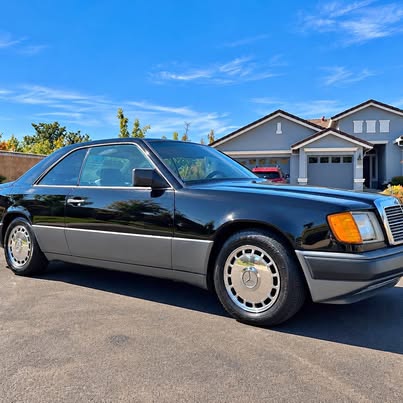
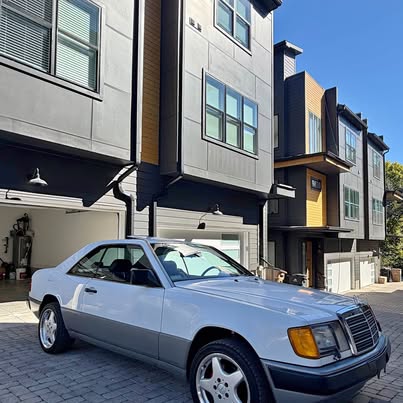
Bruno Sacco's styling is the saloon's language tightened into two doors. The wheelbase is 85 mm shorter than the saloon's, the roofline lower, and the car is a true pillarless hardtop: drop all four windows and there is nothing between the front and rear glass but open air, the B-pillar deleted entirely and the front seat belts carried on motorised presenter arms instead. It is an elegant car rather than a dramatic one, and that restraint is why it has aged so well — and why it spent so long being cheap. For years a 300CE was simply an old Mercedes that cost real money to keep. That era is ending: the best cars — low-mileage, documented, unmodified — now attract serious collector attention, while the bottom of the market is still full of tired examples whose needs exceed their value. Knowing which of those two cars you are standing in front of is the whole subject of this guide.
Underneath, the coupé is pure W124: MacPherson-strut front suspension, the famous five-link multi-link rear axle that set the industry template for a generation, four-wheel disc brakes, a Béla Barényi safety-cell structure, and some of the best rust protection Mercedes had yet fitted to a production car. The engines tell the model's life in two acts. The early 300CE uses the M103, a single-overhead-cam 3.0-litre six with Bosch KE-Jetronic continuous injection — simple, smooth and famously durable. From 1990 the US car received the M104, a twin-cam, 24-valve development of the same block, sold in Europe as the 300CE-24 and simply badged 300CE in America. For 1993 the US 300CE moved to a 3.2-litre M104 with fully electronic HFM engine management, and that engine carried on under the E320 Coupé badge after the facelift. Each step brought more performance and refinement — and more expensive failure modes, because the later cars add the two issues every W124 buyer must now understand: the M104 head gasket, and the biodegradable engine wiring harness fitted to the 1993–95 cars.
Our own listings give a fair picture of where the surviving US stock sits. We currently track six 300CEs, all of them for sale and all of them early cars — the year spread runs from 1988 to 1990, which means the M103 and the first M104 cars are what the open market mostly offers, while the later E320 Coupé tends to change hands through specialists and auctions instead. Every one of the six is an automatic, as all US coupés were. Treat that as a prompt, not a coincidence: the later cars are scarcer on the ground, and the early cars you will actually go and see need the KE-Jetronic and M103 checks set out below at least as much as they need the harness check.
What defines a good 300CE today is not mileage. These engines were designed for mileages that would frighten most modern cars, and a 180,000-mile car with a thick file of invoices is a better buy than a 90,000-mile car with none. What defines it is the accumulated state of a short list of known, priceable items — head gasket, wiring harness where fitted, air conditioning, rear window regulators, suspension bushes — plus the one thing that is not cheaply priceable, rust in the structural mounting points. Work that list methodically and the 300CE is one of the most satisfying classic Mercedes you can own. Skip it, and it will teach you the same lessons at retail prices.
The models
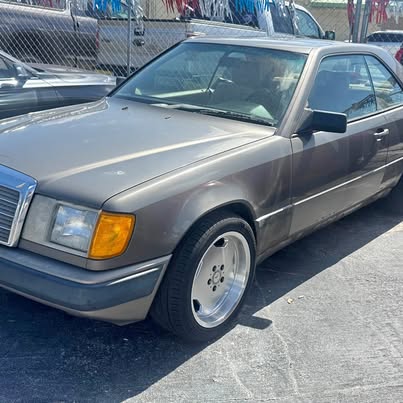
Every C124 is a two-door pillarless coupé on the shortened W124 floorpan; there was no factory convertible in this guide's scope (the A124 cabriolet is a separate car with a different structure) and no estate or saloon variant — those are covered by the W124 range guides. What changes across the range is the engine, the engine management, and, from mid-1993, the face and the badge. Roughly 141,500 C124 coupés of all kinds were built across the model's nine years. Mercedes did not publish a clean, reliable production split for every badge and market, so where a per-model figure is not genuinely documented we leave it blank rather than guess — outputs below are period DIN figures for European cars, with US SAE net figures differing slightly where noted.
| Model | Years | Engine | Output | Built | Character |
|---|---|---|---|---|---|
| 230CE | 1987–1992 | 2.3 four (M102), KE-Jetronic | 136 hp | — | The European entry point; never sold in the US |
| 200CE / 220CE | 1992–1996 | 2.0 / 2.2 four (M111) | 136 / 150 hp | — | Late European fours; light, simple, leisurely |
| 300CE | 1987–1989 (US) | 3.0 six (M103), KE-Jetronic | 180 hp (177 US) | — | The original: simplest engine, the default US buy |
| 300CE-24 | 1989–1992 | 3.0 six (M104), 24-valve, KE-Jetronic | 220 hp (217 US) | — | Badged plain 300CE in the US; the keen driver's car |
| 320CE / 300CE 3.2 | 1992–1993 | 3.2 six (M104), HFM electronic | 220 hp (217 US) | — | The torque car; 1993 US cars still wear the 300CE badge |
| E320 Coupé | 1993–1996 (US 1994–95) | 3.2 six (M104), HFM electronic | 220 hp (217 US) | — | The facelift car: newest, best equipped, harness years |
| AMG 3.4 CE / Hammer Coupé | 1988–1993 | 3.4 six (M104) / 6.0 V8 (M117) | 272 / 360+ hp | handful | Pre-merger AMG specials; verify provenance ruthlessly |
The 300CE (1987–89 in US form) is the car this guide is named for and the one you will most often find. Its M103 engine gives 180 hp in European trim, 177 hp in US specification, and performance that is brisk rather than fast — the coupé is a heavy car at around 1,420 kg, and the automatic's second-gear start (see the gearbox section) blunts the figures further. None of that matters in use: the M103 is turbine-smooth, sounds wonderful over 4,000 rpm, and is the cheapest of the sixes to keep, its injection being mechanical-era Bosch hardware any good Mercedes specialist understands. If you want a 300CE to drive rather than to collect, start here.
The 300CE-24 and the US 1990–92 300CE. In 1989 Mercedes put a 24-valve twin-cam head on the 3.0-litre block to create the M104.980, raising output to 220 hp and giving the coupé genuine pace. Europe got the car as the 300CE-24; America got the same car wearing the plain 300CE badge, so a US 1990–92 300CE is a 24-valve car whether the seller knows it or not — check the engine, not the boot lid: the M104 has a wide twin-cam cover where the M103 has a narrow single-cam one, and the difference takes one glance under the bonnet. For many buyers this is the range's sweet spot: the strongest engine still running the well-understood KE-Jetronic system, before the fully electronic management and the biodegradable harness arrived.
The 3.2 cars: 320CE, the 1993 US 300CE, and the E320 Coupé. The M104 grew to 3,196 cc and gained HFM electronic fuel injection and distributorless ignition for 1992. Peak power is the same on paper, but the 3.2 makes its torque lower and feels stronger everywhere. In the US the engine arrived for 1993 under the old 300CE badge; the facelift of June 1993 brought the new E-Class face — grille integrated into the bonnet, clear indicator lenses, revised boot lid — and the E320 Coupé badge, sold in the US for 1994 and 1995. These are the most modern-feeling, best-equipped coupés, and the cars squarely inside the wiring-harness years. Neither fact should decide you on its own; the harness is a known, one-time, priceable fix, covered in detail below.
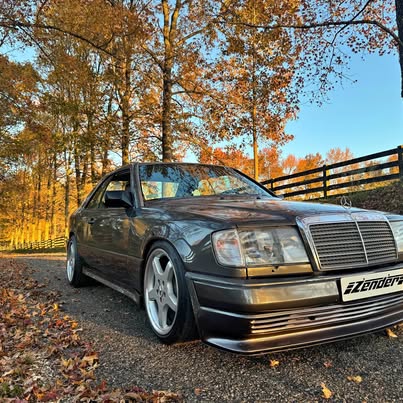
Sportline. From the early 1990s Mercedes offered a Sportline package: suspension lowered by roughly 22 mm with firmer springs and dampers, quicker steering, wider 7-inch wheels, more supportive seats, a smaller steering wheel and Sportline badges. It transforms the car's feel without spoiling it, and genuine cars carry a premium — which is why badges alone prove nothing. The data card and option codes settle it; stance and wheel width are your first visual check.
The AMG cars. Before AMG became part of Mercedes, it built a small number of coupés to order: the 3.4-litre 24-valve 3.4 CE, and the Hammer Coupé with a 6.0-litre quad-cam V8 derived from the M117. They are properly valuable, vanishingly rare, and surrounded by replicas and tribute cars. If you are offered one, the buying process is provenance verification with a marque specialist, full stop.
Trim and equipment. US cars were generously specified from the start: automatic climate control, electric windows and sunroof, cruise control, leather or MB-Tex upholstery, ABS, and (from 1990) a driver's airbag. Options to look for include heated and orthopaedic seats, ASR traction control, and the rear roller blind. Two coupé signatures deserve a mention here because you will test them on every viewing: the seat-belt presenter — with no B-pillar, the front belts live far behind the seats, so a little arm swings out from the rear side panel and offers you the belt when you close the door and turn the key — and the windows, all four of which drop, the rears into the quarters, giving the full pillarless opening. Both systems are covered as cost items in the problem sections below.
Engines and gearboxes
The M103: the single-cam six (1988–89 US cars)
The M103 is a 2,960 cc overhead-cam six with two valves per cylinder, hydraulic valve-clearance compensation, a single distributor driven from the front of the camshaft, and Bosch KE-Jetronic injection — a continuous-injection system in which a mechanical fuel distributor meters fuel to all six injectors constantly, with an electro-hydraulic actuator (the EHA valve) trimming the mixture under electronic control. It produces 177 hp in US trim and a broad, unstressed torque curve, and it is one of the most durable engines Mercedes ever built. A healthy M103 starts instantly hot or cold, idles at a rock-steady 650–750 rpm, pulls cleanly to its 6,200 rpm redline and shows oil pressure pinned at 3 bar at speed, dropping to around 1–1.5 bar at a hot idle — that drop is normal and correct, and a gauge that reads low at idle but pegs under way is not a fault.
The M103's known weaknesses are specific and diagnosable. Oil consumption is the first: the valve stem seals harden with age and heat, and a litre of oil every 600–800 miles was within factory tolerance when new. A car using oil at that rate with clean plugs and no smoke under load usually needs stem seals, not a rebuild — seals can be replaced with the head in place for roughly $600–1,200 at a specialist. Smoke under load, by contrast, is rings and bores, and that is an engine-out conversation; the test drive separates the two. The head gasket on an M103 characteristically leaks oil externally at the back of the head rather than mixing oil and coolant — look for oil weeping down the rear of the block and a burnt-oil smell after a run. It is a nuisance leak long before it is a failure, but price it: a head gasket job runs about $1,500–2,500 done properly with the head skimmed and seals renewed. Camshaft and rocker wear appears on cars that have lived on extended oil changes; a top-end tick that does not fade as the engine warms, plus a lumpy idle, is the presentation, and pulling the cam cover to inspect the lobes is a fair request on a noisy car.
KE-Jetronic behaviour accounts for most "it doesn't run right" 300CEs, and almost none of it is the fuel distributor itself. Learn the cast of characters. The OVP (overvoltage protection) relay, in the relay box behind the battery, powers the injection ECU and the ABS; its internal solder joints crack with age and its fuse blows, and the symptoms — hard cold starting, a high or hunting idle, the ABS light joining in — mimic expensive faults. A new OVP relay is a cheap part (roughly $50–100) and fitting one is the first move on any KE car with electrical-flavoured running faults. The idle control valve and its hoses govern the idle; split rubber elbows around it cause air leaks and a wandering idle. The airflow sensor potentiometer wears at the idle position and causes a stumble just off idle — the classic "it hiccups pulling away" complaint. The EHA valve on the fuel distributor leaks fuel externally when its seals age; a smell of petrol at the back of the engine bay with the engine off is the tell, and the valve itself is a few hundred dollars. Hot-start problems — fine cold, fine hot, but not after sitting for twenty minutes — are almost always fuel pressure bleeding down through a failed pump check valve or a tired fuel accumulator, letting vapour form in the lines; both are modest money. The fuel distributor itself, when it does wear, gives uneven fuelling cylinder-to-cylinder; a rebuilt unit runs roughly $600–1,000 exchanged. None of this needs guesswork: KE-Jetronic is fully diagnosable with a pressure gauge set and a duty-cycle reading at the diagnostic socket, and a specialist who proposes replacing parts in sequence until it runs right is the wrong specialist.
The M104: the 24-valve six (1990–95 US cars)
The M104 keeps the M103's block architecture and adds a twin-cam, four-valve head with variable intake camshaft timing. In 3.0-litre form (M104.980, US cars 1990–92) it still uses KE-Jetronic and a single distributor, and makes 217 hp. In 3.2-litre form (M104.992, US 1993 300CE and 1994–95 E320 Coupé) it switches to HFM fully electronic injection with a hot-film airflow meter and distributorless ignition — three dual-output coils under the central cover on top of the head — and makes the same headline power with noticeably more torque in the middle of the range. Both are superb engines to use: smoother than the M103 at speed, stronger everywhere, and with a harder-edged exhaust note over 4,000 rpm as the intake cam timing advances. Both also concentrate the two big-ticket W124 issues, so buy them with your eyes open.
The head gasket is the M104's signature failure, and it is a matter of when, not if, on an original gasket. The design leaks oil from the high-pressure gallery at the front-right of the head/block joint and, as it deteriorates, can begin to pass coolant as well. Read the signs in order of seriousness: oil wetting the front of the block below the head joint and misting the alternator area; oil tracking down the side of the engine and dripping from the bellhousing area, often misdiagnosed as a rear main seal leak; and finally oil in the coolant or coolant loss with emulsion under the oil filler cap, which is the late stage. Most cars live for years in the first stage. Budget a head-gasket replacement at roughly $1,800–3,000 at a specialist — the head should be checked for flatness, and valve stem seals and the front timing-cover seals (the "U-seal" between the upper and lower covers is a notorious leaker in its own right) should be renewed while it is apart. A car with an invoice for this job, from a known shop, has had the single biggest M104 bill already paid; that paperwork is worth real money.
The wiring harness is the second signature issue, and it belongs to the 1993–95 cars. For those years Mercedes used wiring insulation that degrades with heat and age — it becomes brittle, cracks and flakes off the conductors inside the engine harness, the throttle-actuator harness and the lower (starter/alternator) harness. The symptoms are maddening and various: random misfires, a surging or dying idle, fault codes that move around, a car that runs worse hot than cold. The diagnosis is visual and takes two minutes: open the harness sheath where it runs across the top of the engine and look at the insulation on the individual wires, and check the injector connectors. Flaking, cracked or crumbling insulation settles the question. Mercedes produced updated replacement harnesses with conventional insulation, identifiable by a later production date on the harness tag; the engine harness itself runs roughly $800–1,300 for the part, and a full replacement with labour is typically $1,500–2,500. A 1993–95 car on its original harness is a car with that bill pending — negotiate it into the price rather than walking away, because once done it is done for good. Note the boundary carefully: the KE-Jetronic cars (all M103s and the 1990–92 M104) do not have the biodegradable harness problem. Do not let a seller of a 1991 car charge you for a "new harness" the car never needed, and do not let a seller of a 1994 car wave the issue away.
The M104's supporting cast is mostly shared with the M103 — same oil consumption from the same stem seals, same OVP relay on the KE cars. Additions: on the 3.0, the EZL ignition control unit is expensive when it fails and gives no-start or intermittent cutting-out; on the 3.2, the coil connectors and plug boots under the top cover deteriorate and cause single-cylinder misfires, the cam and crank sensors age out, and oil in the plug wells points to cam-cover gaskets that are cheap parts and an hour's labour. The variable intake cam adjuster on both M104s can weep oil from its front seal — a damp patch on the front of the cam cover is normal to find, and cheap to fix relative to everything else on this page.
Gearboxes
Every US-market coupé is an automatic: Mercedes' own four-speed 722.3 (on the M103 cars) or 722.4, a hydraulically controlled box with a torque converter and no electronics to speak of. It is a strong, long-lived unit with one behaviour that alarms first-time buyers: it pulls away in second gear by design. First engages only on full throttle, on kickdown, or if you pull the selector back to "2" at a standstill. A second-gear start is correct behaviour, not slip — but it also means a lazy-feeling launch is normal, and you judge the box on its changes, not its getaway. Changes should be firm and prompt, up and down; the vacuum modulator sets shift feel, so a box that shifts brutally hard at light throttle or flares (revs rising between gears) under load is usually telling you about vacuum supply or modulator adjustment before it tells you about internal wear. The genuinely ominous signs are a long delay — more than about two seconds — engaging reverse or drive from neutral, which indicates worn clutch packs or a tired pump, and slipping under full throttle in third or fourth. A rebuild at a Mercedes specialist runs roughly $2,500–4,500; fluid and filter history matters, so look for changes every 30,000 miles or so in the file, and check the fluid on the dipstick — it should be red and sweet-smelling, not brown and burnt. A kickdown that does nothing is usually the kickdown switch under the accelerator pedal or its solenoid, both cheap. European cars could be had with a five-speed manual (717.4-series Getrag-built box); US buyers will essentially never meet one outside a private import, and on a manual car second-gear synchromesh is the first thing to test, exactly as on any Mercedes of the period.
Problem areas
The W124 was the best-built Mercedes of its generation, and the coupé shares that engineering — which is why its problems, thirty-plus years on, are so consistent from car to car. There is no long tail of random failures: there is a short list of known items, each with a known price, plus rust in a handful of specific structural places. Work the list, price what you find, and there are no surprises left. Skip it, and the same list presents itself one invoice at a time.
Rust: the map
The W124's factory rust protection — extensive wax injection, zinc-coated panels in key areas, thick PVC underbody coating — was genuinely good, and a coupé that has lived in California or the dry South can still be essentially rust-free underneath. But the cars are now old enough that the protection has failed in predictable places, and a car from the salt belt can be as rotten as anything Mercedes built before it. Rust follows water and trapped mud, in this order:
Jacking points and sills. The four jacking points, hidden under plastic covers in the sills, are the classic W124 failure. Water and grit sit inside the sill around the jack tube, and it rots from inside out; by the time the sill's outer skin bubbles at the bottom edge, the structure around the jack point is usually soft. Pop all four covers off — sellers rarely mind, and a seller who does mind has told you something — and prod the metal around each tube hard with a screwdriver. A car that cannot safely be lifted on its own jack points is a car with welding in its immediate future, and sill and jack-point repair done properly, both sides, runs roughly $1,000–2,500 depending on how far the rot has travelled into the floor edge.
Front subframe mounting points. The front subframe bolts to the body at four points, and the body metal around the front mounts — up in the wheelarch, behind the liner — corrodes where mud packs in. This is structural, it is hidden, and it is the rust that writes a W124 off: repair is fabrication, priced per car, and it can exceed the value of a cheap coupé on its own. Get the car on a lift, or at minimum on full lock with a torch in the arch, and look at the metal around every subframe bolt. The rear subframe mounts deserve the same look; they fail less often but in the same way.
Front wings and spring perches. The front wings rot at the bottom rear corner behind the wheel, around the headlamp bowls, and along the top edge where the inner wing meets — mud thrown up by the wheel lodges against the wing's rear edge and holds moisture against it. The front spring perches, the turrets the road springs seat against, corrode under their coating; a perch that lets go drops the corner of the car, so prod them on the lift inspection and treat perforation as a structural repair, not a cosmetic one.
Rear arches, boot floor and the small traps. Rear wheelarch lips bubble from trapped mud on the inner lip — run a fingertip around the inside of each arch. The boot floor and spare-wheel well collect water from a perished boot seal and the rear lamp seals; lift the spare and look in the well corners. The battery sits in the engine bay on the right, and its tray and the bulkhead below suffer the usual acid track — lift the battery or at least rock it and inspect the tray edges. Door bottoms on the frameless doors fill with water when their drain slots block; feel along the bottom edge of each door for bubbling, and check the drains are clear. Around the windscreen and rear screen, perished seals let water into the A-pillars and rear parcel area — damp carpets in a car that "never goes out in the rain" mean a seal is passing water somewhere, and the floor pans under those carpets are where you look next. Floor pans are strong on a W124 and usually survive unless a leak has fed them for years; surface rust under a carpet is a clean-and-treat job, perforation is a panel job at roughly $500–1,500 a side fitted, and floors, like sills, rarely rot alone.
Read the underseal while you are under there. Factory coating is uniform in texture but honestly aged — chipped at the edges, dirty, patchy where stones have hit. A fresh, uniform coat of black stone-chip blown over everything the week before sale — seams, brake pipes, subframe bolts and all — is a cover-up until the seller proves otherwise.
Suspension, steering and brakes
The front suspension is a MacPherson strut layout with a separate coil spring, a lower control arm, and an anti-roll bar; the rear is the five-link multi-link axle that made the W124's reputation. Both ends are durable and both are full of rubber that is now thirty years old, and worn rubber — not broken metal — is what makes an old coupé feel vague, crashy and nervous.
At the front, the wear list is: lower ball joints, integral with the control arm, so a worn joint means an arm (roughly $250–450 a side fitted); strut top mounts, which crack and knock over sharp bumps; anti-roll bar bushes and links; and the steering linkage — drag link, tie rods and especially the idler arm bush, whose wear gives a dead spot at straight-ahead and a car that wanders. The steering box itself (recirculating ball, power-assisted) develops play that is partly adjustable; a box adjusted to the end of its travel is a rebuild or exchange unit, roughly $600–1,200 fitted. Judge the front end by rocking each wheel at 3 and 9 o'clock for linkage play and at 12 and 6 for ball-joint and bearing play, then by how the car tracks on the drive.
At the rear, the multi-link axle has five links per side, each with bushes, plus the subframe's own four mounting bushes. When the rear subframe bushes and the thrust-arm (torque strut) bushes age, the rear axle steers the car subtly under power and over bumps — the classic presentation is a coupé that feels loose at the back on a motorway lane change and wears its rear tyres unevenly. A full rear bush refresh is a subframe-down job, roughly $1,200–2,500 in parts and labour, and it transforms the car; budget for it on any example without paperwork for it, because at this age it has either been done or it needs doing. Differential mount bushes sag and let the diff thump on take-up. Springs sag and occasionally snap at the bottom coil — a car sitting visibly low or uneven at one corner is telling you to look. Dampers are conventional: bounce each corner and look for leaks; a full set fitted runs roughly $800–1,400, and Sportline cars sit about 22 mm lower by design, so judge stance against the specification, not against the standard car next to it.
Brakes are discs all round with ABS standard on US cars, and the system is simple and well supported. What thirty years does to it: calipers seize (fronts especially, after standing), flexible hoses perish internally and act as one-way valves — a brake that drags and releases when you crack the bleed nipple is a hose, not a caliper — and the handbrake, a drum inside the rear disc hat, seizes or wears to uselessness and is its own small job. A full hydraulic refresh — calipers rebuilt or exchanged, hoses, fluid, pads and discs as needed — runs roughly $800–2,000 with labour, and a car that has stood for years needs it as a matter of routine. The ABS light should come on with the ignition and go out; a light that stays on is most often a wheel sensor or the OVP relay again, in that order of cost.
The coupé body: presenters, windows, sunroof and seals
This is the section the saloon never needed. The pillarless body is the coupé's whole appeal, and its moving parts are where coupé ownership diverges from W124 ownership generally.
Seat-belt presenters. Each front belt is offered to you by a motorised arm that emerges from the rear side trim when the door is closed and the ignition turned. Failures are usually electrical or micro-mechanical rather than the motor itself: the door contact switches, the presenter control unit, or the arm's drive gear and track. A presenter that does not move is an annoyance; one that moves and jams halfway is the same annoyance with noise. Diagnosis is methodical rather than expensive in parts, but trim has to come off to reach anything, so labour is the bill — roughly $300–800 a side at a specialist depending on what has actually failed. Test both sides on every viewing, and test them the way they are used: door closed, key on.
Window regulators. All four windows are electric, and the rear regulators are a coupé-specific mechanism working in a tight quarter panel. Front regulators are shared with the saloon family and moderately priced; rears are dearer, scarcer, and slower to fit — a rear regulator replacement can run $500–900 a side fitted. Operate every window through its full travel, twice. Slowness, tilting in the frame, or a clunk at the bottom of travel are all regulator or guide wear announcing itself. The frameless front glass also seals against the roof rail and the rear quarter glass rather than a frame, so tired door and window seals show up as wind noise at speed and water in the footwells — new seals are available, and a full set fitted is a few hundred dollars, but find the leak before you buy the rubber: water in a coupé's rear footwell can also be travelling from the rear screen seal or a blocked sunroof drain.
Sunroof. Most US cars have the steel sliding/tilting roof. It should slide and tilt smoothly and seal flush. The failure modes are seized or broken lifting arms, a failed motor or cable, and blocked drains at all four corners pouring water into the headlining and pillars. A roof that tilts but will not slide, or slides crookedly, is quoting you a mechanism repair of roughly $400–1,000; one that does nothing at all is often just the switch or motor, worth one fuse-and-switch check before you price the worst. The headlining sags as its foam backing dies; a re-trim is roughly $400–800 and cosmetic, but sagging at the rear corners can be water staining from the rear screen seal or those same sunroof drains, so read it as evidence, not just upholstery.
Interior and trim
The coupé cabin is saloon-grade W124: materials chosen to last, MB-Tex vinyl or leather, and wood (zebrano on early cars, burl walnut later) across the dash and console. Seats are the big interior cost centre: the front seats are coupé-specific, with backrests that fold for rear access and — a detail worth testing — vacuum-operated backrest locks that hold the backrest while the car is moving; a backrest that folds forward under braking has a vacuum leak, usually in the supply lines under the seat rather than the seat itself. Seat spring boxes break and pads crumble, the driver's outer bolster wears first, and a re-pad and spring repair runs roughly $300–600 a seat, with a professional leather retrim into four figures per seat — a sound original interior is worth real money. Wood cracks in its lacquer, starting on the console piece around the gear selector where heat and sun concentrate; refinishing the set professionally runs $800–2,000, and single replacement pieces rarely match, so judge the set as a set. The dashboard top cracks in sun-state cars along the speaker and demister lines; a crack-free dash is a genuine plus on a Florida or Arizona car. Door cards delaminate at their top edges and the steering wheel's rim covering wears — all cosmetic, all visible in every photograph, and all priced in by the market already.
Electrics and climate control
W124 electrics are fundamentally sound — the loom quality on the pre-1993 cars is excellent — and failures concentrate in a known set of components. The OVP relay has already appeared in the engine section; it earns its second mention because it is also the most common cause of an ABS warning light and of "several things stopped working at once" complaints. The blower motor wears its brushes and squeals or dies; on the coupé it is reached from the engine bay side under the windscreen cowl area, a far kinder job than the dashboard-out heater work of earlier Mercedes — expect roughly $400–800 fitted with the regulator (the "porcupine" resistor pack) renewed if speeds are missing. Cruise control fails at the amplifier or the actuator and is specialist-diagnosable; electric aerials seize; window and seat switches in the console wear and are cheap individually but tedious in a set.
Climate control is the automatic push-button system, and it is where a cheap coupé most often hides a four-figure bill. The system moves its air flaps with vacuum pods behind the dashboard; the pods' diaphragms perish, and the symptoms are air from the wrong vents, defrost-only output, or a hiss from the dash. Individual pods are cheap parts; reaching the centre ones is dashboard-out labour, and a full pod refresh runs roughly $1,200–2,500. The monovalve controls hot water to the heater core — heat that will not turn off, or none at all, is usually this valve or its insert, a cheap fix under the bonnet. The evaporator is the expensive one: if it leaks, the dashboard comes out and the bill is roughly $2,000–3,500 with the receiver-drier and expansion valve. Test the air conditioning properly on every viewing — cold at the centre vents within a minute or two at idle, on a warm day — and ask what refrigerant the system carries: original cars run R12, many have been converted to R134a, and a proper conversion (oil, drier, seals, labels) is fine, while one done by simply changing the gas gives mediocre cooling and a shortened compressor life. "The air just needs a recharge" on an empty system means it has a leak, and the leak, not the gas, is the price.
How to inspect one
Allow ninety minutes, bring a torch, a cloth-wrapped magnet and a screwdriver for prodding (with the seller's permission), and insist on seeing the car cold. If it passes you, pay for a lift inspection before money changes hands — the lift is where the structural verdict lives, and it is the best money in the whole purchase.
- Paperwork and identity first. Match the VIN on the title to the plate under the bonnet and the windscreen tag. The VIN decodes the car: a US coupé begins WDBEA, and the engine digits separate the variants — learn them before you go, and check the engine under the bonnet agrees: narrow single-cam cover is the M103, wide twin-cam cover is the M104, whatever the badge says. Ask for the data card and the invoice file. On an M104 car, invoices for a head gasket and (1993–95) a wiring harness are the two documents that most change what the car is worth.
- Cold start. The engine should fire at once and settle to an even idle. A KE-Jetronic car that needs cranking and throttle from cold is pointing at the OVP relay, the cold-start circuit or fuel pressure — all diagnosable, all priceable. Listen for timing-chain rattle that lasts more than a second or two, and watch the oil pressure gauge: pegged at speed, 1 bar or better at a hot idle.
- The harness check (1993–95 cars). Open the engine harness sheath across the top of the engine and inspect the insulation on the wires inside, and around the injector connectors. Cracking, flaking or crumbling insulation is the biodegradable harness failing: it is a $1,500–2,500 replacement, negotiated into the price, not a mystery to discover later. On a car with a replacement harness, look for the later date on the harness tag and the invoice.
- Head-gasket check (M104 cars; oil-leak check on M103s). Torch along the front-right of the head/block joint and down the side of the block for fresh oil, check under the oil filler cap for emulsion, and look at the coolant in the expansion tank for oil film. Oil weeping externally is stage one and negotiable; oil and coolant mixing is a head-off job to price at $1,800–3,000 before you offer.
- The jack-point test. Pop all four sill covers and prod hard around every jack tube, as the rust section describes. Then, if the seller allows, take the car's weight on the factory jack at the worst-looking point. A sill that creaks or flexes under its own jack has failed the hardest test you can give it without a lift, and sill welding goes into the offer.
- Underneath, on the lift. Front subframe mounting points first — the rust that writes these cars off — then spring perches, floor edges, rear subframe mounts and the boot floor from below. Read the underseal as you go: honestly aged and patchy is factory; a fresh uniform black coat over everything is a question. Check the exhaust, the propshaft centre bearing, and the differential for leaks and sagging mounts.
- Trunk and interior floors. Lift the spare wheel and inspect the well corners for water and rust; check the boot seal and rear lamp seals. Inside, lift the front carpets and feel the rear footwells for damp — in a coupé, rear footwell water is a rear screen seal or sunroof drain until proven otherwise.
- The coupé party tricks. Both seat-belt presenters, door closed and key on. All four windows through their full travel, twice — rears especially. The sunroof, slide and tilt. The front seat backrests: they should lock against folding with the engine running. Every failure here is a priced line item from the body section, not a surprise.
- Suspension by hand. Rock each front wheel at 3 and 9 o'clock (linkage and idler arm) and 12 and 6 (ball joint, bearing). Bounce each corner. Then stand back and judge the stance against specification — level for a standard car, about 22 mm lower for a genuine Sportline.
- The test drive. Fifteen minutes minimum, including a motorway stretch. The automatic pulls away in second — correct — and should change firmly without flaring; from a stop, select reverse and drive in turn and time the engagement: a long pause is the gearbox wear sign from the gearbox section. The engine should pull cleanly to 5,000 rpm; a hiccup just off idle on a KE car is the airflow potentiometer introducing itself. Brake hard from speed: straight, no judder, no dragging corner afterwards.
- Heat-soak restart and electrics. Park, switch off, and wait fifteen minutes — then restart. A KE car that now cranks without catching is showing you the fuel accumulator/check-valve hot-start fault while the seller watches, which is the best negotiating position you will ever be in. While you wait, work everything: climate control hot and cold at every vent setting, blower on all speeds, cruise, aerial, lights, wipers, heated seats if fitted.
- Interior last. Sit in every seat, feel for broken spring boxes, check the driver's bolster, read the wood as a set, and look at the headlining's rear corners for water staining. A sound original cabin is the hardest thing about a coupé to recreate at any price, so weight it heavily in the offer.
Values
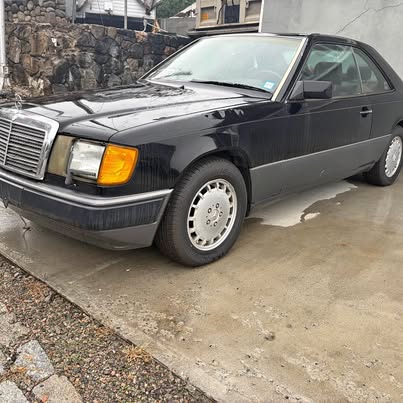
The build's market block beneath this guide carries the current numbers — what is listed now, and what recorded sales have achieved — and those figures move. What does not move is the structure of this market, and it is the structure that should shape your offer.
The 300CE spent two decades as a depreciating used car, and the market still prices it in two tiers that barely acknowledge each other. At the bottom are the cars run as cheap transport: high miles, no file, deferred everything, sold through general classifieds and social marketplaces by owners who priced them against ordinary old cars. At the top are the cars kept as classics-in-waiting: documented from new, garaged, original paint or a quality repaint, offered through specialists and auctions to buyers who know what a sorted W124 costs to create. The spread between a tired example and an exceptional one is wider — several times over — than for almost any other Mercedes of the period, and nearly all of it is explained by the cost of the known-items list in this guide. A car that needs a head gasket, an evaporator, four windows' worth of attention and a rear bush refresh is not a cheap version of the good car; it is the good car's price minus a five-figure workshop bill, and should be valued that way.
Variant premiums are real but modest by collector standards, and they follow desirability rather than rarity alone. The 24-valve cars (US 1990–92) carry a premium over the M103 cars in equal condition because they are simply better to drive, and the E320 Coupé carries a further one for its equipment and modernity — though a 1993–95 car still on its original wiring harness gives much of that premium back, because the market has learned to deduct the harness job from the asking price, and you should too. Genuine Sportline cars earn a premium; badge-only Sportlines earn nothing once the data card is checked. Colour and trim move these cars more than they move saloons: black, dark blue and silver over black or grey leather are the combinations buyers queue for, while period two-tone schemes and brown or beige interiors narrow the audience — which cuts both ways, because the unfashionable car in genuinely good condition is where the value in this market hides.
Asking and achieved prices part company most at the top of the market, where optimistic sellers anchor on the best auction result they can find for a car that is not that car. The headline auction sales are low-mileage, heavily photographed cars, and they say little about a 170,000-mile example with needs. The honest way to value any individual 300CE is from the condition outward: establish what the known items will cost on that specific car, using the figures in this guide, and work back from what a finished example of that variant actually achieves. Sellers of good cars negotiate in hundreds; sellers of needy cars at good-car prices negotiate in thousands once the inspection list is on the table — which is why the inspection, not the haggling, is where the money is made on a 300CE.
Parts and ownership
The W124 was built in the millions across all body styles, the coupé shares the great majority of its mechanical and electrical parts with the saloon and estate, and Mercedes-Benz Classic still supports the range properly. This is one of the easiest prestige classics of its era to keep — with the caveat that "easy" means available, not always cheap, and that coupé-specific parts are the exception to every reassuring generalisation in this section.
Easy: service items, filters, ignition consumables for the M103, brake discs, pads, calipers and hoses, dampers, springs, most suspension bushes and links, steering linkage parts, exhaust systems, water pumps, radiators, glass seals and most rubber. Order today, fit this weekend, at prices close to modern-car money. The KE-Jetronic wear parts — OVP relay, idle valve, EHA valve, accumulator — are all still obtainable new or rebuilt.
Harder and dearer: the M104 head gasket job is labour rather than parts, but the EZL ignition unit for the 3.0 M104 and good fuel distributors are hunted used parts; replacement wiring harnesses for the 1993–95 cars are available but priced as the low-volume parts they are; and the coupé-only catalogue is where patience gets tested — rear window regulators, seat-belt presenter components, coupé glass and seals, and correct coupé trim. None of it is unobtainable, but none of it ships overnight at saloon prices either, and a broken rear regulator on the car you are viewing should be priced as the specialist job it is, not waved through as a switch. Climate parts follow the same pattern: pods and monovalve inserts are cheap, evaporators are a labour bill wearing a parts costume.
Running costs. A sorted 300CE is a realistic regular-use classic. Fuel consumption sits in the low-to-mid twenties mpg on a run and the high teens around town, insurance is in line with other classics of the value, and any good independent Mercedes specialist can maintain the car — the W124 is the bread and butter of that trade. The budget line that catches new owners is the first year: catching up deferred maintenance on a running car honestly costs $2,000–5,000 before you improve anything, and a car bought with two or three big known items outstanding — gasket, harness, air conditioning — can absorb that again. Cars that have sat need the fuel system cleaned end to end (modern ethanol fuel attacks old rubber and varnishes tanks and distributors), every brake component inspected, and all fluids, belts and hoses renewed. Buy a car in regular use over a sleeping one, even at a higher price: on a W124, use is maintenance.
Which one to buy
- The all-rounder: 300CE, 1988–89 (M103). The simplest engine, the best-understood injection, no harness question, and the deepest pool of cars to choose from — our own current listings are all early cars like these. If you want a coupé to drive and enjoy, this is it.
- The driver's car: 300CE, 1990–92 (the 24-valve). The M104 3.0 gives the coupé the performance its chassis always deserved, still on KE-Jetronic and outside the harness years. Pay for the head-gasket invoice; it is the one big bill this variant carries.
- The modern classic: E320 Coupé, 1994–95. The facelift face, the torquiest engine, the best equipment — and a wiring harness that must either be documented as replaced or deducted from the price. A sorted E320 is the most usable coupé of all; an unsorted one is a project wearing a premium badge.
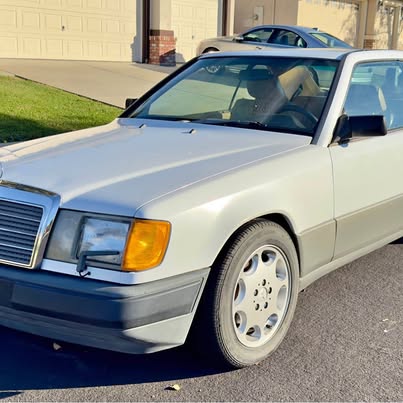
- The value buy: the unfashionable good car. A beige or two-tone M103 car with a thick file and a sound shell will be overlooked by buyers chasing black-on-black, and it drives exactly the same. Condition discounted for colour is the closest thing to a bargain this market has.
- The connoisseur's car: a genuine Sportline. Verified on the data card, with the stance and wheels to match. The package makes the car, the premium is still modest, and the supply of honest ones is small.
- The specialist purchase: AMG 3.4 or Hammer Coupé. Provenance first, car second, this guide third. Buy with a marque expert beside you or not at all.
And the rule that overrides all of the above: buy the car with the known items already done and the invoices to prove it, in the specification you can live with. Head gaskets, harnesses, evaporators and regulators are all fixable at prices you can plan for — but they are cheapest of all when the previous owner has already paid for them. The one thing no invoice can fix cheaply is a rotten shell, and it is the one thing about a 300CE that can never be made original again.
See the 16 E-Class cars currently listed.
What they sell for: E-Class sale prices.