
Mercedes-Benz S-Class buyer's guide
Mercedes-Benz S-Class -- the model's own buyer's guide: variants, values and what to check.
Years listed: 1994-2001 · Series: W140
Overview and history
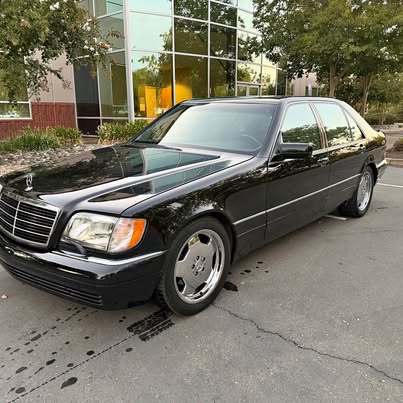
The S500 is the five-litre V8 version of the W140, the S-Class Mercedes-Benz launched at the Geneva motor show in March 1991 and built, in sedan form, until 1998 — with the last cars sold in North America as 1999 models. It is the most famous product of what Mercedes insiders themselves called the cost-no-object era: a car developed through the late 1980s under chief engineer Wolfgang Peter, delayed by roughly a year and pushed well over budget because the brief kept growing, and engineered to a standard the company publicly admitted it could not repeat. The W140 that resulted was bigger, heavier, quieter and more complicated than the W126 it replaced in every measurable way — and the S500, badged 500SEL until the naming change for the 1994 model year, sat at the centre of the range: the V12 S600 above it was the halo, the six-cylinder cars below it were the volume, but the 5.0-litre M119 V8 was the engine the car was really built around.
Understand the development brief and you understand both the car's greatness and its ownership economics today. Mercedes' engineers were told to build the best sedan in the world and were largely left alone while they did it. The result has double-glazed side windows — two panes with an air gap, fitted to cut noise and stop condensation. It has doors and a trunk lid that pull themselves the last few millimetres shut on pneumatic power, so you never slam anything. It has a cabin built like a bank vault, seats engineered with orthopaedic input, and a structure so stiff and so heavy — a loaded S500 weighs the better part of two and a half tons — that the ride and silence still embarrass cars built twenty years later. Bruno Sacco's styling was deliberately monumental: tall, upright, slab-sided, with a grille that announced the car's price before its badge did.
That over-engineering is a double-edged inheritance. When a W140 was new and under warranty, its complexity was invisible. Thirty years on, the complexity is the ownership experience: this is a car with pneumatic pumps for its door latches, vacuum pods behind its dashboard, a hydraulic self-levelling circuit at the rear on many cars, adaptive dampers on some, and an engine-management system that changed fundamentally halfway through production. None of it is fragile in the way period Italian electronics are fragile — the systems were built properly — but all of it is now old, and the bill for putting a neglected example right is set by 1990s flagship labour rates applied to 1990s flagship parts prices. The market knows this, which is why the W140 splits so violently into cheap cars and dear ones, a split the Values section below takes apart.
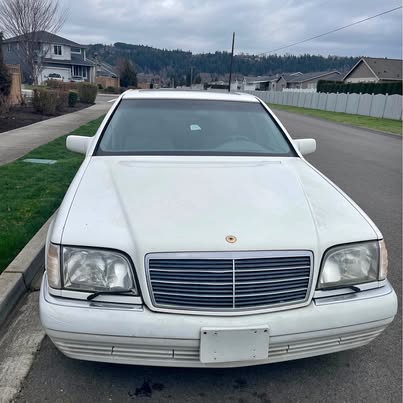
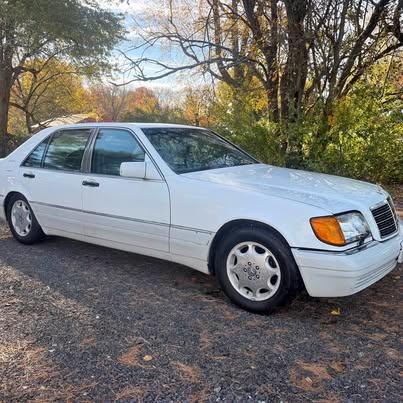
The naming needs one paragraph, because sellers exploit the confusion. The car launched as the 500SEL — 500 for the engine size, S for the class, E for injection, L for long wheelbase (every US-market W140 sedan is the long-wheelbase car; the short-wheelbase S500 sold in Europe was never officially offered in North America). For the 1994 model year Mercedes inverted its nomenclature across the range: the letter moved to the front, and the 500SEL became the S500. It is the same car, the same engine, the same shell — a 1993 500SEL and a 1994 S500 differ in trim details, not in kind. A mild facelift followed for the 1995–96 period — revised bumpers and lower-body cladding, clearer indicator lenses, and detail changes inside — and the deeper mechanical dividing lines, the wiring-harness change and the five-speed gearbox, arrived around the 1996 model year. Those two dates matter far more to a buyer than the badge on the trunk lid, and this guide returns to them constantly.
Our own listings pool is small but representative of how these cars reach the market now: of the 5 S500s currently in our pool, all 5 are W140s, all 5 are automatics, and they span the 1995, 1997 and 1998 model years (two 1995s, two 1997s, one 1998, in a sample of 5) — private sellers, in other words, offering the mid- and late-run cars that make up the bulk of what you will actually go and look at. The early 500SELs appear less often, and the best late cars increasingly change hands through specialists and auctions rather than open listings.
Buy a W140 S500 for the right reason: because you want the last S-Class built to an engineering brief rather than a cost target, and you are prepared to maintain it like one. Buy it with your eyes open and it is one of the great bargains in motoring — a car that cost supercar money to develop, selling for used-hatchback money. Buy the cheapest one on the internet and you will learn, line by line, exactly where that development money went.
The models
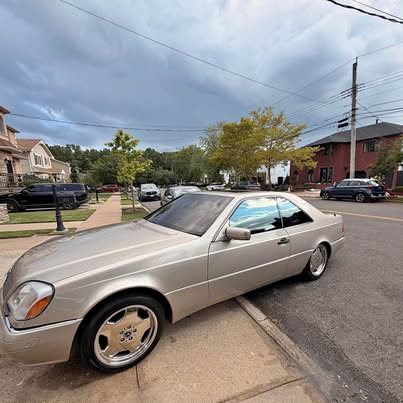
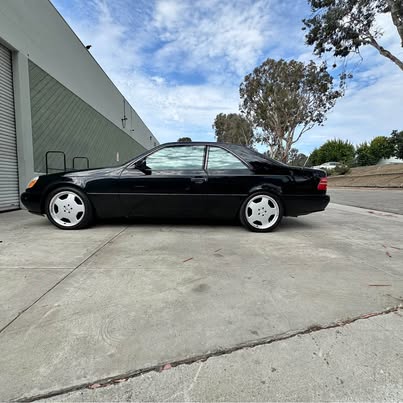
Every US-market S500 is a long-wheelbase W140 sedan with the 5.0-litre M119 V8 and an automatic gearbox. There is no manual, no short-wheelbase US car, and no diesel or six-cylinder variant wearing this badge — if a listing says otherwise, it is mislabelled. The variation that matters is by model year, because the car changed more under the skin than on it. There is also a coupe: the S500 Coupe (chassis C140), sold first as the 500SEC, which shares the engine, gearbox and most of the systems covered here but is a two-door car with its own market; one of the 5 cars in our current pool is in fact a coupe wearing the S500 name, a reminder to read listings by chassis, not by badge.
| Model | Years | Engine | Output | Built | Character |
|---|---|---|---|---|---|
| 500SEL | 1992–1993 (US) | 5.0 V8 (M119), LH injection | 315 hp (US net) | Part of 406,717 W140 sedans | The launch car; four-speed auto, early wiring |
| S500 | 1994–1995 | 5.0 V8 (M119), LH injection | 315 hp (US net) | Part of 406,717 W140 sedans | New badge, same car; harness still the early type |
| S500 | 1996–1999 | 5.0 V8 (M119), ME injection | 315 hp (US net) | Part of 406,717 W140 sedans | Five-speed auto, revised wiring, more electronics |
| S500 Coupe | 1993–1999 | 5.0 V8 (M119) | 315 hp (US net) | Part of 26,022 C140 coupes | The two-door; same systems, pillarless cabin |
(Production figures are given at chassis level because Mercedes' published totals are not reliably separable by engine for the US market; treat any seller quoting an exact build number for "your" S500 variant with suspicion unless it comes with a data card. Outputs are US SAE net figures; European cars were quoted at 320 hp DIN in later years and 326 hp for the earliest cars.)
The 500SEL (1992–93). The launch specification, and in some ways the purest: the full over-engineered brief, the four-speed 722.3 automatic, LH-Jetronic engine management with distributor ignition, and — the detail that now defines it — the early engine wiring harness whose insulation degrades, covered at length in Problem areas. Early cars also carry the retractable parking guide rods that pop up from the rear fenders when you select reverse, a piece of theatre Mercedes deleted in 1995 in favour of ultrasonic Parktronic sensors on later cars. A sorted 500SEL is a wonderful car; an unsorted one carries the longest job list in the range.
The first S500s (1994–95). The badge changed for 1994; the car underneath barely did. The facelift that followed brought the two-tone cladding down to a single colour treatment in stages, tidied the bumpers and lights, and added equipment, but the mechanical dividing lines had not yet moved: LH injection, the four-speed gearbox on 1994 cars (the five-speed arrived with the 1996 model year), and the early-type wiring harness through the 1995 model year. Judge a 1994–95 car exactly as you would a 500SEL, plus the facelift cosmetics.
The late S500 (1996–99). This is the developed car. Engine management moved to Bosch ME with hot-film metering integrated into a more modern architecture, the gearbox became the 722.6 five-speed electronic automatic, side airbags and then further safety equipment arrived, Parktronic became common, and — the single most valuable change for a modern buyer — the wiring-harness insulation was revised, ending the biodegradable-harness era. Late cars also carry more standard equipment and, on many, the options that complicate ownership: ADS adaptive damping and xenon headlamps among them. The last US cars are 1999 models, built in 1998 before the W220 took over.
Equipment and options — read the data card, not the listing. US S500s were heavily standardised: leather, wood, dual-zone climate control, power everything, the pneumatic closing assist and double glazing are all standard fare. The options that matter to an owner are the ones that add systems: ADS (Adaptive Damping System — electronically controlled dampers, working with the rear self-levelling fitted to many US cars), Parktronic, a rear sunshade, heated and orthopaedic seats, and the telephone and CD equipment that is now simply dead weight. Two cars that look identical in photographs can differ by an entire hydraulic damping system. The data card — available from the VIN through a dealer or the Mercedes-Benz Classic Center — lists what the car was built with, and on a W140 it is worth more than any seller description.
Engines and gearboxes
The M119 5.0 V8: one engine, two managements
Every S500 and 500SEL carries the same basic engine: the M119, a 4,973 cc all-alloy V8 with double overhead camshafts per bank, four valves per cylinder, and a bore and stroke chosen for torque rather than revs. In US specification it is rated at 315 hp with 347 lb-ft of torque, figures that sound modest now and are entirely sufficient in practice — this is an engine tuned to move two and a half tons in near-silence, and it does its best work between 2,000 and 4,500 rpm, where it pulls with the flat, unstrained surge that defines the car. It is also, by wide agreement, one of the most durable engines Mercedes has ever built. Bottom ends routinely pass 250,000 miles; the engine itself is almost never what kills an S500. What changes across the production run is not the engine but everything bolted to it, and the two management eras need to be understood separately.
LH cars (1992–95). The early engine — internal designation M119.970 in the sedan — uses Bosch LH-Jetronic sequential injection with a hot-wire air-mass meter, and a distributor ignition system with a cap and rotor at the front of each cylinder head, driven from the camshafts. This is 1980s technology refined to a high polish, and it behaves like it: diagnosis is by blink codes and experience rather than a modern scan tool, and the wear items are period ones. Distributor caps and rotors erode and track, especially on cars that sit; the air-mass meter's hot wire drifts with age and contamination, giving a flat, rich or hesitant car that no amount of plug-changing cures; and the idle-speed and throttle control runs through an electronic throttle actuator whose internal wiring is part of the harness problem described below. None of this is exotic, and a good Mercedes specialist who remembers these cars can sort an LH engine methodically. What you are buying is not fragility but a shrinking pool of people who know the system — factor your local expertise into the purchase, because an LH car in a town with no LH knowledge is worth less to you than the same car somewhere else.
ME cars (1996–99). For the 1996 model year the M119 (now M119.98x) moved to Bosch ME engine management: a more integrated system with hot-film air metering, better diagnostics through the OBD-II port every US car carried from 1996, and electronic throttle control as part of the management rather than an adjunct to it. The ignition remained distributor-based on the W140 application. In practice the ME cars start cleaner, idle tighter, report their faults in language a modern scanner understands, and are the easier cars to keep right in 2026 — the diagnostic path alone is worth money. They also arrived alongside the revised wiring, so a 1996-or-later car escapes both the harness era and the blink-code era in one step. That combination, more than the extra gear in the gearbox, is why late cars command the premium they do.
What the M119 does with age — the same in both eras. Four items recur. First, the camshaft oiler tubes: the M119 feeds oil to its cam lobes through tubes above each camshaft, closed at the ends by small fittings that were plastic on many production runs. The fittings age, pop out or crack, oil pressure to that section of the cam is lost, and the symptom is a ticking top end that owners misdiagnose as lifters. The fix — valve covers off, tubes out, metal-ended replacements in — is a few hundred dollars in parts and a morning's labour, and it is one of the best-value jobs on the car; a ticking M119 with popped oiler fittings is a discount to negotiate, not a car to walk from, provided the ticking is proved to be the tubes and not something deeper. Second, oil leaks: valve-cover gaskets, the front timing-case seals and the oil-pan gasket all weep with age, and a dry M119 is the exception. Budget for resealing rather than being surprised by it. Third, the timing chain and its guides: the chain itself is long-lived, but the plastic guide rails embrittle over decades, and a rattle from the front of the engine on a cold start that lasts more than a second or two deserves investigation before it becomes a skipped tooth. Fourth, hydraulic lifter tick on high-mileage or long-stored cars, usually an oil-history story: these engines want clean oil of the right grade, and a car that quiets down after an oil change and a proper run was telling you about its storage, not its health.
Cooling deserves its own sentence: the M119 in a W140 works hard, the radiators are now old, the viscous fan couplings fail silently, and the electric auxiliary fans depend on switches and relays that also fail silently. An S500 that creeps up in traffic is not "typical" — it is a cooling system asking for its radiator, fan coupling, thermostat and hoses, and overheating an alloy-head V8 is how a good engine becomes a rebuild. The temperature gauge's behaviour on the test drive is a priced item, exactly as the inspection section sets out.
Gearboxes: 722.3 four-speed and 722.6 five-speed
Two automatics, divided by the same 1996 line as the engine management.
The 722.3 four-speed (fitted to 500SELs and S500s through the 1995 model year) is Mercedes' own hydraulically controlled box, and it carries two behaviours that catch out buyers raised on modern automatics. It starts in second gear by design — first engages only on kickdown, or if you pull the selector to the lowest position — so a gentle pull-away is correct behaviour, not slip. And its shifts are firm by design, firmer still when cold. What is not correct is flaring (revs rising between gears), a long delay engaging reverse on a warm box, or a thump into gear that shakes the car; those are wear, and a 722.3 rebuild at a specialist runs roughly $3,000–5,500. The box is otherwise strong, and its most common real fault is neglected fluid: many were treated as "sealed for life" in spirit long before Mercedes said it of the later box, and a fluid and filter change transforms more of these gearboxes than any other single job. Budget for it on any car without a recent invoice.
The 722.6 five-speed (1996 on) is the electronically controlled box that went on to serve across the whole Mercedes range for a generation. In the W140 it transforms the car's cruising — taller top gear, lower revs, better economy — and shifts adaptively and smoothly. Its known behaviours: the electrical connector at the gearbox (the pilot bushing) leaks fluid up into the wiring with age, a cheap part that should be changed preventatively because the expensive version of the fault is a fluid-wicked control unit; the conductor plate inside the box is the common cause of limp-mode and erratic shifting on high-mileage cars, a mid-three-figure parts job rather than a rebuild; and Mercedes' original "filled for life" line should be ignored — fluid and filter every 40,000–60,000 miles is the specialist consensus now. A 722.6 that shifts cleanly hot and cold, with a dry connector and a recent fluid invoice, is about as safe as an old automatic gets.
No manual gearbox was offered on the US S500, and none is worth retrofitting; the car's whole character is built around the automatic. Judge both boxes the same way: cold behaviour, hot behaviour, reverse engagement, and the fluid's colour and smell on the dipstick where one is fitted (the 722.6 moved to a workshop dipstick tube — ask when it was last checked, and by whom).
Problem areas
The W140 inverts the usual classic-car hierarchy of worry. On most old Mercedes the body is the battle and the systems are simple; on this one the body is comparatively honest and the systems are the battle. The engine is tough, the shell is well protected, and the gearboxes are known quantities — what empties wallets is the layered 1990s flagship equipment reaching the end of its third decade all at once, on a car whose market value often will not carry the bill. That is why cheap S500s are cheap, and it is why this section is the longest in the guide. Work through it system by system, and price what you find against the car in front of you — the inspection checklist that follows is built directly on these pages.
The wiring harness: the dividing line of the whole model
Between roughly the 1991 and 1995 model years, Mercedes-Benz — like several European manufacturers — used wiring insulation formulated to be biodegradable, on the theory that a scrapped car's harness would break down rather than persist. In service, under engine-bay heat, it breaks down early: the insulation on the engine wiring harness cracks, crumbles and falls away, leaving bare conductors to short against each other. On an S500 the symptoms arrive as an escalating electrical mystery tour — misfires, a hunting or dying idle, warning lights, throttle faults, eventually a car that will not run at all — and because the damage is inside the loom, no amount of component swapping cures it. Every pre-1996 W140 must be assumed to be affected unless there is documentary proof the harness has been replaced with the revised part; the insulation change came with the 1996 model year, which is why this guide keeps returning to that date.
Learn to inspect for it, because it is visible if you know where to look. The harness runs across the top and front of the engine, and its most accessible sections are around the injectors and along the cam covers. Flex a section gently and look closely: healthy insulation is supple and whole; failing insulation shows fine cracks like crazy paving, flakes when touched, and in advanced cases leaves copper showing. Check also where the loom passes through connectors, and ask the question directly — a replaced harness is a selling point and an honest seller will have the invoice, because the job is not small: a new engine harness plus fitting runs roughly $1,200–2,500 all-in depending on source and labour, and the work is fiddly rather than difficult.
Two traps hide inside this one. The first is the throttle actuator's internal wiring: on the early cars the electronic throttle actuator (the ETA, the unit that meters the throttle under cruise and ASR control) carries the same insulation inside its own sealed casing, where no external inspection can see it. A car can have a new engine harness and a dying ETA. The symptoms — idle faults, limp-home mode, ASR warnings — overlap with harness symptoms, and the cure is a rebuilt actuator, roughly $600–1,200 exchanged, from one of the specialists who rewire them with modern insulation. The second trap is scope: the engine harness is the famous one, but starter and alternator looms of the same era share the formulation on some cars. When you price a pre-1996 car, price the harness as outstanding until invoices prove otherwise — and understand that a car with a documented new harness and a rebuilt ETA has had the single biggest early-car liability retired, which is worth a real premium over an identical car without the paperwork.
Air conditioning: the evaporator, and the dashboard-out economics
The W140's other headline job lives behind the dashboard. The air-conditioning evaporator — the aluminium core inside the heater box that chills the cabin air — corrodes and leaks with age, on every model year, early and late alike. The symptom is a system that holds a charge for weeks or a season rather than years, cooling that fades, and eventually a compressor cycling on low pressure. Diagnosis should be proper: dye in the system, a sniffer at the vents and the condensate drains, and a ruling-out of the cheaper leak points first (condenser, hoses, compressor seals, the drier connections), because the evaporator is the one component on the car whose replacement requires removing essentially the entire dashboard and the heater box behind it.
The economics are stark and worth stating plainly. The evaporator itself is a few hundred dollars. The labour is the job: figures of 20–30 hours are quoted by people who have done it, and at shop rates the total lands around $3,000–6,000, with the honest specialists at the lower end only because they have done enough of them to be quick. This single fact structures the whole W140 market. A car with cold air and a recent evaporator invoice is worth thousands more than the same car with warm air and a story, and a seller who says "it just needs a recharge" about a W140 is either innocent or hoping you are. On the inspection, air conditioning that blows genuinely cold — measured at the vent, on a warm day, after twenty minutes of running — is one of the most valuable things a W140 can show you.
While the dash is in your mind, add the vacuum pods: the climate system's flaps are moved by vacuum actuators buried in and behind the heater box, and their diaphragms perish. The symptoms are air going to the wrong places — demist air at your feet, centre vents that never open, a system that works on one side only. Individual pods are cheap; access is the cost, and some pods are reachable only with the dashboard out, which is why smart owners who pay for an evaporator have every pod replaced in the same labour, and why a car's history of "dash-out work" should be read as a positive, not a negative. The blower motor and its electronic regulator are the accessible members of the family: a blower that works only on some speeds, or surges and fades, is usually the regulator, a manageable job. Test the climate system in every mode on the inspection — heat, cold, demist, recirculation — because this system is where the four-figure surprises live.
Pneumatics: soft-close doors and the pumps that run them
The W140's party tricks are pneumatic, and pneumatics age. Two separate pumps matter. The closing-assist pump, mounted in the trunk, powers the soft-close function: you push a door or the trunk lid to its first latch, and the pump pulls it fully shut. When the system is healthy the pump runs for a few seconds per closure. When a door's closing element leaks or a line perishes, the pump runs longer and longer chasing pressure it cannot hold — ten seconds, twenty, until it overheats, times out or burns out — and the classic presentation is one door that has stopped soft-closing while the others still work, followed in time by a dead pump. Listen on the inspection: close each door in turn and time the pump's run from the trunk. A pump that stops within a few seconds on every door is a healthy system. A pump that runs on is telling you which door to investigate, and the usual cure is the closing element in that door or its line, not the pump itself — though a pump run to death is a rebuild or exchange unit, in the mid hundreds of dollars. The second pump is the PSE (pneumatic system equipment) pump under the rear seat, which runs central locking, the orthopaedic seat bladders where fitted, the retractable parking rods on early cars and various vacuum consumers. PSE faults show as slow or dead central locking and locks that cycle oddly; the pump itself is rebuildable, and its failure is an inconvenience rather than a catastrophe — but like the closing pump, a PSE pump that runs continuously is being killed by a leak elsewhere, and replacing the pump without finding the leak buys you a second dead pump.
Doors carry a second, simpler trap: the door check straps and the sheer weight of the doors themselves. W140 doors are enormous and heavy, hinges and checks wear, and a door that drops as it opens or groans on its check is showing you deferred adjustment. Cheap to fix early, a door skin's worth of damage if the check tears out of the frame — check all four.
Suspension: steel springs, self-levelling, and the ADS question
First, bury the myth, because sellers repeat it constantly: the W140 does not have air suspension. There are no air springs anywhere in the car. The suspension is steel coil springs and conventional dampers, with two complications layered on top of that honest base on many cars — and confusing the three systems leads buyers to price the wrong repairs.
The base system is straightforward and durable in design, but the car is heavy and the components are now old. Front suspension wear shows as knocks over bumps, vague on-centre steering and inner-edge tyre wear: the usual bill is control-arm bushings, ball joints and tie-rod ends, a few hundred dollars in parts per corner and a full alignment afterwards. Rear subframe and differential mounts perish and let the back of the car thump and wander under power. None of this is exotic; all of it is the standard cost of recommissioning a heavy car, and a W140 that drives loosely is almost never one fault but the sum of six small ones.
The first complication is hydraulic rear self-levelling, fitted to many US S500s (standard on the S600; check the data card and look for the hydraulic fluid reservoir and the lines to the rear struts). The system uses an engine-driven pump — shared with the power steering on a tandem pump — feeding rear struts whose ride height is held by gas-filled accumulator spheres. The spheres are the wear item: their internal diaphragms fail with age, the gas charge is lost, and the symptoms are a rear end that rides harshly, bounces without damping, or sits at the wrong height. A sphere is a few hundred dollars; the test is in the inspection section (bounce the rear and watch how it settles; check the fluid level and colour; look for weeping struts). A car whose rear rides like a pogo stick is usually a spheres car, not a struts car — the distinction is worth over a thousand dollars, so make it carefully.
The second complication is ADS — Adaptive Damping System, an option on the S500 and standard on the S600, which replaces the conventional dampers with electronically controlled units whose valving the car adjusts continuously, working alongside the self-levelling. When ADS works, it is superb. When its dampers wear or its electronics fault, the replacement cost per corner is several times that of a conventional damper, and the parts supply is thinner. This is the one option that should genuinely move your bid: an ADS car with a documented, working system is a delight; an ADS car with dead dampers and a warning light is carrying a four-figure liability that a non-ADS car simply does not have. Verify ADS by the data card, not the seller's word — and if the car has it, test it (the system firms noticeably when the sport/comfort control is exercised and the car is driven hard over rough surfaces) and price it accordingly.
Rust: the smaller risk, honestly stated
Against a W108 or W126, the W140's rust story is genuinely better — the shell was well protected by the standards of its day, and the structural rot that writes off older Mercedes is uncommon here. It is not absent. The places to look are the places water sits and road salt works: the bottoms of the front fenders behind the wheels, the lower edges of the doors, the rear wheel-arch lips, the trunk floor and the spare-wheel well (the trunk seal and rear lamp seals leak, as on every Mercedes of the era), the battery tray area, the jacking points and sill ends, and the spring perches and subframe mounting areas on cars from the salt belt. Northern cars that have lived outside can also show corrosion in the brake and fuel lines and in the hydraulic lines for the self-levelling, which matters more than a bubbled arch because a failed line is a safety item. Read rust on a W140 as a usage and geography report rather than the existential threat it is on the older cars: a rusty W140 is usually a car that has been used hard and stored wet, and that story will be confirmed by everything else you find. A clean, dry-climate shell with tired systems is the better buy at the same money — on this model, unusually, you buy the systems and let the shell look after itself.
Interior, glass and electrics
The cabin is built to a standard nothing else at the price matches, and most of it ages gracefully: the leather is thick, the wood is real and usually sound, the seats are superb. The failures are specific. The double-glazed side windows delaminate — moisture creeps between the panes and the edges go milky or cloudy, starting at the corners. It is cosmetic, it cannot be polished out, and replacement glass is expensive and increasingly scarce; judge how much it bothers you, because you will look at it every day. Headliners sag as the foam backing dies, as on every German car of the period; a re-trim is a few hundred dollars done properly. Window regulators and the soft-close door elements have been covered above; add the sunroof, whose mechanism is strong but whose seals and drains, if neglected, put water into the headliner and pillars — test it fully, tilt and slide, and check for staining at the corners of the headliner.
Electrically, the W140's systems are individually robust but numerous, and the pattern of failure is one module at a time rather than systemic collapse — outside the harness years, that is. The instrument cluster's gauges and warning lights should all sweep and settle correctly; the digital odometer on later cars and the trip functions should work. Climate control push-button units develop solder-joint faults with age and heat (intermittent operation, buttons that need a press-and-hold), and exchange or repaired units are the fix. Seat motors, memory functions, the rear sunshade, heated seats — test every one, not because any single failure is expensive, but because the count of dead functions is the most honest condition report a W140 gives you. A car where everything works has been maintained by someone who fixed things as they failed. A car with six dead accessories has been maintained by someone who let things go — and that attitude will not have stopped at the accessories. This principle — systems health as a proxy for the whole car's history — is the closest thing the W140 has to a single buying rule, and the Values and inspection sections both build on it.
How to inspect one
Allow ninety minutes, bring a torch, a tyre-pressure gauge, and a vent thermometer if you have one — on this car the thermometer earns its place. If the car passes you, pay for a specialist pre-purchase inspection with the car on a lift and a scan tool attached (a full Mercedes diagnostic session on a late car, a blink-code and experience session on an early one). On a W140, the inspection is not a formality; it is the purchase.
- Paperwork and identity first. Match the VIN on the title to the plate at the base of the windshield and the stamping in the engine bay. Get the data card decode from the VIN and compare it with the car in front of you — engine, ADS or not, self-levelling or not, original colours and trim. Then read the history file with the problem sections in mind: you are looking for four invoices above all — wiring harness (pre-1996 cars), evaporator, gearbox fluid services, and suspension spheres or dampers. A thick file with those in it changes what the car is worth by thousands.
- Establish the year honestly. Badge means nothing; establish the model year from the VIN and the paperwork, then apply the dividing lines: pre-1996 means LH management, four-speed (through 1995) and the early harness era; 1996 on means ME management, the 722.6 five-speed and revised wiring. A "1996" car built in late 1995 deserves a harness inspection anyway — check the loom itself, per step 4, whatever the paperwork says.
- Cold start. Insist the engine is stone cold. An M119 should fire at once and settle to an even idle within seconds. Listen for timing-chain rattle lasting more than a second or two, top-end ticking (the oiler-tube question from the engine section — ticking that fades as oil pressure builds is a different, lesser story than ticking that stays), and watch for smoke: a puff on start-up after sitting is common; sustained blue smoke is not. Any misfire or hunting on an early car starts the harness conversation immediately.
- The harness inspection (pre-1996 cars). With the engine off, work along the accessible loom — around the injectors, along the cam covers, at the connectors. Flex gently and look for cracked, flaking, crazy-paved insulation or visible copper. Do not accept "it runs fine" as evidence; failing harnesses run fine between shorts. If the insulation crumbles under your fingers, the harness job ($1,200–2,500) goes into the price, in full, alongside the throttle-actuator question — ask whether the ETA has been rebuilt, and treat silence as a no.
- Air conditioning, properly tested. Run the climate system for at least twenty minutes during the viewing and test drive. Measure or honestly judge the vent temperature: it should be properly cold, not cool-ish. Cycle through demist, face, feet and recirculation and confirm the air goes where the buttons say (the vacuum-pod test from Problem areas), run the blower on every speed, and then test full heat. Ask directly when the evaporator was done and ask for the invoice. Warm air plus no invoice is a $3,000–6,000 deduction, negotiated as such.
- Soft-close and pneumatics. Close each door in turn to its first latch and let the system pull it shut; stand at the trunk and time the closing-assist pump — a few seconds per door is healthy, a long run points at that door's element or line. Then close the trunk the same way. Work the central locking repeatedly and watch for lazy locks (the PSE pump's report). On an early car, select reverse and confirm the parking guide rods rise; on a late car, walk the Parktronic test if fitted.
- Suspension by hand and eye. Check the stance first: the car should sit level and at even height, front and rear, side to side. Bounce each corner: a healthy car settles in one movement; a rear that keeps bouncing on a self-levelling car is the accumulator spheres announcing themselves. Look for the hydraulic reservoir and check its fluid level and colour. Under the car (or on the lift at the PPI), look for weeping rear struts, perished subframe mounts and rust in the spring perches and hydraulic lines. If the data card says ADS, confirm the dampers are the ADS units and that no warning light is lit — then price what you found using the suspension section, not optimism.
- The test drive — gearbox. Drive at least twenty minutes, from cold to fully warm, town and highway. On a 722.3 car, confirm the second-gear start (normal), then use kickdown to feel first engage; shifts should be firm, never flaring, and reverse should engage promptly when warm. On a 722.6 car, shifts should be nearly invisible, with no limp mode, no harsh downshift to a stop, and clean manual-range selection. Any flare, delay or thump converts directly into a rebuild deduction ($3,000–5,500 for the four-speed; diagnose the five-speed's conductor plate and connector before assuming the worst).
- The test drive — engine, cooling and brakes. Use the performance: the car should pull hard and cleanly from 40 to 70 mph without hesitation, and the temperature gauge should climb to its normal mark and stay there in traffic — creep at idle is the cooling system (radiator, viscous coupling, auxiliary fans) asking for money, and it is not "typical." Brake firmly from speed twice: straight, no judder, no pull. A W140's brakes are excellent; anything less is wear or seized calipers from sitting.
- Every switch in the car. Methodically: all windows (watch for slow ones — regulator wear), sunroof tilt and slide, both front seats in every direction plus memory and heat, mirrors, rear sunshade if fitted, wipers and washers, lights, horn, radio, cluster functions. Count the failures. Per the electrics section, the count itself is the verdict: zero or one dead function is a maintained car; five is a maintenance philosophy you are about to inherit across every system, including the ones you cannot test.
- Glass, interior and trunk. Check every side window's edges for the milky delamination of the double glazing. Check the headliner for sag and water staining at the corners (sunroof drains). Sit in every seat; check the driver's bolster and the seat springs. In the trunk, lift the spare and the mat: look for water staining, rust in the well corners, and find the closing-assist pump and listen to it once more from close range. Check the battery tray and the tool kit while you are there.
- Underside and rust, last but not least. On the lift at the PPI if at all possible: fender bottoms, door lower edges, arch lips, sill ends and jacking points, spring perches, subframe mounts, brake and hydraulic lines. Rust on a W140 is a geography report — read it as evidence of how and where the car has lived, and let it confirm or contradict the story the systems have told you. A salt-belt car with tired systems is the combination to walk away from; a dry-climate car with tired systems is a negotiation.
Values
The figures that matter for this model are computed from this site's own listings and recorded sales, and they sit below this guide — the listed-now summary and the market block are refreshed every time the site rebuilds, so use them rather than any number quoted elsewhere. What follows is how to read them.
The W140 S500 market is not one market but two, stacked on top of each other and wearing the same badge. At the bottom sits the deferred-maintenance car: cosmetically presentable, mechanically tired, carrying some combination of the headline jobs from the problem sections — a harness on an early car, an evaporator, spheres, a gearbox service, a sheaf of dead accessories. These cars are cheap because the arithmetic is merciless: the work they need, done at retail, approaches or exceeds what the finished car is worth, and every informed buyer prices them accordingly. At the top sits the maintained car: documented, everything working, the headline jobs done, usually a late car, usually sold by an owner or a specialist who can prove the history. The spread between those two markets is among the widest of any modern classic, and the median figures in any market block average across both of them — which is why the median S500 is a statistical object that does not exist in the metal. Read the range, not the middle.
Three things move an individual car within that range, in this order. Documentation first: the four invoices named in step 1 of the inspection are worth more than low mileage, because they retire known liabilities rather than merely suggesting care. Model year second: the 1996-on cars carry a structural premium for the revised wiring, ME management and the five-speed, and the premium is rational, not fashionable — it prices work the buyer will never have to do. Systems health third: the count of working functions, cold air, a quiet pump, a level ride. Mileage, notably, comes a distant fourth — a 180,000-mile car with invoices beats a 90,000-mile car with none, on this model, almost every time. Colour and trim move money only at the very top of the market, where originality and specification start to matter to collectors; our current pool's mix — black and white cars predominating, with a gold car in the sample of 5 — reflects what the mainstream market actually trades in.
Two cautions. Asking prices on these cars are especially unreliable at the bottom: sellers of tired cars anchor on what the car cost new, or on the maintained cars' prices, and the gap between asking and achieved on a project S500 can be the widest in the Mercedes market. And the pool at any given moment is small — our own current sample is 5 cars — so treat any single month's figures as weather, not climate. The durable truth is the shape of the market: you are not choosing between a cheap S500 and an expensive one, you are choosing between paying for the maintenance before the purchase, in the price, or after it, in invoices. The first way is cheaper.
Parts and ownership
The W140 was built in serious numbers — over 400,000 sedans — and Mercedes-Benz supported it accordingly, but ownership in 2026 runs on a two-tier supply: the mechanical core is easy, and the flagship systems are where the patience and the money go.
Easy: service items for the M119 (filters, plugs, belts), brake discs and pads, most suspension wear parts (bushings, ball joints, tie rods), cooling-system components, exhaust sections, accumulators for the self-levelling, oiler tubes, distributor caps and rotors for the LH cars, and the normal run of seals and gaskets. The Mercedes-Benz Classic Center and the specialist trade between them keep the service side of the car at sensible prices, and a good independent Mercedes specialist can maintain the mechanical car without drama.
Harder and dearer: the evaporator (cheap part, $3,000–6,000 fitted — the labour is the part), ADS dampers (several times the price of conventional units, thinner supply), double-glazed side glass (delamination cannot be repaired; good replacement panes are the hunt), closing-assist and PSE pumps (rebuilds and exchanges exist; new-old-stock is drying up), rebuilt throttle actuators for the early cars, LH air-mass meters, climate vacuum pods (cheap parts behind expensive access), and interior trim in the less common colours. The pattern to internalise: on a W140, access is the currency. Again and again the part is affordable and the hours are not — which is why grouping jobs (every vacuum pod while the dash is out for the evaporator; both spheres together; harness and actuator in the same campaign) is how experienced owners keep these cars economically, and why a car's history of grouped, documented campaigns reads so well in step 1 of the inspection.
Running costs. Fuel consumption is what two and a half tons and a 5.0 V8 promise: mid-teens mpg in town, low twenties on a gentle highway run, premium fuel. Budget honestly for the first year: catching up a maintained car's minor deferrals is a four-figure sum; catching up a cheap car's majors is the subject of the Values section. Annual servicing itself is unremarkable — oil, filters, inspections, the occasional wear item — provided the car starts from sorted. Insurance is generally reasonable on classic or agreed-value policies, and the cars are new enough to have modern safety equipment (dual and later side airbags, ABS, traction control, and stability control on later cars), which helps. The ownership profile that works is regular use: W140s deteriorate by sitting — seals dry, pumps sulk, tyres flat-spot under the weight, batteries die under the parasitic load of forty systems asleep. A driven S500 is a reliable S500; a stored one is a recommissioning project on a timer. If you cannot use the car weekly, this is the wrong classic, whatever the purchase price says.
Which one to buy
- The all-rounder: a 1996–99 S500 with invoices. ME management, the five-speed, revised wiring, the full late equipment — and the headline early-car jobs designed out. Pay the premium for the documented car; on this model the premium is the discount.
- The value buy: a 1994–95 S500 with the harness already done. The facelift looks and the simpler four-speed car, with its one structural liability retired and invoiced. Without the harness invoice it is not a value buy at any price — it is a 500SEL in newer clothes.
- The purist's car: a 1992–93 500SEL, sorted. The launch specification, parking rods and all, and the most charismatic version of the brief. Buy it only with the harness and throttle actuator proved done, and enjoy the fact that everyone else was too frightened to.
- The cruiser: any year, ADS and self-levelling working. If your driving is distance, a car with its hydraulic systems documented and healthy rides like nothing else at the money. If the ADS is dead, it is not this car — walk to the next one.
- The brave buy: the cheap car with warm air and a long job list. Only for an owner who does their own labour or has a specialist on retainer, bought at a price that assumes the evaporator, the spheres and the accessory count all land at once. The arithmetic in the Values section is the whole decision.
- The coupe footnote: the S500 Coupe. Same engine and systems, pillarless glamour, a smaller and quirkier market. Everything in this guide's engine and problem sections applies unchanged.
And the rule that overrides all of the above: buy the car whose systems all work, with the invoices to prove the big jobs are done — on a W140, condition is not the paint, it is the paperwork and the pump run-times. The engine will outlast you; the shell will probably outlast you; it is the forty systems in between that you are actually purchasing, and they are purchased exactly as found.
See the 14 S-Class cars currently listed.
What they sell for: S-Class sale prices.