
Mercury Comet Cyclone GT buyer's guide
Mercury Comet Cyclone GT -- the model's own buyer's guide: variants, values and what to check.
Years listed: 1967-1967 · Series: Comet
# Mercury Cyclone — Buyer's Guide
Overview and history
The Mercury Cyclone is the performance intermediate Mercury built, with interruptions in name and body, from 1964 to 1971 — and it is two different propositions depending on which end of that run you buy. At the start it is a Comet with teeth: a compact-based hardtop and convertible given the small-block V8s, bucket seats and attitude that the ordinary Comet lacked. In the middle, from 1966, it becomes a true intermediate on Ford's Fairlane platform, with room under the bonnet for the FE big-blocks and a fastback shape that went NASCAR racing. At the end, in 1969 to 1971, it produces the cars collectors chase hardest: the Cyclone CJ built around the 428 Cobra Jet, the long-nosed Cyclone Spoiler II built purely to homologate an aerodynamic nose for the superspeedways, and the 1970 Cyclone Spoiler with a 429 under a formal new body. Buy the right one and you get a rarer, often better-trimmed alternative to the Ford Torino and Mustang machinery it shares. Buy the wrong one — a rusty unibody wearing a valuable car's stripes and a seller's story — and you own an expensive lesson in how identity, not paint, is where the money lives in this market.
The name itself moves, which confuses listings to this day. For 1964 and 1965 the car is the Mercury Comet Cyclone, the flagship of the Comet compact line. For 1966 and 1967 it is still Comet-badged — Comet Cyclone and Comet Cyclone GT — but the underlying car has grown into an intermediate. From 1968 the Comet name leaves the performance car and it is simply the Mercury Cyclone, based on the Montego line that replaced Comet as Mercury's intermediate. That is why you will see later Cyclones cross-listed as Montegos, and Montego MX family cars dressed and described as Cyclones. They are related, they share a platform and much sheet metal, and they are not the same car in value, specification or identity. The VIN, the body data plate and a Marti Report settle which one is in front of you; badges and stripes settle nothing.
On this site the Cyclone pool is small and honest about it: eight records in total, four offered for sale and four recorded as sold, and every one of them is filed under the Comet series umbrella in the store's taxonomy. The years represented run from 1966 to 1970 — three from 1966, two from 1967, one from 1969 and two from 1970 in the year breakdown — so the pool speaks most directly about the big-block GT years and the late Spoiler era, and not at all about the 1964–65 compacts or the final 1971 cars. Manual gearboxes are well represented among the listed cars, red is the commonest colour in the pool, and one 1966 convertible in Emberglo with a white top shows the softer, open side of a nameplate most buyers picture only as a fastback. Treat those as a flavour of what reaches the market, not as a census of production. The full run is wider, stranger and more varied than any eight cars, and the rest of this guide covers the full run while keeping site claims scoped to that pool.
The models
Read the range as four chapters. Chapter one, 1964–65, is the Comet Cyclone: a compact hardtop (and, for 1965, a convertible) with the 289 cubic-inch small-block at the top of its range, lively performance in a light shell, and none of the big-block hardware that defines the later cars. Chapter two, 1966–67, is the Comet Cyclone and Cyclone GT on the new intermediate platform: a hardtop and convertible, the 390 GT big-block as the headline engine, fibreglass bonnet scoops on the GT, and an Indy pace-car moment in 1966 that put the convertible briefly in the spotlight. Chapter three, 1968–69, drops the Comet badge, adds the fastback body that defines the model's image, and culminates in the Cyclone CJ — a deliberately plain, price-led package built around the 428 Cobra Jet — and the Spoiler and Spoiler II aero cars. Chapter four, 1970–71, restyles the car completely around a protruding grille centre section, offers Cyclone, Cyclone GT and Cyclone Spoiler in ascending order of intent, replaces the FE with the 429 in the top cars, and then fades as emissions rules, insurance surcharges and falling demand close the muscle era down.
| Model | Years | Engine (headline) | Period output | Built | Character |
|---|---|---|---|---|---|
| Comet Cyclone | 1964–65 | 289 V8 | up to 271 hp (hi-po, rare) | volume compact flagship | Light, simple, small-block only |
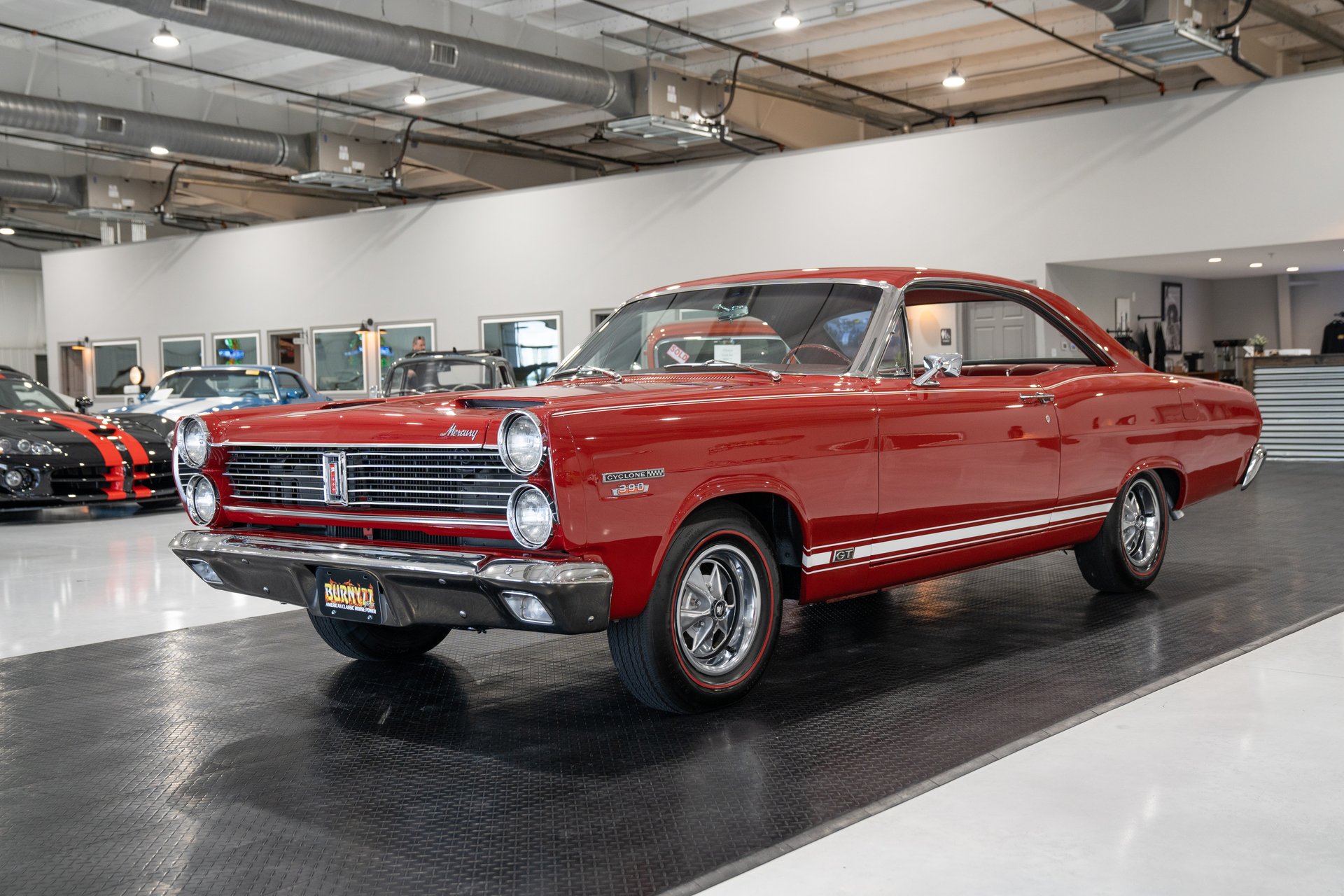
| Comet Cyclone GT | 1966–67 | 390 GT FE V8 | 335 hp | low thousands per year | Big-block pace-car-era GT, hardtop and convertible |
| Cyclone (fastback/hardtop) | 1968–69 | 302/351/390, then 428 CJ | up to 335 hp (rated) | modest intermediate volume | The NASCAR-shaped car; CJ is the value-performance play |
| Cyclone Spoiler II | 1969 | 351W or 428 CJ | 290–335 hp | a few hundred, homologation run | Extended aero nose; Gurney and Yarborough editions |
| Cyclone Spoiler | 1970 (GT and base 1970–71) | 429 Cobra Jet | 370 hp | low production | Last of the breed; 351 Cleveland in lesser cars |
The 1968 redesign is where the Cyclone becomes the car in the posters. The fastback roofline — Mercury's SportsRoof equivalent — was shaped with the superspeedways in mind, and the road car carries that purpose in its silhouette. Base cars with small-blocks are cruisers in a dramatic body, which is a perfectly good thing to buy knowingly and a poor thing to buy at Cobra Jet money unknowingly. The 1969 Cyclone CJ answers that directly: Mercury took the 428 Cobra Jet, put it in the fastback with minimal frills, and sold performance per dollar against Ford's own Torino Cobra. The CJ's plainness is original and correct — bench seats and modest trim on a CJ are features of the package, not evidence of a stripped car.
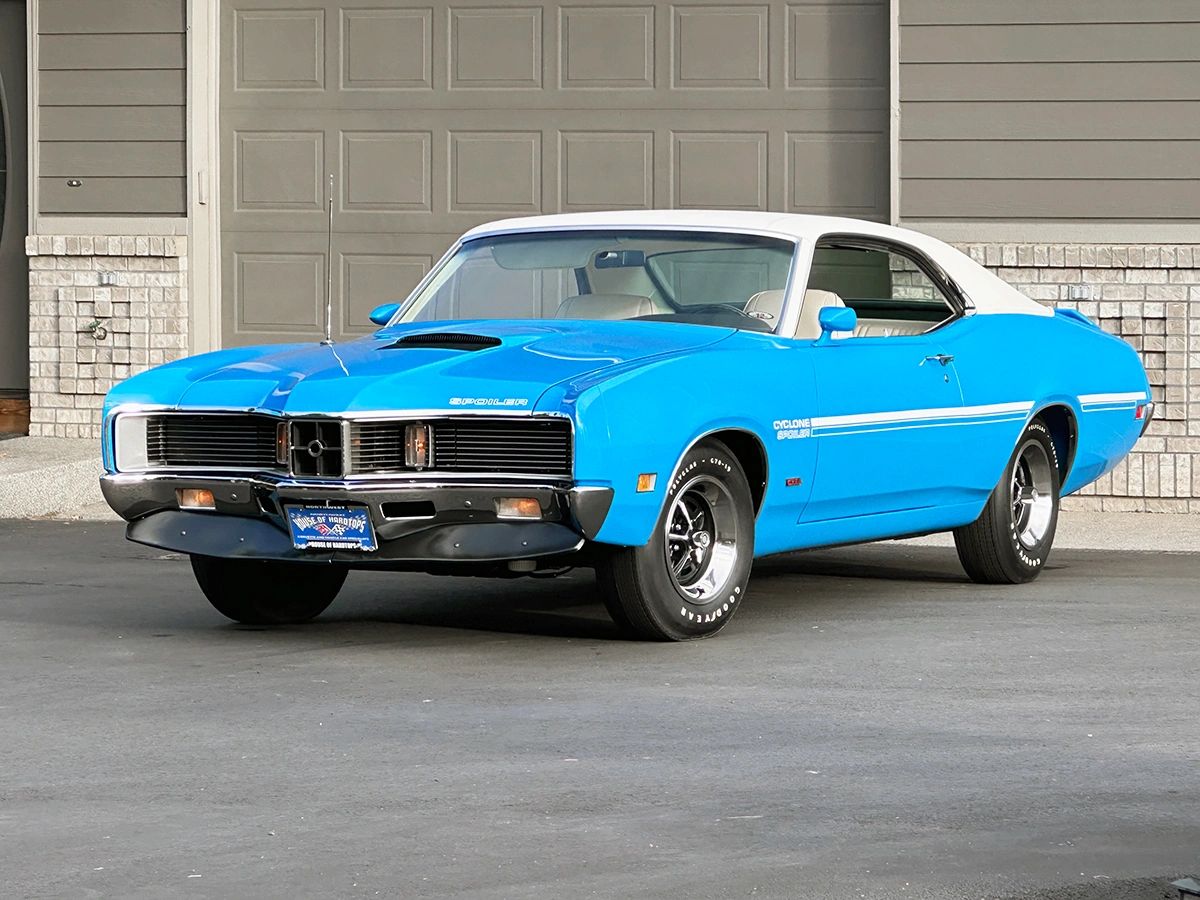
Then the aero cars. The 1969 Cyclone Spoiler wore a rear wing and stripes; the Spoiler II went much further, with an extended, drooped nose and flush grille built in limited numbers so the shape would be legal for NASCAR. Two colour schemes tie to two drivers: white with blue roof and stripes for the Dan Gurney Special, white with red roof and stripes for the Cale Yarborough Special. Both schemes were also available, in period and ever since, as paint and tape on ordinary cars. That sentence is the single most important one in this section. A Gurney or Yarborough car is a Spoiler II by VIN, build record and aero hardware first, and a colour scheme second. A striped fastback with a standard nose is a Cyclone with stripes, worth Cyclone money, however good the story sounds at midnight in a listing description.
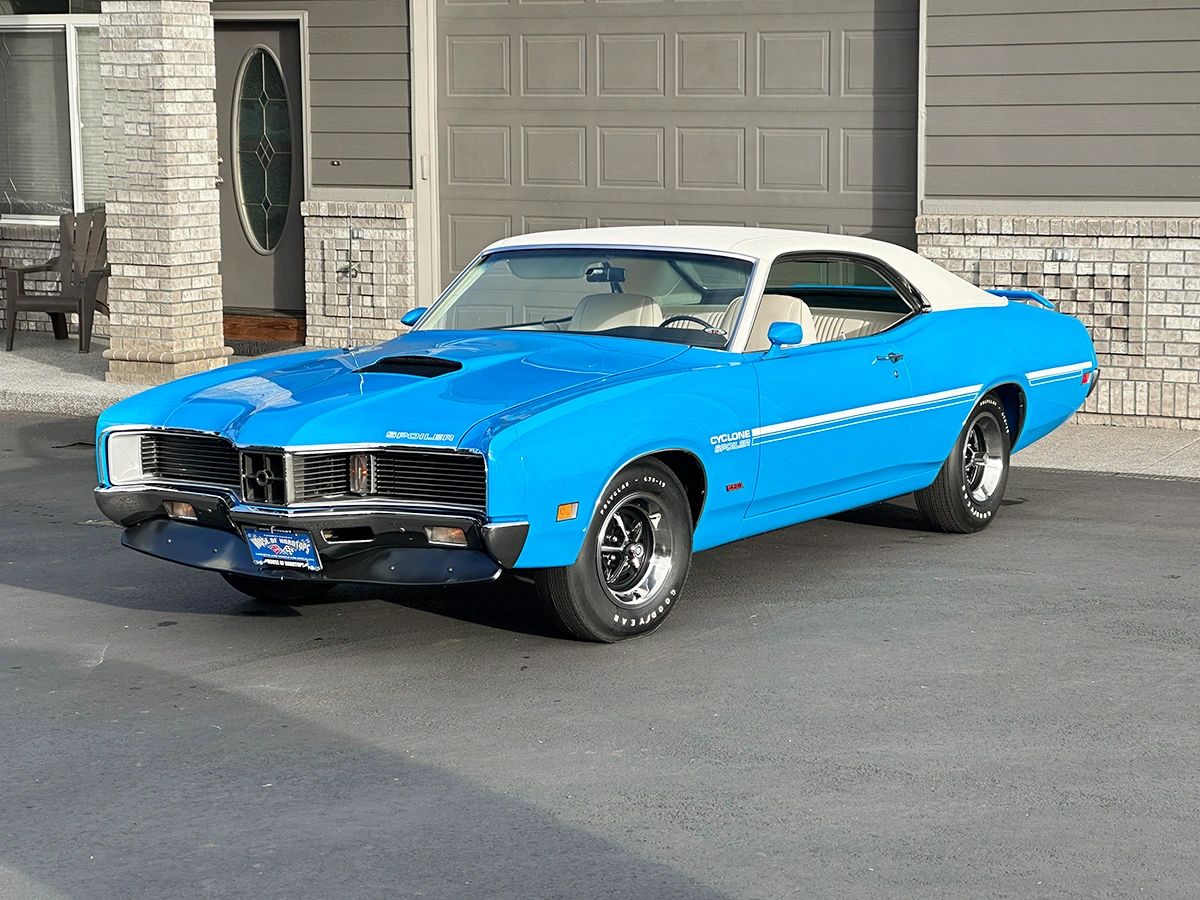
For 1970 the body changes completely: longer, lower, with a prominent central grille beak that owners either love or learn to love. The range rationalises into Cyclone (the price leader, still available with serious engines), Cyclone GT (the trimmed grand tourer) and Cyclone Spoiler (the winged, striped, 429 Cobra Jet flagship, with the Drag Pak and Super Cobra Jet hardware available to those who ticked the right boxes). The 351 Cleveland small-block becomes the volume performance engine and suits the car well. For 1971 the names and shapes carry over with compression ratios and outputs falling, sales thinning, and the range effectively marking time. A good 1971 is a usable, cheaper route into the body style; it is not a 1970 Spoiler, and should never be priced or described as one.

Engines and gearboxes
Three engine families power the Cyclone story, and each has its own buying logic. The small-block Windsor family opens the story (289, 302, 351W). The FE big-block family defines the middle years (390, the rare 427, and the 428 Cobra Jet). The 385-series 429 closes the story in 1970–71, with the 351 Cleveland arriving alongside it as the modern small-block. Learn to identify each family on sight — FE engines carry the intake manifold under the rocker covers, so the covers overlap the manifold edges; a 429 has evenly spaced, canted-valve hardware under wider covers; a Cleveland has its own wide heads and a thermostat housing into the block rather than the manifold — because the commonest expensive mistake in this market is paying for an engine code the car no longer contains, or never did.
The FE big-blocks — 390, 427 and 428 Cobra Jet
The FE (Ford-Edsel) is the engine the Cyclone's reputation rests on, and in 390 GT form it is a better road engine than its paper figures suggest. The 390 GT of 1966–67 uses a hydraulic-lifter camshaft, a four-barrel carburettor (period cars carry an Autolite 4100-series or a Holley, depending on year and specification), cast-iron exhaust manifolds that flow better than their ugly reputation, and a rated 335 hp with torque that arrives early and stays. In a 1966–67 GT with the right axle ratio it gives effortless, elastic performance and a proper big-block exhaust note, at the price of real fuel consumption and a heavy front end that understeers if you charge into a corner on tired suspension. The ordinary 390 two-barrel and four-barrel non-GT variants are softer in cam, compression and intent; they are fine engines in a cruiser, but a GT price demands a GT engine code, GT cam behaviour and the paperwork to match.
The 427 is the FE's racing flagship — side-oiler lubrication on the later performance blocks, solid lifters in most performance states, dual four-barrels or a single large Holley depending on specification, and a temperament that wants octane, attention and a driver who understands valve lash. Fitted to a tiny number of 1966–67 Comets (the 427 was primarily a Fairlane and full-size story, and Comet installations are rare enough that each one is individually documented in the hobby), it transforms the car's value and its running costs together. Do not buy a claimed 427 Cyclone on an engine number alone. FE blocks were swapped between cars for fifty years, 390s have been dressed as everything, and the only safe purchase runs through casting numbers, date codes consistent with the car's build date, the VIN record and expert verification. If that sounds like hard work, it is — and it is still cheaper than discovering the truth after the wire transfer.
The 428 Cobra Jet, arriving in 1968 and defining the 1968½-onwards performance cars, is the FE to buy. Mechanically it is a well-judged production hot-rod: a 428 block with the reinforced main webbing of the police-interceptor lineage, a nodular-iron crankshaft, the larger-valve cylinder heads derived from the 427 low-riser pattern, a hydraulic camshaft with real lift, a 735 cfm Holley four-barrel on a cast-iron (later aluminium on some applications) intake, and low-restriction exhaust manifolds. Rated at 335 hp — the same figure as the 390 GT, which tells you everything about late-1960s rating politics — it makes substantially more, with torque the 390 cannot match. The Super Cobra Jet variant, tied to the Drag Pak axle options, adds a different crankshaft counterweighting arrangement, stronger connecting rods with cap-screw bolts, and an external oil cooler; identifying a genuine SCJ requires the axle code, the cooler hardware and the records together, not any one of them alone.
The 351s and the Boss era — Windsor, Cleveland, and what a Cyclone is not
The small-block story starts with the 289 and 302 Windsors in the early and base cars: simple, light, well-supported engines whose virtues are cheap parts, easy tuning and a sweet exhaust note, and whose vice in a 1968-onwards intermediate is simply mass — the later body asks more of them than the compact did. A 289 or 302 Cyclone is a cruiser with style. Buy it as that, enjoy it as that, and do not let anyone sell it to you as a Cobra Jet alternative.
The 351 Windsor, standard on the 1969 Spoiler II in its four-barrel form, is a taller-deck development of the small-block with a longer stroke, rated around 290 hp in four-barrel tune, and it suits the aero car honestly: the Spoiler II's advantage was always in the air, not in a drag race against its own 428 option. A 351W car should idle smoothly, pull cleanly through a single four-barrel (Autolite or Motorcraft 4300-series carburettors on later cars have their own flat-spot reputation, usually traced to accelerator-pump and float settings rather than to the castings), and show no coolant in the oil or oil in the coolant — the Windsor's head-gasket and intake-seal failures announce themselves exactly that way when they come.
The 351 Cleveland, arriving for 1970, is a different engine wearing the same displacement: canted-valve heads with large ports, a reputation for top-end breathing, and two personalities — the two-barrel, small-port cruiser and the four-barrel, large-port performance version, with the Boss 351 and Cobra Jet Cleveland variants belonging to the Mustang and Torino world and appearing in a Cyclone only if a previous owner put one there. In a 1970–71 Cyclone GT the four-barrel Cleveland is arguably the sweet spot of the whole late range: lighter than the 429, eager to rev, and far cheaper to run. Check Cleveland specifics carefully. The oiling system prioritises the mains in a way that makes sustained high-rpm use hard on bearings in a worn engine, so listen for bottom-end rumble on a hot restart. The factory carburettor's spread-bore pattern tempts owners into intake swaps; a swapped manifold is not a sin, but ask for the original parts. And the Cleveland's cooling depends on the correct restrictor plate under the thermostat housing — a missing or wrong plate causes the classic Cleveland paradox of an engine that runs hot while its radiator stays cool, because coolant bypasses the radiator circuit. Test for it on the road test, not in the driveway.
Now the myth, stated plainly because the money depends on it: there is no regular-production Boss 302 or Boss 429 Cyclone. The Boss 302 engine went into Mustangs and Cougar Eliminators; the Boss 429 was a Mustang-only homologation installation. Period Mercury racing used Boss-derived hardware, and owners have transplanted both engines into Cyclones for decades — some of them superbly. A Cyclone with a Boss engine in it today is a modified car, valued as a modified car, and any seller presenting one as a factory Boss Cyclone is either mistaken or hoping you are. The Marti Report ends the argument in one page.

The 429 and the end of the big-block story
For 1970 the top engine changes family. The 429 is a 385-series engine — canted valves, thin-wall casting, a modern design unrelated to the FE — offered as the 429 Cobra Jet at a rated 370 hp with a Rochester Quadrajet carburettor (Ford used the Rochester on the 429 CJ for airflow and emissions reasons; a car wearing one is correct, not bodged), and as the Super Cobra Jet with a solid-lifter camshaft, a Holley carburettor, forged pistons and the Drag Pak oil cooler and axle package. The 429 CJ is a magnificent road engine: quieter and more civil than the SCJ, enormously torquey, and well matched to the heavier 1970 body. The SCJ is rarer, louder in every sense, and worth its premium only with documentation, because solid lifters and a cooler can be added to a CJ in a weekend and frequently were.
Gearboxes — Toploader, C6 and the rest
The manual gearbox to have is the Ford Toploader four-speed, named for its top-access cover plate and fitted across the performance range. It comes in close-ratio and wide-ratio forms: close-ratio suits the high-revving small-blocks and the 427, wide-ratio suits the torquey 390 and 428 street cars, and the difference is in the first-gear step-off you feel in the first fifty yards of a test drive. A good Toploader shifts cleanly with a mechanical, slightly heavy action through the Hurst shifter fitted to most performance cars. Worn second-gear synchromesh — a crunch on a fast upchange into second, or jumping out of gear on the overrun — is the classic wear point, caused by decades of exactly the driving these cars invite; a rebuild with new synchro rings, bearings and seals typically runs $900–1,800 in parts and labour if the gears themselves are sound, and considerably more if a chipped gear or a worn cluster enters the bill. Clutch condition is part of the same judgement: a big-block car's clutch that judders from rest is usually oil-contaminated or heat-spotted, and a slipping clutch under full torque in third gear condemns itself on the test drive.
Three-speed manuals and base automatics fill out the lesser cars honestly. The C6 automatic is the big-block gearbox: a heavy, immensely strong three-speed that was fitted behind 390, 428 and 429 engines, and whose faults are almost all age and maintenance — hardened seals causing a delayed engagement into drive or reverse on a cold morning (the classic symptom is a pause, then a thud, that improves as the box warms), fluid that has never been changed, and a vacuum modulator whose diaphragm failure draws transmission fluid into the intake and presents, confusingly, as white smoke and a falling fluid level with no visible leak. A C6 service with fluid, filter and modulator is cheap; a full rebuild typically runs $1,200–2,200 and leaves you with a gearbox that will outlast the car. Small-block automatics are the C4 (light, simple, cheap to rebuild) and, on some 351 applications, the FMX (heavier, iron-cased, perfectly serviceable, less loved by rebuilders). Check any automatic the same way: fluid that is bright red and sweet-smelling is maintained; fluid that is brown and burnt is evidence; engagement should be prompt in both directions; and the kickdown must work, because a disconnected kickdown linkage on a car sold as sorted tells you about the standard of the sorting.
Problem areas
Every Cyclone problem sits in one of four groups: the unitary shell rusts in predictable, structural places; the performance hardware that creates the value (Ram Air, spoilers, special engines) goes missing or gets faked; the running gear wears like any hard-used fifty-year-old Ford intermediate; and the trim and interior pieces unique to Mercury vanish from the supply chain. Work through them in that order, because the first group can condemn a car outright, the second determines what it is actually worth, and the third and fourth merely determine what it will cost you.
Rust — the unibody, torque boxes and floors
A Cyclone has no separate chassis. Strength lives in the floor pan, the front and rear torque boxes that tie the suspension loads into the shell, the inner and outer sills (rocker panels), the front frame rails that carry the engine cradle loads, the cowl, and the rear rails that carry the leaf-spring mounts. Rust in cosmetic panels is a paint bill. Rust in those structures is a safety and value bill, and it hides exactly where a shiny car is hardest to inspect: inside closed box sections that rot from the inside out, fed by blocked drain holes, failed seam sealer and decades of wet carpets.
Start at the torque boxes, because they are the Cyclone's signature structural failure. The front torque boxes sit behind the front wheels where the frame rail meets the sill and floor; the rears sit ahead of the rear wheels at the spring-hanger area. Road spray and mud pack into them, drain holes block, and the steel thins from inside until a box that looks painted and sound from a distance crushes under a screwdriver probe or flexes when the car is jacked. Test each one with a firm probe and a torch, and watch the door gaps as the car is lifted one corner at a time: a shell that twists enough to change a door gap or bind a door latch as it rises has lost structure somewhere, and the torque boxes are the first suspects. Professional replacement of a torque box, with the surrounding floor and rail work it usually uncovers, typically runs $800–2,000 per corner in welding and parts — and that figure assumes the rot stops there, which on a car that needs one box it often does, and on a car that needs four it never does.
Floors go next, and the pattern tells you the cause. Front footwell rust usually starts from above: a leaking cowl (see below) or a failed windscreen seal drips onto sound-deadening that holds water against the steel for years, so a car with new carpets and a musty smell deserves a lifted carpet corner and a look at the pan from below. Rear floor and boot (trunk) floor rust usually starts from below and from the boot seal: water enters past a perished trunk seal, sits in the spare-wheel well and the drop-off panels either side of the tank, and eats outward. Probe the boot floor around the fuel-tank straps and the rear valance seam, and check the rear frame rails where the bumper irons and spring shackles mount — a shackle mount tearing out of a rotten rail is a known failure on hard-used cars, and it announces itself as a rear end that steers the car under power.
The cowl is the expensive hidden one. Leaves and debris enter the cowl plenum, block its drains, and rot the cowl side panels and the vent hats inside it. The test is simple and non-negotiable: pour water into the cowl grille (or have the seller do it) and watch the footwells. Water dripping inside the car, especially onto the front carpets near the kick panels, means cowl repair, and cowl repair means removing wings and cutting into a structural area — typically $1,500–3,500 done properly, which is why so many cars instead carry silicone, excuses and wet carpets. A car that smells of mildew, has misting windows on a dry day, or shows fresh sealer smeared around the cowl seams has already told you its answer.
Around those structures, work the perimeter methodically. Front frame rails rot where the battery tray's acid history and road salt combine on the passenger side, and at the steering-box and idler-arm mounts on the driver's side — flex or cracking there changes steering geometry, not just appearance. Inner wings (apron panels) crack and rust around the shock towers; look for tower tops that lean, amateur weld plates, and stress cracks radiating from the tower seams, because a tower that has moved takes caster and camber with it. Doors rust at the bottom seam and around the lower hinge; fastback rear quarters rust behind the wheel arch and at the lower valance; the 1968–69 fastback's rear window and the broad C-pillars trap water at the window channel, so lift the rear trim and look. Convertibles add their own map: the reinforced floor sections, the convertible-only bracing and the top-well area all hold water, and a 1966 convertible like the one in this site's pool needs its underside read more carefully than any hardtop, because the roof that would stiffen a coupe is canvas.
Ram-air hardware, spoilers and the identity hardware
The second problem group is not decay but absence and imitation, and it costs buyers more money than rust does, because rust is visible at inspection and a missing Ram Air system on a car priced as a Ram Air car is visible only if you know the parts list. Learn it. A functional Ram Air installation on a 1968½–70 Cobra Jet car consists of the bonnet scoop (bonded or bolted depending on year), the vacuum-operated flapper door inside the scoop controlled by a vacuum motor fed from engine vacuum, the air-cleaner assembly with its sealing foam that mates to the underside of the bonnet, and the intermediate sealing plate. Every element is specific. Every element gets removed — because the flapper motor fails, because the foam perishes, because a previous owner preferred an open-element chrome air cleaner — and every element is expensive or laborious to replace correctly, with reproduction scoops and flapper assemblies available but a complete, correct, working system typically costing $800–2,500 to assemble and fit depending on how much is missing.
Test it as a system. With the engine running, the flapper should move in response to vacuum as the throttle is snapped; a dead vacuum motor, a perished hose or a flapper seized on its pivots leaves you with a decorative scoop, which is worth decorative money. Check the foam seal for compression set and crumbling — a seal that no longer seals means the engine breathes hot under-bonnet air and the system is a badge, not an induction. And cross-check the claim against the record: the VIN engine code and the Marti Report state how the car was built, and a car built without Ram Air that wears it today is a modified car. Modified well, it can be a fine car. It is not worth factory Ram Air money.
The aero hardware follows the same law. On a 1969 Spoiler, the rear wing, its pedestals and the front chin spoiler are specific parts with specific mountings; on a Spoiler II, the entire extended nose — longer front wings, the drooped nose panel, flush grille and repositioned headlamps behind covers or in the grille depending on specification — is the car. Inspect a claimed Spoiler II like a surveyor: measure and compare the nose against a standard Cyclone's dimensions, look inside the wings for factory seams versus extended and filled panels, check the build record, and remember that nose panels have been transplanted, reproduced and fabricated for decades. A genuine Spoiler II nose shows factory spot-weld patterns and consistent date-coded steel. A fabricated nose shows filler, hand-formed returns and fresh steel where fifty-year-old steel should be. On 1970 Spoilers, verify the rear wing and front spoiler mountings, the correct stripes (which are a kit, not an identity), and above all the engine code, because the Spoiler package and the 429 Cobra Jet belong together and a Spoiler wearing a two-barrel 351 under the stripes is a car whose price must fall back to its mechanical specification.
Brakes, suspension and steering
The running gear is conventional Ford intermediate — independent front suspension with coil springs over the upper arm in the Shelby-style layout the platform inherited, a live rear axle on leaf springs, recirculating-ball steering with power assistance on most performance cars, and front disc brakes standard or optioned on the GT and CJ cars with drums at the rear — and it wears conventionally, which is good news: every fault below is diagnosable in an hour and priced from a deep parts supply.
Front suspension wear shows first as vague steering and uneven front tyre wear. The upper and lower ball joints, the upper-arm shaft and bushings (which also suffer when exhaust heat and age harden them), the idler arm and the tie-rod ends all contribute play, and the test is to rock the steering with the front wheels loaded while a helper watches each joint in turn — the joint that moves before the wheel does is the worn one. Power steering on these cars leaks from the pump, the control valve and the ram hoses in that order of frequency; a groan at parking speeds with bubbles in the reservoir is air from a suction-side leak or low fluid, not necessarily a dead pump. Budget $600–1,400 for a thorough front-end refresh of joints, bushings and alignment on a car that needs everything, less if you stage it, and insist on an alignment printout from any seller claiming the work is done.
Brakes demand respect because the cars are heavy and the original systems are single-circuit on the earliest cars and dual-circuit from 1967. Front discs with a soft pedal usually mean a failing master cylinder or air from a weeping rear wheel cylinder rather than worn pads; a pedal that sinks slowly at a standstill with the engine running is the master cylinder bypassing internally, and no amount of bleeding fixes it. Pulling to one side under braking on a disc car is most often a seized caliper piston or a collapsed flexible hose acting as a one-way valve — crack the bleeder on the pulling side: if fluid jets out and the wheel frees, the hose is the culprit. Rear drums that grab when cold and damp are a period trait; drums that stay grabbed are contaminated shoes. A full brake overhaul — master cylinder, hoses, wheel cylinders, calipers rebuilt or exchanged, discs and drums machined or replaced — typically runs $700–1,600 in parts and labour, and it is the first money you should spend on any car you buy, before any of it goes on speed.
Engines in old age, electrics and interior
The engine faults of age cut across all three families, and the inspection section gives you the tests; here is what the results mean. Blue smoke on start-up after standing, clearing within a minute, is valve-stem seals — a weekend job with the heads on, using compressed air to hold the valves, typically $150–400 in parts and your labour or a shop's day rate. Blue smoke under sustained load is rings and bores, and that is a rebuild conversation: a quality FE or 429 rebuild with machining typically runs $4,500–8,500 depending on specification, a Windsor or Cleveland somewhat less, and any seller's claim of a recent rebuild needs invoices naming the machine work, not a can of engine paint. Coolant loss with no external leak, a sweet smell at the exhaust and a persistent misfire on one cylinder is a head gasket or a cracked head until proven otherwise; a chemical block test that changes colour settles it in five minutes. Oil leaks should be located, not listed: clean the engine, dust it, run it, and look — the FE's intake end seals and the Cleveland's rear main are the usual deep leaks, valve covers the usual shallow ones.
Electrics are simple and therefore neglected. The charging system (alternator and external regulator on most cars) should show a steady charge without flickering lights at idle; flicker plus a hot regulator connector is resistance, not a dying alternator, until you have cleaned the earths. Earth straps — battery to block, block to body — cause more phantom faults on these cars than every other electrical cause combined: slow cranking with a good battery, dim lights, gauges that wander. Ignition is points on most original cars; a car that starts poorly hot, runs flat at high rpm or eats points in a few thousand miles has a failing coil, a worn distributor shaft or incorrect dwell, in ascending order of cost. Electronic conversions are common, reversible and sensible; what matters is that the conversion was wired properly, not soldered into the resistance wire in a way that under-volts the coil.
The interior is where Mercury's plusher brief becomes your cost. Cyclone-specific seat patterns, door cards, badges and bright trim are reproduced patchily compared with Mustang parts, and a torn, sun-rotted interior in a rare colour can cost more to put right than a worn engine: professional retrimming in correct-pattern materials typically runs $2,500–5,000 for seats and cards, a dash pad replacement $400–900 fitted, and a headliner $500–1,000. Convertible tops on the 1966–67 cars add the frame, the hydraulics and the well liner to the list — a top that goes down unevenly has a bent frame link or a failing ram, and a top that goes down but not up on a hot day is usually low fluid and tired seals. Price interiors as seriously as engines. A mechanically honest car with a tired interior is a known cost; a shiny car with a rotten torque box is not, and that ordering is the whole philosophy of this guide.

How to inspect one
Inspect in this order — paper, structure, identity hardware, mechanicals, road — and do not let a seller rearrange it for you. Bring a torch, a magnet wrapped in cloth, a screwdriver for probing (with permission), a tyre gauge, a chemical block-test kit if the car is expensive, and a friend to watch joints and lights while you work controls. Insist on a cold start: an engine already warm when you arrive has had its cold-start behaviour, its choke, its piston slap and its lifter noise edited out of your inspection.
- Start with the paper, not the paint. Match the VIN plate to the title and to the stamped numbers the car carries, decode the data plate for engine, gearbox, axle, colour and trim, and for any Cobra Jet, Ram Air, Spoiler, Spoiler II or 427 claim, require the Marti Report or equivalent build record. A car whose paper says 390 and whose seller says 428 is a 390 with a story until documents say otherwise.
- Read the shell from underneath, torque boxes first. Probe all four torque boxes, the front rails at the steering and battery sides, the sills, the floor pans and the rear rails at the spring shackles, exactly as the rust section maps them. Watch the door gaps as a helper lifts one corner. Structure you find here sets the ceiling on what the car can be worth.
- Do the cowl water test. Pour water into the cowl grille and watch both front footwells for a full minute. Any drip inside means cowl work in the budget — or a different car. Lift a carpet corner on both sides while you are there and look at the pan, the sound-deadening and the bottom of the kick panels.
- Check the fastback and convertible specifics. On a 1968–69 fastback, examine the rear window channel, the sail panels and the boot floor around the tank. On a convertible, cycle the top twice, watch for even movement, and inspect the reinforced floor and top well for the water damage the rust section describes.
- Verify the identity hardware against the claim. If the car is sold as Ram Air, work the flapper with the engine running and inspect the scoop, vacuum motor, sealing plate and foam as a system. If it is a Spoiler or Spoiler II, inspect the wing mountings and, on a II, the nose seams and spot-weld patterns inside the front wings. Stripes prove nothing; hardware and paper prove everything.
- Cold-start the engine and listen in sequence. Note cranking speed (slow cranking sends you to the earth straps and battery before the starter), the first seconds of oil pressure, lifter clatter and how long it lasts, exhaust smoke colour at start-up, and idle quality as the choke comes off. An FE or 429 that is quiet cold, holds strong hot oil pressure later, and shows only the brief stem-seal puff described in the problem areas is behaving normally.
- Test for head-gasket and cooling faults before the road. With the engine warm, check for coolant in the oil (mayonnaise under the filler cap is a clue, not a verdict), oil in the coolant, bubbles in the radiator under revs, and use the block-test fluid on any car showing two of those signs. Squeeze the lower radiator hose for softness and feel for the internal spring; on a Cleveland, remember the restrictor-plate fault and judge the car by whether it holds temperature on the road, not at idle.
- Work the gearbox on the ground, then save the verdict for the road. In a Toploader car, select every gear at a standstill, feel for a graunched second-gear engagement, and check clutch take-up height and judder as you creep forward. In an automatic, time the engagement into drive and reverse from cold: a long pause followed by a thud is the C6 seal symptom from the gearbox section, and it belongs in the price.
- Check the steering and front suspension joint by joint. With the front wheels loaded, rock the steering while your helper watches the idler arm, tie-rod ends and ball joints in turn. The joint that moves before the wheel answers is the worn one. Look at the front tyres: inner-edge wear points to alignment and upper-arm bushings, feathering to toe, and both together to a car that has been driven a long time on worn parts.
- Brake it hard on the road test, in a straight line, hands light on the wheel. A pull condemns a caliper or a hose as the problem areas explain; a sinking pedal condemns the master cylinder; a judder through the pedal is disc thickness variation. Test the parking brake on a slope — on a car with rear drums it is also your evidence about the rear brake mechanism's freedom.
- Drive it long enough to get everything properly hot — at least twenty minutes. Use full torque in a high gear to test the clutch or the automatic's kickdown, lift off at speed to listen for axle whine on the overrun and universal-joint clunk on take-up, watch the temperature gauge in traffic after the fast running, and do a hot restart at the end: a car that cranks slowly or runs roughly hot has shown you its starter heat-soak, its vapour-lock tendency or its Cleveland cooling fault, and all three are price items.
- Finish back at the paper, with your notes priced. List every fault you found against the repair ranges in this guide — torque boxes, cowl, brakes, front end, Ram Air completion, interior — and total them honestly. Then compare that total, plus the asking terms, against what the car verifiably is: its VIN, its build record, its hardware. Buy the car the evidence describes, at the price that evidence supports, and let the seller keep any car that exists only in the description.
Values
The Cyclone market is a market of verified identities, and the Values lesson is that the spread between the best and the rest is wider here than on the equivalent Fords, because so much of a Cyclone's worth sits in claims that must be proved. Two fastbacks in the same colour, photographed the same way, can be entirely different propositions: one a documented Cobra Jet car with its Ram Air hardware complete and its build record in the folder, the other a small-block car with stripes, a swapped engine and a confident description. The market pays for the first car's evidence. It is learning, slowly and at buyers' expense, not to pay for the second car's adjectives. Everything in this section follows from that.
Condition drives the first and largest part of the spread. Structure is the dividing line, because a mechanically tired Cyclone can be rebuilt in stages while a structurally rotten one needs the shell work done before anything else is safe or worthwhile, and shell work on a unibody intermediate is the least predictable spending in the hobby. A car with sound torque boxes, rails and cowl and a worn engine is, in value terms, ahead of a car with a rebuilt engine and thin torque boxes, whatever the photographs suggest. Originality of the structural steel, documented repairs in welded metal, and a dry cowl are worth real premiums precisely because they are hard to fake and expensive to create. Paint is the most overvalued attribute in listings and the least reliable guide: fresh paint over unphotographed metal is a question, not an answer.
Variant premiums follow proof, in a clear order. The Spoiler II sits at the top because its production was a homologation run, its nose cannot be confused with anything else once you know how to read it, and its driver editions tie it to named history — but only the cars that pass the VIN, record and hardware tests share in that premium, and the premium evaporates entirely for a tribute, however faithful. The documented 428 and 429 Cobra Jet and Super Cobra Jet cars follow, with Ram Air completeness, Drag Pak hardware and four-speed gearboxes each adding their own layer when the build record confirms them. The 1966–67 GT sits in the honest middle: a genuinely desirable big-block grand tourer whose values are steadied by the convertible's appeal and the pace-car story, and held back only by the fact that the market for formal hardtop muscle is smaller than the fastback market. The early 289 compacts and the small-block cruisers trade on condition and usability rather than scarcity of specification, and the final-year cars trade at a discount to their 1970 equivalents that a condition-led buyer can use well.
The project-versus-driver gap is the last thing to understand. A project Cyclone is worth the value of its verified identity and its reusable structure, minus the full, honestly totalled cost of everything in the problem areas — and sellers of projects routinely price as if the subtraction were half done. A driver with needs is usually the better arithmetic: you pay for a car whose structure and identity are already proved, whose faults are the priced, staged kind — brakes, bushings, seals, a synchro, a retrim — and you spread the spending while using the car. The exception is the rare-identity project: a genuine Spoiler II or Super Cobra Jet project with its hardware and paper intact can justify restoration economics that a plain car cannot, because the finished car's ceiling is set by rarity rather than by the cost of the work. Even there, the rule holds — the identity must be proved before the money moves, not after.
Parts and ownership
Owning a Cyclone means living in Ford's parts ecosystem with a Mercury accent, and the balance is mostly in your favour. Mechanical parts — engine internals for Windsor, FE, Cleveland and 429, Toploader and C6 rebuild components, brake and suspension consumables, axle parts for the 9-inch — are shared with Mustang, Fairlane, Torino and the full-size Fords, which means deep stock, competitive prices and knowledge in every classic-Ford workshop. A car down for a mechanical part is usually down for days, not months. Budget ownership accordingly: a thorough brake overhaul, a front-end refresh and a C6 rebuild all sit in the ranges given in the problem areas, none of them is exotic, and a well-kept car asks for little more than fluids, tyres and the valve-stem seals and gaskets that age brings.
The Mercury accent is trim, and trim is where you plan ahead. Body panels are reproduced for the volume shapes — floor pans, torque boxes, quarters and the fastback's common repair sections among them — but Mercury-specific brightwork, grille pieces (above all the 1970 beak assembly), badges, Cyclone and GT scripts, interior fabrics in the correct patterns and colours, and convertible-specific pieces are thinner on the ground, sometimes used-only, and priced like it. The ownership rule follows directly: on a car you are buying, missing or damaged Mercury trim is a bigger deduction than the same damage on a Mustang, because you cannot simply order the replacement. On a car you own, buy the fragile correct pieces when you find them, not when you need them, and never throw away a damaged original that a trimmer or plater could use as a pattern or a core.
Special hardware sits between the two worlds. Ram Air components, staggered-shock brackets, Drag Pak oil coolers and Spoiler wings are reproduced in part and hunted in part; completeness on a car you buy is worth money because assembling it later is slow. The Marti Report is the cheapest ownership tool of all — order it for any car you own or are seriously buying, keep it with the title, and let it settle the arguments that otherwise consume forum threads and resale value alike. For the aero cars, the registries and marque clubs carry build knowledge that no manual holds; membership costs little and the Spoiler II community in particular can tell you, from a VIN, whether a car is known, unknown or known to be something else.
Which one to buy
- The all-rounder: a 1966–67 Comet Cyclone GT with the 390 GT and a four-speed or C6. Big-block pace, grand-touring trim, hardtop or convertible, and a market that prices it below the fastback fever. Buy the driest shell you can find and let someone else pay for a pace-car story you cannot verify.
- The value buy: a 1969 Cyclone CJ with a bench seat and plain trim. The CJ's plainness is factory-correct and it discounts the car against plusher Cobra Jet Fords, while the 428 underneath is the same magnificent engine. Verify the code, check the staggered-shock brackets on a four-speed car, and enjoy the market's snobbery working in your favour.
- The driver's pick: a 1970 Cyclone GT with the four-barrel 351 Cleveland. Lighter nose, eager engine, the dramatic 1970 shape, and running costs a small-block keeps honest. Confirm the Cleveland's cooling behaviour on a long test drive and check that the thermostat restrictor plate is present.
- The collector's car: a documented 1969 Cyclone Spoiler II, Gurney or Yarborough. The only Cyclone whose value is set by homologation history. Buy it on the VIN, the Marti Report and the nose hardware together — never on the colour scheme — and expect to pay for proof rather than for paint.
- The open-air buy: a 1966 Cyclone convertible, GT if the budget allows. The pool on this site shows how good Emberglo over a white top looks; the inspection that matters is underneath, in the reinforced floor and torque boxes that replace the roof's stiffness.
- The project buy: a small-block 1968–69 fastback with a sound shell. The shape everyone wants, an engine you can upgrade or simply enjoy, and a price set by honesty about what it is. A sound shell with a 302 beats a rotten shell with a Cobra Jet story at the same money, every time.
The overriding rule: buy the VIN, the build record and the steel — in that order — and let the stripes, the stories and the paint come last, because a Cyclone's value lives in what it verifiably is, and everything else on the car can be bought, bolted or sprayed on later.
See the 1 Comet Cyclone GT cars currently listed.
For sale now
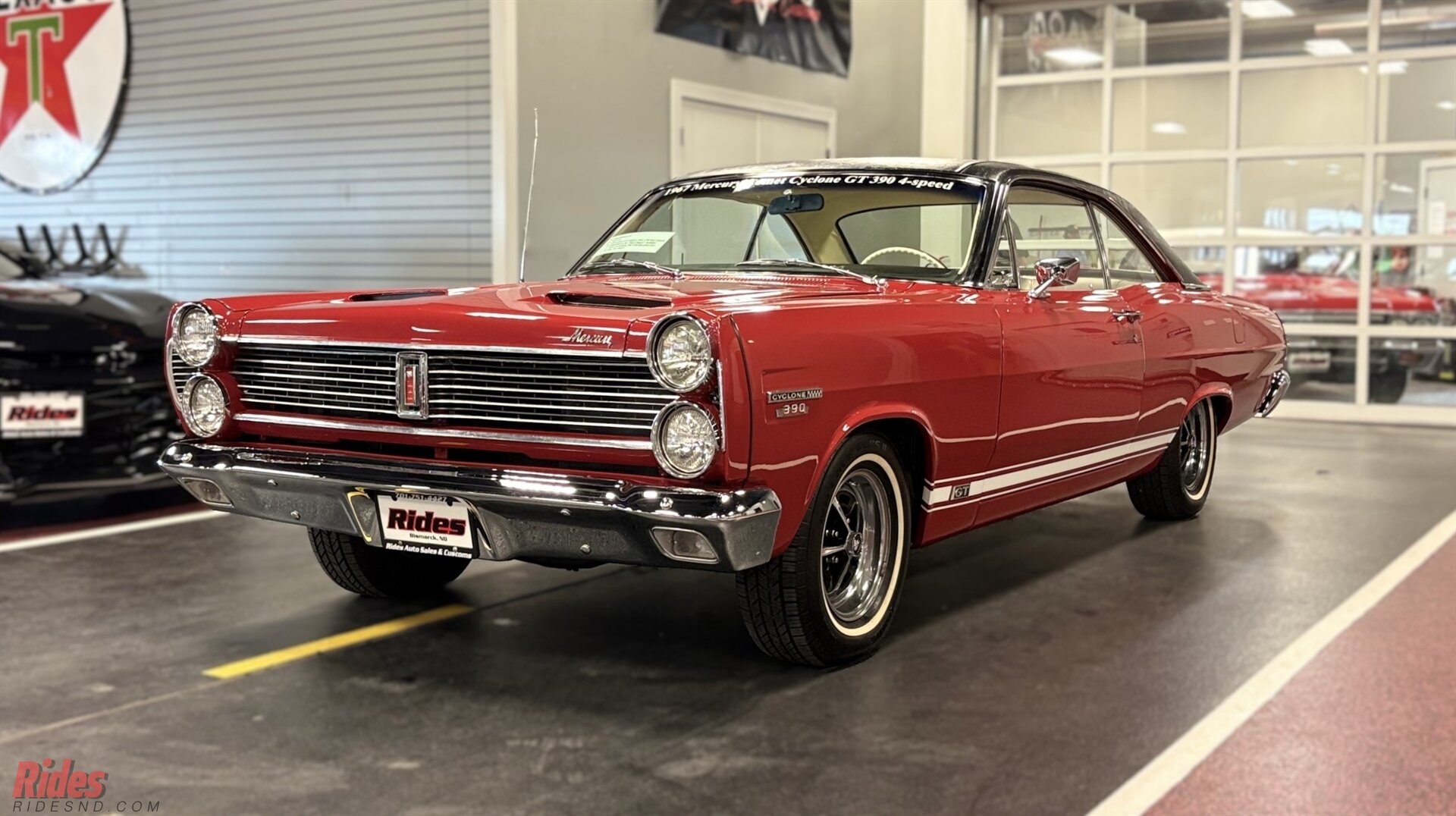 $45,900 · 29% above typical
Expand
What they sell for: Comet Cyclone GT sale prices.