
Oldsmobile Starfire buyer's guide
Oldsmobile Starfire -- the model's own buyer's guide: variants, values and what to check.
Years listed: 1956-1965 · Series: Full Size
# Oldsmobile Starfire buying guide
Overview and history
You buy a Starfire three different times, because the name covers three different cars that share almost nothing except a badge, a jet-age name and a habit of sitting near the top of whatever range they belong to. Keep the three apart before you look at a single car, because parts, problems and even the clubs split along the same three lines, and a seller who blurs them — deliberately or not — costs you money.
The name comes from the Lockheed F-94 Starfire jet interceptor, and Oldsmobile first puts it on a one-off fibreglass dream convertible at the 1953 Motorama. For 1954 to 1956 the name moves to production as the Ninety-Eight Starfire: the most expensive Oldsmobile you can buy, a convertible-only flagship on the long-wheelbase 98 chassis, powered by the 324-cubic-inch Rocket V8. For 1957 only, Oldsmobile spreads the name across the whole Ninety-Eight line as the Starfire 98 — sedans and hardtops included — and offers the famous J-2 triple-carburettor option, then drops the name entirely for 1958.
The car most people mean by Starfire arrives in January 1961 as its own model line. It is a full-size personal-luxury car on the General Motors B-body, sharing its shell and wheelbase with the Dynamic 88 and Super 88 but carrying standard equipment no other Oldsmobile matches: leather bucket seats, a centre console with a tachometer, brushed-aluminium side panels and the most powerful engine in the range, the 394-cubic-inch Skyrocket V8. A hardtop coupe joins the convertible for 1962, the engine grows to the 425-cubic-inch Super Rocket for 1965, and the front-wheel-drive Toronado takes over the flagship role for 1966, the Starfire's last full-size year. This is the Starfire as gentleman's muscle car, built before the term muscle car exists, and it is the version this guide weights most heavily because it is the version you actually find for sale as a collector car.
The third Starfire, for 1975 to 1980, inverts everything. It is Oldsmobile's first subcompact, a badge-engineered sister of the Chevrolet Monza on the rear-wheel-drive H-body platform derived from the Vega, sold only as a two-door hatchback and powered by other divisions' engines — a Buick V6, Chevrolet fours and a Chevrolet small-block V8. Nobody cross-shops it against a 1962 convertible, but listings, parts catalogues and search results mix them constantly, so you confirm which Starfire a listing describes from the year and the photographs, never from the name alone.
One thread does connect the first two generations: the Rocket V8 in its most powerful showroom form. In every full-size year the Starfire carries either the strongest engine Oldsmobile sells or a version of it, tuned with high compression and a four-barrel carburettor. You feel it in the way the cars drive — long-legged, torque-rich and quiet — and you pay for it in fuel and in the cost of putting a neglected example right. The H-body car keeps none of that, and its appeal is different: period charm, lightness and rarity through attrition rather than low original production.
Buy any of them on condition rather than on story. The full-size cars are big, chrome-heavy machines whose restoration costs overtake their market standing quickly, and the H-body cars survive in such small numbers that originality itself becomes the scarce commodity.
The models
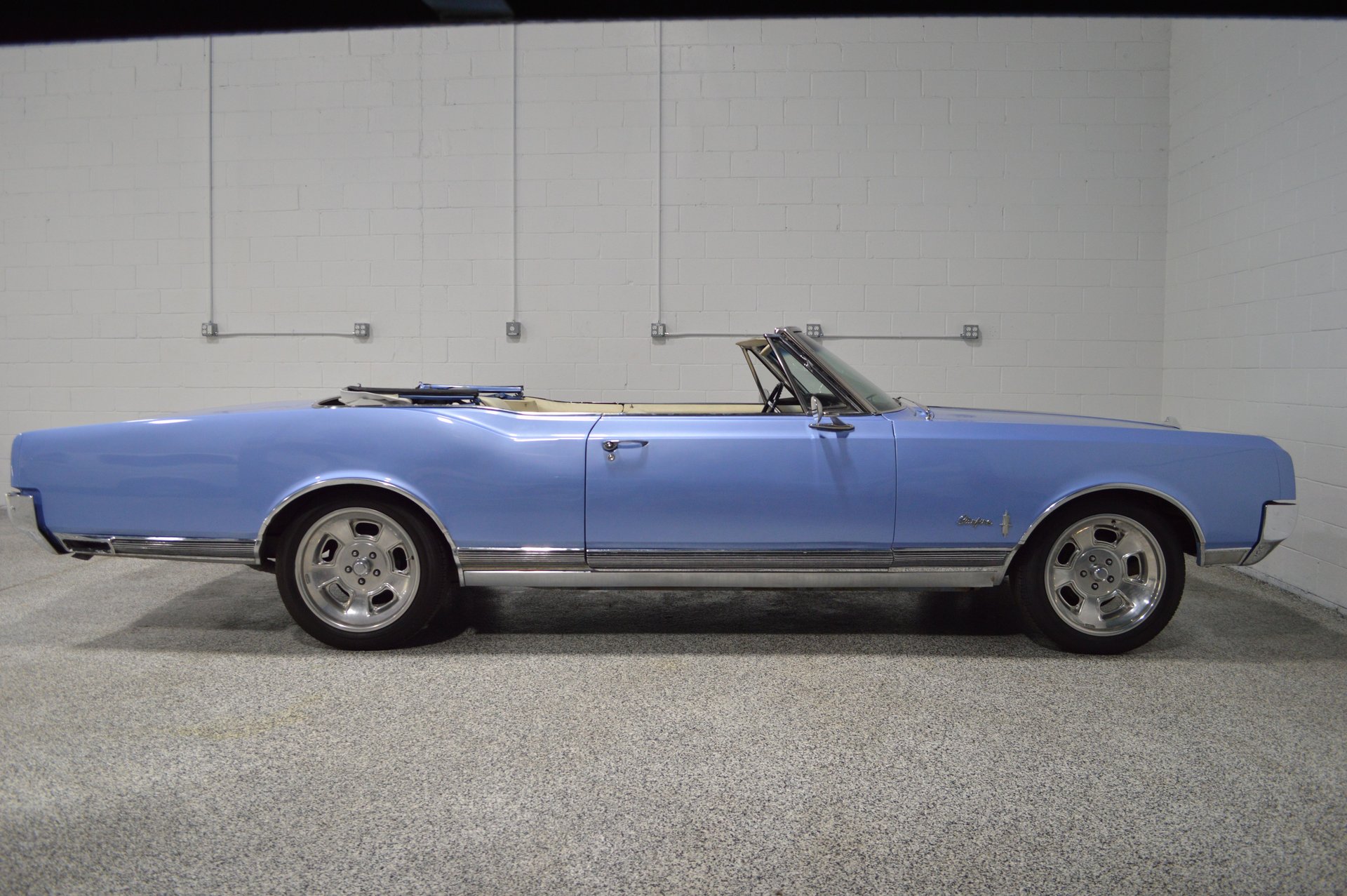
Start with identity, because the Starfire badge goes on cars that look similar to cheaper Oldsmobiles, and the premium lives in the details. On a 1961–64 car the giveaways are the brushed-aluminium side panel, the bucket seats and console, the tachometer and the high-output engine; a Dynamic 88 or Super 88 with Starfire badges added is a known trap, and the body plate and trim codes settle it. On a 1954–56 car you look for the Starfire script, the Ninety-Eight trim and the convertible body — there is no hardtop Starfire in those years, whatever a listing claims. On an H-body car you look for the hatchback shell, the Oldsmobile grille and, on the desirable versions, the GT equipment or the flared Firenza package.
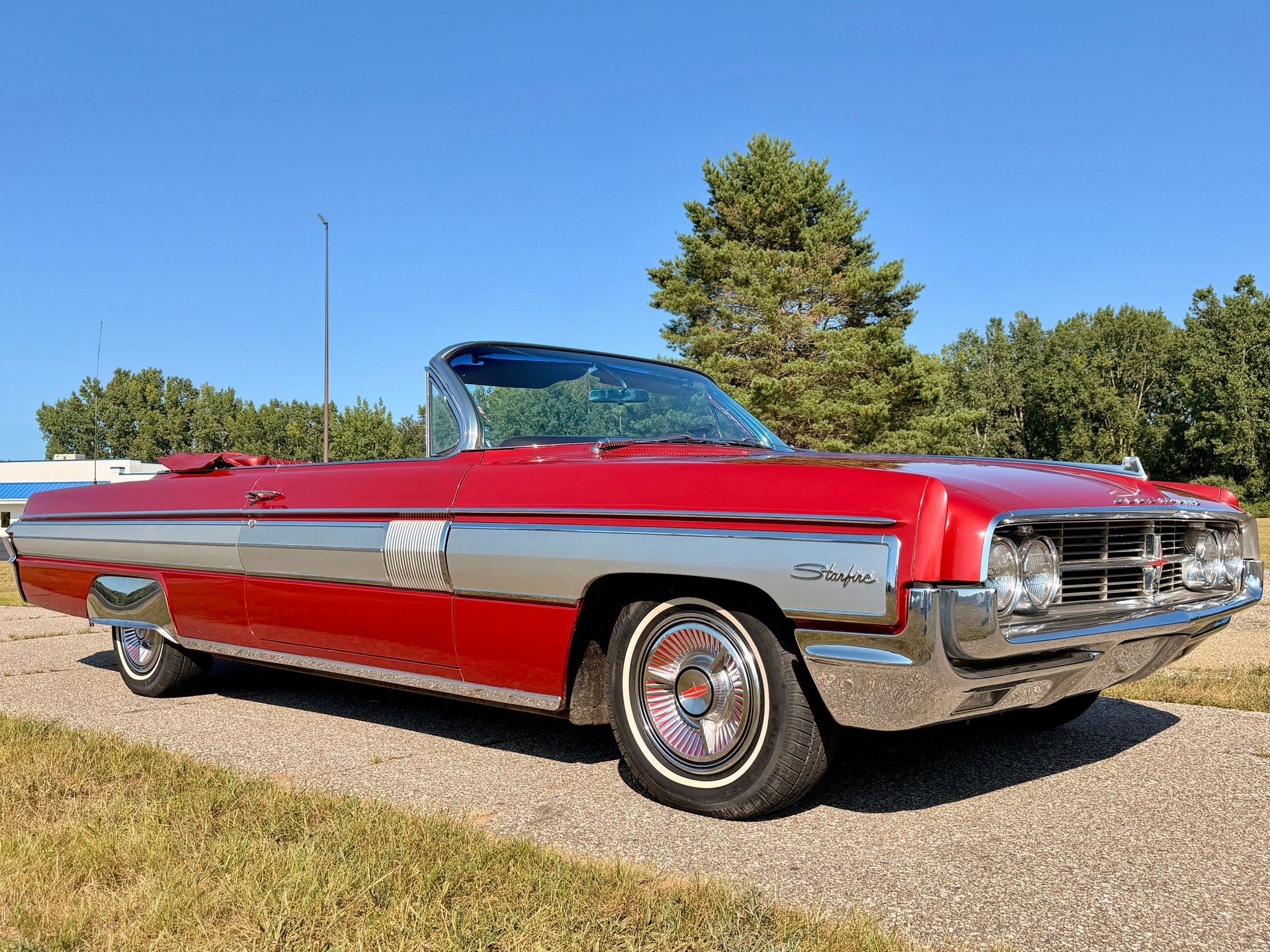
The 1954–56 Ninety-Eight Starfire convertible is a chrome-era flagship in the classic sense: panoramic wraparound windscreen, two-tone paint divided by a sweeping side spear, power everything by the standards of the day, and the 324 Rocket V8 in its strongest tune, rising from 185 hp in 1954 to 240 hp by 1956. Production stays low — 6,800 cars in 1954 sets the tone — because the price sits at the top of the range. You buy this car for presence and for the Rocket's manners, and you accept 1950s running gear: drum brakes all round, a single-circuit hydraulic system and steering that asks for planning rather than reflexes.
The 1957 Starfire 98 spreads the name over every Ninety-Eight body, so a 1957 Starfire can be a four-door sedan as legitimately as a convertible — the only year where that is true. The engine is the new 371-cubic-inch Rocket at 277 hp, and the car you hunt is the J-2 car: three Rochester two-barrel carburettors on a special manifold, rated at 300 hp, progressive in operation so the centre carburettor does the everyday work and the outer pair join in as you open the throttle. A genuine J-2 installation — correct manifold, linkage and air cleaner — is a major value point; a four-barrel car with dummy carbs bolted on for show is a known piece of theatre, and you check part numbers and linkage operation rather than counting carburettors from across the engine bay.
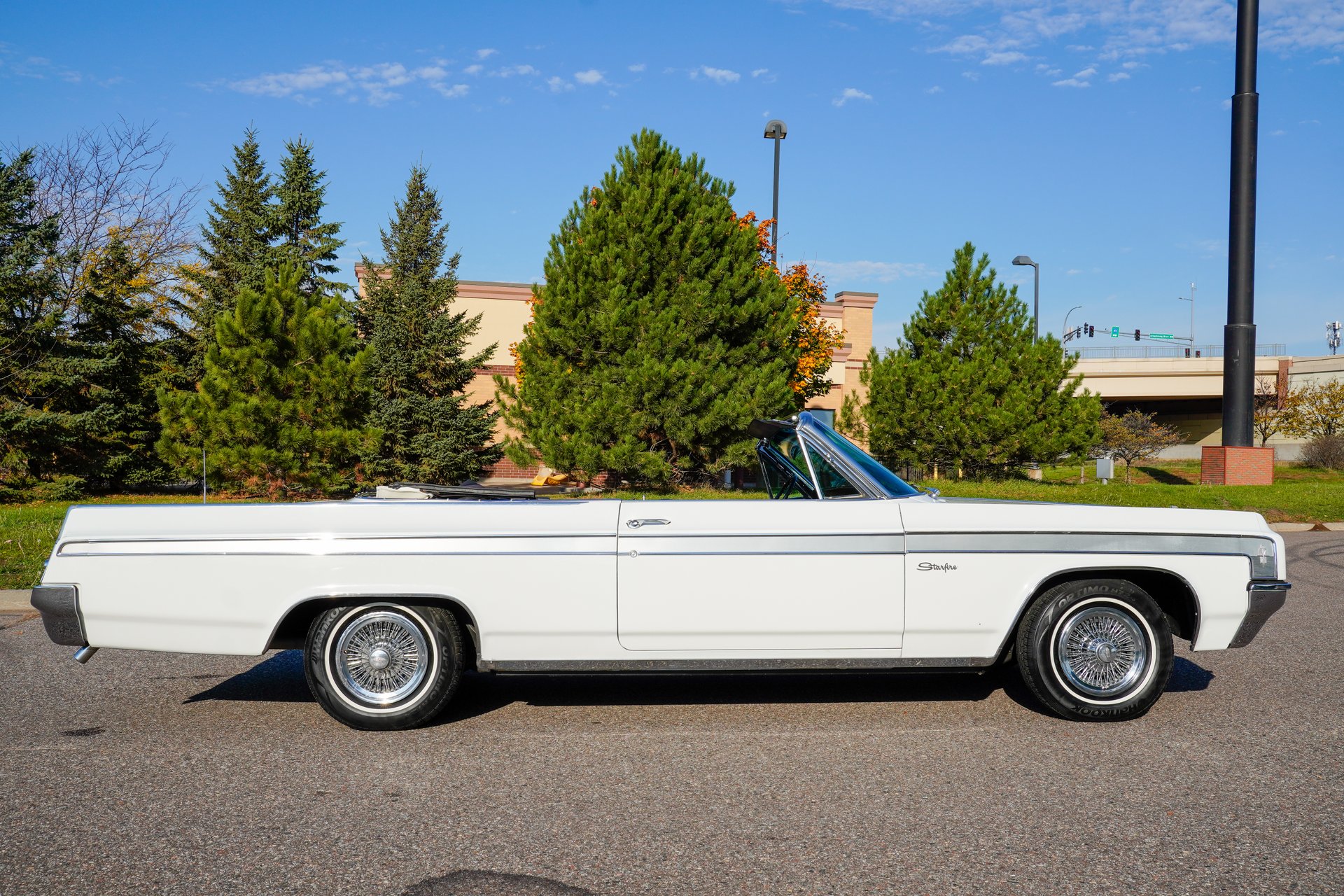
The 1961 Starfire launches the personal-luxury formula as a convertible only, mid-season, at the highest price in the catalogue. The 394 Skyrocket gives 330 hp, the interior steps away from bench-seat convention — leather buckets, a console, a tachometer — and the brushed-aluminium flank panel makes the car identifiable at fifty yards. For 1962 the coupe arrives with a hardtop roofline styled to echo the convertible, output rises to 345 hp, and sales peak: 34,839 coupes and 7,149 convertibles make 1962 the commonest full-size year by a wide margin, which matters when you shop because it gives you choice. The 1963 and 1964 cars keep the 345 hp 394 with slimmer, more restrained trim; they drive identically, and they suffer in the market only because buyers pay for the 1961–62 aluminium theatre.
Watch the 1964 Jetstar I carefully. It is Oldsmobile's cheaper answer in the same shell, it uses the same 345 hp 394, and it looks close enough to fool a quick glance — but it lacks the Starfire's standard leather, trim and equipment, and it is worth less. Badges swap easily; the data plate, the trim codes and the interior specification tell you which car you are standing in front of. The Jetstar 88 is a different car again, with the smaller 330 engine.
For 1965 the whole B-body is restyled — longer, smoother, with the curved side glass and semi-fastback coupe profile of the new GM generation — and the Starfire takes the new 425 Super Rocket at 375 hp, shared only with the Jetstar I. The convertible continues for 1965 and disappears after it; the 1966 range is coupe only, still at 375 hp, now overshadowed by the Toronado's 385 hp version of the same engine. The 1965–66 cars are the most modern-feeling of the full-size Starfires — best gearbox, strongest engine, cleanest styling — and carry the thinnest identity margin over a well-specified 88, which is why the trim and equipment checks matter most on exactly these years.
The H-body Starfire of 1975–80 is a hatchback only, on a 97-inch wheelbase, and its interest concentrates in three places: the early SX trim cars, the GT with its handling and appearance equipment, and the 1978 Firenza, a limited package with IMSA-inspired flared bodywork that is the one H-body Starfire other collectors actively hunt. Engine choice defines the driving experience completely — four, six or eight cylinders from three different divisions — and the engines section treats each separately, because they share nothing but the engine bay.
| Model | Years | Engine | Output | Built | Character |
|---|---|---|---|---|---|
| Ninety-Eight Starfire convertible | 1954–1956 | 324 cu in Rocket V8, four-barrel | 185–240 hp | 6,800 in 1954; low volume throughout | Chrome-era flagship; convertible only; the Rocket at its most glamorous |
| Starfire 98 (all Ninety-Eight bodies) | 1957 | 371 cu in Rocket V8; J-2 triple-carb option | 277 hp; 300 hp (J-2) | 8,278 convertibles | One year only; J-2 cars are the hunted ones; sedans and hardtops also qualify |
| Starfire convertible | 1961 | 394 cu in Skyrocket V8 | 330 hp | 7,800 | The launch car; aluminium flanks, buckets, console, tach; priciest Olds of its year |
| Starfire coupe and convertible | 1962 | 394 cu in Skyrocket V8 | 345 hp | 41,988 (34,839 coupes, 7,149 convertibles) | The peak year; the most choice on today's market |
| Starfire coupe and convertible | 1963–1964 | 394 cu in Skyrocket V8 | 345 hp | Falling yearly; 13,753 coupes and 2,410 convertibles in 1964 | Restrained trim, same performance; 1964 Jetstar I is the lookalike to exclude |
| Starfire coupe and convertible | 1965 | 425 cu in Super Rocket V8 | 375 hp | 15,260 (13,024 coupes, 2,236 convertibles) | New body, new engine, best gearbox; last convertible year |
| Starfire coupe | 1966 | 425 cu in Super Rocket V8 | 375 hp | 13,019 | Coupe only; Toronado takes the flagship role |
| Starfire hatchback (H-body) | 1975–1980 | 140/151 cu in fours, 231 cu in Buick V6, 305 cu in Chevrolet V8 | 84–140 hp depending on year and engine | 125,188 across six years | Subcompact hatch; GT and 1978 Firenza are the collector angles |

Engines and gearboxes
Every full-size Starfire engine is a Rocket V8, but Rocket covers two distinct engine families, and the H-body car abandons the Rocket entirely. You identify what you are buying by displacement, by the casting and stamping evidence on the block, and by the carburettor on top — because badges, decals and seller descriptions all lie cheerfully, and a lesser engine in a Starfire shell is the commonest quiet downgrade in this market.
The first Rocket V8s: 324 and 371 (1954–1957)
The 1954–56 Starfire carries the 324-cubic-inch version of the original 1949 Rocket: overhead valves, hydraulic lifters, a forged steel crankshaft and, in Starfire tune, a Rochester four-barrel carburettor in place of the two-barrel fitted to lesser cars. Output climbs across the three years — 185 hp for 1954, 202 hp for 1955, 240 hp for 1956 — as compression and tuning rise, and the character is the same throughout: unstressed, silent at cruise, and strong from low revs rather than eager at high ones. For 1957 the engine grows to 371 cubic inches and 277 hp in standard four-barrel form. The J-2 option replaces the single carburettor with three Rochester two-barrels on a dedicated manifold for 300 hp; the linkage is progressive, so you drive on the centre carburettor alone until you ask for more, which is why a correctly set-up J-2 idles and cruises like a standard car and why a badly set-up one — outer carburettors opening early, linkage bent, choke arrangement improvised — drinks fuel and stumbles. You test a J-2 by watching the linkage through its full travel with the engine off, then by feeling for the second stage on the road: it arrives as a clean step in urge, not a bog followed by a surge.
These engines are durable, and their enemies are age, sludge and heat rather than design. Hydraulic lifters tick at cold start on a car that sits; a tick that fades as oil pressure builds points to lazy lifters and old oil, while a tick that stays, hot, under load, sends you to oil pressure first — you test with a mechanical gauge screwed into the gallery, because the dashboard warning light tells you almost nothing until far too late. Rear main seals weep, valve-cover gaskets harden and leak onto the exhaust manifolds, and the manifolds themselves crack and snap their end bolts, giving you the ticking-under-load that owners misdiagnose as a lifter. You distinguish the two with a length of hose as a stethoscope: manifold leaks tick in time with one cylinder, loudest at the manifold face; lifter noise comes from under the rocker cover.
The 394 Skyrocket (1961–1964)
The 1961–64 Starfire engine is the 394, the largest development of the first Rocket family, in Ultra High Compression tune: 10.25:1 compression, a high-lift camshaft, a Rochester 4GC four-barrel and ratings of 330 hp for 1961 and 345 hp with 440 lb-ft of torque for 1962–64. It is the defining component of the early-1960s car — smooth, immensely torquey, and tuned for premium fuel in a way you must respect today. A 394 in correct tune on modern premium runs cleanly; one with its timing advanced by ear, its compression raised by skimmed heads, or its carburettor lean from perished gaskets pinks under load, and sustained detonation in a high-compression engine destroys pistons, not just your afternoon. You listen for pinking on a long hill in a high gear at light throttle, and you treat it as a tuning bill to negotiate, not a character trait.
The 4GC itself is a sound carburettor whose faults are ageing faults: a worn throttle shaft drawing air and spoiling the idle, a tired accelerator pump giving the flat spot on tip-in that everyone blames on ignition, a choke that no longer pulls off cleanly so the car floods and soots on cold starts. You test the pump with the engine off and the air cleaner removed — two strong streams into the throats as you snap the linkage — and you test the choke by starting from stone cold and watching it open fully as the engine warms. The myth to correct here is that the 394 is fragile. It is not: it is an understressed, truck-tough bottom end whose top end wants clean oil and cooling-system maintenance. What kills 394s is overheating from a silted radiator and sludge from decades of short-trip oil. A full rebuild by a shop that knows Oldsmobiles runs roughly $6,000–10,000; you price a smoky, low-oil-pressure engine as a rebuild, not as a tune-up.
The 425 Super Rocket (1965–1966)
For 1965 Oldsmobile replaces the whole architecture. The 425 belongs to the second Rocket generation — the family that goes on to include the 350, 400 and 455 — and in Starfire tune it gives 375 hp with a single four-barrel: a Rochester 4GC on the earlier cars and the spread-bore Quadrajet as GM rolls it out across the 1966 lines. You identify the carburettor on the car in front of you rather than assuming it from the year, because both are excellent when rebuilt and miserable when worn, and their kits, choke arrangements and failure habits differ. The Quadrajet's small primaries give the 425 a dual character: gentle, economical cruising on the small throats, and a howling second stage when the large secondaries open — which also gives you the test. A Quadrajet car that feels flat at full throttle usually has a failed vacuum break, a seized secondary air valve or a linkage fault, not a tired engine; you check secondary operation before you let anyone quote you for internal work.
The 425 shares its family's known habits. The nylon-toothed timing gear of this era wears and sheds teeth with age, stretching valve timing retarded and eventually jumping; you check chain slack at the crank pulley — rock the pulley against compression and watch the distributor rotor, where more than a few degrees of free movement condemns the set — and you budget a steel timing set, roughly $600–1,200 fitted, as preventive work on any undocumented car. Oil consumption past the valve guides, rear-main weepage and lifter noise on neglected oil are the other standards. None of it is exotic, and a healthy 425 is the sweetest engine in this guide: quieter than the 394, stronger everywhere, and paired with the gearbox the car always deserved.
The borrowed engines: H-body fours, V6 and V8 (1975–1980)
The H-body Starfire offers you four engines and none of them is an Oldsmobile design, which decides your parts shopping and your expectations. The Buick 231-cubic-inch V6 is the standard engine for 1975–76 and the GT engine thereafter: a two-barrel, 110 hp in 1975 with net ratings softening as emissions tuning tightens. Its defining trait is the odd-fire crankshaft of the early cars, which fires at uneven intervals and idles with a lumpy shake that is design, not defect — the myth to correct on the spot, because sellers apologise for it and buyers misdiagnose it. From mid-1977 the even-fire version, with a split-pin crankshaft, smooths the idle noticeably; you tell them apart by the engine code and by the feel at idle. The V6's real faults are a worn timing set, an oil pump housed in the aluminium front cover that loses pressure as the cover wears, and front-cover corrosion where coolant meets old gaskets.
The fours split in two. The Chevrolet 140-cubic-inch overhead-cam engine, inherited from the Vega, has an aluminium block with an iron head and bores finished directly in the aluminium; it overheats readily, the head warps when it does, bores score, and oil consumption climbs — the full Vega story, and the reason you compression-test any 140 car and check for coolant in the oil and oil in the coolant before anything else. The Pontiac-designed 151-cubic-inch Iron Duke that replaces it is a pushrod engine of opposite character: slow, unkillable in normal use, and known for its fibre timing gear, which runs quietly when new and rattles, then fails, with age; a gear set is cheap, the labour is the bill. The Chevrolet 305-cubic-inch small-block V8, optional from 1977 to 1979 in two-barrel form at around 140 hp, transforms performance and front-end weight in equal measure; its faults are emissions-era faults — EGR and choke behaviour, vacuum-hose decay — plus the soft camshaft lobes that afflict late-1970s Chevrolet V8s, which you detect as a rhythmic exhaust pop and a cylinder that tests low on cranking vacuum rather than on compression. In every case the engine is a parts-bin exercise, and that is good news: mechanical parts for all four remain cheap and plentiful in a way Starfire-specific trim never will be.
Gearboxes
The gearbox divides the full-size cars more sharply than the engine does. The 1954–55 cars use the original four-speed Hydra-Matic, a dual-range design of legendary toughness whose shifts you feel as distinct, deliberate events; the 1956–57 cars use the smoother Jetaway Hydra-Matic, with a controlled coupling and a proper Park position. Both are rebuildable by specialists, and both fail in the modern world mainly through perished seals — one that leaks from every joint and delays engagement when cold wants a reseal and service, roughly $1,500–3,000, while one that slips under power wants a rebuild at $3,500–6,000. You test engagement delay from cold, shift quality at light and full throttle, and fluid colour and smell, in that order.
The 1961–64 Starfire uses the Roto Hydra-Matic, the slim three-speed known universally as the Slim Jim, and here you must be blunt: it is the weak point of the early-1960s car. It couples through a small fluid coupling with no torque-converter multiplication, it shifts harshly by design at some throttle openings, it leaks, and the pool of rebuilders who know it shrinks every year, with some internal parts genuinely scarce. A good Slim Jim — prompt engagement, consistent shifts, clean fluid, no flare — is a real asset and you pay for the car accordingly; a bad one is a $3,000–5,500 specialist rebuild with a waiting list, and conversion to a later Turbo Hydra-Matic, while done, alters originality and value. You therefore test a 1961–64 car longer and harder than any other in this guide: full-throttle runs, kickdown, reverse on a slope, and a long hot idle in gear, because a Slim Jim that misbehaves only when hot is still a Slim Jim you are buying.
For 1965 the Turbo Hydra-Matic 400 arrives and the problem disappears. The TH400 is one of the strongest, best-supported automatic gearboxes ever made, rebuilds run roughly $1,800–3,000 anywhere in the country, and its faults are the honest faults of age — worn clutches giving flare, a tired modulator giving late or early shifts, pan and seal leaks. A vanishingly rare four-speed manual is offered on the 1965 car; if you meet one, you verify it from the body plate and pedal and linkage evidence rather than from the gear knob, because a converted automatic wears the same knob. The H-body cars offer three-, four- and five-speed manuals — the five-speed, available from 1976 to 1979, is the desirable one — and a three-speed Turbo Hydra-Matic automatic whose exact light-duty variant follows the engine; you identify it by the pan shape, you test manuals for second-gear synchromesh wear on a fast downchange, and you remember that clutch and gearbox parts are Monza parts, cheap and findable, while the Oldsmobile badge on the tailgate changes nothing underneath.
Problem areas
A Starfire's problems are the problems of its platform and its equipment level, in that order. The full-size cars share their structure with every other B-body Oldsmobile, so the rust map and chassis wear are family matters — but the Starfire's standard leather, power equipment, aluminium trim and convertible availability concentrate cost exactly where the cheaper cars are simple. The H-body car inverts the equation: simple equipment, fragile structure. Work through the systems in the order below, and remember the most expensive sentence in this guide: rust repair and brightwork restoration, not mechanical repair, are what bankrupt Starfire projects.
Rust and structure: the map
You inspect a full-size Starfire from underneath, on a lift, with a light and a screwdriver you are prepared to apologise for, because the cosmetic panels hide the structural story. The B-body frame is a separate perimeter frame and it rots in predictable places: the side rails where the body mounts trap mud, the rear rails over and behind the axle, and the crossmembers at their ends. Surface scale is normal; flaking, thinning and holed rails are structural, and a convertible — which relies on frame and cowl for the stiffness a coupe gets from its roof — shows weakness first as doors that drop and catch and panel gaps that change between level ground and a jack under one corner. You perform that test deliberately: lift one front corner and watch the gaps and the door's closing effort. A sound car barely notices; a weak car announces itself.
The body rusts where water sits. Floors go first under the carpets — front footwells below the cowl vents, rear footwells below leaking rear windows on coupes; the trunk floor goes over the fuel tank and at its drop-off edges; rocker panels rot from the inside out, so bubbling paint at the rocker is late evidence, not early warning; lower front fenders trap debris behind the wheel; the cowl and windscreen surround leak and then rot, wetting the floors they are blamed on; and on 1961–64 cars the brushed-aluminium side panels trap moisture against the steel beneath them, so you probe the panel edges with particular care — the signature trim creates its own signature rust. On convertibles you add the top well, the rear seat pan and the quarters behind the rear wheels, and you lift every carpet the seller will allow. Welding is the expensive currency here: a rocker and floor section properly replaced runs roughly $1,500–3,500 per side, a trunk floor $800–2,000, and frame rail repair is specialist work you quote car by car — which is why a solid Southern car with tired paint is worth more than a shiny Northern car with fresh underseal, and why fresh underseal over unphotographed floors is a reason to walk, not a feature.
The 1950s cars add their own map: the same floors, rockers and trunk, plus rust around the panoramic windscreen's curved seals, in the spare-wheel well, and in the lower doors whose drain holes block with age. The pot-metal trim on these cars pits rather than rusts, and pitted pot-metal is not a polishing problem — it is a specialist replating problem at hundreds of dollars per piece, which is why you inventory the brightwork piece by piece on a 1950s car before you discuss the engine at all.
Suspension, steering and brakes
The full-size cars ride on coil springs all round with an independent front end, and by now every rubber component in that system is either replaced or perished — there is no third possibility on a sixty-year-old car. You budget for it as a system: control-arm bushings, ball joints, tie-rod ends, idler arm, centre link wear and a steering box with play at the straight-ahead are the standard list, and a car that wanders and clunks is not showing one fault but the whole system's age. The test is specific: with the front end loaded, you rock the steering wheel and watch where the lost motion lives — box, linkage or both — and you lever each front wheel at six and twelve o'clock for ball-joint and bearing play, then at three and nine for linkage play. A full front-end rebuild with alignment runs roughly $1,200–2,500 and transforms the car; a seller who tells you the steering is "just like that when new" is wrong, because these cars steered precisely when new, within the limits of recirculating-ball feel. Rear coil springs sag, and worn rear control-arm bushings let the axle steer the car under power — you feel it as a wiggle on throttle application, and you confirm it by inspecting the bushings for cracking and offset. Power steering pumps groan from low fluid and worn vanes, and hoses weep.
Brakes demand your most conservative thinking. Every full-size Starfire here predates the dual-circuit era: a single master cylinder feeds all four drum brakes, so one failed wheel cylinder, perished hose or rusted line can remove your braking entirely. You therefore inspect hydraulics as a safety system, not a service item — steel lines for corrosion along the frame rail, hoses for cracking and ballooning, wheel cylinders for weeping behind the dust boots, and the master cylinder for the bore corrosion that shows as a pedal sinking slowly at a stop. A full hydraulic renewal runs roughly $900–1,800 and is the first money you spend on any car without documented recent work. The drums are large and effective when in adjustment; a car that pulls under braking has a contaminated shoe, a seized adjuster or a leaking cylinder on one side, and you find which by temperature after a drive — an infrared thermometer on each drum settles in seconds what an hour of guessing doesn't. Disc-brake conversions exist and work, but you value them as a modification, not an upgrade, on a car bought for originality. On 1950s power-brake cars, a pedal that stays rock-hard after start condemns the vacuum booster or its check valve.
Interior, trim and convertible tops
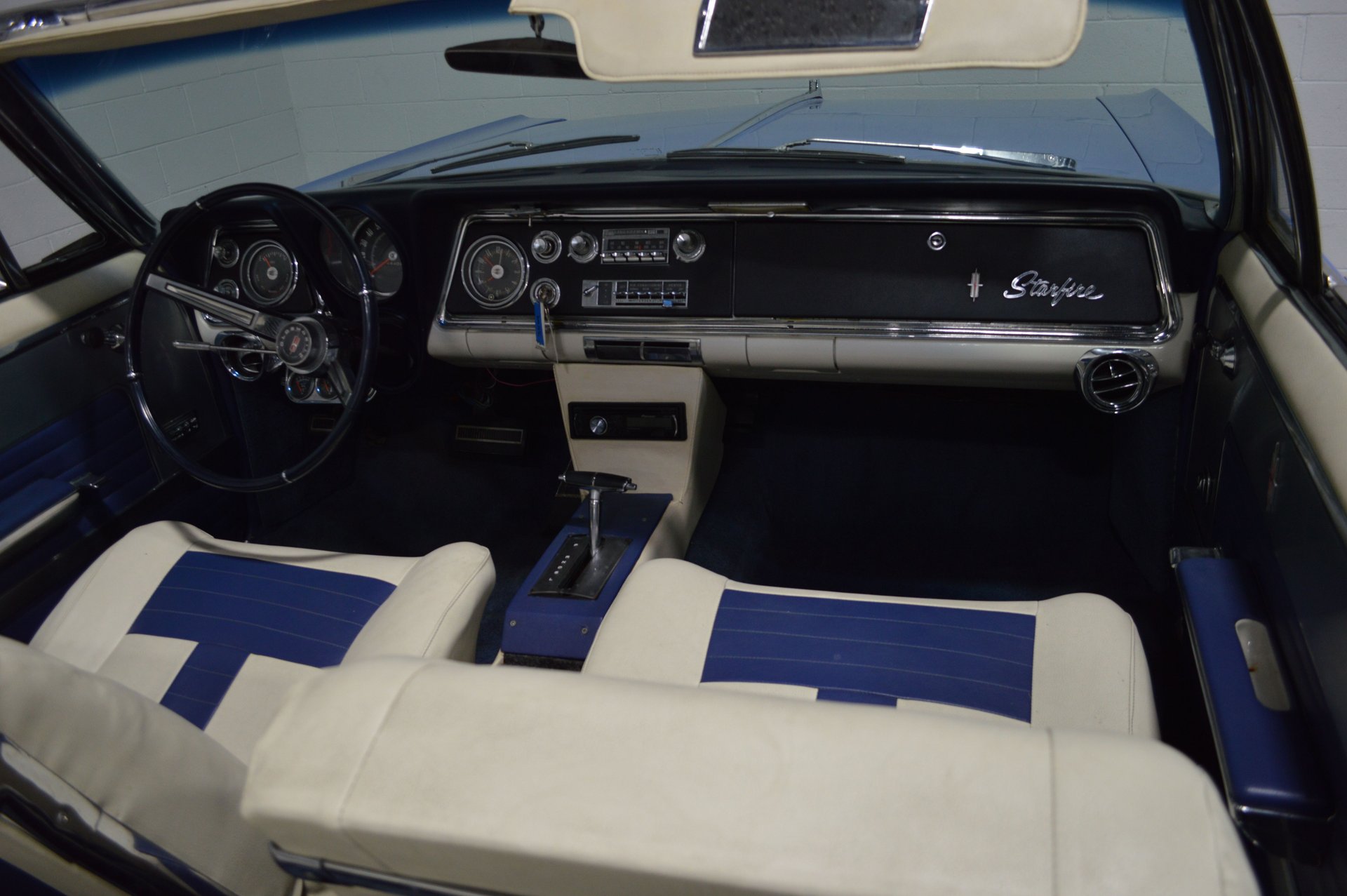
The Starfire interior is the model's promise, and its decay is where budgets quietly double. The 1961–66 cars carry genuine leather bucket seats as standard, and leather that has dried splits at the stitching and the bolster creases, then tears; you press the bolsters and listen for the crackle of dry hide, and you check the driver's seat base, where foam collapse makes you sit in the seat rather than on it. Correct leather retrimming in the original pattern is specialist work at roughly $3,500–7,000 for the buckets and rear seat, and a car retrimmed in vinyl to the correct pattern is a negotiation point about originality, not a disaster — unless the price assumes leather. The console, the tachometer and the dash brightwork are Starfire-specific and scarce: a working tachometer, an uncracked console and complete dash trim are worth real money because you cannot order them, and you test every gauge, because rebuilt instruments run $200–500 each. Carpets hide the floors you need to see, so you lift their edges at the sills as a matter of routine.
On the 1965 car pictured in this guide's interior photograph you see both the appeal and the trap: the buckets-and-console layout, the T-handle selector and the scripted dash are the whole point of the model, and any retrim — however attractive — that departs from the factory pattern in colour blocking or material moves the car away from original specification, which you price accordingly.
Convertible tops are a system, not a fabric. The power mechanism — pump, hydraulic cylinders and hoses — leaks with age, and a top that moves slowly, unevenly or with a groan is telling you about low fluid, a tired pump or a leaking ram, at roughly $400–1,200 to put right before you price the fabric itself. The fabric, pads and rear window run roughly $1,500–3,000 fitted; a yellowed, cracked plastic rear window is normal ageing, while a frame with bent bows or worn pivots is the expensive fault, because the top then never seals or folds correctly whatever fabric you fit. You operate the top through two full cycles, watch for symmetry, and check the well and boot for water staining. On coupes the equivalent test is simpler: water in the rear footwells and a stained headliner point to the rear window seal, the commonest water path on the 1963–66 roofline.
Brightwork drains wallets impartially. The aluminium side panels dent, corrode at their edges and lose their brushed finish; straightening and refinishing them is specialist work, and missing panels convert a Starfire into an argument. Chrome bumpers replate at roughly $600–1,200 each. You inventory trim the way you inventory rust: piece by piece, photographed, before money moves.
Electrics and accessories
Oldsmobile loads the Starfire with the accessories of its day, and you test every one, because each dead accessory is either a small bill or a scarce part. Power windows slow as motors tire and regulators gum; a window that moves slowly but evenly wants cleaning, lubrication and voltage, while one that tilts and jams wants regulator work. Power-seat drive cables seize from disuse — you exercise the seat through its full travel, because a seat that moves once and stops has told you its cables are failing. You check charging voltage at the battery with the engine running and the lights on, expecting roughly 13.8–14.5 volts on an alternator car, and you treat a car that has been "kept on a charger" as a car with an undiagnosed drain or a dead charging system until you prove otherwise with a parasitic-draw test.
Vacuum and air-conditioning separate the sorted cars from the stories. Factory air-conditioning, where fitted, uses the big GM compressor of the period and, on a car converted to modern refrigerant, lives or dies on the quality of that conversion — new hoses, a flushed system, a working expansion valve — rather than on the gas inside it; a system that blows cool but not cold with correct pressures has an air-blend or vacuum-control fault, and the vacuum actuators and control head behind the dash are the fiddly, dash-out end of this work at $800–2,000 in labour terms. Perished vacuum hose is the single commonest cause of "multiple electrical faults" that are not electrical at all. Wiring itself is simple and robust, but sixty years of accessory additions — alarms, stereos, trailer wiring, kill switches — leave splices in every loom, and you trace any intermittent fault to the last human intervention before you blame the factory harness.
The H-body cars: structure, hatch and running gear
The H-body Starfire's problems begin with the fact that it is a 1970s subcompact built down to a price from Vega architecture, and that survival, not mileage, is now the variable. Rust is structural on a unibody car in a way it never is on the framed B-body: fender tops and inner wings, rockers, door bottoms, the hatch aperture and hatch itself, floor edges, the battery tray area and the rear suspension mounts all rot, and rot at the torque-arm and control-arm mounts is a safety failure, not a cosmetic one. You inspect an H-body on a lift exactly as you inspect the big cars, but you lower your tolerance: there is no frame to save a rotten shell, repair panels are scarce to non-existent, and a structurally rusty hatchback is a parts car regardless of rarity. Welding a unibody shell back to strength runs past the car's market standing faster than any other job in this guide, which is why the H-body rule is absolute: buy the shell, and let the mechanical condition be whatever it is, because every mechanical component is shared, cheap and replaceable.
The hatch leaks through perished seals and blocked drains, wetting the load area and rear footwells; struts fail and the heavy hatch falls, which you test by opening it fully and letting go. Worn torque-arm and control-arm bushings give the same throttle-steer wiggle as the big cars in miniature, cured with bushes you can still buy because Monza owners need them too. Brakes are front disc and rear drum with a dual circuit — a genuine safety step forward — and their faults are seized calipers, perished hoses and corroded lines. Interiors suffer the 1970s in full: dashboards crack, seat vinyl splits, headliners drop, plastics embrittle — and here scarcity bites hardest, because Starfire-specific trim was made for one low-volume model. A complete, uncracked H-body interior is a stronger buying reason than a rebuilt engine, and a Firenza's flared panels are effectively irreplaceable except from another Firenza, so you inspect the flares for filler and cracking with the same care you give the shell.
How to inspect one
You inspect a Starfire in a fixed order — identity first, structure second, mechanics third, cosmetics last — because the expensive faults hide under the cheap ones. Allow half a day for a full-size car, take a lift where you can get one, and work this list in sequence.
- Settle the identity before the condition. You read the VIN and the body plate, you decode the style, trim and paint codes, and you confirm the car is what it claims to be: Starfire trim and equipment on a 1961–66 car, a genuine Ninety-Eight convertible for 1954–56, the correct body for a 1957 Starfire 98. On a 1964 car you run the Jetstar I exclusion from the models section — trim codes and interior specification, not badges. A car that fails identity is priced as the car it actually is, or not bought.
- Check the engine's identity. You find the block evidence for the claimed displacement — 324, 371, 394 or 425 on a full-size car; the correct divisional engine on an H-body — and you inspect the carburettor that should be there, including the J-2 linkage on a 1957 car claiming the option. An engine swap is not automatically a rejection, but an undisclosed one ends your trust in every other claim in the listing.
- Do the cold start yourself. You arrive to a cold engine — you touch the exhaust manifold to prove it — and you watch starting behaviour, choke operation, oil pressure warning behaviour and exhaust smoke. Blue smoke at start that clears points to valve guides; smoke that persists under load points to rings and bores; white vapour that smells sweet and continues hot points to coolant, and on an H-body 140 engine that single observation can end the inspection.
- Read the fluids and the leaks. You pull the engine dipstick and the gearbox dipstick, you check coolant colour and level, and you note where the car has marked its parking spot and with what. Slim Jim fluid that is dark and burnt, engine oil that is fuel-thinned, coolant that is rusty — each is a priced deduction from the problem-areas list, and fresh fluids in a car with no service records are a question, not a comfort.
- Lift the car and work the rust map. You follow the rust section in order: frame rails and body mounts, floors, rockers, trunk, cowl and screen surrounds, aluminium panel edges on a 1961–64 car, top well on a convertible, suspension mounts on an H-body. You probe where bubbling or underseal invites it, and you photograph everything for the negotiation.
- Run the jack test on structure. You lift one front corner and watch door gaps and door closing effort change, or not. On a convertible you treat movement as frame or cowl weakness until proved otherwise; on an H-body you watch the hatch aperture and door apertures for the same story told by a unibody shell.
- Test the gearbox as the gearbox section prescribes. For a Slim Jim car this is the long test: cold engagement, light- and full-throttle shifts, kickdown, reverse on a slope, and a hot idle in gear at the end of the drive. For a TH400 car you check shift timing and flare. For an H-body manual you make a fast downchange into second to find the synchromesh wear.
- Drive for the engine's manners. You listen for pinking under light load on a hill in a high gear, for lifter noise that stays hot, for exhaust-manifold ticking, and for the flat spot that separates carburettor pump faults from ignition faults. You watch the temperature gauge in traffic afterwards: a car that creeps hot at idle has the silted radiator from the problem areas, and you price the cooling system, not a thermostat.
- Work the brakes and steering on the road. You brake firmly from speed, hands light on the wheel, and you note pull, pedal feel and pedal sink at the next stop. You feel for wander and throttle-steer from the rear bushings, and you check drum temperatures side to side if the car pulled. On a single-circuit car you treat any hydraulic doubt as a full renewal priced into the offer.
- Operate everything electrical and powered. Windows, seat, top through two full cycles on a convertible, lights, wipers, heater, air-conditioning where fitted, gauges including the tachometer. You write down every failure and sort it using the electrics section — switch, motor, vacuum or wiring — because the total is the deduction.
- Inspect the interior against the trim code. You confirm the material is what the code says — leather where leather should be — you press bolsters for dry cracking, you sit in the seats for foam collapse, and you lift carpet edges at the sills to see the floors the carpets exist to hide. On an H-body car you grade the dashboard, seat trim and Firenza panels, where fitted, as scarcity items.
- Close on paperwork. You read the title, history and receipts, and you weigh documented mechanical work — a Slim Jim rebuild invoice, a timing set, hydraulic renewal — more heavily than cosmetic receipts. Then you make the offer the inspection earned: the car's price minus the priced faults you found, each traceable to a section of this guide.
Values
You read the Starfire market by generation first and by condition second, because the three cars wearing this name live in three different markets that happen to share a search term. The full-size cars of the 1950s trade in the chrome-era convertible market, where presentation, colours and brightwork completeness move results as much as mechanical condition does. The 1961–66 cars trade in the personal-luxury and early-muscle market, where the same buyers compare them with Grand Prixs, Rivieras and Thunderbirds, and where originality of trim and equipment carries unusual weight because so much of a Starfire's identity is trim and equipment. The H-body cars trade in the emerging 1970s market, where survival in original condition is the whole story and a modified or part-restored car loses the very quality its buyers are paying for.
Within any generation, the spread between the best and the rest is wide, and it is driven by the costs this guide has priced for you. A structurally sound car with documented mechanical work and complete, correct trim sits at the top because the next owner is buying years of avoided welding, plating and parts hunting. A shiny car with fresh paint over unexamined floors, a retrim that departs from the trim code, or a gearbox with no history sits far lower once knowledgeable buyers inspect it — and knowledgeable buyers are the market for these cars, which is why asking prices that ignore condition tend to sit unsold while correctly described cars move. Convertibles carry a premium over coupes in the full-size years, a genuine J-2 installation lifts a 1957 car clearly, and on H-body cars the GT equipment and the Firenza package separate the hunted cars from the survivors. In every case the premium attaches to verified specification, not to badges, so the identity work in your inspection is also value work.
The project end of the market teaches the sharpest lesson. A cheap full-size Starfire is usually cheap because it needs the expensive chapters — structure, brightwork, leather, a Slim Jim rebuild — and those chapters together routinely exceed the finished car's standing, which is why unfinished projects circulate from owner to owner. The honest exception is the structurally sound, mechanically tired car: engines and Turbo Hydra-Matic gearboxes are rebuildable at predictable cost, so a dry-climate coupe with a worn 425 is a rational buy in a way that a rusty convertible with a rebuilt engine never is. You use the computed market listings that accompany this guide to place a car against its generation and condition peers, you discount for every priced fault your inspection found, and you remember that you are mostly buying the previous owner's restraint — the car that was never taken apart is almost always the car to have.
Parts and ownership
You run a full-size Starfire on a supply chain that splits into three tiers, and ownership is pleasant exactly to the extent that you learn which tier each job lives in. The first tier is the shared mechanical car: Rocket V8 service parts, TH400 components, and brake, suspension and steering wear parts shared with the rest of the B-body range and much of the wider GM world. These remain available, sensibly priced and familiar to any competent older-car workshop, and the second-generation Rocket family in the 1965–66 cars draws extra support from the 455 performance aftermarket. The second tier is the Oldsmobile-specialist tier: Fusick Automotive and the marque specialists stock reproduction and new-old-stock trim, weatherstripping, emblems, interior materials in correct patterns and the thousand small items that separate a Starfire from an Eighty-Eight, and the Oldsmobile Club of America and its chapters connect you to the used-parts knowledge that no catalogue carries. The third tier is the Starfire-only tier — aluminium side panels, consoles, tachometers, specific brightwork, convertible components in good order — where supply means used parts, patience and occasionally fabrication, and where the correct buying decision was made at inspection, when you chose a car that already had them.
The Slim Jim is the ownership caveat that deserves its own paragraph. Parts and, above all, knowledge concentrate in a small number of specialists; you identify yours before you need it, you keep the fluid clean and cool, and you budget the rebuild as a when, not an if, on a high-mileage undocumented car. On the H-body side the equation reverses: mechanical parts are Monza, Skyhawk and Sunbird parts — cheap, shared and still catalogued — while Starfire-specific body and interior parts are the scarcity, so H-body ownership rewards joining the H-body community early and buying trim pieces when you see them, not when you need them.
Running costs follow size. A full-size car returns fuel economy in the low teens at best, drinks premium in high-compression tune, and wears tyres, brakes and suspension components at heavy-car rates. Annual servicing is simple work — oil, filters, ignition checks, chassis lubrication where fittings survive — and the cars reward use: seals, carburettors, power accessories and convertible mechanisms all deteriorate faster in storage than on the road. Insure on an agreed-value classic policy, photograph the trim inventory you verified, and keep every receipt, because on this model the file of documented work is a tangible part of the car's next sale.
Which one to buy
- The all-rounder: a 1965 Starfire coupe. The 425 at full strength, the Turbo Hydra-Matic instead of the Slim Jim, the cleanest styling of the run and the best parts support of any full-size year. You give up the early cars' aluminium theatre and gain the car you will actually drive furthest.
- The showpiece: a 1961 or 1962 Starfire convertible. The aluminium flanks, the leather and the strongest presence of any car in this guide. You buy the best structure and brightwork you can find, because this is the car where restoration costs bite hardest.
- The value buy: a 1963 or 1964 coupe. The same 345 hp 394 and the same driving experience as the peak years, in a restrained suit the market underprices. You spend the saving on the front-end, brake and cooling renewals the car will certainly want.
- The chrome-era pick: a 1957 Starfire 98 with a verified J-2. The 371, the triple carburettors and the one-year-only name spread make it the connoisseur's 1950s car — provided the J-2 hardware proves genuine under your linkage and part-number checks, not merely present.
- The driver's 1950s car: a 1956 Ninety-Eight Starfire convertible. The strongest 324 tune and the full two-tone spectacle. You inventory the pot-metal brightwork piece by piece before you fall for the paint.
- The H-body pick: a V6 GT or a 1978 Firenza with a sound shell. The V6 suits the chassis, the GT equipment completes the car, and the Firenza is the one H-body Starfire with a following of its own. You buy the shell and the interior, and you let the cheap, shared mechanicals be in whatever state they are in.
- The one to walk away from: any Starfire with structural rust and a good story. Welding, plating and trim hunting outrun every generation's market standing, and the story does not appear on the invoice.
The overriding rule: buy structure and specification, not shine — a Starfire's value lives in its frame or shell, its correct engine and trim, and its documented mechanical systems, and a car that is right in those three places is worth more with tired paint than a gleaming car that is wrong in any one of them.
See the 4 Starfire cars currently listed.
For sale now
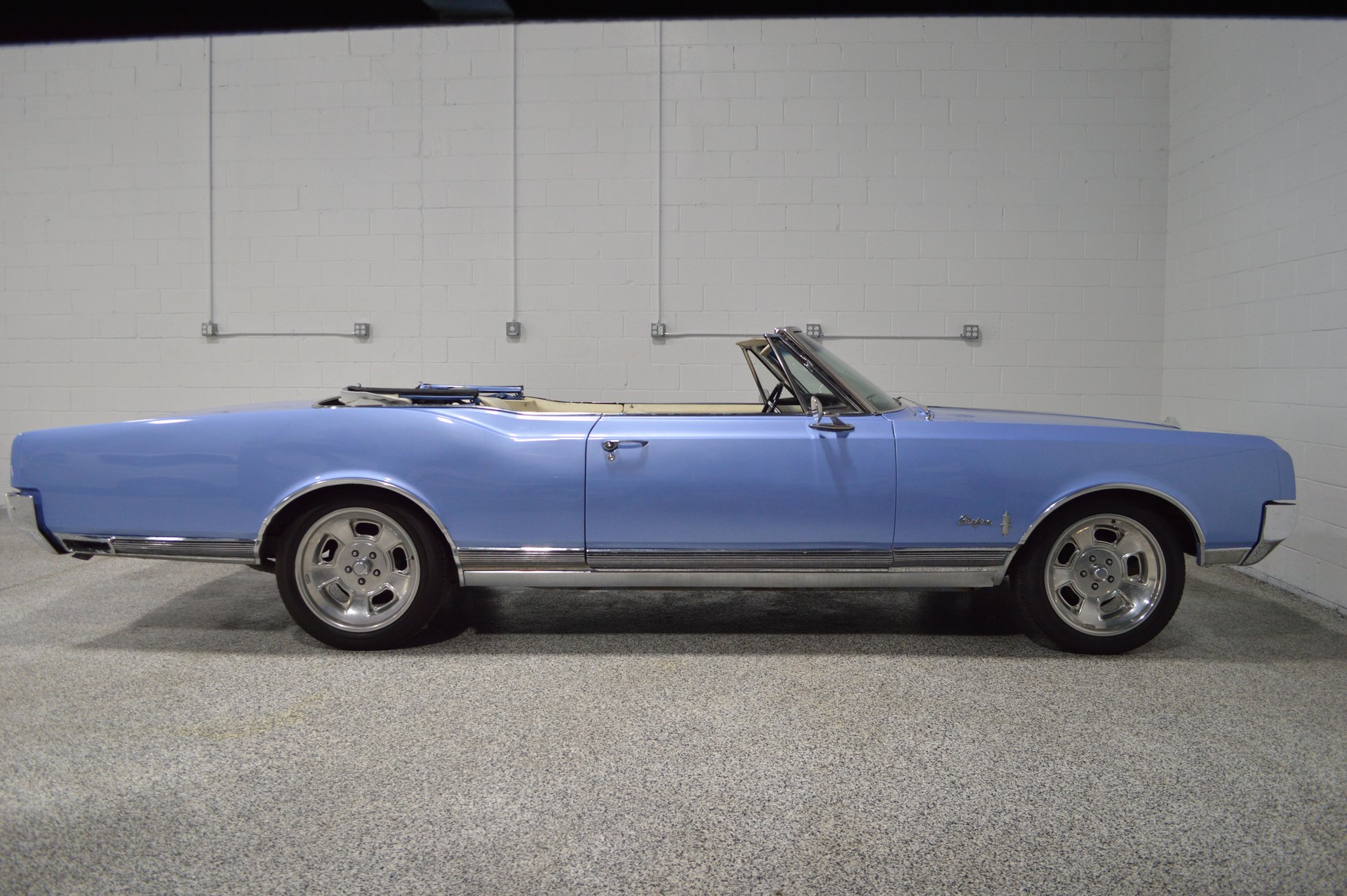 $34,900 · 28% above typical
Expand
 $23,980 · 12% below typical
Expand
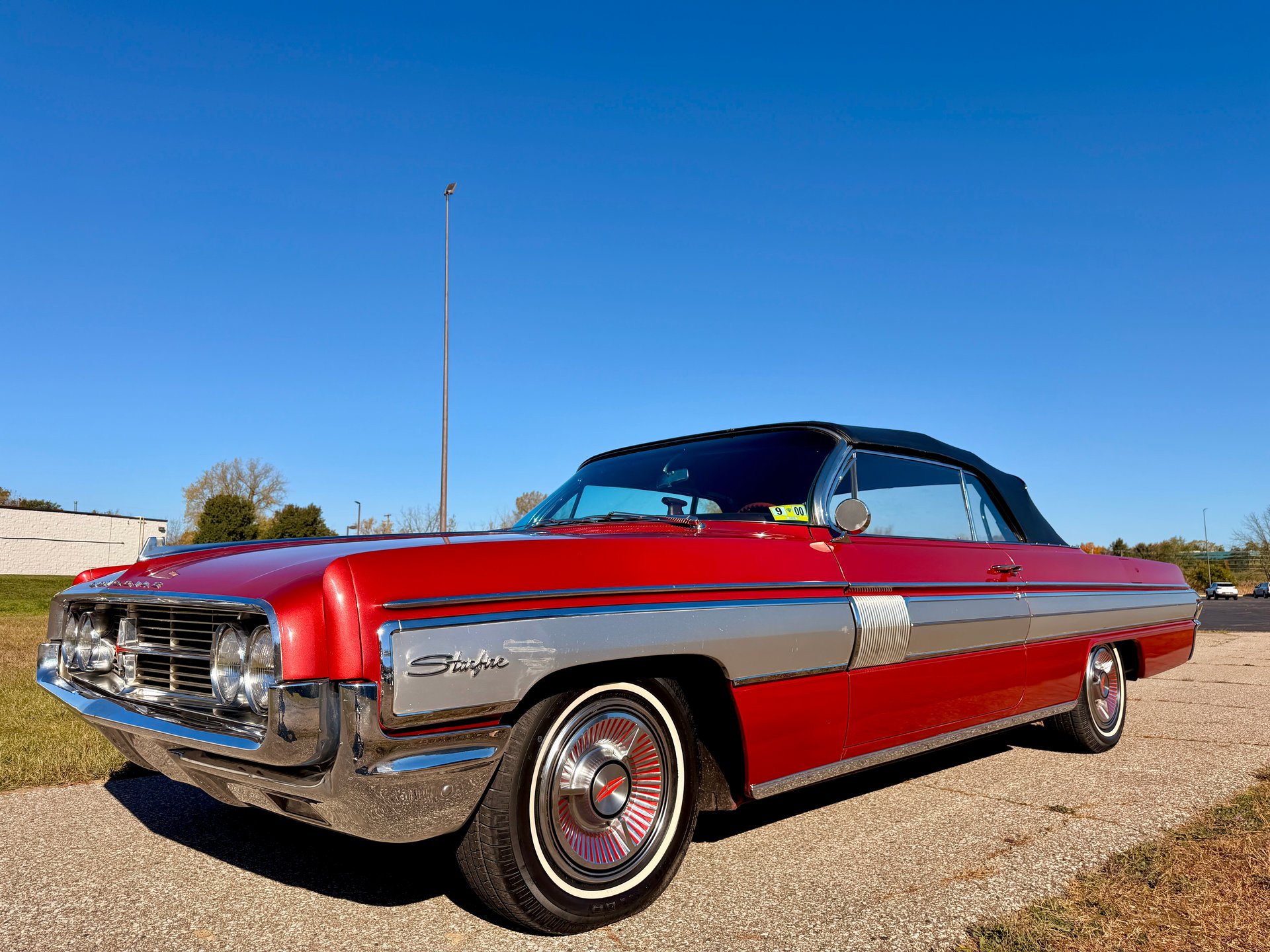 $33,900 · 24% above typical
Expand
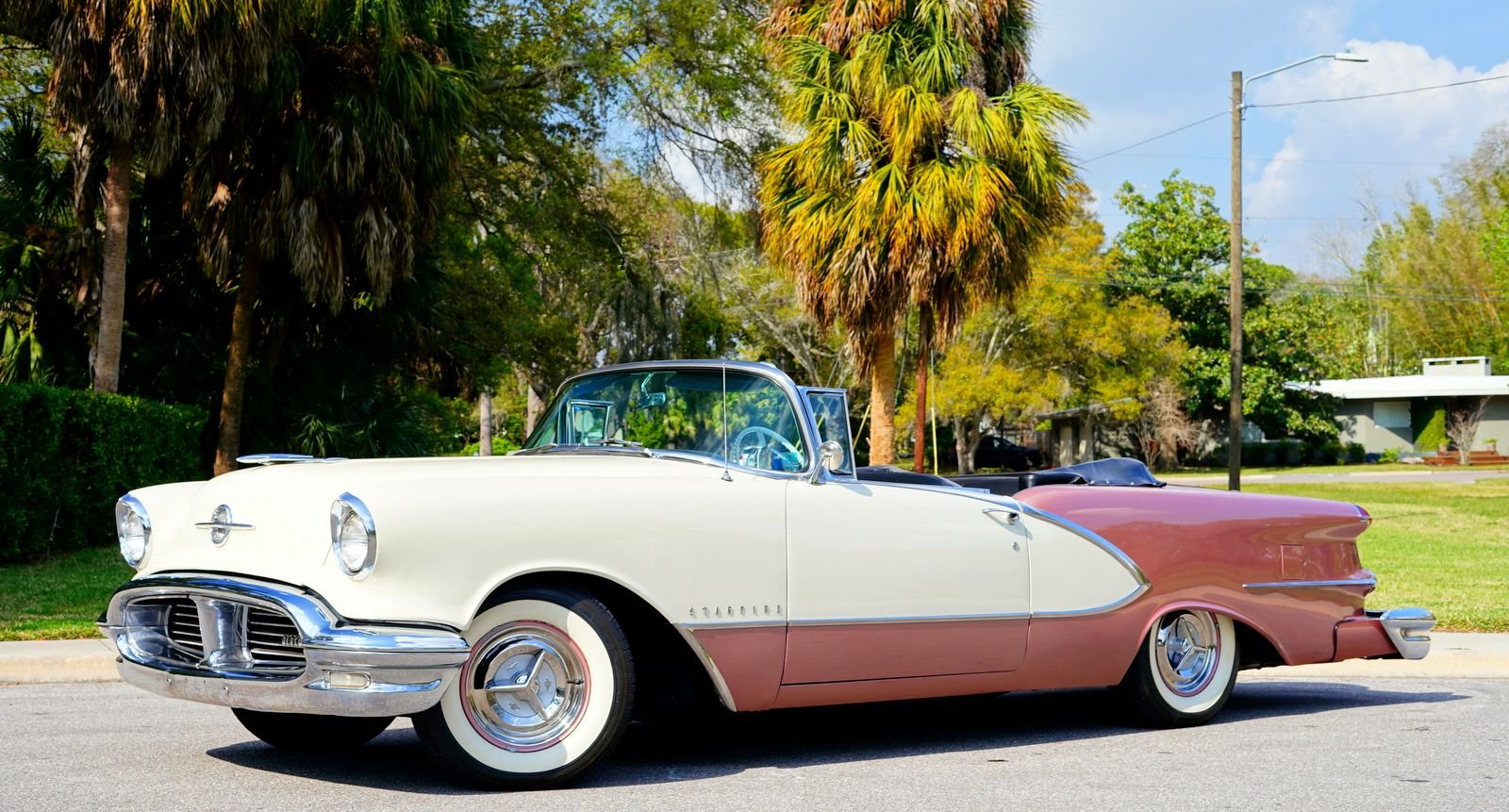 $59,900 · 120% above typical
Expand
What they sell for: Starfire sale prices.