
Plymouth Duster 340 Hardtop buyer's guide
Plymouth Duster 340 Hardtop -- the model's own buyer's guide: variants, values and what to check.
Years listed: 1972-1972 · Series: A-Body
Overview and history
The Plymouth Duster is the car that proves a great shape and a low price beat a long options list. Plymouth launches it for the 1970 model year as a fastback coupe spun off the Valiant — Chrysler's A-body compact — and the trick is visible from the kerb: everything from the windscreen forward is ordinary Valiant, while everything behind it is a new, sharply sloped semi-fastback roofline over a big boot. Underneath you get the A-body's proven hardware: unibody construction, torsion-bar front suspension, a live rear axle on leaf springs, and a 108-inch wheelbase. Nothing about the engineering is exotic. Everything about the packaging is right, and buyers notice immediately: the Duster is a sales sensation, comfortably outselling the Valiant line it borrows from.
You need to understand what the Duster is in the range, because sellers routinely blur it. It is not a muscle car that happens to be small, and it is not a Barracuda — the Barracuda is the separate E-body pony car from 1970 on. The Duster is a compact economy coupe that Plymouth offers across an unusually wide span: at one end a 198-cubic-inch slant six with a three-speed manual and rubber mats, at the other the Duster 340, a genuinely quick small-block performance car. Most Dusters live in between — a 225 slant six or a 318 V8, an automatic, and a life spent as family transport. That breadth is why the model matters to you now: the same badge covers a car worth restoring carefully and a car worth buying cheaply and driving, and the difference is entirely in the VIN, the fender tag and the specification, never in the seller's adjectives.
The arc of the model is the arc of the American industry in miniature. The early cars, 1970 to 1972, are the light, clean ones: thin chrome bumpers, high-compression engines at the start of the run, and the 340 at its best. For 1973 the car gets a restyle — a new grille, revised tail, larger federal bumpers beginning their march, and a useful option in the Space Duster's fold-down rear seat — while emissions tuning and falling compression ratios soften every engine. The 340 leaves after 1973 and a 360 takes its place for 1974, still lively but heavier and less charismatic. Sales peak mid-decade on economy versions, the Gold Duster trim package and, for the final 1976 year, the Feather Duster lightweight special. Production ends after 1976 and the Volare takes over; the Duster name later reappears on unrelated cars, but nothing after 1976 is this car.
Correct the biggest myth now, because it will meet you in classified adverts: Plymouth never builds a Hemi Duster, and never fits any big-block engine to a production Duster. The largest factory engine is the 360 small-block. Hemi and 440 Dusters exist in numbers today, but every one of them is a later engine swap, however professionally done. A swapped car can be a fine thing to own, but you price it as a modified car, you inspect the swap as engineering rather than as history, and you never let the word "Hemi" in an advert move it into original-muscle-car money. The site's own current pool illustrates the point neatly: of the four Duster Hardtops the store holds as this guide is written — a 1971, two 1972s and a 1973, all dealer cars — the 1973 is a Hemi-swapped car wearing its conversion proudly in its stripes and bonnet lettering. It is a Duster. It is not a factory Hemi car, because there is no such thing.

The models
The range divides cleanly once you separate the trim-and-engine ladder from the special packages. Every Duster is the same basic two-door hardtop shell — "hardtop" here in period Plymouth usage for the pillarless-look coupe body, with pop-out rear quarter windows on most years. There is no Duster convertible, no four-door Duster and no estate. What changes across the range is the engine, the running gear that comes with it, and the trim.
| Model | Years | Engine | Output | Built | Character |
|---|---|---|---|---|---|
| Duster (base) | 1970–1976 | 198 or 225 slant six; 318 V8 optional | 125–145 hp (sixes); 230 hp gross, later ~150 hp net (318) | The overwhelming majority of roughly 1.3 million Dusters across the run | The economy coupe Plymouth intended; the honest, usable classic of the range |
| Duster 340 | 1970–1973 | 340 LA small-block V8, four-barrel | 275 hp gross (1970–71); 240 hp net (1972–73) | ~24,800 (1970), ~12,900 (1971), ~15,700 (1972), ~15,700 (1973), approximately | The giant-killer: a real performance car in a compact shell |
| Duster 360 | 1974–1976 | 360 LA small-block V8, four-barrel | 245 hp net (1974), falling thereafter | A small minority of mid-decade production | The 340's successor under emissions rules; strong, heavier, less sought-after |
| Duster Twister | 1971–1972 | 225 slant six or 318 V8 | As base cars | A modest subset of base production | The trap: 340 looks — scoops, stripes, blackout bonnet — on cooking running gear |
| Gold Duster | 1973–1975 | 225 slant six or 318 V8 (360 in some years) | As base cars | A popular mid-decade trim package | The luxury-trim car: vinyl roof, plush interior, gold stripes |
| Feather Duster | 1976 | 225 slant six | ~105 hp net | A limited final-year run | The lightweight economy special: aluminium panels and an overdrive manual |
A note on the figures in that table, because this guide does not dress guesses up as data. Total Duster production across 1970–1976 is on the order of 1.3 million cars, and the six-cylinder and 318 base cars account for the great bulk of it in every year. The 340 build figures quoted are the commonly published factory-derived numbers, reliable to the nearest few hundred; treat any seller who quotes you a rarer figure to the last digit with suspicion unless he produces paperwork.
The base Duster is where you start. Standard power is a slant six — the small 198 in the early years, the 225 throughout — with the 318 two-barrel V8 the popular option. Trim is plain: bench seats, basic carpet, steel wheels. Plymouth sells these by the hundred thousand as second cars, commuter cars and first cars, and that is exactly how you should buy one today: as a simple, robust, pleasant compact coupe, not as a muscle car manqué. A good 318 car is one of the sweet spots of the whole A-body world — V8 sound and torque, cheap parts, no rarity premium.
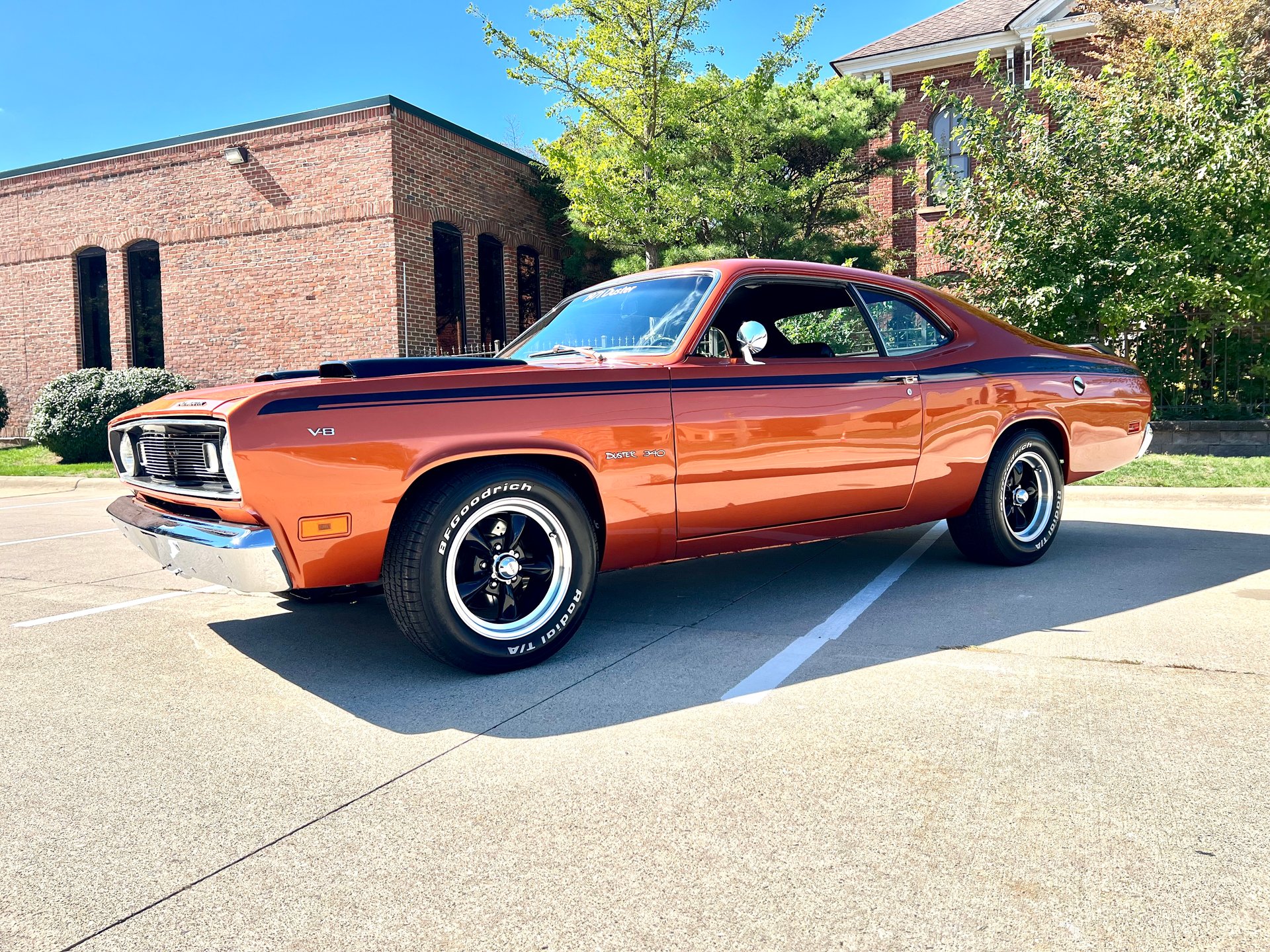
The Duster 340 is the performance flagship and the car most of this guide's identity teaching exists to protect. It is a distinct model, not an engine option on a base car: the VIN begins VS29 rather than VL29, the fifth VIN character is H for the 340 four-barrel, and the fender tag carries engine code E55. With the engine comes the supporting hardware — heavy-duty torsion bars and rear springs, a front anti-roll bar, the 8¾-inch rear axle in the early cars (replaced by the 8¼-inch unit for 1973), larger brakes and the option of the A833 four-speed manual with a Hurst shifter or the heavy-duty A727 TorqueFlite. Period performance is real: a well-tuned 1970 340 runs the quarter mile in the low-to-mid fourteens, in a car that weighs little more than 3,100 lb. This is the Duster the market prices as a muscle car, and therefore the Duster that gets cloned. Assume nothing; decode everything.
The Duster 360, arriving for 1974 after the 340 is withdrawn, keeps the formula — VS29-series identity, four-barrel small-block, uprated chassis — with the longer-stroke 360. It is a strong road car and noticeably cheaper than a comparable 340, but it carries the mid-seventies burdens: heavier bumpers, lower compression, more emissions equipment and softer detailing. Buy it on condition and price, not on lineage.
The Twister is the package you must learn before you look at any 1971 or 1972 car in 340 dress. Plymouth sells it precisely to look like a 340 — twin bonnet scoops, blackout bonnet treatment, side stripes, rallye wheels — while supplying a slant six or a 318 underneath. A Twister is a legitimate and likeable model in its own right, and an honestly described one is fine value. A Twister sold as a 340 is the single most common Duster misrepresentation, and the VIN settles it in ten seconds: a real 340 is VS29 with an H in fifth position; a Twister is a VL29 car with a six or 318 engine code.
The Gold Duster is a trim package, not a performance model: vinyl roof, upgraded interior, distinctive striping, usually a six or a 318. The Feather Duster is the engineer's special — aluminium bonnet, bumper reinforcements and intake manifold, a specially calibrated 225 and the option of the A833 overdrive four-speed, all aimed at fuel economy in 1976. It has a small, devoted following; its aluminium parts are also, as the problem sections explain, parts you inspect differently from steel.
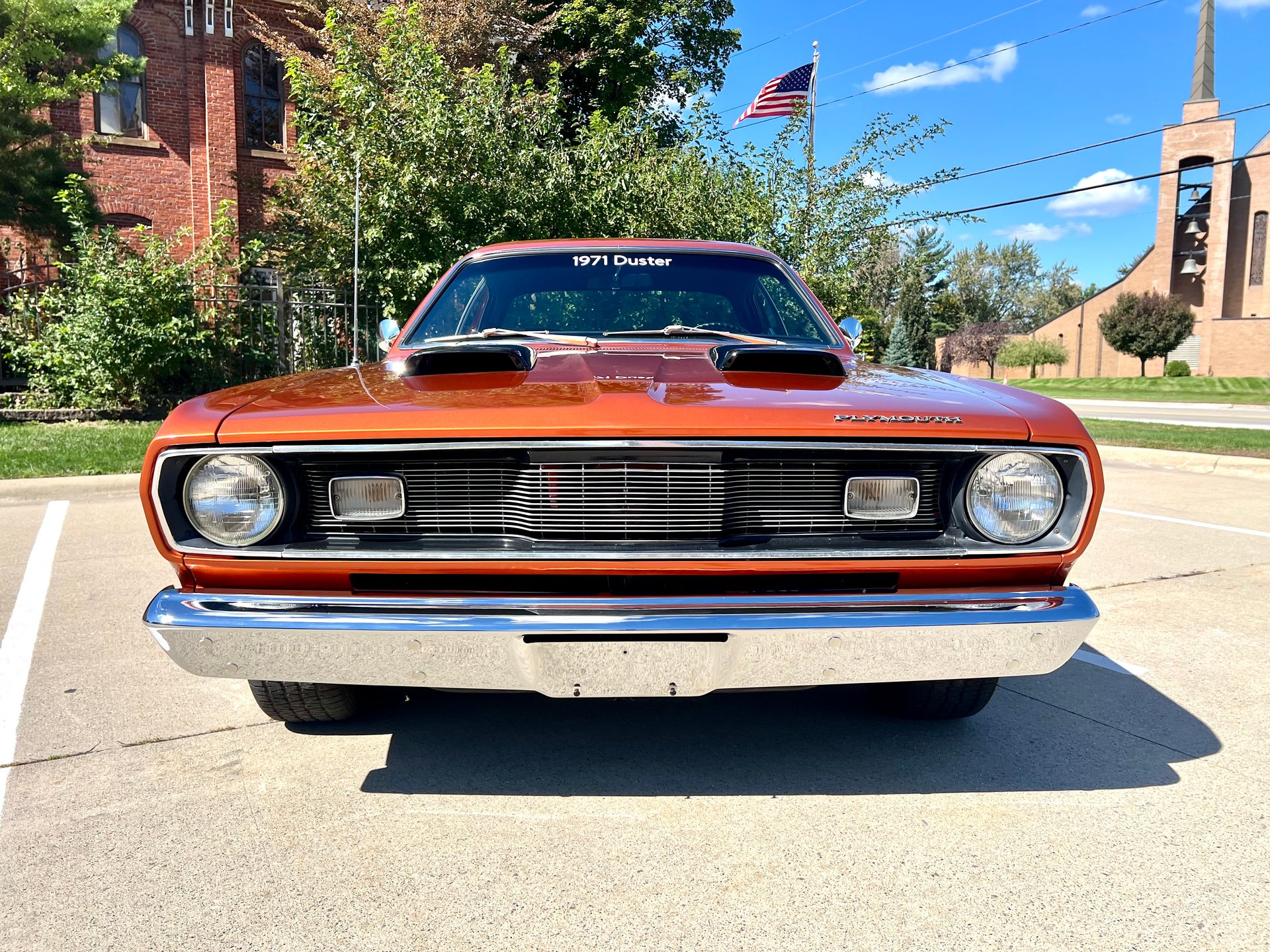
Year by year, the identity cues shift in ways that help you date a car and catch a wrong one. The 1970 car has a simple grille and small tail lamps; 1971 brings a revised grille and, on the 340, the famous "sharktooth" grille that clones copy most often. For 1972 the grille flattens and tail lamps grow. The 1973 restyle is the big visual break: a new, more pointed nose, larger tail lamps and impact-absorbing bumpers, with the Space Duster fold-down seat arriving as an option and electronic ignition standardised. For 1974 the rear panel changes again and bumpers grow further; 1975 and 1976 are detail years. A car wearing another year's nose or tail is not automatically wrong — panels swap freely on A-bodies — but it is a question the seller answers with history, not shrugs.
Engines and gearboxes
Four engine families power the Duster, all of them Chrysler designs, all of them well understood, and none of them fuel-injected in any factory application. Everything here is carburetted, points-ignited in the early years and electronically ignited from 1973, and driven through the rear wheels. Learn each family by its sound, its weak points and its identity marks, because on a fifty-year-old car the engine in front of you is frequently not the engine the car was born with — and on a slant-six or 318 car that may not matter, while on a 340 it is the whole value of the car.
The slant six: 198 and 225 — the engine itself
The Chrysler slant six — the G-series, in service since 1960 — is the Duster's standard engine and one of the most durable production engines ever built. The block leans 30 degrees to the passenger side, which gives the family its name and its instantly recognisable silhouette, and lets Chrysler fit a long, efficient intake manifold under a low bonnet line. In the Duster you meet two sizes: the 198 (3.2 litres), standard in the early years and rated around 125 hp gross, and the 225 (3.7 litres), optional at first and later the standard six, rated 145 hp gross in early form and roughly 100–110 hp net in the detuned seventies. Both use a single one-barrel carburettor — a Carter BBS or a Holley 1920 depending on year and plant — a seven-main-bearing crankshaft, and mechanical valve lifters for the whole Duster run, which means valve clearances are a service item you set with feeler gauges, not a hydraulic silence you take for granted.
On the road the 225 is the better engine by a clear margin: the 198 works noticeably harder at motorway speed and offers no compensating virtue beyond originality in a car born with it. Both pull from low revs with the flat, unhurried torque curve of a long-stroke six, and both will run — audibly unhappy but running — with faults that would stop a fussier engine. That toughness cuts both ways when you buy: a slant six that runs badly is telling you it has been neglected for a long time, because these engines forgive neglect longer than any other part of the car.
The slant six: what actually goes wrong
Three faults account for nearly everything you will ever fix on a Duster six. The first is the exhaust manifold. The cast-iron manifold lives a hard thermal life bolted to an aluminium intake manifold above it — the famous "hyper-pak"-derived log arrangement in milder form — and cracks, warps and broken end studs are routine at this age. A ticking that is loud cold and fades as the engine warms is the classic signature of a manifold crack or a failed gasket surface; a ticking that stays constant points instead to valve clearance. Distinguish them before you buy parts: the manifold tick changes with temperature, the valvetrain tick changes with revs and a feeler gauge settles it. Budget $300–700 for manifold replacement with stud extraction if the worst studs shear, which they do.
The second fault is the carburettor and its heat. The one-barrel sits above the exhaust manifold in the combined intake/exhaust assembly, and heat soak after a hot shutdown boils fuel in the bowl, giving you the classic hot-restart crank-and-flood. A car that starts cold, runs well and refuses hot is usually suffering this, a weak choke pull-off, or a perished needle valve — not, as sellers often claim, "vapour lock that they all do." The third is simple age in the ignition and charging system, shared with the V8s and covered in the problem sections: worn distributor bushings scatter the timing, and the ballast resistor fails open and kills the spark without warning. Carry a spare ballast resistor in the glovebox of any electronic-ignition car; it costs a few dollars and it is the difference between driving home and a tow.
The 318 LA small-block: the working V8
The 318 is the Duster's volume V8 and the engine in the majority of V8 cars you will inspect. It belongs to Chrysler's LA ("lightweight A") small-block family: thin-wall cast block, wedge heads, hydraulic lifters, and in Duster form a two-barrel Carter BBD carburettor and a single exhaust. Period ratings run from 230 hp gross in 1970–71 down through the net ratings of the seventies — around 150 hp for most of the run, less at the very end. None of those numbers captures the engine's character, which is smoothness and low-speed torque in a package that asks almost nothing of its owner. The 318 does not rev like a 340 and does not pretend to. It starts, it pulls, it cruises, and it does so for mileages that embarrass performance engines.
Its faults are the small-block's shared faults in mild form. The Carter BBD two-barrel has a known weakness in its idle circuits: the idle tubes and passages are small, clog with debris and varnish, and produce the classic BBD symptom set — an engine that idles roughly or stalls at junctions, runs acceptably at cruise, and refuses every mixture-screw adjustment because the fault is blockage, not calibration. A thorough ultrasonic clean and rebuild kit, $150–350 in parts and labour if you send it out, transforms these cars; a replacement carburettor bought before the original is cleaned is money spent in the wrong order. Timing chains stretch with age on all LA engines, retarding the cam and softening performance in a way owners mistake for tired rings — check by rocking the crank against the distributor rotor's movement before you condemn the bottom end. Rear main and timing-cover seals weep with age. The nylon-toothed cam sprocket of later seventies engines is a genuine failure item: teeth shed, timing jumps, and you are lucky if the engine merely stops. Any 318 of unknown history deserves a chain set, $250–500 fitted, as early preventive work.
The 340: the performance small-block
The 340 is the engine that makes this guide necessary. Chrysler builds it from 1968 to 1973 as the LA family's high-performance flagship: a 4.04-inch bore, a short 3.31-inch stroke, forged steel crankshaft in the early engines, high-flow wedge heads with 2.02-inch intake valves (1.88-inch from 1972), a windage tray, a double-roller timing chain and a camshaft with real lift and duration for a production engine of its day. The 1970–71 engines run 10.5:1 compression and a Carter AVS four-barrel and are rated 275 hp gross — a figure period road tests suggest is honest or conservative, in the era's manner of understating performance engines for insurance reasons. For 1972 compression falls to 8.5:1, the intake valves shrink, a cast crankshaft replaces the forging during the year, and the carburettor becomes the big Carter ThermoQuad spread-bore; the net rating is 240 hp. The 1973 engine continues in that form. The early engine is the sharper, freer-revving unit and the one collectors prize; the later engine is softer at the top end but torquier in ordinary use and perfectly respectable. What no 340 is, in any year, is slow.
Identity is everything here, so learn the marks. The block casting number for a 340 ends in the family's own sequence and the displacement is cast into the driver's side of the block — you can read "340" in the casting with a torch and a mirror, and you should. The engine's stamped pad, on the front of the block below the driver's-side head, carries the build and displacement codes. The VIN's fifth character H and the fender tag's E55 are the car's claim; the casting is the engine's. All three agree on a real car. A "340" that decodes as a 318 (fifth character G, tag E44) with a four-barrel fitted is the most common performance-Duster deception after the Twister, and it is a deception about money, because the two engines share a block architecture and the swap is invisible from the driver's seat at legal speeds.
The ThermoQuad on 1972–73 cars deserves its own paragraph because it generates more misdiagnosis than any other Duster component. It is a fine carburettor — a huge-capacity spread-bore with a phenolic centre body that insulates the fuel bowls from heat. Its known faults are specific: the bowl's internal fuel-well seals leak down overnight, so the car cranks long on a cold start because the bowl is empty; the phenolic body warps if the air-cleaner stud is overtightened; and the secondary air door's adjustment decides whether the engine bogs or flies when you open the throttle. A bog on a ThermoQuad car is an air-door or well-seal problem until proven otherwise, not a reason to fit a different carburettor — and fitting a square-bore replacement to a spread-bore manifold with a cheap adapter is how these cars acquire their reputation for flat spots. A specialist ThermoQuad rebuild runs $400–800 and is money well spent on a genuine 340.
The 360: the 340's successor
The 360 replaces the 340 for 1974, built on the same LA architecture with a longer 3.58-inch stroke and, in Duster 360 form, the 340's formula of four-barrel ThermoQuad, performance cam and uprated exhaust, rated 245 hp net in its first year and softening as the decade tightens. It uses a cast crankshaft and an externally balanced rotating assembly — which matters practically: the torque converter or flywheel and the harmonic damper are balance-specific, and mixing 360 external-balance parts with 318/340 internal-balance parts gives you a vibration that no amount of tuning removes. If a 360 car shakes at a particular road speed and the seller blames the tyres, check what converter and damper it wears. Everything said about the 318's carburettor, timing chain and seals applies here in stronger form, and the 360's extra torque is harder on the A904 automatic and the 7¼-inch axle if either has been substituted behind it.
Gearboxes: TorqueFlite automatics and the manual options
Most Dusters are automatics, and the automatic is the TorqueFlite, in two sizes. The A904 is the light unit behind sixes and 318s; the A727 is the heavy unit behind 340s and 360s and optional elsewhere. Both are three-speed, hydraulically controlled, and deservedly famous for durability — a TorqueFlite that has had fluid and filter changes survives almost anything, and one that has not usually announces itself honestly with delayed engagement on a cold morning (seals hardened, fluid draining back from the converter) and flared shifts under load. Read the fluid on the dipstick before the test drive: it should be red and smell of nothing much; brown fluid with a burnt smell prices a rebuild at $1,200–2,500 into the negotiation. Kickdown linkage adjustment matters more than on any rival automatic: a disconnected or maladjusted throttle-pressure linkage gives soft, early shifts and, if ignored, burns the box. If a Duster shifts beautifully at light throttle and flares on kickdown, adjust the linkage before you budget a rebuild.
Manual cars use the A230 three-speed (sixes and 318s, column or floor shift) or the A833 four-speed behind the performance engines, with a Hurst shifter — the famous Pistol-Grip in 1970–71 cars. The A833 is a famously strong box with a known appetite for second-gear synchro wear in hard-used cars: a crunch on the 3–2 downshift that a slower hand cures is synchro wear, not your technique. For 1976 the Feather Duster offers the A833 in overdrive form, with a 0.73 top gear in an aluminium case — an economy gearbox that looks like the performance one and is not interchangeable in feel or ratios. Clutches are conventional; linkage is mechanical with a z-bar whose bushings wear and make the pedal vague long before the clutch itself dies. Whatever the gearbox, the rear axle behind it should match the specification: 7¼-inch behind light-duty cars, 8¾-inch (early) or 8¼-inch (later) behind the performance cars, with Sure Grip — Chrysler's limited-slip — a desirable option you verify by jacking the rear and turning a wheel, not by the badge. An open 7¼ behind a car sold as a 340 tells you the drivetrain has been apart and downgraded, and the price follows it down.
Problem areas
A Duster's problems are the problems of a cheaply built, unit-construction car that is now more than fifty years old, and they divide honestly: rust decides whether a car is worth saving, the front suspension decides how it drives, the electrics decide whether it starts, and everything else is maintenance. Work through this section in that order when you assess a car, because the order is also the order of repair cost. Nothing in this section requires a rare part or a lost skill to fix. Almost everything in it is expensive only when it has been hidden — and Dusters, being cheap cars that became valuable cars, attract hiding more than most.
Rust: the map
The Duster's unibody is its structure; there is no separate chassis to save a rusty car, and the A-body's rust map is well charted. Start underneath, because that is where the verdict lives. The single most important structural check on any A-body is the torsion-bar crossmember and its mounting boxes, where the rear ends of the front torsion bars anchor into the body. This area traps mud, rots from inside, and carries suspension loads: a crossmember whose mounting boxes are holed or soft is a structural repair, requiring the area to be cut out and rebuilt with the car's geometry held — budget $1,500–3,500, and walk away from a performance car that needs it unless the price is a project price. The test is a screwdriver and conviction: probe the boxes and the frame rails around them, especially where the rails curve up over the rear axle and where the front rails meet the inner wings. Surface scale is normal; perforation and flaking layers are not.
From there, walk the known map. The front floor pans rot where feet and leaking windscreens wet them, and the leak usually comes from the cowl: the wiper-pivot seals perish, water enters the plenum, and it drips onto the floor and the bulkhead insulation for years before anyone lifts the carpet. Wet front carpets in a car that "never goes out in the rain" mean the pivots, and a plenum full of leaves means the drains are blocked and the cowl sides are next. Lift the boot mat: the boot floor and spare-wheel well rot from a leaking rear-window seal and from the fuel-tank vent, and the drop-off panels behind the rear wheels — the trunk extensions — fill with road dirt and dissolve, taking the lower rear quarters with them. Rear spring hangers and their body boxes are structural and commonly holed on salt-belt cars; the springs mount through the floor, so rot here is both a rust bill and an MoT-of-your-state failure. Lower front wings bubble behind the wheel where the inner splash shields trap mud; wing tops blister along the crown; door bottoms rot where the drain holes block; the lower corners of the windscreen frame and the rear-window channel hold water under their seals and perforate quietly, announcing themselves as damp headlining and a musty car. Cars with factory vinyl roofs carry an extra risk: the roof skin under the vinyl corrodes unseen, and a roof that feels crunchy under the covering or bubbles at its edges can mean a skin replacement, $1,500–3,000 with paint, on a car that photographs beautifully.
Two honest qualifications. First, the Duster's survival pool skews dry-state and garaged, and genuinely solid original cars exist in numbers — the four cars in the site's current pool are all dealer-presented cars in restored or kept condition, which is the top of the market, not the middle. Second, previous repair is the norm, not the exception: quarter panels, floor pans and boot floors are all reproduced, and a car with documented, well-executed panel replacement is a better buy than a "never welded" car whose originality is perforation. Judge the welding, the panel gaps and the paint match, not the fact of repair. What you reject is filler over rot, underseal applied yesterday over everything, and any car whose seller will not let you underneath it.
Front suspension, steering and brakes
The A-body front end is a torsion-bar independent design: upper and lower control arms, longitudinal torsion bars whose front ends key into the lower arms and whose rear ends anchor in that crossmember, an anti-roll bar on performance cars, and drum or disc brakes depending on year and specification. Its wear pattern is consistent. The upper ball joints are the screw-in type and wear first; jack the car under the lower arm so the joint is unloaded and lever the wheel — play you can feel is play that matters, and a joint that separates in service collapses the corner, so this is a safety check, not a refinement. Lower ball joints, tie-rod ends and the idler arm follow the same pattern, and the idler arm in particular is the usual source of the vague centre feel sellers call character: with the car on the ground, have a helper rock the steering wheel while you watch the linkage; lost motion at the idler and centre link is visible before it is felt.
Torsion bars themselves rarely break, but their adjusters seize, and the ride height they set is the car's front geometry: a Duster sitting nose-down or listing to one side has usually sagged, been maladjusted, or — on a car with an engine swap — is carrying weight its bars were never rated for. Six-cylinder bars under a Hemi swap is a specification error you will find in the wild, and it announces itself in bottoming and a car that will not align. Check the bar diameter against the engine: performance cars carry thicker bars, and a swapped car on six-cylinder bars is telling you the conversion was done to a budget. Rear leaf springs sag with age, spring eye and shackle bushes perish, and the car sits tail-down; new springs and bushes, $400–900 fitted, restore stance and stop the axle tramp that worn bushes permit. Shock absorbers are cheap and universally neglected; budget a set into any purchase.
Steering is by recirculating-ball box, manual or power-assisted. The manual box wears at centre and adjusts only within limits; a quarter-turn of free play at the wheel rim after the linkage is proven tight is a worn box, and a rebuild runs $400–800. Power boxes leak from their seals and hoses and are otherwise durable. Brakes divide the range by year in a way that matters for parts: early cars use small-bolt-pattern (5 on 4-inch) hubs, and disc-brake cars from 1973 use the larger 5 on 4.5-inch pattern, so wheels, drums and rotors are not freely interchangeable across the range. Four-wheel drums on an early six are adequate when maintained and marginal when not; front discs are the desirable specification, and a disc conversion using later A-body parts is the commonest and most defensible modification on a driver. A pull under braking is a sticking caliper or a collapsed flex hose before it is anything exotic. Brake pipes on any original car are a replace-on-sight item if they show corrosion — a full re-pipe in copper-nickel is a weekend and $150–300 in materials, and it is the cheapest insurance on the car.
Drivetrain wear beyond the engine
The engines have their own section; what wears around them is covered here. TorqueFlite automatics are covered in the gearbox section — add only that the neutral safety switch and its wiring are the usual cause of a no-crank that sellers misdiagnose as a starter motor, and that a box which engages drive with a bang has low fluid or a high idle before it has internal damage. Manual gearboxes wear as described; the A833's other known fault is jumping out of gear on the overrun, which is worn engagement teeth and a rebuild, $800–1,500, not an adjustment. Clutch release bearings sing, z-bar bushes slop, and a clutch that judders from rest on a car that has sat is often oil on the plate from a weeping rear main seal — which means the gearbox comes out either way, so price the seal into the clutch job. Rear axles divide into three. The 7¼-inch unit behind light cars is adequate for a six or a gentle 318 and nothing more; it whines when its bearings tire and breaks when abused, and finding one behind a performance-claimed car is a downgrade flag. The 8¾-inch is the strong, desirable axle of the early performance cars, with a drop-out centre section and a wide ratio choice; its faults are bearing wear, seal leaks onto the rear brakes, and — on Sure Grip cars — a limited-slip that has gone open with age, which you detect on the jack test described in the gearbox section. The 8¼-inch that replaces it from 1973 is a perfectly serviceable C-clip axle with less ratio choice. Universal joints clunk on take-up when worn; a vibration at cruise that changes between drive and overrun is pinion-angle or UJ wear, and a vibration that appeared after an engine swap is the external-balance error described in the 360 section until proven otherwise.
Electrics: the bulkhead, the ballast and the ammeter
Chrysler electrics of this era are simple, robust in design and let down by three specific weaknesses you should know by name. The first is the bulkhead connector, where the engine-bay harness passes through the firewall on a multi-pin plug. Its terminals corrode, overheat and melt the housing, producing every symptom from a flickering dash to a total no-start to, in the worst documented cases, a harness fire. On any car you inspect, pull the connector apart — with the battery disconnected — and look for green corrosion, heat-discoloured plastic and terminals that have lost their spring. A cleaned and tightened connector is a fix; a melted one means harness work, $300–1,000 depending on how far the heat travelled. The second weakness is the ammeter circuit: the full charging current passes through the dashboard ammeter and the bulkhead on these cars, which is why the bulkhead overheats in the first place. Many surviving cars have a bypass or a voltmeter conversion; treat a well-executed one as an improvement, and an original ammeter car as a car whose bulkhead you inspect with extra care.
The third is the ignition system. Cars to 1972 use contact-breaker points — simple, adjustable, and a service item every 10,000–12,000 miles; a car that misfires under load and has not seen points in years needs points and a condenser before it needs anything else. Electronic ignition, optional in the early seventies and standard from 1973, replaces points with a magnetic pickup and a control box, and introduces the ballast resistor as the system's weak point: it fails open, and the engine dies the moment you release the key from the start position, or gives no spark at all. The diagnosis is a jumper wire and two minutes; the part is a few dollars; the tow truck is neither. Distributor shaft bushings wear on all variants and scatter timing at speed — grab the rotor and feel for side play. Charging is by alternator with an external regulator on early cars; overcharging that boils the battery is the regulator. None of this is difficult. All of it is the difference between a car that starts in the seller's yard and a car that starts in yours.
Interior, trim and glass
The Duster's cabin is vinyl, plastic and thin carpet, built to a price and aged accordingly. Dash pads crack in the sun along their speaker grille and edges; good used pads are scarce and reproduction quality varies, so a cracked pad on an otherwise excellent car is a negotiation point ($300–700 for a quality replacement or recover) rather than a walk-away. Seat vinyl splits along its seams and piping, bench seats sag on their springs, and the foam under a re-covered seat is often original and collapsing — sit in the car for five minutes, not thirty seconds, because the seat tells you the truth slowly. Correct-pattern upholstery kits for the performance cars cost more than generic covers and are worth it on a 340. The fold-down rear seat of the Space Duster option is a genuinely useful party trick — a huge flat load bay — and its hinges, latch and the bulkhead panel behind it should all work and be present; a Space car missing its hardware has lost the point of the option.
Trim is where restoration budgets quietly die. Grilles are year-specific — the 1971 340 sharktooth most of all — fragile in their mounting tabs, and expensive when genuine; a wrong-year grille is a deduction, not a disaster, except on a top-price 340 where correctness is the price. Side stripes and decals are reproduced and frequently wrong in detail or placement. Glass is available; the pop-out rear quarter windows leak at their seals and whistle; window regulators wear and drop glass. Heater cores leak into the passenger footwell — a sweet smell and a misting screen on a damp morning — and replacement is a fiddly half-day because of access. Wiper linkages wear their pivots oval, which is also the cowl-leak source from the rust section, so a car with sloppy wipers and wet carpets is telling one story, not two. Finally, the small things that separate a sorted car from a shiny one: the fuel gauge reading through a sender whose earth strap has corroded, the horn, the reversing lights, the courtesy lights. Test them all.
How to inspect one
Inspect a Duster in the order the money runs: identity first, structure second, mechanicals third, cosmetics last. A beautiful car with the wrong identity is the most expensive mistake available in this market, and it takes ten minutes to avoid. Take a torch, a magnet wrapped in cloth and a screwdriver for probing, with the seller's permission.
- Decode the VIN before you touch anything else. The plate sits on the driver's side of the dash, visible through the windscreen. A base Duster begins VL29; a genuine 340 or 360 begins VS29. The fifth character is the engine the car was born with — H for a 340, G for a 318, a six-cylinder code for a six. If the advert says 340 and the VIN says otherwise, the inspection is over except as a negotiation about a different, cheaper car.
- Read the fender tag and cross-check it. The tag on the driver's inner wing lists the engine code (E55 for a 340, E44 for a 318, E58 for a 360), gearbox, axle, paint and trim codes and build date. It should agree with the VIN and with the car in front of you — paint code against the colour in the door shuts and under the boot seal, trim code against the interior. A missing tag is not fatal but is a deduction; a tag that disagrees with the VIN is a story you make the seller explain.
- Ask for the broadcast sheet and the paperwork. The build sheet is often under the rear seat springs, in the glovebox or with the car's history file. A documented car — sheet, original invoice, service history — is worth more and is easier to resell. On a claimed low-mileage car, demand evidence; the odometer on these cars has five digits and no memory.
- Go underneath and probe the structure. Torsion-bar crossmember boxes first, then front rails, rear rails over the axle, spring-hanger boxes and floor pans — the full map from the rust section. Perforation at the crossmember or hangers reclassifies the car as a project regardless of how it photographs.
- Check the leak triangle: cowl, floors, boot. Feel the front carpets and underlay for damp, look for the wiper-pivot drip stains on the bulkhead, and lift the boot mat to inspect the boot floor, spare well and trunk extensions. Wet at any corner of the triangle means the seals and pivots from the problem sections need work, and the rust they fed needs finding.
- Read the engine's own identity. On a V8, find the displacement cast into the driver's side of the block and the stamped pad at the front of the block. A claimed 340 that casts as a 318 is a 318. On a swapped car — Hemi, 440, modern anything — inspect the conversion as engineering: mounts, torsion-bar size against the engine's weight, cooling capacity, axle and brakes upgraded to match, and paperwork for the work.
- Cold-start it yourself. You want the engine stone cold. A slant six should fire and settle with a manifold tick, if any, that fades as it warms; a V8 should start without throttle theatrics. Blue smoke at start-up that clears is valve seals; smoke that persists under load is rings or bores. Long cranking on a ThermoQuad car points at the bowl well seals from the engine section.
- Do the ignition and charging checks. Watch the ammeter or charge light behaviour, then switch everything on — lights, heater fan, wipers — and watch for flicker or a drooping gauge, the bulkhead connector's signature. If the car is electronic-ignition, ask where the spare ballast resistor is; a knowing owner has one.
- Test the front end on the ground and in the air. Rock the steering and watch the idler arm and centre link for lost motion. Then jack under the lower arms and lever each front wheel for ball-joint play — the screw-in uppers from the suspension section. Note the ride height and stance: nose-down, tail-down or listing each has a named cause in the problem sections, and none of them is "they all sit like that."
- Read the automatic's fluid and the manual's second gear. TorqueFlite fluid red and sweet, brown and burnt prices a rebuild. On the drive, demand a kickdown: flare on kickdown is linkage adjustment before it is a rebuild. In a manual car, make the 3–2 downshift at moderate speed; a crunch is A833 synchro wear, priced accordingly.
- Drive it far enough to get it hot, then restart it hot. Fifteen minutes minimum. Note steering centre feel, brake pull, axle whine on drive and overrun, and vibration that changes between the two — the drivetrain section gives you the differential diagnosis for each. Park, switch off for five minutes, and restart: the hot-restart behaviour separates the sorted carburettor from the heat-soaked one.
- Finish with the small electrics and the trim audit. Fuel gauge against a known fill if you can, horn, reversing lights, courtesy lights, wiper sweep and park, heater fan on all speeds, quarter-window seals. Then price the trim honestly against the car: correct-year grille, stripes, dash pad and seat condition. On a top-price 340, wrong trim is a real deduction; on a driver, it is a list of winter jobs.

Values
The Duster market is really several markets wearing one badge, and the computed listings and recorded-sales figures appended to this guide beneath this section will mean more to you once you can see the divisions. The widest spread is by identity. A genuine, documented 340 — right VIN, right tag, matching engine casting, paperwork — trades in a different world from a base car, and the gap between them is not a percentage but a multiple. Within the 340 market, the early high-compression cars carry a premium over the 1972–73 cars, four-speed cars carry a premium over automatics, and documented cars carry a premium over plausible ones.
Condition spreads on Dusters are unusually wide for a car this simple, because the cheap-car years produced so many neglected examples and the restoration maths only works at the top of the market. A structurally sound, honestly presented driver — six or 318, tidy paint, needs the usual rubber, seals and service work — is the value centre of the whole range: you are buying transportation and fun, the parts are cheap, and your money is recoverable. A project car is worth dramatically less than the same car as a driver, and the gap is set by the structural rust map in the problem sections, not by how complete the car looks: a complete car needing crossmember, floors and quarters is a parts-priced car whatever its engine code, because the welding bill does not care which Duster it is under. Conversely, a genuinely rust-free original car earns a premium that survives scrutiny, because you cannot buy that condition back at any price once it is gone.
Asking prices and achieved prices part company most noticeably at the two ends. At the top, dealer-presented restored cars — the profile of the site's own current pool — carry asking prices that assume the buyer values turn-key condition and presentation, and the recorded sales show what the market actually pays; the distance between the two is your negotiation space, and it is larger on over-restored base cars than on genuine 340s, where rarity disciplines sellers. At the bottom, project cars are routinely advertised at driver money by sellers pricing the car they intended to build rather than the car on their drive. Read the appended sales record by variant, not in aggregate: a median built from mixed sixes, 318s and 340s describes no car that exists. Read it, too, with the clone problem in mind — a recorded sale of a "340" that was really a dressed 318 teaches you about the deception market, not the 340 market.
Modified cars price on their own logic. A well-engineered swap — the Hemi-converted 1973 in the current pool is the type — is worth what the build quality and the driving experience support, assessed like a hot rod: components, workmanship, documentation of the build. It is not worth original-car money and does not appreciate on the original car's curve. Buy one because you want that car, at a price that assumes the next buyer will scrutinise it exactly as hard as you did.
Parts and ownership
Owning a Duster is one of the easiest classic-car propositions there is, because the A-body was built in the millions, shares its mechanicals across the Valiant, Dart, Barracuda and their siblings, and is served by a mature reproduction industry. Engine parts for the slant six and the LA small-blocks are available everywhere, cheaply, often off the shelf at a general parts store in North America: service items, gaskets, water pumps, ignition components, carburettor kits and timing sets are non-events. Performance parts for the 318, 340 and 360 are a small industry of their own. Gearbox and axle parts follow the same pattern — TorqueFlite rebuild kits and A833 components are standard catalogue items, and any competent transmission shop knows both boxes.
The friction lives in body and trim. Mechanical interchange is generous; cosmetic correctness is year-specific. Floor pans, boot floors, quarter panels and wings are reproduced and fit with the usual reproduction caveats. Grilles, tail-lamp assemblies and interior soft trim are reproduced selectively — the high-demand performance-car items first — and the rest comes from the used market, where prices for a correct 1971 340 grille or a good dash pad reflect their scarcity. Small-bolt-pattern brake and wheel parts for the early cars are the one mechanical area where you plan ahead rather than assume availability. Feather Duster aluminium panels are effectively unobtainable except used; a bent aluminium bonnet is a repair, not a replacement.
Running one is straightforward. Fuel consumption is period-typical — a six in the low twenties to the gallon on a run if you drive it gently, a 340 in the teens. The early high-compression engines were built for leaded premium fuel; on modern unleaded they need hardened valve seats at rebuild time, octane appropriate to their compression, and ignition timing set for the fuel in the tank rather than the book figure. Later low-compression engines are untroubled. Service intervals are short by modern standards — oil at 3,000–4,000 miles, points and plugs on the early cars at 10,000–12,000, slant-six valve clearances on the same visit — and none of it needs a specialist: a Duster is a car a competent home mechanic can run entirely, which is a real part of its value proposition. Insurance is at the cheap end of the classic world, agreed-value policies are readily available, and the car's size makes it a classic you can store in an ordinary garage and use in ordinary traffic.
Which one to buy
- The all-rounder: a 318 base Duster, 1970–1972. V8 character, cheap parts, no rarity premium, light and simple. The Duster most buyers should actually buy.
- The performance buy: a genuine 1970–1971 Duster 340. High compression, Carter AVS, the sharpest engine and the strongest market — bought strictly on VIN, tag and casting evidence, with documentation.
- The value performance buy: a 1972–1973 Duster 340 or a 1974 Duster 360. Most of the speed for notably less money, with the ThermoQuad's quirks understood and budgeted. The 1973 car adds the better brakes and the Space Duster option.
- The honest economy car: a 225 slant-six Duster in sound shell condition. Unburstable, cheap to run, and charming — provided the manifold, the cowl and the floors pass the inspection section. Avoid the 198 unless originality in that specific car is the point.
- The curiosity: a Feather Duster or a Gold Duster. Buy the Feather for its aluminium oddity and overdrive gearbox, the Gold for its period luxury trim — each priced as the base car it mechanically is, plus a little for the story.- The modified car: a well-built engine-swap Duster, Hemi or otherwise. Buy the engineering and the paperwork, enjoy it as a hot rod, and pay hot-rod money — never original-car money, because no factory performance Duster beyond the 360 exists.
The overriding rule: buy the shell and the identity, in that order — a rust-free car with a decoded, documented identity is worth more than any engine, stripe or story, because panels and paperwork are the two things you cannot buy back later.
See the 1 Duster 340 Hardtop cars currently listed.
What they sell for: Duster 340 Hardtop sale prices.