
Plymouth Prowler buyer's guide
Plymouth Prowler -- the model's own buyer's guide: variants, values and what to check.
Years listed: 2001-2001 · Series: Prowler
# Plymouth Prowler — Buyer's Guide
Overview and history
You are not looking at a normal production car that happens to look unusual. You are looking at the moment in the 1990s when a major American manufacturer decided to build a hot rod on purpose, in public, using its newest materials and electronics, and to sell it through ordinary showrooms with a warranty. The Prowler starts as a concept car, shown in 1993, in the great age of Chrysler concept cars that actually reached production. The Viper has already proved a show car can be built in small numbers without losing its nerve on the way. The Prowler is the next experiment, and the braver one, because it has to work as a usable road car, pass every crash and emissions rule of its day, and still look like a 1930s roadster that has been chopped, channelled and fitted with wheels a period hot-rodder could only dream about.
Understand that intention first, because it explains almost everything you will find when you inspect one. The car is a technology demonstrator as much as a styling exercise. Chrysler uses it to learn how to build a car around aluminium — aluminium body panels, an aluminium-intensive structure, bonded and riveted construction borrowed from aircraft practice rather than the spot-welded steel unibodies it builds by the million. It uses the car to prove a rear-mounted transaxle in a front-engined production car, to put pushrod-actuated inboard front suspension on a showroom vehicle, and to package run-flat tyres and staggered wheel sizes — 17 inches at the front, 20 at the rear — when almost nothing else runs anything like them. When you find construction that seems exotic for a Plymouth, that is the programme working as intended.
Production begins for the 1997 model year at the Conner Avenue Assembly Plant in Detroit, the same low-volume plant that builds the Viper. There is no 1998 model year — the car pauses while the more powerful engine described below is prepared — and production resumes for 1999 and runs through 2000 and 2001 under the Plymouth name. Then the Plymouth marque itself is discontinued, and the final cars, for 2002, are badged as Chryslers. This is the most common identity confusion on this model, so settle it now: a Chrysler Prowler is not a different or lesser car. It is the same car, from the same plant, built by the same process, wearing a different badge because its original brand has ceased to exist. Anyone who tries to sell you a Plymouth-badged car at a premium over an equivalent Chrysler-badged car on grounds of authenticity is selling you a story, not a car. Judge both exactly the same way.
Total production across all years is around 11,700 cars — the documented figure usually given is 11,702 — which makes the Prowler rare by the standards of a major manufacturer and common by the standards of a specialist car. You will have a real choice of cars at any given moment, parts and knowledge are shared across a meaningful owner base, and yet you will not pass another one every day. It also means there is no excuse for buying a bad one in a hurry: with several thousand later, high-output cars in existence, patience is a genuine strategy on this model.
What the Prowler is not matters as much. It is not a muscle car, and not a European-style sports car chasing lap times. It is a cruiser with genuine pace in its later form, delivered in a relaxed, automatic-gearbox, open-top way, whose real product is the experience of arriving in it. Owners who understand that tend to keep their cars for years and maintain them properly. Owners who bought one expecting a V8 dragster tend to sell quickly, sometimes after modifying the car in ways you will now have to unpick. Keep asking which of those two owners you are buying from, because the answer predicts the car's condition more reliably than its mileage does.
One more piece of context. These cars were bought in large numbers as toys and retirement treats, and a great many have covered very low mileages, spending long periods in garages. That sounds like unmixed good news and it is not. A Prowler that has sat still for five years presents a completely different set of problems from one driven gently every month — aged tyres, a timing belt old in years however fresh it looks in miles, dried seals, a tired battery, stale fluids and rubber at the end of its life by the calendar. Low mileage on this model is a starting point for questions, not an answer, and the inspection section returns to this again and again.
The models
The Prowler range is simple in outline and easy to misread in detail. There is one body — a two-seat open roadster with a manually operated folding soft top — one engine family, one gearbox, and no coupe, no four-seater and no factory performance variant in the usual sense. What changes across the run is output, colour, trim detail and badging, plus a small number of factory special editions that are, in essence, colour and trim packages applied to the standard car. That simplicity is good news: there is no wrong body style to avoid and no obscure variant whose parts are unobtainable. It also means condition and history separate cars far more than specification does.
The first cars, for 1997, all leave the plant in purple — Prowler Purple is the only colour offered in the launch year — and all use the earlier, lower-output version of the 3.5-litre V6. Production in that first year is small, 457 cars, and those cars carry a genuine first-of-the-line interest for collectors. Be clear-eyed about what that interest buys you as a driver: the 1997 car is the slowest Prowler, the most likely to have the oldest components, and the one whose colour you cannot choose. If you want a car to drive, the later cars are simply better. If you want the launch artifact, buy the 1997 knowingly and pay for its history, not its performance.
There is no 1998 car. Sellers occasionally advertise one, and any such claim deserves a careful look at the paperwork and the vehicle identification number, because a car described as a 1998 Prowler is either misdated, mistitled or misunderstood. When production resumes for 1999, the car gains the high-output aluminium-block engine it keeps for the rest of its life, and the colour range widens beyond purple to include yellow, black and red. From this point the mechanical specification is essentially settled, and the differences between a 1999 car and a 2002 car are matters of colour, edition, condition and mileage rather than substance.
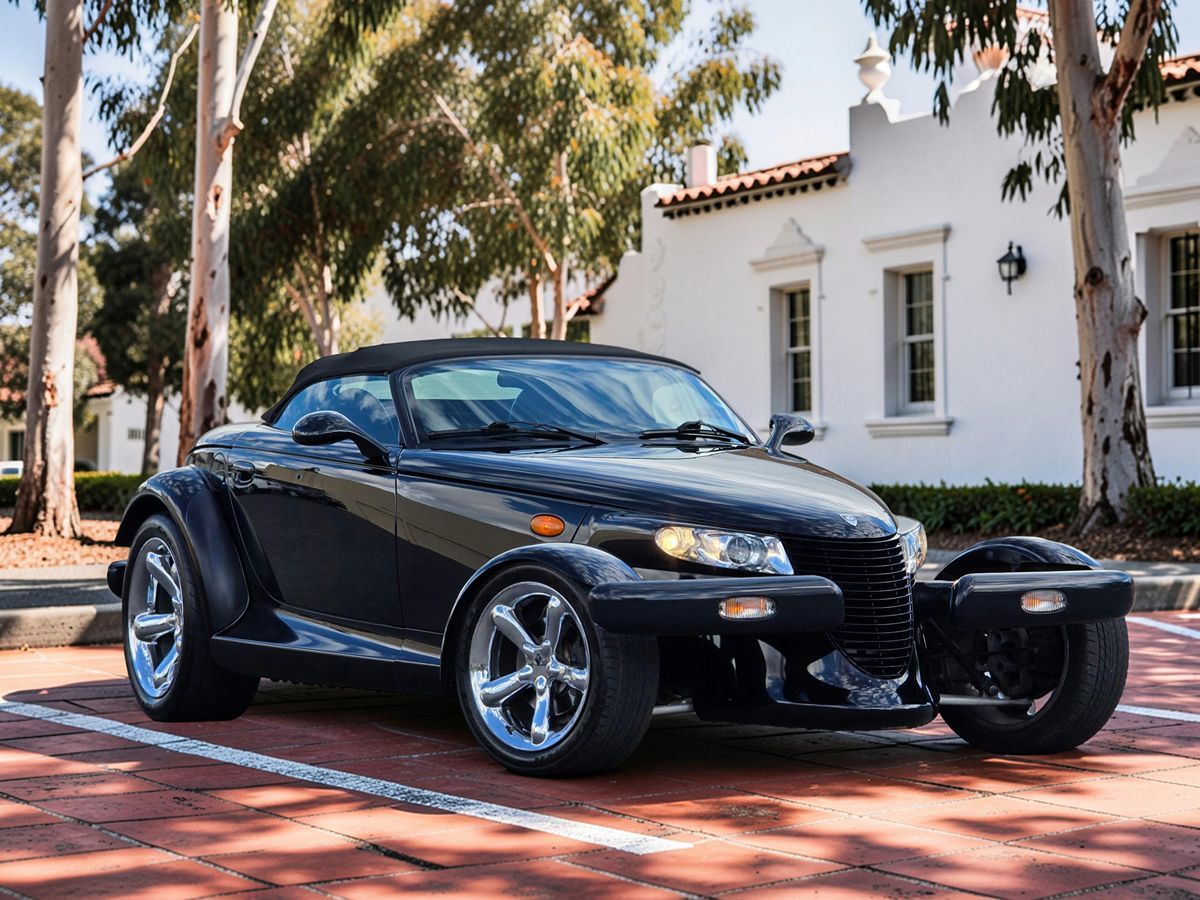
The special editions deserve their own explanation because they attract premiums and generate more confused advertising than everything else in the range combined. The Woodward Edition, offered in 1999, is a two-tone car in red over black, named for Woodward Avenue in Detroit, the spiritual home of American cruising; documented production is 153 cars. The Black Tie Edition, offered for 2000, reverses the idea in silver over black; documented production is 163 cars. Both are mechanically standard high-output cars, identified by paint and trim rather than by anything under the skin. The Mulholland Edition, for 2001, takes its name from Mulholland Drive in Los Angeles and is finished in a deep midnight blue. The final year, 2002, brings Inca Gold cars and, at the very end, a small run in Deep Candy Red; the last Prowler built, in February 2002, is a candy red car. Treat every edition claim the same way: an edition is a paint and trim identity, so it stands or falls on documented original colour and specification, not current appearance. A repainted car wearing Woodward colours is not a Woodward Edition. Ask for the build documentation before you pay any edition premium at all.
Colour in general needs a word of caution, because colour rarity is the most inflated claim in Prowler advertising. Production by colour is well documented for this car — unusually well, because the owner community has kept careful records — which means a claim that a given colour is one of a handful built can usually be checked, and you should check it rather than admire it. Some colours genuinely were built in small numbers in a given year, and some one-year colours are legitimately scarce. But scarcity of colour is not the same as desirability, and a rare colour on a tired car is worth less to you than a common colour on a sorted one. Never let a colour story talk you out of the inspection you would give any other car.
| Model | Years | Engine | Output | Built | Character |
|---|---|---|---|---|---|
| Prowler (launch) | 1997 | 3.5 V6, iron block | 214 hp | 457 | Purple only; the original artifact, and the slowest car in the range |
| Prowler | 1999 | 3.5 V6, aluminium block, high output | 253 hp | 3,921 | The full-performance car arrives; colour choice widens |
| Prowler Woodward Edition | 1999 | 3.5 V6, high output | 253 hp | 153 | Red-over-black two-tone; a paint identity, mechanically standard |
| Prowler | 2000 | 3.5 V6, high output | 253 hp | 2,746 | Settled specification; silver joins the range |
| Prowler Black Tie Edition | 2000 | 3.5 V6, high output | 253 hp | 163 | Silver-over-black two-tone; document it before you pay for it |
| Prowler | 2001 | 3.5 V6, high output | 253 hp | 3,142 | Final Plymouth-badged year; Mulholland Edition in midnight blue |
| Prowler (Chrysler-badged) | 2002 | 3.5 V6, high output | 253 hp | 1,436 | Same car, new badge; Inca Gold and final Deep Candy Red cars |
Read the table with one thing in mind: from 1999 onwards you are choosing between examples, not between models. Engine, gearbox, suspension and structure are common across those years, so your money should follow condition, documented history, originality and colour preference — in that order. The one genuine step in the whole range is from 1997 to 1999, a step in engine output and block construction, not in anything else.

Engines and gearboxes
There is one engine in the Prowler's story, the Chrysler 3.5-litre V6, in two states of tune and two block constructions, and one transmission, a four-speed automatic transaxle mounted at the rear. That sounds like a short section. It is not, because the engine versions decide which cars you shortlist, the timing-belt question on the later engine is the single most important service item on the whole car, and the transaxle layout creates both the car's character and two of its most commonly misdiagnosed faults.
The 3.5 V6 in launch form: 214 hp, iron block
The 1997 car uses the 3.5-litre V6 in the form Chrysler builds for its LH-platform saloons — the Chrysler LHS, Concorde and Dodge Intrepid family. It is a 60-degree V6 of 3,518 cc, with single overhead camshafts, four valves per cylinder and sequential electronic fuel injection, producing 214 hp and around 221 lb-ft of torque. The block is cast iron. In the big saloons this engine has a reputation for being smooth, durable and unremarkable, and all three qualities come with it into the Prowler. It does not sound like a hot-rod engine, it does not rev like one, and in a car that looks the way the Prowler looks, that mismatch is the whole origin of the V8 argument dealt with below.
In service, this version is a known quantity. It tolerates ordinary maintenance, its ancillaries are shared with high-volume saloons and are therefore comparatively easy to source, and its failure modes are the familiar ones of a 1990s American V6: tired sensors, ageing ignition components, coolant-system plastics growing brittle, and oil leaks from hardened seals. None of that is expensive — sensor and gasket work typically sits in the $150–600 range per job at an independent shop, because the parts and knowledge are shared with ordinary cars. What should shape your decision is not fear of this engine but honesty about the package: a 1997 car gives you the least performance, the launch colour only, and the oldest example of everything else on the car.
The 3.5 high-output V6: 253 hp, aluminium block
For 1999 the engine changes in the ways that matter. The block is now aluminium, saving weight over the front of a car already working hard to move mass rearwards, and the engine is in high-output form: 253 hp at around 6,400 rpm and 255 lb-ft of torque at around 3,950 rpm, from a higher compression ratio, revised intake tuning including an active intake arrangement that changes the effective intake path with engine speed, and matching engine management. The basic architecture carries over, but it feels like a different engine: keener to rev, stronger through the middle of the range, and much better matched to the Prowler's weight, a little under 2,900 lb. Period testing puts its acceleration in the high-five to low-six second range to 60 mph — respectable hot-rod pace, delivered without drama.
Now the item that governs ownership of every 1999-onwards car: the timing belt. This engine drives its camshafts by a toothed belt, not a chain, and the belt also drives the water pump. The high-output aluminium engine is an interference design, which means that if the belt fails, pistons and valves occupy the same space at the same time and the damage is a cylinder-head rebuild at best. The service interval is around 100,000 miles, but the belt ages in years as well as miles, and on a car that may have covered a few hundred miles a year for a decade, the calendar is the measure that matters. A belt ten years old on a 30,000-mile car is not a nearly-new belt; it is an overdue belt that happens to look clean. The correct job — belt, tensioner and idlers, water pump while you are in there, fresh coolant — typically costs $900–1,600 at a competent independent, and it is the first negotiation point on any high-output car without a dated, itemised receipt. Accept a receipt naming the belt, the tensioner and the pump, with a date and a mileage, or price the car as if the job is due the day you buy it.
The rest of the high-output engine's care is conventional but not optional. It wants its oil changed on time — long storage followed by short runs is the worst possible pattern — and its cooling system kept in honest condition, because an aluminium engine tolerates overheating far worse than the iron-block car. A temperature gauge that climbs in traffic, a fan that does not cut in, or coolant of unknown age is the early chapter of a head-gasket story, and a head-gasket job with the heads checked and skimmed as needed runs $1,800–3,200. Listen on a cold start for a quiet, even idle, no ticking that persists as it warms, and no misfire under light load. The engine management usually tells the truth through its warning light and stored codes, so a car presented with the light disabled deserves real suspicion.
The rear transaxle and AutoStick
The gearbox is where the Prowler's engineering gets genuinely interesting, and where its weight distribution comes from. The transmission is Chrysler's 42LE four-speed automatic, but it is not bolted to the back of the engine in the usual way. It sits at the rear of the car as a transaxle, driving the rear wheels over a short distance, connected to the engine by a torque tube containing a driveshaft that spins at engine speed. Moving that mass rearwards is a large part of how a front-engined roadster with a big V6 ends up with more weight over its rear wheels than its front, and you feel it in the way the car puts its power down and in the absence of nose-heavy push. The gearbox offers AutoStick, Chrysler's manual-override system, which lets you hold and select gears yourself — and holding a gear through a corner is the difference between a gearbox that helps you and one that interrupts you.
The 42LE has one famous fault, and it is the best news in this guide: the input and output speed sensors fail, and when they do, the control system loses its picture of what the shafts are doing and defaults to a protective limp mode, typically holding second gear. Owners experience a car that suddenly will not change up, conclude the gearbox has destroyed itself, and are quoted accordingly. The sensors are inexpensive, externally mounted and replaceable in well under an hour; the pair, fitted, is typically a $150–350 job. So when a seller tells you a Prowler "needs gearbox work" and the symptom is a car stuck in one gear with no grinding, no slipping and no burning smell from the fluid, your first hypothesis is sensors, and your first test is a code read and a sensor swap, not a rebuild. The reverse also holds: a car that slips between ratios, flares on changes or produces dark, burnt-smelling fluid is a genuinely tired gearbox, and a rebuild by a shop that knows the unit runs $2,200–3,800. Learn to tell the two apart before you view cars.
Fluid discipline matters on this unit. The 42LE is specified for Chrysler's ATF+4 fluid, and the sensitivity of Chrysler automatics of this era to the correct fluid is real, not folklore: the wrong fluid produces shudder and shift-quality complaints that mimic internal wear. Ask what is in it and when it was last changed; a fluid and filter service is a $200–400 job and cheap insurance on any car without a record of one. Check also for leaks at the rear — the transaxle's seals and cooler lines live back there, and a car that marks its parking space at the rear is telling you about the transaxle, not the engine, which confuses owners who go looking for the leak at the wrong end of the car.
A final word on the V8 question, because you will hear it from sellers, fellow enthusiasts and your own first impression. The argument runs that the Prowler needed a V8 and was ruined without one. Treat it fairly: the car looks like a traditional hot rod, traditional hot rods have V8s, and the V6 never sounds the part, however effective it is. But the counter-argument is the car itself. The programme was about aluminium construction, weight distribution and packaging; a period Chrysler V8 would have added weight exactly where the design was removing it, in a nose with no spare room, and demanded a powertrain the car was never designed around. The high-output V6 gives performance period testers found entirely adequate, in a package that handles like a balanced roadster rather than a nose-led dragster. The honest verdict: the Prowler is not a failed V8 car; it is a successful V6 car wearing a V8 costume. Engine-swapped cars exist, and you should avoid them: a swapped Prowler loses its documented identity, its parts support and most of its value.
Problem areas
Everything in this section follows from three facts: the car is built largely of aluminium by low-volume methods, it exposes much of its front suspension to the weather by design, and most examples have lived the stop-start, long-storage life of a toy rather than the steady life of a daily car. None of the faults below is a reason not to buy a Prowler. All of them are reasons to buy a specific Prowler with your eyes open, because the spread between a car whose owner stayed ahead of this list and one whose owner ignored it is the whole game.
The aluminium structure and its repair reality
Aluminium panels dent, crack and corrode in their own ways. They dent more readily than steel in some respects and spring back less willingly; a parking dent a steel panel takes in its stride can crease an aluminium panel in a way that cannot simply be massaged out. Aluminium also suffers its own corrosion — a white, powdery oxidation rather than orange rust — most often where a panel is trapped against another material, where a coating has been chipped and left, or where road salt has sat in seams and under fittings through a winter. Look hardest at panel edges, around fasteners and trim attachments, at the lower edges where road film collects, and anywhere a previous repair has broken the original surface protection. White powder, blistered paint with no impact damage to explain it, and lifting at seams are your aluminium equivalents of the rust bubble: earlier, quieter and easier to miss if you are scanning for orange.
The structural question is not corrosion. It is damage history. The structure uses aluminium extrusions and castings joined by bonding and riveting as well as conventional fastening — strong in service, and unforgiving of amateur repair. A steel unibody can be pulled straight on equipment found in any competent body shop; a bonded aluminium structure needs a shop that understands aluminium: its isolation from steel tools and dust, its behaviour under heat, the correct adhesives and rivets. Such shops are not on every corner, and their work is priced accordingly: a modest structural repair that might be routine on a steel car can run $2,500–6,000 here, and significant damage can pass the point of economic repair sooner than the car's value suggests. Panel gaps that wander, a door or deck lid that does not sit true, refinishing on structural areas rather than outer panels, mismatched fasteners, and any sign of non-factory adhesive work are walk-away signals unless the car comes with documentation from a named specialist who repaired it properly. Cosmetic paint on an outer panel, honestly disclosed and well done, is a different matter — and sellers blur the two deliberately, so learn to distinguish them before you view.
The inboard front suspension and exposed components
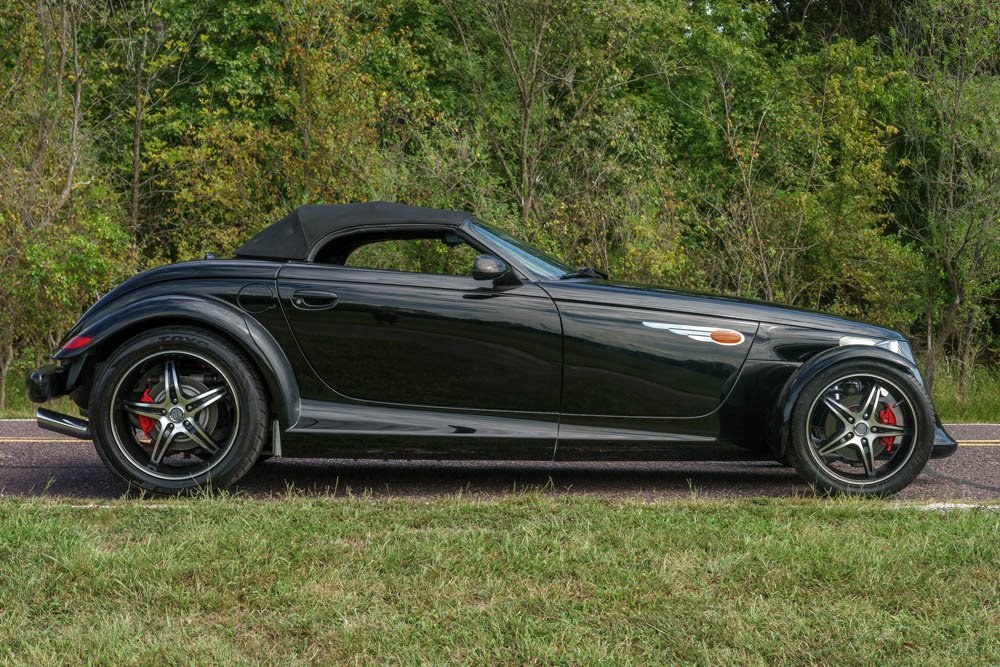
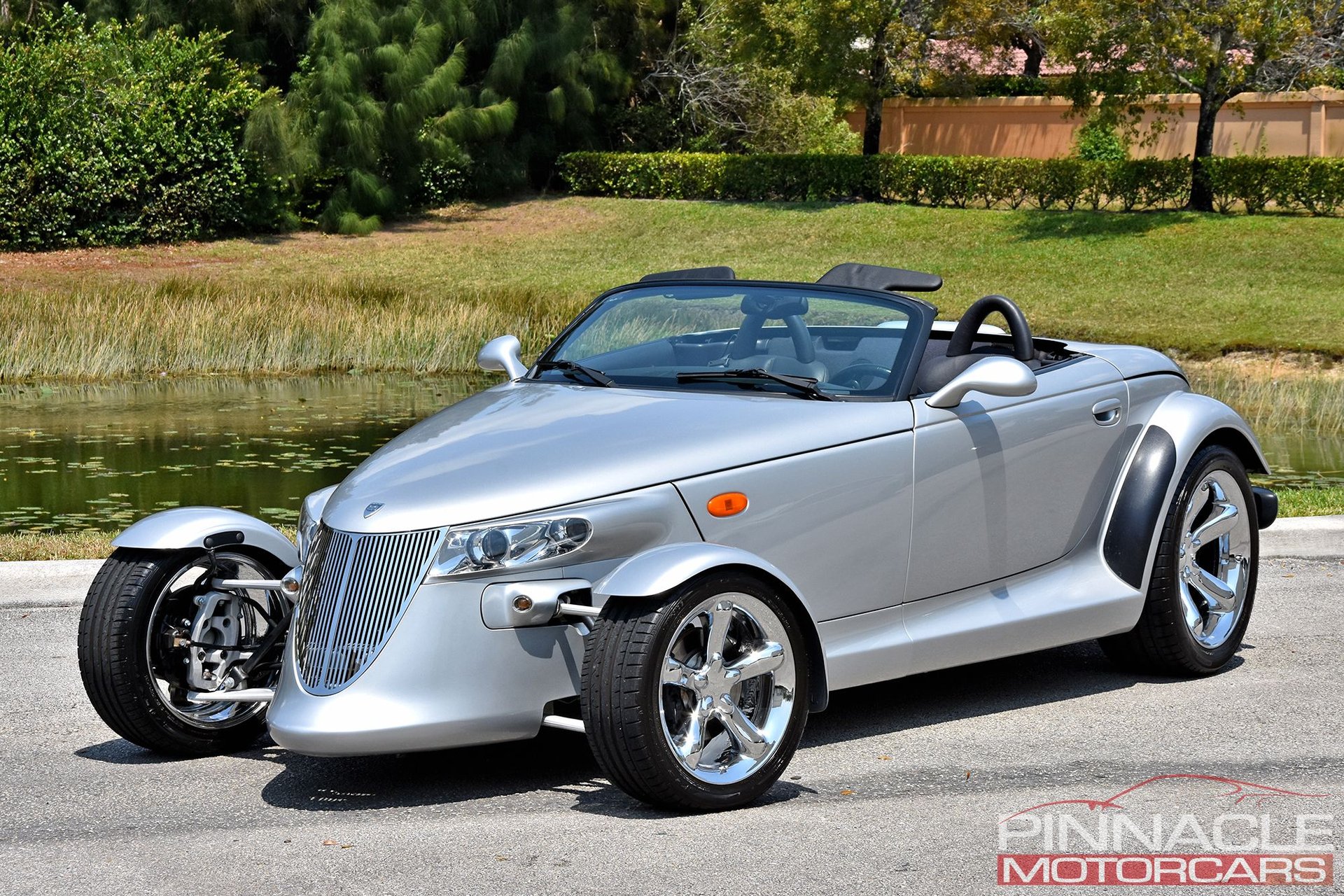
The front suspension is the Prowler's party piece: double wishbones, with the coil-over damper units mounted inboard, high in the chassis, worked by pushrods and rocker arms in the manner of a racing car. This is done for styling as much as engineering — it lets the front wheels stand exposed under their cycle fenders with the hardware tucked away — and it creates an inspection opportunity no ordinary car offers: much of the front end is simply visible. Use that gift.
Work through what you can see. The pushrods, rockers and their pivots should be clean, straight and free of impact damage; these components live in the open, take stone strikes and road salt directly, and a bent pushrod is both a handling fault and a confession about the knock that bent it. Ball joints and their boots matter disproportionately: the joints are exposed to weather, their boots perish and split with age, and once a boot has split the joint behind it is living on borrowed time. Chrysler itself recalled Prowlers over front lower ball-joint corrosion concerns in period, which tells you where the vulnerability lies — ask whether recall work is documented, and inspect as if the recall never happened, because a recall from twenty years ago says nothing about the boots today. A set of front ball joints, supplied and fitted, is typically a $600–1,200 job; leave it undone and you are wearing tyres and listening to a clunk over every broken surface. The test is the classic one: with the front lifted and the wheel supported correctly, lever for play, then rock the wheel top and bottom and side to side, feeling for movement in the joint rather than the bearing. Any notchiness, play or torn boot goes on your list at full price.
Dampers and springs, inboard though they are, age like any others, and on a low-mileage car they age by calendar and by standing in one position. A car that sits nose-down or lists slightly, crashes over ridges its twin glides over, or shows weeping at a damper body is asking for a refresh; budget $800–1,800 depending on whether you replace a pair or refresh the set. Bushes throughout the suspension harden with age and storage, and perished bushes are the most common cause of the vague, clonking feel sellers describe as character. It is not character. It is a bill, typically $500–1,400 in parts and labour to work through properly, and a sorted car feels tight in a way that makes the comparison obvious the first time you drive two cars back to back. Do that if you can: a reference drive in a good car is worth more than any checklist, including this one.
Tyres deserve a paragraph of their own because the Prowler's sizes are unusual, its original equipment is run-flat, and its owners store cars for years on the same set. The staggered fitment — smaller at the front, 20-inch at the rear — makes a full set a considered purchase, and the run-flat construction of the original Goodyear fitment gives a ride many owners describe as the car's worst feature: stiff, noisy and unforgiving. Many cars now run conventional tyres, which ride better and cost less, at the price of having no spare — the car carries none, and there is no space for one — so a puncture strategy becomes part of ownership: a compressor and sealant kit, a recovery membership, or an acceptance that a flat means a truck. Whatever the car wears, read the date codes, not just the tread. A tyre with deep tread and a ten-year-old date code is an old tyre, hardened and past trusting at speed, and a full set in these sizes runs $900–1,700 depending on your choice of run-flat or conventional. Check the inner shoulders especially: a car wearing its front inner edges is telling you about its geometry, its joints, or both.
Window regulators, the top and the small mechanisms
The power windows are the Prowler's most democratic fault: nearly every owner meets it, it is not mileage-dependent, and it announces itself clearly if you know how to listen. The regulators use plastic components that embrittle with age and heat, and when they fail the window drops, sticks, tilts in its frame or refuses to rise evenly. The mechanism matters because sellers disguise it: a window that is slow, needs a helping hand, or has been left permanently up with a warning not to use it is a window whose regulator is already failing, whatever story accompanies it. Test both windows through their full travel, twice. Regulator replacement is a $350–750 job per side, depending on whether you fit a standard replacement or one of the improved designs the aftermarket now offers — and the existence of improved designs tells you everything about the original's weakness. Budget for both sides if one has failed and the other is original.
The folding soft top is manually operated and, by convertible standards, simple, which is in your favour: no hydraulic rams or motors to rebuild. What ages is the fabric, the rear window, the seals and the frame's pivots. Inspect the top up, inside and out: fabric worn thin at the folds, stitching letting go, a rear window clouded or cracked, water staining that betrays a poor seal. Then operate it yourself; it should fold and rise with even effort and latch without persuasion. Leaks usually come from aged seals and adjustment rather than catastrophe, but water entering quietly for years damages carpets, electrics and trim, so footwell staining or a musty smell is a clue to follow, not a detail to forgive. A replacement top in correct material is a $1,200–2,500 job fitted.
The trailer, luggage and the packaging reality
The Prowler has, for practical purposes, no luggage space. Behind the seats there is a small storage area the folding top shares, and it accepts soft bags, goodwill and very little else. This is not a fault to discover after purchase; it is the car's defining practical limitation, and Chrysler's own answer tells you how seriously the factory took it: an optional matching trailer, styled to echo the car's rear end, built in small numbers and sold as the official way to tour in a Prowler. Those trailers are now collectible in their own right, and a car offered with its matching trailer is a genuinely more usable and more valuable package than the same car alone.
Inspect a trailer as carefully as a car if one is included. Check its tyres by date as you do the car's, its wheel bearings for play and roughness, its lights and wiring connector against the car's socket, its lid seal for the leaks that fill stored trailers with mildew, and its paint match against the car in daylight — a trailer repainted to match is worth less than an original pair. Confirm the car's hitch and wiring are factory or properly fitted rather than improvised, and ask what the trailer has carried; they are lightly built and resent being treated as goods vehicles. If there is no trailer, be honest about how you will use the car: weekend touring for two means soft luggage, posted-ahead clothes, or a second vehicle. Buyers who ignore this do not keep their cars long, and part of the supply of low-mileage Prowlers with one brief recent owner is exactly that discovery being made, expensively, by somebody else.
Electronics, sensors and the storage car
The Prowler's electronics are early-modern: multiplexed enough to confuse a casual mechanic, simple enough for a competent one with the right information. The recurring themes are age, storage and voltage. A car living on the edge of a flat battery develops gremlins that vanish with a healthy battery and clean connections, so your first electrical test is the battery itself — its age, its ability to hold charge after standing, and its terminals. Cars presented freshly charged after standing for months are hiding their natural state; if you can, see the car start from cold, after standing, on its own battery.
Work the full electrical census at viewing: both windows as described, central locking and the remote fob, the full instrument cluster through its warning-light sequence, the tyre-pressure warning system — the car monitors its run-flat tyres, and its sensors and their batteries are now old enough that a warning light may mean a dead sensor rather than a soft tyre — the lights, the horn, the wipers, the stereo and the heater controls. The cluster and body electronics are generally durable, but they are low-volume parts: a failed cluster or module is a search and a negotiation rather than a catalogue order, with used units typically $250–800 when found, plus the labour of proving the replacement, and not the wiring in front of it, was the fault. Speed-sensor faults in the transaxle, covered in the gearbox section, present as electrical behaviour too — remember that a gearbox apparently gone mad is most often a sensor gone quiet.
Finally, the service-history trap that storage creates. A car driven 2,000 miles in ten years may show a service book that looks neglected by mileage logic and is actually overdue by calendar logic on every fluid, belt and rubber component it owns. Read history by dates first and mileages second. The owner you want has serviced by the calendar and kept receipts that show the thinking. The owner you are wary of points at the low odometer and calls it proof. On this model the odometer is the least honest number on the car — not because it has been tampered with, but because it measures the one kind of wear this car does least.

How to inspect one
Inspect a Prowler in this order, and do not let a seller rearrange it for you. The sequence moves from identity to structure to systems to the road, because each stage can end the viewing and save you the next. Bring a torch and a willingness to crouch — the panels are aluminium, so the old magnet test for filler tells you nothing here — because the most informative ten minutes happen at knee height, at the front end.
- Identity first. Match the vehicle identification number on the car to the title and paperwork, and read the year from the documents rather than the advertisement. Confirm the badging story: a 2002 car wears Chrysler badges because Plymouth no longer exists, and a car advertised as a 1998 does not exist at all. Any mismatch stops the viewing here.
- Original colour and edition claims. Establish the car's documented original colour before you admire its current one. If it is sold as a Woodward, Black Tie, Mulholland or other edition, ask for the build documentation that proves it. Two-tone paint applied later is decoration; documented two-tone paint from the factory is an edition. Pay only for the second.
- Panel fit and finish at walking pace. Circle the car slowly and read the gaps: doors, deck, bonnet line, and the two front fenders against each other. Aluminium remembers knocks in its gaps, as the structure section explains. Look along the flanks in raking light for creases and ripples, and at panel edges and fasteners for the white powder and blistered paint that mark aluminium corrosion.
- Underneath, in the air if possible. Belly scrapes are expected on a car this low; cracked, torn or non-factory repaired structure is not. Look at the extremities for parking damage and at the fender mountings for the knock a wandering fender gap has already hinted at. Undocumented structural repair should end most viewings on the spot.
- The exposed front end, joint by joint. Crouch at the front and work through the pushrods, rockers and pivots for straightness and stone damage, then every ball joint for a split boot or play, levering each wheel as the suspension section describes. Ask whether the period ball-joint recall work is documented — and inspect as though it is not, because the boots in front of you are today's evidence.
- Wheels and tyres, including the dates. Read all four tyre date codes and check the inner shoulders for the wear that betrays geometry and joint problems. Run a fingertip inside each chrome rim for peeling and blistering, and count the centre caps. Price a full set of tyres into the deal if the dates are old, however deep the tread looks.
- Cold start, on its own battery. Start the car from cold after it has stood, and watch the cluster's warning lights prove themselves and go out. Listen for a clean, even idle with no persistent ticking or misfire as it warms. A car that arrives pre-warmed and freshly charged is a car whose cold behaviour you are not being allowed to buy with knowledge.
- The timing-belt question, in writing. On any 1999-onwards car, ask for the dated, itemised receipt for belt, tensioner and water pump, as the engine section sets out. No receipt means the job is due, and the negotiation proceeds on that basis. No visual inspection substitutes for this document.
- Windows, top and every small mechanism. Run both windows through their full travel twice, watching for tilt, hesitation or a helping hand being needed — the regulator section explains why each is a confession. Raise and lower the top yourself, read the fabric at its folds and the rear window for clouding, then work the releases, mirrors, blower, lights and air conditioning through their full ranges.
- The gearbox, from sensors to shifts. On the road, confirm the 42LE changes cleanly through all its ratios and that AutoStick holds the gear you select. A car stuck in one gear with no slip or burning smell points first to the speed sensors, as the gearbox section explains; a car that slips, flares or smells of burnt fluid is a different and much more expensive conversation. Ask what fluid specification is in it and when it was changed.
- The drive itself, for at least half an hour. Feel for the tightness that separates a sorted car from a bushed-out one: clonks over broken surfaces, vagueness on centre, and crashing from tired dampers are calendar wear, not character. Test the brakes from speed for pull and judder, sit in traffic and watch the temperature gauge behave, and sit in the car, top up, long enough to know whether you fit it in the rain as well as in the sun.
- The storage audit, before you talk money. Read the service history by dates, not mileages, and list what is overdue by the calendar: fluids, belt, tyres, battery, rubber. Look along the accessible wiring for rodent damage on any car that has lived in an outbuilding. The car you want shows an owner who serviced by the year; a low odometer alone has shown you nothing yet.

Values
The Prowler market is unusually readable once you understand what is actually being traded, and unusually confusing if you approach it as an ordinary collectible whose price is set by rarity and year. Around eleven and a half thousand cars exist, the specification from the second production year onwards is effectively constant, and the cars were preserved in large numbers rather than used up. Supply, in other words, is permanent, across the full condition spectrum, from delivery-mileage time capsules to tired examples carrying every fault in the problem-areas section at once. That is the most important fact in this market: no seller has scarcity on their side, however their advertisement is written, and no buyer ever needs to panic.
What moves a Prowler's value, in descending order, is condition, documented history, originality, and then — only then — the identity details advertisements lead with. A car with calendar-based history, a recent timing-belt receipt, sound ball joints and boots, working windows, honest wheels and tyres with young date codes is worth a clear premium over an identical-looking car without them, because the buyer of the second car will purchase every one of those things within the first year, at retail, one invoice at a time. Learn to price a car as its asking figure plus the cost of its deferred list, and compare totals rather than tickets. The market's cheapest cars are very often its most expensive purchases arriving by instalments.
Mileage plays a subtler role here than in most markets, and reading it wrong costs buyers money in both directions. Very low mileage commands a premium, and up to a point that premium is rational — interiors, trim and brightwork genuinely survive better in cars that have barely been sat in. But a barely-driven Prowler carries calendar debt a regularly exercised car does not, so the premium should buy you a car whose owner serviced by the year despite the mileage, not merely a small number on the odometer. At the other end, a higher-mileage car with continuous, documented use is frequently the better ownership proposition and is usually priced as though it were the worse one. That gap — between how the market prices mileage and how mileage actually predicts cost on this model — is where the informed buyer finds value.
The identity premiums deserve a cool head. Launch-year cars carry first-year interest, and documented special editions carry edition interest, and both premiums are real in the sense that the next buyer may also pay them. But both are premiums on stories, and stories only hold their value when the documentation holds up: original colour, build records, unbroken history. A repainted car in edition colours, a launch-year car with a replacement story for every component that made it original, or any car whose rarity claim dissolves when the well-documented colour production figures are consulted, should be priced as the ordinary, mechanically standard car it is. Conversely, do not expect to buy a genuinely documented edition at standard money because you have decided paint does not matter; the market disagrees with you, and it is the market you will sell into one day.
Finally, the asking-versus-achieved reality. This is a discretionary, emotional purchase in a market with permanent supply, which means asking prices are frequently aspirations rather than valuations, and cars sit. A Prowler advertised for month after month is not necessarily a bad car; it is very often a decent car at an unrealistic figure, and exactly the car on which a polite, evidence-based offer — grounded in the deferred-maintenance list your inspection produced — has the best chance of succeeding. Bring your inspection notes, price the faults honestly rather than punitively, and be willing to do the arithmetic out loud.
Parts and ownership
Owning a Prowler is an exercise in managing two different parts supplies at once. The first is the high-volume Chrysler world the car borrows from: the engine's service items and many of its sensors and ancillaries are shared with the LH saloon family and the wider Chrysler range of the period, the transaxle is a known unit with a living base of rebuild knowledge, and consumables of that kind are obtainable at ordinary prices. Filters, ignition components, brake consumables and the like sit in the familiar $30–200 territory per item, and a routine annual service at an independent who knows the car is a $300–600 event. This borrowed infrastructure is a large part of why a Prowler is a more realistic proposition than most low-volume specials.
The second supply is the low-volume Prowler world, and it behaves completely differently. Aluminium body panels, bright trim, centre caps, window regulators in original form, instrument clusters, body electronics, top components and the myriad small parts unique to a car built in the low thousands are finite: they were made for the production run and its warranty tail, and when they are gone, the sources are salvage, specialists who bought stock early, and the owner community's own network. Prices reflect that — the $250–800 used-module range and the jewellery pricing of good centre caps in the problem-areas section are typical — and so does the correct strategy. On this car, you buy spares when you find them rather than when you need them, and you regard the owner clubs and forums not as social decoration but as working infrastructure: they hold the cross-reference knowledge that tells you which high-volume part substitutes for which low-volume one, and who is remanufacturing what. Several known weaknesses have aftermarket answers precisely because the community organised them — improved window regulator components are the standing example. Budget a modest annual sum, in the $150–400 range, for opportunistic spares, and store them properly.
Choosing who works on the car matters more than usual, and it splits by job. Routine engine and transaxle work can go to any competent independent who will follow the specifications — correct ATF+4 in the gearbox, correct belt procedure on the engine. Aluminium body and structure work goes only to a shop with genuine aluminium practice, for all the reasons the structure section gives, even when that shop is further away and books out longer; a cheap steel-minded repair on this structure is the most expensive money in Prowler ownership. Electrical diagnosis rewards a methodical auto-electrician with wiring information over a marque badge on the door.
Running the car itself asks for a change of habit if you are used to modern machinery. Use it regularly — the worst Prowler is a stationary Prowler — and when you use it, use it properly: full operating temperature, some load through the gears, the top exercised, the windows run through their travel, the air conditioning run even in winter to keep its seals alive. Keep it on a battery conditioner if it stands for weeks, keep its tyres in date and its fluids on calendar schedules, and keep every receipt, filed by date. Your file is not administration; on this model the file is a component of the car's value, as real as its paint, and the next buyer will pay for it in the way the values section describes.
Which one to buy
- The all-rounder: a 1999–2001 high-output car in a colour you actually like, with calendar-based history and a recent, receipted timing-belt job. This is the default recommendation for almost every buyer: full performance, real choice, no identity premium to defend.
- The value buy: a Chrysler-badged 2002 car in honest condition. It is the same car as the Plymouth-badged examples, it closes the production run, and it is sometimes priced as though the badge were a fault. It is not, and the difference is yours to keep.
- The driver's bargain: a higher-mileage car with continuous documented use, bought at the discount the market gives mileage it has misunderstood. On this model, exercised and maintained beats stored and neglected, and the price rarely reflects it.
- The collector's pick: a documented 1997 launch car in its original purple, bought knowingly as the first of the line. You are paying for history and accepting the least performance in the range; do it with open eyes and full documentation, or not at all.
- The edition buyer: a Woodward, Black Tie or Mulholland car with build documentation proving the edition from the factory. The premium lives in the paperwork, so the paperwork is what you are actually buying — inspect it as hard as the car.
- The tourer: any sound high-output car sold with its matching factory trailer, checked as carefully as the car itself. It is the only version of this purchase that comes with luggage space, and for two people who intend to travel, it changes what the car is.
The overriding rule: buy the car's condition, history and documentation — never its colour story, its badge or its odometer. On a Prowler, the file and the front ball joints tell you more about what you are purchasing than any other evidence in front of you, and the car with the best file is the best car at any given price.
See the 1 Prowler cars currently listed.
What they sell for: Prowler sale prices.