
Plymouth Prowler buyer's guide
Plymouth Prowler (1997–2002) — Prowler: what's listed, and what they sell for.
Years: 1997–2002 · Models: Prowler
Overview and history
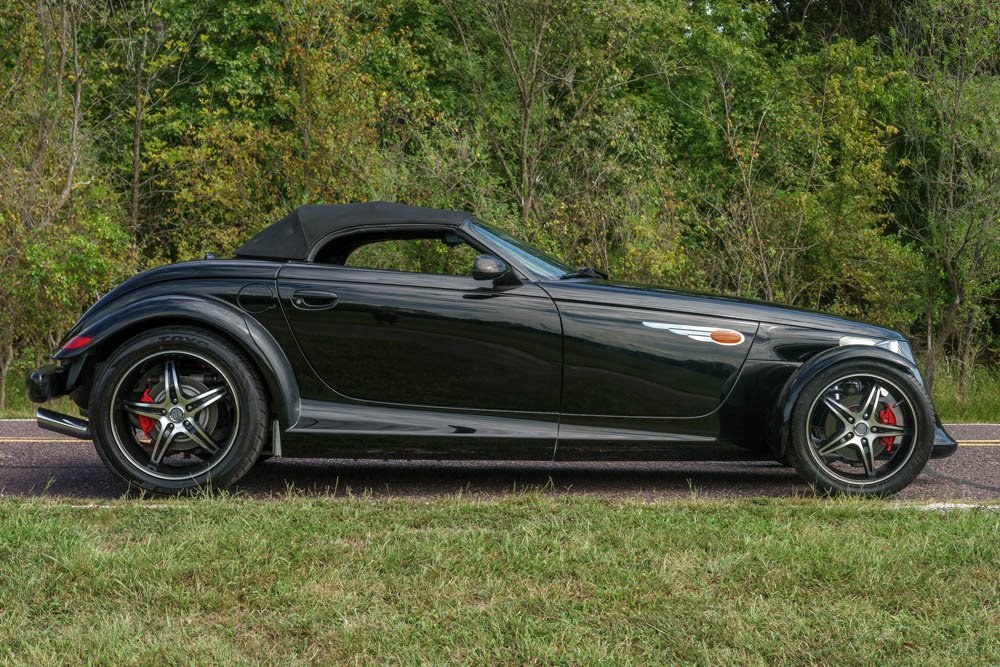
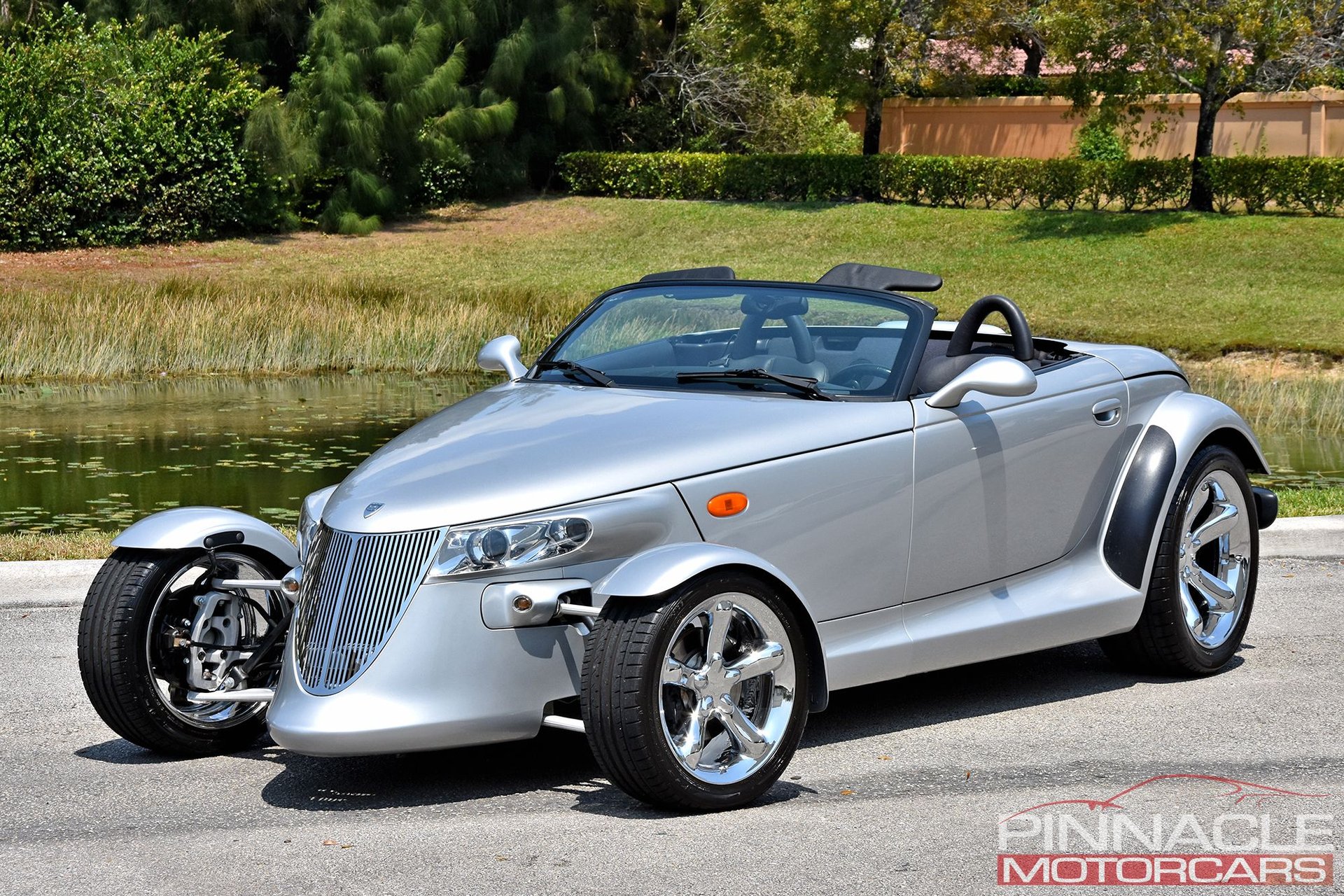
The Plymouth Prowler is the strangest production car Chrysler built in the 1990s, and it is strange in a way no replica, kit car or restomod ever quite manages: it is a factory hot rod, designed by a major manufacturer, built by hand in small numbers, and sold through ordinary Plymouth dealers with a warranty. The nose is an open-wheel-inspired prow tapering to a point between cycle-style front fenders. The front wheels — 17-inch — sit far forward and visibly apart from the body. The rear wheels — 20-inch, and enormous by 1997 standards — are tucked under deep, rounded haunches. There is a V6 where your eye expects a V8, an automatic transaxle where your eye expects a manual gearbox, and a body and chassis built largely from aluminium where your eye expects steel. Every one of those contradictions is the car. If you want a conventional retro roadster, buy something else. If you want the moment when Detroit's concept-car department was briefly allowed to ship the concept car, this is it.
The Prowler began as a concept at the 1993 Detroit auto show, in the fertile period when Chrysler under Bob Lutz and design chief Tom Gale was producing show cars — Viper above all — and then, improbably, putting them into production. The Viper had proved the model: a small, dedicated plant, a small team, low-volume construction methods, and a halo effect worth far more than the cars' direct profit. The Prowler applied the same thinking to a different fantasy. Where the Viper was a modern Cobra, the Prowler was a modern 1930s hot rod — specifically the highboy roadster idiom of post-war American hot-rodding, filtered through 1990s production engineering. Gale's team, with Chip Foose among the designers who contributed to the wider hot-rod styling conversation of the era, gave it the classic cues — pointed grille, freestanding headlamps in pods, exposed front suspension links, a chopped-looking windscreen, a tapering tail — and then engineered it to pass contemporary crash, emissions and durability standards.
Production began for the 1997 model year at Conner Avenue Assembly in Detroit, the same hand-assembly plant that built the Viper. That address matters when you inspect one. These were not stamped out on a high-speed line. The Prowler's aluminium-intensive structure — extruded and bonded aluminium in the chassis, aluminium body panels over it — was assembled at a pace closer to a coachbuilder's than a mass producer's, and panel fit, trim finish and small details vary more from car to car than they do on a contemporary Corvette or Mustang. Some of that variation is character. Some of it, on a specific car in front of you, is accident repair. Telling the two apart is a central skill of buying one well, and this guide returns to it repeatedly.
There was no 1998 model year — production paused while the powertrain was revised — and that pause divides the Prowler into two mechanical generations that look almost identical. The 1997 cars carry the earlier 3.5-litre V6 in its lower-output form. From 1999 the car received the high-output, aluminium-block version of the same 3.5-litre family, with a substantial power increase that transformed its straight-line performance from adequate to genuinely brisk. Production then ran through 1999, 2000 and 2001 under the Plymouth name. Plymouth itself was discontinued in 2001, so the car was rebadged as the Chrysler Prowler part-way through that period and the final 2002 model year is entirely Chrysler-badged. Mechanically the Plymouth and Chrysler cars are the same car; the badge change is a marque history footnote, not a specification break, and it should not by itself move what you pay — though, as the Values section explains, the market does not always behave that rationally about badges, colours and editions.
Total production across all years was 11,702 cars. That figure is genuinely known, small enough to make the Prowler a rare sight, and large enough that you can be choosy: at any given moment there are cars for sale in most regions of the United States, in most of the factory colours, at mileages from delivery miles to well-used. In our own Classic Listings pool at the time of writing the sample is small — ten cars recorded, six offered for sale and four recorded sold, filed under the 1999 and 2001 model years — which tells you something true about the Prowler market generally: it is a thin, slow, enthusiast market, not a liquid one. Cars sit. Sellers wait. Buyers who understand the model can take their time, and should.

The models
There is, formally, only one Prowler model: a two-seat, two-door roadster with a manually folding convertible top, sold in a single body style and a single trim level for its entire life. No coupe was offered, no cheaper de-contented version, no factory performance package beyond the 1999 powertrain revision that became standard. What changes across the production run is the engine tune and block material, the badge on the tail, the colour palette, and a series of special editions that are, mechanically, standard cars in two-tone or limited-run paint with edition trim. The table below therefore reads differently from most in this guide series: the rows are production phases and editions rather than distinct models, because that is how the Prowler range actually works.
| Model | Years | Engine | Output | Built | Character |
|---|---|---|---|---|---|
| Prowler (first series) | 1997 | 3.5 V6 SOHC, iron block | 214 hp | 457 | The original: rarest year, softest performance, launch colour purple |
| Prowler (second series) | 1999–2000 | 3.5 V6 SOHC high-output, aluminium block | 253 hp | 6,667 across both years | The car as it should have been: brisk, lighter engine, full colour palette |
| Prowler (Plymouth, final year) | 2001 | 3.5 V6 SOHC high-output | 253 hp | Part of 3,142 built for 2001 | Last Plymouth-badged cars; Chrysler badge takes over during the year |
| Prowler (Chrysler) | 2001–2002 | 3.5 V6 SOHC high-output | 253 hp | 1,436 built for 2002 | Identical car, Chrysler name; final-year colours include the last-run specials |
| Woodward Edition | 2000 | 3.5 V6 SOHC high-output | 253 hp | Small three-figure run | Red over black two-tone, named for Detroit's Woodward Avenue cruising strip |
| Black Tie Edition | 2000 | 3.5 V6 SOHC high-output | 253 hp | Small three-figure run | Silver over black two-tone, the formal-dress counterpart to the Woodward |
| Mulholland Edition | 2001 | 3.5 V6 SOHC high-output | 253 hp | Limited run | Midnight blue with a contrasting blue top and pinstripe; named for Mulholland Drive |
The 1997 cars
The launch cars are the collectors' Prowlers and the drivers' compromise, and you should decide which of those you are before you look at one. The 1997 production run was short — 457 cars — and heavily weighted to the launch colour, Prowler Purple, a deep metallic violet that remains the colour most people picture when the car's name is mentioned. The engine is the earlier 3.5-litre V6 with a cast-iron block and a single overhead camshaft per bank, producing 214 horsepower. In a car of this weight that is enough to move it along respectably, but no more: period performance was adequate rather than exciting, and next to a 1999-onwards car the difference is obvious from the driver's seat within one on-ramp.
The 1999–2002 standard car
The revised car is the mainstream Prowler and the one most buyers should be shopping for. The high-output 3.5 — aluminium block, revised induction and engine management, 253 horsepower — cut the car's acceleration times by a margin you can feel without instruments and made the automatic gearbox's limitations much easier to forgive. The colour palette widened across these years beyond purple to include yellow, black, red and silver early on, and later the orange, blue and gold tones that give the late cars their distinct character, along with two-tone treatments on the editions. Chrome wheels became a common and then near-universal fitment in place of the earlier painted finish, which matters today because the chrome's condition is now one of the car's known weak points, covered in the Problem areas section.
Across 1999 to 2002 the cars are so mechanically consistent that year-by-year shopping is mostly a distraction. Buy on condition, colour and history. The exceptions worth knowing: 2001 is the badge-change year, so a 2001 car may be Plymouth- or Chrysler-badged depending on when it was built, and sellers occasionally present the Plymouth badge that year as a rarity it is not — both badges were built in quantity that year. The 2002 cars, all Chrysler-badged, include the final special colours and the very last cars off the line, and the market does attach some sentiment to the final year. Sentiment is not specification. A well-kept 1999 in a colour you love is a better car than a tired 2002 in a colour you tolerate, at any price the market is likely to ask.
The special editions
The Woodward and Black Tie editions of 2000 are the best-known specials, and they are paint-and-trim cars: the Woodward in red over black, the Black Tie in silver over black, both with the two-tone split following the car's body lines and with edition interior trim. They were produced in small three-figure numbers each and have a loyal following, particularly the Woodward, whose name ties the car to the Woodward Dream Cruise and to Detroit cruising culture generally. The Mulholland Edition for 2001 took the same formula to a single deep blue with a matching blue convertible top — most Prowlers have a black top — and a pinstripe, and it reads as the most elegant of the factory specifications. The final-year Chrysler cars added further limited colours, of which the deep candy red of the last run is the most sought after; the very last Prowler built was finished in that colour.
For a buyer, the editions raise one question: originality verification. Because an edition is fundamentally a paint scheme, a standard car can be repainted into an edition's colours, and the closer edition values drift above standard-car values, the stronger the temptation. The defences are the ones this guide repeats everywhere: the factory paint codes on the car's labels, the build documentation, the colour of the top where the edition specifies it, and consistency between the claimed edition and the car's recorded build date and original specification. A genuine edition with paperwork is a real thing and worth its premium to the buyer who wants one. An undocumented "edition" is a standard car with a story, and should be priced as one.
Engines and gearboxes
The Prowler has one engine family, in two states of tune, and one gearbox, in one place you will not expect it. Understanding that layout — engine at the front, gearbox at the back, connected by a torque tube — is the foundation for understanding the car's maintenance, its weight distribution, its cabin packaging and several of its characteristic faults.
The 3.5-litre V6: first series (1997)
The launch engine is Chrysler's 3.5-litre V6 from the LH-platform cars — the Dodge Intrepid, Chrysler Concorde and their relatives — a 60-degree V6 with a cast-iron block, aluminium single-overhead-camshaft cylinder heads, four valves per cylinder and sequential electronic fuel injection, displacing 3,518 cc. In the Prowler's original installation it produced 214 horsepower. It is, by the standards of exotic-looking cars, a wonderfully ordinary engine: a mass-produced family-sedan unit with mass-produced parts, mass-produced service procedures and no exotic failure modes. Timing is by a toothed belt driving the camshafts, with the water pump driven from the same belt run — an arrangement that defines the engine's one genuinely important service item, covered below and again in Problem areas.
In service, the iron-block engine's character is smoothness and adequacy. It revs willingly enough, it sounds like what it is — a modern V6, muted by a production exhaust — and it asks for nothing exotic: ordinary oil, ordinary coolant, plugs and filters from any parts store in America. Its weaknesses at this age are the weaknesses of any 1990s Chrysler V6 that has lived through decades of short trips and long storage: perished vacuum and breather hoses, tired engine sensors, weeping gaskets, corroded coolant fittings, and above all the timing belt question. The belt on a 1997 car is not a "check the history" item, it is a "the history almost certainly cannot prove it, so budget to do it" item, because the consequences and costs of belt failure, and the fact that the water pump should be replaced in the same labour window, make this the first big service decision on any early car.
The 3.5-litre V6: high-output (1999–2002)
The revised engine keeps the same architecture and displacement and changes almost everything that matters. The block is aluminium, saving weight over the front axle. A revised induction system with an active intake arrangement, higher compression, revised camshafts and recalibrated engine management lift output to 253 horsepower and give the engine a broader, keener character — it pulls harder through the middle of the range rather than merely revving higher at the top. This is the engine the car always needed, and the performance difference over the 1997 car is the single largest mechanical difference between any two Prowlers.
For the buyer, the high-output engine's service story is the same story told slightly louder. The timing belt remains the headline scheduled item, with the water pump, tensioner and idlers replaced in the same operation as a matter of course; the belt interval is mileage- and age-based, and on cars that have covered tiny mileages over two decades the age limit, not the odometer, is the one that has expired. Accessory drive, cooling system and sensors follow ordinary LH-car practice, which is the Prowler's great hidden virtue: the engine bay of a six-figure-attention car can be serviced by any competent shop with Chrysler experience, from parts that remain in ordinary production channels, at ordinary labour rates. The aluminium block adds one discipline: fasteners into aluminium and coolant chemistry both punish carelessness, so evidence of ham-fisted previous work — chewed bolt heads, sealant smeared where a gasket belongs, mixed coolant colours — is worth more of your suspicion here than it would be on an iron-block car.
Gearboxes: the 42LE rear transaxle and Autostick
There is one gearbox: Chrysler's 42LE four-speed automatic, and its location is the Prowler's cleverest piece of engineering. In the LH sedans the 42LE sits at the front as a transaxle driving the front wheels. In the Prowler, Chrysler mounted the engine conventionally at the front, driving the rear wheels — and placed the transaxle at the rear, between them, connected to the engine by a rigid torque tube containing the driveshaft, which spins at engine speed. The result is a near-even weight distribution for a front-engined roadster, a rear transaxle casing you can inspect under the tail of the car, and a gear-change cable and electronic control arrangement that runs the length of the car.
The gearbox itself offers Autostick, Chrysler's manual-override system: move the lever to the Autostick gate and tap it sideways to request up- and down-changes, which the electronics grant or refuse according to speed and revs. It is not a manual gearbox and does not pretend very hard to be one — changes are automatic-gearbox changes in pace and feel — but it adds real control on a winding road and for engine braking, and you should test that it works, in both directions, on any test drive. A car whose Autostick is dead has an electrical or switch fault that the seller should not wave away.
The 42LE's known behaviours, in the Prowler as in the LH cars, centre on its electronics more than its internals. The transmission's input and output speed sensors are famous across every car that uses this gearbox family: when one fails, the control system loses its picture of what the gearbox is doing and defaults to a limp-home state, typically holding a single gear. The presentation terrifies sellers into describing a failed gearbox and terrifies buyers into walking away from a sound car — the sensors are inexpensive, externally mounted and replaceable without removing the transaxle. The distinguishing work is in the Problem areas section; the point to carry from here is that a Prowler stuck in one gear is a diagnosis to make, not a verdict to accept, in either direction. Conversely, a gearbox that shifts badly in mechanical ways — slipping under load, flaring between ratios, harsh engagement of drive or reverse with correct fluid at the correct level — is a genuine internal wear problem, and rebuild costs are real money even if the unit itself is a production Chrysler box.
Problem areas
The Prowler's problem areas divide cleanly into two kinds. The first kind is ordinary 1990s Chrysler mechanical ageing — sensors, rubber, fluids, the timing belt — which is cheap, understood and shared with high-volume sedans. The second kind is Prowler-specific: the aluminium structure and body, the convertible top mechanism, the window regulators, the front suspension's exposed components, the chrome wheels and the low nose. That second kind is where the money and the disappointment live, because Prowler-specific parts are low-volume parts. Work through both kinds on any car. Our own photo-examination sample for this guide is, honestly, too small to give incidence figures — a single photo-checked car in the pool — so the guidance below rests on the model's documented behaviour across its life, not on percentages we cannot support.
Body, aluminium structure and the nose
Start with the material itself. The Prowler's chassis structure makes extensive use of aluminium extrusions, joined by bonding and mechanical fasteners, with aluminium and composite panels over it. Aluminium does not rust like steel, and a Prowler will never present the sill, floor and arch rot that dominates the problem sections of most guides in this series. What aluminium does is corrode at damaged sites — stone chips, scrapes and fastener points where the protective surface is broken and road salt and moisture get in — presenting as bubbling, white corrosion product and lifting paint, most often low on the car: the bottoms of the doors, the lower rear quarters ahead of the rear wheels, around panel fasteners and along the lower edges that collect road film. It also dents and creases differently from steel, and repairing it properly requires a shop equipped and willing to work aluminium; a filler-and-paint repair over corroded aluminium looks fine for a season and then bubbles through, so fresh paint low on the car wants a magnet-free, eyes-open assessment — tap test, close look at the panel edges from inside where accessible, and a direct question about who did the work.
The nose is the car's signature and its sacrificial part. The pointed prow sits low and ahead of the front axle line, the driver cannot see its tip from the seat, and the parking record of the entire production run is written on nose cones: scraped undersides, cracked tips, stone-chipped leading edges and repainted cones in slightly the wrong shade. Inspect it from kneeling height and from below if the car is on a lift. Hairline cracking around the tip and the headlamp pods, filler evidence, and paint texture that changes at the cone's seams all tell the story. A scraped underside with honest paint elsewhere is normal use; a freshly undetailed nose on an otherwise detailed car is a question. Front bumpers complicate the picture: many cars run without them by owner choice. If the car is bumperless, establish that the bumpers, brackets and hardware come with it, check the mounting points for the damage that sometimes actually motivated the removal, and satisfy yourself about your own state's rules.
Front suspension, steering and ball joints
The Prowler's front suspension is on display — inboard-mounted coil-over units worked by pushrods from the uprights, in the manner of a racing car, with double wishbones and a steering rack. It looks wonderful and it lives in the weather, in the road spray, inches behind the front wheels. Everything in this section follows from that exposure.
The headline component is the front lower ball joint. These joints were the subject of factory recall action during the car's life, and they remain the front suspension's known wear and failure point: a joint that dries, wears and develops play, in the worst case to the point of separation — which is why this is an inspection item with no "probably fine" category. On any car, establish the recall and service history for the front ball joints from documentation, and have the joints checked for play by someone who knows the test, with the suspension loaded and unloaded as the procedure requires. Play in a lower ball joint is a replace-before-driving item, not a negotiate-and-monitor item. A pair of joints fitted, with alignment, is typically a $600–1,200 job depending on parts source and labour market; the alignment afterwards is not optional, because the Prowler's wide, staggered tyres telegraph misalignment as wear quickly.
Beyond the ball joints, work the system as you would on any car, with the exposure in mind: upper ball joints and wishbone bushes for play and perishing, pushrod ends and the inboard rocker pivots for wear, the coil-over dampers for leaks and for the tired, under-damped feel of units that have spent twenty years holding a car up in a garage. Original dampers that have sat compressed and unused for years often present acceptably on a bounce test and badly on the road, with a crashy, uncontrolled quality over sharp edges. Replacement dampers are a four-figure conversation for a set fitted; budget $1,000–2,000 for quality units and labour, and treat a car that rides properly as worth real money over one that does not, because you will feel the difference on every mile.
Tyres belong in this section because the Prowler's fitment is unusual and expensive to get wrong: 17-inch fronts and 20-inch rears, wide at the back, originally specified as run-flat Goodyears in sizes that have not been in ordinary production for years. Almost every Prowler now runs non-run-flat replacements in the factory sizes or close equivalents. The inspection points are age first — read the date codes, because garage-kept cars routinely carry tyres old enough to be dangerous regardless of tread — then matching: a car on four tyres of one make and pattern, of recent date, has been maintained by someone who spent money properly. A car on ancient originals is a museum piece that needs a full set before it is driven anywhere, and a full set in these sizes is a $900–1,800 purchase depending on brand. Wheels: the chrome finish on later factory wheels peels and pits, particularly at the inner rim and around the centre, and centre caps go missing or lose their finish. Rechroming or replacing a set is a four-figure decision; peeling chrome is cosmetic, but it is cosmetic at a price, and it belongs in your negotiation arithmetic.
The convertible top, decklid and windows
The Prowler's top is a manually operated folding roof that stows under the rear decklid, and the whole assembly — top frame, latches, canvas, rear window, decklid latches and releases — is one of the car's most characteristic ownership areas. It is also the area where a ten-minute inspection saves the most money, because top work on a low-volume car is trimmer work at trimmer prices.
Operate the top yourself, through its full cycle, twice. It should unlatch at the windscreen header, fold and stow without binding, graunching or needing a second pair of hands at any particular point, and the decklid should open and close over it cleanly and latch on both sides. Resistance in the cycle is usually frame geometry — a car that has been forced, a bent link, worn pivots — or a decklid latch out of adjustment, and the difference matters: adjustment is an hour's labour, frame work is a specialist conversation starting in the high hundreds and rising past $1,500 for parts and labour if components need replacement. The canvas itself should be checked against the light for thinning, at the fold points for cracking, and at the rear window — plastic on these cars — for the yellowing, creasing and opacity that age brings. A replacement top fitted by a trimmer is typically a $1,200–2,500 job in canvas and labour; the rear window's condition is part of that assessment, because a clear window in an old top is a point in the car's favour and a blind one is a cost already incurred.
Window regulators are the Prowler's most predictable electrical-mechanical failure. The regulators use plastic components that become brittle with age and heat, and the classic presentation is a window that drops, sticks, tilts in its channel or refuses to rise, often — per the universal law of these things — just before rain. Both sides should be run through their full travel several times during inspection, listening for strain and watching for tilt. A regulator replacement is a $350–800 job per side in parts and labour depending on whether an uprated or reproduction unit is used; a car with both windows working crisply has either been lucky or, more likely, has already had the job done, which is worth a line in the service history and a small premium in your assessment. While the doors are open: check the door checks, the latch operation and the fit of the glass against the top seals, because glass adjustment on this car is part of weatherproofing, not just cosmetics.
Engine, cooling and the timing belt
The engine's problem areas are the ordinary ones, taken seriously. Begin with the timing belt, because it dominates. The 3.5's belt drives the camshafts and the water pump, it is age-limited as well as mileage-limited, and on a model whose typical car has spent two decades covering very few miles, the belt in front of you is very often far older than its mileage suggests. The service — belt, water pump, tensioner and idlers, coolant, and the labour to do it properly — is typically a $900–1,600 job at an independent Chrysler-capable shop. What you need from a seller is a dated invoice, not an assurance. No invoice means the job is yours, immediately, and the price should say so. Do not let a low odometer reading talk you out of this: rubber ages on the shelf and in the engine alike, and a belt that lets go turns a routine service into an engine-out conversation about valve and piston contact whose cost is a multiple of the service — exactly the multiple depending on the damage found, which is the point: nobody can quote it until it is apart, so never buy the risk unknowingly.
Cooling follows. The system is conventional — radiator, electric fans, thermostat, water pump — in a tight, low nose with limited airflow at idle, and its enemies are age and storage: radiator cores that silt up, fan motors that tire, thermostat housings and coolant fittings in plastic that embrittle, hoses that perish from the inside. A test drive that includes a period of idling and slow traffic after full warm-up, with your eyes on the temperature gauge and your ears open for the fans cutting in, is the functional test. A car that runs hot in traffic but cool at speed is showing you airflow or fan trouble; a car that warms slowly and runs cool is showing you a thermostat stuck open; both are ordinary, diagnosable, few-hundred-dollar matters — $250–600 for thermostat, hoses and a system flush done properly, more if the radiator itself is done — and both are also the kind of fault that cooks an aluminium-head engine if the next owner ignores the gauge, so their presence in a history file as fixed items is reassuring and their presence as live faults is a price discussion.
Gearbox, transaxle and driveline
The 42LE's problem areas were introduced in the Engines and gearboxes section; here is the working version. The most common fault by a wide margin is speed-sensor failure presenting as limp-home: the gearbox holds one gear, changes are absent or brutal, and the car feels broken in a way that suggests a rebuild. The input and output speed sensors are external, inexpensive — the pair, fitted, is typically a $200–450 job — and diagnosable by code reading and by the classic pattern of the speedometer and shift behaviour failing together. If you are selling, fix it before sale and keep the invoice; if you are buying, do not pay a "gearbox fault" discount for a sensor car nor a full price for one until the diagnosis is proven, because the same limp-home presentation can occasionally be the control module, the wiring or the solenoid pack, at $400–900 fitted, and can — least often, but really — be internal.
True internal wear presents differently: slip under load that worsens hot, flare on the change between ratios, delayed or harsh engagement of drive and reverse from rest, fluid that is dark and smells burnt. Fluid condition is your first witness — bright and sweet-smelling is health, brown and burnt is a history — and the ATF+4 specification is your second: ask what fluid services the car has had and with what. A full rebuild or quality remanufactured unit, fitted at the rear transaxle with the labour that the layout involves, is a $2,500–4,500 commitment; that figure is why a gearbox that merely has a sensor fault and a gearbox that is genuinely worn must never be confused, by either party.
Electrics, instruments and air conditioning
The Prowler's electrics are production Chrysler of the late 1990s, which means a body and powertrain control architecture that any good diagnostician can interrogate, a parts supply that is mostly ordinary, and a set of age faults that are mostly connector, earth and component ageing rather than design mystery. Work the whole car electrically during inspection, because the bill for electrical faults is in the finding, not the fixing.
Interior, seats and trim
The cabin is small, simple and — by the standards of the price when new — plainly trimmed in production Chrysler materials: leather-faced seats, plastic dash and door trims, a centre stack borrowed in spirit from the wider Chrysler range, and the famous colour-keyed dash panel that ties the interior to the exterior paint. Its problem areas are the materials' age, not their design.

How to inspect one
Inspect a Prowler in this order, and do not let a seller's enthusiasm, a shiny detail job or a low odometer reading reorder it for you. The sequence runs from identity to structure to systems to the road, and each step cross-references the problem areas above by name. Allow two hours for a private inspection and book a lift inspection on any car that survives to the final steps.
- Identity first. Match the VIN on the car — windscreen plate, door labels, title — to the paperwork, and confirm the model year and badge agree with what is advertised. Check the paint code against the colour in front of you, especially on a claimed special edition: the edition verification from the Problem areas section starts here, with codes and build documentation, not with the two-tone paint anyone can apply.
- Service history, read properly. You are looking for dated invoices, not stamps and stories: the timing belt invoice above all, then ball joint and recall work, gearbox fluid services with ATF+4 named, tyre dates and regular fluid changes despite low mileage. A thin file on a low-mileage car is normal for this model; a thin file plus seller resistance to a lift inspection is not.
- Cold start, from stone cold. Insist on it. Watch the warning lamps complete their bulb check — the missing-lamp trick from the Electrics section — listen for timing-chain-of-events noises that are not part of this engine's character, watch for smoke, and note how the idle settles. A car presented already warm has had its cold behaviour hidden, deliberately or not.
- The nose and the low bodywork, kneeling. Work the nose cone, lower doors and lower rear quarters as in Body, aluminium structure and the nose: scrapes, cracking, filler evidence, corrosion bubbling at chips and fasteners, paint texture changes. Open and close every panel and read the gaps with the hand-built calibration that section describes — even and generous is factory, changing along its length is repair.
- Underneath, on a lift if at all possible. Aluminium structure for impact damage and joint corrosion, undertrays, jacking damage, leak census from the Engine section — cam covers, seals, sender, steering rack boots — and the rear transaxle for leaks and casing damage. This step is where project cars reveal themselves.
- Front suspension and ball joints, tested not eyeballed. The lower ball joint test from Front suspension, steering and ball joints, loaded and unloaded as the procedure requires; upper joints, bushes, pushrod ends, damper leaks; steering play and rack boot condition. Any lower-joint play ends the inspection until it is priced as a repair.
- Wheels and tyres, with date codes read aloud. Tyre ages and matching from the suspension section, chrome peeling and centre caps, spare and tools where fitted. Ancient tyres on a low-mileage car are a full set's cost — put the figure in the negotiation column now, not after purchase.
- The top, twice through its cycle, and the decklid. As in The convertible top, decklid and windows: full operation by your own hands, latch engagement on both sides, decklid release tested repeatedly, canvas against the light, rear window clarity, seal condition, and the carpets and stowage well lifted and sniffed for the water history.
- Both windows, full travel, several times. The regulator test from the same section: no tilt, no strain, no hesitation, both sides, and the glass seating against the top seals at the top of travel. Then every other electrical consumer — cluster, lamps inside and out, mirrors, locks, alarm, air conditioning cold at idle and heater hot, as in Electrics, instruments and air conditioning.
- Fluids, in order. Engine oil level and condition; coolant colour, level and evidence of mixing or neglect; gearbox fluid on the dipstick for the colour-and-smell test from the Gearbox section; brake fluid age by colour and history; power steering fluid level against any pump noise you heard at step 3.
- The road test, at least thirty minutes and mixed. Cold gearbox behaviour first: engagement of drive and reverse, the first changes, then warmed-through shifting, Autostick up and down on request, kickdown, and a period of traffic and idling to run the cooling test from the Engine section — gauge steady, fans cycling. Listen for the driveline clonks and whines that should not be there, feel for the vague tail of tired rear bushes and the crashiness of tired dampers, and brake firmly from speed twice: pull, judder and pedal feel are all evidence.
- The second cold look, and the paperwork close. Back at rest, re-check under the car for fresh drips after the drive, re-run the decklid release and one window, and then sit with the paperwork: title status — a branded or salvage title on a Prowler is a major value event, see Values — the trailer question if one is claimed, the front bumpers if they are off the car, the original exhaust and any removed parts, and the edition documentation if an edition premium is being asked. Everything promised verbally that is not in the car or in writing does not exist.

Values
The market block beneath this guide carries the current numbers — what is listed now and what recorded sales have achieved — and it is refreshed as the market moves, so this section deliberately carries no figures of its own. What it can teach you, durably, is how the Prowler market is structured, because this market rewards understanding its structure more than it rewards haggling skill.
The first structural fact is the condition spread, and on this model it is wide for an unusual reason: almost every Prowler is, cosmetically, a nice car. They were toys, garaged, and rarely used as transport, so the usual ladder from project to driver to show car is compressed at the top and stretched at the bottom. The real spread is not shiny versus dull; it is sorted versus unsorted. A car with its timing belt done on invoice, recent tyres, working windows and top, documented ball joint history and fresh fluids is a finished purchase. A car that looks identical in photographs and needs all of that is several thousand dollars of work wearing the same paint. The photographs cannot tell you which car you are looking at. The inspection in this guide can, and the market — because so many buyers buy from photographs — systematically underprices the difference. That is the Prowler buyer's single biggest opportunity: pay for documented sortedness, which the market undervalues, and discount undocumented shininess, which it overvalues.
The second fact is the asking-versus-achieved gap. This is a thin, slow market of discretionary purchases, where many sellers are in no hurry and some are testing prices anchored to what the car cost new or to the highest figure they have seen advertised. Advertised prices therefore sit, on average, a meaningful distance above the prices at which cars actually change hands, and time on market is long. The recorded-sales part of the market block below is the corrective: it shows achieved money, and achieved money is the only money that counts. When a seller's price is defended by pointing at another car's advertisement, the answer is that advertisements are wishes and sales are facts. Equally, a car priced at the level of achieved sales, in a good colour, properly documented, will sell while the dreamers sit — if you find that car, the negotiation is about not losing it, not about winning it.
Colour and edition are the third structure, and here the market is frankly sentimental. Purple, as the launch colour, carries a following. The strong late colours and the final-year specials carry followings. The two-tone editions carry a premium over the same car in a standard colour, genuine and documented examples only — the verification discipline from the Models section is what stands between you and paying an edition price for a repaint. At the other end, the common colours in the middle years are where the value sits: mechanically identical cars, bought for less because the market is paying for a palette, not a car. Badge sentiment operates the same way at smaller scale: the Plymouth name has a nostalgia constituency the Chrysler badge does not, and the final Chrysler year has a last-of-the-line constituency of its own. None of these premiums reflects a better car. Decide, before you shop, whether you are the buyer who pays for sentiment or the buyer who profits from other people paying for it.
Mileage, fourth, behaves differently here from almost any other model in this guide series. Because low mileage is the norm, the market pays steeply for the very lowest-mileage cars — the delivery-miles and wrapper cars — and those cars, paradoxically, are the ones needing the most recommissioning spend to be used at all, as the inspection section warned. A car with moderate, regular mileage and a thick history file is frequently the best value on the page: it has been kept in use, its rubber and fuel system have lived working lives, its faults have announced themselves and been fixed, and the market discounts it for the one number that matters least on this model. If you intend to drive your Prowler — and driving it is the best reason to own one — buy the used-and-maintained car and let collectors bid against each other for the odometer readings.
Parts and ownership
Owning a Prowler is two ownership experiences sharing one garage. The mechanical car — engine, gearbox internals, brakes, most electrics — is a 1990s Chrysler, and it is serviced like one: parts through ordinary channels, procedures in ordinary manuals, any competent independent shop able and usually willing. The specific car — body panels, top components, trim, wheels, lamps, Prowler-only hardware — is a low-volume hand-built special, and it is serviced like one: parts hunting through the marque's specialist and NOS network, reproduction runs by enthusiast suppliers, and patience as a line item. Budget and plan for both experiences and neither will surprise you.
Engine and gearbox consumables are the easy side. Filters, plugs, belts, hoses, sensors — including those famous gearbox speed sensors — water pumps, thermostats, brake pads and discs and most suspension wear parts are available through the normal aftermarket at normal prices, because the LH platform sold in the hundreds of thousands and the trade still stocks for it. The timing belt service at $900–1,600 fitted, the gearbox service with correct ATF+4, the brake overhaul with ordinary components: all of this is family-sedan money, and it is the reason a Prowler can be run by an owner of ordinary means in a way that a contemporary Italian exotic cannot. Keep the receipts in a file and the file with the car; on this model the file is a financial instrument, as the Values section explained.
Prowler-specific parts are the other side, and the honest summary is: available, finite, and priced by scarcity. Body panels in aluminium and composite, headlamp pods and lenses, top frames and latches, decklid hardware, window regulators — uprated and reproduction regulators exist precisely because the originals fail — interior trim pieces, badges and the colour-keyed dash panels all trade through a small ecosystem of specialists who dismantle accident cars, hold new-old-stock, and commission reproduction runs of the components that fail most. The community is the catalogue: the owners' clubs and forums maintain the collective knowledge of who has what, which reproduction part is good and which is merely shiny, and joining that community is not a social extra, it is a parts strategy. Expect Prowler-specific trim and hardware to cost two to four times the equivalent sedan part when it can be found, and expect some items — certain colours of interior trim, certain top components — to involve waiting for a dismantled car rather than ordering from a shelf.
The big-ticket specific items deserve their numbers. A convertible top in canvas, fitted, at $1,200–2,500 has already been quoted; add the rear window's condition to the assessment. Chrome wheel restoration or replacement for a peeling set runs into four figures; a set of tyres in the staggered sizes, $900–1,800, is a five-to-seven-year recurring cost on a car that may cover very few miles in that period, because the date code, not the tread, will retire them. Front ball joints at $600–1,200 the pair fitted, dampers at $1,000–2,000 the set, a gearbox rebuild at $2,500–4,500 if the worst happens: none of these is exotic money, and together they describe a car whose worst realistic year costs less than a routine service on many of the exotics it is parked next to at shows.

Which one to buy
- The all-rounder: a 1999 or 2000 high-output car in a standard colour, moderately driven and fully documented. The 253-horsepower engine, the developed specification, no edition premium and no delivery-miles recommissioning trap. This is the Prowler most buyers should buy, and the market's colour sentiment usually lets you buy it for less than the special cars it matches mechanically in every way.
- The collector's car: a 1997 in Prowler Purple. The launch year, the launch colour, the rarest production run — bought for what it represents, with the softer iron-block engine accepted as part of the specification. Buy the best-documented example you can find; at this end of the market the history file is half the asset.
- The value buy: a higher-mileage 1999–2001 car with a thick service history. Regularly used, faults found and fixed, discounted by a market that overvalues low odometers on a model where low mileage is normal. The timing belt invoice, recent tyres and working everything matter more than the number on the cluster.
- The showpiece: a documented Woodward, Black Tie or Mulholland edition, or a final-year car in a special colour. Genuine edition status verified from paint codes and build records, never from badges and stories. Worth its premium to the buyer who wants the specification; a standard car repainted into the colours is worth standard money, and not a cent more.
- The one to avoid: the delivery-miles car at a delivery-miles price that has never been recommissioned, and any car with structural aluminium damage. The first converts its premium into a workshop bill before you can use it; the second is a project in a model whose specific parts supply punishes projects. Both are cars for specialists with their eyes open, not for a buyer looking for a Prowler to enjoy.
The overriding rule: buy the documented car, not the shiny one — on a Prowler, the service file, the tyre dates, the working top and windows and the straight aluminium structure are the car, and the paint and the odometer are merely its advertisement.

Listed now
On Classic Listings today: 1 car is listed here; 0 for sale and 0 marked sold.
See the 1 Prowler cars currently listed.
The market — recorded sales
Recorded-sale figures: 1 recorded sale · median $39,000 · range $39,000 to $39,000 (Nov 2024 – Nov 2026)
Based on 1 recorded sales — too few for a benchmark value.
| Date | Car | Sale price | Source |
|---|---|---|---|
| Nov 19, 2026 | 1999 Prowler | $39,000 | Dealer |
Dates are the sale date where the source states one; otherwise the date the sale was recorded here.