
Plymouth Satellite buyer's guide
Plymouth Satellite -- the model's own buyer's guide: variants, values and what to check.
Years listed: 1966-1973 · Series: B-Body
Overview and history
The Plymouth Satellite is the polite face of the Mopar B-body — the intermediate Plymouth that, between 1965 and 1974, could be anything from a slant-six family sedan to a 426 Hemi hardtop that embarrassed purpose-built performance cars. It began life in 1965 as the top trim of the Belvedere line: bucket seats, brighter trim, and a two-door hardtop or convertible body. It ended, ten model years later, as the name on Plymouth's whole intermediate range — sedans, wagons, coupes, and the Sebring hardtops — before the badge was retired after 1974 and the same basic car carried on as a Fury. If you are standing in front of one now, the first job is to work out which Satellite you are actually looking at, because the name covers a wider spread of engine, body and value than almost any other badge of the era.
Underneath every Satellite sits the same Chrysler B-body architecture: a unitised body with a bolt-in front K-member, longitudinal torsion-bar front suspension, a live rear axle on leaf springs, and room under the bonnet for anything Chrysler built, from the 225-cubic-inch Slant Six to the 426 Hemi. That shared architecture is the model's great strength: the structure and running gear are common to the Belvedere, Sport Satellite, GTX, Road Runner and the Dodge Coronet and Charger cousins, so knowledge, parts and specialists transfer across the family. It is also why identity matters so much: because everything bolts into everything, a Satellite can be — and very often has been — rebuilt around a bigger engine or a more valuable badge than it left the factory with.
The Satellite's life falls into three phases. The 1965–67 cars are the formal, squared-off Belvedere-era cars, with the GTX arriving for 1967 as the performance flagship. The 1968–70 cars wear the rounded restyle most buyers picture when they picture a Mopar B-body; the range widens, the Road Runner joins from 1968, and the performance years peak. The 1971–74 cars are the fuselage-styled generation: Belvedere disappears, Satellite becomes the base series itself, the coupes become Sebring and Sebring Plus, and from 1973 the styling squares off under new bumper rules as the big-block options fade. Our own listings pool reflects that arc in miniature: we currently track 13 Satellites spanning 1965 to 1974, with 1966 the most common year — and every one is an automatic, which matches how these cars were mostly sold.
These cars were built in serious numbers and sold as ordinary family transport as much as as performance cars, and their survival pattern follows from that. The six-cylinder and 318 cars were used up; the convertibles, GTXs and Hemi cars were saved. What reaches the market today is therefore skewed toward 318 hardtops, big-block cars of varying authenticity, and the later Sebring coupes that spent decades as cheap old cars. The mechanicals are fundamentally tough — the TorqueFlite automatic, the 8¾-inch rear axle and the LA small-block are among the most durable drivetrain components America produced in the period. The difference between a good Satellite and a money pit is, as with every unitised Mopar, structural rust and identity: what the shell is hiding, and whether the car is what its badges claim. Sellers use the Satellite name loosely across the whole B-body family, so read the paperwork — VIN, fender tag and, where it survives, the broadcast sheet — before you read the badges.
The models
The Satellite name moves around the range so much that a year-by-year read is the only honest way to shop. In 1965 it is a trim level. By 1971 it is the whole intermediate line. The table below summarises the cars you will actually meet; outputs are period SAE gross figures to 1971 and net figures from 1972, which is why the later numbers fall off a cliff on paper while the cars themselves lost far less than the ratings suggest.
| Model | Years | Engine | Output | Built | Character |
|---|---|---|---|---|---|
| Satellite hardtop and convertible | 1965 | 273, 318, 361, 383 or 426 Wedge V8 | 180–365 hp | — | First year; top Belvedere trim, buckets and brightwork |
| Satellite hardtop and convertible | 1966–1967 | 273, 318, 361/383, 426 Hemi | 180–425 hp | — | The Street Hemi arrives; GTX flagship joins for 1967 |
| Satellite range incl. Sport Satellite | 1968–1970 | 225 six, 318, 383, 440 (GTX) | 145–375 hp | — | The restyle; sedans and wagons join, Road Runner alongside |
| Satellite and Sebring coupes | 1971–1972 | 225 six, 318, 340, 383/400, 440 | 145–375 hp | — | Fuselage styling; Satellite is now the base series |
| Satellite and Sebring coupes | 1973–1974 | 225 six, 318, 360, 400, 440 | 100–245 hp (net) | — | Squared-off facelift; smog-era tuning, 440 fades out |
(The Built column is left blank deliberately: Chrysler's surviving production splits by trim and engine for these years are incomplete and endlessly misquoted, and a guessed figure helps no buyer. Where a seller quotes a tiny production number, ask for the document it came from.)
1965: the first Satellite. By 1965 the Belvedere range had settled: Belvedere I, Belvedere II, and at the top the Satellite, sold only as a two-door hardtop and a convertible, with bucket seats and a plusher cabin as standard. Engines ran from the 273 small-block through the 426 Street Wedge, a single-four-barrel big-block rated at 365 hp that turned this formal hardtop into one of the quickest street cars in America. The 1965 car is a one-year body with one-year trim, which cuts both ways: it is the purest of the early cars and the hardest to trim correctly.
1966–67: the Hemi years begin. The 1966 restyle sharpened the body, and the option that defines the era arrived: the 426 Street Hemi, offered in the Satellite hardtop and convertible and rated, with famous understatement, at 425 hp. For 1967 Plymouth packaged the performance end as the Belvedere GTX — a Satellite-based hardtop and convertible with the 440 Super Commando standard and the Hemi optional. A 1967 GTX is a Satellite in all but badge and trim, and everything in this guide applies to it, plus a layer of documentation scrutiny, because GTX and Hemi badges are the most cloned in the Mopar world.
1968–70: the wide range. The 1968 restyle is the one the market loves: rounded flanks, a long bonnet, and a range that now runs from a Slant Six sedan and wagon through the Sport Satellite — the new top trim, with woodgrain and the plusher interior — to the GTX and, from partway through 1968, the Road Runner. The convertible bows out after 1970. In our current pool the 1968 car is a Sport Satellite, and that is typical: the Sport Satellite hardtop with a 318 is the centre of gravity of the surviving fleet.
1971–72: Satellite becomes the range. The fuselage redesign for 1971 swept the Belvedere name away. Now the base car is a Satellite sedan or wagon, the coupes are the Satellite Sebring and the better-trimmed Sebring Plus with their distinctive loop front bumper, and the Road Runner and a final-year GTX (1971 only, 440 power) sit on top. The 340 gives the Sebring a genuinely quick, lighter option the earlier range lacked. These are the last performance Satellites: the 383 gives way to the 400 for 1972, compression falls, and ratings switch to net.
1973–74: the last cars. A facelift for 1973 squared off the coupes, isolated the body better on rubber mounts, and fitted the new impact bumpers; sedans and wagons got more upright bodies. The 360 joins for 1974 as the performance answer in a world of falling compression, and the 440 survives in its mildest form. After 1974 the name was dropped and the B-body continued as the Plymouth Fury. The late cars are the cheapest way into the model and, in Sebring Plus form, comfortable cruisers — bought for what they are, not for what the badge meant in 1969.


Engines and gearboxes
The Slant Six and the LA small-blocks: 225, 273, 318, 340 and 360
Most Satellites you will ever see run one of these, and that is good news. The 225 Slant Six — canted at 30 degrees to fit under a low bonnet line, with a reputation for outliving the car around it — powered base sedans, wagons and price-leader coupes. It is slow in a B-body and honest about it. Its failure modes are mundane: exhaust manifold cracking and broken studs, a worn single-barrel Carter BBS carburettor, and mechanical valve clearances that are simply never adjusted. A six that ticks hot and pulls cleanly is usually an adjustment away from quiet; a manifold leak ticks in time with engine speed and blows soot at the joint faces — look before you listen.
The LA small-blocks are the centre of the range. The 273 came as a 180 hp two-barrel and a 235 hp four-barrel Commando. The 318, fitted from 1967 and the default Satellite engine thereafter, is the engine to buy if you want to drive rather than collect: 230 hp in its early two-barrel gross-rated form, understressed and cheap to service. Its weaknesses are age, not design: a stretched timing chain retards the cam and softens everything (check for slack by rocking the crank pulley against the distributor rotor), nylon-toothed cam sprockets shed teeth with age, and the Carter BBD two-barrel wears its throttle shaft, giving an idle air leak no mixture screw will tune out. The test is to spray around the shaft bushes at idle: a change in idle speed confirms the leak, and a rebushed carburettor is the fix, not another afternoon of adjustment.
The 340 (1968–73, in Satellites most often in the 1971–72 Sebring and Road Runner context) is a different character: high-winding for a small-block, with a forged crank on early cars and 275 hp gross in its classic form. It wants revs the 318 never asks for, and it is the small-block collectors chase — which means it is also the one most often substituted, restamped or simply worn out. The 360, arriving for 1974, trades the 340's revs for torque and low compression; in a late Sebring it is a pleasant, lazy engine whose main enemy is smog-era carburation and ignition tuning.
All the LA engines share the same service logic. Oil pressure should be strong hot; the rear main seal weeps with age and is a transmission-out job to do properly; and exhaust manifold bolts seize and snap, turning a gasket job into a drilling job — budget roughly $300–800 at a shop on any car blowing at a manifold joint.
The big-blocks: B-series 361 and 383, RB 426 Wedge, 440 and 400 — and the Hemi
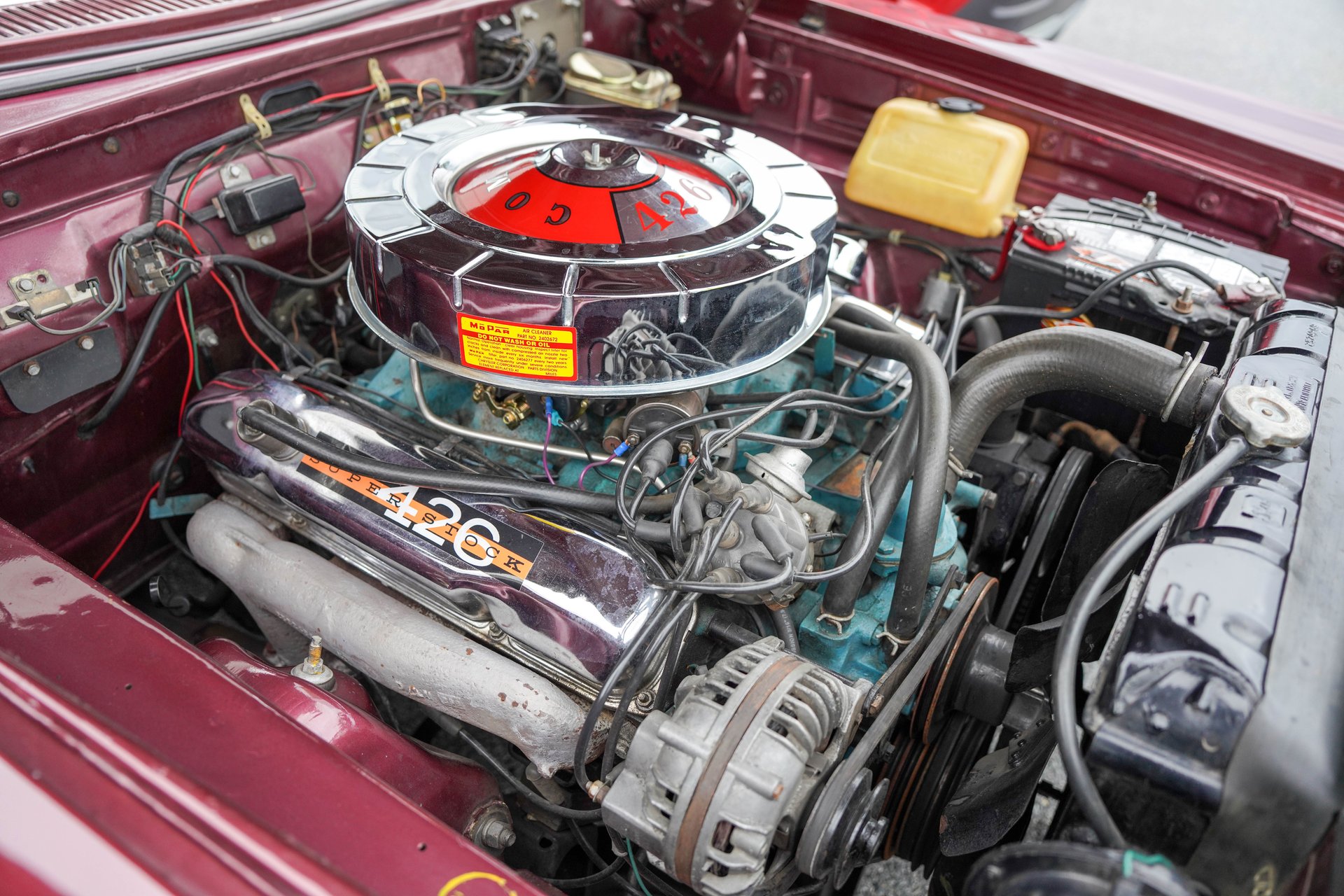
The B and RB big-blocks share architecture — deep-skirt blocks, wedge combustion chambers on all but one, hydraulic lifters, and a front-mounted distributor you can reach without dismantling anything. The 361 (1965–66) is the early, mild big-block: torquey, unstressed and now slightly orphaned for performance parts. The 383 is the volume performance engine, sold as a 270 hp two-barrel and as a four-barrel in the 290–330 hp band depending on year and specification. A healthy 383 is the sweet spot of the whole Satellite story: nearly the torque of a 440, a little freer-revving, and far cheaper to buy and feed than the halo engines. Judge it on oil pressure and valvetrain noise, because the bottom end is rarely the problem.
The 426 Wedge (1965 only in this line, as the 365 hp Street Wedge) is the RB block with wedge heads and a single four-barrel — a strong, simple engine now often confused, deliberately or otherwise, with the race Max Wedge cars and with the Hemi. The 440 arrived in the 1967 GTX at 375 hp with a single Carter AFB, gained the famous Six Barrel option (three Holley two-barrels, 390 hp) for 1969½–71 performance cars, then declined through the smog years as compression fell. A 440's condition hinges on cooling — these engines fill the bay and cook marginal radiators and wiring — and on whether the Six Barrel's outboard carburettors, which open only under load, actually work: a car no faster at full throttle than at three-quarters usually has outboards that never open, and the test is a full-throttle run, not a driveway rev.
The 426 Hemi (1966–71) needs no mythology repeated here, but it does need its buying facts stated plainly. It is a pushrod engine with hemispherical combustion chambers, two huge valves per cylinder worked by rocker shafts, and dual Carter AFB four-barrels on street cars, rated at 425 hp gross for its whole run. Hemis are not fragile, but they are intolerant of neglect: valve clearances are mechanical and need periodic setting, the dual-carburettor linkage needs synchronising, and oil consumption that would be a shrug on a 318 is a diagnostic event on an engine whose correct rebuild is a five-figure specialist job. The only Hemi buying rule that matters: the premium is for a documented, numbers-matching car, verified by VIN, fender tag, block and gearbox stampings and, ideally, the broadcast sheet — a Hemi engine in a car that did not leave the factory with one makes a fast Satellite, not a Hemi Satellite, and the two are priced in different worlds.
The 400 (1972–74) replaced the 383 as the standard big-block: the largest bore Chrysler ever put in a production V8, strangled in period by low compression and lean tuning. Stock late 400s feel flat; the blocks are prized by engine builders as stroker cores. For a buyer, what matters is that a 400 car is priced as a cruiser and should be inspected as one.
Across all the big-blocks, two shared traps. First, heat: the exhaust crossover in the intake manifold cooks the paint off the manifold's centre (normal) but bakes the choke and carburettor base on ThermoQuad cars, covered below. Second, identity: big-block swaps into small-block cars are the most common Satellite transformation, done well and badly. From 1968 the car's VIN is stamped in part on the block's rear flange and the gearbox casing of numbers-matching cars; before that, casting dates and the fender tag's engine code carry the argument. Check them before you pay for an engine.
Carburettors and fuel: Carter AFB and AVS, the ThermoQuad, and modern petrol
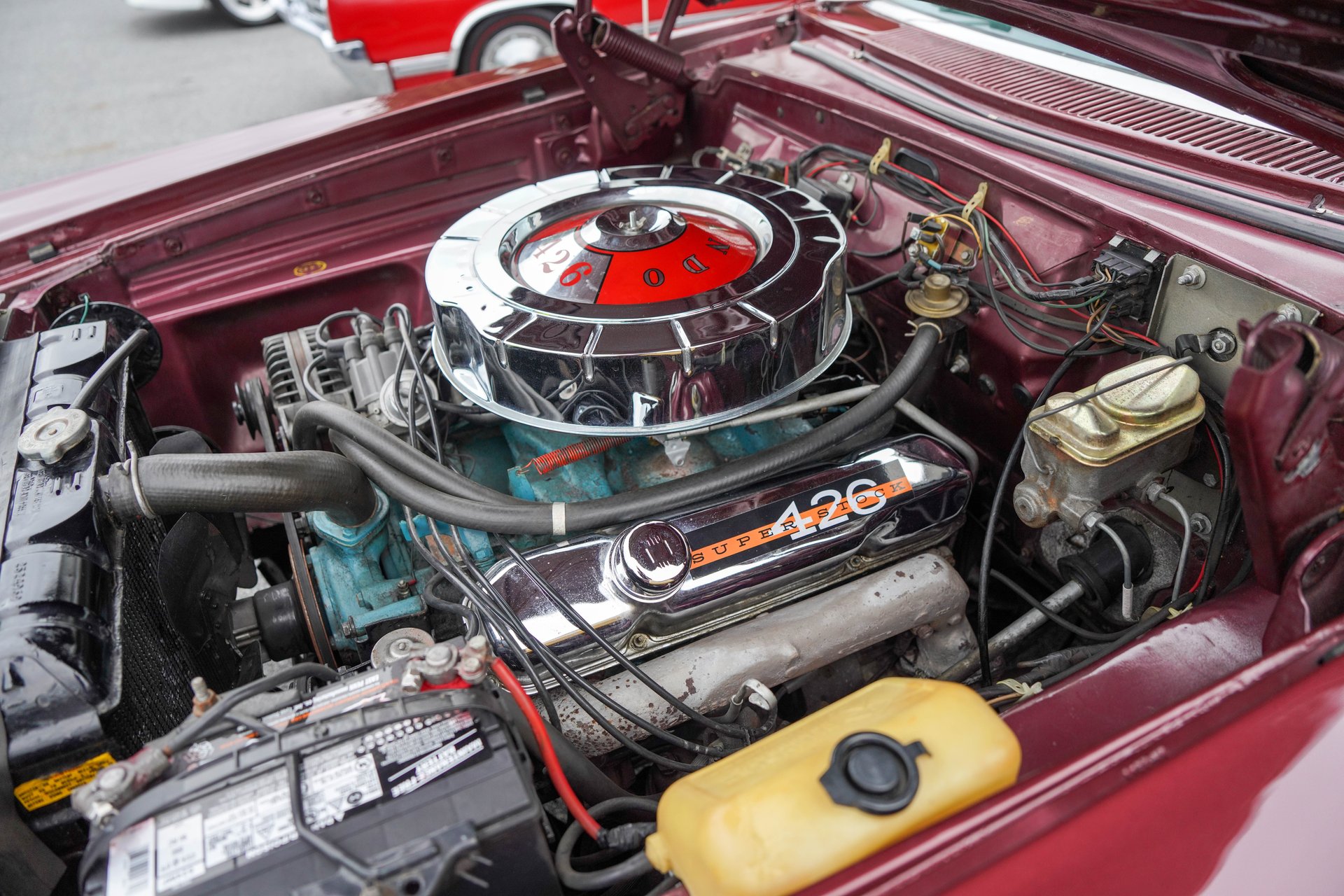
Nearly every Satellite is carburetted, and the carburettor decides how the car starts, idles and feels far more than the camshaft does. Early four-barrel cars use the Carter AFB, whose age faults are worn throttle shafts, a fuel-logged float and a choke pull-off diaphragm that splits and gives a rich, lumpy cold start that clears as the engine warms. The Carter AVS (1968–71 performance cars) adds an air-valve secondary: a flat spot on sudden full throttle is usually the air valve's spring tension, not the jets everyone reaches for. From 1971 the spread-bore Carter ThermoQuad takes over, and it has one failure mechanism you must know: its main body is a phenolic resin moulding, and the two brass well plugs pressed into its underside leak with age, letting fuel drain from the float bowl into the manifold overnight and at hot soak. The symptoms are diagnostic gold — long cranking when hot or after standing, a rich stumble on restart, fuel smell — and are routinely misdiagnosed as a fuel pump or ignition fault. The fix is sealing the well plugs during a rebuild ($250–600 for a proper ThermoQuad rebuild at a specialist); the test is to watch down the primaries after a hot shutdown for fuel dripping.
Modern ethanol-blended petrol attacks every Satellite fuel system the same way: it hardens old rubber hose, lifts tank varnish into the filter, and boils at lower temperatures in a hot engine bay, giving hot-soak percolation and vapour lock on cars that never suffered either on period fuel. Budget for a full rubber-hose renewal in ethanol-rated line, a tank clean on any car that has stood, and an electric booster pump on a big-block car that vapour-locks in traffic. It is the difference between a car that starts in a petrol station queue and one that does not.
Gearboxes: TorqueFlite 727 and 904, the A833 four-speed, and the rear axles
The automatic is the TorqueFlite, in two sizes: the heavy-duty A727 behind big-blocks and high-performance small-blocks, and the lighter A904 behind Slant Sixes and most 318s. Both are three-speed and famously strong. A healthy TorqueFlite engages promptly, shifts firmly and kicks down crisply; the faults to test for are delayed or slipping engagement from rest (check fluid level and colour first — the dipstick settles arguments the seller's story cannot), a 2–3 flare, and a kickdown linkage that is misadjusted or disconnected, which both dulls the car and, because the same linkage controls throttle pressure, can burn a gearbox that is otherwise sound. Never drive a TorqueFlite hard with the kickdown linkage disconnected. A standard rebuild is roughly $1,800–3,500; the 727 costs no more to rebuild than the 904 and lasts longer behind torque.
One year is special: 1965 TorqueFlites are cable-shifted, a one-year mechanism with one-year parts. A 1965 car whose gearbox misbehaves needs a Mopar-literate transmission shop, not a generalist with a later 727 on the shelf.
Manual cars use a column-shift three-speed on sixes and small V8s, and the A833 four-speed behind performance engines, with an Inland shifter on 1966 to early-1968 cars (recognisable by its reverse lockout lever and a vagueness owners either tolerate or cure) and a Hurst shifter from mid-1968. The A833 itself is close to unbreakable; judge it on second-gear synchromesh, on whine in the indirect gears (bearings, a rebuild in the $1,200–2,500 range), and on a clutch that takes up smoothly — judder is as often oil on the plate from a leaking rear main seal as it is a worn disc.
Behind the gearbox, the standard axle is Chrysler's 8¾-inch unit with a removable carrier — gear changes and Sure-Grip work are unusually easy because the whole differential comes out the front of the housing. For buying, what matters is whine under load (crown wheel and pinion wear), a clunk on taking up drive (backlash, worn Sure-Grip clutches or cones), and pinion-seal leaks. Most Hemi and 440 four-speed cars carry the much heavier Dana 60 instead — a value point when original, and another identity check, because a Dana under a car that should not have one is a chapter of its story the seller should be able to tell. Base 1971-on cars use the lighter 8¼-inch axle, adequate for a 318 cruiser.
Problem areas
A note on evidence before the map. Our photo-note sample for the Satellite is a single examined car, so it supports no incidence claims at all — nothing in this section pretends otherwise. What follows is the B-body's well-documented failure geography, drawn from how these cars were built and how they rot, wear and leak. Your inspection of the car in front of you is the evidence that counts, and the checklist after this section is ordered to produce it: structure first, because it is the one bill that can exceed the car's value; then running gear; then the electrics that decide whether the car starts; then the cabin.
Rust: the map
A Satellite is a unitised shell — there is no separate frame to save it — and its rust follows the water and the mud traps designed into the B-body. Work through it in this order.
The torsion-bar crossmember. The single most important structural check on any B-body, and the one most buyers have never heard of. The front torsion bars anchor at their rear ends in sockets in a crossmember under the front of the floor, and that crossmember carries the entire front suspension load. It rots from inside its box sections, fed by water and mud thrown up over decades, and a perforated anchor lets a torsion bar pull through — a collapse, not a creak. Prod the crossmember around both bar anchors and along its ends where it meets the rails. Surface scale is normal; softness, holes or plated patches here are a fabrication repair, priced per car, and a legitimate walk-away on a car priced as a driver.
Front rails, K-member and inner wings. The front frame rails run from the crossmember forward to carry the bolt-in K-member, engine and front suspension. They rot at their rear ends near the crossmember, around the K-member mounting points, and where the inner wing (fender apron) seams trap mud above them. The battery tray rots from the top down under the battery, and the acid track eats the apron beneath it — lift the battery or at least rock it and inspect the tray edges with a torch. The K-member itself is heavy and usually survives; the rails it bolts to are the question.
Cowl, windshield channel and front floors. The windshield seal and cowl vent admit water that runs down inside the cowl sides and into the front footwells, where it sits under the carpet and rots the front floor pans from the top down. This is the classic B-body sequence: a car can show tidy sills and still have front floors like lace. Lift the front carpets on both sides without exception. Floor repair sections are available and a side fitted runs roughly $500–1,200, but floors rarely rot alone — treat a holed front floor as a marker to re-inspect the cowl, the crossmember behind it and the rails below it.
Sills, door bottoms and lower wings. The rocker panels rot at their ends, where wheel spray packs in, and door bottoms rot from inside when the drain slots block — run a fingertip along every door's bottom edge for bubbling, then check the drains are clear. The lower rear of the front wing traps mud against the cowl and perforates. None of these alone kills a car; together they price a body programme, and they are where filler hides — work a cloth-wrapped magnet along every lower panel.
Rear quarters, wheel arches and trunk. The rear quarters rot behind the rear wheels, along the arch lips, and at their lowest point where the trunk floor extension (the drop-off panel) closes the quarter's inner side; that drop-off rots with the quarter, and the pair are the standard B-body rear repair. The trunk floor rots from water entering past the rear window channel — worst on hardtops — and past the trunk seal, collecting under the mat and in the well corners. Lift the mat and spare wheel on every car. A stained floor is a clean, treat and reseal; a perforated one is panel work at roughly $800–2,000 fitted and painted, and it earns a hard look at the rear rails and spring mounts below.
Rear rails and spring hangers. The rear frame rails kick up over the axle and carry the leaf-spring front hangers and rear shackle mounts. Perforation around a hanger or shackle mount is structural in the same league as the torsion-bar crossmember: the spring is located by that metal. Prod both sides, at both ends of each spring. Northern cars can be sound in the quarters and rotten exactly here, because this is where road salt lives longest.
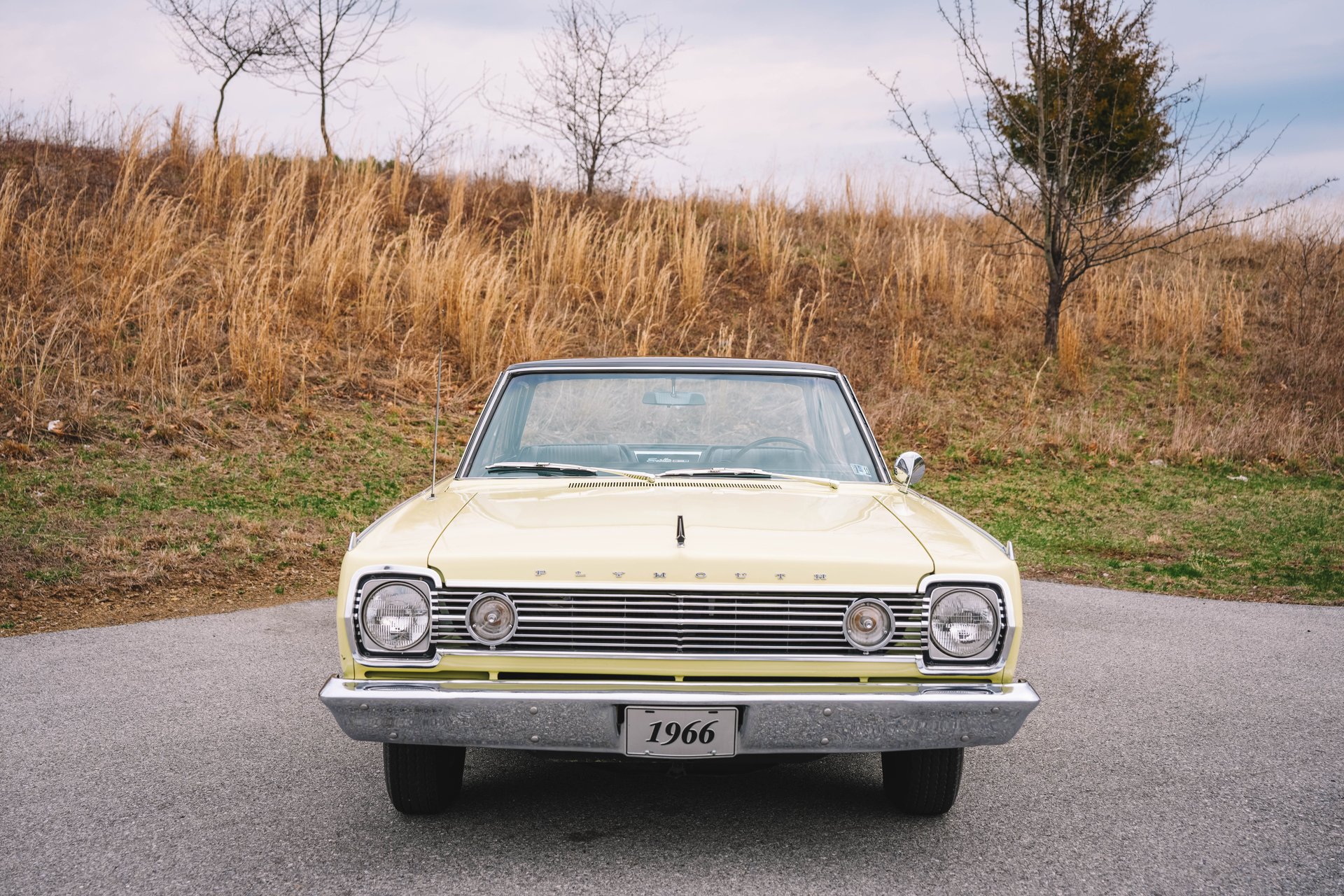
Vinyl roofs. A large share of Satellites, including the 1966 and 1968 cars pictured in this guide, wear a vinyl roof, and vinyl traps moisture against the roof skin, above all around the rear window and sail panels. Bubbling paint at the base of the rear pillars, or a crunchy feel when you press the vinyl near the window edge, means the roof skin is perforating under the covering — a repair that means vinyl off, metal work, paint and new vinyl, and one of the few rust jobs here that can rival a floor programme for cost. Press and look on every vinyl-roof car.
Suspension, steering and brakes
The front suspension is Chrysler's torsion-bar system, with ride height set by adjuster bolts at the bar anchors. That adjustability is a diagnostic gift: a car sitting nose-down may simply have tired bars or bars wound down, so measure ride height by the factory procedure (between set points on the lower arm, not the arch gap) before condemning anything. Worn ball joints, perished control-arm bushes and a worn idler arm are the standard wear list, all available and affordable — a full front-end renewal with alignment is roughly $800–1,800 fitted. What is not a wear item is a bar anchor pulling through; that is the crossmember story above. Rear leaf springs sag and occasionally lose a leaf at the centre bolt; a car low at one rear corner is a spring or shackle bush until proved otherwise, at ordinary money.
Steering is a worm-and-roller box, manual or power-assisted. Wear shows as free play at the wheel centre — separate box wear from linkage wear by having a helper rock the wheel while you watch each joint in turn under the car: movement at the idler arm and tie-rod ends is cheap; play inside the box is an adjustment first (the sector adjustment on top of the box, done by the book, in small increments) and a rebuild at roughly $400–900 if adjustment cannot recover it. Power-steering cars leak from the pump (Federal or Saginaw units depending on year), the pressure hose and the box's sector seal; a pump that groans at full lock is usually low fluid or a dying pump. None of this should kill a purchase; all of it should be priced.
Brakes divide by year, and the division matters. Base cars carried four-wheel drums for most of the run — adequate when maintained, with the usual faults of seized wheel cylinders and perished hoses, plus a single-circuit master cylinder on 1965–66 cars that makes hose condition a safety item rather than a maintenance one; dual circuits arrive for 1967. Optional front discs come in three generations: the 1966–69 Kelsey-Hayes four-piston fixed-caliper system, whose calipers seize piston by piston and whose parts are the expensive version of everything; the 1970 Bendix single-piston design; and the 1971-on Chrysler pin-type sliding caliper, for which everything is cheap. A disc conversion using later factory parts, done completely with the correct master cylinder and proportioning, is a plus on a driver; done halfway it shows as a low pedal or premature rear lock-up, and the test drive's hard stop is where you find it. A full hydraulic refresh on a car that has stood is roughly $700–1,800 depending on generation — and standing is what most of these cars have done, so judge the system guilty until the pedal, the fluid colour and a hard stop prove it innocent.
Electrics and ignition: the bulkhead, the ballast and the ammeter
Chrysler electrics of this era fail at three named places, and knowing them turns a no-start from a mystery into a sequence.
The bulkhead connector. The engine-bay wiring passes through the firewall in a multi-pin disconnect block, and its terminals corrode, loosen and overheat — worst on the high-current charging circuits that pass through it twice on their way to and from the dash ammeter. The mechanism is resistance: a corroded pin drops voltage, the drop makes heat, the heat softens the block and loosens the pin further, and the car progresses from dim lights and a lazy charge to intermittent total electrical death and, at worst, a melted connector. The tests are electrical: measure voltage at the battery and at the alternator output with the engine running and loads on, and measure the drop across the bulkhead on the charging wires — more than about half a volt lost there is the fault found. Cleaning and re-tensioning terminals cures a sound block; a melted block means harness repair, and many owners bypass the ammeter circuit with a fused heavy-gauge run, a modification to welcome when neatly done and fused, and to distrust when it is twisted wire and tape. The connector is visible at the right of the second engine-bay photograph in the engines section: look for discoloured plastic and green terminals before anything else in the bay.
The ballast resistor. The white ceramic resistor on the firewall is the most famous small part in Mopar ownership. The ignition coil runs through it in the RUN position and is fed full voltage, bypassing it, while cranking. When it fails open-circuit — and it fails with heat and age — the engine fires eagerly while the starter turns and dies the instant you release the key. That symptom is the diagnosis; no other common fault produces it so exactly. The part costs a few dollars and takes minutes to change; carry a spare in the glovebox of any points or electronic-ignition Satellite, and treat a seller's story of an intermittent cut-out with a two-dollar test before you let it become a four-figure discount negotiation in either direction.
Ignition systems by year. Points ignition fails the old way: worn points, a tired condenser, a worn distributor bush giving timing scatter you can watch with a timing light as a wandering mark. Chrysler electronic ignition — optional from 1971, standard for 1973 — replaces the points with a reluctor distributor and a control unit on the firewall, and adds its own failure set: the ECU depends on its mounting bolts for its earth, so a corroded mounting is an intermittent no-spark; the ECU itself fails hot, giving a car that stops warm and restarts cold; and the dual ballast resistor can fail on either circuit, one producing the classic start-and-die above. A hot no-start on a 1973–74 car is the ECU and its earth until proved otherwise — and proved means a spark test while the fault is present, not parts changed on suspicion. The mechanical voltage regulator (pre-1970) sticks and overcharges, boiling the battery; the electronic regulator from 1970 fails quietly and undercharges. Both are cheap; the acid damage from months of overcharging is not.
The rest is fifty-year-old-car standard: earth straps corroded at engine and body (the cause of half the slow cranking blamed on starter motors), a starter relay whose burnt contacts click and do nothing, and neutral safety switches that make a good car refuse to crank in Park but start in Neutral — a switch adjustment, announced by the car itself if you know to try both positions.
Interior, trim and weather sealing
The cabin decides how much of the car you can restore with money and how much needs luck. Mechanical parts are easy; year-correct trim is the hunt. 1965 is a one-year trim set, and its bright trim, grille and tail-panel pieces are genuinely scarce. 1966–67 cars share more, but Satellite scripts, medallions and GTX trim are reproduced only in part. 1968–70 is the best-supported era: seat covers, door panels, carpets and dash pads are reproduced for the hardtops, and a tired interior in these years is a budget line (a full quality retrim runs roughly $2,500–6,000 fitted) rather than a research project. 1971–74 swings back toward scarcity: the fuselage cars' door panels, dash pads and plastics are far less reproduced and embrittle with age, and a crack-free late interior is worth real money precisely because you cannot simply order one.
Vinyl splits at the stitching and at the driver's entry bolster first; foam crumbles and a seat that looks right can sit like a deckchair — sit in the driver's seat, always. Dash pads crack from the speaker grille outward. The heater matters more than it looks: the blower motor and heater core live behind the dash, a core leak announces itself as a sweet smell and a misting windscreen, and core replacement is a dashboard-out job in the $800–1,500 labour range on most years. On convertibles (1965–70), the hydraulic top system — pump, rams and lines behind the rear seat — leaks with age, the frame pivots wear and let the top sit crooked, and the well the folded top lives in collects the water that rots the rear floor extensions; a convertible's trunk and rear floors deserve double the standard inspection. Every rubber seal on the car is a consumable: budget a full seal kit into any car you intend to drive in rain, because on a B-body the seals are not weatherproofing trivia — they are the rust prevention system for the floors, the trunk and the quarters described above.
How to inspect one
Allow two hours and bring a torch, a cloth-wrapped magnet, a tyre-pressure gauge, a multimeter and a friend to rock the steering wheel and work the pedals. Insist on a cold engine and, if the car passes you, pay for lift time before money moves — on a unitised B-body the underside is the car.

- Paperwork and identity first. Match the VIN to the title. On 1965–67 cars the plate is on the driver's front door hinge pillar; from 1968 it is on the driver's side of the dash, read through the windscreen. Then decode the fender tag on the driver's inner front wing: it carries the car's engine, gearbox, axle, paint, trim and build date as stamped codes. A missing tag is not fatal — they unbolt — but on a Hemi, GTX or 440 car it moves the burden of proof entirely onto the seller. Look for the broadcast sheet in the rear seat springs or behind the glovebox, and on any big-money car ask whether the engine and gearbox carry the car's partial VIN stamping, as 1968-on numbers-matching cars should.
- Cold start. From stone cold, a carburetted car should fire with a couple of pumps and a fast idle that steps down as the choke opens. Watch the exhaust: blue smoke at start-up that clears is valve-stem seals; smoke that stays is rings or worse. Listen for a timing-chain rattle that does not fade and for valvetrain ticking that points at the Slant Six's adjustment or a big-block's lifters.
- The ballast test and the charge test. If the car starts and dies as the key returns to RUN, you have found the ballast resistor fault from the electrics section — note it, price it at almost nothing, and move on. With the engine warm and the lights and blower on, put the multimeter on the battery: a healthy charging system shows roughly 13.8–14.5 volts. Much less, or a big difference between alternator output and battery voltage, sends you to the bulkhead connector before you condemn the alternator.
- Underneath: the structure decides. On a lift or with the car safely raised, prod the torsion-bar crossmember around both bar anchors, the front rail ends, the rear rails at the spring hangers and shackles, and the sill ends. Perforation at the crossmember, hangers or rails is structural and decides whether the inspection continues at all. Read the underseal as you go: patchy, chipped and dirty is honest; a fresh uniform black coat over everything, applied the week before sale, is a question.
- Floors and trunk. Lift all the carpets, front first — the cowl-leak sequence in the rust section makes the front footwells the telling spot — then the trunk mat and spare wheel. Staining is a reseal; holes are a programme, and a holed front floor sends you back to step 4's crossmember with fresh suspicion.
- Body and gaps. Work the magnet over the lower wings, door bottoms, sill ends, arch lips and rear quarters. Press a vinyl roof gently around the rear window and sail panels for the crunch of rust under the covering. Check door fit and hinge play by lifting each door's trailing edge, and read the panel gaps for accident history.
- Engine health in the bay. Pull the dipstick: level, colour, fuel smell on a car that has stood. Look for manifold joint blowing (soot, ticking) and oil tracking from the rear main area under the car. Check for timing-chain slack by rocking the crank against the rotor. On a ThermoQuad car, watch down the primaries after a hot shutdown for fuel dripping — the well-plug test from the engines section.
- Front end and steering. With your helper rocking the wheel gently, watch the idler arm, tie-rod ends and ball joints for lost motion, joint by joint, so you know whether the play is linkage money or box money. Bounce each front corner and let it settle; check the ride height is even side to side, remembering torsion bars are adjustable and sag is a measurement, not a guess.
- The test drive. Twenty minutes, mixed roads. The TorqueFlite should engage promptly, shift firmly and kick down when asked — and confirm the kickdown linkage is connected before you judge the box at all. A manual car gets the second-gear synchromesh test, hot and cold if you can. A 340 or a Six Barrel 440 should wake up decisively at full throttle; a car that does not has the secondary-air-valve or outboard-carburettor conversation waiting.
- Brakes and stance. Brake hard from speed, twice: straight, no pull, no judder, a pedal that stays where it is. A pull is a seized caliper piston or a collapsing hose; rear lock-up on a disc-converted car is the missing proportioning valve. Then stand back and read the stance as in the photograph above — nose height, rear level, side-to-side evenness.
- Heat, electrics and the cabin systems. Idle it hot for ten minutes and watch the temperature gauge — big-blocks find out marginal radiators in a queue, not on the open road. Work every electrical item: lights, wipers, washers, heater blower on all speeds, horn, gauges. Smell for heater-core sweetness and look for a misting screen. Try cranking in Park and in Neutral; a Neutral-only start is the safety switch introducing itself.
- Interior last, and the driver's seat first. Sit in every seat, the driver's longest. Feel for collapsed foam under good vinyl, check the dash pad around the speaker grille, the headlining seams, and — on a convertible — run the top through a full cycle and inspect the well and the rams for leaks. A sound, correct interior on the scarce-trim years is the hardest part of the car to recreate, so weight it like structure, not like cosmetics.
Values
The market content beneath this guide — the cars listed now and the recorded sales — carries every current figure, and it is refreshed as the market moves, so this section teaches you how to read it rather than repeating numbers that would date. What follows is the structure of Satellite value, which changes far more slowly than the prices themselves.
The first driver is identity, and it is not close. A documented Hemi car, a genuine GTX and a verified 440 car sit in different markets from everything else wearing this badge, because the premium attaches to the paperwork — VIN, fender tag, broadcast sheet, matching stampings — as much as to the metal. The same car with the same engine fitted later is a modified Satellite and is valued as one: strong money for a well-built car, but a fraction of the documented article. This is why clones and tribute cars are not automatically bad buys; they are bad buys only when they are priced as the real thing. Buy a tribute knowingly, at tribute money, and it can be the best value in the whole model range.
The second driver is the year band. The 1968–70 cars carry the styling premium — the market pays for the rounded restyle, the Road Runner and GTX halo and the peak performance options, and convertibles add a scarcity premium on top. The 1965–67 cars trade a step below that peak except where the Hemi or GTX badge lifts them out of it. The 1971–72 Sebring coupes have been climbing as buyers recognise the fuselage styling and the last real performance options, while the 1973–74 cars remain the value end: often the best-equipped and most complete cars per pound or dollar spent, priced down by smog-era reputations their road manners do not deserve.
Within any year, condition spread dominates. The gap between a project Satellite and a sorted driver is wider than the gap between model years, because the expensive work — structural welding, paint, trim on the scarce years — costs the same whatever the badge says, and quickly exceeds the finished value of a base car. That is why the cheap car at the bottom of any listing set is usually the expensive one: a rusty 318 hardtop and a rusty Hemi hardtop need the same crossmember, floors and paint, and only one of them is worth more finished than the work costs. Read asking prices against achieved prices with the usual auction discount in mind: sellers of Mopars ask optimistically, exceptional documented cars achieve close to ask, and ordinary cars negotiate. Originality of specification is worth more than originality of parts: a correct-specification car with a rebuilt engine beats a tired car whose only virtue is never having been touched.
Finally, specification details move individual cars: a four-speed where most are automatics, a Sure-Grip axle, working factory air conditioning, an unusual documented colour, and Sport Satellite or Sebring Plus trim all add their increment. Engine swaps cut the other way for originality value and the other way again for driver value — our own pool currently includes an LS-swapped 1970 car, and cars like it should be priced purely as modified drivers, on the quality of the conversion and the shell.
Parts and ownership
The Satellite shares its mechanical life with the entire B-body family — Belvedere, GTX, Road Runner, Coronet, Charger — and that makes it one of the best-supported American cars of its era. Almost everything that wears is reproduced, remanufactured or sitting on a shelf in the Mopar trade, and the specialist knowledge base is deep.
Easy: engine service and rebuild parts for the 318, 383 and 440 (the 340's specific parts cost more; Slant Six parts are cheap and plentiful), TorqueFlite rebuild kits and hard parts, 8¾-inch axle gears, bearings and Sure-Grip components, suspension wear parts including ball joints, bushes and torsion bars, brake consumables for the drum and 1971-on disc systems, cooling system parts, carburettor rebuild kits for the AFB, AVS and ThermoQuad, weatherstrip and seal kits, and glass for the popular hardtop bodies. Order today, fit this weekend, at prices in line with any mainstream classic.
Harder and dearer: Kelsey-Hayes four-piston caliper parts and rotors for the 1966–69 disc option; 1965-only trim, TorqueFlite cable-shift parts and one-year details generally; Hemi-specific engine components, where everything exists and nothing is cheap; correct Six Barrel induction components; GTX and Sport Satellite bright trim and medallions; 1971–74 interior plastics, door panels and dash pads; convertible top frames and rams; and good chrome in any year — re-plating a full set of bumpers and brightwork is a serious bill, so count the pitted pieces on any car and price them in. A quality repaint is a five-figure job done properly, which is why this guide's rule is to buy the body and the interior and fix the mechanics.
Running costs. A sorted Satellite is a realistic regular-use classic. The 318 automatic hardtop is the low-effort version: fuel consumption in the mid-to-high teens per gallon in mixed use, less for the big-blocks. Servicing is within any competent classic workshop's ability, with two Mopar habits worth forming: keep the ballast resistor spare in the glovebox, and treat any charging oddity as a bulkhead-connector inspection before it becomes a harness repair. The budget line that catches new owners is the first year: catching up deferred maintenance on a running car — fuel-system rubber, brake hydraulics, suspension wear parts, seals, fluids — honestly runs into four figures before you improve anything, and recommissioning a car that has slept for a decade costs several times that. A car in regular use, bought at a premium over a sleeper, is almost always the cheaper car by the end of year one.
Which one to buy
- The all-rounder: 1968–70 Sport Satellite 318 hardtop. The styling everyone wants, the toughest and cheapest engine in the range, the best trim support of any Satellite, and a deep market to buy from and sell into. If you want one Satellite to drive, this is it.
- The value buy: 1973–74 Satellite Sebring Plus. Fuselage style, the best equipment levels of the run, a quieter and more civilised car than the sixties cars — and the softest prices in the model, because the market still prices the reputation instead of the car. A 360 or 400 car is the pick of them.
- The performance buy: 383 four-barrel car, 1968–70. Nearly all the big-block experience — torque, sound, presence — at a fraction of 440 and Hemi money, in the years the market loves. Verify the engine is the car's own specification, and it is the sweet spot of the range.
- The connoisseur's car: 1965 Satellite. The first and purest, with one-year body and trim. Buy the most complete one you can find; the trim hunt is the ownership experience.
- The small-block charmer: 340 Sebring, 1971–72. The high-winding LA in the fuselage coupe is the driver's car of the late range. Judge it hard on engine originality, because 340s were used as 340s should be.
- The collector car: a documented Hemi or GTX. Bought as paperwork first and a car second, verified by tag, sheet and stampings before any discussion of condition. A genuine one is blue-chip Mopar; a story is just a fast Satellite with an expensive badge.
- The open car: 1965–70 convertible. Any engine, bought on the rear floors, the top mechanism and the completeness of the convertible-only trim. The 318 convertible is the honest summer car of the range.
And the rule that overrides all of the above: buy the soundest shell you can find, in the specification you can verify. Engines, gearboxes, brakes and ballast resistors are all fixable at prices you can plan for. A rotten torsion-bar crossmember, rear rails eaten at the spring hangers, or a Hemi story the paperwork will not support are the three ways a Satellite takes money off you without giving any of it back.
See the 6 Satellite cars currently listed.
For sale now
 $23,000
Expand
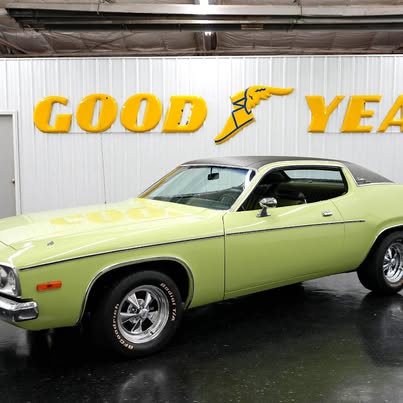 $27,000 · 15% below typical
Expand
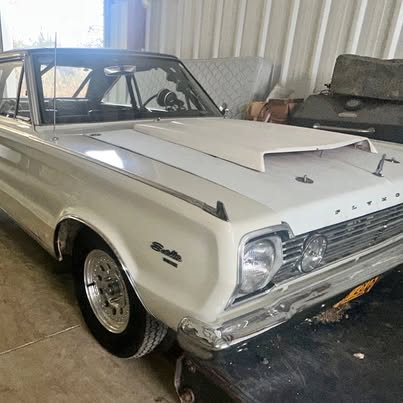 $39,000 · 23% above typical
Expand
What they sell for: Satellite sale prices.