
Porsche 944 buyer's guide
Porsche 944 -- the model's own buyer's guide: variants, values and what to check.
Years listed: 1986-1989 · Series: 944
Overview and history
The Porsche 944 Turbo — factory type 951, or 952 in right-hand drive — is the car that proved the front-engined, transaxle Porsches could embarrass the 911. When it reached the United States for the 1986 model year, it offered near-911 Turbo performance, a genuinely balanced chassis and a hatchback's practicality for substantially less money, and period testers who drove it back to back with the 911 Carrera regularly picked the 944 Turbo as the better road car — a verdict that still holds today.
The lineage matters because it explains the engineering. The 944 of 1982 took the 924's transaxle layout — front engine, gearbox at the rear axle, connected by a torque tube — and replaced the Audi-derived engine with a proper Porsche design: a 2.5-litre four that was, in essence, half of the 928's V8, complete with twin balance shafts to cancel the big four's second-order vibration. The Turbo's development ran through competition: the 924 Carrera GT homologation car and the 1981 Le Mans 924 GTP had already shown what a boosted transaxle Porsche could do, and the production 944 Turbo, shown at Frankfurt in September 1985, applied those lessons with an air-to-air intercooler, forged pistons, a strengthened transaxle and serious brakes.
The result was a car with almost even weight distribution, steering of rare feel, and performance that embarrassed exotics: period US tests put the standard car at around six seconds to 60 mph with a top speed in the mid-150s mph, and the later Turbo S was quicker again. It was also a proper Porsche in its details — galvanised body, forged alloy wheels on the flagship, Brembo brakes, a boost gauge in the cluster — sold at a price that undercut the 911 it could outrun on a twisty road.
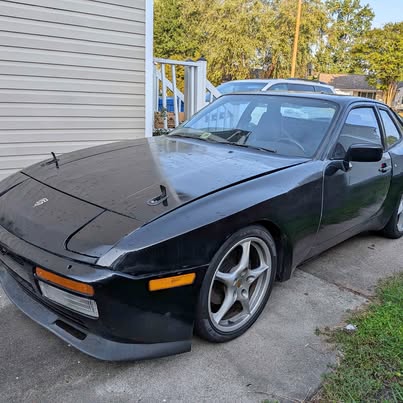
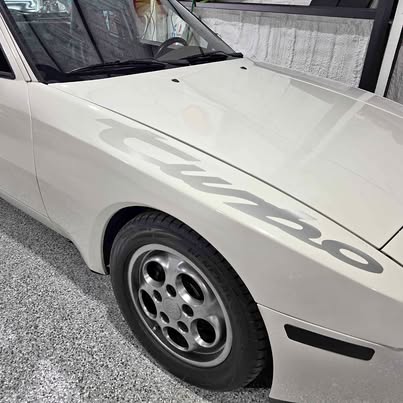
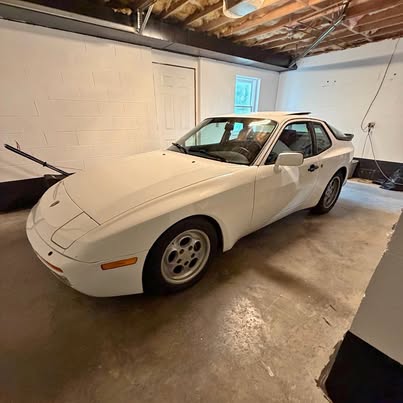
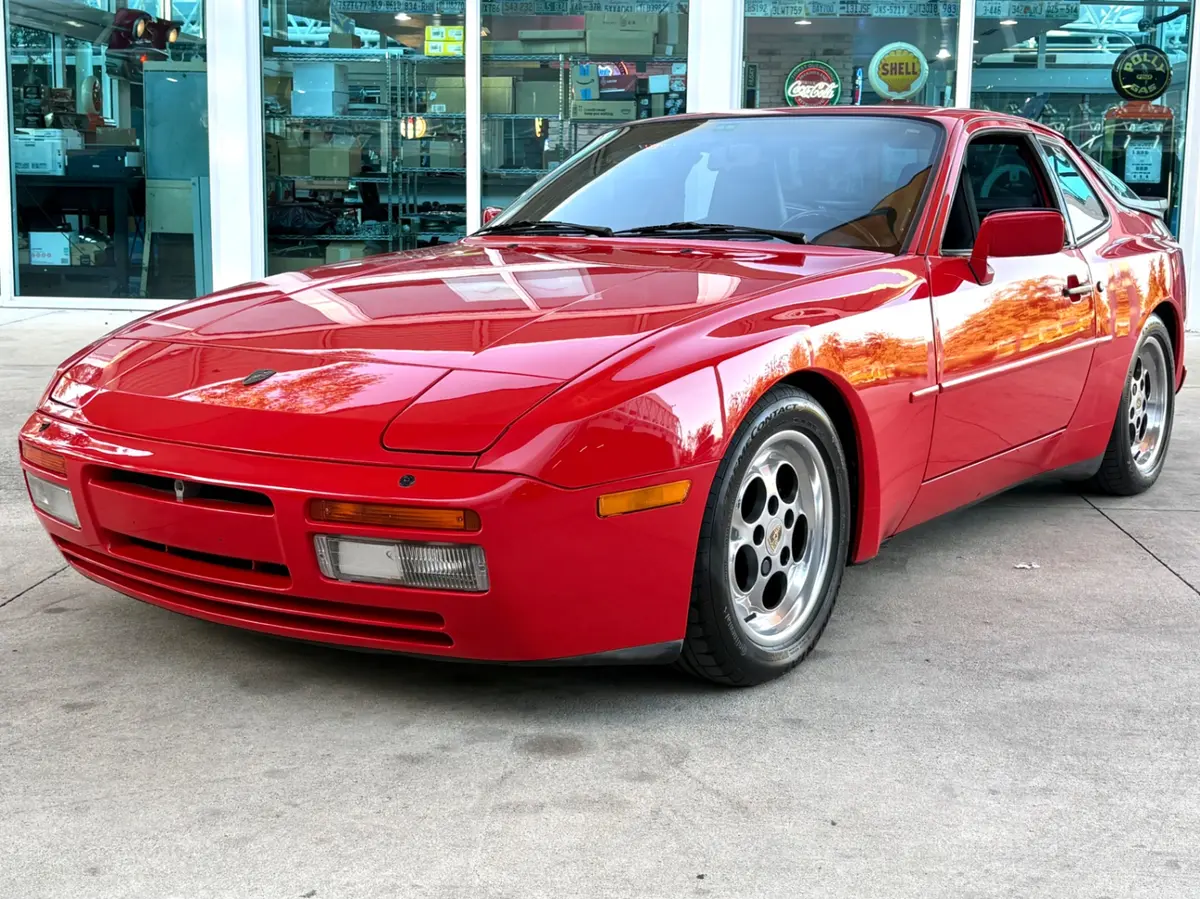
Production ran from late 1985 to 1989 for the road cars in the US market, ending as the 944 line itself wound down toward the 968. Roughly 25,000 Turbos were built across all markets, the great majority of them the standard car; the Turbo S of 1988 and its identical 1989 successor, badged simply Turbo, are the rare and sought-after minority. Our own listings illustrate how thin the US supply now is at any given moment: we currently track just four 944 Turbos, three offered for sale and one recorded sold, spanning the 1986 and 1988 model years — a snapshot, not a census, but a fair picture of a model that appears in small numbers and sells on condition when it does.
A 944 Turbo is not a fragile car — the engine, transaxle and shell are all fundamentally strong — but it is a car with a short list of expensive, well-understood failure points, nearly all of them maintenance-driven. The timing and balance-shaft belts, the head gasket, the number 2 rod bearing, the boost-control plumbing and the clutch are the five conversations that decide what any given car is really worth. A car with invoices proving those jobs are done is a bargain at a premium; a shiny car with no paperwork is a project wearing a driver's clothes. Everything below is about telling the two apart.

The models
There are really only two road-car specifications to understand, plus a competition footnote — but the difference between them is large enough that misidentification, innocent or otherwise, is the first trap in this market. Every 944 Turbo is a two-plus-two hatchback coupe with a five-speed manual transaxle; Porsche never offered an automatic Turbo, so a car advertised as an automatic 944 Turbo is a misdescribed standard 944 until proved otherwise.
| Model | Years | Engine | Output | Built | Character |
|---|---|---|---|---|---|
| 944 Turbo | 1986–1989 (US) | 2.5 four (M44/51), K26 turbo, intercooled | 217 hp | The bulk of about 25,000 Turbos | The standard car; fast, balanced, the default buy |
| 944 Turbo S | 1988 | 2.5 four (M44/52), larger K26, intercooled | 247 hp | Small minority of production | The flagship: more boost, bigger brakes, M030 suspension |
| 944 Turbo (1989) | 1989 | 2.5 four (M44/52) | 247 hp | Small minority of production | The S specification without the S badge |
| 944 Turbo Cup | 1986–1989 | 2.5 four (M44/51 based) | About 220 hp | Very small numbers, race series cars | Factory race cars for the Turbo Cup series; not road cars in the usual sense |
(Outputs are US-market figures. European standard cars were rated at 220 PS and the S at 250 PS; the small gap is emissions calibration, not hardware you need to chase.)
The standard Turbo (1986–1989). Engine code M44/51, a KKK K26 turbocharger, 217 hp and 243 lb-ft of torque — the torque figure is the one that matters, because it arrives with the boost at cruising speeds and defines the car's effortless mid-range. The 1986 cars are the purest and lightest specification, with 16-inch Phone Dial wheels and no airbags; from 1987 the cars gained an airbag steering wheel in the US, revised offset suspension geometry and wheel fitments, and detail changes year by year. None of these years is the wrong one — buy the condition, not the year.
The Turbo S (1988) and the 1989 Turbo. For 1988 Porsche built the definitive version: engine code M44/52, a larger K26 turbocharger, revised engine management and more boost for 247 hp and 258 lb-ft, plus the hardware to match — the larger front brakes from the 928 S4, the M030 sports suspension with adjustable Koni dampers, a limited-slip differential as standard, a strengthened transaxle with its own oil cooler, and forged 16-inch Club Sport wheels. The launch cars were finished in a dedicated Silver Rose colour with a burgundy Studio cloth interior, and those cars carry the strongest collector premium; later Turbo S production came in the regular colours. For 1989 the S badge disappeared but the specification did not: every 1989 US 944 Turbo is an M44/52 car with the full S hardware. That makes the 1989 the connoisseur's quiet buy — the flagship mechanicals without the flagship badge tax — and it makes verification essential: S badges have been fitted to standard cars before now. The engine code settles it: the type is stamped on the engine, the option sticker in the rear luggage area and the service book list the equipment, and M030, limited-slip and Club Sport wheels should all be present together. A car with the badge and only some of the hardware is a standard car with a story.

Options that matter. The limited-slip differential (standard on S and 1989 cars, optional before) is worth having and worth verifying rather than assuming. M030 suspension is desirable on any year. Sport seats hold you properly and wear on their bolsters tells the truth about mileage. The removable sunroof panel, air conditioning and cruise control were common US fitments. What matters most, though, is not the option list but the modification list: the 944 Turbo responds dramatically to boost, and a generation of cars was chipped, fitted with manual boost controllers and turned up beyond what the fuel system and head gasket were asked to handle when new. A documented, professionally modified car can be excellent; an anonymous chip and a bleed valve are a discount, not a bonus, and the inspection section treats them that way.
The Turbo Cup cars were factory-built racers for the one-make Turbo Cup series — lightened, caged, with magnesium wheels and no road-car trim. They surface occasionally, they are wonderful things, and they are outside the scope of a road-car purchase: verify one with the factory, not with this guide.
Engines and gearboxes
The standard engine: M44/51
The M44/51 is a 2,479 cc single-overhead-cam, eight-valve four: 100 mm bore, 78.9 mm stroke, an aluminium block and head, and the twin counter-rotating balance shafts that make a four of this size idle and rev with six-cylinder smoothness. For Turbo duty Porsche reworked it thoroughly rather than simply bolting on a blower. Compression drops to 8.0:1, the pistons are forged, the cylinder head is a Turbo-specific casting with ceramic liners in the exhaust ports to keep heat out of the head, the exhaust valves are uprated for turbo temperatures, and the engine carries its own oil cooler and a larger cooling system with a bigger radiator. Fuel and spark are managed by Bosch Motronic — the DME — working with a second control unit unique to the Turbo, the KLR knock-control unit, which listens to knock sensors on the block and governs boost and ignition timing together. That two-box arrangement was sophisticated for 1985: the engine runs close to the knock limit because the electronics are watching.
The turbocharger is a KKK K26, water-cooled as well as oil-cooled — an electric auxiliary coolant pump circulates water through the bearing housing after shutdown to stop heat soak cooking the oil in a stationary turbo, and you should hear that pump hum for a while after a hot switch-off. Boost is controlled the period way: a conventional wastegate sets the mechanical base pressure, and a solenoid cycling valve, driven by the KLR, bleeds pressure from the wastegate line to raise boost when conditions allow. Maximum boost on the standard car is about 0.75 bar, and the delivery defines the driving experience: below roughly 3,000 rpm the car is a mild 2.5-litre four; as the K26 wakes, torque arrives in one long, strong surge to the 6,500 rpm region. A healthy M44/51 starts instantly hot or cold, idles evenly at just under 1,000 rpm, shows strong oil pressure — around 4 bar at speed when warm, dropping toward 2 bar at a hot idle is normal — and pulls cleanly through the boost range without hesitation, smoke or pinking. US output is 217 hp at 5,800 rpm with 243 lb-ft at 3,500 rpm, and a good one still feels every bit of it.
Servicing defines longevity. The timing belt drives the water pump and the balance shafts have their own belt; both live behind the front covers and both are age-limited as much as mileage-limited, as the problem section covers in detail. Oil discipline matters more than on the normally aspirated car, because the same oil feeds the turbo bearing — and the service book is where a lifetime of it is proved.
The Turbo S engine: M44/52
The M44/52 looks identical on a viewing and is not. Its K26 carries the larger number 8 turbine housing (the standard car uses the smaller number 6 housing), which flows more exhaust at high rpm at the cost of a fraction more lag low down; the DME and KLR maps are revised; and maximum boost rises to about 0.83 bar. The result is 247 hp at 6,000 rpm and 258 lb-ft at 4,000 rpm, with the extra performance concentrated exactly where the standard car begins to run out of breath — the top of the rev range. On the road an S does not feel transformed at town speeds; it feels transformed at full throttle in third and fourth, where it keeps pulling with an urgency the standard car lacks. Period figures put it at about five and a half seconds to 60 mph and 162 mph maximum, 911 Turbo territory by any honest measure.
Everything said about belts, oil and cooling for the M44/51 applies unchanged. The practical differences for a buyer are threefold. First, identity: the M44/52 premium is real, so confirm the engine type from the stamped engine code and the car's option record rather than the badge, exactly as the models section describes. Second, the larger turbo and higher boost leave less margin for the tired components described in the problem section — a marginal head gasket or a lazy cycling valve shows itself sooner and harder on an S. Third, the matching chassis hardware (928 S4 front brakes, M030, limited-slip, strengthened transaxle with cooler) is part of the value: an S missing its forged Club Sport wheels or sitting on standard dampers has had money taken out of it, and the price should say so.
Gearboxes: the five-speed transaxle
There is one gearbox: a five-speed manual, mounted at the rear as a transaxle and driven through a rigid torque tube from the front-mounted engine. The layout gives the car its balance and gives the buyer two extra assemblies to judge — the torque tube itself, whose bearings support the driveshaft inside it, and a clutch that sits at the front, on the engine, like a conventional car's.
The Turbo's transaxle is a strengthened version of the 944 unit, with gearing matched to the boosted engine's torque curve: long, relaxed ratios that put cruising at low rpm and let third gear do most cross-country work. Changes should be light, precise and quiet, with synchromesh that copes with a brisk downchange into second without a graunch. The Turbo S and 1989 cars use the further-strengthened transaxle identified by the AOR code, with a transmission oil cooler and the limited-slip differential as standard; a cooler is visible as a small radiator with oil lines at the rear of the car and its presence is one of the quickest S-specification tells on a lift. On standard cars the limited-slip was an option — desirable, and verifiable from the option codes or by the both-wheels test on a lift, never from a seller's assurance.
Judge the driveline as a system on the test drive. A whine that follows road speed from behind you is torque-tube or transaxle bearing wear, not a characteristic noise. A clunk on taking up drive points at the clutch's rubber centre or worn CV joints before it points at the gearbox. A car that jumps out of gear, or baulks second when cold and worse when hot, is budgeting a transaxle rebuild — realistically $3,000–5,500 at a specialist before any while-you-are-in-there work — and a clutch replacement on this car is a major labour job, $2,000–3,500 all-in, precisely because the torque tube and transaxle come out to do it. Neither figure should frighten you off a car priced for it; both should frighten you off a car priced as if they were done when they were not.
Problem areas
Everything in this section is a known, documented behaviour of this engine and chassis — the 944 Turbo has been understood by specialists for decades, and there are no mystery faults left, only unbudgeted ones. Work through it in the order a car's bills arrive: belts first, because they can end the engine in a second; then the head gasket and the bottom end; then the boost system that makes the car feel right or wrong; then the supporting systems.
Belts, head gasket and the bottom end
The timing and balance-shaft belts. This is an interference engine: if the timing belt breaks or jumps, pistons meet valves and the bill becomes an engine rebuild. The belt also drives the water pump, and the balance shafts run from a second toothed belt alongside it. Rubber ages whether the car is driven or not, so the interval is time as well as distance — the accepted discipline is replacement at about 45,000 miles or four to five years, whichever comes first, with the water pump, front engine seals, idlers and rollers assessed or renewed at the same time, because the labour to reach them is most of the job. A full belt service with pump and rollers at a specialist runs roughly $1,200–2,200; the belt job alone, without the pump, is less — and worth less, because a pump that seizes takes the new belt with it. The failure mechanism to understand is that these belts rarely snap dramatically on a maintained car: they shed teeth, or a tired tensioner or a weeping front seal contaminates the belt with oil until it jumps. The distinguishing evidence is documentary, not mechanical — you cannot judge a belt's age by looking at it on a viewing, and a seller's verbal "belts done last year" without an invoice naming the date and mileage is worth nothing. No invoice, price the job in, in full, on day one. After replacement the belts need a tension re-check at about 1,000–1,500 miles, because new belts settle; an invoice for that re-check is the mark of a shop that knows these cars. A whine from the front of the engine that rises with rpm is often an over-tight balance belt — annoying rather than dangerous, but it tells you the last belt job was not done by a specialist hand.
The head gasket. The classic Turbo failure, and it follows a pattern: the gasket's fire ring lets go at the rear of the head, around number 4 cylinder, where cooling is least effective and heat soak after a hot shutdown is worst. Early symptoms are subtle — a slow, unexplained coolant loss, a faint misfire on a hot restart, bubbles in the expansion tank at idle. Left alone, combustion pressure drives gas into the cooling system, the car pressurises its hoses and pushes coolant out, and eventually coolant and oil begin to mix. Understand the mechanism before you diagnose: a Turbo can also lose coolant from a cracked expansion tank, a tired radiator end tank or the turbo's own water lines, all cheap, so coolant loss alone does not convict the gasket. The distinguishing tests are a chemical block test on the expansion tank (exhaust gas in the coolant changes the fluid's colour — a ten-minute test any garage can do), a cooling-system pressure test held overnight, and a compression and leak-down test that shows whether one cylinder — usually the rear one — is down on its neighbours. The cure is a head-off job with the head checked for flatness, and the correct replacement is the later wide-fire-ring gasket developed for the Turbo S; expect $1,800–3,200 at a specialist depending on what else the front of the engine needs while it is apart. A car with a documented recent gasket on the correct part is a car whose biggest engine bill has been prepaid for you.
Rod bearing number 2. The bottom end's one real weakness, and the one that separates track-used cars from road cars in the paperwork. Under sustained high cornering loads — the classic case is a long, fast right-hander on track rubber — oil surges away from the pickup in the sump, the pump draws air, and the bearing that suffers first and worst is the number 2 rod bearing. High mileage, low oil level, thin oil and extended high-rpm use all shorten the odds. The failure announces itself as a deep knock under load that follows rpm, falling hot oil pressure, and copper-coloured debris in the oil filter; by the time it knocks audibly, the crankshaft journal is usually scored and the job is an engine-out rebuild at $8,000–15,000 rather than a bearing swap. The distinguishing test on a viewing is therefore preventive evidence, not noise: hot oil pressure at idle and at 3,000 rpm against the gauge, the sound of the engine under load on the test drive, and above all the history — a car with invoices for preventive rod-bearing replacement, or for a baffled sump or an uprated pickup fitted for track work, has had this risk managed. Specialists commonly renew the rod bearings as insurance on high-mileage engines while the engine is out for other work, at roughly $2,500–4,000 as part of a larger job. A standard road car on road tyres with full oil and sensible use is at low risk; a cheap car with a track-day past and no engine invoices is carrying the risk uninsured, and should be priced that way.
Oil leaks and the front of the engine. Cam-tower and cam-housing gaskets weep, balance-shaft and crank seals harden, and the engine oil cooler's seals can let oil and coolant meet — mayonnaise in the expansion tank on a car whose head gasket tests clean points here, and the reseal is a few hundred dollars in parts inside a $600–1,200 job. None of these leaks is a walk-away; all of them are evidence of whether the front-engine service (belts, seals, pump together) has been done as one job or dodged piecemeal.
Turbocharger, boost control and cooling
Low boost is a symptom, not a diagnosis. The boost gauge in the cluster and the seat of your trousers will both tell you when a car is not making boost; the skill is knowing the four usual causes, in the order they occur. First, split or perished boost hoses and intercooler couplings: the rubber and fabric hoses between turbo, intercooler and intake are now decades old, harden with heat cycles, and leak under pressure while looking fine at rest — the car feels flat and may hiss under load, and a pressure test of the intake tract finds it. Second, the cycling valve: the KLR-driven solenoid that bleeds the wastegate line is a plastic-bodied part living in engine-bay heat, and when it cracks, sticks or loses its electrical signal the system defaults to wastegate-spring pressure only — the car runs cleanly but makes roughly half boost and feels like a normally aspirated 944 with low compression, which is to say slow. A replacement valve is a modest part ($150–350) inside an hour's diagnosis, and a car condemned as needing a turbo very often needs this valve and a set of hoses. Third, the wastegate itself: its diaphragm perishes and its valve sticks, giving either lazy boost (stuck open, exhaust bypassing the turbine) or dangerous overboost (stuck shut). Fourth, the KLR and its knock sensors: failed sensors or a faulty unit pull boost and timing back to protect the engine, so the car feels strangled and flat even though every pipe is sound. The distinguishing discipline is to test in that order — pressure-test the plumbing, substitute or test the cycling valve, check wastegate operation with a hand pump, then read the electronics — and to distrust any seller whose low-boost car has already been diagnosed, at a distance, as needing the most expensive item on the list.
Overboost is the dangerous direction. If the gauge swings past its normal maximum, or the car surges and cuts out under full throttle (the DME's protective cut doing its job), shut the test drive's full-throttle work down: sustained overboost on an engine with a tired head gasket finishes the gasket, and on a chipped car it can finish more. A manual boost controller plumbed in place of the cycling valve, or a wastegate signal hose disconnected or blocked, is the usual cause, and either one reclassifies the car from standard to modified for pricing purposes, whatever the seller calls it.
The turbocharger itself is a durable K26, and its failure mode is bearing wear from its two enemies: dirty oil and heat soak. Worn bearings show as blue oil smoke — classically a cloud on start-up after sitting, or smoke on the overrun after a boosted run — plus shaft play you can feel at the compressor wheel with the intake hose off, and oil pooled in the intercooler pipes. Smoke on start-up alone is not proof: valve-stem seals on a high-mileage head give a similar puff, and the distinguishing evidence is the combination of shaft play, oil in the intake tract and smoke that persists under boost. A K26 rebuild by a turbo specialist runs roughly $800–1,500 exchanged or rebuilt, plus removal labour. The water-cooling circuit is the turbo's life-support: the electric after-run pump should hum after a hot shutdown, and a pump that has silently failed ($250–500 fitted) shortens turbo life every time the car is parked hot. Ask the seller, at the end of the test drive, to switch off and stand with you for thirty seconds. Silence where the pump should hum is a small fact that tells a large story about deferred maintenance.
Cooling the engine. The Turbo runs a larger radiator than the standard 944 and twin electric fans, and it needs all of it. Radiator plastic end tanks crack with age, the expansion tank crazes and splits at its seams, the fan resistor pack and relays fail so fans run on one speed or none, and forty years of mixed coolant leaves the system furred. An engine that creeps up in traffic but cools at speed has a fan or airflow problem; one that overheats under boost has a circulation or head-gasket problem, and the block test from the gasket section separates them. Budget $600–1,400 for a radiator and tank renewal with hoses if the system is original, and treat a car that runs cool in all conditions as the sorted article.
Fuel, ignition and electrics
The DME relay is the famous no-start. One relay under the fuse panel powers both the DME and the fuel pump, its solder joints crack with heat cycles and age, and the car cranks healthily and never fires — or cuts out hot and restarts when cool. It is a $30–60 part that takes two minutes to swap, every experienced owner carries a spare in the glovebox, and its failure has sold more cheap 944s than any other single cause. On a viewing, a car that will not start is not automatically a bargain or a disaster: substitute a known-good relay before you price an engine management fault. A seller who produces the spare relay unprompted is telling you the car has been owned by someone who knew it.
Reference and speed sensors. The DME times the engine from two sensors reading the flywheel at the bellhousing. Their connectors and leads crumble with heat, and the failure signature overlaps the relay's: cranking with no spark and no injector pulse, often intermittent over bumps or after heat soak. The distinguishing test is at the sensor connectors — resistance and signal checks a specialist does in minutes — and renewal is a $300–600 job, fiddly for access rather than dear in parts. Budget it on any car with a hot-restart complaint and no invoice.
Fuel delivery and the fire question. The electric pump, filter, pressure regulator and damper are conventional and durable; pumps grow noisy before they fail, and a car that hesitates under boost but runs cleanly at cruise is asking for a fuel-pressure test before it asks for anything electronic. The serious point is the rubber fuel lines in the engine bay: they run near exhaust heat, they are decades old, and perished lines are the one genuine fire risk on these cars. Any smell of fuel in the bay, any line that is hard, cracked or weeping at its crimps, is a stop-and-fix item — a full set of lines and a filter is $300–700 fitted — and a car reeking of petrol does not get a test drive, it gets a discount and a trailer.
Charging, grounds and the small electrics. Voltage regulators wear their brushes and give flickering lights and a wandering voltmeter; engine and body ground straps corrode and manufacture a dozen phantom faults at once. Headlamp motors, window regulators and switches, the sunroof's cables and gears, and the hatch release all fail at this age and all yield to cleaning, lubrication and modest parts. Judge the pattern, not the items: a car where everything electrical works has been used and maintained, and on a 944 Turbo that correlation is worth money.
Clutch, torque tube and transaxle
The rubber-centred clutch is the driveline's scheduled surprise. The original clutch disc uses a rubber hub as its torsional damper, and the rubber disintegrates with age — not mileage, age — leaving free play in the drive take-up, a clunk on and off the throttle, and eventually a disc that can fail outright. The distinguishing feel is slack: the car shunts at parking speeds and clunks as you engage, while the clutch itself neither slips under boost in a high gear (that is a worn friction plate) nor drags (that is hydraulics). The cure is a modern spring-centred disc, but reaching it means removing the transaxle and sliding the torque tube back, which is why the all-in job runs $2,000–3,500 and why a recent clutch invoice transforms a car's value. The hydraulics — master and slave cylinders — weep and fail on the same timescale and are a few hundred dollars; do them with the clutch if they are original.
Torque-tube bearings announce themselves as a speed-related whine or rumble from the centre of the car, present in gear and in neutral at the same road speed, which separates them from transaxle whine that changes with gear and load. Rebuilding the tube with new bearings is a specialist job at roughly $1,000–1,800 plus the labour of removal, usually combined with the clutch. Transaxle wear itself shows as tired second-gear synchromesh (a crunch on a hurried change that a sympathetic double-declutch avoids), bearing whine under load, and leaks from aged seals; the S and 1989 car's cooler lines add their own leak points. CV joints on the rear axles click on lock and knock on take-up when their boots have split and the grease has gone; a set of boots caught early is cheap, joints run $600–1,200 the pair fitted. None of this is exotic — it is a driveline that asks to be assessed as one bill, because the labour overlaps so heavily that doing the clutch, tube bearings and seals together costs far less than the sum of the separate jobs.
Chassis, steering and brakes
The front suspension is a MacPherson strut layout with aluminium control arms, and the arms carry the classic trap: the ball joints were not designed as a separately replaceable item, so worn joints historically meant new arms at serious money, though reputable renewable-joint conversions now exist. Play at the wheel, a knock over sharp bumps and uneven front tyre wear are the tells; price arms or a proper conversion at $800–1,600 the pair fitted, and walk away from any car offered with the cheap pressed-in joints of unknown origin. Caster blocks and strut-top mounts perish and make the front end feel loose and imprecise — a $300–700 refresh that transforms a vague car, and a common false diagnosis for rack wear. The power steering rack itself leaks from its seals and the pump whines when low; a rack reseal or exchange unit is $700–1,400 fitted. At the rear, the semi-trailing arms and transverse torsion bars are strong, but their bushings are forty years old, wheel bearings growl, and the handbrake — small shoes inside the rear discs — is usually adjusted by hope.
M030 cars add a specific check: the adjustable Koni dampers are rebuildable, and a car sitting unevenly or crashing over bumps on tired Konis needs a damper budget ($1,200–2,500 to rebuild or replace the set properly) rather than a spring guess. Standard dampers are conventional money. Brakes are the Turbo's glory — four-piston Brembo fixed calipers front and rear — and their age fault is seized pistons from perished seals and corroded bores on cars that have sat, plus discs worn thin beneath the pads. A full hydraulic refresh with caliper rebuilds, discs, pads and hoses runs $1,200–2,500; judge it by pedal feel and disc condition, and remember a car that has stood for years needs this work whether the pedal feels acceptable in the yard or not. Wheels matter to value: correct 16-inch Phone Dials on an early car, forged Club Sports on an S, are part of what you are paying for; kerbed replicas are a negotiating point.
Body, hatch and interior
The galvanised shell is why these cars survive where contemporaries dissolved, but galvanising buys time, not immunity. Rust starts where water and road dirt sit: the bottom of the battery tray and the floor beneath it, the rear ends of the sills, the lips of the rear arches under their stone-protection film, and around the windscreen if a replacement screen was fitted carelessly. Bubbling under the stone guards is the classic tell — lift a corner of the film mentally and price paint, not polish. A magnet and a torch settle most of it on a viewing; structural rust on a 944 is uncommon enough that a genuinely rotten car should simply be left. The front valance and rear under-tray are Turbo-specific and vulnerable; cracked, missing or standard-944 panels are accident history until proved innocent.
The big glass hatch is the body's other signature: the glass delaminates from its frame with age (milky edges that spread), the struts fail so the hatch will not stay up, the seal leaks into the rear luggage area, and the electric release and rear wiper fail in chorus. A hatch glass renewal is expensive and increasingly hard to source — examine the edges closely and price accordingly. The sunroof panel's seals shrink and its lift arms and cables break; the mechanism is fixable with modest parts and immodest patience. Door handles break their trigger mechanism, leaving a handle that flaps without opening — cheap part, fiddly fitting, excellent evidence of how a car has been treated.
Inside, the post-1985 oval dashboard cracks on its top surface in sun-state cars, and a cracked dash is a $800–1,800 problem to put right properly. The odometer's plastic drive gear crumbles, so the mileage stops while the car does not: treat any gap or stall in the recorded mileage as a true-mileage-unknown car and price it on condition and invoices, not on the number in the window. Sport-seat bolsters wear through on the driver's entry side; leather dries and splits, cloth (including the Turbo S Studio cloth) fades. The climate-control system mixes vacuum and electric faults — a heater valve that sticks gives full heat or none, the control head's sliders and the blower's speeds all need testing on the viewing, in July as much as January, because the blower and flap work is dashboard-deep labour. Air conditioning on a converted or original system is a bonus; assume a dead system needs $800–2,000 to cool again and be pleased when it needs less.
How to inspect one
Allow ninety minutes, insist on a cold engine, and bring a torch, a cloth-wrapped magnet, a tyre-pressure gauge and a notebook. If the car passes you, a specialist pre-purchase inspection with compression, leak-down and block tests is the best money in the whole purchase.
- Paperwork before metal. Match the VIN on the title to the plate and stampings. Read the service book and invoices for the four dated items that price the car: timing and balance belts with water pump, head gasket, clutch, and any rod-bearing or sump work. Check the engine code against the badge — M44/51 for a standard car, M44/52 for a Turbo S or 1989 car — and read the option sticker for limited-slip and M030. A stalled odometer history, per the interior section, means the mileage is a claim, not a fact.
- Cold start. From stone cold, the car should start at once, idle evenly and show no smoke beyond a breath of condensation. Blue smoke that persists, a deep knock under light load, or a long crank that a warm car never shows all point back into the problem sections — and a seller who has warmed the car up before you arrive has voted on what you would have found.
- Under the bonnet, engine off. Look for the modified-car tells: a manual boost controller, a non-standard chip carrier in the DME, blocked or rerouted wastegate hoses. Smell for fuel at the lines — any petrol smell stops the drive until it is explained. Check coolant colour and level, oil condition on the dipstick, and the state of the boost hoses and intercooler couplings you will later blame or clear for low boost.
- The belt question, answered with paper. Do not try to judge the belts by eye. Ask for the invoice, check its date and mileage against the interval in the problem section, and confirm the water pump and the tension re-check appear on it. No invoice means the full belt service goes into your offer arithmetic today, not into a promise.
- Underside on a lift if at all possible. Battery tray and floor, sill ends, rear arch lips, front valance mounts, torque-tube and transaxle leaks, CV boots, steering rack boots and dampers, brake discs inside and out, and the transaxle cooler and its lines on an S or 1989 car. Read the underseal as on any classic: honest and patchy is factory; a fresh uniform coat over everything is a question.
- The boost test drive. Fifteen minutes minimum, engine fully warm. In third gear from low rpm, boost should build from about 3,000 rpm in one clean surge and hold steady to the red line — gauge steady, no hesitation, no cut-out. Half boost and a clean-running engine is the cycling-valve pattern; a hiss and a flat top end is plumbing; surging or cutting is overboost, and you stop the full-throttle work there. Note hot oil pressure at idle and at speed for the rod-bearing conversation.
- Gearbox, clutch and driveline. Brisk changes up and down, especially into second, hot and cold. Feel for take-up clunk (rubber clutch centre or CV joints), shunt at parking speeds, and listen for the road-speed whine of torque-tube bearings in and out of gear. Test clutch slip with full boost in a high gear: rpm rising without road speed is a worn plate, priced as the full clutch job.
- Cooling and the shutdown test. In traffic after the drive, the temperature should stabilise and the fans should cycle. Then switch off hot and listen for the turbo's after-run coolant pump humming — silence is the small fact with the large story from the cooling section. Check for coolant loss or pressurised hoses after the run, and if anything is doubtful, the block test settles gasket versus tank before money moves.
- Chassis and brakes. Straight-line braking from speed, hands light: straight, no judder, firm pedal. Rock each front wheel for ball-joint play, listen for knocks over sharp bumps, and check the steering for the looseness that is usually caster blocks and mounts rather than the rack. On an M030 car, bounce each corner and look for the tired-Koni crash.
- Electrics and the no-start kit. Work everything: windows, sunroof, hatch release, wipers, washers, headlamps up and down, blower on all speeds, heater hot and cold, air conditioning. Ask to see the spare DME relay in the glovebox — its presence is a character reference for the previous owner; its absence plus a hot-restart story is the sensor-and-relay budget from the electrics section.
- Body and hatch. Magnet along sills, arch lips and lower doors; edges of the hatch glass for delamination; struts holding the hatch unaided; sunroof operation; door handles working without flap or slack. Compare pop-up lamp gaps and panel reflections side to side, and check the wheels are the correct type and staggered widths for the model and year.
- Interior last, mileage honestly. Sit in every seat, feel the driver's bolster, read the dash top for cracks, test the odometer against a measured mile on the drive if the history has gaps. A sound, original interior and a full invoice file are the two things money cannot quickly recreate — weight them as heavily as the boost gauge.
Values
Read this market the way the specialists do: not as one model with one price, but as three overlapping markets wearing the same badge. At the bottom sit the projects — cars with expired belts, tired gaskets, dead clutches or long storage, whose asking prices look tempting until the inspection checklist has been priced against them; on a 944 Turbo the gap between a project and a sorted driver is unusually wide, because the deferred jobs are individually expensive and collectively exceed what the finished project was saved at purchase. In the middle sit the honest drivers: maintained cars with invoices, higher miles, a few cosmetic faults, which change hands steadily and represent nearly all of the real market. At the top sit the low-mileage, original, fully documented cars — and above them again the Turbo S, where originality of specification is itself the commodity.
The spreads within each variant are driven by evidence, not by colour or by a seller's enthusiasm. A thick, dated invoice file covering the belts, gasket, clutch and bearings moves a car up a class; a missing file moves it down one, whatever the odometer says, because on this model the odometer itself is a known weak witness. Turbo S values carry a genuine premium over the standard car, and the Silver Rose launch cars carry a further premium for their specification and rarity — but only when the engine code, option record and hardware all agree, since a standard car wearing S badges is worth standard money minus the cost of your suspicion. The 1989 cars sit in an interesting position: mechanically the flagship, badged as the standard car, and priced by buyers who know from the engine code and by sellers who sometimes do not.
Asking prices and achieved prices part company most widely at the top and the bottom of this market. Exceptional cars are often advertised optimistically and sell after negotiation to the small pool of buyers who can verify them; projects are advertised at driver money by sellers pricing the paint instead of the invoices, and the inspection is what closes that gap. Auction results for verified, well-presented cars are the cleanest signal of what the market actually pays, and they consistently reward documentation and originality over recent cosmetic spending. As a negotiating posture: price the car in front of you, subtract the dated jobs it needs at specialist rates, and let the seller keep the paint. The computed market block beneath this guide shows what is listed and what has sold — read it against the condition classes above, not as a single number.
Parts and ownership
The 944 Turbo is one of the best-supported Porsches of its era to keep. Porsche built the 944 family in large numbers, the factory's classic parts programme covers the model seriously, and the car shares its architecture with the 944, 944 S2 and 968, which keeps both the new-parts trade and the used-parts market deep. A strong specialist network knows these cars to the last torque setting, and the knowledge base — factory manuals, club expertise, decades of documented fault-finding — is as good as it gets for a car of this age.
Easy and reasonable: service items, filters, belts and rollers, brake discs and pads, suspension wear parts, dampers in standard specification, clutch hydraulics, hoses, radiators and expansion tanks, water pumps, alternators and starters, DME relays and sensors, and most seals and gaskets. Order today, fit this week, at prices that will not frighten anyone used to modern performance cars.
Harder and dearer: the wide-fire-ring head-gasket job done properly ($1,800–3,200), the clutch as a complete driveline job ($2,000–3,500), a transaxle rebuild ($3,000–5,500), an engine rebuild after a rod-bearing failure ($8,000–15,000), K26 turbo rebuilds ($800–1,500 plus labour), torque-tube bearing rebuilds ($1,000–1,800 plus labour), aluminium control arms or quality ball-joint conversions ($800–1,600 the pair), M030 Koni rebuilds, hatch glass, crack-free dashboards, correct Turbo body panels, and forged Club Sport wheels in unkerbed condition. Notice the shape of that list: it is the problem section restated as a shopping list, which is why the inspection concentrates where it does.
Running costs. A sorted Turbo is a realistic regular-use classic: fuel consumption in the mid-twenties mpg on a run and the high teens in town, insurance in line with other classics of its value, and servicing that any good Porsche independent can handle. The budget line that catches new owners is the first year of catching up: bringing a running but deferred car fully current — belts and pump, fluids, hoses, brake hydraulics, the small electrical backlog — honestly runs $2,500–5,000 before you improve anything, and recommissioning a long-stored car runs more. After that, the car asks for discipline rather than money: belts on their time interval, fresh oil on schedule for the turbo's sake, coolant kept correct. Owners who keep that rhythm describe the same car the magazines tested; owners who defer describe the problem section.
Which one to buy
- The all-rounder: a standard 944 Turbo with a full invoice file. The 217 hp car is not the consolation prize — it is the sweet spot of performance, availability and running cost, and a documented one is the best value in the whole transaxle range.
- The flagship: a verified Turbo S. Buy it for the M44/52 engine and the chassis hardware, verify it by engine code and option sticker rather than badge, and pay the premium only when every piece of S equipment is present. A Silver Rose car is the collector's version of the same purchase.
- The quiet buy: a 1989 Turbo. Full Turbo S mechanical specification without the S badge or its full premium. The market prices the badge; the engine code tells you what you are actually getting.
- The value buy: the honest high-mileage driver. Miles matter far less than invoices on this model. A 140,000-mile car with belts, gasket and clutch documented is a better purchase than a low-mileage car with a stalled odometer and a story.
- The project: only with your eyes open. A cheap Turbo needing belts, gasket and clutch is three major jobs deep before it turns a wheel in anger. Buy one only at true project money, with the workshop capacity to match, and never as your first example of the model.
And the rule that overrides all of the above: buy the paperwork, then the boost, then the car. A 944 Turbo whose belts, head gasket and clutch are proven by dated invoices, and which makes full, clean boost on the test drive, is a car whose expensive surprises have already been paid for by someone else. Everything else about the model — paint, wheels, even mileage — can be improved in your ownership at prices you can plan. The reverse order, paint first and paperwork never, is how the cheapest 944 Turbo becomes the most expensive one you will ever own.
See the 35 944 cars currently listed.
For sale now
Expand
What they sell for: 944 sale prices.