
Subaru Baja buyer's guide
Subaru Baja -- the model's own buyer's guide: variants, values and what to check.
Years listed: 2003-2005 · Series: Baja
Overview and history
You are not buying a small truck that happens to have a Subaru badge. You are buying a Subaru Legacy Outback that happens to have a pickup bed instead of a wagon roof, and almost everything useful you can know about the Baja follows from that sentence. Understand it and the strengths, the compromises, the rust map and the repair bills all make sense. Miss it and you judge the car by the wrong standard and walk away either disappointed or, worse, with the wrong example.
Subaru shows the idea first as the ST-X concept in 2000 — a four-door Outback with its rear roof cut away to form a short bed, and a panel behind the rear seats that opens so long loads run into the cabin. The production Baja arrives for 2003 with that formula intact. Every Baja is built at Subaru of Indiana Automotive in Lafayette, Indiana, alongside the Legacy and Outback. Production runs for the 2003, 2004, 2005 and 2006 model years, and then stops: no second generation, no replacement.
The car underneath is the third-generation Legacy in raised Outback form: a steel unibody, not a ladder frame; MacPherson struts front, multi-link rear; four-wheel disc brakes; permanent all-wheel drive on every car; and a flat-four mounted longitudinally ahead of the front axle. That means Outback clearance, seats, dashboard — and Outback rust and engine behaviour. When a seller calls a part "truck-specific and impossible to find," test it hard: most of the mechanical car is Legacy and Outback, and that is the Baja's greatest ownership asset.
What is specific is everything behind the rear seats. The bed is short — about 41.5 inches long with the tailgate closed and the pass-through shut — integral with the body, with a ribbed floor, tie-down points and a tailgate that drops flat. Behind the rear seatback sits the Switchback: you fold the rear seat, release the panel, and open a passage from bed into cabin, so with the tailgate down a long, narrow load — timber, a ladder, skis — runs the length of the car. You do not gain a real crew-cab bed's volume. You gain length for awkward objects, which for many owners is the one truck job that matters week to week.
Correct two myths at the outset. The first is that the Baja is a Brat for the modern era. It is not, except in spirit: the Brat is a much smaller, simpler, part-time-four-wheel-drive coupé utility, while the Baja is a family car with four doors, modern crash structure and permanent all-wheel drive — it shares an idea with the Brat, not a component. The second myth is that the Baja fails as a truck and therefore fails altogether. Against a Tacoma its bed is too short and there is no low range, no solid rear axle and no frame. As an all-weather, all-wheel-drive car that carries muddy or awkward things without ruining an interior, it is coherent and, on snow or a wet track, more capable than a two-wheel-drive pickup on road tyres. You buy it for the second job; if you need the first, you need a different vehicle.
Sales are slow in period — a niche product priced close to larger, conventional pickups. The Baja is never common, it gets less common every winter as salt-belt rust and neglect take cars off the road, and survivors divide sharply into cherished, enthusiast-owned cars and tired workhorses run on deferred maintenance because the basic car is so forgiving — right up to the moment it is not. On this site the pool tells that story plainly: nine cars are listed at the time of writing, seven of them 2003 cars and two of them 2005 cars, every one an automatic and every one sourced through Facebook Marketplace. Treat that as a snapshot of how thin and early-car-heavy the market is, not a census. You often choose between two or three reachable cars, not twenty, so condition and evidence outweigh model-year snobbery by a wide margin. And the car is now old: timing-belt history matters on a calendar as much as on an odometer, and hoses, CV boots, top mounts and bushes are age items on every example.
The models
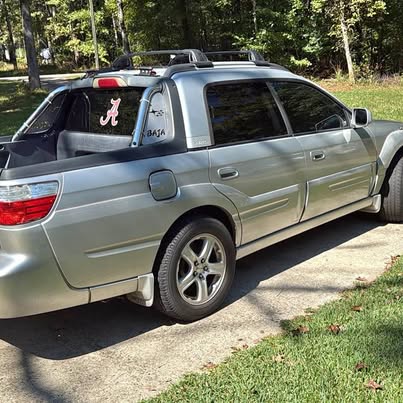
The range is simple, and that simplicity helps you. There are three names you meet — Baja, Baja Sport and Baja Turbo — across four model years, two engines and two gearboxes. There are no front-wheel-drive cars, no V6, no diesel, no regular-cab or long-bed variant. If a listing invents a variant outside those three names, the seller is describing trim, options or confusion, not a separate model.
| Model | Years | Engine | Output | Built | Character |
|---|---|---|---|---|---|
| Baja | 2003–2006 | EJ25 2.5-litre flat-four, naturally aspirated, SOHC | 165 hp, 166 lb-ft | Lafayette, Indiana, 2003–2006 model years | The original and the default buy: adequate, simple, cheapest to run, the engine with the head-gasket question to settle |
| Baja Sport | 2003–2006 | EJ25 2.5-litre flat-four, naturally aspirated, SOHC | 165 hp, 166 lb-ft | Lafayette, Indiana, 2003–2006 model years | Same mechanical car as the base Baja with sport trim differences; buy on condition, never pay a mechanical premium for the badge |
| Baja Turbo | 2004–2006 | EJ25 2.5-litre flat-four, turbocharged and intercooled | 210 hp, 235 lb-ft | Lafayette, Indiana, 2004–2006 model years | The performance Baja: genuinely quick for the type, stronger gaskets, higher running costs, the enthusiast's car |
Production totals are modest and Subaru does not publish a clean trim-by-trim build table you can lean on in a negotiation, so be suspicious of a seller quoting an exact, tiny build figure for a colour-and-gearbox combination as a reason to pay more. What is solid: the car sells in low thousands per year, the Turbo is a minority, and manual cars are a minority within a minority. Rarity is real; precise rarity theatre is not evidence.
The 2003 car launches the range, naturally aspirated only, and already well equipped — all-wheel drive, air conditioning, power windows and mirrors, cruise control, roof rails and the Switchback are the proposition, not exotic options — because Subaru pitches a lifestyle vehicle, not a stripped work truck. The Sport adds trim: different alloys, cladding and body-colour details, leather-wrapped wheel and selector on many cars, upgraded audio. Its mechanical specification is identical to the base car. It does not mean turbo, and it does not mean a transformed suspension. A tidy base car beats a tired Sport every time.
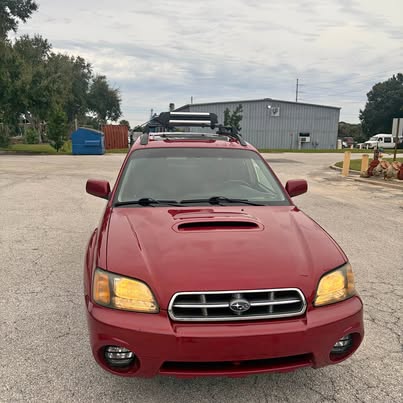
For 2004 the Turbo transforms the top of the range — the most important model-year change in the Baja's life. It brings a bonnet scoop feeding a top-mounted intercooler, much more power and, more usefully, mid-range torque, and a car that no longer feels merely adequate loaded, with four people and a hill. A leather package brings leather seats and a power driver's seat. If a claimed Turbo has no scoop, stop: the scoop is functional, because the intercooler breathes through it. A turbo engine under a flat bonnet is a conversion, a bonnet swap after damage, or a misdescription, and each requires paperwork, not reassurance.
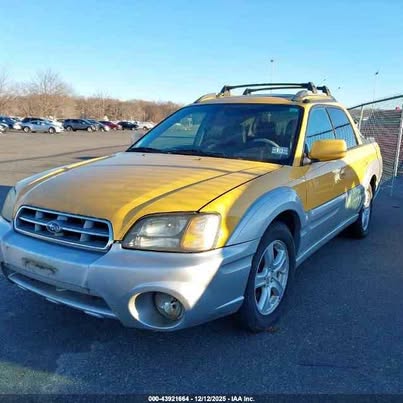
The 2005 and 2006 cars continue the same structure with detail changes, not reinvention: colours rotate — the bright yellow of so many launch images is an early-car colour, and two of the nine cars in this site's pool are yellow — and trim packaging is shuffled. There is no facelift that makes a late car a different vehicle to inspect. A well-kept 2003 beats a neglected 2006 every time; if you want the Turbo, you shop 2004 onwards by definition.
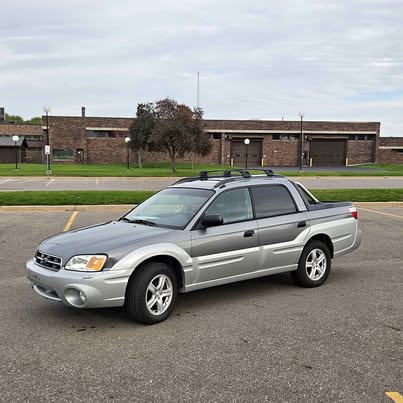
Colours and cladding deserve a practical word. The contrasting lower cladding is tough textured plastic that shrugs off stone chips, but it fades unevenly and can conceal scuffs a painted bumper would show. Yellow fades if the car lives outside, and a yellow car with one fresher panel has usually had paint. Silver cars — four of the nine in this site's current pool — hide dirt and fading best and are easiest to match after a repair, which cuts both ways: a silver car is also the easiest in which to hide a repair. Look down every flank in raking light regardless of colour.
One naming trap: listings often render the car as a "Sport Utility Pickup," and the word "Sport" in that body-style string has nothing to do with the Baja Sport trim. Settle trim from equipment and build records, not marketplace category text — the mechanical car is the same either way.
Engines and gearboxes
Two engines power every Baja, and they are brothers: both 2.5-litre horizontally opposed EJ25 fours, both belt-driven overhead-cam, both sitting low in the nose, which is why a Baja corners flatter than its ride height suggests. The differences — aspiration, gasket specification and tune — decide what you inspect and what you budget.
EJ25 naturally aspirated
The standard engine is the SOHC EJ25 in Phase II form, the EJ251 family at launch, in the same SOHC lineage as the wider Legacy and Outback range updates. It displaces 2,457 cc, with a single overhead camshaft per bank, four valves per cylinder and sequential fuel injection, producing 165 hp at 5,600 rpm and 166 lb-ft at 4,000 rpm. In a car of roughly a tonne and a half that pushes air like an Outback with a bed, that is adequate rather than brisk: you plan overtakes, you use the gearbox, and loaded or uphill, progress is steady. Owners who expect that get on with it very well.
The character is pure flat-four: a slightly offbeat idle, a purposeful thrum under load, and a willingness to rev between 2,500 and 5,000 rpm rather than be lugged. Fuel consumption is the standing disappointment — permanent all-wheel drive, an upright body and usually an automatic mean thirst in the high teens to mid-twenties miles per gallon, not economy-car figures. Budget for it.
The defining service item is the timing belt. The EJ25 is an interference engine: if the belt fails, pistons meet valves and a cheap omission becomes a rebuild. Subaru's schedule is 105,000 miles or 105 months, and on a twenty-year-old car the calendar matters as much as the mileage. You want documentary evidence and the job done properly — belt, tensioner, idlers and, as universal practice while the front of the engine is apart, the water pump — typically $900–1,500 at an independent specialist. A car with no evidence and an overdue belt must absorb that job in its price on day one, and cam and crank seals are checked at the same visit, being nearly free then and expensive later.
Other items are mundane, which is a compliment. Spark plugs sit low on the sides of the engine against the inner wings and are awkward to reach, but they are a scheduled job, typically folded into a major service for $250–450 depending on labour and whether plug leads or coil components need renewal. Most naturally aspirated cars use a coil pack with plug leads; a misfire under load in the wet is leads or coil pack far more often than anything exotic, and you diagnose it with a water spray in the dark before you buy parts. Oil consumption deserves honesty: a healthy EJ25 uses a little, a tired one more, through valve-stem seals, ring wear and leaks from cam seals, valve-cover gaskets and the rear separator plate. A quart between services on a 180,000-mile car that runs cleanly is a monitoring item; a quart every 500 miles with blue smoke on the overrun is an engine near the end of its life. The head-gasket question gets its own treatment in Problem areas — read it before you view any naturally aspirated car.
EJ25 turbo
The Turbo engine is the EJ255, a turbocharged, intercooled development of the same architecture, shared in essentials with the contemporary Forester XT and related to the WRX and Legacy GT turbo units, in a Baja tune producing 210 hp at 5,600 rpm and 235 lb-ft at 3,600 rpm. The torque is what you feel: where the NA car needs revs and planning, the Turbo pulls from the middle of the range with a flexibility that suits loaded, hilly, all-weather work. By 2004 utility standards, it is a quick car.
The hardware matters. The turbocharger is oil-fed and water-cooled and lives or dies on oil discipline. The intercooler sits atop the engine and breathes through the scoop, so the seal between scoop and intercooler matters: a perished seal lets hot bay air wash over it and costs the charge cooling the system exists to provide. Inside are lower-compression pistons and — critically — multi-layer steel head gaskets far more durable than the naturally aspirated car's originals. The Turbo is not the head-gasket car; it has its own failure modes, and you inspect for those.
Turbo checks start with oil: you want frequent changes with the correct grade, because bearing wear and sludging follow neglected oil. Listen cold for turbo whine that changes as the car warms, watch the mirrors under hard acceleration for blue smoke — oil passing turbo seals — and feel for boost that surges, hesitates or tails off, pointing to wastegate, boost-control solenoid or split hoses that perish with heat and age. The small filters in the turbo oil feed are a known specialist point: a restricted feed starves the turbo, so a replacement turbo with no explanation for the first failure is a warning, not reassurance. A replacement unit typically runs $1,200–2,200 fitted, and if the cause is not found, the new one follows the old.
The turbo engine also runs hotter and punishes cooling neglect faster: cooling condition that a naturally aspirated car tolerates for a season can overheat a Turbo on one long grade, and an overheated turbo EJ warps heads and turns a cooling job into an engine job. Treat cooling evidence on a Turbo as a first-order buying criterion, and expect premium fuel, higher consumption and less forgiving service discipline. Buy the best-documented Turbo you can find, not the cheapest.
Correct one myth plainly: the Baja Turbo is not a WRX with a bed. It shares engine family and specialist knowledge with Subaru's performance cars, but it is tuned for torque, sits in an Outback chassis, and performance-car parts are not automatically upgrades.
Gearboxes and all-wheel drive
You choose between a five-speed manual and the four-speed 4EAT automatic, and the choice interacts with the all-wheel-drive system. Both are permanent all-wheel drive and genuinely capable on suitable tyres; they distribute torque differently. Manuals use a viscous-coupling centre differential with a nominal 50:50 split — simple, mechanical, predictable on slippery surfaces. Automatics use an electronically controlled multi-plate transfer clutch, front-biased in cruising and sending more torque rearward as slip demands. Neither is "real" and the other "fake": the manual is more predictable, the automatic smoother and actively managed.
Both fail mainly through mismatched tyres. An all-wheel-drive Subaru runs tyres of equal circumference at all four corners, always. A car run for thousands of miles with one new tyre and three worn ones, or different sizes front and rear, has been winding up its centre coupling or transfer clutch on every dry mile, and the wear shows as binding, juddering or a groan on tight, slow, full-lock turns. Test every car on full lock in a car park, in both directions, and ask directly when the tyres were replaced — in fours, or in matching pairs at worst, is the only acceptable answer.
The manual gearbox is a known Subaru five-speed: a decent shift when linkage bushes are fresh, a vague throw when they are not, synchromesh that resents being rushed into second when cold even on a good car, and a clutch that lasts under sympathetic use and costs $1,100–1,900 fitted when it does not. Listen for bearing whine that rises with road speed in gear and changes on the overrun; gear oil changes are cheap insurance.
The 4EAT is a conventional torque-converter four-speed, and conventional is praise: not fast-shifting, prone to hunting on grades with a load, but durable and, in the Turbo, well matched to the torque. Its enemies are heat and old fluid — fluid that is black and smells burnt tells you the box has run hot and neglected, and a proper fluid service typically runs $250–450. Check shift quality cold and fully hot: flaring, delayed engagement of drive or reverse, or a thump into gear are all evidence. In this site's current pool every one of the nine listed cars is an automatic, mirroring the wider market: manuals are scarce, and a good manual requires patience rather than a premium paid for a bad one.
Front differential oil is integral with the automatic's arrangements on 4EAT cars and separate on manuals; rear differential oil is a small, cheap, endlessly postponed job on both. CV joints — the Baja has independent suspension at both ends — click on full lock when worn and split their boots with age; a boot caught early is a boot, caught late a joint or shaft, at $300–600 a side fitted.
Problem areas
Head gaskets and the cooling system: the EJ25 story, told precisely
Every Baja conversation reaches the head gaskets, and most of what you hear is a muddle of two different failures on two different engines, compressed into one scary sentence. Separate them, because the Baja's naturally aspirated engine suffers one of them, largely escapes the other, and the test you run differs completely depending on which failure you are hunting.
The first failure belongs to the earlier DOHC EJ25 of the late 1990s, the EJ25D. That engine leaks internally: combustion gas and coolant cross the gasket, the cooling system pressurises, coolant is pushed out, the engine overheats, and the driver sees temperature spikes, bubbles in the expansion tank and coolant loss with no puddle. It is a dramatic failure and it built the reputation. The Baja does not use that engine. If a seller warns you that a Baja will "blow its head gaskets and overheat on the test drive," they are quoting the DOHC story at the wrong car.
The Baja's naturally aspirated SOHC EJ25 suffers the second failure: an external leak. The original gasket specification — a single-layer design with a coating — degrades with age, heat cycles and coolant chemistry, and the gasket begins to weep coolant, and in some cases oil, outward from the head-to-block joint, most characteristically at the rear of the left-hand bank and the front of the right-hand bank. The leak is slow. It drips onto the exhaust and subframe, it smells sweet after a run, it crusts at the joint line, and it loses coolant so gradually that an owner who never checks the expansion tank can run the system low over months. Here is the mechanism that turns a small fault into a big bill: the external leak itself rarely stops the car. What stops the car is the neglect that follows. Run any engine low on coolant often enough and it overheats; overheat a flat-four with alloy heads and you warp a head, and then you have the internal failure as well, caused not by the gasket's design but by the overheating the ignored leak invited. The gasket is a vigilance issue that becomes an engine issue only in the hands of an owner who does not look under the bonnet.
The Turbo's EJ255 uses multi-layer steel gaskets and does not share this pattern in any comparable way. Turbo head-gasket failure exists, as on any engine that has been overheated or run with detonation under boost, but it is a consequence of abuse or cooling failure, not a scheduled expectation. Do not let a seller charge you a "they all do gaskets" discount on a Turbo, and do not let one wave away a weeping naturally aspirated car with "they all do that" either. On the NA car, they very often do — which is precisely why you price the fix into the deal.
So run the right tests. For the external leak, you need the car cold, a torch, and ideally a ramp or a mirror: inspect the head-to-block joint lines on both banks from above and below, looking for coolant crusting, dampness, clean washed patches in road grime where coolant has been rinsing the joint, and staining on the exhaust and subframe beneath. Check the expansion tank level and ask when it was last topped up and with what — plain water dilutes corrosion protection and accelerates the cycle, and Subaru coolant chemistry matters on these engines; period Subaru practice even includes a specific coolant conditioner for this issue, a detail a knowledgeable owner mentions unprompted. For the internal failure you are not expecting but must exclude, run the combustion-leak test: with the engine warm, a chemical fluid tester on the expansion tank changes colour in the presence of combustion gas in the coolant. Bubbles that rise steadily in the tank at idle, a top hose rock-hard within a minute of a cold start, white exhaust vapour that persists fully warm and smells sweet — any of these moves the car from "external weep, price the job" to "internal failure, walk or price an engine-out rebuild." The distinction is worth thousands, and it takes ten minutes to establish.
The repair, done properly, is an engine-out job — the heads sit low against the chassis rails and the quality repair removes the engine, checks the heads for flatness, and fits the updated multi-layer steel gaskets that supersede the original specification, which is why a car with documented gaskets already done to the updated specification is worth real money over an identical car on its originals. A full job at a specialist, engine out, heads checked, updated gaskets, with timing belt, water pump and seals renewed while access is free, typically runs $2,200–3,500 depending on region and machining. Done cheaply with the original gasket type, it is a job you buy twice. Ask any seller who claims the gaskets are done for the invoice, the gasket type and the mileage, and treat "done by a mate, no paperwork" as not done.
Cooling components age on their own schedule: radiators weep at the core-to-end-tank seams and block internally, at $450–800 fitted; thermostats stick; water pumps weep; small hoses perish out of sight; and the radiator cap — a pressure valve, not a lid — loses its seal and lowers the boiling point invisibly. Budget cooling renewal as a programme, not a surprise.
Rust: the map for a unibody pickup
A framed truck rusts in its frame and cab corners and you inspect it like a truck. A Baja rusts like a Legacy Outback, with a pickup bed's worth of extra seams and water traps at the back, and you inspect it like a unibody car that has lived outdoors — because there is no frame to save the structure when the shell goes, and structural rust in a unibody is the car. In the salt belt, rust — not the engine — ends most Bajas, and it is the first thing you assess and the last thing you compromise on.
Start at the rear wheel arches, the Baja's signature rust site, inherited directly from the Legacy and Outback. The arch lip is a folded, double-skinned seam that traps salt and mud against itself, and corrosion starts inside the fold and bubbles out through the paint at the lip, typically at the top and rear of the arch first. Press and tap along the lip: sound metal is crisp, filler is dull and slightly soft to a knuckle, and bubbling that has broken the paint means the fold behind it is further gone than the bubble suggests — it always is. From inside the wheel well, look at the inner arch and the seam where arch meets sill and floor; a car can present a tidy outer lip over a holed inner arch, and the inner arch is structure.
Move to the sills, the rocker panels under the doors. They are structural box sections, they carry jacking loads, and they rust from the inside out where drainage blocks and where cladding holds wet dirt against the paint. The cladding that protects the lower body also hides the early stages, so you get underneath, you check the jacking points for crushing and perforation, and you apply the sill-jack test: jack the car at the factory point and watch and listen. A sound sill takes the weight silently. A rotten one crunches, flexes or drops flakes onto the driveway, and that result settles the sills regardless of how the car looks from standing height. Budget $1,000–2,500 per side for proper sill repair with cut-out and welded new metal, and understand that sill rust rarely travels alone — it arrives with arch, floor-edge and subframe-mount rust as a package.
The rear subframe and its mounts are the other structural headline. The multi-link rear suspension hangs from a steel subframe bolted to the shell, and both the subframe and the shell metal around its mounts corrode, the subframe often worst where its design traps water and where salt sits on its upper surfaces unseen. A heavily scaled, flaking or perforated rear subframe is a major job — replacement with a sound unit, plus whatever the mounts need, typically $1,200–2,500 with labour and alignment — and perforated mounts in the shell are welding work that can end a cheap car's viability. Get the car on a ramp if the seller allows it, or at minimum on your back with a torch and a screwdriver used as a probe on suspect metal. Surface rust on a subframe is normal and treatable. Metal that flakes in sheets or probes through is not.
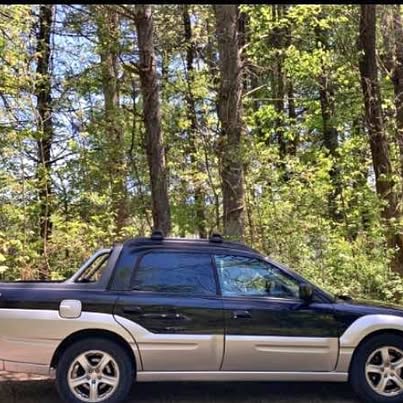
The bed adds its own map. Its floor is steel under the liner treatment, and water sits under mats and toolboxes and in the floor ribs; lift any mat and check the floor seams and front corners where water runs down from the cab joint. The tailgate rusts along its lower seam and around its handle and hinges, and a tailgate that is heavy or swollen along the bottom edge is corroding from inside. Water through tired Switchback seals runs into the rear footwells, so damp rear carpets are a bed-seal clue, not just a door-seal clue. At the front, work the standard Subaru map: front subframe and mounts, arch liners, lower radiator support, door bottoms, windscreen surround. A dry-state car — this site's pool includes Georgia and Florida cars alongside Massachusetts and Michigan cars — can be structurally years younger than a same-mileage salt-belt car, and travelling for one is often the cheapest rust repair you will ever buy.
Finally, separate cosmetic from structural rust in your pricing, because sellers blur them. Stone-chip rust, a door-skin bubble, surface scale on arms: cosmetic, negotiable in hundreds. Arches into the inner structure, sills, subframe mounts, floor edges, bed seams: structural, negotiable in thousands or a walk-away. At Baja values, heroic structural restoration of a tired car does not close, so the rule is simple: buy structure, repair mechanics, never the other way round.
The bed, the Switchback and the tailgate
The Baja's party piece is also a cluster of small, specific faults a general Subaru inspection misses, so give the back of the car its own ten minutes. Work the Switchback through its full cycle yourself. Fold the rear seats, release the panel, open the pass-through, close it, latch it, and repeat. The panel should move without force, the latches should engage positively on both sides, and the seals should be supple and complete, not cracked, shrunken or smeared with silicone — silicone on a seal is a leak that has been decorated, not repaired. A stiff or misaligned panel suggests the rear of the shell has taken a knock, the hinges are worn, or the panel has been forced. Replacement seals and trim for the Switchback are among the genuinely Baja-specific parts on the car, so condition here is worth more than condition of, say, a door card, which any Legacy gives you. Pour a jug of water over the closed Switchback and rear window area and check inside for ingress if the seller permits; if they do not permit, check the rear footwell carpets and under the rear seat base for damp, tide marks and the mould smell that gives old leaks away.
Inspect the bed as a working surface. The liner treatment should be intact; where it is worn through or cracked, the steel beneath rusts in the ribs where water stands. Check drainage: a bed that holds a pond after rain has blocked drainage or a sagging floor. Pull every tie-down hard; one that moves is rusted at its fixing. Operate the tailgate through its arc: it should lower smoothly, latch on both sides with a positive click, and sit flush; a gate that latches on one side only has worn latches, bent hinges or a twist. Look for the spare wheel, confirm the jack and tools are present, and confirm the spare is usable and correctly sized — the all-wheel-drive tyre rule applies to the spare the moment you fit it.
Then read the evidence of work. A Baja that has hauled gravel shows it in a dented bed floor, torn liner, bent tie-downs and a scarred tailgate top edge. That is no reason to walk away — the car was built to work — but it is a reason to check rear suspension sag and subframe stress, and to pay a workhorse price, not a cherished-car price.
Suspension, steering, brakes and wheel bearings
The running gear is Outback running gear, and it wears honestly. Struts and dampers are tired by 120,000–150,000 miles on cars still wearing originals; a Baja that pitches, floats or crashes over sharp edges is telling you so. Strut replacement in pairs, with the knock-prone front top mounts, typically runs $700–1,200 an axle set fitted with alignment. A light knock over broken surfaces at low speed is a drop link until proven otherwise, at $150–300 a pair — the cheapest noise on the car. Do not let a seller turn it into a rack story, or a rack story into it: a rack leaking from its gaiters or knocking with the engine off is a rack, at $800–1,400 fitted for a reconditioned unit, and steering pumps whine and weep on age across the range.
Wheel bearings are a Subaru ritual: a hum or drone that rises with road speed and changes — louder one way, quieter the other — as you load and unload the bearing by weaving gently. Tyres change note with the surface; bearings change with the load. Replacement is typically $350–600 a corner fitted. The propshaft centre bearing and joints wear at high mileage and cause vibration or a clunk on taking up drive, endlessly misdiagnosed as gearbox trouble.
Brakes are conventional discs all round, but check them as a system: discs lip and corrode, rear calipers seize on sliders and the handbrake mechanism, hoses perish, and hard lines on a salt-belt car corrode along the sills and over the rear subframe where you cannot see without a ramp. Line failure is the one rust consequence that can hurt someone, so lines are a ramp item, not a glance. A full brake refresh typically runs $800–1,500, and you should expect to spend it on almost any Baja in year one.
Interior, electrics and the small things that date a car
The cabin is Legacy of the period: durable cloth or leather, clear instruments, switches that mostly still work at twenty years. Dating wear shows in the driver's seat bolster, the leather wheel's rim on Sport and Turbo cars, and the rear seat, which tells you how often the Switchback has been cycled — scuffed seatbacks are usage history, not faults, until the mechanism will not latch.
Electrics are simple and the faults are correspondingly simple. Test windows, central locking, heated seats where fitted, and air conditioning in sequence, and price what does not work. Air conditioning that does not blow cold is most often a condenser leak — stone damage at the front — or compressor seals, and a proper diagnosis precedes any regas; a seller's "just needs a regas" is a $150 hope covering a $600–1,100 reality, so price the reality. At ignition, check the full bulb check and look for an airbag or ABS light someone has "solved" by removing the bulb. Cruise, rear wiper, heated mirrors and audio are each a small negotiation lever, and together they are how a "mint" car becomes a $1,000 list. Beyond the Switchback, sunroof drains, door membranes and rear light seals leak, showing as damp carpets and misted windows — in a Baja you check the rear footwells first, for the Switchback reason above.
How to inspect one
Inspect in this order — paperwork, structure, then the mechanical tests that price the car. Do not invert it: a Baja with a sweet engine and rotten sills is not a bargain at any price.
- Start with the paperwork, before you travel. Ask for title status, service history, and specifically the timing-belt and any head-gasket invoices, with mileages and dates. Ask what tyres the car wears and when they were fitted. Crisp answers signal a maintained car; vague ones mean you are buying the previous owner's neglect as well. On arrival, confirm the VIN — windscreen plate and driver's door label — matches the paperwork, and that a claimed Turbo carries the turbo engine under a scooped bonnet.
- Read the listing against the car. Note the trim name and the claims — "Sport," "Turbo," "gaskets done," "no rust" — and test each on the car itself, using the distinctions in The models and Problem areas. In this site's pool every listed car is an automatic, so if you want a manual, confirm the gearbox directly rather than trusting listing text. Marketplace text miscopies; the car is the primary source.
- Do the cold walk-around for structure first. The car must be cold — you cannot run the head-gasket or cold-start tests on a warmed-up car, and a seller who has pre-warmed it has removed your best evidence, so note that and reschedule if you must. Walk the rear arches, pressing the lips; look down the flanks in raking light; check panel gaps around the bed and tailgate for the symmetry that says the rear of the shell is straight.
- Get underneath: sills, subframes, floor, brake lines. Torch, mirror, and a probe for suspect metal. Apply the sill-jack test from the rust section if the seller permits jacking. Settle the rear subframe and its mounts now. This step, not the test drive, is where most Baja purchases should succeed or fail, because structural rust is the fault you cannot economically undo.
- Inspect the bed and work the Switchback through its full cycle. Lift any bed mat, check the floor ribs and front corners, pull every tie-down, lower and latch the tailgate on both sides, fold the seats, open and close the pass-through twice, and examine the seals for cracking, shrinkage and silicone. Check the rear footwells and under the rear seat base for damp. The bed specifics are in Problem areas; this is where you execute them.
- Run the head-gasket tests, cold start first. Start from cold and listen: a brief fading rattle is age; persistent knocking that never fades as it warms is wear, while the EJ's known cold piston-slap character is assessed by severity, not treated as an automatic walk-away. Watch for white exhaust vapour that persists warm. Then, warm, check the expansion tank for steady bubbling, squeeze the top hose for abnormal early pressure, and inspect both head joints for the external weep in Problem areas. If permitted, a combustion-leak fluid test settles the internal question in minutes. Classify before you drive: no leak, external weep to price, or internal failure to walk away from.
- Check every fluid as a record of care. Engine oil — level, colour, and the filler cap's underside for emulsion. Coolant — level, colour, and whether it looks like proper coolant or rusty water. Automatic transmission fluid — level per the handbook method, colour and smell. Brake and power-steering fluid too. Neglected fluids mean neglected everything.
- Test the tyres and the all-wheel-drive system the tyres protect. Confirm all four tyres match in make, size and approximate wear, and check the spare matches too. Then, on the test drive's slow-speed portion, do full-lock circles in a car park in both directions: binding, juddering or groaning is centre-coupling or transfer-clutch distress, and mismatched tyres in the car's past are the first suspect, per the gearboxes section.
- Drive it properly. Drive at least twenty minutes, to full temperature and beyond. A manual should select every gear cold and hot without baulking beyond normal cold second-gear reluctance; an automatic should engage promptly and shift without flare or thump, cold and fully hot. A Turbo should build boost cleanly, with no surge, hesitation or blue smoke in the mirrors. Weave gently to load the wheel bearings side to side, and listen over broken surfaces at low speed for the strut and drop-link noises in Problem areas.
- Brake it, steer it, and check the systems under load. Firm stops should pull straight with no judder — judder is disc condition, pulling is a caliper or hose. Steering should self-centre, run silent on full lock, and show no play with the engine off. Work the air conditioning, windows, locking, lights, wipers and heated seats, and read the bulb check at ignition for missing warning lights. Every dead system is a priced item, not a shrug.
- Re-inspect hot. After the drive, look again at the head joints, radiator seams and hoses for leaks that only show under pressure and heat, and smell for hot coolant — the sweet trace is the external gasket weep's calling card. Check for fresh drips on clean ground: oil, coolant, power-steering fluid. A car is most honest in the five minutes after a hard drive.
- Price the car as a list, then decide. Write down every fault found with its job cost from the ranges in this guide — belt service if unevidenced, gaskets if weeping, sills or subframe if corroded, bearings, brakes, air conditioning — and add them. Then apply the overriding logic of Which one to buy: structure first, evidence second, variant last. If the list turns a cheap car into an expensive one, it was never cheap. If a dearer car needs nothing on the list, it was never dear.
Values
Read the market for a Baja the way you read the car: structure first, story second, badge last. The computed market summary that appears with this guide — the cars listed now and the recorded sales — is where the live numbers live, and this section teaches you how to interpret them rather than repeating figures that date the moment they are written. What follows holds true whether the current listings sit high or low.
The condition spread is enormous, because the model divides cleanly into survivors and casualties. At one end: the dry-state, documented car — gaskets done to the updated specification, belt in date, subframe clean, bed honest. At the other: the salt-belt workhorse with bubbling arches, a weeping gasket, four mismatched tyres and a Switchback full of silicone — not the same vehicle in any economic sense, though a listings page presents both under one model name. Most price differences you see are positions on that spectrum, and an anomalous price is usually a condition difference you have not yet inspected, not a bargain or a delusion.
Asking and achieved prices part company on niche cars. A seller can ask a cherished-car figure for a tired car for months, because no flood of comparable listings corrects them; equally, a good car can sit underpriced because the local audience on any given weekend is small. Time on market is therefore weak evidence here. The evidence that matters is in the metal and the paperwork: go in with your inspection list priced, show your working, and negotiate from the cost of the jobs the car needs.
Variant premiums follow a clear logic. The Turbo carries a premium grounded in substance: quicker in a way you use every day, scarcer, and free of the standard car's gasket pattern while bringing its own smaller costs. Within that premium, documentation is the multiplier — an undocumented Turbo is discounted by exactly the buyers who pay most for good ones. The Sport badge carries little durable premium, because the mechanical car is identical to the base model. Manuals cut both ways: a smaller audience softens general prices, but committed enthusiasts firm prices for genuinely good manual cars. Never pay a rarity premium for a manual gearbox attached to a rotten shell.
The project-versus-driver gap is the other spread to understand. A non-running or structurally tired Baja is worth only a fraction of a sorted driver, and the fraction is smaller than sellers expect, because the arithmetic does not close: structural welding, a gasket job, a belt service and a brake refresh together approach or exceed the finished car's value unless you supply the labour yourself. Rarity supports good cars; it does not levitate bad ones, because the buyer pool for a bad Baja is thinner than the pool for a good one, not thicker.
Geography and completeness move value too. A clean-structure car in a salt state is worth travelling for, because every local buyer competes for the same small stock of unrotted shells. And on a car whose specific parts are finite, completeness — second key, handbook, Switchback trim intact, bed furniture present, a thick service file — is not garnish. It is a component of the car, and you price its absence as a cost you are about to incur, if the part can be found at all.
Parts and ownership
Ownership is easier than the Baja's rarity suggests, for the reason established at the start: most of the car is Legacy and Outback. Service parts — filters, plugs, belts, brake components, suspension consumables, wheel bearings, CV boots and joints — are ordinary Subaru stock, widely available, competitively priced and familiar to any independent Subaru specialist, of which North America has a healthy network precisely because the wider Subaru parc is so large. You do not need a Baja specialist. You need a Subaru specialist, and for the turbo car you need one who works on turbo Subarus routinely and understands their oil discipline.
Budget ownership as a programme. In year one, clear the deferred list almost every car carries: a timing-belt service if evidence is short of perfect, at $900–1,500 with tensioner, idlers and water pump; fluids throughout; and whatever the inspection priced in brakes, tyres or air conditioning. Thereafter a sorted car costs ordinary-Subaru money — servicing, consumables, the occasional bearing or drop link — plus age items such as a radiator at $450–800 fitted. The NA car's one big shadow is the head-gasket job at $2,200–3,500 if it has not been done; treat it as a known future cost, verify whether it has been spent, and NA economics become calm. The Turbo swaps that shadow for oil and cooling discipline, and the $1,200–2,200 turbo replacement if the worst happens.
Tyres are an ownership rule, not a preference. You replace them in fours, rotate them to keep wear even, and if you destroy one on a worn set you choose between a new set and having a single new tyre shaved to match the set's circumference, because one full-tread tyre against three worn ones taxes the centre coupling or transfer clutch on every mile. Price a set into any car wearing a mixed set — and treat the mixed set as evidence about the previous owner's understanding.
The genuinely scarce parts are the Baja-specific body and bed components: Switchback panel, seals and trim; bed liner sections and tie-downs; tailgate and hardware; rear bumper and bed-adjacent cladding; rear window and surround; Baja-specific badging and lamps. Made for a low-volume car for four years, they do not reproduce themselves in the aftermarket the way Mustang or Jeep parts do, and supply is the stock on surviving cars and in breakers' yards. A car missing Switchback trim or wearing a damaged tailgate is missing something you may hunt for months. Price the hunt into the car, and if you fall for the model long-term, buy scarce trim when you see it rather than when you need it.
Insurance and classification follow the car's identity as a wagon derivative rather than a commercial pickup in most jurisdictions, but they vary, so confirm how your insurer and state treat the Baja before you buy. Fuel is the standing cost nobody escapes: the Turbo wants premium and drinks more, and no maintenance changes the physics of permanent all-wheel drive in an upright body. Winter is where the car repays you — on proper winter tyres a Baja is genuinely sure-footed, and snow-country owners who maintain them keep them for years, which is one more reason good cars are scarce. Join the owner community, whose archive holds two decades of model-specific knowledge, keep every invoice, and maintain the file you would want to be handed. On a Baja, the file is part of the car's value.
Which one to buy
- The all-rounder: a naturally aspirated Baja or Baja Sport with the head gaskets already done to the updated multi-layer specification and documented. The default buy for most people: Outback running costs, the defining engine question answered by a previous owner's invoice. In a pool like this site's current one — nine cars, all automatic, seven from the 2003 launch year — this documented NA car, in whichever year it appears, is where your money works hardest.
- The enthusiast's buy: a Baja Turbo, 2004–2006, with oil and cooling history you can read. You pay more to buy and run it, and get the car the Baja always wanted to be — genuinely flexible, genuinely quick, free of the standard car's gasket pattern. Buy the best-documented Turbo, not the cheapest.
- The value buy: a sound-shell naturally aspirated car with an external gasket weep, priced to absorb the full, proper, engine-out gasket job. The weep is the most negotiable serious fault in the Baja market because it frightens general buyers more than Subaru specialists. If the structure is clean and the arithmetic in How to inspect one closes, you end up with a sorted car — new gaskets, belt and pump — for project money.
- The manual-gearbox buy: any variant with the five-speed, bought on condition alone. The viscous centre differential gives the most predictable slippery-surface behaviour, but manual cars are scarce enough that buyers overpay for tired ones. Patience is the whole strategy.
- The one to avoid: any Baja with structural rust in the sills, arches into the inner structure, or rear subframe mounts. No engine, colour or badge redeems a rotten unibody at Baja values, because the welding bill consumes the car's worth before the mechanical list is opened.
The overriding rule: buy the structure and the paperwork, and let the variant fall where it falls — a documented, solid-shell naturally aspirated car beats a rotten or undocumented Turbo every single time, because on a Baja the shell and the service file are the car, and everything else is a part you can buy.
See the 7 Baja cars currently listed.
What they sell for: Baja sale prices.